fbpx

September 19, 2024

Manischewitz Offers Exciting New Products to Welcome the New Year

Just in time for the High Holy days, Manischewitz® unveiled some exciting new products that go along with its recently invigorated new brand-look. 

“Manischewitz is not just about food; it’s about stories, heritage and a sense of belonging,” Shani Seidman, CMO of Kayco Kosher, the parent company of Manischewitz, told The Journal. “Through this rebrand, we aim to capture the hearts of the culturally curious and kosher-keeping alike, offering a taste of Jewish tradition that is accessible to all.” 

Manischewitz’s new product additions includes several ready-to-eat frozen items, like matzo balls, potato knishes and blintzes (cheese, blueberry and potato), as well as bakery items, such as challah, chocolate babka and chocolate rugelach. They are also introducing holiday staples, such as honey, honey cookies and apple butter. All of which feel synonymous with the Jewish new year.

“Jewish holidays are about remembering the past, and at the same time, looking forward to a better future,” Seidman said. “All of the things we do on Rosh Hashanah, dipping apples in honey for a sweet new year for example, frames our outlook.”

“Jewish holidays are about remembering the past, and at the same time, looking forward to a better future,” Seidman said. “All of the things we do on Rosh Hashanah, dipping apples in honey for a sweet new year for example, frames our outlook.” 

Seidman has strong cooking memories of her maternal grandmother making tzimmes, round raisin challah and honey cookies. 

“I still go back to my parent’s house for Rosh Hashanah and we continue this tradition,” she said. 

Seidman said she loves adding the simanim (the signs of a new year) into holiday dishes, such as pomegranate or sticky honey chicken.  

“It is a fun way to bring the flavors and themes of the holidays to the whole meal,” she said.

Micah Siva’s delicious recipe for apple butter tzimmes (shared below) is a great new take on a traditional dish.

“I love this recipe because it throws away the notion that tzimmes has to be toothache level sweet,” Siva, founder of Nosh with Micah and author of “Nosh” told the Journal. “In place of honey, apple butter sweetens the dish ever so slightly, relying on dried fruit, root vegetables and apple butter.”

She added, “It’s perfect for those looking to decrease their added sugar, even during the holiday season with a double dose of apple in this dish.”

Manischewitz’s journey began in 1888 with a simple box of matzo. Today, the company continues that tradition, while embarking on a journey to transcend the kosher aisle and reach a broader demographic that includes younger and growing families. They want to invite everyone to “Savor Our Tradition” and explore the culinary heritage of Jewish culture. 

“From our Manischewitz Family to yours, wishing everyone a happy, healthy and sweet new year,” Seidman said.

For more new recipes for Rosh Hashanah and beyond, visit kosher.com and manischewitz.com. 

Apple Butter Glazed Tzimmes

by Micah Siva

3/4 cup Manischewitz Apple Butter
1 cup vegetable stock, such as Manischewitz
Vegetable Broth
1 Tbsp Tuscanini Apple Cider Vinegar
6 dried figs, quartered
1 cup prunes
1 large sweet potato, peeled and chopped
1 medium apple, peeled and chopped
4 medium carrots, peeled and chopped
4 medium parsnips, peeled and chopped
3 Tbsp olive oil
1 tsp cinnamon
1 tsp ginger, freshly grated
1/4 tsp salt
1/4 cup chopped parsley
2 Tbsp sesame seeds

Combine the apple butter, vegetable stock, and vinegar in a bowl. Add the quartered figs and prunes. Soak for 20 minutes.

Preheat the oven to 350 degrees Fahrenheit.

In a large bowl, toss the sweet potato, apple, carrots and parsnips with olive oil, cinnamon, ginger and salt.

Add the vegetables to a 9×13″ baking dish.

Pour the apple butter mixture over top.

Cover and bake for two hours or until tender.  Top with parsley and sesame seeds.

Manischewitz Offers Exciting New Products to Welcome the New Year Read More »

A Tale of Two Challahs

When my beloved grandmother Nana Aziza passed away, my grandfather Aba Naji was 90 years old. Although he was sad and bereft, he was determined to write his memoir. Every day, he and I sat with a hot cup of cardamom and mint tea, made the same way my grandmother had always made it. He would tell me stories and I would be transported back in time, to the mighty rivers of Babylon. The stories that shape my narrative, formed in a land forever out of reach. 

My grandfather grew up in Baghdad, the handsome and charming son of a busy, respected doctor. His studies at the American University in Beirut were cut short by the start of World War II and he had to return home. Soon after the Farhud in June 1941 (a violent, Nazi-inspired pogrom), his father passed away and my grandfather became responsible for his mother Emmy Lulu, his sisters Toya and Rachelle and brother Maurice. 

The Iraqi government sent him south, to be a teacher in the village El Azair, where the Tomb of Ezra is located. There, he fell in love with and married my grandmother. Her father was extremely wealthy and they lived a life of relative ease. After the birth of their third child in September 1946, my grandparents returned to Baghdad, where he began working in civil engineering for the Iraqi army.

In May 1951, my grandparents made aliyah to Israel, with my seven-year-old mother and her four younger brothers. They lived in a Ma’abara, one of the wretched settlement villages hastily erected to house the large influx of Jews from Muslim lands in the Middle East and North Africa. 

Soon after, my grandfather was called to Tel Aviv to be debriefed on information that he had about the Iraqi army. After rejecting an offer to work in counterintelligence, my grandfather had just enough money to catch the bus home. It was a Friday morning and everyone was getting ready for Shabbat, carrying bags filled with loaves of challah, fruits and vegetables and wine. 

While 60 years had passed since that time, my grandfather was still bitter at the memory of not being able to purchase challah for his young family. 

Years passed and my grandparents moved their family to Sydney. My childhood memories are dominated by beautiful Friday night dinners at their home. A long dining room table with smiling faces, a silver kiddush cup, two glorious loaves of challah and an abundance of delicious food. 

As Sephardic Spice Girls, Rachel and I have been privileged to teach many classes and conduct many challah bakes. One of the organizations that we love working with is Yesh Tikva, which provides direct support, services and educational resources on infertility to the Jewish community, as well as raising awareness and sensitivity. Rachel and I are so honored to host one of their High Holy Day Challah Bakes (https://yeshtikva.org/challahbakes/). Sign up to join Yesh Tikva in the Valley on September 24 or be with us at OBKLA on September 25.     —Sharon 


I have an ambivalent relationship with challah. Unlike most of my Ashkenazi friends, I have zero warm and fuzzy childhood memories of the fluffy Shabbat bread. 

In fact, it was only when I was in my late 20s that I even tasted challah, here in the United States. 

Like nearly all Iranian Jews, I grew up watching my father say the “Ha’Motzi” blessing over two flatbreads, right before our family enjoyed a succulent Shabbat meal consisting of Persian stews and rice. 

In post-revolutionary Iran in the late 1980s, one of the few moments of tranquility and joy I experienced as a child was walking to the local baker and watching in mesmerized wonder as he carefully pulled a long loaf of Barbari bread from a modest clay oven. (I feared the six-foot-reach fire of that oven almost as much as I feared the Ayatollah.)

I was tasked with asking the baker to cut the long bread in half and wrapping the ends in newspapers. It always resembled the two stone tablets of the Ten Commandments because the ends were curved and the sides were straight. I was like a young Persian Moses carrying the tablets — if Moses had been tempted to bite those holy tablets because they were so fresh and fluffy!

Indeed, the smell of that freshly baked, yeast-leavened bread, sprinkled with sesame seeds, was so mouthwatering that I couldn’t help myself from taking small nibbles as I happily walked home carrying the loaves. My six-year-old logic also deduced that the giant bread would provide cover for my head in case of a sudden missile attack in the heart of the city. I should probably mention that I lived in Teheran during the long, miserable Iran-Iraq War waged by the Ayatollah Khomeini and Saddam Hussein. 

I have always taken issue with the assumption that challah is the definitive Shabbat bread for all Jewry. (Note: never, ever repeat this claim to a Yemenite grandmother!) But challah is undeniably unique and delicious. Hence, my ambivalence. 

Who can resist a warm slice of challah on a chilly, 68-degree Shabbat afternoon in Southern California?

Recently, I was ecstatic (and a little fearful) when my wonderful friends and fellow Jewish Journal columnists, Rachel and Sharon, offered to help me make challah at home. 

During the two-day holiday known as Chag Ha’Amazon, or Prime Day, I had purchased a Bosch mixer. I was curious to see how the machine would mix an entire five-pound bag of bread flour without overheating. In the end, my Bosch worked beautifully, making smooth, elastic dough!

Rachel and Sharon sent me their delectable challah recipe and I set out all the ingredients. They arrived at my house like two rays of Sephardic sunshine — cheerful and uplifting. If a trio of Moroccan, Iraqi and Iranian Jews can make a classic Ashkenazi Shabbat bread, I hope Ashkenazim worldwide will be open to making everything from easy homemade pitas to jachnun.

I have survived both the Ayatollah and Saddam, but I am now prepared to admit to you, dear reader, that making challah truly scared me. Yet watching the happy, confident ease with which Rachel and Sharon prepared the dough (and ran the Bosch mixer as if it was an extension of their hands) made me feel for the first time in my life that I could successfully make challah myself.

“I have survived both the Ayatollah and Saddam, but I am now prepared to admit to you, dear reader, that making challah truly scared me.“ – Tabby Refael

For this, I am indebted to them. Take a person fishing and they will eat for one day. Teach me to prepare fluffy challah with ease and joy and I will eat for much longer than is medically advised!

—Tabby Refael, Columnist, The Jewish Journal of Greater Los Angeles


Like Tabby, I too am an immigrant to the United States. I have very vivid memories of my first Ashkenazi Shabbat meal, when my family was invited to Rabbi Shulman’s home. 

It was the first time I tasted matzah ball soup and I immediately fell in love. But then we were served gefilte fish. I will never forget the horror that my eight-year-old self experienced when I took that first bite. I quickly dumped that mouthful into my napkin and I have never touched gefilte fish since. It was at that meal that I tasted sweet, fluffy challah for the first time. What’s not to love?

In Casablanca, my mother would bake a traditional Shabbat bread in an oval log shape. For the Jewish holidays, she always added fennel seed to her dough, which made it especially fragrant and sweet. 

In Los Angeles, she worked full time, so on Friday mornings my father would buy fresh challah from the kosher bakery on Doheny and Pico (which is now where Aish is located).

I was inspired to start baking challah when my children brought home little loaves of homemade challah from their preschool. 

Over the years, I have learned the technique and quite a few tricks. It has become a therapeutic and spiritual experience for me. Eating warm homemade challah on Shabbat is a unique moment of joy and pleasure for my family. 

I prefer to use yeast imported from Israel. I am careful that when I proof my yeast, the water is warm, not cold and not too hot. I add sugar and cover my bowl with a towel, then I set out the rest of the ingredients, including high gluten flour, which gives my loaves a lofty rise and that perfect chew factor. Only when the yeast has bloomed and is very foamy, do I start to make the dough. 

Using a mixer allows me to make a lot of dough. I bake the challahs, then freeze the extras. (If you don’t have a mixer, kneading the dough by hand is an excellent workout and super satisfying.) 

Once the dough is mixed and pulls away from the sides of the bowl, I let it sit for 5 minutes, then I turn on the mixer for another 5 minutes. I spray a large bowl with Pam and transfer the dough, then I cover it with plastic wrap and a heavy towel and let it sit for an hour. I dump the dough onto a lightly floured counter and cut it into portions, roll it into balls and leave it to sit a bit, so the dough relaxes. When braiding my challah, I oil my hands, which helps smooth the dough. For a beautiful, dark glaze, I make an egg wash by beating one egg with a tablespoon of honey to brush onto the dough. 

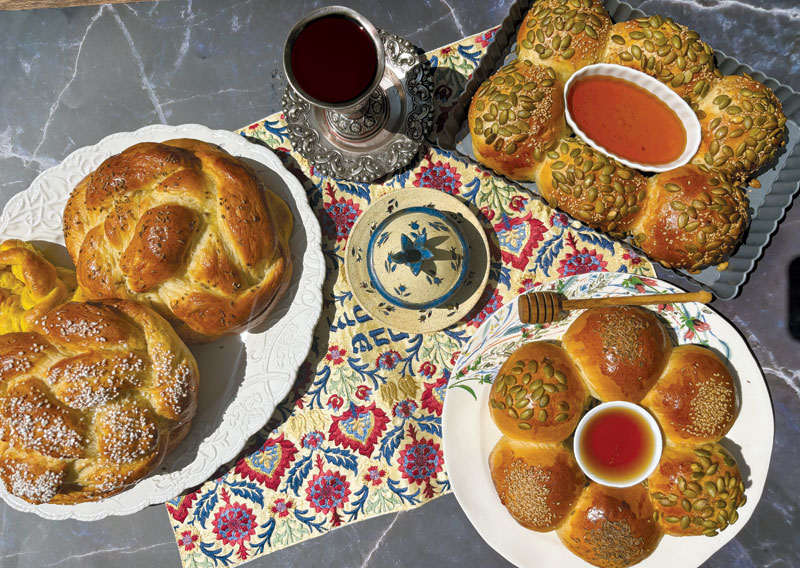
For Rosh Hashana and for Sukkot, I decorate my challah with fennel seeds, pumpkin seeds and sunflower seeds. 

May our homes always be filled with the sweet, fragrant aroma of freshly baked Challah.

—Rachel 

CHALLAH

4 Tbsp active dry yeast
4 1/2 cups warm water
2 Tbsp sugar
5 lbs high gluten bread flour
1/2 cup sugar
2 Tbsp salt
3 large eggs
1/4 cup honey
1¼ cup vegetable oil
Egg Wash
1 egg and 1 Tbsp honey, beaten

Combine yeast, warm water and sugar in a glass bowl. Cover with a towel and set aside to proof for 10 minutes.

In a large bowl, combine the flour with the sugar and salt. Add the eggs, honey and oil and mix well.

Add the proofed yeast mixture to the dough and mix until all the ingredients are well incorporated. Transfer the dough to a lightly floured surface and knead until the dough is smooth and elastic. If the dough feels too sticky to handle, gradually add a little flour.

Return dough to the large bowl, cover with plastic wrap and a towel. 

Set aside to rise in a warm spot for one hour.

Preheat the oven to 350°F.

Take Challah and recite the blessing (below)

Separate the dough into sections and braid into challah. Allow each challah to rise 15 minutes.

Brush with egg wash, sprinkle with toppings and bake for about 45-55 minutes, until challah is golden brown.

Allow challah to cool completely before storing.

Note: It is a mitzvah to make the blessing of Hafrashat Challah when baking 5 pounds of bread dough.

Transliteration: Baruch ata Adonai Elo-hainu Melech Ha’olam asher kid’shanu b’mitzvotav v’tziva’anu l’hafrish challah.

Translation: Blessed are You, L-rd our G-d, King of the Universe, who has sanctified us with His commandments and commanded us to separate challah. 

Separate a small ball of dough, approximately one ounce, and say: “This is challah.”

Burn the challah by wrapping it in a piece of silver foil and placing in the oven.


Sharon Gomperts and Rachel Emquies Sheff have been friends since high school. The Sephardic Spice Girls project has grown from their collaboration on events for the Sephardic Educational Center in Jerusalem. Follow them
on Instagram @sephardicspicegirls and on Facebook at Sephardic Spice SEC Food. Website sephardicspicegirls.com/full-recipes.


A Tale of Two Challahs Read More »

Table for Five: Ki Tavo

One verse, five voices. Edited by Nina Litvak and Salvador Litvak, the Accidental Talmudist

When you have finished tithing all the tithes of your produce in the third year, the year of the tithe, you shall give [them] to the Levite, the stranger, the orphan, and the widow, so that they can eat to satiety in your cities.

– Deut. 26:12


Kira Sirote
Author of “Haftorah Unrolled,” Ra’anana, Israel

Our verse is the commandment to give ”Maaser Ani” – tithe to the poor after a harvest. Torah doesn’t actually say ”poor,” it says: “The Levi, the foreigner, the orphan, and the widow.” This list also appears in the commandments of celebrating the harvest holidays, Shavuot and Succot: ”You shall rejoice in your holiday: You, your son, your daughter, your manservant, your maidservant, and the Levi, the foreigner, the orphan, and the widow, who are in your gates.” (Devarim 16:14) 

The Midrash says: “G-d said: you have four dependents, and I have four dependents. If you bring joy to Mine together with yours in your home, during the holidays that I gave you, then I will bring joy to yours together with Mine, in My House – ‘I will bring you all to My Holy mountain, and bring you joy in My House of Prayer.‘” (Tanchuma Re’eh 18) 

People who do not have the means to own land, or to work and harvest the land that they own, are dependent on the kindness of others. The Torah demands that we do not see it as kindness, but rather as responsibility. People who do not have the same kind of roots in the land as others might perceive themselves as less grounded, unmoored and undesirable. The Torah demands that we include them in our homes and in our celebrations. That will make us worthy of G-d’s House, Beit HaMikdash, where everyone feels included and valued, regardless of their financial and social status.


Rabbi Tova Leibovic-Douglas
@rabbi_tova, www.theritual.house 

We see this commandment of caretaking for the stranger, orphan, and widow throughout our texts. Jewish wisdom commands us to ensure that those most vulnerable in our communities are the ones to never forget. Yet, in our world of chaos that meets abundance, change that meets fear, and reaction that meets distraction, I wonder if this commandment is truly lived out by most in the way it once was prioritized. Many of us forget those who rely on us because we are not yet satisfied with ourselves. Will we ever be? The question for us to consider during this time of reflection and spiritual investigation of the Hebrew month of Elul is if we are living according to the values that are set out for us as the blueprint for our souls. Ki Tavo translates to “when you enter,” and while it may be describing the Israelites entering the land of Canaan, the phrase is an invitation for us to personally remember that while we are preparing to enter a New Year in our calendar, we have obligations that are deeply spiritually important. This verse reminds us to ask: are we prepared to enter this year? If so, let us do the work to feel satiated so that we can move towards nourishing those who need it most. It is past time.


David Brandes
Screenwriter, World Famous in Canada

My cranky old friend, screenwriter Walter Davis used to say, “The problem with the entire human enterprise is that man ain’t no good.” Walter was only confirming what God suspected all along. Recall, after the flood (Genesis 8:12) God reflected: “The imagination of the heart of man is evil from his youth.” And then there is the Sh’ma where God hones in on the problem and warns us “not to follow our hearts and eyes which we lust after.” The Rabbis took it very much to heart and ruled that we recite the Sh’ma twice a day in our prayers. 

Okay, so there are design flaws in man and no 1.1 update is available. Lest you fall into despair, God has many workarounds, namely the commandments. Tithing your earliest produce in this week’s parsha is but one example. Not to make us feel good; not because it’s the right thing to do; and certainly not because it would place us on the right side of history. It’s a corrective for our flawed nature. The Abarbanel explains“ … the purpose was to humble man’s selfish passions … and subdue natural instincts.” Or as Freud put it, civilization begins with repression. 

This is a good time of the year for us to consider our dark side. The High Holy Days are almost upon us. It’s an opportunity to ask for forgiveness for our transgressions. Have you ever wondered why Yom Kippur isn’t optional?


Nicholas Losorelli
Ziegler School of Rabbinic Studies Class of 2025/5785

Tithing is a concept that feels foreign to many of us today. We tend to see our income as ours and ours alone, believing we are the sole arbiters of how much to give. However, this parsha reminds us that not everything we harvest is actually ours — we must give some away. We have many choices, but the requirement to tithe is not a choice, it’s a divine mandate. Although we labor, we neither caused the rain to fall nor the plants to grow — those powers of nature are God’s. As such, we mustn’t fool ourselves as to who is the true owner of the labor of our hands. While human civilization gives us the privilege of manipulating nature for our benefit, it also creates economic disparity, leaving people like strangers, orphans, widows, and many others vulnerable, a pitfall of human agency and nature of which the Torah is acutely aware. 

The Torah is both aspirational and realistic, acknowledging that human free will can lead to suffering. Given this reality, tithing represents a compromise: we may build our cities, manipulate nature, and exercise our free will, but we must also care for those affected by civilization’s inequity and iniquity. They too are made in the image of God and helping them isn’t just right — it’s righteous. At the heart of Tzedakah is Tzedek — justice, and if we stand any chance at holding onto this world, we must partner with God in the mitzvah of giving away what is rightfully God’s to give.


Ilan Reiner
Architect & Author of “Israel History Maps”

Every year, landowners are required to set aside a portion of their produce for the Levites, who have no land of their own. This tithe is given annually to support the Levites in their Temple duties. However, on the third and sixth years of the Shmita (the seven-year agricultural cycle), a different type of tithe is required: The Year of the Tithe. 

In the Year of the Tithe, landowners must distribute their produce not only to the Levites but also to those without land — namely, the stranger, the orphan, and the widow. Rabbi Naftali Zvi Judah Berlin, known as the Netziv, offers an insightful interpretation. He explains that the annual tithes given to the Levites compensate them for their service in the Temple, akin to membership dues for shul. In contrast, the Year of the Tithe is a dedicated expression of honor to Hashem. 

While this practice may seem like an act of social justice — feeding the poor — the Torah reveals a deeper spiritual lesson. By ensuring that the less fortunate are not merely provided for but are satisfied, we demonstrate our commitment to divine principles. 

The commandment concludes with a confession — a formal declaration before Hashem — affirming that the commandment was fulfilled faithfully. This acknowledgment is integral to the ritual, as it positions the community to seek divine blessings for the nation and the Promised Land of Israel. The act of tithing in this manner not only addresses immediate needs but also strengthens the spiritual and communal bond between the people and Hashem.


Table for Five: Ki Tavo Read More »

Yizkor for the Victims of Oct. 7

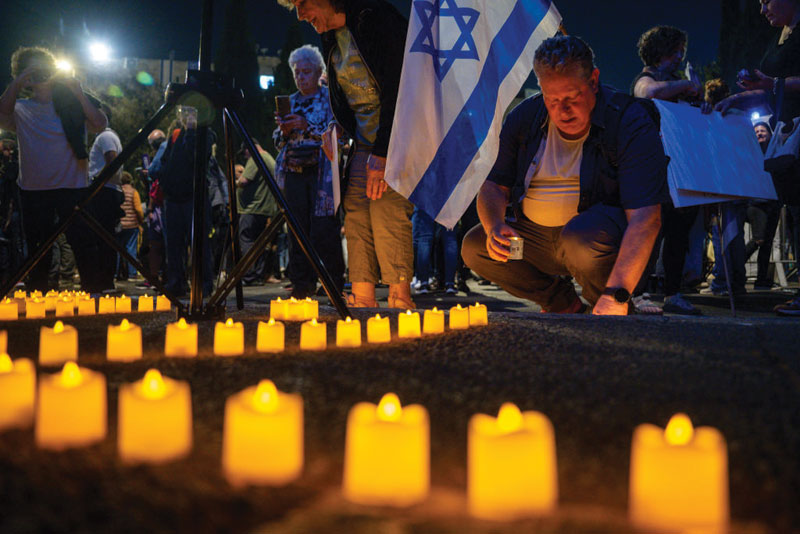
May God remember all the women, men and children of Israel who were brutally murdered on the seventh of October. We are shattered, God, our hearts are breaking on this Yom Kippur. Our minds cannot grasp the enormity of the loss. We keep thinking we will wake up from this nightmare, we wish we could make sense of the senselessness of this tragedy. We wish we could have protected every soul who was brutally slaughtered. 

We wish we could understand Your silence, God. The cries of the victims echo through the universe. God of the broken-hearted, God of the living, God of the dead, send comfort and strength to the grieving, send hope to the children, send healing to Israel.  

We pray they are at peace now, far away from the horror they endured. Their lives ended in tragedy, but that is not how we will remember them. We will remember their heroism, their love for family and for life itself, their faith in the future, their laughter, their kindness, their determination, their spirit of hope, their passion for Israel and for peace. 

Teach us, God, to believe that we can rise up from this tragedy with hope for Israel, hope for our people, hope for peace, hope for the new year that is upon us. 

Let them find peace in Your presence, God. Their lives were extinguished, but their light will forever shine upon us and illuminate our way.

Amen.


Rabbi Naomi Levy is the founder of Nashuva and author of “Einstein and the Rabbi.”

Yizkor for the Victims of Oct. 7 Read More »

Leadership and the Lord

“If the Lord Almighty came down and said, ‘Joe, get out of the race,’ I’d get out of the race. The Lord Almighty’s not coming down,” President Biden remarked after calls came for him to step aside following his dismal debate performance in June — a statement he later presumably came to regret. “God alone,” Donald Trump, in turn, reassured Americans, “prevented the unthinkable from happening,” following an assassin’s attempt on his life. Kamala Harris hasn’t yet alluded to hearkening to the heavens — but there’s still time. 

While the role of providence in these politicians’ journeys will no doubt continue to be debated by pundits, it is worth revisiting the model of Moses, whose farewell address in the book of Deuteronomy we’ve been reading in synagogue these past weeks. 

Recapping one of the legendary Israelite leader’s finest moments, in the midrashic collection known as Numbers Rabbah recounts the following conversation between Moses and God:

“He [Moses] said to him: You have taught me. He said before Him: ‘Master of the universe, from where do Israel know what they have done [in worshiping the Golden Calf]? Did they not grow in Egypt, and all of Egypt are idolaters. 

“When You gave the Torah, You did not give it to them, and they were not standing there, as it is stated: ‘The people stood at a distance’ (Exodus 20:18), and You gave it only to me, as it is stated: ‘To Moses, He said: Ascend to the Lord’ (Exodus 24:1). 

“When You gave the commandments, You did not give them to them. You did not say: ‘I am the Lord your God [eloheikhem],’ but rather: ‘I am the Lord your God [elohekha]’ (Exodus 20:2). 

“You said it to me. Did I, perhaps, sin [by making these arguments]? The Holy One blessed be He said to him: ‘As you live, you have spoken well. You have taught Me. From now on I will speak with the expression: ‘I am the Lord your God [eloheikhem].’”

In a radical reading of Moses’ argument to God to spare His misstepping people, the rabbis have the national leader use what seems to be rhetorical hairsplitting — arguing that God’s usage of the singular instead of plural in certain key contexts should legally spare Israel from certain demise. But one can glean key lessons in leadership between the grammatical nuances. 

The first is that the people emerged from a surrounding context that left them with moral murkiness. Steeped in the paganism of Egyptian idolatry, it wouldn’t be fair, Moses argues, to judge them for current mistakes. Give them time to mature as they march toward the Promised Land, and spiritual improvement will no doubt follow.

The second element of Moses’ argument is assuming responsibility for the implementation of God’s law — the Torah and the commandments. When the people violate expected norms, Moses seeks not to finger-point but to shoulder responsibility. Law flows through the leader not to provide him with personal loopholes for avoidance but as a means of modeling how society as a whole should civilly function.

When the people violate expected norms, Moses seeks not to finger-point but to shoulder responsibility. Law flows through the leader not to provide him with personal loopholes for avoidance but as a means of modeling how society as a whole should civilly function.  

Lastly, Moses expresses humble uncertainty. While he is aware of his exclusive positioning as political sovereign, he acknowledges that ultimate justice lies in the heavens whose ways are not always knowable to mankind. 

As Elana Stein Hain notes in her analysis of this midrashic passage in her book “Circumventing the Law,” “The interaction between Moses and God is not about a shrewd textual reading. It is about the newly minted relationship and religious identity of the Israelites that God wishes to encourage. And it is about the ongoing relationship between Moses and God as well as Moses and the Israelites.” 

In other words, there is a tripartite dynamic at play. The leader’s primary objective should be ensuring a positive relationship between the people and God, powered through his own personal relationship with the divine. All three parties — God, nation and political leader — in this way share in a covenantal commitment to the other.

As Americans continue to look toward the heavens for a satisfying, safe, or at the very least sane resolution to this election cycle, we would be wise to look once more to  the Moses model.

As Americans continue to look toward the heavens for a satisfying, safe, or at the very least sane resolution to this election cycle, we would be wise to look once more to the Moses model. If our eyes are set on spiritual refinement, loyalty to the law, collective responsibility and most of all humility, we may very well emerge renewed from this months-long season of malaise, with heaven’s help.


Rabbi Dr. Stuart Halpern is Senior Adviser to the Provost of Yeshiva University and Deputy Director of Y.U.’s Straus Center for Torah and Western Thought. His books include “The Promise of Liberty: A Passover Haggada,” which examines the Exodus story’s impact on the United States, “Esther in America,” “Gleanings: Reflections on Ruth” and “Proclaim Liberty Throughout the Land: The Hebrew Bible in the United States.”

Leadership and the Lord Read More »

Our Prompts Have Recently Changed

I watched a TV show about “mediums,” also called “spirit mediums,” who purportedly set up communication between the living and the dead. This medium put a man in touch with the spirit of his great-great-grandfather, Willy, who some pirates supposedly hanged. I’d rather have spoken to the pirates, but that’s me. 

The medium contacted Willy quicker than I can contact my wife, who was in the next room checking the dog for ear mites. You might think someone hanged by the neck with tongue protrusion might be challenging to understand, and need speech lessons, but not great-great-grandfather Willy. He came through crystal clear. 

These spirits never seem to be busy. They always appear to be floating around, waiting for you to call. I’ve seen a few of these shows, and the one thing humans and spirits have in common is that they both hang up on telemarketers. 

We live in an age where it’s easier to contact the great beyond than the great nearby. Growing up, if you walked into a store, you’d hear, “Get the phone; it might be a customer.” People were reachable. Now I find it nearly impossible to contact any living being unless I have a gas leak or owe them money.

These days, every place you call, you hear, “Please listen carefully because we have recently changed our prompts.” One hundred million American businesses all changed their prompts the same day. I’ve never met anyone who memorized even one prompt. I care as much about their prompt changes as they care about my underwear changes. 

Americans waste a collective 900 million hours a year on hold, or on average 42 days of their life. At 72, life is too short to spend whatever time I have left listening to American Airlines’ new prompts. 

But what’s with the prompt changing? Was anyone dissatisfied with the old prompt system? I loved the old system. It was perfect. Now you hear that Al Goldberg, who was prompt 42, is now 81, and Sylvia Swift, who was 86, is now 43. Ralph Patrick is now Mindy Swanson — like their gender changes, they change their prompts almost daily. 

Then, at the end, you get to hit the pound sign, my favorite. I love hitting the pound. I feel my job isn’t over until I hit the pound. The pound is like the judge’s gavel. The pound makes it official. Or you can hold for the operator, and when the operator finally comes on, you’re promptly de-prompted and then disconnected. 

The system I hate more than fascism is the one where you respond verbally. This thing is so sensitive to sound that if someone sneezes in Peru, it throws the whole thing out of whack. I’ve been at home trying to answer their questions verbally and have gone rabies-mad at my family making noise. “Everyone shut up…” You need to dig one of those drug cartel tunnels from Mexico to the US to get the necessary quiet.

And don’t get me started on passwords and apps. Almost all new apps on my iPhone don’t have the name of the company, just a logo. UBER still says UBER. YELP says YELP. I get it. How can I remember what company a feather in a hat is? I went to what I thought was the UCLA medical app to book a colonoscopy and instead booked myself for a flea bath at the vet’s office.

So, what do I do? It all boils down to the serenity prayer: “God grant me the serenity to accept the things I cannot change, the courage to change the things I can, and the wisdom to know the difference.” The world is changing faster than a speeding bullet, and I feel like I’m chasing it with a pogo stick. If I have a stroke one day, it won’t be from not exercising or not eating well. It will be from being put on hold.  Everywhere I call to prove it’s me, they want my birthday. Then they switch me to someone else who also wants to know my birthday. Not one of them has ever sent a gift. For God’s sake, will someone pick up the phone and simply say Hello?


Mark Schiff is a comedian, actor and writer, and hosts, along with Danny Lobell, the “We Think It’s Funny” podcast. His new book is “Why Not? Lessons on Comedy, Courage and Chutzpah.”

Our Prompts Have Recently Changed Read More »