As a 13-year-old boy, Elon Kviatkovsky, the Chef at LA Kosher Catering at Valley Beth Shalom, had two options when he returned home from school: a sandwich or a home-cooked dinner. The choice was obvious, but there was a catch—he had to prepare the dinner himself. With both parents working, the responsibility fell on him. So, after riding home from school on his bike, he sat down to do his homework. And then Kviatkovsky would roll up his sleeves and start cooking schnitzel, chicken, kebab and hummus.
When his parents returned home after a long day at work, the table was set, and dinner was served.
“My parents were always excited to come home to a nice warm dinner,” Kviatkovsky recalled. “My mom especially loved hummus and I used to make it myself, boiling garbanzo beans and mixing in oil and all the other ingredients. Luckily, I almost burned the house down only once.”
“My parents were always excited to come home to a nice warm dinner.” – Elon Kviatkovsky
Years later, after graduating high school, he was unsure of what he wanted to do and found himself selling vacuums door-to-door. His parents, knowing his passion lay elsewhere, urged him to come back home and attend culinary school. Kviatkovsky enthusiastically abandoned the vacuums and enrolled in culinary school. After graduating, he trained with renowned chefs, including Michelin-starred Chef Josiah Citrin at Mélisse in Santa Monica and Chef Bill Bracken at the Peninsula Hotel’s distinguished Belvedere restaurant in Beverly Hills.
Two years ago, he joined LA Kosher Catering at Valley Beth Shalom, where his two children, Layla, 11, and Shai, 7, study. “My wife had her bat mitzvah there, and I’ve attended countless bar and bat mitzvahs there,” he said.
For Chef Kviatkovsky, it was a great opportunity to leave his mark on the place and elevate the menu, which had remained largely unchanged since 1952.
“The company was owned by a father and son,” Kviatkovsky explained. “It was a classic Ashkenazi-Sephardic style menu. The food was delicious but old-school. The younger generation, who grew up here, wanted to see more interesting dishes and a menu that evolves.”
Over the past two years, Kviatkovsky has taken the original menu and elevated it, adding a twist to familiar dishes and making them new and exciting. There’s a variety of options, from traditional French and Persian cuisines to modern Asian or Italian fusion dishes, all handmade. The menu also includes Israeli and Moroccan salads and pita imported from Israel.
After 30 years of the same menu, the changes have been warmly welcomed by the many customers who rely on LA Kosher Catering for their celebrations.
As far as Kviatkovsky is concerned, it’s tikkun olam — repairing the world — when he sees people enjoying his food. After all, one of the basic questions people ask after every event is, “How was the food?” A lot of the success of an event relies on the quality of the food.
LA Kosher provides catering services to cities as far as San Diego and Santa Barbara, offering both kosher dairy and nondairy menus.
This month, LA Kosher Catering began offering Shabbat-to-go again — a full Shabbat dinner for families — which quickly became very popular among the parents of children at Valley Beth Shalom.
“Anyone can also order on our website, you don’t have to have children at the school,” said the chef. “Parents are coming to pick up their kids and grab Shabbat dinner. After all, the last thing you want to do after a long day at work is start cooking for everyone.”
Families also enjoy prepared meals for Rosh Hashanah and Hanukkah. “Passover is our most popular one as it saves so much time and effort,” said Kviatkovsky.
When asked what the most rewarding aspect of his work is, Kviatkovsky said, “At the end of the day, when you put two people in a room with a meal, it’s the best part of the day. What we do as restaurateurs is bring people together, create a vibe. You don’t even have to speak — just enjoy sitting together and sharing a good meal.”
Whipped Eggplant (Baba ganoush)
4 medium eggplants
2 Tbsp tahini
1 Tbsp sesame oil
2 Tbsp fresh lemon juice
1 Tbsp Kosher salt and salt to taste
4 cloves roasted garlic confit
2 Tbsp garlic oil
Garlic confit:
Peel one head of garlic.
In a small pot, put garlic and 1 cup of olive oil and 1 tablespoon of kosher salt in a baking dish and bake in the oven at 350°F for 20 minutes. Pull it out and let it cool.
In the broiler or on the BBQ, poke eggplant with holes to let out steam. Cook over a high flame to char all the skin leaving burnt skin and soft eggplant. Put in a bowl and cover with plastic to let eggplant steam 20 minutes.
After the eggplant is cooled remove the charred skin from the flesh. Rinse under cold water and put on a paper towel to dry.
Add the peeled eggplant, tahini, sesame oil, garlic confit, garlic oil, and kosher salt to taste in a blender.
Whip eggplant until smooth.
It can be eaten immediately or after two hours stored in the fridge.
Lawsuit: Santa Ana School District Hid Ethnic Studies Curriculum from Jewish Community
A new filing in a lawsuit against the Santa Ana Unified School District (SAUSD) alleged that the district purposely hid antisemitic and biased material ethnic studies courses they were developing from the Jewish community in violation of state law.
The lawsuit was initially filed in Sept. 2023 by the Anti-Defamation League (ADL), American Jewish Committee (AJC), the Louis Brandeis Center for Human Rights Under Law and the Covington & Burling law firm. According to an Aug. 26 press release, the new filing alleged that the SAUSD Ethnic Studies Steering Committee discussed about how to deal with “the Jewish question” in response to the Jewish community’s concerns about the curriculum and that committee members referred to Jews as “oppressors” who benefit from “white privilege.” Senior officials on the committee also discussed the possibility of approving ethnic studies courses during Jewish holidays when the Jewish community could not weigh in.
“Under the Brown Act (California’s open meeting laws) and AB 101 (the 2021 statute making ethnic studies a requirement for graduation from public high schools), California school boards are required to take specific steps to make members of the public aware of proposed curricula and allow for public comment,” the press release stated. “The motion and supporting evidence proves that SAUSD knowingly circumvented these laws to approve curricula with dangerously anti-Jewish teachings before the public became aware of them.”
A SAUSD official told National Review that they’re not commenting on ongoing litigation.
Anti-Israel Protesters Set Up Mock Israeli Checkpoints at Sonoma State
Anti-Israel protesters set up a mock Israeli checkpoint at Sonoma State University (SSU) on Aug. 20.
The Press Democrat reported that the protest was held at SSU’s Seawolf Plaza, protesters dressed in military garb “spoke with bravado as other protesters acting as Palestinians tried to pass through.” The Press Democrat quoted SSU Students for Justice on Palestine (SJP) member Albert Levine as saying, “We don’t want to make people uncomfortable, but we want people to be uncomfortable with the idea of what we’re paying for overseas with our tax dollars.” Madyline Jaramillo, another SSU SJP member, told The Press Democrat: “This action also helped us to gauge where admin is right now and their response, as well as the response from students. We’re here to make noise and get students on board.” Jaramillo also told the paper that the protest was “one of many” planned for the year.
“Israel Bombs, Cornell Pays” Graffiti Spray-Painted on Cornell Building
The words “Israel bombs, Cornell pays” and “Blood is on your hands” were scrawled in red spray-paint on the entrance of Cornell University’s Day Hall on Aug. 26.
Those behind the graffiti told The Cornell Daily Sun, “We had to accept that the only way to make ourselves heard is by targeting the only thing the university administration truly cares about: property. With the start of this new academic year, the Cornell administration is trying desperately to upkeep a facade of normalcy knowing that, since last semester, they have been working tirelessly to uphold Cornell’s function as a fascist, classist, imperial machine.” Day Hall, according to the Daily Sun, is the university’s “main administrative building.” Additionally, the perpetrators told the Daily Sun that “debates and peaceful protests” alone “will never be enough to achieve the change we demand.”
Vice President for University Relations Joel Malina wrote in a statement that afternoon that the university was “appalled this morning to find graffiti spraypainted overnight in several campus buildings and outdoor locations. These acts of vandalism are not just violations of University policy but are also crimes.” Malina added that university police are investigating the matter.
Settlement: Jewish Students Exempt from MIT Grad Student Union Dues
Five Jewish graduate students at the Massachusetts Institute for Technology (MIT) are now exempt from paying dues to the university’s Graduate Student Union (GSU) after the students objected to the union’s support for the Boycott, Divestment and Sanctions (BDS) movement.
The students had alleged in a lawsuit that the GSU ordered them to pay dues despite the students invoking their religious objection under Title VII of the Civil Rights Acts over the union’s support for BDS. According to Campus Reform, the GSU’s vice president “was said to have been arrested and subsequently placed on paid ‘union leave’ funded by union dues, following her involvement in an anti-Israel protest.” Under the settlement, the GSU must inform all graduate students that “that they will not restrict the ability of those who resign their union memberships to cut off dues payments for political expenses and pay a reduced amount to the union,” according to a press release from the National Right to Work Foundation, which provided free legal assistance to the Jewish students. The Jewish students will be donating the money that the union demanded to charities of their choice, including American Friends of Magen David Adom.
Fire up the grill for Labor Day! Here are some wonderful recipes to prepare for your kosher cookout.
Chef Alon Shaya believes that baba ganoush is perfect for an outdoor party. Note: Eggplant is in season from July to October.
“This charred eggplant not only captivates with its aroma but also stands out as the star of the meal,” Shaya, co-founder of Pomegranate Hospitality and author of “Shaya: An Odyssey of Food, My Journey Back to Israel,” told the Journal. “Its robust flavor and velvety texture make it an ideal dish for outdoor gatherings, where it can be savored as a savory centerpiece that complements any kosher menu.”
Baba Ganoush
2 large (1-pound) eggplants1 large clove garlic, crushed 3 tablespoons Tbsp lemon juice
3 tablespoons Tbsp raw tahini
1 tablespoon Tbsp ice water
¼ cup sour cream
½ teaspoon tsp Morton kosher salt
Prick the eggplants all over with a fork before you roast them. To cook these on a gas stovetop, you may want to line your burners with foil, if you’re worried about a mess. Lay each eggplant on its side directly on the burners of a gas stovetop, and cook over a medium flame for 25 to 30 minutes, until the bottoms halves are haggard and blistered with bits of papery white char. Just when you think they’re ready to rotate, you can probably cook that side for another 5 minutes.
Flip the eggplant, and cook until the other side is equally charred; rotate them slightly if you notice that any parts aren’t coloring. They’re ready when they’re uniformly charred and you can pierce them at the neck with no resistance, 40 to 50 minutes total. The uglier they are, the more flavor there is inside. Take them off the heat, and let cool.
Steep the garlic in the lemon juice for at least 30 minutes, then remove and discard the garlic. Whisk the lemon juice with the tahini and ice water, and don’t worry if at first it looks curdled: keep whisking and, like magic, it will become light and smooth.
Cut the tops off the eggplants, halve them lengthwise, and gently open them up. Scoop out the flesh, taking care not to bring along too much of the papery char, which is bitter. It’s not the end of the world if you have a few stowaways; they’ll just add a little extra smokiness.
Scoop all the creamy flesh into a fine-mesh sieve to drain away any excess liquid, then give it a few chops to make it spreadable. Fold it together with the prepared tahini mixture, sour cream, and salt, and serve at room temperature.
For a hearty meal, try Chef Jeffrey Kollinger’s grilled ribeye.
“This dish is perfect for cookouts,” Kollinger, owner of Spice of Life Catering, told The Journal. “Smoky ribeye and creamy potatoes with the gourmet touch of a tomato chutney will impress any guest.”
“Smoky ribeye and creamy potatoes with the gourmet touch of a tomato chutney will impress any guest.” – Jeffrey Kollinger
Grilled “Cowboy” Ribeye with Olive Oil, Smashed Fingerling Potatoes and Tomato Chutney
For the Ribeye: 2 “Cowboy-Cut” Ribeyes – at least an inch thick. Each should weigh around 22oz.
1 hour prior to cooking, remove steaks from the refrigerator, season generously with salt and pepper, cover, and allow to rest at room temperature.
Preheat your grill to medium low heat (propane is easy, charcoal will need to be pushed to one side of the grill). With a paper towel, carefully and lightly oil the grates where the steaks will go. Place the ribeyes in the medium/medium low “sweet spot” and… RESIST THE URGE TO TOUCH IT! Allow 4-5 minutes of cooking on the first side before you flip it over.Cook an additional 3-4 minutes on the second side. Cook to desired temperature using whatever method you’re comfortable with (touch, thermometer, etc.). Allow to rest for 5 minutes before enjoying!
For the Fingerling Potatoes: 8 oz fingerling potatoes, washed
2 oz shallots, peeled and cut in ¼’s
1 head garlic, cut in half (along the equator)
2 sprigs of fresh thyme
3 oz olive oil
Salt to taste
Preheat the oven to 325°F. Combine all ingredients in a mixing bowl and toss to ensure everything is evenly coated in salt and oil. Put mixture on a parchment lined sheet pan in a single layer.
Roast in a preheated oven until potatoes are cooked through and tender, around 30 minutes.
After you take it out of the oven, remove the roasted garlic from the skin and add the contents of the entire pan (including all the oil) back to the mixing bowl. Crush potatoes with a stiff wire whisk until they become creamy (as the oil emulsifies with the potato).
For the Tomato-Ginger Chutney: 2 20-oz cans diced tomatoes in juice
1 cardamom pod
1 teaspoon coriander seeds, recently toasted
1 teaspoon cumin seeds, recently toasted
1 teaspoon fennel seeds, recently toasted
1 Jalapeño, whole
2 oz fresh ginger, peeled and cut into ¼” coins (around a 2” piece)
½ cup light brown sugar, packed tightly
3 oz rice wine vinegar
Combine everything in an appropriately sized saucepan. Bring to a simmer and reduce heat to low. Cover loosely and allow to slowly cook, stirring occasionally to prevent sticking and burning, around 30 minutes. Once liquid is evaporated, remove from the heat and discard the jalapeño and ginger.
One verse, five voices. Edited by Nina Litvak and Salvador Litvak, the Accidental Talmudist
Keep and hearken to all these words that I command you, that it may benefit you and your children after you, forever, when you do what is good and proper in the eyes of the Lord, your God.
– Deut. 12:28
Rebbetzin Miriam Yerushalmi CEO SANE; Author, Reaching New Heights
The letters of the Hebrew word notzer (“keeping”) may be rearranged to form the word ratzon (“Divine Favor” or “Will”). A meritorious deed results in Hashem’s bringing reward into the world for many years, even for 1,000 generations after the original deed, because it is in keeping with the Divine Will.
During Elul, we recite the Selichot prayers, which include the verses listing Hashem’s 13 Attributes of Mercy. We are reminded that Hashem is full of compassion and the source of all mercies. Additionally, these verses encourage us to emulate these holy attributes in our own lives, thereby decreasing our negative qualities while strengthening the expression of our inner spiritual beauty. Integrating Hashem’s 13 Attributes into our hearts and minds will help us relate to ourselves and to others in our lives with compassion. We pray that we be able to respond to others whose behavior or words are hurtful in ways that help them while protecting our own well-being.
Feeling hurt, we often may feel tempted to act unkindly (may G-d protect us). But regardless of what kind of treatment we think the other person may deserve, we emulate Hashem and act kindly, graciously and even generously towards everyone. Even one moment of dignified behavior, of controlling negative reactions, of acting generously, can profoundly affect our life and the lives of our offspring for generations. As a result of our kindness, good comes into the world and lasts in this world and in the world of truth, forever.
Rabbi Jonathan Leener Prospect Heights Shul
As the verse indicates, children play a central role in the covenantal mission of the Jewish people. Jews think not in days, weeks, months, or years, but in centuries. When we view time in this expansive way, education and children become highly significant. The Talmud (Shabbat 119b) even refers to schoolchildren in messianic terms as “anointed ones.” Recognizing that the path to redemption is long, we understand the need to invest in generations of Jews to ensure we ultimately get there. In the words of my teacher, Rabbi Yitz Greenberg, “The perfect world can be reached only by an endless chain of human effort. The actions of any one person or any single generation are not enough.”
This long-term investment begins with Jewish education, where the focus is on the individual child. As King Solomon taught, “Train a child according to his way” (Proverbs 22:6). For the Torah to endure within a child, the teacher must engage the child’s entire being, not just their mind. Rabbi Kalonymus Kalman Shapira, one of the great Jewish educators, emphasized this holistic approach, stating, “We are not now seeking the mind of the student alone, but rather, we seek the entire student: the soul, spirit, and neshama of the Jewish child.” As we approach the new year and begin to set new goals and spiritual commitments, let this verse remind us to start with the children.
Rabbi Tal Sessler Temple Beth Zion
One of the chief religious challenges of our time, indeed of all time, is “How to be religious without betraying humankind?” In other words, how do we lead a religious life endowed with both fervour and authenticity on the one hand, and a humanitarian universalism of basic human decency on the other hand?
This is a formidable challenge. We live in a time in which crimes against humanity are perpetrated in the name of piety and righteousness. This is not exclusive to radical Islam. To give but one example, Prime Minister Rabin was also murdered by a religious zealot, and under the pretext of so-called religious law. In the words of Rabbi Sacks, there are those who “kill in the name of the God of life, wage war in the name of the God of peace, hate in the name of the God of love, and practice cruelty in the name of the God of compassion.” In other words, there are those who constantly violate the divine instruction to strictly do “what is good and proper” in the eyes of God.
Nachmanides cautioned us not to be villains under the pretext of Torah. The late rabbi Yehuda Amital, a Holocaust survivor and seminal Modern Orthodox figure, preached time and again that human decency is primary, and therefore also precedes the minutiae of religious law. What is at stake in this battle is not only intricate theological disputations but also, in many ways, the very fate of the human story.
Rabbi Michael Barclay Spiritual Leader of Temple Ner Simcha
The directions of this verse are clear: Do God’s commandments, specifically the ones preceding this verse, and things will go well for us and our children. And only a few verses earlier is an important Jewish law: We are forbidden from ingesting blood.
This was important for non-Jews to realize in the Middle Ages, when in 1144 in Norwich, England the Jews were accused of killing Christian children for their blood. Called the “blood libel” and defined as blaming Christian deaths on Jews, this fallacy has caused thousands of Jews to be persecuted; most educated people thought this crazy accusation disappeared centuries ago. But with the prevalent Jew-hatred since October Oct. 7, this blood libel accusation, clearly forbidden in the Torah (Deut. 12:23), has resurfaced with some of the largest social influencers: Nick Fuentes, Jake Shields, and Candace Owens to name a few. Owens recently even used this blood libel to attack the origins of the ADL, after previously also asserting that “Hollywood is controlled by a Jewish gang of thugs like the Crips.”
When we see anyone making these types of accusations, we must all stand up and stop them. The text in this week’s parsha is clear: Blood is forbidden for Jews. The extensions of the blood libel must be confronted directly and stopped. These social influencers must be exposed as the Jew-haters they are. We must correct all antisemitic falsehoods the moment they happen. Each of us has an obligation to expose Jew-hatred based in blood libels, and in so doing, may we receive the promise found in this verse: that we and our children benefit forever.
Lori Schneide Shapiro Rabbi/ Open Temple
How do you feel about blood? The living waters of the body contain within them all of the imprints of our ancestry. Chapter 12 commands not once but TWICE that “you may not partake of it; you must pour it on the ground like water.” Ibn Ezra’s commentary identifies “Keep and hearken …” to the prohibition against the drinking of the blood, moving us into an obeisance connecting Judaism to our DNA. Did the ancestors know of epigenetics? Not in so many words, but in metaphor. The actions of our ancestors are imprint on our blood; our behaviors nurture patterns that move our lives and the lives of those who will follow us into a path of intimacy with the Divine; or exile. Life is an ancestral journey, unknotting the transgressions of those who came before us. Our parsha reminds us that each and every choice — from the molecular to the magnanimous — matter, and within that meaning we deepen the infinite intimacy with the Divine. As we move into so many milestones this year marking the yamim no’raim, we must ask ourselves how we turn blood into a path to holiness. From the blood spilt from human evils to the more prevalent spilt bloodthirstily in venal pursuits; and, in doing so, may our guardianship of Judaism pulse through our every vein.
Hillel International has partnered with the Secure Community Network (SCN) to launch “Operation SecureOurCampuses” to offer a variety of resources for Jewish groups this academic year.
“As we approach the fall, we know based on intelligence work, open-source reporting and telegraphing of intent by organized protest groups that we will anticipate a challenging environment on campus,” a spokesperson for SCN told JNS, noting a focus on 50 North American universities it described as “high-risk.”
Topping the list of services the program aims to provide are “full-time analysts dedicated to monitoring campus safety/security developments and providing intelligence and information-sharing support.”
SCN developed a new training program for the initiative that would instruct Jewish students on how to respond when confronted by protesters. Other training sessions teach situational awareness and responses to life-threatening events. The group will also provide security assessments for Jewish facilities on campus. SCN says it further aims to enhance coordination across Jewish organizations and consult on developing emergency plans.
“Creating vibrant Jewish life on campus depends on having safe environments for Jewish college students, which is why we are so proud to work alongside SCN in strengthening our security support for campus Hillels worldwide,” said Adam Lehman, president and CEO of Hillel International.
“We are committed to ensuring that members of the community feel safe and supported as they pursue their education,” said Michael Masters, SCN national director and CEO.
“Operation SecureOurCampuses, coordinated with key partners across the community and public safety, is a proactive measure to address these threats and work closely with our partners to protect every center of Jewish life on campus,” he stated. “We are committed to ensuring that members of the community feel safe and supported as they pursue their education — they should be able to walk across campuses free from fear, harassment or targeted violence.”
Pollster Frank Luntz held a focus group of 23 Jewish students via Zoom on Aug. 25, from major schools all over the country including UCLA, Columbia University, Harvard University, Tulane University, Rutgers University, UC Berkeley and the University of Washington. When he asked where any of the students go when they don’t feel safe, their answers included Hillel and Chabad; one student said the Louis Brandeis Center for Human Rights Under Law because of the action they take against universities. But none of the students mentioned the university administrators, which Luntz said “is really significant.” He asked them why.
“They have not done their job to protect us,” Kayla, a student at USC, replied. “And any matter that comes up, it takes forever to hear any sort of response. And as little as, ‘Oh, we’re on it,’ or ‘We’re investigating.’ You’ll never hear from USC. So people have stopped reporting to them, and have lost hope with reporting with them.” Harvard student Ariel said that he “lost faith” in the university when his friend, an Israeli student, was physically assaulted by a residential advisor (RA) and the school did nothing about it. He “decided from that point on I would only go to Chabad.” Other students gave similar answers.
Luntz also asked the students if it was going to be worse this year; around six or seven students said yes. Alex, a student at UC Irvine, told him that at his campus, where there is “a minuscule Jewish population and a very high Middle Eastern population,” the encampment was built after the semester had “pretty much ended.” He thinks they’re “going to have a faster time getting it off the ground” when the new year begins. Michael, a Drexel University student, said “I think that the hate has become normalized. There’s people I knew last year that have been learning new things on social media that made them anti-Jewish, anti-Zionist. That really came over the summer. People changed a lot over the summer for the worst. And I think the encampments last year excused a lot of actions and I think more people are willing to do those extreme acts.”
“I think that the hate has become normalized. There’s people I knew last year that have been learning new things on social media that made them anti-Jewish, anti-Zionist. That really came over the summer. People changed a lot over the summer for the worst.”
–Michael, a Drexel University student
Only three students raised their hands when Luntz asked if they felt completely safe on campus.
The Luntz focus group highlights the unease in the Jewish community regarding the likely coming wave of antisemitism on campuses when school starts again. Jewish groups have begun releasing recommendations for universities to take action. On July 31, the Anti-Defamation League (ADL), American Jewish Committee (AJC), Conference of Presidents of Major American Jewish Organizations, Hillel International and the Jewish Federations of North America released recommendations for universities to counter antisemitism on their respective campuses. It is broken down into three parts: communicating university policies on campus protests, supporting Jewish students and ensuring campus safety. The section on supporting Jewish students is the longest item. It urges universities to prevent Jewish students from being discriminated against, condemn instances in which Jewish student organizations are targeted, denounce the Boycott, Divestment and Sanctions (BDS) movement and require students to partake in antisemitism education and training. Most importantly, it warns universities that there may be disruptions on the anniversary of the Oct. 7 massacre and schools should prepare themselves for that.
It’s not the only list put out by Jewish groups in anticipation of a likely wave of antisemitism on campuses when school starts again. StandWithUs has 10 recommended strategies for Jewish students on their campuses, including “finding or building a solid foundation of peers who care about Israel and the Jewish people like you do,” forging relationships with university administrators, journalists and elected officials and knowing your campus legal rights. Rabbi Noah Farkas, president CEO of the Jewish Federation of Greater Los Angeles, released an open letter highlighting the organization’s plan to protect Jewish students on campuses, which includes uniting the Jewish community across all Los Angeles campuses and ensuring that universities enforce their codes of conduct consistently.The Federation has also released a back-to-school guide for students and held a sold-out seminar earlier in the month for incoming first-year college students.
The Israeli-American Council (IAC) published a guide for students on how to handle antisemitism on campus, suggesting that students read through their schools’ codes of conduct and explaining how students can file a complaint to the Department of Education’s Office of Civil Rights if a “faculty member has made public remarks against Israel, Judaism, Israel’s right to exist, or Hamas as a ‘resistance’ movement, which has led students at your university to feel discomfort.” Further, the IAC’s guide encourages students to be “proactive,” hold pro-Israel and tabling events and build bridges with non-Jewish allies.
Combating campus antisemitism has long been a focus for the Jewish community, but these lists of recommendation highlight the increased concern from Jewish groups following Oct. 7. Which begs the question that Luntz asked during his focus group session: Will it be worse on the campuses this year?
Farkas is optimistic that things will be better, pointing to the preliminary injunction requiring UCLA to protect Jewish students from being excluded from campus spaces; the university withdrew its appeal against the injunction on Aug. 23. He also pointed to UC President Michael Drake’s new directive banning encampments, face masks concealing identities and the blocking of university pathways; a similar policy has been announced for the CSU system.
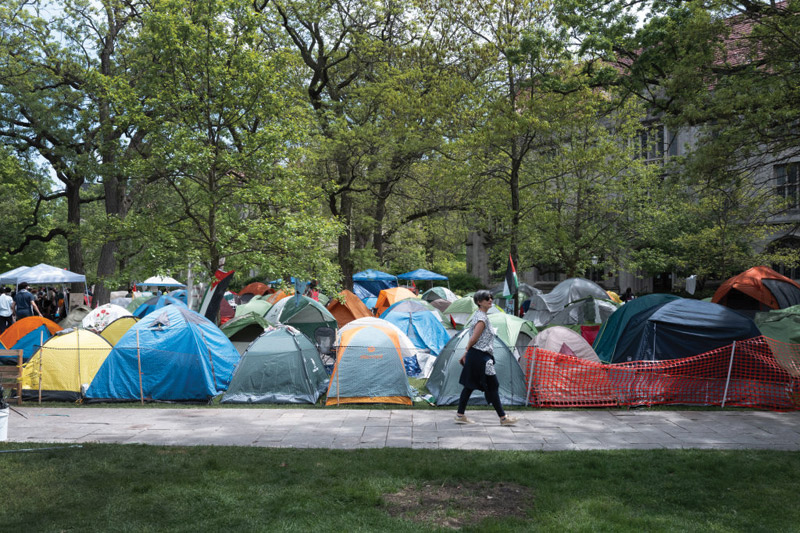
An encampment on the University of Chicago campus on May 04, 2024 (Photo by Scott Olson/Getty Images)
“The encampments, the protests, all of that, it caught the administrators by surprise, and a lot of their argumentation about what’s happening on campus is that they weren’t prepared, they didn’t know … and there’s that none of that now,” Farkas said. “No one can be naïve to think that more protests won’t happen … so they can’t claim that anymore, so they have done some planning.”
“The encampments, the protests, all of that, it caught the administrators by surprise, and a lot of their argumentation about what’s happening on campus is that they weren’t prepared, they didn’t know … and there’s that none of that now … Anyone who is a university official, they are responsible to the public and we’re not afraid of using our public voice to hold them accountable.” – Noah Farkas
UCLA Professor Kira Stein told The Journal, “We’re really pleased to see that the University of California has publicly committed to a zero-tolerance policy for encampments, masking, and blocking paths on campus.” The founder and chair of the Jewish Faculty Resilience Group (JFrg) at UCLA added, “This progress is the result of months of hard work and persistent advocacy by Jewish and non-Jewish faculty and staff of the JFrg, who have been on the front lines dealing with antisemitism at UCLA. We’ve taken risks with our reputations and careers, sacrificed countless hours away from family and friends, gathering testimonies, writing letters, and presenting our concerns to the UC Regents and even to Congress. It’s encouraging that our efforts, along with recent legal action by students, are finally paying off.”
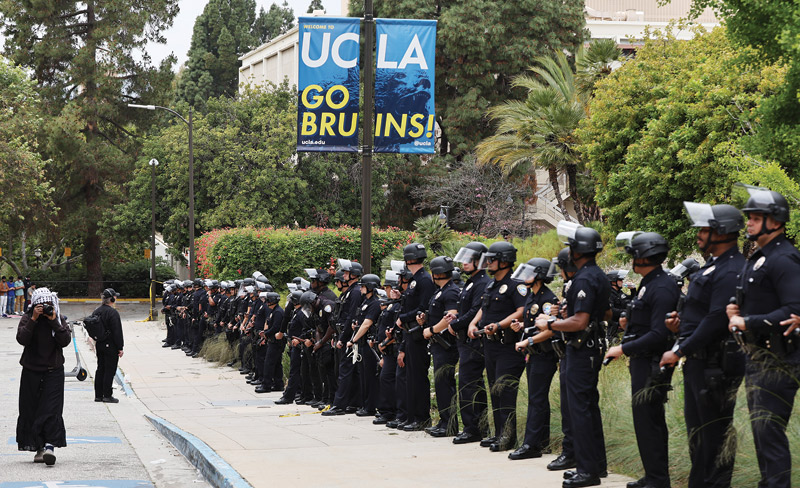
LAPD officers keep watch after police cleared a new encampment of pro-Palestinian protestors on the UCLA campus on May 23, 2024 (Photo by Mario Tama/Getty Images)
“We’re really pleased to see that the University of California has publicly committed to a zero-tolerance policy for encampments, masking, and blocking paths on campus.” – Prof. Kira Stein
Ben Stern, a rising sophomore at Rutgers University-New Brunswick and a CAMERA on Campus fellow, also thinks that the campus climate will be better. “A lot of students after Oct. 7, they really stepped up what they’re willing and able to do for pro-Israel organizations and advocacy on campus,” he said, adding that he went to the recent Israel on Campus Coalition (ICC) conference and 10 other Rutgers students were there. “It was really nice to see that there are so many people ready to be real leaders on our campus.”
“A lot of students are concerned about the conflict, particularly Israel’s operations in Gaza to uproot Hamas. They don’t understand that it’s not one side against the other. They don’t understand that it’s not Israelis vs. Palestinians; rather, it’s the survival of the Jewish state against the radical Islamist terrorist organization that seeks its destruction.
– Douglas Sandoval
Stern, who is the social media chair of his campus’s Students Supporting Israel (SSI) chapter, also pointed out that the Students for Justice in Palestine (SJP) chapter at their campus has been suspended until July 2025, “so we’re going to be facing, hopefully, a lot less organized resistance to our event organizing.”
Some universities are taking action. New York University (NYU) updated its Non-Discrimination and Anti-Harassment Policy and Procedures for Students (NDAH) to state that “for many Jewish people, Zionism is a part of their Jewish identity.Speech and conduct that would violate the NDAH if targeting Jewish or Israeli people can also violate the NDAH if directed toward Zionists.”The policy cites “excluding Zionists from an open event” and “calling for the death of Zionists” as some of the examples that would violate the NDAH. UC Berkeley, according to The College Fix, will be “expanding its antisemitism education this fall, including in its Golden Bear Orientation” as well as a more extensive look into the matter in the university’s resident assistants program.
Others aren’t so sure that things will be better. Columbia University Professor Shai Davidai posted a lengthy thread on X explaining why he believes the campus climate will be even worse this year, even with the resignation of President Minouche Shafik. He noted that none of the students involved in occupying a campus building and holding three janitors hostage will be expelled and that Students for Justice in Palestine (SJP) activists disrupted move-in day for students at Barnard College. Eden Yadegar, president of the Columbia chapter of Students Supporting Israel, noted on X that “every incident referred to the Rules Committee was absolved & the students were put back in good standing — considering multiple faculty that participated in the encampment SIT ON THE RULES COMMITTEE, there’s no surprise at the lack of accountability here. The corruption at @Columbia runs deep.”
“I’m nervous,” Shira Goodman, vice president of advocacy at the ADL, told The Journal. “We’re hearing about plans for ramped up protests. We’re seeing that there was summer school by SJP and things like that, and we definitely see an escalation in tactics. On the other hand, we’re seeing universities come out with new policies related to protests, time, place and manner restrictions, claiming that they are going to enforce their rules, so if they communicate clearly to the campus community about everybody’s responsibility to ensure access to all parts of the university … and they talk about everyone’s responsibility for creating that kind of community … it could be better.
“But we saw in the spring universities make policies, say they were going to do things, and then not enforce their policies, renege on threats of discipline, on due discipline, and so I want to be optimistic, but I’m concerned. I want to see a change but I’m not exactly sure what to expect. We’re preparing for the worst but hoping for it to be better.”
UCLA Hillel Executive Director Dan Gold told The Journal that they expect the campus climate to be “pretty similar” to what it was last year. “The activism that we’ve seen around the country has continued over the summer, and we know that the groups that were disrupting our campus will likely intend to do so in the fall,” he said.
UC San Diego student Ellia T., co-vice president of Tritons for Israel (TFI) and a CAMERA on Campus fellow, told The Journal that after the anti-Israel encampment on campus was dismantled, “a bunch of students came out of the woodworks to speak about their support of the encampment because of the way it was handled. So we saw a major uptick at the end of the year who didn’t really care before or weren’t aware and were all of a sudden supporting this antisemitic pro-Hamas movement.” She wasn’t sure how that would translate into activity this coming year.
But Douglas Sandoval, managing director for CAMERA on Campus, told The Journal that he thinks it will be “far worse” on the campuses this year. “We’re seeing so much organizing on the part of SJP and their affiliates like the Young Democratic Socialists of America,” he said. “They’re incessantly pushing the narrative that Israel is committing human rights violations, that Israel is targeting innocent civilians … this victimhood narrative, we believe, is something they’re going to carry over into the academic year. They’re going to want to organize and rally against Israel as fervent as they did this spring with the encampments, if not worse.”
Caleb Loewengart, external vice president of Students Supporting Israel (SSI) and the 2024-25 StandWithUs Emerson Fellow at the University of Colorado Boulder, told The Journal, “I think that we’re going to see more activity on campus compared to last year. I think it would be naive to assume that we’re the only students preparing events and programming for the upcoming semester. At the beginning of the summer, the University of Colorado Board of Regents passed a resolution condemning a Denver student group that organized protests outside multiple board members’ houses, sparking outrage across the CU school system. It wouldn’t surprise me if this attempt to take a stance on antisemitic rhetoric is taken as an escalation and we see their response build in the first couple months of the new year.”
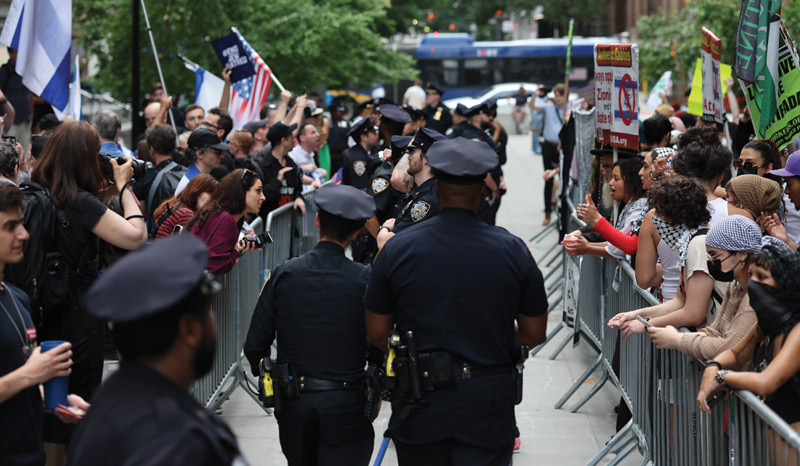
Protest across the street from campus while workers and police remove a pro-Palestinian encampment at DePaul University on May 16, 2024 (Photo by Scott Olson/Getty Images)
And the anti-Israel groups certainly have been preparing for action. The ADL noted in a June 28 blog post that National Students for Justice in Palestine (NSJP) has been holding summer school sessions, as has SUNY BDS and San Francisco State University Professor Rabab Abdulhadi. The Free Press reported that the Young Democratic Socialists of America (YDSA) are planning to hold a nationwide “Student Strike for Palestine” to “disrupt campus life.” George Mason University Professor David Bernstein posted on X that a residential advisors (RA) session at “a top 10 university at Hillel” featured six RAs donning keffiyehs. UCLA student Kian Kohanteb, co-president of Bruins for Israel Public Affairs Committee (BIPAC), told The Journal that there have been “whispers of another encampment” but they don’t know for sure. Farkas said that he had gotten word that some “anti-war protesters are starting to organize at USC at the beginning of the semester” but hasn’t heard anything more than that. The citizen journalist who goes by “@thestustustudio” on X reported on Aug. 22 that “student activists at George Washington University are already protesting on the first day of school and ushering in their ‘Year of Struggle’ and that the night before, the campus was vandalized with “Disclose Divest Now” graffiti.
“These organizations were doing classes to train students about protest tactics … about how to escalate tactics … they’re preparing to continue their disruptive activities,” the ADL’s Goodman said. “Universities and other students who kind of want to have a different experience also need to be prepared to know that it’s coming.”
She added that the one-year anniversary of Oct. 7 will likely feature “competing efforts to have protest activity and have vigils and memorials … universities need to be clear what their rules are, how they’re going to maintain distance between those events, how they’re going to keep everybody safe, and let everybody have their right to engage in activity.”
StandWithUs CEO and Co-Founder Roz Rothstein told The Journal that StandWithUs believes that anti-Israel groups “will continue to build on last year’s unlawful and discriminatory encampments. This could include attempts to reestablish encampments, calls for campus-wide referenda, often in the form of manipulative ‘push polls’ designed to elicit opposition to Israel, and even student strikes/walk-outs. Given that many university administrations opted to compromise with anti-Israel agitators during last year’s encampments instead of enforcing their own policies and state laws, the anti-Israel actors may feel incentivized to escalate their actions on those campuses. Currently, we are monitoring over 25 campuses that made such compromises, in addition to monitoring all campuses for possible illegal disruptions.”
“Given that many university administrations opted to compromise with anti-Israel agitators during last year’s encampments instead of enforcing their own policies and state laws, the anti-Israel actors may feel incentivized to escalate their actions on those campuses. Currently, we are monitoring over 25 campuses that made such compromises, in addition to monitoring all campuses for possible illegal disruptions.”-Roz Rothstein
Sandoval believes the anti-Israel groups will be utilizing “faculty to push their agenda as much as possible … They’ve realized that students are vulnerable, student groups are held to a moral standard, to stringent standards and moral codes and faculty members, particularly tenured faculty, have a lot more protection to carry out a lot of the horrendous ‘activism’ — the libels, the misinformation, spreading propaganda — these faculty members can operate in ways student groups cannot,” he said. As an example, Sandoval pointed to how even though SJP is banned at Rutgers, “all these faculty members that teach there, starting with Noura Erakat and others at Rutgers, continue to promote an anti-Israel narrative with very little in the way of — if not any — repercussions at all. I think that’s a sneak peek into what we’re going to see more in the fall, we’re going to see the rise of Faculty for Justice in Palestine … it may not be students leading the encampments, you may have a contingency of radicalized faculty that are at the core, the nucleus. It may not be students that are leading widespread protests and chaos, it may be more faculty and outside organizers than what we saw this spring. So that’s our biggest concern: the role of Faculty for Justice in Palestine in continuing the work of SJP chapters and taking the hostility toward Jews suspected of being Zionists to places we’ve never seen before.”
Stern acknowledged that the faculty at Rutgers “is pretty concerning” and recalled having a professor who assigned the class to read and comment on an essay he wrote that “gave away his political positions” and “undermined some arguments that some pro-Israel advocate might try to make.” However, Stern also had a philosophy professor, who generally kept his politics out of the classroom, “acknowledging the seriousness of the events that had occurred” on Oct. 7 and “that it’s something to be sad about.” The professor did subsequently get in trouble with clubs where he was a faculty advisor and had some difficulty defending his remarks, according to Stern. “But all I saw was, wow a professor that’s willing to stand up for … not even standing up for Israel, standing up for just some objectivity, which is a lot to ask for at Rutgers unfortunately,” Stern said. “That made me pretty optimistic … I would advise people against being too pessimistic.”
University administrators “have learned many painful lessons from last year’s encampments and their consequences.It is clear that the neglect of the encampments and of the anti-Jewish bigotry, as well as all the broken campus rules, only served to encourage the bad behavior to fester and grow,” Rothstein said. “Many administrators turned a blind eye to the violation of campus rules and blatant discriminatory behavior, hoping that it would all ‘blow over.’That did not serve campuses well, and instead encouraged more bad behavior and negative consequences for the campus community.There is also concern that some universities that did act to penalize the perpetrators are reneging on suspensions/disciplinary measures against encampment leaders and other perpetrators, which may serve to escalate the situation on those campuses.
“In spite of lessons learned and our hope that university administrators will not tolerate new beginnings of encampments and blatant discrimination against Jewish students, this hope must be balanced with the threats we hear from anti-Israel groups to ‘escalate’ the disruptions on campuses in the coming year. Our legal and campus departments have spent the summer preparing, organizing and mobilizing. If universities fail to intervene in the early stages of illegal actions by anti-Israel student groups, including by professors and/or outside agitators, we are ready to work with our students, faculty and campus partners to protect the rights of our community.”
The Jewish community is ready to take on the coming wave of antisemitism. Goodman said that after the ADL released their campus antisemitism report card in May, the Jewish group held webinars with universities on the report card as well as their campus partners like Chabad and Hillel and campus law enforcement. Further, the ADL has a “Best Practices Toolkit” page on their website highlighting best practices from universities, such as Brandeis University announcing in Nov. 2023 that they no longer recognize the SJP chapter on campus after it was determined that the chapter was not aligned with the university’s values and New York University’s (NYU) Bias Response Line that provides a response within 48 hours after a form is submitted.
Goodman believes “that every campus has the power to do this, it’s an issue of will … we’re going to keep leaning into that advocacy while also providing the resources,” adding that “the ADL will use all tools at our disposal, from direct advocacy to universities, to the Campus Report Card, to advocacy to elected officials with oversight powers, to litigation, to hold colleges and universities accountable for their responsibility to provide a safe learning environment for all students.We encourage students to continue to report incidents to ADL and other partners like Hillel, Chabad, and SCN [Secure Community Network], who are working to prioritize Jewish student safety and well-being.”
“The ADL will use all tools at our disposal, from direct advocacy to universities, to the Campus Report Card, to advocacy to elected officials with oversight powers, to litigation, to hold colleges and universities accountable for their responsibility to provide a safe learning environment for all students.“ – Shira Goodman
Rothstein said that StandWithUs “has spent the summer evaluating and adding to our strategies and resources. We have prepared hundreds of student leaders on campus with a variety of strategic approaches to begin the academic year.StandWithUs is helping students work proactively and strategically to build their base of peer communities on campus, to host events that educate students with inspiring and accurate information about Israel, and to develop relationships with other student groups, administration and local elected officials.We have prepared our student leaders to respond to antisemitism immediately, and not allow it to fester.When in doubt, we guide them to reach out to our campus managers and/or our legal team for help.In addition, we will soon be sharing resources to keep students safer physically as well.”
Alyza Lewin, president of the Louis Brandeis Center for Human Rights Under Law, told The Journal that the organization is ramping up the lawsuits against universities as well as increasing the numbers of their law students in their training programs on anti-discrimination law, the First Amendment and academic freedom so they can be “effective ambassadors” on their campus and mentor undergraduates on the matter so they “can stand up and push back.”
Alyza Lewin, president of the Louis Brandeis Center for Human Rights Under Law, told The Journal that the organization is ramping up the lawsuits against universities as well as increasing the numbers of their law students in their training programs.
Farkas, who stressed the Federation does not engage in litigation, said that the organization will be holding universities accountable through “the court of public opinion,” as the Federation’s community engagement arm “has relationships with elected officials, with UC Regents, etc. and we’ll definitely make our voices heard in that space … politicians, anyone who is a university official, they are responsible to the public and we’re not afraid of using our public voice to hold them accountable.” And if students don’t feel safe on campus, Farkas recommended that they go to their campus Hillel or Chabad; Farkas said the Federation is working to help the Hillels “have a more robust security standpoint” and is “looking into additional funding opportunities, making grants for these Hillels to be better service providers to the Jewish community.”
Davidai told The Journal that there is an initiative by the grassroots organization EndJewHatred to ban masking in protests. “In addition, we plan to counterprotest every hateful protest, to make it clear to the school that we will not be intimidated out of public spaces on campus,” Davidai said.
Gold said that an issue last year was that the campus Hillel’s planning over the summer had to be changed “on the fly” after Oct. 7 happened. Now, they’re able to better prioritize their outreach to Jewish students.
As for JFrg, Stein said that “one of the big things we’re working on is our documentation effort against anti-Zionism and anti-Jew hate on campus. We have a fantastic team of volunteers who are scouring the Internet and carefully reviewing the responses we receive to our JFrg at UCLA Antisemitism Incident Report Questionnaire (AIR). Every single incident reported to us is investigated and documented in detail. This is a crucial part of what we do, and we’re even exploring the possibility of setting up a hotline and a mobile app to make it easier for people to report incidents. With these tools, we can efficiently collect, organize, and use statistical data to respond quickly and present solid evidence when needed.
JFrg is also starting the Project Anti-Terrorism and Hate (PATH) Initiative that “is all about creating a comprehensive playbook to counter the strategies used by groups like Faculty for Justice in Palestine (FJP) and Students for Justice in Palestine (SJP),” Stein said. “The playbook will cover everything from civil rights and safety to decision trees for navigating threatening scenarios on campus. We’re thinking outside the box, exploring creative and innovative ways to advocate for our community and ensure that we remain visible, dignified, and unapologetic on campus. And we’re not stopping there. On Sunday, Sept. 15, we’re having a major event, generously co-sponsored by Stephen S. Wise Temple and with the endorsement of several community organizations: ‘Back to School Amid the Israel-Hamas War.’ This event will shine a spotlight on the challenges students and faculty are facing at Los Angeles universities right now, and we’ll explore how the broader Los Angeles Jewish community can step up and make an impact.”
The JFrg is looking to expand to other Los Angeles campuses but “we need the Los Angeles Jewish community to come together and help fund us,” Stein said. “Our faculty and staff volunteers are doing incredible work, but they have day jobs and we we’re looking to fund the development of our rapid response team, a more extensive film and interview team, a hotline and mobile app, as well as expand our weekly support groups for faculty and students who have been marginalized, boycotted, or even suspended due to their experiences with antisemitism. Once we get this formula right, we want to expand it to other Los Angeles area colleges. Already, we are inviting California faculty and staff to our support groups and other events so we can help them strengthen their groups, too. It’s all hands on deck. We need to help each other out.”
For CAMERA on Campus, one of the focuses will be educating students. “A lot of students are concerned about the conflict, particularly Israel’s operations in Gaza to uproot Hamas,” Sandoval said. “They don’t understand that it’s not one side against the other. They don’t understand that it’s not Israelis vs. Palestinians; rather, it’s the survival of the Jewish state against the radical Islamist terrorist organization that seeks its destruction. The same way that in the West Bank — or Judea and Samaria — you have radical groups including Fatah, which is considered ‘moderate,’ toeing the same radical anti-Israel line that Israel should not exist as a country. As elementary as that sounds, CAMERA on Campus is giving students a history lesson, waking them up to the reality of Israel’s precarious geopolitical situation. We’re helping them understand the ideological battle between democracy, freedom of speech, the right to live life according to your own course, vs. the opposite: autocracy, religious extremism and fundamentalism, the chilling of speech, the silencing of any dissident voices. This goes beyond Israel … we work tirelessly to give students as much information as possible so they can be effective as possible in their activism on campus.” Such examples of activism include holding rallies, bringing speakers to campus and publishing op-eds.
“The power behind doing anything effective on campus is the truth, so CAMERA on Campus believes that we have to give them access to the truth before they can be effective in addressing any of the issues they’re facing on campus,” Sandoval said.
Gold struck a note of optimism, saying “we have more students in leadership positions with Hillel, with the sub-groups of Hillel, than we’ve ever had. It just shows that students saw what happened last year and were motivated to get involved.”
Jewish students are looking to go more on offense this year and building coalitions. Kohanteb told The Journal that “a lot of last year was reactionary, the other side would do something and we would have to react to it. This year, we’re trying to be more proactive, make some events in order for the community to understand what’s happening and be prepared for what is happening.” BIPAC will also prioritize reaching “out to communities and see if we can do coalition-building.”
“I think that the majority of Israel’s supporters are focused on top-down intervention and have given up hope on changing peoples minds, when in reality the true battle is on the ground and solving antisemitism at its root is the only way to have a lasting impact,” Mikael Rochman, president of Columbia’s SSI chapter, told The Journal. “Of course we will continue to do what we can to work with the administration, but we have learned throughout Jewish history and were reminded last semester that we cannot expect those in power to protect us when mobs rise against us, as they will almost always do what is in their interest rather than what is morally correct. By not constantly narrating our own story, we allow others to hijack it and tell it for us and that is exactly what anti-Israel groups have done for years.” Rochman said that his SSI chapter’s “goal this year is to gain control over our own narrative, attacking the antisemitism at its root, build coalitions with other student groups, expose the bad actors who wish to divide Israelis and Palestinians and unite us so that we may change the status quo for the better. Without getting into too much detail those four things will be the focus of all of our activity, from events, tabling, rallies, social media, visual displays, and countering.”
Ellia T. said that TFI is planning an Oct. 7 remembrance event in a public area “so that we can show people the pain we went through on that day and demonstrate that this event that happened was extremely hurtful to us and that we are also mourning the loss of our people.” She added that TFI has been in contact with the administration to make sure security is there to protect it from disruptions.
Stern, the Rutgers University student, added that “a lot of people are doing fellowships, so people are getting ready to organize events” and students involved with groups like StandWithUs, CAMERA on Campus, Hillel and Chabad are talking amongst each other to put on “big events with a lot of numbers” to show that “there’s a strong” Jewish and pro-Israel presence on campus.
He also highlighted the importance of building coalitions on campus with non-Jewish allies, though he acknowledged that it would be “a very big uphill battle” at Rutgers “because something SJP has been doing for years is building coalitions, they have a lot of members who are members of other clubs, they have a lot of outreach and a lot of influence on a lot of other clubs at Rutgers. We are playing catch-up on that, but we’re hoping for a really good, big semester.” Additionally, Stern contended that many pro-Israel students are in their first and second years at Rutgers, “so we’re hoping that they can make new friends and build relationships with other clubs and people while, maybe optimistically, that the relationships and networks that SJP has will be graduating soon.”
UCLA student Eli Sánchez, president of Bruins for Israel (BFI), told The Journal: “In the wake of Oct. 7, UCLA’s Jewish community grew stronger and more tightly-knit, but we also found ourselves increasingly isolated from other groups on campus. This year, BFI will prioritize building bridges beyond political divides by showcasing Israel’s vibrant and diverse culture. We aim to find common ground and establish meaningful connections with other cultural groups on campus, while maintaining our commitment to providing a community space for Zionists and equipping students with the tools to report and combat antisemitism. We believe that by building these bridges, we can help ensure that the Jewish and pro-Israel community is less isolated, safer, better understood, and more integrated into the UCLA community.”
Rothstein said that they have been “witnessing unprecedented motivation and dedication from Jewish, Israeli, and Zionist students.We had more applicants for our Emerson leadership Fellowship than ever before.Students are determined to return to campus to claim their space, grow and enrich their communities, fight against anti-Jewish bigotry, and fight for their rights and the rights of others. StandWithUs will be there to support them every step of the way.”
Farkas pointed out that at both the Republican and Democratic National Conventions “Jews are highlighted as a positive force in this country … I refuse to believe that the fringe militant antisemites on the right or the left are really the story of this city and the story of these colleges and the story of America. Because it seems to be that a different story is finally starting to be told in a way we all should take heart in.”
In a little more than a month, Israel will mark the first anniversary for the Oct. 7 attack and massacre. This will be a sad, sober, day. Especially so, because many of the hostages are still in captivity. Especially so, because the war isn’t over, and there’s no end to it in sight. Especially so, because Israelis are politically and socially divided. Case in point: the first anniversary. They can’t even agree on how to mark this date. They can’t even agree to share in their grief on this date.
The date itself is a challenge. Israel is a place in which events are marked on their Hebrew date. Yitzhak Rabin was murdered on Nov. 4, and for many Israelis that’s the proper time for remembering him and the tragedy of his assassination. But the official date of remembrance is the Hebrew date of Cheshvan 12. Israel was born on May 14, but Independence Day is on Iyar 5.
The October 2023 massacre was carried out on a holiday – Simchat Torah. A country can’t turn a holiday into a day of remembrance. So, the date of the national memorial day was set to Tishrei 24, after the holidays (25, if it falls on Shabbat). And yet, it was clear to everyone involved that the public isn’t going to celebrate the holidays as usual and patiently wait for the official day – this year, Oct. 27, 20 days after the actual date most of us have in mind. The result is a decision to have two days of remembrance in the first anniversary. One on Oct. 7, the other one on Tishrei 25. That’s already somewhat awkward, as it’s not clear what the country is going to do with the second date, when the earlier one will clearly be the more dominant.
And as if this isn’t difficult enough, the government decided to manage this most sensitive event in the least considerate way possible, thus making it a cause for another social rift. The task of organizing the event was given, almost off-handedly, to one of Israel’s most controversial Likud ministers, Miri Regev. Last year, Regev oversaw the official Independence Day event and the result was miserable. More than once it became quite clear that her main concern is to have PM Netanyahu as the focus of every ceremony she’s managing. More than once it became quite clear that her other main concern is to make sure that these events will serve as opportunity to boost her – and her party’s – political interests. Surely, she isn’t the first politician to utilize national events for political purposes. But she managed to do it with little finesse and very little sophistication.
Regev decided to have a filmed ceremony for Oct. 7 with no crowd. Why? Because a crowd could be a risk.What if someone in the crowd booed the PM? What if a speaker makes a comment – live! – that she can’t control? She did not consult with the communities that were attacked on Oct. 7, did not form a committee with which to try and navigate this sensitive matter of how to remember a war that is still ongoing. In short, neither she nor the government made any effort – not even a fake effort – to form a consensus on how to mark Oct. 7.
Regev decided to have a filmed ceremony for Oct. 7 with no crowd. Why? Because a crowd could be a risk.What if someone in the crowd booed the PM? What if a speaker makes a comment – live! – that she can’t control?
I don’t know what our leaders were thinking. Maybe they weren’t thinking. Maybe they just don’t care. But the result of their action is depressing. There is something that the government will be doing. There is something else – an alternative ceremony – that was initiated by families of the Oct. 7 victims. A remembrance day of the coalition – and a remembrance day of all those who do not agree with the way the coalition handles this matter. Some might consider it a left eye tear and a right eye tear. There are many such people, including some who don’t usually join divisive initiatives, and don’t usually oppose what the government does.
When it became clear that some Israeli communities, including most of the kibbutzim that were attacked near Gaza, refuse to cooperate with the government’s production, Minister Regev made things worse by holding a press conference. When Regev holds a press conference, no matter the topic, one can be certain that things will get worse. And indeed, she spoke derogatively about her opponents, and called the opposition “just noise.”
The response was quick and decisive. A highly popular commentator and activist announced that he will be the facilitator of the alternative event. Another popular actor and model joined him. The Israeli musician – and war hero – Idan Amedi criticized Regev. This isn’t “noise,” he wrote, “these are our brothers and sisters.” The next day the President offered his services: Let’s have a small ceremony at the President’s House, he wrote. Amedi pushed Regev to accept the offer. “We need compromise,” he wrote.
Regev rejected the offer. One hopes that this wasn’t her last word. The President handed the government a ladder. It should grab it and – as Amedi wrote – let us “cry together” as brothers and sisters.
Something I wrote in Hebrew
Here’s a paragraph I wrote about the Pew report on global immigration:
Three million Jewish immigrants live in the world today. About a fifth of us. It is the result of tragedies and successes. On the one hand, Jews were forced to leave, flee, escape, from places where it was impossible, or very difficult, to live. On the other hand, Jews were welcomed in many places, primarily the young and developing Israel, but also in other countries in the West. Of the 10 routes that Jews took from their birthplace to their current destination, where they live today, eight lead to Israel: from Ukraine, Morocco, Russia, Romania, USA, Ethiopia, Iraq, Poland. Two of the 10 main routes lead to the USA – from Israel and Russia. But look at the difference: 50,000 Jews born in Russia live in the US. One-hundred-fifty thousand in Israel.
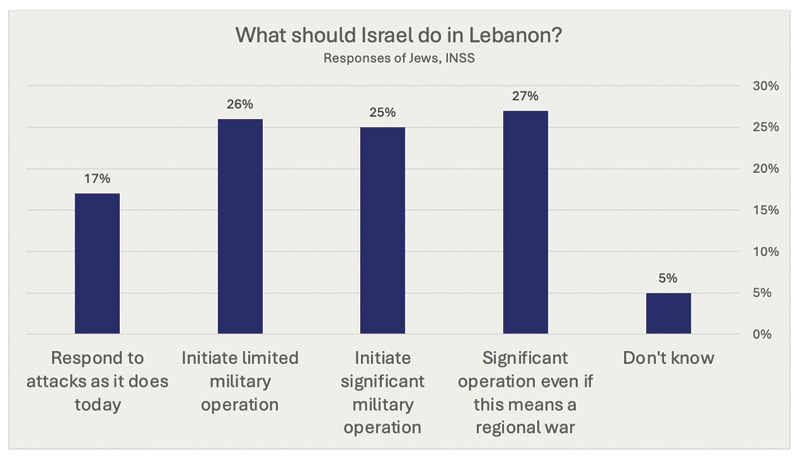
A week’s numbers
Israelis gradually come to realize that their only choice in southern Lebanon is a war with Hezbollah. Support for such war rises with time.
A reader’s response:
Judy Levitan asks: Are Israelis worried about a Kamala Harris administration? Answer: Some worry, some aren’t. Their list of worries is long, and Harris does not top it.
Shmuel Rosner is senior political editor. For more analysis of Israeli and international politics, visit Rosner’s Domain at jewishjournal.com/rosnersdomain.
Western media hostility toward Israel is hardly a virgin conversation within American Jewish circles. Coverage of the ongoing fighting between Israel and the Iranian regime’s patrons, Hamas, Hezbollah, and Houthi group Allah Ansar, as in previous conflicts, features rampant bias.
In an appearance on MSNBC two days after Oct. 7, Anti-Defamation League CEO Jonathan Greenblatt accused mainstream media of being complicit in a world that allowed the “dehumanization of Israelis and sanitized the terrorism of Hamas.”
In an appearance on MSNBC two days after Oct. 7, Anti-Defamation League CEO Jonathan Greenblatt accused mainstream media of being complicit in a world that allowed the “dehumanization of Israelis and sanitized the terrorism of Hamas.”
This pro-Hamas sentiment and willingness to uncritically accept whatever narrative the “Gaza Health Ministry” passes along is obvious to even casual readers. When citing Palestinian casualty figures, outlets like the Associated Press accept Palestinian casualty numbers from the “ministry,” which editors know very well means Hamas. In stark contrast, when sources from the Israel Defense Forces provide figures of enemy casualties, disclaimers that no evidence accompanied the data are often added.
This pro-Hamas sentiment and willingness to uncritically accept whatever narrative the “Gaza Health Ministry” passes along is obvious to even casual readers.
Earlier this month, Commentary magazine editor John Podhoretz fired back at headlines from numerous publications that blindly regurgitated claims from the Hamas officials accusing the Israeli military of targeting a school, killing 93 civilians. He noted on X that “the school hit in Gaza is a) not in session; b) was hit at 5 am; c) there is no schooling in Gaza; d) was a Hamas command center.” Podhoretz called the dispatches a “blood libel.”
Stateside, Jews have endured hundreds of Charlottesvilles on American city streets and university campuses since the Hamas attack, where leftist and Islamist demonstrators call for “global intifada,” “from the river to the sea,” and other genocidal terms. In numerous instances, they have physically assaulted Jews. Unlike with the neo-Nazi march of seven years ago, coverage of pro-Hamas protests has never been 24/7, not even when a Jewish senior citizen at arally in Thousand Oaks, California was assaulted and killed. When covering the protests at Columbia, UCLA, and other campuses, mainstream media regularly engages in both sides-ism.
With mainstream media insufficiently interested, it’s no wonder President Joe Biden, speaking last week at the Democratic National Convention in Chicago, sought to appease the progressive flank of the party, declaring: “The protesters outside have a good point.” Meanwhile, Attorney General Merrick Garland held off for nearly eight months before convening a press conference to condemn the antisemitic violence and his Department of Justice has been mum since.
The Democrats’ presidential candidate, Vice President Kamala Harris, took even longer to issue a single statement of condemnation of the protests — and that didn’t materialize until a protest two blocks from the Capitol during Prime Minister Benjamin Netanyahu’s speech to Congress last month involved assaults on police officers and federal property desecration.
The Jewish organizational world exacerbates the problem by showing insufficient concern. Because the community has historically supported Democrats in presidential elections going back a century, there is less of an incentive to cast a critical eye on how the media ignores or distorts domestic issues not directly related to Israel, since the resulting narrative is generally in line with their political views. This is confusing, at best, since for nearly a decade many of these voters have expressed grave concerns about the impact the proliferation of “misinformation” has had on the American polity.
Perhaps the most vivid example of mainstream media malfeasance this year has been the ridiculing and suppressing of details of Biden’s cognitive decline. “‘Cheapfake’ Biden videos enrapture right-wing media, but deeply mislead,” declared one Washington Post “analysis.” Co-author and in-house “fact checker” Glenn Kessler called the video clips “especially pernicious” and gave them “Four Pinocchios,” its harshest rating. When this brazen blocking effort collapsed and Biden eventually agreed to step aside for Harris, the handwaving away of the acuity issue immediately resumed. No questions have been posed as to why Biden, no longer fit to campaign, is still entrusted with the nuclear football until January.
If a young neighbor we paid to mow our lawn repeatedly failed to show up, would we then rely on that same individual to feed our cats while we were out of town for two weeks? It’s way past time Greenblatt and the rest of the community digested that the rotten apple, which is the mainstream media’s Israel and antisemitism coverage, has spoiled the entire barrel and invest in more reliable alternatives.
Jason Epstein is president of Southfive Strategies LLC, an international public affairs consultancy (@Southfive).
Last month my nephew sent me a meme. Two guys are casually talking, each with a beer in his hand. One guy says, “My party’s antisemites are tolerable – not at all like yours.”
Both funny and disturbing at the same time, this meme captures the bilateral, political weaponization of antisemitism. True to form, in his convention speech President Biden called out antisemitism on the right, failing to acknowledge the surging antisemitism on the left.
In recent years a radical wing of the Democratic Party has shown increasing tolerance for antisemitism, along with growing hostility toward Israel. While most Democrats, when asked, will condemn antisemitism and say they support Israel, they often fail to make the distinction between Israel and its terrorist enemies.
One Democrat who never makes that mistake is New York Rep. Ritchie Torres who said, “I feel no need to be balanced between Israel and Hamas. One is a democratic ally of the U.S. The other is a genocidal terrorist organization.”
One Democrat who never makes that mistake is New York Rep. Ritchie Torres who said, “I feel no need to be balanced between Israel and Hamas. One is a democratic ally of the U.S. The other is a genocidal terrorist organization.”
Another is Senator John Fetterman (D-Pa.) who said, “I would be the last man standing to be absolutely there on the Israeli side with no conditions.”
How many other Democrats have spoken so unambiguously about their support for Israel?
Indeed, it takes passion and conviction to counter antisemitism. During the congressional hearings, it was Elise Stefanik’s (R-N.Y.) outrage that led to the resignation of the presidents of Harvard and UPenn.
Yet Jewish people are too easily satisfied with the tepid, hollow support we often hear from some Democrats. We need to raise the bar regarding our expectations. Simply condemning antisemitism is not enough.
We need to raise the bar regarding our expectations. Simply condemning antisemitism is not enough.
When Jewish students must decide whether to attend the most prestigious universities, or somewhere they will be safer, simply condemning antisemitism is not enough.
When synagogues and Holocaust museums are attacked by people shouting “Free Palestine,” simply condemning antisemitism is not enough.
When protesters call for the genocide of Jews, simply condemning antisemitism is not enough.
Also not enough is President Biden’s support for Israel. His alliance that initially seemed steadfast has since wavered. With every criticism of Israel and threat to withhold weapons, Hamas is emboldened, less likely to release hostages and reach a ceasefire agreement.
Harris has said that she won’t be silent when it comes to the suffering in Gaza. Her remarks often begin with, “Israel has a right to defend itself,” and end with ways that will make it more difficult for Israel to do so.
Netanyahu’s July visit to Congress revealed the anti-Israel sentiment that permeates some members of the Democratic Party. About half of Senate and House Democrats boycotted his speech. Revealing her disdain for the prime minister, Kamala Harris was also a no-show. Her refusal to have a public press conference with Netanyahu, and her steely demeanor toward him, was not encouraging.
Had she and the absent 125 Democrats attended, they would have seen four Israeli soldiers, black and white, Jewish and Muslim, a microcosm representing the diversity that is Israel. One soldier ran eight miles, not away from terror, but toward it, to save his fellow Israelis. Other soldiers, undaunted by their lost limbs and partial eyesight, went back to fight again. Their bravery in the face of danger is an inspiration. In contrast to the evil that is Hamas, these heroes represent the best of humanity, filling us with awe and hope.
In Gaza there is a fine line between Hamas terrorists and the rest of the population. There is no fine line, however, between the valiant soldiers in Congress that day in July, and the protesters outside Congress. While the soldiers selflessly serve their country, the protesters, mired in ignorance and self-righteousness, act like petulant children throwing a temper tantrum. With no thought about the impact, they block roads and highways. They accomplish nothing and are nothing but useful idiots to terrorists and tyrants.
In 1985, before President Reagan planned to lay a wreath at a cemetery where SS soldiers were buried, Elie Wiesel told Reagan, “That place, Mr. President, is not your place. Your place is with the victims.”
To Vice President Harris and all the sanctimonious Democrats who boycotted the speech, I would say, “Your place is not with the protesters who burn American flags and support Hamas. Your place is with our ally Israel, one of the strongest democracies in the world, a country that provides the U.S. with invaluable intelligence that keeps us safe. Your place is in that chamber where we paid tribute to heroes who made us pause and think about what good over evil really means.”
A country the size of New Jersey under attack on seven fronts, a country that suffered such horrendous brutality, a country that still has so many held hostage, a country that continually has rockets raining down on it, a country that has gotten smaller in the north as Hezbollah has made it inhabitable, does not need more piling on.
If she won’t be silent, then let’s see Harris speak resoundingly about the Oct. 7 massacre. Let her speak with fury over the pictures Hamas released of bloody, beaten women and teenage girls tied up and still held hostage. Let her show anger for the 12 Israeli children killed while playing soccer. There is so much that she should not be silent about, but her speech conveys passion primarily for the people of Gaza, a large percentage of whom are terrorists or terrorist supporters.
If Harris won’t be silent, then we should not be silent either. It is incumbent on all of us to call or email our representatives, senators, Biden and Harris, telling them they should consistently support Israel and speak out against antisemitism with conviction and frequency. Call again and again. Let’s stop the Democrats from taking the Jewish vote for granted. The pro-Hamas camp has been able to sway the Democrats. It is time for us to sway them back in the other direction.
It has been said that fighting antisemitism is like draining the ocean with an eye dropper.
While it sounds like an impossible task, we should remember a famous line from Pirkei Avot. “You are not obligated to complete the mission of repairing the world, but neither are you free to abandon it.”
This line is often quoted by a governor from a must-win state whom the Democrats surprisingly, or maybe not surprisingly, did not select for vice presidential candidate: a man named Josh Shapiro.
May we always be mindful of this quote calling us to action. Let us seek ways to repair the world, and at this time, let us embark on a mission to reinforce the Democratic Party’s support for Israel.
Marjorie Davis lives in Providence, R.I. She graduated from Brandeis University with a degree in Computer Science, and is a Senior Database Specialist in a large, international technology company. She is a frequent writer on antisemitism and Israel.
Most Jews in L.A., Miami and Tel Aviv likely haven’t heard of the Egyptian island the ancients called Yeb. Also referred to as Elephantine, it now constitutes part of modern-day Egypt’s city of Aswan. Yet as a new book shows, the dynamic between Jews who inhabited the island over two millennia ago and their coreligionists in Judea bears more than a passing resemblance to today’s Israel-Diaspora relationship.
As one can’t help but notice in reading the brilliant scholar Malka Simkovich’s “Letters from Home: The Creation of Diaspora in Jewish Antiquity,” the political and religious entanglements, communal aspirations, and spiritual longings possessed by individuals who resided in the Holy Land and those who didn’t — and the interplay between the two populations — seems to have hardly changed in thousands of years.
Consider her description of the questions faced by those Jews who fled to Egypt after facing persecution elsewhere and who, through hard work and opportunity, found themselves financially more successful and even physically safer than their cousins in the Holy Land. Just swap out Pharaoh’s fiefdom for Pico-Robertson.
“These [Egyptian] Jews were enthusiastically involved in building successful Jewish communities outside Judea. But they were also loyal to their homeland and to the Jerusalem Temple … outsiders to these communities might have wondered whether these Jews were more pious than Jews who lived in Judea, where bitter in-fighting was taking place.”
Like so many of today’s Diaspora Jews, those of the last 400 years before the start of the Common Era felt in foreign lands not like exiles but as individuals who had found opportunity in their environment, even if it was spiritually less-than-ideal.
Like so many of today’s Diaspora Jews, those of the last 400 years before the start of the Common Era felt in foreign lands not like exiles but as individuals who had found opportunity in their environment, even if it was spiritually less-than-ideal.
As Simkovich’s study argues, Yeb’s religiously committed Jews asked themselves questions that you might find debated in today’s Jerusalem Post and Jewish Journal:
“Did the presence of Jews outside the land of Israel mean that Jews were still living in a state of exile and that a restoration awaited them in the distant future, even though Jews in Judea had already established political independence? How was the astonishing success of Jews outside the land of Israel meant to be understood? Was God going to put an end to Jewish life outside the land, as the prophets long ago promised? And if God was planning to allow these communities [in the Diaspora] to thrive, what did Jewish life outside the land of Israel mean?”
Unsurprisingly, as “Letters from Home” demonstrates, there was disagreement over the answers. After all, the Bible itself, in books like the Scroll of Esther, seemed to portray Jews outside of Israel as politically savvy and socially successful, albeit subject to the whims of their non-Jewish overlords.
As Simkovich notes, some Judeans insisted their faraway friends and family members were, by dint of declining to return home, spiritually deficient sinners. Insertions to the Scroll of Esther were composed by a few such Judeans during the Second Temple period. These additions to the canonical text aimed at a means of offering religious rebuke to those who sought, in the governments of gentiles, the means of salvation. Jerusalem’s cobblestones were not to be neglected for the gilded streets of Shushan.
Other texts from that period, like the Third Book of Maccabees, insisted, as Simkovich writes, “that all Jews, wherever they live, share a common destiny” and are “fundamentally connected to one another.” “Ben Sira,” a non-biblical book produced during the Second Temple period and known to the rabbis of the Talmud, also did not perceive Jewish life outside of Israel to be “a problem that requires a resolution.”
Breaking with Deuteronomy’s depressing prophetic description of sin followed by oppression and expulsion from our national homeland, the authors of these ancient texts, like so many Jews today, declined to see their lives as “fulfillments of biblical predictions concerning the Israelites’ displacement.” Like Jewish-Americans who would decry accusations of “dual loyalty,” these ancient ancestors did not perceive fealty to their homeland and host country as in tension. Nor did they perceive two halves of the global Jewish population, but rather a cohesive whole, albeit one spread out geographically.
Like Jewish-Americans who would decry accusations of “dual loyalty,” these ancient ancestors did not perceive fealty to their homeland and host country as in tension.
The dynamic of the Diaspora will, undoubtedly, continue to be debated until the Messiah comes. Until then, participants in this crucial conversation can gain much historical insight into its complexities from Simkovich’s learned and engaging “Letters from Home.”
Rabbi Dr. Stuart Halpern is Senior Adviser to the Provost of Yeshiva University and Deputy Director of Y.U.’s Straus Center for Torah and Western Thought. His books include “The Promise of Liberty: A Passover Haggada,” which examines the Exodus story’s impact on the United States, “Esther in America,” “Gleanings: Reflections on Ruth” and “Proclaim Liberty Throughout the Land: The Hebrew Bible in the United States.”

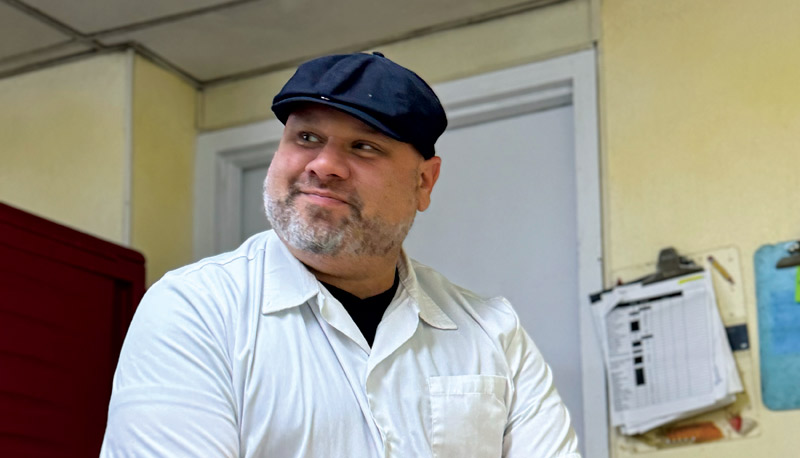
 Whipped Eggplant (Baba ganoush)