fbpx

July 11, 2024

While Consumed with Gaza, is Israel Losing the North?

“Northerners feel that the country has abandoned them,” author and former Israeli ambassador Michael Oren writes on his Substack. “Their plight barely makes the news. They have no indication of when, if at all, the fighting will end or how Hezbollah will be forced to retreat from the border. IDF commanders in the region estimate that as many as 40% of its previous population is unlikely ever to return.”

The tragedy of the north is the dark secret of post-Oct. 7 life in Israel. The massacres of Oct. 7, which occurred in the south, were so horrific and traumatizing they have sucked up most the emotional energy of an exhausted nation. The continued plight of the hostages has only intensified the focus on Hamas and the war in Gaza.

It’s understandable, then, if the north is getting second billing. But Oren is here to blow the shofar of alarm.

“For nine straight months, beginning on October 10, Hezbollah has been pummeling the north. Thousands of rockets, exploding drones, and anti-tank missiles have been fired at border villages and at cities as far south as Tiberias,” he writes. “Some 80,000 Israelis have been displaced or, more accurately, uprooted, torn from their workplaces, their schools, and communities. Levels of family violence, substance abuse, and divorce have soared.”

Walk through hotel lobbies throughout Israel and you’ll see many of these refugees. They’re usually the groups with lots of kids.

“We call them tenants,” the concierge at a Tel Aviv hotel told me when I asked him if families wandering through the lobby were refugees.

These “tenants” are the face of a country in crisis, a country feeling threatened on multiple fronts and slowly eroding its mystique of security.

“Israel is losing the north, but the loss will not be of land alone,” Oren warns. “Endangered, too, is the state’s commitment to defend all our citizens irrespective of their place of residence, to preserve our precious human and natural resources, and to deter our enemies.”

Israel has inflicted serious damage on Hezbollah, including the targeted killings of senior commanders. But because its army is stretched so thin at the moment, it would rather avoid an all-out war in the north, which might drag in Iran and other terror proxies. Such threatening outcomes can still be averted, Oren writes, given that Hezbollah chief Hassan Nasrallah has said he will accept a ceasefire if Hamas does. “Israel must exhaust all diplomatic and military means to pressure Hamas to accept the hostage-for-ceasefire deal currently on the table,” he says.

It’s all very messy, very complicated, and very dangerous. There are no ready-made solutions. It’s not Israel’s fault that it is surrounded by hostile forces sworn to its destruction that are now bolder than ever.

This is a time, in other words, for maximum wisdom and leadership. But experts I’ve spoken to from across the political spectrum have shared the same refrain: There is a huge gap between the level of the challenges Israel is facing and the quality of its leadership.

That is an unfortunate reality, but at least in democracies, leaderships eventually change.

In any case, despair and pessimism are luxuries Israelis can ill afford. Resilience is the Israeli oxygen. So the population soldiers on, doing its share on the ground, volunteering to help refugees, assisting the troops, demonstrating for the hostages, living their everyday lives and never losing their dreams and aspirations.

Indeed, as crucial as security is, that alone won’t be enough. Post-war, Oren writes about the north, “Israel must mount a national campaign to develop and reinvigorate the area. In partnership with Diaspora Jewry, the state must build industrial and high-tech parks, enhance tourist sites, and construct the schools, hospitals, and transportation systems capable of serving hundreds of thousands of new northerners.”

Even in the midst of collective trauma, Oren can envision rays of light.

“How do you live with the constant threat of violence and war?” the late Chief Rabbi Jonathan Sacks asked. “That takes faith. Israel is the people that has always been sustained by faith, faith in God, in the future, in life itself.”

That faith in life, despite how bad things may get in the north or the south, may well be the secret weapon that enables Israelis to prevail.

Shabbat shalom.

While Consumed with Gaza, is Israel Losing the North? Read More »

Where is God?

Where is God?

Some of my congregants were asking tonight—

Where is God right now,

right now when we need Them In the world

fighting for justice, exposing liars,

Lifting up the righteous, making the path clear?


Where is the God of Noah

Who promised to never destroy us again?

Where is the God

Of Avraham and Sarah

Who gave new life when they thought their time had passed?

Where is The God of Isaac

Who showed up with a ram

in the place of the knife in his father’s hand?

Where is the God of Joseph

Who gave the blessing of future knowing?

Where is the God of Moses,

The God who split the sea,

Who fed us coriander from the sky,

Who magically provided all that we need,

Who issued water from mythical wells and rocks?

Where is the God we bless for giving us life, sustaining us, and enabling us to reach this day?

Where is the God in whose names we praise?

Where is the God we know, Or have been told we know?

Where is the God of Purim, the God of— it works out in the end?

Where is the God of the ones who believed?

Where is the God of Sinai,

of revelation of mind blowing truth?

Where is the One we thank every day? The God we call One?

Where is God, any God, any God right now?


Another congregant said to me today—

“The God of predestination is not working for me;

God is every breath I breathe.”

Another said, “the God of punishment does not resonate with me.

Where is the God of meaning?”

I’ve outgrown the God who says, “listen to me or else!”

Who teaches to have the blindest faith.

I’m done with learning lessons,

choosing to have a king,

Or waiting for a man to come on a donkey

or white horse and save me.


It’s not a punishment to have to save ourselves—

I repeat: It’s not a punishment to have to save ourselves.

It’s a sacred trust never seen here before.

Where hope springs from within,

Where we learn to stand,

And map our own path,

choose our own battles

Or the way of peace for that matter.


Every Torah story has been a clue

Every lesson has been figures on cave walls

Of what we are capable of.


Don’t forget The God of Rivka gave her intuition.

The God of Hannah offered a listening ear.

The God of Jacob gave him the power to wrestle,

Who made 7 years of work pay off until Rachel was in his arms.


Where is the adult God

who doesn’t coddle you,

Or punish you

Or control every step of the way?

Is there such a thing? Will you believe?

Where is God? Read More »

Thirsty Jewish Heart – a poem for Parsha Chukat

From there to the well; that is the well of which the Lord said to Moses, ‘Gather the people, and I will give them water.’” Then Israel sang this song: “’Ascend, O well,’ sing to it! ~ Numbers 21:16-17

The story says on our way to the promised land
before we got to the well, mountains moved together
to crush enemies waiting to shoot their arrows
into our Jewish hearts.

This is just a story. It doesn’t mean it didn’t happen
it just wasn’t written down, like later when there was
a situation with a small amount of oil and a week’s
worth of time. And now we fry potatoes whenever we can.

We learned of this miracle, as was passed on with
spoken words, and not documented in the original text,
when we saw the blood of our crushed enemies and
we knew what had happened.

We also were thirsty and the water sprang up
and we sang to it. Thousands of years later and I
have yet to sing a song to the purified water that
comes out of my kitchen spigot.

Maybe we should all be singing songs to
our beverages as these are the gifts of our time.
I sing a song to the water people, the princes and
nobles who solved the hard water crisis of my time.

We are a book and a half away from crossing
the final river. All these years later, so many arrows
are still pointed in our direction. I’m turning on the faucet
hoping to wash them away from my thirsty Jewish heart.


Rick Lupert, a poet, songleader and graphic designer, is the author of 28 books including “God Wrestler: A Poem for Every Torah Portion.” Find him online at www.JewishPoetry.net

Thirsty Jewish Heart – a poem for Parsha Chukat Read More »

GOP’s Israel Plank Challenges the Democrats

Pro-Israel and anti-Israel activists within the Democratic Party are fighting over the language to be included in this year’s platform. There was a similar struggle eighty years ago—and a man named Netanyahu was in the middle of that debate, too.

As the presidential election of 1944 approached, most Republican Party leaders thought there was no point in trying to woo Jewish voters, since they had voted overwhelmingly for Franklin D. Roosevelt in the three previous elections.

Benzion Netanyahu thought otherwise. The historian and Zionist activist—and father of Israel’s current prime minister—traveled to the GOP convention in Chicago that summer to press for adoption of a pro-Zionist plank. Neither party had ever previously included such a plank in their platform.

Netanyahu had already developed relationships with former president Herbert Hoover, the dynamic Congresswoman Clare Booth Luce, and other important Republican figures. American Zionist leader Abba Hillel Silver, who delivered the invocation at that year’s convention, was close to Sen. Robert Taft, chair of the resolutions committee.

Lobbying by Netanyahu and Silver convinced the Republicans to include an unprecedented plank urging “refuge for millions of distressed Jewish men, women, and children driven from their homes by tyranny,” and the establishment of a “free and democratic” Jewish state in Palestine.

The GOP’s platform not only endorsed Jewish statehood, but also criticized President Roosevelt. It declared: We condemn the failure of the President to insist that the [British authorities in] Palestine carry out the provisions of the Balfour Declaration and of the mandate, while he pretends to support them.”

The Republican plank alarmed Rabbi Stephen Wise, the era’s most prominent American Jewish leader. Wise was deeply loyal to President Roosevelt and the Democratic Party; in his private correspondence, he referred to the president as the All Highest” and the Great Man.”

Rabbi Wise had not been planning to attend that year’s Democratic Party convention, but the Republicans’ plank threatened to undermine Jewish electoral support for the president. “I now think I shall go there,” he told a colleague,in order to be certain that the Resolution on Palestine which must now be adopted shall more than neutralize the damage done by the [Republican platform].”

In his conversations with delegates at the convention, Wise warned that without a pro-Zionist plank, hundreds of thousands of Jews in New York might vote for GOP nominee Thomas Dewey, who was the state’s popular governor. That could swing New York, with its 47 electoral votes—the most of any state—to the Republicans.

Congressman Emanuel Celler, Democrat of Brooklyn, warned White House aides that “the Jews in New York and other areas like Philadelphia, Chicago, Boston, San Francisco [and] Cleveland are greatly exercised over the failure of our Administration” regarding Palestine and Jewish refugees. If the Democrats did not support Zionism, then “as far as the race of Abraham, Isaac and Jacob is concerned [Dewey] would steal the show right from under our noses…”

Rabbi Wise had no trouble securing permission to address the Democrats’ committee on resolutions–only to discover, to his dismay, that Rabbi Morris Lazaron, leader of the anti-Zionist American Council for Judaism, would also testify. The Council was the 1940s equivalent of Jewish Voice for Peace—few in number, but loud and amply covered by sympathetic newspapers.

Ultimately, Wise’s position prevailed—mostly. The Democrats’ plank did not mention the plight of European Jewry, but it did call for unrestricted Jewish immigration and colonization” of Palestine and “the establishment there of a free and democratic Jewish commonwealth.”

For Netanyahu and Silver, this bipartisan endorsement of Jewish statehood was a significant achievement. It enshrined support for Zionism, and later for Israel, as part of American political culture for decades to follow.

Today, however, there are elements within the Democratic Party who would like to reverse that tradition. They want the platform to call on Israel to cease firing at Hamas; they also want it to oppose U.S. weapons for Israel, beyond the shipments that the Biden administration recently suspended.

As they did in 1944, the Republicans today have thrown down the gauntlet. This year’s GOP platform states, “We will stand with Israel, and seek peace in the Middle East.” It also condemns antisemitism, pledges to “hold accountable those who perpetrate violence against Jewish people,” and promises to deport foreigners in the United States who support “terrorism and jihadism.”

Can the Democrats match that, given the sentiment toward Israel among some segments of their party? On the other hand, can they afford not to? With significant numbers of pro-Israel voters in swing states such as Pennsylvania, Michigan, Wisconsin and Arizona, this year’s platforms could be more important than ever before.


Dr. Medoff is founding director of The David S. Wyman Institute for Holocaust Studies and author of more than 20 books about Jewish history and the Holocaust. His latest is Whistleblowers: Four Who Fought to Expose the Holocaust to America, a nonfiction graphic novel with artist Dean Motter, published by Dark Horse / Yoe Books.

GOP’s Israel Plank Challenges the Democrats Read More »

The Paradoxical Difficulty of Reversing Lies

The Book of Numbers tells us that the priest who splashes

on a corpse-contaminated person ashes

of a red heifer, will himself thereby become impure,

most paradoxically a victim of what should be the cure


of the impurity of one on whom the ashes have been poured.

The paradox by which he is afflicted cannot be ignored,

reflecting the effectiveness of all the lies

that antisemites tell about the Jews. Although extremely wise,


King Solomon allegedly found no explanation that was rational

for this paradox, but might have done for when it’s national,

affecting all the Jews, who for millennia have been sadly cursed

by the impurity of lies — that by the truth are often not reversed.


Num. 19:7-8 states:

כִבֶּ֨ס בְּגָדָ֜יו הַכֹּהֵ֗ן וְרָחַ֤ץ בְּשָׂרוֹ֙ בַּמַּ֔יִם וְאַחַ֖ר יָבֹ֣א אֶל־הַֽמַּחֲנֶ֑ה וְטָמֵ֥א הַכֹּהֵ֖ן עַד־הָעָֽרֶב׃

The priest shall wash his garments and bathe his body in water; after that the priest may reenter the camp, but he shall be impure until evening.

וְהַשֹּׂרֵ֣ף אֹתָ֔הּ יְכַבֵּ֤ס בְּגָדָיו֙ בַּמַּ֔יִם וְרָחַ֥ץ בְּשָׂר֖וֹ בַּמָּ֑יִם וְטָמֵ֖א עַד־הָעָֽרֶב׃

The one who performed the burning shall also wash those garments in water, bathe in water, and be impure until evening.

According to a midrash, King Solomon famously stated, “I had said I would become wise—but it is far from me.” A midrash in Tahuma claims that the king said: “With all other [laws of the Torah] I held my footing, but when it comes to the teaching of the heifer, I analyzed, I asked and I researched [without understanding].”


Gershon Hepner is a poet who has written over 25,000 poems on subjects ranging from music to literature, politics to Torah. He grew up in England and moved to Los Angeles in 1976. Using his varied interests and experiences, he has authored dozens of papers in medical and academic journals, and authored “Legal Friction: Law, Narrative, and Identity Politics in Biblical Israel.” He can be reached at gershonhepner@gmail.com.

The Paradoxical Difficulty of Reversing Lies Read More »

A Bisl Torah -Turn Back a Page

We are quick to judge Moses as he strikes the rock. This is the act that is said to prevent him from entering the Promised Land. He disobeys God and angrily, hits the rock, forcing bitter waters to rush forth.

But what if God had turned back a page. Instead of demanding excellence from Moses, wondering why Moses exhibited such unexpected behavior, what if God paused and ask why? Prior to this incident, Miriam dies and her accompanying well disappears. Physical nourishment gone. Soulful nourishment gone. A depleted Moses, grieving and angry.

How many of us judge someone based on the actions they present in the moment? A sharp comment or seemingly rude tone. But if we take the time to turn back a page, perhaps someone’s unpleasant behavior is due to more than meets the eye.

We’re often anxious to skip to the end of the story. But sometimes, turning back a page reveals a complexity and nuance needed to truly understand someone else. Let’s not be afraid to dig a little deeper.

Shabbat shalom


Rabbi Nicole Guzik is senior rabbi at Sinai Temple. She can be reached at her Facebook page at Rabbi Nicole Guzik or on Instagram @rabbiguzik. For more writings, visit Rabbi Guzik’s blog section from Sinai Temple’s website.

A Bisl Torah -Turn Back a Page Read More »

A Moment in Time: “Is Astrology Compatible with Judaism?”

Dear all,

Far away from the city lights of Los Angeles, I witnessed a night with a gazillion stars. It was not hard to find the Big Dipper, so I was able to capture this photo.

I thought about the awkward relationship Judaism has had with astrology. On one hand, our texts prohibit divination and soothsaying (which Judaism connects to astrology).

On the other hand, who of us has not wished someone “MAZAL TOV!” (which we often translate as “Congratulations” though it actually means, “May the stars be in your favor”?

I find meaning in our Marariv prayer, which teaches that God places the stars in position as they travel through the sky. In other words, we can read the constellations – acknowledging they have no intrinsic powers – but that God put them there for us to ponder.

And so …. I looked out at the Big Dipper. And as I connected the dots, I thought about how life is filled with opportunities and obligations to fill in the gaps, to bring worlds together, and to make meaning from the big picture. I don’t believe the stars have power. But I do believe the stars are a catalyst for me to think more deeply and broadly.

I was but a speck in the thousands of generations who have pondered the constellations. But in this moment in time, I was connected to each and every being since the dawn of time who has stood in wonderment at the universe.

Is astrology compatible with Judaism? What do you think?

With love and shalom,

Rabbi Zach Shapiro

A Moment in Time: “Is Astrology Compatible with Judaism?” Read More »

Beauty Without Borders

There’s a charming café in the heart of Tzfat, an ancient, mystical city nestled in the hills of Galilee, that might as well be located in West Hollywood. Everything about Bella Bakery & Café (recently renamed Bella & Jacqlyn), from the quality of the coffee to the freshness of the croissants to the romantic French music, screams hedonism, which is fine if you’re in West Hollywood.

But Tzfat screams anything but hedonism. Every alley, every ancient synagogue, every bookstore, every tombstone is imbued with reverence and holiness. Walking through Tzfat is like bathing in a virtual mikvah of holy air.

And yet, I’m drawn every morning to that sanctuary of pleasure, where the Americano is so good I feel I need to apologize to God.

The other morning, I was amused by this scene of an elderly, ultra-Orthodox couple enjoying a coffee while a sensual French song came on. Do they have any idea what this song is about? I wondered. If they only knew.

Here was a clash of two worlds—a song one might expect to hear on a nude beach on the French Riviera, playing for religious Jews whose lives revolve around modesty and restraint.

But here’s the thing—it didn’t feel like a clash at all. You see, the religious couple probably didn’t know French, so they didn’t get the words. All they heard was great music from a great song that fit the mood of a morning coffee.

No words! Just the music.

In the Hasidic tradition, they have what are called nigunim— soulful, melodic chants that have no words. They’re powerful precisely because they are wordless; the chanting itself is the point. There is no “message” to distract you from the vibe of the chant. You surrender to the raw beauty of a melody.

It’s ironic that as a man of words, I’m reflecting today on the power of no words. But there’s a mysterious quality to the idea of absence, of holding back. Designers call it negative space; Kabbalists call it white fire.

At a time when we are overdosing on words, when words are routinely weaponized and distorted and vulgarized, an absence of words can feel like a welcome tonic, a refreshing cleanse.

This verbal restraint speaks to a kind of modesty, to allowing other things to shine besides words.

That religious couple in the cafe didn’t understand the sensual lyrics of that French song. They didn’t need to. They already had beauty without words, beauty without borders.

They had music.

Beauty Without Borders Read More »

Print Issue: The Return to Jewish History | July 12, 2024

CLICK HERE FOR FULLSCREEN VERSION

Print Issue: The Return to Jewish History | July 12, 2024 Read More »

It Was a Smokin’ Affair

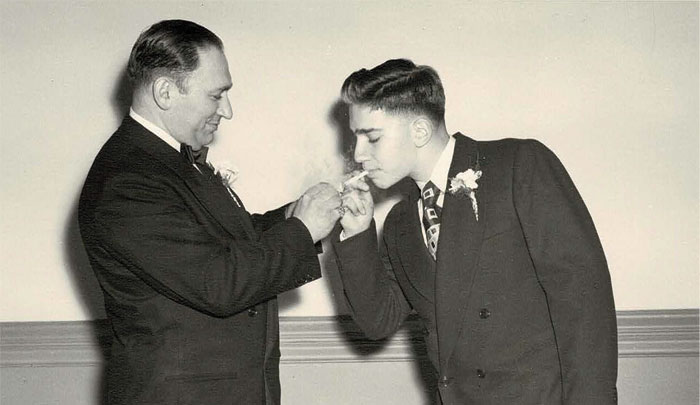
My father smoked a cigarette on January 8, 1949 in Brooklyn. He was just 13. His father lit it. The act is preserved in a sepia photograph in a just-discovered album.  It surfaced 75 years later, during the clean-out of my parents’ apartment. But many things in the photo and album are not exactly as they appear. Some cultural forensics can uncover the lives and aspirations of immigrant Jews in mid-20th century America.

For a father to introduce his young son to the pleasures of a cigarette, today, would be controversial. It might get the father kicked off social media, or worse. But save for Walter Winchell, social media shaming was far in the future.  And this is not just about the ills of smoking. It’s much more and must be examined through the lens of the time. The occasion of this father-son smoke was the son’s Bar Mitzvah! A Bar Mitzvah is a serious ceremony demanding months of preparation by a 12-year-old Jewish boy (in 1949, alas, only boys qualified). It culminates on the boy’s 13th birthday when he is called to the Torah during religious services — usually at a synagogue — to read or chant.  Hardly occasion for a smoke.  And yet, there they are. My father with his pompadour and double-breasted suit, taking a puff. My grandfather in his tux, cradling the match.

My grandparents didn’t smoke. My father didn’t. This is probably the only time in his 88 years that he had a cigarette in his mouth. So why do it? Because Jews, like other immigrant groups at the time were keen to embrace American culture. Who defined American culture? In this instance, the photographers, Renard Studio of Utica Ave, Brooklyn, who staged the photos and produced the album. Its well-constructed scenes and fancy-dress evoke Hollywood movies of the 1940s. Renard, probably a Gentile-owned company, can be partially forgiven for trying to project a bit of the glamorous Protestant-American monoculture of the postwar era onto what is otherwise a Jewish religious affair.  But they took almost as many liberties with the traditions as Oliver Stone did with the Kennedy assassination. Renard spared no opportunity to over-glamorize, over-secularize, and even to over-sexualize.

The album is fancier than my own wedding album from 1985. A fancy wedding seems to have been the inspiration for the staging of the photos.  There is no ring in the standard Bar Mitzvah, so Renard had to make due.  The photographers enlisted my father’s older sister to play (the made-up role of) Tallis-bearer. Dorothy parades down the center aisle of the synagogue carrying my father’s Tallis like Anne Baxter’s Nefretiri carrying gifts to Yul Brynner’s Pharaoh in “The Ten Commandments.”  On stage, Dorothy drapes the Tallis around the shoulders of her brother, the prince-in-waiting. It is, in Hollywood parlance, a “fictionalized” portrayal of a real event.

Like most fictionalizations, there are elements of truth. A Bar Mitzvah is the Jewish rite of passage from childhood into adulthood – although mainly symbolic. At that moment, certain responsibilities of an adult Jew do attach, such as counting as a member of a Minyan. But Renard played this coming-of-age theme to the hilt. There is a photo of father and son, side-by-side tying their ties in a mirror. Another, of my father’s contemporaries (all under-age) toasting him with what surely is not grape juice.  And a cringe-worthy picture of my father beckoning a young woman (either a girlfriend or merely a girl friend who happened to be at the wrong place and wrong time) up a staircase. It’s hardly Rhett Butler carrying Scarlett O’Hara up the grand staircase, but it is suggestive. Today, you are a man.  Perhaps the most overt projection of American-Christian culture onto my family’s Jewish event is emblazoned on the cover of the album. Rather than call it by its rightful Hebrew name, “Bar Mitzvah” (the term appears nowhere in the album), the gold lettering announces, “My Confirmation” followed by “Larry.” Larry has been officially Christianized and secularized.

To be clear, my grandparents were not duped by whoever staged the photos and turned their son’s Bar Mitzvah into a Hollywood movie. They are not victims. They wanted to assimilate into the prevailing culture. They wanted to move from the confines of a segregated society of immigrants into the American mainstream. A glamorous Bar Mitzvah and dinner affair — complete with first cigarette — likely seemed to them a necessary step. They may have spoken Yiddish — the language of the “Old Country” — to each other, but they spoke English to their children. If they couldn’t achieve the American dream in its entirety (my grandfather dropped out of Drexel for lack of money in the 1920s) they earnestly hoped the opportunities of the “Geldina Medina” (the Golden Land) would accrue to their son.  Like other Jewish immigrants and their community, they loved their new country. This love is captured in the album’s pages devoted to the processional into the synagogue. The grand processional was, of course, led by the rabbi, but the second position was reserved for a flag-bearer carrying a large American flag. The congregation members were proud Americans.

My grandparents were not duped by whoever staged the photos and turned their son’s Bar Mitzvah into a Hollywood movie. They are not victims. They wanted to assimilate into the prevailing culture. 

Immediately following the American flag was another flag-bearer. He carried the flag of the recently-declared (May 1948) independent State of Israel, a state not yet a year old. The members of the congregations were also proud Zionists.  Proud American, proud Zionist, there is no contradiction.  There were no flags proclaiming, “Death to America.”

My father achieved the American Dream that his parents sought for him. He went from a highly competitive public high school, Brooklyn Tech, to Stevens Institute in Hoboken.  He made it to Stevens on academic merit. His gold medal in science and silver in math from Brooklyn Tech surfaced with his Bar Mitzvah album.  After Stevens, he went to MIT and finally to Harvard for a Ph.D. Unlike Ryan O’Neal in “Love Story,” he did not play hockey. Despite his Bar Mitzvah photos, he was not a particularly glamorous guy nor an athletic one. Unlike Timothy Bottoms in “The Paper Chase,” my father did not ignore his grades (or throw them into the ocean!)  He was a straight arrow who went to school, completed his homework on time (and his master’s thesis at MIT early), and respected authority. In short, he went to school to go to school. He parlayed his studies into a career in computers and finally his own consulting business. He enjoyed his work. It allowed him to purchase a home in the suburbs, send two kids to private colleges, and travel the world with his beloved wife of 65 years.

The drive of immigrant Jews to Americanize — and to be allowed to Americanize — in the first decade of the 20th century was not without hiccups or blind-spots. A job offer during WWII to my eventual mother in-law was retracted by a prominent New York company when they learned she was a Jew. Such things were not uncommon. My father’s older sister – the Tallis-bearer in the “Larry Movie” — was not doted on like her brother. She was not expected, nor did she attend college. Like many Americans of their time, Jewish and non-, my grandparents were myopic in this respect, and it’s regrettable. But like the 1949 image of a father lighting his 13-year-old’s cigarette, they must be viewed through the proper lens. My immigrant grandparents tried their best to position their son for success in their adopted home. They were fiercely loyal to that home and embraced its culture.  All while maintaining their religion and ethnic identity. They sought to reconcile their own culture with the prevailing one.  They pushed study and academic achievement to the max. And it worked. It seems we can forgive them a little Hollywood “treatment” of Larry’s Bar Mitzvah – and learn from their example.


Evan D. Morris, PhD is a Professor of Biomedical Imaging and Biomedical Engineering at Yale. His father, Larry Morris (z’’l) passed in March 2024 at the age of 88.

It Was a Smokin’ Affair Read More »