fbpx

June 13, 2024

Columbia Prof Shai Davidai Testifies Before Congress About Campus Antisemitism

Columbia University Assistant Professor Shai Davidai provided congressional testimony on June 13 describing the “hostile environment” on campus since Oct. 7.

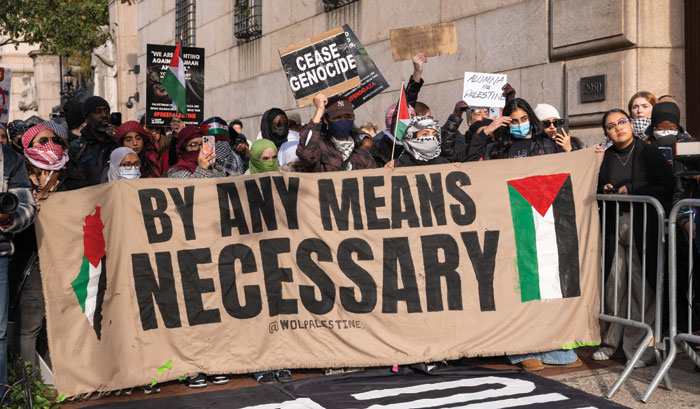
“To say that civil rights are being violated does not begin to capture what Jews and Israelis have been forced to endure on campus,” Davidai told the House Ways and Means Committee. “Over the past months, Jewish students at Columbia have been locking themselves in their dorms to avoid being assaulted. They have been spat on, attacked, bullied, and vilified. Columbia has done nothing to stop pro-terror student organizations that justify, excuse, and celebrate the massacre of my people, and chant for their eradication ‘by any means necessary.’ As if violence against my four-year-old Israeli niece and my 93-year-old Israeli grandmother would be justified acts of resistance by ‘freedom fighters’ — acts worthy of celebration.”

Davidai listed what he sees as the failures of the university to take action to protect Jewish and Israeli students on campus, including dismissing “Jewish students’ concerns about their physical safety, prompting a prominent Jewish leader to urge students to evacuate campus”; allowing “multiple illegal protests to take place on campus” and “professors to teach classes inside an illegal encampment from which Jewish and Israeli students were denied entry and in which their physical safety could not be guaranteed.” He also accused Columbia of negotiating “with pro-Hamas and pro-Islamic Jihad student organizations” that “violently took over a university building and held a university employee hostage against his will” and expressed support for rockets to be fired at Tel Aviv as well as for Hamas’s military wing “to attack Jewish American students on campus.” Further, these student groups “invited speakers with known ties to terrorist organizations to lead a ‘Resistance 101’ event, in which students were encouraged to express support for terrorism and were told that the Oct. 7 massacre was a necessary and justified action.”

The professor noted that “Columbia in theory” has been different from “Columbia in practice,” contending that while the university has suspended “two pro-terror student organizations” as well as “a handful of student leaders who invited to campus speakers with known ties to terrorist organizations,” these suspensions were never enforced. The university has also claimed that a professor who voiced support for Hamas and Hezbollah was terminated, but that professor still teaches at the university, claimed Davidai.

He pointed the finger not just at Columbia President Minouche Shafik, but at the university administration and the Board of Trustees as a whole. Davidai claimed that many faculty members “openly support and celebrate Hamas.”

“For decades, there has been no accountability for professors who indoctrinate rather than educate young Americans,” Davidai told the committee. “There has been no leadership, no taking of personal responsibility. In such a climate, it is not surprising that students feel complete impunity to spew their hatred toward Israelis, Jews, and the United States of America.”

“For decades, there has been no accountability for professors who indoctrinate rather than educate young Americans. There has been no leadership, no taking of personal responsibility. In such a climate, it is not surprising that students feel complete impunity to spew their hatred toward Israelis, Jews, and the United States of America.” – Prof. Shai Davidai

Davidai also detailed the “personal price” inflicted upon him and his family since he began speaking out. “My home address and class schedule have been posted online, urging people to harass me. Members of these pro-terror organizations have publicly smeared me, my wife, my parents, and my late grandfather. They even published pictures of my two-year-old daughter and eight-year-old son,” he said. “Yet, I refuse to be deterred. I am not fighting for myself. I am fighting for every decent American who believes that antisemitism and support for terrorism have no place on college campuses. I am fighting for every person – Jewish or non-Jewish – who believes that rape is never, never, never OK.  I am fighting for the future of higher education.”

Responding to  questions from committee members, Davidai said that there has been a “purge” of faculty members who disagree with anti-Israel faculty at Columbia and other universities for decades. “When you are only allowed to listen to one point of view, then you end up either agreeing with that point of view … or you drop out of the class,” he argued. “There have been experiences of students that feel like they have to write papers that oppose their own values just to get a passing grade.”

Davidai also criticized “the vast majority” of Democrats and Republicans on the committee who weren’t present for the hearing. “They didn’t see this as a top priority, so their constituents and the students around the country, they see that antisemitism, support for terrorism is not a priority for the House, so why wouldn’t they go and protest?” he contended.

Rep. Brad Schneider (D-Ill.) defended his colleagues, claiming that there are often multiple congressional hearings occurring at the same time. “It’s not a matter of priority, we come and go … this is a priority, that’s why we’re having this hearing … that’s why we have legislation come to the floor.” Davidai countered: “Your top priority is where you show up, and this is the not the top priority. It’s a second, third or fourth priority.”

Rep. Jason Smith (R-Mo.), the chairman of the committee, agreed with Davidai. “Members of this committee were asked to serve on this committee, and they should be present,” Smith said, “and it’s all about priorities. We’re busy people but this is the most important committee in Congress, and that is why people should be in their seats.”

In response to a question from Rep. Brad Wenstrup (R-Ohio) on what would happen if Congress started cutting funding to universities, Davidai said: “Even before you cut it off, their knees will start shaking and change will happen.” He contended that universities only “care about money and PR, and if you start playing with that, things will change.”

Toward the end of hearing, Davidai called for permanently banning “every pro-terror student organization,” expelling the leaders of these organizations and for sanctioning — if not firing — these students organizations’ faculty advisors. Davidai also urged universities to prevent professors who express support for terrorist organizations like Hamas from interacting with students and for all universities to adopt the International Holocaust Remembrance Alliance definition of antisemitism.

Among those who also testified at the hearing were recent Cornell University graduate Talia Dror, who said that “nothing has changed” in terms of the “antisemitic environment” on campus since she first testified to Congress eight months earlier. “Cornell’s policy of appeasement infused the protests with renewed vigor,” she claimed. “Classes were constantly interrupted and several exams were even moved as the pro-Hamas student group continued to wreak havoc on campus life. They let the inmates run the asylum.” As an example, Dror pointed out that after Cornell cleared a pro-Palestinian encampment on campus in May, the university thanked “the students responsible for the encampment for not inciting physical violence. Rather than punishing protesters for violating university rules, they expressed gratitude that the students terrorizing campus and stifling intellectual disagreement managed to stop themselves from physically carrying out their violent sentiments.”

Cornell recently did release a plan to combat antisemitism on campus, which doesn’t “mention firing antisemitic professors or cutting ties with Qatar, a country which has invested 1.8 billion dollars in Cornell, and is one of Hamas’s most prominent financial backers. Their proposed solutions are performative band-aids on the administration’s inability to understand and address Cornell’s deeply ingrained, systematic moral rot.”

Kenneth Marcus, founder and chairman of the Louis Brandeis Center for Human Rights Under Law, also testified; he claimed that the Department of Education’s Office of Civil Rights (OCR) has been “unlawfully” dismissing antisemitism cases and that OCR has prevented students from appealing the dismissal of these cases. Marcus urged the Department of Justice and OCR to collaborate in investigating these cases.

The others who testified before the committee on June 13 were American Jewish Committee CEO Ted Deutch and Dr. Jonathan Pidluzny, director of higher education reform at the America First Policy Institute.

Columbia Prof Shai Davidai Testifies Before Congress About Campus Antisemitism Read More »

‘Ezra’ Shines a Light On Autism, Parenting and the Power of Love

“Ezra” proves that some fathers will do anything for their sons. When the son is autistic the stakes are even higher. 

The movie, which stars Robert De Niro, Bobby Cannavale and autistic 13-year-old actor William Fitzgerald as grandfather, father and son, is part buddy road-trip movie. It also has equal parts how to and how not to parent. 

“To me it’s a love story,” Elaine Hall, who, along with Alex Plank, was an autism consultant on “Ezra,” told the Journal. “It’s a testimony of how much we will put ourselves on the line for someone that we love.”

When stand-up comedian Max (Cannavale) and his ex-wife, Jenna (Rose Byrne) are forced to confront difficult decisions about their son’s future, Max (without permission) takes Ezra on a cross-country road trip.

“Having a child diagnosed as neurodivergent is a journey that is lifelong, and it’s a journey where nobody gives you a roadmap.”
– William Horberg

“The road trip is always a metaphor,” producer William Horberg told The Journal. “Having a child diagnosed as neurodivergent is a journey that is lifelong, and it’s a journey where nobody gives you a roadmap.”

While those with an autistic child try to do the right thing, it’s important to remember, there is no one right thing,

“Whether you’re the parent of a neurodivergent child or the parent of any kid, you’ve gone through those experiences of needing to let go and trusting … them,” Horberg said. “And it’s super hard to do.”

Written by screenwriter Tony Spiridakis, “Ezra” is inspired by Spiridakis’ own experiences in parenting his autistic son, Dimitri, while there is plenty of creative license. “Ezra” is directed by Tony Goldwyn, who also appears in the film and happens to be Dimitri’s godfather. Goldwyn, Horberg, Jon Kilik and Spiridakis serve as producers.

“It turns out both my boys are on the spectrum,” Spiridakis told the Journal. “They’re both neurodivergent, and they both needed to go to special needs schools … Like in the movie, I was hell bent on public school being the right way to deal with it.” (Side note: It wasn’t.)

When asked what impact he wants for the film, Spiridakis said he wants people to be more accepting of each other. 

“I also want to show parents, of both neurodivergent and neurotypical children, that they will, in fact, make mistakes, and that those mistakes do not preclude them from loving their kids,” he said. “Because, if whatever they did wrong came from a loving place, they need to understand that and continue to further go deeper into understanding their children.”

Courtesy Bleecker Street

In the film, Max goes big in the mistake department. The point was to show people what it’s like for a family trying to figure out how to advocate for an autistic child. One of every 88 children in the United States is estimated to be on the autism spectrum. 

“I wanted to show a father behaving very badly. but doing what he thought was very good,” Spiridakis said. “Those are contradictory things, I understand, but to me the story was always about doing the wrong thing, so that the right things may happen.”

And, to those who see themselves in this film, Spiridakis said: Forgive yourself, hang in there and find some humor in the situation. 

“People have to release the pressure with laughter, and my son Dimitri did that for me,” Spiridakis said. “He would always do something wildly inappropriate, but it would make me laugh.”

Hall said meeting Spiridakis’s Greek family was one of the highlights of working on this film. “They’re just wonderful, but very similar to my family,” Hall said. “I felt at home.”

“I made Max and Jenna a Jewish family originally, because … they were [like] this family that I had known from growing up in Queens,” Spitadakis said. “I remember thinking, ‘Whatever happened to me. I wonder what it would be like in this family that was so close, whose parents had [escaped] from Germany.” 

He added, “I felt deeply connected to that, and it was an imaginary way of taking myself out of it and putting it into this other culture, which was Jewish.”

Spiridakis, Goldwyn and the other producers were committed to authenticity in casting the actor playing Ezra, and, Hall said, that’s the way it should be. They needed an actor who is autistic. but could also carry a movie.

“It was also about finding somebody who could tolerate the process of making a movie and create a process that was safe, and that was sustainable for 25 days of shooting,” Horberg said. “To be the focus of attention of, you know, 200 adults every day for 8 or 10 hours a day, requires a lot of preparation and careful thought and planning.”

Hall, who is founder of The Miracle Project, a fully inclusive theater, film and expressive arts program for neurodivergent and disabled individuals, believes they interviewed 85 12 to 15 or 16 year olds around the country for the title character.

“Just the process of that alone made an impact in the autism community, because there were kids who never even thought that they could ever audition for something like that,” Hall said. “By learning the lines and going in and meeting Tony and Tony G, and being treated so respectfully, it changed their lives.” 

The popular belief, Hall explained, is that neurodivergent individuals don’t show feelings and are not empathic, but the opposite is true. We may express ourselves differently than a neurotypical person would. 

“They are the most sensitive human beings on the planet,” she said. “And films like ‘Ezra’ give us a window into that sensitivity and that connection.”

‘Ezra’ Shines a Light On Autism, Parenting and the Power of Love Read More »

Israeli Singer David Broza Doing Mini North American Tour

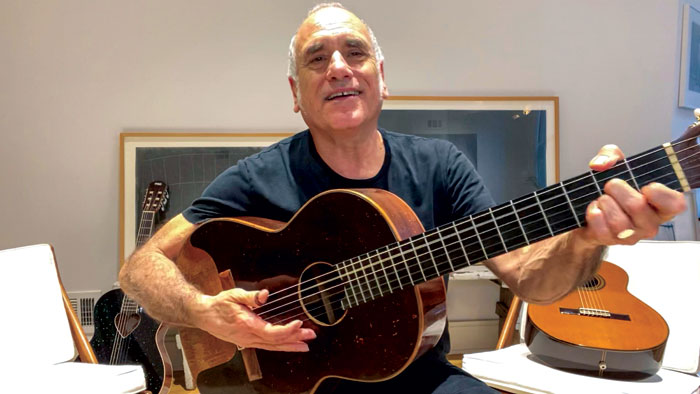
As it was for so many Israelis, for David Broza, Oct. 7, 2023, was a call to action. Since then, Broza has put himself on the front lines; he immediately cancelled a tour celebrating of the 40th anniversary of “Haisha She’iti (The Woman With Me)” and started playing the nearly 150 pop-up concerts he has performed across Israel.  

He performs solo,  just him and his grand classical guitar, providing a brief reprieve from the ongoing conflict. It’s a reprieve for him as much as the audience. “I come and try to totally detach myself from the reality that we’re witnessing and bring an escapism to the room,” Broza said. Almost every day, and sometimes multiple times per day, he’s playing for people that need it. With Israel Defense Forces brigades and displaced civilians as his audience, he often performs  wearing a helmet and a tactical vest.

“I’m not the first artist to go to the front lines, and I feel very fortunate that with all the negativity around, I can do three, four, sometimes five shows a day, going from one unit to another, and then I go to the displaced people,” Broza said. “I go wherever music is needed, I just wing it and I play and I give my heart out there. I don’t even think about it. My driver takes me through these places, and some of them are very unpleasant. You hear the rockets. He keeps driving forward, and I’m just telling him where we got to go.

Born in Haifa in 1955, Broza was 12 when his father bought him his first guitar. He would spend a significant part of his youth in Madrid, Spain at a religious boarding school, where felt like “renegade.” Still, that time in Spain had a massive influence, the sounds of flamenco and folk pop still evident in his songs. Over the decades, he’s recorded in multiple languages and collaborated with musicians such as Spanish guitarist Paco de Lucía, Wyclef Jean of the Fugees, and singer/songwriter Jackson Browne. 

One throughline of his career is that Broza has consistently promoted peace and understanding with his music. This was on full display with his 2014 album and documentary, “East Jerusalem/West Jerusalem,” where he chronicled eight days that brought together Israeli and Palestinian musicians.

”In my case, what I can offer is a couple of hours of great music that I bring from home, from Tel Aviv, from Israel that I bring from my journeys in America and in Spain, and just connect with the souls in the deeper end of things.” – David Broza

“I’ve always been out in the streets promoting what I think is coexistence and peace,” Broza said. Between performances, continues to find inspiration and create new music. Any given day, Broza is practicing or composing for four to six hours. As he embarks on his mini U.S. tour, he continues to bring a message of hope and unity through his music. “In my case, what I can offer is a couple of hours of great music that I bring from home, from Tel Aviv, from Israel that I bring from my journeys in America and in Spain, and just connect with the souls in the deeper end of things.”

He has been on the road performing since he was 18. And now at age 68, his setlist features songs in Hebrew, English, and Spanish. Given how effortlessly he bridges cultures and divides, so it’s no surprise he remains optimistic about the future of the people in Israel and its neighbors. 

“I don’t believe in just waiting for fate,” Broza said. “I believe in getting up and grabbing fate and directing your life towards where you want. If you want to live and find a way to live in peace, which today is almost a four-letter word in Israel. You have to wait a little, maybe in making the big picture your goal, but you still have to feel it inside of you. You have to trust that people don’t want constant battles and constant fights. At some point it’ll culminate and there will be some kind of pause or solution or a horizon that will open up. And I don’t want to miss that. I want to be there right at the front of it and welcome it. So I perform for all walks of life — for anybody.”


David Broza’s tour kicked off in Los Angeles at the Saban Theatre. He will be performing throughout the month of June with stops in San Francisco, New York, Boston and Toronto. For tickets, visit https://davidbroza.net/tour. 

Israeli Singer David Broza Doing Mini North American Tour Read More »

As Antisemitism Rises, a Campaign Heats Up to Discredit the Term

“The callousness, dehumanization and targeting of Jews on display at last night’s protest outside the Nova Festival exhibit was atrocious antisemitism – plain and simple,” the Democratic congresswoman tweeted. “Antisemitism has no place in our city nor any broader movement that centers human dignity and liberation.”

Those words came from Democratic Rep. Alexandria Ocasio-Cortez, a notorious critic of Israel and leading light in progressive circles.

What was most noteworthy, though, was the response from her fellow progressives. They accused her of selling out, of providing a fig leaf to the Jewish establishment. Some accused her of “getting a visit from your AIPAC babysitter.”

What’s going on?

“The blinding rage directed at AOC for daring to utter the word ‘antisemitism’ in relation to the pogromist mobs outside the Nova exhibit is something to behold,” Izabella Tabarovsky posted on X. These responses from progressive-Islamist friends, she added, “tell us something important about this moment.”

One thing it tells us is that just as antisemitism is reaching alarming levels, an even more alarming movement is afoot to discredit the term.

“Over the last few years there’s been a campaign going on to disarm, distort and discredit the very term antisemitism,” Tabarovsky writes. “One time-tested technique here is to create so much confusion & controversy around the term that people would feel too hesitant to condemn antisemitism or speak of it all.”

She lists a series of examples, as in 2021, when Bernie Sanders’ national surrogate, Amer Zahr, called on activists to stop condemning antisemitism: “Don’t condemn sh**, we have a cross-sectional, intersectional movement that is winning…Stop it. Stop it. Stay focused. Say free, free, Palestine and nothing else.”

Another instance was when Students for Justice in Palestine (SJP) mobs forced Rutgers to withdraw a statement condemning antisemitism. Rutgers complied, promising to be more “sensitive & balanced” in the future.

She also cites the case of April Powers, a Black Jewish DEI professional who had to resign from her job after she put out a statement condemning antisemitism.

Back in 2021, Tabarovsky writes, “this all seemed shocking. Today it’s become completely normalized. Constant claims that antizionism is not antisemitism are playing a massive role in creating confusion and intimidation around the issue.”

That’s why any clear evidence that antisemitism is real, like the hatefest at the Nova exhibit that AOC condemned, must be attacked at once. The very notion of antisemitism must be delegitimized as a Zionist conspiracy, another nefarious Jewish attempt to shut down critics and control events.

Why has the term become such a growing threat to progressives?

For starters, it disrupts their cherished oppressor/oppressed narrative that is their ideological lifeblood. Jews are stereotyped as white, Western and powerful, the ultimate exemplars of oppressive white privilege. They must never be allowed to be victims.

We saw this at work dramatically right after Oct. 7, when progressives came down hard on Israel and the Jews even though 1200 Israelis got massacred by Hamas. The mutilation, the beheadings, the rapes, the burning alive of bodies were so staggering, it presented a nightmare scenario for progressives who are used to bashing the Jewish state as a genocidal, imperialist and colonialist bad actor.

Suddenly, these powerful Jews looked like victims, victims of the most savage Jew haters imaginable.

This new victim status for Jews was unacceptable, even if it was so blatantly justified, especially since it was so justified. It had to be nipped in the bud.

The progressive campaign to delegitimize the term antisemitism, then, is just another way of telling Jews to stay in their oppressor lane. Bashing a warring Israel is now the easiest way for the left to bash Jews.

But there’s something even bigger at play: The war against Israel is also a war against everything progressives hate about the West. That’s why the term antisemitism must be discredited. Bad guys can never be victims.

The leftist media, which consistently downplay antisemitism from the left, have become the great enablers.

“The New York Times has published countless stories about the rhetoric of participants in the 2017 ‘Unite the Right’ rally in Charlottesville, Virginia,” Christine Rosen wrote in Commentary in a piece titled, “Why the Media Ignore Anti-Semitism.”

“Where are the big-think pieces and deeply reported stories about the organizations and funders behind the anti-Jewish groups staging protests outside synagogues and other Jewish institution?”

As Rich Lowry writes in National Review Online, “every day is a Charlottesville now, but hardly anyone notices…The antisemitic rhetoric and menacing nature of that event — in a different, left-wing form — are being replicated all over the country in openly hateful pro-Hamas protests.”

If white supremacists were showing up all over the country and agitating against Jews and vandalizing property, he asks, “Can you imagine the headlines and nightly news reports?”

We’re left with this bizarre landscape where, on one side, Jewish activist groups are exposing the spooky rise of antisemitism from the left, while on the other side, progressive groups are undermining the very idea of antisemitism, encouraging people to disregard the whole thing as a Jewish-Zionist con.

Meanwhile, Jewish progressives must be disillusioned to see how so much of the Jew hatred these days is coming from inside their own house. Will they walk on eggshells so as not to alienate their progressive comrades, or will they have the courage to tell it like it is, even if it hurts their team?

When even AOC rings the alarm, you know we’ve entered new territory.

As Antisemitism Rises, a Campaign Heats Up to Discredit the Term Read More »

A Lot More Goats – A poem for Parsha Naso

And for the peace offering: two oxen, five rams, five he goats, five lambs in their first year… ~ Numbers 7:47

You’d think it would be awkward when
everyone showed up to the party with
the exact same gifts.

But it wasn’t. Moses had registered at the
great department store in the sky, and what
was brought, was exactly what was desired.

If only bringing livestock to our enemies
could be enough to cause peace to reign.
I’d send a young bull to my neighbor who

keeps parking by the fire hydrant in front
of our house. I’d send a ram and a lamb
(one each!) to Russia and North Korea.

I’d send two oxen to Iran. I’d send
five rams to Hamas. I’d send five lambs
each less than one year old to China.

Maybe they’d send them back electrified?
(And affordably priced!) How many spoons
full of gold filled with incense will it take

for my neighbors to stop complaining
that there are too many Starbucks in our city?
How many silver sprinkling basins are needed to

get people to signal before they change lanes
on the freeway? Would it make a difference if
I filled it with flour and olive oil?

There was a livestock party at the Tabernacle.
Like our hopes for peace, many of them
went up in smoke.

If we want to get closer to the world yet to come,
we’re going to need more goats.
A lot more goats.


Rick Lupert, a poet, songleader and graphic designer, is the author of 28 books including “God Wrestler: A Poem for Every Torah Portion.” Find him online at www.JewishPoetry.net

A Lot More Goats – A poem for Parsha Naso Read More »

WBT Honors Rabbi Leder, Pico Union Project Celebrates, ELNET Names Leadership

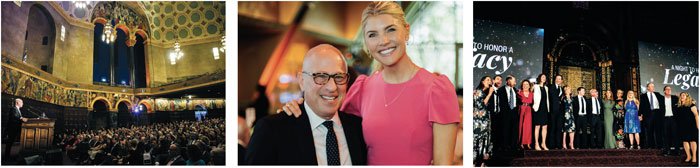
A Wilshire Boulevard Temple (WBT) gala honoring departing Senior Rabbi Steve Leder was held on May 19 at the synagogue’s Erica Glazer campus in Koreatown. Celebrating the rabbi’s four decades of spiritual leadership, the program was appropriately titled “An Evening to Honor a Legacy.”

Special guests included Amanda Kloots, co-host of “The Talk” and comedian Jeff Ross. Musical performers were Jenna Parris and WBT Senior Cantor Lisa Peicott. An elegant dessert reception followed the program. 

Leder began his career at WBT as a newly ordained rabbi in 1987 and rose to become one of the most influential rabbis in the country. During his time at WBT, he has revitalized the synagogue’s landmark campus, grown its schools and expanded the community’s footprint across three vibrant campuses. 

Last year, Leder announced plans to step aside as the congregation’s senior rabbi on Aug. 31, and remain part of the rabbinical team on a more limited basis for an additional two years. Rabbi Joel Nickerson, a member of the temple clergy since 2019, is succeeding Leder in the role, effective Sept. 1. 

“Perhaps your most important legacy is that you have built a leadership team that is ready to take the flight controls,” WBT President Scott Edelman said. “With Rabbi Nickerson and Cantor Peicott at the helm, our temple will continue to soar. And somehow, you have done all these things with good humor, unrelenting optimism and infectious joie de vivre.”


Pico Union Project Founder Craig Taubman with Board Member and Vice President of Programs for Pico Union Project Stuart K Robinson. Photo by Iris Schneider

Pico Union Project (PUP) celebrated a decade of service with a “Pico de Mayo” street fair and fundraiser on May 26.

The event took place at the nonprofit’s historic location: an architecturally stunning 1909 building, originally one of Los Angeles’ oldest synagogues, now a multicultural interfaith destination.

More than 1,000 community members from the Pico-Union neighborhood and beyond turned out for a program that included free food distribution, a street fair and concert performance. 

PUP Founder Craig Taubman provided an address about the nonprofit’s work, and L.A. City Councilmember Eunisses Hernandez spoke. L.A. Mayor Karen Bass also provided an address by video, as did L.A. County Supervisor Hilda Solis, who announced a $200,000 grant for the interfaith nonprofit.


Larry Hochberg and Tom Flesh. Courtesy of ELNET

The board of directors of ELNET-US unanimously voted to appoint Tom Flesh as the chair of the board.

ELNET-US co-founder and outgoing Chair Larry Hochberg will serve as chair emeritus on the board and continue to mentor the next generation of ELNET leaders. As only the second chair in ELNET’s history, Flesh will build on the legacy of Hochberg and co-founder Newt Becker to further the reach of ELNET in the U.S. and throughout Europe and the Middle East, according to the organization. 

“It is my honor to be serving in this role at a critical organization,” Flesh said. “From defense ties to trade and diplomacy, Europe is critical to Israel’s security. I am committed to working with our professionals and community of supporters to strengthen these bonds at a time of great peril and opportunity for the Jewish state. As the son of Holocaust survivors, I could not think of a better way to honor my parents’ legacy.”

Flesh serves on the boards of several real estate companies and philanthropic organizations. He and his wife, Judy, are active in interfaith unity efforts, Jewish and Israel-based institutions and organizations focused on education and at-risk youth. 

“We are very fortunate to have Tom on our team at ELNET,” David Siegel, president of ELNET-US, said. “He has been indispensable to our efforts to expand the community of ELNET supporters in Los Angeles and throughout the nation.”

ELNET, also known as the European Leadership Network, is an Israel advocacy organization based in Europe that’s dedicated to broadening and deepening Israel-Europe relations. 

WBT Honors Rabbi Leder, Pico Union Project Celebrates, ELNET Names Leadership Read More »

A Moment in Time: “Building our Tomorrow”

Dear all,

The ZEMR* (Zach, Eli, Maya, Ron) family is in the process of moving (locally)! We are in the midst of packing and culling and schlepping. It’s an emotional process, filled with dreams – but also with sadness. We’ve been here since 2001. Lots of memories.

When we married in 2002, I wrote a wedding song “Ze Dodi” that included the lyric, “Take my hand, and we’ll build our tomorrow, and we’ll nurture the blessings of our home.” In 2019, our family expanded with the birth of Maya and Eli. They soon learned to sing our wedding song.

This past weekend was our last Shabbat in this house. As we sang Ze Dodi, I remembered that with every change comes loss. But with every change comes opportunity. Indeed, ZEMR will go forth to build our tomorrow. While we will forever nurture this past Shabbat as a moment in time, we won’t allow holding on to a memory to eclipse the dawning of new light, fresh possibilities, and reimagined dreams!

We all have the chance to build our tomorrow. Why not start – today!

With love and shalom,

Rabbi Zach Shapiro

(* in Hebrew, ZEMR means “music.)

Link to the original recording of “Ze Dodi”

A Moment in Time: “Building our Tomorrow” Read More »

Public Diplomacy is Boring. Fight the Jew Haters with Israeli Parties.

The Jew haters have gone hysterical. They have no limits. No decency. They will spew their hate outside an art exhibit for the victims of the Nova festival. They will assault a Chabad rabbi at UCLA. They will target anyone they think is a Zionist.

They’ve gone berserk.

Their goal is to intimidate Jews. To shut us up. To make us cower and go home.

The haters are making all the noise.

And what do we do?

We complain.

We write articles.

We talk about the need for public diplomacy.

We publish leaflets.

We argue on social media.

But what we do on the streets, where the real action is happening?

We’ve given that up.

They fight on the streets. We fight on Instagram.

When we occasionally hit the streets, it’s with a show of Israeli flags. We show our Jewish pride.

That’s fine, but it’s soft. It’s predictable.

What do the Jew haters show on the streets?

They show hate and ugliness.

Who would ever want to be friends with that?

What should Jews show?

They should show fun.

They should have a party.

Anywhere there’s a hatefest, they should set up a party pop up.

It’s not that complicated: One tent. One portable sound system. Killer Israeli music.

Invite a group of cool Jews who like to dance, blast the music, fly the Israeli flag, and start dancing. And serve coffee. They scream “Free, free Palestine,” you scream “Free, free coffee.”

Voila.

Fight the joyless haters with a Tel Aviv party.

Let the cops make the arrests. Let the legal eagles and activists do their thing. Let the PR experts make the arguments.

You hit the streets and campuses and party. You do happiness. You show fun and love of life, not fear.

So when the media cover the hysterical haters screaming up a storm, now they’ll cover Jews dancing and having a blast.

Put yourself in the shoes of anyone walking by who’s got nothing to do with either side.

Who do you think they’d want to be friends with?

Public Diplomacy is Boring. Fight the Jew Haters with Israeli Parties. Read More »

Print Issue: Is AKLA The Future of Jewish Pride | June 14, 2024

CLICK HERE FOR FULLSCREEN VERSION

Print Issue: Is AKLA The Future of Jewish Pride | June 14, 2024 Read More »