fbpx

June 5, 2024

Graduation Ceremonies Follow Challenging Year for Jewish Students

When De Toledo High School, a college preparatory school in West Hills, held its graduation ceremony for the more than 80 seniors in its 2024 class, the school continued its longstanding tradition, one that has been around since its inaugural 2006 class, of each graduate having a tallit presented to them by their respective parents.

The atarah, or the neckband of the tallit, sewn along the edge of the tallit closest to the head, was designed by the Jewish high school’s first arts teacher, and it features an intertwined knot — symbolizing, according to de Toledo Head of School Mark Shpall, connectiveness. Also, at a fraught moment for Jews around the world, the students’ wearing of the tallit signifies Jewish pride.

About a month prior to this year’s graduation ceremony, all the de Toledo parents of seniors were on campus and tied the tzitzit (fringes) of their senior’s tallit. 

“They’re actually completing the tallis for their graduate,” Shpall told the Journal in a Zoom interview before the June 6 graduation. “We have a structure that we’ve refined over the years that really contributes to this becoming a very meaningful ceremony.”

With the end of the academic year finally here, the community’s high schools celebrated their seniors during in-person graduation ceremonies. While each school has its own unique approach to the annual ritual of celebrating its graduates, Jewish values were central to the programs at a time when it’s increasingly challenging to be Jewish on college campuses, thus creating some uncertainty for the students in the year ahead.

Milken Community School, which serves grades 6-12, is among the country’s largest pluralistic Jewish high schools. This year, the school’s celebrating a 12th grade class that has more than 120 students, and those in the class of 2024 are attending 30 different colleges in more than 15 states. There are even two graduates who will be joining the Israel Defense Forces. 

The school’s graduation ceremony will be held June 10 at the Greek Theatre. Approximately 1,500 attendees are expected. 

According to the school’s leadership, it hasn’t been an easy year for the seniors. The Oct. 7 attack in Israel occurred right in the heart of college application season. The subsequent rise in nationwide antisemitism, particularly on college campuses, led to some of the school’s graduating seniors, particularly those committing to schools as early-decision applicants, to reevaluate their options.

“What we’ve seen happening and tried to facilitate is informed decision-making,” Milken Community School Head of School Sarah Shulkind told the Journal.

Shpall, who has been at de Toledo for 22 years, said concern about antisemitism on college campuses has been a constant topic of conversation among parents of graduating seniors.

“They would be woefully unaware if they didn’t have some level of concern,” he told the Journal.

In turn, Shpall has urged seniors and their parents to find Jewish life on campuses next year that can provide a sense of community, whether it’s courtesy of the college Hillel, Chabad or a Jewish Greek organization. 

“Almost every university has some unrest, some antisemitism,” Shpall said, pointing to anti-Israel protests that have taken place over the past several months at USC, UCLA, Columbia University and UC Berkeley, among other schools. 

But if a student decided not to attend the college they always wanted to go to because they were afraid of facing antisemitism, “the antisemites win,” Shpall said. 

Shulkind agreed, saying schools where there’s been some of the most visible antisemitism would benefit from having pro-Jewish voices on campus.

“In a lot of ways, those places need our kids.” – Sarah Shulkind

“In a lot of ways, those places need our kids,” the Milken head of school said.

To be sure, antisemitism on college campuses wasn’t a primary concern for the graduating class at Sinai Akiba Academy (SAA), which serves early-childhood through grade 8, but at the eighth-grade graduation ceremony, held June 6, the speakers discussed the middle school’s six core values. This includes “love for Israel.”

Each soon-to-be ninth grader was admitted to their top-choice high school next year, including Milken, Beverly Hills High School and Shalhevet High School.

What did all the ceremonies have in common? While these days Oct. 7 is always top of mind, they celebrated first and foremost students’ character and achievement — beyond simply their grades. 

“One of the unique things that’s always been part of our culture is the graduation is fully focused on the graduates,” Shpall said. “There’s no ranking of our students. We do not rank them. Graduation does not have any individual accolades. This is about our entire class and the class graduating together. It’s just been our ethos since the beginning not to differentiate the kids over their grade-point-averages.”

At Milken, the ceremony kicks off with the blowing of the shofar, a ritual that’s also done at the beginning of the seniors’ school year. The ceremony convenes all the school’s faculty, from grades 6-12, underscoring how each member of the teaching staff had an impact on the academic life of the students. 

The ceremony concludes with a recitation of a nigun, a religious song sung in groups.

Graduation Ceremonies Follow Challenging Year for Jewish Students Read More »

Don’t Give Up the Fight

For twenty-five years, I was a member of a far-left Trotskyist organization and a vitriolic anti-Zionist. I’ve written about this elsewhere and generally try not to repeat myself, but want to tell a different aspect of the story for the sake of a point I’ve never made explicitly. Today I’ve repudiated the antisemitism of those years, embraced my Jewish identity, and am a grateful member of the incredibly accepting Jewish community. I’m completely committed to Israel, which I hope to be visiting for the first time next week. And I owe it all to Jews who refused to shut up about antisemitism.

I was living in London when I quit that Trotskyist party, in 2016. I left it not because I had any specific political differences, but because I no longer knew what I believed. I’d repeated the party line for so many years, my own thoughts and feelings were off limits to me. I still craved involvement in leftwing politics however, and immediately joined the British Labour Party. A messianic fervor swirled around its then-leader, Jeremy Corbyn, and I longed to be one of his acolytes.

When I first read that Comrade Jeremy and other Labour members were being accused of antisemitism, I did what any good leftist would do: I swore it was slander, lobbed by nasty right-wingers to destroy the left. I continued to insist this for many months, suppressing any niggling doubts. Everyone I knew and respected was outraged that our champions of the oppressed were being charged with antisemitism. It was unthinkable that they — and I — were wrong about something so huge and ugly. I tried to shove the matter into a distant part of my brain.

But eventually the noise was overwhelming. Almost every time I picked up my beloved Guardian newspaper, which was otherwise mostly hostile to Jews and Israel, I found another article about a new claim of antisemitism in the Labour Party. Sometimes an opinion piece by an anti-Corbyn Jew even made it in. British Jews held demonstrations, appeared on talk shows. Finally the BBC aired a documentary called “Is Labour Antisemitic?” I watched it twice, then decided to do something radical: I decided to fact-check my beliefs. It was extremely hard to keep reading when I realized that the online British publication I’d stumbled on, Fathom Journal, was Zionist: so thoroughly had I been brainwashed to believe that Zionists were evil, alone in front of my computer I actually felt physically afraid. But I read on, one devastating fact after another, until an earthquake careened through my head and I realized with horror: I have been totally wrong.

None of this would have happened if it weren’t for the tenacity of British Jews. I didn’t want to go poking under rocks: I knew that challenging the left on antisemitism, or even asking unseemly questions, would make me the left’s enemy, leading to exile from my political home. But these Jews wouldn’t allow me to ignore them. They wrote and marched, yelled and spoke and were basically completely obstreperous until uncomfortable seeds of doubt were planted in my head. In the end they not only convinced me and, undoubtedly, others; but they helped ensure Corbyn would lose his position of political power and become widely, if not universally, disgraced in British society. Today antisemitic rampages are a regular feature of British life and its Jews are again (or still) under attack, but they fight on. We should acknowledge victories when they happen, and Britain’s Jews scored some big ones. They never gave up, and that’s why I’m here today.

Today the antisemitism is so impossibly putrid and pervasive, it’s tempting to think there’s no point in fighting it. These people are so hate-filled, irrational and vile, the thinking goes, it’s foolish to believe they could ever be convinced to see the error of their ways. Better, the argument continues, to sink more deeply into the Jewish community, fighting the hate with Jewish self-love rather than taking on antisemitism directly. I have mixed feelings about this. On the one hand I think it’s essential to not be so single-mindedly focused on antisemitism that you lose sight of the beauty and wisdom of Jewishness, itself. I credit Dara Horn with setting me straight when I first started confronting the bigotry I’d contributed to all those years. To paraphrase, if you can name almost all the Nazi death camps but not a single Yiddish author, you have a blinkered idea of what it is to be Jewish. This comment of Horn’s made me realize that while I’d become fairly knowledgeable about Jew-hate, I knew very little about Jews themselves. I started exploring my own Jewish identity and my life is all the richer for it. 

So I’m a big believer in people nourishing themselves on whatever it is they love about being Jewish — whether that means religious observance or the more secular side of Jewish life. Keep yourself fulfilled and your people will benefit from it. But also: Fight antisemitism. Use whatever platform you have. Issue documentaries, podcasts, op-eds. Speak up at work, school, on social media. Personally I don’t bother with people who call me a baby-killer on X, but I salute those with more pugilist spirits than I have. You may never convince them, although I wouldn’t say it’s impossible; I, more than most people, know better. And you don’t know the full impact of your words and actions.

The haters are a minority, but history shows a tiny number of impassioned individuals can do monstrous things when the majority have no conviction. 

“The best lack all conviction, while the worst are full of passionate intensity,” W.B. Yeats wrote. He was commenting in 1919 but it could have been today, when throughout the West, universities, city streets, museums and other institutions are besieged by mobs outraged that the Jews have a state. The haters are a minority, but history shows a tiny number of impassioned individuals can do monstrous things when the majority have no conviction. That’s why it’s so important to fight: not so much for the pogromists, who are likely unreachable, but to make the passive majority uneasy. To make them ask questions. To go poking under rocks. To realize, ultimately, that they must defend Jews, along with the precious Western liberal values now under assault. Victories are not only possible, but inevitable. Whether it will be enough is up to us.

So don’t lose heart, my fellow Jews. Speak, write, mobilize, shout. Raise holy hell. Your strength is greater than you realize.


Kathleen Hayes is the author of ”Antisemitism and the Left: A Memoir.”

Don’t Give Up the Fight Read More »

USC Chabad Vandalized

The USC Chabad Jewish Student Center was vandalized on the evening of June 4.

The Chabad posted to Instagram that “two thugs just smashed the glass on our front door and ran off … Thank G-d none of the kids were near the door and we are all safe. Have to figure out something to secure the front door until we can get this fixed.”


View this post on Instagram


A post shared by Chabad of USC (@chabadusc)

A subsequent post from the Chabad featured a video of the incident. “They ride up, see the house, one comes towards it and then goes back to the street and another one comes with him to kick the window in,” the post stated. “The other two take off as soon as they do, and the two perps are just behind them.”


View this post on Instagram


A post shared by Chabad of USC (@chabadusc)

KNBC Los Angeles reported that Chabad Rabbi Dov Wagner and his family were present at the Chabad house at the time of the incident. Wagner told the outlet that they “heard a smash, crashing glass, so I came toward the front door” and that “when you don’t know what’s coming at you, it’s a scary moment.” He vowed that they will not “back down … I believe in spreading light,” he told the station. “That’s what we do here. The more darkness in the world, the more we have to fight.”

World Jewish Congress NextGen intern Alyssa Wallack, a former Chabad Student Board President and current USC student, said in a statement posted to Instagram: “Hearing about perpetrators smashing the glass on the front door of the Chabad House felt like a personal attack. This place is my home away from home. We gather there to celebrate traditions and find warmth and belonging. This attack has made me feel unsafe in what’s supposed to be our safe space away from the climate on campus.”


View this post on Instagram


A post shared by WJC NextGen (@wjcnextgen)


UPDATE: Wagner told The Journal in a June 6 phone interview that at the time of vandalism, he was with a bride and groom preparing for their wedding. “Suddenly we heard a smash from the front … I didn’t know at first what exactly had happened, ran towards the door, was scared that maybe somebody had shot at the house, you don’t know what’s on the other side,” he said. “Looked out and saw there wasn’t anybody there, and then we looked at the Ring video and saw that it had actually been kicked in.”

Wagner described the front door as “an old historic door” but said that “the financial implications are not severe … Much bigger than the financial impact is the sense of violation,” Wagner said. “This is a place that’s served as a home away from home for thousands of people and judging simply by the number of them I’ve heard from in the last 36 hours now, it’s something that very much feels like a violation and attack to many of them.”

He added that his “phone hasn’t stopped buzzing with hundreds of messages of support, outrage. It is heartwarming to see how many people are affected, how many people care, but at the same time, but at the same time that also makes it clear that whether or not this was targeted, this is something that has affected very many people.” Wagner said that “on our side, obviously this will only spur us to try and reach more people, bring more positivity, bring more goodness to the world.”

The Los Angeles Police Department told The Journal that they don’t have any further information on the vandalism at this time.

USC Chabad Vandalized Read More »

‘Displaced Persons:’ Short Stories Celebrate Both Struggle and Rejoicing

When Joan Leegant begins writing a short story, she doesn’t have a theme, character, or even intention in mind. Instead, she begins with one sentence and sees where it takes her. Fans of the short story will discover that the first sentences in Leegant’s new story collection, “Displaced Persons,” lead to a treasure of expertly crafted dramas that probe the eternal themes of belonging, estrangement, love and responsibility, and the quest for meaningful relationships.  

The 14 stories in the collection are divided equally between those set in Israel and set in the U.S. The author, a former attorney, spent five years as a visiting writer at Bar Ilan University in Tel Aviv, lecturing on American literature and culture. She also taught English to African refugees and asylum seekers from Sudan, Ivory Coast and Eritrea.

The idea of displacement as a theme of the stories is both geographical and psychological. “The experiences of exile and belonging can be both outward and inward,” Leegant said. “Sometimes, you can be displaced within your own home.”

The idea of displacement as a theme of the stories is both geographical and psychological. “The experiences of exile and belonging can be both outward and inward,” Leegant said. “Sometimes, you can be displaced within your own home.”

The title story of the collection was one of my favorites. In “Displaced Persons,” the protagonist is a graduate student (whose name we don’t know) who has come to Israel to study and teach, leaving behind the emotional upheavals stemming from her parents’ divorce in the U.S. Like the author, the protagonist teaches African refugees, many of whom have walked all the way across Egypt to live and work menial jobs in Israel — opportunities for which they are enormously grateful. In a subplot, the protagonist has also been asked by her Israeli neighbor, Sigalit, to break some difficult news to her elderly, Holocaust survivor mother: that Sigalit’s 21-year-old son is moving to Berlin, where college is free and the jazz is great. Sigalit fears the news will kill her mother, who even refused “the German money” as reparations. 

Layered into these subplots are the grad student-teacher’s memories of having met the first Holocaust survivor she had ever known, the unfriendly grandmother of a teenaged girlfriend. All three strands of the story skillfully weave together themes of displacement, acceptance, and new beginnings.  

Leegant writes with ironic humor and a knowing, sophisticated eye on human nature, the complexities of family relationships, the craving for connection, and the nearly unbreakable bonds among family members, even those estranged from one another. Fragile sons appear in several stories. Two of those focus on the mothers who struggle relentlessly to save their young sons from a downward spiral into mental illness. 

The shortest story in the collection — and one of the most powerful — is “The Bus,” which is autobiographical and closest to the author’s heart. It focuses on another fragile son, a 23-year-old in treatment for cancer. During one chemo treatment at the hospital, the son gives his mother permission to stop pretending to read the same waiting room magazine she pretends to read during each appointment. 

“He took my hand in his, the skin of his wrist nearly transparent now, and said, The magazine. You don’t have to do that for my sake. . . . You can close the magazine now, Mom. It’s okay. You don’t have to pretend anymore, for me.”

The stories that comprise “Displaced Persons” were written over more than a decade. Several won individual prizes, and as a collection it captured the 2022 New American Fiction Prize, leading to a paperback edition published by New American Press on June 1. 

Since October Oct. 7, the literary and publishing industry has become a hotbed of rabid antisemitism, with calls to cancel or refuse to publish books and stories by Jewish authors. Leegant has not even tried to book herself at literary festivals she has deemed unfriendly and decries as “cowardly and shameful” instances of antisemitism in a literary world that usually champions literary fiction. Fortunately, her book is earning enthusiastic reviews, and she had found many literary journals that still care only about good writing and avoid ugly anti-Israel rhetoric. “This has helped me to sustain my faith in the publishing process right now,” she added.

Readers unfamiliar with Israel’s truly cosmopolitan and multifaceted society may be surprised to read stories here involving the Jews of Baghdad, Israel’s acceptance of African refugees, and friendship between two army pals — one secular and one religious — who had both survived sniper fire. However, the more personal stories set in America touch the deepest chords: The stories about adult daughters with aging fathers; fragile sons and their mothers; the heartbreaking attempt to repair a badly damaged relationship between an adult sister and brother in the final story, “After.” 

Leegant’s previous books include the award-winning “An Hour in Paradise: Stories,” and the novel “Wherever You Go.” She is working on two other novels now, but she has a particular love for the short story form, “the discovery and surprise and the freedom to write about anything I want. I don’t have to be married to it for years or produce 300 or 400 pages. With short stories I often experience joy and exhilaration during the writing, even if the material is dark.”  

While some of the themes in this collection are heavy, the writing never is. In “Hunters and Gatherers,” a mother named Gina struggles to save her son, Greg, from mental illness. The story begins, “Greg is on a diet where he eats only what people ate ten thousand years ago, and Gina is down with that. Anything that gets her 26-year-old son out of the basement and eating at all is fine with her.” 

There is a determination and a resilience among the characters (a quintessentially Jewish trait) that are consistently uplifting. Characters may struggle in their relationships, but continue to seek and often achieve bonding that is life-affirming. As Leegant says, “We all have to struggle and we all have to rejoice.” For any fan of literary fiction, the publication of “Displaced Persons” is a reason to rejoice.


Judy Gruen is the author of “Bylines and Blessings,” “The Skeptic and the Rabbi,” and several other books. She is also a book editor and writing coach. 

‘Displaced Persons:’ Short Stories Celebrate Both Struggle and Rejoicing Read More »

Rabbi Moshe Kotlarsky, Chabad Leader, Passes Away at 74

Rabbi Moshe Yehuda Kotlarsky, a key leader in the Chabad community, passed away on June 4 after a long battle with cancer. He was 74 years old.

Kotlarsky was the vice chairman of Merkos L’Inyonei Chinuch, which is the educational arm of the Chabad-Lubavitch movement. There, he grew Chabad around the globe and worked with the Lubavitcher Rebbe, Rabbi Menachem Mendel Schneerson, before his passing in 1994. Kotlarsky carried on the Rebbe’s legacy by establishing thousands of Chabad outposts.

Born in Crown Heights, Kotlarsky continued the work of his father, Rabbi Hershel, a Holocaust survivor who established Chabad communities in New York and Montreal. He was married to Rivka Kazen, the daughter of one of the Rebbe’s first emissaries, and together they had nine children, whom they raised in Crown Heights. The Rebbe appointed him for a job at Merkos L’Inyonei Chinuch Chabad Headquarters, and in 1968, he began traveling around the world, helping young emissaries set up centers in different communities in the former Soviet Union, the Caribbean and the Far East, to name a few.

“Rabbi Kotlarsky’s passing leaves an enormous, aching void.” – George Rohr

Kotlarsky also served as chair of the International Kinus Hashluchim, the annual convention of Chabad emissaries, which hosts thousands of emissaries in Crown Heights every year. As vice chairman of Merkos, he led Chabad on Campus International, which is on 230 college campuses worldwide, as well as the Rohr Jewish Learning Institute, known as the JLI, which is the largest provider of Jewish education for adults. He founded Merkos 203, which his son Rabbi Mendy Kotlarsky runs; it launched programs like Chabad Young Professionals, CTeen: Chabad Teen Network, Mitzvah Society networks and CKids.

Even though Kotlarsky was extremely busy in his roles as a dedicated father and Chabad leader, he also found time to assist anyone in need, often answering requests at all hours of the night and ensuring that countless people received emergency financial and medical assistance. In the past few years, as he battled cancer, he oversaw the establishment of hundreds of new Jewish libraries, mikvahs, Chabad centers and Hebrew schools.

“Rabbi Kotlarsky’s passing leaves an enormous, aching void,” said George Rohr, president of NCH Capital and chairman of the Chabad on Campus International Foundation and the Rohr Jewish Learning Institute. “I was so blessed to work together with him for over 40 years. It is hard to fathom the Jewish world without him, his love and endless care for the Rebbe’s shluchim and his powerful, relentless drive to build Yiddishkeit worldwide.”


Rabbi Moshe Kotlarsky, Chabad Leader, Passes Away at 74 Read More »

CSULA SJP Promotes Fundraiser With Image of Leila Khaled and PFLP Logo

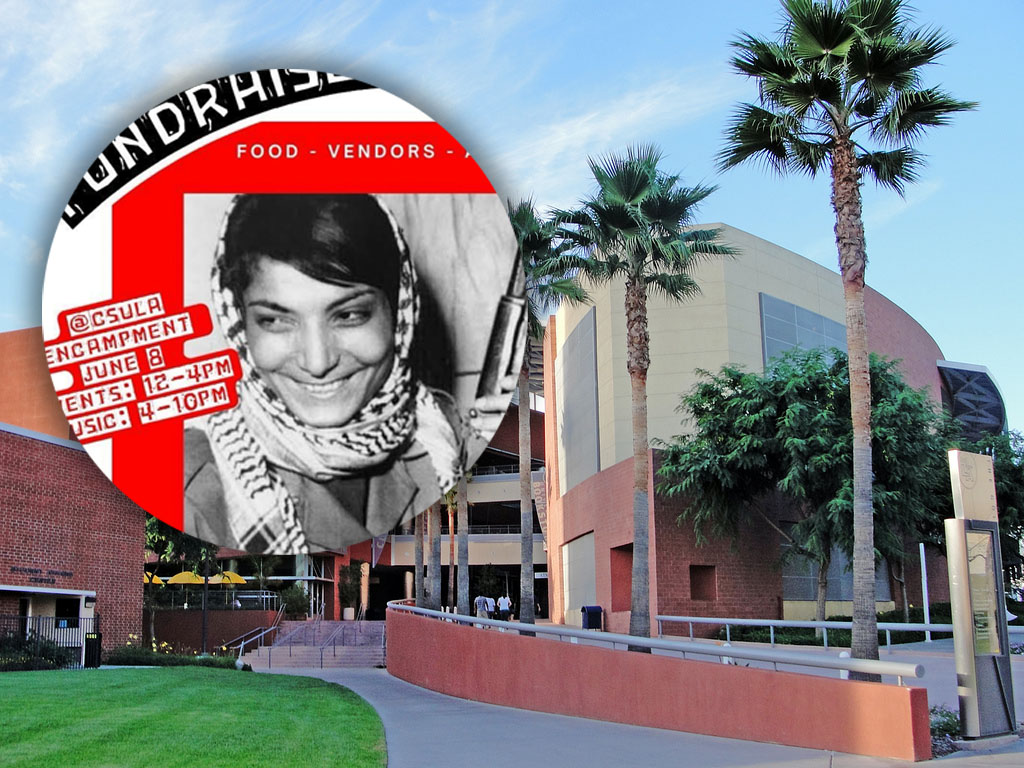
CSU Los Angeles’s Students for Justice in Palestine (SJP) chapter posted an image on Instagram promoting their upcoming “Fundraiser 4 Falastin” that appeared to show the Popular Front for the Liberation of Palestine (PFLP) logo as well as a photo of a young Leila Khaled holding a rifle.

As first reported by Campus Reform, CSU SJP posted the image to promote their June 8 fundraiser; according to the graphic, it will be held at the “CSULA encampment” and will feature events from 12-4 pm and music from 4-10 pm. The PFLP logo can be seen in the lower left-hand corner and Khaled can be seen in the center.

https://www.instagram.com/p/C7172YzOqGg/?igsh=MzRlODBiNWFlZA==

The PFLP, a Marxist-Leninist group, has been designated as a terror organization by the United States, European Union and many other countries, according to Jewish Virtual Library. Khaled was among the terrorists who hijacked commercial jetliners in 1969 and ’70. Her attempt to detonate grenades on the 1970 flight were thwarted and no one was injured or killed in either incident.

Campus Reform Deputy Editor Adam Sabes, who broke the story for the outlet, asked on X where the money from the CSU SJP fundraiser will be going.

On X, Middle East analyst Eitan Fischberger wrote, “Hey @CalStateLA, your SJP chapter appears to be fundraising on campus for the PFLP terrorist organization. You might want to get on that.”

Tali Goldscheft, who works in marketing and communications, posted on X: “At least they’re not pretending to be pro-peace anymore. The charade is gone.”

CSULA Strategic Communications Executive Director Erik Hollins said in a statement to the Journal, “This is not an event recognized or approved by Cal State LA. The university does not have authority to stop social media postings by a non-registered group. We are, however, disturbed by the inclusion of the logo of a designated foreign terrorist organization along with the image of a former member of that group. That does not align with the values of Cal State LA and is not something we believe represents the interest of constructive dialogue.”

The university’s SJP chapter did not immediately respond to the Journal’s request for comment.

The pro-Palestinian encampment has been on campus for more than a month; CSULA President Berenecea Johnson Eaneshas decided that the encampment falls under freedom of speech. Eanes reportedly met with the encampment in mid-May, where “she agreed to disclose Cal State L.A.’s foundation and auxiliary investments, which campus leaders have control over, and to recommend revisions to its investment policies ‘by adding a human rights-based approach’ and reviewing current investments to align with that policy,” The Los Angeles Times reported. However, she did not agree with the protesters’ demand to issue a statement supporting a ceasefire in the Israel-Hamas war, per the Times.

CSULA SJP Promotes Fundraiser With Image of Leila Khaled and PFLP Logo Read More »

Soul Searching: Reform Movement Aims to Liberate Its Zionist Calling

“The question before us is the same one that splintered the Reform movement a century ago and almost broke us. Are we truly committed to Jewish peoplehood? If so, what are our obligations flowing from that commitment? Are we truly committed to the Zionist idea and the State of Israel?” 

Rabbi Ammiel Hirsch, in his passionate keynote address at the second Re-Charging Reform Judaism Conference at the Stephen Wise Free Synagogue on NYC’s Upper West Side May 29-30.

“We thought that we had resolved these tensions by the mid-20th century, in the aftermath of the Holocaust and upon Israel’s founding. We didn’t. Oct. 7 revealed to us that our central values, principles we have stated and restated for decades, are under intense pressure from without and within.”

Rabbi Hirsch was followed by equally passionate speeches by Sinai Temple’s Rabbi Emeritus David Wolpe, ADL CEO Jonathan Greenblatt, and Eden Yadegar, a rising senior at Columbia University in a joint program with the Jewish Theological Seminary.

The rest of the two-day conference did not share the same Zionist passion and moral clarity. We saw why some Jewish students were part of the Zionism-free encampments, part of the fervid desire to “globalize the Intifada.” Perhaps saddest of all, many didn’t want to understand, let alone address, the underlying issues that led to this.

Zionism, Judaism, + Liberalism

Perhaps most disconcerting was a fundamental misunderstanding of both Zionism and classical liberalism. The fact that Zionism, the self-determination of the Jewish people, is a subset of both Judaism and liberalism seemed alarming to many, even after Hirsch and others well explained the intricacies.

The fact that Zionism, the self-determination of the Jewish people, is a subset of both Judaism and liberalism seemed alarming to many, even after Hirsch and others well explained the intricacies.

“Some of us have been warning for years that the abandonment of Western liberal values is always bad for Jews,” said Hirsch. “When we forsake Martin Luther King’s understanding of liberalism, to judge people not by the color of their skin but by the content of their character; when we elevate feelings over facts, bias over evidence, group entitlement over individual merit, cancelation over debate: When we dismiss liberal values as rooted in white privilege, oppression, colonialism, and racism, we have betrayed liberalism, and undermined the very foundations that made the West dominant and Western Jews secure. 

“The passions unleashed by an illiberal state of mind threaten both the West and Western Jews.”

Hirsch then addressed one of the core questions of the conference: Whether the Reform movement’s “big tent” should include ordaining anti-Zionist rabbis. “Principles require parameters; beliefs require boundaries. Otherwise, we believe nothing.”

He then addressed one of the core questions of the conference: Whether the Reform movement’s “big tent” should include ordaining anti-Zionist rabbis. 

“Principles require parameters; beliefs require boundaries. Otherwise, we believe nothing. If we are a Zionist movement, especially at a time when Zionism is under such pressure from without and within, is it conceivable that we would be ordaining anti-Zionists to lead our congregations in the future?

“Let us stand for the principles we have stated and restated since the mid-20th century: We are a Zionist movement. We are committed to the centrality of Jewish peoplehood. We are theologically, philosophically, and practically devoted to the Jewish state — not uncritically — but unconditionally.”

That view was not acceptable to Dr. Andrew Rehfeld, president of the Hebrew Union College Jewish Institute of Religion. He called it a “political litmus test,” which goes against “the principles of liberal Zionism.” Asked whether ordaining a Jew for Jesus would also be viewed as such, he seemed less certain.

“When people say Israel has the right to exist, it’s a complicated philosophical question,” Rehfeld said. Earlier, Greenblatt had scoffed at using that term. “Philosophically speaking, those are words I never get to use. Because in the world in which I live, the outcome is the same. Liberated zones. Liberated of Jews on their own terms.

“Anti-Zionism is antisemitism because Zionism is a Jewish value,” Greenblatt stated unequivocally. “Zionism is as fundamental to our tradition, to our faith, to our peoplehood as every other Jewish value that we speak of.” 

But Rehfeld dug in deeper. “What gives the right of the Jewish people to control state power? Are there limits to that right?”

He had hit one of Natan Sharansky’s three d’s of antisemitism — delegitimization, demonization, double standard — without even realizing it. As Wolpe put it: “The only state in the world in which people call for its elimination is Israel. Now, if it were not for the fact that Israel also happens to be the only state that is occupied by a people who have a millennial history of prejudice against them, then you might say it’s coincidence.”

Rehfeld was far from alone. Teaching kids to love Israel unconditionally was called “indoctrination” and “deception” by multiple educators. 

Thankfully, voices of reason periodically intercepted the introduction of anti-Zionist notions. “The longing to return to Zion is integral, inextricable to Judaism,” said Amanda Berman, founder and executive director of Zioness. “Zionism is not about politics.”

Religion is not political

Throughout the conference, there was a general assumption that everyone there was a Democrat who believed the current Israeli government is “extreme” and “militaristic.” Living in NYC I’ve gotten used to this, but that doesn’t make it right. 

Judaism, whatever the denomination, is about values not politics. It was the ugly infusion of politics into my conservative synagogue here that forced me to leave after my son’s Bar Mitzvah. And I don’t think it’s a coincidence: When you replace values with politics you produce confused congregants willing to engage in morally reprehensible behavior, like unwittingly supporting the harming of Jews.

“The insistence on universality should not erase what those students were really missing, which is Ahavat Yisrael: Love of Israel, to love your own family,” Wolpe said. 

“The insistence on universality should not erase what those students were really missing, which is Ahavat Yisrael: Love of Israel, to love your own family,” Wolpe said. “The recognition that the people who are closest to you should be closest to you. And there’s nothing wrong with that. That is not a violation of human nature. That is the way of human nature.”

The other problem of allowing religion to be politicized is that we won’t be the only ones doing it. Greenblatt talked about how anti-Zionist activists, both in Congress and on campus, are using religion to subvert democracy.  “These activists are using the largesse of the institutions, using the liberties provided by them, exploiting the weakness of so many of these college presidents whose codes of conduct were never equipped for anything like what they’re seeing. And look at members of Congress or elected officials who are using the tools of our own democracy against us.”

Universalism + particularism 

“The more particular you are the more universalistic you can be,” Wolpe said. “When the United Nations … wants to express itself universally, what does it do? It takes a quote from Isaiah: ‘Nation shall not lift up sword against nation.’ They turn to Jewish particularism when they want to express universalism.”

Indeed, Jewish universalism is grounded in Jewish particularism: “Thou shalt love thy neighbor as thyself.” The second half of “Justice, justice you shall pursue” is “so that you may live and inherit the land that God has given you.”

The Religious Action Center, founded in 1961 to advance the values of justice, inclusivity, tolerance, respect, human dignity, unity, and peace, “insisted that Judaism’s universal aspirations emerged from, and are a result of, Jewish particularism, a function of Jewish peoplehood, not its negation,” Hirsch said. “For us Jews,” wrote Abraham Joshua Heschel, “there can be no fellowship with God without the fellowship with the people, Israel. Abandoning Israel, we desert God.”

“Did we intend for our young people to lead anti-Zionist Passover seders at university encampments in so-called ‘liberated zones’ — liberated from Zionists?” Hirsch asked. “Had we known, would we have focused more on Ahavat Yisrael — love, commitment, and responsibility for the Jewish people — the place where everything Jewish starts, without which nothing Jewish can be fully understood?

“Had even the most fervent American peace activist found themselves in one of those border communities on that awful day, they, too, would have been slaughtered in their beds, brutalized and sexually assaulted in the fields, or viciously taken hostage,” Hirsch said. “No one would have asked their views.”

Wolpe mentioned Sharansky’s description of two kinds of Jews in the Soviet Union. “There were the Universalists. They became the Communists. They helped enslave the Soviet Union. And then there were the Jews. They were the Refuseniks. They were the Particularists. And they helped liberate the Soviet Union.”

“Jews get to define Judaism,” Hirsch said. “Others get to decide whether they accept us as we see ourselves.”

In the numerous workshops and panel discussions, these views were overshadowed by some rabbis and educators who took no responsibility for the current climate but seemed obsessed with parsing “Israel education” to satisfy not Judaism, but a kind of anti-Judaism.

At the very end, Rabbi Meir Azari, executive director of Beit Daniel, a congregation in Tel Aviv affiliated with the Israel Movement of Progressive Judaism, seemed visibly pained by everything he just heard. After describing the ongoing suffering, trauma and mourning of Israelis today, he looked out into the sanctuary and said: “We can do better. You can do better.”

Hatikvah

The conference was punctuated by the campus experience. Hillel International’s Director of Israel Education, Rabbi Melissa Simon, talked about how “In the face of isolation, indifference, and disinformation,” it’s been a record-setting year for Hillel in terms of number of students participating in their programs.

And we had the opportunity to hear Eden Yadegar, the president of Students Supporting Israel at Columbia, speak: “University leadership has proved to us day after day that they couldn’t care less about us, their Jewish students, and that they cannot and will not protect us. At Columbia, Jewish students have been spit on for speaking Hebrew, shoved and hit with sticks, rocks, and fists, singled out in classes by professors, forced out of social clubs, blocked by peers and professors from entering certain parts of campus, and told to go back to Poland.

“The existential fight for Jewish survival on campus was and is all consuming. I have been yelled at on campus multiple times. told by my peers that I am a disgusting colonizer and that I should be ashamed of myself. It is undeniable how normalized and ubiquitous antisemitism has become at Columbia. We refuse to allow anyone to hate us for being Jewish more than we love it. We refuse to allow others to define our Judaism for us.” 

Then she read from the letter, titled “In Our Name,” that she co-authored and was signed by 700 Jewish students: “To the Columbia community, over the last six months, many have spoken in our name … Most notably, some are our Jewish peers who tokenize themselves by claiming to represent real Jewish values and attempt to delegitimize our lived experiences of antisemitism.

“Those who demonize us under the cloak of anti-Zionism forced us into our activism and forced us to publicly defend our Jewish identities. We proudly believe in the Jewish people’s right to self-determination in our historic homeland as a fundamental tenet of our Jewish identity.

“Contrary to what many have tried to sell you, no, Judaism cannot be separated from Israel. Zionism is, simply put, the manifestation of that belief. Our religious texts are replete with references to Israel, Zion, and Jerusalem. The land of Israel is filled with archaeological remnants of a Jewish presence spanning centuries. 

“The evil irony of today’s antisemitism is a twisted reversal of our Holocaust legacy.

“Protestors on campus have dehumanized us, imposing upon us the characterization of white colonizer. We have been told that we are ‘the oppressors of all brown people,’ and that, ‘the Holocaust wasn’t special.’ Students at Columbia have chanted ‘we don’t want no Zionists here,’ alongside ‘death to the Zionist state’ and to ‘go back to Poland.’

“In every generation, the Jewish people are blamed and scapegoated as responsible for the societal evil of the time. We are targeted for our belief that Israel, our ancestral and religious homeland, has a right to exist. We are targeted by those that misuse the word Zionist as a sanitized slur for Jew. Synonymous with racist, oppressive, or genocidal. We know all too well that antisemitism is shape-shifting. We are proud of Israel, the only democracy in the Middle East. Israel is home to millions of Raki Jews, Ashkenazi Jews, and Ethiopian Jews, as well as millions of Arab Israelis, over a million Muslims and hundreds of thousands of Christians and Jews.

“Israel is nothing short of a miracle for the Jewish people and for the Middle East more broadly. Our love for Israel does not necessitate blind political conformity. It is quite the opposite. For many of us, our deep love and commitment to Israel pushes us to object when its government acts in ways we find problematic.

“Israeli political disagreement is an inherently Zionist activity.

“If the last six months … have taught us anything, it is that a large and vocal population of the Columbia community does not understand the meaning of Zionism and consequently does not understand the essence of the Jewish people.

“Yet our concerns have been brushed off and invalidated.

“We recoiled when people screamed resist by any means necessary. Telling us that we are quote all ‘inbred’ and that we ‘have no culture.’ We ultimately were not surprised when a leader of the Columbia University Apartheid Divest encampment said publicly and proudly that, ‘Zionists don’t deserve to live,’ and that we’re lucky they are, ‘not just going out and murdering Zionists.’

“We felt helpless when we watched students and faculty physically block Jewish students from entering parts of campus that we share, or even when they turn their faces away in silence. The silence is familiar. We will never forget.

“You never know how strong a tea bag is until it is in hot water. The Jewish community at Columbia remains resilient, proud, and united in the face of bigotry, bullying, and harassment espoused by our peers and professors and tolerated by our university leaders.”

She ended with words from Sharansky: “Dear Jewish students of America, today you are on the front line. The future of American Jewry and maybe even America itself stands in your hands. Be brave.”


Karen Lehrman Bloch is editor in chief of White Rose Magazine.

Soul Searching: Reform Movement Aims to Liberate Its Zionist Calling Read More »

A Prayer for Elsa

Elsa (not her real name) is 96 and a Holocaust survivor. She lives alone in a Section 8 subsidized studio apartment in Hollywood, which she rents for $218 a month. Her carpet has not been replaced since the 1970s. It is dirty and makes her slippers dingy and dark.

She cannot see very well and the lighting in the apartment is inadequate. She struggles with shame and self-recrimination about living “abnormally” in a pigsty. She works from morning to night, seven days a week, she says, to keep things orderly. It is hard for a 96-year-old but she does it. The apartment smells fresh. The kitchen and bathroom are always clean. Spotless, really. I am always amazed. She receives help from a variety of agencies but it is, through no one’s fault, uneven and patchy. Life is complicated and there are holes in the system. There’s family, but even then.

Writing this, I am asking myself why I have not done more. I keep meaning to call the landlord to see if adequate lighting is possible but I am stopped by Elsa’s voice in my head: Don’t challenge the authorities because they will make life difficult for her. What if they find a way to throw her out on the street? What if she were to become homeless? What then? I used to tell her that wouldn’t happen. I told her she could come and live with me. She laughed. I was at first hurt until I finally understood that she trusts no one. Her life experience and traumas have shaped her worldview. She walks in the world with honesty and direct candor. The world is not always prepared for such filter-free communication. It has gotten her in trouble more than once. Her faithful friends see a miracle in her: gritty, scrappy, elegant, erudite, earthy, charming, funny and (did I say) brilliant. Shakespeare, Albee, Arthur Miller: she quotes great minds and, in darker moments, Hitler. 

Last week, while I was at the IKAR Shabbaton in Ojai, she called me. She was in Hollywood Presbyterian Hospital with congestive heart failure. She asked to be taken to Cedars Sinai, a hospital she trusts, but the ambulance drivers, as required, took her to the closest hospital, Hollywood Pres.

Her cardiologist of 40 years recently retired. She said its sad when you out-stay your doctors and caregiver’s career. It is hard to start over and become unknown after 50 years of being known. She loved her South African doctor. She said he never entered the room alone. Hashem always accompanied him. She felt safe in his care. The new doctors seem young and lovely but they do not know her and the practice of medicine has changed in her lifetime. There were no concierge doctors at one time.

Elsa never had children and the family she does have is not in Los Angeles. Her social worker from Jewish Family Services was on vacation when this all went down. The social worker at the hospital was incommunicado for days. No judgement. The caseloads are to blame, not the people.

Through calls and calls and calls to community leaders and professionals, Elsa was given a bed at Grancell Village, the rehab arm of the Jewish Home. Dr. Noah Marco, Jewish Health’s extraordinary medical director, shepherded her path. 

Tonight, Elsa sleeps in a clean room, safe and secure. But her future is filled with worry. It is hard to be old in America, she says. I see she is right. Even with resources the journey is arduous. But without? Without resources, the journey is treacherous and terrifying.

We must do better. In corners all over this city, elders suffer alone. We must seek them out and see them. We must slow down to help them. We must hold them patiently as they struggle to express themselves or ask the same question twice. We must show them love, respect and care.

We must do better. In corners all over this city, elders suffer alone. We must seek them out and see them. We must slow down to help them. We must hold them patiently as they struggle to express themselves or ask the same question twice. We must show them love, respect and care. 

The inscription over the door at the Jewish Home reads, in Hebrew and English: 

 “Do not cast us off in old age
When our strength fails,
Do not forsake us “

May we watch over these women and men at this defining chapter of their lives, with the love and dignity all children of God warrant and merit. May we, may we show them love before they breath their final breath.

Amen.


Samara Hutman, co-founder/director of The Righteous Conversations Project, is grateful to know, and have known, many women and men of the last generation of Holocaust Survivors in Los Angeles, New York and Israel.

A Prayer for Elsa Read More »

Support Israel, But Don’t Forget About the Diaspora

“Nobody is donating to our organization. All the donations are going to Israel.” 

My friend, who works at an incredible Jewish nonprofit in the U.S., recently told me this. It echoed what another friend mentioned a few days prior: “My synagogue reached out and asked for a donation, but I told them I was sending everything to Israel right now.” 

Ever since Oct. 7, Israel has been on all our minds. Constantly. We are praying for the release of the hostages, for a safe and speedy end to this war, for Israelis to finally be able to live in peace. We’ve fervently checked the news and scrolled on social media for updates, feeling our hearts skip a beat when we hear the heartbreaking news about another soldier or hostage who didn’t survive. We won’t be able to take a deep breath until we know this is finally over. 

At the same time, we are sending money to Israel not only to support the war effort, but also to try to revive the economy – which has suffered greatly post-Oct. 7. Israelis who had to put their businesses on pause because they went to fight in the IDF or were displaced from their homes are struggling. It’s important to be there for them by donating, publicly showing our dedication to Israel and sending messages of love. 

But we cannot forget about the Jews in the diaspora. 

The Jewish people are one big family. We are connected to each other. When one of us rejoices, we all rejoice; when one of us is in need, we all pitch in to help. It’s what makes our community so remarkable. 

The Jews in the diaspora, along with their synagogues, institutions and non-profit organizations, need your help too. Your support may not help Israel directly, but I fully believe it will help indirectly by strengthening our people during a time of turmoil.

For instance, if you sponsor a kiddush at your shul, you’ll show that you want to give back to your community – and it encourages others to do the same. It may also make them more likely to show up to synagogue, knowing kiddush is going to be special that week. Perhaps you can sponsor it in honor of a loved one who passed away or for a birthday celebration. 

Another idea is to donate to organizations like Hillel and Chabad, which are working hard on college campuses to foster a sense of Jewish pride among students, who need that right now. Those students could end up becoming much more connected to their Jewish identities, going on Birthright and having Jewish children who keep our beautiful tradition alive. 

You could also simply Venmo a Jewish person in need, like a single mother who can’t afford food for her children or a friend who lost their job and needs help paying their rent. There’s no question that people are struggling financially in our country right now; our community is not immune to this harsh reality. 

One thing is clear: When we support our fellow Jews wherever they live, we strengthen the Jewish people as a whole.

Of course you should keep sending packages to IDF soldiers, donating to displaced families and saving up for a trip for Israel so that you can spend lots of money there and help out the country’s economy.

But don’t forget your friends at home, either. When Israel thrives, the diaspora thrives – and vice versa.

With our collective efforts at home and in Israel, we will ensure our Jewish family continues to flourish, even in the face of hardship. At this time of great need, I encourage you to be as generous and giving as you can.


Kylie Ora Lobell is the Community Editor of the Jewish Journal. You can find Kylie on X @KylieOraLobell or Instagram @KylieOraWriter.

Support Israel, But Don’t Forget About the Diaspora Read More »

The Three Israels

Jewish tradition describes three Israels: the state, the land, and the people. Last week, as a rabbi leading a mission of North American Jews, I observed three different Israels: war-torn Israel, the living Israel, and an American perception of Israel that is far from reality.

Michal Uziyahu described her life living on the Gaza border before Oct. 7 as 95% heaven and 5% hell. Dr. Ron Lobel, director of emergency and disaster management at Barzilai hospital in Ashkelon, called his life before Oct. 7  “a disillusioned paradise.”

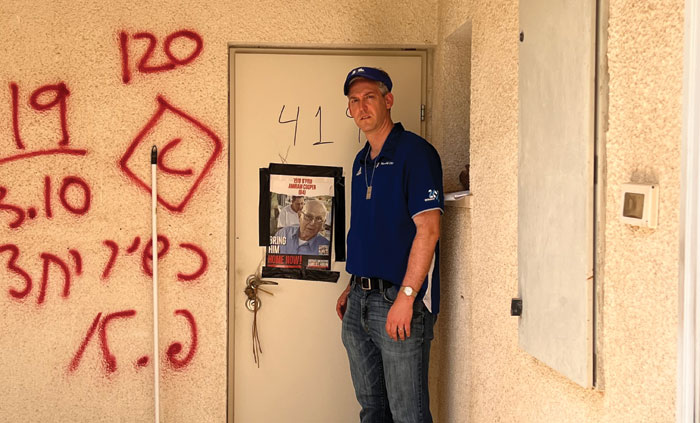
The Israel in the news is one of destruction and death, but behind the pictures is a country grasping for life, ordinary people searching for hope and light. Amiram Cooper, a hostage in Gaza whose death the IDF announced on June 2, was the uncle of a member of my synagogue. I have told his story for the last seven months. Last week, as I walked through Kibbutz Nir Oz, the community he founded in 1951, his story came alive.

As Mor, a 41- year- old mother, guided us through the burnt wreckage of her home on Kibbutz Nir Oz, she described the violence in the terrorists’ voices as they entered her home. I cried when I glanced at her son’s charred soccer cleat, blackened stuffed animals, and the growth chart pasted on the bedroom wall. It could have been my own children. She told us that her middle son wanted to give up. He whispered, “Mommy, let’s open the door and die.” They chose life, and they survived. We continued toward a fence surrounding empty fields. It was the fence I saw on TV that terrorists infiltrated, the exact location where Yaffa Adar was driven away in a golf cart, and where the Bibas babies were kidnapped. 

Our last stop was Amiram Cooper’s home. No longer a name, I gently touched the front door of his completely abandoned abode. I turned to Mor and asked, “Would you like to bring your family back home?” She responded, “Rabbi, I cannot answer that. For me, it is still Oct. 7.”

For Israel, it is still Oct. 7.

Nonetheless, a living Israel exists side by side with a war-torn Israel.

In the Tel Aviv cafes that bustle past midnight, beaches on the Mediterranean that remain full, and in Jerusalem’s marketplace that pulsates with energy, the true living Israel is found in small actions far from cameras.

Two weeks ago, my cousin, Elad, was drafted into the paratroopers. As I walked into his home to celebrate the Sabbath, I noticed large balloons that read, giyus kal, “have an easy draft.” He returned home as a civilian, exchanging his uniform for his prayer shawl. On Sunday morning, I became a tourist, but he transformed back into a soldier, as his mother prayed to see him next Shabbat.

A living Israel, where hope abounds amidst darkness.

On our visit to the Gaza border town of Tzohar,  we made the desert bloom, as we planted saplings alongside preschoolers. A young student asked, “Can we plant some more?” A living Israel, where children who live under constant air raid sirens desire a life full of planting. And even in the worst of times, one can still hope.

On our visit to the Gaza border town of Tzohar, we made the desert bloom, as we planted saplings alongside preschoolers. A young student asked, “Can we plant some more?” A living Israel, where children who live under constant air raid sirens desire a life full of planting. And even in the worst of times, one can still hope.

Planting in Tzohar

Shelly Shem Tov is the mother of Omer Shem Tov, 21, who was kidnapped by Hamas at the Nova festival. Shelly received a sign of life when the IDF discovered a diary in one of the locations Omer had been held.

This is what it reads.

“1. One more day …
2. Food …  food … food … food …
3. My dear mom, I love you.”

Every day, Shelly finds the courage to tell Omer’s story, so that I can write his story, and so that you can share his story too. Shelly Shem Tov has a dream of a living Israel, when her son walks back into her life.

The third Israel is found here in America. 

As I arrived home in Los Angeles, helicopters hovered above a newly formed UCLA encampment. Students boycotted Harvard commencement and ripped up Columbia diplomas. I thought to myself, if only Omer and Amiram could speak to these students. 

And if only every college student would take the opportunity to visit Israel and meet the people before they build their tents. I could guarantee the social media discourse would change instantly.

For if “all eyes are on Rafah,” then let “all eyes be on Israel” too. When that happens, the world will see a nation fighting for its survival, inspired by days of hope and peace ahead.

This version corrects that Yaffa Adar is not a Holocaust survivor.


Rabbi Erez Sherman is Senior Rabbi of Sinai Temple.

The Three Israels Read More »