fbpx

January 4, 2024

Family Members Advocate for Their Loved Ones Abducted by Hamas

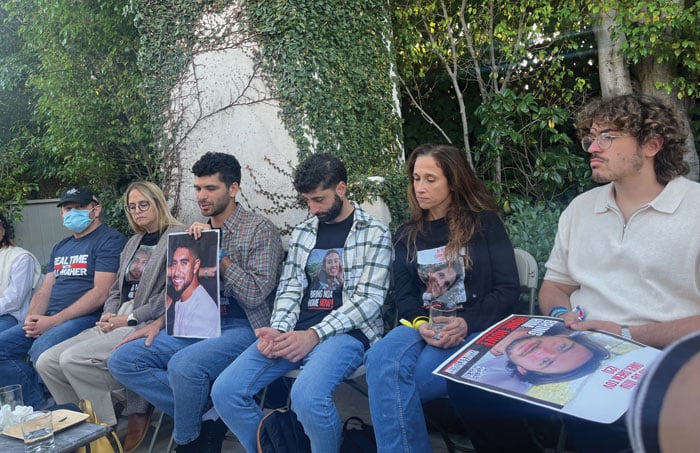
Family members and close friends of five Israelis who had been abducted by Hamas arrived in Los Angeles to raise awareness and hopefully contribute to the release of their loved ones. On a Saturday afternoon, Kaye Popofsky Kramer hosted an intimate gathering in her Hancock Park backyard. Attendees, included influencers who heard firsthand accounts of the emotional challenges faced by those with family members held by a terror organization in Gaza.

Noga Gur-Arye, whose nephew Alon Ohel, 22, was kidnapped from the Nova music festival recounted the moment she learned about Alon’s abduction. “At 9 a.m. on Saturday the phone started ringing and didn’t stop. I was sleeping but finally answered. It was my mom who told me that Israel was at war, and Alon was at a festival near Gaza. I immediately called my sister, she said that the last contact they had with him was at 8:08 am, and there had been no communication since.”

After connecting with Alon’s friend, who survived the terror attack, the family learned that Alon had been kidnapped. “Apparently, Alon and a group of 30 people sought refuge in a bomb shelter. Unfortunately, Hamas discovered them and threw grenades into the shelter six or seven times. Despite someone’s efforts – including Alon’s – to throw out the grenades, one exploded, leaving only seven survivors.”

Hamas terrorists instructed the survivors to exit the shelter. Alon was abducted along with Israeli-American Hersh Goldberg-Polin, who had lost his arm in the explosion. A video filmed by Hamas captured the distressing moment when Alon was dragged by his hair to a pickup truck. “It’s been 56 days since then, and there has been no sign of Alon or Hersh,” shared his aunt. 

Amir, Noa Argamani’s roommate was next to speak. “From the first time I met her, I knew we would be good friends.” 15 years ago Amir lost his brother while he was serving in an IDF combat unit. In the current conflict, he lost three close friends and two more friends, Noa and her boyfriend Avinatan, were kidnapped.

“At 8:30 a.m., I received a text from Noa saying, ‘They are shooting at us,’ followed by, ‘I’m sending you my location.’ Her boyfriend sent us a picture of them in hiding and asked for help.”

Two hours after receiving the last text, Amir saw a video showing Noa on a motorcycle driven by Hamas, screaming, “Please don’t kill me.” Meanwhile, her boyfriend was led to Gaza on foot.

“Noa is an only child to her parents. Her mom, who is from China, is battling cancer and has only a few weeks to live. Her only wish is to see her daughter alive again, and it’s agonizing to witness the world’s silence on this matter.”

Since the start of the war in Gaza, 87 Israelis have been released, but 137 people are still held captive. The initial focus was on freeing elderly women, children, and their mothers, with young men given lower priority. This has left many Israeli families frustrated and fearful for the safety of their loved ones.

Testimonies from those released reveal harsh conditions, with limited provisions —often just one pita bread and occasionally a small amount of cheese. Some days, they went without any food. 

Testimonies from those released reveal harsh conditions, with limited provisions — often just one pita bread and occasionally a small amount of cheese. Some days, they went without any food. Towards the end of their captivity, survivors testified that the rations dwindled further, forcing them to share a single pita bread to ensure everyone had a bite.

Ilay David learned of his brother Evyatar, 22, being kidnapped through a text message from an unidentified number. “Until that moment, we were uncertain about whether he was kidnapped or dead. We knew he was at the music festival and spent hours wondering if he managed to escape. The video we received showed my brother shirtless on the ground with his hands behind his back. He was bitten and looked very scared.” 

M.R, who prefers to keep his identity private due to his past position in the Israeli army lives in California and was on vacation in Israel when the war broke out. “I served in Gaza and I know Arabic fluently. Once I heard about what happened, my friends from my unit and I drove to Nahal Oz, one of the Kibbutz where Hamas entered.”

M.R.’s phone was bombarded with text messages requesting help from friends and individuals aware of his army service. As they approached Nahal Oz, they were confronted with a scene reminiscent of a war apocalypse. A young girl lay dead under a car, burned vehicles, and houses riddled with bullets.  With hundreds of Hamas terrorists in the area, M.R., dressed in civilian clothes, pretended to be one of them. He shouted in Arabic, warning them that women  were shooting from the houses. “I told them to stay away. I knew that according to their belief, being shot by a woman would prevent them from reaching heaven and obtaining the 72 virgins they were promised.” 

Carmel Gat, 39, an occupational therapist was abducted along with her sister in-law Yarden Roman. Yarden’s husband Alon and their daughter Geffen managed to escape before they were taken to Gaza. Carmel’s mother Kineret, was murdered.  Merav, Carmel’s friend shared her story; “After 52 days, some hostages were released, including Yarden. We heard from other released hostages that she practiced yoga with the children and kept their spirits up. We also heard horrifying accounts about the hostages’ experiences there. It’s crucial that they are all released as soon as possible.”

Amit Shem Tov spoke about his brother, Omer, who turned 21 in captivity. “That morning after Hamas sent rockets and began their attack, Omer called us and said he was heading back home, but when my mom called him at 8 a.m., he said he couldn’t make it out. My father had his location and noticed he was heading toward Gaza. He tried calling to warn him he was going the wrong direction, but there was no reply.”

At 8 p.m. the family received a message from Omer’s friend and a video which confirmed their worst fears. Omer had been kidnapped. “I didn’t want to watch it at first, but my mom did and she immediately started crying. He was in a pickup truck, his hands tied behind his back.”

Their parents, Sheli and Malki Shem Tov, promptly established the Hostage Missing Forum, which is dedicated to bringing back the hostages, raising awareness, and supporting the families in their time of need. 

Gilad Lederer, the CEO of a technology company, volunteered from the outset to assist and accompanied the families to Los Angeles. In the few days since their arrival in L.A., they have given interviews to local TV stations and continue to recount their story.  Lederer said that Israel is fighting on two fronts — one against Hamas and the other for the world’s opinion. He remarked, “It’s sad that we find ourselves needing to be heard and explain what happened. It’s sad that we need to explain that it’s wrong kidnap children from their beds and men and women from a music festival. We don’t understand why some people tear down posters of those kidnapped from walls or write ‘Occupiers’ instead of ‘Kidnapped’ and it’s shocking that, to this day, the U.N. has not condemned Hamas.”

For more information about the kidnapped Israeli citizens, please visit: https://stories.bringthemhomenow.net

Family Members Advocate for Their Loved Ones Abducted by Hamas Read More »

A Moment in Time: “Seeing Something for the First Time …. Again.”

Dear all,

Walking into my home on Wednesday afternoon, Maya and Eli ran to me exclaiming, “Daddy, there’s a rainbow, there’s a rainbow!!!!!”

We then sat, gazing out the window at not just one rainbow, but at the marvel of a double rainbow that smiled over the city.

I never tire of seeing rainbows. But this was the first rainbow my kids have seen in person. And experiencing the marvel through their eyes enabled me to behold the colors in the sky as though it was my very first time.

Imagine, just imagine, if we all encountered the world through the wonderment of a child’s eyes. They remind us not to take a precious moment in time for granted.

Baruch Atah Adonai, Blessed are You, Adonai, who remembers Your covenant with and promise to creation.” (Based on the traditional Hebrew prayer for seeing a rainbow).

With love and shalom,

Rabbi Zach Shapiro

A Moment in Time: “Seeing Something for the First Time …. Again.” Read More »

Jewish Self-Defense in a Time of Fear: A Review of Ayelet Gundar-Goshen’s “The Wolf Hunt”

A couple of weeks ago, my husband sent me a link to a local Krav Maga club. He was thinking of signing up for a free trial and also taking our 16-year-old son.

I would like to say my husband’s motivation was to improve his fitness; he is an avid runner, but he doesn’t do any weight-training. Or maybe I wish it were a desire to relieve stress — isn’t that one of the benefits of martial arts? But I knew as soon as he mentioned Krav Maga that he was thinking about pure and simple self-defense. He works in a university, where people regularly march through campus shouting “From the river to the sea, Palestine will be free!,” which might have a contested meaning but feels threatening nonetheless. We live adjacent to a neighborhood that is majority Muslim; almost every window has either the river-to-the-sea motto or some other all-caps angry sign directed at Israel, where many members of our family live. We avoid the weekly ceasefire protests in our city because they often include blatantly antisemitic slogans and illustrations, such as “Khaybar Khaybar ya yahud jaish al Mohammed sauf yaud” — a reference to a historical massacre, which translates to “Khaybar, Khaybar, oh Jews, the army of Mohammad will return” — and “Keep the world clean,” with a Magen David shown tossed in the trash. I guess a lot of us are thinking about self-defense these days.

When Ayelet Gundar-Goshen’s recently published fourth novel, “The Wolf Hunt,” came out in English this past summer, I read it thinking about Lionel Shriver’s “We Need to Talk about Kevin.” Both are novels about high school murders, and both investigate the relationship between a mother and son. In both cases, the mother, who is the protagonist, is revealed to be an unreliable narrator, leaving readers unsure about her son’s capacity to harm others. Both are deeply psychological novels, asking how much we can know anyone. I loved “The Wolf Hunt” as I loved “We Need to Talk about Kevin.”

In the wake of October 7, I reread Gundar-Goshen’s new novel, this time thinking about the responses to the attack on Israeli soil. It felt like a completely different book.

In the wake of Oct.  7, I reread Gundar-Goshen’s novel, this time thinking about the responses to the attack on Israeli soil. It felt like a completely different book. 

Already, in my first read, I could see where Shriver’s and Gundar-Goshen’s novels diverged, chiefly in what we can conclude about the sons, but also because of the role that national identity, culture and attitudes play. Although both are set in the U.S. and have a clear American context, in “The Wolf Hunt,” Lilach is an Israeli transplant to Silicon Valley. Lilach’s Israeliness — or rather, her in-betweenness as an Israeli-American — is significant. Her failure to understand her son, Adam, comes, at least in part, because he is American raised. She also struggles to really know her husband, Mikhael, because of the position he held in the Israeli Defense Forces, a position that was formative to his character; his “military ID had been branded into his flesh with a white-hot iron along with an order for eternal secrecy,” she says.

But now I also see how the distinction between aggression and self-defense makes these books rather different beasts. Shriver’s book tracks the growth and development of a boy who seeks to do harm. Gundar-Goshen’s is about averting harm — though this trajectory, too, can have dire consequences.

“The Wolf Hunt” begins with a sadly all-too believable, too familiar premise, set not long after the Pittsburgh Tree of Life and Chabad of Poway attack: A man walks into a synagogue on Rosh Hashanah in the Bay Area and stabs a young woman to death. 

After the synagogue stabbing, there is a panic among the Jewish residents, and a desire to fight back against antisemitism. For Gundar-Goshen’s born-and-raised diasporic Jews in California, there are committees and meetings. For her Israelis, however, the fight involves hard-core self-defense: Krav Maga. 

Lilach, our heroine, is plainly conflicted. On the one hand, she doesn’t like the macho Israeli attitude that she sees as potentially damaging. On the other hand, she observes with dismay the way her nephews, visiting from Israel, get up early, run, make protein shakes, are “strong and tan, loud and brash”; in comparison, her son Adam plays video games, is not athletic, and “trailed after [his Israeli cousins] like a dog hoping to be adopted.” Embedded in Lilach’s consciousness is the fear that, as the granddaughter of a Holocaust survivor who had been in the camps, she has passed down to her son “the gene that has like sheep to the slaughter written on it.”

So, Lilach encourages her son to join the new Krav Maga classes. 

We know from the outset what will happen because Lilach tells us on the very first page. There is an African-American boy at Adam’s school, Jamal, a follower of the Nation of Islam, a bully, and when he dies suddenly, her son stands accused of his death: “They say he killed Jamal.” 

Is Adam guilty? Although “The Wolf Hunt” functions as a kind of mystery novel (and in that sense, is a real page-turner), it is Gundar-Goshen’s explorations of terror, fear, revenge, solidarity, parental protectiveness, self-defense and the Israeli psyche that makes this novel worth reading — particularly now. But my main beef about this book is that it ended. It kept me spellbound, and I hope this isn’t Gundar-Goshen’s last.


Karen Skinazi, Ph.D is Associate Professor of Literature and Culture and the director of Liberal Arts at the University of Bristol (UK) and the author of “Women of Valor: Orthodox Jewish Troll Fighters, Crime Writers, and Rock Stars in Contemporary Literature and Culture.”

Jewish Self-Defense in a Time of Fear: A Review of Ayelet Gundar-Goshen’s “The Wolf Hunt” Read More »

Lawsuit: Rutgers Law Student Faces Discipline for Reporting Antisemitism

A lawsuit filed on Tuesday alleges that an Orthodox Jewish student at Rutgers Law School is facing punishment as severe as expulsion for reporting another student’s antisemitism.

The lawsuit alleges that the Jewish student, 36-year-old Yoel Ackerman, was in a Rutgers Student Bar Association (SBA) group chat in which a student named “J.A.” posted a video titled “3 lies about Palestine.” The video, according to the lawsuit, denies that Hamas committed acts of rape on Oct. 7 and denies that Hamas slaughtered concertgoers at a music festival, despite publicly available video evidence to the contrary. Additionally, the “3 lies about Palestine” video claims that “‘Palestinian resistance fighters’… were ‘kind’ and ‘merciful’ on Oct. 7,” per the lawsuit.

The video concludes: “So why are they lying? It’s called ATROCITY PROPOGANDA. They lie about atrocities in order to incite emotions, hatred and violence. WHY? Because they are the ones planning to commit atrocities themselves. To do this, they need to convince you that Palestinians are barbaric animals, that rape, torture and behead babies. This is a war of information.” The lawsuit alleges that “they,” is “a dog whistle for Jews.” Another student, “M.A.,” replied to the video with a heart emoji.

According to the lawsuit, “Mr. Ackerman was deeply offended and shocked” that the video was shared in the SBA chat, and that Ackerman replied to J.A. by stating: “The SBA has not taken a position on this. Now is not the time for your inciting post.” J.A. doubled down on sharing the video, claiming that he did so in multiple chats as a way of “clearing up propaganda.” The lawsuit further alleges that J.A. later harassed Ackerman by asking him why he was “triggered” by the video and challenged him to debunk the video’s claims.

Ackerman remembered that the Jewish Law Student Association (JLSA) at Rutgers encouraged Jewish students to send them screenshots of harassment, so Ackerman sent them screenshots of J.A. and M.A. In his email to the JLSA, Ackerman wrote that his email contained “receipts” of law students who supported Hamas and the terror group’s atrocities on Oct. 7. The lawsuit argues that Ackerman did this in “good faith” and with the intent of protecting his fellow Jewish students from “harassment, intimidation, bullying and discriminatory conduct.”

Shortly after the email was sent, an unidentified individual who had access to the JLSA’s email account forwarded Ackerman’s message to Sarah Regina, associate dean of student affairs at Rutgers Law School in Newark, and another law school dean. The unidentified individual claimed that Ackerman was “doxing” law school students; the lawsuit denies that Ackerman doxed anyone, claiming that Ackerman “merely shared information that J.A. and M.A. chose to publicly share to members of the Rutgers community, including speech and their names and photographs attached to such speech.”

Instead, Rutgers launched disciplinary proceedings against Ackerman on charges that he defamed and doxed J.A. and M.A. The lawsuit further alleges that the school has denied Ackerman from being “represented by counsel (who cannot speak or otherwise advocate on Mr. Ackerman’s behalf), and have failed to advise him of the witnesses who will testify against him.” Ackerman faces discipline as severe as expulsion or suspension from the law school.

Additionally, the Rutgers SBA has allegedly subjected Ackerman to impeachment proceedings, including a hearing on Oct. 26 in which, according to the lawsuit, no evidence was presented to substantiate the claim that Ackerman knowingly shared private information about other students with malice. “The content and tone of the SBA hearing were designed or allowed to air antisemitic bias with the intent of discriminating, threatening, harassing and bullying the Jewish law students, including Mr. Ackerman,” the lawsuit states. Rutgers suspended the SBA for a week.

Ackerman no longer feels safe on campus, which is why he requested that he attend his classes virtually; his requests were denied by his professors, who allegedly claimed that doing so would violate school policy. However, the lawsuit claims that no such policy exists on the school. Additionally, Ackerman has asked for get a chaperone from the university police to escort him to his car at night due to how unsafe he currently feels on campus, per the lawsuit.

The lawsuit contends that what Ackerman has allegedly dealt with is tantamount to discrimination and retaliation. He is seeking compensative, punitive and exemplary damages.

I will not be silent in the face of hatred towards Jews.”- Yoel Ackerman

Reporting on Tuesday’s press conference, The Algemeiner quoted Ackerman saying: “Just five days after the largest attack and attempt at genocide against the Jewish people since the Holocaust, one of my peers shared a video that was highly offensive and in my opinion antisemitic … What has resulted since is nothing more than an attempt by Rutgers and other students to silence my right to speak out against antisemitism. I will not be silent in the face of hatred towards Jews.”

David Mazie, one of Ackerman’s lawyers, told National Review, “Yoel Ackerman is being targeted by Rutgers for standing up to antisemitism.  This lawsuit is just one step in our quest to change the culture at Rutgers which has allowed antisemitism to fester.”

A spokesperson for Rutgers Law told TV station WPIX they don’t comment on pending litigation; however, they do take “seriously claims of antisemitism, Islamophobia, and all forms of bias and intolerance.  Any such claims are investigated and reviewed, and where appropriate, remedial or disciplinary actions are taken.”

The Rutgers SBA did not immediately respond to the Journal’s request for comment.

Lawsuit: Rutgers Law Student Faces Discipline for Reporting Antisemitism Read More »

Gertrude Stein’s Anti-Jewish Positions Are Greeted Warmly by a New Generation of Jews

We are living in a Twilight Zone today that is dominated by groups of people advocating against their own interests and values. The best example of this perplexing phenomenon is the so-called progressive Jewish camp, which has come out in full support of goals being advanced by Hamas against Jews in Israel and around the world. 

While many in the mainstream are critical of Generation Z for being attracted to political ideas that contradict the values they profess to uphold, they are not the first generation of activists to live in hypocrisy.

The “Lost Generation,” born between 1883 and 1900, perhaps best represents this enigma. These were the unfortunate souls who fought in World War I, lived through the Depression and sent their kids off to fight in World War II. They too had strong voices that were in conflict with their professed agendas.

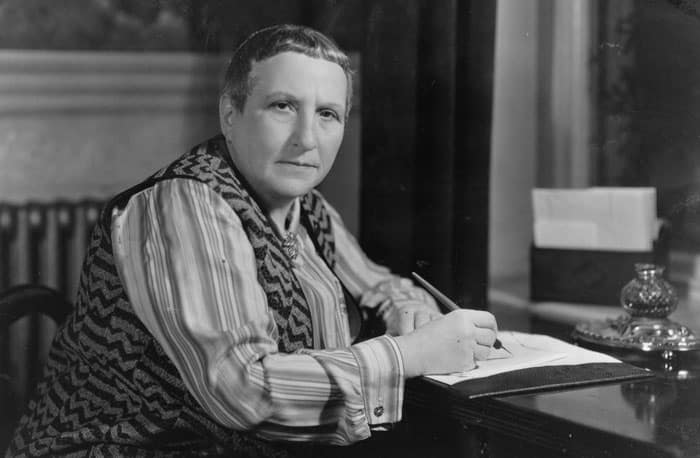
One of the more famous members of the “Lost Generation” was Gertrude Stein from Pittsburgh, Pennsylvania. She left the U.S. at the age of 27 and, flush with family wealth, eventually positioned herself in Paris at the center of a very lively avant-garde arts and culture scene that included several luminaries of the day. Her famous “salons” were featured in Woody Allen’s beguiling 2011 movie “Midnight in Paris.” Ernest Hemingway, Pablo Picasso, F. Scott Fitzgerald, Sinclair Lewis, Ezra Pound and Henri Matisse were all regulars at one of the most intriguing inflection points in history, hatched in Stein’s own living room.

In many ways, Stein was similar to today’s “wokesters.” On the one hand, her open, unapologetic, same-sex partnership with Alice B. Toklas, as well as her support for modernist artists, would seem to put her squarely in the “progressive” camp. On the other hand, though Jewish herself, Stein had no compunction about advocating for Adolf Hitler’s nomination for the Nobel Prize in 1938.

To be clear, by 1938 the Anschluss of Austria, the “Nuremberg Laws,” the arrest of over 30,000 Jews and the horrific destruction and violence known as “Kristallnacht” (The Night of Broken Glass) had all just occurred and painted such a crystal clear picture of what was to come that only a naïve person or hypocrite could ignore.

As the world continued to unravel, Stein held fast to her ideological stance. Given the Nazis’ opinions on homosexuality, the Jews, and even the modern art movement, which Hitler classified as “degenerate,” one would think that Stein would have changed her tune about the changing situation on the ground, particularly after the Nazis conquered France. 

Alas, Stein only doubled down on her stance including lending immense support to the Vichy Government led by Marshal Philippe Pétain who would eventually be convicted of war crimes for his role in WWII. Stein was a huge fan of Petain until the bitter end, the hypocrisy of which seemingly eluded her until her death in 1946.

Seventy-seven years after Stein’s passing, a new generation of activists is rising in America and the western world. Like its forebears, this generation is also making choices that are in direct conflict with their professed goals.

Seventy-seven years after Stein’s passing, a new generation of activists is rising in America and the western world. Like its forebears, this generation is also making choices that are in direct conflict with their professed goals. Even in the face of overwhelming evidence to the contrary,  the left wing of the Democratic Party supports Hamas’s objectives through daily calls for another ceasefire even as Hamas continues to reject offers of a ceasefire.

Leftwing Jewish groups, including “Jewish Voice for Peace,” “Bend The Arc” and “If Not Now,” have taken positions that line up neatly with Hamas’s positions while remaining largely silent about both the massacres on Oct. 7th and the ongoing holding of hostages by Hamas. In the face of overwhelming evidence, including Hamas’s own video testimonies detailing the atrocities of Oct. 7th, these lemmings hold fast to positions as oxymoronic as “Queers for Palestine.” Indeed, like the Nazis, Hamas detests homosexuals and puts them to death.

As a former Hillel CEO with more than 20 years of experience on U.S. college campuses, it is admittedly jolting to see Jewish students standing shoulder-to-shoulder with the enemies of the Jewish people chanting “from the river to the sea, Palestine will be free,” as if this phrase is somehow not an actual call for genocide against the Jews. A generation of activists has risen that does not know Gertrude Stein and yet is blithely goose-stepping with her support for authoritarians and mass murderers.

Last month we celebrated Hanukkah, the Festival of Lights. We commemorated the victory of hope over hate, light over darkness and nonconformity over conformity. What we don’t generally do at Hanukkah is recall the Hellenists, those Jews who so closely aligned themselves with the dominant Greek culture that they actually fought against the Maccabees.

The Steins of today have set themselves apart from and in direct opposition to a Jewish community that is more unified than it has been since WWII.

Like Stein before them, today’s “anti-Jewish” Jewish marchers are not just on the wrong side of Jewish history; they are on the wrong side of history.

Just as the Hellenists and Stein aligned themselves against their fellow Jews, today’s Jewish outliers will also likely be written off the history page. Like Stein before them, today’s “anti-Jewish” Jewish marchers are not just on the wrong side of Jewish history; they are on the wrong side of history.


Aaron Weil is a former Hillel Executive Director and CEO. He resides in Ra’anana, Israel.

Gertrude Stein’s Anti-Jewish Positions Are Greeted Warmly by a New Generation of Jews Read More »

What’s Driving the Campaign Against Brothers in Arms?

The feelings of unity that Israelis shared after the barbaric massacre of Oct. 7 are slowly ebbing. Now the tensions and disputes of the last year are returning to the fore, parallel to the ongoing war.

Netanyahu seems to be in constant campaign mode, trying to deflect blame for his years of empowering Hamas, and what we in Israel call his “poison machine” — meaning the network of hired professionals, activists and bots manufacturing nonstop propaganda — has turned its rancor toward the NGO Brothers in Arms.

Brothers in Arms was established as a civic resistance group to the current government’s attempt at judicial overhaul. It was founded mostly by army veterans, secular centrist Zionists who took action against the unraveling of Israel’s republican ethos and liberal public sphere. They were arguably the largest, most organized and efficient group in the coalition of organizations resisting Netanyahu’s government, taking part in the protests and leading other ventures in the ongoing effort to oppose its plans.

The beginning of the war brought a swift shift for them. The organization turned into an auxiliary support group for the IDF, operating an enormous assemblage of warehouses and courier services aimed at supplying equipment missing and needed by the soldiers and helping civilians who have left homes near the war zone. They have done all this with their signature motivation and organizational skills.

Over the past few weeks, in response to Netanyahu’s blatant concern about his own political future, they have again begun to criticize him. That’s when the “poison machine” resumed taking aim at them. 

But it’s not only the government’s usual mouthpieces doing it. Brothers in Arms have been the target of sustained attacks by broader circles in the Israeli right, and it begs the question: Why? When the Israeli government is so dysfunctional, when acting ministers cause immense damage to the war effort by blurting out fantasies about resettling Gaza with Jews or, on the contrary, wiping it out with an atom bomb — what could be so annoying about an organization of Zionist patriots who have built the largest and most effective civilian support system for the IDF ever, who are helping citizens who have been dislocated, not to mention literally saving lives, while,  yes,  opposing the current government and demanding it be replaced? What’s the big deal?

I propose that their effectiveness is exactly what makes them a big deal: That they embody a highly organized, efficient and motivated secular, liberal civic movement such as has not been seen in Israel in decades.

In this it is a direct competitor to groups on the religious right, which are also organized, effective and highly motivated, which are changing the geography of Israel in Judaea and Samaria, which send “Torah groups” to live in secular neighborhoods, which employ pressure and lobby groups in the Knesset – and which used to be the only team to appear for the match. 

Flashback 50 years. After the Yom Kippur War, two large civic movements arose: Gush Emunim and Peace Now. Both rose from the trauma of the Arab nations’ surprise attack, and both sought to rebuild Israel.

Gush Emunim ran to the hills of Samaria, established settlements and changed the face of the country forever. Peace Now pushed for the peace treaty with Egypt, then for the Oslo Accords, and changed Israel as well.

But the collapse of the Israeli left since the breakdown of the peace process with the Palestinians has also broken Peace Now. It has long ceased to be the great movement it once was. In its place, many rights-centered organizations arose, but since the ‘90s a mass civic movement in the center or the left of Israel’s political field was nowhere to be found.

Gush Emunim is also gone, but the masses and the motivation are still there, and are channeled to the service of small movements, well financed by the government, which work just as tirelessly to change the face of the country.

The religious right became used to the fact that many  Israelis — at the political center,  left and  mainstream, the secular population, the urban populace, the broad middle class — did not like what they were doing, but assumed such individuals preferred continuing with their lives to actively opposing them. Secular bourgeois Israelis are weak, nihilistic,  self-centered hedonists, are they not?

Brothers in Arms is the first civic movement in decades to show the same determination the religious right organizations have — from the other direction.

Brothers in Arms is the first civic movement in decades to show the same determination the religious right organizations have — from the other direction. They are incredibly organized, thorough and efficient as only military personnel know how to be, motivated, and understand — as the other side realized a long time ago — that the struggle is over the essence  of the country, its democracy and even its very existence.

This is the reason they are attacked so vehemently. Their opponents will do everything they can so that they will be the only force left on the civic stage after the war, shaping the country anew as Gush Emunim and Peace Now did.

Brothers in Arms fight not for certain political solutions to the Israeli-Arab conflict, as did Peace Now, but for the liberal and democratic framework of the country itself. They represent an ethos of republican service and proficiency in the face of the disintegration of the state into quarreling tribes and the politics of pressure groups and partisanship. They rise against the legitimization of corruption and the celebration of unprofessionalism, and of course protest the attempt by the current government to crush the separation of powers in Israel. Opposing all these clearly threatens the forces that attack them.

There is no doubt that after the war Israel will be brimming with various enterprises attempting to rejuvenate and reinvigorate Zionism in Israel by setting ambitious social goals and projects. There certainly will be such initiatives from the religious right, just as Gush Emunim appeared after the Yom Kippur War. Thankfully, there will also be such endeavors from the center and the left, of which Brothers in Arms will play a prominent role.

We can hope that they and others make an opportunity of this crisis, an opening to use the strengthened bond between the people and to the state to push towards a constructive, republican and liberal nationalism, presenting a vision of humanistic, prophetic Judaism as part of building a model society — an aspiration which was always part of the Zionist movement.


Dr. Persico is a Research Fellow at the Shalom Hartman Institute and a Rubinstein Fellow at Reichman University

What’s Driving the Campaign Against Brothers in Arms? Read More »

Peeking Inside TikTok’s Quran Book Club

On Oct. 18th, Aurora Birdy—a trans influencer, posted their first TikTok about the war in Gaza, accusing Israel of apartheid and genocide. 

By Nov. 25th, they had started reading the Quran. “It blew my mind,” they raved. “Did you know that Allah is beyond gender?” 

Aurora is not alone on their path from outrage at Israel to curiosity about the Quran. A search on TikTok for the phrase “Quran Book Club” reveals a whole mini-movement of young Americans — mostly women — who have started reading the Quran and are actively converting to Islam or considering doing so. 

Some of the new converts are donning hijabs. Others are not. Some are running to their local mosques. Others are doing this all online. Many come from the progressive vanguard of the American left and many others are ex-Christians. 

Despite this diversity, however, one thing seems to unite them all: Their decision to convert is rooted in their political feelings about Israel and Palestine. Their profiles are decked out with Palestinian flags and watermelon emojis. They are more likely to talk about decolonization than they are about dua. 

These extremely-online converts look to Muslim influencers to explain their new faith to them in terms amenable to American progressives. One such figure is Misha Euceph, a Pakistani-American content creator currently working on a book (forthcoming from Little, Brown) which she states “will unveil a progressive, largely ignored vision of Islam which “is not only compatible with modern ideas around sex, politics and everything in between, but informs them in ways we’ve never considered before.” 

Euceph is intelligent and charismatic. Watching her clips, I was reminded of some of my favorite progressive Jewish influencers—people with the ability to condense the moral message of an ancient faith into a social media post in a way that’s both accessible and deep.

Many of the new converts on TikTok, however, display a different sensibility. A far cry from Euceph’s progressive Islam, these proselytes are more reminiscent of a Hamas cleric.

Megan Rice (@megan_b_rice) had never read the Quran before Oct. 7th. Today she wears a hijab and regularly makes TikToks about Islam and anti-Zionism for an audience of nearly a million individuals. In one post, a gum-smacking Rice muses about ways that anti-Zionists might infiltrate Israel to take the land and kill Israeli soldiers.

TikTok user @openingmyheart24 reads a quote from the Quran about eternal scorching hellfire, suggesting that though it sounds harsh, it’s a fitting punishment for Israel and her inhabitants.

Ex-Christian convert @femmeslibre reads a quote about “those who spread corruption in the land.” She doesn’t explicitly state who “they” are, but her meaning is not lost on her followers in the comment section.

A constant refrain, repeated verbatim by almost everyone involved in TikTok’s “Quran Book Club,” is that they were “inspired” to convert “by the faith of the Palestinians” in the face of great hardship.

If this is true, one might ask why we didn’t see a similar wave of conversions in solidarity with the victims of the Syrian civil war, or why there was no wave of Catholic conversions inspired by the plight of Central American refugees, or, for that matter, a rush on AME churches during the summer of 2020.

What is it about the “faith of the Palestinians” specifically that has progressives ordering hijabs on Amazon? 

After all, Gaza is a strip of land dominated by an extremist, jihadist iteration of Islam. It was this faith, not Misha Euceph’s “progressive, largely ignored vision of Islam” which burned in the hearts of Hamas militants on Oct. 7th as they slaughtered over 1,000 innocent people in the most gruesome ways imaginable.

Perhaps, for some of these converts, this is precisely what they find so inspiring.

If that sounds like an uncharitable interpretation, remember who we are dealing with. Anti-Western, antisemitic, and violent rhetoric has become de rigueur for the anti-Zionist left. BLM Chicago has lionized the paragliding murderers who invaded the Nova music festival in southern Israel and it was only a few weeks ago that young anti-Zionists on TikTok were praising Osama Bin Laden for his “Letter to America.” 

To be more charitable, many of the new converts seem motivated by genuine spiritual and intellectual curiosity as well. Aurora Birdy’s enthusiasm is undeniable. It is also — for me — quite familiar. I was raised in a completely secular home. Judaism was something that I embraced in college, and I remember well the thrill of encountering its depth for the first time — especially having grown up in a culture which is quick to dismiss Abrahamic faiths as retrograde and simplistic.

In “the Madness of Crowds,” Douglas Murray writes about the collapse of society’s grand narratives — frameworks of understanding the world that were traditionally rooted in religion. 

“It was inevitable that some pitch would be made for the deserted ground,” he writes, “People in wealthy Western democracies today could not simply remain the first people in recorded history to have absolutely no explanation for what we are doing here, and no story to give life purpose.”

In recent years, social justice movements have stepped up to fill this void, offering adherents a moral map to the universe and a guide to their place within it. 

Actually changing one’s identity for the cause is a newer phenomenon. Moreover, it’s an option that was notably unavailable when the focus of the movement was race in America. Not for lack of trying — a number of activists and left-wing professors such as Rachel Dolezal, Jess Krug, and Raquel Saraswati masqueraded as racial minorities for years. When they were discovered, however, they were shunned — not praised.

Unlike changing one’s race, changing one’s religion is possible, creating a legitimate path for zealous activists to center themselves in a faraway conflict and ritualize their social justice commitments.

Unlike changing one’s race, changing one’s religion is possible, creating a legitimate path for zealous activists to center themselves in a faraway conflict and ritualize their social justice commitments.

There is a lesson here about the ravages of the internet on our culture, but the more important takeaway has to do with meaning and identity. Our steady abandonment of religion as a society has not quashed our yearning for transcendence and meaning. Nor has it made us a nation of free thinkers. Rather, it’s made us a nation of easy marks, ready to be duped by the first influencer who tells us who we are, what we should believe, and who we should hate.


Matthew Schultz is a Jewish Journal columnist and rabbinical student at Hebrew College. He is the author of the essay collection “What Came Before” (Tupelo, 2020) and lives in Boston and Jerusalem.  

Peeking Inside TikTok’s Quran Book Club Read More »

To My College Peers Calling for Intifada

To the vile protestors yelling outside my dorm building: Congratulations. 

To the Cooper Union thugs who banged on the library doors that served as refuge for their Jewish classmates: Congratulations. 

To those at Princeton who proudly proclaimed, “Long live the intifada” and “From the river to the sea, Palestine will be free”: Congratulations. 

To the “peace-loving” NYU students who chanted, “Intifada, intifada, globalize the intifada” and aptly summarized their stance on the two-state solution, “We don’t want no Jewish state, we want all of it”: Congratulations. 

To the cowards at Harvard who hid behind anonymity as they tore down hostage posters: Congratulations.  

To those who protest hate speech and remain silent as Jews bear the brunt: Congratulations. 

To all the “feminists” who turn a blind eye to, or even condone, the rape of countless women left murdered with broken pelvises: Congratulations. 

To all the “gay rights” activists who promote an ideology that mandates the slaughter of every LGBTQ+ member: Congratulations. 

To the Cornell students who are committed “to diversity and inclusion” and then post, “If I see another Jew on campus… I will stab you and slit your throat…drag you and rape you and throw you off a cliff…” while insisting that anti-Zionism is not antisemitism: Congratulations.

Congratulations for revealing your twisted, visceral, antisemitic hatred more effectively than I ever could. Your demonic defense of terror has clarified any confusion.

Congratulations for revealing your twisted, visceral, antisemitic hatred more effectively than I ever could. Your demonic defense of terror has clarified any confusion. No, you do not care for truth or justice or women’s rights. Murder, rape, beheading and kidnapping are evil, you say – unless it’s done to Jews. Then it’s “acceptable in the proper context.” Tell me, future leaders, what would make you murder, rape, behead and kidnap? What “context” could permit such depravity? It appears that being born a Jew is sufficient. 

Congratulations on unveiling the ugly truth: that the Holocaust is not merely a tragic past, but a horrific present. As the granddaughter of Holocaust survivors, I knew evil existed but I never understood who could tolerate it. Congratulations, college students. I now know Nazi sympathy did not die, it is very much alive in you. 

Dear “social justice warriors” who are so quick to condemn past generations: do not forget that future students will judge you as well. Make no mistake, the Jewish people and their allies know how this will end. The Jews have survived Egypt, Persia, Greece, and Germany. Hamas will be no different. The question remains, how will you be remembered? 

The Hebrew phrase “mazel tov” is often mistakenly translated into English as “congratulations.” However, rightly understood, this term has a very different meaning. “Mazel” implies constellations, or timing, and “tov” means good. When Jews wish each other “mazel tov” they are blessing one another that this time should prove to be auspicious and fortuitous. So “mazel tov,” America. It is my fervent wish that this painful moment and revelation of complete moral bankruptcy on college campuses will awaken the nation and ensure a better future.


Fayga Tziporah Pinczower is a Straus Scholar at Yeshiva University. 

To My College Peers Calling for Intifada Read More »

Unbreakable: A Woman Who Lost Four Family Members Remains Strong

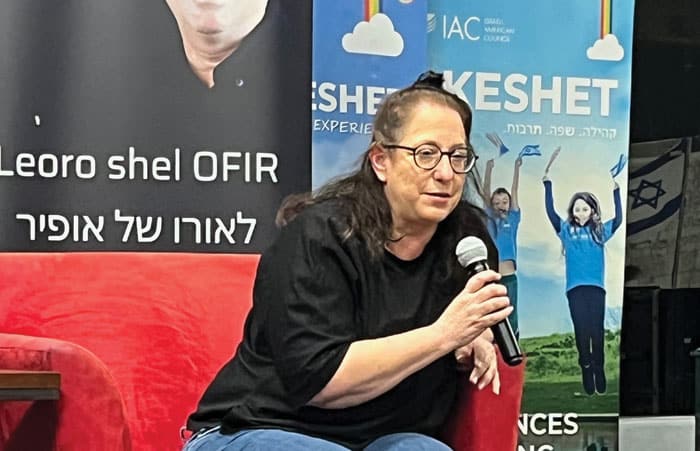
Several weeks after Vered Libstein lost her husband, son, and mother, she arrived in the USA accompanied by her brother-in-law Doron Libshtein, a world-famous self-development mentor and Miriam Peretz, who had lost two sons during their service in the IDF. Peretz became a lecturer and public speaker on coping with loss and Zionism.

The lecture took place on the third night of Hanukkah at the IAC Shepher Community Center in Woodland Hills. The Libstein family resided in Kibbutz Kfar Aza, situated between Netivot and Sderot. Ofir, Vered’s husband, served as the Head of Sha’ar Hanegev Council. His wife recalled how he used to say that the kibbutz is 95% paradise and 5% hell, due to the proximity to Gaza and the rockets that were sent to Gaza envelope settlements from time to time.

“We didn’t move to Kfar Aza because we didn’t have money or because of some ideology. We lived there because we believed it’s the best place in the world.“ -Vered Libstein

Now, the entire area had been evacuated, and residents are scattered in hotel rooms in Eilat, the Dead Sea, and Tel Aviv. Vered, who lost so much in the war, embarked on a lecture tour along with her brother-in-law. “We didn’t move to Kfar Aza because we didn’t have money or because of some ideology. We lived there because we believed it’s the best place in the world,” she said.

When Hamas launched its terror attack on Israel, Ofir, 50 left the house with his pistol. “My son Aviv said that he hears him shooting just outside the house. After about an hour I received a phone call from the Kibbutz council telling me that he doesn’t respond to their calls. I asked Aviv to check his location on the phone and he said, he is right here, outside the house. When he saw there is no change in the location for some time, he ran outside to look for him and found him dead.”

A little earlier, Libstein received a phone call from her father telling her that her mother Bilha was shot to death by Hamas. Her 19 year-old son Nitzan, the second of her four children, moved out of the house a few weeks before that and lived in the youth housing in the Kibbutz. “He told us he was shot in his hip through the shelter door, we told him how to do a tourniquet and spent two hours with him on the phone until his battery died. We asked him to hang on until help will arrive.” 

The area was swarmed with hundreds of Hamas terrorists, making it nearly impossible to reach Nitzan. A few days later, his body was recovered, and within 48 hours, the father and son were laid to rest side by side. The family’s tragic ordeal didn’t end there. Vered’s nephew, Netta Epstein who also lived in the youth quarters of the Kibbutz, jumped on a grenade to save his girlfriend and got killed on the spot. 

The sequence of funerals unfolded rapidly, with Neta being buried on Tuesday, Ofir on Wednesday, Bilha on Thursday morning  and Nitzan at 3 pm. Experiencing four funerals within a few days is incomprehensible, yet Vered remains determined to carry on in memory of her loved ones and for her three remaining children.

Libstein acknowledged the temptation to ponder what might have happened if his brother and his family were still vacationing abroad and not at home that day. However, he emphasizes that dwelling on the past hinders the ability to see the future and is optimistic about the possibility of peace. “70 years ago if you heard that one day we will be friends with German and that we would go there on vacations, you would have said: No Way! But it is possible. We must look at the picture that we are all together if we won’t believe it’s possible, it won’t happen. In order to see the light we must believe.

Miriam Peretz understands the unbearable pain of losing loved ones all too well. Two of her sons, Uriel at 22 and Eliran at 32, were killed in Israel’s wars. After losing her second child, she made a conscious decision to focus on the positive aspects of life. Peretz believes that having a reason to live is crucial, as lacking it makes it challenging to face each day. When asked about her strength and resilience, she responds that everyone possesses the strength that becomes evident in times of crisis, providing opportunities for personal growth.

While Peretz acknowledges that she doesn’t experience complete happiness, she finds purpose in life that propels her forward. With four children and an active lifestyle, she received the Israel Prize for lifetime achievement in 2018 and ran for the position of the president of Israel in 2021. Following the Oct. 7th massacre, she took it upon herself to visit families who lost loved ones, addressing the common question of where God was in the face of tragedy. Peretz asserts that there is no clear answer to that question, urging people to think differently about such events. She emphasizes the importance of focusing not on how long one has lived but on what they have achieved with the time given.

 “Ofir lived a full life, he thought about how to unite people. He gave a lot to the community. One of the things that fulfill a person is giving to others, as much as you give, you feel a sense of purpose and accomplishment and that’s what keeps me going.”

Unbreakable: A Woman Who Lost Four Family Members Remains Strong Read More »

Skirball Receives $2 Million Grant to Fund Black-Jewish Connections

The Karsh Family Foundation has given a $2 million gift to the Skirball Cultural Center to support the Skirball’s work highlighting connections between Black and Jewish Americans. 

“There has never been a greater need for solidarity between Black and Jewish communities as threats of antisemitism and racism continue to bedevil our democratic freedoms,” said Skirball President and CEO Jessie Kornberg. “We know this gift from the Karsh family will allow the Skirball to meet that need and we are so grateful.”

The announcement was made during a Dec. 5 program called “Perspectives on Black-Jewish Relations in the Fight for Civil Rights” that showcased Civil Rights icon the Rev. Dr. Bernard Lafayette, Jr. in conversation with Los Angeles Councilwoman Katy Yaroslovsky. It highlighted the relationship between Jewish values and the defense and establishment of civil rights and was inspired by the Karsh Foundation gift.

“These alliances have been a bedrock of American progress and can be again.” – Martha Karsh

Martha Karsh, who co-founded the Karsh Family Foundation alongside her husband Bruce, said they are both “proud to support the Skirball’s ongoing efforts to celebrate those who have worked to dismantle systems and laws that have segregated and subjugated Jews, Blacks and other historically oppressed minorities. These alliances have been a bedrock of American progress and can be again.”

The Skirball’s current exhibition, “This Light of Ours: Activist Photographers of the Civil Rights Movement” shows photos from the movement, including ones from a Jewish American photographer who documented this vital work. 

Additionally, the Skirball has created a community that will explore Black-Jewish relations. Those involved include Chief Operating Officer of the Los Angeles Urban League Cynthia Mitchell Heard; Dr. Alison Rose Jefferson, independent historian and curator; Chief Executive Officer of the United Negro College Fund Dr. Michael Lomax; Chief Executive Officer of LA Commons Karen Mack; and Distinguished Professor David Myers, the Sady and Ludwig Kahn Chair in Jewish History at the University of California, Los Angeles. 

“The Karsh Family’s gift will fund important research and planning for additional exhibitions and curriculum design, as well as community gatherings,” said Jefferson. “We are excited to be engaged in this important work alongside one the nation’s most important Jewish cultural centers.”

According to Kornberg, the Black and Jewish communities have deep ties throughout modern American history. 

“Whether through Julius Rosenwald and Booker T. Washington’s school-building partnership in the 1920s, the extraordinary work of HBCUs to welcome German Jewish refugees in the 1930s or the lionized coalitions between Civil Rights leaders and Jewish congregations in the 1960s – at key moments in American experience shared experiences and interests between Black and Jewish communities have forged a path through conflict towards greater inclusion and prosperity,” she said. “In an age of increasing division and social disconnection, it is important to better understand how these communities connected in the past so that we might imagine strengthening those connections in the future.”

In general, Kornberg believes that the Skirball’s programs and exhibitions and sharing of Jewish history and culture will help to demystify Judaism and Jewish identity for a broader audience, working to fight antisemitism at the same time. 

“As the foreign becomes familiar the opportunity for sharing, mutual appreciation, and respect despite difference grows,” she said. “The hope with a cultural connection project like this one is to help all those who experience it see themselves in some aspect of all sides of a story – not just those with whom they might initially identify.”

Skirball Receives $2 Million Grant to Fund Black-Jewish Connections Read More »