fbpx

January 3, 2024

Club Z National Teen Conference Coming to Los Angeles January 12-15

How do you get adults to have “civilized conversations” about Israel? Start teaching them the basics while they’re in high school. That’s what the Israel education organization Club Z aims to do. For the first time since it was founded in 2015, Club Z will be holding its National Teen Conference on the west coast—right here in Los Angeles from January 12-15.

The Club Z mission is to raise “modern-day Zionists who are articulate and knowledgeable leaders.”

The goal of Club Z can be summarized in one photo that they put on their pamphlets: a photo of a pro-Israel college student on campus smiling while holding a sign that reads “Come have a conversation with us.”

Club Z alumni protesting “Israel Apartheid Week” at UC-Berkeley in March 2023 (Photo credit: Club Z).

They address everything from hate on social media, to identifying media bias, to confronting antisemitism on college campuses, to organizing and speaking at Israel rallies and how to counter protest safely and effectively.

The annual conference will bring hundreds of students and alumni, and a slate of keynote speakers including Israel Activist Adela Cojab, IDF veteran and comedian Joel Chasnoff, PragerU CEO Marissa Streit, and Jewish Broadcasting Services Vice President Shahar Azani. Unlike most conferences, the keynote speakers typically stay for the duration of the Club Z weekend for maximum impact.

The organization’s founder, Masha Merkulova conceived of the idea for Club Z out of a personal necessity in teaching her children. In 2010 and 2011, she noticed that even though her seventh-grader son attended a reputable Jewish day school in the San Francisco Bay area, the Jewish education from the day school, Hebrew school, summer camps, and youth movements didn’t address the conflict nor “prepare our kids to understand various anti-Israel accusations.”

“The education has been sterilized,” Merkulova told the Journal. “Everything is done through the lens of Jewish values— which is great, we need to have values. But there is more to Jewish identity than Jewish values. We have been graduating thousands and thousands of kids who don’t understand that Judaism is not a religion. They don’t understand that being a Jew means being connected to a specific land in a specific place, and so all of these things culminated in our kids [being] unable to defend themselves when it comes to hatred not only on the college campus, but even in in their high schools and especially in public high schools.”

Merkulova looked for a program that she envisioned could rectify her concerns. She couldn’t find any.

“When I did not find anything, in my limitless arrogance and chutzpah, I thought ‘well how hard could this be? I’ll just I’ll teach and I’ll run a short limited program of series of workshops for [my son]  and his friends.’”

Club Z started as just for boys and soon thereafter brought girls in. Merkulova would cook dinners for them on Saturday nights, they’d get together, and she would present information about Israel. From there, the kids started inviting more friends and Merkulova started inviting speakers.

In January 2015, Club Z held its first conference with just under 20 high school students. It was at a yoga retreat site in Calistoga in wine country, which has since been destroyed by wildfires.

The kids wanted more. They liked the community Club Z created and kept asking when the next session and the next conference would be.

Since then, Club Z now has over 150 teams across the United States. The organization grew and so did the number of alumni who wanted to keep coming back after they went off to college.

Batsheva Frankel, the Club Z Director of Education said that over the years, she has witnessed a surge in interest in Jewish education from previously less-engaged Jewish youth and young college students who attended Club Z. She says that the stressing of respectful and fact-based conversations, especially in the digital age is paramount.

“What we’ve always done, and of course now it’s even more important, is to talk about how to have a civilized conversation,” Frankel told the Journal. “We don’t encourage our teens, but even the parents, to get involved in crazy social media stuff because it’s a no-win.”

Frankel said that in the wake of the attacks of October 7, a lot of the teams are having to have these conversations with their friends that they’ve known for a long time. And that’s one of the hallmarks of the 2024 National Teen Conference in Los Angeles.

“One of the things we’re guiding them with, which we’ve never had to do before, is how to have conversations with your friends who are now suddenly posting lies about Israel or liking different posts that are just outrageous and it’s painful for these teens.”

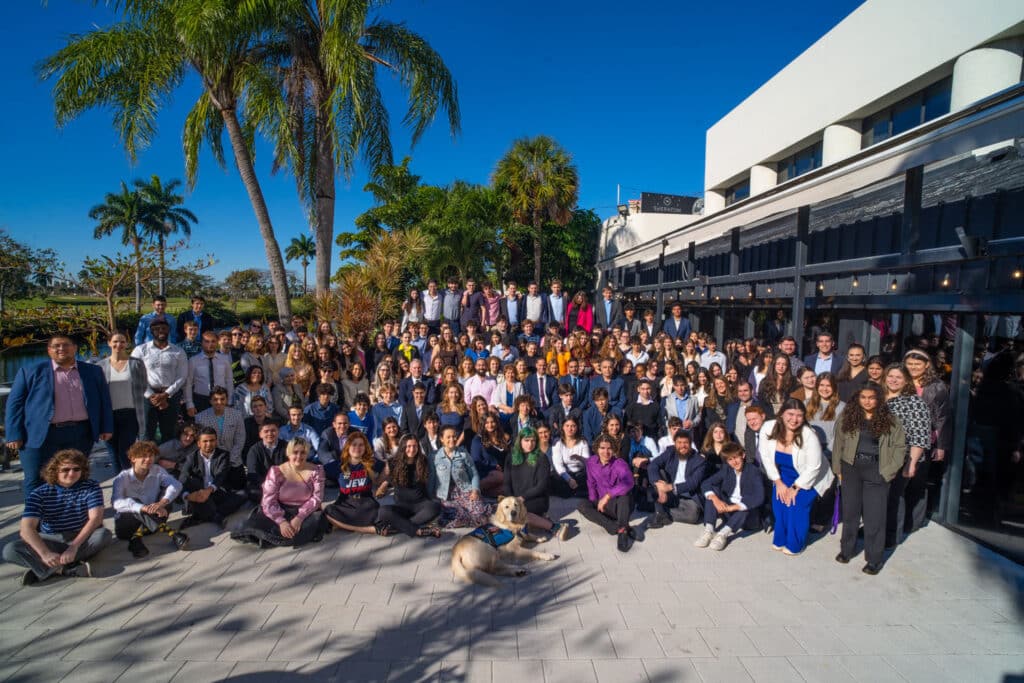
The 2023 National Teen Conference in Miami included dozens breakout sessions, on topics such as “Raised to Hate: Ask Me Anything” (where Yahya Mahmid, an Arab-Israeli zionist lamented his upbringing as a Jew hater), “Will the Real Jews Please Stand Up? Antisemitism and Black-Jewish Relations” (featuring Joshua Washington, Director for the Institute for Black Solidarity with Israel), “How to Spot Anti-Israel Bias in the News,” and “Rules of Engagement with Colonel Richard Kemp.”

Colonel Kemp, a retired British Army officer and veteran of the Gulf War, Bosnian War, War in Afghanistan and Iraq War, will be at the conference yet again this year.
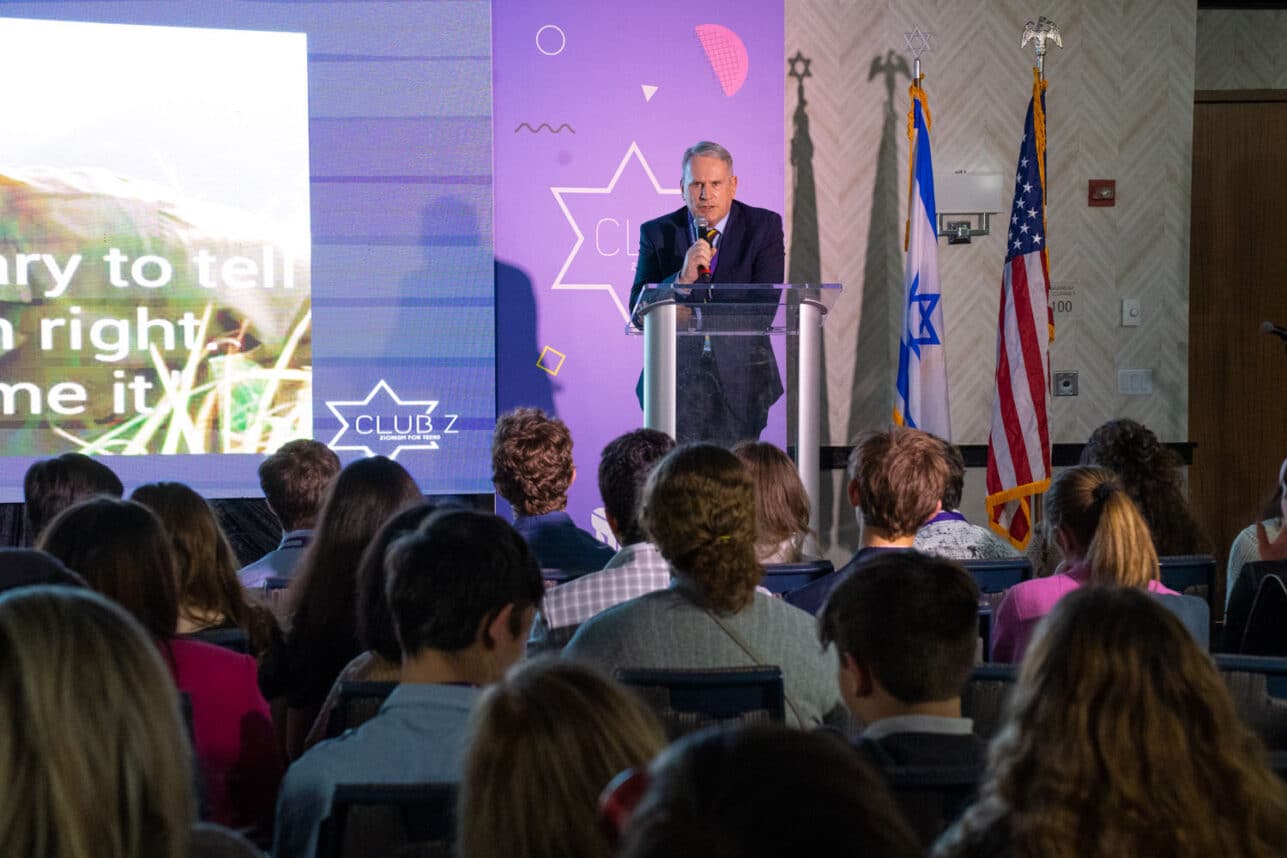
Col. Richard Kemp, British Army ret., speaking at the Club Z National Teen Conference in Miami in 2023 (Photo credit: April Nicole).

Between the annual conferences, the local Club Z groups around the country keep the enthusiasm and engagement amongst members together. Even as they go off to college, many alumni come back to support the local teen chapters. Isabella Gurevich, currently a sophomore at Brooklyn College, shared what impact Club Z has had on her, especially in the contentious college campus environment.

“Every time I am thrown with hate on campus, I can reach out to a friend I went through Club Z with,” Gurevich told the Journal. “And every time I go to a conference, I always learn something new. They always have a different speaker, new sessions, a different everything.”

But the goal always remains the same. Gurevich credits Club Z with preparing her for anti-Israel and anti-Jewish sentiments on campus, and for inspiring her to pursue a degree in marketing and political science. Her involvement with Club Z has also led her to participate in multiple conferences aimed at curbing antisemitism every year.

“I tell high schoolers absolutely not to be just active, but to be the most active,” Gurevich said.

Attendees don’t even need to be Jewish to attend. Although registration is closed, Club Z is still selling keynote tickets.

Club Z’s marketing director, Gail Rauner, who has spent over two decades in the world of public relations, says that “Club Z is the fulfillment of her career dreams.”

“Our Club Z curriculum lasts the entire year and then kids stay in it for three or four years,” Rauner told the Journal. “So when you spend the time and explain the nuances of Israel’s history, it gives the kids a lot of confidence to understand the ancestral and even modern politics of the State of Israel.”

Club Z National Teen Conference Coming to Los Angeles January 12-15 Read More »

‘Recipe for Change: Standing Up To Antisemitism’ Wins Emmy

On December 16, “Recipe for Change: Standing Up To Antisemitism” won the Emmy Award for Best Daytime Special. The program, subtitled, “Dinner, Discussions and Jewish identity,” celebrates Jewish culture through the lens of food and conversation.

“In my lifetime, there has never been a more critical time for a program like ‘Recipe for Change’ than the present, with the extreme rise in antisemitism here in the U.S. and globally,” Todd Shotz, the show’s consulting producer, told the Journal. Shotz is the founder of the Jewish education company Hebrew Helpers, as well as a filmmaker and Jewish technical advisor for film and TV.

“Being recognized in this way by the Television Academy felt so incredibly rewarding after I have spent the last 25 years educating about Jewish values, history and practice and aiming to produce projects which champion a cause I believe in,” he said.

Produced by LeBron James’ The SpringHill Company and YouTube Originals, “Recipe for Change: Standing Up To Antisemitism” invites the viewer to three Shabbat dinners: two in Los Angeles, one in New York City. 

Hosts Ilana Glazer, Moshe Kasher and Idina Menzel partner with renowned chefs Nancy Silverton and Einat Admony, and culinary historian Michael Twitty. Silverton, Admony and Twitty offer their take, along with their signature dishes. 

Guests range from actors and creatives to advocates and entrepreneurs. They include Skylar Astin, Michael Ian Black, Rachel Bloom, Tommy Dorfman, Alex Edelman, Hannah Einbinder, Jordan Firstman, Lori Gottlieb, Bryan Greenberg, Hari Nef, Josh Peck, Zac Posen, Ruth Reichl, Rachel Sumekh and Michael Zegen, along with rabbi Sharon Brous and ADL CEO Jonathan Greenblatt. Rachel Dratch also joins in as an on-the-street reporter.

These meals provided the perfect forums for the hosts, chefs and guests to celebrate their Jewish heritage, identity and culture, as well as discuss the rise of antisemitism and its impact on the Jewish community. 

The original plan was to shoot two dinners. Then, they decided to add a third. 

“The last dinner was really helpful to us, because we could figure out what we needed, what questions we wanted to make sure to ask again to get more of the information [out there],” Shotz said. “Trying to cover 4,000 years of Jewish history, culture, tradition, practice, ritual, dispelling myths and [libels] against us was … a herculean task.”

“Recipe for Change: Standing Up To Antisemitism” premiered in April 2022 and has been viewed nearly 980,000 times. 

They considered doing the meals as Passover seders, as a way to encapsulate the Jewish experience, Shotz explained. They ultimately decided a Shabbat meal would be more evergreen. “What is more fundamental to the Jewish people than Shabbat,” Shotz said. 

Showrunner and executive producer Joel Relampagos said he loved making the viewers feel like they were a part of these meaningful dinners. It was a full team effort.

“There were so many beautiful, powerful, personal stories that were shared and it was important to us that viewers felt they were experiencing it with us.“ – Joel Relampagos

“We really wanted those watching to feel like they have their own seat at the table and are a part of these needed conversations,” Relampagos told the Journal. “There were so many beautiful, powerful, personal stories that were shared and it was important to us that viewers felt they were experiencing it with us. How I only wish that viewers could have tasted the delicious foods!”

“My favorite part of the project was to be able to bring together unique voices from different industries and backgrounds but highlight the similar Jewish experiences,” Camille Maratchi vice president, unscripted and documentaries of The SpringHill Company, told the Journal. 

Maratchi, who served as co-executive producer on the program, calls it an “honor and a privilege” to work at The SpringHill Company, whose mission is to build content like this. 

“Empowerment is at the center of everything we do and this show is a clear example of that,” she said. “I’m proud of the show we put together and am thankful to the many people who helped put it together both in front of and behind the camera.” 

“Standing Up To Antisemitism” is the second installment in the “Recipe for Change” series. The first one, “Stop Asian Hate,” was nominated for an Emmy last year.

“When we started ‘Recipe for Change’ it was in response to the rise of Asian hate,” she said. “We set out to make a show about marginalized people to help raise awareness and combat hate while celebrating the people and culture through conversation and food.” 

This installment, “Standing up to Antisemitism,” has the same goal. 

“We didn’t realize how significant and important the work would become so I hope that this show can continue to be a guide and a teaching tool about the Jewish religion and culture,” she said. 

Shotz found creating this valuable conversation starter to be a meaningful experience. “One that we hoped could both build bridges between our community and others as well as dispel some of the misinformation about us that is out there,” he said. 

Relampagos hopes the show continues to make those from the Jewish community feel seen, heard, inspired, proud and represented. And that it educates and raises awareness for those who are not Jewish.

“I want those who are non-Jewish to understand the importance of being there to support and uplift their Jewish friends, colleagues and chosen family,” he said. “Solidarity is always important and I hope that people see how needed allyship truly is, as well.” 

He adds, “If we truly want change in this world, every single one of us can be an essential ingredient in that recipe.”

Watch “Recipe for Change: Standing Up to Antisemitism” on YouTube.

‘Recipe for Change: Standing Up To Antisemitism’ Wins Emmy Read More »

Bibi on a Razor’s Edge

I sure hope Bibi is right.

I say this not as an unadulterated Netanyahu supporter. Like many American Jews, I have admired his economic, security and diplomatic successes over the years. And like many ardent Zionists both here and in Israel, I have been concerned by his recent exercises in judicial tap-dancing and the increasingly troubling coalition-building that his legal troubles have required. But I also try to remind myself that Israelis get to make these decisions for themselves. So I watch from a safe distance (although not feeling quite as safe as I did three months ago) and continue to hope for the best for Israel and its people without presuming that I know what’s best for them.

Since Oct.  7, I’ve watched Netanyahu try to lead his country after the worst atrocity against the Jewish people since the Holocaust. It’s clear that the country’s government, intelligence services and military were woefully unprepared for the Simchat Torah massacre and it appears likely that he will be removed from office for those failures the same way that Golda Meir was replaced after similar breakdowns led to the Yom Kippur War fifty years ago.

Regardless of how much longer Netanyahu remains as Israel’s leader, his current position demands that he articulate a credible strategy for winning the war in the face of mounting international skepticism and domestic exhaustion. 

But regardless of how much longer Netanyahu remains as Israel’s leader, his current position demands that he articulate a credible strategy for winning the war in the face of mounting international skepticism and domestic exhaustion. On Christmas Day, he outlined a remarkably ambitious set of goals for the war’s successful resolution in a Wall Street Journal opinion piece. In the opening paragraph, Netanyahu presented his objectives clearly and succinctly:

Hamas must be destroyed, Gaza must be demilitarized, and Palestinian society must be deradicalized.

I want all those things to happen, too. Every Hamas terrorist should be captured, imprisoned or killed. Gaza should be a safe and free place administered by a credible multi-national governing coalition in which its people can work, live and thrive. And Palestinian children should be taught that Judaism and Islam are two of the world’s great religions and that followers of those two faiths can co-exist with mutual respect and affection.

But that could take awhile, to say the least. Although thousands of Hamas fighters have been killed, the high death rates of Israeli military personnel suggest that the terrorist organization will continue the fight for the foreseeable future. The question then becomes not whether Israel should continue to work toward Netanyahu’s goals (of course they should), but rather whether the war against Hamas should continue as it is currently being fought until each of those objectives has been thoroughly and completely accomplished. 

Netanyahu correctly argues that leaving Hamas intact will guarantee additional violence against Israel and its people. Yet the terrorist organization’s leaders are reported to have surrounded themselves with Israeli hostages, making the release of the more than 100 remaining captives even more difficult as the war continues. Ongoing combat also requires considerable economic sacrifice for Israel, which is the announced reason for withdrawing thousands of reservists from Gaza in recent days. Worst of all, mounting evidence of the atrocities committed by Hamas fighters on Oct.  7, including systematic rape, sexual abuse and other horrific examples of gender-based mutilation has failed to shift world opinion. Even Israel’s strongest allies are pressing for some type of scaledown as the war enters its fourth month. 

Israel certainly cannot stop fighting right now. That would give the terrorists an unacceptable victory and would set the stage for even worse attacks in the future. Netanyahu’s aspirations are both noble and necessary, but eliminating Hamas, transforming Gaza and remaking the Palestinian culture are long-term goals. I want to believe him when he says that achieving all three are necessary conditions before the fighting can stop, but it’s difficult to see such dramatic changes occurring quickly enough for that to happen in the near or medium future.

I hope that Netanyahu’s laudable objectives can be accomplished before the price of Israeli blood, treasure and international isolation become too great to bear. I hope Bibi is right. Or if he’s not, that his successor is developing a more achievable strategy.


Dan Schnur is the U.S. Politics Editor for the Jewish Journal. He teaches courses in politics, communications, and leadership at UC Berkeley, USC and Pepperdine. He hosts the monthly webinar “The Dan Schnur Political Report” for the Los Angeles World Affairs Council & Town Hall. Follow Dan’s work at www.danschnurpolitics.com.

Bibi on a Razor’s Edge Read More »

Should We Feed Into the Outrage Machine?

Recently, I found out that a group called Doctors Against Genocide was planning to hold a pro-Hamas rally inside the United States Holocaust Memorial Museum in Washington, D.C. I posted the flyer to my X account and wrote about how this was clearly antisemitic and had to be shut down. Then I went to bed.

When I woke up the next morning, the tweet had been viewed over 450,000 times and received hundreds of comments from angry people on both sides. 

I looked at my other tweets, the more inspiring ones, and realized that they weren’t nearly as popular. All my tweets about antisemitism and other inflammatory topics received the most attention.

The algorithm clearly decides to promote outrage. Now, I wonder: Should we feed into the outrage machine?

Up until Oct.  7, I would never post something controversial on social media. I thought, I’m going to stay far away from it so I don’t attract any trolls. I wanted people to come to my page for comfort and inspiration, not for hard-hitting, negative news.

But after Oct.  7, and the explosion of antisemitism when the Jewish people were hurting the most, I couldn’t be quiet anymore. My people were being attacked literally and figuratively on a daily basis, and I have a unique voice: I’m a convert. I’ve been on both sides of this, and I can offer a different perspective. Oct.  7 and its aftermath only reaffirmed my choice to become a Jew and strengthen the Jewish people during this horrible time.

There is a big “however,” here though: I don’t post every angry thought in my head. I often start tweeting something and then decide to delete it because I think, “This is not productive.” If I do post something negative that’s happening, I always try to add an uplifting message at the end of it. 

I don’t want my posts to just get people riled up or make them upset. I want people to feel stronger once they read one of my posts. I want to give them advice on actions they can take to feel better. I want to remind them that Hashem is in control, and Hashem is good – even if we don’t know what “good” means. 

What does well on social media is usually not good for Jews, or society in general. Social media is very effective at stirring up arguments and dividing people. If you spend all day on X, Facebook, Instagram, and TikTok, you’d probably think that everybody hates you and be paranoid about leaving your house. Typically, when you get off your devices and go out into the real world, it’s a much calmer place. Everyday interactions aren’t so dramatic. In my life offline, I find that 95% of the people I come across are nice, and most of them don’t have hateful feeling towards me. They really don’t even care that I’m a Jew.

Before posting anything on social media, I encourage you to pause and think about how people may react to it. How will it make them feel? Determine your goals for posting and stay away from gossip and attacks.

Before posting anything on social media, I encourage you to pause and think about how people may react to it. How will it make them feel? Determine your goals for posting and stay away from gossip and attacks. It’s fine to state a strong position, but you don’t have to attack others in order to do it. You can be upset, but give people something to do and think about as well. You should aim to bring people together – not tear them apart.

As a Jew, it’s my mission to bring light into this world, especially when the darkness can seem so overwhelming. If I give into the frenzied news cycle and the criticism and the hate, that means the darkness wins. I don’t want people to lose hope – it’s what has gotten us this far. If we lose it now, we lose everything. 

I’m going to continue to fight the good fight online and off, and I won’t give up on my mission to keep hope alive. 

I hope you’ll join me.

What do you post about on social media? Email me: Kylieol@JewishJournal.com.


Kylie Ora Lobell is the Community Editor of the Jewish Journal.

Should We Feed Into the Outrage Machine? Read More »

A Bisl Torah – Jewish Resolutions

Recently, my husband and I celebrated our 14th wedding anniversary. A few days prior, we went on a family walk. I suggested we walk to Walgreens. My husband immediately agreed. We looked at each other and both sheepishly smiled.  I confessed, “You need to buy your anniversary card too?” He replied, “Absolutely.” As we walked together and laughed at the idea that we were buying each other’s cards at the same time, we both admitted that the card was redundant to the experience. Written expressions of love are good reminders but carving out time to walk with those we love is priceless.

Everyone is listing their new year’s resolutions. Ways they will exercise, instruments we want to play, languages we hope to learn. But the Jewish calendar is constructed in a way that honors the most essential resolutions: to appreciate God’s beauty in this world, celebrate life, mourn, and grieve death, and observe the sanctity of time. Time with family, friends, and community to learn, connect and grow with each other. Time to walk with those we love.

If you are looking for ways to open your heart and widen your soul, immerse yourself in Jewish resolutions. Come to synagogue. Observe Shabbat. Take a class. Look at the Jewish calendar and find lessons that bring meaning and purpose to one’s life. Take God’s precious gift of time to be a blessing to the world.

May 2024 bring us a year in which we walk together. A year of good health, joy, and appreciating God’s glorious world.

Shabbat Shalom


Rabbi Nicole Guzik is senior rabbi at Sinai Temple. She can be reached at her Facebook page at Rabbi Nicole Guzik or on Instagram @rabbiguzik. For more writings, visit Rabbi Guzik’s blog section from Sinai Temple’s website.

A Bisl Torah – Jewish Resolutions Read More »

Identity Crisis

In the movie The Ten Commandments at the Burning Bush when Moses, Charlton Heston,      

was addressed by God The One Almighty,                                                        

Cecil B. DeMille did not know whose voice he should use for God. He wasn’t jestin’,     

when he chose Charlton, gunman, PC righty.                                                                     


Cecil’s choice to speak the voice of God was Moses’ Jewish father, Levite Amram.              

The fire melting media-Moses’ ice is                                 

lit by the flame of insight to his roots, when hearing God explain “I Am Who I Am,”       

resolving his identity’s great crisis,                                                                                     


in contrast to the way the crisis of identity of Jews has been exacerbated                               

by being zapped as Zionistic colonizers,

the question, whether to be or not to be when bated

at them, distressing the Old Faithful geysers.


The movie The Ten Commandments, was made by Cecil B. DeMille in 1956, when Charlton Heston was still a liberal Democrat. Rabbi Meir Soloveichik pointed out that DeMille suggested that the voice of God addressing Moses from the Burning Bush should be that of his father, Amram.  

My poem follows Rabbi Lord Jonathan Sacks’s interpretation of Exod.  3:11: 

יא  וַיֹּאמֶר מֹשֶׁה, אֶל-הָאֱלֹהִים, מִי אָנֹכִי, כִּי אֵלֵךְ אֶל-פַּרְעֹה; וְכִי אוֹצִיא אֶת-בְּנֵי יִשְׂרָאֵל, מִמִּצְרָיִם. 11 And Moses said unto God: ‘Who am I, that I should go unto Pharaoh, and that I should bring forth the children of Israel out of Egypt?’

God had introduced himself to Moses in Exod. 3:6 as the God of his ancestors: 

Moses however still asks מִי אָנֹכִי, who am I?  This is not a rhetorical question, asked in order to indicate his modesty. He asks this question because he suffers from an identity crisis.

The first word after the first verse of the Shema in Deut. 6:4 is ואהבתv’ahavta, commanding  all Israelites to love God.  The medieval commentator Ba’al HaTurim explains that this word contains the letters האבותha’avot, meaning the forefathers, thereby implying that all Jews who recite the first verse of the Shema should follow the God-loving paradigm followed by Abraham, Isaac and Jacob. This suggestion not only anticipates Rabbi Sacks’s explanation of God’s declaration to Moses in the Burning Bush that He was the God of the patriarchs, but also justifies—presumably serendipitously—-Cecil B. DeMille’s decision to imply that God, when speaking to Moses at the Burning Bush, used the voice of his father Amram. 


Gershon Hepner is a poet who has written over 25,000 poems on subjects ranging from music to literature, politics to Torah. He grew up in England and moved to Los Angeles in 1976. Using his varied interests and experiences, he has authored dozens of papers in medical and academic journals, and authored “Legal Friction: Law, Narrative, and Identity Politics in Biblical Israel.” He can be reached at gershonhepner@gmail.com.

Identity Crisis Read More »

Michaele Weissman: “The Rye Bread Marriage,” Breaking Bread and Composed Beet Salad

Rye bread is a beloved foodstuff with a rich history. To author Michaele Weissman, it’s so much more.

“What do you do if you’re a writer, married to a guy who was born in Latvia, is obsessed with Latvian rye bread and stays obsessed through [all] decades of your lives,” Weissman told the Journal.

One day, she woke up and told her husband, “My next book is going to be called ‘The Rye Bread Marriage.’”

Weissman’s literary memoir intertwines the bread’s history along with their personal journeys. It’s an honest account, filled with humor, heart and rye bread. “The Rye Bread Marriage” was recently named as one of the ten best memoirs of 2023 by Zibby Owens.


Weissman has published four books and hundreds of articles. Her previous book, “God in A Cup,” is about the specialty coffee industry.

“I had followed some young coffee buyers around the world and had many, many adventures,” Weissman said.

For “The Rye Bread Marriage,” she decided, they would go traveling in Eastern Europe. This time, Weissman’s husband, John Melngailis, would take center stage. Melngailis is a retired professor of electrical engineering and the owner of Black Rooster Food, a small company marketing Latvian rye bread.

“Long before I fell in love with rye bread, but when I had fallen in love with John, I used to say I married him because I knew with him I’d never go hungry,” she said. “We share a common love  of food and food shared … with loved ones; that’s a huge bond between us.”

When Weissman entertains at home, she prepares three courses. She is a champion if the first course being composed salads. Her composed beet salad recipe is below.

“I don’t want to jump up after five minutes and change the soup bowls,” she said. “I want my guests, even though it’s the first course, to begin to get to know each other, to be relaxed and leisurely.”

Weissman has found that a big, beautiful, composed salad, filled with beets, pomegranate seeds, maybe a little fennel, oranges, walnuts and cheese, is not a lot of work.

“The secret is that if you serve such a thing as the first course, people will take seconds and they might even take thirds and yet they’re not too full to eat the rest of your dinner,” she said. “And I love that because the dinner starts immediately, the conviviality starts immediately.”

Weissman says that while many things change as you age, the joy of getting to know a new friend or spending time with an old one, while feeding them something delicious, nourishing them, endures.

“I always think that [the best] families are often about something,” Weissman said. “Some are about classical music, some about hiking and kayaking; our family is about this.”

Literally breaking bread.

“It’s about gathering friends at our table and sharing what we love,” she said. “Frankly, I can’t think of a better thing to build a life about around.”

Learn more about Michaele Weissman and The Rye Bread Marriage at MichaeleWeissmanWrites.com.

For the full conversation, listen to the podcast:


Composed Beet Salad

Photo by Michaele Weissman

A composed salad is one where you layer the ingredients, one on top of the other, instead of throwing the ingredients together in a bowl and tossing them with the dressing. When you are ready to serve, carefully pour the dressing over the top, making sure it drips down into the nooks and crannies.

Serves 8 or 10 as a first course,

Layers

4 to 6 cups lettuce or bitter greens for the base of the salad. (I prefer bitter greens such as radicchio, endive or frisee, but you can use any kind of fresh greens.)

4 large (but not huge) red or golden beets, or both. (approximately 4 cups after slicing). Make these a day or two before serving. Roast the beets in tin foil in a 375 oven for 40 to 60 minutes, depending on their size. Then wash and peel (after roasting the skins will fall away). Slice them and store in the refrigerator for several days. You can dress the beets ahead of time, as soon as you make the vinaigrette dressing (below). They will absorb the flavors of the vinaigrette without breaking down.

Optional: 1 or 2 large fennel bulbs, stalks discarded, cores discarded, sliced thin. (4 cups)

2 or 3 oranges, peeled, sliced and cut into small pieces (2 to 3 cups). When you cut them up, get rid of as much of the pith as you reasonably can and save the runoff juice for the vinaigrette.

3/4 cup or more pomegranate seeds (fresh, if available). Whole Foods and other stores sell pomegranates already seeded, if the idea of seeding them is daunting. To seed a pomegranate, cut the whole fruit in half and then slice the halves along the white pithy.  Cut in this way, the seeds pop right out their casing.

3/4 cup toasted walnuts. I always toast them, but you really don’t have to

1 – 1 1/2 cups high quality Roquefort cheese, broken in small pieces. Use the best Roquefort you can afford, quality in this instance makes a difference.  If cost is an issue, skip the fennel.

Vinaigrette

Makes 1 1/2 cups

Note: I always use honey and Dijon mustard in the dressing for salads that contain fruit. These two ingredients make the olive oil and vinegar “jump together,” avoiding a lot of arduous whisking.

1 1/2 tablespoons chopped shallot

grated zest from one orange (approximately 1/2 teaspoon)

1 1/2 tablespoons dijon mustard

2 tablespoons of honey to taste. (You can add more to the finished product if you like, but don’t overdo)

1 cup or slightly less high quality olive oil

1 tablespoon orange juice (from cut up oranges)

2 teaspoons red balsamic vinegar or pomegranate syrup, if you have it

1 teaspoon or less red wine vinegar or white champagne vinegar

fresh ground pepper (I use half a teaspoon, but you can use less)

salt to taste

Add all the ingredients (except the olive oil and vinegars) to a small bowl and whisk together.

Slowly add the olive oil and vinegar, while whisking all the ingredients together. You will be amazed how easily the vinaigrette emulsifies.

Putting it Together

Artfully lay out the salad on a large flat platter, one ingredient at a time. See photo above.

The presentation looks amazing, but it is easy to do.

Serve as a first course with (ideally) Black Rooster Baltic Rye Bread, The sweet/acidic/sour of the vinaigrette and the sweet/acidic sour of the fruit partners beautifully with an earthy 100 percent sourdough rye. A crusty baguette goes well too.

Bon Appetit!


Debra Eckerling is a writer for the Jewish Journal and the host of “Taste Buds with Deb.Subscribe on YouTube or your favorite podcast platform. Email Debra: tastebuds@jewishjournal.com.

Michaele Weissman: “The Rye Bread Marriage,” Breaking Bread and Composed Beet Salad Read More »

Israeli Women’s Entrepreneurial Spirit Resonates Profoundly After Oct. 7 Terror Assault

For Israel’s thriving tech industry, glowingly billed as “the start-up nation,” it is not hyperbole to suggest that the country has been wounded in all economic sectors in the wake of the Oct. 7 terror attacks. These severe setbacks include cuts to its many wizened and lucrative tech employees, many of whom have been called up for military duty.

It has been reported in the days after the Oct. 7 terror assault that cybersecurity firms will continue to experience significant changes. This sector, for a host of reasons, makes up a great percentage of the country’s workforce. Many larger firms have moved their business headquarters to the U.S. and, in some cases, to Europe. Many have maintained their research and development centers, according to reports by Security Week.

The cybersecurity sector in Israel is, as reported in Security Week, “believed to employ more than 20,000 people. Microsoft, Intel, Palo Alto, and CyberArk are each thought to employ around 1,000 people in Israel, with Check Point Technologies employing around 1,500. Many of these jobs are in [research and development].” The Times of Israel estimated that in 2021, $11 billion was earned in this sector of the economy. According to Reuters, high-tech industries have been the fastest-growing sector in Israel and account for 14% of its jobs.

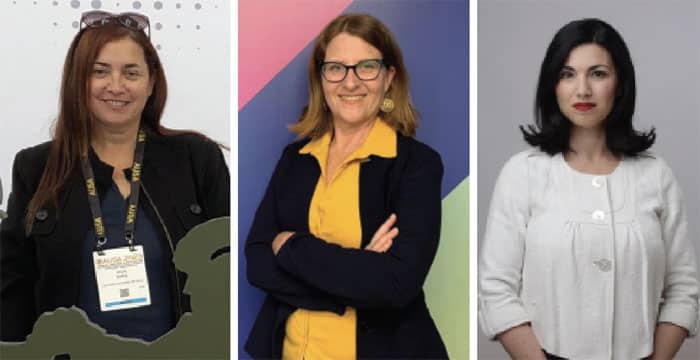
Sigal Gafni, an Israeli entrepreneur who grew up in the southern town of Arad, was at the Association of the United States of America (AUSA) summit in Washington, D.C., when the terror assault took place. She returned to her native country in horror and disbelief.  “I arrived in Israel,” she said,  “and it was immediately clear to me that my business will fall into a period where I probably won’t be able to work.”

SG Communications, of which Gafni is founder and CEO, provides various products and all types of services for high-tech organizations and those working in cyber and defense. Its primary aim is to support companies’ growth by opening new markets worldwide and differentiating their added value. “We, in Israel, are every day under the threat of a cyberattack, which has become an integral part by terrorists as they wage war against us,” said Gafni. She added, “in order to help communities in the world that are under attack and are subject to physical danger, we have developed unique products whose purpose is to identify in advance of these threats, and to deal with them in time to prevent injuries to innocents.” The products and services “specialize in consulting and  planning on a variety of advanced security solutions.”

There are five hundred multinationals operating in Israel — mainly research and development centers after buying Israeli start-ups — from Intel to IBM, Apple, Microsoft, Google and Facebook, Reuters reported. Just days after the terror assault, it was also reported that “tech companies operating in Israel are expected to fortify security as they could face disruptions.” In this same news report, Reuters cited the chief investment officer and founding partner at Cresset Wealth Advisors, Jack Ablin, who underscored that “short-term resources” could be diverted if the conflict expands. A growing number of Israel’s tech start-ups have already been incorporated in the U.S.

”Many start-ups are unprepared to deal with the crisis and are struggling to find investors. At a pivotal moment that determines a company’s survival, our goal is to bridge the gap and provide a tailor-made solution.” – Karina Rubinstein

Karina Rubinstein, an innovative expert and ClimaTech venture partner with InNegev, which according to its mission is dedicated to fostering top-tier Israel innovation and “generating a vibrant new growth model for the Negev region,” recalls that, “On Oct. 7, Israel [awoke] to the most horrific terror attack since its independence. Over 300,000 citizens, start-up founders and entrepreneurs among them, left their daily jobs to defend and protect our homeland. Many start-ups, though, are unprepared to deal with the crisis and are struggling to find investors. At a pivotal moment that determines a company’s survival, our goal is to bridge the gap and provide a tailor-made solution.”

The InNegev incubator, which is located in the West Negev, invests in early stage climatic start-ups. “During these challenging times, we are committed to helping the Israeli ecosystem. Our own activity has practically stopped, and we’re focusing on helping out wherever we can. I continue to share what we’ve been engaged [since the terror attacks] to help the ecosystem, specifically down south and cross-country,” Rubinstein said. Her experiences with investors and venture capitals are “not specific to the U.S., but around the globe. [I enjoy] the excitement of building new stuff from scratch, like [with] a new company, new product, and new markets.”

Viktoria Kanar, the CEO and founder of Re-Fresh, an innovative platform that offers an array of conceptual and technological solutions to the fashion and textile industries, said, “In the short term, U.S. businesses are hurting, and [American] companies with representations in Israel have had to operate without numerous employees who’ve been called up for reserve duty. In the long term, adjustments will likely be made in order to cope with the losses U.S. companies will bear due to the current situation.” Kanar’s Re-Fresh’s company has one solid U.S. investor in the U.S., which is SOSV. It is “one of the largest deep-tech investors in the world,” she said.

“I think that there is a huge problem in the climate tech community that has mostly — and blindly — come out against Israel, without any real background knowledge or understanding. It is not [aware] how much the Israeli entrepreneurial and start-up ecosystem has contributed to green tech innovation,” Kanar added. She remains hopeful, however, that “our contacts in the U.S. are not affected [as a result of Israel’s military response to the terror attacks]. I see it as our duty to educate and help people understand that doing business as usual is not an option. Israelis are known for their resilience, and some of the biggest investments in Israeli companies have been made during wars.”

Israeli Women’s Entrepreneurial Spirit Resonates Profoundly After Oct. 7 Terror Assault Read More »

Providing for IDF Soldiers After a Friend’s Death at Nova

David Newman’s untimely death at the Nova music festival prompted his friends to create Soldiers Saves Lives, a startup operation dedicated to supporting soldiers on the front lines.

Ike Bodner, one of the five friends who have come together to establish the organization, spoke with the Jewish Journal about the friend he grew up with in Jerusalem.

“It was a harrowing day,” he said. “I woke up that morning to the sound of sirens, and since my room happens to be a bomb shelter as well, I went right back to sleep. After all, we are used to sirens in Israel. When I woke up again, I saw the headlines of what had happened.”

Baruch Apisdorf (Bucky), who had lent Newman his car so he could go to the Nova Music Festival with his girlfriend Noam, texted David: “I hope you are not there,” and received the following text in response: “Pray for me and your car.” The next text that came was more serious: “Praying for a miracle. Something terrible has happened.” That was the last text.

What unfolded next was recounted to David’s friends by Noam. They were having a blast at the music festival, dancing, happy and carefree, when they noticed what they thought were fireworks. Only, they weren’t.

”He told people who escaped the music festival what to do and where to hide. He saved many people.” – Ike Bodner

In a video recorded by Noam, the two are seen sitting under a tree, waiting for the barrage of rockets to stop falling. Noam is even singing, totally unaware of the gravity of their situation. Shortly after, they started running until they saw a garbage container. “David was a big guy and very strong,” said Bodner. “He started tossing people in there. He told people who escaped the music festival what to do and where to hide. He saved many people.”

Newman, who served in the Golani combat unit, was a leader. In that role, he found himself atop the pile of people who were hiding, making him the first target. After hiding for a while, he ventured out to assess whether it was safe to seek help. However, Hamas terrorists noticed him and threw a grenade into his dumpster, killing him on the spot. Noam sought refuge under his body and survived, but tragically, many of those hiding in the dumpster lost their lives.

David Finishing His Army Course

However, the friends were unaware of this yet and remained determined to find David and bring him back. Gidon and Ezra, armed with two drones, headed south in the hope of locating their best friend. Upon reaching the war zone, they found the road blocked by the IDF and were not allowed to continue. A day later, David’s body was recovered.

Bodner had known Newman since they met at school in Jerusalem. Many of their parents made aliyah years ago from the U.S. They, along with Baruch, Gidon, Gabe and Gani, formed a close-knit group of friends. Because they hadn’t served in a combat unit, they felt compelled to contribute in a different way. Thus, the idea of raising donations and providing essentials to the IDF emerged. 

Recognizing the soldiers’ need for gear in the ongoing war, they moved quickly. They initiated the first shipment by sleeping only 30 minutes on the first night, taking turns, and quickly became experts in raising funds and coordinating shipments to Israel. They meticulously ensured that all the gear was approved by the IDF to prevent any wastage. 

Bodner transformed his mother’s Long Island home into a collection center and spread the word within the Jewish community. Hundreds of Jews responded by bringing duffle bags filled with tactical gear, medical supplies and more. They also enlisted the assistance of El Al and raised the necessary funds to finance the transportation of these shipments to Israel. In less than 48 hours, these five young men, without any prior experience, orchestrated an inspiring operation.

The initial shipment of 12,000 tons of supplies arrived at Ben Gurion Airport right after David had passed. The friends stood at the airport, embracing each other in a circle, with tears flowing freely. They had marked the first of many shipments, all in memory of David. The next day, they all went to their best friend’s funeral. Noam, who sustained injuries, was brought there from the hospital.

The organization now boasts 10 full-time staff members and has successfully shipped $23 million worth of equipment to Israel. 

The friends firmly believe that David would have been proud to witness their accomplishments.


Find out more about Soldiers Save Lives – In memory of David Newman on soldierssavelives.org.

Providing for IDF Soldiers After a Friend’s Death at Nova Read More »

Can We Turn Curses into Blessings in 2024?

At a doctor’s visit last week, I met an elderly Jewish woman and we discussed affairs in Israel. Halfway through our conversation, she made an observation that I still can’t shake. “You are very lucky that you are young, that you know what’s going on in the world and that so many people send you messages and videos,” she said to me, right before asking my age and whether I was married.

I drew a deep breath and wondered if she knew how many of those people either send me well-intentioned videos from Israel that are so tragic that they often leave me inconsolable for days, or post one anti-Israel comment after another for me and others to see on social media. 

Case in point: When my column from Thanksgiving 2022, titled, “If the Pilgrims Had Been Jewish,” was reposted this November, the only comments accused Israel of genocide and showed photos of wounded Palestinians. I don’t know what a bunch of imaginary Jewish pilgrims have to do with Hamas, but perhaps that’s my problem. 

I was moved by the elderly woman’s admission that she felt disconnected from the world, and her belief that I was so blessed to have unprecedented information at my fingertips. Before we said goodbye, she made a request: “Will you take down my number and send me some videos every day?” she asked. “No one sends me anything and I want to see good videos from Israel. You can also send me bad ones. I just want to see what everyone else is seeing.”

I took her name and number and reassured her I would do my best to send her some updates and uplifting videos — content she would not be able to find easily by merely Googling news about Israel.

A few hours later, I received a call from a Jewish friend who, with her husband and young children, recently left California as a result of an uptick in crime, homelessness and soaring rent prices, and moved to Florida. Her voice sounded distressed. “I can’t take all of these messages and videos anymore, Tabby,” she said. “I got off Facebook and Instagram. I told people to stop sending me anything about Oct. 7 for now. I can’t have a broken heart every hour of every day. It’s too much. My kids see me crying almost every day.”

I thought about my friend, who felt cursed by knowing and seeing too much, and about that old woman, who felt cursed and isolated by knowing and seeing too little. 

The older woman taught me to reframe my own sense of feeling held hostage to doomscrolling, grim news and a never-ending barrage of depressing antisemitism on social media. I realized that I could hold space for feeling both overwhelmed by the constant content I receive (or look up myself), but also grateful that I have access to information. 

Her lament reminded me of the stories my late grandparents used to share about gathering around the family radio in Iran and hearing sporadic news related to the Holocaust — after the Holocaust occurred. They did not have access to honest reporting about the Holocaust in the early 1940s because the Nazis had flooded Iran with propaganda, especially radio programs. Only after the war did my grandparents have some access to the truth, and even then, they only heard news related to worldwide Jewry if a radio station or local newspaper happened to cover the subject. 

A few years later, in May 1948, my grandparents heard news again via radio that the modern state of Israel was born. They saw few images of the joyful event, but treated every photo they viewed in newspapers as precious. And when the War of Independence was at its peak, there were even fewer images to see, and there was no one to telephone in the nascent Jewish state because all of our family was still living in Iran. 

Seventy-five years later, some of their grandchildren and great-grandchildren watched the worst single-day massacre in Israeli history unfold in real time from horrifying updates and videos on their smartphones in America, and others lived through it directly, because so many of those grandchildren and great-grandchildren now live in Israel. 

Whereas a radio once connected my grandparents to the joys and pains of their ancestral homeland, today, their descendants are a short drive away from the spaces in the south where Jews made homes and thriving, beautiful communities, and the scorched earth and unrelenting stench of annihilation that now remains of those communities. 

My family in Israel feels under attack. Some of them are depressed and feel hopeless. But unlike me and so many others, whether staunchly secular or religious, they are nevertheless able to declare that they live in “Eretz,” with all the beauty and heartbreak that comes along with fulfilling a 3,000-year-old dream. 

In America, I drive my car from one superstore to another and drag one Amazon box into my home after another. I love this country with all my heart, but here, my car is almost always full, and my soul often feels empty. 

Since Oct. 7, I don’t know who is more cursed and who is more blessed anymore. The only clarity I have is a certain realization that behind some curses are hidden blessings. It took an isolated, elderly woman to help me realize that access to the greater world, and yes, even the evil liars and racists in it, are still a blessing. She also does not have many close friends left, unlike my younger friend who moved to Florida, who, after Oct. 7, has felt abandoned and disillusioned with those she thought were her friends, who now seem to sympathize more with Hamas than with Jews. 

My friend in Florida views those ex-friends as curses; she has since “purged” many of them from her life. But as I think about that old woman, I realize that in order to purge friends, you first need a few friends.

We’ve all been offered an enormous blessing this year in finally knowing who sees us as human beings, deserving of love, self-defense and healing, and who sees us as irredeemable oppressors. 

The pain of Jews worldwide, especially in America, in experiencing utter emotional abandonment from their friends is real and unprecedented. But it’s not a curse. We’ve all been offered an enormous blessing this year in finally knowing who sees us as human beings, deserving of love, self-defense and healing, and who sees us as irredeemable oppressors. I know many Jews who, for years, enjoyed happy hours with former friends and colleagues who now seem incapable of recognizing the humanity of Jews.

Personally, I would rather drink alone than enjoy cocktails with half a dozen people who laugh at my jokes, but demand that Jews and Israel stop trying so hard to defend themselves and well, live. 

The Torah is replete with warnings that blessings may turn into curses, and that’s understandable, because it is much easier to turn something very good into something very wretched. But to turn certain seemingly wretched problems into possible blessings, even if they are still painful blessings, often requires the wisdom and clarity of those who are much older. 

More than that, it also requires the patience, wonder and compassion of those young enough to put away their phones in a doctor’s waiting room, smile and dare to connect with another. Like many others, I (and my friend in Florida) may be inundated, but that also means that others find us relevant. And now that I have the phone number of an elderly woman who would do anything to simply receive an endearing video from Israel, I truly look forward to inundating her with anything and everything that will help her feel relevant and more importantly, connected with more Jews.


Tabby Refael is an award-winning writer, speaker and weekly columnist for The Jewish Journal of Greater Los Angeles. Follow her on X/Twitter and Instagram @TabbyRefael

Can We Turn Curses into Blessings in 2024? Read More »