fbpx

June 6, 2023

Diversity at Dodger Stadium

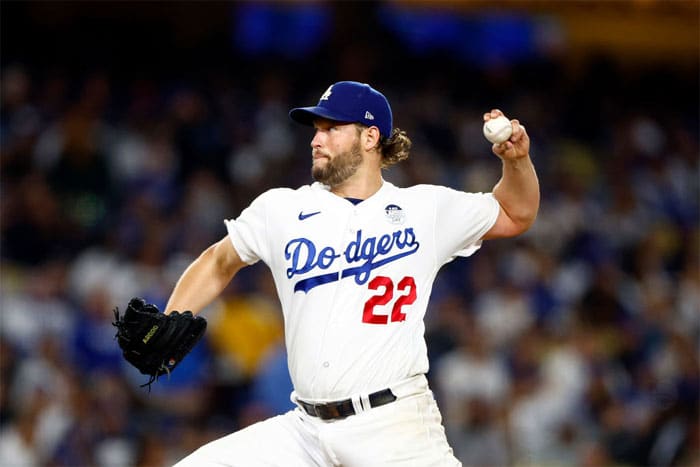
I don’t share Clayton Kershaw’s religious faith, but I certainly respect it. I hope that he respects mine, too. 

The Dodgers’ star pitcher has been in the news lately as part of a controversy that his team has brought on itself regarding the annual LGBTQ Pride Night celebration they are holding next week. The Dodgers invited, then disinvited, then reinvited the Sisters of Perpetual Indulgence, a charitable organization that uses religious satire to draw attention and support for important causes. Kershaw, who is a devout Christian, publicly disagreed with the Dodgers’ decision to honor the group. While careful not to criticize the Pride movement or its goals, he also announced that the team would restore the Christian Faith and Family Day they have hosted in the past.

Unlike several other players and one major league team, Kershaw has made it clear that he will not boycott Pride Night. He stressed that his dissatisfaction is not with the event itself, but rather with the inclusion of a group that he believes does not show appropriate respect to his chosen religion. 

I am personally not offended by the Sisters, but I also recognize that they are lampooning a religion other than my own. Just as I wouldn’t want others to decide whether a parody of the Jewish faith should upset our community, I’m hesitant to impose my values on a devout Christian for whom another’s well-meaning attempt at humor might be less amusing.

Whether or not one agrees with Kershaw’s conclusion, he has made a clear effort to lower the volume of the debate rather than heighten it, no small feat when religious values and human rights are at stake. Adding a second identity-based program, rather than escalating a fight over the first, seems like a reasonable step toward compromise. This has not been a perfect process, but Disney and DeSantis, for example, could learn something valuable from the way this disagreement was handled.

But I am still dissatisfied with Christian Faith and Family Day. I would happily attend, if one important change could be made. I possess both faith and family, but because I am a follower of another religion, the decision to specifically honor Christianity tells me that I am either unwelcome or will be marginalized if I choose to attend. It may be unintentional, but the Dodgers are telling me, as well as thousands of other Southland baseball fans, that we are not wanted that day. (Same for Sandy Koufax, the one Dodger pitcher whose exemplary career outshines even Kershaw’s.)

I don’t think for a moment that Kershaw is antisemitic. He worships in a different way than I do, and I doubt he thinks less of my religion just because he practices another. His commitment to civil rights is well-known, through the work of the nonprofit foundation that he and his wife founded and the philanthropic work they have done to support underprivileged African youth. Most notably, Kershaw deserves tremendous credit for his courageous statement after George Floyd’s death.

“Silence won’t cut it,” Kershaw said. “We have to start by saying something and STANDING up for our Black brothers and sisters. I want to listen, I want to learn, I want to do better and be different. I want my kids to be different.” 

Just as Kershaw made an extra and admirable effort to stand with those of other racial and ethnic groups, I hope that he and the organization he represents would now make the same type of attempt to show his respect for those of other religious faiths. Not just Jews, but Muslims and Hindus and Sikhs and Buddhists and Mormons and others.

Invite all of us to Dodger Stadium to celebrate a range of faiths and family structures, with no hierarchy or suggestion that any of us are better or worse than the rest. 

Invite all of us to Dodger Stadium to celebrate a range of faiths and family structures, with no hierarchy or suggestion that any of us are better or worse than the rest. The Dodgers have a long tradition for their commitment to civil rights and diversity. Hopefully the team of Jackie Robinson and Fernando Valenzuela and Jaime Jarrin and Hideo Nomo and Farhan Zaidi — and Clayton Kershaw — can make room for us, too.


Dan Schnur  is the U.S. Politics Editor for the Jewish Journal. He is a Professor at the UC Berkeley, USC and Pepperdine. Join Dan for his monthly webinar “The Dan Schnur Political Report” (www.lawacth.org) on the first Tuesday of the month at 5 PM PST. Follow Dan’s work at www.danschnurpolitics.com

Diversity at Dodger Stadium Read More »
David Halevy

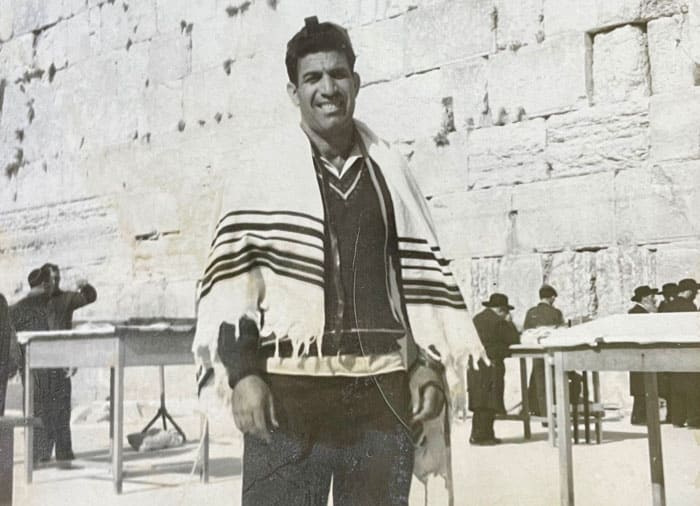
A Prince Among Men —Memories of My Father

(By Sharon Halevy Gomperts)

Maybe every daughter idolizes her father, but my father was truly a legend. 

Born on Yom Kippur, 1935 in Baghdad, Iraq to parents Rafael and Rosa, he was the middle child in a family of nine — older siblings Toya, Moshe, Shlomo and Daisy and younger siblings, Naim, Eliyahu, Adina and Aryeh. His father was a wealthy merchant and food wholesaler who moved his family from the crowded Jewish quarter of Baghdad to a house in Kerrada on the Tigris River. 

His older brother Moshe was a leader in the “T’nuah,” the underground Zionist movement and he recruited my young father. Given the undercover alias Go’el, he was a runner who would deliver messages between different cells. My grandmother Rosa never quite forgave Moshe for involving him in this illegal activity. My Dad was especially close to Naim, his younger brother and in the Spring of 1950, at the ages of 14 and 15, they decided to escape from Iraq with a small group. They paid an Arab guide to smuggle them over the mountainous border with Iran. After a lot of aimless walking, my father realized that they were low on water and that the guide was lost. He made the life-saving decision to turn themselves in to the border police. They were arrested and put in a jail cell with Communist prisoners. After a week in jail, he bribed the guards to release them from prison. He left convinced that Communism was the most foolish political system. The group made their way to Tehran, where the T’nuah housed young Iraqi Jewish escapees in tents in the Jewish cemetery. 

In Israel, he lied about his age in order to avoid high school. He worked as a laborer but soon asked his foreman to cut his wages and train him to be a bricklayer. He learned the trade and soon his fellow bricklayers were complaining that he was racing with them and showing off how fast he could lay a row of bricks. 

He built a home in anticipation of the arrival of the rest of his family, so they were able to avoid the ma’aborot, the transit camps hastily erected by the Israeli government to absorb the many refugees fleeing from Arab countries. 

In 1961, my grandmother’s cousin asked him to come take measurements for a room they wanted him to add to their house. He was mesmerized by the beauty of their 17-year-old daughter, Shoham. He waited two years, then sent my grandmother to ask my grandparents Naji and Aziza if he could date her. 

On March 17, 1964 he married the love of his life, my mother Sue. His grandmother Farha was the sister of her grandmother Lulu. There were five sisters, but one of them was blind and unmarried. She visited the homes of her nieces and nephews. My parents grew up listening to the same stories of their great aunt Chatun. 

My brother Rafi and I were born in Israel but my parents followed my mother’s family to Australia. My father built us a beautiful three-story house in Kirrawee and then he built two more houses nearby. Every morning, he would make Vegemite sandwiches for Rafi and me. He would give my six-year-old brother 12 cents for our bus fare. Some days, instead of taking the bus, my brother would decide that we were walking home. We would stop at the corner store and buy ice blocks and lollies. We would arrive at the building site and my father would say “you walked home today.” I never understood how he knew. At 18, I realized that it would have taken a lot longer to walk. 

He knew that I loved Granny Smith apples, so he would always pack one for my snack. One day, I didn’t eat it and my friend asked me for it. I felt very guilty, so I confessed to my Aba. He was so happy that I shared and from that day, he always put two apples in my lunch. 

When the economy took a downturn, my father started selling ladies clothing in the markets. Every day was a new location and he’d have to pack and unpack the racks and the clothing. He worked long hours and never complained. 

We moved from Kirrawee to the Eastern Suburbs of Sydney and my brothers Danny and Nathan were born. He built us another three-story home, but this one had stunning views of the Sydney Harbor Bridge and the iconic white-tiled sails of the Opera House. 

In 1981, we immigrated to Los Angeles. My parents continued to work in the fashion business and my father invested in real estate. I was lucky enough to work with my parents. When I married, had my son Ariel and then divorced, my mother and father helped me raise him. They were thrilled when I married my husband Alan and had three daughters. Years later, he told me that he wished we hadn’t left Australia but that Ariel and Alan had made it worthwhile.

My father was the quintessential Iraqi man who loved his wife more than anything and put his family first. 

My father was the quintessential Iraqi man who loved his wife more than anything and put his family first. He was a voracious reader with an intelligent mind. He had a quiet manner and a strong presence. He was incredibly disciplined. He didn’t talk a lot but when he spoke, you listened. One of the best things about him were his witty observations and his completely unexpected sense of humor. 

He had a passion for dates, managing to plant 1,000 date trees in Australia. 

His most incredible legacy are his grandchildren, of whom he was so proud. 

On Friday January 13, we celebrated my mother’s birthday and my eldest daughter Gabriella’s birthday. I made one of his favorite foods—shepherd’s pie. The next Friday night, he and I were in the Emergency Room at Cedars Sinai. We had a long journey where he battled tough infections. For the last two weeks he was at home, with my mother. All his grandchildren came to visit. 

This past Shabbat, Alan and I were with him in the ICU. I held his hand and sang a few songs in Hebrew. When the doctor said he was leaving this earth, I said Shema Yisrael. I looked up at the screen and the time read 18:36pm. 

Shepherd’s Pie

Shepherd’s Pie 

Beef filling
1/3 cup vegetable oil, divided
6 onions, finely chopped
1 1/2 pounds ground beef
1/2 cup Char-B-Que Barbecue Sauce
2 Tbsp tomato paste
2 Tbsp soy sauce
1 tsp allspice
1 tsp paprika
1 tsp turmeric
1 tsp garlic powder
1 large eggplant, salted, drained and diced
1 lb mushrooms, cleaned and sliced

Mashed potatoes
8 large potatoes, peeled and cubed
2 cups water (more or less)
3 Tbsp olive oil
1/2 tsp kosher salt
1/2 tsp garlic powder

Preheat oven to 350°F.
Heat a small amount of oil in a large pan and sauté onions till soft and golden.
Place onions in large baking dish.
Heat a small amount of oil, add beef and sauté using a wooden spoon to break into small pieces.
Add barbecue sauce, tomato paste, soy sauce and spices, stirring thoroughly.
Add meat mixture to the onions and mix well.
Arrange diced eggplant on baking sheet, drizzle with oil and roast 15-20 minutes until golden.
Layer on top of the meat.
Sauté mushrooms in oil and layer on top of roasted diced eggplant.
In large pot, place potatoes and add water until level is halfway up potatoes.
Add olive oil, salt and garlic powder.
Cover pot and bring to a boil, then turn to lowest heat and simmer until potatoes are fork tender, about 15 to 20 minutes.
Mash potatoes till soft and creamy and spread atop meat and eggplant.
Bake uncovered 1 hour.
Serves 10-12.


Sharon Gomperts and Rachel Emquies Sheff have been friends since high school. The Sephardic Spice Girls project has grown from their collaboration on events for the Sephardic Educational Center in Jerusalem. Follow them
on Instagram @sephardicspicegirls and on Facebook at Sephardic Spice SEC Food. Website sephardicspicegirls.com/full-recipes.

A Prince Among Men —Memories of My Father Read More »

Try These Delicious Party Pizzas to Celebrate Graduates

A pizza adds pizzazz to any graduation party. Here are some fun, unique and delicious pizza options to add to your menu.

Hank and Zahava Reinhart love their recipe for Caramelized Pastrami and Onion Pizza.

“This is the perfect grad-party recipe,” Hank Reinhart, founder & president of Sabavi Home, told the Journal. “It’s quick and easy to make, is a crowd-pleaser for both young and old, and is a great handheld food.” 

Caramelized Pastrami and Onion Pizza
Photo courtesy of Sabavi Home

Caramelized Pastrami and Onion Pizza

into bite-size pieces
1 pre-baked Pizza crust or flatbread
2 Tbsp oil
1 large onion, sliced or diced – your preference
Favorite BBQ sauce

Plus:
Any greens of choice
Garlic mayonnaise
Spicy mayonnaise, for drizzling

In a frying pan, sauté the onions over medium-high heat in oil until they soften and begin to brown. Add the pastrami and sauté for five more minutes until cooked. Add your favorite bbq sauce — just enough to coat — and cook a few minutes more, until thickened
Spread the prebaked crust or flatbread with a generous amount of garlic mayonnaise end to end. Sprinkle the onion and meat mixture in an even layer over the dough.
Preheat your barbecue or oven to 375°F and heat the pizza until the dough gets crispy on the edges.
Drizzle with some spicy mayo and top with greens of choice.


Za’atar Pizza
Photo courtesy of Debbie Kornberg

Debbie Kornberg’s delicious za’atar spiced pizza was featured at the San Diego-based pizza chain, Pizza Port, as one of their Pizzas of the Month. 

“It incorporates the flavors of the Middle East and brings you closer to Israel,” Kornberg, founder and CEO of SPICE + LEAF, told the Journal. “This pizza elevates any informal gathering or celebration!”

Za’atar Pizza with Roasted Eggplant, Garlic & Feta

Pizza dough*
Olive oil
SPICE + LEAF Authentic Za’atar
Feta cheese
Fresh mozzarella
1 eggplant, cut into 1/4 inch slices
10 -12 whole garlic cloves
1 can of diced tomatoes, drained or 3 – 4 fresh tomatoes, diced
1/4 cup red onion, minced

Prep for roasted eggplant:
Preheat the oven to 400°F.
Cut eggplant slices into quarters. Lightly brush with olive oil. Sprinkle za’atar on top of eggplant. Roast for about 15 minutes until toasty brown.
Use 2 tsp Za’atar for 1 cup of eggplant.
Prep for roasted whole garlic cloves:
Preheat the oven to 400°F.
Toss whole garlic cloves lightly with olive oil. Roast until toasty brown and soft on the inside.
Roll out pizza dough and drizzle olive oil as base
Sprinkle healthy portion of Za’atar over pizza:
– 1 Tbsp. of Za’atar for a small pizza
– 1.5 Tbsp. of Za’atar for a medium pizza
– 2 Tbsp. of Za’atar for a large Pizza
Sprinkle feta cheese or fresh mozzarella cheese over pizza according to your liking.
Add za’atar roasted eggplant, roasted garlic cloves, tomatoes and red onions.
Dust additional Za’atar over pizza, about 3-6 tsp. depending on the size of the pizza.
Bake at 450°F for about 12 – 15 minutes (depends on thickness of dough*) or until the dough is toasty brown and cheese is melted.
*If using a pre-made pizza dough, review baking instructions of suggested baking temperature and baking time.


“If you want to have a dairy graduation party, which I totally recommend because everyone loves lavish cheese plates, then be sure to make this fruit pizza for dessert,” Zoë Biehl, senior editor of Gluten-Free Palate, told the Journal. 

Gluten-free fruit pizza is a sweet treat made with fresh fruits that are both healthy and tasty. Although the recipe is made with gluten-free flour, you can easily switch it out for regular flour. 

“This is a visually stunning and delicious dessert, perfect for a party,” Biehl said. “The idea of having pizza for dessert is fun and unusual.” 

Gluten-Free Fruit Pizza

Prep time: 5 minutes
Cook Time: 1 hour 30 minutes

Ingredients

Pizza crust
1/2 cup soft butter
1 egg
1/3 cup sugar
1 tsp almond extract
1 1/4 cups gluten-free plain flour
1 tsp baking powder
1/3 tsp salt

Cream
1/2 cup cream cheese
3 tsp powdered sugar
1/2 cup whipping cream

Decoration
5-6 raspberries
5-6 blueberries
2-3 strawberries
1 kiwi
5-6 mint leaves

For the crust:
Preheat the oven to 350°F.
In a mixing bowl, beat softened butter and sugar. Add egg and almond extract and beat again.
In a separate bowl, mix all dry ingredients: flour, salt and baking powder.
Combine wet and dry ingredients until you get a thick, sticky dough.
Transfer the dough to a parchment lined round baking dish.
Put another layer of parchment on top of the dough. Then, pour ceramic pie weights (weighted beans or you can use ordinary dry beans, peas or chickpeas to weigh down the crust) on top of it.
Bake for 25 to 30 minutes. Then let the crust cool.
Assemble the pizza:
Mix cream cheese, powdered sugar and whipping cream in a separate bowl. Beat for 1-2 minutes until a fluffy, homogeneous cream is obtained.
Spread the cream on the crust.
Garnish with raspberry, strawberry, blueberry and kiwi slices. Add mint leaves before serving.
Note: Ensure all ingredients are at room temperature before starting.
Enjoy!

Try These Delicious Party Pizzas to Celebrate Graduates Read More »

Rosner’s Domain | Litvaks Without Leadership

“At 100, as good as Dead and gone completely out of the world”. This is a Mishna, from Pirkei Avot. Rabbi Gershon Edelstein, the leader of the Litvak ultra-Orthodox community who died May 30th, was little more than a hundred, and must have known the commentary of the Gaon on this Mishnah — a commentary indicating its source: Isaiah 35. In future days, says the prophet, “Someone who dies at 100 years Shall be reckoned a youth”. So, that’s the vision for the days of Messiah. Which may be interpreted as contradiction to the popular belief that the expected age is 120, as was the age of Moses when he died. 

Be that as it may, Rabbi Edelstein passed. His funeral attracted hundreds of thousands. What is it that they mourn? Good question. If a 100-year-old person is already considered “dead and gone”, there is nothing to mourn. Still, there is grief. A great sage had died. A community leader had died. Only a year has passed since he became the prominent leader of the Lithuanian ultra-Orthodox, with the death of Rabbi Chaim Kanievsky. The Haredi community tend to enthrone elderly leaders, which ensures frequent turnover. 

Length of tenure is important. Pope Benedict served for seven years, Pope Francis is completing a decade. Not by chance, their influence is not comparable to that of their predecessor, John Paul II. There are of course many differences of style and character and circumstances that made the Pope of the late 20th century so influential. But the duration of his term was also of consequence. Pope John Paul II served for more than a quarter of a century. The duration of a leader’s tenure allows him to set a long-term agenda and implement it. Rabbi Edelstein did not have time to lead beyond routine decisions. Neither did Kanievsky before him. Who was the last great rabbi with the ability to make a difference? Some will go back to the days of Rabbi Elazar Menachem Shach back in the ’80s. His influence was evident for about 30 years. Whether this was a positive or a negative influence is beside the point, and a question of ideological position. But there is no doubt that he set a path and made sure that the public progressed on it. 

It is often said that Haredi society has been in a leadership crisis for quite a few years now. Rabbi Edelstein had many admirers, but he never had the authority of Rabbi Shalom Elyashiv, or Rav Shach. You can call it, as the Taslmud does, “yeridat hadorot,” the decline of greatness with the passing generations. Or maybe it is the time in which we live — a tough time for leadership, even among Haredim. Or maybe it’s a matter of luck — maybe the next leader will have better health, a longer life, and will serve the time required to anchor his leadership. Either way, leadership upheavals have consequences. What will we see in the Haredi community? 

Two possibilities can be offered, one contradicting the other. In the absence of dominant leadership, a group may go through a process of erosion and disintegration. People or subgroups feel freer to follow their own advice. If such thing happens, the common claim about undercurrents that are gradually changing ultra-Orthodox society, bringing it closer to Israeliness, to modernity, could become reality. The argument is often made that these processes are already underway, and ought to be supported and encouraged with patience rather than urgency. Simply put: Maybe the shaky rabbinical leadership of the Haredi public serves the long-term social goals of the rest of the Israeli public. 

Of course, there is also a second possibility. Maybe the lack of leadership actually hinders a possible process of integration and slows progress. Why? Because in the absence of a dominant leadership, everyone must take the most extreme positions, so as not to be suspected of striving against the sacred principles. If there’s not a dominant leader, there is no one who has enough authority, enough power, to decide that it is time to make a change. 

We’ve seen such case in the past when Sephardic Rabbi Ovadia Yosef was dominant enough to make important, even revolutionary (in ultra-Orthodox terms) halachic decisions, and to implement them. When Rabbi Yosef said something was kosher, his community followed.  

Leadership is hard. It is hard at age 50 or 60 or 70, it is close to being impossible for those who are named as leaders close to the age of 100, when they are almost “gone.”

The Lithuanian Haredim do not currently have a leader who has such authority. There is no Mikhail Gorbachev, who rose to power from within the party establishment and then became a reformer. There is no Menachem Begin, who led a political party for a generation, and could convince it to accept a peace agreement that included the evacuation of territories. The Litvak will name a new leader, but leadership is not just something one gets, it is also something one must take, activate, deepen. Leadership is hard. It is hard at age 50 or 60 or 70, it is close to being impossible for those who are named as leaders close to the age of 100, when they are almost “gone.”

Something I wrote in Hebrew

Here’s what I wrote concerning the growing feeling of Israelis that what we need is autonomy for subgroups that would save us the constant bickering over ideological differences:

The idea of “live and let live” is a tempting one. The idea of living together when all that connects us are the “rules of the game” is a tempting idea. But these are ideas that leave a big void in the heart of the Zionist-Israeli project. These are ideas that leave Israel poor and lacking when it comes to cohesion and a shared vision. And this should also be taken into account: A society like ours will have difficulty coming up with an effective response to common challenges and common enemies if it breaks up into groups and tribes, whose partnership loses a dimension of content and becomes a partnership that is mainly technical.

A week’s numbers

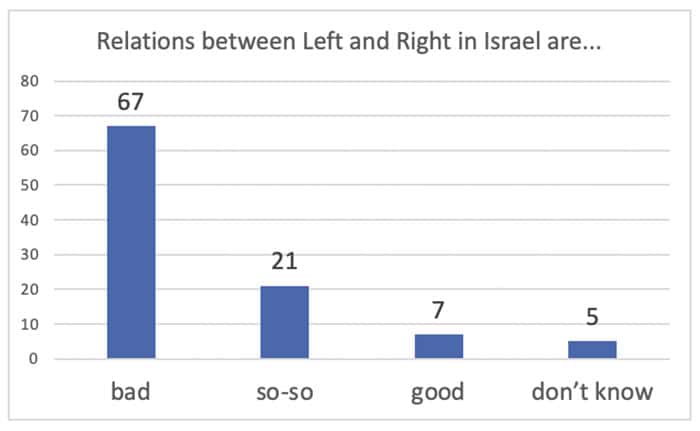
A new IDI survey asked Israelis about the main tensions in Israel and the way they’d characterize the relations between groups. Here’s one finding:

A reader’s response:

Bruno Bergman asks: “why is the crime rate among Arabs in Israel so high?” Answer: that’s complicated. A combination of neglect by the state and the police, and deficiency in political and social leadership in the community.


Shmuel Rosner is senior political editor. For more analysis of Israeli and international politics, visit Rosner’s Domain at jewishjournal.com/rosnersdomain.

Rosner’s Domain | Litvaks Without Leadership Read More »

June 6, 1944: Over 4,000 Jewish Soldiers Fought in D-Day

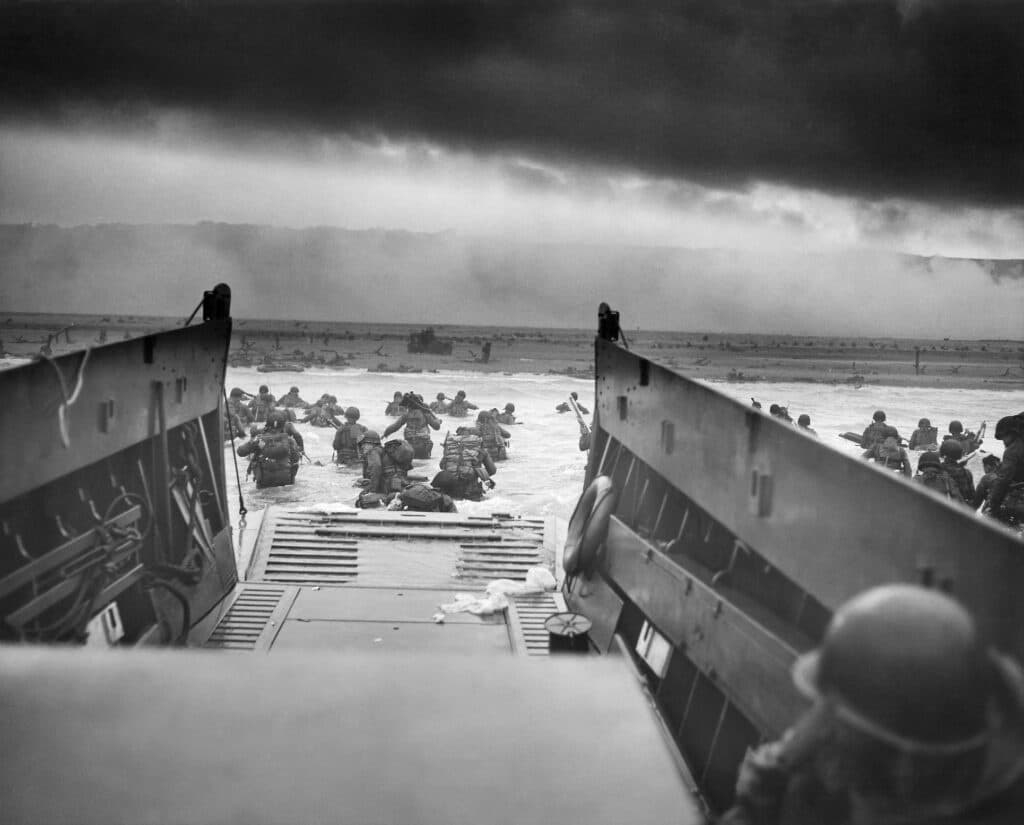
It was ten minutes after midnight on Tuesday, June 6, 1944. The first U.S. pathfinders parachuted into the Cotentin Peninsula in northern France— they were the first of 23,400 paratroopers who would jump out of airplanes that day.

The Nazis had occupied France for the past four years. And now, the first Allied troops led by the United States, United Kingdom and Canada officially entered Nazi-occupied territory in France.

Just hours before, Supreme Commander of the Allied Forces General Dwight D. Eisenhower issued the  green-light to what would be the largest sea and air invasion ever known to humanity.

In his decree, Eisenhower said, “Soldiers, Sailors, and Airmen of the Allied Expeditionary Force!

You are about to embark upon the Great Crusade, toward which we have striven these many months. The eyes of the world are upon you. The hope and prayers of liberty-loving people everywhere march with you.”

At 3:30 am, the first of over 6,000 ships and landing crafts embarked across the choppy waters of the English Channel for a three hour trip south to battle a well-trained, well-equipped German military.

The Allied invasion of France was codenamed Operation: Overlord. The Battle of Normandy on June 6th was code named Operation: Neptune. Most people know the events of that cold and bloody Tuesday as D-Day.

In addition to troops from the U.S., U.K. and Canada, there were troops fighting alongside them from Australia, Belgium, Czechoslovakia, Denmark, Greece, the Netherlands, New Zealand, Norway and Poland. There were also an estimated 177 French commandos. In all, over 160,000 Allied troops invaded Nazi-occupied France that day.

And amongst the Allies, there were an estimated 4,000 Jewish soldiers who fought on D-Day, according to the Jerusalem Post. In that report, British D-Day veteran Walter Bingham, found that “Jews made up 4.2% of American soldiers, 1% of the British fighters, and 1.5% of the Canadian forces.”

They were amongst the estimated 550,000 Jewish men and women who served in the U.S. Armed Forces during World War II.

One of those 4,000 Jewish soldiers who fought on D-Day was U.S. Army T/5 Irving Lukoff from Chicago. At age 27, Lukoff was a Signal Corps Lineman in General George S. Patton’s Third Army.

His son, Lieutenant Colonel Mark Lukoff, United States Army (ret.), a Vietnam veteran, told the Journal that his father spoke very little about his experiences on D-Day. But he also said that if his father were alive today, he would be honored to have his sentiment in Jewish newspaper all these years later:

“The only serious thing he ever said about his experience was that as a Jew, it was important for him to be in Europe, fight the Nazis,  that Jews can use guns, Jews don’t lie down, regardless of what the Nazis say,” Lukoff told the Journal of his father. “They knew what was ahead of them, but they went.”

The Allied invasion was successful, but came at an enormous cost: over 9,000 Allied soldiers would die that day. When the Allied troops crossing the English Channel arrived in the morning during low tide, they were met by massive Nazi gunfire from an elevated position on the seaside cliffs.

In 2022, Lukoff visited Omaha Beach and Utah Beach, where his father and fellow American troops first made landfall. When he saw the cliffs overlooking the beaches where the Nazi gunners were stationed, he was in awe at the will and determination of the Allied troops..

“We were there a year ago and to say, ‘well how did these guys climb up that hill?’” Lukoff said. “When you see it, you really understand. You wonder, ‘how did that happen? How did they do it?’”

When asked about the upcoming 80th anniversary of D-Day next year, Lukoff wondered how many veterans will be left to attend.

The publication Stars and Stripes reported that about 50 World War II veterans participated in a ceremony commemorating the 79th anniversary of D-Dayat the Normandy American Cemetery in France, where over 9,300 are buried.

U.S. Ambassador to France Denise Bauer, who attended the ceremony, posted a message on Twitter in French (translation provided by Twitter): , “Very moved by this ceremony at the American cemetery in Colleville-sur-Mer, in memory of those who fell for Freedom. I would also like to pay tribute to all the veterans who honor us with their presence. We are deeply grateful to you.”

Among the veterans who made the return for the ceremony was 99-year-old Charles Shay, who traveled to northern France from Maine. At age 20, Shay was an infantryman and medic who served at Omaha Beach on D-Day.

 “There aren’t many of us left,” Shay told Stars and Stripes. “I hope to be here again next year.”

June 6, 1944: Over 4,000 Jewish Soldiers Fought in D-Day Read More »

Cynthia Weil, Grammy-winning Songwriter, Dies at 82

Songwriter Cynthia Weil died June 1 at the age of 82. From the 1960s to the 1990’s, Weil, with her husband of 62 years, Barry Mann, wrote over 80 chart-topping songs for some of the most iconic singers in the world,

Weil was born in New York on October 18, 1940. Her mother, Dorothy Mendez, had Sephardic roots that may have dated back to the Spanish Inquisition; her father, Morris Weil, was the son of Orthodox Polish immigrants and owned two furniture stores.

They married in 1929 and lived in Manhattan. In Scott R. Benarde’s  2003 book, “Stars of David: Rock ‘n’ Roll’s Jewish Stories,”  Weil remembered growing up in “a kosher home with big Shabbat dinners and celebrating holidays at a Conservative synagogue.” Weil was eight when her father died, and religion became less of a force in her life. She attended Sunday school  but did not enjoy it, and promised herself  that “no child of [mine] would ever have to go through the same.”

Weil and Mann married in 1961. That same year,  Tony Orlando had a #15 hit with their song, “Bless You.” As part of the New York-based songwriters based out of the Brill Building (where they worked alongside other songwriters including Carole King and her husband, Gerry Goffin, Burt Bachrach and Hal David, Mike Lieber and Jerry Stoller, Jeff Barry and Elle Greenwich, Doc Pomus and Mort Shuman) they were one of the songwriting teams writing songs produced by Phil Spector on his Philles record label: The Crystals (“Uptown, 1962, #18, “He’s Sure the Boy I Love” 1962, #11), The Ronettes (“Walking in the Rain” 1963, #23) and probably their best-known song, “You’ve Lost That Lovin’ Feeling” which topped the charts for the Righteous Brothers in 1964. They also wrote hits for Eydie Gorme (“Blame it on the Bossa Nova, 1962, #7), The Drifters (“On Broadway,”  a #9 hit, written with Lieber and Stoller in 1963, and later a #7 hit for George Benson in 1978).

Mann and Weil’s ability to write in different styles allowed them to thrive in the post-Beatles pop world. The Animals took their “We’ve Gotta Get Out of This Place” to #13 in 1965. That year, Paul Revere and the Raiders had two of their biggest his with Mann-Weil songs: “Kicks” (#4) and “Hungry” (#6), and wrote another chart-topping hit for the Righteous Brothers, “(You’re My)  Soul and Inspiration.” In 1968, they had a #22 hit with “The Shape of Things To Come,” performed by Max Frost and the Troopers, written for the teensploition cult favorite “Wild in the Streets.”

Weil and Mann’s songs were also recorded by Dusty Springfield, The Monkees, The Partridge Family, B.J. Thomas (“”I Just Can’t Help Believing,” a #9 hit in 1970, recorded a year later by Elvis Presley, and “Rock and Roll Lullaby,” a #15 hit in 1972),  The Grass Roots, and Blood Sweat & Tears. They had one of their biggest hits with Dolly Parton’s “Here You Come Again” (#3 1977), and in 1986, Linda Ronstadt and James Ingram had a #2 hit with their “Somewhere Out There,” written with James Horner for the movie “An American Tail.”

Their songs ranged in style from dreamy pop to hard rock, from country lilt to jazzy swing. Weil, who was the lyricist of the team,  was also one of the first songwriters to confront modern themes: Racism in “Uptown,” drugs in “Kicks,” and in “Broadway,” the hard road to success.

Weil and Mann were inducted into the Songwriters Hall of Fame in 1987.  In 2010, they were inducted into the Rock & Roll Hall of Fame where they received the Ahmet Ertegun Award, which is “given to non-performing industry professionals who, through their dedicated belief and support of artists and their music, have had a major influence on the creative development and growth of rock & roll and music that has impacted youth culture.”

In her acceptance speech, Weil said the award was “twice as sweet [because] my greatest teacher, my greatest inspiration, my greatest collaborator has always been my husband and partner Barry Mann … I think what’s held  us together has been this great bond of creativity,  it’s been rock and roll. So I want to thank the music for giving us our life together.”

Weil is survived by husband Mann, now aged 84, and daughter Dr. Jenn Mann, a psychotherapist in Los Angeles.

Cynthia Weil, Grammy-winning Songwriter, Dies at 82 Read More »

Five Years Later, Remembering Charles Krauthammer

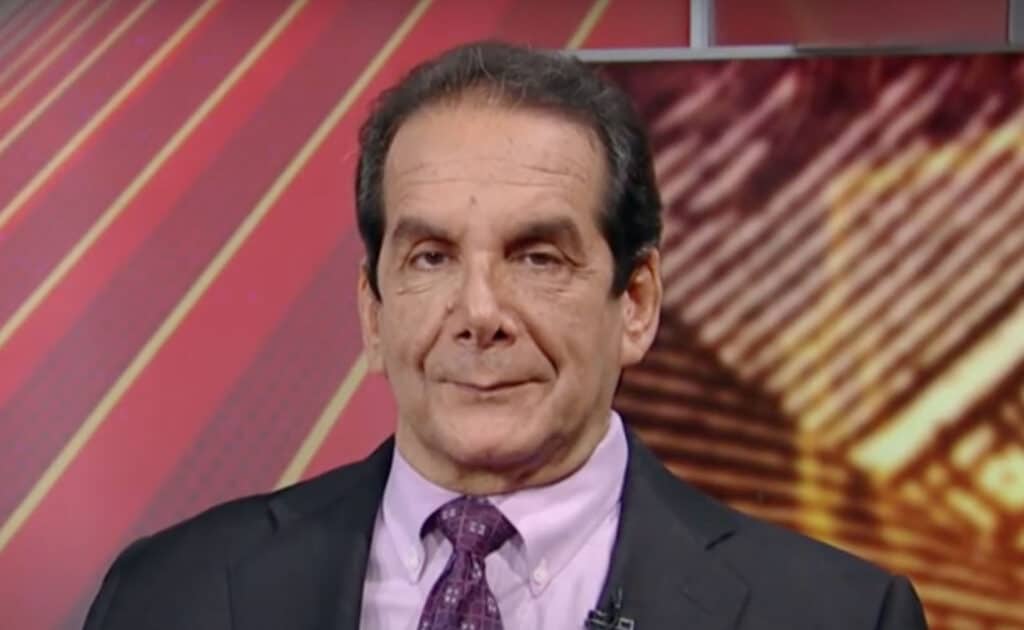
Nobody knows everything, but Dr. Charles Krauthammer sure came close. Five years after his death, the words on so many subjects of this psychiatrist-turned-political commentator have done more than been proven prescient. They have become truisms themselves. Whether the topic was Judaism, foreign policy, baseball, chess, classical music or D.C. follies, Dr. Krauthammer offered platinum prose. The breadth, width and depth of his knowledge was so extensive that it was reasonable to think that “Maybe this guy does know everything.”

Few would have expected that a wheelchair-bound man in a soft voice would become a television rock star, but Krauthammer was exactly that. His genius was breaking down complex issues of religion, politics and other matters in the simplest, clearest terms. Sixty months after his passing, this unique gift is not just relevant but sorely missed.

While not a culture warrior, Krauthammer summarized the debate over public education for kids with four key words of common sense: “Parental rights are sovereign.”

With humor, he deftly chose a side in the debate over whether negative government actions were based on incompetence or deliberate malice. Given those options, he opined, “When dealing with government, always assume incompetence. Don’t give them more credit than they deserve.”

In explaining his shift from Walter Mondale liberalism to Ronald Reagan conservatism, Krauthammer flippantly remarked, “I was young once.” Yet his more serious answer is one everyone can learn from. “I followed the evidence. The evidence changed, so I changed.”

His humor was evident in explaining why Australian Prime Minister John Howard was given less respect than Rodney Dangerfield despite a successful presidency. “He looks like a bank branch manager at a Waga Waga bank.” Australians laughed and nodded in agreement.

Krauthammer was trusted because without bombast or theatrics, he told it like it was. This was his moral obligation to those who heeded his words. “You’re betraying your whole life if you don’t say what you think – and you don’t say it honestly and bluntly.”

His appreciation of Israel went beyond religious and political affinity. The man guided by logical reasoning saw Israel as a miracle. “Israel is the very embodiment of Jewish continuity: It is the only nation on earth that inhabits the same land, bears the same name, speaks the same language, and worships the same God that it did 3,000 years ago. You dig the soil and you find pottery from Davidic times, coins from Bar Kokhba, and 2,000-year-old scrolls written in a script remarkably like the one that today advertises ice cream at the corner candy store.”

Despite receiving sustained adulation, Krauthammer showed a humility and open-mindedness. He understood what little he could not understand. His rational mind could not always process the irrational, especially when it pertained to himself. His column “Suffering a Relapse, and Loving It” had him analyzing his own obsession with baseball. “Why should I care about these tobacco-spitting, crotch-adjusting multimillionaires who have never heard of me and would not care if I was dispatched to my maker by an exploding scoreboard?” Krauthammer happily conceded, “I have no idea.”

He had no idea because this one time, the intellectual titan’s premise was wrong. The Washington Nationals knew exactly who he was. They honored him on the jumbotron scoreboard the day he died. The only thing that exploded was the roar of the crowd.

From culture to religion to politics, his medical ethics were his commentary’s beating heart. He said the right things to encourage people to do the right things. He was a proud Jewish agnostic who feared God. His lifetime of writing meaningful words belied a man far more concerned with deeds. “I don’t really care what a public figure thinks. I care about what he does. Let God probe his inner heart.”

He was a proud Jewish agnostic who feared God… “I don’t really care what a public figure thinks. I care about what he does. Let God probe his inner heart.”

Five years after his death, the evidence points toward Charles Krauthammer’s words lasting in perpetuity.

Five Years Later, Remembering Charles Krauthammer Read More »

Hate Speech at CUNY Demonstrates the Hole in Biden Plan to Fight Antisemitism

On May 25, 2023, the Biden Administration published its much anticipated “U.S. National Strategy to Counter Antisemitism.”

Much anticipated, in large part because of the alarming and well-documented rise in antisemitic attacks against Jews and Jewish institutions, particularly in New York City where hate crimes targeting Jews had increased by 39% from 2021 to 2022, and where 94% of those victims were visibly Jewish Orthodox Jews who were almost always (97% of the time) attacked by members of other minority groups.

To the Biden Administration’s credit, this rise in antisemitic attacks led to the White House investing considerable resources to shape and create its 60 page “National Strategy.”

Before the plan was released, practically every mainstream Jewish organization had urged the White House to use the definition of antisemitism that is the most accepted and widely used definition by both democratic governments and Jewish institutions around the world, the IHRA definition. After all, it’s common sense that before one can solve a problem, one has to define it. A famous quote widely attributed to Albert Einstein is that if he was given an hour to solve a problem, he would spend 55 minutes defining the problem and then five minutes solving it.

The reason the IHRA definition is so important is that it captures how antisemitism has evolved over the last 100 years to include not only irrational xenophobic hatred for the Jew as an individual, but also irrational xenophobic hatred for Jews as a nation. This is the hatred of Israel; the hatred of the Jewish national rights movement, Zionism.

The late Chief Rabbi Lord Jonathan Sacks defined antisemitism as:

“Denying the right of Jews to exist collectively as Jews with the same rights as everyone else. It takes different forms in different ages. In the Middle Ages, Jews were hated because of their religion. In the nineteenth and early twentieth century they were hated because of their race. Today they are hated because of their nation state, the state of Israel. It takes different forms but it remains the same thing: the view that Jews have no right to exist as free and equal human beings.”

More importantly, Rabbi Sacks noted how the 21st century version of antisemitism has mutated in a way so haters can deny the hate:

“The new antisemitism has mutated so that any practitioner of it can deny that he or she is an antisemite. After all, they’ll say, I’m not a racist. I have no problem with Jews or Judaism. I only have a problem with the State of Israel. But in a world of 56 Muslim nations and 103 Christian ones, there is only one Jewish state, Israel, which constitutes one-quarter of one per cent of the land mass of the Middle East. Israel is the only one of the 193 member nations of the United Nations that has its right to exist regularly challenged, with one state, Iran, and many, many other groups, committed to its destruction.”

This dramatizes the value of the IHRA definition, which recognizes that: (1) under antisemitism’s previous mutations Jews were regularly demonized as bloodthirsty baby-killers; (2) with antisemitism’s current mutation, which incorporates anti-Zionism, antisemites regularly demonize the world’s only Jewish state as a uniquely bloodthirsty predator-state and baby-killer; (3) during antisemitism’s earlier mutations, antisemites regularly demonized Jews as controlling banks, the media, and governments; and (4) during the 21st century, the “I am only anti-Zionist” antisemites regularly demonize Israel or Zionists as controlling banks, the media, and foreign governments.

Which brings us back to the Biden Administration’s big announcement on May 25th. With tremendous fanfare, and to the disappointment of many Jewish groups, the Biden National Strategy not only referenced the IHRA definition, but also commended the Nexus definition, which only served to dilute the IHRA definition. Not to better define it, but by its plain language, to more narrowly define it.

For example, the Nexus definition provides that: “[p]aying disproportionate attention to Israel and treating Israel differently than other countries is not prima facie proof of antisemitism.”

The problem with that condition is that today’s insidious mutation of antisemitism is precisely about “disproportionate attention to Israel and treating Israel differently.” Adding a qualifier like “not prima facie proof” does nothing to diminish that reality.

Many Jews were dismayed to learn that Biden’s National Strategy included the Nexus definition, as well as a nod to “other definitions” besides IHRA, the consensus definition of the Jewish community. But that dismay was coupled with significant and justifiable concern when the Jewish community learned that one of the Biden Administration’s partners in “fighting antisemitism,” according to talking points in the National Strategy, was going to be CAIR (the Council on American Islamic Relations).

This is a justifiable concern because CAIR is a leading purveyor of antisemitism as it is defined by IHRA and most of the world’s Jews, which includes being obsessed with Israel, demonizing Israel, and treating Israel differently than one treats all other countries.

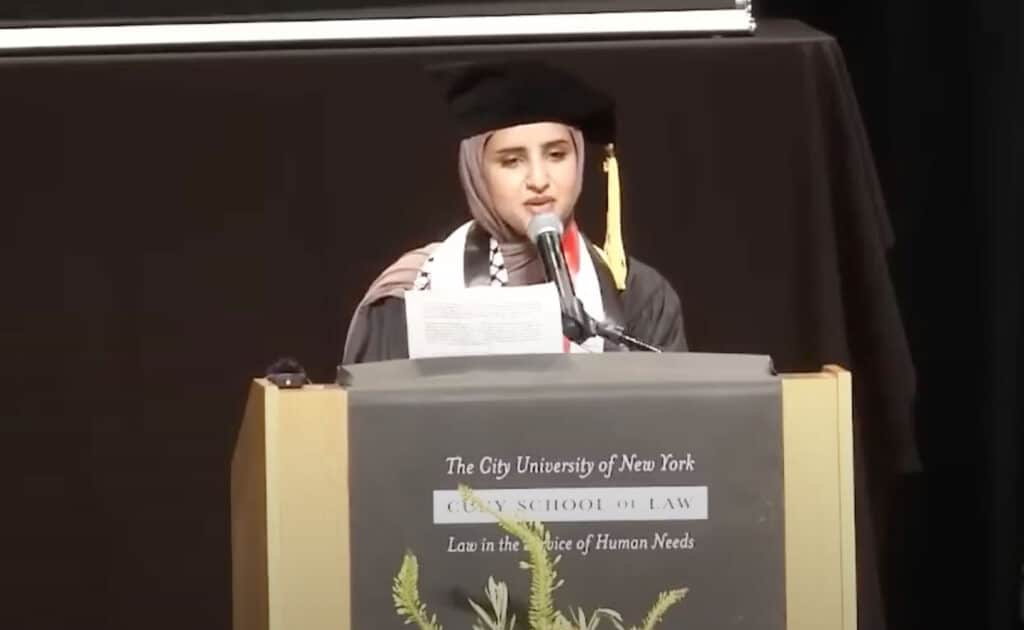
The prescience of that concern was demonstrated shortly thereafter, when a hate-filled rant was made public by CUNY (the City University of New York) on YouTube. In that May 12, 2023 speech, Commencement Speaker Fatima Mousa Mohammed said the following demonizing lies about Israel, which plainly tap into the trope of the bloodthirsty Jew: “Israel continues to indiscriminately rain bullets and bombs on worshippers, murdering the old, the young, attacking even funerals and graveyards, as it encourages lynch mobs to target Palestinian homes and businesses, as it imprisons its children, as it continues its project of settler colonialism, …”

And in a speech she gave to her fellow CUNY Law students and others prior to their graduation Fatima Mohammed said: “Zionist professors [must] be banned from college campuses,” and that “Zionist students [should] not be allowed in the same spaces as Palestinians” and that “Zionism is a genocidal threat.”

Fatima Mohammed’s demonizing claims in her speech plainly ignore the tremendous efforts Israel takes to avoid civilian casualties as well as erase the deep Jewish ancestral relationship with the land of Israel. Comments, which are textbook antisemitism under Rabbi Sack’s and the IHRA definition. The tropes employed by Ms. Mohammed stem from her clearly deep obsession with the one Jewish state, an obsession the IHRA definition accurately defines as grounded in antisemitism, and which the Nexus definition excuses.

A few days later, on May 31, after the CUNY Board of Trustees rightfully characterized Ms. Mohammed’s “commencement address” as hate speech, CAIR demonstrated in one tweet why the NEXUS definition’s inclusion in the Biden National Strategy is so problematic in the fight against antisemitism:

Under the IHRA’s comprehensive definition of antisemitism, it is clear that Fatima Mohammed’s speech, as well as the conduct of those encouraging and defending it (like CAIR) are examples of antisemitism. And any National Strategy to fight antisemitism that can’t make that distinction is doomed to fail.

So if President Biden is serious about fighting antisemitism, he has to decide what’s more important to him – alliances with groups like CAIR – or fighting an ancient hatred – as it exists today.

Hate Speech at CUNY Demonstrates the Hole in Biden Plan to Fight Antisemitism Read More »