fbpx

June 1, 2023

Campus Watch June 1, 2023

Jewish Student Elected UCSB President

A Jewish UC Santa Barbara student has been elected as Associated Student (AS) President.

The Algemeiner reported that the student, Tessa Veksler, received 51% of the vote. She told The Algemeiner that she felt it was necessary to run after the Russian invasion of Ukraine, as she was one of the few Ukrainian students in the student government. “Many students turned to me for advice,” Veksler said. “In working to help international students in Ukraine I realized how very few resources were available and that the ones that were available were not well known.”

Veksler also observes Shabbat — the first UCSB AS President to do so — and she has already assigned her responsibilities to her other AS colleagues during Shabbos. She told The Algemeiner that “people have, if anything, expressed admiration for my being able to observe on a college campus.”

CUNY Law Posts Entire Video of Anti-Israel Commencement Speech

The City University of New York (CUNY) School of Law posted the entirety of the May 12 commencement address given by Fatima Mohammed, a member of CUNY Law’s Students for Justice in Palestine (SJP) chapter, after the law school faced criticism of censorship from pro-Palestinian groups.

The Times of Israel (TOI) reported that during her speech Mohammed said that “Israel continues to indiscriminately rain bullets and bombs on worshipers, murdering the old, the young, attacking the funerals and graveyards as it encourages lynch mobs.” She also praised those resisting Zionism “by any means necessary,” per TOI.

Both the Jewish Community Relations Council of New York and Anti-Defamation League New York/New Jersey criticized Mohammed’s speech as having “incendiary anti-Israel rhetoric” and denigrating “students’ identities.” When asked to respond to such criticism, a spokesperson from CUNY Law told the Journal, “Members of the Class of 2023 selected student speakers who offered congratulatory remarks and their own individual perspectives on advocating for social justice. As with all such commencement remarks, they reflect the voices of those individuals.”

More Than 150 UVM Faculty Members Call on University to Apologize for Handling of OCR Investigation

A letter signed by more than 150 University of Vermont (UVM) faculty members called on University President Suresh Garimella to apologize for his handling of the investigation conducted by the Department of Education’s Office of Civil Rights (OCR).

UVM was being investigated over allegations that they failed to adequately respond antisemitic incidents on campus; OCR and UVM came to a resolution in April that included requiring the university to implement policies protecting Jewish students on the basis of their ethnicity as well as their religion. VTDigger reported on May 17 that the 182 faculty members who signed the April 28 letter lambasted Garimella for misinforming the community when he said in September that the “truth” would show that the university properly handled the antisemitism complaints when the OCR investigation determined otherwise. The faculty members called for Garimella to apologize and “provide a full and accurate account of what actually happened.” The faculty senate passed a resolution on May 18 echoing the letter, NBC 5 reported.

When NBC 5 reached out to the university to comment, they replied: “Our aim now is to ensure that all on our campus hear our commitment to addressing antisemitism, feel empowered to report it whenever it occurs, and are supported in those times in which we must confront it in our community.”

Antisemitic Symbol, Racial Slurs Found in University of Maryland Dorms

An antisemitic symbol and multiple racial slurs were found in one of the University of Maryland (UMD) dormitories last month.

Fox 5 DC reported on May 22 that the symbol and slurs were found on April 29, and another slur was found scrawled on a chair on May 2. The university said in a statement, “The University of Maryland is deeply concerned to learn of these actions, which have no place on our campus or in our community. We all share a responsibility in creating safe, welcoming, and inclusive places to live, work, and study, and acts of hate and bias are not acceptable.”

Report: Nearly All Antisemitism Eradicated from Saudi Textbooks

A new report from IMPACT-se released on May 23 has found that over the past five years, nearly all antisemitism has been removed from Saudi textbooks.

The Jewish News reported that the removed material included text “implying that Jews are the enemies of Islam” and allegations that Israel attempted arson against the al-Aqsa Mosque in 1969. However, Saudi textbooks still refer to Israel as “the Zionist entity” and call Zionism a “racist movement.” IMPACT-se CEO Marcus Sheff said in a statement that there is a “clear trend of moderation in relation to Israel.” “Kudos is due to the Saudi government for this multi-year and systematic removal of Jew hate and moderation of content on Israel in the textbooks of over six million Saudi children, and of many more who study the textbooks outside of Saudi Arabia,” he said.

Campus Watch June 1, 2023 Read More »

A Moment in Time: “We ALWAYS Leave a Trail”

Dear all,

A couple of weeks ago, Ira (a member of our congregation) brought me on a beautiful hike. As magnificent as the vista was against the gorgeous flowers, Ira pointed out a phenomenon that I so easily could have overlooked…

It was a snail crossing the path, leaving behind a tiny trail.

It really made me think. No matter what we are doing – we always leave a trail behind. Our actions, our words, our gestures (as well as our inactions, our silence, and our indifference) … they all count. And whether we realize it or not, others notice at any given moment in time.

What trail are you leaving behind, and how will your choices today create a better world for tomorrow?

Ira and I had a lovely hike. The trail he left in my heart through our conversation transformed my week!

With love and shalom.

Rabbi Zach Shapiro

A Moment in Time: “We ALWAYS Leave a Trail” Read More »

A Bisl Torah – Opportunity versus Obstacle

I spent one hour with my family in an escape room. An escape room involves a series of puzzles, symbols, and clues that eventually lead you to unlock a door, leading to freedom. At first glance, it feels as if there is no obvious way out. Locks in every direction. No visible sign as to where one should start. We became overwhelmed by the number of obstacles standing in our way. Finally, we took a deep breath and decided to “begin again”, suddenly realizing that the first clue was right before us. Thus, began our path towards opening the door.

For many, “no” is the easiest answer to start with when presented with a series of obstacles. No…it costs too much money. No…we don’t have enough time. No…it never worked before so why try now? No…the journey forward is filled with too many briars and thorns. The concept of “no” is usually seen first. “No” is the escape room: locks and puzzles and convoluted pictures that confuse the mind and boggle the soul. It may seem easier remaining in the room. But sometimes, saying “yes” is the ultimate key to changing the trajectory of one’s journey and changing the trajectory of one’s life.

It is understanding the difference between obstacle and opportunity. When Adam and Eve dwell in the Garden of Eden, God calls out, “Ayeka?” “Where are you?” Adam, afraid and bewildered, begins to hide. We too, when faced with what feels like unanswerable questions, begin to hide, unsure of what to do or where to go. But even through his fear, Adam replies to the Lord. There is an opening…there is still a pathway forward.

Even the hardest of puzzles are meant to be solved. Answers may be difficult to find but often, an optimistic attitude leads to alternatives unexplored. It is much easier to say “no”, yielding a blocked entrance. But “yes”…yes to trying again…yes to trying at all…that may reveal the exact opportunity God is hoping you’ll see.

Shabbat Shalom


Rabbi Nicole Guzik is a rabbi at Sinai Temple. She can be reached at her Facebook page at Rabbi Nicole Guzik or on Instagram @rabbiguzik. For more writings, visit Rabbi Guzik’s blog section from Sinai Temple’s website.

A Bisl Torah – Opportunity versus Obstacle Read More »

Surely No Farewell to David Wolpe

To err is human, and to disagree is Jewish,

was the axiom with which David Wolpe ended his long sermon series labeled “Off the Pulpit.”

Truth is a see-saw from which what is only “truish”

will make us fall, as Jacob’s brother Esau did when he decided greedily to gulp it.

Because half-truths can be extremely tasty, to ourselves we tend to feed ‘em,

and though they ought to make us gulp, we gulp a lot of them  unedited, like  Edom.

So let us all now praise good rabbis who leave us – for now – with Jewish knowledge in full force,

continuing, while we debate, to find good outcomes for our hearts and souls –and peace of course.


Rabbi David Wolpe published his last “Off the Pulpit” sermon on the eve of Shavuot 5783, 4/25/23:

A Final Musing, With Thanks

Thirty years ago, I began publishing 200-word columns, first in print in the NY Jewish Week and then online. In 2004, an early collection of them was published by Behrman House called “Floating Takes Faith.” Now as I step down as Senior Rabbi of Sinai, it is time to bring this column, having written some 1,500 of them, to an end.

From the beginning, I aimed at the refrigerator. Perhaps this or that musing would be stuck on the door as a helpful thought. If this column gets pasted to a refrigerator – or a computer, or a bathroom mirror – it will be as a reminder that all things, good and bad, must end.

It has been a great pleasure sharing thoughts each week, and God willing, I will continue to do so in many other ways. For now, however, these columns called “Musings” or “Off the Pulpit” have run their course. I hang my kippah up in the hope that they have enlightened, amused or even inspired a bit over the decades, and with deep thanks for your kindness – B’vracha, with Blessing – David Wolpe

David Suissa wrote: (“David Wolpe: Fearless Rabbi,”  Jewish Journal, 5/25/23):

After 26 years of leading Sinai Temple and dealing with some of the most difficult issues in our community, Rabbi David Wolpe is ready for new challenges.

“Life is so much more interesting when you say yes,” Max Webb Senior Rabbi at Sinai Temple David Wolpe told me on a recent Zoom call. Indeed, I’ve known Wolpe, who is retiring this month, for most of the 26 years that he’s been at Sinai, and I can attest to his affinity for saying yes.

.

Gen. 25:30 states:

ל  וַיֹּאמֶר עֵשָׂו אֶל-יַעֲקֹב, הַלְעִיטֵנִי נָא מִן-הָאָדֹם הָאָדֹם הַזֶּה–כִּי עָיֵף, אָנֹכִי; עַל-כֵּן קָרָא-שְׁמוֹ, אֱדוֹם.   30 And Esau said to Jacob: ‘Let me gulp, I pray thee, some of this red, red pottage; for I am faint.’ Therefore was his name called Edom.


Gershon Hepner is a poet who has written over 25,000 poems on subjects ranging from music to literature, politics to Torah. He grew up in England and moved to Los Angeles in 1976. Using his varied interests and experiences, he has authored dozens of papers in medical and academic journals, and authored “Legal Friction: Law, Narrative, and Identity Politics in Biblical Israel.” He can be reached at gershonhepner@gmail.com.

Surely No Farewell to David Wolpe Read More »

House Unanimously Passes Resolution Condemning Antisemitism

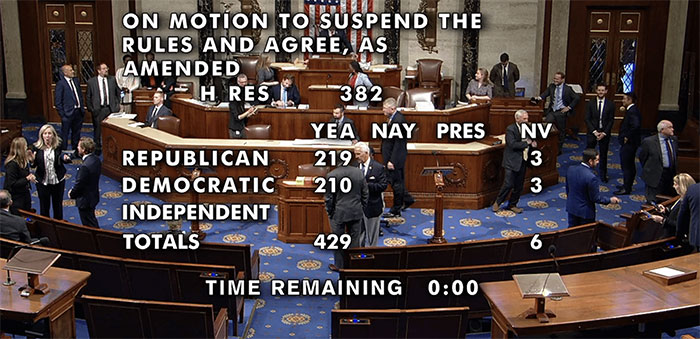
The House of Representatives unanimously passed a resolution 429-0 on May 31 that both condemned antisemitism and urged elected officials to inform the public about the contributions Jewish Americans have made to society.

The five-page resolution noted that every president since 2006 has issued proclamations recognizing May as Jewish American Heritage Month and that “Jewish Americans have served in government and the military, won Nobel prizes, led universities and corporations, advanced medicine and philanthropy, created and performed in enduring works of performing and visual art, written great novels, become emblems of justice as members of the Supreme Court of the United States, and so much more.” The resolution also noted that due to rising antisemitism, four in 10 American Jews have changed their behavior and that 2021 FBI data found that Jews “remain the single most targeted religious minority in the United States.”

Additionally, the resolution noted that a 2020 survey of millennials and those in Generation Z found that 63% didn’t know that six million Jews were murdered in the Holocaust and that 36% thought the figure was two million or less. The resolution concluded with a call for “elected officials, faith leaders, and civil society leaders to condemn and combat any and all acts of antisemitism” and “calls on the Executive Branch and civic leaders to identify and educate the public on the contributions of the Jewish American community.”

The Anti-Defamation League tweeted, “This month, we lobbied Members of Congress to pass legislation recognizing the contributions of the American Jewish community and denouncing #antisemitism. Amidst the rise of dangerous antisemitic attitudes, we applaud the House for passing this resolution today.” They then thanked House Minority Leader Hakeem Jeffries (D-NY) and Representative Debbie Wasserman Schultz (D-FL) (who first introduced the resolution), David Kustoff (R-TN) and Brian Fitzpatrick (R-PA) for their “critical leadership on this resolution.”

“Today, the House unequivocally condemned antisemitism by passing my resolution with a bipartisan vote,” Wasserman Schultz tweeted. “As Jewish American Heritage Month comes to a close, let’s recognize that while hatred is on the rise, we must recommit ourselves to the fight against it and all hate.”

House Unanimously Passes Resolution Condemning Antisemitism Read More »

Why the White House Plan Makes Jews Stronger

In America, the Jewish community has grappled both with the blessings and benefits afforded us in a liberal democracy and the slights and insults of a latent antisemitism that’s never really disappeared from society.

So perhaps it should not be surprising to see a wide range of reactions, even some second-guessing of the efficacy of the new National Strategy to Counter Antisemitism, the historic plan to address anti-Jewish hate across American society announced last week by the Biden Administration.

Let’s be clear about the fact that the White House National Strategy isn’t perfect. What plan ever is? There’s no one ideal solution that will eradicate antisemitism, no silver bullet that will stop the oldest hatred.

But should we throw up our hands and distrust any assistance just because we continue to face bigotry? Should the Jewish community – which in recent years has faced shootings at our synagogues, beatings in the streets, harassment on campus, relentless abuse online – try to go this alone, without the aid of law enforcement and federal protections? Should we reject the offers of help from our allies in other communities? From partners in public agencies?

Let me say definitively – absolutely not. There’s strength in numbers. And there’s strength when the federal government stands behind you. That’s why there’s civil rights protections and hate crime laws in this country.

Here’s some reasons why the White House plan not only makes us safer, but actually works to make us stronger.

The National Strategy is a first-of-its-kind plan for the United States. It’s the type of framework that is nothing short of a quantum leap forward for our agenda of fighting hate, for the communities that we serve, and the country that we love.

If you read the strategy — and I hope that everyone will do so — it’s hard not to be blown away on numerous levels. It is astonishing to absorb its ambition, its breadth, its scope, and its specificity. It is a remarkable document.

We all know that antisemitism isn’t new. Far from it. And we all know that, while its markers like attitudes and incidents were in retreat for decades, arguably generations, it has resurfaced with a vengeance in our times.

No organization has done more than the one that I lead, the ADL, to track its surge and to work to stop it – not just with sharp statements or tweets, but with substantive partnerships and programs. But we also are realistic that without government support, certain priorities, like increased funding for synagogue security, are not possible.

As a former White House official, I’ve seen what you can do when you are able to harness the full force of the U.S. government. The results can be seismic. You literally can move mountains.

That’s why ADL actively assisted in the development of the White House strategy, contributing more than 30 distinct policy recommendations. ADL also organized grassroots advocates to urge Congress and the Biden Administration to develop a unified national strategy to monitor and combat antisemitism. The foundations for these policies were set forth in part by ADL’s COMBAT Plan, a proposed set of government initiatives to fight antisemitism, which ADL originally released in June 2022.

The White House strategy takes mission-critical steps to push back against the rising tide of hate across society. It elevates antisemitism as a federal priority, like expanding the economy or combating climate change. It embraces the IHRA definition of antisemitism, placing it at the center of federal policy. And the plan outlines 200 concrete provisions across four pillars to alleviate the issue – these include increasing awareness of the threat and celebrating Jewish American heritage; improving safety and security for the Jewish community; reversing the normalization of antisemitism; and building cross-community solidarity and collaborative action.

These four categories include detailed actions ranging from supporting antisemitism and terror prevention measures, conducting an antisemitic violence threat assessment, funding research into antisemitism and strengthening the Office of the Special Envoy to Monitor and Combat Antisemitism.

This could not come at a more important moment. In January, ADL released survey findings showing the highest percentage of respondents harboring extensive antisemitic prejudice in decades, with nearly 20 percent of the American public subscribing to classic antisemitic tropes. And antisemitic incidents surged to historic levels in 2022, with a total of 3,697 incidents reported across the U.S., an increase of 36 percent. This included 91 bomb threats against Jewish institutions last year, as well as a disturbing increase in organized white supremacist propaganda, which was up 100 percent to 852 incidents.

Given these disturbing trends and violent attacks in recent years such as those targeting Orthodox Jews in Brooklyn, worshippers in Colleyville, Texas and Jewish pedestrians in Times Square, ADL repeatedly urged the White House to take action. Thankfully, the call was answered. The finished product has its flaws (even a reference to CAIR in the accompanying talking points, an organization that regularly promotes hateful antizionism, is mystifying) and implementation will be the ultimate measure of success, but the plan sets a high bar that should strengthen our resolve and energize our community.

We all stand to benefit from a government strategy that has laid the groundwork for a unified, smart, strategic, and coordinated “whole of society” plan to fight antisemitism in all forms, both in American and around the world.


Jonathan A. Greenblatt is CEO and National Director of ADL (the Anti-Defamation League).

Why the White House Plan Makes Jews Stronger Read More »

Print Issue: Jewish Champions | June 2, 2023

CLICK HERE FOR FULLSCREEN VERSION

Print Issue: Jewish Champions | June 2, 2023 Read More »

SB_logo2

The Eyebrows Seen Around The World ft. Dani Bergman

The Schmuckgirls are back with their next episode in their Jewish Matchmaking series! This episode they welcome the outgoing Dani Bergman. They discuss her famous eyebrows and looking at dating like it’s just going out with a friend. Dani gives a look into how she ended up in Miami and also talks about her busy but fun work life. She shares how she found out about Jewish Matchmaking from a Facebook group and how her move to Miami really helped to propel her life forward in multiple ways. Dani talks about her experience on the show and meeting with Aleeza and how the show had to navigate not just finding a match, but people willing to go on TV. She also shares the story being the “hectic” hat. The girls dive a little bit into the David missing Dani’s birthday fiasco and then move on to a more meaningful conversation about why a show like Jewish Matchmaking is so necessary. Dani also shares some of her biggest takeaways from the show and what she learned from Aleeza. The girls end with a game of “This or That.” You can find Schmuckboys on Instagram @schmuckboysofficial and Dani @danimbergs. Send all your dating questions, stories, advice to schmuckboysofficial@gmail.com


The Eyebrows Seen Around The World ft. Dani Bergman Read More »

Rabbis of LA | Rabbi Sari Laufer: Meet a Feminist Rabbi

For Sari Laufer of Stephen Wise Temple, being a rabbi and a feminist came as naturally to her as breathing. Growing up on the Upper East Side of Manhattan as an only child of two staunchly feminist parents, her path was set early.  “I don’t have a choice,” said Rabbi Laufer, “because everything I do, because of who I am, this is the way I walk in the world.” 

That extends to the bima. “When I read Torah, I read it as a feminist,” she said.  “When I teach Torah, I teach it as a feminist.”

What does it mean to be a feminist teaching Torah? It means, she says, telling the stories of those who aren’t seen. 

What does it mean to be a feminist teaching Torah?

 It means, she says, telling the stories of those who aren’t seen. “One thing I am called to do, always, probably because of having learned from feminists and having feminist theology, is that I feel very called to try to lift up voices that may not immediately be obvious in our texts.”  Those voices do not exclusively belong to women. “Plenty of men’s voices in the Torah are not heard,” the rabbi said. “The beauty and challenge of reading our text is — depending on your theology — even if you see a multiplicity of voices in the text, in the priestly voice, only certain people are included in that conversation.”

Making sure that everyone was heard was something she learned at home. “I picked up from my parents, from the way they were talking/acting,” she said. Her mother was a nurse/nurse educator, and she was a model for her daughter, showing that a woman can do anything she wants. “My (late) dad often was the primary parent,” Laufer said.  She speaks of him with a strong burst of pride. “It takes a strong feminist to say ‘I will be the one at home’ since that traditionally has been the woman’s job,” Laufer said.

“Now, as a working parent, I reflect on what it meant to have a working mom.” Her husband, Ben Cutter — the son of a rabbi and an assistant director at USC Hillel — also grew up as an only child. Are they raising their 9-year-old daughter, Orli, and 6-year-old son, Jacob, the way they were raised? “I don’t know if there is anyone completely able to set aside the way they were raised,” she said. 

Laufer wants to raise her children with a genuine curiosity about the world around them. That is a challenge. “I grew up in New York where it comes very naturally,” she said. “You interact with the world much more than I think you do in Los Angeles.” The three of them often go hiking, a habit started during the pandemic.

A graduate of Northwestern University, she was ordained by Hebrew Union College in Los Angeles in 2006, then returned to New York, where she spent a decade at Congregation Rodeph Sholom on New York’s Upper West Side before joining Stephen Wise in 2017. 

In her teaching she talks about big “T,” Torah. “I have dedicated my life to it,” said the rabbi. “But I also think about little ‘T,’ Torah, like what is the truth and wisdom that is out in the world?”

One way of fusing the two “T”s is taking the children to marches, where she sometimes has to answer questions that are hard to explain to a 6-year-old. She lives with her husband and children in the San Fernando Valley, and they are all familiar with the sign-carrying activist seen at the intersection of Sepulveda and Ventura ever since the George Floyd murder in 2020. “I have taken my kids to make blessings, signs to keep in our car, just so they see a world beyond their small world,” Rabbi Laufer said.

It’s important to the rabbi that her children see her working. “Sometimes they feel I am picking work over them, but I don’t think I really do.” On a recent Sunday morning, Orli and Jacob did not want her to leave for the hour that she would be gone. “But I am happy that they see there is work that I love,” the rabbi said. 

“Many years from now when they sit in a rabbi’s office and talk about a eulogy for me, I hope they say nice things. I hope it is the same story from both.”

Fast Takes with Rabbi Sari Laufer

Jewish Journal: What is your favorite Jewish food?

Rabbi Laufer: I am going to cheat and give two: Writ large, my favorite food is fried potatoes.  After six years at Stephen Wise, I have become a Persian food aficionado. Fesenjoon (chicken,walnut and pomegranate stew).

JJ: What book is at the top of your nightstand?

Rabbi Laufer: “The Lives We Actually Have,” by Kate Bowler, a book of blessings for the lives we actually have.

JJ: Your favorite music?

Rabbi Laufer: My music shuffle is a fascinating mix of Israeli pop, lots of show tunes, Indigo Girls, Grateful Dead and 1990s hip-hop.

Rabbis of LA | Rabbi Sari Laufer: Meet a Feminist Rabbi Read More »

Sweet Summer Days: Corn Salad Recipes

When I was a little girl in Casablanca, I loved eating the grilled corn on the cob from the Arab street vendor. He would have many ears of corn sitting on a pile of glowing charcoals. Using a giant pair of tongs, he would turn them over and over until the kernels of corn were slightly puffed and slightly blackened. He would dip one ear of the cooked corn into a bucket of heavily salted water, place it on a piece of corn husk and hand it to me. 

I just remember the explosion of smoky, salty, sweet flavor. The fresh corn was crispy and fleshy and juicy all at the same time.

When I asked my cousin Simy about the corn vendors in Morocco, she told me that they were on street corners all over town, as well as the beaches. Since then, I’ve always loved corn in any shape or form. 

When I asked my cousin Simy about the corn vendors in Morocco, she told me that they were on street corners all over town, as well as the beaches. Since then, I’ve always loved corn in any shape or form. 

Luckily for me, the influence of our Mexican neighbors means that corn is very popular on California menus. At this time of year, there is such an abundance of fresh corn at farmers markets and the local supermarket. And that’s our cue to shift into summer recipes.

One of my favorite ways to use corn is in salads. It’s an easy way to eat it without getting your hands dirty and corn stuck in your teeth. Corn adds an unexpected sweetness and brightness. I prefer to use the white corn rather than the bright yellow corn as the white is sweeter and more tender.

The salad recipe I’m sharing here uses grilled corn but will work just as well with boiled or even raw corn. (Grilled corn imparts a smoky flavor, while boiled corn is subtle and sweet and raw corn will be crunchy and milky sweet.) This salad includes romaine, sweet oranges, pistachios and ripe avocado. Of course, it’s no secret that corn pairs really well with avocado, but this salad has the perfect combination of unexpected ingredients. Something about the crunch and the creamy factors. 

Here’s to a summer filled with sunny days and delicious corn salads.

—Rachel 

When I was a little girl, corn was my favorite vegetable. My grandmother’s pantry was always stocked with cans of corn. She would open a can, heat up the corn, put a tiny pat of butter on top and I was the happiest girl on earth. On the cans of corn was an illustration of a pretty little farm girl in a bonnet standing near a field filled with sheaves of corn and that just added to the pleasure. 

Now that I’m mostly an adult, I still love corn. There’s nothing better than sinking your teeth into corn on the cob. Corn on the cob is summer barbecues. Corn on the cob is a healthy treat between rides on sweaty days with the kids at Knotts Berry Farm or Disneyland. Corn on the cob is one of the simple pleasures in life. 

Quite a few years ago, Stan from Stan’s Produce told me that the easiest way to cook corn on the cob was to double a paper towel, wet it, put it on top of the corn and microwave for 5 to 8 minutes. I often use this technique and always think of Stan. 

Whenever I host Shabbat lunch or a barbecue, I love to make a southwestern style salad with corn and canned black beans, avocado, tricolor peppers, purple onion and radishes. I make a dressing with spicy mayo, olive oil and lime juice. I garnish with corn chips which makes it fun to eat. It’s always a hit (even with the pickiest eaters).

The recipe I share here is more of a riff on street corn with fresh juicy tomatoes, crunchy red, orange and yellow peppers, crisp cucumber, Italian parsley and purple onion.

The recipe I share here is more of a riff on street corn with fresh juicy tomatoes, crunchy red, orange and yellow peppers, crisp cucumber, Italian parsley and purple onion. The Mexican influence comes through the addition of creamy avocado, fresh-squeezed lime juice and crunchy plantain chips. If you’re serving a dairy meal, add some crumbled Feta cheese. 

Just simple, healthy and delicious.

—Sharon 

Sharon’s Corn Salad

3 ears of corn, boiled or microwaved
1 red pepper, 1 orange pepper, 1 yellow
pepper, diced
2 large firm heirloom tomatoes, diced
1 bunch Italian parsley, soaked, rinsed and
roughly chopped
1 purple onion, thinly sliced
1 ripe avocado, cubed
6 radishes, thinly sliced
Plantain chips or corn chips, for garnish

Dressing
1/3 cup olive oil
2 limes, juiced
Salt and pepper

Strip kernels of corn from the cob and place in a large bowl.
Add the peppers, tomatoes, parsley, onion, avocado and radish.
Just before serving, pour in the salad dressing and toss well.


Rachel’s Corn Salad
Photo by Alexandra Gomperts

Rachel’s Corn Salad

3 ears of white corn
4 romaine gems, chopped into thin shreds
2 medium avocados, cubed
2 oranges, peeled and cubed
1/3 cup roasted and salted pistachios
Dressing:
1/4 cup olive oil
1 large lemon, juiced
1 teaspoon dry oregano
Salt and pepper to taste

Grill the corn for 10 minutes or until fork tender. Let cool, then strip the kernels.
Prepare the dressing in a bowl. Add the cubed avocado to the dressing and coat well.
Assemble the salad in a large bowl. Place the Romaine lettuce gems on the bottom. Add the grilled corn in the center of the bowl. Add the avocado and the dressing around the corn.
Place the oranges around the outer edges of the bowl.
Garnish with the roasted pistachios.
Toss immediately before serving.


Sharon Gomperts and Rachel Emquies Sheff have been friends since high school. The Sephardic Spice Girls project has grown from their collaboration on events for the Sephardic Educational Center in Jerusalem. Follow them
on Instagram @sephardicspicegirls and on Facebook at Sephardic Spice SEC Food. Website sephardicspicegirls.com/full-recipes.

Sweet Summer Days: Corn Salad Recipes Read More »