fbpx

June 1, 2022

Stepping In the Same Blood Twice: The Riddle We Cannot Seem to Solve

It may sound like the beginning of a bad joke or a horror story, but it is true: Studying law, playing games and telling jokes often involve hypotheticals. “What if?” queries allow us to explore and map out various alternative theories, not unlike the “choose your own ending” books many of us read as children. Hypotheticals help exercise the mind, and offer endless paths forward to a series of difficult problems and questions that we might anticipate in real life. Hypotheticals, like proverbs, serve as the daughters of experience. And while one might suspect, to paraphrase Heraclitus, you cannot step into the same river of experience twice, it seems that hypotheticals refute this proverbial daughter by reliving the same experience over and over again.

I stumbled onto this repetition myself through none other than a hypothetical writing exercise in one of my courses.

At the end of this past semester I gave students an in-class writing assignment that involved a big “What if?” question: If you had Elon Musk’s 44 billion dollars, what would you do with it? Would you buy Twitter? If not, what would you do with the money?

As I waded through the river of grading, I started to notice a familiar pattern emerging in every single class. If the student was male, he wanted weaponry of some kind, or to have his body modified as weaponry. Think about that for a minute.

Bodies themselves as weaponry.

Most involved firepower of a high caliber. One student wrote about his desire to have the arm of Robocop. (“Just think what I could do with that!” he ruminated). Most wanted Iron Man’s suit to wield at their disposal, and quite a few wanted Batman’s choice of weaponry as technology. Since we are talking hypotheticals, I don’t need to have you guess which gun is the gun of choice in these hypotheticals—it is the very same gun we continually hear about in the news currents that wash over us almost daily. I even had one student say if he had 44 billion dollars, he would buy a naval war ship and he would blow up Disney World with it. I asked why, and he said it was mostly just a joke.

I even had one student say if he had 44 billion dollars, he would buy a naval war ship and he would blow up Disney World with it.

Mostly.

A joke.

So many of the past mass shooters have said in response to being reported for disturbing behavior, that they were only joking.

Joking.

Their jokes turned out to be future plans in plain sight. Not a proverb or a parable, but a riddle. A curious thing about riddles is that their solution is always part of the riddle itself. And with riddles something is always a stake, sometimes your very life.

Paraphrasing Freud, maybe a gun isn’t a cigar or a joke, but it’s just a gun. Wading deeper into the subconscious wellspring of so-called jokes in plain sight invoking violence hidden in plain sight, I also couldn’t help but think of Freud’s taxonomy of “Der Witz” that requires three people: one who cooperates with the teller at the third’s (usually absent) expense.

The feminine is often present only in its absence as part of a joke, as the butt of the joke as it were—present as a silent viewer overhearing dialogue on their pretend presence conjured not for reality, but to serve as an actor in another person’s imagined (but maybe real) joke. The answer Oedipus gives to the Sphinx’s riddle regarding who walks on four feet in the morning, two in the afternoon and three at night is simple: man. Ah yes, but who walks up to a shooter to protect children completely unarmed while 19 men with guns hide behind a door? Who lies in a pool of blood clutching dead students? The answer to that riddle is also simple: woman.  

Who lies in a pool of blood clutching dead students? The answer to that riddle is also simple: woman.

Dreams, Freud points out, are about the individual. Jokes, on the other hand, are a social activity.

Speaking of social engagement and hypotheticals: Not a single, solitary female student in my courses desired in their heart of hearts a gun or weapon of any kind. Not one female issued a call for destruction. There were no “jokes” that flirted with potential violence. The common theme of the women?

Fear.

Fear of being under a man’s thumb for their entire lives. They wanted financial stability so they could have freedom. They all said they would invest in public welfare, foster life in the body politic, in schools, in homeless shelters. They all wanted to give back to their communities, to their families, to society.

As I watch the news reporting on this latest mass shooting that will be embedded in the river of our collective consciousness, I am thinking not only of the dreams of the two women who taught students at Robb Elementary, but also of the waves of collective nightmares that will ripple outward for generations. I am thinking about the threats of rape the Uvalde shooter barraged girls with online endlessly, yet the young women reporting it were ignored before they finally resigned themselves to accept, “This is what life is like for girls.” I am thinking of the 19 children who cried out for over an hour for help that did not arrive until their bodies were already riddled with bullets. I’m thinking of Miah Cerrillo who watched the shooter walk up to her female teacher and say “goodnight” before shooting her in the head. The 11-year-old cried when she said she thought of the man shooting them and the 19 men outside with badges and guns who did nothing to save them for over an hour, but instead policed the parents as their children were murdered. She is afraid of men at age 11. And I can’t say I blame her.

Is our future going to look a lot like our past? Can we choose our own ending? Our very lives are at stake in this riddle, and so are the daughters of our experience.


Shellie McCullough is an educator, writer and lecturer in Higher Education. Her book “Engaging the Shoah Through the Poetry of Dan Pagis: Memory and Metaphor” is available through Rowman & Littlefield.

Stepping In the Same Blood Twice: The Riddle We Cannot Seem to Solve Read More »

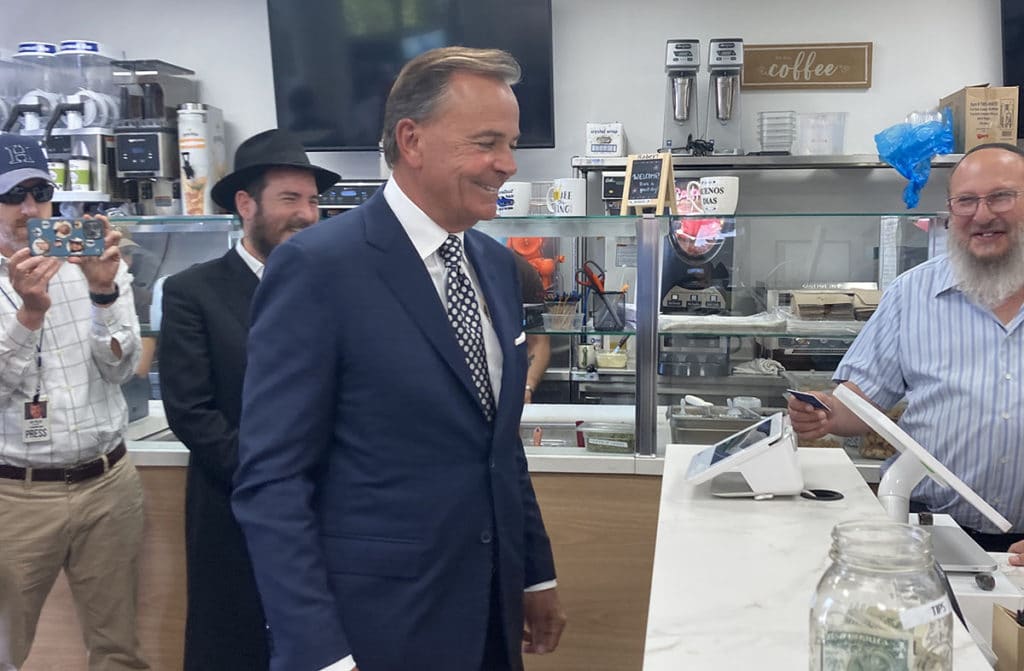
Mayoral Candidate Rick Caruso Visits Pico-Robertson

News trucks and cameras littered the sidewalk and curb outside Beverly Hills Bagel Company, a kosher retailer in one of Los Angeles’ most Jewish neighborhoods.

The reason was an unannounced visit by Rick Caruso, a leading candidate in the Los Angeles mayoral race.

Wearing a suit and tie and flashing a friendly grin at passersby, Caruso on Tuesday visited the Pico-Robertson area, where he met with Chabad leaders about issues of importance to the Jewish community before stopping by several kosher businesses in the predominately Jewish area.

“We were happy to meet him as we would be happy to meet anyone running for office who wants to hear about the needs of the Jewish community,” a Chabad spokesperson said after the visit, explaining the meeting did not amount to Chabad’s official endorsement of the candidate.

Caruso’s pop-in on Tuesday occurred one week before the mayoral primary election takes place June 7.

In the widely covered race to succeed outgoing L.A. Mayor Eric Garcetti, Caruso, a successful businessman and real estate developer, is facing off against Congresswoman Karen Bass and L.A. City Councilman Kevin de Leon, among others, to lead this city.

With election day less than one week away, polls show Caruso and Bass, a Democrat in U.S. Congress, virtually even while a sizable percentage remain undecided. De Leon is a distant third, according to polls.

In the mayoral primary, if no candidate garners more than 50-percent of the votes, a runoff is held in November.

Tuesday’s visit by Caruso, who is Catholic, was his attempt to demonstrate sensitivity to Jewish voters before the upcoming citywide election. Caruso met privately with Chabad rabbis in an outdoor setting at the movement’s offices on Pico boulevard, and addressed issues of safety and security at a time when anti-Jewish attacks are on the rise.

Caruso addressed issues of safety and security at a time when anti-Jewish attacks are on the rise.

“Clearly he wants people to be aware of what his commitments are,” Rabbi Chaim Cunin, who was among those at the meeting, said. “It was very helpful and constructive.”

Caruso also discussed his time serving as a president of the Los Angeles police commission as well as his familial connection to once-Jewish enclave Boyle Heights, where his grandparents settled in the 1920s after emigrating from Italy to the United States.

Afterwards, the mayoral candidate bought coffee and bagels for neighborhood residents at the bagel café. He also visited local ice cream store Munchies, where he signed yarmulkes for kids, and the Glatt Mart, a kosher market.

“I told him he might be 10 pounds heavier by the time he is done with Pico,” Cunin, CEO at Chabad of California, told the Journal.

Before entering the mayoral race in February, Caruso was known for his success in the private sector. His real estate developments include popular shopping destination The Grove as well as the Americana in Glendale and Palisades Village.

Since entering the race, he has made his campaign about three issues: ending the city’s homelessness crisis, reducing crime, and tackling corruption among city officials.

Polling suggests the message has resonated with many Angelenos.

Mayoral Candidate Rick Caruso Visits Pico-Robertson Read More »

Pro-Life?

As the mother of a 12-year-old living in New York City, where crime and violence escalate on the hour, I initially tried to skip over the details of what transpired in the Uvalde, Texas, classrooms last week. But when we learned that the police had made fatal mistakes in handling the rampage, that was no longer an option.

Against “active shooter” doctrine, 19 officers stayed in the hallways for nearly an hour while children and teachers inside the classrooms were calling 911, pleading for help. The police even prevented federal agents from entering the school. The agents finally ignored the police and killed Salvador Ramos but not before he murdered 19 fourth graders and two teachers. 

Ramos had legally bought the AR-15 semiautomatic rifle he used in the massacre, just after his 18th birthday. Last year, Texas Governor Gregg Abbott made it even easier for Ramos by no longer requiring permits to carry a gun.

The party that claims to be pro-life seems to suddenly forget that fact when it comes to guns.

Despite all of this, most Republicans responded in unison, as they do after every mass shooting: Back off! Don’t blame guns! A strict hyper-partisanship was maintained, kids be damned. The party that claims to be pro-life seems to suddenly forget that fact when it comes to guns.

The Second Amendment is a right indeed—but that doesn’t mean it can’t be restricted, as the Supreme Court affirmed in 2008. Every constitutional right has restrictions. I think it’s fair to say that James Madison did not envision an 18-year-old legally wandering the streets with assault weapons, which spin out high-velocity bullets at triple the speed of a handgun.

AR-15 semiautomatics are the “civilian” versions of military weapons, designed to kill people quickly and in large numbers. What non-military use do they have? Do hunters need to kill deer quickly and in large numbers? Fully automatic weapons have been heavily restricted in the U.S. since 1934. Our society doesn’t seem to be ailing from a lack of machine guns on the streets.

In 1994, President Bill Clinton signed an assault weapons ban, which banned the AR-15 and similar semiautomatics. Mass shootings went down in the decade that followed. Once the ban expired in 2004, mass shootings again began to rise. Most notably, the AR-15 was used in the 2012 massacre at Sandy Hook Elementary School in Connecticut, detonating 27 lives.

The NRA has used the mantra ‘guns don’t kill people; people kill people’ for decades. The words are true, but any one of those fourth graders could have told you how ludicrous the argument is. Ramos fired at least 100 rounds within the first two minutes. Perhaps if he had transformed himself into a space laser, he would have had the same effect without the gun.

Firearms became the leading cause of death for U.S. kids in 2020. There have already been more than 200 mass shootings in 2022, 27 at schools. The GOP (correctly) wants Democrats to stand up to radical progressives. What will it take for the GOP to finally stand up to the equally nefarious NRA? 

The fatal mistakes made by the Texas police only underscore the need for more restrictions. People are fallible; mistakes, even with the best training, will sadly be made. The same goes for the fact that his friends and family didn’t notify authorities about his intentions. 

I especially don’t understand how Republican parents can turn their heads from this. Sure, there are other problems that need to be addressed, like better security at schools and the growing mental health crisis among male teens. But at what point do you allow yourself to respond as a parent—as a human?

For the past two years, we have all been forced into a mass pressure cooker, and it is now exploding. Anarchy can be felt quite literally on the streets of both Los Angeles and NYC. As a country, we have reached our breaking point.

But an honest debate about rational gun laws is long overdue, and for that to happen the hyper-partisanship, extremist rhetoric, and gratuitous divisiveness need to end.

We just lost 19 fourth graders because the adults in government refuse to act like adults. Enough.


Karen Lehrman Bloch is the editor in chief of White Rose Magazine.

Pro-Life? Read More »

We Must Act Now in Order to Save the Rohingya People

In 1939, four months before the invasion of Poland, 937 souls set sail aboard the MS St. Louis as a dark cloud of totalitarianism swept through Germany at the hands of the Third Reich. Passengers aboard the St. Louis, many of whom were Jewish, left their homes in Hamburg for what they hoped would be a new life across the Atlantic Ocean and a world away. Instead, the world turned its back. 

Today, the Rohingya people in Burma suffer at the hands of dictators bent on genocide amid a world awash in indifference. As you read this, we have an opportunity to act or risk the same outcomes that led to the near-erasure of the Jewish people.

When the St. Louis tried to disembark at the Havana harbor, authorities turned back nearly everyone. Driven by antisemitic vitriol, the Cuban government effectively sentenced 254 Jewish men, women and children to immediate death as they sent them back to Germany en route to the kinds of concentration camps that would go on to kill 12 million people in the name of security, poverty alleviation, and the purification of the master race.

History is repeating itself in Myanmar—also known as Burma—and will continue unless we act. The United States Senate must pass the BURMA Act today to deliver the kind of aid and empowerment those aboard the St. Louis never received.

The violence is well documented, and the terror of the Rohingya people is unmistakable. A 2018 United Nations report cited the “gravest crimes under international law” after a military crackdown resulted in targeted persecution, rape and mass murder as more than 700,000 Rohingya fled their homes to seek safety. Like the Jews of Europe eight decades before, the Rohingya people, an ethnic Muslim minority in Myanmar, have long been scapegoated for societal ills. They were othered, ghettoized and dehumanized long before the UN cited crimes against humanity in the region.

Global actors, including the United States, now formally recognize what happened in Myanmar as a genocide. Meanwhile, the mass exodus continues to result in dangerous journeys in which men, women and children seek some semblance of freedom—often in makeshift rafts on the open sea—desperate to find a welcoming place that offers fundamental human rights. According to a UNHCR statement, “some 630 Rohingya have attempted sea journeys across the Bay of Bengal from January to May 2022, with women and children making up 60% of those trying to flee.”

Survivors have been met again and again with harsh conditions and deepening instability. Thousands have been turned away from countries like Indonesia and Malaysia, many of whom are forced back out to sea without support, echoing the ill-fated journey of the St. Louis.

When Rohingya are admitted to certain countries, such as Bangladesh, increasingly strict policies curtail fundamental freedoms. Bangladeshi authorities, for example, demolished thousands of Rohingya shops, closed dozens of schools, prohibited learning in the native Rohingya dialect, and restricted movement and internet access within the largest refugee camp in the world in Cox’s Bazar.

In recent months, thousands of Rohingya people have forcibly moved to the dangerous island of Bhasan Char, located 37 miles off the mainland, where harsh weather conditions wreak havoc.

For years, the world ignored the trauma and suffering of the Rohingya people. Their pleas for justice were dismissed while the Tatmadaw, the military body that overthrew Myanmar leader Aung San Suu Kyi, continued their pervasive campaign of terror. The good news is that the world is beginning to call out this injustice. In March, U.S. Secretary of State Antony Blinken stood on the steps of the United States Holocaust Museum and declared violence against the Rohingya a genocide because “It’s crucial to all of us who are committed to living up to the maxim of ‘Never again.’”

We know this story viscerally, which is why we must demand accountability from Congress and continued support from the Biden administration.

Now is the time for the United States to turn words into action.

The United States, United Nations Security Council, International Criminal Court and international powers worldwide must seize this opportunity to bring those responsible to justice. It is crucial to confront these atrocities comprehensively.

We can do that through the BURMA Act, which aims to bring those responsible for crimes against humanity to justice. The Rohingya people deserve a safe place to call home with guaranteed protection. That is impossible as long as Myanmar remains under military control.

As representatives of the Jewish community, we strongly urge the Senate to act swiftly in passing this crucial legislation.

As the globe teeters on the edge of uncertainty, the United States must reclaim its mantle of leadership and stand up for the Rohingya people.

Eighty-three years ago, the world stood idly by while an authoritarian regime dehumanized and targeted millions because of their inherent identity. May 27 marked the anniversary of the passengers of the St. Louis waiting to be let in on Cuban shores. The boat remained in international waters until June 9, when authorities finally told them none of Cuba, Canada, or the U.S would accept them. They bore witness to how apathy turns into genocide.

To change the future, we must learn from the past. We can do that by demanding that Congress act by swiftly passing the BURMA Act.


Serena Oberstein is the executive director of Jewish World Watch, bringing help and healing to survivors of mass atrocities around the globe and seeking to inspire people of all faiths and cultures to join the ongoing fight against genocide. She has spent nearly two decades working toward a more just society  on the local, state, federal and international level in the nonprofit and public sectors.

We Must Act Now in Order to Save the Rohingya People Read More »

Escaping LA, Almost

We left Los Angeles in August of 2021. The cut was sharp and final, as we quickly sold our home, packed our belongings, and boarded a flight to our new life. When the plane finally landed in Florence, I didn’t even care about how much I was sweating in the oppressive late-summer Tuscan heat. I felt that I had accomplished something miraculous: I had escaped, and everything was going to be okay.

People always ask me why we left the U.S., and the truth is that it wasn’t one thing. It was all the things, moving faster and faster, barreling into me every day. It was some of the people around me, acting as if the violence, the homeless people, the fires, the rising crime were nothing out of the ordinary. Hey, that’s life in the big city.

I don’t mean to bash LA. When I got a job at UCLA after grad school and moved to the City of Angels, I thought I’d never leave. I loved LA instantly, and the truth is that I still do. There are a lot of things I miss besides family and friends: sushi and any ethnic cuisine I can think of, beaches and the glorious coastline. I miss being able to drop my son off for school while wearing yoga pants and a tank top (it’s considered indecent to wear such clothing out of the gym here). And I really miss living in a city full of Jews—that’s the thing that stings most. I can’t pick up pretzel challah in the Pico-Robertson neighborhood anymore. When I need challah, I have to make it because there’s nowhere to buy it. We were the only Jews at the Chanukah party we threw last December. We’ve since met others, and my son is even learning Hebrew with Chabad of Tuscany, but by the time Sukkot rolls around I’m pretty sure we’ll know only a handful of Jews to invite to our Sukkah. As much as I was ready to leave LA, there were some important things that I took for granted when it came to living there.

I realize in writing this that despite being happy where I now live, I’m a little angry that I was forced out of a city I loved. It’s complicated, as people say. Perhaps any authentic grappling with the emotional cost of leaving or staying in a place you love, one that is also rapidly changing, must be complex. Is there any genuine feeling that doesn’t look like ambivalence when all is said and done?

I’ve heard that a lot of people have left LA in the past year, citing the same issues that drove my family and me out of the city. Still, the rising median home price shows no signs of slowing, which means that a lot of people still believe in the city. I hope their optimism is prescient.

I’m a doomsday prepper at heart. After years of teaching the Holocaust, how can one not be? I have always been determined to not be someone who doesn’t see the signs, someone who doesn’t get out before it’s too late. Expect the worst and prepare for it, my father always said, and so I do.

In the summer of 2020, I was sickened, along with everyone else, by the murder of George Floyd. But then the protests started—the ones that were deemed necessary despite the fact that we were in a pandemic that required social distancing. And then the fires and the looting and the broken glass appeared along with swastikas on synagogues, and whole rows of shops on Ventura Boulevard, just below our home in Studio City, were boarded up. One night, there were calls on Twitter for protesters to go into the hills of Studio City and loot and burn the homes in my neighborhood. I was terrified. That night we kept watch until the sun came up, ready to do whatever necessary to protect ourselves. Nothing ever happened. No one came. But it didn’t matter. The fear, the threat, the sleepless night—it was enough for us to say “No more. It’s time to go.”

The mildly distressing detail in this story—distressing because, after all, I am a proud liberal—is that both my husband and I were armed with guns as we sat watch. The previous year we had watched crime rise exponentially in our area. Once when someone banged on my door in the evening, trying to get in, I called 911 and no one answered. Another time I called 911 because a vagrant who was using meth was wandering erratically around the neighborhood. No answer. When we finally spoke to friends in law enforcement, they advised us to arm up. “We can’t guarantee that we can protect you.” And so we armed up, after undergoing more defensive handgun training than the average American police officer.

That comfort only revealed the deeper issue: We were suddenly living in a place that made owning a gun necessary, and I didn’t want to live like that.

We had always hated guns. We still hate guns. But given what was happening in our city, we were thankful we had them. And yet, we were also angry that we had them in our home. On the surface, every night I went to sleep I felt good because I knew that if something happened and the police didn’t come, I had both the skills and tools to protect myself and my family. But that comfort only revealed the deeper issue: We were suddenly living in a place that made owning a gun necessary, and I didn’t want to live like that.

Earlier that year, before the lockdowns commenced, there was an active shooter drill at my son’s elementary school in Hollywood. They didn’t tell us it was going to happen. My son came home one day and said, “We did something like a fire drill but for when a bad person comes in the school.” In the U.S., we live in a place where active shooter drills are necessary, where children have to be taught to fear in order that they can survive, hopefully.

There’s a short story by Ida Fink called “The Key Game” in which two parents (non-Jewish mother, Jewish father) play a game with their 3-year-old child in Nazi Germany. Every night, the mother knocks on the door and the child must verbally answer the door and then pretend to run around looking for the key and make as much noise as he can for as long as he can in order to give his father time to hide behind the wall before the Nazis enter. I started thinking more about this disturbing story with the advent of active shooter drills in schools. The idea that children—anywhere, but especially in the U.S., the land of vast freedoms and enormous opportunities—must constantly be alert and ready for violence is a sad indictment of our society. 

And yes, we’re all responsible. It’s not just the monsters who pull the triggers. It’s not just the politicians who oppose stricter measures on guns. It’s everything that goes along with those things. It’s the way that our growing mental health crisis is treated like an afterthought. It’s the way all of us scream and bicker and hurl accusations at the other political side every time something like this happens. And it’s something else. It’s something about us Americans, culturally and collectively. What is it? Like many, I’m struggling to figure it out. This epidemic goes much deeper than guns. We have a lot of thinking and soul searching to do.

I took a walk this morning around my neighborhood in Fiesole, in the hills above Florence. I expected that the mesmerizing beauty of this small town, with its cypresses and its jasmine and its wilting wisteria—with no graffiti or homeless tents or drug addicts in sight—would help me forget. But I still found myself in tears, thinking about all of those little fourth graders and their brave teachers, all those lives blown away in a little school in Texas 7,000 miles away. But what about the rest of the children, the ones left behind? I cry for them too.

I’m not okay because I didn’t really escape. As much as I don’t like to admit it, part of who I am will always be in the place I left.

My son is in fourth grade. I have the luxury of knowing that, here, no one ever hears of killers walking into classrooms and firing at children. But that doesn’t mean I’m okay. I’m not okay because I didn’t really escape. As much as I don’t like to admit it, part of who I am will always be in the place I left.


Monica Osborne is a former professor of literature, critical theory, and Jewish studies. She is Editor-at-Large at The Jewish Journal and is author of “The Midrashic Impulse.”

Escaping LA, Almost Read More »

Rosner’s Domain: Can Israel Win Over the Young?

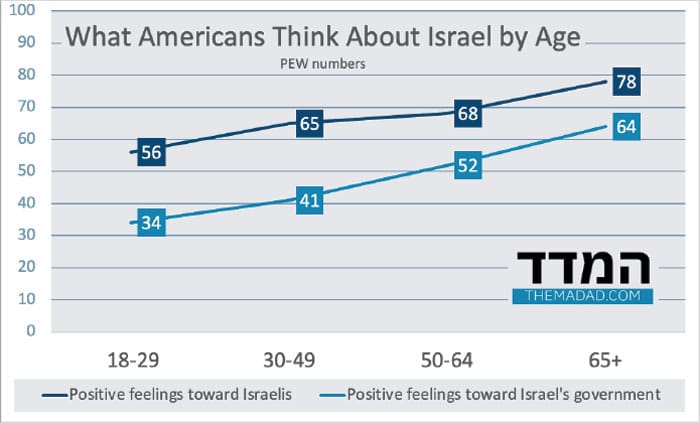
New data from the PEW Research Center confirm the persistence of trends that have been previously identified in Americans’ attitudes toward Israel. This includes a variety of things: Americans generally have a positive feeling toward Israelis, and this year also Palestinians. The governments of Israel and the Palestinians are seen in a less positive light (with a significant advantage for Israel). The preferred solution to the Israeli-Palestinian conflict is two states for two peoples, though the plurality of Americans (37%) have no position on this matter (why would they?). 

What always attracts attention in these polls is not the general picture, but rather the tendencies of subgroups. Republicans support Israel more than Democrats. Evangelicals are more supportive than atheists. Older Americans are more positive toward Israel than younger Americans. In fact, this is the most important finding, because this is where the concern about the future becomes most vivid. This is the root cause of the occasional headline along the lines of “Israel is losing America.” If young people are less sympathetic to Israel, then all we have to do is wait, as the old generation of sympathetic Americans make room for a younger one of unsympathetic Americans. 

Of course, this process is not written in stone. First, it’s not clear whether young people are less sympathetic to Israel because they are young, or because they are different. If it’s because they are young, then perhaps when they get older (and hopefully wiser) they will change their position on Israel. If it’s because they are different, there is still hope for a future change because of actual changes in reality. For example, the survey shows that the Israeli government of 2022 is more popular with Americans than the Israeli government of 2019 (sorry Netanyahu fans, that’s what the data says). That is, the fact that Israel currently has difficulty with young Americans does not mean that this trend will continue in the same direction. It can also change or maybe even be reversed. 

What will make it reverse? Here we begin the more important and interesting discussion about “Israel is losing America.” When someone uses the term “Israeli is losing,” there is a silent assumption behind these words that Israel is responsible for the loss. “Israel” does something that causes the “loss”. If Israel were to act differently, American support may not be lost. The sentiment is of Israeli responsibility, and perhaps even guilt. Because of Israel, this thing happens. Because of Israel, young Americans become less sympathetic. 

Maybe that’s true. Maybe it’s because of Israel. But we need to be careful before jumping to such conclusions; one, because I’m not sure it is really Israel’s fault, and two, because I’m not sure that even if it’s because of Israel that Israel can do much about it. 

Let me explain: Suppose young people in America can no longer tolerate countries that have a distinct national identity. They are in a post-national mood. Suppose that in order for Israel to get the sympathy of young Americans, it must shed its national identity. Stop being the nation state of the Jewish people, and become a neutral state, like America. Suppose this is the case – is it still true to say that “Israel is losing America” or maybe it is “America is losing Israel”?

Is it reasonable to expect that Israel shed its national and Jewish identity so that young Americans will sympathize with it? 

Suppose this is the case: is it reasonable to expect that Israel shed its national and Jewish identity so that young Americans will sympathize with it? This is not an easy question. Israel needs the support of America, and American public opinion is an important factor to continued American support. On the other hand, Israel needs American support so that it can defend itself and its identity as the nation state of the Jewish people. That is the purpose of the Israeli enterprise. If young Americans are no longer willing to support this enterprise, perhaps Israel’s way forward is not to try and bring them back, but rather try to understand how it would manage without their support. 

Of course, it is not clear that this is the key for Israel’s problem with young Americans. Maybe the problem is different. Maybe one of accurate information; maybe it’s the occupation (which brings us back to the question: so what should Israel do, evacuate the territories to please young Americans? And what happens if it turns out that the gamble failed, and the territories become an unbearable security nuisance?); maybe it’s the peculiar mixture of religion and state that is practiced here, and that Americans find difficult to understand (let me remind the readers, that we Israelis also find it hard to grasp some peculiar American traditions, such as the one of selling automatic guns to troubled teens). 

In conclusion, there is a fact: young Americans are less sympathetic to Israel. There is an argument: Israel must make young Americans more sympathetic. There is a problem: it is not clear whether the change required to restore sympathy is possible under Israel’s circumstances.

Something I wrote in Hebrew

As Israelis debates the merit and deficiency of a new “reform” in matriculation exams (the basic idea: written report replaces exams in Bible, literature, civic studies, and history), I argued that Israel is lucky to have parents who make sure the kids have what is needed for success, because the schools aren’t up to the task:

“The Israeli education system is a faltering system. There is no a planned facilitation of students by an ‘establishment.’ There is no functioning establishment. I wish there was a functioning establishment, which had the ability to implement reasonable plans. But there is no such thing. The fact that there are many excellent students in Israel, who later become researchers and entrepreneurs and inventors – professionally successful people — is not thanks to the education system. It is despite the education system.”

A week’s numbers

The numbers from PEW – see column on the left-hand side.

A reader’s response:

Ely Rose asks: “did you not predict the falling of the Israeli government? As far as I can tell, it is still standing.” My response: True, and yet I’d put my chips on an election between November 2022 and March 2023. 


Shmuel Rosner is senior political editor. For more analysis of Israeli and international politics, visit Rosner’s Domain at jewishjournal.com/rosnersdomain.

Rosner’s Domain: Can Israel Win Over the Young? Read More »

California Legislative Jewish Caucus Endorses Diverse Group of Candidates

Last week, the California Legislative Jewish Caucus announced endorsements of seven candidates running for the State Legislature. The move comes just before the June 7 California primary election. 

All seven candidates are running for open seats. The Caucus has also endorsed all of its members currently running for re-election. 

Assemblymember Jesse Gabriel and Senator Scott Wiener, the Chair and Vice Chair of the Caucus, respectively, called themselves “proud to endorse such a strong and diverse slate of candidates for State Legislature.” 

If elected, these candidates have the potential to significantly increase Jewish Caucus’s presence in Sacramento. It currently has 19 members, after Assemblymember Matt Haney was elected via a special election in San Francisco. The Caucus’s focuses on the priorities of California’s Jewish community and uplifting vulnerable Californians of all backgrounds. 

The slate of endorsed candidates showcases the diversity among Jews in the Golden State. If elected, their districts would span from Marin County to the San Fernando Valley. A majority of these candidates are women, three publicly identify as LGBTQ+, and two are people of color.

Gabriel and Wiener continued by noting that “these impressive leaders already have accomplished so much in their communities” and that they are “particularly proud that our slate reflects the beautiful diversity of our Jewish community.” 

Among the candidates are Morro Bay City Councilmember Dawn Addis running in the 20th Assembly District and outgoing Palm Springs Mayor Christy Holstege campaigning to represent the city in the 42nd Assembly District. Other candidates include Jennifer Esteen (AD-20), Daniel Hertzberg (SD-20), Josh Lowenthal (AD-69), Andrea Rosenthal (AD-39), and Steve Schwartz (AD-12). 

 “We are excited to partner with them in Sacramento on our shared goals of fighting antisemitism, strengthening Holocaust education, deepening the California-Israel partnership, and advancing our Tikkun Olam agenda to uplift vulnerable Californians of all backgrounds,” said Gabriel and Weiner. 

California Legislative Jewish Caucus Endorses Diverse Group of Candidates Read More »

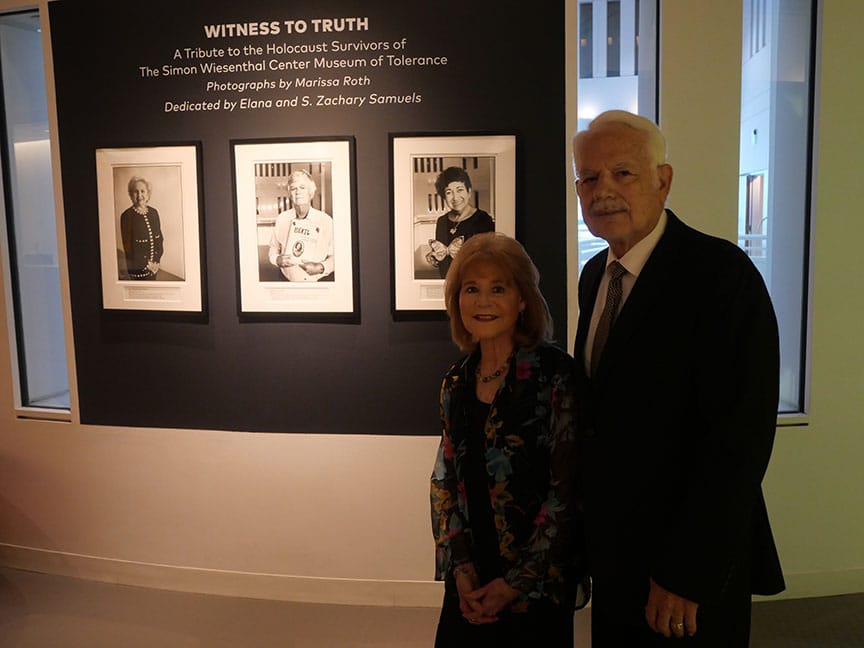
Wiesenthal Center Dedicates Witness to Truth Portrait Gallery

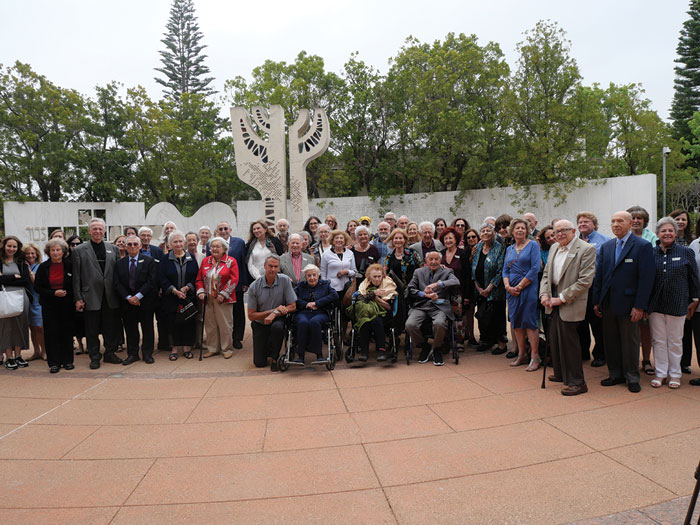
In 2005, Marissa Roth, a Pulitzer-prize winning photojournalist, approached Simon Wiesenthal Center (SWC) Director, Museum Volunteer Services Elana Samuels, and Liebe Geft, director, Museum of Tolerance (MOT), to pitch a photographic project. Roth proposed creating a gallery of Holocaust survivor portraits that would line the museum’s lobby atrium. While there was no budget for such an endeavor, Samuels and her husband Zachary felt passionately that the project had to move forward, and they wrote the first check.

Geft, with husband Dr. Ivor Geft, wrote the second check as additional support flowed in. Fifteen years in the making (accounting for a two-year setback due to COVID-19), with a number of photo sessions over the years, the Witness to Truth Portrait Gallery was completed and dedicated on May 19, International Holocaust Remembrance Day. The gallery is a collection of 104 black-and-white portraits of Holocaust survivors.  

Dedication ceremonies were attended by 28 SWC MOT Holocaust survivors as well as family members representing 13 survivors who have passed. Samuels presided over the ceremonies with Geft and Rabbi Marvin Hier, founder and CEO of the SWC, delivering remarks.

Those whose portraits are featured in the gallery were active SWC volunteers at one time. “Some greeted the public; others were tour guides; most were speakers sharing their Holocaust experiences with students,” Samuels said. “One survivor worked in the library and archives. All were very proud to be a part of the museum, sharing their message of hope and tolerance, and preserving the memory of the Holocaust.”

Elana and S. Zachary Samuels

During COVID, the gallery went up online, and survivors hosted weekly virtual live Holocaust survivor webinars that are heard by people around the globe. 

“With 100 testimonies recorded, last year the virtual zoom presentations reached more than 100,000 listeners in every corner of the world,” said Samuels. 

Addressing his remarks to the survivors in attendance, Hier said, “It is up to you, who know first and foremost, what it means to go through a Holocaust, who have stepped forward in history. All of you here today, who we honor, who went on to rebuild Jewish life. To build Jewish institutions of learning to return to the Promised Land. That today there is a state of Israel, and so to you, we can’t thank you enough for what you have done for all of the Jewish people.” 

Hier then turned his remarks to contemporary world events: “Here we are a mere 80 years later and look how many haters, how many bigots, how many antisemites, have infested our world here in the U.S., in North America and in Europe,” he said. “Look at Putin and Ukraine, the Ayatollahs of Iran who deny the Holocaust and are developing nuclear weapons. We know who the first customer of their nuclear weapons will be. It will be the State of Israel.”

Among the attendees were Amrom Deutsch, 97, who was born in a small town between Romania and Hungary. “In 1944 on the last day of Pesach they came to the house,” he said.

Among the attendees were Amrom Deutsch, 97, who was born in a small town between Romania and Hungary. “In 1944 on the last day of Pesach they came to the house,” Deutsch, whose portrait is featured in the gallery, said. “We had nothing to steal. We lived a normal and poor life. We didn’t know who they were or what they wanted.”

Deutsch’s family consisted of 11 members, with nine surviving the Holocaust. After being imprisoned in a ghetto, he was taken to Auschwitz and eventually to Bergen-Belsen until he was liberated.

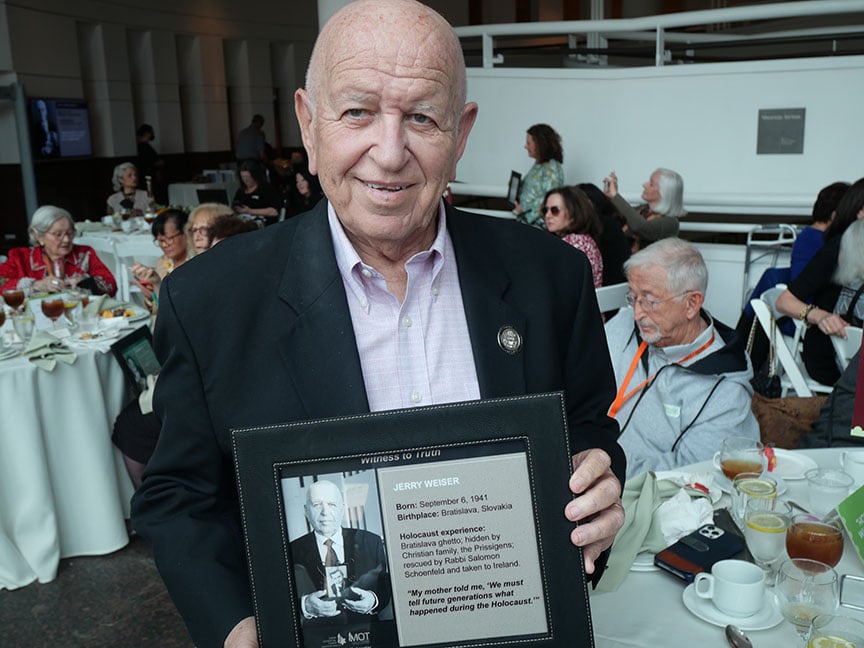
Also in attendance was Jerry Weiser, 80, who described himself as a hidden child. “My mother smuggled me out of the [modern day] Bratislava, Slovakia ghetto. I ended up in Ireland and I actually was raised as a Christian. I went through a number of religions until I was reunited with my mother in Israel, where I became an Orthodox Jew.”

Jerry Weiser

Weiser’s mother never spoke about the Holocaust. “But she told me that in 100 years nobody will remember that the Holocaust even happened,” he said. “I decided I had to tell the story, so I became a volunteer at the Simon Wiesenthal Center.”

With the passing of time, 42 Holocaust survivors from the Witness Gallery remain alive today. Many are very frail, in the hospital or care facilities and were unable to attend the event in person.

With the passing of time, 42 Holocaust survivors from the Witness Gallery remain alive today. Many are very frail, in the hospital or care facilities and were unable to attend the event in person.

In addition to the Witness to Truth Gallery, in 2011 Samuels started The Legacy Project. The Legacy Project consists of video interviews with Holocaust survivors with the goal to create a library of testimonies to be used in the MOT for educational programs and for public visitors. So far, 30 survivors’ stories have been captured on video. Tragically, 19 of the original 30 survivors have already passed away leaving only five still able to share their stories.

With the gathering of Holocaust survivors and their descendants in the SWC auditorium, mixed emotions filled the room. The Witness to Truth exhibit portrays the human faces of the survivors. It personalizes that the Holocaust was not a mere statistic of six million Jews murdered, but also of people who survived.

One of the questions often asked is how many survivors remain to tell their stories. Answers vary and are difficult to pinpoint.

“I do not know the number of Holocaust Survivors alive today,” Samuels said. “However, I am very aware of the fragility of life. They are the most precious and dwindling asset. Holocaust survivors are my role models and mentors, and it is for that reason that I am so passionate about the Witness to Truth Portrait Gallery and Legacy Project.”

Wiesenthal Center Dedicates Witness to Truth Portrait Gallery Read More »

Survivors of Mass Shootings: Three Stories, as Shared by Their Mothers

On August 10, 1999, then-sixteen-year-old Mindy Finkelstein was enjoying her first job — a camp counselor at the North Valley Jewish Community Center (JCC)    when a white supremacist entered the building and opened fire. Finkelstein was shot twice in the leg, rendering her the oldest child victim of the shooting. Three other children and an office worker were also wounded in the attack. The shooter, Buford O. Furrow, later shot and killed a mail carrier before being arrested. 

Nearly twenty-three years later, Mindy, according to her mother, Donna “had a very tough few days” last week after hearing news of the massacre at Robb Elementary School in Uvalde, Texas, in which 19 children and two teachers were killed. “She was profoundly sad, angry, and needed to organize a march,” said Donna. Mindy organized a vigil last Thursday in front of San Leandro City Hall to honor the Uvalde victims.

In the aftermath of mass shootings, we understandably focus on the victims who lost their lives, as well as their grieving loved ones. But frequently forgotten are the stories, struggles and valiant rebuilding efforts of those who survived mass shootings — particularly the youth — but whose physical and emotional scars have yet to heal. Here are three stories of how life progressed for three young survivors of mass shootings, as shared by their mothers. 

Mindy’s Story 

As a camp counselor, Mindy Finkelstein was walking a six-year-old camper to the arts and crafts area when the shooter entered the JCC that August day, firing 70 shots. For several of the injured children, that summer marked their first time at a Jewish camp. 

The bullets that entered Mindy’s leg missed her main artery, but she had physical limitations “for a while after,” her mother, Donna Finkelstein, told the Journal. The emotional trauma of having survived the JJC shooting, however, still remains. Mindy suffers from Post-Traumatic Stress Disorder (PTSD). “She’s having trauma now,” said Donna, with regard to Mindy’s response to last week’s shooting in Texas. Mindy declined an interview with the Journal.

“Mindy was in therapy immediately after the shooting, but the trauma didn’t happen immediately.” – Donna Finkelstein 

“Mindy was in therapy immediately after the shooting, but the trauma didn’t happen immediately,” said Donna. In the years that passed since the shooting, she continued to struggle with PTSD. “Graduating from high school meant leaving my safety zone,” she told the Journal in August 2009, on the ten-year anniversary of the attack. “Everything about me just crumbled. I went up to [the University of California in] Santa Barbara, and within three days, a guy walked into my room with a fake Nerf gun, and that did it for me. My parents came, and I went back home for a year.”

Mindy was hospitalized in an adolescent unit, according to Donna. She had stopped eating and was growing increasingly depressed. News of the shooting at Virginia Tech in 2009, which claimed 32 lives, proved particularly difficult for her. When she was 33, Mindy suffered “a breakdown,” Donna said, when she visited Israel with her fiancé to attend a wedding and saw Israel soldiers in the streets, holding Uzi guns. “She stopped functioning,” said Donna. 

Donna’s two grandsons (from Mindy’s older sister), a fifth grader and second grader, know their aunt was shot over two decades ago. “The trauma goes through the family,” said Donna, who works for Canoga Park High School as intervention counselor. Mindy’s own children are too young to know what happened to their mother.

“Now as an adult, as a mother, as a wife, I almost feel sad for the teenager that I was in that I didn’t end up having what some would consider a normal teenage experience, because my life was altered forever that day,” Finkelstein told “Today” in 2018. “I’m proud of myself for the road I took afterwards.”

Both Donna and Mindy are advocates for gun violence prevention. “I promised myself that once she [Mindy] survived, I’d do everything I could to prevent any other parent from having to face losing a child or being injured by firearms,” she said.

After the shooting, Donna worked with Loren Lieb, whose then-six-year-old son, Joshua, was shot twice in the leg, to co-found the San Fernando Valley chapter of the Million Mom March, which later became the Brady Campaign to End Gun Violence. In 2000, the Million Mom March held rallies throughout the country on Mother’s Day, calling for common sense gun control laws. Mindy spoke at the march, and she and Donna also became active in the Women Against Gun Violence and The Coalition to Stop Gun Violence.

For Mindy, for whom the JJC had been a home away from home since she was five, the attack was a terrible reminder of the pernicious danger of antisemitism. “I was shot because I was Jewish,’’ she said in the 2018 TODAY interview. “That’s painful in a different way.”

One week after Mindy was released from the hospital after the attack, a group of family members — Holocaust survivors — hugged her and said, “You’re one of us.” She also suffered PTSD from having been repeatedly told by many around her that what she had suffered through would change gun legislation in America, only to witness such bills continue to fail at state and federal levels. 

The JCC attack ignited trauma in others who were injured as well. Five-year-old Benjamin Kadish nearly bled to death after bullets pierced his colon and entered the main artery in his right leg. He suffered critical injuries and needed months of physical therapy and additional surgeries. 

Loren’s son, Joshua Stepakoff, also faced challenges after the shooting. In 2009, Loren told the Journal: “We’d go out somewhere, and here’s this cute kid on crutches, and everybody would ask, ‘How did you break your leg?’ and he would say, ‘I got shot.’ And then they would realize who he was. So we stopped going out, because he hated the attention.” 

When asked how Mindy is faring today, Donna responded, “In general, Mindy is doing well,” while also noting her struggle in response to last week’s school shooting. Mindy and other survivors of mass shootings, including those from Sandy Hook Elementary and Virginia Tech, have formed friendships and offer critical support to one another. 

Charlotte and Caleb 

“Like with any kind of shock and grieving, the damage of it really hits you later,” said Sara Lowell, whose son, Caleb (then a freshman) and daughter, Charlotte (then a senior) survived the mass shooting at Marjory Stoneman Douglas High School in Parkland, Florida that killed 17 students and staff on February 14, 2018. “I always thought when the news trucks leave, that’s when it’s really going to hit them,” said Sara. As it turned out, she was right. During the initial weeks after the shooting, the community was “surrounded by help,” she reflected, and constantly approached by the media. Every day, another communal gathering took place at their “headquarters” — a local park. There were memorial shrines as well as grief counselors. But after a month or so, according to Sara, things inevitably began to shift back to normal.

“The hardest part for my kids afterwards was breaking those habits: Caleb was always saving a bus seat for his friend, Alaina; after she was killed, her seat was empty, and Caleb watched as the bus drove past her stop.”
– Sara Lowell 

Both Caleb and Charlotte lost friends in the shooting. “The hardest part for my kids afterwards was breaking those habits: Caleb was always saving a bus seat for his friend, Alaina; after she was killed, her seat was empty, and Caleb watched as the bus drove past her stop,” said Sara tearfully. “His friend, Alex, played in the trombone section of the band with him. After Alex was killed, they kept his chair, until one day, the teacher just pulled it. Caleb came home so upset that day.”

Charlotte’s friend, Carmen, with whom she attended AP Literature class, was also killed in the shooting. That day, one class period before the attack began, Carmen stood up in class and read an assignment: A poem for Valentine’s Day. 

“In class, at least, the desk of every child who was killed remained a shrine,” said Sara. “No one sat in it.”

Less than a year after the shooting, while enrolled in her freshman year at college, Charlotte “fell apart,” according to Sara. “Charlotte decided she didn’t want to be in America and tried to complete her freshman year abroad in London, but as soon as she arrived there, she didn’t want anyone to know about her experience. She even lied about her hometown,” said Sara. Not wanting to be defined by the Parkland massacre, she nevertheless became increasingly disturbed by one question, which she continued to ask her mother during frequent calls from London: “How are people going on with their lives?” Charlotte asked incredulously.

“After the shooting, Charlotte had therapy, but she still became very depressed. I saw every sign of depression. I think the kids who survived all have survivor’s guilt. They all struggled with that.”- Sara Lowell 

“After the shooting, Charlotte had therapy, but she still became very depressed,” said Sara. “I saw every sign of depression. I think the kids who survived all have survivor’s guilt. They all struggled with that.” 

Charlotte was particularly traumatized after the shooting from fear that her younger brother, Caleb, was dead. During the shooting, she hid inside a band locker, and heard that a friend, Ashley, had been shot. According to Sara, her teacher began to scream that no one should use their phones, in case any lights attracted the shooter. For one-and-a-half hours, her family sent frantic calls to a family group text, asking, “Charlotte, where are you?” and “Charlotte, chime in.” Charlotte finally was evacuated and collapsed on a grass field across from the school. When she saw her brother emerge from the campus alive, she ran into his arms. 

After the shooting, Sara called Parkland Cares, which was established after the shooting to offer free mental health care to those affected by the trauma, but Charlotte kept repeating, “I don’t want to talk about it.” Eventually, she was able to access therapy and begin the long road to rebuilding her life. 

In the past four years, Charlotte has “discovered exercise and yoga and things that are great for her brain,” said Sara. Now 22, she recently completed her undergraduate studies in urban planning and architecture, and will begin a master’s program in the fall. Caleb, now 19, is enrolled in a local university. Charlotte declined an interview with the Journal; Caleb is currently studying abroad and could not be reached.

“Both kids feel as though you can’t buy a beer, but you can buy an assault rifle and ammunition,” said Sara. After Caleb participated in a Birthright trip to Israel, he came back home and asked why “American schools couldn’t be like in Israel, with much tighter security measures. Maybe that (stringent security measures in Israel) is not normal,” said Sara, “but this — school shootings in America — is normal?” 

“I saw trauma in their faces”

“I remember, for the rest of the year, many children didn’t go back to school; there were therapists and therapy dogs on campus every day, and three red-beret-wearing Guardian Angels had a tent set up to give the kids a sense of security,” Rabbi Shuey Biston of Chabad of Parkland told the Journal.

Biston was one of the first to arrive at the perimeters that February day, as children were running out of classes, screaming. He offered them use of his cellular phone to call their parents. “I saw trauma in their faces,” he said. “Shock and fear. One of them was had stepped over bodies to escape,” Biston recalled. After the shooting, Biston and fellow rabbis from Chabad of Parkland visited the school each Friday, “just to be there.” He estimated that roughly 300 of the students had held their bar and bat mitzvah ceremonies at the Chabad center. “A lot of the kids just knew us,” said Biston, “and after the shooting, we would go to just be there; to be comforting.”

But Biston understands the lingering pain of those who survive such horrors: “The pain is unbearable,” he said. “In a small community, where everyone knows everyone, there is a tremendous amount of messaging, on the one hand, that you’re the most fortunate if your child survives. But on the other hand, if your friend or neighbor’s child is taken, there’s a tremendous amount of survivor’s guilt, knowing you’ve been saved and someone else hasn’t.”

Biston estimates that at the time of the shooting, nearly 30 percent of the student population at Douglas High School was Jewish. After the attack, Chabad of Parkland partnered with The Shabbat Project to offer every Jewish girl at the school a pair of Shabbat candlesticks. And students who wanted a mezuzah for their front door also received one (over 1,000 mezuzot were distributed, according to Biston).  

When asked how most Parkland students who survived the attack fared in the months and years that passed, Biston stressed that they responded “with absolute resiliency. You saw them march in Washington; their voices were heard. These kids created movements and were strong. But that doesn’t mean that there wasn’t plenty of students who were depressed, who changed schools, and there were two suicides from kids enrolled at the school that year.” But the city and the local organizations responded strongly, said Biston. In addition to Parkland Cares, Eagles’ Haven Wellness Center opened in March 2019 to “rediscover wellness and restore hope to the Parkland/Coral Springs community following the tragic school shooting,” according to its website. The center offers “wellness experiences” ranging from yoga and dance to creative art classes and support groups. All services are free to nearly 700 students, parents and teachers. 

“After the shooting, so many students asked me why G-d had allowed this to happen,” said Biston. “There is no answer to that question. There’s evil in this world. That’s a fact. What we need to do is to combat that evil, The Rebbe taught us that when you see evil in this world, you overpower it with light. That will overwhelm the forces of darkness, and that’s what we did here.”

Last week on her Facebook page, Mindy, who survived the 1999 JCC shooting, posted the following: 

The ones that will survive will suffer. Not just today and not just until they get out of the hospital. You want examples? When I was pregnant, I had to have lead testing to ensure the bullets from 20 years ago wouldn’t affect my blood stream. I tried to have shrapnel removed but it caused shingles to pop out instead. And this was just in the last four years. Since I was shot almost 23 years ago, I have had countless panic attacks. I had two complete mental breakdowns. I’ve been tormented by neo-Nazis thinking I should have died. I have nerve damage in my leg and large scars I get asked about constantly. And I’m one of the luckiest ones. I survived a mass shooting, but survival should never be ignored. Keep the survivors in mind today and 20 years from now. They will never be the same.

In fear of the gunman in the Uvalde shooting, 11-year-old survivor Miah Cerrillo told CNN that she smeared the blood of a dead friend on herself and played dead. Her mother told the news outlet that Miah is traumatized and can’t sleep. 

As more and more facts emerge from last week’s horrific tragedy in Texas, the stories of those who survive mass shootings remain a critical element in how we remember, and more importantly, how we respond to such attacks. Case in point: In fear of the gunman in the Uvalde shooting, 11-year-old survivor Miah Cerrillo told CNN that she smeared the blood of a dead friend on herself and played dead. Her mother told the news outlet that Miah is traumatized and can’t sleep. The young girl spoke during the interview while wrapped in a blanket, despite the heat. Earlier, the sound of a vacuum cleaner at a car wash “completely set her off,” according to Miah’s mother. Miah agreed to the CNN interview so that others would know what it’s like for survivors of school shootings, but also to prevent such future horrors. 

But Sara, whose children survived the Parkland shooting, sees things differently: “No one cares,” she said. “Next week, this won’t be in the news. They forgot about us. If the Parkland kids can’t make change, nobody will. Nothing happened. And nothing is going to happen again.”


Tabby Refael is a Los Angeles-based writer, speaker, and civic action activist. Follow her on Twitter @TabbyRefael


Survivors of Mass Shootings: Three Stories, as Shared by Their Mothers Read More »

A Tight Mayoral Race

When Los Angeles voters go to the polls next week to begin the process of selecting the city’s next mayor, they will be looking backward rather than forward. 

That’s not intended as an insult to Karen Bass, Rick Caruso and Kevin de Leon, the most visible of the soon-to-be-winnowed field of candidates. They have laid out vivid, detailed and occasionally realistic policy platforms on issues like crime, homelessness and job creation, which have come to dominate the public consciousness in the city. But the campaign to date seems to be centering around voters’ feelings about how Los Angeles has gotten into our current situation more than where we should go from here.

At the time this column was submitted, the most recent credible public poll on the race was taken by the Los Angeles Times and UC-Berkeley’s Institute of Governmental Studies back in early April. It showed Caruso and Bass in a statistical dead heat, with first-time candidate Caruso barely edging longtime officeholder Bass by a tiny 24-23 margin. De Leon, who had not yet begun his advertising campaign, was at 6 percent and a whopping 40 percent were still undecided. More recent private polling released by Bass’ campaign shows a similarly close race.

Angelenos were also asked in the Times-IGS Berkeley poll about their opinion of current mayor Eric Garcetti. They were just as divided in their feelings about the incumbent as they are about his most likely successors, with 48 percent of likely voters saying that they approved of the job he is doing in office and 46 percent saying that they disapprove of his performance. 

The two poll questions showed significant overlap, with a strong correlation between feelings about Garcetti and preferences in this campaign. Voters supportive of Caruso were more likely to disapprove of Garcetti’s performance, while those who backed Bass and De Leon were more likely to approve of the mayor. Self-described liberals and voters from minority communities tended to think highly of Garcetti and Bass. Conservatives, moderates and San Fernando Valley residents tended to be down on Garcetti and high on Caruso. 

We can assume that most eligible voters don’t follow the daily activities at City Hall all that closely. That means that their job approval of the mayor is probably based less on detailed knowledge of the decisions he has made and the actions he has taken and more on their general sense of how Los Angeles is doing at this particular time. Which means that voters who are satisfied want to keep things going in the same direction with a more traditional candidate whose background is in politics and those who are unhappy are going to look for a very different approach with a political outsider whose experience is in the private sector.

The other clear delineation between Caruso supporters and Bass or De Leon voters are the issues they prioritize. Homelessness is unsurprisingly the biggest issue in the campaign by a sizable margin, and Caruso maintains a small advantage on it. But Caruso’s edge on criminal justice policy, the second most important issue to voters is immense. Angelenos prefer him by a 4-1 message when it comes to crime. Bass does much better on housing affordability and climate change, the same issues on which voters give Garcetti higher marks.

Bass and De Leon would mean a continuation along the path traveled by Garcetti over the last several years. Caruso would represent a dramatic change of direction. 

While more polling will be released between now and next week’s primary, it’s likely that this basic dynamic will remain unchanged. Bass and De Leon would mean a continuation along the path traveled by Garcetti over the last several years. Caruso would represent a dramatic change of direction. 

Barring a last-minute comeback from De Leon that edges out Caruso rather than Bass, the battle lines from now until November seem very clear. The two surviving candidates will fight over a miniscule number of voters whose final decision may rest less on what they think about the candidates than their opinion of the current mayor.

Garcetti has indicated that he may not endorse anyone in the race. But he may not need to. It seems that for many Angelenos, the past actually is prologue.


Dan Schnur is a Professor at the University of California – Berkeley, USC and Pepperdine. Join Dan for his weekly webinar “Politics in the Time of Coronavirus” (www/lawac.org) on Tuesdays at 5 PM.

A Tight Mayoral Race Read More »