fbpx

September 2, 2021

Kosher in the Kitch’s Nina Safar

With Rosh Hashanah right around the corner, home chefs may need some inspiration for meals for the holiday. The Jewish Journal caught up with Kosher in the Kitch’s Nina Safar, a Pico-Robertson based cookbook author, social media maven with 70,000 followers and single mother who offered up her favorite recipes and tips for cooking for Rosh Hashanah and year round. 

The Jewish Journal (JJ): How long have you been cooking? 

Nina Safar (NS): I learned to cook when I was 17. My mother was diagnosed with breast cancer and it was really difficult for my family. I have six younger siblings. We ate a lot of takeout and neighbors brought us food. While it was sweet, it was also depressing because my mom was supermom and making huge meals before this. One night, I said I’d make my mom’s food for Friday night dinner. When I saw my family enjoying my mom’s recipes I’d cooked, it felt like life was normal and things were going to be OK. I realized food was magic. Being able to feed people was such a blessing. 

JJ: What makes your recipes different?

NS: When I recipe test for a cookbook (I have two cookbooks), I first think of how it’s traditionally done. Then I go through the ingredient list and process and say, “What can I shave off?” I take off anything that isn’t truly necessary to get that same taste. I guess if you’re a traditional chef, your recipes are going to be more complicated. I’m just a girl who likes food and a single mom who doesn’t have a lot of time in the kitchen or the budget for lots of ingredients. My recipes are ridiculously easy. They are meant for people who don’t have time but love to serve good food. Anyone with any level of cooking can make a recipe of mine, and it’ll come out good.

JJ: You’re a single mom of two young boys. How do you balance your career with raising them? 

NS: It’s just one day at a time. It can definitely get difficult, but it’s all about managing my time, especially because I work for myself and everything feels like a priority. What recipe can be created today, and what can wait until tomorrow? When I’m with my kids, I try to have everything done before I get them from school, and then I have an hour or two with them. When they are in bed, I get back to work. 

JJ: What are your favorite dishes for Rosh Hashanah?

NS: My mother’s sweet noodle kugel is always my favorite, especially because you want to have a sweet dish on Rosh Hashanah. I actually started making that in a muffin form because everyone gets their own individual portion. It always reminds me of being home with my mom. Since she’s passed, one of my favorite things to do is cook the recipes I grew up with because it’s like she’s here with me. 

JJ: What tips do you have for people who are cooking for Rosh Hashanah?

When you get stressed out, remember that the guest is already so happy with whatever you offer because they aren’t shopping and cooking and doing the dishes.

NS: When you get stressed out, remember that the guest is already so happy with whatever you offer because they aren’t shopping and cooking and doing the dishes. I always say keep your menu simple. Recycle recipes and maybe to keep it exciting, have one or two new dishes instead of a menu based off of everything new. Do what your family likes and incorporate one or two new dishes. When you have a recipe you’ve made before, it’s just easier. 

JJ: What are you doing for the holidays?

NS: I’m going to New York to see my dad and make the holiday for him. It involves a ton of cooking. I’m very excited. I’m going to do some of the classics like my mom’s sweet noodle kugel, and a dessert that’s very easy to make, the honey cake served in a jar with dairy-free coconut whipped cream. It’s super easy and looks nice and everyone loves it. The grandkids are coming and they’re going to love it. I try to have it feel like bubbe is still around because she loved baking. I’m also making apple pie stuffed crumb muffins, pomegranate glazed meatballs, honey chicken, fried gefilte fish with onions and a salmon dish with thinly sliced tomatoes, lemon and fresh dill. It looks really impressive in the center of the table.  

JJ: What do you love most about the High Holidays?

NS: Being with my family. My favorite thing is to cook food for the people I love. There is no better time to do it than the holidays. I love siting around the table with family, especially when everyone is busy with work and their gadgets these days. It’s a beautiful time to eat, be with family and have good food.

Rosh Hashanah Recipe: Sweet Noodle Kugel Muffins

PREP TIME: 5 MINUTES | COOK TIME: 20 TO 25 MINUTES

Nonstick cooking spray

 5 eggs
1⁄2 cup oil
1 cup applesauce
1 cup crushed pineapple with juice
3⁄4 cup sugar
1⁄2 teaspoon salt
1⁄4 teaspoon cinnamon
12 ounces wide egg noodles, cooked according to the package directions

1. Preheat the oven to 350°F. Grease a 12-cup muffin tin with cooking spray.

2. In a large bowl, whisk together the eggs, oil, applesauce, crushed pineapple, sugar, salt and cinnamon. Add the cooked noodles to the bowl and mix well.

3. Divide the batter evenly among the prepared muffin cups.

4. Bake for 20 to 25 minutes or until the muffins are set and the edges are slightly crusty.

Make-Ahead Tip: This recipe freezes well. You can prep and cook the muffins in advance and store them in the freezer in an airtight container for up to six months.

Kosher in the Kitch’s Nina Safar Read More »

Happy New Dishes

Every Rosh Hashanah, my mother, my daughters and I set the table with all the foods for the simanim, the signs for a sweet, happy, healthy New Year. Every year my mother reminds us of the rules that she learned at the table with her grandfather Yosef Chai—that we wear white, that we greet each other cheerfully and that we be especially careful not to break anything. When my father and brothers conduct the Seder according to the order laid out in the Ben Ish Chai’s siddur, I have a special thrill knowing my family connection to this great man.

Rachel and I are especially thrilled that the Jewish Journal is back in print. We are thrilled to present to you, dear reader, these sweet recipes from the old country that are guaranteed to tantalize and tempt those at your table. 

May we be blessed with the best year ever.

Poisson en Croute

In the 80s and 90s, whenever our family had a special occasion – – holidays, anniversaries, birthdays or family visiting from Europe – – my mother would make fish in puff pastry. The fish is finely minced and seasoned with onion, charred bell pepper, lemon juice and paprika and makes a wonderful contrast to the crispy, flaky puff pastry. She served it with a roux made with white wine, flour and capers. 

It was always impressive and very delicious. 

She would form her poisson en croute in a log shape like a long bureka but I formed ours in the shape of a fish. I cut the pastry into a fish shape freehand, but if you are not that confident there are many fish templates online.

A fun centerpiece for your Rosh Hashanah table.  —Rachel

1 pound white fish, skinless, boneless and finely minced
1 onion, finely chopped
1 red bell pepper
¼ cup green olives, finely chopped
¼ cup chopped cilantro, finely chopped
2 tablespoons bread crumbs
1 tablespoon fresh lemon juice
1 teaspoon paprika
Salt and pepper
1 10oz bag baby spinach
1 large carrot, sliced on the diagonal
Olive oil for sautéing
1 egg white and 1 egg yolk
One package Pepperidge Farm puff pastry

Roast the bell pepper on stove top , keep turning til completely chard. Place in a plastic bag for 15 minutes. Peel and seed and dice into small pieces.

Place fish into food processor until completely chopped into smooth consistency.

In a pan, place one tablespoon of oil and onion and cook until translucent.

In a bowl, place the fish , onion, cilantro, olives, breadcrumbs, paprika, salt, pepper and mix, set aside.

Sauté the carrots in oil until tender and season with salt and pepper

Sauté the spinach for two minutes in oil until it starts to wilt.

Preheat oven to 425°F. 

Lightly roll out first layer of puff pastry and cut into a fish shape. Then cut second sheet to the same size and shape. 

Place puff pastry on a baking sheet lined with parchment paper and layer with carrots, fish filling and spinach. 

Brush egg white around the edges of the dough, then place second sheet of puff pastry on top. Seal edges by pressing with a fork to make a pretty pattern. 

Cut a circle for the eye and use extra dough to make fins and scales. Brush the top of fish with egg yolk.

Bake for approximately 20 minutes or until dough has puffed and is golden brown.

Tamarind Chicken 

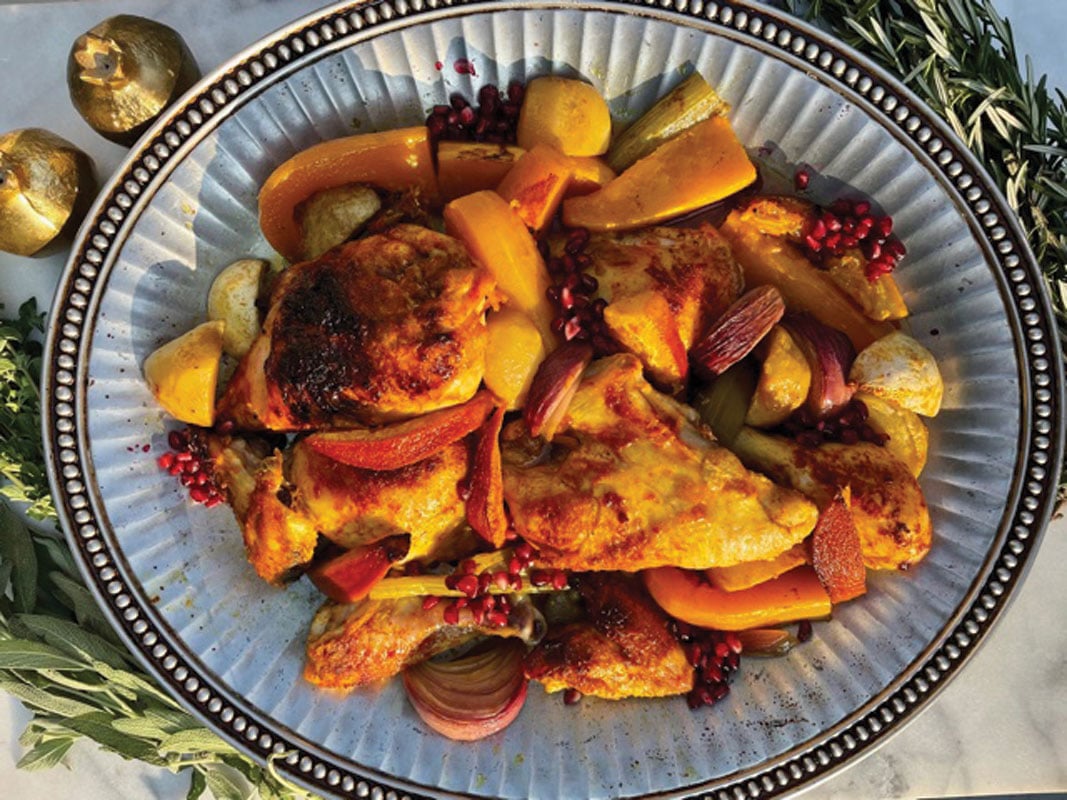
When your parents are from Iraq and you are growing up in Sydney, Australia, you become accustomed to eating and drinking things vastly different from your friends. But there are some things you’ll never understand. One of those is the satisfaction my parents would get from drinking water infused with the fleshy pulp surrounding tamarhindi seeds. I’ve still never tried this tamarind beverage, so I can’t really say whether it’s good or not. What I can tell you is that I absolutely love tamarind paste in my cooking!

The tamarind tree is native to Africa, but also grows in India, Pakistan and other tropical regions. The bean like pods contain a fibrous pulp that ripens into a sweet and sour paste. From India, where tamarind is used to flavor curries, it traveled to the Middle East, where it is called tamarhindi, date of India. 

This chicken dish includes butternut squash, turnip, celery and onion. But the tamarind, honey and orange juice give it the most deep and delectably tangy sweet and sour flavor. Make sure you have rice available to soak up all that yum! -Sharon

1 chicken, cut in 8 pieces
1 medium butternut squash, peeled and chopped into wedges
6 small turnips, washed and chopped into wedges
1 purple onion
2 celery stalks, chopped into large pieces
1/4 cup olive oil
Salt and pepper to taste
2 tablespoons olive oil
1/4 cup tamarind paste
1/4 cup honey
1 orange, juiced, with peel reserved and cut into strips
2 teaspoons turmeric
2 teaspoons paprika
2 teaspoons mustard powder
1 teaspoon garlic powder

Preheat oven to 425°F.

In a large baking dish, arrange butternut squash, turnips and celery around the sides and place chicken pieces in the center. Place orange rind between the chicken pieces. 

Pour olive oil over chicken, then sprinkle with salt and pepper. 

Over medium heat, warm the oil in a small pan, then add tamarind paste, honey, orange juice and spices. 

Bring the sauce to a gentle boil while stirring. Let the sauce reduce and thicken. 

Brush the chicken with the sauce and roast for 30 minutes. 

Lower temperature to 300°F, cover chicken with foil and roast for another 55 minutes. 
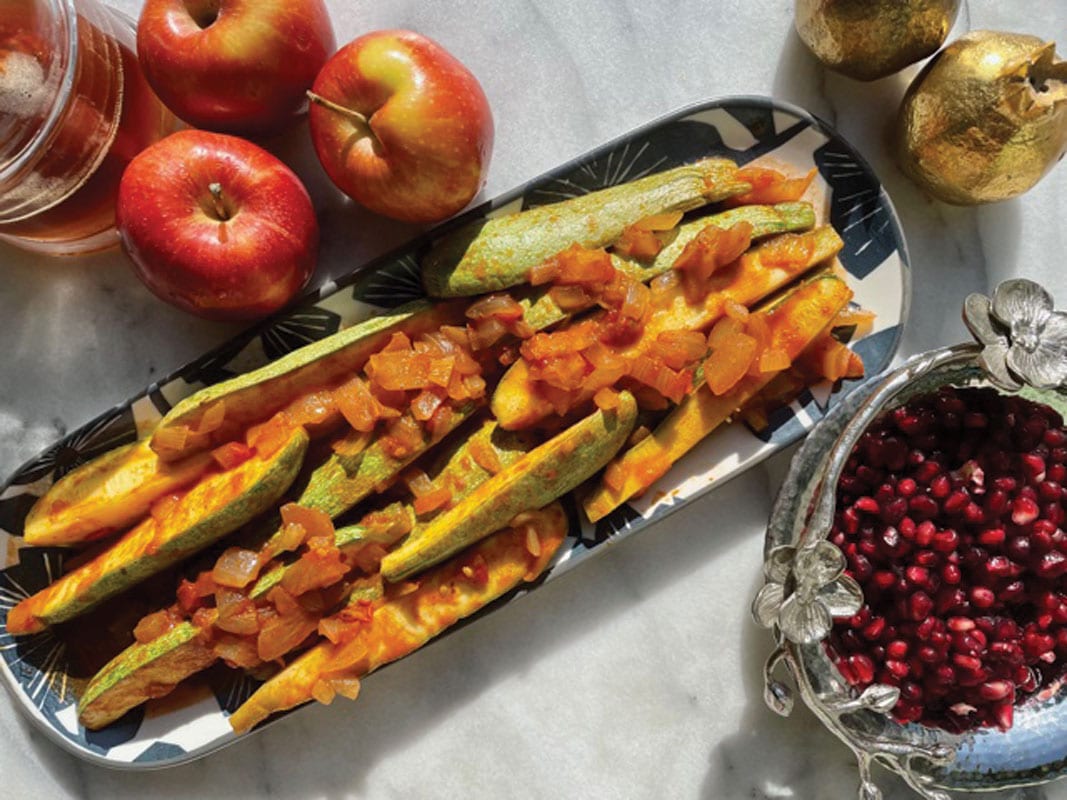
Mexican Squash Stew 

By the time we sit down at the table for the Rosh Hashanah Seder, everyone is starving. So when we get to the part of eating my mother’s kar’a, gourd in Arabic, it tastes extra delicious. This recipe from my mother’s repertoire is like all her cooking—healthful, fresh and delicious. 

I used to be obsessed with zucchini, but when I would cook it, it would be bitter more times than not. So now zucchini is pretty much banished from my house. I much prefer the pale green Mexican squash. It has a thin tender skin and juicy, mild, tasty, almost seedless flesh. Let the squash simmer in the juices of the tomato and you’ll be guaranteed a truly yummy side dish. – Sharon

6 Mexican squash, washed and cut in quarters lengthwise
1 large onion, finely chopped
3 large tomatoes, diced
2 tablespoons of tomato paste
1 teaspoon turmeric
1 teaspoon paprika
1/2 teaspoon allspice
Salt and pepper to taste
Oil for sautéing

Oil for sautéing 

In a large pot, warm oil over medium heat and add onions. Sauté until translucent.

Add tomatoes, tomato paste, turmeric, paprika, allspice, salt and pepper and stir well.

Add the squash and stir in the sauce. Cover tightly, lower heat and let simmer for at least one hour until soft and tender. 

Waldorf Salad

When I was a little girl in Kirrawee, a southern suburb of Sydney, Australia, every school lunch was a Vegemite sandwich on whole wheat bread made by my mother. Every week my father would go to the wholesale market and buy a big box of Granny Smith apples because he knew they were my favorite. So one of my snacks would always be a green apple. One day, I gave my apple to a friend and when I came home, I fearfully told my father. To my surprise, he laughed and was so happy. From that day on, he always put two apples in my lunchbox.

Nowadays, I still love to eat apples (honey-crisp are my favorite) and to cook with them. I love them with chicken, in my curries and of course, baked into cakes and puff pastry. But nothing beats a Waldorf Salad. 

Named for New York’s astonishingly beautiful Art Deco Waldorf-Astoria Hotel, Waldorf Salad originally contained just apples, celery and mayonnaise. It evolved to include walnuts and dried fruit, like raisins, cranberries and dates.

I make it with crispy, sweet apples like Smitten, Envy, Gala or Fuji and tart Granny Smith. The celery adds crunch, the pecans add a meatiness, the dates add a deep, honey sweetness and the bed of spinach adds extra nutrition. Instead of mayonnaise, I dress the salad with a light vinaigrette made with a good oil, red wine vinegar, mustard powder and honey. 

A deliciously light, refreshing salad full of simanim for a sweet new year.  —Sharon

3 large honeycrisp apples, large dice
1 large Granny Smith apple, large dice
2 stalks celery, thinly sliced 
3/4 cup pecans, roughly chopped
5 medjool dates, chopped
1 10 ounce bag baby spinach
Pomegranates for garnish, if desired

Place apple and celery in a bowl and toss with vinaigrette.

Just before serving, arrange spinach on a serving dish, place apple and celery on top. Then garnish with pecans, dates and pomegranate. 

Red Wine Viniagrette
1/4 cup extra virgin olive oil
1/4 cup red wine vinegar
2 tablespoons honey
1 teaspoon English mustard powder
1/2 teaspoon garlic powder
Salt and pepper

Combine all ingredients. Whisk until spices have dissolved and dressing is smooth. 
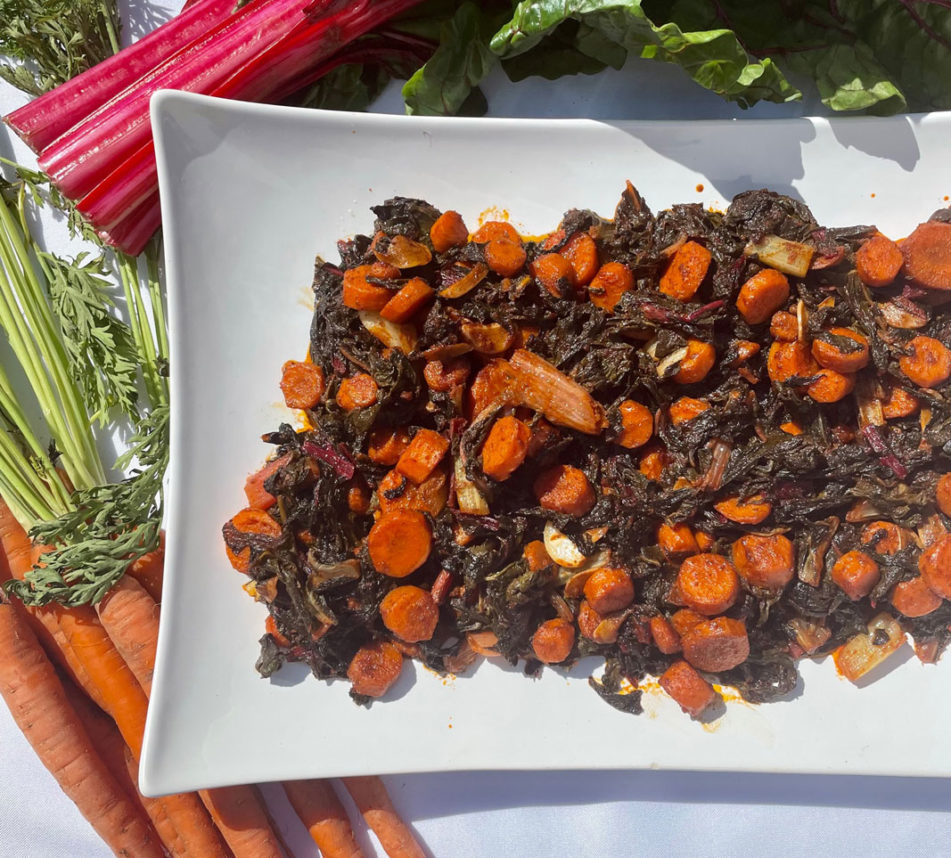
Moroccan Carrot and Swiss Chard Salad

 Swiss chard, spinach and beets are all called selek in Hebrew, which also relates to the word for depart. In the Seder, we implore Hashem that our enemies, haters and those that wish evil will depart (or get lost in Hebrew slang). 

One of the classics of the Moroccan kitchen, this salad is always on the table for Shabbat and the Jewish holidays. Like a matbucha salad, the carrots and Swiss chard are cooked then served cold. It tastes even better a day or two or three later.

Before my niece Ines could speak a word, this was her favorite salad. All through her childhood, my mother would make it for her every Shabbat. Now she is a beautiful young lady and living in New York, so whenever she is in town I prepare it for her. She won’t be at our Rosh Hashana table this year, so this past shabbat I made a huge platter of this delicious salad in her honor. And although there were fifteen of us at the table, she ate most of it. It’s that good! – Rachel

3 bunches of swiss chard, destemmed, rinsed and chopped into 1/4 inch strips
4 large carrots, peeled and sliced into the thick pieces
1 teaspoon salt
4 garlic cloves, crushed
1 tablespoon cumin
2 tablespoons paprika
2 tablespoons apple cider vinegar
Salt and pepper
½  lemon

Fill a large pot halfway with water, add a teaspoon of salt and bring to a boil. Add carrots and boil for 3 minutes, then add the swiss chard and give it a stir so that it is covered with water.  

Turn off the heat and let sit for 2 minutes, then strain and rinse with cold water to stop the cooking. Let cool. 

 Over medium heat, warm the oil in a large pan, the add the garlic and spices. 

When they start to sizzle, add the vinegar, stir well and add the carrots and Swiss chard. Continue to sauté for 3 to 5 minutes.  

Turn off the heat and let cool. 

Refrigerate until ready to serve. Add salt and pepper to taste and a squeeze of fresh lemon juice
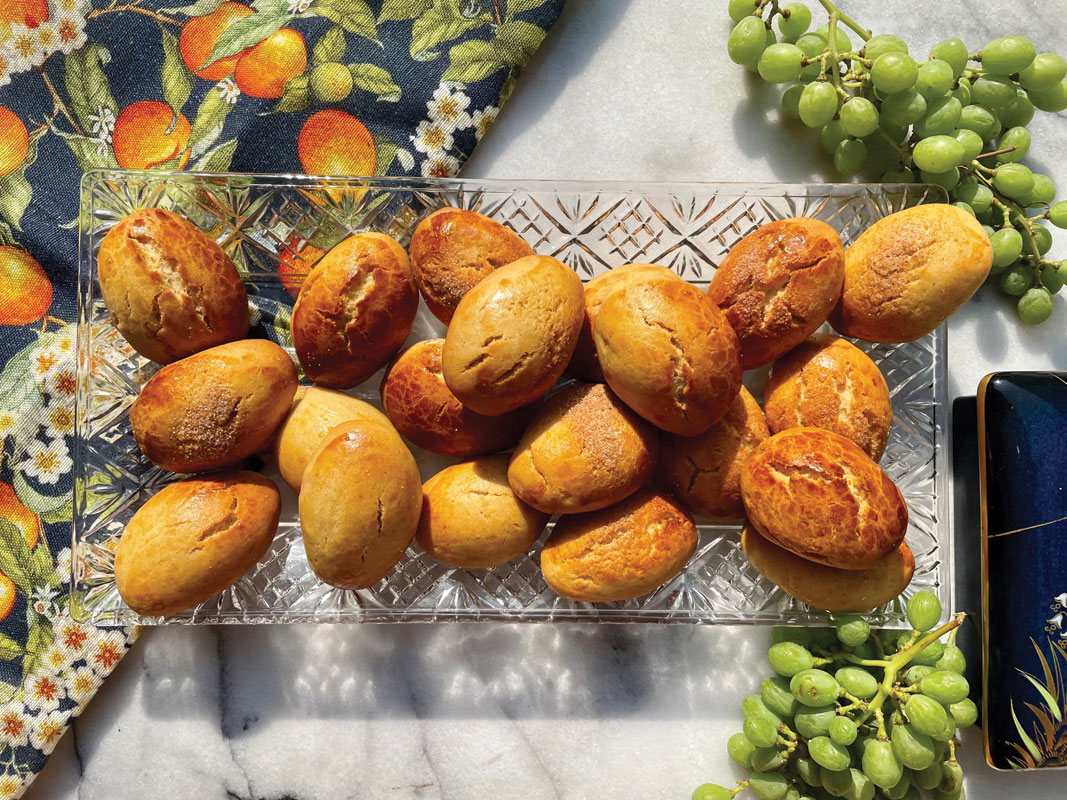
Maman’s Petit Biscuits Au Miel

(Maman’s Little Honey Biscuits)

I was in my kitchen at one o’clock in the morning. I had just set the last cake to cool on my counter and I was tired but contented. Distractedly, I took a bite of honey cookie fresh out of the oven. It had been a very long time since I’d eaten one and the scent and flavor instantly transported me back to my childhood in Casablanca. It made my heart so happy.

These very traditional Moroccan cookies are redolent with honey, cinnamon and fresh fragrant orange rind. They are not particularly delicate with their dense texture and thick shape, but they are the essence of home and comfort. They are perfect to keep in a battered metal box or cookie jar on the kitchen counter, ready to be savored with your morning coffee and afternoon tea.

As we say in the Seder, may your new year be as sweet as honey! —Rachel 

4 eggs
1 cup sugar
1 cup oil
1 teaspoon baking powder
1 teaspoon cinnamon
1 tablespoon orange rind
4 tablespoons honey
Approximately 4 to 6 cups of flour

Topping:

1 egg, beaten
1/4 teaspoon cinnamon
1 tablespoon sugar

Preheat oven to 350°F.

In a stand mixer, beat the eggs and sugar for 5 minutes, then add the oil, baking powder, cinnamon, orange rind and honey. 

Slowly incorporate the flour until the dough comes together and is not sticky to the touch.

Line a baking sheet with parchment paper then form dough into walnut sized balls. Shape into logs and then press down so that cookies form an oval shape.

Brush egg on top of cookies and sprinkle with cinnamon sugar.

Bake for 15 minutes or until golden brown. 
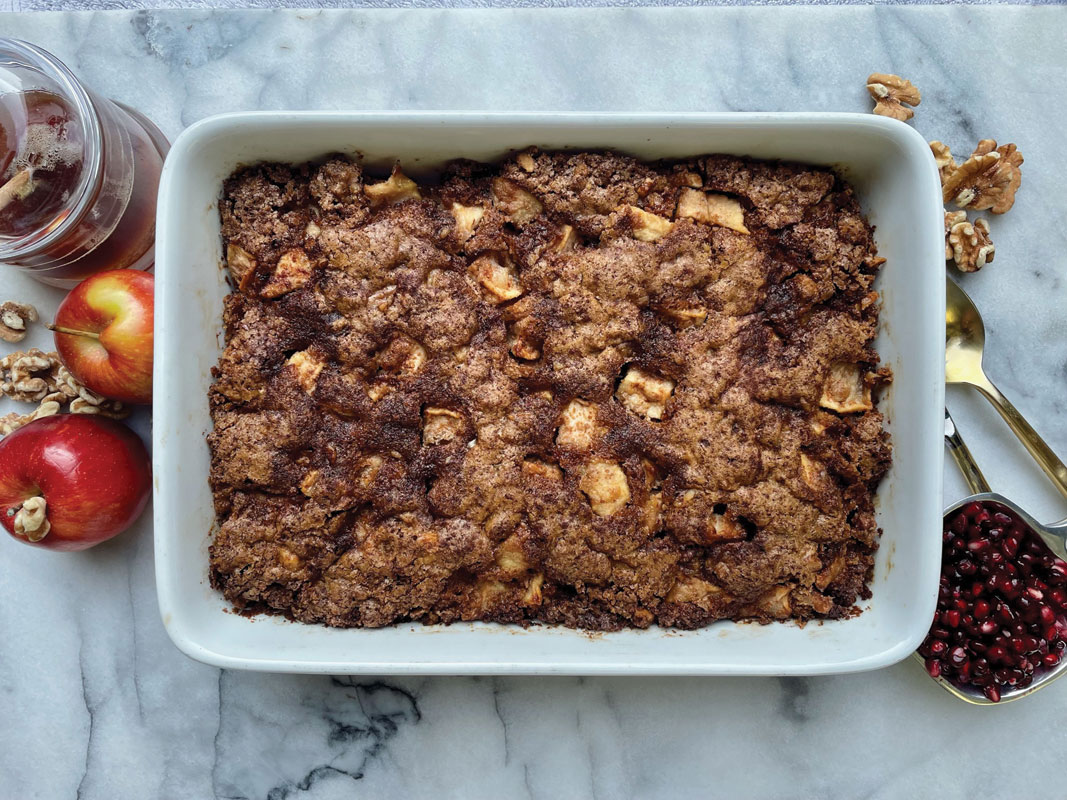
Silvia and Marina’s Apple Cake

Sometimes someone who works with you becomes a much-loved member of the family. The always smiling Marina worked for Neil’s honorary Uncle Jack and Aunt Silvia for over 30 years and even though they both passed away decades ago, she is still an honored guest in our home. Sylvia was the kitchen director and the menu planner and she taught Marina how to make all the classic Sephardic dishes. Marina cooked to perfection, making every dish taste authentic, wholesome and delicious. Between Jack’s storytelling, Silvia’s gracious manner and Marina’s cooking, their home was always full of happy, well-fed guests. 

During the high holidays they always served this moist apple cake in adorable silver cupcake holders. I loved it as a newlywed. Then Neil and I would bring our sons Sammy and Max there and they loved it too. Our daughter Rebekah was a baby when Silvia passed away, so she never grew up with the pleasure of this yummy cake. To my great joy, I recently found the recipe that Silvia gave to me at my bridal shower. I baked the cake and Rebekah loved it. Now it will become our tradition to carry forward. —Rachel

4 Medium golden delicious apples, peeled and cubed
2 cups sugar
2/3 cup safflower oil
2 large eggs
1 teaspoon cinnamon
2 teaspoons vanilla extract
2 teaspoons baking soda
2 cups flour, sifted 
2 cups chopped walnuts

Preheat oven to 350°F.

In a large bowl, toss apples with sugar and let stand for 30 minutes.

Beat eggs, oil and vanilla with a whisk until frothy. 

In a separate bowl, combine flour, cinnamon, baking soda and walnuts.

Add the egg mixture into the dry ingredients to create a very thick, doughy mixture, then add the apples.

Pour the mixture into a well-greased oven dish and bake for 50 to 60 minutes until the top is browned.

Comments: Serve in bowls, like a crumble. This cake can be made up to 3 days ahead. Store sealed in the refrigerator. When ready to serve, bring to room temperature or warm in the oven at 350F for 20 minutes. Serve with whipped cream or non dairy ice cream.

Date cake with toffee sauce

My mother always baked with lots of dried fruits and nuts and this date cake is a modern take on those flavors. It’s got lots of dates and lots of flavor and depth from all the spices and brown sugar. Topping the cake with boozy, caramelly sticky syrup and serving with a side of coconut cream or soy ice cream makes it an extra special treat.  —Rachel

1 ½ cups pitted dates
1 cup brewed coffee
1 ¾ cup all-purpose flour
1 teaspoon baking powder
½ teaspoon baking soda
1 cup packed dark brown sugar
4 large eggs
2 teaspoons vanilla extract
1 teaspoon allspice
1 teaspoon cinnamon
12 tablespoons salted butter, or butter substitute (such as salted Miyokos vegan butter)

Toffee Sauce:

1 cup packed dark brown sugar
2/3 cup light corn syrup or molasses
2 teaspoons orange zest
6 tablespoons whiskey
8 tablespoons salted butter, or butter substitute (such as salted Miyokos vegan butter)

Preheat oven to 325F

Coat a nonstick Bundt pan with butter and flour (Pam Baking Spray works well).

In a large bowl, whisk flour, baking powder and baking soda together, then set aside.

In a medium saucepan over medium heat, bring dates and coffee to a boil, then remove from heat and let cool.

Pour the coffee and dates into a food processor and add the sugar and process until smooth.

Add eggs, vanilla and spices.

Add the butter or butter substitute and process until incorporated.

Pour liquid mixture over the flour and fold with a spatula to combine thoroughly.

Pour into cake pan and cover tightly with foil and bake for 50 to 60 minutes, until an inserted toothpick comes out clean.

Remove the foil and cool for 15-20 minutes.

Over medium heat, in a small saucepan melt the sugar with corn syrup and orange zest, then bring to a gentle boil for 3 minutes.

Reduce the heat to low, stir the whiskey in and whisk in the butter, two tablespoons at a time until melted and smooth, then remove from stove.

Place cake on serving dish.

Brush the top of the cake with warm sauce, then drizzle sauce over each cake slice, just before serving.

Cake can be stored tightly wrapped at room temperature for up to 3 days.

The sauce can be refrigerated for one week.

To reheat and serve warm: wrap the cake in foil and place in an oven heated to 300°F for about 15 minutes. Sauce can be microwaved to reheat.


Happy New Dishes Read More »

Table for Five: Special Rosh Hashanah Edition

One verse, five voices. Edited by Salvador Litvak, the Accidental Talmudist

Remember us for life, O King who desires life, and inscribe us in the Book of Life – for Your sake, O Living God!
-From the Rosh Hashanah prayers


Yehudit Garmaise
Reporter, freelance writer

When we ask to be inscribed in the Book of Life, we are asking for shelimus, wholeness, within ourselves, our communities, and with Hashem. 

First, healing comes from the acceptance of Hashgacha Pratis, or Divine Providence, that everything we have experienced and continue to experience is heaven-sent – specially chosen to equip us to serve others and to fulfill our personal missions. 

Our sense of wholeness also requires our quiet understanding that everything we need is right in front of us, or just not yet revealed. 

In terms of our relationships with others, we gain wholeness from remembering to silently retreat from conflict: the opposite of shalom. Peace, however, is not just the avoidance of combat, but in Hebrew, shalom is close to the word shalem, or “complete.” 

This year, we might remember to ask, not just for a sense of fullness for ourselves, and not just for other Jews, but for the wholeness that comes from all of K’lal Israel living good, healthy, and peaceful lives that are guided by the Torah. 

Our shelimus, comes from living as Hashem commands. We do, and we understand. Our wholeness also derives from our temimus, or purity, as we read in Parshas Shoftim, “Be complete with Hashem, your G-d.” 

From here we learn that in exchange for living by the Torah, Hashem rewards us with an indescribable sense of peace, wholeness, and sweetness. 

Wishing everyone the simcha that comes from knowing that we are a fortunate mishpacha, family, in that Hashem is always near.


Rabbi Shlomo Seidenfeld
Scholar In Residence JMI/Aish

Sefer Hachayim, The Book of Life – now that has best seller written all over it! After all, who doesn’t want to experience a vibrant and fulfilling life? Who doesn’t want to ingest the secret sauce that unleashes his/her unique and energizing potential? So, the big question is, what constitutes a life well lived and what perspectives can keep us on the path to being inscribed in the Book of Life?

Here’s one thought. It’s interesting and telling that the instrument that is designed to wake us up on Rosh Hashanah, the shofar, must be hollow. I know what you’re thinking. Brilliant observation, Rabbi! It obviously has to be hollow in order for sound to emerge from the instrument. With your indulgence, I’d like to posit a more spiritually satisfying response. 

Perhaps the very design of the shofar is teaching us the secret to living a fulfilling life. Perhaps the shofar is trumpeting the perspective that when G-dliness blows through us, when we live elevated lives, then our deepest potentials are awakened within us. However, when we focus selfishly on our own achievements and when we stop striving to be our best selves, we become hollow instruments. The secret to being inscribed in the Book of Life is to live a life that is noble. Life isn’t a biological condition. It’s a divine mission. It’s an invitation to partner with G-d on his vision for a humanity that transcends biology. Now that’s a book I’d want to read and write!


Michael Berenbaum
Professor of Jewish Studies, American Jewish Univesity

I deal with death virtually every day: to study the Holocaust is to grapple with murder and to be surrounded by death, cruel death, unjust death, merciless death and by murderers who regard the life of others as worthless, valueless, and the taking of life as inconsequential. 

How can one deal with so much sadness, so much loss, so much evil? 

I learned the answer from survivors, who dared to recreate life in the aftermath of overwhelming death. The highest birth rate in Europe after World War II was in the Displaced Persons Camps where people who had no idea what the future would bring, where they would live, what they would do, how the world might be, dared to bring new life into the world – Jewish life. They said, na’aseh v’nishma, we shall do and we shall hear. 

Life is precarious therefore ever more precious. 

Life must be cherished, a gift not to be taken for granted. 

Life is to be celebrated. “Choose life so you may live.” 

Life is fragile therefore, it must be lived within intensity, with purpose, yet also with care. 

This year as we are all surrounded by death, by the threat death, this plea is ever more important. 

Life is to be preserved: the commandment of this hour is vaccines, even boosters, masks, and necessary social distancing, protecting ourselves by protecting others. 

I embrace the paradox of these Days of Awe: we confront our finiteness, our fragility, even our insignificance but are told to reach for the infinite, be strong, and become of significance.


David Brandes
Screenwriter – dbrandes@pacbell.net

This is how Rosh Hashanah always went in Kemptville. With the highest of hopes an unknown chazzan was engaged for the Holy Days. Ours was a struggling community of 10 Jewish immigrant families, mostly from Galicia, in a rural Canadian village. We inevitably ended up with an equally struggling Jew from Montreal who barely held a tune. 

By mussaf, the late morning service, the tone-deaf chazzan’s singing became so painful that everyone spontaneously turned to Maxie Miller to take over. Maxie, the bitter frustrated benefactor of our clapboard shul, had a beef with everyone and everyone with him. It took endless begging before Maxie, feigning self-deprecation, agreed to step in. Maxie had an annoyingly thin, high, scratchy voice but the moment he took over he became totally immersed in the daunting task of praying on our behalf. 

By the time he reached zachreynu l’chaim, remember us for life, he was in full flight. He became our Koussevitzky, the famous Russian conductor. He prayed to God, he pleaded with God, he cried to God. He and God clearly had an intimate relationship that spanned generations. Maxie became transcendent and carried us with him. My mother, my father, the entire community was deeply touched and elevated. 

The women’s section started tearing and the men turned solemn. They all trembled before God, as one, praying for inscription in the book of life. I will never forget Maxie’s gift, and his generosity… Unlike most of us, Jews of that generation lived intimately with God. We have lost something worth rediscovering.


Ilana Wilner
Associate Director of Undergraduate Admissions, Yeshiva University

There is a story told about Rabbi Salanter. He went for a walk in the neighborhood one winter night. Along the way, he saw a small house with a dim light in the window that glowed in the darkness. The light drew him to the house, and he entered it. In the faint light he saw a shoemaker fixing shoes in a hurry, hitting the hammer at full force. The rabbi asked him: “Why are you working this late at night to repair shoes?” The man replied: “As long as the candle is burning there’s still time to work and repair.” The Rabbi left the shoemaker’s home and continued his neighborhood walk. But as he was walking, he began reciting the shoemaker’s words first to himself and then aloud for everyone to hear: “Dear Jews, as long as the candle is burning, there’s still time to work and repair.” 

In our verse we see the word chaim, life, repeated four times. The emphasis on this word challenges us to think about the light still burning, the work still to be done. This year as I recite this prayer during the ten days of repentance, I will be thinking of the burning light, that it is never too late to re-examine and reignite the word and meaning of “life.” 

Even as we look back on this difficult year let us also make sure we are looking ahead. With each repetition of the word chaim, I will ask myself, is my life aligned with one that God wants and considers righteous? Was I compassionate enough? Kind enough? Charitable enough? Patient enough? 

We recite this verse during the Ten Days of Repentance to remind us the candle is still burning, and there is still work to be done to better ourselves and the world. I know I’ll be thinking about this story during my prayers.

Table for Five: Special Rosh Hashanah Edition Read More »

Why Is This Rosh Hashanah Different From All Other Rosh Hashanahs?

I
The holidays are coming early this year –
or if you give up your allegiance to the
Gregorian calendar, they’re coming on
exactly the same day they always come.
So quit complaining that you can
still taste August.

II
It’s our second pandemic Rosh Hashanah –
It’s nice to have new traditions. Once you’ve
done something twice, it’s the same thing
as if it happened at Sinai.

III
This year the apple chicken will be made
out of a mushroom based meat substitute –
It’s better for the chicken and, anyway,
you should focus on the apple part.

IV
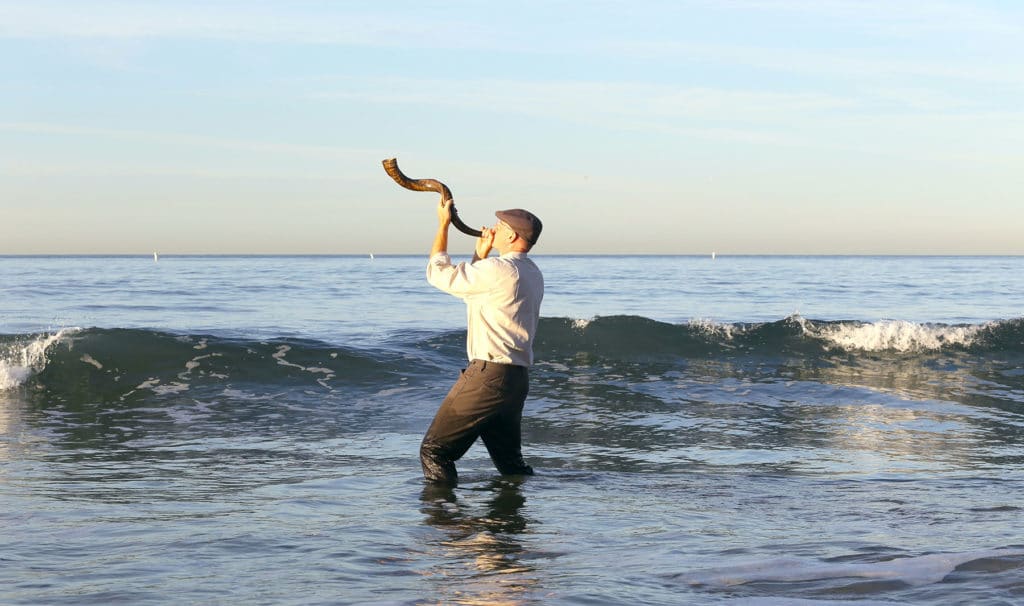
We will not blow our shofars this year –
at least not in mixed company. Out of concern
for everyone’s health, we will stand outside
far enough apart, and bend our bodies into
the shape, and wait to do any blowing until
we’re safely back at home with our Zooms.

V
This one’s for the bees – They’ve gone
missing this year so we should be frugal
with our honey. The planet is changing and
they may never come back. Consider agave.
Even date syrup will get the sweet job done.

VI
The challahs will no longer be exclusively round.
Thanks to our extra creative time at home
prepare yourself for a dodecahedron.
Still with raisins, of course, we’re not savages.

VII
The book of life is on Kindle now and
they’re considering electronic signatures.
The trees are rejoicing and, for the right price,
you can pay a guy on the dark web to
get your name in without having to go to shul.

VIII
Some things will stay the same –
The person in the White House
for some reason.
The Rabbi’s sermon will be
I mean barely.
It’s tradition.


God Wrestler: a poem for every Torah Portion by Rick LupertLos Angeles poet Rick Lupert created the Poetry Super Highway (an online publication and resource for poets), and hosted the Cobalt Cafe weekly poetry reading for almost 21 years. He’s authored 25 collections of poetry, including “God Wrestler: A Poem for Every Torah Portion“, “I’m a Jew, Are You” (Jewish themed poems) and “Feeding Holy Cats” (Poetry written while a staff member on the first Birthright Israel trip), and most recently “The Tokyo-Van Nuys Express” (Poems written in Japan – Ain’t Got No Press, August 2020) and edited the anthologies “Ekphrastia Gone Wild”, “A Poet’s Haggadah”, and “The Night Goes on All Night.” He writes the daily web comic “Cat and Banana” with fellow Los Angeles poet Brendan Constantine. He’s widely published and reads his poetry wherever they let him.

Why Is This Rosh Hashanah Different From All Other Rosh Hashanahs? Read More »

This Rosh Hashanah, Let Us Renew Our Breath

As we enter a new year, the third calendar year in the Jewish calendar of the pandemic, I am haunted by the spiritual implications of COVID’s impact on our lives. With its assault on life’s breath, COVID bears elements of a spiritual, as well as physical, ailment. We have lost touch with our communities, our families and most essentially, our breath. What meaning-making might we apprehend as we live through a time where we are either dying from lack of breath or required to wear masks that inhibit our own?  If there is any message through this macabre time, it lies in the very source of scarcity for its victims—a deeper return to breath, the breath of life that sustains us and returns us.

Rosh Hashanah is a time of renewal. In pandemic times, Rosh Hashanah is a time to renew the most elemental act of our lives: our breathing.

Rosh Hashanah is a time of renewal. In pandemic times, Rosh Hashanah is a time to renew the most elemental act of our lives: our breathing.

Let’s start with the science: What is the best way to breathe?

Journalist James Nestor spent two weeks with his nasal passages plugged up as the subject of a scientific study on nasal breathing. Having had his own epiphany at a breath workshop, Nestor set out to deepen his understanding of the nature of breath through an empirical as well as religious lens. His seminal book on the subject, aptly called “Breath,” published earlier this year, draws those seeking a renewed relationship with this unconscious, automatic reflex. His research takes him from Silicon Valley to the dental offices of Manhattan to the catacombs of Paris and beyond. He reminds us that “the average reader will take about 10,000 breaths to read to the end of the book … and maybe, by the law of averages, you will take 670 million breaths in your lifetime.”

What makes Nestor’s book unique as a study on breath and an important work on the subject is his thesis on nasal breathing. During a visit to an anthropology museum, he stands among thousands of human skulls and learns “that of the 5,400 different species of mammals on the planet, humans are now the only ones to routinely have misaligned jaws, overbites, underbites and snuggled teeth.” As Nestor plunges deeper into his research, even taping up his nasal passages for two weeks, his data continues to support his thesis: much of humanity’s physical deterioration—aches, pains and ailments—is rooted in one simple truth: we are breathing through our mouths, rather than our noses.

For Nestor, “To breathe is to absorb ourselves in what surrounds us, to take in little bits of life, understand them, and give pieces of ourselves back out. Respiration is, at its core, reciprocation.” This requires an opening of not only our airways and nasal passages, but also our minds, hearts and souls.

God’s Breath of Life

Nasal breathing was practiced widely throughout the ancient world. 

Judaism’s acknowledgement of nasal breathing began when the God “character” thought to create a human body and animate it with the breath of life. Gathering the dust of the earth, this first subtle act, is a pinhole into the world of universal spiritual truths, as the first breath of life in the Bible was a nasal breath when God created Adam in Genesis 2:7:

“The LORD God formed man from the dust of the earth. He blew into his nostrils the breath of life, and man became a living being.”

When we breathe we enhance our ability to apprehend that which contains every moment as a unique and sustained moment in time—that which is godly. Breathing animates our body with a godly presence that we call our soul.

The Yod/Hey/Vov/Hey of the Tetragrammaton of God’s Name is the name that cannot be spoken. It is a Jewish involuntary reflex to replace it with Adonai or Hashem. However, indeed, it cannot be spoken, for if we were to speak this unspeakable word, what would it sound like? Take a moment to form these sounds—just two syllables. Take a deep nasal breath and listen for the whisper: Yah. Through the mouth, exhale: Vah. Drink of the breath of life. Yah-Vah. God’s name.

Deep breathing has the capacity to create a body experiencing the transcendent. Deep breathing is a conduit into the word ‘kadosh’ as the word itself is untranslatable, suggestive of a hallowed space.

Just as a deep breath fills us with godliness, it enters our body as tiny molecules and influences nearly every internal organ, serving as a switch to every major system in our body, turning it on and off. Relaxing our body, we experience the genius of homeostasis, the perfection found in digestion, the wonderment of intimacy. Deep breathing has the capacity to create a body experiencing the transcendent. Deep breathing is a conduit into the word “kadosh” as the word itself is untranslatable, suggestive of a hallowed space.

We make ourselves holy through breath.

Shallow breathing is the staccato note of alarm, the switches go haywire, and the body responds like an alarm has sounded. Check in with ourselves after a sudden loud noise or the crying of a child after hearing a crash, and there is a gasp—air has been withheld, and the body kicks into action: The adrenals kick in, fight or flight reflex is triggered and we are capable of superhuman responses, with urban legends claiming the lifting of cars and the Book of Kings’ Samson taking down the pillars of the Temple at Dagon. Breath is what makes us superhuman. And in Judaism, Breath is godly.

High Holidays and Breath

High Holidays are spiritual Iron Man Marathons. Beginning with the 9th of Av—a day to recognize the wreckage of life around us—we enter into nine weeks of an intensely reflective process engaging us in abstention, self-reckoning, reflective letters of forgiveness, horn blowing, public prayer, music, shameless displays of self-abnegation, physical expressions of purgation, and one epic day of subsisting on nothing but breath. The Jewish High Holidays are an embodied experience, demanding that we align our hearts, minds, bodies and souls. 

From the start, we are commanded to piece together the sacred fragments of what we contribute to a broken world that only each of us can personally redeem. This year, I offer that each of us possesses the very ingredient that, in its essence, is the primary element of T’shuvah (return). This secret spiritual weapon enters us the moment we are born and sustains us until our final now. This secret weapon is breath. Breath is the vehicle that animates, resuscitates and redeems us through this time. It is the engine of prayer, the nourishment through a fast, the fuel for a shofar blast, the attachment of the human form to the divine.

Breath and its connection to spirit are easily understood in English, as “Respiration” and “Spirit” are derived from the same Latin root (spir) which means “breathe, have a longing for.” The longing of yichud (oneness) with God is physically captured in our liturgical imagery throughout Elul and the High Holidays. God itself becomes a “A King in the Field.” We are face-to-face with our Lover, our Judge, our Father, our Creator. With tremulous breath, we animate our Shofar as our alarm to awaken. Our voices rise to petition “Our Father, Our King” to deal kindly with us. 

But all of these prayers are truly, just reflexive, as the Breath of Life is the Spirit moving through us all of the time—it is upon us to apprehend its enduring presence with deep inhalations or block its entry. The letters “hey” and “chet” closely resemble one another but for one tiny aperture; “hey,” which appears twice in God’s name, is open for this oxygen flow, with a “yod”-like space in its form; the letter “chet,” meaning “sin or transgression,” is completely closed.

Our ancestors were etymological wordsmiths trying to capture the human experience through language. The Hebrew of the Bible is a literary love story, filled with onomatopoeic and alliterative allusions elevating the breath of life through human form. Professor David Golomb (z”l), a Harvard-educated professor of Aramaic and Biblical Hebrew, emphasized to his first-year rabbinical students: “What differentiates the God of the Israelites from all other Ancient Near-Eastern Gods is that our God wrote.” The written tradition naturally evolved into an oral one, as the word cannot be expressed without the Breath of Life. Even the rabbinic commandment to hear the Torah read aloud transforms into a spiritual imperative when we consider that we cannot truly hear the Torah without someone breathing each word before us through a meditative chant. One human, each breath, the song of God. From the sublime to the subhuman, the very breath of life that can chant the words of God creating ex nihilo also possesses the capacity to destroy in ways that are irreparable. The rabbinic stridency toward Lashon HaRa, or evil tongue, builds out an entire ethical system committing our breath toward words that nurture and redeem life, as language is, perhaps, breath’s easiest transgression. We are called through the reckoning of the many verbal transgressions in the Al Chet prayer to release weaponizing our breath toward the detriment of others, and to rebirth ourselves with pure breath once again.

Sh’mitah: Earth’s Exhale

As we stand before 5782, we also enter into a quiescent pause in our earth cycle, as this year is earth’s year to “exhale.” Sh’mitah (literally, “release”), is the commandment that we let the earth pause, and in doing so, reclaim our own pause. Rav Kook in Shabbat Ha’Aretz writes:

“What the Sabbath achieves regarding the individual, the Sh’mitah achieves with regard to the nation as a whole. A year of solemn rest is essential for both the nation and the land, a year of peace and quiet without oppressor and tyrant … It is a year of equality and rest, in which the soul reaches out towards divine justice, towards God who sustains the living creatures with loving kindness. There is no punctilious privilege but the peace of God reigns over all in which there is the breath of life … Life can only be perfected through the affording of a breathing space from the bustle of everyday life.”

Sh’mitah is an ancient agrarian technology finding its way back into modern Jewish relevance. The transvaluation of sh’mitah in 5782 requires for each of us to consider what it means to be an extension of this rhythm of nature. We are called to consider our seasons, our cycles, where our pruning has caused harm and how our harvests can become more bountiful. Sh’mitah during pandemic times is an opportunity for us to rest from all of our earthly distractions and redirect our lives to what is essential, one breath at a time.

The Breath in Pandemic Times

As High Holidays demand that we live in community, how do we reconcile this rededication of breath in community through COVID restrictions? For those of us who have no choice but to experience services through Zoom, how do we engage an embodied reciprocity of song, community and responsibility if we are siloed out in our homes? 

Absent from our community’s live, beating hearts, song and tears, might this year, more than any other, demand that we Renew our Breath and the awareness that it invites us into? How does Renewing our Breath transform our sense of our place in a world of 7 billion others? How might Renewing our Breath during a COVID pandemic chasten a harsh judgement? How does an awareness of each breath deepen our understanding that we are all living on borrowed time? Breathing through a 25-hour Yom Kippur service and meeting the moment of the Unatanneh Tokef prayer, a prayer of how we will die, is the pinnacle practice of our spiritual marathon: feast on this breath today, and may it enter our every pore, lest it be among our last.

For those of us seeking renewal in 5782, repentance begins with the breath you are taking right now. What if God’s essence in the Torah is really the breath that sustains us from our first moment to our last? What if the entire linchpin of creation hinges on our ability to self-regulate our bodies in confluence with the cosmos? When I connect myself to breath, prayer comes alive. I find myself crying, and the shell of a corroded and hardened heart softens. Breath is our vehicle to repentance, our chariot to the God of our ancestors and our companion from birth to death. If there is any lesson in the world right now, it is to renew our breath, speedily in our time. To connect with every tree, steadfastly and silently standing witness as it grants the gift of oxygen, and to offer back our carbon dioxide as a partner in creation. It is to take a breath before using that power toward harm, to pause—and to convert the destructive force of language toward a song or a sigh that will cherish instead of castigate.

To renew our breath in 5782 is to connect what we know of science with what we know of ourselves. It is to understand that each and every inhalation is graced with the gift to become the person we are meant to become.

Our time spent this High Holidays must be an exercise of this awareness. At Open Temple, our services this year will be on the beach. We will feel the ru’ach (wind) on our cheeks as we reconnect with the ru’ach (breath) that animates our bodies. 

Each of us has a unique working of creation that only we can offer; our breath is our conduit to connect to that purpose every moment of our lives until we arrive upon the moment of God’s Holy Kiss.

Let us renew. Let us slow down. Let us breathe.

This Rosh Hashanah, Let Us Renew Our Breath Read More »

Voices to Inspire

The Jewish Journal asked local voices to share a few inspirational words for the High Holy Days. Here is what they shared.

Rabbi Sherre Hirsch
Chief Innovation Officer for American Jewish University

Emmanuel Levinas, a 20th century Jewish philosopher, stated that with the coming of Elul, we are back to back with our fellows. But through Elul we begin to turn, to make tshuvah, to become face to face with the other. By the end of the holy days, we are no longer distracted by external forces. We are focused on that which is most important, the face directly in front of us. But Levinas assumed that both people want to turn. What if one turns but not the other? What if one needs more time? Then we are not face to face; we are back to face. Hence, some of us never turn. We want assurance that if we ask forgiveness, the other will ask as well. We want affirmation that our efforts are not in vain. Except real tshuvah comes without guarantees. Tshuvah is not transactional. If we are willing to turn regardless, we may find the ultimate transformation by glimpsing the face of the Divine. 

“Last year required innovation; this year requires stamina.” — Rabbi David Wolpe

Rabbi David Wolpe
Max Webb Senior Rabbi at Sinai Temple

Last year required innovation; this year requires stamina.  We thought we would be in a different place, but we have faith that we can create a time of holiness and meaning, connection and sanctity.  We refuse to be dispirited; we will renew ourselves and our communities and prepare, as we have for thousands of years, for both the challenges and the joys of the new year. May it be a healthy and sweet year for us all.

What do I need to release to be ready for this new year?
— Rabbi Laura Geller

Rabbi Laura Geller
Rabbi Emerita of Temple Emanuel of Beverly Hills

This New Year begins a Sh’nat Sh’mitah, sabbatical year. Sh’mitah means “release.” It is a year of releasing — debts, fields, indentured servants; these economic and agricultural changes remind us that all we have is lent to us. We need to release from our conviction that the privilege we experience comes from our own merit, and remind ourselves that we have an obligation to take care of each other and the earth. Laws concerning sh’mita raise questions about so many of the pressing issues of our time: climate change, economic inequality, food insecurity, the balance of rest and work, connection to Israel, justice and community. It also challenges us with deeply personal questions. What do I need to release to be ready for this new year? What do I need in order to be able to release what I ought to let go of?

Rabbi Adam Kligfeld
Senior Rabbi at Temple Beth Am

There is sanctity in doing, and saying and acting. We are a people of mitzvot, of positive obligations. And there is sanctity in not doing, in restraining, in choosing not to send that email, not to let those words emerge from your mouth. Our tradition exquisitely melds together the notions of proactive religious behavior alongside noble silence. Things and deeds we must say and do, and those we are prohibited from saying and doing. We emulate Biblical God, the Creator, by creating ourselves, with word and deed. And we emulate the Kabbalistic God of tzimtzum, of pulling back, putting less of ourselves out there than is maximally possible, to make room for others and for beauty we cannot create on our own. This year: make your mark by what you do and say, and also by what you elect not to.

Rabbi Noah Farkas
Incoming President & CEO of the Jewish Federation of Greater Los Angeles 

Rosh Hashanah celebrates, among many things, the creation of the world.  What inspiration do we take from the world’s birthday? Before God was a Redeemer or Revealer, God was an artist. For six days God created life. God “spoke and the world came into being.” God made the invisible visible. But when God created humanity, God gave us a small piece of godliness, endowed us with the Divine Image. God is the first artist and you and I the first masterpiece. Which means we are a work of art. Over the millennia we have built and manipulated, cajoled and created anew this world given to us, often for the better and sometimes for the worse. Generations have bequeathed to us the works of their hands in the form of painting, song and poetry. Which means we are also artists at work. Art becoming an artist, the created becoming the creator; this is sacred cycle of life. As this new year approaches and we reflect on the work of our spirit, let us be humbled and inspired to fashion ourselves a new in partnership with each other and with God.

Rabbi Daniel Bouskila
Director, Sephardic Educational Center

Upon celebrating birthdays, it’s customary to wish long life, until 120. Recently on my birthday, a dear friend sent me a message saying, “May you love until 120.” A deeply profound typo! On this upcoming Rosh Hashanah, the collective birthday of all of humanity, my wish is that we may all love until 120…and beyond.

My heart needs soothing with Torah tropes and the sound of the ocean at Tashlich and children laughing.— Rabbi Jill Zimmerman

Rabbi Jill Zimmerman
Path With Heart, Hineni Spiritual Community

The sound of the shofar in Elul this year is soul-disturbing. This year, there is no need for the shofar to “wake me from slumber” because I’ve been awake, alert and sleepless for too many months. Sirens of ambulances and fire trucks ring in my ears. The wailing of families having lost loved ones too soon is a constant drone. This High Holy Days, I long to hear the music of our people, the sound of the cello and the harmony of voices, even through my computer speakers. My heart needs soothing with Torah tropes and the sound of the ocean at Tashlich and children laughing. The shofar blasts this year — tekiah, shevarim and t’ruah — acknowledge the brokenness of our world and the deep yearning for renewal and wholeness. May each blast herald a new day.

Sam Yebri
Partner at Merino Yebri, LLP and Candidate for City Council 2022

What makes Yom Kippur so profound and solemn for me is how uniquely personal it is. Unlike the holidays of Passover, Sukkot or Chanukah, it is not about history or community. Yom Kippur is uniquely about taking stock of your own personal journey, not in comparison to others, but in comparison to your ideals. What have I accomplished with a gift of one year of life? Whom have I helped and whom have I wronged? Do I merit being written in the Book of Life for another year? These questions that we ask ourselves on Yom Kippur raise the day’s most important lesson: that it is never too late to shift course, start afresh, and strive for the ideal version of yourself.

Rabbi Ilana Grinblat
Vice President of Community Engagement for the Board of Rabbis of Southern California

I enter these High Holidays with mixed emotions. I am grateful to have survived this year and to be vaccinated for Covid. Yet, this joy is incomplete – as we now face another surge. Bleary-eyed from exhaustion, how can we see our way ahead when life feels precarious? A midrash offers the image of a mirror. Rabbi Harold Kushner explains: “The figure we see in the mirror seems to be twice as far from us as it really is. But with every step we take toward the mirror, the reflection takes a step toward us. So it is with repentance. Our goal seems so far off but God says to us, ‘Take one step toward Me and then another, and I will meet you more than halfway.’” As we summon the strength to wake up in the morning and face each day, let’s step forward, and God will meet us more than halfway.

Judy Gruen
Author of “The Skeptic and the Rabbi: Falling in Love with Faith”

Sukkot, which follows Yom Kippur, is the only Jewish holiday noted as the “season of our happiness.” Not Pesach, when we were finally freed from bondage, and not Purim, when God saved us from Haman’s genocidal plot against us—only Sukkot. And how can we be commanded to feel an emotion, anyway? Sitting in our fragile sukkahs, Sukkot reminds us that true happiness is never sourced in even the sturdiest material possessions. How often do we see people’s lives descend into miserable train wrecks after gaining immense material wealth? Sukkot reminds us that the only permanent “wealth” is our spiritual connection to God and His endless love for us. Happiness isn’t about having; it’s about values and attitudes. That’s why, even when sitting in a flimsy sukkah where we may be too hot or too cold, we really can access transcendent happiness, locally sourced in our unbreakable bond with our God.

What greater expression of love is there than forgiveness? — Rabbi Pini Dunner

Rabbi Pini Dunner
Senior Rabbi of Beverly Hills Synagogue in California

In a world that has descended into misery and chaos on so many fronts, our task must be to use the High Holidays as a time to reaffirm our unconditional love for our nearest and dearest. The concept of teshuva — the chance God gives us all to rehabilitate ourselves from a messy past — is an expression of God’s love for us. What greater expression of love is there than forgiveness? As human beings created in the image of God, we must emulate Him and show our love and forgiveness towards everyone in our lives. It’s time to drop the rancor and bitterness, and to come together in friendship and togetherness; together we can solve the problems of the world so that they don’t overwhelm us.

Janice Kamenir-Reznik
President at Jewish World Watch

How incredible that the High Holidays mandate reflective introspection. Theoretically, by Yom Kippur, we understand our flawed conduct and are ready to repair the damage we caused through admission and apology; if we follow the playbook, we qualify to perform “tshuvah.” The underlying assumption is that everyone errs every year; the Holidays impose the companion obligations of introspection and humility. “If I did anything to hurt you this year…” is neither reflective nor humble, and is not t’shuvah.  Maimonides suggests that admissions must be specific and coupled with a commitment not to repeat the mistake. T’shuvah is not complete until later. When confronted with similar circumstances, one must not repeat the error. Whatever one’s level of religious observance, self-reflection, humility and t’shuvah are remarkable mandates. How brilliant that our forebears created these Holidays, prioritizing mindfulness and compassion in human relationships. Ultimately, these practices embody hopefulness, as redemption is always possible, relationships are always reparable and we can all become better people next year than we were this year!

“I ask our communal leaders to join me in acknowledging that we need to listen more. — Jay Sanderson

Jay Sanderson
President & CEO of the Jewish Federation of Greater Los Angeles

For me, the High Holidays is a time of deep reflection and teshuvah. It is very important for all of us to acknowledge our sins, repent, ask for forgiveness and commit wholeheartedly to learn from them. This is my last few months of 12 years serving as the President and CEO of the Jewish Federation of Greater Los Angeles. I have been honored and humbled to serve this important role and lead our community especially during this horrific pandemic. I have tried my best but I have been imperfect. I deeply apologize to those who I have hurt and to those who feel that I have been unresponsive to their concerns and needs. I hope you will forgive me. Our community is struggling and more polarized than ever in my lifetime. I ask our communal leaders to join me in acknowledging that we need to listen more (especially to those we do not agree with) and lead with more openness, less self-righteousness and a recognition that we have a shared mission to build a strong, inclusive and flourishing community.

Rabbanit Alissa Thomas-Newborn
B’nai David-Judea Congregation

On Rosh Hashanah, Jews look backward and forward. But in 5782, many may be at a loss, feeling despondent. We stand before God with acute awareness of pain, illness, death and terror. Will this year be different and better from the last? The Aish Kodesh reminds us: “It is impossible for a parent to hear the cries of the child and not run to rescue.” He taught these words on Rosh Hashanah in the Warsaw Ghetto, not with naivete but as a prayer — modeling how prayer can be a complex blend of hope, gratitude and even challenge to God — reflecting everything we are. Uncertainty, loss and brokenness come with being human. As do resilience, repentance and salvation. On the birthday of the world, we feel our humanity with heartbreak and exhilarating joy. We yearn to be lifted, cradled and rescued by Avinu (our Father). It is this uniquely human prayer that pierces the heavens. May we have the courage to pray and live in this way and know lasting health, safety, normalcy, close embraces and welcoming smiles.

Rabbi Shlomo Einhorn
Dean of School at Yeshivat Yavneh

The challenge of the Yom Tov season is that we view the process of teshuvah as too difficult. How will we ever be perfect? But we forget that angels weren’t allowed into the Holy of Holies, only a person of flesh and blood. G-d wants us present over perfect. And more importantly, we also forget what teshuvah is. It’s about returning to a relationship with G-d. “But I am so distant from Him; how is this possible to repair?” G-d is etzem hachaim, the essence of life. Therefore, we can never be distant from G-d. It’s simply about shifting our awareness to where we recognize that it’s not possible to be far away from G-d. This is the epitome of teshuvah, and the rest is commentary.

Andrea Hodos
Associate Director, NewGround: a Muslim-Jewish Partnership for Change

The first step is listening. In Elul, the shofar wakes us up with a sound that starts at the narrow end, and emanating from its width, widens us and prepares us to absorb a broader perspective. We receive the Torah of Rosh Hashanah: of Hagar it says, “God opened her eyes and she saw the well of water,” (Gen. 21:19) and of Avraham, “Avraham lifted his eyes, and there was the ram.” (Gen. 22:13)  Moments preceded by deep listening expanded their perception and allowed them to transform danger into life. On Rosh Hashanah, known as Yom Hazikaron, the Day of Remembrance, we are reminded of the infinite nature of God’s perception and compassion, and we are challenged to expand our own. Listen first, and let that listening expand your understanding of yourself and of others. Let your listening allow you to see as much as you can, with as much compassion as you can muster: for yourself and your shortcomings, and for others and theirs. Together, let this be our path towards life.

Shawn Landres
Co-founder of Jumpstart Labs and an Appointed Commissioner for the County of Los Angeles and the City of Santa Monica

There is a point of no return in every trip. On our longest and most important journeys, there frequently are no landmarks in sight: the past is untenable and the future invisible. Globally, nationally, locally, personally, we find ourselves at countless points of no return, intersecting and overwhelming, as we work to mitigate climate change, preserve democratic civil society, repair racial, economic, and social inequities, bring the pandemic under control, care for our loved ones and ourselves and more. Theologically and liturgically, the 10 days from Rosh Hashanah to Yom Kippur are filled with uncertainty; we seek t’shuvah, return, but there is no going back, and our collective and individual destinations feel more distant than ever. May the coming days and weeks remind us of our purpose, affirm our solidarity, and instill within us the momentum to persevere.

Rabbi Jason Rosner
Senior Rabbi and Executive Director Temple Beth Israel of Highland Park and Eagle Rock

We aspire and commit to change the behavior of the entire human community in this next year. We understand that we cannot live by the maxim “Plastics, Benjamin,” the planet destroying short-term pursuit of profit. We are coming into a Shmita year, a year to let land and people recover from exploitation. We can change the course of our species but it means setting aside the mentalities of individualism, materialism, and mass consumption.

Rabbi Elchanan Shoff
Beis Knesses of Los Angeles

Joy. If you owed a whole bunch of money and you had a chance to wipe the slate clean and be totally out of debt – it would be a great joy! You’d happily go to the few hours required to achieve that amazing forgiveness. The high holidays are filled with many emotions. One of the most important ingredients is joy! Happiness! It your experience of high holidays doesn’t include some spirited dancing and unbridled joy – it’s missing the main ingredient! God made us and he loves us and he wants us to get things right. And he helps us start over! L’chaim!

Elon Gold
Comedian

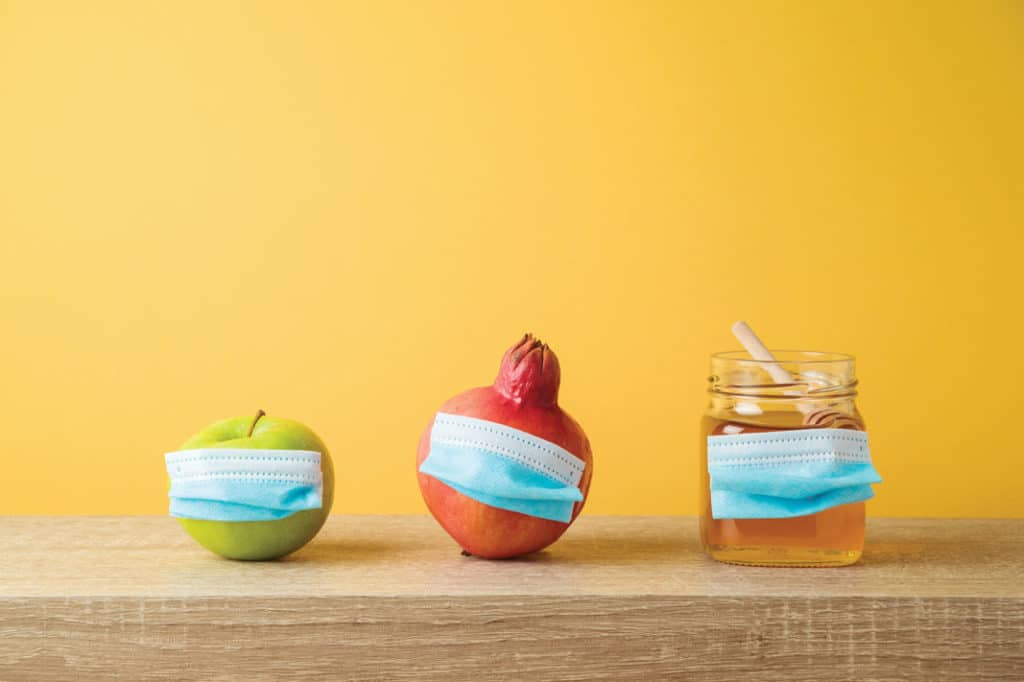
I just hope this Rosh Hashanah is better. Last year I was dipping apples in Purell!

Voices to Inspire Read More »

How American Jewish University is Confronting the Jewish Future with Innovation and Optimism

In today’s rapidly shifting world, American Jewish University (AJU) is marshalling its creativity and boldness to transform how individuals and communities learn and access Jewish wisdom.


A mission-driven institution that has served the Los Angeles community for decades, AJU is pioneering a slate of online academic and community programs that are making Jewish education and wisdom more easily available, at all stages of the life cycle, around the world.

“The pandemic created an opening for AJU to radically change in real time how we deliver education,” says AJU President Dr. Jeffrey Herbst. “We saw this as an opportunity to move quickly, both on new initiatives and initiatives that were already in our pipeline. We reject the traditional narrative of the North American Jewish community, most notably about the abandonment of affiliation and ever-increasing anomie, and see instead new moments to engage large numbers of Jews and others who have not found their home for learning.”

The University launched B’Yachad Together: Spirited by AJU, a leading digital platform for conversations centered on Jewish wisdom that has drawn an average of 600 viewers per event. It has also developed robust online degrees in education and business, and new learning opportunities for the next generation of Jewish leadership at the Ziegler School of Rabbinic Studies. With one of the largest gifts the University has received in its history, it created the Maas Center for Jewish Journeys, championing those too-often relegated to the periphery of Jewish life. Within the Maas Center, the Miller Introduction to Judaism program’s latest digital venture, On One Foot, offers a self-paced video course for anyone interested in learning about the basics of Judaism from an open, embracing perspective.

“AJU is pioneering a slate of online academic and community programs that are making Jewish education and wisdom more easily available.”

While distinct, these offerings are intertwined with the University’s long-standing mission to elevate the Jewish journeys of individuals and organizations. These digital programs reflect and respond to the deeper needs—social, spiritual, and intellectual—of a changing 21st century society.

Herbst explains that AJU is “a non-denominational university based on Jewish wisdom across the board. We do not impose one particular perspective and we are not bound to serve a geographically-defined population.” This is clearly reflected in the University’s B’Yachad program, soon to be rebranded, led by Chief Innovation Officer, Rabbi Sherre Hirsch. B’Yachad draws a world-wide community to online conversations that capture and deliver insights from guest speakers and AJU faculty.

Hirsch believes that in today’s world, “there is a hunger for more conversation.” She explains that “right now, online, we have a lot of content, but not a lot of context. So, we can go online and learn whatever we want, but we don’t have someone helping us understand.” B’Yachad, Hirsch says, was intentionally developed differently to host original conversations that capture Jewish thought and knowledge.

Events have featured a variety of voices, including New York Times bestselling author Anita Diamant and Academy Award winning producer Melissa Berton; Former Ambassador of Israel to the United States Michael Oren; Los Angeles County Supervisor Sheila Kuehl; and Ozark’s Julia Garner and Chris Mundy.

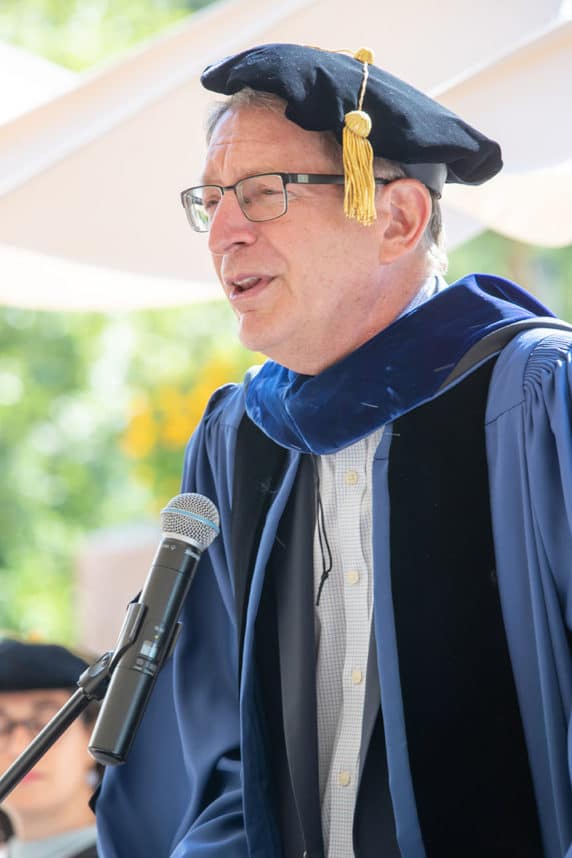
AJU President Dr. Jeffrey Herbst

Hirsch says her team pictures the warmth of a Shabbat dinner when putting together the virtual programming, recognizing that “a level of intimacy creates something that we are all craving.” The need for a resource like this is demonstrated by the program’s engagement, well beyond Los Angeles and North America, including communities in South Africa, Australia, Israel, and Argentina. “It’s enabled people to find their place and home within Judaism,” says Hirsch. That’s even true for the interviewees, who have often had “an ‘aha’ moment about their Judaism,” while speaking on the platform, says Hirsch. Hirsch says that these programs are only the beginning of the virtual events and learning opportunities that AJU will offer. “We are constantly iterating and are excited to unveil an entirely new interface soon,” she says.

AJU programs provide that sense of connectedness combined with a degree of accessibility not previously imagined. “It is in our DNA to be accessible to all,” states Herbst.

Ease of access is also a focus of the University’s academic programs, including its recently launched School of Enterprise Management and Social Impact (SEMSI), a first-of-its-kind business school in the United States fully committed to promoting value and impact. SEMSI’s cutting-edge MBA will empower a new generation of business and non-profit leaders to serve as ethical change-agents who lead purpose-driven ventures. The degree is completely online. Courses under SEMSI, led by Dean David Groshoff, will teach students to view modern business practices through a lens of values rooted in Jewish ethics.

“The business leaders of tomorrow require an education that arms them with the ability to drive companies that prioritize communities, the environment, and society, not solely equity holders,” says Groshoff, noting that this is what the School is addressing, “not just in a single chapter or course, but in the entirety of our programmatic offerings, throughout our business school.”

B.A. in Early Childhood Education Class of 2021

Within the School for Jewish Education and Leadership, AJU has similarly recognized and responded to a changing world, offering online programs for an M.A. in Early Childhood Education and B.A. in Early Childhood Education. The School is driven by a bold vision to elevate the knowledge, skills, and performance of early childhood educators working to ensure a vibrant Jewish future. While the School, led by Dean Dr. Rachel Lerner, has long centered leading models of education, the trailblazing online format allows for something altogether new: accessibility.

“Accessibility is a central value for our university,” says Lerner. “We are thrilled to offer these online degree programs, which remove typical barriers to entry.”

These technological innovations are only a survey of AJU’s current offerings, which embrace a rapidly changing world with an eye toward the future. “AJU’s ability—as a nimble institution—to constantly innovate will be central to our identity in the years to come,” says Herbst.

Herbst also acknowledges that, “some things cannot be replaced by technology,” noting that AJU’s Camp Alonim, held at the Brandeis Bardin Campus in Simi Valley, which has long been part of the Los Angeles Jewish community’s fabric, will “continue to be an immersive Jewish experience that profoundly influences young people, in large part because of the in-person connections that are forged.”

“We hope to marry excellent in-person education with a best-in-class digital platform to serve the large numbers of people who are seeking us out.”


To learn more about American Jewish University, visit www.aju.edu or contact Michelle Starkman, Vice President of Communications, at Michelle.Starkman@aju.edu.

How American Jewish University is Confronting the Jewish Future with Innovation and Optimism Read More »