fbpx

April 15, 2021

Two Stories as We Celebrate 73 years of the State of Israel

In 1991, I was living on Kibbutz Sa’ad as part of my Nativ gap-year program. As that year’s Shavuot ended in 1991, we turned our TVs on and learned about the wonder of Operation Solomon, the clandestine and heroic effort to save over 14,000 Ethiopian Jews. The operation brought them covertly to Israel in stripped El Al airliners, על כנפי נשרים (al kanfei n’sharim) on the wings of eagles. I will never forget the sentence I heard on TV that night (which I think was uttered by Brigadier General Nachman Shai, who was then the spokesman for the IDF). It went something like this: “This operation shows that had the Jews had an airline and an address in 1939, there would have been no Auschwitz.”

It was perfectly appropriate and poignant statement, and only slightly hyperbolic at that. He was, in one sentence, reinforcing one of the driving forces of Zionism, which is that the world has continued to do everything in its power to prove to the Jews that they actually do need their own home (even as many in that same world do everything possible to wrest that home from those Jews). Within Rabbi David Hartman’s Sinai-Auschwitz paradigm, in which the Jewish condition is one of balancing two nodes (living on earth with a divine purpose and ensuring that we are not eradicated so that we can actually just live), the post Operation-Solomon sentiment was that Israel was a bulwark against a future Auschwitz, on behalf of any worldwide Jew of any race, denomination or personal observance. That sentiment remained a critical part of what was created in 1948, and we dare not take it for granted — even as we try to live out and retroactively earn Sinai, even as we aspire to be lights unto the nations, even as we continue to learn and evolve into a healthy version of the odd organism which is a Jew with power.

I think about 1991 as we sit in 2021, as much of the fraught conversation about Israel’s identity and soul zeroes in on 1967, which for me is too often a smokescreen that occludes the true target date, which is 1948.

This smokescreen was painfully reinforced to me during one memorable moment when I traveled as part of the Encounter program to meet with and listen to Palestinians in East Jerusalem and the West Bank. As I have spoken and written about before, my Encounter experience was heart-opening but not only, or even primarily, in the direction one might assume. I am grateful for the experience, and hold admiration and true respect for Encounter’s leadership and vision. And with my heart pried open, what I experienced and heard during those four days made me less optimistic about the possibility of a two-state solution, not more so.

At one point we were speaking with a young Palestinian Arab, a Christian woman who, with Jerusalem residency, enjoyed more access and unfettered travel than many other Palestinians do. She had grown up in the Fatah youth movement, hoping to improve her life and the lives of her peers through political activism. At some point she gave up that hope, finding too much corruption, graft and fecklessness everywhere she looked. “A pox on all their houses,” was sort of how she described it.

So she turned towards mindfulness and other forms of peacemaking, deep within the spirit. She helped launch a meditation and mindfulness center in the West Bank, open to all. She spoke the language of togetherness and unity and human bondedness. She claimed to hold no hatred in her heart, and I believe her. She rhapsodized, quite compellingly, about how intertwined the Jewish and Arab stories and fates are; about how when it rains, it rains the same on either side of the fence; about how this region has the potential to be the next Dubai in terms of openness and mutual thriving; about how human understanding and open-heartedness will bring us past this quagmire. I was moved. I wanted to make a donation on the spot to her organization and help support her vision.

On Encounter, we are taught — properly, I would say — only to ask questions to which we do not know the answer. We should ask questions not as a “gotcha,” not to embarrass or demean or to make a point. But only to learn. After this woman spoke, I asked a question that was burning in my soul: Can you imagine anywhere in your consciousness a resolution to the conflict that includes, in some way, the State of Israel?

I truly wanted to know, as she extrapolated out from the beautiful and holy work she was doing, whether we Jewish visitors, who deeply wanted to partner with her, could dream together of a workable peace, a mutually dignified existence, a cessation of nihilistic aspirations of annihilating the other — and that it would include something called Israel, the Jewish state.

But she had a one-word answer. And it broke my heart. She said, “no.”

I heard my mind literally say these words to myself as I processed her answer: I want to support her and her work. I want her and her fellows to live with freedom, dignity, national identity, her human rights celebrated and guaranteed. I want her to feel that she is living a blessed life in a blessed part of the world, lacking nothing that human beings ought to lack, at the core.

But not if it means no Israel. My Zionism teaches me, and Nachman Shai teaches me, that to go back is no option.

My Zionism teaches me, and Nachman Shai teaches me, that to go back is no option.

It seems that in this Jewish moment, even wishing the State of Israel a happy birthday is laden with controversy, judgment and rancor. I have no illusions about the complexity of maintaining a Jewish polity in the twenty-first century. But today, especially, on יום העצמאות, I celebrate and I only celebrate.

I celebrate that in 1948, the Jews won the war, for to lose it would have meant to lose everything and everyone. I celebrate that the State of Israel exists, for its existence is incalculably better for the Jewish people than would be its non-existence. I celebrate the home and address to which Operation Solomon brought Jews from Ethiopia, the very home and address my inspiring Palestinian friend cannot imagine deserving to exist.

And I celebrate dreaming about the next time I will be able to visit, all the while committing to doing my part to earn the love of the fragile yet sturdy, vulnerable yet mighty, maddening yet exquisite, divided and divisive but also singular in purpose State of Israel.

Happy Birthday Israel.  יום חג העצמואת שמח.

Two Stories as We Celebrate 73 years of the State of Israel Read More »

YULA Girls Student Sarah Shaye Places Sixth in International Bible Competition

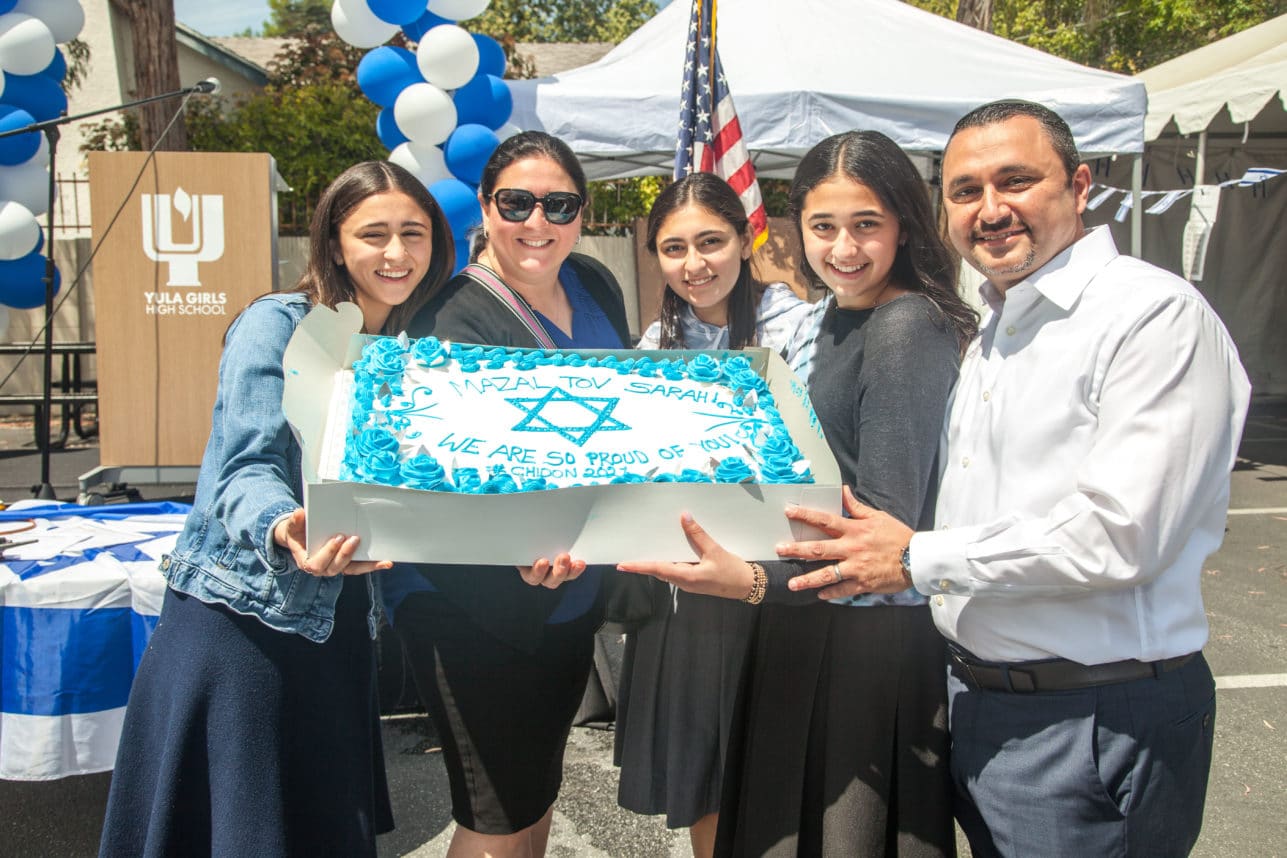
Sarah Shaye, a ninth-grade student at YULA Girls School and former student at Harkham Hillel Hebrew Academy, took sixth place in the Chidon Hatanach (National Bible Contest) competition held in Israel, besting 600 students from over 80 schools in the United States. To get to the final round, she competed against 50 semi-finalists in 30 countries and emerged as one of the top 16 international finalists, just one of three in the United States. At the finals she tied for fourth place, with the tiebreaker giving her sixth-place honors.

The annual competition, held in honor of Israel Independence Day, was broadcast live on Israeli Television on April 15. Due to pandemic restrictions, competitors outside of Israel participated via live stream. Sarah answered the rigorous questions at 1 a.m. Pacific time from her Beverlywood home. Competing students in Israel were onstage and others were in their home countries. The competition lasted well into the early morning hours of Los Angeles time, with Prime Minister Benjamin Netanyahu personally delivering questions to the final four contestants.

Sarah learned more than 450 chapters of Bible (more than half of the Bible) in preparation for the contest.

Sarah learned more than 450 chapters of Bible (more than half of the Bible) in preparation for the contest. The questions are very advanced and technical, so students spend upwards of an entire year studying for the competition.  “Chidon Hatanach has inspired me to learn and love the Tanach (Bible),” Sarah said. “The time I spent learning Tanach has strengthened my commitment to Hashem and has inspired me to continue learning Torah beyond this competition.”

Later that day, a somewhat tired yet excited Sarah was surprised when the entire school threw her a congratulatory celebration and presented her with a special cake to mark the occasion.

Shaye family (L-R) — Hannah, 18 (sister), Kelly (mother), Yaelle, 17 (sister), Sarah, 15 (award winner), Omid (father). Not pictured- Leah, 12 (sister), Michael, 5 (brother)  (Harvey Farr)

“It has been an honor and privilege to represent the Los Angeles Jewish community in the Chidon Hatanach Haolami competition,” Sarah added.

The competition was established in 1958 by Israeli Prime Minister David Ben Gurion.


Harvey Farr is a local community reporter for the Jewish Journal.

YULA Girls Student Sarah Shaye Places Sixth in International Bible Competition Read More »

I Wouldn’t Get Used to This – a poem for Torah Portion Tazria-Metzora

If a man loses the hair on [the back of] his head,
he is bald. He is clean.
Leviticus 13:40

No one complains when babies are bald
but let a few decades go by and if the skin
of our heads becomes visible, it becomes a thing.

Industries have arisen to help us deal with
this affliction. Wigs, magic hair dust you can
sprinkle on the vacated areas, expensive surgeries

that will rearrange your hair like when you were young
and spread your broccoli to the far edges of your plate
to make it seem like you made a dent.

We start out as babies and end up looking like babies.
Our hair makes other arrangements
our skin folds over unto itself

The things inside our skin forget how to work.
We even start to behave like babies.
We get cranky, or at least I do.

And then, too soon, we are treated like them.
Our outside privileges are taken away.
Limits to what machinery we can operate

are put in place, and everything is proofed
so we can do no damage. This is,
despite our complaints, as it should be.

Our bald heads, beacons of normalcy –
hearkening our eventual return to dust.
Gather your brooms, my friends

There’s a cleanup on aisle your entire life.
There’s no way around this.
This has always been temporary.


God Wrestler: a poem for every Torah Portion by Rick LupertLos Angeles poet Rick Lupert created the Poetry Super Highway (an online publication and resource for poets), and hosted the Cobalt Cafe weekly poetry reading for almost 21 years. He’s authored 25 collections of poetry, including “God Wrestler: A Poem for Every Torah Portion“, “I’m a Jew, Are You” (Jewish themed poems) and “Feeding Holy Cats” (Poetry written while a staff member on the first Birthright Israel trip), and most recently “The Tokyo-Van Nuys Express” (Poems written in Japan – Ain’t Got No Press, August 2020) and edited the anthologies “Ekphrastia Gone Wild”, “A Poet’s Haggadah”, and “The Night Goes on All Night.” He writes the daily web comic “Cat and Banana” with fellow Los Angeles poet Brendan Constantine. He’s widely published and reads his poetry wherever they let him.
I Wouldn’t Get Used to This – a poem for Torah Portion Tazria-Metzora Read More »

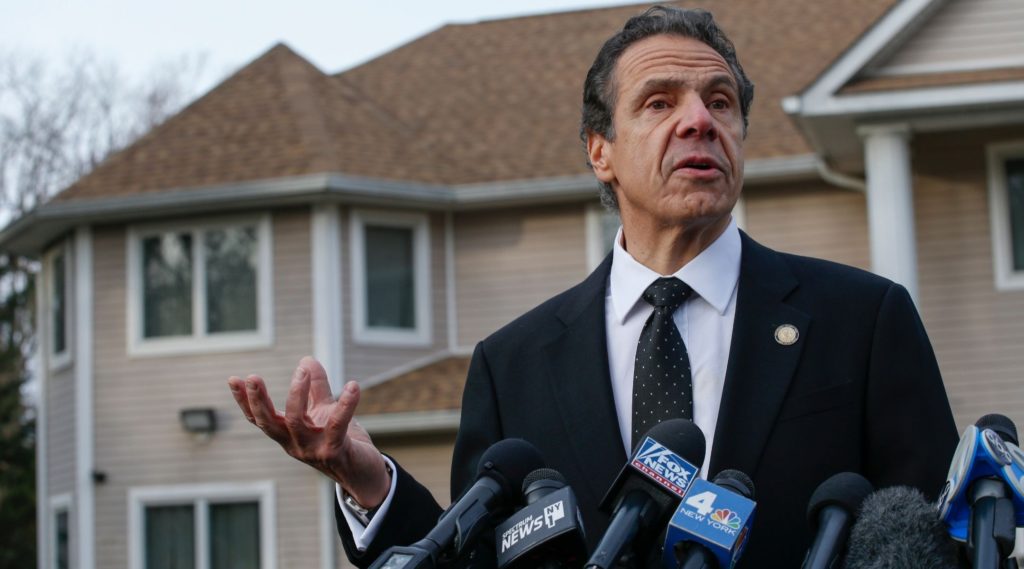
Report: Cuomo Said “These People and Their F—ing Tree Houses” During 2006 Sukkot Event

A recent report is claiming that New York Governor Andrew Cuomo, a Democrat, made a comment about “f—ing tree houses” during a 2006 Sukkot event when he was running for state attorney general.

Jewish Telegraphic Agency (JTA) reported that in an April 13 New York Magazine story, Cuomo “vented to his team” about “these people and their f—ing tree houses” during the Sukkot event. A spokesperson for Cuomo denied that the governor ever made that remark, pointing out that Cuomo’s brothers-in-law are Jewish and that “he has the highest respect for Jewish traditions.”

The reported comment sparked outrage on Twitter. “How this man is still in office is beyond our comprehension,” the Stop Antisemitism.org watchdog tweeted.

Writer Melissa Braunstein also tweeted, “That jerk and his f&$?ing attacking observant Jews. Again.” She added in a subsequent tweet, “How many similar comments has Cuomo made over the years, but nobody thought it was newsworthy?”


JTA Opinions Editor Laura E. Adkins tweeted, “Stripped of context, the quote is something mildly amusing that many of us Jews might say. And it does sound like a silly / mildly annoying campaign event to ‘have’ to attend! BUT just because many of your staffers are casual and comfortable with their Judaism does not mean you can ‘get away’ with being so if you’re not a Jew. AND Marrying, employing or befriending a member of a minority does not prove you’re an ally / entitle you to in-group privileges!”


JTA Washington Bureau Chief Ron Kampeas quipped, “Succot are not ‘f***ing tree-houses,’ they are f***ing huts.”


Cuomo has been criticized for singling out the Orthodox Jewish community for the spread of COVID-19 and subjecting primarily Orthodox neighborhoods to more restrictive COVID-19 measures.

H/T: Twitchy


Report: Cuomo Said “These People and Their F—ing Tree Houses” During 2006 Sukkot Event Read More »

Future in Question for Chicago Loop Synagogue and its Monumental Stained-Glass Window

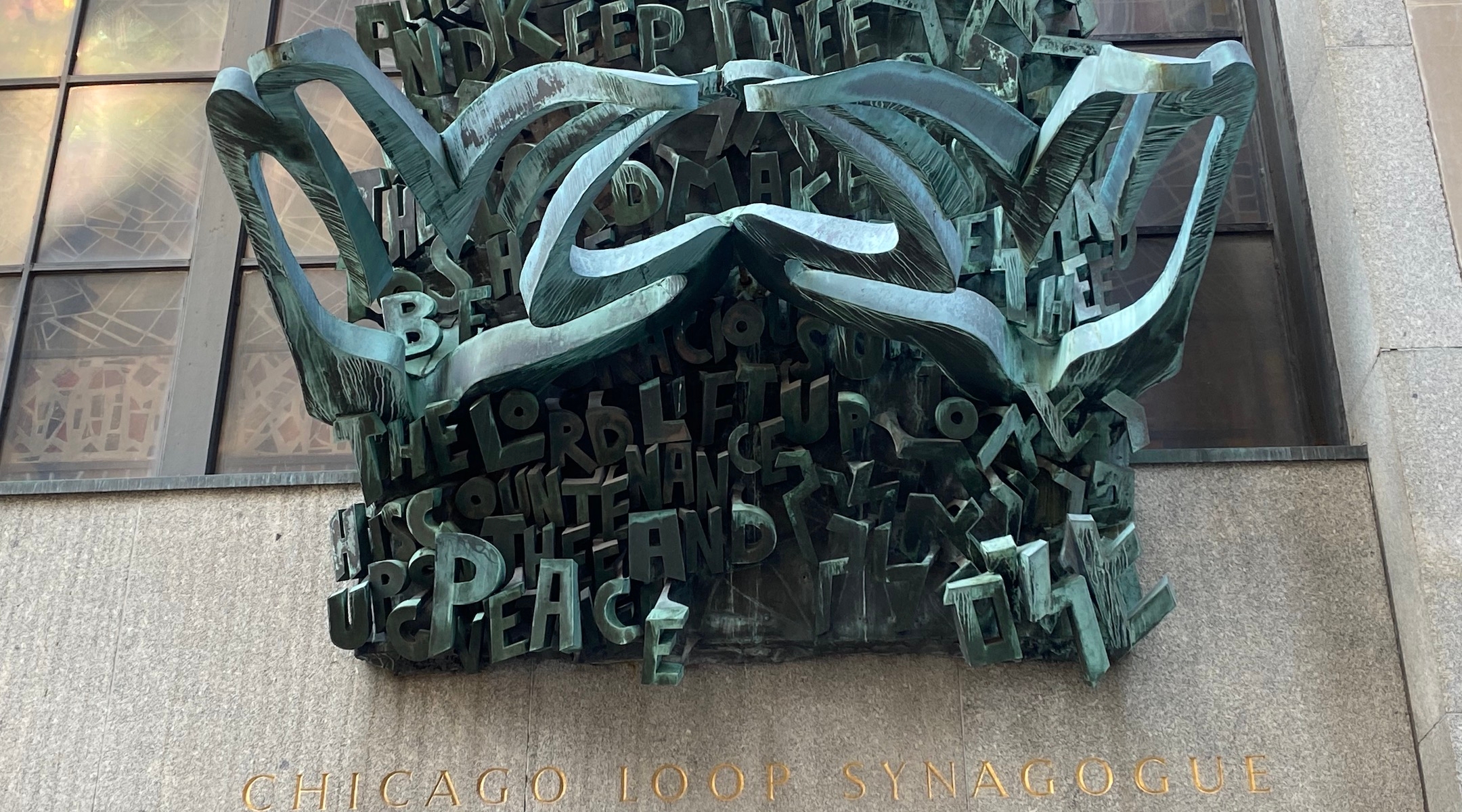
(JTA) — Just three stories high and hemmed into a small 5,000-square-foot lot, the building at 16 S. Clark St. is a small jewel box situated amid this city’s dense urban fabric. Exuding an aura of cool simplicity, the structure’s facade is composed of glass, metal and concrete planes. Its name is etched in delicate gold lettering: Chicago Loop Synagogue.

Perched above the synagogue’s front door, a two-ton sculpture extends over the sidewalk. Created by Henri Azaz in 1963, the work consists of bold letters tumbling over each other spelling the priestly benediction. A pair of massive hands emerges from the words, sloping downward as though placing a blessing on the heads of all those who enter.

The brass and bronze has since weathered and turned a tarnished green. Streaked with corrosive lines, the heavy hands now look weary. Chicago Loop Synagogue has fallen on hard times, and its future is precarious.

The only consistently operating Jewish house of worship in Chicago’s Loop, the 1.5-square-mile area touted as the second largest business district in North America, the Loop Synagogue has been unusual since it was conceived in 1929. Few members live anywhere nearby. Before the pandemic, most popped in for lunch or a prayer service during the workday while spending Shabbat at their home synagogues in the suburbs. In recognition of that unusual arrangement, dues top out at $180 — meaning that the congregation’s 400 members generate far too little revenue to keep operations afloat.

The pandemic abruptly halted the flow of commuters, severing ties that for many Loop members were only tenuous in the first place. But keeping the building closed also cut expenses necessary for operating the synagogue’s outdated and inefficient systems, buying the congregation’s leaders time to ponder the possibility of relocating to a less expensive space. One pressing question: What will happen to the historic stained-glass panels that are perhaps the Loop Synagogue’s most defining feature?

The congregation’s president, Lee Zoldan, reports that the synagogue has enough cash assets in the bank to continue running comfortably for another year and a half.

“Then we are headed for the red,” she said. “The time to panic is now.”

Chicago Loop Synagogue was initiated by a gift from the Midwest Branch of The United Synagogue of America (today the United Synagogue of Conservative Judaism). The goal was to serve commuters seeking kosher food and a place to pray during the workday. It remains the only Loop venue to offer both services.

The institution quickly gained national recognition. By 1934, the prayer space was renovated to accommodate more worshippers, and was featured in the Chicago Tribune for installing air conditioning. Situated just a few blocks from the site of the 1933-34 Chicago World’s Fair, the synagogue also boasted wall paintings designed by A. Raymond Katz, official muralist for the “Century of Progress.”

Today the Chicago Loop Synagogue holds fast to its identity.

“We are not a neighborhood synagogue,” administrator Mary Lynn Pross said. “We have always been a synagogue for the world.”

Now, as in its early years, synagogue members include commuters from Chicago’s nearby suburbs. Les Blau is among them. Each weekday morning prior to the pandemic, Blau attended services at Central Avenue Synagogue, a Chabad-affiliated house of worship near his home in Highland Park, then hopped on the train for a 45-minute ride to his law office in the Loop. In the afternoons, Blau took a quick jaunt from his office to the Loop Synagogue to attend mincha, the afternoon service.

“It’s the only institution like it in the Loop – the only synagogue in the area that holds afternoon services every weekday all year round,” he said.

Other commuters come from New York, Los Angeles and internationally.

“We’ve got members who regularly fly in on business,” Pross said. “Whenever they are in town, they head here for daily services.”

The downside of serving as a destination synagogue is a weak sense of community. Nearly every member also belongs to a home synagogue closer to where they live.

“We are really three – or even four – different congregations,” Zoldan said.

Strong ties bind members who saw each other every day at shacharit, the morning service. So, too, for those who regularly attended mincha, like Blau. But the two groups generally didn’t overlap. Nor did they intersect with the 30 to 40 members who live in the Loop’s immediate outskirts and regularly attended services on Saturdays.

Decline began long before the synagogue shut its doors in response to COVID-19. Between 1992 and today, membership numbers dropped from 1,400 to 416. Zoldan offers a conjecture to explain why: “As our regulars retired and stopped attending, they were not replenished with newcomers.”

That appears unlikely to change. Some of those who attended services regularly before COVID-19 are being vaccinated and looking forward to returning to their luminous prayer space once the pandemic is under control. But pre-pandemic commuting patterns seem unlikely to resume. Meanwhile, new options are emerging to serve younger Jews who are moving to the West Loop, an adjacent and up-and-coming neighborhood.

That has put intense pressure on the Loop Synagogue, where leaders fear losing people if they raise dues significantly beyond $180 a year, a fraction of what full-service suburban synagogues charge members.

“We are in dire straits,” Pross said. Overall, operating expenses for the building run approximately $400,000 a year, and the synagogue has no endowment or large donors.

The “Hands of Peace” sculpture is mounted at the entrance to the Chicago Loop Synagogue. (Michael Landau)

Letting go of their mid-century modern structure, however, is hardly the ideal answer. Never mind that it is an architectural gem or that the congregation’s most significant asset – its property located just blocks west of Millennium Park – is worth millions. Relinquishing the building would also doom the fate of Chicago Loop Synagogue’s monumental stained-glass window.

Designed by the renowned New York-based artist Abraham Rattner especially for the synagogue, the work was the subject of a 1976 exhibition at the Smithsonian American Art Museum and a 1978 exhibit at the Skirball Cultural Center in Los Angeles. Insured for $1.5 million, the spellbinding window is simply too large to fit anywhere except where it sits now: inside the prayer space for which it was created.

To create the work, Rattner drew inspiration from the opening passages of Genesis, honing in on the hidden meanings of the words “… and there was light” to channel cosmic creative energies of the Divine.

After two years working on conceptual and design schemes, Rattner spent another year engaged in the window’s fabrication in the Paris studio of stained-glass artist Jean Barillet (where other American synagogue stained glass has also been fabricated). The scale was expansive. At 40 feet wide and three stories high, it was devised to fill the entire eastern wall of the synagogue. Jutting into the prayer space from the far-left corner of the window, Rattner incorporated the ark that would house the Torah scrolls. He surrounded it with flames – integrated into the glass – leaping up and out, drawing attention to the presence of God in the very heart of the sanctuary.

Rattner once wrote that he wanted Chicago Loop Synagogue worshippers to experience “renewed faith in a higher elevation of being.”

“Rattner was a deeply spiritual artist, imbued with a powerful moral connection to his own Jewishness,” said Samantha Baskind, a historian of Jewish art at Cleveland State University.

Today the synagogue’s vast space, cathedral-like in its openness, is dominated by the window. A kaleidoscope of blues and purples pierced by electric shades of yellow take on the forms of planets, trees, Hebrew letters and the Israelite tribes hovering and extending toward one another. Those who enter are “awestruck,” Blau said. And Pross, who herself is not Jewish, recalls people dropping into the building before COVID-19.

“They came just to sit in the sanctuary. It’s hard to explain to someone who has not been here,” she said. “You have to be in that room, with the light streaming through that window … the experience transcends religious identity.”

In addition to these occasional visitors, over 2,000 people visit the space each year as part of the Chicago Architecture Foundation’s annual Open House tour. Groups from the Art Institute of Chicago and the Chicago Historical Society also regularly tour the building to study the architecture and behold the window.

Zoldan has convened a task force charged with imagining a new future for the congregation and its building: one that will generate revenue while allowing them to preserve the Rattner window intact and continue meeting in their space. Possibilities include identifying an organization to co-locate in the building, such as an education center, a theater or an event space.

The most desirable of the options on the table: create a national sanctuary for synagogue stained-glass. Envisioned in part as a light-and-color experience and in part as a museum, this “stained-glass sanctuary” would provide dissolving synagogues across the county safe haven at Chicago Loop Synagogue for their own colorful windows.

This idea is favored by task force member Michael Landau, an architect who has worked on over 75 U.S. synagogues and is known for his creative reuse of historic sacred materials. Landau takes windows, Torah arks, eternal lights and other treasured ritual objects that hold synagogues’ histories and incorporates them into new contemporary design schemes.

His goal with the objects is “honoring their history by giving them new life and provoking interest in their past.”

That is Landau’s hope for Chicago Loop Synagogue. As other congregations across the country shrink, disband and struggle to figure out what to do with their own stained glass, the Loop Synagogue with its Rattner window beckons.

“I think it can serve as a beacon,” Landau said, a gathering place for displaying the windows and telling the stories of their congregations.

Blau is likewise optimistic about the synagogue’s future.

“All it takes is one person – or a few — who don’t want to see this magnificent structure go to the wrecking ball,” he said.

Zoldan, the president, is more pensive.

“There is a lot of work to be done,” she said. “This is a monumental endeavor.”

In the worst-case scenario, the congregation would have to leave its building altogether. Fearing that possibility, Zoldan has reached out to a number of museums to see if she might find a new home for the window. But at three stories tall, the work’s tremendous scale would make moving it prohibitive.

“I don’t want to see it divided up into pieces and sold off as scrap,” Zoldan said, pausing and taking a deep breath before continuing.

“That window has been the centerpiece of our sanctuary since the day it was installed. We are attached to it,” she said. “The window, our location, our historic building — they are all integral to who we are.”

Future in Question for Chicago Loop Synagogue and its Monumental Stained-Glass Window Read More »

Bezalel

My name is Bezalel – son of Uri son of Hur, tribe of Judah – and the man Moses marched me before God to see how he singled me out.

Until then I had been timid about my talents, embarrassed to have only built wastefully for men, and wastefully for their whims;

carving wood and cutting stones for every craft, I favored the smell and smoke of the smith’s work, I preferred the dirt of that disguise to any distinction.

But I could not refuse what God asked:

I could not refuse the Tabernacle and its tent and covering, the Ark and its cover and its poles for carrying, all the furnishings and oils and incense and aroma,

(for a man who had only built for other men, and that by force, I was freed to do God’s work)

I could not refuse the Tabernacle and its tent and its panels and strips of cloth and twisted linen and yarn for the curtains, all joined to one whole,

I could not refuse the goat’s hair and copper clasps and the reddened ram skins for the tent and its covering, the dolphin skin,

I could not refuse the acacia wood for the wall of the Tabernacle and its tent and the silver sockets there, and I could not refuse to overlay it all in gold,

I could not refuse the curtains for the Tabernacle and its tent, curtains of blue and purple and crimson and twisted linen, and the embroidered designs there of cherubim,

(I could not withdraw my hands from such work, my hands and eyes and body chanting with work and sweating in sacred effort)

I could not refuse the Ark of acacia wood, its rings and poles for carrying and its overlaid gold inside and out,

I could not refuse the Ark’s covering and the hammered cherubim I made of gold, two cherubim carved atop the Ark and facing each other,

I could not refuse to carve these cherubim, spreading their shielding wings over the Ark and protecting it from the like of all that we had left in Egypt,

(I could not keep from profusion and enthusiasm for the pinpoint of embroidery or the harmony and heave of the entire structure, I could not keep from joy and fatigue and accumulation – I could not keep from the happiest laughter at this labor)

I could not refuse the table of acacia wood, its rim and molding and rings, its bowls and ladles and jugs and jars to offer libations,

I could not refuse the lampstand, its hammered cups and calyxes and petals, all of gold, this lamp of God covered in the shapes of almond blossoms and branches,

I could not refuse the altar for incense offerings, an altar of acacia wood with four horns placed at its corners and overlaid in gold – and the holy anointing oil I also saw to, the aromatic work of perfumers,

I could not refuse the altar for burnt offerings, an altar of acacia wood with four horns placed at its corners and overlaid in bronze,

I could not refuse its scrapers and basins and flesh-hooks and fire-pans and all its copper utensils,

and I could not refuse the enclosure, the hangings and hooks and embroidery and its screen, all made to enclose the house of God, the Holy of Holies enclosed and enclosed,

a place for God to linger and for God’s things to live and a place for our worship wherever we were.

I could not refuse to construct our own mountain of God as Sinai receded and became a place in our minds,

I could not refuse to set up a shadow of God on the earth, a place where God’s semblance might be supposed and glimpsed by all who are deserving,

I could not, after a lifetime of wasted skill and ability and knowledge, done anything else.

If the man Moses was said to glow after meeting with God, and if he covered his head and humbled his strange appearance for the sake of those who might be frightened,

I also glowed and I also loved, Bezalel son of Uri son of Hur, body bared to sun and fire and to steaming water, and with hands and mind finding their source finally, their only work and their only rest.


Tim Miller‘s poetry and essays have appeared in Parabola, The Wisdom Daily, Jewish Literary Journal, Crannog, Southword, Londongrip, Poethead, and others across the US and UK. Two recent books include Bone Antler Stone (poetry, The High Window Press) and the long narrative poem To the House of the Sun (S4N Books). 

Bezalel Read More »

A Bisl Torah — Happy Birthday to Israel

On Tuesday night, Sinai Temple made shakshuka with Danny Corsun and Zoey Corsun of Culinary Judaics Academy. The evening was a cooking celebration in honor of Israel’s birthday. Shakshuka is a well-known Middle Eastern dish, often served in Israeli homes and restaurants for breakfast or lunch. Peppers, tomatoes, harissa, za’atar, eggs and an assortment of other spices, the dish does not disappoint. But it’s spicy and strong. A mishmash of flavors all trying to get a word in. Ingredients you wouldn’t necessarily put together but somehow, stand out on their own and combine to make the most beautiful dish.

Seems like the perfect metaphor for Eretz Yisrael. A bold country, filled with a glorious tapestry of opinions, religions, cultures, voices, and traditions. A land filled with grit, ingenuity, memory, and honor. Each story different from the next. Each story interwoven with another, connecting the soul of every Israeli, infusing hope and a yearning to come home.

On Tuesday, a taste of Israel entered our kitchen. Then and now, I am reminded of Yehuda Amichai’s stirring words:

Once I sat by a gate at David’s Tower,
I placed my two heavy baskets at my side. A group of tourists
was standing around their guide and I became their target marker. “You see
that man with the baskets? Just right of his head there’s an arch
from the Roman period. Just right of his head.”
“But he’s moving, he’s moving!”
I said to myself: redemption will come only if their guide tells them,
“You see that arch from the Roman period? It’s not important: but next to it,
left and down a bit, there sits a man who’s bought fruit and vegetables for his family.”

Israel is a land filled with a range of ingredients: a man buying fruits and vegetables for his family, an IDF soldier riding the bus to go home for Shabbat, olim learning Hebrew, a Masorti rabbi preparing for Pesach, people wrapping tefillin on Ben Yehuda Street. The cities of Tel Aviv, Haifa, Jerusalem, Safed, Tiberias and Eilat. Shakshuka, dates, falafel, rugelach, and cholent.

May Israel’s beauty, varied and vast, continue to fill our souls. From thousands of miles away, her spirit lifts ours.

Happy Birthday, Israel and Shabbat Shalom


Rabbi Nicole Guzik is a rabbi at Sinai Temple. She can be reached at her Facebook page at Rabbi Nicole Guzik. For more writings, visit Rabbi Guzik’s blog section from Sinai Temple’s website.

A Bisl Torah — Happy Birthday to Israel Read More »

British Actor Jokes Israel “Ignores the Arab Population” With COVID-19 Vaccines

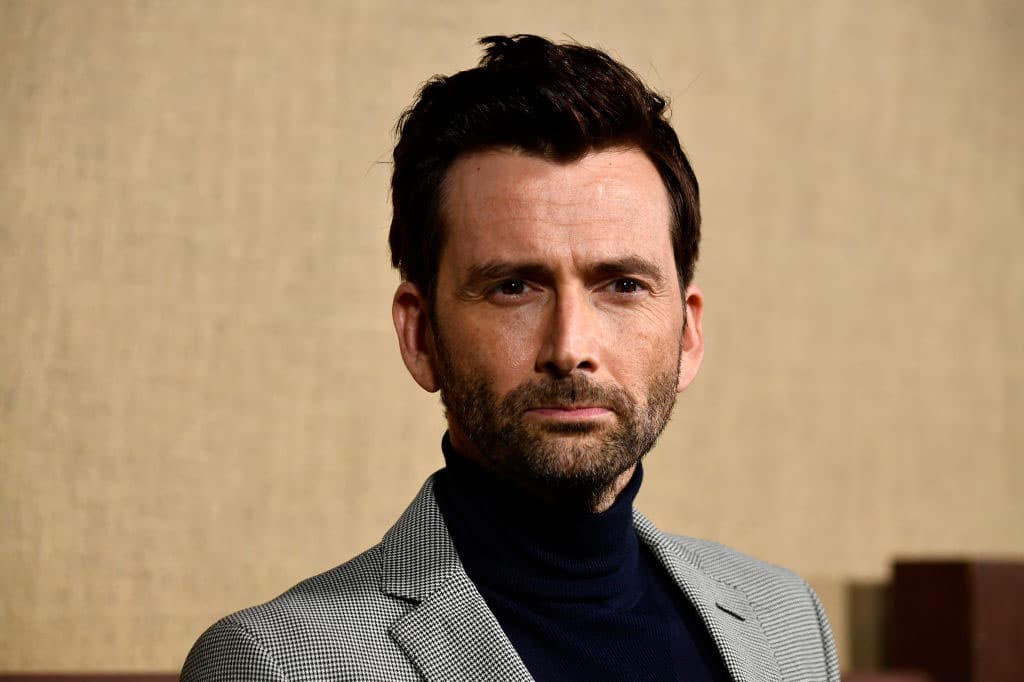
British actor David Tennant joked during an April 9 BBC comedy segment that Israel has ignored its Arab population when it comes to the COVID-19 vaccine distribution. The Jewish News reported that Tennant said that British residents could only travel to countries with a similar vaccination rate to Britain. He pointed to Israel, which has around 61% of its population vaccinated against the virus, while Britain has 46%.

“As you can see, Israel ha[s] populated 61 percent of their population, which is pretty much everyone there if you ignore the Arab population, which they do,” Tennant said. “So they’re done.”

Jewish groups condemned the remark.

“@nbcsnl lies again on @BBC – Outrage,” the Simon Wiesenthal Center tweeted, referencing the February joke from Saturday Night Live’s Michael Che, who said: “Israel is reporting that they’ve vaccinated half of their population. And I’m going to guess it’s the Jewish half.”

Michael Dickson, executive director of StandWithUs Israel, tweeted the joke “is not funny and not true. Israel’s healthcare system is equal to all and an exemplar of coexistence. This is just an antisemitic ‘blood libel’ being played for laughs.”


British journalist David Collier similarly tweeted that the joke was “racist” and that “Israel has given more vaccines to ‘Arabs’ than Iraq, Egypt, Syria and Lebanon COMBINED + as % of [population] more than ANY NATION in the world. Put that in your antisemitic pipe and smoke it.”


A spokesperson for the Israeli embassy in London told the Jewish News, “Israel offered vaccines to all of its citizens above the age of 16, regardless of their religion, ethnicity or social status. Arab citizens in Israel have been offered vaccines and special campaigns in Arabic have targeted these communities in order to prevent misinformation and address any concerns that they may have in order to increase uptake.”

The BBC has defended the joke as “satirical” in a statement to the Jewish News.

British Actor Jokes Israel “Ignores the Arab Population” With COVID-19 Vaccines Read More »

Unscrolled, Parashat Tazria-Metzora: A Pox Upon Your House

In many contemporary editions of the Torah, the name of the skin condition which concerns Parashat Tazria-Metzora is transliterated but not translated. The word, Tzara’at, is thus unfamiliar to the ears and stripped of associations. We cannot know for certain what it is.

Faced with this uncertainty, we have two choices. We can, as many physicians have, medicalize the text, attempting to apply a modern scientific framework to the Biblical description. Perhaps the most famous suggestion is leprosy, though there have been many others, including psoriasis, scabies, syphilis and ringworm.

We can also, as many sages have, spiritualize the text, understanding Tzara’at as a condition caused by sinful speech acts — hateful words or careless gossip. That it manifested on the skin was a sign of our spiritual sensitivity in those early days of our peoplehood. While today, like Dorian Gray, we have mostly succeeded in severing the connection between our bodies and souls, back then, our sins showed.

Even more mysterious is the Torah’s description of Tzara’at of the clothing, found in the warp and weft of fabric, and Tzara’at of structures, which afflicts the building blocks of one’s home.

As readers, we are again faced with a choice. We can concern ourselves with the question of what the Biblical author was seeing (perhaps mold or dry rot or fungus), thereby coming to understand that thing in our own conceptual language. Or we can concern ourselves with the question of how the Biblical author was seeing, thereby coming to see our own world through a new lens.

We can concern ourselves with the question of how  the Biblical author was seeing.

Were we to make this second choice, what would we see through our new lens? We would see a world in which the barrier that separates the spiritual from the physical is but a thin and semipermeable filigree — easily bent, torn and bumped into. We would see a world in which the body is a symptom of the soul, and a world in which health is considered the purview of the priest. We would see a world in which the borders of the body are more expansive than those we conceive for ourselves, stretching to encompass the garments we wear and the homes we dwell in — no longer regarded as inanimate matter but rather as living tissue, capable of health and susceptible to disease.

Whichever choice we make, however, will yield new questions, new answers and new insights, leaving us with a richer understanding of the Torah and of the world around us.

It may be of some interest to note that the rabbis of the Talmud didn’t believe that any house had ever actually become afflicted by Tzara’at. As written in the Tosefta: “There never was and never will be an afflicted house. So why were these laws written? So that you may study them and receive a reward” (Negaim 6:1).

There are a few other laws in the Torah that the sages suggest are purely theoretical, and the justification is always the same: They are there for us to study, to puzzle over, to interpret. They are there so that we may merit the reward, each generation anew, of being transported through our study of Torah to the strange and fertile grounds of our shared history and transformed by what we discover there.


Matthew Schultz is the author of the essay collection “What Came Before” (2020). He is a rabbinical student at Hebrew College in Newton, Massachusetts.

Unscrolled, Parashat Tazria-Metzora: A Pox Upon Your House Read More »

Lawfare Project Urges Zoom, UC Merced to Cancel Event Featuring Palestinian Terrorist

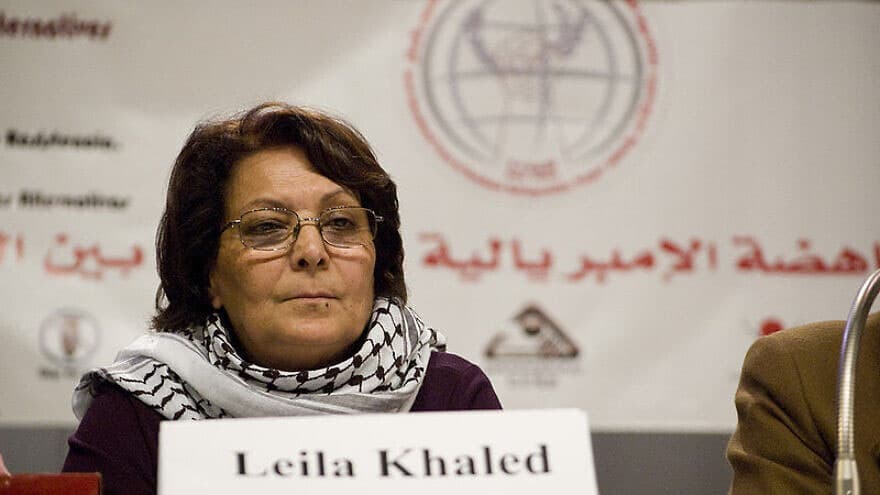
The Lawfare Project is urging Zoom and the University of California, Merced, to cancel an upcoming event featuring Palestinian terrorist Leila Khaled.

The event, titled “Free Speech and Palestine,” is scheduled to take place on April 23 at noon Pacific Time, and is being co-sponsored by San Francisco State University’s Arab and Muslim Ethnicities and Diasporas Studies (AMED), as well as the University of California Humanities Research Institute. It will be hosted by UC Merced’s Zoom account and moderated by UC Merced professor Sean Malloy.

The Lawfare Project has written letters to both Zoom and UC Merced ChancellorJuan Sánchez Muñoz informing them that the event could violate federal law by providing material support or resources to a foreign terrorist organization.

Khaled played a critical role in two airplane hijackings in 1969 and 1970 as a member of the U.S.-designated terrorist organization the Popular Front for the Liberation of Palestine. The Israeli Shin Bet considers her part of the Jordanian command of the PFLP.

Last September, Zoom canceled an event also featuring Khaled hosted by the San Francisco State University’s AMED after the Lawfare Project informed the company that permitting Khaled to use its platform wouldviolate federal law. Additionally, some 90 Jewish and pro-Israel groups also urged SFSU president Lynn Mahoney to cancel the event, who repeatedly defended the event by invoking freedom of expression.

According to an Eventbrite page advertising the April 23 discussion, the event will” explore a set of questions that center Palestine at the heart of discussion on free speech and academic freedom.” It particular, the event appears to explore why the original September 2020 discussion was shutdown and seeks to explore questions “around censorship, free speech, and the role of corporations like Zoom on university campuses, how can we center the voices of Palestinians and of oppressed peoples?”

As of publication, registration for the Zoom event remains live.

“San Francisco State University is once again sponsoring a webinar featuring notorious plane hijacker and PFLP terrorist Leila Khaled, this time in partnership with UC Merced,” Brooke Goldstein, executive director of the Lawfare Project, told JNS.

“Just as we did with SFSU’s previous attempt to host Khaled, The Lawfare Project has notified Zoom and trusts them to continue to comply with the law and their own Terms of Service by refusing to provide material support—here, in the form of its video conferencing service—to a member of a designated Foreign Terrorist Organization, as is prohibited by 18 U.S.C. § 2339B.”

Lawfare Project Urges Zoom, UC Merced to Cancel Event Featuring Palestinian Terrorist Read More »