fbpx

February 11, 2021

Train

By morning the children’s clothes
had dried on the barbed wire
and were packed with toys for the train.
The drunks felt themselves sober
and the hasty lust from last
night evaporated,
but the children were clean
and their skin scrubbed with love.
Prayers were left for the childless
and the alone, while hot water
and the habits of home were the worship
of parents going with their children,
taking them to leave them, leading
them to the ends of memory.

Tim Miller‘s poetry and essays have appeared in Parabola, The Wisdom Daily, Jewish Literary Journal, Crannog, Southword, Londongrip, Poethead, and others across the US and UK. Two recent books include Bone Antler Stone (poetry, The High Window Press) and the long narrative poem To the House of the Sun (S4N Books). 

Train Read More »

A Bisl Torah — Let Love In

In the secular world, this weekend brings in a holiday known for love. Cards exchanged, chocolates consumed, cheesy movies watched. It’s a time in which we show affection for those we care about. But if we are being honest, it is also a time in which we hope to feel honored, valued, and seen. How much of these Hallmark holidays is wondering if a card will end up in our own mailbox?

And this is where I think our tradition reminds us of the import of self-love. Self-love is different than being egotistical or narcissistic. Self-love is looking at oneself and offering the affirmation, “I believe in myself. I am more than enough. I was created to bring my unique essence into this world.” Vayikra teaches, “Love your fellow as yourself.” But what happens if we have little self-confidence? How beleaguered our world becomes when we minimize our self-worth. Love someone else the way I love myself? Great love can be gifted to many when we understand the importance in finding ways to love our singular soul.

Give yourself a little self-love. Taking a few moments to list what you admire about yourself. Looking in the mirror and determining how you inspire another person to grow. Understanding that your presence in this world adds beauty, fulfillment, comfort, and light. You were created with purpose and reason. If you learn how to respect yourself, there are much greater odds that you will learn how to respect another human being.

Don’t be afraid to show a little self-love. The rest of the world will thank you.

Shabbat Shalom


Rabbi Nicole Guzik is a rabbi at Sinai Temple. She can be reached at her Facebook page at Rabbi Nicole Guzik.

A Bisl Torah — Let Love In Read More »

A Moment in Time: Retracing Your Steps

Dear all,

On a recent walk (yes, we are taking frequent walks during the pandemic!) we arrived at the park 2 miles away minus one of Eli’s shoe! Frustrated, we turned around and retraced our steps. My hopes that the shoe was nearby were erased with each step back toward home.

We finally spotted the shoe at the top of the highest hill along the way (which was within arm’s reach of home). Go figure!

But I was not discouraged. As annoying as it was, with each step came opportunity to reflect. And I asked many questions along the way regarding looking back at my life:

1) What am I most proud of?
2) Who were the people who inspired me?
3) Why did I chose my career path?
4) When did I last call a family member?
5) Where am I now?

Judaism teaches that we should be in a state of internal review each day.

And so … Retracing our steps is not only about finding something we lost. It’s also about creating a moment in time to find ourselves.

With love and shalom,

Rabbi Zach Shapiro

A Moment in Time: Retracing Your Steps Read More »

Will a Palestinian Election Matter?

This once would have been the sort of gesture that would have inspired hope for peace in the Middle East, as well as gestures of support and friendship from the U.S. government. But no longer. Instead of being encouraged to prioritize a reboot of the moribund peace process, the setting of dates for the first Palestinian elections in 15 years has been met with silence from the Biden administration.

That has to be something of a disappointment to the leadership of the Palestinian Authority, which has labored long and hard in negotiations with its Hamas rivals to produce an agreement for a legislative election in May and a presidential vote in July. The document that representatives of P.A. leader Mahmoud Abbas’s Fatah Party and Hamas, say both sides will “respect and accept” the results of the vote.

The intended audience for this latest attempt at Palestinian reconciliation was President Joe Biden and his foreign-policy team. But while establishment types who believe fervently in empowering the Palestinians have retaken control of the U.S. State Department and the National Security Council, Biden’s crew is less than enthused about the value of what the Palestinians are doing.

Part of that has to do with the almost-universal skepticism that elections will actually be held. After all, Fatah and Hamas have talked about this many times before in the last decade with the effort always ending in no elections, and the two sides eyeing each other with suspicion and hate.

However, believing that it is vital that they win over Biden after enduring four years of a Trump administration that correctly regarded Abbas and Fatah as being as uninterested in peace as the Islamists of Hamas, maybe this time they mean it. Or at least, they are prepared to go through with something that will look like an election, even if the odds of it being free or fair remain slim.

The Biden team doesn’t want to be rushed into involvement in another round of pointless negotiations involving the Palestinians. Biden’s foreign-policy priority in the region is another bout of appeasement of Iran.

But there’s more to the general lack of enthusiasm for Palestinian democracy than just skepticism about whether Fatah and Hamas are dissembling. The real question is whether going through the motions of an election in a political culture that values violence more than good governance is meaningless.

The real question is whether going through the motions of an election in a political culture that values violence more than good governance is meaningless.

Many Americans once held high hopes for the idea of spreading democracy across the Middle East. Part of the reasoning behind the decision to go to war in Iraq in 2003 was the hope that deposing the brutal regime of Saddam Hussein could lead to something better than just another military dictator or authoritarian.

That proved to be a tragic mistake. The idea that you could parachute into a country where the rule of law had not previously existed—or had any experience of representative government—and produce anything remotely resembling democracy led to a nightmare for both the United States and the Iraqi people.

Some of the same reasoning inspired the administration of former President George W. Bush to be an enthusiastic backer of Palestinian democracy. Bush had rightly cut off PLO chief Yasser Arafat as an unrepentant terrorist and foe of peace. But after his death, he bought into the absurd notion that Abbas—Arafat’s longtime aide who wore a suit rather than theatrical combat fatigues—could lead the Palestinians to peace and freedom.

This was a product of a belief that the only formula for peace between Israel and the Palestinians had to include an embrace of democracy by the latter. Regimes run by authoritarians are inherently unstable and survive only so long as the leader has the firepower to hold onto power. Democracies are, at least in theory, much better peace partners because their governments are held accountable by the people.

It’s hard not to wince when remembering the powerful influence that Natan Sharansky and Ron Dermer’s book, The Case for Democracy: The Power of Freedom to Overcome Tyranny and Terror, exerted in the Bush White House. The former prisoner of Zion was the perfect inspirational advocate for the cause. Co-author Dermer went on to become a powerful player in the Netanyahu government and then serve as Israeli ambassador to Washington for seven years, was also an articulate exponent for their thesis. They believed that the triumph of Western ideals of liberty in an Arab world where they had no historic roots and little appeal was a necessary prerequisite for peace. That persuaded many that faith in democracy was practical politics as well as an expression of idealism.

But the results of the Palestinian elections in 2005 (the presidency was won by Abbas) and 2006 (in which Hamas won control of the legislative assembly), as well as the subsequent Arab Spring attempts to bring democracy to the region, debunked this seemingly attractive and logical theory.

As it turns out, the very undemocratic governments of Egypt and Saudi Arabia, as well as the Gulf States that have, via the Abraham Accords, normalized relations with Israel, are, at least for the foreseeable future, very good peace partners for Israel. By contrast, the democratically elected Muslim Brotherhood government of Egypt elected in 2011 was a nightmare both for the Egyptians and Israel. The same is true for Abbas and his Hamas rivals after they won elections.

A look at the current state of Palestinian opinion only reinforces this lesson.

The latest survey from the Palestinian Center for Policy and Survey Research, whose polls are generally considered about as trustworthy as any in the Arab world, has some grim truths for those who still hold onto hope that democracy is the answer to the problem.

According to the poll, Hamas leader Ismail Haniyeh would beat Abbas 50 percent to 43 percent in a presidential election. The wild card in Palestinian politics is if Marwan Barghouti—a Fatah terrorist operative currently serving several life-in-prison sentences in an Israeli jail for ordering murders of Israeli civilians—decides to run. A Barghouti party running independently of Fatah would get 25 percent of the vote, and he would beat any Hamas candidate handily if he faced off against them in the presidential contest.

Given that approximately half of the Palestinian electorate still believes that the right policy for their leaders is armed conflict against Israel, the popularity of Hamas and a killer-like Barghouti, especially when lined up against the corruption of Abbas, is hardly surprising. A clear majority rejects the idea that the preferred way out of the conflict is a peace agreement.

Elections in the absence of a democratic political culture are meaningless. As in Egypt and elsewhere in the Palestinian world, there is no liberal democratic alternative to parties that reject peace. Salam Fayyad, the American-educated one-time Palestinian prime minister, was once held out as the future of his people. But he had virtually no support and has faded from view.

Biden may someday wish to circle back and take another crack at the peace process, but he knows that if Hamas wins the election, that will doom any wishful thinking he may have on the subject. The main takeaway from the idea of Palestinian elections is that as long as Palestinians remain mired in a political culture that prizes the shedding of Jewish blood over good government, democracy will actually make peace even less likely. The Palestinians need to fix that before anyone should think that elections will solve anything for them, let alone advance the cause of peace.


Jonathan S. Tobin is editor in chief of JNS—Jewish News Syndicate. Follow him on Twitter at: @jonathans_tobin.

Will a Palestinian Election Matter? Read More »

Gershom Gorenberg

Gershom Gorenberg: War of Shadows

Gershom Gorenberg is an American-born Israeli journalist, and blogger, specializing in Middle Eastern politics and the interaction of religion and politics. He is currently a senior correspondent for The American Prospect, a monthly American political magazine.

Follow Shmuel Rosner on Twitter.

Gershom Gorenberg: War of Shadows Read More »

Can I Have My Cow Back? — A poem for Torah Portion Mishpatim

After Exodus 22:4-26

Some of our best laws are here –

If a fire goes forth and finds thorns…

…then congratulate the fire for
living above its expectations and
finding what it needs.

If a man gives his neighbor a donkey
for safekeeping…

I’ve been dreaming of receiving
donkeys with all the trust implied.
I’ve been imagining a safe donkey-shelter
in my backyard for years.

If a person borrows an animal
from his neighbor…

It’s way above the cup of sugar
level to borrow a cow from
Nancy down the street.

You shall not allow a sorceress to live.

All I’ve been doing, for decades,
is allowing sorceresses to live.
If You must, take me now, Oh God
for this transgression. I just really like
the way they can make things disappear.

Whoever lies with an animal
shall surely be put to death.

Or at least don’t take video of it.
You know that’s going to get out
and if this is why you were borrowing
an animal to begin with, it’s a real problem.

If you take your neighbor’s garment as security…

…then you are known as Linus
and you are a cherished member
of our shared cultural heritage.
Just, please, return it, along with the
sheep you’ve been borrowing.

There are laws about sharing
coming along. I promise I won’t
leave you out in the cold.


God Wrestler: a poem for every Torah Portion by Rick LupertLos Angeles poet Rick Lupert created the Poetry Super Highway (an online publication and resource for poets), and hosted the Cobalt Cafe weekly poetry reading for almost 21 years. He’s authored 25 collections of poetry, including “God Wrestler: A Poem for Every Torah Portion“, “I’m a Jew, Are You” (Jewish themed poems) and “Feeding Holy Cats” (Poetry written while a staff member on the first Birthright Israel trip), and most recently “The Tokyo-Van Nuys Express” (Poems written in Japan – Ain’t Got No Press, August 2020) and edited the anthologies “Ekphrastia Gone Wild”, “A Poet’s Haggadah”, and “The Night Goes on All Night.” He writes the daily web comic “Cat and Banana” with fellow Los Angeles poet Brendan Constantine. He’s widely published and reads his poetry wherever they let him.

Can I Have My Cow Back? — A poem for Torah Portion Mishpatim Read More »

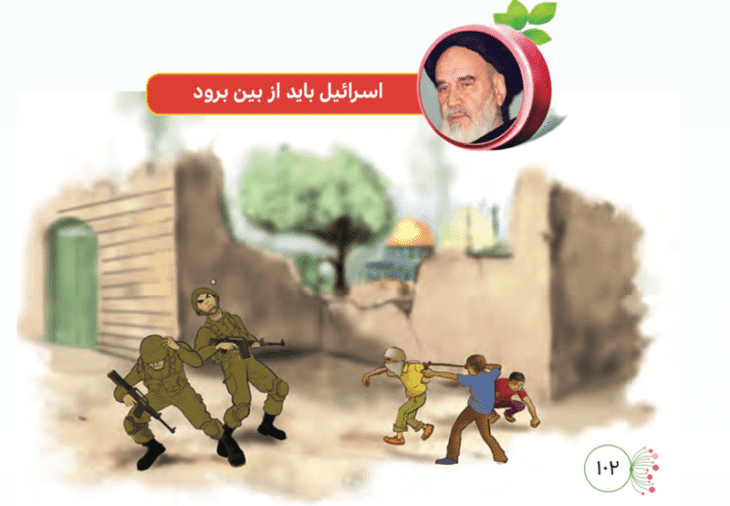
ADL Report Reveals Iranian Textbooks Are Seething with Anti-Semitism and Incitement

On the forty-second anniversary of the Iranian revolution, the New York-based Anti-Defamation League (ADL) released a comprehensive study exposing how Iranian textbooks teach blatant anti-Semitism and incitement to violence against the United States, Israel and the Jewish people.

The study, titled “Incitement: Antisemitism and Violence in Iran’s Current State Textbooks,” reveals that recent state-sponsored Iranian curriculum even accuses Western media and Saudi Arabia of overhyping the COVID-19 pandemic in Iran to derail its celebration of the 1979 Islamic Revolution last year (the annual celebrations are held on February 11). Recent school books also glorify Qassem Soleimani, the Iranian Revolutionary Guard Corps (IRGC) leader killed by a targeted American airstrike in Iraq in January 2020.

“Iran’s textbooks show how deeply ingrained this official campaign of incitement is within society, and how they are reaching impressionable young people with these xenophobic and dehumanizing messages as part of the formal teaching curriculum,” ADL CEO Jonathan Greenblatt said in a statement.

The study revealed how Iranian school books refer to Israel as a fake country that merits elimination. Students across the country are forced to chant “Death to Israel” (and “Death to America”) daily and are taught that Jews have historically been enemies of Islam, forging Islamic texts and even resorting to Freemasonry to undermine Muslims. The books also teach that American-led sanctions against Iran encompass a “satanic plan” to destroy the Muslim faith. The textbooks describe Iranian nuclear scientists, many of whom have been assassinated by foreign agents in recent years (neither Israel nor the United States has claimed responsibility), as having “achieved a blessing with [your] great jihad and the blood of [your] bounteous youths.”

An eighth grade social studies book titled “Civics, History, Geography” states, “The only way on the path of confrontation with Israel until it is completely eradicated is to unite the Muslims, continue the resistance, and strengthen the courageous protests and popular struggle of this country (intifada).” (Courtesy Anti-Defamation League)

In a statement, ADL’s Washington Director for International Affairs David Weinberg, who authored the report, referred to such hateful teaching as “educational anti-Semitism” and added that “The Government of Iran frequently claims publicly that its animus is directed solely at the State of Israel, not the Jewish people, but that is flatly contradicted by its own educational content.”

Iran, which the State Department has labeled the world’s leading state sponsor of terrorism, continues to host Holocaust cartoon contests that give a platform to anti-Semites from around the world to deny or mock the Holocaust.

“This kind of incitement is a long-running practice by the Iranian government for decades,” Weinberg told the Journal. “It’s not necessarily surprising to find hate and incitement in these books; it’s still important to document and expose them and to inform both the public as well as government officials.”

“This kind of incitement is a long-running practice by the Iranian government for decades.”

Weinberg said he gained easy access to the textbooks online through Iran’s Ministry of Education. “For many other Middle Eastern governments, the books are only accessed through third-party sites. But Iranian leaders uploaded the books themselves. They’re shameless.”

Since the 1979 Islamic Revolution, the regime has made no secret of its hateful animosity toward the United States (“The Big Satan”) and Israel (“The Little Satan”). Such vitriol has only increased in the last two decades, as social media has enabled Iranian leaders to reach millions of people worldwide.

On Twitter, Iran’s Supreme Leader Ali Khamenei regularly refers to Israel as “cancerous” and demands “the elimination of the Zionist regime.” In January, the ADL wrote to Twitter CEO Jack Dorsey and urged him to remove all of Khamenei’s Twitter accounts, citing repeated violation of the social media platform’s policies against incitement to bigotry and racism. (Twitter suspended former President Donald Trump’s account in January but has refused to take the same measure with Khamenei.) In January, Twitter removed one of Khamenei’s tweets, in which he accused the West of trying to “contaminate” other nations with the COVID-19 vaccine.

Image accompanying a ninth-grade lesson titled “Cultural Attack,” from the current Iranian textbook, Heaven’s Message: Islamic Education and Training” (Courtesy Anti-Defamation League)

The ADL report states that “Iran’s state curriculum for the academic year 2020-21 strenuously militarizes young people, indoctrinating them for war.” One example of child militarization includes courses titled “Defense Preparation.” Textbooks claim that ISIS is a “fabrication” of the United States, Israel and various Arab “puppets.” Members of the Baha’i faith — a persecuted religious minority in Iran — are depicted as filthy, as are followers of Wahhabism, the main form of Islam practiced in Saudi Arabia. Some textbooks issue a call to overthrow the Arab gulf state of Bahrain, which recently established diplomatic and economic ties with Israel.

In contrast to Iran, Saudi Arabia, which has been criticized in the past for its overly anti-Semitic textbooks (which also taught female subjugation to men and hostility to religions other than Islam) recently began scrubbing such dubious content. This fall, Saudi school books were conspicuously devoid of teaching capital punishment against homosexuality and praising martyrdom as the highest goal in Islam. Calls to “fight Jews” are also fewer in Saudi classrooms (though still intact), with one tenth grade textbook having removed a quote by the prophet Muhammad: “The [Day of Judgment] will not come until Muslims fight the Jews, and the Muslims will kill them [all].”

As the Biden administration prepares to confront the various challenges related to Iran — including the country’s dangerous pursuit of a nuclear weapons program and its violent hegemonic aspirations in the Middle East and the Persian Gulf — studies like the ADL’s offer a comprehensive analysis that can better inform effective American policy toward Iran.

According to Weinberg, the report will be shared with Congress as well as the executive branch. It has also been shared with national governments across multiple continents, including Arab, European and Latin American countries.

“The issue of anti-Semitism in Middle Eastern textbooks goes beyond Iran,” Weinberg said, “but obviously, Iran is arguably the most severe case.”


Tabby Refael (on Twitter @RefaelTabby) is a Los Angeles based writer, speaker and activist.

ADL Report Reveals Iranian Textbooks Are Seething with Anti-Semitism and Incitement Read More »

Relationship Between Haredim, Non-Haredi Israeli Jews at Breaking Point

The relationship between Israel’s Haredi (ultra-Orthodox) population and the rest of the country’s Jewish citizens is at a breaking point as a result of the coronavirus.

“There hasn’t been anything like this in the last 50 years or so, maybe even more,” Professor Benjamin Brown of the Hebrew University of Jerusalem and the Israel Democracy Institute, an expert in Orthodox and Haredi Judaism, told The Media Line.

Dr. Dan Ben-David, head of the Shoresh Institution for Socioeconomic Research and an economist at Tel Aviv University, agrees.

“I don’t think we’ve ever been at such an impasse before as we are today,” he told The Media Line.

Many of Israel’s ultra-Orthodox leaders and their followers have flouted the Health Ministry’s coronavirus restrictions, including lockdown orders, as Israel faces the largest health crisis and one of the worst economic situations in its history.

Just last week, thousands of Haredim attended the funeral of one of their leaders, Rabbi Meshulam Dovid Soloveitchik.

“The majority are good people, but their leadership is leading them down the drain,” Ben-David said.

On January 8, as Israel entered into a stricter phase of the third lockdown and closed schools, some yeshivas and other Haredi-run institutions for children refused to shutter, with authorities hesitating to enforce the rules.

“Their cynicism is unparalleled to a certain extent. They regularly insist on preventing their children from receiving a core-curriculum education [basic secular studies], not just during the corona pandemic, but part of the problem is they want to basically be able to brainwash their children so that whatever they say goes and whatever comes from the outside doesn’t go,” Ben-David said.

“They don’t teach them science so they don’t understand how viruses work,” he added. “They don’t understand math so they don’t understand what an exponential function is. When you double or triple each time the number of people each person infects, then that is causing a lot of them to die and a lot of them to be sick, and along with them the rest of us.”

“They’re bringing down an entire health care system and an economy by just simply craftily violating all the rules and regulations,” Ben-David continued.

These behaviors have only exacerbated tensions in their existing relationship with other Israeli Jews, who have long felt that Haredim give to Israeli society a lot less than they take.

While roughly three-quarters of Haredi women work outside the home, the men mostly study in yeshivot. With an average of a little over seven children per family, many still cannot make ends meet and are dependent on Israel’s welfare system. In addition, full-time religious study provides most Haredi men with an exemption from the military service that is mandatory for other Jewish Israelis.

“People feel … they enjoy the fruits of the Israeli worker and they also disturb public health … They simply don’t give a damn about what the government says and they do it in a mocking and scornful way and it really irritates non-Haredim,” Brown said.

“It’s [expletive] ridiculous. Maybe if the police had actually enforced the rules in these religious neighborhoods, we wouldn’t be in our third lockdown,” Ari Klein, a secular Jerusalemite, told The Media Line. “They don’t follow any of the health protocols. Stores in their neighborhoods have great deals on baby stuff but I won’t go because it’s not worth the risk.”

Haredi mother of eight Miriam, who declined to give her last name, has also experienced this friction. A secretary in a Jerusalem area office, she feels that she is on the receiving end of the anger of the broader Jewish population.

“I was so mad because I wear a mask. My family follows the rules. Everyone I know does the same,” Miriam added.

Brown believes that tensions between the Haredim and everyone else will simmer down once the pandemic is over.

“People will direct their energies much more to regaining their work and … their normal life rather than fight[ing] about how you behaved in the past,” he said.

However, Ben-David says it will take political change for ties between the two groups to improve.

“If leaders will put the entire country before personal and sectoral interest, then I think they have the ability to calm things down and get us on a sustainable path,” he said. “It has begun to dawn on people that we have basically an insurrection here of individuals who refuse to obey Israeli law, from what we mandate in the schools to health care and all down the line, everything that we do.”

“If things are already difficult when the Haredim are only 7 or 8% of the adults, what’s going to happen when their kids, who already are a fifth of the children in Israel, grow up?” Ben-David asked. “Who’s going to be able to pass laws and do anything in the Knesset then, let alone in two generations when, according to the Central Bureau of Statistics, they will be half of the children in Israel?” he said.

Ben-David says the tensions between the Haredim and the rest of Israel have only brought attention to deeper systemic problems that Israel as a whole faces, including a “dysfunctional” health care system and an education system that is ranked among the worst in the developed world.

“It’s not just the Haredim that are getting a crummy education,” he said.

“We need serious leaders at a serious time to take serious control of this country and put us back on a path that is sustainable and one that has a future,” Ben-David added. “Israel has a history of, when our back is to the wall to get our act together. Our back is pretty much to the wall now.”

“We’ve seen the future and we don’t like it. It’s time to do something about it while we still can,” he said.

Here are the latest COVID-19 numbers for the Middle East and North Africa as of 2 pm Greenwich Mean Time (UTC±0) on Thursday.

Country Confirmed Cases Deaths Recovered Active Cases
Afghanistan 55,445 2,424 48,279 4,742
Algeria 109,782 2,926 75,243 31,613
Bahrain 109,604 391 102,725 6,488
Cyprus 32,072 217 2,057 29,798
Djibouti 5,962 63 5,854 45
Egypt 171,390 9,804 133,331 28,255
Iran 1,496,455 58,751 1,278,857 158,847
Iraq 636,908 13,144 603,814 19,950
Israel 712,078 5,266 639,016 67,796
Jordan 340,177 4,411 323,206 12,560
Kuwait 173,983 980 163,264 9,739
Lebanon 328,023 3,803 217,578 106,642
Libya 126,361 2,009 108,434 15,918
Mauritania 16,902 427 16,121 354
Morocco 476,689 8,436 456,751 11,502
Oman 136,622 1,539 128,461 6,622
Pakistan 559,093 12,185 516,683 30,225
Palestinian Territories 165,535 1,910 154,727 8,898
Qatar 155,901 254 147,727 7,920
Saudi Arabia 371,720 6,420 362,642 2,658
Somalia 4,935 139 3,720 1,076
Sudan 27,820 1,849 22,208 3,763
Syria 14,668 965 8,366 5,337
Tunisia 219,650 7,378 180,381 31,891
Turkey 2,556,837 27,093 2,445,285 84,459
United Arab Emirates 339,667 974 319,787 18,906
Yemen 2,133 616 1,428 89
Total 9,346,412 174,374 8,465,945 706,093


Steven Ganot contributed to this report.

Relationship Between Haredim, Non-Haredi Israeli Jews at Breaking Point Read More »

“Mandalorian” Star Dropped for Her Holocaust Comparison Post

Lucasfilm announced on February 10 that they will be parting ways with actress Gina Carano after she had shared a post making a comparison to the Holocaust.

According to Deadline, Carano shared a TikTok post in her Instagram story, stating, “Jews were beaten in the streets, not by Nazi soldiers but by their neighbors…even by children. Because history is edited, most people today don’t realize that to get to the point where Nazi soldiers could easily round up thousands of Jews, the government first made their own neighbors hate them simply for being Jews. How is that any different from hating someone for their political views.”

A spokesperson for Lucasfilm announced in a statement, “Gina Carano is not currently employed by Lucasfilm, and there are no plans for her to be in the future. Nevertheless, her social media posts denigrating people based on their cultural and religious identities are abhorrent and unacceptable.”

United Talent Agency also announced that they would no longer be representing the actress.

The Stop Antisemitism.org tweeted that Carano’s social media post was wrong and that “Disney is using her to set an example for people to stop using Jews as tokens to prove their political points.” In subsequent tweets, they argued that it was hypocritical for Disney to fire her but not Pedro Pascal, the star of “The Mandalorian,” as Pascal compared the treatment of migrant children at the border in 2019 to a Nazi concentration camp. Stop Antisemitism also noted that the photo Pascal used was actually a 2010 photo of Palestinian children at a soup kitchen.


Former New York Democratic Assemblyman Dov Hikind, who also heads the Americans Against Anti-Semitism watchdog, also tweeted, “Holocaust/Nazi comparisons are almost always ignorant trivializations regardless of political affiliation! NO ONE should lose their job for doing so!!! If it’s [a] fireable offense, FIRE ALL, not selectively!”


The Forward’s culture reporter PJ Grisar, on the other hand, argued that “The Mandalorian” — the popular Star Wars show on Disney Plus — is centered around survivors of genocide that weren’t political in nature, showing the flimsiness of Carano’s comparison.

“The Nazis turning people against their Jewish neighbors is well-documented and has been acknowledged by every serious historian on the Holocaust,” Grisar wrote. “The Nazis rounded up WAY more than ‘thousands of Jews’ (one wonders what Carano’s been reading and how it’s been ‘edited’; if we’re being generous, she could have just meant in Germany). Being Jewish is in no way equivalent to one’s chosen political ideology, particularly when that ideology — as in Carano’s case — spreads lies about the 2020 election, belittles mask mandates, approves of anti-Black Lives Matter posts and is just generally hateful.”

It is not yet known who will replace Carano on “The Mandalorian.”

“Mandalorian” Star Dropped for Her Holocaust Comparison Post Read More »

Meltdown at The New York Times Over N-Word

When the top editor of the world’s newspaper of record flips and flops and flips again on a subject as sensitive as use of the N-word, you know things are getting messy at The New York Times. And when a Pulitzer prize-winning columnist claims that the paper “spiked” his column on the subject, well, it just gets messier.

This sad story started when longtime New York Times science reporter Donald McNeil was accused in 2019 of using a racial slur while on an overseas trip chaperoning high-school students. At the time, the paper reprimanded but chose not to fire him because there was no malicious intent: McNeil allegedly was referring to the N-word as part of a debate, not using it as a slur. So editor-in-chief Dean Baquet gave him a “second chance.”

But when the story resurfaced last week in The Daily Beast, an internal firestorm erupted at the Times, with 150 outraged employees writing a joint letter to management saying that “intent is irrelevant” and demanding an apology and further investigation.

After McNeil apologized and then was forced to resign, Baquet changed his tune on intent and declared: “We do not tolerate racist language regardless of intent.”

This triggered yet another firestorm for the simple reason that it’s hard to justify the notion that “intent” shouldn’t matter. Liberal columnist Jonathan Chait explained that distinction in New York Magazine in a piece titled, “Describing a Slur is Not the Same as Using it.”

That is so self-evident that Baquet himself flip-flopped yet again this morning by acknowledging in a staff meeting: “Of course intent matters when we’re talking about language in journalism. Intent matters.”

Maybe he was influenced by the cancelled Bret Stephens column, which, according to reports, began as follows:

“Every serious moral philosophy, every decent legal system, and every ethical organization cares deeply about intention. It is the difference between murder and manslaughter. It is an aggravating or extenuating factor in judicial settings. It is a cardinal consideration in pardons (or at least it was until Donald Trump got in on the act). It’s an elementary aspect of parenting, friendship, courtship and marriage.”

The columnist added: “A hallmark of injustice is indifference to intention.”

What I find especially noteworthy about this brouhaha is how tedious it is. Does a Pulitzer prize winner really need to invest a whole column on an idea as obvious as the value of intent?

But this is The New York Times, so it’s hard to look away. The drama of a top editor who gets an obvious thing right the first time, but then panics when bullied by a mob, and then panics again and redresses himself, is endemic of how low and fearful our discourse has become.

In a cancel culture run amok, one of the biggest fears in America today is the fear of saying the wrong thing. I can understand that impulse if the “wrong thing” is insulting someone because of their race, religion, gender, ethnicity or otherwise. I’d love to live in a world where people are extra careful before unleashing such insults, even as I appreciate that the insults are generally protected by the laws of free speech.

In a cancel culture run amok, one of the biggest fears in America today is the fear of saying the wrong thing.

But when we become afraid to even mention a word to describe something, when we’re petrified that the cancel mob will come after us and our livelihood, I’d say we’re due for a sober reckoning, or at least some candid analysis.

As Columbia linguistics professor and author John McWhorter wrote on Substack, “My own observation of this sort of thing… is that the people hunting down McNeil are swelling with a certain pride in claiming that ‘We decide what we will tolerate,’ as if this constitutes what black nationalists would term ‘self-determination.’ But the issue is whether what is being determined for the self is good for the self in question.”

McWhorter, who is Black and has written often on these issues, adds that “it is only a certain mob who are making this ‘determination’ [and that] the idea that it is inherent to black American culture to fly to pieces at hearing the N-word used in reference is implausible at best, and slanderous at worst.”

The more important point, he writes, is that “insisting on this taboo makes it look like black people are numb to the difference between usage and reference, vague on the notion of meta, given to overgeneralization rather than to making distinctions.”

It would be useful to see more reporting and courageous commentary on this subject. New taboos that are silencing people through fear of losing their jobs is not just a “problem” — it is an alarming trend and condition that must be exposed through maximum sunlight.

And speaking of exposure, I would hope the Times will flip-flop yet again and decide to publish Stephens’s column. Even a meltdown can use some sunlight.

Meltdown at The New York Times Over N-Word Read More »