fbpx

September 11, 2019

Trump and Democrats Have Stake in ‘Bibi Primary’

Long before the Iowa and New Hampshire voters go to the polls next year, the first primary of the 2020 presidential campaign is already upon us.

Call it the Bibi primary.

Given the internal divisions within their party over Israel and the Middle East, most of the Democratic primary candidates have decided that the best way to straddle the divide between traditional pro-Israel Democrats and the party’s newer wave of more confrontational anti-Zionists is to soft-pedal more substantive questions on settlements, Gaza and other security matters and to escalate the vitriol in their personal rhetoric against Israeli Prime Minister Benjamin Netanyahu himself. Almost all of them go to great lengths to explain that their dissatisfaction with Netanyahu does not necessarily make them opponents of Israel, and that they would be eager to work with a more reasonable Israeli leader.

All of which is just fine unless Bibi is no longer Israel’s prime minister. If Netanyahu does not remain in power after the upcoming election, he is almost certain to be replaced by a like-minded successor on many of the issues that agitate Democratic activists. “Bibi-ism without Bibi” would leave the current policy disagreements between American liberals and Israeli conservatives firmly in place.

There might be a short-term window in which the Democratic candidates praise the new prime minister and express hope for what they consider a more productive working relationship. But the strong similarities between Netanyahu’s agenda and that of his successor will quickly close that window of goodwill, which will make it much harder for the candidates to continue to pacify their party’s base by demonizing yet another Israeli leader without either shifting leftward on substantive matters or risking the wrath of angry primary voters. Before too long, they will realize that the best political outcome for them would have been for Bibi remain in office so they can continue to vilify him personally while still proclaiming their support for a more accommodating — but hypothetical — alternative.

If Netanyahu does not remain in power, he is almost certain to be replaced by a like-minded successor.

On the other side of the aisle, it looks as though President Donald Trump is beginning to hedge his bets.

As recently as late August, there was fevered speculation in both countries about what type of last-minute surprise Trump would unveil to help his friend secure re-election. Perhaps Trump would endorse annexation of the West Bank, participate in a three-way security summit with Netanyahu and Russian President Vladimir Putin, or even return Israeli spy Jonathan Pollard to Israel.  But in stark contrast to his high-profile moves before the April vote designed to shore up Netanyahu’s support, Trump has been much more circumspect heading into the new elections.

The most notable interaction between Netanyahu and Trump recently has been the absence of interaction. It was widely reported that the Israeli prime minister was not even able to get Trump on the phone to try to convince him not to pursue a meeting with Iranian President Hassan Rouhani at the upcoming United Nations General Assembly meeting. After Trump’s rebuff, Netanyahu appears to be resigned to have wistfully conceded that such a meeting would not be as bad as all that.

So Trump could still attempt to put his thumb — if not his fist — on the scale for Netanyahu. He could announce an enhanced security agreement or even an 11th-hour visit to Israel. But he seems less likely to invest as much of his own political capital in his old friend. Maybe he feels like he’s already done all he can to incrementally increase his own Jewish support and that other issues will be as valuable for motivating his religious conservative base. Or maybe Trump thinks he’s already won the Bibi primary — and that there’s nothing else in it for him to stand with his embattled ally.


Dan Schnur is a professor at the USC Annenberg School for Communication and Journalism, UC Berkeley’s Institute of Governmental Studies and Pepperdine University. 

Trump and Democrats Have Stake in ‘Bibi Primary’ Read More »
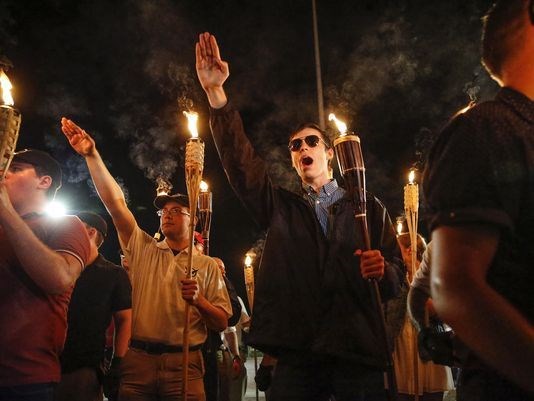
Hollywood’s Nazi Obsession Makes it Harder to Fight Them Offscreen

What do Oscar-bait dramas, B-horror films, superhero flicks and quirky comedies have in common?

Nazis.

Heroes face off against mutant Nazis in the Marvel Universe. One of the superhero saga’s directors, Taika Waititi, is playing Adolf Hitler in his upcoming satire “Jojo Rabbit.” Between “Ida,” “The Pianist,” “Schindler’s List,” “Sophie’s Choice,” “The Reader,” “Inglourious Basterds” and “The Imitation Game,” an ever-widening range of films with Third Reich antagonists have swept up Academy Awards. 

Nazis are “the unquestioned consensus villains of the 20th century” according to Thomas Doherty, professor of American Studies at Brandeis University. Doherty is a cultural historian and the film review editor for the Journal of American History who authored “Hollywood and Hitler.”

As the number of living Holocaust survivors dwindle, it seems that Hollywood’s infatuation with Nazi adversaries will outlive the people who faced them in real life.

Filmmakers have deemed Hitler’s regime the perfect antagonist, given the lack of gray area surrounding their cruelty. However, the saturation of Nazism in our cinematic culture encourages the overuse of the rhetorics of our culture. 

Nazi foils are particularly handy in establishing the moral righteousness of protagonists in film and television, unlike other American wartime enemies.

“The reason it’s particularly congenial to film is you have this absolutely clear moral trajectory in any sort of conflict, which is rare,” Doherty said. “Even if you go to the Japanese theater, you’ve got the dual racism on both sides that is operating. You have dual guilt about the internment camps and Hiroshima and Nagasaki; it’s not quite as clear a moral template as the allies and the Nazis.”

Nazis are also simply cinematic.

“They’ve got the regalia, the uniforms, and are personified by a series of villains you love to hate,” Doherty said. “The parts are just so deliciously sinister that we almost embrace them.”

“That’s kind of what Nazis have become onscreen — these
scene-stealing villains.” — Thomas Doherty

This infatuation is not lost on filmmakers. In fact, according to Doherty, Quentin Tarantino has directly addressed this trope.

“The Tarantino movie ‘Inglourious Basterds’ is so instructive. What that movie is really about — it’s not about historical Nazism at all — but it’s about our kind of love affair with the Nazis on screen,” Doherty explained. “And it is a love affair because whether it’s the Nazi villains in ‘Casablanca’ or even ‘Schindler’s List,’ it’s the way Ralph Fiennes comes in and steals the movie from Ben Kingsley and Liam Neeson.”

You don’t have to enjoy this dynamic to acknowledge it exists.

“There’s something really perverse about that, but that’s kind of what Nazis have become onscreen — these scene-stealing villains,” Doherty noted.

Hans Landa, “Inglourious Basterds’ ” Jew-hunter, is not only the most obvious example of a seductively sinister Nazi but also the most awarded. Christoph Waltz won the Cannes Film Festival’s best actor award, and the BAFTA, Screen Actors Guild, Critics’ Choice, Golden Globe and Academy Award for best supporting actor for the role.

It’s extremely rare for an actor to become a champion in both the worlds of French, British and American film but Waltz’s depiction of a terrifying Nazi was irresistible to all.

What also seems irresistible to many is comparing contemporary people to Nazis.

“Anytime someone says something wrong that you disagree with, ‘he’s a Nazi,’ right?” Doherty said. “The easy resort to these metaphors that we see in so much of our corrupted public discourse does make a generation forget what Auschwitz was actually like or the Nazis actually did. It just becomes a convenient shorthand for a villain of choice.”

The diminishing returns on Nazi comparisons and imagery make it harder to grapple with their resurgence today.


Ariel Sobel is a screenwriter, filmmaker and activist.

Hollywood’s Nazi Obsession Makes it Harder to Fight Them Offscreen Read More »

Want to Understand Israelis? Start Here

My name is Sarah and I am an American Israeli, and I want to tell you something that I hope you try to understand:

Although Israel has one of the most powerful armies in the world, the country never has known a day of peace since it came into being, and that fosters a fear that is real and it does something to everyone who lives there.

And for those who say, “Israel has no real security concerns,” tell me: Have you ever sat down with an Israeli over coffee and asked her what it’s like to live under the threat of rocket fire?

Have you ever visited Har Nof, a quiet neighborhood in Jerusalem with a lot of families, and asked the young rabbi with tired eyes to describe the day in 2014 that terrorists stormed the synagogue and butchered five husbands and fathers and sons in prayer?

Have you ever choked on the smoke from a suicide bombing, smelling blood and flesh and charred bone, wondering why your sweetheart never came home from work, why their phone goes straight to voicemail? 

Have you ever seen your child look at you with huge eyes and ask, “When is Daddy coming home?” while the answer, “He isn’t” is lost in that huge scream that rips through you as you see the soldiers at your door with tears in their eyes.

“Have you ever choked on the smoke from a suicide bombing, smelling blood and flesh and charred bone?”

Have you ever thought twice about getting on a bus? Or have you ever gotten off the bus in the middle of nowhere because a man gets on wearing a bulky jacket on a hot day? Do you wake up every morning and before doing anything, check the news and call the people you love the most and instead of asking, “Hey what’s up?” you say, “Where are you? Are you safe? Did you hear? How many dead?”

Did your child spend the summer in a bomb shelter? Does your child still have nightmares about rockets flying through the air? Does a low-frequency sound — a vacuum cleaner, a motorcycle, the hum of the washing machine — make you look frantically around for shoes and jackets so you can run to the shelter, even though this time it’s nothing because too often it WAS something?

Have you ever walked through neighborhoods and hated yourself for not trusting your neighbors — and as you walk you still believe in the goodness in people? Do you still feel sick to your stomach when you find out that a 13-year-old boy was knifed in the same spot where you stood 24 hours before? Do you sit with your friends and talk about close calls? “I should have been on that bus but I was hungover and I slept through my alarm.” “I was supposed to be at Hebrew University cafeteria but I had to pee, so I was in the bathroom, instead.”

Roots run deep through frustration and through fear, through a history where you feel that you can’t control your own tomorrow. And it’s hard to move forward when you’re so afraid because the ground feels so uncertain, like it could give way.

So if you’re still here reading, please: If you want there to be a just and peaceful resolution for everyone and move forward, I’m asking you to understand why it should be simple but it isn’t.

If you can, this might help Israelis take the brave and necessary first steps toward reaching out to the Palestinians to build a better future.


Sarah Tuttle-Singer is the new media editor at The Times of Israel and the author of “Jerusalem, Drawn and Quartered: One Woman’s Year in the Heart of the Christian, Muslim, Armenian, and Jewish Quarters of Old Jerusalem.”

Want to Understand Israelis? Start Here Read More »

When it Comes to Guns Reason, Not Rage

In response to recent gun violence, triggered activists are threatening to “pack” the Supreme Court if it doesn’t overturn the Second Amendment, and “active shooter” drills in K-12 schools include students and teachers huddling in silence, hiding from an imaginary gunman.

Fear over gun violence and proposed gun bans increase gun sales and applications for concealed-carry permits for self-defense.

It’s usually a bad idea to determine public policy as a result of emotion rather than reason. Let’s maintain reason and enforce the many gun-control measures already on the books, including banning purchases by ex-felons, youth and “at-risk” individuals who are dangerous or mentally ill.

Americans widely support waiting periods and background checks on gun purchases, closing gun-show loopholes, and using “smart” guns usable only by the registered owner. We also should restrict high-capacity magazines, military-style weapons and cop-killer bullets.

Other sensible ideas include community outreach and policing strategies such as voluntary gun-buyback programs, stiff sentencing laws, educational programs, federal research on gun violence and more local mental health and teen counseling facilities. Trained retired cops and former military personnel may offer security and deterrence in public spaces.

The media should refuse to reveal the names of perpetrators seeking fame via “suicide by terror.” Parents should monitor malign “trolling” on the anonymous dark web 4chan and 8chan internet message boards.

Our nation has long supported gun control. One cannot board an airplane with a firearm. There is no shortage of thoughtful ideas, but efforts aimed at outright gun bans have failed miserably, as in violence-plagued Chicago, because guns are easily transportable across state lines.

Liberal legal scholar Michael Waldman writes in “The Second Amendment: A Biography” that as government has grown increasingly powerful and dominant in our lives, public agitation (empowered by the NRA and its political and financial clout) has risen in defense of gun ownership. The U.S. Supreme Court formally ruled in favor of an individual citizen’s right to own guns in District of Columbia v. Heller, 554 U.S. 570 (2008).

Centrist UCLA law professor Adam Winkler documents that gun control always has accompanied gun ownership in his study “Gunfight: The Battle Over the Right to Bear Arms in America.”

What we need is less ideology and more compromise.

Conservative John Lott Jr., author of “More Guns, Less Crime,” argues the wrong people have guns. Responsible gun owners acquire training in the use of guns, and may deter potential crime as first responders. Lott explains that gun-free zones (or, for example, a woman living alone) are identifiable targets, as criminals don’t obey gun restrictions.

There is no magic bullet in our continuing national debate over gun violence in America, where firearm-related deaths are far higher than in other nations.

Over the past 50 years, some 1.5 million of our fellow citizens have died by gunfire from suicide (the most common cause) or by criminal homicide, or in much smaller numbers due to accident or negligence.

Gun violence most often occurs in urban areas and frequently is associated with young adult or juvenile males, often in gangs. The majority of these shootings involve handguns, not automatic (multiple shots per trigger) or semi-automatic (one shot per trigger) assault weapons.

There are some 300 to 400 million pistols, revolvers, rifles and shotguns throughout the country, with private household gun ownership estimated at 30 to 40%.

The growing popularity of the AR-15 has introduced Vietnam War-style weaponry into the civilian life of our country. Mass-shooting tragedies at schools, malls, outdoor concerts and festivals produce public panic, but account for only a tiny fraction of gun-related deaths.

Our culture wars reveal a similarity between the gun debate and the abortion debate, with the political sides each advocating, alternately, for limited government and protected individual constitutional rights on the one hand, and federal and state government restrictions on the other.

What we need is less ideology and more compromise. The NRA could endorse legislation raising the age to buy firearms.

Effective gun control has broad support. Let’s be rational, not reactionary, and enforce the law to protect our communities.


Larry Greenfield is a fellow of the Claremont Institute for the Study of Statesmanship & Political Philosophy.

When it Comes to Guns Reason, Not Rage Read More »

We’re All Heathens

In 2009, I attended a three-week seminary course in Jerusalem, becoming one of the first in my non-Orthodox family to travel to Israel for the specific goal of Jewish learning.

In what became an infamous emblem of the struggles many non-Orthodox Persian Jewish parents experiences when their children become more observant, my mother hugged me at the airport and said, “Stay safe. Make sure to visit your uncles. And if you come back, get married and decide to wear a wig, I’ll kill myself.”

She then waved goodbye and resumed questioning my hungry father over the whereabouts of a box of pistachio nougat.

In Israel, I took a bus to Mea Shearim, an ultra-Orthodox neighborhood in Jerusalem, in search of Judaica gifts (and a cheap wig that would terrify my mother), but as soon as I stepped off the bus, I felt like a naked heathen.

Clearly, I was out of my element. Wearing a V-neck T-shirt, bright pink cardigan, knee-length skirt and with bare legs, I could sense an air of judgment among the locals that reflected my deficiency in being the “right” kind of Jew.

Back in L.A., I wore the same “brazen” outfit to Rosh Hashanah services, and was nagged about wearing such “stubbornly modest” clothes. Some family members even jokingly referred to me as “the rabbi’s wife” — despite the fact that I was still single, because in their eyes, I looked too religious.

Truly, one’s heathen in Mea Shearim is another’s rebbetzin in L.A. 

Truly, one’s heathen in Mea Shearim is another’s rebbetzin in L.A. 

As for my mother, she was uncomfortable with any level of Jewish observance that exceeded hers, which can be described only as a mix of charming traditionalism, Old World superstition, and paralyzing fear of a thunderbolt-clad God.

As you can imagine, I was confused.

I considered myself Orthodox Light, but when I was in the presence of “real” Orthodox Jews, as I called them, I felt like an imposter. And when I was among family and non-observant friends, I was a religious fundamentalist.

My only comfort against my Orthodox imposter syndrome was the thought that there had to be Charedim in Mea Shearim that would have frowned upon non-Charedi Jews, even if those Jews were Orthodox rabbis who made Moses look like Woody Allen.

In other words, there are Jews everywhere — from secular to ultra-Orthodox — who will never be observant enough for other Jews. And you know what? I’m as guilty as anyone. Despite my imposter syndrome, I’ve been known to frown on other Jews’ level of observance. Once, I begged a secular, non-Persian Jewish friend to join me for Kol Nidre services, instead of going to a steakhouse with his friends. He chose the steak, and I was dumbfounded.

I can only conclude that we’re all heathens. Of course, I’m using the term tongue-in-cheek, in the sense that we’re all heathens, and none of us is a heathen.

Heretic musings aside, in the weeks leading up to Rosh Hashanah and Yom Kippur, most of us find ourselves auditing the ways we have “strayed” from God. Persian Jews, regardless of observance level, acknowledge two iron-clad religious truths. First, one’s posterior, if you will, is expected to be at the Shabbat table every Friday night. And second, that same posterior must be on a synagogue pew every Rosh Hashanah and Yom Kippur.

Anything on top of that is a bonus. I had never met a Jew who experienced Yom Kippur with a side of garlic fries but who am I to judge?

Judgment is only there to stunt our spiritual growth. Nothing kills motivation to grow like the feeling that we’re basically irredeemable. I especially loathe hearing secular friends describe themselves as “bad Jews.”

The best description I ever heard about religious observance came from Rabbi Shmuel Tiechtel of Chabad of Arizona State University, my husband’s alma mater.

“Tabby,” he said over coffee during a visit to L.A. several years ago, “there are no ‘good’ or ‘bad’ Jews, and no ‘religious’ or ‘irreligious’ Jews. There are only those who are connected and those who are not. I hope that you’ll choose to be connected.”


Tabby Refael is a Los Angeles-based writer and speaker. 

We’re All Heathens Read More »

Uniting Around a Big Judaism

When you feel under attack, you’re not inclined to think big. You’re more consumed with immediate threats.

The Jewish world these days is feeling under attack. Whether it’s the rise of anti-Semitism from all sides, the continued assault of BDS or an intersectionality movement that isolates Jews, the bad news keeps coming and throwing us off balance.

This is in addition to the ongoing challenge of maintaining our Jewish identity in a fast-changing and secularized culture.

The nasty business of politics, of course, has made everything worse. Many Jews process current events, including attacks on Jews, through a strictly partisan lens: How will this help my side and hurt the other side? All too many of us have become foot soldiers in a political fight to the death.

The net effect is a community deeply divided at the worst possible time. In this vulnerable state, is it any wonder that our responses to the whirlwind of threats have been so scattered and ineffective?

So, it’s worth asking: What would be a more effective response? How can we fight anti-Semitism in a way where the Jewish community comes out ahead? 

At a time of rising attacks on the Jewish people, how can we come together around a tradition that has nourished us for 3,300 years?

I’d like to suggest an approach I call Big Judaism.

As much as anything, Big Judaism represents an attitude. It encourages us to think big. Most importantly, it asks us to look at what unites us rather than what divides us. It doesn’t expect us to agree with one another or change our views — that’s not the point. 

The point of Big Judaism is to take a step back and look at the big picture: At a time of rising attacks on the Jewish people, how can we come together around a tradition that has nourished us for 3,300 years?

Big Judaism is about projecting strength rather than weakness. Bullies and haters feast on weakness. We must meet them with this unified message: If you hate Jews and Judaism, we will double down on both.

Big Judaism is about coming together to share our big ideas with humanity, from the serene beauty of Shabbat to the Jewish imperative to repair the world.

America is an ideal place to go big on Judaism. I know it’s popular to look at the rising anti-Semitism and pretend we’re back in pre-Holocaust days. This hyper-alarmism may be good for media ratings, but it dishonors a country that embraces our ideals and defends our rights.

For Jews right now, the axiom that “the best defense is a good offense” has never been more applicable.

A good offense means not settling for the rhythm of the victim — they hate, we call out; they attack, we call out; they spray graffiti, we call out.

A good offense means projecting pride in our Judaism whether we are attacked or not.

And when we are attacked, we must do more than “call out” or call the police. If a synagogue finds a swastika on its walls, it ought to organize a Torah rally and strengthen its Jewish programming. If Jewish students find anti-Semitic pamphlets, they ought to throw a Jewish pop-up party on campus.

Because anti-Zionism is often a cover for anti-Semitism, it must be addressed the same way — by doubling down on Judaism. The best way to defend the Jewish state is to stand up for Jewish pride.

Anti-semitism is indeed a threat, but a broken and splintered Jewish community is an even bigger one.

Each denomination, each community, each Jewish group can contribute in its own way. Every Jewish holiday is an opportunity to make the values and rituals of Judaism more visible and prominent. We can’t allow armed guards in front of synagogues to become the emblem of modern-day Judaism. This shows fear and darkness at a time when we need to show strength, unity and light.

Big Judaism doesn’t mean we stop criticizing our own and holding ourselves accountable. It does mean, however, that we recognize we’re also accountable to our community to unite as a “big family” against common threats. At moments like these, it is the duty of Jewish leaders everywhere to bring us together for a higher cause.

Many of us have become so consumed with politics that it’s hard to see any higher cause. The Jew-haters are hoping we will stay this way, tearing one another apart while they continue to tear us down. Anti-semitism is indeed a threat, but a broken and splintered Jewish community is an even bigger one.

As we’ve learned throughout our history, Jew-haters don’t care whether we’re Democrats, Republicans, Sephardic, Ashkenazi, atheists, Zionists or what have you. For the haters, “Jew” is enough to treat us as one.

If “Jew” is enough for them, why is it not enough for us? With the High Holy Days around the corner, it’s time to think big. It’s time to fight back against our common threats by uniting around a Big Judaism — one that respects our differences but honors our shared heritage and destiny as a Jewish family.

Then we win no matter what.

Uniting Around a Big Judaism Read More »

Sept. 13, 2019

For fullscreen version click here.

Read more of our archives here. 


Sept. 13, 2019 Read More »