JERUSALEM (JTA) — Diplomats and Israeli families who lost loved ones on 9/11 were joined by United Airlines pilots, firefighters and police officers to mark the 18th anniversary of the terror attacks.
The annual ceremony led by the Keren Kayemet LeIsrael-Jewish National Fund (KKL-JNF), Jewish National Fund-USA and the U.S. Embassy in Israel is held at the 9/11 Living Memorial Monument in Jerusalem.
Among those on hand for the ceremony on Wednesday were the U.S. ambassador to Israel, David Friedman, and the U.S. secretary of veterans affairs, Robert Wilkie.
The 30-foot-high bronze sculpture is the only monument outside of the United States to include all the names of the 9/11 victims. It portrays the American flag folded into the shape of a memorial flame. A metal shard from the ruins of the Twin Towers is incorporated into the base of the monument.
On Tuesday evening, a ceremony in Jerusalem inaugurated the “Tribute in Light,” in which two beams of light were ignited that stretched nearly 1,000 feet above the city — similar to the Ground Zero tribute in New York.
“We stood together in solidarity on 9/11 and we knew that terrorism could not defeat us,,” Friedman said at the ceremony. “Standing here today at this beautiful memorial, we all recall that terrible day in 2001 and we honor the memory of the victims. In their honor, let us also reaffirm our sense of solidarity and commitment to our most cherished values. That will be the lasting legacy of 9/11.”
One verse, five voices. Edited by Salvador Litvak, Accidental Talmudist
You shall not wear a mixture of wool and linen together. –Deuteronomy 22:11
Rabbi Lori Shapiro Open Temple
Rav Kook, the first chief rabbi of Palestine for the Ashkenazi community, wove Judaism into modernity through an understanding of his duty to unite a fractured peoplehood. His words contextualized Judaism for an emerging modernist nation post-World War I, post-persecutions and pogroms:
“The legal iniquity in the ownership of property is registered in the prohibition of wearing a mixed garment. … We are inhibited from the free mixing of wool, which was taken by robbery from the innocent sheep, with flax, which was acquired by equitable, pleasant and cultured labor.”
Rav Kook’s commentary on a biblical hok — a legal status of indiscernible rationale — fuels the imaginary and mystical power of hukkim. These laws might be comparable to Zen koans, fleeting expressions of mystery so inaccessible as to cast doubt upon us; thus, thrusting us forward in our search for meaning. At a time of faithlessness and confusion, Rav Kook’s commentary preserves an inviolable religious practice rooted in a humanistic call.
As we ready ourselves for the High Holy Days Torah readings on sacrificial worship — of the goat, the bull, the ram, the son and the wife — how might our consciousness expand when we consider these offerings? And how do they weave into the very fabric of our lives? Are we living our lives with a practice of discernment? Or, are we materially mixing in ways that break instead of mend? As we rise to the call of 5780, may we make our lives as exacting as shatnez.
Justin Levi President, The Community Shul
There are many laws in Judaism that don’t make rational sense, at least on the surface. Not mixing wool and linen? You’ve got to be kidding me. Why in the world would God make such a seemingly random and pointless rule? If I can’t possibly understand the rule, why should I follow it?
Such is the attitude of so many people in our society today. We often hear the phrase “my truth,” as though the truth is malleable. If it doesn’t make sense to me, then it doesn’t make sense. This is narcissism, pure and simple.
Ultimately, the best reason to believe in God isn’t the most obvious. The knowledge that someone else controls the universe means that I don’t control it. I don’t know everything. I need to listen to other perspectives and to other people. As Father Cavanaugh stated so concisely in the movie “Rudy,” “There is a God, and I’m not Him.”
At some point, we need to realize that the world doesn’t revolve around any of us as individuals. We are united by a loving Creator and the world He gave us. In order to come to this realization, sometimes we need to do things we don’t want to do, and even some things we can’t understand. If we do, we can suppress our egos just enough that we can live together peacefully. Following the guidance of a loving, all-powerful, all-knowing Creator, and doing so in a linen-free suit seems like a good start.
Ilana Wilner Judaic Studies, Shalhevet High School
There are two places in Tanakh where the phrase “wool and linen” are used together, once to tell us the prohibition of wearing garments mixed with these materials, the other in describing the Eshet Chayil, the woman of Valor.
Every Friday night we sing, “She seeks out wool and linen, and her hands work willingly,” she is praised for working with these two materials we are prohibited from combining. How could combining these materials be prohibited and praised? The technical answer given is that she is making tzitzit, the only garment that is permitted to be made of both wool and linen.
I believe there is a deeper value that helps reconcile the two accounts. We learn from the verse that she does not simply combine the two materials but rather actively seeks them out and eagerly works through the discomfort to create something that blends. From the prohibition we learn on the one hand the importance of holding our values and opinions. We don’t always need to rush to a compromise or conflate ideas. Yet at the same time, from the Eshet Chayil, we learn that machloket, disagreement, and active dialogue between conflicting ideas is to be praised where we willingly work through the discomfort.
As a Modern Orthodox Jew living daily with the balance of rules and exceptions, of ideas seemingly in tension, I am inspired by the Eshet Chayil, who actively seeks to live in the machloket, grapples with the uncomfortable and, through honest inquiry, pursues complexity, deep understanding and growth.
Rabbi Pinchas Winston Thirtysix.org
Shatnez is the biblical prohibition against wearing wool and linen together in the same garment, the wool being from sheep or lambs, and the linen coming from the flax plant. Although shatnez is considered to be a Torah statute, a Torah law that defies human logic, the rabbis connect it to the story of Cain and Abel.
Cain was a flax farmer and Abel was a shepherd. When Cain killed Abel out of jealousy, it resulted in the “prohibition” of combining flax and wool. (This was even though the actual commandment not to wear such a combination didn’t come for thousands of years, and applies only to Jewish people.) One might have thought that “fixing” the sin would mean wearing the combination, not avoiding it. But when Cain took the life of his brother, he spiritually changed the world, effectively closing the door to such profound unity between “brothers.”
Our long history of killing and wars has shown this to be true. Therefore, we have to first open the door to such intense human unity before we can enjoy it, at which time it will be permissible again to wear flax and wool together. In recent times, the League of Nations was kind of an attempt at this, and the U.N., another. However, instead of fostering unity, they have often caused the opposite, and will continue to do so as long as our Cain-like tendencies override our Abel-like traits. Torah can help with that.
Rabbi Elliot Dorff American Jewish University
Modern biblical scholars point out that when the priests officiated, they did wear garments made of a mixture of linen and wool (Exodus 28:6, 15; 39:2, 5). Such garments therefore enjoyed a degree of holiness comparable to that of the sacred dedicating oil and incense (Exodus 30:22-29), all of which were reserved for the priests and prohibited to laypeople, in order to distinguish priests from laypeople.
Maimonides (Guide 3:37) also thinks that the purpose of this prohibition was to distinguish one group of people from another, but he thinks it was to distance Jews from the practices of idolatrous priests, who put together vegetable and animal substances in their clothing for worship.
This prohibition, then, is one of many in which the Torah creates distinctions. Some are deeply meaningful. Shabbat, for example, is markedly different from weekdays, thus giving significance to both rest and work. Some distinctions among people are also warranted and helpful, as the division between those who are qualified and licensed to practice medicine and those who are not.
The Torah, though, ascribes different roles and privileges to priests, Levites and Israelites based solely on lineage. The rabbinic tradition was much more democratic, so that people as humble as the shepherds Hillel and Akiba could become rabbis. In our own day, then, we need to ask where and why distinctions among people are warranted and where and why they are not, and then our own actions and our public policies should reflect that careful evaluation.
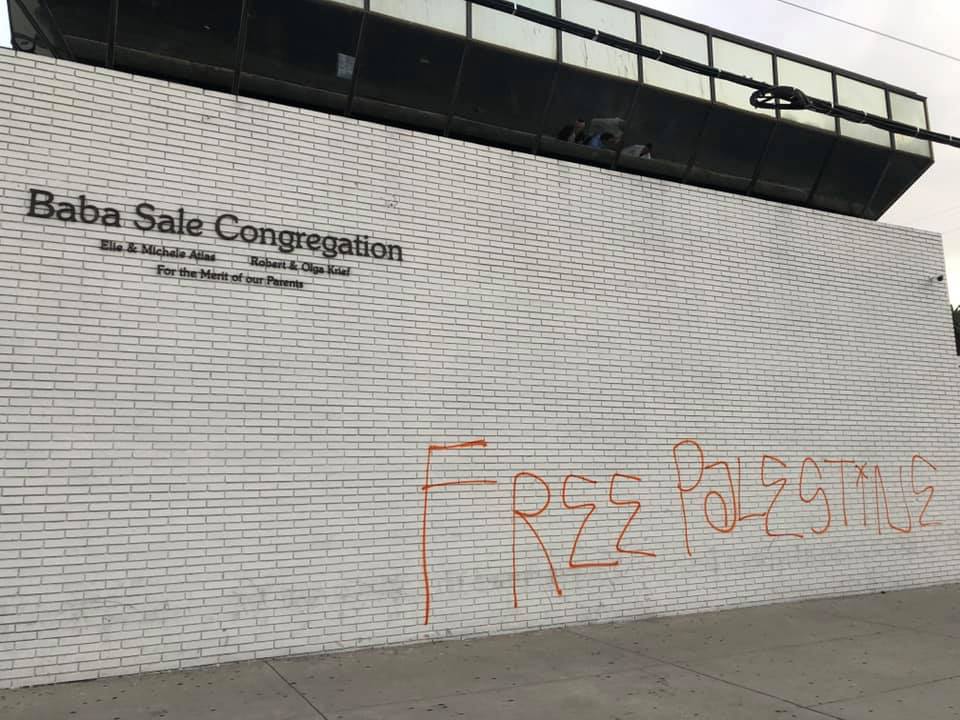
Baba Sale Congregation in the Fairfax district of Los Angeles was defaced with “Free Palestine” graffiti on the morning of Sept. 11.
Zev Opos, who is on the board of directors for the congregation, told the Journal that three female witnesses saw three men in hoodies drawing on the synagogue. One of the witnesses said described one of the suspects as “a tall African-American man,” Opos said.
“Once they finished tagging and saw the women, they ran to their car, which was waiting for them on Oakwood [Avenue], and they drove away,” Opos said.
The Journal has obtained video footage from the congregation showing a hooded man spray-painting the synagogue, before driving off in a vehicle.
Photo courtesy of Baba Sale Congregation.Photo courtesy of Baba Sale Congregation.
Opos said that while there have been “small graffiti incidents in the past” at Baba Sale, there has never been large anti-Semitic graffiti until now.
“We’re a Jewish house of worship that’s located 7500 miles from the Middle East where this conflict is taking place, and we came under attack solely for being Jewish,” Opos said, “because we as a congregation, we don’t take any political positions and we’ve never made any political statements.”
He added that Baba Sale is a Moroccan shul, so the graffiti opens old wounds given the history of Arab nations expelling Sephardic and Mizrahi Jews following the establishment of the State of Israel in 1948.
“It shows that anti-Semitism and anti-Zionism are really rooted in the same place, and that’s [a place] of hate,” Opos said, adding the congregation will now undertake additional security measures, including requiring attendees to punch in a code before entering the synagogue, or having someone inside let them in.
“The security companies that are employed by us, they are being updated that they need to be on higher alert as a result of this incident,” Opos said.
Anti-Defamation League (ADL) Los Angeles tweeted it is “working with law enforcement on this shocking act of vandalism on a synagogue. As our annual audit reflects, anti-Semitic incidents have been on the rise in California.”
In a follow-up tweet, ADL Los Angeles said: “Vandalism is never ok, and blaming all Jews as a way of criticizing Israel is clear anti-Semitism.”
@LA_ADL is working with law enforcement on this shocking act of vandalism on a synagogue. As our annual audit reflects, anti-Semitic incidents have been on the rise in California. pic.twitter.com/nsBMvzCDgd
American Jewish Committee Los Angeles Regional Director Richard S. Hirschhaut said in a statement, “When I see the Moroccan Jewish synagogue in my neighborhood grotesquely vandalized with ‘Free Palestine,’ it’s a harsh reminder that anti-Zionism and anti-Semitism have the same roots. This is part of a disturbing and unacceptable trend of anti-Semitic crimes in Los Angeles that we must confront.”
Opos wrote in a Sept. 11 Facebook post: “‘Free Palestine’ is a dog whistle which means replacing Israel with Palestine. ‘From the Jordan River to the Mediterranean Sea Palestine shall be free.’ The targeting of a Jewish house of worship nowhere near Israel shows that this is about Jews. Raw anti-Semitism.”
He added that he wanted to “send a clear message that we are not afraid, we will not be intimidated, and we have no fear.”
UPDATE: Los Angeles City Councilman Paul Koretz said in a statement to the Journal, “Acts of intolerance and hate have no place in the City of Los Angeles. We will not allow for the peace and tranquility of our communities to be disturbed by those who propagate fear. We stand with the congregants of Baba Sale. My Director of Public Safety has been briefed by the Area Commanding Officer of the Los Angeles Police Department and all resources will be brought to bear to apprehend the suspect(s).”
They stand arm-in-arm, expressions thoughtful. The groom, in his tuxedo, holds his top hat across his lower belly like a shield. The bride, in her white gown, points her left hand toward her womb — a subconscious silent prayer?
This three-inch ceramic couple graced the top of my parents’ wedding cake on June 22, 1947. The faces and finery are well-worn and nicked, but emotion swelled in me when I found it after my mother’s death, a precious keepsake.
Today’s cake toppers are whimsical — acrylic flamingos, confetti-themed “Mr. and Mrs.,” glittery silver-moon cutouts. This heavier memento reminds me of the greater durability of most marriages of that World War II generation. From their black-and-white wedding photos, my parents smile into the unknown future.
For 47 years, they remained committed and loyal, through times of happiness, promise, conflict and even shocking tragedy. Like their cake topper, their union stood the test of time, chipping slightly here and there, dulling around the edges, yet resilient, sturdy, never breaking.
Judy Gruen is the author of “The Skeptic and the Rabbi: Falling in Love with Faith.”
If you’ve paid attention to the state of politics over the past few years —or even the past few weeks — you might have noticed that Israel has become a polarizing wedge issue. It’s become the political tool of choice by both liberals and conservatives for asserting their stance among their base. The effect has magnified in the past year as President Donald Trump has galvanized every opportunity to paint the Democrats as an anti-Israel party while gloating that he is the “king of Israel.” Trump is riding on this sentiment in hopes to win reelection, which explains why he described voting for Democrats as being “disloyal” to Israel.
The hyper-partisan debate over Israel has further compounded in the Trump era. The emerging liberal view of young voters is that Israel is much less a bastion of democracy than it claims to be and more of an oppressive right-wing colonialist government. Israeli Prime Minister Benjamin Netanyahu’s full embrace of Trump has deepened this growing chasm, giving many the impression that the two leaders are a reflection of each other. By this logic, each should be treated as part of the same symptom to fight against.
In the most recent presidential cycle, Israel was not a banner issue that dominated the political zeitgeist. Yet so much has changed since 2016. Over the past decade, there has been mostly bipartisan support for the U.S.-Israel relationship. It’s only recently that one’s position on Israel has become a litmus test for political support.
Since its birth in 1948, the United States was the first country to recognize Israel’s existence, and ever since, the U.S. Congress has remained its strongest ally. That much remains true, despite what some people might tell you.
What has changed, however, is the pulse of Democratic and Republican voters — not so much politicians.
Recent polling indicates that pro-Israel support among Democrats is quickly eroding while support among Republicans is surging.
A 2018 Pew poll indicated the widest partisan divide over Israel in any single year with 79% of Republicans expressing sympathy for Israel versus only 27% of Democrats.
A 2019 Gallup poll revealed there are nearly as many liberal Democrats who sympathize with the Palestinians (38%) as with the Israelis (41%), with the rest favoring neither side, or are unsure.
Mark Mellman
In another Pew pollreleased in 2019, it’s reported that Democrats view the Israeli and Palestinian governments with nearly identical unfavorable ratings. Only 26% of Democrats have a favorable view of the Israeli government while 27% express a favorable view of the Palestinian government. By a one-point differential, more Democrats favor the Palestinian Authority — the government that paid terrorists over $400 million in 2018 — than the flawed but stable Israeli democracy.
To understand this paradigm shift requires an understanding of the changing political landscape as well as generational differences among voters. The Pew poll indicates that 56% of voters older than 65 sympathize more with Israel than the Palestinians, but only 32% of those younger than 30 say they feel the same way.
Alarming trends like these have some people concerned about the future of the Democratic Party and bipartisan support for Israel. In January, a new group called the Democratic Majority for Israel (DMFI) launched with the goal of energizing the party’s base with a pro-Israel message rooted in strong Democratic principles.
Over the past decade, there has been mostly bipartisan support for the U.S.-Israel relationship. It’s only recently that one’s position on Israel has become a litmus test for political support.
Mark Mellman leads the group. He’s a seasoned veteran of political consulting and one of the most revered pollsters in the country. His background in Democratic politics has a robust 35-year career.
Newsweek credits his work on the environment with helping “turn Bill Clinton green.” The Economist recognized him as the “brains behind the Democrats’ successful ‘Medicare’ strategy” and Politico described Mellman’s firm’s role in developing Democrats’ economic messages, noting that Mellman’s manufacturing presentation “electrified Democratic leaders.”
Mellman’s career has covered the full political landscape, but now he’s focusing his energy around Israel. The group’s board of directors is co-chaired by former Clinton White House Communications Director Ann Lewis, as well as former Michigan Gov. Jennifer Granholm, Democratic strategist Paul Begala and several other prominent political figures.
Explaining why he launched the group, Mellman told the Journal, “There is no organization that is waging the political battle to make sure that the Democratic Party remains pro-Israel.”
In its January launch statement, Mellman said, “Our mission at Democratic Majority for Israel is to strengthen the pro-Israel tradition of the Democratic Party, fight for Democratic values and work within the progressive movement to advance policies that ensure a strong U.S.-Israel relationship.”
Despite the dismal polling that indicates a decline in Democratic pro-Israel support, Mellman remains optimistic, reassured by the overwhelming number of pro-Israel Democrats in Congress. Still, he sees some warning signs of deterioration among the base.
“For 10 or 15 years now, the pro-Israel message has been coming largely from the right to the left — and that just doesn’t work,” he said. “There is different vocabulary, different values, different touchstones, different concepts that are important.”
Mellman notes how in this hyper-partisan climate, Israel has been co-opted as a conservative issue. “People look at Netanyahu and say he was tight with Mitt Romney and now even tighter with Donald Trump. If he’s friends with these Republicans, then he must be the enemy of Democrats. That is another overlay to the problem.”
Matt Brooks, executive director of the Republican Jewish Committee, told the Journal in an email why he thinks the pro-Israel message has become more dominant among conservatives.
“I think the biggest reason for this is the shifting political center of gravity toward the progressives in the Democratic Party,” he said. “They have been largely responsible for pulling the Democratic Party away from its traditional pro-Israel moorings. I believe support for Israel should be bipartisan but sadly, Democrats/progressives have turned sharply away from Israel in recent years.”
As noted earlier, numerous polls indicate that the majority of Democratic voters have waning sympathies for Israel — particularly the younger, more progressive wing of the party. Older generations of liberals think of Israel within the context of defending itself against hostile neighbors while the young progressive wing sees a different narrative. The social justice-conscious generation that dominates progressive movements today sees Israel’s more than half-century occupation of the West Bank as an oppressive abuse of power against a people they view as powerless victims. Here lies the great dilemma.
In 2017, the Democratic Socialists of America voted to include boycott, divestment and sanctions (BDS) in its party platform, a stunning rebuke of its founders, Michael Harrington and Irving Howe — longtime Israel advocates. Mellman is not fazed by this development, but rather more concerned with Israel being demonized within more traditional flanks of the party.
“There’s a group called RootsAction,” he said. “They put out a list of incumbent Dems who should be primaried. For the first time I’ve seen, they included their support for Israel as a reason to challenge these incumbents. And they’re not part of Democratic Socialists of America.”
The list included Eliot Engel (D-N.Y.), Josh Gottheimer (D-N.J.), Brad Schneider (D-Ill.) and Juan Vargas (D-San Diego).
“We have a state party in California that was endorsing six bellicose anti-Israel resolutions,” Mellman continued. “They were stopped, but they were on the agenda.” This is in reference to California’s Democratic convention held in San Francisco from May 31-June 2, which was widely condemned by the Anti-Defamation League and Jewish Democratic Council of America for its one-sided blame of Israel for fueling violence and conflict.
“There is no organization that is waging the political battle to make sure that the Democratic Party remains pro-Israel.” — Mark Mellman
In March of this year, the progressive advocacy group MoveOn led a campaign encouraging 2020 presidential candidates to #SkipAIPAC. “You cannot be a progressive and support AIPAC because of the policies that they’ve supported,” Iram Ali, MoveOn’s campaign director, told NBC News.
The political infighting perhaps has best been portrayed by the intense relationship between House Speaker Nancy Pelosi (D-San Francisco) and the likes of newly elected Reps. Alexandria Ocasio-Cortez (D-N.Y.), Ilhan Omar (D-Minn.), and Rashida Tlaib (D-Mich.). The clash of political views on issues ranging from Israel to climate legislation seems like the type of division that would come from separate parties, not from within the same one.
For pro-Israel Democratic politicians to resonate with young voters, they have to achieve the balancing act of defending the virtues of the U.S.-Israel relationship while also acknowledging the precarious nature of the conflict. Landing the perfect balance is a near masterful dance.
It’s become in vogue for progressive groups to demonize Israel beyond legitimate criticism all while ignoring flagrant wrongdoings by the Palestinian leadership. Palestinian solidarity has become a rallying cry for movements as disparate as women’s equality to LGBTQ rights.
In 2016, roughly 200 pro-Palestinian demonstrators shut down a panel at the National LGBTQ Task Force’s annual “Creating Change” conference featuring A Wider Bridge, a group that seeks to advance LGBTQ rights in Israel.
And again, at the January Creating Change Conference in Detroit, pro-Palestinian demonstrators disrupted the opening ceremony, staging a 13-minute protest chanting “From the river to the sea, Palestine will be free,” a slogan which refers to wiping out the Jewish state.
Rebecca Vilkomerson, the executive director of Jewish Voice for Peace, said in an interview last year with the online news publication The Intercept, “It’s becoming almost standard that if you support single-payer health care and climate justice, you’ll support Palestinian rights.”
In June, the Washington, D.C., Dyke March made a spectacle of banning Jewish pride flags due to their resemblance to the Israeli flag, claiming that they represented “national symbols.” Co-Chair Ann Lewis showed up along with other progressive pro-Israel groups organized by Zioness and A Wider Bridge and after an 11-minute standoff managed to be let into the march.
At 82, Lewis is just as active as ever. “We showed up, we spoke up and people responded to us,” she said, adding that in Mellman, pro-Israel Democrats have a well-informed optimist.
“There’s a perception among young people in the Democratic Party that being pro-Israel is not good politics in the primary. One of the things we’re trying to do is change that perception.” — Mark Mellman
And there are incidents that show that optimism is not necessarily misplaced. In July, an overwhelming majority of the House passed H.R. 246, which condemned the BDS movement targeting Israel. The resolution passed by a vote of 398-17. But Mellman is still vigilant of the trends.
“There’s a perception among young people in the Democratic Party that being pro-Israel is not good politics in the primary,” he said. “One of the things we’re trying to do is change that perception.”
Mellman’s group has put that to the test. For the 2020 presidential race, DMFI has organized grassroots activists in Iowa and New Hampshire to make sure itsmessage gets out. Their most prominent activation came in response to the anti-occupation group IfNotNow, which Mellman notes “doesn’t recognize Israel’s right to exist in any boundaries.” IfNotNow led a campaign pressuring presidential candidates to vow to end Israel’s occupation of the West Bank. DMFI provided 2020 candidates with talking points on how to respond to these incidents and released a memo to all candidates.
Mellman notes that his group is keeping the presidential candidates on message. “Most of these candidates have very strong pro-Israel records,” he said. “On the other hand, a couple of months ago 700 rockets were fired at Israel from Gaza —not one of those candidates made a statement about it. We contacted each of the campaigns — after we did, four or five made a statement about it.”
For pro-Israel Democratic politicians to resonate with young voters, they have to achieve the balancing act of defending the virtues of the U.S.-Israel relationship while also acknowledging the precarious nature of the conflict.
Mellman’s organization has launched its own super PAC and plans to fund candidates in addition to advocating for policy and messaging. He said, “The people we are supporting are already pro-Israel. They didn’t decide to become pro-Israel in hopes that we would support them. There’s super PACs in every issue except in the pro-Israel community.” He added, “We are the only pro-Israel super PAC, certainly on the Democratic side.”
It’s no secret that President Trump wants to make recently elected Congresswomen Omar and Tlaib the face of the Democratic Party over their support for BDS. But Mellman notes that Omar and Tlaib dominating the media doesn’t mean their views prevail in Congress.
“We saw that 92% of Democrats in the House voted to condemn the BDS movement,” he said.
Although DMFI is focused on supporting pro-Israel Democrats, it’s open to having dialogue under as big a tent as possible, including Omar.
“I don’t want to say she’s a lost cause,” Mellman said. “We have tried on several occasions to meet with her to discuss our views and to do so privately. We were told that we would have such a meeting by her office, but so far they have refused to schedule it. We don’t consider anybody a lost cause. We want to talk to everyone.”
Mellman said DMFI also tried to talk directly with Tlaib, but, “She, too, essentially refused our entreaty.”
Nonetheless, Mellman remains optimistic, although he tempers it with realism. “I am concerned about the future trend,” he said. “If I wasn’t concerned, I would’ve stayed at my firm doing what I’ve been doing for the last 35 years.”
Update: A previous version of this article incorrectly stated that in polls Democrats had “unfavorable” views of Israel rather than “waning sympathies” for Israel and that Republicans had “favorable” views of Israel rather than “expressing sympathy” for Israel.
Peter Fox is a contributing writer for the Forward and Tablet magazine. Follow him on Twitter @thatpeterfox.
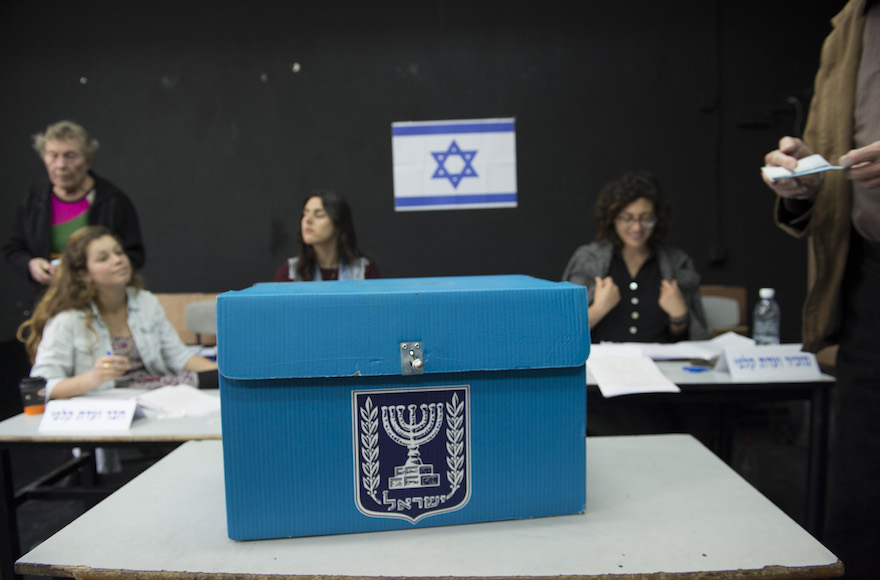
On the eve of Israel’s second election this year, against the backdrop of issues with Iran, Syria and Gaza, and a conversation-changing vow by Prime Minister Benjamin Netanyahu to annex the Jordan Valley (if elected), political tactics and electoral calculations take center stage. Here’s a short guide of what to expect before, during and after election day, Sept. 17.
Friday-Tuesday Polls: By law, the last polls are published on the weekend before election day. Take these polls with a grain of salt: At least 1 in 5 Israelis make up their minds on election day. Earlier this week, a poll found that only 53% of voters had decided who to vote for.
Campaign: In the final three days, when the public sees no new polls (but politicians continue to poll), the two largest parties, Likud and Blue and White, will work hard to convince voters that the only way to keep the hope alive for their bloc is to vote for them. Their rationale: The one who gets more votes gets the mandate to form a coalition. So it is Netanyahu vs. Benny Gantz.
Voters: The public is tired of politicking and elections. If the low-energy campaign doesn’t become a high-energy, last-minute campaign, expect a relatively low turnout.
Tuesday Turnout: Arab turnout is key because it was low in the April election. Likud turnout is key — because Likud voters seem more tired than others and less prone to vote. They are also among the least certain of who they’ll vote for. You can trust only one camp to vote as usual: Charedi voters score above 70% certainty (Likud, 46%; Blue and White, 56%).
Tuesday Night Exit polls: There are three main things to watch for on election night: 1. Will the pro-Netanyahu camp get more than 61 seats? 2. Which of the two main parties gets more seats? 3. Which of the two main contenders is likely to have more members of Knesset (MKs) support him?
Results:Be patient because this election could be determined by a few hundred votes. (In fact, that’s what happened in April. Had the New Right gotten a few hundred more votes, Netanyahu could have formed a governing coalition.) As votes are counted, be aware that every change could be crucial, especially if the change makes or breaks a party that crosses or fails to cross the electoral threshold (watch Labor and Otzma Yehudit, the one in danger and the one that’s hopeful).
Wednesday Morning Scenario 1: Likud, Yamina, United Torah Judaism, Shas and, possibly, Otzma Yehudit have 61 seats or more. Game over. Netanyahu has a coalition, and the only question remaining is the price the public must pay for it.
Scenario 2: Because Likud is the largest party, and/or because more new MKs want Netanyahu to remain prime minister (as opposed to Gantz), and/or because of other reasons, President Reuven Rivlin hands Netanyahu the mandate to form the next coalition. As this scenario plays out, there are three main options:
Netanyahu persuades Avigdor Lieberman to join him for a very high reward. Example: Lieberman will be prime minister in the fourth year of the coalition. Game over.
Netanyahu persuades Gantz and Blue and White to join a unity government under him. Game over.
Netanyahu fails to form a coalition. After 28 days, either Gantz gets the mandate or someone else from Likud steps in to challenge Netanyahu and form a Likud-led coalition without him.
Scenario 3: Because Likud is the largest party, and/or because more new MKs want Netanyahu to remain prime minister (as opposed to Gantz), and/or because of other reasons, Rivlin hands Gantz the mandate to form the next coalition. As this scenario plays out, there are three main possibilities:
Gantz persuades Likud to join a unity government. The key for him is to convince the members of Likud that Netanyahu’s time is over. For Netanyahu, joining a coalition under Gantz is not an option (he will have to resign if he is indicted). Game over. Netanyahu’s game over.
Gantz finds a way to persuade Charedi parties and anti-Charedi parties to sit together under him. No analyst believes such a scenario is likely.
Gantz fails. Netanyahu gets the mandate.
October Trump plan: If the political situation calls for having a peace plan on the table — by way of assisting Netanyahu to assemble a unity government — it is likely that President Donald Trump finally will release his peace plan (theoretically, this could happen before October but the window is brief because Rosh Hashanah is only a week and a half after election day).
Hearing: In early October, Netanyahu will face the attorney general and could face charges for bribery, fraud and breach of trust. By that time, Netanyahu hopes to know that his position is secure.
If he remains prime minister, he plans to make sure that no trial prevents him from doing his job (either by getting immunity from the Knesset or by going to court while serving as prime minster, as the law currently permits).
November Government: If there is no government, Israelis will have to consider the possibility of an unfathomable third election.
Shmuel Rosner is senior political editor. For more analysis of Israeli and international politics, visit Rosner’s Domain.
Shmuel’s book, #IsraeliJudaism, Portrait of a Cultural Revolution, is now available in English. The Jewish Review of Books called it “important, accessible new study”. Haaretz called it “impressively broad survey”. Order it here: https://amzn.to/2lDntvh
Naama Klar is the good-girl-next-door from a religious settlement who married a secular man. Today, at the age of 34, she is at a crossroads in her life. She has just returned to work as managing director of the policy and strategy nonprofit — the Reut Institute — after being on maternity leave for the past seven months.
A first-time mother, Klar admits the guilt of leaving her son in the hands of a nanny has yet to abate, but after a week back at work she is fueled by the projects she is leading and their ramifications for the Jewish people.
One of those projects is the Peoplehood Coalition, launched a year ago as an informal gathering of a couple of dozen friends and colleagues who, like Klar, were concerned about the fraying relations between Israeli Jews and the Diaspora. Today, the coalition has ballooned to more than 200 activists, including former U.N. envoy Ron Prosor, who are devoted to changing the Israeli mindset that Israel is the be all and end all of what it means to be a Jew; and that the Diaspora had no relevance.
Klar was steeped in that mindset for most of her life. She received a religious Zionist education in her hometown of Kedumim, a northern West Bank settlement. She was taught to believe that every issue connected to world Jewry had the same answer: The State of Israel and its army.
“I was brought up Israeli, hence blind to the identity of other Jews,” she said.
“ ‘Israel is the nation state of the Jewish people’ is nothing more than an empty headline, an idea that will dissolve itself if we continue to negate the Diaspora.”
The first time her attitude changed was as an exchange student in Brussels studying international relations and political economy. Her roommate, a Jewish student from Belgium, asked her to explain how, as a Jew, she could comfortably continue violating the rights of Palestinians.
Klar said she realized that for Diaspora Jewry, the answer to every single issue facing the Jewish people and their legacy might have nothing to do with having a nation state and a strong army and everything do with human rights.
“Certain components of the Zionist vision that were necessary in establishing the state are now too heavy and too irrelevant and are taking the relationship with the Diaspora down,” she said. “Israel is part of a bigger story: the story of the Jewish people.”
In the existing paradigm, Klar said world Jewry is easily dismissible, even replaceable by say, evangelical Christians. “ ‘Israel is the nation state of the Jewish people’ is nothing more than an empty headline, an idea that will dissolve itself if we continue to negate the Diaspora,” she said. “The Jewish people can and should exist — even without a state.”
Yet she bristles at the suggestion that she is turning her back on everything she once stood for. “I just thought [then] that Jewishness was something much narrower. But the values I believe in today are aligned with those I was brought up with. It’s all about peoplehood. Today, I am no longer Israeli,” she said. “I am part of world Jewry.”
There’s a man who sits near me at minyan who davens with his phone on the table in front of him. The screen stays on, split into four camera angles of the street outside, and he keeps an eye on it.
Sometimes, after I finish the amidah, my eyes wander over to the live feed. People shuffle by, heads buried in their devices and I imagine who they might be or where they might be going. Perhaps they’re hustling to a later service or heading home from a faster one. I don’t think anyone with evil intentions will appear. But the thought does enter my mind. Here to make time with The Great Surveillance Camera In The Sky, instead I catch myself looking over my shoulder.
It seems like only yesterday that we were living and praying in a bubble of sweet naiveté. Times have changed. White supremacy is in bloom and is drawing oxygen from a toxic national discourse and a vacuum of moral leadership. The last year saw two of our holy spaces come under violent attack. Tree of Life is now the name of a massacre.
It has been 20 years and a few weeks since a man carrying an automatic rifle walked into the North Valley Jewish Community Center and opened fire, striking five people before fleeing. The gunman, bent on killing Jews, cased three other institutions first but found them well secured. He settled on the first soft target he could find.
The attack has informed security policy at Los Angeles Jewish institutions ever since. The logic: Fortify yourself as well as, if not better than, your neighbor. What else explains the arms race now quietly unfolding between synagogues in my neighborhood? My shul installed security cameras only once the shul up the street had them. When one shul arms its guard, or adds a second, the others follow suit. The newest big shul on Pico Boulevard, with 8-foot cinder block walls could pass for a fallout compound. How far off are metal detectors?
“We will not defeat anti-Semitism with taller fences and more video cameras. We can’t just raise the drawbridge. We need offensive tactics, too.”
Even as our concerns become embedded in our architecture, things inside shul almost always feel the same. The cholent tastes the same, the niguns are the same. I avoid the same people and arrive during the same part of musaf. I’m glad we have someone at minyan with an eye on the door. I wouldn’t suggest that the threat against our places of worship does not warrant more rigorous security — of course it does. Feeling safe is essential to the work of connecting with God and with one another, even if our prayers betray a growing fear.
Consider, however, the implications of a strategy whose ethos is not outrunning the lion but outrunning the other human. Each new layer of security further isolates our communities from one another, weakening the exchange of knowledge, tradition and goodwill. I suspect I’m not the only Jew feeling less inclined to shul hop these days.
By insulating ourselves from danger, we wall ourselves off from the society we live in and remain responsible to. As Jewish culture is assailed and disinformation about us abounds, retreating from the public sphere runs contrary to our interests. We should be making ourselves more accessible, more inclusive, more involved in causes that are not our own. We will not defeat anti-Semitism with taller fences and more video cameras. We can’t just raise the drawbridge. We need offensive tactics; a corresponding arms race, friendlier competition between our beloved institutions to fortify the values that make our community worth protecting.
Maybe Judaism has to circle the wagons but why not make one giant circle instead of a thousand smaller ones? Orthodox shuls should partner with other Orthodox shuls but they also should be organizing charity events with Reform congregations and symposia with Conservative temples. We must insist on finding religious and cultural common ground because we need one another more than we realize.
This is the moment to emphasize interfaith and cross-cultural outreach. These engagements humanize the stranger, strengthen alliances and remind us that we’re not going it alone. We can’t just ask other groups to show up for us. We have to show up for them, too.
When we build a wall between ourselves and society, we might become less vulnerable to the symptoms of hate — an armed guard deters a would-be attacker — but we become more susceptible to contracting the disease. No culture, religion, political identity or level of observance makes one safe from developing xenophobia, racism or apathy. That means all of us have to be not only vigilant in rooting out those strains of thought, but proactive in warding them off.
Louis Keene is a writer living in Los Angeles. He’s on Twitter at @thislouis.
The last few years have been turbulent in Israeli-American Jewry relations. The most recent escalation was over women’s and egalitarian prayer at the Kotel, but this was not an isolated issue.
Since the 1970s, every decade has seen a conflagration over “Who is a Jew?” prompted by ultra-Orthodox parties’ attempts to exclude from recognition under Israeli law most American “Jews by choice” and the rabbis who convert them. One of the reasons for the short-lived 21st Knesset was the demand made — once again — by the ultra-Orthodox Shas party to pass a law to preempt an anticipated Supreme Court ruling in favor of non-Orthodox converts. This time, the ultra-Orthodox parties and the Israeli Chief Rabbinate also aimed to exclude Modern Orthodox converts.
Amazingly, all of this may end as Israelis goes back to the polls on Sept. 17. Israel has never experienced a similar opportunity to end the decades-old fundamentalist Orthodox hold over its religious Jewish life.
The short explanation goes back to the failed coalition negotiations following the April elections. Israel’s Knesset has 120 members, and its government has relied on coalition-building. Historically, coalitions have included religious parties as “kingmakers,” granting their support in the early decades to the Labor party and in recent decades to Likud. The Orthodox parties always exact a price for their support, and it gets met, based on a myth that one cannot form a government without them. The perception exists that paying them off is a good deal, for they make few claims regarding security and economic policy.
Israelis repeatedly have expressed their aspirations to realize the principles stated in the country’s Declaration of Independence, which states the country will “uphold full social and political equality regardless of religion, race, or gender,” and that it “will ensure freedom of religion and conscience.” Their aspirations, however, have been ignored by the country’s powers that be — from right, left and center as each, in turn, has sought the ultra-Orthodox parties’ support.
Israel has never experienced a similar opportunity to end the decades-old fundamentalist Orthodox hold over its religious Jewish life.
Interestingly, rare exceptions did occur when the government came under pressure to change the “Who is a Jew?” laws to exclude non-Orthodox conversions; they found themselves under massive pressure from American Jewry. On those occasions, Israel’s government backed off, realizing Israel’s strategic interests and the ongoing support of American Jewry were at stake.
So what happened this time? The leading political contenders in the April elections no longer were right versus left, because the left has lost much of its popular appeal. Surveys demonstrate that only 15% of Israeli Jews identify as left of center and 63% identify themselves as right of center. Thus, the elections mostly pitted right versus center.
Three former chiefs of staff — one of whom also served as minister of defense — lead the major centrist party, Blue and White. Its leadership includes a significant number of leaders from the right. Blue and White proved a game-changer, and the elections resulted in identical showings for Likud and Blue and White (35 Knesset seats each). Likud and its natural supporters only had 60 Knesset seats, one short of a majority, because of the surprise turnabout by Avigdor Lieberman, head of the Yisrael Beiteinu party. Lieberman insisted the Military Draft Bill, geared to enlist more ultra-Orthodox men, be adopted as law. The ultra-Orthodox party leadership rejected this, and Prime Minister Benjamin Netanyahu decided to go again to elections rather than allow the president to appoint another candidate to form a coalition.
Since then, as efforts to depict Blue and White as the “weak left” are failing, Lieberman’s party has dramatically changed course, focusing almost solely on opposition to theocracy, vowing the only coalition it will support is a broad, civil union between Likud, Blue and White, and Yisrael Beiteinu. This focus on religious freedom has resulted in a projected doubling of its mandates in the coming election. More recently, Blue and White, having previously expressed a desire to partner with the ultra-Orthodox parties, declared it will not enter into a coalition with them and “not give in to extortionists.”
These dramatic changes reflect Hiddush’s public opinion polling since January, which consistently shows the majority desires a coalition government that does not depend on the ultra-Orthodox parties.
Lieberman has translated this into a renewed campaign strategy, which has paid off in a big way. Blue and White’s voters also have indicated their desire that their party enter into a civil coalition rather than ally with the ultra-Orthodox parties. They also expressed a desire for their party to commit to religious freedom. At long last, the party heeded them and most undecided voters who have indicated a commitment to religious freedom may sway their votes.
Over the course of the last couple years, some key American Jewish leaders have expressed their strong feelings regarding the rift between Israel and American Jewry. The leadership of the Jewish Agency canceled a festive dinner with Netanyahu, protesting a Cabinet decision to suspend the Kotel agreement. This was followed by public, forceful pronouncements by Ronald Lauder in a New York Times op-ed and Charles Bronfman in an article in the Forward. They represented the discontent with Israel’s religion and state policies, which cuts across political and religious lines.
Israel’s response, as the prime minister conveyed, has been scornful. While he has pledged to ensure “every Jew, whether Orthodox, Conservative or Reform, feels at home in Israel,” his explanation for the rift is that it stems solely from American Jewry’s “drifting away from Judaism.” Israel’s former minister of Diaspora affairs Naftali Bennet similarly attributed the problem to American Jewish assimilation, and Israel’s consul general in New York Dani Dayan,rebuked American Jewry, saying it must respect Israeli democracy. Others in the Cabinet have been explicitly offensive to American Jews in general and to Reform and Conservative Judaism in particular.
The challenge of religious freedom and equality features centrally in the coming elections, with political projections indicating the long-established coalition formula of surrender to the ultra-Orthodox parties’ demands may come to an end. If this occurs, it would relieve Israel from the many deep layers of religious coercion, anti-pluralistic policies, religiously motivated gender discrimination, constant challenges to conversion and the right to family, and more. It also would be a step in healing the bonds with American Jewry, which slowly have been eroding to the point of endangering both Jewish unity and Israel’s core strategic interests. These aspirations are reflected in the trans-denominational and transpolitical endorsements across Israel and the U.S. of the “Vision Statement: Israel as a Jewish and Democratic State,” which Hiddush’s Rabbis and Cantors for Religious Freedom and Equality widely shares. Clearly, both Jewish communities are ready for the dawning of a new era.
Will Netanyahu’s last-minute dramatic announcement about partial annexation if he is appointed prime minister change the scenario described here? It’s too early to say but we doubt it.
Stanley P. Gold is chair and Rabbi Uri Regev is president of an Israel-Diaspora partnership: Hiddush — Freedom of Religion for Israel. Gold reported from Los Angeles and Regev from Jerusalem.
Moses was the original Jewish political activist and lobbyist. He organized his thoughts and priorities, then went to the top powers to demand action. What’s more, God made it clear the choice of Moses, complete with his speech disability, was intentional, leading many to believe that Moses’ experience as a person with a physical disability was of great value.
Whether you are interested in fighting anti-Semitism, strengthening the U.S.-Israel relationship or fighting for better public schools and jobs for people who have disabilities here at home, don’t leave civic engagement to special interest lobbyists.
This High Holy Days season coincides with National Disability Employment Awareness Month (NDEAM), so now is a great time to reach out and enable people with disabilities to get the education, jobs and access they need to fully participate in their communities.
Los Angeles has 183,786 students with disabilities. Additionally, although 70% of people with disabilities want to work, only 36.7% of L.A.’s 566,325 working-age residents with disabilities (ages 18-64) have jobs. Thousands of them are Jewish and would like nothing more than to work and/or volunteer at one of the many wonderful Jewish organizations in Los Angeles.
Jews with disabilities want to contribute their energy and ideas to help tikkun olam — just like anyone else.
So how can you, as one Jew — whether you have a disability or not — make a difference? How can you, too, be like Moses and achieve great things for people?
1. Pick yourtarget
“Making the world a better place” has a nice ring to it, but you need to have a real “theory of change.” This means having a specific and effective plan of action.
2. Start by listening
An L.A.-area congressman once shared a great idea. He said to always start a meeting by asking questions about the other person and their objectives. Nod. Take notes. Smile. If you can find out how to accomplish some of their goals while accomplishing yours, they will be on your side. You won’t always agree on everything, but sometimes, best friends are made through silence and a smile.
3. Don’t dance the horah alone
Moses may have been one guy with a speech impediment, but even he knew the importance of delegation and collaboration, working first with his brother and sister, Aaron and Miriam, then forming a whole team on the advice of his father-in-law Jethro. In modern times, God has given us the ability to create our own coalitions to make miracles happen. You need to build a team. Key allies can be synagogues, HaMercaz and other disability organizations, vocational rehabilitation offices, workforce boards, the Los Angeles Chamber of Commerce, the L.A. Mayor’s Office on Disability, school systems and employers.
4. Help people do a mitzvah and do well
It’s not cynical to say politicians and companies generally do what is in their own interests; it’s realistic. Our system was created to make our leaders beholden to the people and corporations beholden to shareholders. Hence, you have to show them how they can do good and do well themselves at the same time. Help your friends achieve the “the three P’s” of every successful politician: power, prestige and popularity. Give them a message to sell and the ability to deliver it. In the case of employment-first policies for people with disabilities, these messages include the fact that problems are best solved by working with people who have experienced them firsthand and know solutions that work.
5. People don’t care how much you know — until they know how much you care
Don’t just flash leaders with facts. Make it personal and be sure the decision makers know it. Tell a real story about how education and jobs impact people where they live. Remind them that people with disabilities deserve equal opportunities to earn income, achieve independence and be included.
6. Tell it to the moms
We know Miriam and the midwives were as much the heroes of Moses’ story as he was. Just the same, in the United States, women are the ultimate swing voters. If you can’t explain how your issue will improve the lives of moms, don’t expect broad support. Women care about improving their lives and their children’s opportunities to survive and thrive. If you can’t help them, they won’t help you.
“Jews with disabilities want to contribute their energy and ideas to help tikkun olam (to heal the world) — just like anyone else.”
7. Understand who leaders listen to, and what they value
It took 10 plagues to get Pharaoh to listen. To politicians, losing an election could be as significant as losing a loved one. Every two years, elected officials either win reelection or die a political death. It’s survival of the fittest. If you can’t show an elected official specifically how an issue you support will help him or her get reelected (or cause defeat if they are against it), you will fail. Luckily, supporting education and jobs for people with disabilities is hugely popular and is a win-win-win for people with disabilities, employers and taxpayers alike.
8.Collect the gelt
They say money makes the world go around, and that goes double for advocacy. Issues need access, public support or both, just as generous gifts were required to build the tabernacle. Without them, like the enslaved Israelites, you will toil without purpose. Write down and implement a serious fundraising plan. Don’t start the work until you know you will be able to fund it.
9. Don’t start five minutes before the Sabbath
Like Jewish holidays, synagogues, day schools, workforce boards and elected officials have deadlines. Know how much time you have to accomplish your goals, the steps to achieve them and when you must do each. If you can’t put your goals and tasks on a calendar, you will fail.
10. The most important decisions you make may be what you will not do
One of the biggest mistakes Jewish leaders and organizations make is trying to do too much at once. You have to walk (or roll) before you run. Remember, the Talmud teaches us that no one can complete the work alone, yet we all must do our part.
Jennifer Laszlo Mizrahi and Matan Koch are with RespectAbility, a nonprofit whose new “Project Moses” is funded through the generosity of The Jewish Community Foundation of Los Angeles. They are looking to recruit and train Jews with disabilities to serve in Jewish organizational leadership. To get involved, email MatanK@RespectAbility.org.