fbpx

September 11, 2019

Spiritual Leader Ram Dass Reveals His True Self in ‘Becoming Nobody’

Jewish filmmakers Jamie Catto and Raghu (Mitchell at birth) Markus do not believe there is anything been-there-done-that about the 88-year-old spiritual leader Ram Dass (“Servant of God”). Born Richard Alpert, a Jew, and at one time a psychology professor/LSD pioneer at Harvard (think Timothy Leary), he ultimately morphed into an iconic New Age/Hindi guru.

His is an amalgam of Eastern and trendy philosophies that include attaining an egoless life — neither defined by past regrets nor future strategies—where only the present deserves to be experienced (celebrated) and lovingkindness/awareness takes precedence over envy, competition and ambition. His first book, “Be Here Now,” recounting his own personal journey on a spiritual path, is a Bible among New Agers and he is viewed as the Granddaddy of the self-help movement.

Director Catto and producer Markus maintain that Ram Dass, who lives on Maui and has suffered a stroke, has greater application today than ever and that their documentary about him, “Becoming Nobody,” couldn’t be timelier. Just check out his presence on social media. He has well over a million followers on Facebook, Instagram and Twitter, not to mention his multi-thousand admirers on such digital outlets as RamDass.com and the Beherenownetwork.com.

The internet plays its role in boosting his audience, the filmmakers concede, but more to the point there’s a new generation of activists on the scene who simultaneously realize they have to clear their own minds and habitual ways of thinking before they can effectively tackle political/cultural issues. 

“Ram Dass is a powerful support for anyone looking to make changes [psychological, moral, emotional, intellectual, cultural or political],” Markus told the Journal in a conference call. “He creates trust. I never met anyone who was more present in the moment for me.”

Asked to what degree favoring other philosophies or religions over Judaism may also hint at a kind of unconscious self-hating embarrassment among some Jews, Catto put forward an inflammatory response.

“In this time of shallow and egoic people cashing in on the New Age, Ram Dass is 100% authentic, humble, hilarious, real,” added the British-born Catto, speaking from London. “People can see the difference between him and other teachers. His teachings are practical and down-to-earth. They have mainstream appeal.”  

Catto, 51, a musician and videographer best known for his world music video “One Giant Leap 2: What About Me?” has been a dedicated Ram Dass follower for 26 years. Markus, 72, who headed a music production company for 20 years, has been an acolyte for half a century. For the past 12 years he has served as executive director of Love Serve Remember, a foundation dedicated to Ram Dass teachings. 

Featuring current interviews with Ram Dass, interwoven with archival footage of past conversations and public lectures, “Becoming Nobody” highlights an erudite man awash in charm and a self-deprecating sense of humor. Still, depending on viewpoint, he is an embodiment of enlightenment or a paragon of psychobabble appealing to those followers with lots of discretionary income and far too much time on their hands.

Markus reluctantly admitted that following and/or espousing spiritual paths might have limited application for those who are struggling to survive. That said, he suggested the most impoverished in India are, thanks to their culture, already inculcated with a sense of karma and connectivity to a Divine presence. As for the already “enlightened ones” (especially among the well-heeled), they have a duty to feed and love the poor, Markus said. Compassion is the core of Ram Dass spirituality.

Asked about the large Jewish presence in the movement — not least such notable leaders as Jack Kornfield, Sharon Salzberg, and Joseph Goldstein — Markus said a spirit of adventure and an interest in learning about other worldviews is intrinsic to the Jewish cultural experience. And so it’s not surprising at all.

Asked to what degree favoring other philosophies or religions over Judaism may also hint at a kind of unconscious self-hating embarrassment among some Jews — e.g., fear of appearing provincial or worse, tribal — Catto put forward an inflammatory response, acknowledging that what he thinks on this topic is taboo and perhaps he should remain silent.  

He reluctantly said that as the Chosen People the Jews were chosen to serve and had the opportunity to do so with the kabbalah, but for selfish reasons chose not to, believing others outside the faith were not ready for such power. That was a huge mistake and the Jews have suffered horrific karma for thousands of years, he continued. Spiritual leaders such as Ram Dass et al are healing that ancient self-inflicted wound.

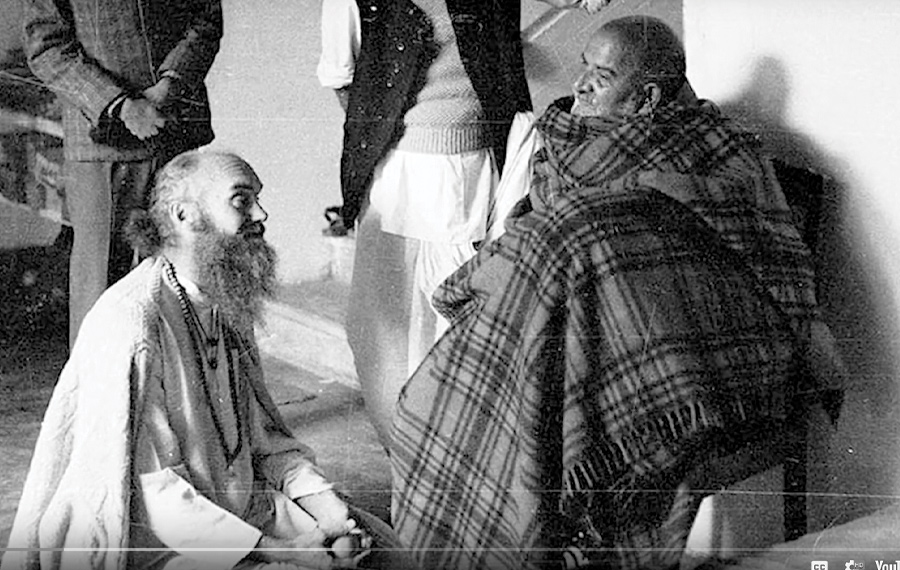
Whether or not Ram Dass would concur is arguable. In the film he recognizes his Jewish roots, but like many countercultural icons, felt alienated from his own background and the society at large with its broader teachings (philosophical, psychological, intellectual). He studied many religions and philosophies, though ultimately found special solace in the presence of Hindi leader Neem Karoli Baba who, according to all accounts, was saint-like, a doorway to the Divine. It was an encounter that paved the way for his particular brand of “becoming nobody.”

Ram Dass’ advanced years have only enhanced the filmmakers’ shared conviction that the definitive film on him was begging to be made, although two previous movies on the spiritual leader are out there, including a 2017 documentary short, “Ram Dass Going Home,” which was shortlisted for an Oscar nomination.

Making the film was challenging, with many false starts. Visually, it didn’t work initially and the picture took longer to pull together than expected. “And there are always challenges in raising money,” Markus said. “Still, we didn’t have to pull teeth. Investors loved the concept and wanted to support it.”

Ram Dass played an active role in shaping the film and said he has been deeply gratified by the audience response at early screenings in Maui. The filmmakers are hopeful that moviegoers leave the theater “inspired to turn their lives around from meanness and self-protection to loving kindness and service,” Markus said. “That’s the key to Ram Dass.”

“Becoming Nobody” is currently playing at the Laemmle Glendale, Playhouse 7, Claremont 5 and Monica Film Center.


Simi Horwitz is an award-winning, New York-based writer.

Spiritual Leader Ram Dass Reveals His True Self in ‘Becoming Nobody’ Read More »

Itzhak Perlman to Play SoCal on National Tour

Violin virtuoso Itzhak Perlman just turned 74, but he hasn’t slowed down his busy performance schedule, which now includes tours through April 2020. Accompanied by pianist Rohan De Silva, Perlman will perform at the Younes and Soraya Nazarian Center on the Cal State Northridge campus to open its 2019-2020 season on Sept. 19. 

“I’m doing the usual program that I do. I’m going to do some Beethoven and some Franck and some Dvorák, stuff that I enjoy playing and listening to,” Perlman told the Journal. “It’s going to be fun.” Fans also can expect to hear John Williams’ theme from “Schindler’s List.” “I always do that,” Perlman said.

The recital also launches a program called Violins of Hope. A Los Angeles County-wide collaboration between four symphonic orchestras, the Los Angeles Museum of the Holocaust and the Soraya, it celebrates a collection of more than 60 instruments rescued from the Holocaust and restored in Israel by Amnon Weinstein and his son Avshalom in their shop in Tel Aviv. Niv Ashkenazi, a former student of Perlman’s who holds the only violin from the collection in North America, will tour 40-50 public and private schools as part of a yearlong arts education program. The instruments will come to Los Angeles for the first time in March.

“It’s a wonderful project,” said Perlman, who is seen visiting the Weinsteins’ shop in the 2018 documentary “Itzhak.” “Amnon showed me a whole bunch of these incredible instruments that have so much history behind them. These violins, more than most, are powerful examples of perseverance. They once represented survival for their owners and they symbolize the same to us today.”

Perlman’s personal instrument is a priceless 1714 Stradivarius that he’ll play on the tour, which also will include California performances in Palm Desert on Jan. 20 and Santa Barbara the following evening. He plans to see his son, one of his five children, while he’s in Los Angeles and hopes to visit some Napa wineries, as he has a Sept. 15 concert in Rohnert Park in Sonoma County. 

“Perlman’s biggest issue with travel has to do with mobility and the lack of accommodation for people with disabilities, as he contracted polio as a boy and uses a wheelchair.“

He also loves to stop in at the Museum of Contemporary Art whenever he plays Disney Hall, though it’s not always possible “when you’re busy with rehearsals and you’re trying to rest and relax and prepare for the concert,” Perlman said. He stays healthy on the road by taking jet lag into account. “You have to know what your body reacts to and whether you’re going to be able to go to sleep right away. You have to figure it out and adjust.” 

Although Perlman keeps kosher at home in New York, “on the road it’s more difficult. I try to keep away from things that are obviously not kosher,” he said. When he has a concert on Saturday night, he flies in before Shabbat begins. He never performs on Friday night. 

But Perlman’s biggest issue with travel has to do with mobility and the lack of accommodation for people with disabilities, as he contracted polio as a boy and uses a wheelchair. “Travel is hard for anybody, but for somebody like myself who has a problem with walking, it’s even more difficult,” he said. “The way the airplanes are designed, the facilities are made for someone maybe 4-foot-9 and 100 pounds. It’s ridiculous. The airlines could make life for people with disabilities so much easier if they were to design bathrooms that were a little bigger, but it would take an extra seat away. It’s very unfair and very unpleasant. You just sit there and hope you don’t have to go.”

Nevertheless, Perlman takes the long flight to Israel, where he was born pre-statehood in 1945, a few times a year. “I’m going for a concert sometime in October. Zubin Mehta is leaving the Israel Philharmonic Orchestra, and it’s one of the last concerts that he will conduct,” he said. 

Perlman will be home in New York for the High Holy Days “with the mishpachah” — a large clan that includes a dozen grandchildren. He and Toby, his wife of 52 years, are “holding at 12, but I don’t think we’re finished yet,” he said.

The couple recently celebrated the 25th year of their Perlman Music Program with a gala and concert. Toby started it to foster young musical talent as a summer program. “But now we have things going on all year, in New York and Florida and Israel,” Perlman noted. He often teaches classes at the Juilliard School in Manhattan, and for those who can’t take advantage of that, he offers his violin expertise through online tutorials at MasterClass.com.

Perlman has reached the heights of achievement as a musician, educator and humanitarian, with 16 Grammy Awards and a Grammy Lifetime Achievement Award, four Emmy Awards, the Presidential Medal of Freedom, the National Medal of Arts, the Medal of Liberty, the Kennedy Center Honor and Israel’s 2016 Genesis Prize to his credit.

But there is one accomplishment that eludes him: eating without gaining weight. “My problem is I love food. Chicken noodle soup, matzo ball soup, stuff my mother used to make when I was growing up. Chinese food, Korean food, Indian food — I like everything,” he said, laughing. “Maybe I should start Jewish weight watchers: How to lose weight and still have matzo ball soup.”

Otherwise, he has no complaints. “The important thing in life is to be happy with what you’re doing. I’m very happy with what I do,” Perlman said. “A growing family and music — what can be better?”

Itzhak Perlman performs at the Younes and Soraya Nazarian Center at Cal State Northridge at 7 p.m. Sept. 19.

Itzhak Perlman to Play SoCal on National Tour Read More »

‘Raise Hell’ Chronicles the Wit and Wisdom of Journalist Molly Ivins

Molly Ivins, the funny, fearless, firebrand columnist, author and political pundit who blazed trails for female journalists and championed First Amendment and civil rights, died of cancer in 2007. But the irrepressible “Mouth of Texas” is speaking out once more in the timely, engaging documentary “Raise Hell: The Life & Times of Molly Ivins,” opening in theaters Sept. 13.

Los Angeles-based filmmaker Janice Engel was captivated by Kathleen Turner’s portrayal of the larger-than-life Texan when she saw “Red Hot Patriot: The Kickass Wit of Molly Ivins” at the Geffen Playhouse in 2012. She immediately wanted to bring Ivins’ story to the screen. She reached out to Ivins’ former assistant and estate executor, and began a funding, research and asset-gathering process that would take 6 1/2 years. The resulting film premiered at the Sundance Film Festival and won the audience award at the SXSW Film Festival this year.

“Molly Ivins was brilliant, fascinating and wildly funny. She spoke truth to power and gave a voice to people who didn’t have one. She used humor to get people to pay attention. That was her way in,” Engel told the Journal. “She called George [W.] Bush ‘the Little Shrub,’ which I thought was hilarious. I totally related to her in many ways.”

A Jewish New Yorker by birth, Engel, like Ivins, “grew up an outsider, feeling different. Molly bucked authority and so did I. I always cared about underdogs. I could never play the game the way it’s supposed to be played,” she said. “As I researched and got to know her and talked to her friends and colleagues, I realized there were an incredible amount of parallels between us.”

Engel had access to Ivins’ archives, housed at the University of Texas at Austin, and personal photos from family members and friends. She amassed over 300 hours of footage of Ivins and more than 45 interviews with Ivins’ colleagues, her siblings and notables including Dan Rather and Rachel Maddow. Only “a few Republicans said no,” Engel said. 

Going in, she wanted to emphasize Ivins’ proud Texan side, her courage to speak out when others would not, and give viewers a sense of her larger-than-life personality. “She was an outsider and chose to stay that way. She couldn’t be bought and that allowed her to write her opinions.

She was so prescient. Things that she wrote about 30 years ago are happening right now,” Engel said. The 6-foot-tall redhead was also an alcoholic who could “drink people under the table. Drinking was her entrée into the boys’ club. But at the end of her life, when her cancer returned, Molly got sober,” Engel noted. “She decided to go out clear-minded and face her own truth.”

Engel, who fondly recalls watching black-and-white movies in her father’s lap at an early age and pretended to be sick to stay home and watch films, followed her cinematic obsession to USC film school and made music videos before segueing to documentaries. These include TV series about drug addiction and plastic surgery. “Real life, people, real stories — that’s who I am. But I still want to do narrative [films],” she said. Engel also makes short documentaries about Holocaust survivors, liberators and rescuers for What We Carry, the education program she created for students in middle school and above. The name refers to the few possessions Jews carried with them into the camps. 

“Molly Ivins was brilliant, fascinating and wildly funny. She spoke truth to power and gave a voice to people who didn’t have one.” — Janice Engel

A “99%” Ashkenazi Jew whose grandparents collectively came from Russia and Austria-Hungary, Engel grew up in a Reform home in Massapequa Park, N.Y. “We celebrated the holidays but weren’t super religious. I was confirmed, but it was not fashionable for girls to be a bat mitzvah then,” she said. She doesn’t go to synagogue and describes herself as a secular Jew. 

“In some ways, my path is much more spiritual, has more of an Eastern bent,” she said. “I’ve been to India three times and I didn’t go to Israel until 2014.” 

Engel and her wife married 25 years ago under a chuppah at the Hollywood United Methodist Church, with an Indian woman officiating. “We both broke the glass,” she said. “It was all about being inclusive. For me, being Jewish is very cultural. There’s a tribal thing that extends beyond the religion. It’s who you are inside.”

Engel, who teaches documentary film at the Academy of Art University in San Francisco, thinks the enthusiastic film festival response to “Raise Hell” bodes well for its theatrical release, which will be followed by a streaming run on Hulu. “Molly’s driving this bus. We’re just blessed to be on the ride. It has its own life,” Engel said. She thinks Ivins would love the documentary. “I think she’d be happy that it’s not a hagiography, that it’s warts-and-all. I think she’d love that all her friends are in it, that we reached out to as many people as we could from her circle.”

The filmmaker is eager to introduce her one-of-a-kind subject to a new generation. “I’m proud to share this incredible journey that I’ve had. Each project is a journey and an education. The best thing about being led into Molly’s life through her friends and her family is we now get to share it,” Engel said. She hopes people will be inspired by Ivins’ messages and the way she conveyed them. “We need to laugh so that we can find our way back to the table and talk to each other. We need to come together and save our democracy,” she said. “It starts with us.”

“Raise Hell: The Life & Times of Molly Ivins” opens in theaters Sept. 13.

‘Raise Hell’ Chronicles the Wit and Wisdom of Journalist Molly Ivins Read More »

Local Teen ‘Lucky to Be Alive’ After Vaping Incident

Eighteen-year-old Simah Herman said she is lucky to be alive after almost 10 days in the hospital, including being placed in a medically induced coma, after complications from vaping. 

Herman was rushed to the hospital Aug. 15 feeling dizzy and nauseated, with a severe loss of appetite. Doctors initially thought she was suffering from pneumonia. But over the next 48 hours, her condition deteriorated and she was placed in a drug-induced coma for four days because she could no longer breathe on her own.

Luckily, Herman survived her ordeal but to date, the Centers for Disease Control and Prevention (CDC) has confirmed five deaths related to vaping in California, Illinois, Indiana, Minnesota and Oregon. 

As of Sept. 6, Herman was one of 450 possible cases in the United States to suffer from severe pulmonary disease related to e-cigarettes and vaping.

The CDC is advising consumers to consider not using e-cigarette products or vape pens — battery-operated devices that heat a liquid and deliver an aerosolized product to the user.

Raised in an Orthodox Jewish home, Herman was exposed to variations of Juuls, vape pens and e-cigarettes by friends at her Jewish day school in Beverly Hills. At 16, she tried vaping for the first time, not because of peer pressure, but because it looked cool, she said. 

“I just did it,” she told the Journal. “I didn’t really think anything of it. I noticed a bunch of different people had them so I would just take a hit off my friends but then I felt bad because I was using theirs all the time so I was like, ‘OK, I’ll just get my own.’ That ended up in one big spiral because then I was addicted.”

According to a Sept. 6 New England Journal of Medicine report, the aerosolized substances that users inhale in battery-powered e-cigarette devices are not harmless, as the marketing suggests.  

“E-cigarette aerosol generally contains fewer toxic chemicals than conventional cigarette smoke,” the report states. “However, e-cigarette aerosol … can expose users to substances known to have adverse health effects, including ultra-fine particles, heavy metals, volatile organic compounds, and other harmful ingredients.”

The U.S. Food and Drug Administration also issued a statement Sept. 6 stating:

“Because consumers cannot be sure whether any THC vaping products may contain Vitamin E acetate, consumers are urged to avoid buying vaping products on the street, and to refrain from using THC oil or modifying/adding any substances to products purchased in stores. Additionally, no youth should be using any vaping product, regardless of the substance.”

Herman said she was spending roughly $20-$30 each time she went to purchase Juul pods, pens and other accessories. The smoke house she illegally went to in North Hollywood didn’t card her because she told them she was 22. 

 “This is a pen that looks like a mascara wand. They’re pink. They’re purple. They’re pretty and cute. They smell like a candle and I want parents to know that.” 

— Stacy Herman 

Over the two years she was vaping, she began to feel nauseated, out of breath and had blurred vision. She also lost her appetite and would go several days without eating. A dancer for almost 12 years, she stopped because her symptoms worsened. She never thought it had something to do with vaping because nobody around her was getting sick from e-cigarettes.

Her mother, Stacy Herman, was unaware her daughter was vaping. Stacy told the Journal she initially thought her daughter was anorexic. Stacy took her to her pediatrician on several occasions to no avail. It wasn’t until Simah was unconscious that Stacy found the stash of vaping products in her daughter’s bedroom.

“I found her vape pens and her stash and I brought it back to the hospital and I said ‘You better save her ’cause I’m gonna kill her,’ ” Stacy said. “I didn’t know what it was. It isn’t recognizable. This isn’t the stuff from our childhood. As an adult, as a mother, I never smoked pot, I never smoked cigarettes but it doesn’t look like that anymore. This is a pen that looks like a mascara wand. They’re pink. They’re purple. They’re pretty and cute. They smell like a candle and I want parents to know that.” 

Stacy, who lost her own mother (also named Simah) to lung cancer, never worried her daughter was smoking because she never had the symptoms of a cigarette user — bad breath, smelly clothes, yellow teeth. “She smoked in her room, in our house, under our roof and we had no idea,” Stacy said.

For Herman, her hospitalization set her on the path to recovery and on a crusade to warn others about the dangers of vaping.   

“When I woke up, basically the only way I could communicate was with writing so I took a pen and paper and I wrote [about vaping],” she said. “I didn’t know my mom knew that I was vaping … and we just looked at each other and she said, ‘You know?’ and I said, ‘You know?’ and we both just started crying. I couldn’t let this happen to any of my friends who were smoking.”

It’s been almost three weeks since Herman was discharged from the hospital and she has quit vaping. She said she went through withdrawal in the hospital so she no longer craves nicotine. In November, she hopes to be well enough to start cosmetology school — a dream she’s had for a long time. Together with her mother and her cousins, she has also started an anti-vaping campaign. Her Instagram post on the dangers of vaping, with a picture of her in the hospital has gone viral and she hopes she can persuade more people to stop.

“I was UCLA [hospital’s] first vape-related illness,” Herman said. “They had no idea because there is no research out there. Is a little head rush from a tiny flash drive worth your life? Worth never seeing anyone you love again? Worth never doing anything you love again? Is it really worth everything to waste everything on a stupid little vape pen?

“It’s not worth it.”   

Local Teen ‘Lucky to Be Alive’ After Vaping Incident Read More »

Jewish World Watch Rallies for Uighurs

A protest by Jewish World Watch (JWW) spotlighted China’s targeting of its Uighur population — a Muslim ethnic minority that reportedly is being held in detention centers by China’s Communist government.

Approximately 70 protesters, including members of the Uighur diaspora community, JWW leaders and local Christian and Muslim activists, turned out to the Sept. 8 rally outside the Federal Building in Westwood. They carried signs, some using an alternate spelling for the ethnic group, that read “Missing, 2 Million Uyghurs,” “Where Are They?” and “#SaveUyghurs.” Marching along Wilshire Boulevard, they chanted: “Close the concentration camps,” “Fascist China” and “Freedom for Uighurs.”

Ann Strimov Durbin, JWW director of advocacy and grantmaking, told attendees, “This is a human tragedy of epic proportions.” 

“As with anything with Jewish World Watch, when we hear about something that approximates genocides or reminds us of what happened to the Jews during the Holocaust, we try to do what we can,” JWW Executive Director Susan Freudenheim told the Journal at the rally.

Vaughan Meyer, chair of JWW’s advocacy committee, said the treatment of the Uighurs was not just reminiscent of the persecution Jews faced during the Holocaust but how Jews have been persecuted throughout history. “I think that advocacy is critical,” she said.

According to JWW, of the 11 million Uighurs currently living in China, mainly in the country’s northwestern Xinjiang region, more than 2 million are in Chinese detention camps. While China’s ruling Communist government has referred to them as “re-education camps,” JWW says they violate international law. 

The JWW website states, “While the Chinese government argues that the recent crackdown is a necessary security measure, its arbitrary detention of the Uyghurs, reported use of torture and other human rights violations against detainees.” 

According to the Los Angeles Times, there are an estimated 1,000 Uighurs living in Southern California. One of those who attended the rally (along with others who came from San Francisco and San Diego) was M.T., a 37-year-old Uighur. An information technology engineer who has been living in the United States for 10 years, he declined to give his full name in order to protect his family’s safety back home in China. He said his parents’ passports have been confiscated and the Uighur population in China at large is facing “cultural genocide,” with the Chinese government attempting to erase the group’s language, religion and way of life. 

“They want to make every single person think the same, speak the same,” he said. “They want to manufacture human thoughts. The biggest thing we need to do is make awareness of what China is trying to hide. They are minimizing the number [of people detained].” 

Ann Lau, an activist and member of China’s Han majority ethnic group, also attended the rally. “I think all Chinese here should support the right of people of China,” she said. “I think it’s important we stand up for other people’s rights.” 

Freudenheim said the Jewish community was called to speak out at the rally just as it always is obligated to speak out for those facing injustice.

Jewish World Watch Rallies for Uighurs Read More »

‘YidLife Crisis’ Tackles Anti-Semitism

Jamie Elman and Eli Batalion were almost through the third season of their Yiddish-language YouTube comedy series, “YidLife Crisis,” when they decided to start over. While previous episodes had titles like “Sukkannabis,” a pitch by Elman’s character, Chaimie, for Sukkot to become “the highest of holidays,” and “(((Jewish))) General Hospital,” in which Chaimie feels the burn of an STD, the daily news of anti-Semitic acts around the world demanded special attention. The new video, called “An Anticementish Episode,” focuses on the swell of stories about anti-Semitic incidents and whether they have been amplified by social media or are a real and rising threat.

“Jewish social media is a nonstop barrage of hate and terrible things,” Elman told the Journal. “Between [crowds shouting] ‘Jews will not replace us,’ [President Donald] Trump and antifa, [graffitied] swastikas are on the rise in the States and in Canada. The whole thing is farkakteh, out of control. We couldn’t stay out of the conversation.”

As Elman and Batalion explored ideas for the new episode, they were struck by people’s responses to anti-Semitic graffiti, including the Facebook video of a young woman in Bucharest who transformed a graffiti swastika into a flower with a message reading “No hate, please.” And in Berlin, Paintback, a group of young street artists, have been converting swastikas to images featuring cute animals.

The video will launch on Sept. 19. After an opening riff with the regular mix of “YidLife” topics — racism, food and weed — the duo talk about whether anti-Semitism is on the rise and how best to handle graffiti: Do you erase or cover over it with something else or do you leave it up as a memorial, so that no one forgets that hate exists in the world? 

“Jews are being torn apart, from the right and the left, and have never been more divided,” Elman said. “The division has gotten so extreme that we felt we had to comment. As comedians, we thought there’d be value in what we do — having sensitive and difficult conversations introduced through the cogent course of comedy.” 

“Jews are being torn apart, from the right and the left. The division has gotten so extreme that we felt we had to comment. As comedians, we thought there’d be value in what we do.” — Jamie Elman

Batalion and Elman grew up in Côte-Saint-Luc, a Montreal suburb that is nearly 40% Jewish, according to Wikipedia. Elman said that part of “YidLife’s” DNA is Montreal and its diversity. 

“It’s a multicultural, multilingual, amazing place, with every color of the rainbow and yet anti-Semitism is on the rise even here,” Elman said. “It never really occurred to me that this could happen here today, but it is happening.”

“The social feed can amplify the reality. It’s hard when there’s something else every day,” Batalion said. “I’d feel uncomfortable wearing a kippah or looking religious [while] walking around. That’s ridiculous. In Western society, we should feel comfortable, but [today] it’s taking a risk.”

The new video tackles the question of perception and reality surrounding today’s anti-Semitic incidents, Batalion said. “Is it a new level of frequency or is social media creating a more exaggerated impression? A bit of the dialogue of our two characters is, ‘It is happening’ and ‘No, it’s not.’” 

The global “YidLife Crisis” audience ranges from teens to nonagenarians, Yiddish speakers and non-Yiddish speakers, Jews and non-Jews, with political leanings from both ends of the spectrum, Elman said. 

“If there’s anything we can do to be part of the conversation by using comedy in some way, we might be able to get people to think differently about the topic,” Batalion said. “We are trying to present both sides, to show that there are good arguments for saying it’s a clear and present threat and to saying that sometimes it is exaggerated. We’re not coming from a biased, advocacy place. We’re trying to show a comedian’s perspective on this issue, allow people to have less one-sided views.”

He added that they also are planning to develop curricula around the video. 

At the video’s end, there is a clip of Batalion and Elman in two different YouTube frames: one positioning the clip as an argument for the extreme right and the other using the same clip in an extreme-left context. 

“People will see what they want to see, see their own sides [reflected in the video],” Batalion said. “Are there rational people in the middle? We’ll see.” 

While producing the video, Batalion and Elman received word that The Peace Network, an organization in Montreal, had selected them as 2019 Peace Ambassadors. In this role, they have been promoting the many Peace Day initiatives throughout the city in the lead-up to International Peace Day on Sept. 21.

“People appreciated what we were trying to do,” Elman said, noting that someone at the organization had seen the duo’s short film, “Chewdaism,” at a screening for 750 people at an old theater in Montreal. “The episode was done before we got asked [to be ambassadors] but it feels like good timing and fortuitous.”

Another star of this video is the Montreal cheese bagel, a knish-like dough in a horseshoe shape which, in its classic form, boasts a blintz-like, sweet cheese filling. Elman and Batalion grew up eating cheese bagels at the mall, and Elman sees them as an apt analogy for the state of current events.

“It’s a two-sided horseshoe and we find that anti-Semitism comes from both ends of the cheese bagel,” he said. “It’s about the current climate of extremes. And also, we wanted to make you hungry.” 

“YidLife Crisis” will present “YidLive!” on Oct. 26 at Shomrei Torah Synagogue in West Hills. For more information visit their website.

‘YidLife Crisis’ Tackles Anti-Semitism Read More »

International Incubator Supports Intentional Jewish Communities

A Jewish incubator called Hakhel (from the Hebrew “kehillah,” or community) is helping young Jews around the world support new expressions of Jewish life through intentional communities. 

Hakhel was established in 2014 as a partnership between the Jewish sustainability nonprofit Hazon and Israel’s Ministry of Diaspora Affairs. Headed by Israel-based Rabbi Aharon Ariel Lavi, Hakhel currently boasts 109 communities in 80 cities in 28 countries around the globe, including five in Southern California.

A professional community organizer and social entrepreneur, Lavi told the Journal intentional communities are “a group of people who share space and time, vision and values and mission. They live in proximity to one another and meet regularly; they share a set of values and an internal culture; and they use these things as a platform for social activism to make the world around them a better place.

“Hakhel was inspired by the crisis of loneliness in the Western world on the one hand, and the success in which Israeli society has dealt with it since the 1980s,” Lavi continued. “Communities have always been important. They are, in fact, the second most important component in Jewish identity after the family.” 

Lavi said because of the ever-changing job market, which often sees people (especially young people) moving around a lot, it can be hard to make lasting friendships. And that’s where Hakhel steps in for those seeking Jewish connection. 

Hakhel, he said, nurtures people’s growth with mentorship, funding and network-building, including weekly group calls that allow the different communities to discuss what they are doing and to learn from one another. 

“Hakhel was inspired by the crisis of loneliness in the Western world on the one hand, and the success in which Israeli society has dealt with it since the 1980s.”
— Rabbi Aharon Ariel Lavi

The five Hakhel communities in Southern California are Career Up Now in Los Angeles, composed of professionals mostly working in the high-tech field; Or Gavoah in Encino, which brings people together for group Shabbats and other events; RuJuLa in Chatsworth, which connects hundreds of Russian-speaking Jewish families in the Los Angeles metropolitan area; Beth Jacob Irvine Community in Irvine; and Urban Kibbutz SD in San Diego.

Avital Khazanov, who runs Or Gavoah, started hosting Shabbat dinners in her backyard last September. Born and raised in Ukraine, Khazanov moved to Los Angeles nine years ago but missed the Jewish community she had grown up around, so she created the community she wanted. That first Shabbat dinner “was an open event for everyone to join, regardless of religion,” said Khazanov, 30. “I invited my friends and told them that they could bring friends. We had 50 people in my backyard. People [asked] me to do more. That means there is a need.”

After connecting with Hakhel in October last year and becoming part of the incubator, Khazanov now hosts events once or twice a month.

“I always have an open space, accommodations [a Kosher meal] for the religious people,” she said. “A lot of singles come to my Shabbat because they are looking to meet somebody and explore their network. I feel that people are looking for the right people to be friends with and feel safe and comfortable.” 

Khazanov is leading her first spiritual retreat, focusing on self-care, this month and said she loves that she can bring spirituality and Judaism together to help people grow and learn something new.

Career Up Now currently is based in Beverly Hills but also has communities in San Francisco, Palo Alto, Atlanta, Las Vegas and Boston.

“Our primary demographic is emerging professionals, and yet we are an intergenerational community,” said 39-year-old co-founder Bradley Caro Cook. “We have a high ratio of community leaders to [mentor] emerging professionals. Our oldest community leader is [about] 87.”

Career Up Now, he said, focuses on members spending time together, supporting one another in the business world and beyond, and looking into the Jewish traditions to find answers to the questions that trouble society today.

“It is important to emphasize that we are not trying to build a Jewish underground,” Lavi said, “but rather find a way to connect the new emerging communities to the existing networks and institutions. We need to seek unity and not further splits within the Jewish people.”

Those seeking to create a new Hakhel incubator can fill out an application form on the organization’s website (hazon.org/hakhel). Incubators can start with a core group of just three or four people. Applications are accepted on a rolling basis. According to Hakhel’s guidelines, if accepted, Hakhel offers “matching mini-grants, professional consulting, and learning trips to Israel for individual communities and community leaders”; networking of “communities through conferences, peer-learning, trainings and seminars”; and the development of “content and educational materials to further develop the field and the discourse of Jewish intentional communities and to support the work of our communities.”

“What we are looking for is a real need on the one hand, meaning that there are unaffiliated Jews who might be looking for this,” Lavi said. “We would not support someone who simply plans to cannibalize an existing community in order to grow his or her own community. The second thing will be a sense of confidence in the founders’ ability and motivation to lead this process to success.”

International Incubator Supports Intentional Jewish Communities Read More »

Letters and Music Highlighted in Craig Taubman’s Jewels of Elul

Craig Taubman is a self-described “human doer” — keeping himself busy with spiritual projects that can better his community. Taubman, who runs the Pico Union Project (PUP), said when someone told his wife years ago he should focus more on becoming a “human being,” he realized it was easier said than done.

“During the holidays, we do a lot of focusing. I’m actively involved. I’m so busy doing, that oftentimes I’m not really there,” Taubman said.

But this month, during Elul, when we are called on to do some introspection ahead of the High Holy Days, Taubman is even more focused on the business of “becoming human.” 

Now in its 15th year, Taubman has been working to make his Jewels of Elul project a meaningful and reflective experience for his thousands of email subscribers and himself. 

Each year, Jewels of Elul provides one insight per day during the month of Elul. Year after year, Taubman has tried to shake up each introspection with various views, musical elements, tributes and perspectives.

“I didn’t think I had that much to say,” Taubman said recalling Jewels’ origins. “Maybe I can go to a group of friends and ask them to do it. And that’s what I did. I went to 29 of my friends who were rabbis and cantors, leaders in the Jewish community. This is an amazing thing and people really liked hearing from different voices.”

From there, he published an annual booklet titled “Jewels of Elul” — which is now available for the year 5780 — and went on to create musical playlists, sheet music and spiritual thoughts-to-go for more than 20,000 people. 

This year, Taubman’s Elul theme is “A Letter to Myself,” in which each Elul email is formatted as a letter. To date, letters have been written by President Donald Trump’s Special Envoy for Monitoring and Combating Anti-Semitism Elan Carr, Temple Beth Hillel Beth-El Rabbi Neil Cooper, Holocaust survivor Hedy Orden, Jewish Federation of Greater Los Angeles President Jay Sanderson and editor and author Rabbi Danya Ruttenberg. Each has written a letter to either their future, past and present selves, their children and even to inanimate objects.

Taubman wanted diverse voices featured each day to unify the community.

“When our country and, frankly, our world is so divided and we look at the other as an enemy, we need to listen to voices that we don’t typically hear. I think it is critical.” 

— Craig Taubman

“When our country and, frankly, our world is so divided and we look at the other as an enemy, we need to listen to voices that we don’t typically hear,” he said. “I think it is critical. I specifically chose to feature an Orthodox rabbi as well as a transgender rabbi. I firmly believe that there is no right voice, there is no one voice.”

Along with the letters, Taubman has created a 13-song playlist. He reached out to jazz singer Chava Mirel, spiritual singer Beth Schafer, Greece-born tenor Alberto Mizrahi (aka the “Jewish Pavarotti”), Gypsy-rock klezmer band Mostly Kosher, New Haven jazz group the Afro-Semitic Experience and Makom LA spiritual leader Danny Maseng, to name a few.

“I could easily collect 13 of my own songs, but one of the things I appreciate most about the month of Elul [is] there are 29 opportunities,” Taubman said. “What if I give it to 13 other people? It was another quickly [made] thing. I put a letter out to my friends, I asked if there was something for the holidays and we tracked this beautiful CD.”

Jewish High Holy Day prayers “Hayom,” “B’Rosh Hashana,” “Pitchu Li” and “Adonai Ro’i” are featured on the downloadable CD as well as Mostly Kosher’s “You Slay Me,” which has been modified to fit the themes of Elul. 

Maseng, who sings “Adonai Ro’i” on the playlist, wrote in the liner notes that this prayer is his favorite psalm “plain and simple. The most concise and profound God poem I know.”

Schafer also said in the liner notes that her song “Here I am” helps prepare her for erev Rosh Hashanah. “The opening strains of erev Rosh Hashanah begin with ‘Hineni,’ or ‘Here I am.’ It is the very first moment of our arrival at the New Year. Worn, tattered, broken, we come before God with soulful cries as if to say, ‘I have showed up, the work is hard, will you take me as I am?’ We call upon God with the moniker El Elyon (God on high) as if to reaffirm our lowness. ‘Hineni’ is about being present even when it is uncomfortable to be so and to be willing to do the spiritual work that our holy days ask of us.”

Though Taubman says he loves them all as he prepares for the High Holy Days, a personal favorite is “Kol Nidre.”

“We do it with a string quartet [at PUP]. That’s one of the oldest Jewish tunes and to hear it at a multifaith center played on an organ that initially could only be used by pumping air through bellows with your hands because it was before electricity is a pretty powerful thing. It sort of brings everything together.”

Taubman said having music played during services is “like the cherry on top of ice cream. It is, for me, the essence that speaks the loudest. Music is everything.”

With the digital music downloads and Elul letters all coming in through email, most of Jewels of Elul has become electronic. Taubman hopes it reaches as many people from all walks of life as possible. As far as what people take away, he said he’d rather not tell anyone how and when to take in these bits of spiritual information. He just wants the Jewels to be there for anyone — whether they find it on the third day of Elul or the 27th.  

“I think the pathway to renewal, teshuvah, begins with the first step and you might take it on the 29th day of the month. You may take it three days after Rosh Hashanah when you pick up a book and find meaning. Elul is simply 29 opportunities to begin the journey.” 

Letters and Music Highlighted in Craig Taubman’s Jewels of Elul Read More »

Bourekas: A Love Story

I believe that Jewish cooking is a key to bringing and keeping Jews together.

I married a Sephardic man and my bridge to becoming Sephardic was through food, and bourekas were one of the first Sephardic foods I fell in love with. And as my son Jed says, “Bourekas: Now that’s something we can all get behind.”

The essential ingredient in a great boureka is love — the love a cook puts into making the little pies. But more than that, it’s the time and care that someone takes to teach another person how to make them.

Passed down on recipe cards loaded with notes, corrections and maybe a smudge of flour or oil, our culinary traditions thrive. Traditional Jewish recipes are part of our mesorah, our oral tradition, and our heritage because long before there were recipe cards, there were cooks and bakers who had the skills and the tools to prepare these dishes, consistently and beautifully. 

Watching my friend, mentor and food hero, Kaye Israel, make bourekas is the real deal — that’s how I learned that there are bourekas, and then there are bourekas. There is the skill of making a boureka, and then there is the art of crafting a boureka. Israel’s bourekas are artisanal. 

Her recipes are based on the classic cookbook “The Sephardic Cooks: Comé Con Gana” from Congregation Or VeShalom Sisterhood in Atlanta. There are a few personal touches here and there, but her recipes are in the tradition of the Island of Rhodes, made consistently with skill, patience and love. 

But why make bourekas? Because making and sharing food is just plain Jewish, going back to Abraham and Sarah. Bourekas are a Jewish love story.

I realize some people don’t want to make dough, and not everyone has the time to bake these days. But if you’re looking for a boureka with some love in it, take the easy route: Buy some ready-made puff pastry or pie crust dough, use one of these traditional fillings, and make your own bourekas.

Comé con gana! Eat with pleasure.

Chese Bourekas
These are best served warm.

Cheese filling*:
1 1/2 pounds baking (russet) potatoes,peeled, boiled, drained and mashed
2 eggs, beaten
1 teaspoon kosher salt
1/2 cup cottage cheese, mashed
1/2 cup grated Romano or Parmesan cheese
1/4 cup crumbled Feta cheese, or more to taste
Combine all filling ingredients in a medium-size mixing bowl. Adjust cheeses and salt to taste. Reserve.

*Filling for 36-40 bourekas.

Classic boureka dough:
1/2 cup vegetable (or canola) oil
1 dry-measuring cup of crushed ice, plus cold water to total 1 1/4 cup ice water
1/2 teaspoon salt
1 teaspoon cinnamon (for pumpkin or other sweet bourekas only)
4 cups all-purpose flour, plus more if needed
Egg wash (1 egg yolk mixed with 2 teaspoons of water)
Sesame seeds for a garnish
Preheat conventional oven to 400 F or convection oven to 370 F.

In a large mixing bowl, combine all dough ingredients and wait until the ice is partially melted. Gently mix the dough until blended, but don’t overmix.

Divide the dough evenly into 36-40 small round balls. Roll each piece of dough into 4-inch-long ovals that are 1/8-inch thick.

Place a scant tablespoon scoop of filling in the center of the circle, moisten the edge of oval, and then fold oval in half and seal moistened edge. Crimp sealed edge with fingers or a fork.

Brush the top of each boureka with egg wash. If desired, sprinkle each boureka generously with sesame seeds.

Place the bourekas on a cookie sheet coated with nonstick cooking spray, about 1/4-inch apart.

Bake for 25 to 30 minutes or until golden. Cool on a rack. Can be double-wrapped in foil and frozen for up to a month.

Bourekas de Calabaza
Inspired by “Sephardic Holiday Cooking” by Gilda Angel

Pumpkin filling:
1 16-ounce can cooked pumpkin (not pumpkin pie filling)
1 tablespoon all-purpose flour
1 teaspoon ground cinnamon
1/3 cup packed brown sugar
1 egg, beaten (reserve 2 tablespoons for the egg wash)

Pumpkin boureka dough:
1 cup vegetable (or canola) oil
2/3 cup cold water
1 teaspoon salt
1/2 teaspoon cinnamon
4 cups all-purpose flour, plus 1/2 cup more if needed
Egg wash (2 tablespoons beaten egg mixed with 2 teaspoons of water)
Cinnamon sugar, pumpkin seeds or turbinado sugar for garnish

Preheat oven to 375 degrees.

In a small mixing bowl, combine all filling ingredients. Reserve.

In a large mixing bowl, combine all dough ingredients to form a workable dough, adding more flour if necessary.

Divide dough evenly into 36-40 small round balls. Roll each piece of dough into a 4-inch-long oval that is 1/8-inch thick.

Place a scant tablespoon of filling in center of oval, and then fold in half. Crimp edges with your fingers or a fork to seal.

Brush the top of each boureka with the egg wash. If desired, sprinkle each boureka with cinnamon sugar or pumpkin seeds.

Bake on an ungreased cookie sheet for 20-25 minutes or until golden. Cool on a rack. Can be frozen.

Makes 36-40 bourekas.

Spinach Filling or Frittata
About one third of this recipe can be used as filling for 36-40 bourekas, using the Classic Boureka Dough, and the rest to make a 9×13-inch frittata.

Olive oil
1 large onion, coarsely chopped and sautéed until translucent
3 eggs
3 egg whites
1 15-ounce container fat-free cottage cheese
1 teaspoon dried oregano (optional)
1 teaspoon garlic powder (optional)
1/4 teaspoon nutmeg (optional)
1/4 teaspoon white pepper (optional)
Kosher salt to taste (about a teaspoon)
3 16-ounce bags frozen chopped spinach, thawed
4 ounces feta cheese, finely crumbled
8 ounces shredded mozzarella cheese, divided
8 ounces grated Muenster cheese
Matzo meal (optional)

Preheat the oven to 350 F.

Grease an 8×10 casserole dish with olive oil and dust with matzo meal if desired. In a large mixing bowl, combine the onion, eggs, cottage cheese, spices, pepper and salt, to taste, mixing until smooth.

Fold in the thawed spinach, feta and three quarters of the mozzarella cheese. Pour half spinach mixture into prepared dish and smooth top.

Sprinkle most of grated mozzarella and Muenster cheeses (reserving a tablespoon or two of each) on top of spinach layer. Spoon an even layer of the remaining spinach mixture on top of the grated cheeses and then smooth the spinach.

Sprinkle with tablespoon or two of matzo meal (optional) and drizzle with about  tablespoon of olive oil.

Bake for 45 to 55 minutes or until the center of frittata is “set.”

Remove frittata from the oven and cool at least 30 minutes before serving.

Serve warm or at room temperature.

Frittata can be double wrapped tightly with foil and frozen, but must be thawed before reheating. Reheat, covered, at 350 for 15 minutes. After reheating, sprinkle more cheese on top and allow it to melt.

Makes 2 frittatas, each serving 6-8.

Bourekas for a Crowd
Preheat conventional oven to 380 F or convection oven to 350 F. 

Buy one package of two rolls of frozen puff pastry ready to bake sheets (10×16 inches long, 26 ounces). Defrost in the refrigerator overnight. Unroll carefully. The center may need more time, so be patient.

Place a rack in the center of oven. Roll first defrosted puff pastry to form a 12×18 rectangle. Place the dough on a cookie sheet that has baking parchment that has been coated with nonstick cooking spray.

Spoon 1/2 of any boureka filling recipe down the length of the rectangle, leaving a 1/2-inch border on all four sides.

Moisten entire edge with a bit of water. Fold overlapping long edges toward center of boureka to form a log. Seal tightly with fingertips.

Fold 1/2-inch ends of boureka and seal tightly with fingertips.

Using a pastry brush, brush the top of the boureka with egg wash (1 egg yolk and 2 teaspoons of water), and sprinkle with a topping if desired.

Cut 3 or 4 1-inch diagonal slits on the top of pastry to vent steam. Repeat, using the second piece of dough. 

Bake for 35-40 minutes or until golden brown. Cool on a rack before cutting into 1-inch diagonal slices.

Serves 12-16. 


Debby Segura lives in Los Angeles. She designs dinnerware and teaches cooking classes.

Bourekas: A Love Story Read More »

Jewish Women International Names Author and Activist Meredith Jacobs as CEO

WASHINGTON (JTA) — Jewish Women International named Meredith Jacobs as its new CEO to succeed longtime chief Lori Weinstein.

Weinstein is stepping down after 20 years helming the organization, during which she oversaw its transition from B’nai B’rith Women to an independent group.

Jacobs, the chief operating officer, is a writer who founded the Modern Jewish Mom website, which eventually merged with Kveller, now a JTA sister website. She also has edited the Washington Jewish Week. Weinstein will remain involved as CEO emerita.

Jewish Women International advocates for reproductive rights and against violence against women. It also runs a program educating young women in financial literacy.

The transition will take place at the end of this year. The announcement was made Monday.

Jewish Women International Names Author and Activist Meredith Jacobs as CEO Read More »