fbpx

May 8, 2019

Unconditional Love: A Mother’s Day Story

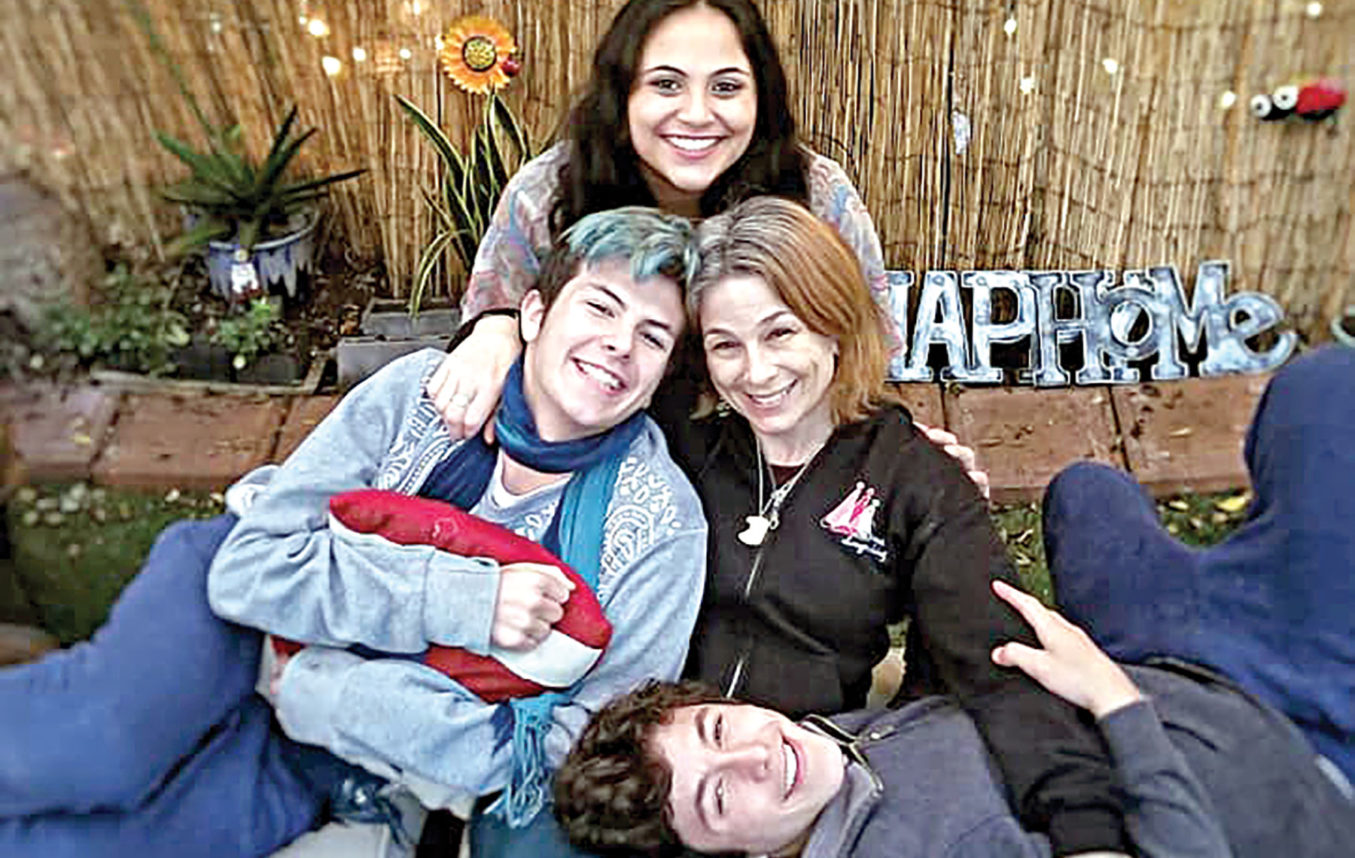
Six years ago, Deborah Engel Kollin learned that her then-12-year-old son, Yoni, was gay. Four years later, Yoni came out as non-binary, identifying as neither male or female.  Engel Kollin was supportive even though she didn’t understand everything about her child’s journey. 

“I don’t find it a challenge. I find it an opportunity more than anything,” Engel Kollin said. “And to me, the love that I have for my children is unconditional and it doesn’t matter who they are, how they present, as long as they are ethical, good, moral people who care about human beings and are positive, productive members of society.” 

Engel Kollin and her husband, Dani, have four children, including a 16-year-old girl they’re fostering, and belong to Temple Beth Am Synagogue.

Yoni, 18, a Hamilton High School senior who goes by the gender pronoun, “they,” is an artist with a passion for poetry. Last month, JQ International, an organization serving LGBTQ Jews in Los Angeles, honored Kollin. They attended the luncheon with dyed hair, eye makeup and a floral top. In their acceptance speech, Yoni said that they only felt truly seen after their mother joined the board of JQ.

For Engel Kollin, now JQ International’s leadership engagement chair, upon learning that Yoni was gay, her greatest concern was not that Yoni wouldn’t give her grandkids but that their sexual identity would make them an outsider in the Jewish community. 

“I didn’t want Yoni to have to choose between being gay and being Jewish and when he first came out, he thought that was the choice he had to make,” Engel Kollin said. “And through [JQ’s] JQSA (Jewish Queer Straight Alliance), he saw he didn’t have to make that choice.”

While Engel Kollin and Yoni have always been close, she said their shared involvement with JQ strengthened their relationship. “It gave us another way to connect,” she said, “and we are both involved with JQ and we go to a lot of things together.”

Because Engel Kollin struggled with infertility and their 21-year-old daughter is adopted, “Maybe that’s why I never had an issue with Yoni being gay because you can become a parent in any way,” Engel Kollin said. “It was not like, ‘Oh I won’t have grandkids.’ They can adopt. There are so many ways to become a parent.”

Yoni hopes to attend Cal State Long Beach next year and study graphic design. For her part, Engel Kollin isn’t concerned about Yoni’s classmates targeting them for wearing jewelry and makeup; she is concerned about anti-Semitism on campus.

“If anything, I’m not scared about his being gay, although some people say I should be,” she said. “I am more concerned with the Jewish aspect.” 

Like any Jewish mother would be.

Unconditional Love: A Mother’s Day Story Read More »

Marching for My Zayde at Auschwitz-Birkenau

Nothing can prepare you for a visit to Auschwitz-Birkenau. No amount of movies, books, journals or stories can accurately portray the horrors that changed the course of history forever. 

I learned about the Holocaust in Hebrew school and heard about it from my late zayde who was a survivor. But until you see it in person, you have no idea. 

During the two days I attended the 31st annual March of the Living on May 1 and 2, the three-kilometer (just under two-mile) march from Auschwitz to Birkenau in Kraków, Poland, my feelings ricocheted from sadness to fear to astonishment. Not only did more than 10,000 people participate this year, we marched on Yom HaShoah — Holocaust Memorial Day. 

Some on the trip said it would have been easier “if the weather was worse” —words travelers never say. The beaming sun shone in a blue sky dotted with perfectly white clouds, and the ground was covered in daisies and lilacs. Within the concentration camp, colorful flowers broke through the earth. How could a place filled with such beauty hold such sorrow?

This juxtaposition made the Holocaust feel all the more real to me. Six million Jews weren’t just prisoners on the cloudiest or snowiest of days. They worked, survived and died through the seasonal changes, including the beautiful days.

Many who attended the March of the Living had never been to Poland before, let alone a concentration camp. This year, the coordinators decided to incorporate a tour of the camps prior to the march so that it wouldn’t be so overwhelming. 

There are moments you know are coming and prepare yourself for — like entering the crematorium. Tour guides give you the option not to enter if you are uncomfortable. Knowing I had a choice while millions didn’t, I entered. 

Anxiety set in immediately as claustrophobia enveloped me in the dark containment room that once held nearly 2,000 people at a time. Trying to find light, I discovered walls scuffed with millions of old scratch marks from those who had tried desperately to escape the Nazi killing machine. 

Having the ability to walk out of a gas chamber after only a few minutes adds a perspective that can’t be taught in a classroom. You want to protect everyone so that nobody ever has to go in without having the choice to come out. 

There are moments you know are coming and prepare yourself for — like entering the crematorium. Tour guides give you the option not to enter if you are uncomfortable. Knowing I had a choice while millions didn’t, I entered.

But it was also the little things that stayed with me during the march. We passed the famous gates that read “Arbeit Macht Frei” (Work Sets you Free), while many dismissed the trees that stood tall next to it. A tour guide told me the first camp prisoners had planted the four trees immediately adjacent to the gates. So much of the evidence from more than a million people murdered was destroyed, but there were those trees with leaves and branches stretching toward the sky.

The four trees next to the gates of Auschwitz.

A great deal of evidence still remains, though. Two tons of hair behind a glass case cut from an estimated 30,000 people; documentation of direct orders to exterminate so many human lives; luggage and other personal belongings. 

One of the many posters left along the train tracks during the march.

Despite it all, several survivors still return to the March of the Living to educate young people. Birkenau survivor Hedy Bohm, 91, from Romania, shared her feelings attending the march for the sixth time. 

“As long as I come and see the young people … these thousands of eager and bright Jewish young faces, I’m happy to be with them,” Bohm said. “I’m happy to teach them whatever they need to be ready for life. For years, I think a lot of survivors have had the feeling that times remind us of the 1930s. Unfortunately, I feel the same way, too. … We are unable to learn. History repeats itself. We try to remember, we try to be smarter. We try, and that’s all we can do. Keep on trying.”

March of the Living founder and Co-Chair Dr. Shmuel Rosenman addressed thousands of families, survivors and students ahead of the march, saying, “Today, we proclaim to our enemies with a loud and clear voice: We shall not be defeated! We will return here year after year to raise our voices against anti-Semitism and, indeed, against all forms of racism and hatred. As a survivor of Auschwitz once said, ‘The only one thing worse than Auschwitz is if the world ever forgets that there was an Auschwitz.’ We promise to never allow that to happen.”

The march began with the blast of a shofar. At first, the only sounds were footsteps hitting the dirt floor. Then soft murmurs picked up as groups merged with others sharing stories of survival and family, the most common phrase overheard being, “I’m marching for …” or “I’m marching in honor of …” 


I couldn’t help but think I was marching in honor of my zayde.


Erin Ben-Moche was invited as a member of the press by the March of the Living organization to participate in the march. 

Marching for My Zayde at Auschwitz-Birkenau Read More »

Daring to Believe: Grilled Kebab and Laffa Recipe for Yom Ha’atzmaut

It is a supreme irony that I’m writing recipes for Israeli Independence Day (Yom Ha’atzmaut) for American readers, safe in my house overlooking majestic Lake Victoria in Uganda, while my homeland, Israel, has been bombarded by rockets over the past weekend. Four Israelis were killed and dozens injured in attacks by militant terrorist groups Islamic Jihad and Hamas, which have launched more than 600 rockets and mortar shells. It was reported that 240 of these projectiles were intercepted by the Iron Dome defense system, but many fired from Gaza landed within Gaza, killing more than 20 Palestinians and injuring countless others. 

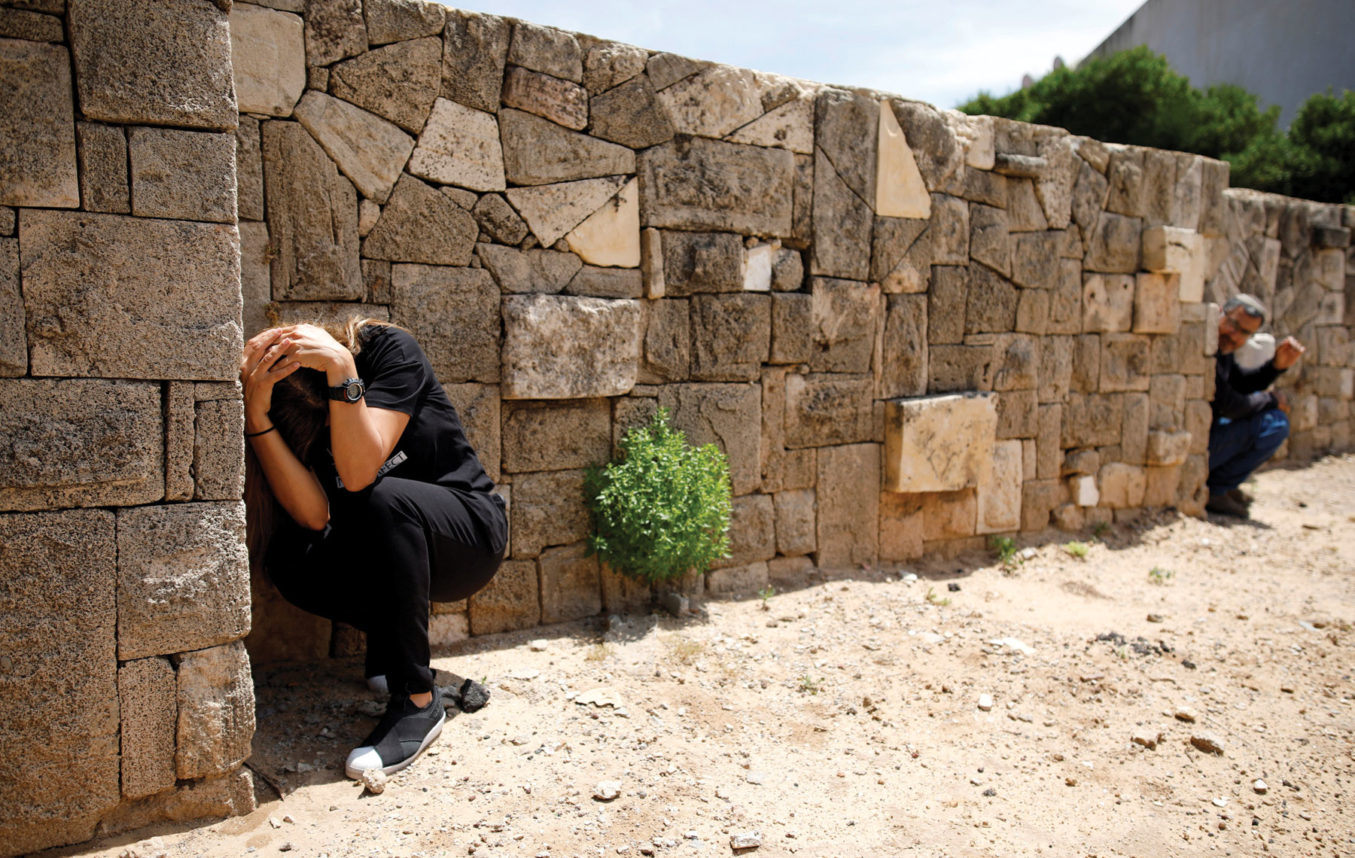
The government closed schools in most of Israel’s southern cities on May 5 and the situation is considered code red (emergency), with sirens blaring to warn of incoming rockets, traumatizing residents. Although most of my friends and family reside in Tel Aviv and its suburbs, Israelis in the south aren’t the only ones worried. Rockets fired in March landed only two streets from my best friend’s house. It demolished their neighbors’ villa, injuring all seven members. Although the house, a bit north of Tel Aviv, was struck by an unusually long-range missile, the event left my friend’s two young daughters traumatized and their parents shaken; a harsh reminder of the reality Israelis contend with.

While thousands of visitors enjoy Tel Aviv’s beaches in the run-up to the Eurovision Song Contest (planned for the past year), it’s a testament to the Israeli spirit that most of the revelers interviewed on Israeli television who are partying, eating in restaurants and enjoying the nightlife, feel safe. And this isn’t only because Israelis are inured to acts of terror, but because at the end of the day, they have no choice. They know what they need to do — they have a call list and a plan of action, bomb shelters in their basements and schools, and frequent drills. They’re alerted by Israeli telecoms with notifications of emergency code levels and instructions. 

It’s May 5 in Uganda as I write this and I’m in the same time zone as my family in Israel. No one knows if there will be a cease-fire in the run-up to Yom Ha’atzmaut. No one knows if there will be more rockets launched or how deep into Israel they will strike, and no one knows if the next text message they get from their son or nephew will be to tell them that their unit has been moved to the front lines of this conflict. Nor do they know if their husbands or sons will be called up for reserve duty (mandatory up to age 45 for males.) What they know, and what I know, is that the show must go on. In Israel, people don’t plan their daily movements around terror. If they did, they might find it difficult to get out of bed in the morning and be tempted to keep their children home from school every day.

I’ll be celebrating the holiday with other Israelis in Uganda at an event thrown by our consulate, and I’ll be nudging the universe with positive vibes by serving these kebabs at the American Embassy where I work. But at this juncture, I don’t know if I should be writing a recipe for the Bulgarian Beef and Lamb Kebabs my family eats for the Yom Ha’atzmaut festivities or handing over a recipe for charcoal-grilled rockets, as one of my cousins suggested (morbid Israeli humor), “one part metal, one part explosives, onion, salt and pepper to taste — yummy.” 

But after talking to a few of my favorite Israelis on the phone over the past few days, I bet that every backyard, beach and restaurant in the country will be full of families enjoying a traditional “al ha esh” (BBQ) session. Blame it on that crazy Israeli confidence or audacious optimism but in order to move forward every day, I, like most Israelis, need to believe that’s a pretty safe bet.

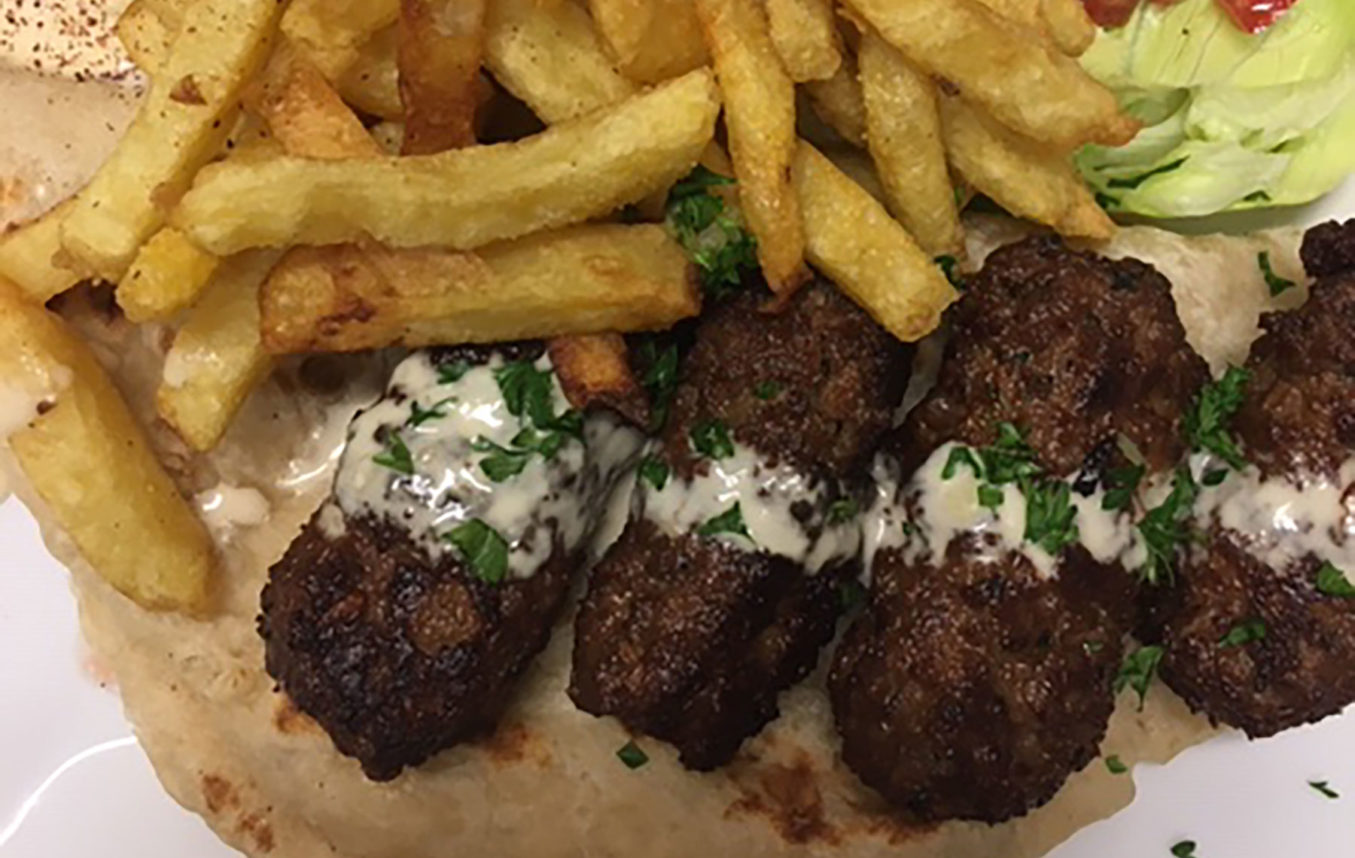
KEBAPCHETA — BULGARIAN STYLE KEBAB

1 3/4 pounds minced beef (20% fat, 80% meat)
1/4 pound minced lamb (you can use all beef, if you prefer)
2 slices of crustless bread, soaked in water until mushy (optional if gluten free)
1 egg
2 medium white onions, finely chopped or grated
1/2 cup parsley, finely chopped
1 tablespoon cumin
1 teaspoon paprika (sweet or hot)
1 tablespoon black pepper
2 tablespoons kosher salt
1/2 teaspoon sugar (optional, but aids in caramelization)

Mix all ingredients well. The most efficient way I’ve found to do this is to put all ingredients in a Ziploc bag with all the air removed and then throw it onto a countertop a few times until they are combined.

Refrigerate overnight (or at least 1 hour.) When ready to cook, cut a corner of the plastic bag and squeeze out 2-inch-long sausage-shaped kebabs and lay on a plate or baking sheet.

Grill over charcoal for best flavor but these can be cooked in a pan or even under the broiler. Turn kebabs every few minutes until a deep, brown color on all sides and cooked through. This should take about 6 minutes per batch depending on how hot the grill is.

Serve with Israeli salad, lettuce, pickles, pita or laffa bread (recipe below) hummus and tahini.

Makes about 30 kebabs.

LAFFA (FLATBREAD)

7 cups all-purpose flour
1 package active dry yeast (1/4 ounce)
2 tablespoons sugar
2 teaspoon salt
4 tablespoons olive oil
3 cups warm water

Combine dry ingredients in the bowl of a stand mixer. Add oil and water and mix with a dough hook attachment until dough is soft, smooth and elastic, about 12 minutes.

Place dough in an oiled bowl and cover with plastic wrap and then a tea towel. Place in a warm draft-free corner or in a microwave that’s not in use. Let dough rise for 1 hour or until doubled in size. 

Divide the dough into 12 equal-sized balls and roll on counter until smooth. Place on an oiled baking tray and cover with a damp tea towel for about 20 minutes. 

Heat a flat pan or griddle on medium heat (a cast iron pan works well for this.)

On an oiled wooden cutting board, flatten dough balls with your hands (or use a rolling pin) until they are a 12-inch circle. Place on hot surface of pan. When edges look dry and bread begins expanding, turn over and cook on the other side. This usually takes about 2 minutes per side. Immediately place laffa in a basket or on a plate and cover with clean kitchen towels to keep warm. Continue with remaining dough balls.

Makes 12 laffas.


Yamit Behar Wood, an Israeli-American food and travel writer, is the executive chef at the U.S. Embassy in Kampala, Uganda, and founder of the New York Kitchen Catering Co. 

Daring to Believe: Grilled Kebab and Laffa Recipe for Yom Ha’atzmaut Read More »

Weekly Parsha: Kedoshim

One verse, five voices. Edited by Salvador Litvak, Accidental Talmudist

You shall not hate your brother in your heart. You shall surely rebuke your fellow, but you shall not bear a sin on his account. –Leviticus 19:17


Rivkah Slonim
Education director, Rohr Chabad Center for Jewish Life at Binghamton University, New York

Figuring out what motivates people is difficult, often entirely impossible. There are even times when it’s hard to discern our own motivations. 

Sometimes, the particular motivation doesn’t matter. A case in point would be giving tzedakah (charity). No matter what reason compels you to give, it is considered a mitzvah. And then there are instances in which motivation is the defining factor. Such a case is discussed in our tripartite verse. 

Rebuking one’s fellow is an important mitzvah, says the Torah, but it is carefully qualified. The prerequisite precedes the commandment in the first part of our verse: Do not hate your brother in your heart. Only then, can you reprimand in a way that is efficacious in causing him to stop sinning. But if malice or jealousy or any negative emotion propels your rebuke, you will carry the sin of your brother for you were not invested in his good and betterment in the first place. That is the sin. 

Before issuing censure, our inner landscape must be scrubbed of any emotion but love and care. Even a hint of antipathy, like the slightest germ, must be cleansed from the area before “inoculating” a patient. Otherwise, instead of healing and protection, the “needle” becomes an entry point for illness. 

Sometimes we fool ourselves into believing our motivation is pure. The Rebbe Maharash would say: You cannot fool God. You cannot even fool your fellow. At most, you fool yourself, but what kind of trick is it to fool a fool?


Rabbi Ilana Grinblat
Vice President of Community Engagement, Board of Rabbis of Southern California

My children and I recently took a rock-climbing class that was followed by a test on how to belay each other. The exam included explaining the safety checks that both people must do before the climber begins to ascend. 

Like rock-climbing, rebuking is a dangerous sport with potential to harm both parties — emotionally if not physically. Rabbi Yehuda Leib, the Mokhi’ah of Polonnoye, understood the first part of this verse as a safety check that should be completed before beginning the second part of this verse. He wrote: 

“One who wishes to rebuke another must first examine whether he holds any personal grudge against the other person. Only if you are sure that you do not hate your brother in your heart are you permitted to rebuke him.”

Imagine how our families, friendships and nation would be if we all checked our motivations before rebuking each other and only did so coming from a place of love and in a loving manner. 

Then we could surely climb to new heights.


Rabbi Mordecai Finley
Ohr HaTorah Synagogue

“You shall not hate your brother in your heart” reminds us that the metaphor “heart” in Hebrew does not mean what it means in English. “Heart” in the Bible is something like the “ego-self.” We are commanded, “Do not follow your hearts …” (Numbers 15:39). The heart/ego self is not bad but it is where patterns of destructiveness (the yetzer harah, or evil inclination) can reign. 

The “lev” (ego-self) is part of our human nature. It is part of the “fast mind,” the contours of which are, for example, thoughts, feelings, emotions, drives, impulses, sensations, intuitions, imagination, all of which collude to tell us what the world is like and what we should do. And the “lev,” in complex situations, is utterly untrustworthy. It might be right about something, but oftentimes is not. The first step toward wisdom and virtue is skepticism about what is happening in your “lev.” 

Regarding “hatred” (perhaps defined as “judgment sans reason plus toxicity”), we are simply told: “Don’t do it.” It is profoundly difficult, however, to “just not hate.” When we discover ourselves hating, we have to develop a skill to replace that ego-self pattern with something else. The second part of the verse is “rebuke” (instead of hating). The Hebrew word for “rebuke” has the same root as the Hebrew word “to prove something to be true.” 

Aim for truth and reason, and hatred will take care of itself.


Rabbi Tal Sessler
Sephardic Temple

Our verse stipulates unconditional love of one’s fellow Jew. Ahavat Yisrael is indeed one of the chief cornerstones of Jewish spirituality. In the Tanya, the Alter Rebbe highlights the importance of national unity. Alluding to the final paragraph of the Amidah, the Alter Rebbe stresses the pervasive linkage between the words “Barchenu Avinu” (bless us our Father), and the words which immediately follow in the Amidah “Koolanu ke ehad.” (All of us as one). For the Alter Rebbe, only when we are “ke-ehad” (united as one) do we merit celestial benedictions. 

In light of recent terror events, the pertinence of this mitzvah looms large. Six months ago, a reputed white supremacist shot and killed Jews in a Conservative synagogue in Pittsburgh. Last month, a reputed white supremacist shot and killed a Jewish woman in a Chabad synagogue. For our enemies, there’s no difference between a Reform Jew, a Conservative Jew or an Orthodox Jew. The same should apply to us. 

As Jews, we share a common fate, irrespective of our manifold theological, political and ethnic differences. The neo-Nazis who shed our blood care not whether we are Sephardic or Ashkenazic, liberal or conservative, ultra-Orthodox or atheistic. And neither should we. “Do not hate your brother in your heart,” is a very timely mitzvah indeed. We must strive more than ever before to achieve it, and learn from the seventh Lubavitcher Rebbe, who, after the Nazis searched out every Jew in the world with hate, was determined to search out every single Jew in the world with love.


David Sacks
Torahonitunes.com

Rebuke. It’s heavy. Nobody wants to be told that they’re doing something wrong. But if nobody helps us, how are we going to improve? 

If you think about it, sometimes criticism can be the very thing we want most. 

Rabbi Noach Weinberg gives a great example. Imagine someone comes up to you and says, “You dropped your wallet.” No one in their right mind would say, “Why are you criticizing me?” The opposite! You’d be so grateful. 

So the question is, how can we point out one another’s flaws in a way where everyone wins, and no one feels diminished? 

Here are a few guidelines I’ve learned from the Torah and life. 

First, remember what your goal is. Is it just to express anger? If so, think over what you want to say five times first — and then don’t say it. 

Don’t attempt to rebuke someone unless you genuinely love them. 

But that’s not enough. You must also be certain that the other person knows that you love them, and that your words are coming only from the most positive place. 

If you’re guilty of the same behavior as the one you’re trying to correct, work on uprooting that behavior in yourself first. Otherwise, as the Talmud teaches, they won’t listen to you. 

Nothing inspires change more than a good role model. If they see that quality realized in you, that will be the best way to inspire the change you seek. 

Finally, be patient. Real change takes time.

Weekly Parsha: Kedoshim Read More »

What We Can Change Is Our Attitude

When I was around 8 years old, I was summoned from class to receive the terrible news that my beloved Papa (my paternal grandfather) had been hit by a bus. He was walking the streets of Nob Hill in San Francisco, and a bus failed to stop at a stop sign. The impact threw my Papa into the air, breaking just about every bone in his body.

His doctors didn’t expect him to survive; miraculously he did. But he was in a badly fractured body, and he never recovered his vitality or resilience. His nerves were shattered, prompting him to cry often and for no apparent reason. His movement was faulty and his body so frail that he spent most of his time in his bedroom and his apartment. That meant that my Nana (my paternal grandmother) also was tethered to that same apartment. Day after day, she could look out of her windows to see the bustle below: the energy of San Francisco’s Chinatown, of its downtown district, of the wharf. But she couldn’t go out to participate. She was as much a prisoner as he was.

In such confinement, there are only two possible responses. The first is to dwell on the constraints that force a house arrest, and grow embittered, angry and sad over the many activities and social opportunities now out of reach. The second possibility is to shift one’s focus, to use the space created by imagination, memory and fantasy to create a world big enough in which to thrive, despite the very real and brutal restraints. 

The choice isn’t easy, but it’s simple. We can’t always change the reality, but how we relate to that reality can change its meaning, its impact and its significance.

Jewish law illustrates this essential insight in several instances, but I’d like to highlight my favorite. Let’s imagine that you want to take your dog for a walk on Shabbat, so you’re concerned that your stroll with the pooch should accord with Jewish law. Two immediate concerns might arise: The first is that is it prohibited to trap an animal on the Sabbath. Isn’t buckling a collar and leash on a dog a form of trapping (one of the 39 forbidden melakhot/forms of labor)? How can that action be justified? The second concern is that it is prohibited to carry on Shabbat (another of the melakhot). But if you manage to get that leash and collar on your dog, you will wind up holding the handle of the leash and carrying the leash, won’t you?

Turns out that Jewish law has an answer to both challenges, and they hinge on the attitudes of the dog! If the dog resists the leash and collar, then it is a form of trapping, and it is forbidden. But if the dog (like my Molly) responds to the leash and collar by jumping with excitement, wagging her tail and running to get the collar on so she can walk, well, in that case it isn’t trapping at all, and it is quite permissible. All because of the mental mood of the dog! Not only that, but if she is happy to have the collar and leash attached, then when she leads you out of the house, halachically speaking, it is she, not you, who is carrying the leash. 

In both instances, the physical reality remains the same, but the attitude, understanding and mood transform the halachic significance of the act entirely. Attaching the leash goes from biblically prohibited capital punishment to praiseworthy — entirely because of the appraisal and emotions of the pet.

My Nana — and anyone who wrestles with chronic illness, with different abilities, in hospice, in a nursery (and those who care for them) — understands that same fundamental choice: Focus on the limits and become dispirited, or focus on the love and possibilities, and then the prison loses much of its harshness. My Nana responded to her confinement by learning how to paint miniature nature scenes, which she painted by the hundreds. All of her friends and relatives were gifted these paintings, and I now realize that they were her portals into the great outdoors. Her feet could not hike the lake country, but her mind and spirit could.

We all retain the power to choose, to surrender to our challenges and participate in imprisoning ourselves through regret, resentment, rage, or to center ourselves in the resistance-generated freedom made possible by the attitudes we cultivate along the way.

I’d write more now, but Molly just came in with her leash in her mouth. We’re choosing to go for a walk.


Rabbi Bradley Shavit Artson is the Abner & Roslyn Goldstine Dean’s Chair and professor of philosophy at the Ziegler School of Rabbinic Studies and vice president of American Jewish University. He is also the dean of the Zacharias Frankel School at the University of Potsdam in Germany, training Masorti/Conservative rabbis for Europe.

What We Can Change Is Our Attitude Read More »

The Real Meaning of Yom Ha’atzmaut

Last year, I was in Atlanta on a book tour shortly before Yom Ha’atzmaut — Israel Independence Day. I challenged the audience’s hearts and heads. I urged my listeners to make Israel’s 70th anniversary memorable for their kids and grandkids by serving ice cream for breakfast that day and every Independence Day thereafter. Some donors involved with Atlanta Jewish Academy made it happen just days later, bringing the sweetness of the holiday alive with fudge pops and other goodies.

A rabbi later heard me tell this story and accused me of treating Israel superficially. I found this assertion ironic, given my central intellectual and spiritual mission since last April, which has triggered Zionist salons worldwide: I am inviting Jews to host other Jews to talk about Zionism, Israel, Jewish identity and life itself, as part of a broader project of reading Zionist texts as keys to understanding the real meaning of Israel — and Yom Ha’atzmaut.

Some authors are megalomaniacs, hoping to change the world. I set out a year ago with a more modest goal for my latest book, “The Zionist Ideas.” I said that if we can celebrate Israel’s 70th anniversary throughout the year with 70 Zionist salons taking place worldwide, I would declare my book a success. So, yes, I too hoped to change the world, one conversation at a time.

I am proud to say I exceeded my goal.

Over the past year, I have run at least 140 Zionist salons in 32 cities in the United States, Canada, the United Kingdom, South Africa and Israel. I have been in elegant townhouses and grotty Hillel dining halls; in a Memphis convention hall; Los Angeles’ Museum of Tolerance; and a sukkah by the Tel Aviv beach. I have addressed groups of rabbis, community leaders, Zionist activists, Jewish chaplains, educators, students, parents and funders. I have spoken to old Jews and young Jews, left-wingers and right-wingers, religious Zionists and Zionist atheists, enthusiasts and skeptics, Diaspora Jews and Israelis. I have had intense conversations with half a dozen undergraduate activists around a table and with 1,100 Zionists in one of those temporary tents holding mega-events.

Through all these conversations, I have come to two contradictory conclusions worth contemplating as we celebrate Israel’s 71st birthday: There’s much more goodwill toward Israel and Zionism than the headlines suggest — but the communal and environmental obstacles to tapping into that goodwill are growing, not receding. Sadly, frustratingly, the conclusion I drew about Zionism in my first Jewish-related book, “Why I Am a Zionist,” still holds true: A century ago, Zionism brought pride back to the word “Jew”; today, Jews must bring pride back to the word “Zionist.”

So, yes, our kids, our friends and we should eat ice cream for breakfast on Yom Ha’atzmaut to experience the sweetness of Israel and make the celebration memorable. You can eat the sweets on the Gregorian calendar date of May 14, too. And this year, add a special prayer for the four new victims of Palestinian rocket attacks: Moshe Agadi, 58; Ziad al-Hamamda, 47; Moshe Feder, 67; and Pinchas Menachem Prezuazman, 21. Reach out to their loved ones or the 234 injured with cards, letters or donations. However, we also should feed our minds and fuel our souls with thoughtful texts and passionate discussions focusing on Israel’s great accomplishments and ongoing challenges to make the day meaningful.

I have come to two contradictory conclusions worth contemplating as we celebrate Israel’s 71st birthday: There’s much more goodwill toward Israel and Zionism than the headlines suggest — but the communal and environmental obstacles to tapping into that goodwill are growing, not receding.

BDS and BDS Obsessions

This approach may be doubly unfashionable because it’s not dealing with the boycott, divestment and sanctions (BDS) movement or how BDS may strike some people as BDS without the “D.” From the right, it seems that all Zionist and Israel-oriented conversations lead to the big question of how to fight BDS, which some of us call “blacklist, demonization and slander.” We are supposed to be perennially defensive, woe-is-me Zionists — hurt by and obsessed with the ongoing systematic campaign to delegitimize Israel. My right-wing friends don’t realize that making every conversation about Israel be about the conflict and the crisis gives many Palestinians a propaganda victory they don’t deserve. We have spent too many years dancing to their war drum — in Israel and worldwide.

I get it. I have been defending Israel against Bash-Israel-Firsters for decades. But even if our enemies won’t stop attacking us on Yom Ha’atzmaut, I insist on ignoring them that day — and for as many days of the year as I can. Theodor Herzl understood that Zionism had to be visionary and aspirational, not merely anti-anti-Semitism. Our challenge is to defend ourselves fully but not full time, and to fight for some kind of peace as aggressively, creatively and heroically as we have fought so many wars and mini-wars, ideological and military.

Today, Zionism must be more than anti-anti-Zionism, too. It’s not just the one cliché still giving off whiffs of the Jews’ galut — exilic — mentality: The best defense is a good offense. Zionism brings alive another cliché and idea: Living well is the best revenge, and Herzl’s poetic slogan, “If you will it, it is no dream.”

Theodor Herzl understood that Zionism had to be visionary and aspirational, not merely anti-anti-Semitism.

Don’t Take Israel for Granted Day

Yom Ha’atzmaut is Don’t Take Israel for Granted Day. One personal highlight this year was addressing a group of 100 high school students from NCSY and CHAT — the Orthodox youth movement and the legendary Jewish day school in Toronto, respectively — before the AIPAC Policy Conference in Washington, D.C., in March. I told them about a Birthright organizers’ meeting we held at the Weizmann Institute in Rehovot, Israel. The dean who greeted us mentioned in passing that seven of the 25 top biotech drugs in the world had been developed there: three drugs exclusively at Weizmann and four in partnership with other Israeli universities.

I said, “Did you hear what this guy just said? Israel is a pimple on the skin of the world — that’s how small we are. We like to think it’s a beauty mark, but it’s really, really small. The Weizmann Institute is a pimple on that pimple. And it developed seven of the top 25 biotech drugs in the world! How come you heard that, nodded, and didn’t stand up and sing ‘Hatikvah’ — the Israeli national anthem? What’s wrong with us? When did we start taking all these miracles for granted?”

I reported that I forced all these grizzled tour operators and educators to stand up and sing “Hatikvah.” These wonderful students heard the story and, as one, stood up and sang “Hatikvah.”

The other BDS I can’t shake is “Bibi Derangement Syndrome,” an obsessiveness about Israel’s prime minister that has many once-patriotic Jews seeing Israel only through the prism of Bibi hatred. Echoing America’s do-or-die electoral warfare, they cannot even acknowledge Prime Minister Benjamin Netanyahu’s accomplishments in stabilizing the economy and more or less keeping the peace — which many of us who voted against him nevertheless recognize. And, although most Israelis dismiss Netanyahu’s cynical, transparent election-eve cry to annex the West Bank, it’s become the No. 1 conversation topic regarding Israel among many American Jews — who seem far more agitated by Netanyahu’s blustering than hundreds of rockets bombarding Israel from Gaza.

It’s this BDS mentality that produced that sick cartoon in The New York Times’ International Edition — which failed to set off editorial alarm bells against bigotry — of a big-nosed Jewish dog, “Bibi,” leading around the blind, kippah-wearing President Donald Trump (who obviously was taking a break from his usual job of being anti-Semitic). Even the Times felt forced to apologize — grudgingly, at first, then slightly more sincerely — for its “anti-Semitic tropes.”

It’s frustrating that the same American Jewish liberals who admirably won’t let Trump define America for them allow Netanyahu to color their entire perspective on Israel. The “Trump-portunity” should be teaching us all that you can love a land and hate its leader; but too many American Jews apply that lesson only to their home, not their homeland.

Just as every conversation about the United States isn’t about race or poverty, and every conversation about Canada isn’t about linguistic tensions, not every conversation about Israel should be about the Palestinians.

I don’t fear talking about Netanyahu, BDS or Palestinians or any “hot” issue, but I do resent a growing inability to address any other foundational issues regarding Israel and Zionism — and an assumption I somehow am dodging the “real” questions by not getting stuck on those topics.

From Amygdala Jews to Oxytocin Zionists

The American Jewish left and right are succumbing to parallel diseases regarding Israel. I sometimes call it the I.I.I. — the Israel Indignation Industry. A psychologist might call it anhedonia, an inability to enjoy something pleasurable — in this case, Israel or Zionism. Perhaps you are too angry about it, or too angry at those who are too angry about it. I often have walked away from synagogues, organizations and schools feeling that my most pro-Israel audiences were in trauma, emotionally flatlining over Israel, choosing sadness or frustration when there are so many other emotions to indulge.

After one such interaction, I spent the morning researching this phenomenon, learning these terms, and came across a remarkable anthropological insight. Neurologist Dr. Rick Hanson teaches that “To keep our ancestors alive, Mother Nature evolved a brain that routinely tricked them into making three mistakes: overestimating threats, underestimating opportunities and underestimating resources (for dealing with threats and fulfilling opportunities).” Warning about this “Velcro” approach to negativity and “Teflon” approach to positivity (nothing good sticks), Hanson concludes, “This is a great way to pass on gene copies, but a lousy way to promote quality of life.”

Many American Jews need to learn from their Israeli brothers and sisters to view Israel with a lighter touch and hope in their hearts. Apply Hanson’s quotation to Diaspora Jewish history: It’s a great way to stay stuck fighting anti-Semitism, but a lousy way to promote Zionism or quality of Jewish life. Thousands of years of suffering made us amygdala Jews — with what Hanson calls “the alarm bell in your brain” constantly triggered. In Israel, they’ve become oxytocin Zionists. Oxytocin is that happy hormone that floods us with positive emotions and helps us bond. Instead of “overestimating threats, underestimating opportunities and underestimating resources,” we need a Zionism that neutralizes threats yet seizes opportunities and taps our creative resources.

Many American Jews need to learn from their Israeli brothers and sisters to view Israel with a lighter touch and hope in their hearts.

When I shared this analysis in a follow-up lecture, one of the synagogue’s stalwarts came up to me, a man in his 70s, with tears in his eyes. He said, “I have always been a proud Jew. I never before realized I am a Zionist, too, but I … am … a … Zionist.”

I was deeply moved — but more deeply depressed. This and hundreds of other interactions had suggested to me that as a Jewish community, we have not made the case effectively for profound, identity-oriented, non-advocacy-oriented, nonpartisan, ideological conversations about Israel. The growing noise from campuses, the media, within the Jewish community and from our own amygdala puts too many obstacles in our path. We start too many conversations about Israel with a hunched back, a furrowed brow and a problem. That’s not how we talk about Israel in Israel.

Four Steps to a New Zionist Conversation

Getting to the true meaning of Yom Ha’atzmaut this month and to Israel year-round requires four steps.

Step 1: Learn about what Zionism is. “The Zionist Ideas” updates Arthur Hertzberg’s classic anthology of the great Zionist writings, “The Zionist Idea.” Zionism is the movement of Jewish nationalism based on the notion Jews are a people, not just a religion; Jews have ties to a particular homeland, the Land of Israel, which doesn’t preclude others from having ties, as well; and Jews — like the 192 other countries represented in the United Nations today — have the right to establish a state on that land. Today, having established a state, the Zionist movement focuses not just on defending the state but perfecting it.

In 1959, when Hertzberg’s book came out, Israel was fragile; the Zionist conversation was robust. The Jewish people had just talked themselves into a movement and a state! Today, Israel is robust, but the Zionist conversation is fragile. Shame on the delegitimizers, the haters and those who would rob us of our joy. Shame on us, too, who have abdicated, surrendered and abandoned the term because it’s not as popular as the latest Jewish startup or Jewish-produced Hollywood film or Netflix series.

Learning from our African American friends, LGBTQ friends, feminist friends, we should proclaim that we are ready to take back the night, have a Jew-jitsu and turn the negatives into positives.

Step 2: Add an “s” for the 21st century, making the Zionist idea into Zionist Ideas. The “s” should evoke question marks, not exclamation points, according to the teaching of Birthright’s International Vice President of Education, Zohar Raviv. Hertzberg had 34 texts, while “The Zionist Ideas” has 168; Hertzberg ran long manifestos, but “The Zionist Ideas” runs short and punchy for today’s attention spans; Hertzberg had no women and few Mizrahim, yet “The Zionists Ideas” opens the conversation. 

To organize the texts and avoid a Zionist Tower of Babel, I divided the book into three chronological sections: Pioneers, until 1948, the visionaries, including Theodor Herzl, A.D. Gordon, Ze’ev Jabotinsky, HaRav Kook, Rachel the poetess (Rachel Bluwstein) and Henrietta Szold, who conceived of a Jewish state and talked, dreamed, argued and sang it into existence; the Builders until 2000 or so, including David Ben-Gurion, Golda Meir, Menachem Begin, Elie Wiesel and Rav Tzvi Yehudah Kook, who made the state the living miracle it is. Seeking a title for the third section, I asked a friend, “Who are we today? We, our kids, our grandkids?” He said, “The Nothings.” I don’t buy it. We’re Somethings. We are the Torchbearers, heirs to an amazing tradition. As in the Olympic torch relay, after inheriting it from others, we have to tend to it. We might even turn to an alternative energy source, but we keep the movement, the initiative, the flame burning, glowing and inspiring us. We pass it to the next generation.

Step 3: Educate and embrace nationalism: A 30-something teacher of Israel and Zionism heard me speak at a conference of Israeli educators and hissed: “Every time you say the word ‘nationalism’ or talk about ‘torchbearers,’ I think of Trump, Charlottesville and Nuremburg.”

I felt this young teacher had been listening censoriously rather than generously, listening to take offense, to hear prejudices confirmed, to reinforce the walls of his fortress of self-righteousness, rather than entering into a fellow educator’s world. How do you teach about Israel, Zionism, America itself, without what’s becoming the new “N-word” — never to be spoken — “nationalism”?

When did nationalism stop being a neutral tool, able to shape Nazism and Stalinist Communism at their ugliest and Zionism and Americanism at their loveliest? No one, not from the left or the right, should own “nationalism.” Love him or hate him, Trump has no right to brand his golden “T” on the word. It’s not prime real estate to be auctioned off; it’s an international treasure all should share.

Nationalism is the phenomenon that gives form and meaning to modern politics by uniting humans in large collectives capable of working together through government — ideally, self-government. Liberal nationalism forges democracy and nationalism to create those Western miracles that include the United States and Israel, forging identity bonds among groups of people who grant the consent of the governed, then try fixing the world with shared ideals. 

Nationalism organizes our world politically, providing a framework for finding meaning and taking action. Jewish nationalism, i.e., Zionism, acknowledges we are not just a religion, but a people with a shared history, consciousness, fate, network, stories and values. As a people, we are wired to experience an oxytocin rush when we bump into one another far away from home; when we bump into the Western Wall; and when we work together to build something beautiful and transcendent in our homeland or through other tribal frameworks.

It’s not a question of right or left, or right or wrong, but of rights and responsibilities in a democratic community. It’s because humans are tribal and need some levels of organization more particular and personal than a broad, all-encompassing, identity-negating “we are the world”-ism.

Being “Z-positive,” up on Zionism and Israel, thrusts us into the heart of today’s biggest, most volatile political debate: Can we resist a hyper-individualism that’s too self-indulgent; a distorted-identity politics that unfairly rejects Israel; and a hyper-nationalism that’s turned brutish? A reinvigorated Zionist conversation not only can help us feel better about Israel and Judaism, it can help offer America and the West a complex, multidimensional way out of this all-or-nothing fight between selfish lost souls at one extreme, illiberal leftists at another extreme, and illiberal nationalists at yet another extreme.

Step 4: Embrace different Zionist types. Within the three chronological sections in Step 2, I organized the material into six schools of Zionist thought per period: Political Zionism, Labor Zionism, Revisionist Zionism, Religious Zionism, Cultural Zionism, and Diaspora or Identity Zionism. Even if people disagree with my categorizations, I say, “Let’s argue it out.” It’s a good day when I get an email or someone stops me on the streets of Jerusalem to question which Zionist thinker I put where or whom I left on the cutting-room floor.

I’m not arrogant enough to call Zionism the answer for everyone; it’s our answer, offering a framework for meaning, community and caring that works for many of us.

Most relevant for us is this sixth category that not only welcomes Jews outside of Israel into the conversation but creates a common language for all modern Jews. In the 19th century, Zionism tackled “the Jewish problem” of assimilation and anti-Semitism. Today’s Jewish problem is anomie, affluenza, and the Western epidemics of loneliness, alienation and loss of meaning. I’m not arrogant enough to call Zionism the answer for everyone; it’s our answer, offering a framework for meaning, community and caring that works for many of us.

Identity Zionism goes in two different directions. It uses Jewish peoplehood and statehood as frameworks for meaning and mission. It also can result in a sense of deeper engagement in our lives and a connection to causes that transcend our stripped-down, selfish universe and may stir Jews worldwide. 

Identity Zionism encourages ideological matchmaking. Just as early pioneers took their most passionate secular commitments, such as to socialism, and fused them with Zionism, we should do the same. We should have a Feminist Zionism, an Eco-Zionism, an Entrepreneurial Startup Zionism, a Gay Zionism and a Mizrahi Zionism, among others.

This approach led to another high-and-lowlight. A Jewish Army chaplain at a seminar exclaimed, “Wow! I never connected the conversation about Zionism to my Americanism.” As flattering as that was, it meant this proud, thoughtful American and proud, thoughtful Jew had never connected the dots, or been invited to connect the dots between Zionism and his identity. In short, he, like most of us, had never really taken Zionism personally.

If Zionism and Israel are merely burdens to defend or antiques to appreciate, we all lose. If they are launching pads for personal and collective exploration and fulfillment, wherein we see who we are and who we can be, we can all win. A robust, inspiring, liberal Jewish nationalism can remind us of what nationalism is and isn’t, what it can be, and isn’t always allowed to be.

In that spirit, I am now hoping others will pick up my torch and run their own Zionist salons, following the guidelines at zionistideas.com, which also has synagogues’ and educators’ guides, and at zionistsalon.co.il, which has material in Hebrew and English.

Various topics I mapped out reflect the modern Zionist agenda. “A Zionist salon for those wary of attending a Zionist salon” offers basic definitions and clears up assumptions. The second showcases key Zionist one-liners, from right to left, religious and nonreligious, inviting every participant to pull one quotation provided randomly and either agree, civilly disagree or simply learn about Zionism and life from a great Zionist. The third ponders what Zionism means in the 21st century.

“Will the real Zionist please stand up?” compares sabras born into Israel and into army service with immigrants who chose to move to Israel, framing a conversation about choice, sacrifice, commitment and belonging. “The shadow of anti-Semitism vs. the opportunity of statehood” asks whether Zionism is and should be defensive and reactive or proactive and visionary.

Beyond the general Zionist conversation, there are salons for Feminist Zionists, Religious Zionists, Identity Zionists in general and Progressive Zionists with the theme that, borrowing from Ameinu’s manifesto, “Progressive Zionism is not an oxymoron.” One salon explores Zionism’s Jewish and democratic roots, while “A Zionist salon on the Jewish people” asks, “How do we get along globally? How can we improve Israel-Diaspora relations?”

The co-stars of these conversations are dozens of amazing Zionist thinkers, dead and alive, male and female, Ashkenazic and Mizrahi, Diaspora-born and sabras, left and right, religious and nonreligious. They address deep, enduring questions about tradition and change, universalism and particularism, idealism and pragmatism, being exceptional and being normal. Reading a great Zionist text simultaneously catapults you on two flight plans: soaring into the world of Jews, Judaism and peoplehood, along with the world of people, nationhood and globalism.

But the real stars will be the Jewish people, should they choose to host one, run one or simply attend a Zionist salon to help redefine the conversation about “What Zionism means to me” and to us today.

Hertzberg’s book gathered texts demonstrating how Jews debating and arguing, often on the margins, bubbled over and created a movement and a state. I gathered enough wonderful texts to have a Zionist salon for non-Jews, as well — or for Jews and non-Jews to have a dialogue pushing beyond overlapping advocacy agendas to address shared challenges and articulate shared values.

Looking ahead, we need to translate the book into Hebrew with approximately 70 percent of the texts unchanged to build a common global Jewish conversation, and 30 percent new, reflecting the Israeli accent one needs to bring a desperately needed conversation about Zionism in the Jewish state to the Jewish state. I have run at least half a dozen such conversations in Hebrew and been struck by how thirsty young Israelis in particular are for a more idealistic, ideological and values-oriented Zionist framing that explains this wonderful but challenging country of ours. Before settling on new texts, wouldn’t it be great to host a grass-roots conference with some Zionist heavyweights — but with every member of the audience attending invited to bring a favorite Zionist text, to nominate one voice to add to the Hebrew edition?

This initiative — and the broader vision of spreading Zionist salons globally — requires an institutional partner to spread the word. I hit my 70, doubled it, and am raring to continue. As a community, can we aim for 700? Seven thousand? As with building the state itself and renewing the Jewish people, when it comes to rebuilding the Zionist conversation and renewing an identity-based discourse, Herzl was right: “If you will it, it is no dream.” But Zionism was never a solo act. I cannot do it alone. As Arik Einstein sang, “You and I can defy the skeptics. You and I can and will change the world,” and that is how to bring deeper meaning to this Yom Ha’atzmaut — and to our lives.


Gil Troy, a distinguished scholar of North American History at McGill University, is the author of “The Zionist Ideas: Visions for the Jewish Homeland — Then, Now, Tomorrow,” published by The Jewish Publication Society.

The Real Meaning of Yom Ha’atzmaut Read More »

More Than 100 Artists, Entertainment Industry Members Condemn Efforts to Boycott Eurovision

More than 100 musical artists and members of the entertainment industry signed a statement condemning those advocating for a boycott of the upcoming Eurovision Song Contest in Tel Aviv.

According to a press release from Creative Community for Peace (CCFP), the statement reads, “The spirit of togetherness is under attack by those calling to boycott Eurovision 2019 because it is being held in Israel, subverting the spirit of the contest and turning it from a tool of unity into a weapon of division. We believe the cultural boycott movement is an affront to both Palestinians and Israelis who are working to advance peace through compromise, exchange, and mutual recognition.”

The statement goes on to say that “a cultural boycott is not” a viable solution to the Israel-Palestinian conflict.

Gene Simmons of KISS, Sharon Osbourne and Disturbed lead singer David Draiman were among those who signed the statement.

“This year, approximately 200 million people will watch, visit and take part in the Eurovision song contest, celebrating music and the diversity of our different cultures,” Ari Ingel, CCFP director, said in a statement. “The members of the entertainment industry who have signed this statement, along with the thousands of individuals who have endorsed its message, all believe in building bridges through music and the arts as a means to achieving greater understanding and peace in the region.”

In February, Netta Barzilai, the Israeli singer who the 2018 Eurovision contest, told the BBC, “Boycotting is preventing light from being spread, and when you boycott light, you spread darkness.”

The 2019 Eurovision contest will take place from May 14-18.

More Than 100 Artists, Entertainment Industry Members Condemn Efforts to Boycott Eurovision Read More »

Surrendering to (the Reality of) Hamas

It is quite annoying to have to declare Hamas the winner in a round of violence. And yet, at least to a certain degree, Hamas is a winner. This week, Israel celebrates its 71st anniversary, and again, instead of talking about Israel’s achievements, one must talk about Gaza and Hamas.

Four Israelis were killed in the first half of this celebratory week, hit by rocket fire from Gaza last weekend. These casualties, and the more than 600 rockets and mortar shells launched from Gaza, make this brief eruption of violence the deadliest for Israel since the 2014 Protective Edge operation.

As is Israel’s habit in recent years, the response to rocket fire was bombing and destroying several locations in the Gaza Strip. But as the number of Palestinian fatalities testifies (fewer than 30), Israel was careful to harm as few civilians as possible and not too many Hamas operatives. Had it not, thousands would have been killed or maimed. Had it not, escalation would have followed, with more bloodshed.

Why does Israel act with such caution in Gaza? Why does Israel restrain itself when Hamas (or Islamic Jihad) opens fire? One reason is moral: Israel has no desire to see mass Palestinian casualties. But of course, this doesn’t fully explain the restrained response. Sometimes it’s necessary to respond harshly. To get to such a point, one of two thresholds must be crossed. The first is a threshold of violence that Israel can no longer tolerate. The second is a threshold of reasoning, namely, for Israel to have a plan that would make a harsh response more effective than a mild response. 

Repeatedly over the past five years, Israel has chosen restraint over brute force when rockets fall on Israeli towns. Time and again, Prime Minister Benjamin Netanyahu has accepted a supposedly intolerable situation and refrained from ordering a harsh response. This comes with a certain political price: Netanyahu is criticized from the right for being too weak and is criticized from the left for having no long-term plan to improve the situation in Gaza.

“Netanyahu isn’t pleased with the recurring eruptions around Gaza. But he also doesn’t wish to make a bad situation worse — or see more people killed and gain nothing from it.”

He currently ignores such criticism. Having just won reelection, he probably believes he has enough political capital to make unpopular or difficult decisions. Thus, his goal seems to be the same at every instance of Gaza violence in recent years: to end it quickly, with as little damage as possible, knowing full well that what he gets is a temporary respite from violence. Nothing more than a timeout. 

What Netanyahu does is simple: He buys periods of quiet. Hamas is short on cash, Qatar is willing to provide it with cash, Israel is willing to trade cash for quiet. Hamas will get the cash — from Qatar — if it keeps Gaza calm. Sometimes it’s $10 million, sometimes $15 million or even $30 million. It all depends on the timing, the conditions and the ability of the parties to reach a compromise, mediated by Egypt. 

Why?

Because Netanyahu doesn’t seem to think that the thresholds were crossed beyond which the only option is war. He believes that Israel can withstand an eruption of violence from time to time, absorb it and move on. Of course, no one wants to minimize the suffering of Israelis who live under the threat of such eruptions, and yet when we look at these instances when the situation calms, it’s clear that the south is quick to recover and go back to normalcy — or what southern Israelis accept as normalcy.

The threshold of violence is the one with which the prime minister has little room to maneuver. If a rocket, rather than killing one Israeli, would kill a score of schoolchildren, the government would have no choice but to act with harsh force. Hamas — don’t mistake the group for fools — also knows this and hence, in some cases, attempts to avoid such incidents or at least create the impression that it also restrains itself. A clear testimony to that was on display on May 5, when an anti-tank missile fired by Hamas killed Moshe Feder, 68, when he was driving his car near Kibbutz Erez. After the attack, Hamas distributed a video that creates a false impression that Hamas chose to hit one car rather than a passenger train. In reality, no trains were running in the south at the time of the attack. The video is propaganda.

While the threshold of violence is in some ways a matter of calculation and in some ways a matter of chance, the threshold of reasoning is dominated by cold calculation. It is based, in essence, on the answer to a simple question: Can Israel improve its strategic situation by acting in a different fashion, whether this means more violence, or more compromise, or more creative ingenuity? Clearly, Netanyahu’s answer to this question, at least for now, is no. He doesn’t see a way for Israel to improve the situation by upping the ante, intensifying the military response, killing more people, making the rounds of violence longer. Netanyahu isn’t pleased with the recurring eruptions around Gaza. But he also doesn’t wish to make a bad situation worse — or see more people killed and gain nothing from it.

Two fundamental suspicions form the basis for Netanyahu’s calculation. He suspects that the military cannot provide him with a victory that is more beneficial than the short-term arrangements he can get by bribing the enemy with Qatari money. He is also suspicious of the notion that Israel can engineer the future of Gaza, by doing this (occupation), that (easing of security measures) or the other (handing Gaza to the Palestinian Authority). In a true conservative fashion — not neo-conservative — Netanyahu prefers the status quo over the pipe dream that Israel can liberate and democratize the Gaza Strip. 

His suspicion is based on his reading of Middle East realities and on Israel’s experience. When Israel attempted to engineer a new Lebanon in the 1980s, it failed. When it meddled in Palestinian politics, in the 1990s, it also failed. When other nations attempted to democratize other countries or regions in the Middle East, the result was often disastrous. By making war, President George W. Bush didn’t make Iraq a better place. By making speeches, President Barack Obama didn’t make Egypt a better place. Netanyahu knows that in this region, intervention often leads to chaos and anarchy — the rise of ISIS, the civil war in Syria. These are examples that Israel doesn’t want to copy in Gaza. They make the rule of Hamas, as bad as it is — and it is bad —  better than the alternatives. 

And thus, a sour cease-fire. There is no glory in the compromise with Hamas, and no promise for a better future. Netanyahu is buying time and will keep buying time until one of two thresholds is crossed: Either violence forces him to act, so as not to give the impression that Israel is willing to tolerate an even more aggressive Hamas, or someone comes forward with a plan that convinces the highly reluctant, highly suspicious, highly cautious prime minister that Israel has a viable way for igniting a long-term improvement in Gaza.


Shmuel Rosner is senior political editor. For more analysis of Israeli and international politics, visit Rosner’s Domain at jewishjournal.com/rosnersdomain.

Surrendering to (the Reality of) Hamas Read More »

Escape From Iran

The tale of how Albert Elay Shaltiel escaped the clutches of Iran’s Islamic Revolutionary Guard Corps (IRGC) is not for the fainthearted. It was 1987 and the 17-year-old Persian Jew knew he had to make his escape before being forcefully conscripted into the army and sent to war with Iraq. 

Leaving his parents at home in Tehran, Shaltiel embarked on a treacherous journey to the tripoint border with Afghanistan and Pakistan. He was smuggled among the cargo of a truck that included weapons, opium and hoards of cash. The Revolutionary Guard seized the truck and Shaltiel was held captive for about three weeks.

Placed in solitary confinement, he was given just enough food to keep him from dying. He was routinely beaten and kicked and was made to wear sackcloth over his head. He defecated and urinated in his pants and was given no extra clothes to shield himself from the freezing desert air near the Iranian city of Zahedan.  

Sometimes his torturers would connect his fingers to a box that sent electrical currents through his body in an attempt to force him to give up the names of his smugglers. The only name Shaltiel knew was that of a Jewish family friend who organized his escape. However, he also knew revealing the name would place his friend and his children in peril. “I was ready to die in order to keep this secret,” Shaltiel said. 

The days and nights blurred together and the haunting call of the muezzin for daily prayers was the only way Shaltiel could mark time. Eventually, he was thrown into a coffin-like box and hauled into the back of a van to be transported back to Tehran. But along the way, the van crashed and the coffin was hurled outside. Shaltiel subsequently was transferred to something resembling a field hospital. There, he met and made friends with a group of around 15 Baluchi tribesmen who also were being held captive by the IRGC. 

He was smuggled among the cargo of a truck that included weapons, opium and hoards of cash. The Revolutionary Guard seized the truck and Shaltiel was held captive for about three weeks.

One morning, Shaltiel awoke to the sound of gunshots. Their kinsmen were rescuing the Baluchi. They took Shaltiel with them and he lived with the Baluchi for close to a month. 

Shaltiel maintains the Baluchi are part of the 10 lost tribes of Israel and said that during his time with them he witnessed a circumcision, men wearing tzitzit and women lighting candles on Friday night. 

Shaltiel eventually escaped two months later via Karachi in Pakistan. He sought asylum in Austria and from there traveled to the United States. He remained in America until he made aliyah in 1998. In Israel, he met his future wife, Yael, who was born in the same year and in the same Tehranian hospital as Shaltiel. 

In 2005, after years of infertility, Yael gave birth to a baby boy, Ilai. In honor of their “miracle child,” they set up the ILAI Fund. The nonprofit has helped more than 1,000 children with special needs from difficult socio-economic backgrounds gain access to the tools and therapies they need. Each year, Shaltiel takes part in the ceremony organized by Yad Vashem on Holocaust Remembrance Day, laying a wreath to honor the 280,000 disabled victims killed by the Nazis. 

Shaltiel has told his story to thousands of people all over the world. “If I am able to inspire just one person to be able to overcome challenges and give hope for a better tomorrow,” he said, “then I have done my job.”

Escape From Iran Read More »

Karsenty: Jewish Leadership Unequipped to Tackle Anti-Semitism in France

In 2004, Philippe Karsenty, a French Jew of Moroccan descent, took a break from his work as a stockbroker to self-fund a 10-year venture challenging France 2 Television for what he believed was one of the worse blood libels in modern history. Proponents regarded him as a David fighting Goliath, while his detractors viewed him as a conspiracy theorist.

The case in question is that of Muhammed al-Dura, a major flashpoint at the start of the Second Intifada, which saw an estimated 1,000 Israeli and 3,000 Palestinian lives lost. In 2000, France 2 aired footage that showed 12-year-old al-Dura dying in the arms of his father, allegedly the victim of Israel Defense Forces bullets. At various judicial levels, Karsenty sought to prove, based on an original German investigation, that the act was staged. Karsenty won in France’s appellate court, then a higher court overturned the verdict. He was fined 11,000 Euros for defamation.

While Karsenty made a splash in the media and Israel-advocacy worlds, this small victory, (despite the ultimate trial loss), of raising awareness about alleged French media bias has not fundamentally transformed French media culture toward more balance when reporting on the Israeli-Palestinian conflict. Karsenty believes this serves as incitement against Israel and, by extension, Jews.

“If there is no political counterweight and willingness to tell the truth about Israel in the media, it’s a declining community,” Karsenty said at a Parisian café near the Arc de Triomphe.

“We’re a community that suffers every time something comes to Israel because the media defames Israel and sides with the Arabs, and that’s terrible. We’re losing Jews here. Some are going to Israel. Some are going anywhere else, and some are getting completely lost. They’re assimilating and don’t want to be associated with the ‘criminal state.’ ”

Karsenty continues to advocate for Israel as a private citizen and, to an extent, as the former deputy mayor and a current councilmember of Neuilly-sur-Seine, a well-to-do suburb outside Paris. These days, he directs his anger less at the French media and more at what he considers an impotent Jewish-French and American leadership. He believes Jewish advocacy groups put parochial interests above actual community concerns.

“They need to keep access, and in order to keep access, they forget their mission statement,” he said, reserving his harshest criticism for the American Jewish Committee and its leader, David Harris, who not only shunned Karsenty’s al-Dura efforts but branded Karsenty an “extremist.”

For Karsenty, the real Jewish threat comes from a media hostile to Israel and a political brass that speaks correctly when discussing the need to combat anti-Semitism but doesn’t take enough action to stop it.

More recently, Karsenty served as a media commentator on the destructive fire of the Notre Dame cathedral. Fox News cut him off about an hour into the fire when he questioned the unanimity of the French media outlets that quickly concluded the fire was accidental.

Several incidents in recent years have triggered that perception. France is no longer a safe place for Jews: The 2015 Hyper Cacher supermarket attack that occurred in conjunction with the massacre of staff at the Charlie Hebdo publication; the 2006 murder and kidnapping of Ilan Halimi by  African Muslims; the 2017 murder of Sarah Halimi in her home; and the allegedly anti-Semitic burning of an 85-year-old Holocaust survivor, Mireille Knoll, in 2018. More recently, anti-Semites affiliated with the “Yellow Vests” movement verbally attacked French Jewish philosopher Alain Finkielkraut.

After coffee, Karsenty and I walked down the Champs-Elysees, where two weeks earlier, Yellow Vest vandals trashed and looted luxury retail shops. Hugo Boss and Bulgari had to close temporarily. Louis Vuitton was boarded up as a precaution. ATM machines were tampered with and burned. Since November 2018, the Yellow Vest movement has staged protests every Saturday in various locations in Paris.

“Most of the Yellow Vest protesters are French Christian people and see all these high taxes for decades while public services decline. They’re upset,” Karsenty said. He thinks the movement draws as many anti-Semites as are proportionate to France’s population, including those trafficking in old stereotypes about Jews controlling banks and the media. Some have legitimate concerns about economic justice, but anarchists, vandals and opportunists have infiltrated the movement. 

As for the rising right-wing National Rally party under Marine Le Pen, Karsenty is cautious. “Even though I disagree with her on many issues, she hasn’t been caught on anything on Israel or the Jews. Of course, in her party, you have many who are anti-Jewish, but they are the same in other parties,” he said. While Le Pen has not publicly denigrated Israel, she has not come out in support of the Jewish state.

For Karsenty, the real Jewish threat comes from a media hostile to Israel and a political brass that speaks correctly when discussing the need to combat anti-Semitism but doesn’t take enough action to stop it. For example, on the list for elections to the European Union parliament this month is Pascal Durand, a supporter of the boycott, divestment and sanctions movement, who sought to visit convicted Palestinian terrorist Marwan Barghouti, in an Israeli prison. “Even the Israeli ambassador in Paris tweeted and said he was surprised and worried to see him as a candidate on [French President Emmanuel] Macron’s list.”

As for physical safety, it all depends on where Jews live and travel. In metropolitan Paris, Jews should anticipate no trouble when wearing kippahs and religious symbols, although some take precautions. In areas known as the “banlieues,” or suburbs, a growing, low-income Arab and North African Muslim migrant population have spurred a Jewish exodus because of anti-Semitic attitudes and general disregard of Western values.

I joined Karsenty for Friday night services in his neighborhood. No heavily armed guards were visible, and men put on kippahs right before entering the multistoried shul.

Signs inside the synagogue hardly hinted at a community in decline, with advertisements for Hebrew lessons, Jewish educational programs and the self-defense and fighting discipline Krav Maga. Pews were filled with young and old alike. Young, stylish women sang hymns from the balcony. Most of the congregants were of Sephardic (Moroccan, Algerian and Tunisian) descent, as they make up the majority of France’s estimated 500,000 Jews.

Karsenty said looks can be deceiving. Even this community is on edge. 

But there’s an unexpected ray of light. French leaders traditionally have forged strong ties with Arab countries at the expense of Israel, in part due to economic reasons tied to oil. With demand for Arab oil lessening and the energy market diversifying, the time may be ripe for effective pro-Israel lobbying in France.

“Even Saudi Arabia and other countries are now getting closer and closer to Israel because technologies are moving away from oil,” Karsenty said. “It can be a game changer.”

Corrections: A previous version of this article incorrectly stated that Ilan Halimi was abducted in 2016 by North African Muslims and that Marwan Barghouti was the founder of the BDS movement. Omar Barghouti founded the BDS movement. Palestinian 2nd Intifada Leader Marwan Barghouti has been in an Israeli prison since 2002, serving five lifetime sentences for murder.


Orit Arfa is an American-Israeli journalist and author based in Berlin. 

Karsenty: Jewish Leadership Unequipped to Tackle Anti-Semitism in France Read More »