The Beauty of Gefilte Fish
The Beauty of Gefilte Fish
The Beauty of Gefilte Fish Read More »


File this under good news for those that support the democratization of art, enjoy free stuff and are looking for something to distract them from carbohydrate-withdrawals this Passover.
After nearly a century of wandering in the desert of copyright restriction, Cecile B. DeMille’s 1923 silent Biblical epic film, “The Ten Commandments,” has reached the promised land of pubic domain.
The copyright on the film expired on Jan. 1. 2019, following 96 years since its original release date by Paramount. What does this mean exactly? Well, for one Reddit user who uploaded the entire film on YouTube the day it entered the public domain and subsequently received a notification that the film was taken down following a copyright claim by Paramount, it meant a David-like victory over Goliath.
The crusading Reddit user contested the claim by pointing out that the film now officially belonged to the public. Paramount apparently backed down because YouTube allowed the user to upload the film, which can now be viewed online in its entirety in time for Passover.
The film was a blockbuster of its time. According to a 1959 Montreal Gazette obituary of DeMille, DeMille spent more than $1 million on the 1923 Paramount production and was the first Hollywood producer to spend that much on a film. The gamble paid off. The box-office “returns from the $1.5 million Biblical film held the Paramount revenue record for 25 years—to be broken, eventually, by other DeMille productions.”
It is easy to see why audiences ate up this two-part mammoth work like manna. The Exodus story makes up the prologue of the film. In the opening sequence, there are massive sets depicting ancient Egypt, with a large cast of extras portraying Hebrew slaves undergoing the backbreaking work of constructing the ancient Egyptian empire.
The Red Sea sequence some time later begins with the Hebrews crossing the Red Sea and ends with two walls of waves crashing down on the charging chariots of regretful Egyptians. The special effects are way ahead of their time.
This prologue concludes with Moses receiving the Ten Commandments, which is also a visual feast. Upon seeing that the Hebrews have built a Golden Calf in his absence, Moses smashes the tablets. Watching this scene, one sees how this film was a precursor to DeMille’s better-known 1956 film of the same name starring Charlton Heston.
While the first 48-minutes of the film retells the familiar Exodus story, with words lifted right out of the Bible narrating the silent, organ-heavy film, the second half of the film is set in San Francisco, “showing the efficacy of the commandments in modern life,” IMDb says.
Actor Theodore Roberts, a veteran stage actor and the son of a sea captain who appeared in 23 of Demille’s films, according to IMDb, plays Moses in the film.
DeMille’s visionary film was under copyright protection for so long due to this country’s restrictive copyright law. The release of works published in 1923 into the public domain this year marked the first time since 1999 that the copyright protection on U.S. works has expired, following repeated extensions on the duration of copyright in this country. From here on out, works will be released ever year on Jan. 1, which is officially known as Public Domain Day. (For more on copyright law as it pertains to this film and other works, read Duke University School of Law’s article on the subject.)
As a tagline for Public Domain Day, how does “Let My Copyright Go!” sound?
DeMille Film ‘The Ten Commandments’ Freed from Copyright Bondage Read More »


Photos by K.D. Leperi
There are few places to travel where you immerse yourself in what seems like a foreign culture and country, but don’t need a passport to get there. Santa Fe, New Mexico is one of those places. It is such a different experience for most Americans that the city even has the tagline of City Different.
Chances are your time may be limited, and so I share the essentials of Santa Fe – what you should have on your list “to see and do” while in this rarefied city of colorful cultures, terracotta adobes and turquoise skies.
For starters, be aware that the city is located on a high desert plateau above 7,000 feet at the southern end of the Rockies. Hydrate well to avoid altitude sickness and if you need something to help get over the edge, check out Santa Fe Oxygen and Healing Bar on San Francisco Street. For those traveling from the Midwest or East Coast where the humidity is higher, the climate is desert dry in this part of the country. Many experienced travelers come prepared by packing extra body lotion, eye drops and even nasal saline spray.
Day 1
Best to take it easy on your first day and confine your exploring to town square and immediate surroundings. Afterall, it’s a very walkable city. Shop genuine crafted jewelry from the local Native American vendors on the sidewalk in front of the Palace of the Governors. Then explore the New Mexico Museum of Art, Saint Francis Cathedral and the Loretto Chapel – famous for its miraculous circular staircase that bears no nails.
Tour the Georgia O’Keeffe Museum, located downtown within easy walking distance of the historic Plaza. The museum claims to have the single largest repository of O’Keeffe’s work in the world. Foodies will enjoy taking a cooking class with lunch at the Santa Fe School of Cooking. The internationally-acclaimed Santa Fe School of Cooking & Market is an expert on all things involving Southwestern cuisine. Questions about green and red chiles? You’ll learn about it here while dining on the delectable tastes afterwards.
Save the afternoon for spa treatments along with soaking pool rejuvenation at Ten Thousand Waves Japanese Style Spa Resort. The idyllic setting in the nearby foothills features the tradition of the Japanese ryokan. Pinons and junipers surround the facility, reminding you that it’s not Japan, but New Mexico.
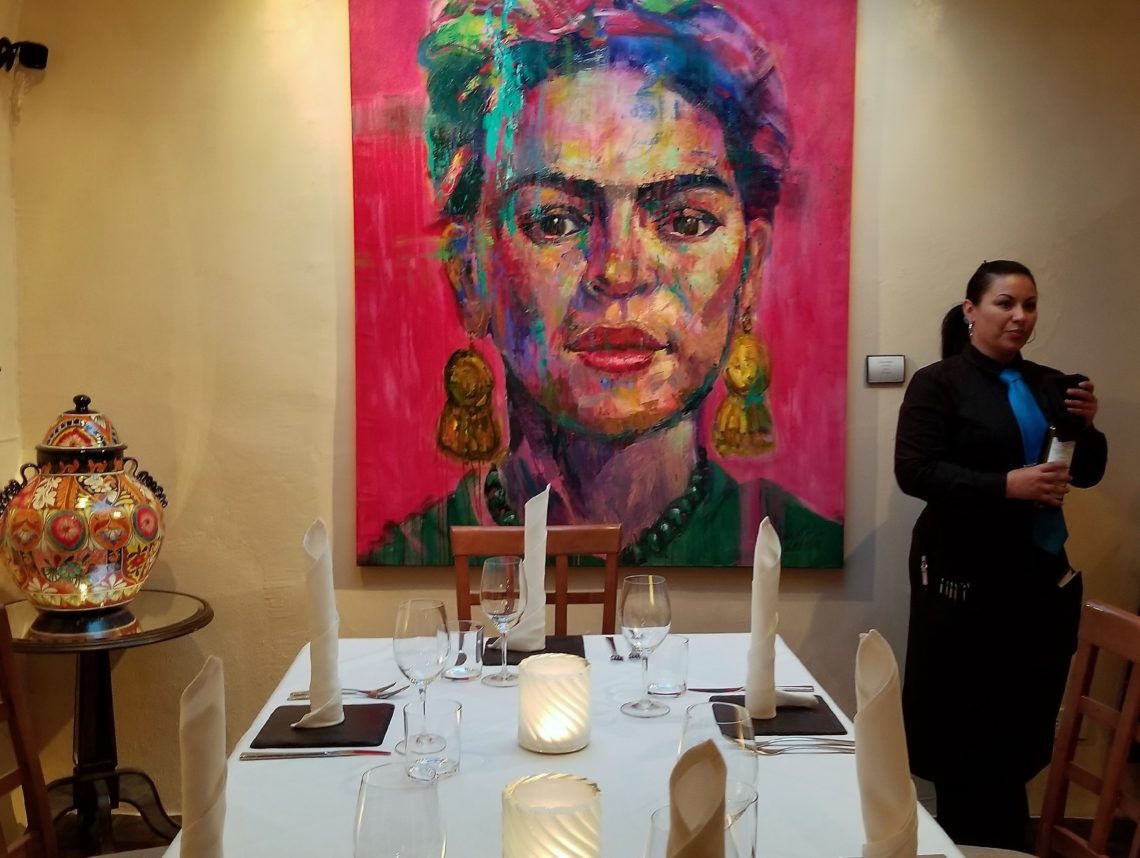
Make dinner reservations at one of the best restaurants in town, and for that matter, the entire state of New Mexico. Sazon and Chef Oleas are known for fine dining in the style of traditional Mexican cuisine, with Sazon recently receiving the Open Table’s Diner’s Choice award and Best top 10 Restaurant in New Mexico. The small menu receives personal chef attention and features locally sourced products.
Overnight at La Fonda on the Plaza, a 4-Diamond hotel known for its history, authentic New Mexican architecture, handcrafted furniture, colorful décor and original art throughout the property and in the guest rooms. Another great choice is nearby Drury Plaza Hotel, known for its large rooms and super-sized amenities. They are especially accommodating for families. A tad farther is the only resort in town, La Posada de Santa Fe. Conveniently located close to the historic Plaza and Canyon Road, this historic AAA Four Diamond Award-winning resort is known as a showcase for original art, adobe-style casitas, pool and a spa.


Day 2
Start the day off with breakfast at a favorite local joint. Tia Sophia’s is known for their breakfast burritos prepared in traditional Northern New Mexico style, with affordable prices and a kid-friendly atmosphere.
Indulge the remainder of the morning in nearby Museum Hill (car needed). Check out the Museum of International Folk Art, Museum of Indian Arts and Culture and the Wheelwright Museum of the American Indian. For the best restaurant views on the hill, stop by for lunch at the Museum Hill Café.
Then head to Canyon Road for a magical half-mile of artisan galleries and mixed-media art and paintings ranging from traditional to modern. Besides fine art and shopping, many of the best restaurants in town are located here. Geronimo and my favorite new entry, Milad Persian Bistro. Word-of-mouth is spreading fast about this restaurant that specializes in Persian cuisine.



Day 3
One of the hottest places to visit that has received international acclaim is Meow Wolf House of Eternal Return. This art installation opened in March of 2016 and feels like an Alice in Wonderland trip. You never know what’s up the fireplace, inside the fridge or behind a closet door. Interactive, colorful, and multi-sensational, hidden discoveries constantly challenge the mind. Great for all ages.
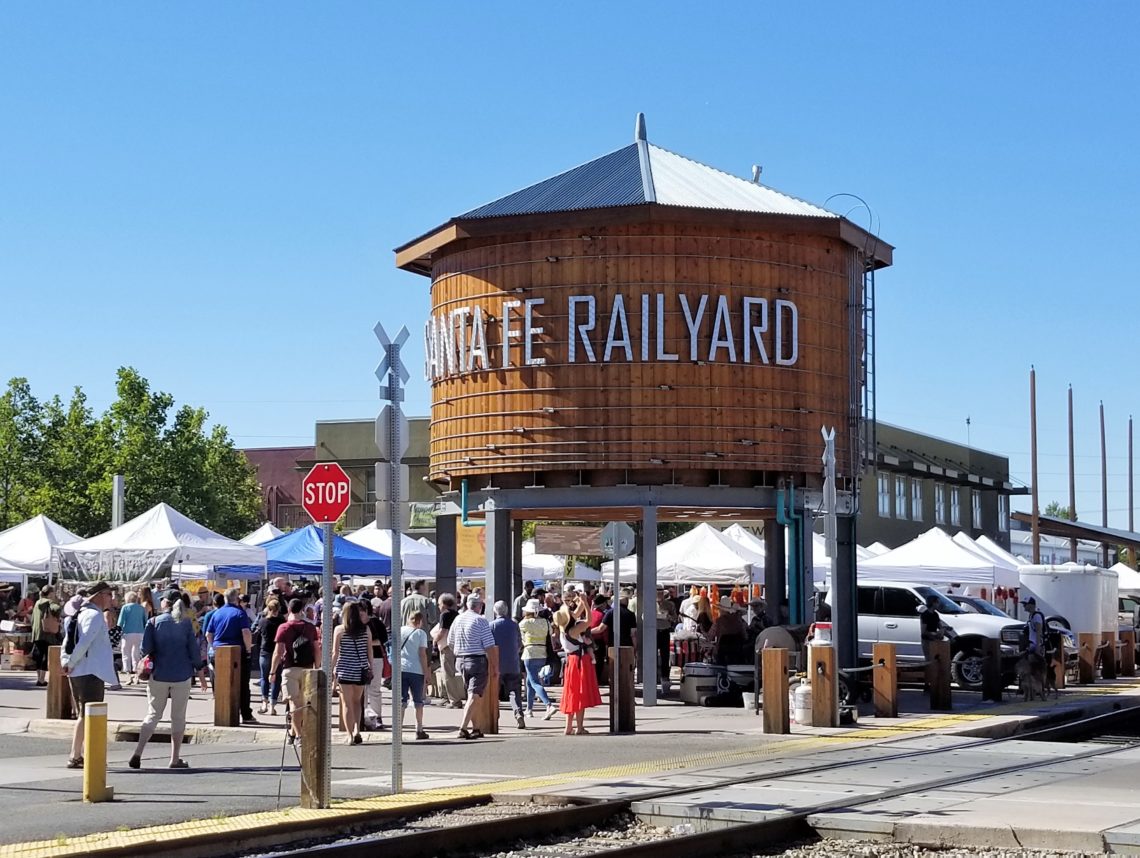
Consider checking out the Santa Fe Railyard for great places to eat like Opuntia Café in the Baca Railyard area. If it’s Saturday, visit the vibrant Farmer’s Market open year-round for great deals on local produce, foods and even chilis.

Other restaurants:
La Plazuela, The Shed, Four Seasons Rancho Encantado’s Terra Restaurant, breakfast at Sweetwater Harvest Kitchen
Festivals all year round
Santa Fe Indian Market, Spanish Market, International Folk Art Market and Santa Fe Opera.
IF YOU GO:
Essential Santa Fe Read More »

WASHINGTON (JTA) — Ron Dermer, the Israeli ambassador to Washington, the keynote speaker at a White House reception for Jewish leaders, lavished praised on the Trump administration.
The event Tuesday was notable because kept off the invitation list were leaders of three of the four major streams of American Judaism. Only leaders of Orthodox Jewish groups were present, although there was one Washington D.C. area Conservative rabbi.
Dermer spoke in praise of the Trump administration and its Israel policy, including moving the U.S. embassy to Jerusalem, withdrawing from the Iran deal, defending Israel at the United Nations and recognizing Israeli sovereignty over the Golan Heights, attendees said.
Rabbi Levi Shemtov, who directs American Friends of Lubavitch (Chabad) spoke about the coming Passover holiday at the reception in the Indian Treaty Room in the Eisenhower Executive Office Building, which adjoins the White House. Elan Carr, the State Department’s anti-Semitism envoy briefed the guests on combating anti-Semitism overseas.
Jared Kushner, the president’s son-in-law, was expected to attend, but was a no-show.
The Reform, Reconstructionist and Conservative movements, whose leaders were not invited, have clashed with the White House on a range of policies, including immigration and President Donald Trump’s rhetoric, seen as fueling bias. The Orthodox movements have been more welcoming of White House policies, particularly relating to Israel, including Trump’s decision to move the U.S. embassy to Jerusalem.
Also not invited was the Anti-Defamation League, the country’s leading Jewish civil rights group. Nor was J Street, the liberal Jewish Middle East policy group, HIAS, the lead Jewish immigration advocacy group, or the Israel Policy Forum, a group dedicated to a two-state outcome to the Israeli-Palestinian conflict. The Simon Wiesenthal Center, another anti-defamation group, also was not invited, although its founder, Rabbi Marvin Hier, delivered a blessing at Trump’s inauguration.
A number of Jewish Trump administration officials attended, including Jason Greenblatt, the lead Middle East peace negotiator.
Among the groups which did make the cut were the American Israel Public Affairs Committee, B’nai B’rith International, EMET, the American Zionist Movement, the Foundation for Defense of Democracies, the Hudson Institute, Hadassah, the National Council of Young Israel, the American Jewish Committee, the Jewish Federations of North America, the Jewish Council for Public Affairs, the Zionist Organization of America, the Alpha Epsilon Pi fraternity, the Coalition for Jewish Values, the Republican Jewish Coalition, Jexodus, the Orthodox Jewish Chamber of Commerce and the Conference of Presidents of Major American Jewish Organizations
Israeli Ambassador Ron Dermer Lauds Trump at White House Reception for Jewish Leaders Read More »

WASHINGTON (JTA) — Official U.S. maps now include the Golan Heights as part of Israel.
Jason Greenblatt, the top White House Middle East peace negotiator, posted a map Tuesday on his Twitter feed.
“Welcome to the newest addition of our international maps system after @POTUS issued a proclamation recognizing Israeli sovereignty over the Golan Heights,” Greenblatt said.
https://twitter.com/jdgreenblatt45/status/1118234058872512518
President Donald Trump in March recognized Israel’s sovereignty over the strategic plateau. Israel captured the heights from Syria in 1967 and annexed the area in 1981.
The Trump administration also has mostly ended the practice of referring to the West Bank as “occupied” and recognized Jerusalem as Israel’s capital, later moving its embassy there.
Official US Maps Now Show Golan Heights as Part of Israel Read More »
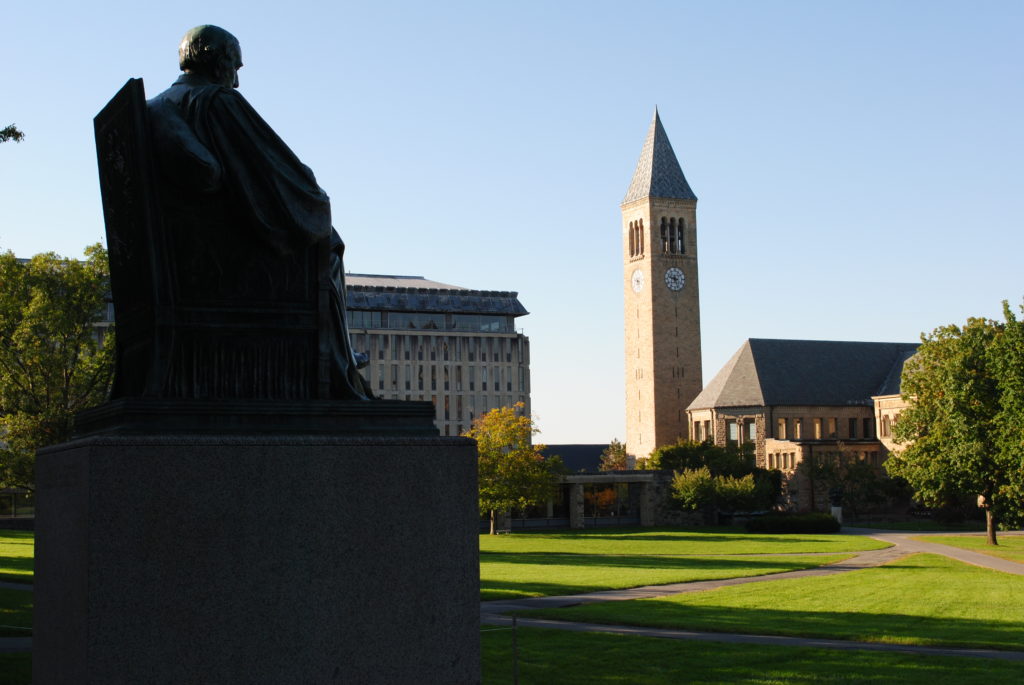
A swastika was discovered a building at Cornell University on April 13.
The Cornell Daily Sun reports that the swastika was found on the Goldwin Smith Hall building in the Arts Quad area on campus; Cornell President Martha Pollack said in a statement to the campus community on April 14 that the anti-Semitic depiction had been on the building “for quite some time.”
“This symbol of hatred, intolerance and anti-Semitism has no place at Cornell,” Pollack said. “While this cowardly act, which is being investigated by the Cornell University Police Department, defaced the physical campus, it will not deter us from our ongoing efforts to build an inclusive, empathetic and loving campus community.”
“We are deeply concerned to learn that a swastika was once again found on Cornell’s campus,” Cornell Hillel wrote in a Facebook post on April 14. “Though it appears the swastika may have been there for some time, its discovery now is no less upsetting. Swastikas are symbols of hate and anti-Semitism; this is an act that should never be tolerated on our campus.”
The Anti-Defamation League New York and New Jersey chapter tweeted, “It is deeply troubling to hear of another swastika incident @Cornell, after 3 more incidents reported last November. We will continue to speak out refuse to allow this to become the new normal. Pleased to see Cornell Police investigating.”
It is deeply troubling to hear of another swastika incident @Cornell, after 3 more incidents reported last November. We will continue to speak out refuse to allow this to become the new normal. Pleased to see Cornell Police investigating https://t.co/oB20HAdFQp
— ADL New York / New Jersey (@ADL_NYNJ) April 16, 2019
In November, three swastikas were found in a span of nine days on Cornell’s campus. Ryan Lombardi, vice president for student and campus life at Cornell, said in a statement at the time, “I vehemently denounce such acts, which are clearly intended to intimidate members of our community. The swastika has historically been – and continues to be – used as a symbol of intolerance, terror and repression against vulnerable communities.”
Swastika Found on Cornell Campus Building Read More »
“My first thought on waking up is: ‘What are the bastards hiding?’ ”
So observed Bob Woodward of The Washington Post, who exposed the Watergate scandal and triggered the resignation of President Richard Nixon by digging up what his administration was trying to cover up.
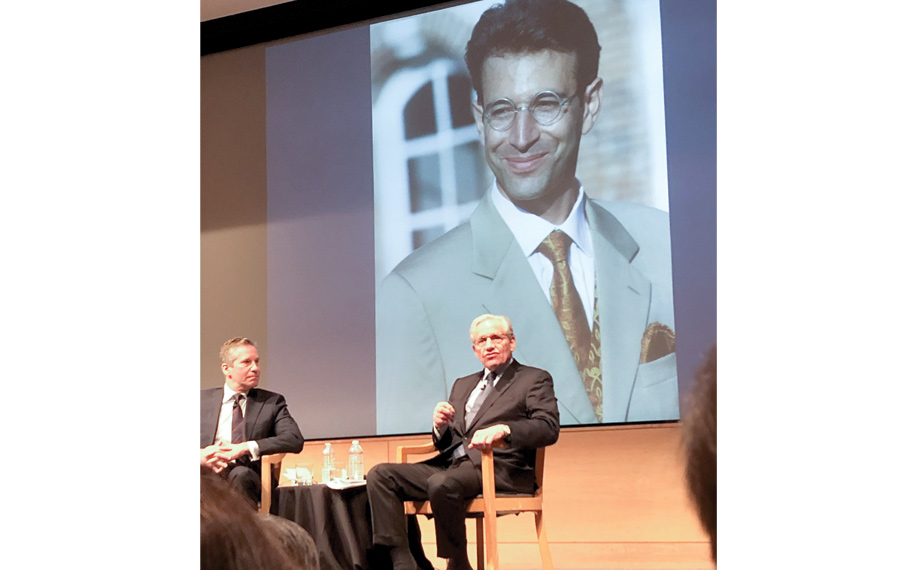
Woodward spoke recently at the Daniel Pearl Memorial Lecture, honoring the life and death of the young Jewish Wall Street Journal reporter, murdered by Islamic extremists in 2002, while investigating a terrorist network in Pakistan.
Over the past 17 years, the annual lecture, under the auspices of the UCLA Burkle Center for International Relations, has drawn an overflowing house as a crash course on the nature and pitfalls of journalism. Presenters have included such illustrious practitioners as Anderson Cooper, Tom Friedman, Ted Koppel and Larry King.
Woodward drew his No. 1 rule for good journalism from Pearl’s report on the devastating 2001 earthquake in India, reprinted in the book “At Home in the World.” As he approached a field littered with victims and noticed the smell of decaying bodies, a nearby fireman called out to him, pointing to one casualty, “Come closer, come closer and you can see his hand.”
Observed Woodward, “That’s the job of a journalist — to come closer and closer — and Danny Pearl was a master of details.” So was Carl Bernstein, Woodward’s partner in breaking the Watergate story. “Carl used to push every story to the final second of his deadline, because he felt that he never knew enough,” Woodward said.
Woodward was introduced by Los Angeles Mayor Eric Garcetti and by Daniel Pearl’s father, UCLA professor emeritus Judea Pearl, a computer scientist and considered a world-class authority on artificial intelligence.
“My first thought on waking up is: ‘What are the bastards hiding?’ ” — Bob Woodward
Although many people have written off journalism as a form of politics, Judea Pearl countered that good journalism was more important than ever. That is particularly true because “we are under siege by President [Donald] Trump and we cannot stay on the defensive,” said Woodward, whose recent book “Fear,” which is sharply critical of the White House atmosphere, has been denounced by Trump as “fiction.”
Woodward’s formula for bringing journalistic reports closer to the reader is the old-fashioned practice of speaking to interviewees face-to-face, preferably in their own homes.
For instance, as part of one investigation, he knocked on the door of a private home to talk to the four-star general inside. The general was unenthusiastic, asking Woodward, “Are you still doing this s—?” but Woodward got his interview.
In another case, the reporter called a source at 11 p.m. and when the official objected to the late hour, Woodward said he lived nearby and could be at his house in four minutes. “How do you even know where I live?” the agitated official demanded, but after Woodward showed up, the interview stretched into the dawn of the following day.
Granted, this journalistic method demands a certain amount of chutzpah and self-confidence, but gets better results than the interaction with journalists preferred by big shots.
“If you send an email to the White House saying you want a response, you will get four press secretaries trying to figure out how to write a statement that doesn’t mean anything,” Woodward said.
Here are some samples of Woodward’s advice to aspiring or practicing
journalists:
Step back from political food fights.
Don’t think too highly of yourself.
Show that you are really interested in what the other person is saying.
Don’t despise your enemies — they, too, have a human face.
Don’t speak or write with too much certainty.
To illustrate the last rule, Woodward cited his reaction to President Gerald Ford, when he swiftly pardoned his predecessor, the disgraced Nixon.
The general reaction in the media was that Ford’s move was based on some kind of corrupt bargain and would forever damage his reputation. Some 45 years later, Woodward was working on a book on the legacy of Watergate and asked Ford why he had sabotaged his own career by pardoning Nixon. Ford responded that he knew what the consequences would be of a trial that would split the country for months or years and obliterate any hope of healing the nation.
That reason, Woodward said, “was the very opposite of my earlier conception and I couldn’t get it out of my head. It took me 45 years” to revise his initial judgment.
For that reason, he concluded, “Before writing ‘Fear,’ I read everything about
what Trump had done in the first 18 months in office. I knew I couldn’t wait another 45 years to correct any mistake I might have made.”
Bob Woodward on the Power of Journalism Read More »

Writer-director Jeff Lipsky knows that some audiences may view him as an apologist for Nazis. Indeed, in his film “The Last,” the central character, Claire (Rebecca Schull) is its spokesperson. She is a 92-year-old unrepentant German-born Nazi, defending herself with conviction. She is also terminally ill and plans to take her own life, but does not want to die without revealing the truth. The twist here is that she has lived her life as a Jew.
“My challenge was to give her a backstory that was unimpeachable, so that any question an audience might have, she has answered,” Lipsky told the Journal in a phone interview. “I am not trying to make a Nazi sympathetic, but rather I’m asking audiences to put themselves in her shoes. Given her circumstances, I defy anyone who is being honest with themselves to say they would have behaved differently.”
“The Last,” Lipsky’s seventh indie film, is a multigenerational Jewish family drama awash in theological and philosophical discussions that explore how each member of the family responds to Claire’s shocking confession. There’s her great-grandson Josh (AJ Cedeño), a modern Orthodox Jew; Josh’s Catholic-born wife, Olivia (Jill Durso), a Jewish convert; Claire’s nominally observant granddaughter Melody (Julie Fain Lawrence); and Melody’s husband, Harry (Reed Birney), an agnostic.
Lipsky, whose films frequently focus on families in crisis, said “The Last” was a departure in its autobiographical inspiration: Lipsky’s nephew, like Josh, is a modern Orthodox Jew, and his Catholic wife is a convert to Judaism and a more committed Jew than virtually anyone else in the family. Lipsky felt there was a story there that cried out to be told.
He also wanted to chronicle a family dating back to the Holocaust. After reading a feature in the paper about someone discovering that his grandfather was a Nazi, Lipsky found his narrative linchpin.
They later admitted it was disturbing for them to see a sympathetic character voicing such terrible thoughts. I hope audiences can see Claire’s irrational, virulent anti-Semitism for what it is. And maybe it could even help inform them on what’s going on now.” — Rebecca Schull
Lipsky also decided to incorporate historical figures into his chronicle, which led him to Dr. Carl Clauberg, a German gynecologist who conducted medical experiments on Jewish women at Auschwitz. In the film, Clauberg becomes Claire’s mentor, lover and savior.
“For her to reverse her philosophy, even decades later, would represent a rejection of Carl [and her] mother,” Lipsky said. “She’d view it as an act of cowardice. She is no more able to abandon them than she is her new family, whom she has raised as Jews and loves just as much.”
Still, the question remains: Why did she pose as a Jew to begin with and maintain the disguise for more than half a century?
“Survival,” Lipsky said. “It was the only way she could get into America, and then she assimilated herself into a New York community of Jews.”
Schull, 90, told the Journal in an interview at her apartment on the Upper West Side of Manhattan that she might have hesitated about tackling the role more than she did if Lipsky weren’t Jewish.
Best known for her seven-year stint (1990-97) as Fay Cochran, the genial ticket agent on the sitcom “Wings,” Schull said, “I might have been suspicious that [Lipsky] was expressing some deep-seated feelings he couldn’t express otherwise. Jeffrey’s intention was certainly not to stir up anti-Semitism.”
Nonetheless, as a Jew who hailed from a fervently Zionist home and raised her three children Jewish, she was conflicted.
“There was some kind of leap that I had to make,” she said. “Claire is horrible, but she is a demanding role and I was intrigued. It’s my profession.”
In learning her lines, Schull said she found a way to make Claire sound intelligent, reasonable and spontaneous. “She tells her life’s story, and if you just keep repeating what she’s saying, her thinking becomes part of you,” she said.
At a recent screening of “The Last” at the Jewish Community Center in New York, responses were generally positive, with audience members citing the film’s risk-taking originality and Schull’s extraordinary performance.
Still, Schull recalled a couple of friends who remained silent. “I can take criticism,” she said, “but to say nothing, is wrong. They later admitted it was disturbing for them to see a sympathetic character voicing such terrible thoughts. I hope audiences can see Claire’s irrational, virulent anti-Semitism for what it is. And maybe it could even help inform them on what’s going on now.”
Said Lipsky: “You can love the film or hate it, but if it challenges audiences to discuss it and ideally never forget it, then it has done what it’s supposed to do. I’d like moviegoers to leave the theater believing that even when things seem clearly black and white, there are shades of gray.”
“The Last” opens April 26 at the Laemmle Royal, 11523 Santa Monica Blvd., Los Angeles; and the Town Center 5, 17200 Ventura Blvd., Encino. Lipsky and Schull will participate in Q&A’s after the 4 p.m. and 7:10 p.m. screenings on April 26 at the Royal, and after the 4 p.m. and 7 p.m. screenings on April 27 at the Town Center 5.
Simi Horwitz is a New York-based feature writer and film reviewer.
A Nazi Woman Lives as a Jew in ‘The Last’ Read More »
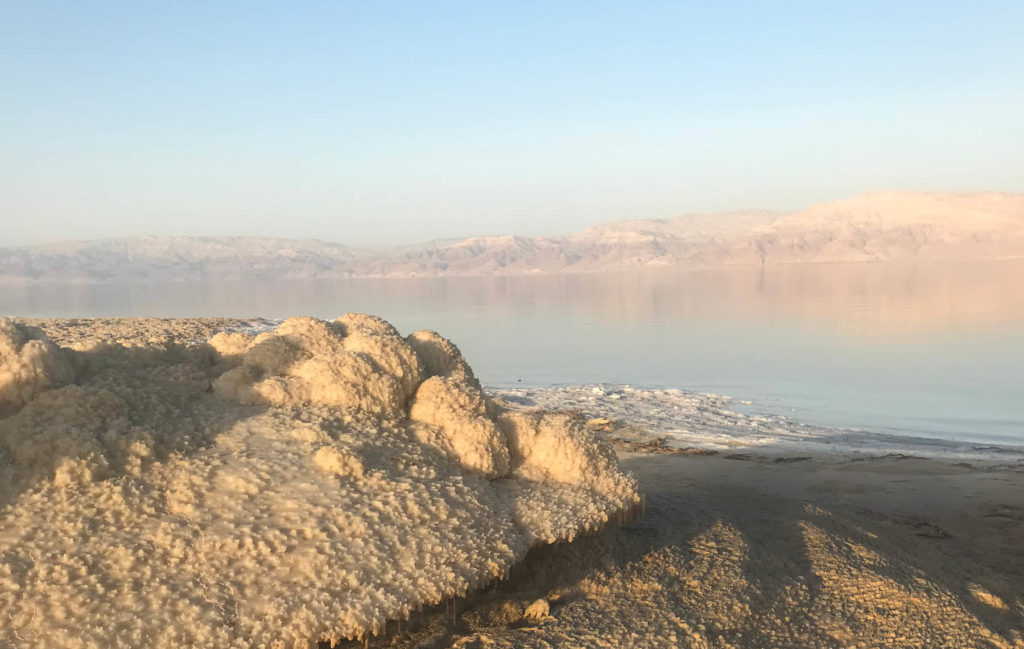
The Dead Sea is dying. Because of drought and rising temperatures caused by global warming, its waters are receding and its shores are pockmarked by more than 6,000 sinkholes. Scientists and engineers have come up with a plan to save it and supply crucial water to the region, but it will require the cooperation of Israel, Jordan and the Palestinian Authority. And complicated ecological, scientific, financial and geopolitical issues may thwart it from becoming a reality. The PBS “Nova” documentary “Saving the Dead Sea” outlines the problem, the solution and what it will take to implement it.
In the proposed Red Sea-Dead Sea Conveyance Project, a desalination plant will be built in southern Jordan on the shores of the Red Sea, and the leftover brine from the process will be transported to the Dead Sea to raise its level. Scientists estimate that it will require 200 billion gallons of brine annually to stabilize the Dead Sea’s decline. Jordan and the Palestinian Authority will get more drinking water, too, from the Sea of Galilee and the existing Israeli water system. The estimated cost of the project is $10 billion.
First, there are ecological ramifications to consider. The chemistry of the two seas is very different, and mixing the water from them could alter the Dead Sea’s salt content and mineral composition. There is concern about how the desalination plant might affect coral reefs in the Red Sea, and what might happen to Israel’s fresh water aquifer if there’s an earthquake. It’s also an insurance issue. Who would pay for such a disaster?
But first the $10 billion must be raised. “The World Bank is the funding agency for the project and they need to raise the money from United Nations member states. Then the plant and the pipelines need to be built. It will take years,” producer Avner Tavori told the Journal.
Tavori, who grew up in Haifa, recalls driving down to the Dead Sea when it looked very different from today. “The sea reached all the way to the road. Now it’s almost a mile away and the area between is filled with sinkholes,” he said. “There’s no tourism in the northern part anymore. The area looks like a war zone.”
The ecological catastrophe can be blamed in part on human interference. In the 1950s, Israel diverted water from the Sea of Galilee to irrigate the desert and supply cities with drinking water. “Nobody thought about what it would do to the Dead Sea,” Tavori said. “We think we’re doing something good, but it wasn’t the case. It’s a lesson in consequences.”
“If people don’t have water, they fight. They go to war over water. This is a whole Middle East problem and the only way it can be solved is if the people in the region work together.” — Avner Tavori
Today, with the supply from the Galilee and desalinated water from the Mediterranean Sea, “Israel really has enough water,” Tavori said. “Jordan doesn’t and with the increase in Syrian refugees, it’s getting worse and their aquifer is on the verge of collapse. They really want this desalinization plant. The Palestinians don’t have any access to water because Israel controls the road to the Red Sea. They are in it to be the third party — the World Bank requires more than two countries to qualify for the funding. Geopolitically, it’s very complicated.”
Tavori pointed out that access to water was one of the issues in the 1967 Six-Day War. “If people don’t have water, they fight,” he said. “They go to war over water. This is a whole Middle East problem and the only way it can be solved is if the people in the region work together.”
Filmed last spring in Israel and Jordan, “Saving the Dead Sea” includes interviews with geophysicists, chemists and hydrologists from the water ministries of Israel, Jordan and the Palestinian Authority. All agree that the region’s water problems are severe, but some worry about the risks.
“We have to address things wisely,” the Palestinian Authority’s former water minister Shaddad Attili said. “We have to address the consequences of climate change. We have to address also the consequences of human intervention.”
Whether the project is implemented, “We will never get the Dead Sea back to what it used to be, but we can do things in the short term to stop the decline,” Tavori said. “There has been talk in Israel about flipping the direction of the water in the [existing] National Water Carrier. Instead of taking water out of the Sea of Galilee, water would go into it and it would become a reservoir. The infrastructure is there.”
As it stands now, “Based on the existing peace agreement, Israel is obligated to give Jordan water from the Sea of Galilee, which it is doing,” Tavori said. “Israel has also pledged to give water to the Palestinians through the existing pipelines. Under the new plan, the amount will be doubled and Israel is updating the infrastructure with bigger pipelines that will connect the Galilee and Jordan. The current pipes are old and have leaks and it’s not enough for what they need, but it’s helpful.”
Based in New York since 1986, Tavori was a journalist who segued into working for the political campaigns of Shimon Peres and Yitzhak Rabin, and was appointed Rabin’s press secretary for Israel’s mission to the U.N. He got into documentary filmmaking after meeting his wife, Terri Randall, “Saving the Dead Sea’s” writer-producer.
Tavori hopes that the documentary will create better understanding of the ecological and geopolitical issues involved in saving the Dead Sea. “If water from the Red Sea gets to the Dead Sea and doesn’t destroy it, the level will stabilize over time,” he said. “But with the population of the region going to quadruple in 50 years, who knows? That’s the big question.”
“Saving the Dead Sea” premieres April 24 on PBS’ “Nova.”
Environmental and Political Issues Complicate ‘Saving the Dead Sea’ Read More »
