fbpx

April 16, 2019

Tree of Life Invites Teens to Decorate Temporary Fencing Around Building

(JTA) — Pittsburgh’s Tree of Life congregation is inviting teen artists to create “uplifting images and graphics” to print on windscreens to be hung on the temporary fence surrounding the building while it undergoes repairs in the aftermath of the deadly shooting there in October.

Artists aged 13-17 from around the world have been invited to take part in a project titled “#HeartsTogether: The Art of Rebuilding.”

The building was heavily damaged in the attack by a gunman that killed 11 worshippers from the three congregations that were meeting in the building on a Shabbat morning.

It is not known when the building will be ready to be used again for worship, the congregation said in an announcement of the young artists project.

“The intention of #HeartsTogether is to transform the temporarily vacant and dismal site into a thing of beauty,” the announcement said. “It will reflect the strength and positivity that well-wishers shared with us in our darkest days. It is one way we are beginning to give back.”

The synagogue said it was “Impressed by how many young people reached out to us in the wake of our tragedy.”

All the submissions will be displayed in an online gallery on the synagogue’s website.

The synagogue requested that all submissions be “positive and reflect an appropriate theme along the lines of love, unity, strength, inclusiveness, healing, gratitude, kindness, community, diversity, faith, hope and compassion.” The artists are asked to not use the words “hate” or “hatred.”

“The sidewalk gallery is our way of saying ‘thank you’ to our first responders and local and global neighbors who showed us so much love in the wake of the assault on our synagogue building,” the congregation said in a statement posted Monday on Facebook.

Tree of Life Invites Teens to Decorate Temporary Fencing Around Building Read More »

Brooklyn Yeshiva Preschool Shut Down Over Measles Vaccination Violations

(JTA) — New York City closed a Brooklyn yeshiva’s preschool for defying a Health Department order to provide medical and attendance records regarding measles vaccinations.

The preschool at the United Talmudical Academy in the largely haredi Orthodox Williamsburg neighborhood is the first yeshiva program to be shut down by the city since Mayor Bill de Blasio declared a public health emergency over the measles outbreak in Brooklyn’s haredi community earlier this month.

De Blasio ordered unvaccinated people living in four ZIP codes in the Williamsburg neighborhood to get the vaccine or be required to pay fines of up to $1,000. As of Monday, New York City has confirmed 329 measles cases, nearly all in Brooklyn, since the outbreak began in October.

The preschool serves 250 students aged 3 to 5, according to The New York Times.

The Department of Health threatened to fine or even close yeshivas in Williamsburg if students who are not vaccinated against measles are allowed to attend classes. The department has issued 23 violations to yeshivas and day care facilities in connection with unvaccinated children or not complying with records requests, according to The Washington Post.

Also Monday, a group of Brooklyn parents filed a lawsuit in Kings County Supreme Court in Brooklyn against the mandatory measles vaccination order.

Brooklyn Yeshiva Preschool Shut Down Over Measles Vaccination Violations Read More »

Live Free – Thought on Shabbat HaGadol 2019 – Rabbi Mordecai Finley

Live Free

Thought for Shabbat Ha-Gadol

Here is the bad news: what the Jewish tradition means by “freedom” and what we mean by “freedom” are two different things. When we think of freedom, we think of freedom from government interference in our rights to life, liberty and the pursuit of happiness. We think of freedom from unreasonable coercion and restrictions. We think of being a free people, free to vote for or against our government, and being free to express ourselves.

Freedom in our tradition means something fundamentally different from the liberal conception of freedom. The liberal conception of freedom from tyranny is rooted in the idea that a free people can choose, within rational limitations, how to live their lives.

Passover is referred to “z’man heiruteinu” – “the time of our freedom” freedom from the tyranny of Pharaoh. The similarity ends here. According to the Bible, we were freed from Egypt not so that we could decide our own fate, but so that we could be free to serve God. Serving God includes the moral commandments, often the focus on liberal Judaism, and the ritual commandments, often the focus of more traditional Jews. Neither group, I would stress, neglects the other kind of commandments. Just each one tends to stress either the moral side (commandments between one person and another) and the other, the ritual side (commandments between a person and God.)

Neither group, those who focus on the moral commandments or those who focus on the ritual commandments, would say we are free, in some kind of metaphysical sense, to violate the law. We might be free from the King of England, but we are not free from the Sovereign of the Universe. A liberal Jew, who focuses on moral responsibility, would not say you are free to discriminate in employment, even if within the law. An Orthodox Jew would certainly not say that you are free to break the laws of the Sabbath. Of course, you are politically free to do so in America, but you are not free, in some metaphysical sense.  Metaphysically, you are obligated.

Judaism is essentially a system of obligations, not rights. Judaism, from its traditional sources, can certainly accommodate the modern liberal state (liberal, in the sense of the focus on liberties), but its focus, nevertheless, is on obligations, not freedom as liberty.

How does this apply to us?  First, and obviously, we are morally obligated to work for political freedom, in other words, to “establish justice throughout the land.”  The inner life tradition would have us add a focus on our own behaviors, not just the oppressive behavior of others. Think about acting in anger, resentment, and holding grudges. Think about acting reactively and defensively, where feelings and emotions produce negative behavior. Think about acting from fear. Think about favoring someone because you feel sorry for them, not based on any rational thought. Think about losing empathy for someone. Think about deciding not to fulfill a promise.  Look around you. Do you know anyone who is free? Yes, we are free politically, for example, to choose whom we vote for. But in some cases, spiritually and morally, we are not free at all. Our choices seem foisted on us by inner forces that choose for us.

I have seen relationships ruined, families torn apart, friendships ended, by anger, criticism, complaining, condemning, conflict and defensiveness  – because of a lack of inner freedom to act morally and mindfully. Once people fully admit how their bad thinking or negative feelings and emotions cripple them, they realize how not free they are.

Here is the good news:  Once we focus on being a moral– acting in accord with the moral law in Judaism, for example –  we start to get a sense of inner freedom. It is not about what they do; it is about the kind of person we want to become. We can choose to let go of anger, raging, criticizing, complaining, condemning, accusing, blaming, labeling and defensiveness. We can choose not to accept fear or seeking approval as a way of dealing with the world. We can choose to focus on what is right, true and good.  Anything to be worked out can usually be worked out mindfully, kindly or assertively, as the case may be. We can let go of the slavery of toxic thinking, feeling, speaking and acting.

People of the world doing inner work, unite! Break the chains of destructive patterns and breathe. Feel the freedom.

 

Live Free – Thought on Shabbat HaGadol 2019 – Rabbi Mordecai Finley Read More »

More Gang Members Arrested in Attack on Argentina’s Chief Rabbi

BUENOS AIRES, Argentina (JTA) — Three gang members suspected of being involved in the home invasion attack on Argentina’s chief rabbi were arrested in three raids in the Greater Buenos Aires area.

Buenos Aires city police also recovered objects belonging to Rabbi Gabriel Davidovich, including a pen with Hebrew words in a box labeled “Jerusalem,” money and jewelry matching the description of items that the rabbi said were stolen from his home.

The arrests took place on Monday night.

“Now with the today’s three detainees we have arrested the whole gang. It is great work by the city police,” Diego Santilli, Buenos Aires City minister of security and vice mayor, told the state news agency Telam. The gang leader was among those taken into custody in the latest raids.

Buenos Aires police tweeted photos of the recovered money and personal items.

The February attack left Davidovich with serious injuries, including nine broken ribs and a punctured lung.

The attack is not being treated as a hate crime, and reports have indicated that it was a revenge attack arranged by a prominent member of the Jewish community involved in a divorce case adjudicated by the rabbi.

Davidovich also says he’s not sure if the home assault was anti-Semitic, despite hearing the assailants shout “We know that you are the AMIA (Jewish center) rabbi” during the attack.

His wife was home during the Feb. 25 attack, which took place at approximately 2 a.m. in the Jewish neighborhood of Once in the Argentine capital.

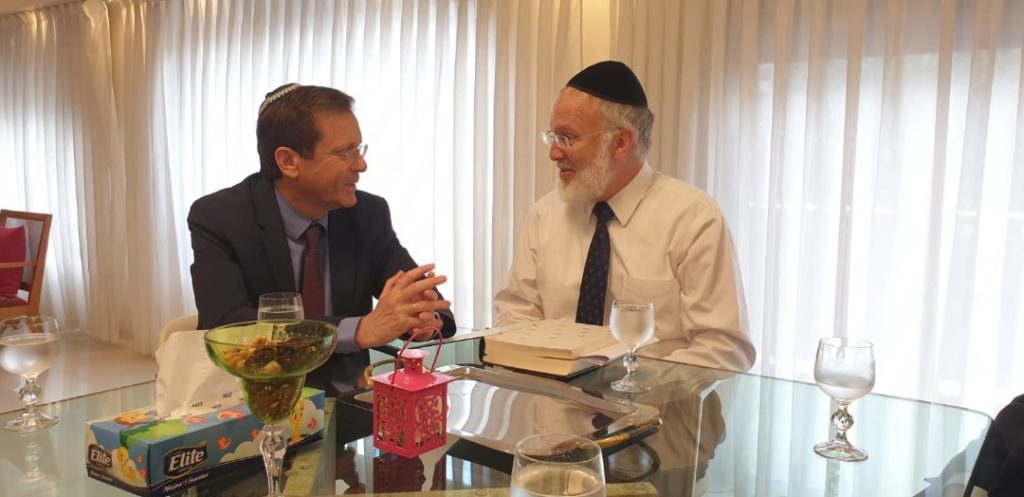
The rabbi reappeared in public one month after the attack in a meeting with the head of the Jewish Agency, Isaac Herzog.

Two members of the gang were captured one month ago. Fingerprints found on one of the windows of the rabbi’s house were the key to identifying some of the members of the gang. City cameras also helped to identify three vehicles used by the attackers.

Davidovich has served as chief rabbi since 2013. The office of the rabbinate is located in the AMIA Jewish center building in Buenos Aires.

More Gang Members Arrested in Attack on Argentina’s Chief Rabbi Read More »