fbpx

April 16, 2019

A Remarkable Life: From Arab Sahara to Jewish Los Angeles

As I read Ed Elhaderi’s powerful memoir — “Nomadic Soul: My Journey From the Libyan Sahara to a Jewish Life in Los Angeles” — I kept hearing the words God said to Abraham, our Biblical father: Lekh lekhah, “Go forth from your land, the land of your birth, the house of your father to the land that I will show you.” A Chasidic master once pointed out that the phrase lekh lekhah, ordinarily translated as “go forth,” has a more literal meaning: lekh means to go or walk, and lekhah means “unto yourself” or “for yourself.”

Elhaderi’s journey outward is also a journey inward. As he discovers a new land and language, a new world and people, a new sense of inner tranquility and direction, he also goes on an inner journey of discovering how to stitch together the world from which he came — the rural, primitive, poor village in Libya of the 1950s and early 1960s — with the world in which he now lives, as a Jew-by-choice in Los Angeles.

I must confess that I thought I knew Elhaderi. We attend the same synagogue each week and greet each other as friends. He is always respectful and courteous, even a bit shy. It is apparent his manners were shaped by a different culture, one more traditional than the avant-garde world of the city in which we live. But the more I read of his life, the more I understood that I had only glimpsed the surface of his story and the length of his journey.

Elhaderi was raised with little contact with the outside world. His family occasionally read newspapers and books, but they had no television and limited access to radio broadcasts. His world was oral — words were spoken, stories were told.

In his book — written with the critically acclaimed memoirist Tom Fields-Meyer of Los Angeles — he is able to convey that world, to depict his distant father and his loving mother, his extended family and his brother, the friends that shaped him and the restrictions of that world.

Elhaderi’s work reminds us of how diverse the Jewish community is today, how many stories we have to tell, and how in our synagogues and communities we must remember to discover one another.

Education offered him an opportunity. His intellect took him from his village to the big city and ultimately to the United States. Libyan leader Muammar al-Qaddafi wanted to transform his country and bring it into the modern world, so he invested in the education of his most gifted youth. The nonathletic and lower-class Elhaderi took advantage of the opportunity by studying at the University of Tripoli and then pursuing a doctorate at the University of Wisconsin, Madison. Qaddafi believed that the young people like Elhaderi who were now educated would return home, but education changed Elhaderi, making him realize that he could not return to the land of his birth and the house of his father.

In Libya, Elhaderi had been raised to distrust Jews, even to despise them, though he never met one. Nearly all of Libya’s Jews had left after Israel achieved statehood in 1948, but after Israel’s decisive victory in the Six-Day War, anti-Jewish and anti-Zionist sentiment (one and the same in Libya) intensified. Raised in that atmosphere, Elhaderi came to the United States and almost immediately experienced cognitive dissonance between the Jews he was taught to hate and those he encountered in his university’s classrooms and laboratories. They were accomplished men and women, gifted and dedicated teachers, helpful colleagues, not the horned monsters he had been led to expect.
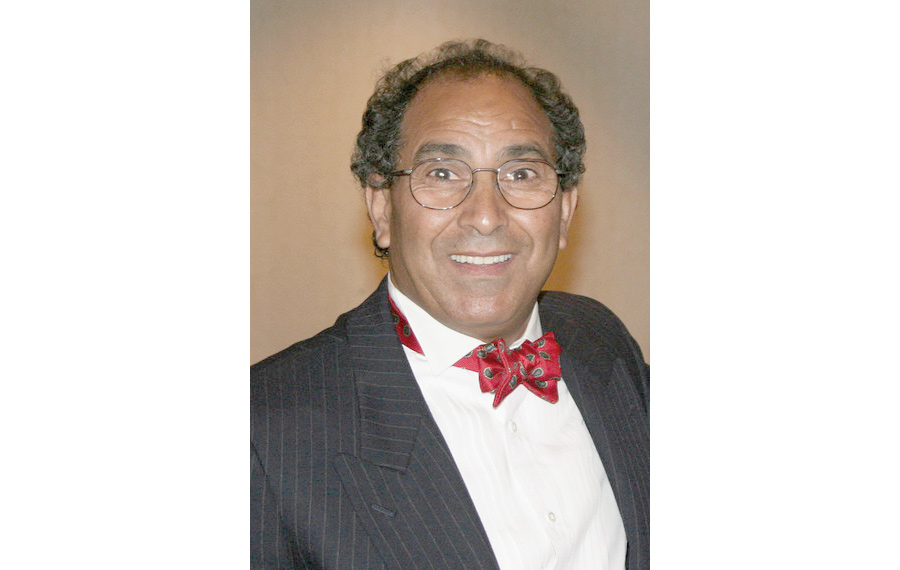
Author Ed Elhaderi

He was smart enough and hard-working enough to succeed in his education, and open enough to let his journey take him where it was to take him — to encounter the enemy as a person. That courageous openness transformed his life in ways he could not have imagined, in large part because he encountered a Jewish woman who was equally open to him, and a rabbi and a community that welcomed him with open arms. 

William James in his “Varieties of Religious Experience” distinguishes between the “once born” and the “twice born.” My Judaism is that of a “once born,” a natural inheritance from my parents and theirs before them; a tradition transmitted to me by teachers and community, from my land, the place of my birth, and the house of my father. Jewish tradition was the first language of depth that I encountered; the melodies of my childhood were deepened by the adult sensibilities I have developed. At times, particularly in those moments when the theology of the prayers I recite challenges the world I inhabit, I return to the native belief of my childhood, suspending disbelief, at least for a time.

Elhaderi is a “twice born” — at least a twice born; perhaps many more times than that. He stands at a distance from his childhood, the world of his youth, the community and tradition that shaped him. He came to Jewish tradition and to the Jewish people as an adult, already with a family and a sense of self. He experienced that community and that tradition as the goal of a long journey. He encountered it as transformation and not just continuity.

The Talmud wisely states that “In the place of one who returns” — teshuvah means repentance but more basically return — “even the righteous cannot stand.” I am certainly not righteous but I am deeply indebted to Elhaderi, whose story has enriched my experience and deepened my community. I cherish him as a man and revere the place where he stands.

Elhaderi’s work reminds us of how diverse the Jewish community is today, how many stories we have to tell, and how in our synagogues and communities we must remember to discover one another. I know for certain that we will be enriched by that encounter.


Michael Berenbaum is director of the Sigi Ziering Institute and a professor of Jewish Studies at American Jewish University.

A Remarkable Life: From Arab Sahara to Jewish Los Angeles Read More »
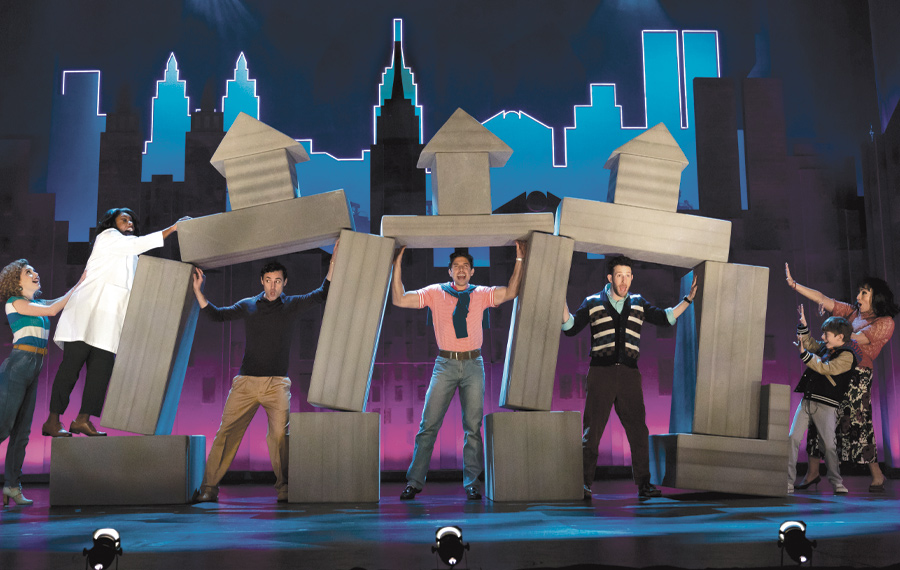
‘Falsettos’ Explores What it Means to Be Jewish

Themes of love, loss, the AIDS crisis and family bonds blend together in the musical “Falsettos,” about a gay man, his ex-wife, their young son and their new partners. But with songs including “Four Jews in a Room Bitching,” “Miracle of Judaism” and
“Jason’s Bar Mitzvah,” it also explores what it means to be Jewish. The national touring company production is now playing in Los Angeles at the Ahmanson Theatre.

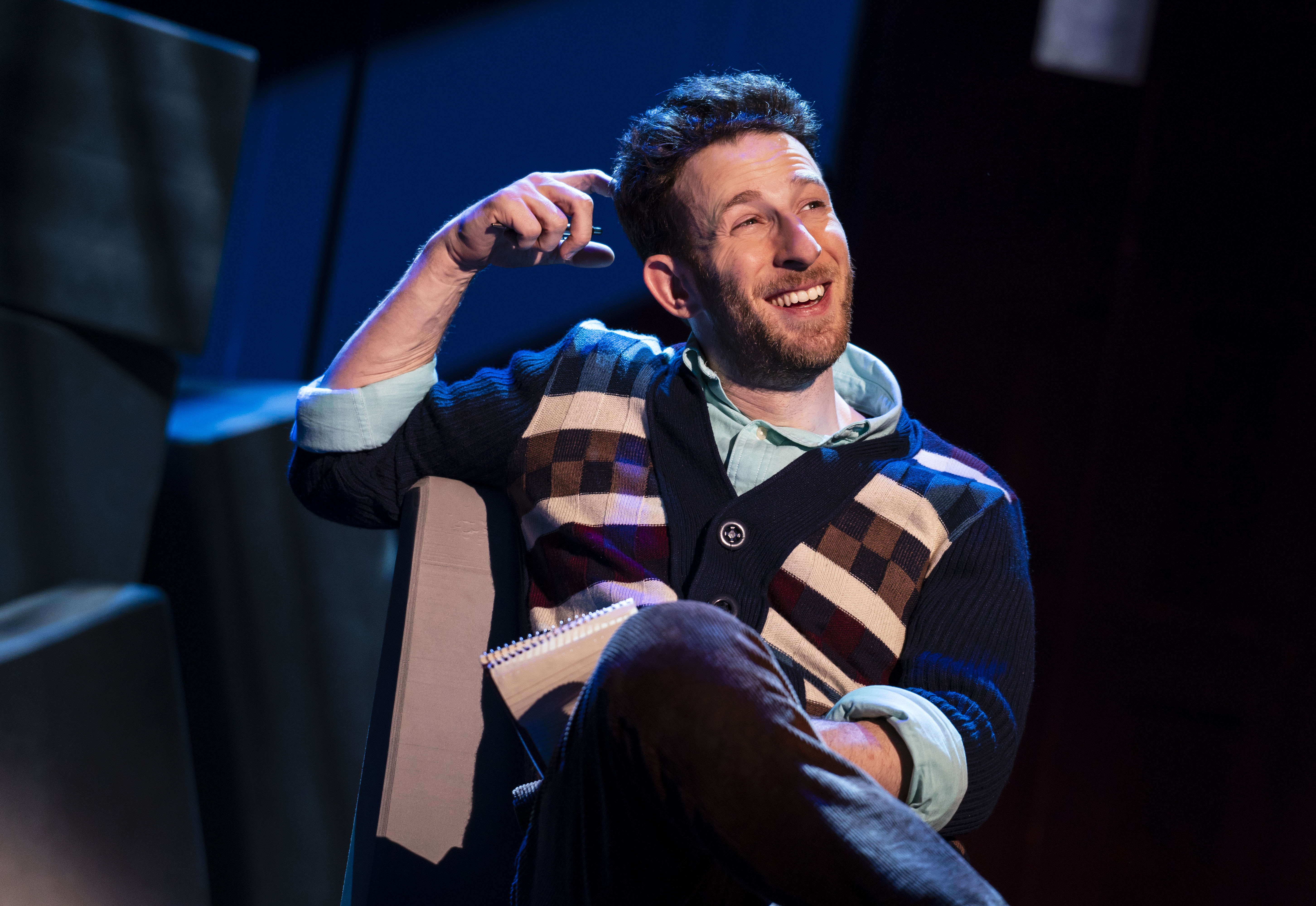
“I relate to the Jewish cadences and culture references in it and I think that the way Judaism permeates the show is so honest,” Nick Blaemire, who plays psychiatrist Mendel Weisenbachfeld, told the Journal. “It does a great job of telling everybody’s story from a Jewish perspective. It begins with the kitschy stereotype of ‘Four Jews in a Room Bitching’ and then it ends with the most beautiful, heartbreaking, entirely human and grounded bar mitzvah I could possibly imagine. It’s a profound intersection between religion and love.”

For Blaemire, a theater veteran who played Jewish “Rent” playwright Jonathan Larson in “Tick…Tick…BOOM!” and the Jewish member of a Christian boy band in “Altar Boys” on his first national tour, “Falsettos” has brought him closer to Judaism.

A self-described “lapsed Jew,” he had a crisis of faith when a close family friend died at the age of 13. “It turned me into a more secular Jew,” Blaemire said, and he didn’t go through with his bar mitzvah. “I’ve always identified with the culture but I’ve had some shame about where I fit into it,” he said. “But this has been a very Jewish year for me. This show coming into my life has been such a gift. In a way, I feel like I got my bar mitzvah at 34.”

Blaemire finds a lot to relate to in his character, Mendel. “While I don’t agree with his ethics to a certain degree, I understand the choices he makes and what he’s going through and the loneliness that motivates the actions that he takes,” he said. “I also admire the stepfather that he becomes. My wife and I are talking about having kids and I’m trying to fathom what a big thing that is and how big an influence you can have over a young person’s life.”

Debuting on Broadway in 1992, “Falsettos” won Tony Awards for its book by William Finn and James Lapine and music and lyrics by Finn. But the show’s genesis dates back several decades to their trilogy of one-act musicals, “In Trousers” in 1979, “March of the Falsettos” in 1981 and “Falsettoland” in 1990. They combined the latter two plays into one two-act show that takes place two years apart, in 1979 and 1981.

“I’ve always identified with the culture but I’ve had some shame about where I fit into it. But this has been a very Jewish year for me. This show coming into my life has been such a gift. In a way, I feel like I got my bar mitzvah at 34.”

 — Nick Blaemire

“It’s a pretty unparalleled piece of writing,” Blaemire said. “It speaks to an issue that we’re still dealing with today in a profound way. It describes a nontraditional family in a way that breaks the idea of what a family is. The setup is crazy: gay Jewish man leaves his wife for another man, his therapist falls in love with his wife and they try to create a family. It’s a proxy for all of our own individual experiences. There is no ‘normal,’ and it’s been proven so beautifully in this show. I’m constantly looking for things that challenge me and this is like a New York Times crossword puzzle. It’s so intricate and so subtle. It’s the gift that keeps on giving.”

Born in Washington, D.C., to a Jewish mother and Methodist father, Blaemire grew up in a Reform “Jewish bubble” in Bethesda, Md., where he started taking theater classes before he was in kindergarten. He continued acting in plays all through school and college at the University of Michigan. “I’ve been obsessed with theater since I discovered it,” he said. “I wasn’t a particularly social kid, and didn’t fit in. Make believe was the avenue that helped me find friends and find myself in a very supportive community. And in a lot of ways, I feel that I’ve found my connection to Jewish culture through theater.”

Nick Blaemire, from the First National Tour of “Falsettos,” which will play at the Ahmanson Theatre. Photo by Joan Marcus.

The Brooklyn-based actor has appeared on TV in “The Good Wife,” “Law & Order,” and the new “Fosse/Verdon” as a cast member of “Damn Yankees,” a show he knows well: he played the Devil in a high school production. He’s currently writing two film scripts and stage musicals about the dogs that were sent into space at the dawn of space exploration, and an English adaptation of a French play about the impact of Anne Frank’s diary.

“I’d like nothing more than to make TV, movies, theater, music and art in any way that feels important to me and useful to the audiences that watch them,” he said. “But I’m writing more these days because you never know where the next acting gig will come from.” 

Blaemire will be on the road with “Falsettos” through June 30, and his actress-writer wife, Ana Nogueira, and their dog, Leo, are joining him for the California segment. He is particularly excited about playing at the Ahmanson, which he called “a bucket list place.

“This show is such a transcendent experience,” he said. “It’s striking a chord like I’ve never experienced before. I think people need this kind of frank honesty right now.”

“Falsettos” runs through May 19 at the Ahmanson Theatre.

‘Falsettos’ Explores What it Means to Be Jewish Read More »

‘Defiant Requiem’: They Sang to the Nazis What They Could Not Say

In 1943-44, at Terézin, a hybrid ghetto/concentration camp in the Czech Republic, 150 Jewish prisoners, led by a remarkable conductor, sang Verdi’s “Requiem” as a private act of defiance against the Nazis. 

Two separate performances of “Defiant Requiem: Verdi at Terézin,”— on April 16 at Segerstrom Concert Hall in Costa Mesa and on April 17 at UCLA’s Royce Hall — paid homage to those prisoners and to Rafael Schächter, the man who led the choir at Terézin, where the Nazis imprisoned many Jewish cultural figures, including classical musicians. 

“Defiant Requiem: Verdi at Terézin,” which has been presented nearly 50 times around the world, performs Verdi’s Christian funeral mass in its entirety. The music is intercut with film clips, narration and taped testimonies from survivors. Much more than a concert or musical event, it’s a soul-wrenching testament to the power of maintaining one’s humanity in the most inhumane circumstances. 

In a phone interview with the Journal, Murry Sidlin, 78, who created, crafted and conducted “Defiant Requiem,” said that 25 years ago, when he was conductor of the Minneapolis Symphony Orchestra, he wandered past a table of used books. “I walked over and pulled a book from the middle. It was sticking out, almost beckoning me,” Sidlin said. “It was called ‘Music in Terézin.’”

The book, by Joža Karas, deals with music and the Holocaust. Sidlin was drawn to it because he is a noted orchestra conductor and music educator, and his grandmother was killed during the Holocaust.

“That book is about musicians at Terézin,” Sidler said. “I opened the book at random to a chapter called ‘Rafael Schächter.’ It said he had grown up in Romania and had excelled in music. In the last paragraph, it said that [at Terézin] he put together a volunteer choir of 150 singers and taught them Verdi’s “Requiem” by rote, because there was no score other than his own, and they performed it 16 times between September 1943 and June 1944.”

“The general state of things at Terézin was just insanity and chaos. And in the midst of all this, this guy, [Schächter], put together performances of the Verdi ‘Requiem?’ ” — Murry Sidlin

Sidlin knew the “Requiem” required an orchestra, double-size choir and four operatic soloists. When he read it had been performed at Terézin, Sidlin found it hard to believe. 

Soon after finding the book, Sidlin left Minneapolis and became conductor of the Oregon Symphony in Portland. While there, he continued to pursue Schächter’s story. It soon became clear to Sidlin that Terézin’s reputation as a model concentration camp was Nazi propaganda. There was a Jewish Council of Elders that oversaw cultural events, but the council was a tool of the Nazis. Prisoners were allowed to wear civilian clothes with a Star of David insignia, as in the ghettos, but Terézin inmates faced the same conditions as prisoners in other concentration camps: little or no food, slave labor, illnesses including typhus, and constant fear of sudden violence and death. 

“The general state of things at Terézin was just insanity and chaos,” Sidlin said. “And in the midst of all this, this guy, [Schächter], put together performances of the Verdi ‘Requiem?’” 

Sidlin contacted historians and they put him in touch with Edgar Krasa, who had been Schächter’s bunkmate at Terézin. Sidlin flew to Boston, where Krasa lived, and spoke with him for hours. Krasa, as it turned out, was one of Schächter’s first recruits for the choir, and he connected Sidlin to other survivors, witnesses and singers who talked about their experiences. 

“The Council of Jewish Elders at Terézin did not want Verdi’s ‘Requiem’ performed,” Sidlin said. “They felt [that performing a Catholic funeral mass] was going to stir up a lot of trouble. There were rabbis at the camp who were very unhappy about this. … The council told Schächter in no uncertain terms that this should not be done, and he told them in no uncertain terms that this was the right thing to do: It’s inspiring, it’s beautiful music and the text is proper and right …”

Sidlin said that Krasa told him that Schächter’s choice of Verdi’s ‘Requiem’ was deliberate: It was because of the text’s coded language. The Latin liturgy talks about Judgment Day: “When therefore the Judge will sit/Whatever lies hidden will be revealed/Nothing will remain unavenged.” Even as they were facing death, the Jews in that choir sang to the Nazis that, in the end, they would be punished. But the lyrics were Latin, so it’s unlikely the Nazis understood. 

As members of Schächter’s 150-person choir were deported, he recruited others and the new singers also had to learn the piece by rote. On June 23, 1944, Schächter’s choir, plus its “orchestra” of a broken piano, gave its final performance: this time for the Nazi command escorting a delegation from the International Red Cross (IRC). 

After considering several options, Sidlin decided that the best way to pay homage to those inmates and to Schächter would be to create an event that blends musical and theatrical elements. In 2002, conducting the Oregon Symphony, Sidlin presented “Defiant Requiem: Verdi at Terézin” for the first time. 

The interspersed narration and survivor interviews tell personal and poignant stories: 

“Whenever I sang, my stomach stopped growling from hunger.” 

“Singing the ‘Requiem’ made us feel human.” 

“This music put us in another world. This was not the world of the Nazis, this was our world.”

“We sang to the Nazis what we could not say to them.”

An occasional train whistle, echoing the trains that took Jews to death camps, is a reminder that the original performance took place in a concentration camp. 

And at the end, there’s a slow, mournful rendition of Nurit Hirsch’s melody to the often-sung prayer, Oseh Shalom — a hint that even after such overwhelming tragedy, there is hope for peace.

‘Defiant Requiem’: They Sang to the Nazis What They Could Not Say Read More »

Iger, Pittsburgh Rabbi Honored; Carr Sworn In

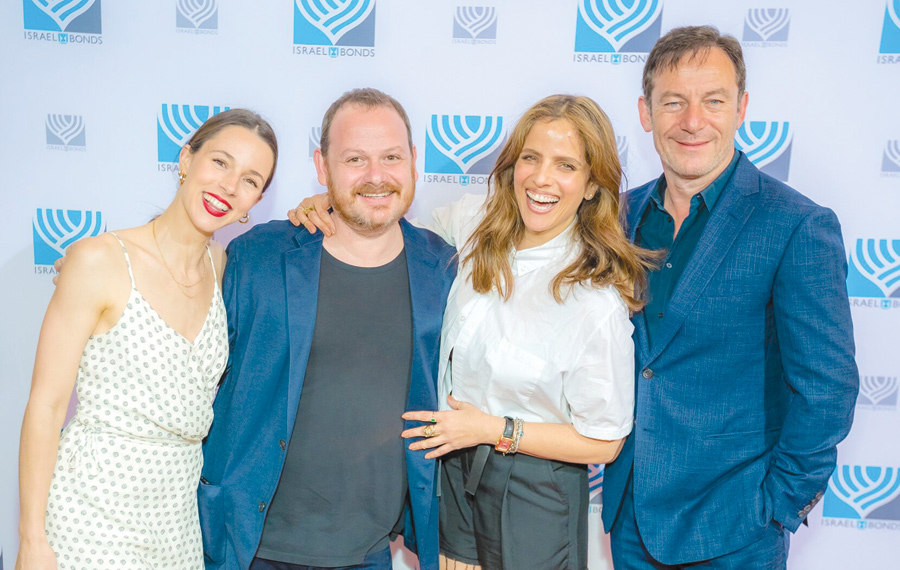
Israel Bonds Women’s Division of Los Angeles honored three Israel Bonds investors for their commitment to the Jewish state during its annual Golda Meir Luncheon on March 31 at the Four Seasons hotel in Beverly Hills.

The event recognized Melanie Ryngler with the Golda Meir Award and Brigitte Medvin and Myrtle Sitowitz with the Lion of Judah Award.  The gathering brought together a sold-out crowd of more than 300 supporters and advocates of Israel, from all facets of the Jewish community.

The featured guest speaker, Gideon Raff, an Emmy Award-winning executive producer of the Showtime series “Homeland,” was recognized with a David Ben-Gurion Award for sharing Israeli culture with the world.

 Georgette Joffe, Laura Stein and Leigh Stein co-chaired the gala with L.A. Women’s Division Chair Jean Friedman and Israel Bonds L.A. Chair Gina Raphael. 

“This event and others like it show why it is so important to bring together supporters of Israel from all around the world and from all walks of life,” Raphael said. “By bringing together longtime supporters and new Israel Bonds investors, we’ve succeeded in securing more investments than at any previous Golda Meir Luncheon.”

Over $9 million of Israel Bonds investments and indications to invest were made at the reception.

“We were thrilled to welcome so many investors from the Los Angeles community to the annual Golda Meir Luncheon, who demonstrated the depth and breadth of their commitment to a thriving Israel,” said Israel Bonds Regional Director Erez Goldman. 


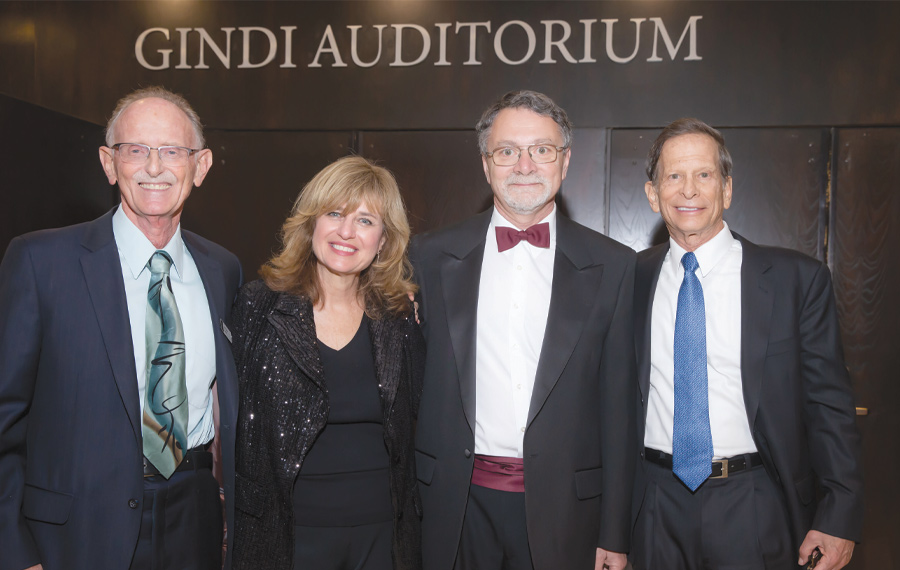
The L.A. Jewish Symphony’s (LAJS) 25th-anniversary celebration honored (from left) LAJS founders Dr. Ian Drew, Noreen Green, Mark Kashper and Dr. Richard Merkin. Photo by Curtis Dahl/L.A. Jewish Symphony

The Los Angeles Jewish Symphony (LAJS) celebrated its 25th anniversary on April 7 with a gala and concert at American Jewish University that featured highlights from the orchestra’s signature repertoire.

The evening, which drew more than 350 people, featured Brad Pomerance as master of ceremonies and included performances by longtime friend of the LAJS, actress Tovah Feldshuh, sopranos Hila Plitmann and Rachel Reich, and pianist-composer Emily Bear.

The evening honored LAJS founders Dr. Richard Merkin, Dr. Ian Drew, Noreen Green and Mark Kashper with an award presented by former California Gov. Gray Davis.  

Event co-chairs were Janet Schulman and Drew. Honorary co-chairs were Michael and Lori Milken and and his late wife, Barbara. 

The LAJS was founded in 1994 under the leadership of Green, the group’s artistic director and conductor. It is the only symphony orchestra outside of Israel dedicated to the performance and preservation of orchestral works of distinction that explore Jewish culture, heritage and experience.

“This celebration is a dream come true for me,” Green said. “It has been a joy to share great Jewish music with our community for the past 25 years, and I look forward to continuing the tradition for many years to come.”


From left: Fayge Yemini, co-director of the Chabad Israel Center in Los Angeles (far left), joins Dahlia and Elan Carr at his swearing-in ceremony. From left: Fayge Yemini, co-director of the Chabad Israel Center in Los Angeles (far left), joins Dahlia and Elan Carr at his swearing-in ceremony.

Elan Carr was sworn in as United States Special Envoy to Monitor and Combat Anti-Semitism on April 11 in Washington, D.C. 

The ceremony was held in the Benjamin Franklin State Dining Room at the U.S. State Department, with U.S. Secretary of State Mike Pompeo administering the oath of office while Carr placed his hand on a Bible held by his wife, Dahlia. 

Carr was appointed to the position in February. He previously served as a deputy district attorney for Los Angeles County, where he prosecuted violent crimes for more than a decade. The son of Iraqi-Jewish refugees, he is an officer in the U.S. Army Reserve and in 2003–2004 was deployed to Iraq.

Fayge Yemini, co-director of the Chabad Israel Center in Los Angeles, attended the ceremony. According to the organization, Carr’s mother, Carmella Pardo, and stepfather, Nissan Pardo, are supporters of the Chabad Israel Center, and the Carrs regularly attend events and programs there with their children. 

Sinai Temple Men’s CLUB HELD ITS 32nd annual Burning Bush gala on April 7 and honored Sinai Temple members Sharona and Daniel Nazarian and Julie and Michael Silberstein. 

“The Burning Bush Awards are presented annually to deserving men and women of the Sinai community who represent Jewish values, support of Israel and a commitment to giving back and tikkun olam,” a Sinai Temple statement said. “This year’s recipients are pillars of Sinai Temple, represent strength in community and are deeply defined by their Jewish identities.”


From left: Daniel and Sharona Nazarian and Julie and Michael Silberstein were the honorees at the Sinai Temple Men’s Club’s 32nd annual Burning Bush gala. Photo courtesy of Sinai Temple

Sinai Temple Senior Rabbi David Wolpe presented both awards. He spoke of the Nazarians’ commitment to family and the Silbersteins’ embodiment of community, and recognized the couples’ leadership at Sinai Temple and beyond.

The evening also highlighted and raised funds for the Emergency Volunteers Project (EVP), a volunteer-based nonprofit organization that trains and deploys U.S. firefighters to combat fires and crises in Israel. Approximately 20 firefighters joined Sinai Temple members and guests for the gala, and many of them spoke of their love and commitment to the State of Israel. 

The event, which drew more than 300 attendees, raised over $80,000 for EVP.

Speakers were Acting Israeli Consul General of Israel in Los Angeles Eitan Weiss, EVP founder and Director Adi Zahavi and EVP firefighters from Los Angeles.

Sinai Men’s Club members Faranak Rostamian and Shimon Ben-Poorat co-chaired the gala along with acting Men’s Club President Farshad Rafii.


Robert Iger (center), chairman and CEO of the Walt Disney Company, accepted the Humanitarian Award at the Simon Wiesenthal Center’s National Tribute Dinner
on April 10. Flanking Iger (from left) are Larry Mizel, Dawn Arnall, Rabbi Meyer May, Ron Meyer, Rabbi Marvin Hier and Jim Gianopulos. Photo by Alex Berliner/AB Images
Photo by Alex Berliner/AB Images

The Simon Wiesenthal center and its museum of tolerance held its annual Tribute Dinner on April 10 at the Beverly Hilton Hotel, honoring Walt Disney Company Chairman and CEO Robert Iger and Rabbi Jeffrey S. Myers of the Tree of Life Congregation in Pittsburgh.

Iger received the Center’s Humanitarian Award. Myers, who tried to shield his congregants during the Oct. 27 massacre at his synagogue in which 11 people were killed, received the Center’s Medal of Honor.

In his address to the gathering, Rabbi Marvin Hier, who founded the Wiesenthal Center in 1993, pointed out that between Brexit, unseasonable cold weather and America “paralyzed by an inability to have honest debates without rancor or malice … it seems our whole world has gone off the tracks.” Hier also cited the growing chasm between the country’s rich and poor, as well as the increasing incidents of anti-Semitism.

Iger, in his remarks, also noted that “the work of the Wiesenthal Center has never been more important. … What has happened to our country?”

TV talk show host Jimmy Kimmel lightened the mood with some well-placed quips.

Enough studio heads served as banquet chairs to form a minyan — including Steven Spielberg, Jeffrey Katzenberg, Ronald O. Perelman, Haim Saban and Casey Wasserman — but few, if any, of them attended.

The event raised $3.6 million. 

— Tom Tugend, Contributing Editor


Want to be in Movers & Shakers? Send us your highlights, events, honors and simchas. Email ryant@jewishjournal.com.

Iger, Pittsburgh Rabbi Honored; Carr Sworn In Read More »

Westwood’s Model Matzah Factory Brings the Passover Experience to Life

Something amazing has happened on the third floor of Chabad House at UCLA in Westwood. It’s been magically transformed into the five different sets that make up the Martin Ackermann Model Matzah Factory. It’s the site of a clever, fun and hip retelling of the story of Passover, followed by an interactive lesson in how matzo is made.

Craig Ackermann, whose family dedicated the program in memory of his father, Martin, told the Journal, “As a lover of Passover, freedom and children, and as a practical hands-on person, my dad would undoubtedly support this wonderful effort to educate the next generation about God’s liberation of our ancestors from Egypt in such a tangible and beautiful way.” 

Chabad Youth Director Aron Teleshevsky leads the experience, designed for children and adults alike. Local college students assist him by playing many of the characters (Moses, Pharaoh) along with Teleshevsky’s brother-in-law Rabbi Zalman Goodman from Chabad of Beverly Hills.

The Matzah Factory experience starts in the main room, where, after a brief introduction, Moses comes out from the pyramid to retell the story of the Children of Israel’s struggles in Egypt. Armed with God’s message to “let my people go,” the audience joins Moses to meet with Pharaoh at the palace in the next room. 

“There are two parts to the experience. One is reliving the story of the Exodus, making it something that’s a little bit less foreign. The second is the process of making matzo, because matzo is a big part of Pesach.”

— Aron Teleshevsky

The humorous and modern script is designed for optimal engagement. For instance, when Pharaoh and his assistant are pelted with the plague of toy frogs, the song “Who Let the Frogs Out?” (with apologies to Baha Men and their hit 2000 single, “Who Let the Dogs Out?” ) plays over the loudspeaker. 

Once Pharaoh relents after the final plague of the death of the firstborn, Moses leads participants to a farm where they are shown how to separate the seeds from the wheat and grind them into grain. The next room, the rainforest, has a lesson on how the flour and water are carefully combined to make the matzo dough. “No water can touch [the flour] until right before it’s ready to go,” Teleshevsky said. And finally, attendees are led into the bakery where they roll out and make holes in the matzo dough. The matzo is then baked and participants take their edible, though not kosher for Passover, treats home.

Rabbi Zalman Goodman of Chabad of Beverly Hills leads kids through the Model Matzah Factory.

“It’s all about bringing [the story of Passover] to children and adults in a hands-on way,” Teleshevsky told the Journal after one of the performances. “Adults need this sense of connection just as much as kids do. Of course, we want the kids to grow up with a feeling of connection and to be able to implement Judaism into their lives, keep the traditions going and pass it on to their children, God willing. But the adults need to feel it, too.”

Every year, in the weeks leading up to Passover, the Matzah Factory plays in Westwood. Teleshevsky also takes the show on the road to schools and synagogues throughout Los Angeles. 

“There are two parts to the experience,” he said. “One is reliving the story of the Exodus, making it something that’s a little bit less foreign, a little bit less abstract. The second part is the process of making matzo, because matzo is a big part of Pesach, and it’s a big part of the story of when the Jewish people left Egypt.”

The experience is tweaked accordingly for children and adults. “Last night, I was at Temple Isaiah,” Teleshevsky said. “We had a group of adults, so we spoke more about the significance of the different plagues, the story and what we could learn from it.”

Teleshevsky hopes that whoever experiences the Matzah Factory or even reads about it is inspired to do something extra to connect with their heritage. “Connect to the spark inside of you,” he said, whether it’s another Friday night dinner, lighting Shabbat candles, visiting the mikveh, putting on tefillin or doing another mitzvah. “Just reconnect,” he said. “That’s what it’s about.”

Chabad has been running the Matzah Factory for 30 years; Teleshevsky has been in charge for the past seven, and it still draws crowds. “It’s always about updating [the stories and experiences],” he said,  “and making it more fun, more creative, more hands-on and more experiential.”

Westwood’s Model Matzah Factory Brings the Passover Experience to Life Read More »

Passover Blintzes With Leonard Cohen

It’s a busy time in the Jewish world. Israelis had perhaps the most controversial and significant elections in their history, launched lunar lander Beresheet into space carrying, among other things, a Torah and memoirs of a Holocaust survivor, only to have it crash land into the moon, during the run-up to Passover, the most time-intensive holiday in our calendar to prepare for. 

Endless spring cleaning, consuming chametz and preparations to host a seder might make people feel as if they are participating in the Exodus before the dinner has commenced. Then, there is daily life that people need to contend with: work, kids, homework, research, cooking, eating, carpooling — the tachlis (the reality or the bottom line). 

This week, after many weeks absent from my kitchen in Uganda, I went to see an exhibition on Canadian singer and songwriter Leonard Cohen at the Jewish Museum in New York City. I realized how little time I’d spent listening to music since I’d left my kitchen in Uganda and how much I’d been missing it. 

After a few hours spent glued to images of Cohen performing throughout a career that spanned 50 years until his death in 2016, in a space that enveloped me in lyrics and prose and poetry, I was almost shivering in recognition of our basic human need for purpose and passion. Here, in this space, it was easy to understand and digest one of the most important Jewish themes of Passover: Dayenu. 

Dayenu – if it wasn’t enough that we were freed from slavery, we were given the Torah. And if that wasn’t enough, we were given Shabbat. And as if that wasn’t enough, we have music, we have food, we have the ability to love, and if that wasn’t enough, we have music, we have poetry, we have a soundtrack of our lives. Although Cohen was the master of longing and his lyrics, like a prayer, channeled mysterious darkness that lured us in, perhaps it’s that secret mood that links music and ritual and keeps them forever intertwined. Whether it’s the ritual of washing the floor and cleaning the cupboards or the ritual of preparing the Passover seder plate and the specific foods we cook year after year within our family culture. As if it wasn’t enough that we were able to survive the harrowing trials put to our people, and still thousands of years later are thriving. 

And as if that wasn’t enough — that we are living in a time where our homeland, rockets aimed toward us, Iron Dome at the ready in defense, elections and a leader’s trial on the horizon — as if that wasn’t enough — I still stood in my kitchen, rapt in awe as Israel’s spacecraft crashed onto the lunar surface, and sang “Hatikvah” prouder than ever.

And as if that wasn’t enough, that day that I was able to stand with a museum full of Cohen fans and through the capability of technology, hum along with his songs and feel the vibration of the bass reverberate through my body from the bench I was seated on — that was the same day that I heard this announcement from Israeli company SpaceIL, which launched Beresheet into space: “Good evening, people of Israel. I have a message for you. After all the massive support that I got from the entire world for this project, I decided to lead a new project: Beresheet 2. The mission we started, I hope we can complete. This is my goal. As for my message for all the youngsters: If it doesn’t work at first, stand up and complete it. And this is what I’m doing, and what I wanted to tell you this evening. Thank you.”

What follows is my blintzes recipe for Passover, made with potato starch, which  in my opinion, are even better than ones made with wheat flour. And although it’s not rocket science, it will still make you feel proud to serve them with fresh blackberries and raspberry coulis and a splurge of sour cream. I prepared them while I listened to Cohen sing “Dance Me to the End of Love” on a continuous loop. And if that wasn’t enough, the blintzes that encase the delightfully fluffy lemon-scented filling can be rolled up and cut into a noodle shape to use in chicken soup in lieu of matzo balls during Passover. Dayenu.

PASSOVER CHEESE BLINTZES

For the batter:
1/2 cup potato starch
1 cup water, room temperature
4 large eggs, beaten
1 teaspoon salt
3 tablespoons butter or coconut oil or vegetable oil for cooking crepes

For the filling:

1/4 pound farmer’s cheese
1/4 pound full-fat cottage cheese (or ricotta)
2 tablespoons cream cheese, room temperature
1/4 cup powdered sugar
1 teaspoon vanilla extract
3/4 teaspoon salt
Rind of half a lemon, finely grated
Raspberry jam boiled with 1 tablespoon of lemon juice and 1 tablespoon of water for serving (optional)
A handful of fresh berries (raspberries, blueberries or blackberries), for serving
1 tablespoon powdered sugar, for garnish
1/2 cup sour cream, for serving (optional)

Put potato starch in a measuring cup and add room temperature water. Stir well.

In a separate bowl, beat eggs and then add salt and stir together with potato starch mixture and mix thoroughly until smooth batter forms. Pour into a small pitcher. 

Lightly grease or spray an 8-inch nonstick pan or griddle. Over medium heat, pour a little less than 1/2 cup batter into pan and then tilt and swirl pan so batter covers the entire bottom of the pan. Pour excess batter back into the pitcher.

Cook for about 45 seconds, or until the edges of the crepes start to curl and the center looks dry. Loosen edges with a spatula and flip blintz onto a plate, grease pan again, stir batter (it separates while sitting) and repeat the process with remaining batter.

Combine filling ingredients and mix until smooth. To assemble, spoon 2 heaping tablespoons of filling onto the lower third of the blintz. Fold the bottom edge over the filling and then fold the two sides of the blintz into the center. Roll the blintz away from you and put on a plate. 

When ready to serve, melt a tablespoon of butter or oil in a pan. Cook the blintzes over medium heat, flipping when each side becomes golden brown. Serve with raspberry sauce, berries and sour cream. Garnish with powdered sugar.

Makes 12 blintzes.

For Passover noodles:

Prepare batter with the recipe above and cook as blintzes. Take each blintz and roll into a tight cylinder. With a sharp knife or scissors, cut cylinder to the desired width of noodles (about 1/8 to 1/4 inch wide.) Store noodles in an airtight container in the refrigerator until ready to serve in hot soup. Noodles should not be boiled but can be stirred into the soup a few minutes before serving.


Yamit Behar Wood, an Israeli-American food and travel writer, is the executive chef at the U.S. Embassy in Kampala, Uganda, and founder of the New York Kitchen Catering Co. 

Passover Blintzes With Leonard Cohen Read More »

Weekly Parsha: Shabbat Pesach I

One verse, five voices. Edited by Salvador Litvak, Accidental Talmudist

“An Aramean was destroying my father, and he went down to Egypt and he sojourned there with a small number, and he became there a nation: great, powerful and numerous.” – Passover Haggadah


Rabbi Lori Shapiro
Open Temple 

The phrase “An Aramean was destroying my father” is a sliding door to history. 

According to biblical scholarship, the phrase itself dates as far back as the Mari texts (of the 18th century B.C.E.). These ancestors were nomads; moving with their herds, they lived on the land. A lingual fossil, this phrase connects us with the imaginations of those who came before those who came before us, and hints of what we are to uncover at Passover: our unknown history. 

There is a wonderful commentary by Rabbi Azriel Hildesheimer (1820-1899) that asks, “Why does the haggadah consider Laban worse than Pharaoh?” His haggadah commentary Hukkat HaPesach responds that it is Laban’s inveigling of Jacob that leads to an unintended birth order of Jacob’s children, and that Joseph, the first-born son of Rachel, was actually meant to be the first-born son. Had this been the case, Rabbi Hildesheimer suggests, Joseph (and his family) would not have ended up in Egypt nor known Pharaoh. 

The phrase is the prompt for the Maggid that demands that we consider all of the fate that brought us to this place in time, as well as arouse our curiosity about those things that we do not yet know. We are all living narratives of our lives unfolding; which stories have yet to be unearthed? This Passover, while sitting at the table with those who may move into memory next year, may we reclaim the stories of what actually was,as we continue to Become. 

Ilan Reiner
Author of “Israel History Maps”

The haggadah wants us to experience the seder in historical perspective. This night is different from all other nights and we know why we’re celebrating. Or we think we know. What was the real threat from which HaShem saved us? 

Surprisingly, the haggadah talks about how bad Laban was, and how he was worse than Pharaoh. Interpretation of this verse is controversial and the haggadah chose an interpretation that, in essence, is telling us that the real threat was from the “acts of Laban” and not the from “acts of Pharaoh.” According to the midrashic (exegesis commentary) explanation of this verse, Pharaoh “only” wanted to kill the boys. It was Laban who wanted to annihilate Jacob’s entire family by means of assimilation (Jacob said he feared Laban would take his wives and children). Our ultimate salvation from Egypt wasn’t from slavery or death, but from our drowning into the Egyptian culture, society and way of life. 

As we celebrate Passover every year, let’s reflect on how, in every generation, the greatest enemy of our existence is the temptation to completely blend in and erase our identity and morality. HaShem can save us from wars and physical threats, but only we can save ourselves from spiritual and cultural threats. Toward the end of the haggadah, we realize the final step of salvation by God, which is Jewish sovereignty in Israel. Only with a Jewish homeland in Israel, can we keep our Jewish identity strong and proud around the world.

David Brandes
Writer

“Harry,” thunders the producer to the studio executive, “I’ve got the next ‘Mission: Impossible’!” 

“Speak.” 

“It’s about my ancestor Jacob whose father-in-law tries to destroy him. He relocates to Egypt, where his people are first hailed and then forced into slavery. They almost lose their souls, but miraculously they grow in numbers and, get this, never lose track of the family mission.”

“I didn’t know you had such an amazing family, Phil.”

“So do you, Harry. It’s yours, too.”

“What happens next?”

“With a lot of help from the Master of the Universe, they escape slavery and become a great nation.”

“You got a hook for the publicity?”

“First of all, it’s an event, not just a story. It’s filled with action, heroism and touching human drama. And it doesn’t just tell a tale; it helps bring on the messianic redemption through personal liberation and transformation — for everyone who hears it and allows themselves to be moved by it.” 

“What about the kids? Will they find it interesting?”

“Are you kidding? It’ll trigger their imaginations more than ours. They’ll be asking questions through the night and fighting to stay awake. They’ll be telling their kids about where they were when they first heard it. It’s a story for the ages, Harry.” Harry thinks for a moment. 

“Phil, that’s the greatest story I’ve ever heard.” 

Sara Brudoley
Torah Teacher and Lecturer

“An Aramean sought to destroy my father” refers to Lavan, who wanted to destroy our father Yaacov. This verse is taken from Mikra Bikurim, the positive commandment to express praise and thanksgiving to God when bringing the first fruits to the Temple. 

The whole structure of the story of the Exodus from Egypt in the haggadah is based on the verses of Mikra Bikurim (Deuteronomy 26:5-8), and every detail mentioned there is expounded on in the haggadah. 

Why was Mikra Bikurim chosen as the foundation for telling the story of the Exodus? Why not go straight to the source, to the Torah verses that actually describe the Exodus? From this we learn that when we thank HaShem for the fruits, we should be thankful for all the events that make this offering possible: From the time he saved our patriarch Yaakov, through the exile and redemption from Egypt, until the bequeathing of the land of Israel. 

This sequence teaches us to start at the beginning when thanking HaShem. It is written (Mishnat Rabbi Eliezer) that from Pharaoh we learn that ingratitude is tantamount to heresy. Its opposite is praiseworthy. In telling the tale of our Exodus, “whoever elaborates on the story is to be praised.” At the seder, we thank HaShem for his eternal protection over us. That’s why the haggadah was based on Mikra Bikurim — the verses in the Torah that express gratefulness. 

Rabbi Mendel Schwartz
The Chai Center

Bashert is a magic word, which we use for upbeat divine intervention. Many times, however, there is a dark side to the chain of events. We usually don’t call the dark side bashert, but nothing happens by chance, and there are no coincidences in life. We may not like it and we may not accept it, but we cannot ignore it. Divorcing your first spouse is the dark side of bashert. 

I recently met somebody who excitedly told me he remembered my father, Schwartzie, and had great respect for him. He said, “Schwartzie introduced me to my first wife.” His current wife was standing right there and looked a bit uneasy. I asked the woman if she was happy. She said yes. I asked the fellow if he was happy. He said yes. I said, “Schwartzie was the matchmaker for this marriage, as well.” I feel this person became a better human being, a wonderful husband and a mensch, all because of that first marriage. I don’t desire this on anyone, but if God chose that first marriage to begin and end, there is a bashertness in this, as well. I call it the dark side of bashertness. 

The Torah and the haggadah suggest this very message to us when the verse proudly states, “An Aramean was destroying my father, and he went down to Egypt and sojourned there with a small number, and he became there a nation:  great, powerful, and numerous.”

Weekly Parsha: Shabbat Pesach I Read More »

Promises

(In the early 1960s, psychologist Walter Mischel conducted an experiment with preschoolers to explore the connection between delayed gratification and future success: One marshmallow now … or two later?)


Who waits for the second marshmallow?
Lab rats under blue fluorescence,
kicking metal table legs
weighing pros and cons.
Sugar cloud so tempting
on its deckled paper plate,
grab one now, or wait a bit
and get a double dip?


The Hebrews followed Moses
to a promised Promised Land,
but when he left to chat with God
they built a golden calf.
Alone in desert silence,
terror high and dry,
they reached for comfort’s glitter,
spirit seized by need.
Memory of pyramids,
the overseers’ cruel whips,
softened by fresh drifts of sand,
drowned in hunger’s now. 


Who can blame a three-year-old
for giving in to sweet,
a frightened slave for craving light
in soullessness of dark?
What future lies in future’s path
impossible to know,
but sugar high on curling tongue?
We want our marshmallows now.


Paula Rudnick is a former television writer and producer who has spent the past 30 years as a volunteer for nonprofit organizations. 

Promises Read More »

Why Passover Is So Good for the Jewish Brain

With Passover upon us, it is a good time to reflect upon and appreciate the incredible power of what is perhaps the most ancient and persistently practiced of all group rituals in the world and its impact on the human brain.

Using the field of neurotheology, which seeks to understand the relationship between the brain and religious phenomena, we can better document the many ways that Passover stimulates the brain. Passover represents a kind of “ultimate ritual,” in terms of its ability to evoke powerful thoughts, feelings and experiences in the Jews who practice this holiday.

Let us begin with the fundamentals: Passover begins by reflecting on the horrors of being enslaved. This can elicit strong reactions in brain structure called the amygdala, resulting in intense negative emotions. Ultimately, such emotions need to be resolved through the ritual of the seder, which brings about a new understanding of the Jewish relationship to God that leads away from suffering. However, a complex process like this one does not occur easily, and many steps must be followed before this synthesis can happen.
The Passover seder represents not only an order of presenting various ideas and symbols, but it is essentially a rhythmic process, and rhythms lie at the heart of all great rituals. Rhythms drive the body and brain by affecting what is called the autonomic nervous system, which regulates our heart, lungs and other organs. Such rhythms can create powerful experiences that bind stories with physical and emotional experiences. Thus, the incredible impact of Passover is that we not only cognitively understand the importance of the story, but we feel it throughout our body. Which is why actions such as eating the Charoset and matzo are so important — we’re literally taking in foods that help us experience the story itself.

In fact, many aspects of the Passover seder have a profound influence on our senses, including taste, smell, sight and hearing. We can even include our sense of touch in recognizing the distinction between sitting upright and reclining. Through these actions, we accomplish what the Mishnah states (Pesachim 10:5): “In every generation, one is obligated to see themselves as though they were taken out of Egypt.”

The rhythms of Passover occur on so many levels in the prayers, songs, the Ten Plagues and the cups of wine. Drinking the cups of wine makes powerful use of the brain’s processes, as the smells and tastes stimulate sensory areas of the brain and signify that something important is happening. The wine is also used to help us physically experience the Ten Plagues by using the action of spilling a drop of wine out of the glass for each plague.

“The rituals of the Passover seder take advantage of every level of rhythm that the brain experiences”

The four cups of wine take advantage of another important area of the brain that is involved with numbers. Our quantitative brain not only helps us solve mathematical problems, it literally imbues numbers with meaning. The number four affects the brain in a particularly intense manner because four represents many things, both mathematically and generally in life. In mathematics, four is the smallest square and is the smallest nonprime number. In life, we have four grandparents and four fingers (and one thumb). More significantly for Judaism is that the number four represents the Tetragrammaton, identifying God. With all of these meanings, it is no surprise that “four” should invoke not only the quantitative processes of the brain throughout the seder, but it should provide a mysterious and magical quality as well. The number four also reappears in the four questions and the four children. Again, this emphasizes that the questions are not simply there to be answered, but they are the four questions.

As we stated above, our brain is highly responsive to rhythms. Electrical rhythms are part of how our nerve cells function and connect together. Our brain regulates all the rhythms throughout our body, including our heart rate, respiration rate, circadian rhythms and hormonal rhythms.

The rituals of the Passover seder take advantage of every level of rhythm that the brain experiences. There are the inherent rhythms of the seder itself, but Passover occurs in a larger temporal rhythm by happening every year. Just as animals migrate thousands of miles to experience the renewal of spring, so, too, our brains “migrate” in the context of finding freedom that began with our Exodus from Egypt.

This yearly rhythm also occurs throughout a person’s life, binding the brain to the essential Jewish story from birth to death. The rhythm expands from generation to generation so that the holiday binds families from children to great grandparents; and across the centuries, binding all Jews together in a powerful sense of oneness. This sense is fundamental to rituals and is associated with areas of the brain involved in establishing our sense of self and our relationship to the world.

It seems remarkable that the Passover seder could have such a huge neurological impact, given that it began long before there was any knowledge of the workings of the human brain. Today we can appreciate the power of Passover not only for its religious and philosophical significance, but for its power over the human brain to bind all Jews together, for all time.


Dr. Andrew Newberg and Rabbi Dr. David Halpern are the authors of “The Rabbi’s Brain: Mystics, Moderns and the Science of Jewish Thinking.”

Why Passover Is So Good for the Jewish Brain Read More »

Families Sue DC Synagogue Preschool Alleging it Ignored Child Sexual Abuse

(JTA) — The families of eight children who attended the preschool at a prominent Washington, D.C., synagogue have filed a lawsuit accusing the school of ignoring signs that a teacher was abusing children.

The civil suit accuses the school of failing to protect the children from “a known and avoidable risk of sexual abuse” by a teacher employed at the Washington Hebrew Congregation’s Edlavitch-Tyser Early Childhood Center from 2014 until he was suspended in 2018 over allegations that he “may have engaged in inappropriate conduct involving one or more children.”

A statement sent to media outlets by the families’ attorneys said the male teacher “was allowed and encouraged to be alone with the children individually and in small groups,” and that the alleged abuse affected both boys and girls aged 2 to 4.

“The abuse included the most grievous, demeaning and damaging forms of sexual abuse,” it said.

The suit was filed late Monday afternoon in D.C. Superior Court.

The families who filed the suit are not identified in the document and have asked to remain anonymous throughout the legal proceedings to protect their children’s privacy, according to the attorneys.

The accused teacher is named in the suit and in the statement. He has not been criminally charged and is not a defendant in the suit.

A spokeswoman for Washington Hebrew, Amy Rotenberg, said the temple is still reviewing the lawsuit, The Washington Post reported.

“In August 2018, Washington Hebrew Congregation immediately reported the allegations to DC Metropolitan Police Department (MPDC) and Child Protective Services as soon as we learned of them,” Rotenberg said in an email. “Since that moment and for the past eight months we have continually and fully cooperated with the ongoing criminal investigation.

“We have taken this matter seriously and have kept the community regularly apprised of what we know,” she wrote.

A spokesman for the Metropolitan Police Department of the District of Columbia told CNN on Monday evening that an investigation into alleged sexual abuse of children at the school is ongoing.

Washington Hebrew, which is affiliated with the Reform movement, has about 3,000 member families and is the oldest congregation in the city. The synagogue has deep roots in Washington’s political establishment and counts among its members prominent influencers of both parties.

Families Sue DC Synagogue Preschool Alleging it Ignored Child Sexual Abuse Read More »