fbpx

January 16, 2019

A Tu B’Shevat Story: Rebuilding L.A.’s Jewish Camps


It’s just over a week before Tu B’Shevat on a sunny morning in Malibu, and Wilshire Boulevard Temple (WBT) Camps, which operates Camp Hess Kramer and Gindling Hilltop Camp, is largely deserted, save for the occasional worker driving a 4×4 pickup truck on the windy, mud-caked roads, and a cleanup crew, wearing protective yellow hazmat suits and face masks, sweeping pools of dirty rainwater off platforms surrounding the few remaining buildings.

“Welcome to the disaster zone,” says WBT Camps Executive Director Doug Lynn at the entrance to the camps.

He’s referring, of course, to the devastation wreaked by the Woolsey Fire in November, which decimated 27 of its 28 cabins on the 187-acre property. 

Inside the camp stands a pickup truck, burned to a crisp and frozen in time. Nearby, a building that used to house staff during summer sessions looks like the target of a drone attack. Nails and broken shards of glass litter the ground. It’s hard to believe this was once the crown jewel of the Reform camping community in Southern California.

Rabbi Bill Kaplan (left) and Shalom Institute staff survey the damage. Photo courtesy of the Shalom Institute

Lynn, 45, who has been working at the camp for 14 years, trudges through the wreckage, made worse by recent mudslides. He laughs in disbelief at the areas that were once roads, now completely buried by mud. “This looks like a field. It’s not,” he promises. “There’s a road under here, clearly defined.”

The vegetation used to serve as a protective barrier, shielding the camps from mudslides during rainstorms, but the fire destroyed all the vegetation. “In this environment, there is nothing holding the hillside up,” Lynn says.

He points to what once was the outdoor sanctuary, a place of worship, where the ark and the amud — the pillar — were destroyed; the swimming pool that now looks like a flat parcel of earth filled to the brim with mud.

Recalling seeing the camp for the first time after the fire, Lynn says, “It was surreal. It was like walking on the moon. It was white as far as the eye can see.” 

The fire also destroyed the homes of nine staff members living onsite, and WBT had to find new housing for them. With the forced closure of the camp, many employees lost their jobs. WBT found them new positions at its synagogue campuses in West L.A. and Koreatown. 

“It’s been a really hard process because so many of our staff have been working here for so many years, but we are really trying to live our ideals of community,” Lynn says. “The temple made a decision that we will take care of our own people.”        

WBT Assistant Camps Director Ari Kaplan, 29, was 8 years old when he began attending Camp Hess Kramer. He fell in love with Kramer because, he says, it was a place he could be his “fullest self.” 

“It’s in my blood,” he explains. “My dad was a camp director here. I made my closest friends here. It’s a place where you can be yourself. It’s an easy place to fall in love with.”

“You can’t tell now,” Lynn adds wistfully, “but it was beautiful.”

He says that although many people have expressed a desire to help WBT rebuild, the camp does not yet know how much money it will need to raise.

“We spent some time being sad. Camp has been around for 70 years and it was wonderful,” Lynn says. “This is an opportunity to look at what camp will be for the next 70 years. That’s the uplifting part of it. It will take fundraising and committed people already stepping up saying, ‘I want to be involved.’”

One of the 35 structures burned in the fire at the Shalom Institute.
Photo by Ryan Torok

The organization currently is looking for a temporary site for its upcoming summer camps. It is working with the California Coastal Commission in the debris-removal process and has applied to the Federal Emergency Management Agency for financial assistance.

While Lynn says it’s too early to talk about Tu B’Shevat — the birth of trees — in connection with the camp, Rabbi Bill Kaplan, executive director of the Shalom Institute in Malibu, is eager to draw parallels.

The Institute, which hosted Camp JCA Shalom at its 220-acre property, was also devastated by the Woolsey fire. It lost 35 of its structures. Twenty-nine staff members living onsite with their families had to find new homes, and much of the Institute’s vegetation and trees were destroyed in the blaze. 

Looking over the remains of the camp, which is still closed, Kaplan says they’ll be marking the holiday as the  “re-birthday of the trees. The trees are coming back and the trees are alive,” he says. “They’re still here and they are the core of what the Shalom Institute is about.”

In previous years, the Institute has held Tu B’Shevat community events but this year, the fire made that impossible. However, on Jan. 20, spiritual community Nashuva will gather at TreePeople to prepare native plants and trees to plant at fire and drought-damaged areas in the Santa Monica mountains. TreePeople Founder and President Andy Lipkis plans bring the plants to the Shalom Institute’s home in Malibu.

“If you think about it, this is the very intent and meaning behind the holiday of Tu B’Shevat,” Lipkis said in an email. “Teaching and reminding people about caring for and protecting our trees and forests, so we can all survive and thrive.” (Q-and-A with Lipkis, page 54).

And on Jan. 22, the Institute will lead students from Abraham Joshua Heschel Day School in an offsite day of Tu B’Shevat activities. 

Kaplan calls himself the “King of Tu B’Shevat,” and combines his love of Judaism with his passion for the outdoors in the belief that Jews are not just the “People of the Book” but also the “People of the Land.” 

In addition to his responsibilities at the Shalom Institute, Kaplan runs an educational program called Edible Judaism, which offers a “pathway and opportunity to Jewish education” through an appreciation of nature. 

The remains of Wilshire Boulevard Temple Camps staff housing.
Photo by Ryan Torok

And while Kaplan mourns the loss of the Marla Bennett Israel Discovery Center and Garden in the fire (named in honor of a Camp JCA Shalom alumnus killed in a terror attack in Israel in 2002), he praises the successful relocation of the Institute’s Shemesh Farms, the home of 20 varieties of bulk herbs, vegetables, native flowers and fruit trees. The site employed 45 adults with special needs who tended to the land and crafted products that were then sold to support Shemesh Enterprises. 

The Malibu Jewish Center and Synagogue was untouched by the fire and has taken on Shemesh Farms. The Institute plans to build raised flower beds and use a vertical growing system called a “tower garden” in the hopes of building an even bigger farm on the synagogue’s available acreage. 

Because of its proximity to the Pacific Ocean, Kaplan has taken to describing the farm as “Shemesh by the Sea,” and touting it as an example of turning “adversity into opportunity.”

The Institute already has secured a temporary site for this summer. It will hold Camp JCA Shalom at the Gold Creek Center in the Angeles National Forest. The site is the former home of legendary filmmaker Cecil B. DeMille and is owned by the Korean Presbyterian Church. The Institute will rent the space from May through September in 2019 and 2020. 

“It’s an incredible facility on its own mountain,” Kaplan says. “For the next couple of years, we’re on the road.”

For now, Kaplan is thankful for the small things, encouraged by the signs of life springing up around the camp. Fresh green has grown on charcoaled hills, new growth has sprung on the oak trees, and the organization’s arborist says the majority of the plant life will grow back.  

“Our theme is from ashes to blossoms, and you can see now this new growth going all along the tree up here,” Kaplan says, pointing to one of the oak trees. “You look over here, you can see an incredible amount of new growth. For us, that is inspiring.”

A Tu B’Shevat Story: Rebuilding L.A.’s Jewish Camps Read More »

Former N.Y. Assemblyman Calls on Fellow Dems to Condemn Rep. Tlaib

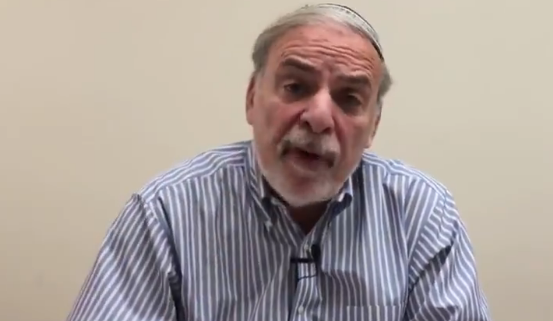
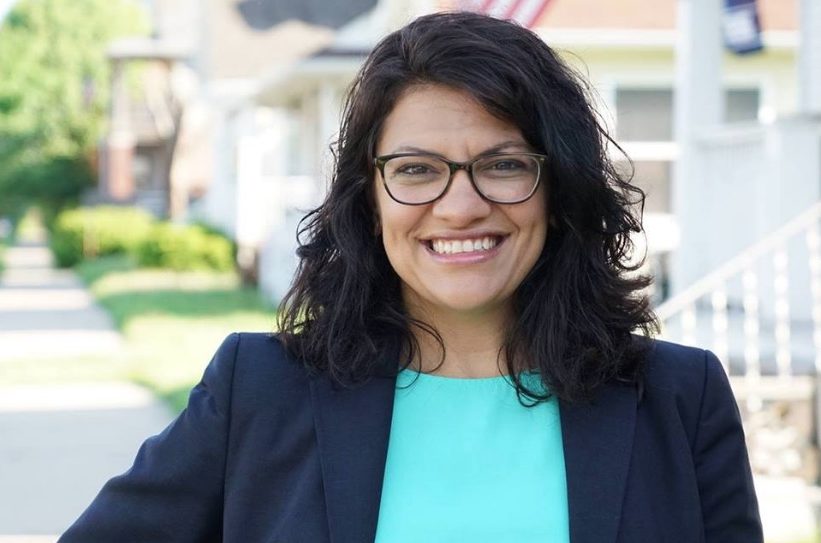
Former New York Assemblyman Dov Hikind is calling on his fellow Democrats to condemn Rep. Rashida Tlaib (D-Mich.) for her anti-Semitism.

In a Wednesday video posted to Twitter, Hikind highlighted how within her first few days in Congress, Tlaib accused “the Jewish people of dual loyalty here in America, something that the enemies of the Jewish people going back to Nazi Germany and all over the world have used against the Jewish people.”

Hikind was referencing a tweet where Tlaib accused supporters of an anti-Boycott, Divestment and Sanctions (BDS) bill in Congress of forgetting “what country they represent.” Anti-Defamation League CEO Jonathan Greenblatt called Tlaib’s tweet “deeply problematic.”

Hikind then pointed to the photo floating on Twitter of Tlaib with Abbas Hamideh, “a supporter of Hezbollah, a supporter of Hamas.” Hikind proceeded to highlight some of Hamideh’s tweets, including one that read, “Long live the courageous Arab-Muslim lion, [Hezbollah] Sayyed Hassan Nasrallah!”

“Let us remember that Hezbollah has been involved in [an] attack upon American soldiers,” Hikind said. “This is a terrorist organization, as defined not just by the Trump administration, the Obama administration before. And this is who our new member of Congress associates with? On her first day, she associates with those who want to murder and maim and destroy the Jewish people and destroy the state of Israel.”

Hikind then asked if Speaker of the House Nancy Pelosi (D-Calif.) and Senate Minority Leader Charles Schumer (D-N.Y.) have “the guts” to condemn Tlaib.

“Is it only when it’s a Republican that Democrats speak out?” Hikind asked. “Or is it only when it’s President Trump that the Democratic Party is united to condemn any kind of racism or hatred? What about the Democratic Party?”

Tlaib seemed to make reference to the Hamideh photo with a Tuesday tweet stating, “Right wing media targeting me again.”

“Yes, I am Muslim and Palestinian,” Tlaib wrote. “Get over it.”

Pelosi and Schumer’s offices did not respond to the Journal’s requests for comment as of publication time.

Former N.Y. Assemblyman Calls on Fellow Dems to Condemn Rep. Tlaib Read More »

Our Uncle Gadi Eizenkot

Maj. Gen. Gadi Eizenkot is a stocky, unassuming, man. He was born and raised in Israel’s periphery. Never an aristocrat, never a prince, he is “a person’s person,” “a soldier’s soldier.” Earlier this week, he ended a four-year term as Israel Defense Forces (IDF) chief of staff, his career celebrated, his character admired. Will he also end up being a politician, many asked. Noooo — many of his friends hurriedly said. He is much too decent to become a politician. 

Eizenkot was a down-to-earth chief of staff, rarely seeking the limelight. Was he a good general? To be honest, such things aren’t easy for a layman to determine. Many of the actions for which he was responsible are classified. Many of his initiatives will bear fruit only with time. Many of his decisions can only be judged when new realities emerge. 

To give an example: Eizenkot invested a lot of his energy in combatting Iran’s attempt to establish a base in Syria. He was, as Bret Stephens described it in a New York Times interview, “the first Israeli general to take Iran head on, in addition to fighting its proxies in Lebanon and elsewhere.” Obviously, Stephens admires him for that — as most Israelis do. But that battle is still ongoing, and it’s not known how it will end. When it does end, determining the exact contribution of each leader to the success (or failure) of the mission will be difficult. What is Eizenkot’s part, compared with that of Prime Minister Benjamin Netanyahu, Defense Minister Moshe Yaalon, Defense Minister Avigdor Lieberman, the next Chief of Staff Maj. Gen. Aviv Kochavi or Northern Command’s Maj. Gen. Yoel Strick?

Another example: Eizenkot convinced the government that launching a military operation in Gaza would be a mistake. His position, and Netanyahu’s ultimate decision to take his advice, ignited the political crisis whose ultimate result is the upcoming election (Lieberman quit, shrinking the size of the coalition, and making the election the next logical step). Was restraint in Gaza the right call? Only time will tell. In fact, not even time. A decision to refrain from action is sometimes necessary, just to make sure that all options were exhausted before a decision to go to war.

If so little is known, why is Eizenkot praise-worthy? Because he was well liked most of the time by most Israelis because he was trusted. In Israel, the chief of staff is not a distant professional, a war expert. Of course, his abilities as a soldier are of great importance, but his abilities as a public figure are no less important. The Ramatkal (the Hebrew term for chief of staff) is a family member. He is our uncle general, commander of our children (in my case, two boys under Eizenkot’s command). He decides if these young people go to war, and when and why. Israelis know that sometimes war is necessary, but need to trust their uncle general that he will enter into war only when war is essential. 

“Gadi Eizenkot was well liked most of the time by most Israelis because he was trusted.”

Eizenkot’s role as a public figure was paradoxical. He was successful in this role by avoiding publicity. He rarely gave interviews, rarely made bombastic statements and rarely attended galas, parties or glitzy events. He did not play the mass media “fame game.” He didn’t seem polished and slick. He didn’t project the image of a politician in uniform or a diplomat wannabe, like some of his famous predecessors.   

When a general isn’t seen as a politician or a soon-to-be politician, it doesn’t necessarily make him a better soldier. But it does make him a better Ramatkal. It makes him better at making the people whose security depends on him trustful. Can we be certain that he made all the right decisions? Hardly. Can we be sure that he stirred the IDF toward victory? No, we can’t. But we can be certain that he made his decisions in good faith and without misguided motives.


Shmuel Rosner is senior political editor. For more analysis of Israeli and international politics, visit Rosner’s Domain online.

Our Uncle Gadi Eizenkot Read More »

Amnon Damti: Dancing to a Different Tune

Amnon Damti was 10 years old when he saw a performance by Russia’s Bolshoi Ballet on television and knew he had found his calling. 

Five years earlier, Damti traveled with his mother from their home in Northern Israel to Jerusalem. They arrived at a building that was teeming with children. It was a glorious time for him and he played games all afternoon. But later that evening, he realized his mother had disappeared. He searched for her everywhere. A counselor eventually came to tuck him into bed and told him gently that he would be living here from now on. Jerusalem’s Institute for Deaf Children became his home for the next 13 years.

Decades later, that story would become the inspiration for a dance called “Man in Shadow of Bird,” which Damti, Israel’s most famous deaf-born dancer, would perform in the White House in front of President George H.W. Bush. 

Damti dances by feeling the vibrations of the music in the floor. For three months, he worked closely with the composer behind the music for the White House piece, which told the story of a bird whose only desire was to be set free from its cage. Yet when that finally happened, the bird couldn’t handle it. 

“I wanted to be free, in body and mind. But when I left the institute, I felt too open. Suddenly, I could no longer communicate. My wings were broken,” he said. 

Jill, Damti’s wife of 29 years, acts as his interpreter. Early on, she made the decision that she would not become his voice. With the exception of media interviews, Damti finds ways to make himself understood. 

“I wanted to be free, in body and mind. But when I left the Institute for the Deaf, I felt too open. Suddenly, I could no longer communicate. My wings were broken.”  

Jill, who is not hearing impaired and who learned sign language from Damti, became his dance partner. In 1989, they formed “Two Worlds.” It became the longest-running dance show in Israel’s history, combining dance, pantomime and audience participation. The show was named “Two Worlds” to describe their respective dance backgrounds: Damti trained in classical dance and ballet, while Jill’s background was in synchronized swimming. 

The have traveled the world performing in all manner of institutions, including prisons, shelters for asylum seekers, embassies and orphanages. Last year, they were invited to work at a secret location in Southern California for children and teenagers rescued from sex trafficking. Holding hands is often part of the couples’ dance therapy. However, because of the trauma these children had undergone, they were given strict instructions not to use touch. Nevertheless, one by one, the children started to open up. 

“Slowly, slowly, they took their hands out of their pockets, put down their hoodies and gave a small smile,” Jill said.

At one point, they asked the group to clasp their hands together in the sign for “Shalom” and make a wish. 

“I will never forget the face of these kids,” Jill said. “It was so powerful to see everyone make their wishes, a look of survival.”

Damti recalled a moment from his own youth when he finally understood that he, too, mattered. It was when he saw dancing on television for the first time. 

“I had always felt closed, like no one knew my world or knew me,” he said. “Suddenly, I felt proud of myself, proud of who I am, of my deafness and of my dance.”  

Amnon Damti: Dancing to a Different Tune Read More »

Does Trump Work for Russia? Let Mueller Do His Job

When it was reported in the past week that President Donald Trump frequently talked to his aides last year about his desire to withdraw from the North Atlantic Treaty Organization, alarm bells went off across the political spectrum and around the world. Such an action would have almost certainly precipitated the end of NATO, thereby eliminating the foundation of the post-World War II security structure and leaving both the United States and its Western allies at serious risk to the increasing threat of Russian aggression.

Given Trump’s resistance to admitting Russian interference in the 2016 election; his extremely solicitous behavior toward and secret conversations with Vladmir Putin; and the suspicious dealings with Russian government representatives by Trump’s campaign chairman Paul Manafort, his first national security adviser Michael Flynn, his son Donald Jr., and his son-in-law Jared  Kushner, it would be logical to assume that he is acting in obeisance toward one of the world’s most authoritarian and belligerent leaders. 

But Trump has been complaining about this country’s financial commitments to international organizations for more than 30 years. So it is also reasonable to conclude that Trump’s long-held nationalistic and isolationistic tendencies that have driven his thinking on trade, immigration and security policy led him to the conclusion that a coalition like NATO had outlived its usefulness. Alternatively, one could make a plausible argument that Trump’s threats were nothing more than negotiation brinksmanship, an aggressive (and fairly successful) effort to force our allies to increase their financial contributions to the alliance.

We don’t know yet which of these motivations drove Trump, but that hasn’t stopped most of us from convincing ourselves that we do. And most of use have come to those conclusions based less on our knowledge of U.S.-Russian relations or geopolitical history than our opinions about immigration, climate change and Brett Kavanaugh. The president has become a Rorschach test for most voters, and most of us now view his individual policy decisions almost completely within the context of our broader regard — or disregard — for him. But that means that we often leap to conclusions before we have all the facts at hand. Resisting that impulse requires a level of patience and perseverance, which, understandably, is in short supply.

When it comes down to it, we don’t know if Trump works for the Russians. But Special Counsel Robert Mueller does know — and appears to be very close to telling the American people what he knows. At least for now, whether you happen to believe that Trump is a criminal, a hero, an isolationist, a snake-oil salesman or some combination thereof, that has to be good enough.

“Don’t get me wrong. … If Trump has been doing Putin’s dirty work — wittingly or unwittingly — then he should be removed from office and sentenced to prison.”

Don’t get me wrong. I would like to know just as much as you if the president of the United States is an agent of this country’s most significant geopolitical foe. If Trump has been doing Putin’s dirty work — wittingly or unwittingly — then he should be removed from office and sentenced to prison. If his actions are simply bluster and braggadocio from a narcissistic chief executive, more conventional political remedies are available through the 2020 election. And if this was a misbegotten scheme to open a hotel in Moscow that spiraled into something far more nefarious, then Congress, under its powers established by the U.S. Constitution, will have to decide what to do about a corrupt leader of the executive branch.

At some point in the weeks or months ahead, Mueller will submit his report. The Democratic-controlled House of Representatives will then decide whether the information in that report justifies initiating impeachment proceedings, and if it does, the Republican-controlled Senate will decide whether to follow suit. Removing a sitting president from office requires a two-thirds vote of the Senate, so Trump’s fate ultimately will be decided by exactly 20 GOP senators. Their votes will be determined by the veracity of Mueller’s conclusions and the strength of his arguments.

Why the civics lesson? Because the process described in the preceding paragraph is going to take a very long time. More than two years passed from the beginning of the Watergate hearings until Richard Nixon’s resignation. The charges against Bill Clinton were defeated in the Senate roughly 13 months after his relationship with Monica Lewinsky became public. If Trump is impeached, the process is unlikely to conclude until some point at the height of the 2020 presidential election. Which means that those 20 Republican senators will be making their decisions in the middle of one of the most polarizing and divisive campaign seasons in American history.

Either consciously or intuitively, Trump understands this. The lesson he has internalized from his years on the national political landscape is that he gains nothing from attempting to persuade undecided or skeptical voters to join his team. His victories have been almost entirely predicated on his ability to motivate his most dedicated supporters. He has seen that his ability to leverage Republican members of Congress depends on his base’s willingness to pressure their elected representatives into falling in line behind him.

The midterm elections showed the limitations of Trump’s approach. His allies not only were outnumbered by his opponents, but those opponents were much more motivated than his troops — the result of which was a historic Republican defeat in the House of Representatives. But Trump’s efforts to excite the GOP base in red-state Senate races preserved his party’s majority in that chamber, reinforcing his belief that he can prevail only when he’s able to incite his backers to a fever pitch.

One other thing about those 20 Republican Senators: Trump knows he cannot broaden his foundation of political support to convince them to save him. His only option is to inflame GOP loyalists to a level of outrage against his — and their — enemies. While Trump is highly skilled at rousing his supporters, he is even more talented at goading his opponents into a frenzy. He is highly aware that high-dudgeon Democrats can inspire Republican fury just as effectively as he can.

Along with this scorched-earth communications strategy, Trump’s personal makeup requires a constant state of highly visible bellicosity as well. An old quote, attributed at various times to Irish author Brendan Behan and basketball player Dennis Rodman, says, “The only bad press is an obituary.”

Or, as Trump stated in his book, “The Art of The Deal”: “Good publicity is preferable to bad, but from a bottom-line perspective, bad publicity is sometimes better than no publicity at all. Controversy, in short, sells.” 

Over the course of a career in the ferocious New York City media market, Trump learned how to fight for space on Page Six and for time on Howard Stern’s radio show. Trump saw that turning unfavorable attention into something favorable is much easier than trying to get an audience to listen when it is barely aware of your existence. This approach brought him tremendous benefits once he announced his candidacy; as the ongoing conflicts and controversies he provoked on the campaign trail allowed him to completely overshadow his more measured rivals. While Jeb Bush and Marco Rubio played by old-school Marquess of Queensbury rules, Trump was the political equivalent of a UFC fighter. By the time they understood what he had done to them, he was the Republican nominee.

Two-and-a-half years later, little has changed. For reasons having to do with both strategy and temperament, Trump’s default reaction to almost any public or media opportunity is to look for opportunities to cause even more outrage. When The New York Times reported last weekend that the FBI had opened an investigation into whether Trump had been working on behalf of Russia, Trump turned up the outrage meter to the highest possible level.

Combined with the escalating fight over the government shutdown, Trump was brawling on multiple fronts — which is right where he wants to be.

Trump knows that most voters dislike him. He knows he can’t change their disgust. But he understands that his path to victory relies on his ability to make his opponents just as unlikable. So, he baits his foes into not just reacting to him, but overreacting.

For Trump’s critics, waiting on Mueller’s report might not be as viscerally satisfying as responding in-kind. But the special counsel’s report is coming. Then we’ll know for sure. But not before.


Dan Schnur teaches political communications and leadership at USC, UC Berkeley and Pepperdine. He is the founder of the USC-L.A. Times statewide political survey and a board member of the Los Angeles Museum of the Holocaust.

Does Trump Work for Russia? Let Mueller Do His Job Read More »

The Two Worlds of ‘Mrs. Maisel’

What is so intriguing about “The Marvelous Mrs. Maisel,” the acclaimed television series now in its second season on Amazon Video that features a young, wealthy Jewish woman from New York City’s Upper West Side in 1958 who decides to pursue a career in underground stand-up comedy?

Essentially, two things.

First, the time in which the show is set — near the end of post-World War II conformism and the Eisenhower era — is when the underpinnings of the countercultural 1960s were taking hold in small nightclubs and among clandestine political groups in urban centers such as New York, Boston and San Francisco. Amid Americans’ fascination with suburbia, big cars and TV dinners, came the birth of the civil rights movement, the testing of free-speech laws and the stirrings of the sexual revolution. Mrs. Maisel, also known as Midge, is so interesting because while she is a product of society’s emphasis on conformity, she uses the privilege gained as the daughter of the Weissmans — a Columbia University math professor and a tightly wound, European-educated mother — to test the limits of that conformity. At a time when male comedians were changing their names to seem less Jewish, she does the opposite, using her married name, “Mrs. Maisel,” as her stage name while crafting a slightly blue comedy routine. 

Second, “Mrs. Maisel” gives us a slightly twisted slice of urban American Jewry that is not about new immigrants learning to assimilate and differentiate ­— such as the characters from authors like Isaac Bashevis Singer — but rather about assimilated Jews who live almost exclusively in a Jewish orbit yet are beginning to see the limitations of that experience. Midge is not rebelling against being Jewish; in fact, she seems quite proud of it when she chides her husband, Joel, about his gentile secretary/mistress (“She’s just a Methodist version of me!”). By the 1950s, Jewish men had been taking their Jewishness on the non-Jewish road for decades, but not many Jewish women had the ability to do so.  

The show depicts the nexus and the division between the affluent Jews on Riverside Drive and the gritty magnetism of the Greenwich Village scene that was fostering the growth of the folk-music revival, bebop jazz and stand-up comedy. In addition to the Village’s counterculture bringing forth folk artists such as Dave Van Ronk and Phil Ochs, and jazz musicians like Miles Davis and Nina Simone, its comedic component was led by performers such as Mort Sahl, Bill Cosby, Red Foxx and, of course, Lenny Bruce. In fact, comedy pushed the limits of free speech the way jazz pushed the boundaries of the 12-note musical scale (Bruce famously claimed his comedy was inspired by jazz). Enter Midge, the Uptown assimilated Jew, fully acclimated to American culture yet still inhabiting an almost exclusively Jewish orbit. The only recurring, non-Jewish characters seem to be Zelda, the Weissman’s maid; and Joel’s love interest, Penny Pan, who is nothing more than a Jewish fantasy of a gentile woman. 

Although genteel anti-Semitism is very much a normative part of 1950s New York culture, Midge seems oblivious to it. She comfortably moves from Uptown to Downtown (mostly in taxis) without much noticing it. But even when she ventures out of her Jewish cocoon, she seems to end up among Jews. For example, The Music Inn (whose founder, Jerry Halpern, is Jewish), which became the Mecca of the folk revival, is depicted in various episodes as it existed then (and still exists today). Another notable Jewish figure who inhabited that Village scene was Israel “Izzy” Young, founder of The Folklore Center. 

The Gaslight Café, where Midge performs, became a folk-music magnet but was also a popular venue for comedy. Profanity became an essential element of the comedic enterprise (Midge listens to albums of the young Red Foxx on her phonograph). And, of course, gender stands at the center here. Women weren’t comedians, just “vocalists” (Billie Holiday, Ella Fitzgerald, Patsy Cline, et al). How many times do booking agents ask Midge, “Are you a singer?” In the last episode of Season 1, Midge gets heckled by a man who says, “Go clean your kitchen!” — to which Midge responds, “I’m Jewish. I pay people to do that.” She seems oblivious to the world around her. She’s already rich and thus has nothing to lose.

As has been noted by others, Midge seems loosely modeled after the young Joan Rivers (who, unlike Midge, made her unattractiveness part of her act), and her nemesis in the first season, Sophie Lennon, seems like a kind of Phyllis Diller or Moms Mabley (“You have to play a character; you can’t just be yourself.”). The show does a wonderful job juxtaposing the wealth of Jewish assimilation (Midge studied Russian literature at the very goyish Bryn Mawr College) and the rough-and-tumble life of the “outer borough” Jew (i.e., Queens, Brooklyn or the Bronx) depicted by the savvy and hilarious agent Susie Myerson (who hails from the gritty streets of the Rockaways). 

And there is the scene in Riverside Park about the noted pediatrician Dr. Benjamin Spock that is especially incisive. Spock’s book on parenting was a bible for an entire generation. Of course, Midge doesn’t seem very interested in her children at all. Interestingly, she often doesn’t even know where her kids are, which seems normal and, in some way, not far from Spock’s view.

Astrid, the wife of Midge’s brother, Noah, is a great character, a convert to Judaism who endlessly and unsuccessfully tries to win favor from her Jewish in-laws by being way too Jewish. “I can’t get enough of the Holy Land,” she says. What assimilated Jew referred to Israel as the Holy Land? In any case, in one scene, she gives Midge’s 4-year-old son, Ethan, “Rabbi Cards” as a gift. As she gives him one card, she says, “This is Rabbi Hirschenson from Hoboken,” which is actually a crazy reference. Haim Hirschenson was indeed a famous rabbi from Safed and a colleague of Rav Kook, who was “exiled” to Hoboken because he wrote the teshuvah in favor of women’s suffrage in Israel. Could the show’s writers have added Hirschenson because of his position on women’s suffrage? If so, it’s a fabulous reference.

Before Bob Dylan arrived in the Village in 1961 and while Henny Youngman, Buddy Hackett and Don Rickles were making Jews laugh in the Catskills, there must have been people like Midge, Jewish refugees from Riverside Drive, who left their kids with gentile baby-sitters because they saw something brewing in the smoky, smelly and noisy jazz and folk clubs of the Village and, after listening to Charles Mingus, had a late-night snack at Schmulka Bernstein’s delicatessen. They couldn’t abandon their Jewishness. Instead, they made it into a commodity. Izzy Young did it. Bob Dylan did it. Joan Rivers did it. But why does Midge do it? That may be part of what keeps our interest. 

Midge isn’t in it for the money or the sex or even the fame (at the beginning). She does it because she is bored of her Riverside Drive “Classic Six,” six-room apartment. There is a scene where she and Lenny Bruce and some black jazz musicians are sharing a joint between sets (Midge’s privilege enables her to try anything!). The musicians ask Bruce to introduce the second set, but Bruce demurs because he’s too stoned. Midge interrupts by saying, “An activity! Yes, I’ll do it. It’s an activity!” She then goes onstage and nails it. When she returns to Bruce offstage, he looks at her quizzically, as if to say, “Who are you? No one does this for an activity!” Maybe that’s what is so interesting about Midge. She’s not doing it for the reasons everybody else does. She doesn’t have the self-esteem problem Joan Rivers had. She just wants an activity. And it is that banality that makes her so interesting and often quite funny, because she seems as confused as we are.


Shaul Magid is the Jay and Jeanie Schottenstein Professor of Jewish Studies and Religious Studies at Indiana University, Bloomington, the Brownstone Visiting Professor of Jewish Studies at Dartmouth College, a Kogod Senior Research Fellow at The Shalom Hartman Institute in Manhattan, rabbi of the Fire Island Synagogue and author of “American Post-Judaism.” 

The Two Worlds of ‘Mrs. Maisel’ Read More »

We Must Go After Bigots on Both Sides

Last week, Rep. Steve King (R-Iowa) was interviewed by The New York Times. King has a long history of racially tinged comments — comments that could plausibly be interpreted as either racist or as awkwardly phrased but not racist. But his interview with the Times destroyed any vestige of such vagary, as he explained, “White nationalist, white supremacist, Western civilization — how did that language become offensive? Why did I sit in classes teaching me about the merits of our history and our civilization?”

Obviously, this is out-and-out bigotry. White supremacism is a grave evil — the declaration that whites are innately superior to others is by definition discriminatory. So is white nationalism, which is based on the assumptions of white supremacism. Ironically, King embraces the arguments of the political left when he suggests that Western civilization is coincident with and springs from racial discrimination.

That’s why I called on Congress to censure King; I maxed out by donating to his political opponent and called on others to do so, too. House Minority Leader Kevin McCarthy (R-Calif.) denounced King’s comments and said there would be consequences from the Republican caucus. Sen. Tim Scott (R-S.C.) tore into King and silent Republicans in the pages of The Washington Post. The National Republican Congressional Committee already had announced it would cut ties with King last October.

Rep. Rashida Tlaib (D-Mich.) is openly anti-Semitic. Last week, she accused members of Congress of dual loyalty to Israel thanks to their support for anti-BDS legislation. Tlaib is a supporter of the boycott, divestment and sanctions movement, and a defender of CNN contributor Marc Lamont Hill, who called for the destruction of the State of Israel. This week, it emerged that Tlaib hosted Abbas Hamideh, a pro-terrorist artist, at her swearing-in in Detroit; she also invited him to a private dinner. Hamideh has openly called for the destruction of the State of Israel and embraced the leadership of Hezbollah. Thus far, no comment from Tlaib.

“The immune systems of both the Republican and Democratic parties have been compromised.”

Rep. Ilhan Omar (D-Minn.) tweeted in 2012, “Israel has hypnotized the world, may Allah awaken the people and help them see the evil doings of Israel.” Democratic leadership has been silent.

Rep. Alexandria Ocasio-Cortez (D-N.Y.) met and danced with anti-Semite Al Sharpton, a man who once helped incite riots in Crown Heights and racial arson at Freddy’s Fashion Mart. Sharpton once called Jews “diamond merchants” and “white interlopers” and ranted, “If the Jews want to get it on, tell them to pin their yarmulkes back and come over to my house.” Sharpton is still a treasured member of the leftist coterie.

Democratic leaders including Sen. Kirsten Gillibrand (D-N.Y.) have embraced anti-Semites like Women’s March leader Linda Sarsour. The Women’s March leadership as a whole has been embraced by members of both the leftist media and the Democratic Party. That leadership includes Tamika Mallory, who appeared on “The View” this week to defend her view that insane anti-Semite Louis Farrakhan is the “greatest of all time.” When pressed to condemn Farrakhan, she demurred.

Here’s the sad reality: In American politics, there are bigots on both sides. There are alt-right bigots who masquerade as defenders of Western civilization while promoting pagan racism; there are leftist bigots who masquerade as crusaders for diversity while promoting intersectional racism. The difference is that the right occasionally cleans house. It is nearly impossible to think of a Democratic figure too radical or bigoted for Democrats. 

The immune systems of both the Republican and Democratic parties have been compromised. But only one party seems to have even a baseline readiness to excise cancers from its midst — and it’s not the party the mainstream media would have you believe.


Ben Shapiro is editor-in-chief at The Daily Wire.

We Must Go After Bigots on Both Sides Read More »

Marching as a Woman, as a Jew, as a Rabbi

I will be attending the Women’s March, Los Angeles on Jan. 19 and here’s why:

In a forum convened by the American Jewish Committee, Emiliana Guereca, executive director of Women’s March LA, explained why she founded Women’s March LA. She said, “I knew as a Jewish, Latina woman, if I didn’t mobilize my communities, both the Jewish and Latina voices would be missed, left out of a national conversation to fight for women’s rights.” What she thought would be a mere walk in the streets of downtown Los Angeles transformed into a movement of diverse voices sharing a fight for “humanity and equity for all.”

But now Women’s March LA (WMLA), an independent 501(c)(3), is incorrectly and dangerously conflated with the Women’s March in Washington, D.C. WMLA states, “We are aware of the recent concern about the Women’s March Inc.’s leadership team and their perceived support of [Nation of Islam leader] Louis Farrakhan, whose statement about Jewish, queer and transpeople are not aligned with the Women’s March Unity Principles. Women’s March LA (WMLA) strongly denounces these statements and recognizes the pain they have caused for the Jewish and LGBTQIA+ communities …We believe our diversity makes us stronger and do not tolerate anti-Semitism, hate speech, bigotry, homophobia, Islamophobia, transphobia or any other form of hatred.”

Many Jewish women struggle with the decision to attend this year’s Women’s March LA. Although it is clear Women’s March LA is a different organization than Women’s March Inc., the questions remain: “Won’t our presence be perceived as support for the movement in Washington?” “Just showing up will look like we support anti-Semitism and bigotry.” And yet, as the founders of Women’s March LA, Jewish women work tirelessly to ensure women of all races and creeds have the ability to be heard and seen, I dread the answer to the question, “What happens if we don’t show up?”

Because if we don’t show up, the Jewish voice is a muted in a way it has never been silenced before. We silence ourselves. Our very essence as a people is changed when we choose to let someone else’s perception cloud our ability to use our voices as agents of change — voices that change the lives of minorities, voices that change the lives of women unable to speak for themselves. Will we let others speak for us or will we choose to follow in the steps of Bella Abzug, Louis Brandeis, Abraham Joshua Heschel and Golda Meir, Jewish activists who prayed with their feet? In response to Pharaoh’s question to Moses as to whom will leave to journey to the Promised Land, Moses responds, “With our young and our old, with our sons and our daughters, we will go.” Moses knew that a nation that includes a woman’s perspective is not just richer, but a necessity. I refuse to silence myself when silenced women are depending on my voice.

If Jewish women choose to excuse themselves from the conversation, I am not sure the nation will even notice the absence of Jewish voices.

Perhaps, even more, frightening: If Jewish women choose to excuse themselves from the conversation, I am not sure the nation will even notice the absence of Jewish voices. We can’t be so naïve and self-absorbed to think that on Jan. 19, women and men alike will think to notice, “Oh, the Jews decided to stay home.” Quite the contrary. I doubt anyone would bat an eye. Instead, we will shackle ourselves into a bondage of inconsequentiality and unimportance.

To the Jewish women of Los Angeles, I call out to you: Alongside my mother, sister and daughter, on Jan. 19 I will proudly stand at the Women’s March LA. Women’s March LA gives me the gift to use my voice: as a rabbi, as a woman, as a Jew. This March holds up the highest of ideals, throwing hatred to the ground and reminding the world that we are given small chances and few opportunities to reach the Promised Land — a Promised Land in which women are cherished, protected, embraced and pushed forward. This is our chance. How dare we waste it.


Rabbi Nicole Guzik is a rabbi at Sinai Temple.

Marching as a Woman, as a Jew, as a Rabbi Read More »

Why Am I Excluded From the Women’s March?

On the Jan. 14 episode of ABC’s “The View,” co-host Meghan McCain said that politically conservative women like herself who are anti-abortion are being excluded from the Women’s March. Tamika Mallory and Bob Bland, two of Women’s March Inc.’s co-presidents appeared on the show in an apparent attempt to quell some of the controversy swirling around the massive rally. They told McCain that all women are welcome and that “there are no prerequisites.”

https://www.youtube.com/watch?v=iRzOS7SNKmY

Yet if you’re a white, cisgender Jewish woman who loves Israel, there are.

The Women’s March Inc. leadership announced Jan. 14 that more than two dozen women have been added to its steering committee. Three are Jews: Abby Stein, Yavilah McCoy and April Baskin. Stein is a transgender Jewish woman and activist. McCoy and Baskin are Jews of color.

Why are there no cisgender, white Jewish women on the steering committee? After all, the overwhelming majority of American-Jewish women are white and straight. If the Women’s March Inc. leadership is trying to be inclusive, then it has made (yet another) mistake by not including someone who looks like most American-Jewish women. And it leaves me feeling unrepresented.

It’s a strange thing to feel purposely excluded. Is this how black Jews like Baskin and McCoy, and trans Jews like Stein, usually feel? Is that the point the Women’s March Inc. leadership is trying to make? Or are these the only Jews willing to be publicly aligned with a woman who loves and admires a man who has referred to my people as termites? Alternatively, is the message meant to be that only cisgender, white Jews are termites who need to be exterminated?

Either way, I do not feel comfortable allying myself with the Women’s March Inc. even though rabbis are now urging us to. On Jan. 15, a group of rabbis I admire, including Rabbi Sharon Kleinbaum of Congregation Beit Simchat Torah, and Rabbi Joshua Stanton of East End Temple, both in Manhattan, issued a statement urging Jews to participate in the national Women’s Marches in Washington, D.C., and New York.

“Why are there no cisgender, white Jewish women on the steering committee?” 

They have been “in dialogue” with Mallory and co-president Linda Sarsour, “who listened carefully and respectfully to our hurt and concern. We have not resolved our differences but we agree to continue meeting, talking and working together long after the 2019 Women’s March is over,” they write. “Tamika and Linda have also heard the concerns of other Jewish leaders and have acknowledged earlier mistakes. They have denounced anti-Semitism and have taken meaningful steps to welcome more Jewish women onto the Steering Committee of the Women’s March and engage Jewish organizations at the highest levels of collaboration.”

Yet on “The View,” when McCain pressed Mallory to denounce Farrakhan’s anti-Semitic, homophobic statements, she did not. Instead, she said she doesn’t agree with everything he says.

The rabbis mentioned above also wrote in their statement, “All of our communities are internally complex and diverse and involve webs of connection that are misunderstood by people outside those communities. No individual can speak for an entire group of people.”

That last statement is a cop-out, for not just obliquely blaming Jews for “misunderstanding” a web of connection between Farrakhan and the black community, but also for giving a hechsher to Mallory’s refusal to outright condemn his reprehensible, influential rhetoric.

What is no longer a question is that, sadly, anti-Zionist and anti-Semitic alliances among some leaders of the Women’s March have made this more divisive among liberal American Jews than anything else I can recall. It is sad that the spirit of unity that pervaded the first Women’s March, just after President Donald Trump’s inauguration, is now dead and gone.

Looking at the paucity of Jewish leaders willing to sign onto the rabbis’ new statement, it’s no question that most of the mainstream Jewish community is no longer interested in aligning with the Women’s March leadership — even if it now includes three Jews.


Debra Nussbaum Cohen is a journalist in New York and author of “Celebrating Your New Jewish Daughter: Creating Jewish Ways to Welcome Baby Girls Into the Covenant.”

Why Am I Excluded From the Women’s March? Read More »

Tlaib’s Bigotry Has No Place in Congress

Most American Jews despise President Donald Trump. All Jews hate anti-Semitism. The barely visible silver lining of Rashida Tlaib’s nascent congressional career is to help each of us decide how we should rank our revulsions.

In her first few days in office, the Michigan Democrat quickly demonstrated a knack for controversy. Her promise to pursue Trump’s impeachment, referring to him with an epithet not suitable for this publication, drew predictable condemnation from the president’s defenders. Trump’s critics, even those who would normally disapprove of a member of Congress using highly charged obscenities, enthusiastically applauded. (Newly re-minted House Speaker Nancy Pelosi and other Democrats savvy enough to recognize the potential backlash that a rush to impeachment could bring to their party watched nervously from a distance.) 

Under most circumstances, a few news cycles of overwrought cable television debate would have brought the “motherf—–” controversy to a close. But only a few days later, Tlaib ignited another political firestorm when she attacked supporters of legislation that would protect state and local governments that sever ties with companies boycotting Israel.

Tlaib isn’t the only member of Congress to support the boycott, divestment and sanctions (BDS) movement against Israel. The pro-BDS voices on the political left — even in the American-Jewish community — are steadily growing in strength and confidence. But even most BDS backers don’t begin their criticism of those who oppose the boycotts by accusing them of disloyalty to the United States. 

“Criticizing a political opponent for being wrong — or even foolish — is standard practice in most policy debates, but implying sedition is not.”

Tlaib, who didn’t announce her support for BDS until after her election in November, began a recent tweet that dredged up the age-old trope of dual loyalty by openly questioning the patriotism of American politicians and citizens who stand on behalf of Israel.

Tlaib went on to argue that allowing state and local governments to avoid awarding contracts to businesses boycotting Israel somehow has free speech ramifications. (There is a constitutional right to free speech, but not to government contracts.) Her tweet in its entirety reads:

“They forgot what country they represent. This is the U.S. where boycotting is a right & part of our historical fight for freedom & equality. Maybe a refresher on our U.S. Constitution is in order, then get back to opening up our government instead of taking our rights away.”

Take away the first sentence of Tlaib’s tweet and what’s left is a misleading but fairly harmless polemic. But questioning whether an elected official’s primary allegiance is to a country other than the U.S. sounds suspiciously like an accusation of treason. Criticizing a political opponent for being wrong — or even foolish — is standard practice in most policy debates, but implying sedition is not. 

Tlaib’s tactics are distasteful but familiar. In 1928, Democratic presidential candidate Al Smith faced allegations that as a Roman Catholic, he would establish a Rome-to-Washington hotline if elected, so that the pope could send him direct instructions. During the 1960 presidential campaign, John F. Kennedy’s opponents suggested that, if he were elected, he might be more loyal to the Vatican than to the American people because he was Roman Catholic. Several weeks before his election, Kennedy buried the ugly accusations in his famous speech to a group of Protestant ministers in Houston.

“I am not the Catholic candidate for president. I am the Democratic Party’s candidate for president, who happens also to be a Catholic,” Kennedy said. “I do not speak for my church on public matters, and the church does not speak for me.” 

Perhaps the time has come for the American politicians and citizens who oppose anti-Israel boycotts to deliver a similar message, not to all BDS supporters but to those like Tlaib who seem to believe that standing up for Israel is somehow un-American. The religious bigots who opposed Smith’s and Kennedy’s elections have been consigned to the ash heap of history. Their 21st-century counterparts deserve a similar fate.


Dan Schnur teaches political communications and leadership at USC, UC Berkeley and Pepperdine. He is the founder of the USC-L.A. Times statewide political survey and a board member of the Los Angeles Museum of the Holocaust.

Tlaib’s Bigotry Has No Place in Congress Read More »