fbpx

January 16, 2019

Streisand to Receive Environmental Award

Barbra Streisand will add another award to her Emmy, Oscar and Grammy collection when she is honored for her environmental activism by the UCLA Institute of the Environment & Sustainability at its annual Hollywood for Science Gala.

“When I moved to L.A., the air was unbreathable. Rivers were catching fire in Ohio,” Streisand said in a statement. “Then public support and a number of farsighted politicians passed legislation to clean up our air and water. Now we face a planetary crisis of climate change. It is imperative for all humanity that we act now.”

Model Gisele Bündchen will also be honored at the event, which will be held at Jeanne and Tony Pritzker’s Bel Air estate on Feb. 21.

Streisand to Receive Environmental Award Read More »

Schwartz, Menken to Pen Disney’s Live-Action ‘Hunchback’

Oscar-winning composers Stephen Schwartz (“Wicked,” “Godspell”) and Alan Menken (“Beauty and the Beast,” “Aladdin”) will team up to write the music for Disney’s new live-action version of “The Hunchback of Notre Dame.”

Schwartz and Menken wrote the music and lyrics for the 1996 animated take on the Victor Hugo story, some of which will be included in the new incarnation.

Josh Gad (“Beauty and the Beast,” “Frozen”) is among the producers, but it’s unclear whether he will play Quasimodo or any role.

David Henry Hwang, the Tony-winning playwright of “M. Butterfly,” is on board to write the screenplay.

Disney’s animation-to-live-action version of “The Lion King,” with Billy Eichner and Seth Rogen as Timon and Pumbaa, will be released July 19.

Schwartz, Menken to Pen Disney’s Live-Action ‘Hunchback’ Read More »

Jewish Man Punched in Chest in Crown Heights

A Jewish man was punched in the chest as he was walking in the Brooklyn neighborhood of Crown Heights on Wednesday morning.

According to COLlive, the man, who is in his 20s and was wearing a kippah, was punched by another man, for what seemed like an unprovoked attack. The suspect, who is reportedly black, continued to walk away after he punched the man.

The New York Police Department (NYPD) is investigating the incident as a possible hate crime and are sifting through surveillance footage.

The reported incident comes after a 19-year-old Jewish man was reportedly punched in the face and thrown to the ground by a teenager on Saturday. The teenager allegedly asked the Jewish man, “Do you want to fight?” before throwing the punch.

The NYPD is putting additional patrol cars in the neighborhood in response to the recent incidents.

According to the Anti-Defamation League, anti-Semitic incidents surged by more than 90 percent from 2016 to 2017.

Jewish Man Punched in Chest in Crown Heights Read More »

What’s Happening: Tu B’Shevat Seder and Hike, Maira Kalman

FRI JAN 18

YJP Shabbat Dinner
More than 100 young Jewish professionals connect and network with an open bar and a four-course Shabbat dinner at Pat’s Restaurant. Organized by YJP, which brings together diverse and ambitious crowds of 21–39-year-olds in a spirited social environment. 6-10 p.m. $85. Pat’s Restaurant, 9233 Pico Blvd., Los Angeles. (310) 692-4190.

MLK Shabbat
San Pedro’s Temple Beth El celebrates an MLK Shabbat in advance of the Jan. 21 national holiday honoring Martin Luther King Jr.’s birthday. The Mt. Sinai Missionary Baptist Church choir joins Cantor Ilan Davidson and the Beth El in-house band, the Moody Jews, in a blending of soulful gospel and traditional Shabbat music. Refreshments and mingling follow. 6:30 p.m. Free. Temple Beth El, 1435 W. Seventh St., San Pedro. (310) 833-2467.

Soul Shabbat
Back by popular demand, gospel singer and composer Dr. Dee and members of BYTHAX (pronounced By-That’s) promise to have Kol Tikvah members dancing in the aisles on a Shabbat focused on souls and soul sounds. Rabbis Jon Hanish and Becky Hoffman, Cantor Noa Shaashua and rabbinic intern Esther Jilovsky lead the musical services. Socializing and sweet treats follow. 6:30–7:30 p.m. Kol Tikvah, 20400 Ventura Blvd., Woodland Hills. (818) 348-0670.

SAT JAN 19

Tu B’Shevat Seder
After Shabbat morning services, Hollywood Temple Beth El holds “Tu B’Shevat Seder and Song,” featuring Beth El Rabbi Norbert Weinberg leading participants through four levels of existence via four layers of fruits and nuts. Bring a generous bag of dried fruits or nuts, or bottles of white or red grape juice, to share. Any unopened bags and bottles will be given to the SOVA food pantry. Shabbat services, 9:45 a.m.; “Seder and Song,” noon. Hollywood Temple Beth El, 1317 N. Crescent Heights Blvd., Los Angeles. (323) 656-3150. Email temple@htbel.org for additional information.

“Secrets”
The Gallery at Jewish Women’s Theatre (JWT) debuts “Secrets: Maury Ornest’s Hidden Art,” which reveals the hope and beauty within a troubled mind. After Ornest died of heart disease at 58, his family discovered secret storage units containing 1,000 canvases he had created over the two decades he suffered from paranoia, delusions and psychotic breaks. The program features a talk with the artist’s sister, Laura, followed by the first performance of JWT’s “Family Secrets,” which are secret stories of youthful indiscretions, missteps and naughty activities. 6:30 p.m. reception. 7 p.m. art talk. “Family Secrets” 8 p.m. Art and art talk free. Ticket required for “Family Secrets.” $45-$50. Additional art talks on Jan. 28 and Jan. 29. The Gallery at The Braid, 2912 Colorado Ave., Suite 102, Santa Monica. (310) 315-1400.

SUN JAN 20  

Tu B’Shevat Hike
Experience Tu B’Shevat with members of IKAR. The egalitarian congregation participates in IKAR Green Action Tu B’Shevat, a seven-mile roundtrip adult hike and a BYO veggie picnic lunch. Under the leadership of Jeff Zimmerman and Rabbi Keilah Lebell, hikers convene at the trailhead at the end of Brentwood’s Westridge Trail. They proceed to the historic Nike Missile Site to celebrate Tu B’Shevat, reaching an elevation of 900 feet, offering views from the ocean to downtown L.A. Hikers are advised to bring a minimum of one liter of water, sunscreen, sunglasses and meat-free food. Contact mtgreenaction@ikar-la.org if hike is canceled due to rain. No dogs allowed. 9:45 a.m.–1:30 p.m. IKAR, 1737 S. La Cienega Blvd., Los Angeles. (323) 634-1870.

PJ Library Family Hike
On the eve of Tu B’Shevat, PJ Library families enjoy a hike of about a mile in Franklin Canyon, one of Southern California’s most popular hiking locations. A bottle of water, sunblock and comfortable shoes are advised. No dogs allowed. Hikers assemble by the PJ Library sign at 9:45 a.m. Hike begins at 10 a.m. To RSVP, or for more information, contact mfritzen@jewisha.org

“The Migrant Kitchen”
Leah Hochman, director of the Louchheim School for Judaic Studies at USC; chef, author, radio host and restaurateur Evan Kleiman; and documentarian James Mann (“The Migrant Kitchen”) examine “The Migrant Kitchen: Jewish Deli, Tradition and Identity in L.A.,” a discussion on the intersection between Jewish culture and culinary tradition. Reception follows. 4–5:30 p.m. Free, parking $12. Reservations requested. USC Doheny Memorial Library, Room 240, 3550 Trousdale Parkway, Los Angeles.

MON JAN 21 

MLK Clothing Drive
For the seventh year, Big Sunday organizes the MLK Day Clothing Collection and Community Breakfast to honor Rev. Martin Luther King Jr.’s birthday. On behalf of disadvantaged people, Big Sunday is collecting new and gently used work clothes, casual clothes, warm clothes, coats and athletic wear for women, men, boys and girls of all ages and sizes. New underwear and socks are in demand. Last year, Big Sunday sent more than 50,000 articles of clothing to four dozen organizations. To organize a clothing drive or if you have questions, contact rob@bigsunday.org. 10 a.m.–1 p.m. Free. 6111 Melrose Ave., Los Angeles. (323) 549-9944.

TUE JAN 22

Rabbi Nolan Lebovitz

“Roadmap Jerusalem”
The documentary film “Roadmap Jerusalem,” which tracks the connection of Jerusalem to the Jewish people by exploring the biblical, archaeological and political history of the city, is screened at Sinai Temple. “Roadmap” follows Rabbi Nolan Lebovitz as he travels the streets of Jerusalem, walks the corridors of the Knesset and learns about Jewish archaeological and historical connections at the Temple Mount. After the screening, Lebovitz and Sinai Temple Rabbi Erez Sherman take questions and discuss the documentary. 7:30–9 p.m. Free for temple members, $18 general admission. Sinai Temple, 10400 Wilshire Blvd. (310) 474-1518.

Alison Laichter

Jewish Meditation
Meditation teacher Alison Laichter, founder of the Jewish Meditation Center, infuses meditation techniques with Jewish language, intentions, texts and understanding at an afternoon meditation session at the Skirball Cultural Center. The session incorporates themes and traditions from upcoming Jewish holidays and features instruction, brief exercises, a Q-and-A and discussion. 2–3:30 p.m. $5 general admission. Skirball Cultural Center, 2701 N. Sepulveda Blvd. (310) 440-4500.

WED JAN 23

“Israel in Exile”
Centering on the hot and contemporary topic of forced migration, Carly Crouch compares the prophet Ezekiel’s reaction when his community was deported from Jerusalem to Babylonia in the sixth century B.C.E. with the reactions of more recent forced migrants. Exploring how the experience of forced migration changed the way people talked about themselves, Crouch, a Fuller Theological Seminary professor, looks closely at the effect of the Babylonian exile on Israelite identity. Noon–1:30 p.m. Free. UCLA, 314 Royce Hall. (310) 267-5327.

Maira Kalman

“Sara Berman’s Closet”
Illustrator Maira Kalman and her son, artist Alex Kalman, participate in a conversation about their new family memoir and ongoing exhibition, “Sara Berman’s Closet,” at the Skirball Cultural Center. The Kalmans review the inspiration and process for their twin projects about their mother and grandmother, Sara Berman. Maira Kalman, whose work has appeared in The New Yorker and The New York Times, has a reputation for detecting the usually ignored in daily life. The book will be available for purchase. The exhibition will be open to ticketholders 90 minutes before the program starts. 8 p.m. $15 general admission, $10 members. Skirball Cultural Center, 2701 N. Sepulveda Blvd. (310) 440-4500.

THU JAN 24

Kishinev’s 1903 Pogrom
The first time in Russian-Jewish history that a mass attack on Jews received international attention was the Kishinev 1903 pogrom, when 49 Jews were murdered in this obscure border town. In a presentation at UCLA, Stanford University professor Steven Zipperstein describes how this incident led to such diverse and contradictory events as a new Haganah, the founding of the NAACP, the first version of “The Protocols of the Elders of Zion” and the emergence of the Israeli army. UCLA history professor Sarah Abrevaya Stein moderates. 4–5:30 p.m. Free. UCLA, 314 Royce Hall. (310) 825-5387, RSVP line: (310) 267-5327.

What’s Happening: Tu B’Shevat Seder and Hike, Maira Kalman Read More »

Rep. Omar on Anti-Israel Tweet: ‘Only Words I Could Think About Expressing’

Rep. Ilhan Omar (D-Minn.) said that her 2012 tweet accusing Israel of hypnotizing the world “were the only words I could think about expressing” at the time.

Omar tweeted in November 2012, “Israel has hypnotized the world, may Allah awaken the people and help them see the evil doings of Israel.”

When asked by journalist Christiane Amanpour on Wednesday about that tweet, Omar explained that during the 2012 Israel-Hamas conflict she felt that the media coverage made it seem like “no other life was being impacted” by the conflict.

“Those unfortunate words were the only words I could think about expressing at that moment,” Omar said, “and what is really important to me is that people recognize that there is a difference between criticizing a military action by a government that has exercised really oppressive policies and being offensive or attacking to a particular people of faith.”

When Omar was confronted on Twitter about the tweet in May, she responded, “Drawing attention to the apartheid Israeli regime is far from hating Jews. You are a hateful sad man, I pray to Allah you get the help you need and find happiness.”

Shortly after Omar was elected, she came out in support of the Boycott, Divestment and Sanctions (BDS) movement after saying during the campaign that she was against it. The Anti-Defamation League (ADL) called Omar’s BDS support “alarming.”

“BDS doesn’t just criticize Israel’s gov., it denies its right to exist as a Jewish State,” the ADL tweeted. “@IlhanMN also said she supports a two-state solution. Rep-Elect Omar, you owe it to your new constituents to clarify your views.”

Rep. Omar on Anti-Israel Tweet: ‘Only Words I Could Think About Expressing’ Read More »

JEA Lunch, TBA Member Named USY Pres

Rabbi Shimon Abramczik, Florette Benhamou, Fanny Koyman and Patty Tanner were selected as recipients of the Milken Family Foundation’s 2018 Jewish Educator Awards.

The 29th annual awards were presented at a Dec. 13 luncheon at the Luxe Sunset Boulevard Hotel. With the award, each recipient was given $15,000.

Abramczik teaches Judaic studies and serves as director of 11th- and 12th-grade student activities and Israel guidance at YULA Boys High School in Los Angeles. Tanner is the K-6 math coordinator for Wise School in Los Angeles. Benhamou is a first-grade teacher at Harkham Hillel Hebrew Academy in Beverly Hills. Koyman is the lead Hebrew and Judaic studies teacher for transitional kindergarten and kindergarten at Abraham Joshua Heschel Day School in Northridge.

Attendees at the event included Milken Family Foundation Executive Director Richard Sandler; Builders of Jewish Education Executive Director Gil Graff; Milken Family Foundation co-founder Lowell Milken; Stephen Wise Temple Senior Rabbi Yoshi Zweiback; and Mark Goldenberg, who sang the Israeli and American national anthems.

The Jewish Education Awards recognize K-12 educators working at schools affiliated with the Builders of Jewish Education organization, “based on their demonstrated excellence as teachers, administrators or other education professionals,” according to the awards website.

“I don’t do what I do every day for an award,” Benhamou said when she accepted her prize. “To teach is to touch a life forever.”


From left: Noa Kligfeld and her father Temple Beth Am Senior Rabbi Adam Kligfeld, who have served as international president of United Synagogue Youth, in 2019 and 1990, respectively.
Photo courtesy of Temple Beth Am

Noa Kligfeld, daughter of Temple Beth Am Rabbi Adam Kligfeld, has been elected to serve as international president of United Synagogue Youth (USY), the youth movement for Conservative teens across the country.

“I believe that, whoever you are, your voice deserves to be heard,” Kligfeld said upon her election. “And I promise to listen to all of you, because in a religious community it is kol hakolot [all of the voices] — all our amazing, unique, valuable voices complementing one another to create something beautiful.”

Kligfeld was elected to the position on Dec. 27, making her the second international president of USY from Temple Beth Am in three years. Noah Lee, a member, of the Los Angeles synagogue, was the 2017 USY international president. 

In a joint statement, Temple Beth Am President Avi Peretz and Executive Vice President Stuart Tochner called Kligfeld’s appointment “nothing less than historic within the Conservative Movement. … For nearly 70 years, United Synagogue Youth has been the crown jewel of the Conservative Movement. Never before, in all those years, have two out of three successive international presidents come from the same synagogue USY chapter.”

Kligfeld previously served on the USY Far West Region’s religion and education committee. Her father, the senior rabbi at Temple Beth Am, served as USY international president in 1990.

“Never before in the history of the Movement have a parent and a child both served as USY international president,” the synagogue’s statement said.

“Noa’s remarkable achievement this week reminds us about what makes Temple Beth Am unquestionably unique,” Peretz and Tochner said. “We raise children who revel in their Jewish identities. We ground their enthusiasm with substantive knowledge gained through a Pressman [Academy of Temple Beth Am] or JLC [Jewish Learning Community] education. Most importantly, we raise mensches — and, consequently, the next generation of Jewish leaders.”


Distant Cousins performs at a recent benefit concert in West Hollywood and helped raise funds for the rebuilding of the Tree of Life Synagogue in Pittsburgh; Photo courtesy of Yael Kempe

A West Hollywood benefit concert for Pittsburgh’s Tree of Life synagogue was held at the Peppermint Club on Dec. 19. 

Performers included rapper Kosha Dillz, indie rock band Distant Cousins, “conscious pop” band Blesd and singer, songwriter and multi-instrumentalist Ray Goren.

The Tree of Life synagogue was targeted in a deadly mass shooting that killed 11 people on the Shabbat morning of last Oct. 27, the deadliest attack against Jewish people in U.S. history. 

The West Hollywood event raised funds to help repair the synagogue’s building, which incurred physical damage in the attack.


Grammy-winning singer Seal (front row, center) visits Vista Del Mar Child and Family Services. Photo courtesy of Vista Del Mar Child and Family Services

Acclaimed performer Seal visited Vista Del Mar Child and Family Services in Los Angeles for the organization’s open mic night on Dec. 17.

The singer spent time with Vista Del Mar’s children, sharing in their talents, stories and a message of hope.

“His choice to be of service and to show the power of song to connect to those of like mind and heart is truly tzedakah,” a spokesperson for the organization said.

Seal, a Grammy Award-winning British singer-songwriter known for hit songs “Kiss From a Rose” and “Crazy,” also met with Vista Del Mar’s Leadership Advisory Board (LAB) fellows. 

LAB fellows, made up of professionals ages 25–45, use their resources and relationships to optimize the lives of Vista Del Mar’s children, according to the spokesperson. They participate in a 10-month comprehensive program where they have the opportunity to work with the facility’s youth and learn from experts about philanthropy, fundraising and children’s mental health, as well as leadership skills, including public speaking and media training. 

Seal, who was raised in a foster family, told his story to the children and provided each of them with a handwritten note with words of encouragement and inspiration.

Before and after his talk, Seal spent time inside Vista Del Mar’s residential Special Care Facility, where he further connected with the youth.

Caroline Cameron, a LAB fellow, introduced Seal at the event and shared the story of her work with the program in the past year. Children from Vista Del Mar’s Arts Enrichment program also sang a song. 

Originally the Jewish Orphan’s Home of Southern California, Vista Del Mar Child and Family Services provides a range of programs serving children and families in need.


Want to be in Movers & Shakers? Send us your events, honors and Simchas to ryant@jewishjournal.com 


Correction: The date that Noa Kligfeld was elected to serve as international president of United Synagogue Youth was misreported in an item in the Jan. 18 Movers & Shakers. She was elected Dec. 27.

JEA Lunch, TBA Member Named USY Pres Read More »

The Tallis

Do you wear this tallis like a house of worship?

like a magic cape empowering your ancient incantation?

Does it swaddle you in safety?

Do its fibers hear your prayer?

It is a sky of stars stroking your face,

your entirety falling towards a kiss that brushes eternity,

Your transcendence woven with the light of peace.

The hope of everything finding Her way home.

Blessed are You, Shechina our God, Spirit of the universe,

who has sanctified us with Her commandments,

and commanded us to enwrap ourselves in Tzitzit.

The Tallis Read More »

Andy Lipkis: Going Out on a Limb Led to TreePeople’s Growth

In 1973, when TreePeople founder Andy Lipkis was an 18-year-old college freshman, he decided to build upon an experience he had at Camp JCA Shalom in Malibu. He contacted administrators of numerous summer camps in the San Bernardino National Forest and persuaded 20 of them to commit to his idea of starting a tree-planting program that could improve air quality and provide other natural benefits.

However, after ordering 20,000 smog-resistant trees from a California Department of Forestry and Fire Protection (Cal Fire) nursery, he ran short of money and Cal Fire officials began destroying the seedlings to make room for the next year’s crop. Lipkis alerted the Los Angeles Times, which published a story that stopped Cal Fire from going further, saving 8,000 trees from his original order. The story also prompted a flow of donations and support that enabled him to go forward with his planting program.

Ever since, Lipkis has been leading TreePeople, a nonprofit that he estimates has worked with more than 2 million people to plant and care for more than 2 million trees. The organization also works to influence government leaders and agencies in instituting green policies and programs. 

Lipkis took a break recently to chat with the Journal about Tu B’Shevat, his love for trees and the work that TreePeople has been doing since the devastating Woolsey Fire last November. 

Jewish Journal: What’s your first memory of Tu B’Shevat?

Andy Lipkis: I heard about Tu B’Shevat in Hebrew school. I just remember hearing that it was the birthday of the trees. I was pretty young. I planted my first tree on Tu B’Shevat. 

JJ: What is your Jewish background? 

AL: My family helped found the synagogue B’nei Israel, which no longer exists, in Baldwin Hills. I grew up very much culturally Jewish going to Hebrew school there. I had a bar mitzvah. I was also in youth group at the temple. But the part much more close to my heart, and more descriptive of who I am, was my summers at Camp JCA. That was where I gained my values of service and concern for social activism.

JJ: When did you first start to take an interest in nature, specifically trees? 

AL: My parents planted an apple tree when they built the house I grew up in. I had a significant relationship with our garden and that tree. On both sides of the family, my grandmothers had apartments with gardens where I could grow vegetables. I had my hand in the soil from the earliest days. I also used to go hiking in the hills above our home in Baldwin Hills. 

JJ: What’s your favorite tree and why? 

AL: I love oak trees. They network. Their roots and fungal network that interconnect them with other trees and plants have been shown in scientific research to enable them to send messages, warnings of threats, food and medicine to those other trees, plants and species. I believe they are the reason our ancestors created Tu B’Shevat. Without them, our society, homes, communities, food supply and health are all at risk.

JJ: When did you decide you wanted to make environmentalism your life’s work? 

AL: Honestly, in summer camp at JCA. That’s when I really learned what tikkun olam was all about. We were into civil rights, into stopping the Vietnam War, and then Earth Day was established in 1970 and I was part of it that year. We learned about how air pollution and smog were killing the trees in the forests, and we were told they’d be gone in 20 years if the trees kept dying at that rate. We were told, essentially, that if Washington wasn’t doing anything about it, then we kids had to.

“I love oak trees. … I believe they are the reason our ancestors created Tu B’Shevat.”

JJ: So what did you do? 

AL: We decided we’d turn a place that was used in camp to park trucks and play softball into a meadow with smog-resistant trees. It took three weeks of incredibly hard work. Grass sprouted. Birds and squirrels came. It was almost Disneylike. There was something so powerful about us kids discovering we had the energy to do something that could heal the world in a small way. Our camp director, who was crying before we boarded our buses to go home, gathered our group and told us, “If this means something to you, go make it real when you get back home.” 

JJ: What has TreePeople been up to in the aftermath of the Woolsey Fire? 

AL: A lot, actually. For 15 years we’ve been working to restore the Santa Monica Mountains from fires by planting native oak trees and plants that don’t burn. We’re planting native grasses. In many of these fires, homes surrounded by oaks fare much better. Oaks don’t ignite during a firestorm unless they’re dead. Even at Camp JCA Shalom, the oak trees didn’t burn. Much of the structures did, but it was the non-native grasses that ignited everything. We’ve been replanting burned areas with native grasses, removing non-native grasses.

JJ: What else is TreePeople up to? 

AL: We’re leading the Los Angeles Urban Cooling Collaborative, a research partnership with the UCLA School of Public Health, University of Miami, Yale School of Forestry, Climate Resolve and L.A. County Public Health to determine the needed expansion of L.A.’s urban tree canopy. It would possibly … provide 40 percent coverage or more. Our staff is facilitating the planning within L.A. city government to develop a cooling plan for the city to combat ever-hotter temperatures. 

JJ: How can people get involved with TreePeople? 

AL: Our work is to inspire, engage and support the people of L.A. to participate in making L.A. safe, healthy, fun, sustainable and resilient. People can check out the calendar and listings, including Tu B’Shevat-themed events, at treepeople.org/volunteer. They can also offer financial support or be an advocate and participate in our policy work.

Andy Lipkis: Going Out on a Limb Led to TreePeople’s Growth Read More »

Yarn Wrapped Branch Centerpiece for Tu B’Shevat

To celebrate the birthday of the trees, here’s a quick and easy branch-themed arrangement for your home. Start by gathering any branches you can find in your yard. Just like that, without any adornment, they look dramatic in a vase. But to add some pops of color, we’re wrapping yarn around the branches and finishing it off with yarn pompoms. This centerpiece has so much personality, you’ll want to display it year-round.

What you’ll need:
Branches
Glue
Yarn
Pom-poms
Vase
Marbles, sand or sea glass


1. Apply glue to various parts of each branch. Try making each section between one and two inches. It’s easier to work with these shorter sections.


2. Cut a length of yarn that is around 18 inches and wrap it around the branch where you applied glue. Cut off any excess yarn. Repeat throughout the branches so you have multiple sections of color.


3. Glue some yarn pom-poms on the branches. You can find pom-poms at the crafts store.


4. Place the branches in a vase, and hold them in place with marbles, sand or sea glass. If you’d like, wrap a little yarn around the vase as well to tie in the yarn theme.


Jonathan Fong is the author of “Flowers That Wow” and “Parties That Wow,” and host of “Style With a Smile” on YouTube. You can see more of his do-it-yourself projects at jonathanfongstyle.com.

Yarn Wrapped Branch Centerpiece for Tu B’Shevat Read More »

Capturing the Mind and Heart of Jimmy Carter

There has been a spate of White House memoirs in recent months, many intended to settle scores; publicize gossip, accusations and rumors to score points in ongoing battles; to get even or to pull ahead. They titillate and torment. Seldom do they reflect and inform.

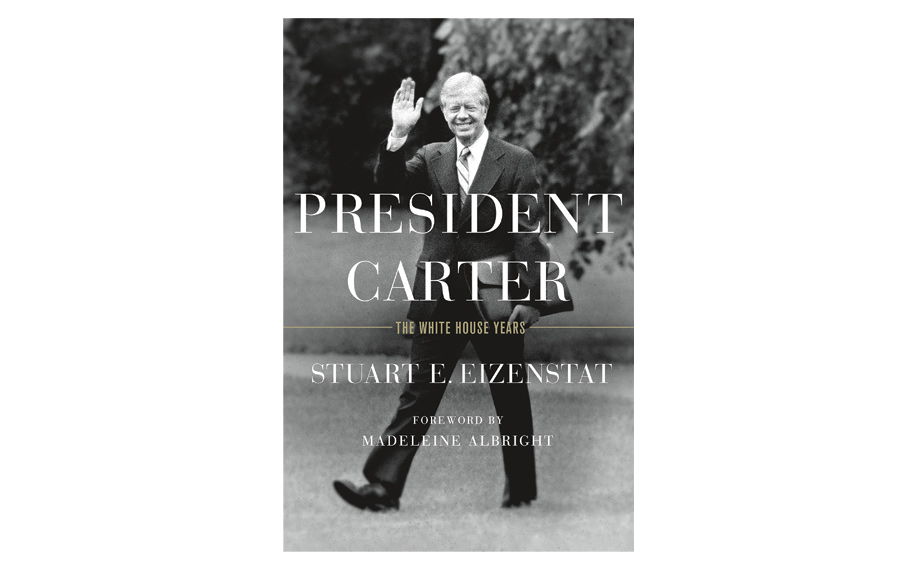
Thirty-eight years in the making, “President Carter: The White House Years” (Thomas Dunne Books) is part memoir and part history. Written by Stuart Eizenstat, then Carter’s chief of domestic policy, the book has the immediacy of a participant who was in the room and close to the action, shaped by the contemporaneous notes Eizenstat took, documents he examined and scores of interviews he conducted over the past 40 years with those who worked in the Carter White House, his cabinet, members of Congress and leaders of industry, government, labor, politics and the diplomatic corps who fought with or against White House initiatives.

Eizenstat came to Washington, D.C., with Carter’s Georgia team, stayed in Washington and served in the Clinton and Obama administrations in departments as varied as State, Commerce and Treasury. He also was U.S. Ambassador to the European Union (EU), where he took on the additional assignment of Holocaust restitution, a role that he has performed inside and outside of government as the lead negotiator for the Conference on Jewish Material Claims Against Germany. 

A Washington veteran who has learned much of how the government functions and how to use all the levers of power in his decades of public service, he conveys the voice of experience knowing well what was done wrong, out of ignorance or oversight, stubbornness or misjudgment. There is not a word of malice in the book — not even for Sen. Edward M. Kennedy (D-Mass.), who challenged Carter in the Democratic primaries of 1980 and weakened him.

When Eizenstat served as ambassador to the EU, for the first time in American history an ambassadorial residence was kosher. He was among a new generation of American-Jewish public servants whose children went to Jewish day school and who, when an emergency did not beckon, could be found in synagogue at Sabbath morning services. He was a Jew who felt comfortable being a Jew at home and in public, comfortable in bringing Jewish values and Jewish interests to his work, and he was respected for it. Today, this is commonplace. Before the Carter years, it wasn’t.

“Today, as we debate whether character counts in political leadership and if honesty is important in politics, we remember Jimmy Carter as a man of unblemished character.”

Full disclosure: I have known Eizenstat since I came to Washington in 1979 to work on the President’s Commission on the Holocaust, a Carter initiative, spearheaded by Eizenstat and his staff. Our work resulted in the creation of the United States Holocaust Memorial Council, which led to the establishment of the U.S. Holocaust Memorial Museum on the Mall. We went to the same synagogue; on Shabbat afternoons, I studied with his oldest son and we have been friends ever since — socializing and sharing Shabbat and festivals from time to time. So reader be aware, I am not neutral about the man, yet I can read his work most objectively.

Eizenstat sets out to reconsider the conventional assessment of Carter as an ineffectual, unsuccessful, one-term president, the worst since Herbert Hoover. After all, those who were alive during his administration from 1977-81 recall high inflation and high interest rates, long gas lines, the Iran hostage crisis and the Soviet invasion of Afghanistan. We can also recall the so-called “malaise speech,” which soon became counteracted by Ronald Reagan’s sunny disposition and cemented into national consciousness with his campaign question: “Are you better off today than you were four years ago?” With Reagan, it became “Morning in America” or so it seemed.

Eizenstat argues that Carter’s initiatives on energy policy and the environment have stood the test of time, innovating and sensitizing Americans — initiatives that may even withstand the efforts to dismantle them and all subsequent initiatives by the current administration. His efforts on the economy included saving Chrysler and New York City from bankruptcy. He appointed Paul Volker as chairman of the Federal Reserve, setting him lose to tackle inflation and stagflation, the twin plagues of the 1970s. He also had to deal with the aftermath of the Vietnam conflict and Lyndon Johnson’s domestic agenda without paying for them. Carter appointed Volker because it was good policy. Volker remained independent of White House pressures although he understood that the Fed’s policies to crush inflation would hurt him politically. On foreign policy, Carter is remembered for the fall of a shah and the Iran hostage crisis, yet Eizenstat reminds us about the Panama Canal treaty, Salt II and the openings to China and the Soviet Union. 

There are multiple narratives as to why the Soviet Union fell. Surely, one reason is that the focus on human rights, so central to the Carter administration, highlighted the tyranny of the Soviet Union. Andrei Sakharov and Anatoly [now Natan] Sharansky deserve some of the credit, along with Pope John Paul II, whose visit to Poland undermined communism and Jimmy Carter.

The most severe critique of Carter’s emphasis on human rights came from Reagan’s U.N. Ambassador Jeane Kirkpatrick, who argued that authoritarian regimes could turn democratic but totalitarian regimes could not. In the early 1990s, her thesis was proved demonstrably wrong as Eastern European regimes became laboratories of democracy. Today we must worry when democratic regimes turn authoritarian!

Eizenstat is candid in depicting Carter’s failures and willing to accept responsibility for his own mistakes.

Today, as we debate whether character counts in political leadership and if honesty is important in politics, we remember Carter as a man of unblemished character. Devoutly religious, he promised the American people after the Watergate scandal that “he would never lie.” His piety was apparent during his presidency and beyond, and along with his his decency, made him one of the most consequential former presidents in history. He is a man who, even after he was diagnosed with brain cancer, got up on Sunday morning to teach Bible class in his Plains, Ga., church. A man of uncommon character and unrivaled integrity, it seemed he was ineffective.

Jews have a particular memory of the Carter years. There was pressure on Israel, the first mention of the Palestinians’ aspirations, the tension with then-Prime Minister Menachem Begin and the awful feeling that the U.S. might sell out Jews for barrels of oil at a reasonable price. We also remember that Carter received the lowest percentage of votes for a Democratic candidate for president since before Franklin D. Roosevelt’s administration. The Jewish community had split its vote between Reagan and Carter at approximately 40 percent each, with John Anderson, the third-party candidate, receiving some 20 percent.

To convince skeptics who think they remember this period well, Eizenstat had his work cut out for him. In an elegantly written book, filled with good humor and gripping anecdotes and well as policy discourses and historical insight, he proves their recollections are at odds with the evidence.

President Carter’s contributions have been underrated. He is often judged, even by those who should know better, by the title of one of his many post-presidency books, “Palestine: Peace Not Apartheid.” Jewish critics hastened to charge him with calling Israel an apartheid state. Yet Carter saw then what was obvious since the beginning of his presidency and what many on the Israeli left still see, despite the sad state of current events in the Middle East. That is, if there is only one state between the Jordan and the Mediterranean, it cannot be both a Jewish state and a democratic state without subordinating the rights of the Palestinians. Many on the Israeli right are now confronting this issue and are fumbling into articulating diminished rights for the Arabs of Israel and even lesser rights for those in the occupied territories. Unlike Israel’s Declaration of Independence, the new Jewish state law makes no mention of respecting minority rights, and Israel has reduced the status of Arabic, the language spoken by 1 in 5 Israelis.

On Soviet Jewry, Carter’s contribution was essential. He elevated human rights to the center of American foreign policy, reversing the course that former President Richard Nixon and former Secretary of State Henry Kissinger chartered before him; and once human rights took front and center, the Soviet Jewry movement became a human rights movement and massive support was forthcoming from Cold Warriors and more importantly, from human rights activists. This was a major breakthrough in the movement, which previously had lukewarm support from the Nixon White House, which had openly — and in Kissinger’s case, cravenly — opposed the Jackson-Vanik Amendment.

Jimmy Carter was essential to the resettlement of Iranian Jews in the United States, essential because Eizenstat could take a Judeo-centric concern to the president of the United States directly, unapologetically and proudly, something his predecessors with easy access to the Oval Office did not do during FDR’s administration.

The story is worth repeating. In Executive Order 12172, Carter expelled all non-resident Iranians and suspended visas for all new arrivals in retaliation for taking American Embassy officials hostage in Tehran. Eizenstat was informed of the plight of Iranian-Jewish students and their families by Mark Talisman, who was working for the Council of Jewish Federations in Washington. Iranian leaders and students, among them Moussa Kermanian, his son Sam and Isaac Moradis. He convened a meeting with all the significant officials. For the Jews attending this meeting, there was the haunting memory of the Holocaust — when entry to the United States was barred to Jews fleeing Nazi Germany. Iranian-Jewish students would be allowed to secretly file for asylum so as not to endanger their families back home. While these appeals were being adjudicated, their expulsions would be rescinded and exceptions to the Executive Order would be made for those facing religious persecution — Jews and also Baha’i and Christians as well as Zoroastrians.

President Carter’s contributions have been underrated. He is often judged, even by those who should know better, by the title of one of his many post-presidency books, “Palestine: Peace Not Apartheid.” 

Ever sensitive to religion, Carter agreed, and one can see the results daily in Los Angeles, with its thriving Persian-Jewish community. In 1979, unlike 1933-44, pressure from establishment Jewish institutions, in cooperation with Jewish White House staff, was able to secure the president’s immediate consent to rescue Jews.

Camp David

The Camp David Accords would have never happened without Jimmy Carter. It began, Eizenstat admits, with Carter’s mistake. Carter invited the Soviet Union into the peace process, not recognizing that then-Egyptian President Anwar Sadat had expelled the Soviet presence from Egypt and was so frightened at the prospect of the Soviets returning, that Jerusalem became preferable to Moscow.

At a meeting in Cairo attended by a mid-level Carter administration official, Sadat said that he was willing to go to Jerusalem. The State Department was slow on the uptake because that move didn’t fit in with its Mideast policy. Yet soon the breakthrough spiraled out of State’s control. Sadat went to Jerusalem and the U.S. administration stood idly by.

When it became clear that the parties could not achieve peace on their own, Carter’s most basic values projected the process forward. A religious Christian, he relished the task of making peace between Muslims and Jews. Throughout the book, Eizenstat, with the wisdom of hindsight, faults Carter for his radical separation between policy and politics and his refusal to pay the usual Washington game of advancing policies as a tool of politics and using politics to advance policy. Yet for Camp David to happen, such a separation was essential, as there was little political upside required to make peace between Egypt and Israel.

Carter risked it all in inviting the parties to Camp David. The full prestige of his office and his presidency were at stake; their failure would become his failure and unlike most summits where every moment, even the final statement is carefully orchestrated, nothing was certain. The chance of failure was real.

Carter was trusted by Sadat and distrusted by Begin, both because Begin distrusted Carter himself and because Begin distrusted Sadat’s trust in Carter. The rural presidential setting in Maryland isolated and insulated the parties, and Carter deftly handled Sadat and Begin’s outbursts. Both were prima donnas, both strong willed. Sadat was facing pressure from his delegation that he was giving too much, and Begin faced pressure from his that he was offering too little. To the very end, success was uncertain and Carter was at his finest during the negotiations.

It was during these negotiations that the breach between Carter and Begin developed. Carter thought that Begin had agreed to a suspension of settlements while Begin believed that he had merely agreed to suspend settlements during the final negotiations for the Camp David Accords. When, months later, settlement building resumed on the West Bank,
Carter felt betrayed and Begin felt betrayed by Carter’s feelings of betrayal. Nevertheless, Carter continued to invest his prestige in the peace process and, without that pressure, no accords would have
been reached.  

Carter incentivized the peace accords with a multifold increase in foreign aid to Israel to be spent in the United States on military purchases, with a lesser amount for Egypt, tying both countries to American equipment for the past four decades.

Israel resented the pressure, yet without that pressure, there would have been no agreement. In the years since, the pattern has repeated itself as Presidents George H.W. Bush, Bill Clinton and Barack Obama pressured Israel and paid a political price by losing Jewish political support; Presidents Reagan, George W. Bush and Donald Trump haven’t pressured Israel, and therefore reaped the political benefits. Carter’s was the first to attack American dependence on non-renewable energy sources and sought to limit Arab power. Yet Jews were silent when, soon after he left office, solar panels were removed from the White House roof. American dependence on Arab countries for energy enriches them, emboldens them, enables them to be more reckless and weakens Israel and the United States.

Eizenstat is not reticent to admit error and is not hesitant to criticize Carter, but never does so with anger or disrespect. He does it by appreciating Carter’s strengths and weaknesses, something that ripens with time. Every leader has his/her limitations, every leader makes mistakes. Every leader who comes to Washington from the outside to shake things up must learn the ways of Washington without becoming a captive of the town. And while, in principle, good policies should be good politics, Carter’s radical separation of the two limited what he could achieve and led him to expend his early political capital without seeing benefits for it.

White House memoirs usually have a short shelf life; they are readable for weeks and perhaps, if quite good, for months. Eizenstat’s memoir took four decades to write but will be worth reading four decades from now as the definitive memoir/history of a consequential, if not successful, presidential administration.


Michael Berenbaum is director of the Sigi Ziering Institute and a professor of Jewish Studies at American Jewish University.

Capturing the Mind and Heart of Jimmy Carter Read More »