fbpx

January 16, 2019

Jews Go Underground as ‘Aryans’ in ‘The Invisibles’

World War II movies frequently feature daredevil heroes with steel-trap minds, but for sheer guts and ingenuity it’s hard to beat four young Jews in “The Invisibles,” alternately titled “We Want to Live.”

The four main characters, two men and two women in their late teens and early 20s, were born and raised in Berlin. However, instead of emigrating after Hitler came to power in 1933, they stayed in their native city. When all escape routes were cut off, they went underground as German “Aryans.”

Cioma Schönhaus, a former art student, became a skilled forger, not only saving dozens of Jewish lives but also earning enough money to buy his own sailboat to paddle around Berlin’s lakes. Hanni Lévy dyed her black hair blond, spent most of her days in dark movie houses and went out in the evening posing as a bereaved German war widow. Ruth Arndt worked for a high-ranking Nazi officer who entertained his colleagues with lavish banquets, and Eugen Friede hid out with remaining German communists and socialists and joined an anti-Nazi resistance group.

My second cousin, Ernest Güenter Fontheim, was himself one of the “Invisibles,” and major segments of the movie parallel his own experiences. Before the Nazi takeover in 1933, some 180,000 Jews lived in Berlin (including my parents, sister and myself). Mainly through large-scale emigration, by 1943 the Jewish population figure was down to 7,000. In the same year, Nazi propaganda minister Joseph Goebbels went even further and proudly announced that the German capital was now “Judenrein” (“cleansed of Jews”).

A number of the surviving Jews were in mixed marriages and were saved by the intercession of their gentile spouses, but most Jews went underground, and an astonishing 1,700 Jews were still alive when Russian troops conquered Berlin in the spring of 1945.

What did it take to stay alive when the slightest suspicion or slipup could lead to concentration camp internment and/or death?

Aaron Altaras as Eugen Friede. Photo courtesy of Greenwich Entertainment

“The common characteristic of the ‘Invisibles’ was that they were young,” Claus Räfle, director of the film, told the Journal. “They had to make instant decisions and be able to play other characters naturally. If questioned or eyed with suspicion, they had to be able to respond in a self-assured, relaxed manner, as without a care in the world.”

Other survival factors were sheer chance, good luck and the aid of courageous German gentiles willing to risk their jobs and freedom to help Jewish strangers. Among them was Hanni Lévy (played by Alice Dwyer), who hid during daytime in movie theaters. After a while, the cashier at the theater became suspicious, but instead of turning in Levy, she offered Levy shelter and safety in her apartment.

Räfle combines a feature film, in which youthful actors re-create the young principals as the wartime activists, while the actual, now elderly survivors comment on their own stories.

Even after liberation, the surviving “Invisibles” were at risk. Germans may have been skeptical when Goebbels declared in 1943 that there were no more Jews in Berlin. However, Russian soldiers took Goebbels at his word and refused to believe the claims of the Jewish survivors by declaring firmly, “Hitler killed all the Jews.”

This predicament is dramatized in the film when a Soviet officer confronts Schöonhaus (Max Mauff) and Friede (Aaron Altaras). As the two men plead desperately for their lives, the officer demands of them, “If you are Jews, then recite the Shema Yisra’el prayer.” Sweating and stuttering, the men comply and are embraced by the Soviet officer.

My cousin recalled a similar situation. He was hiding in Berlin when Soviet troops conquered the city. He was confronted by a drunken Russian soldier. Refusing to believe that my cousin was a Jew, the soldier ordered him to stand against the wall, raised his pistol and pulled the trigger. However, the pistol chamber was empty and the soldier ordered my cousin to remain standing at the wall until he could find a new supply of bullets to reload the pistol. Ernest took off as fast as he could.

In 1947, Ernest immigrated to the United States, formalized his interest in science and embarked on a distinguished career as professor of physics at the University of Michigan. At 96, he is now retired and lives in Washington, D.C., with his wife and close to their two children.


“The Invisibles,” in German with English subtitles, opens Jan. 25 at the Laemmle Royal in West Los Angeles and Laemmle Town Center 5 in Encino.

Jews Go Underground as ‘Aryans’ in ‘The Invisibles’ Read More »

‘Family Secrets’ Reveals Jewish Skeletons

A granddaughter learns that her beloved rabbi grandpa was a con artist. A daughter discovers that her doctor father is into degradation pornography. A sister is never told about the sibling who died before she was born. 

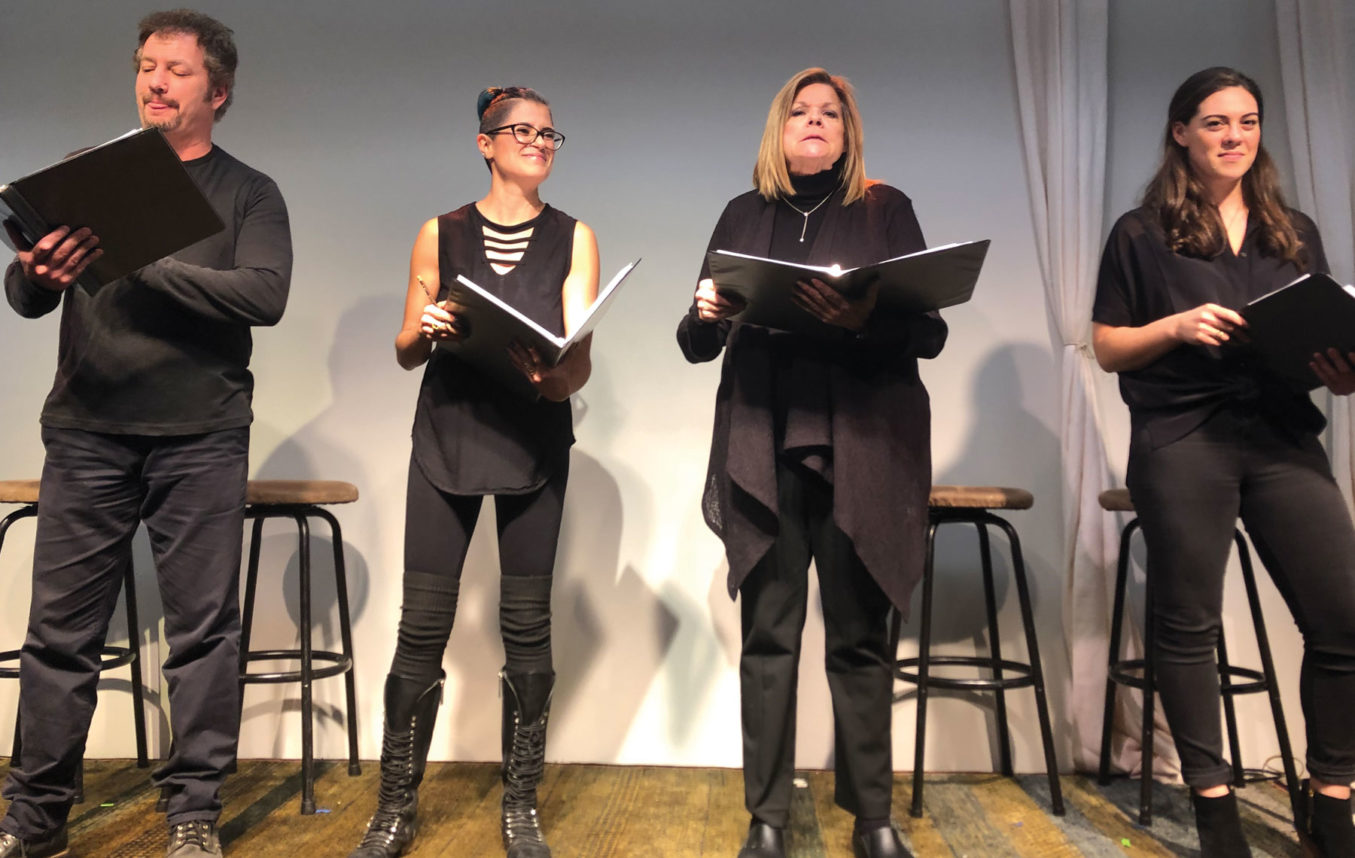
These are three of the dozen provocative tales told in the Jewish Women’s Theatre (JWT) production “Family Secrets,” currently playing at The Braid in Santa Monica and other locations through Jan. 29.

Opening with the lively song “My Dysfunctional Family,” the show is a mix of poignant, shocking, funny and touching true stories about sex addiction, forbidden romance, sexual abuse, teenage pregnancy and hiding one’s true self, all told from a Jewish perspective.

“Family secrets are so compelling because we all have them,” co-director Susan Morgenstern told the Journal after a rehearsal. She contributed the aforementioned piece about her older sister’s hidden death. “The poison of it was keeping the secret, so to hear it now and know that audiences will hear it is very cathartic,” she said.

Rosie Moss, one of the show’s four performers, found much to relate to in the material. A piece about a Polish grandfather’s relationship to Judaism resonated with her.

“My grandfather’s family is from Poland and Russia, so it’s easy to think about the generations before me coming to America and what that means for your identity,” she said. “I didn’t have a swindling rabbi in the family, but we have some not-so-perfect characters that I don’t know the full stories about, and I want to go call my grandmother and get more details. This stuff is all pretty universal.”

JWT Artistic Director Ronda Spinak narrowed down some 60 submissions to choose the 12 in the show. “I asked myself, was I moved by this? Did I learn something? Did I laugh out loud? If the piece has one or all of those, it [went] in the possible pile,” she said. Then she looked for variety, balance and resolution. “It wasn’t enough to share the secret. What happens when that secret is shared or not shared? How does that play out? What kind of impact does the keeping or sharing of that secret have? The pieces in the show answer that question or don’t answer it.”

Spinak co-founded the nonprofit JWT 12 years ago “to give voice to Jewish women to tell their stories onstage. Our mission is to create, produce and preserve Jewish stories so that future generations will know what it was like for the Jewish man and woman in America. We do men’s stories, too. Men come to our shows,” she said, although the audience is typically 55 percent or more female.

Spinak spoke about the JWT’s roots in “the tradition of Jewish women having salons in their homes, to bring forth cultural voices. We’ve performed in synagogues, museums, a women’s prison.” “Family Secrets” will play at several local synagogues and theaters over three weeks before heading to Santa Barbara and the Bay Area. 

“[The show] will make people think about their own secrets and the impact of learning those secrets and the impact of not telling them. If you’ve kept a secret, there’s usually a reason for it.” — Ronda Spinak

“There are so many different ways to be Jewish and to practice Judaism,” Spinak said. “We try to represent that in our shows.” 

Upcoming JWT shows include “It’s a Lie,” which, Spinak said, tells “funny, ironic stories surrounding death.” It opens in March, followed in May by “True Colors,” about Jews of color. “There are many ways to do Jewish,” Spinak said.

Spinak, whose heritage is Ashkenazi and one-quarter Sephardic, grew up in Orange County and has fond memories of attending Camp Hess Kramer. “I learned to have a spiritual connection to nature and to mash up creativity and Judaism,” she said.

Although her parents “didn’t believe in God anymore” after her sister’s death, Morgenstern said she found her way back to Judaism though JWT, where she’s been the resident producing director for six years. 

“I’ve started to understand exactly how Jewish I am,” she said. “Everything that matters to me is Jewish. I’m much more spiritual and focused on my Judaism. I feel more connected. I love my work here. It’s meaningful to me and I see the impact that we have.”

Co-director Lisa Cirincione, who also acts at JWT, was surprised at how deeply the plays have affected her. Raised Jewish by a Jewish mother (her father is Italian and Catholic), she said she “loved the material because it allowed me to learn about my own Judaism. The content penetrated my heart really deeply and quickly, and kept me coming back. I’ve gotten to play all kinds of Jewish women: American Jews, Russian Jews, Iranian Jews.”

New Jersey native Moss grew up in a “proud, culturally Jewish family. Reform but with a lot of traditions,” she said. “My brother is in his last year of rabbinical school and my mother is the executive director of a synagogue in Manhattan.” Her paternal grandmother sang and told stories in Hebrew, Yiddish and Polish, and influenced her desire to perform. 

Moss appeared in the JWT’s “Guilty Parties” last year, and she wrote and produced the short film “Enchanted LLC,” about a children’s party performer, based on personal experience. “It’s not a Jewish theme, but that’s what I want to do next,” she said.

Moss hopes audiences will come away from “Family Secrets” with “an understanding of all of our flaws, that we’re not perfect. Maybe something in our past is complicated but it still can be experienced and celebrated.” 

“It will make people think about their own secrets and the impact of learning those secrets and the impact of not telling them,” Spinak said. “If you’ve kept a secret, there’s usually a reason for it. Is telling it going to destroy? Bring closer? Inspiring people, making people think, provoking new thoughts, provoking change is really important. Having an audience leave talking about a piece and sharing secrets of their own begins dialogue about ideas that the Jewish people of America are wrestling with.”


“Family Secrets” runs through Jan. 29. Visit jewishwomenstheatre.org or call (310) 315-1400 for venues and dates.

‘Family Secrets’ Reveals Jewish Skeletons Read More »

Kindness Rules at Yavneh Hebrew Academy

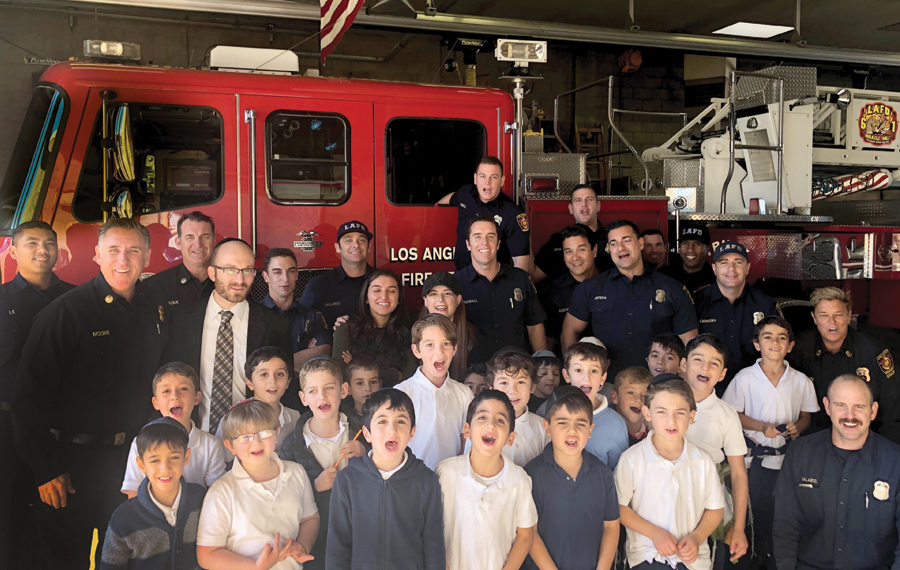
On a recent December morning at Yavneh Hebrew Academy in Hancock Park, third-grader Yonah Mandelbaum offered his lunch to a classmate after the boy said he didn’t want to eat the lunch his mother had packed.

Yavneh Program Director JJ Duchman overheard the exchange and handed Yonah a “kindness scratch card” for what he called a “flagrant act of kindness.” The scratcher allowed Yonah to participate in an after-school party as a reward.

Acknowledging these acts of kindness is part of Yavneh’s Dare2Care Kindness program, introduced last fall. Duchman said the program is designed to make Yavneh “the kindest school in the country. Our goal is to create a school atmosphere of being kind to one another at all costs, while learning to empathize with others and committing to midot tovot, or good character traits.”

Yavneh is approaching the program through a predominantly experiential focus, with the understanding that teaching kindness must be accompanied by acting kind to others. 

When Yavneh staff and administrators “witness” acts of loving-kindness, they reward students with scratch cards that can be redeemed for prizes such as pizza or gift cards. 

The school also hosts “Kindness Assemblies,” with the belief that if children are able to put themselves in another child’s shoes and feel his or her negative emotions, whether sadness or embarrassment, they will be less prone to cruelty and bullying. In fact, students have submitted essays and pictures for a contest titled “My Message to the Class Bully.” 

 “Our goal is to create a school atmosphere of being kind to one another at all costs, while learning to empathize with others and committing to good character traits.” 

— JJ Duchman

In light of recent tragedies including the Tree of Life synagogue shooting in Pittsburgh in October, Duchman said, “As the world is witnessing acts of darkness and our country is separated more than ever, we feel it’s crucial to come together.  If our learning, education and values are not being lived and experienced, then we are missing the point.” 

Yavneh Dean Rabbi Shlomo Einhorn concurred. “Judaism’s understanding of kindness is so beautiful that it needs to be lived inside and outside of the halls,” he said. “The things that move us and change us are not the information we read about; they’re what we see other people do. We must teach our students to live by example.”

Mindy Lyon said her sons Jared, 9, Adam, 5, and Jonah, 3, are learning about kindness through firsthand experience. “The importance of chesed can only be taught with a hands-on approach,” she said. “There is no greater lesson we can teach our kids than helping another person in need. I am so thankful to Yavneh for teaching our children the value of kindness through this important initiative.”

On Dec. 3, the school launched an eight-day program called “The Kindest Hanukkah” to encourage children to take kindness “out to the streets,” Duchman said. Lyon’s children picked out gifts to donate to Tomchei Shabbos, an organization that helps local Jewish families in need. “I wanted my kids to learn the lesson of giving and not only receiving during this holiday,” she said.

Lyon’s son Jared told the Journal, “You should be nice to everyone no matter what, because it makes the world a better place.”

As part of The Kindest Hanukkah program, the fourth-grade girls represented Yavneh at a menorah-lighting ceremony at Los Angeles City Hall. Nine-year-old Liel Levy read a short speech about the Dare2Care program, saying, “A true act of kindness isn’t just being nice to your best friends. It’s saying hello and smiling to someone who may be different or alone.”

Liel’s mother, Ganit Levy, told the Journal, “We are so proud of Liel and her kind heart, and hope that this beautiful trait stays with her forever.” 

Yavneh faculty and staff said they have seen an increase in kindness from the students since the launch of the program. Sixth-grade teacher Libby Engel said, “As I left my car recently, my hands were so full. Before I could even think, two eighth-grade girls offered to take all my bags. When I had two girls that were absent for a few days because they were sick, I had two girls offer to stay in from recess and help [them] catch up on missing work.”

“We made it a priority to put kindness on the front burner,” said headmaster Rabbi Moshe Dear. “We did this first by sensitizing our faculty and staff to modeling, reinforcing and finding curricular connections to kindness. Our programming team then planned to bring kindness from within the school and to share it with those outside of the school, much like the lights of the Hanukkah menorah shine and brighten the darkness outside.”

In addition to Dare2Care, Yavneh also has implemented an “Honorable Mentchen” program that enables teachers to submit detailed forms highlighting students’ acts of kindness. Criteria for the Honorable Mentchen include whether a child has demonstrated an understanding of the difference between right and wrong, and made a choice or action for what was right, even in a difficult situation. Recipients receive a certificate and are highlighted in Yavneh’s monthly newsletter. 

Duchman hopes to continue Yavneh’s efforts toward what he calls “experiential Judaism,” particularly through acts of kindness. “We showed that we will not back down from hate,” Duchman said. “We will add love and kindness. In a world filled with darkness, each student is a candle, dispelling evil with light.”


Tabby Refael is a Los Angeles-based writer.

Kindness Rules at Yavneh Hebrew Academy Read More »

Women’s March LA and D.C. Women’s March, Inc. Aren’t the Same Org

For those on the fence about whether to participate in the upcoming Women’s March Los Angeles on Jan. 19, Women’s March Los Angeles (WMLA) Co-founder and Executive Director Emiliana Guereca explained at a recent meeting with L.A. Jewish community leaders, that people should attend because WMLA is not affiliated in any way with Women’s March, Inc. (the D.C.-based organization).

At issue is the ongoing controversy surrounding the Women’s March, Inc.’s leadership, anti-Semitic and anti-LGBTQ remarks made by Louis Farrakhan and the refusal by two of the organization’s leaders — Linda Sarsour and Tamika Mallory — to condemn Farrakhan’s statements.

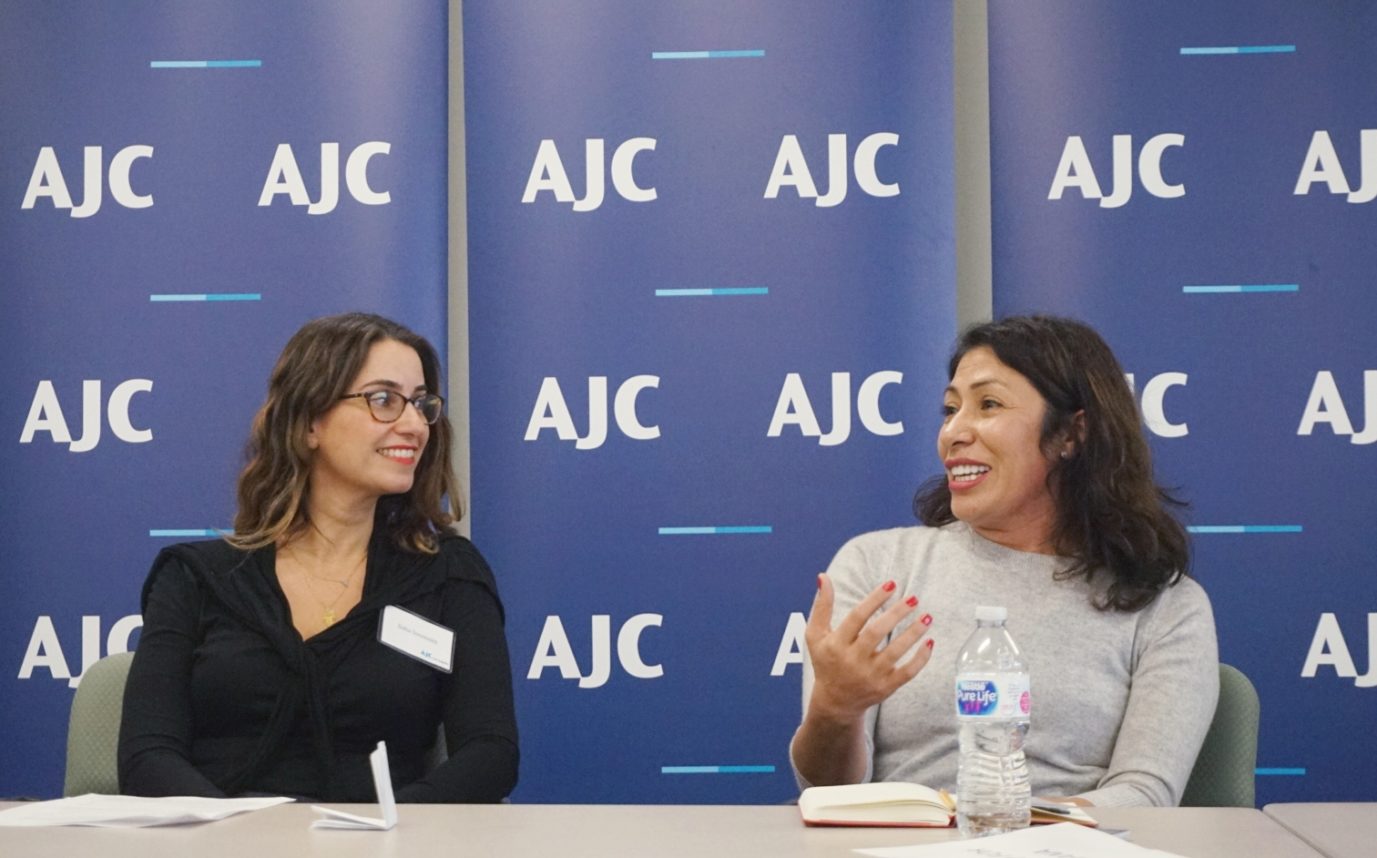
Last week, the Los Angeles Regional Office of the American Jewish Committee (AJC) hosted an open discussion on the issue with prominent Jewish community leaders and Guereca.

Guereca reiterated a written statement by WMLA that makes it clear they are separate organizations and that WMLA does not share leadership, structure or funding with Women’s March, Inc. and has no input in Women’s March, Inc.’s leadership or decision-making.
In addition, WMLA stated it “strongly denounces [Farrakhan’s] statements and recognizes the pain they have caused for the Jewish and LGBTQIA+ communities.”

Saba Soomekh, AJC Los Angeles assistant director, told the 13 women and five men in attendance, which included representatives from Sinai Temple, Temple Emanuel of Beverly Hills, Leo Baeck Temple, Valley Beth Shalom, Stephen Wise Temple, Congregation Kol Ami, Zioness, Jewish Federation of Greater Los Angeles, Jewish Public Affairs Committee of California (JPAC), JQ International, 30 Years After, and Jumpstart, that an “important timely conversation,” was needed. 

“Jewish women should not have to leave their identity and values at the door to join the women’s rights movement,” Soomekh said. “Our view is that we can proudly be Jewish, Zionist and feminist at the same time.”

“I think the media really fed us a concocted ‘Colors of Benetton’ picture: a Muslim, black, Latina and white woman all together. That worked for the march but for a movement it doesn’t work.” — Emiliana Guereca

Guereca spoke passionately about how she, together with WMLA Co-founder  Deena Katz, wanted to create WMLA because as a Jewish and Latina woman, she feared that both communities may get left out of the bigger D.C.-based movement. 

She added that, at the time, they started organizing the march, they had no idea WMLA would also grow into a movement. “We are continuing as a movement but we are not part of a national organization,” she explained, adding WMLA was the first to incorporate as a nonprofit on Nov. 9, 2016, the day after the national election. 

Back then, Guereca and Katz helped organize 20 marches in California, “and we found [then] the D.C. team was problematic in its relationships and its rhetoric.” She added that WMLA has voiced its concerns to the D.C. organization and has tried to work with it to become a national organization with chapters across the nation but to date has not managed to do so.

The sticking point still appears to be the perception that the marches around the country are all under the D.C. March umbrella. Asked why this is the case, Guereca said, “I think the media really fed us a concocted ‘Colors of Benetton’ picture: a Muslim, black, Latina and white woman all together. That worked for the march but for a movement, it doesn’t work.”

When asked if the marches are different then why is everyone using the same marketing and branding logo, Guereca said WMLA has filed a lawsuit for trademark infringement against the D.C. organization.

“We want them to change their branding,” she said. “The logo was put forth by a volunteer and put in public domain to be used by anyone organizing as a women’s march. We did not put forth that logo to look unified [as an organization].”

Rabbi Denise Eger of Congregation Kol Ami was the first in the room to openly and profusely thank Guereca for agreeing to the meeting. “I think this is really courageous of you to meet with all of us,” she said, “and I’m grateful the local march has distanced itself in word and deed [from Women’s March, Inc.].

Eger then added that she wanted to address the issue of anti-Israel and anti-Zionist language that had been used at previous local marches by WMLA speakers, although she added she did not hold WMLA accountable. 

Guereca said there always have been guidelines in place for speakers but that the issue had been that the anti-Israel remarks and what she called “hate speech” had come from those who were not officially selected to speak but had been passed the microphone by speakers on the roster.

Going forward, Guereca said, “We’ve spoken to our staging company where we’ll have ‘Golden Globe’ music come on and we have figured out you can’t hand the microphone to someone else who is not scheduled to speak. We either stand for all women or we stand for no one. We can’t tolerate hate speech toward anyone.” 

When asked if Guereca shouldn’t be putting herself forward more, as a Jewish and Latina woman leading WMLA, the way Sarsour and Mallory are seen as leaders, Guereca said, “I have a full-time job. [Her WMLA position is a volunteer position.] We had to hire a crisis PR management team. We were kicked out of our previous offices because we had people protesting outside. I have small kids. We don’t have 24-hour security like [Sarsour] does. Do I want to live my life that way? Absolutely not.”

However, Guereca said WMLA is still working toward creating a national organization and believes that ultimately the four women leading Women’s March, Inc. will step down. “I think there has to be room for them to step down because I think the further you push them against the wall there’s going to be a fight.”

There needs to be the ability to craft a dignified departure for these women, she said, because that’s how a nonprofit board should run. “And that’s part of a conversation we’re having with [Women’s March, Inc.’s] COO about the possibility of a graceful exit [for them].”

A women’s movement — not just marches — continues to be the goal, Guereca said. “It’s time to bring in board members and build [the movement] up. If that doesn’t happen, the organization will go down in flames because there is no way it can withstand another crisis.”

Women’s March LA and D.C. Women’s March, Inc. Aren’t the Same Org Read More »

Beloved Broadway Star Carol Channing, 97

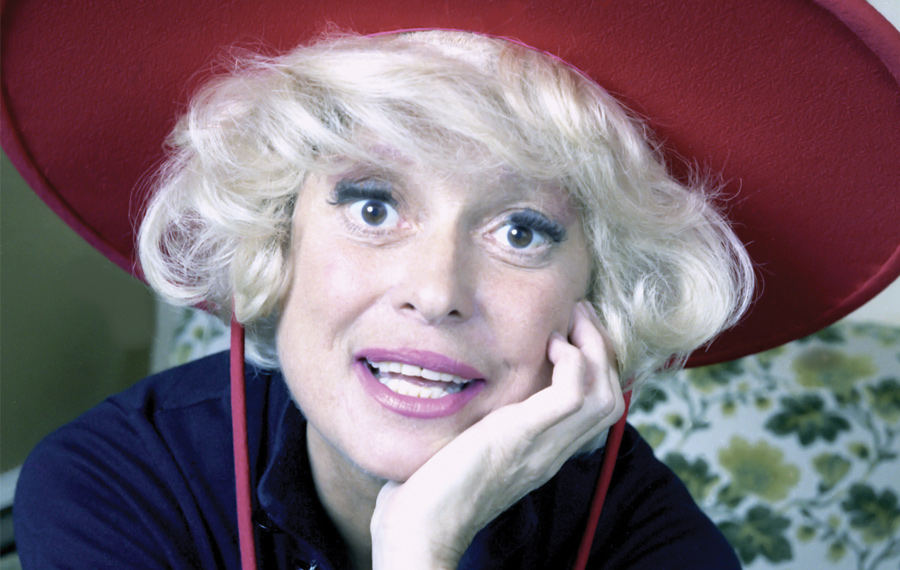
Carol Channing, the wide-eyed, raspy-voiced Broadway star who made an indelible impression as Dolly Levi in “Hello, Dolly!” and as Lorelei Lee in “Gentlemen Prefer Blondes,” died the morning of Jan. 15 at her home in Rancho Mirage, Calif. She was 97.

Channing had suffered two strokes in the past year, according to her publicist, B. Harlan Boll, who in a written statement called her “an original Industry Pioneer, Legend and Icon.” 

An indomitable presence — she starred in revivals of “Dolly” well into her 70s and was still performing at 93 and — Channing estimated she appeared as Dolly Levi more than 5,000 times, missing only one performance. During her final Broadway run as Dolly in 1995, she told The New York Times: “Performing is the only excuse for my existence. … What can be better than this?”

The only child of George and Adelaide (Glaser) Channing, Carol Channing was born in Seattle on Jan. 31, 1921, and raised in San Francisco. Her mother was Jewish and her father was a journalist who eventually became the editor of The Christian Science Monitor. She discovered her love of performing when she was 7 years old and, in a class election, imitated her teachers to the delight and laughter of her fellow students. From that moment she was hooked. (She also won the election.)

“Performing is the only excuse for my existence … What can be better than this?” — Carol Channing

While studying drama and dance at Bennington College in Vermont, in 1941 she went to New York and auditioned for a role in Marc Blitzstein’s musical play “No For an Answer.” She got the role, and although the show closed after only three performances, her performance was praised, and she decided to pursue a Broadway career. She was cast as an understudy for Eve Arden in Cole Porter’s “Let’s Face It” and found work in nightclubs and at Catskills resorts, but returned home at her father’s insistence in 1946. Convincing him to give her one more chance, she came to Los Angeles where she auditioned for Gower and Marge Champion, who cast her in their revue, “Lend an Ear.” A success in Los Angeles, the show also played for a year on Broadway and led to her being cast in “Gentlemen Prefer Blondes” in 1949. 

Playing Lorelei Lee, the innocent flapper and gold digger, made her an immediate star. Time magazine wrote: “Perhaps once in a decade a nova explodes above the Great White Way with enough brilliance to re-illumine the whole gaudy legend of show business.” The show ran for two years on Broadway, followed by a yearlong national tour; the song “Diamonds Are a Girl’s Best Friend” became her signature song. She went on to star in “Wonderful Town,” “Pygmalion” and “Show Girl” on Broadway, toured the country in her own cabaret act and performed in nightclubs with George Burns when Burns’ wife and performing partner, Gracie Allen, was ill. 

The role of Dolly Levi in “Hello, Dolly!” brought her even bigger fame. A massive hit, it won 10 Tony Awards (including best actress for Channing), and ran for seven years. Channing left after the first year, but returned to the role on Broadway in 1977, 1981 and 1994. She also appeared as “Lorelei” (reprising her role from “Gentlemen Prefer Blondes”) in 1973;  “Sugar Babies” in 1980; “Jerry’s Girls” in 1984; and with Mary Martin in “Legends!” in 1986.

Channing’s brassy, exaggerated persona didn’t make an easy transition to film and TV. She received an Oscar nomination for supporting actress in 1967’s “Thoroughly Modern Millie,” but “The Carol Channing Show,” a sitcom produced by Desilu productions in 1966, was never picked up. She guest-starred on many shows, including “Rowan & Martin’s Laugh-In,” Flip Wilson’s show “Flip,” “The Muppet Show,” “Sesame Street”  and “The Love Boat.” She also played the White Queen in Irwin Allen’s made for TV production of “Alice in Wonderland.” A lifelong Democrat, her name appeared on Richard Nixon’s “enemies list,” which she called the highest honor of her career.  

Channing was married four times: to Theodore Naidish, Alex Carson, Charles Lowe and Harry Kullijian. She had one son, Channing Lowe, an editorial cartoonist, who survives her.  

Beloved Broadway Star Carol Channing, 97 Read More »

Italian-Sephardic Dish Pharaoh’s Wheel Is Delish

I read “The Classic Cuisine of the Italian Jews” by Edda Servi Machlin cover to cover, something I’ve done perhaps twice in my entire life. I just couldn’t put it down. Machlin tells the story of her community of Livorno Jews. Livorno Jews were originally brought from Jerusalem to Italy by the Romans as slaves, just as depicted on the Arch of Titus in Rome. They were not Sephardic Jews, as they never passed through Spain. Although they lived in Europe, they were not Ashkenazi Jews either. They were Romaniote Jews. They were Jews brought to Italy and Greece by the Romans. I was transfixed.

Their foods were not purely Sephardic, certainly not Ashkenazic, but not your basic Northern Italian either. Their recipes were uniquely Livorno and uniquely Jewish. And that really would have been enough (or as we say “Dayenu!”). But these foods intimately linked Livorno Jews to our Jewish calendar and holidays in a wonderful way — with creativity, with flavor and with a zest for living. 

This week, the Torah portion is Parashat Beshalach. As the waters part, the Jews cross the Sea of Reeds closely pursued by Pharaoh’s charioteers. In one of the great close calls of all time, the Almighty causes the wheels to fall off the chariots, enabling the Jews’ escape! 

So here we are in late January reading Beshalach, which leads directly up to Passover and its miracles and wonders. And it occurs to me that just as the seder of Passover is designed to involve children in the wonders of the Exodus, so is a curiosity like the Pharaoh’s Wheel. It is what I call a dinner table teaching moment, and the best educational aid I know is great food!

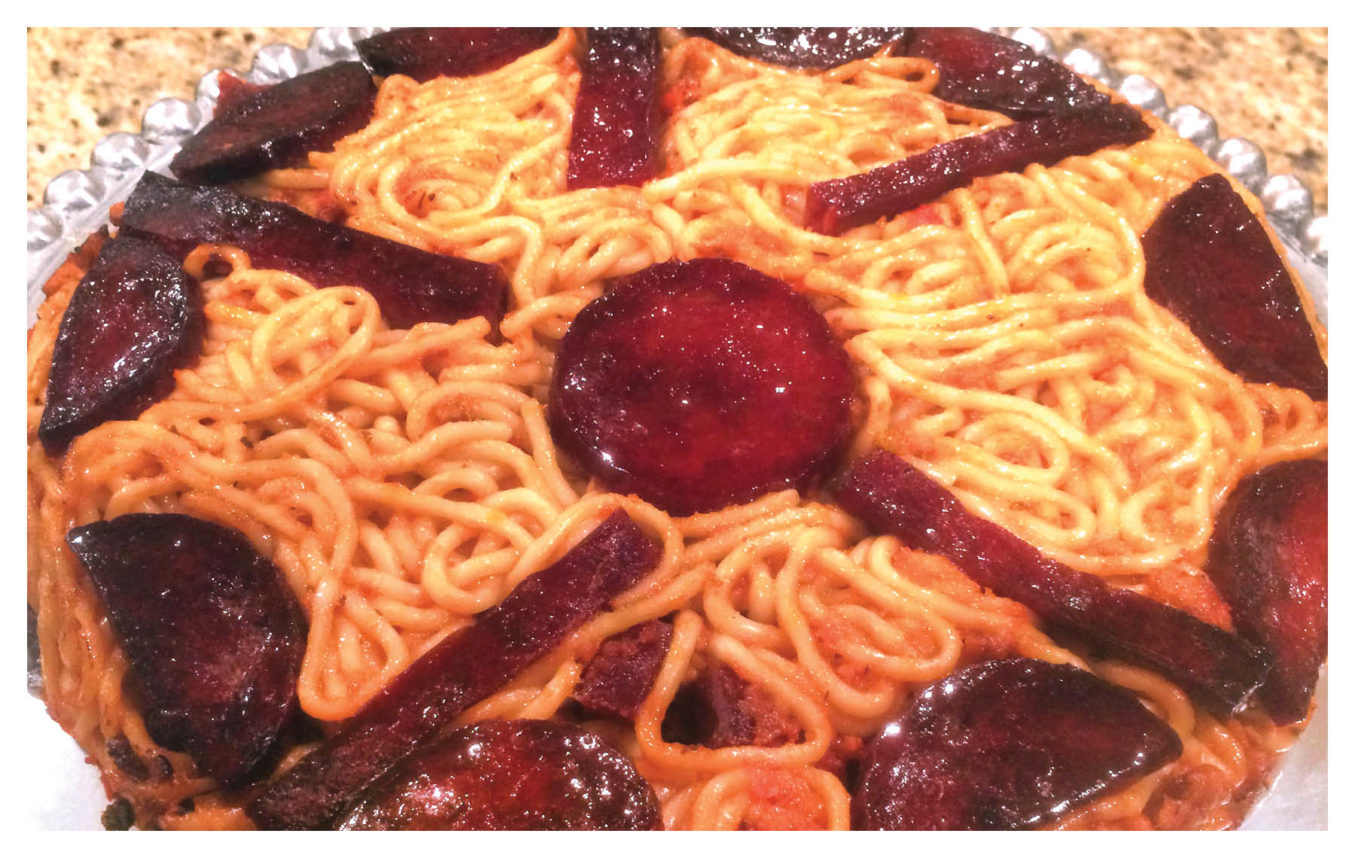
An Italian-Sephardic dish, Pharoah’s Wheel is a big wheel of pasta baked in a rich, salami-studded meat sauce with pasta “spokes” and big salami “hubcaps” (prized by lots of kids). Over the years, I’ve adapted the original recipe to my family’s taste. I leave out the raisins and nuts, I double the salami and I buy pasta instead of making it from scratch. But I like to think that the children at my Shabbat table look at that once-a-year treat, that huge, delicious Pharaoh’s Wheel, with the very same sense of joy and freedom that Beshalach brought to Romaniot Livorno!

PHARAOH’S WHEEL
1 pound dried spaghetti or linguini
2 cups meat sauce (recipe below)
1 cup diced dried salami, plus slices and sticks
Olive oil or nonstick cooking spray
Prepare the meat sauce.
Preheat the oven to 350 F.

Cook the pasta according to directions on the package (gluten-free pasta is fine) and drain well.

Generously grease a shallow, round baking pan or pie plate with olive oil or nonstick cooking spray.

Place a round slice of salami at the center of the prepared pan, and put additional slices or shapes of salami in whatever design you like, to create the look of a wheel.

Add the diced cubes of salami and the meat sauce to the cooked pasta. Gently spread the pasta-sauce mixture on top of the salami shapes in the pan. Pat the top of the wheel until the pasta is flat. (If using a glass pan, look up through the bottom of the pan to make sure the placement of the pasta didn’t disturb your design!) Bake for 1-1 1/2 hours or until a nice crust forms on all sides. Invert your Pharaoh’s Wheel over a serving dish and serve hot. This dish can be frozen and reheated. 

Makes 6-8 servings.

MEAT SAUCE
(Sugo di Carne)
1/4 cup olive oil
1 yellow onion, peeled and chopped
1 carrot, peeled and chopped
1 stalk celery, peeled and chopped
1 tablespoon flat leaf parsley, chopped
1 teaspoon dried oregano
1 clove garlic, minced (optional)
1 pound ground meat (beef or turkey thigh)
6 ounces tomato paste
2 cups water, chicken or beef stock
Kosher salt, to taste
Black pepper, to taste

In a large heavy saucepan, heat the olive oil. Add the chopped onion, carrot, celery, parsley and oregano and sauté gently for about 5 minutes.

Add the garlic and ground meat and sauté until finely crumbled and no longer pink. Add the tomato paste and stir well to combine.

Slowly add the water or stock and cook, covered, over low heat for about 45 minutes.

Let the sauce cool, and adjust seasoning with kosher salt and freshly ground black pepper. The sauce should be thick. If it seems watery, simmer it for a couple of minutes more to evaporate excess liquid. This sauce may be frozen.

Makes 3 cups.


Debby Segura designs dinnerware and textiles, teaches cooking classes, and lives in Los Angeles.

Italian-Sephardic Dish Pharaoh’s Wheel Is Delish Read More »

Trees: The Ground Beneath Our Feet Tells a Different Story

Trees are secretly talking, trading and waging war on one another.

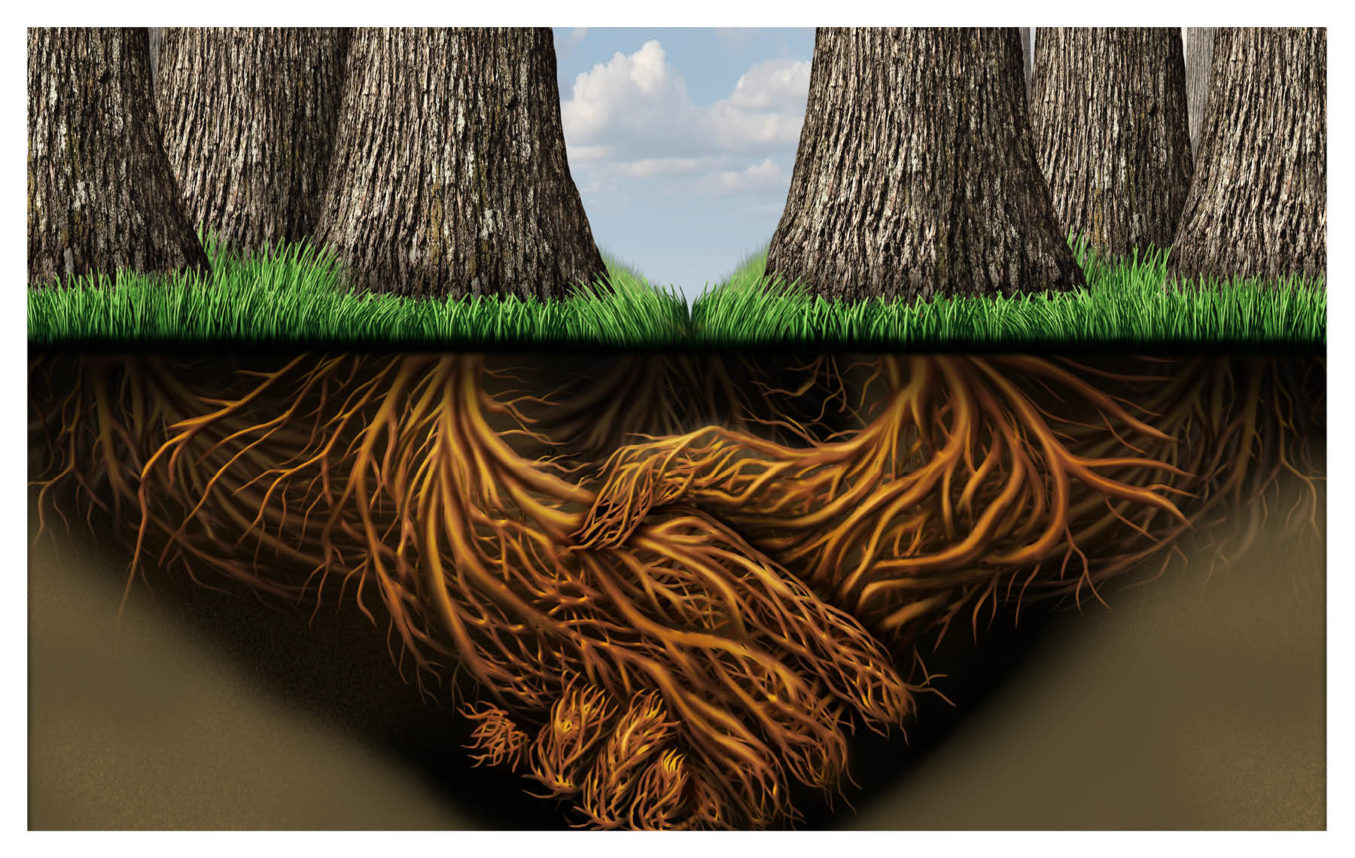
They do this by using a network of fungi that grow around and inside their roots.

The fungi provide the trees with nutrients, and in return, they receive sugars.

But scientists have found this connection runs far deeper than first thought.

By plugging into the fungal network,

trees can share resources with each other.

The system has been nicknamed the Wood Wide Web.

It’s thought that older trees, fondly known as mother trees, 

use this fungal network to supply shaded seedlings with sugars, giving them a better chance of survival.

Those trees that are sick or dying may dump their resources into the network, which might then be used by healthier neighbors.

Plants also use fungi to send messages to one another.

If they are attacked, they can release chemical signals through their roots, which can warn their neighbors to raise their defenses.

But like our internet, the Wood Wide Web has its dark side, too.

Some orchids hack the system to steal resources from nearby trees. Other species, like the black walnut, spread toxic chemicals through the network to sabotage their rivals.

Arboreal cybercrime aside, scientists are still debating why plants seem to behave in such an altruistic way.

The hidden network creates a thriving community between individuals.

When you are next in woodland, you might like to think of trees as part of a big superorganism, chatting and swapping information, and food, under your feet. 


Excerpted from a video on the BBC.

Trees: The Ground Beneath Our Feet Tells a Different Story Read More »

Weekly Parsha: Beshalach

One verse, five voices. Edited by Salvador Litvak, Accidental Talmudist

Then the children of Israel came into the midst of the sea on dry land, and the waters were to them as a wall from their right and from their left. –Exodus 14:22


Rabbi Ilana Grinblat
Vice President of Community Engagement for the Board of Rabbis of Southern California

As the rain poured, our kids ran outside, playing and dancing. Changes in nature captivate us. I can only imagine how mesmerizing the splitting sea was.

This verse describing this magnificent event seems like a contradiction in terms. How could the Israelites be simultaneously “in the midst of the sea” and “on dry land”?

The rabbis offer multiple resolutions to this contradiction. In Bereshit Rabbah, one rabbi explained that the Israelites were in the midst of the sea – until the water reached their noses – and only then did it become dry land. Rabbi Nehorai understood the verse to mean that they went into the midst of the sea as though they were on dry land — meaning that they had available in the sea what they had on land. He explained that when the daughters of Israel were carrying their children through the sea, if the kids cried, the moms would pick an apple or a pomegranate from the sea to feed them.

How wonderful of Rabbi Nehorai to be concerned that the kids had snacks along the way!

Yet perhaps, the contradiction in the verse is precisely the point. At the moment of the splitting of the sea, the separate categories of “on dry land” and “in the midst of the sea” converged.

Likewise, the real miracles in our lives change the way we view the world —  obliterating pre-established categories. Complex realities often don’t fit into simple binaries. Sometimes, what we consider impossible can become possible.

Rabbi Benjamin Blech
Professor of Talmud, Yeshiva University

Fanaticism, philosopher George Santayana famously said, consists of redoubling your efforts when you have forgotten your aim.

Fanaticism and extremism are twins. Both camouflage themselves in the cloak of idealism. Both claim that they and they alone possess the key to truth. Both do not seek knowledge but only care to impose their own extreme views on others. For them, moderation is a vice, not a virtue. For the most part, they do not speak, they shout; they are motivated not by love but by hate; they do not discuss, they primarily denigrate those who disagree with them.

Tragically, their presence in contemporary society — politically, culturally and theologically — seems to be ever more noticeable. The right and the left move further and further apart and the moderate center appears to be disappearing. It is the sickness of our age, a sickness which ignores the warning of King Solomon, wisest of all men: “Do not be righteous overmuch, neither be over wise; why should you destroy yourself?” [Ecclesiastes 7:16]

Judaism, as Maimonides pointed out, is based on the principle of “the Golden mean.” It is the key to all mitzvot. It is the essence of wisdom. How remarkable that when the children of Israel miraculously walked through the Red Sea on dry land on the way to Sinai, they witnessed the wonder of the waters turned into a wall on either side of them. The path to freedom and greatness was in the middle, between the extremes of right and left.

Rabbi Cheryl Peretz
Associate Dean, Ziegler School of Rabbinic Studies

As our ancestors left Egypt, the Torah describes the greatest miracle ever. God parts the sea waters, paving the way to freedom and liberation. Defying nature and reason, the wet sea becomes dry ground. In “The Book of Miracles,” Rabbi Lawrence Kushner shares the rabbinic story of two children, Reuven and Shimon, whose experiences were of anything but a miracle. As they cross through the great walls of the sea, all they saw was the mud on their feet. They never looked up to see the water miraculously divide as it is held on either side by the power of God. Consequently, they failed to see why everyone else stood on a distant shore singing and dancing. God had provided for their escape and they were freed from the oppression of their slavery. But, for Reuven and Shimon, the miracle never happened. 

“Their eyes were closed — they may as well have been asleep,” says the midrash (Exodus Rabbah 24:1). 

People see only what they understand, says Kushner, not what lies in front of them. We doubt, we question, we rationalize — closing our eyes and hearts to the unknown and the Unknowable. But, to be a Jew, Kushner teaches, is “to wake up and to keep your eyes open to the many beautiful, mysterious and holy things that happen all round us every day.” Imagine what might be our own experience — of meaning, connection, of transcendence — if only we open our eyes to our right and our left. 

Rabbi Elliot Dorff
American Jewish University

Walls play very different roles in our lives. Sometimes they are used to keep people in a defined perimeter, as in the walls surrounding a prison. Other walls are used to define that perimeter, as the walls of a building determine its square footage. Yet other walls are used to keep people or other threats out. 

The walls in this passage are of this last, protective sort, keeping out the water that would otherwise engulf the Israelites passing from one shore to the other. Those walls, like many others, are beneficial, even life-saving. 

Others, though, are more controversial, keeping out people or goods that should be let in. Physical walls, though, are not the only kinds. Legal walls for generations kept out African-Americans, Jews and Catholics from some neighborhoods, and they separated blacks from whites in schools, restaurants and even bathrooms. Today, we are embarrassed by those legal walls of the past. Like physical walls, though, legal walls often serve important and good purposes, defining, for example, what is acceptable behavior and what is not. 

Similarly, economic walls, as in tariffs, may or may not benefit a nation’s best interests. Emotional walls, too, sometimes protect us from assaults to our welfare, as when we close off relationships with degrading or abusive people. Sometimes, though, we create emotional walls that keep us from healthy and nurturing relationships and experiences, stunting our growth and fulfillment. 

What are the walls in your life? Do they help you or harm you? 

Rabbi Yehuda Mintz
Recovery Through Torah

Was God inflicting the Ten Plagues upon the Egyptians in retribution for their 210-year enslavement of the Israelites or was God attempting to convince his children of his power and love? Perhaps it was both.

The vast majority of Jewish commentaries suggest that 80 percent of the Hebrew slave population said, “Thanks but no thanks” to God with regard to the Exodus; they preferred to stay with what they had and knew. The 20 percent who followed Moses were the reluctant believers. 

Our Heavenly Father had to have patience in transforming us from an enslaved, skeptical people to a free, believing nation. 

As we left Egypt and reached the sea, we panicked, looking back and seeing the mighty Egyptian army in pursuit of us. It was Moses who stretched his arms toward the raging water, but it was Nachshon ben Aminadav who took God at his word and leaped into the sea. Only when the water reached his nose did the sea part; and only then were the Israelites motivated to come into the sea on dry land. Only then did the waters form a protective wall for them on their right and on their left. Our covenant with God is not that we are his observers, but that we are his participants in the care of his creation. 

So I keep a saying on my desk that reads “Leap and the net will appear.”

Weekly Parsha: Beshalach Read More »

The Tree That Survives the Desert

Tu B’Shevat, a Jewish holiday commemorating the importance and sanctity of trees, could not be more fitting in this day and age. Undoubtedly, it’s not easy to be a tree these days. Extended drought periods induced by climate change make it more and more difficult for those that need water to survive. Add to this the constant increase in pests and invasive species, one gets an idea of the grim reality in which many tree species are forced to survive the rapid and extreme changes.

However, there are trees that remain strong and durable and even thrive in the most hostile conditions. In a new Israeli study, scientists found that the acacia tree in the Arava desert in Israel is the world’s largest tree growing in such a hot and dry climate. The tree has an even higher growth rate during the hot, rain-free desert summers than during the slightly wetter winters, and research into this remarkable resilience might provide valuable information about how to deal with climate change.         

One of the expected effects of climate change is the northward movement of the global desert strip and the transformation of semi-arid regions into desert-like regions. This process negatively impacts natural vegetation and agricultural produce, and as a result, jeopardizes the nutritional security of millions of people. Due to Israel’s unique geographical location at the transitional zone from the Mediterranean to the desert climate, many local studies look into the resilience of natural vegetation and drought-tolerant crops. 

Some of the latest research into acacia trees was conducted by Tamir Klein of the Department of Plant and Environmental Sciences at the Weizmann Institute of Science, in collaboration with Gidon Winters of the Dead Sea and Arava Science Center, and Shabtai Cohen of the Volcani Institute. For three consecutive years, the researchers tracked 10 acacia trees from two species that are distributed in the Arava desert — a strip of desert stretching about 41 miles between the Gulf of Eilat and the southern shore of the Dead Sea in Israel. The researchers looked at two species: Acacia tortilis (the flat-top tree known to us from African landscapes) Acacia raddiana. Tracking was done using stem thickness sensors (to determine if the trees grow or merely survive and remain the same size), water-flow sensors in the stem, and a camera that documents the state of the leaves. 

The area in which the trees are being examined, the Sheizaf Stream in the Arava, is hot and dry, with annual precipitation of only 20 millimeters (less than an inch). Therefore, the researchers hypothesized that the trees in the area grow for about two to three weeks a year, when the stream enjoys floods and rains, and are dormant for the rest of the year. “It was a naive thought,” Klein said. “We got exactly the opposite of what we expected. We found that the acacia trees grow very actively in summer, in the dry season.” In the winter, however, the growth of the trees actually stopped. 

These results are also significant on a global scale, Klein said. “Although there are very hot and dry places in the Sahara Desert, for example, they do not enable tree growth, or the few trees that exist in them do not grow on days when temperatures and dryness peaks. Understanding the mechanisms that help a tree survive in dry conditions is of supreme interest to science and decision-makers.” 

“In a new Israeli study, scientists found that the acacia tree in the Arava desert in Israel is the world’s largest tree growing in such a hot and dry climate.”

The researchers speculate that the survival secret of the acacia is a vast underground water source, which is available to the roots also in summer. In the Arava, there are a number of aquifers (underground water reservoirs), and the acacia trees have long roots, which can reach tens of meters of depth so that they may have access to one of these aquifers. The researchers’ hypothesis stems from the fact that water was found flowing through the trunks of the acacia tree all year round (as opposed to most trees in Israel) and also that the trees are green almost throughout the entire year. Additionally, the researchers found that the trees grow larger in summers that follow rainy winters when underground water sources fill up more.

“The tree has its origin in tropical Africa, from where it spread millions of years ago,” Klein said. “As a tropical tree, it is genetically programmed to grow in maximum light and heat conditions.”

In the next phase of the study, whose results have not yet been published, the researchers sought to understand in greater detail the source of the growth. They found that the trees perform photosynthesis even in summer and they can use it to grow during the hot season.

The researchers currently are trying to get a better idea of the unusual growth pattern several ways. On the one hand, they survey the water that flows through the tree in order to learn about the depth of its source. On the other hand, a collaboration between doctoral student Daphna Uni of Tamir Klein’s lab and Winters as well as Efrat Sheffer of Hebrew University is to test how much of the tree’s growth happens through photosynthesis products in summer and how much by using photosynthesis reservoirs. This year, another test is to compare the status of Israeli acacia trees to those growing in South Africa, where the climate is less extreme.

“In view of the climatic changes that are taking place right now, the research is of crucial importance,” Klein concluded.


A longer version of this article appeared on ZAVIT 

Racheli Wachs is a staff writer at Zavit environmental news agency in Tel Aviv. 

The Tree That Survives the Desert Read More »

Jewish Parents, Teachers Voice Support for Teachers Strike

As tens of thousands of educators, parents and students marched, picketed and voiced their solidarity with the teachers strike against the Los Angeles Unified School District (LAUSD), Jewish parents and employees of the district contacted by the Journal said they stood in strong support of the teachers’ cause.

“I am tremendously grateful to our teachers for being willing to put their own pay at risk to stand up to say to the school board and to the state and the county that we have been desperately underfunding our schools for years and years and years, and that we cannot allow this to happen any longer,” said parent Brooke Wirtschafter of Tarzana.

Wirtschafter, who spoke with the Journal by phone, said she proudly sends her children to Gaspar De Portola Middle School and North Hollywood High School and kept them home while teachers were out marching and walking picket lines.  

Officials with the teachers’ union, United Teachers Los Angeles, estimated 50,000 people participated in a march through downtown Los Angeles on Jan. 14, with thousands more participating in other protests and picketing on following days. 

The union is negotiating for better wages, health benefits, smaller class sizes, better resources, full-time nurses, librarians and counselors. 

“I think it’s important for Jewish kids to be in public school both because they need to understand what it’s like for us to be a minority in this country [and] for other kids to see Jewish kids in school.” — Brooke Wirtschafter

LAUSD, the second largest school district in the nation, employs more than 34,000 teachers and educates 600,000 students at more than 1,300 schools and educational centers. On the first days of the strike, about one-third of the district’s students went to their respective schools, where substitutes and other staff kept them occupied with activities.

Mehgan Manes, who has been teaching for more than 15 years and is currently a math teacher at Paul Revere Charter Middle School in Pacific Palisades, said she participated in the Jan. 14 downtown march.

“It was so crowded. It was like the 10 Freeway,” she said. “Despite the rain, it didn’t deter anyone. People really showed their strength in numbers. That made it all the more exciting.” 

Paul Revere Charter Middle School substitute teacher Diana Kramer took part in the same march. “Many subs are not crossing the picket line but were told they’d be paid more if they worked [Jan. 14],” Kramer said. “I got [to Paul Revere] at 7 in the morning, and most of the teachers were [on the picket line] in the pouring rain.” 

Another parent, Jessica Emerson McCormick, told the Journal she kept her daughter home from the Girls Academic Leadership Academy in the Mid-Wilshire District.

“I’m very proud of the teachers and very supportive of the strike,” Emerson McCormick said in a phone interview. “I think it’s obviously part of a greater national movement. A lot of states led the way before L.A. went on strike. I am, at the same time, hoping that it is as short as possible.” 

She also acknowledged that she has “immense privilege” to keep her kids home from school, saying there are “many, many families where it’s not realistic or possible to keep their kids home — whether their kids get meals at school or whether they have no alternative childcare.”

LAUSD provides 870,000 meals, including breakfast, lunch, dinner and snacks for its students daily, according to its website. 


VIDEO: Teachers march downtown Jan. 14


Ethan Isenberg said his 6-year-old son, Eli, has Angelman syndrome, a rare genetic disorder that leaves him with many physical disabilities. He attends Grand View Boulevard Elementary in Mar Vista, and the aide that usually assists him is on strike.

“She knows him well enough to aid him with medication when necessary,” Isenberg said, “and since she’s not here and the school doesn’t have a full-time nurse, my son has to stay home from school.”

“I’m hoping that nursing resources are there for the kids like my son,” he added. “They need someone who knows the kids. Too much is being asked of them [nurses] and it’s putting the kids in danger.”

For parents in a bind, Valley Beth Shalom (VBS) and the Silverlake Independent Jewish Community Center have set up day centers for students of all ages.

VBS’ Strike Camp is hosting various activities from 8:30 a.m.–4 p.m. Monday through Thursday and will close at 3:30 p.m. on Fridays for a Kabbalat Shabbat service open to the community. On the first day of the strike, 25 students attended, and VBS expected that number to grow as the strike continued.

“We will offer this camp as long as it’s necessary,” said VBS Executive Director Matthew Weintraub. 

Silverlake Independent Jewish Community Center, in association with Camp Gilboa, is also hosting an extended winter-break camp for students who need a place to go.

“It affects so many people from so many socio-economic backgrounds, said the center’s Executive Director Neil Spears. “We decided we would have an 8:30 a.m. to 3 p.m. day camp to give kids an enriching and safe place to be during the strike so parents could have more options. About 60 kids [have] signed up.”  

The Jewish Free Loan Association (JFLA) told the Journal Jan. 16 they set up special funds to help teachers and government workers cover their expenses while they are striking and missing paychecks.

“We are also providing interest-free loans to families that are choosing not to send their kids to school during this time and need money for daycare,” said JFLA Director of Marketing Daphna Nissanoff-Gerendash.

Paul Revere’s Kramer said that over the years she has had to take on various side jobs, including being a Lyft driver, because her wages are so low. “Class sizes have gotten bigger and bigger, even though it seems like the money is there,” she said. “I’ve seen really great teachers leaving because they can’t afford to live where they teach. Everyone I have seen today is totally committed to seeing this through.”

LAUSD teacher Mona Cohen has taught for more than 40 years and marched alongside her community most of the day Tuesday. Cohen said she not only believes in public education but the students who will become the next generation of leaders.

“Education is the future, these kids are the future and that’s where the money needs to be invested,” she said adding, “they [students] need to be exposed to new things to broaden their knowledge. They need adequate funding to do that.”

Wirtschafter, who grew up attending public schools and believes in the value of public school education, said Jews in Los Angeles should be standing behind the teachers’ efforts.

“I think it’s important for our kids to grow up [with] a mix of people that is like a mix of the real world and the real cities that they live in,” she said. “I think it’s important for Jewish kids to be in public school both because they need to understand what it’s like for us to be a minority in this country, but I think it’s important for other kids to see Jewish kids and know Jewish kids in school.”

Jewish Parents, Teachers Voice Support for Teachers Strike Read More »