fbpx

August 29, 2018

Non-Jewish at the Jewish Journal

When I thInk of religion, I think of a painting my brother drew when he was 8 years old. It’s a picture of my childhood church, where I was baptized and my parents were married. There, in the middle of a center pew, is my stick figure family, fast asleep. He titled the painting “Snooze Town at Easter Mass.”

Although my parents aren’t devoutly religious, they forced us to go to Christianity classes and Mass once in a while. They believed Mass provided good family time and connected us to important values. My siblings and I usually sat in the pew scowling, not the least bit interested in what the priest had to say. Why did we have to be here? Why did we surround ourselves with people we didn’t actually know?

Last year, after contemplating my own beliefs, I decided to give up Christianity altogether, not out of boredom but out of an inability to connect the details of the Bible (which I did not believe in) with the values my parents and I found important. I believed in honesty, generosity, love and compassion. I just didn’t believe in the story of Jesus Christ, our supposed savior. I freed myself to live by my own personal beliefs. I meditated at a Buddhist temple every week, not in an effort to convert to Buddhism but to reflect on my own thoughts. It wasn’t until I started my internship at the Jewish Journal this summer that I realized I had been missing something.

In a strange way, interning at the Journal felt like the obvious next step in my spiritual journey. I had learned at the Buddhist temple that putting myself in an environment where I didn’t fit in (surrounded by Mandarin-chanting strangers) was the perfect environment for me to learn about myself. I thought of the internship as a double win: I would learn about journalism and about Judaism. I did not expect the people at the Journal to be excited about their work. If religion wasn’t exciting, what could be exciting about writing about Judaism?

On my first day, I was welcomed into an extraordinarily friendly workplace, but also into an entirely new religious community.

At the editorial staff meetings, one person would mention the recent work of a certain rabbi and at least one other person would add on something else they knew about that rabbi. Someone would mention a kosher restaurant, and everyone would nod because they had already been there.

The names of rabbis, synagogues and even certain Jewish families made up the common vocabulary. I felt as if I had walked into a family discussing what was happening in their relatives’ lives. And that is how I came to know the Journal: a bunch of hardworking people writing stories about what they valued most — their own family. What I had been missing, what I had been wanting, was a family like this one. For me, religion had always been too much about personal beliefs and not enough about community.

And the community made the religion exciting. I learned where all the writers got their passion when I covered my first event, a protest on Tisha B’Av against the separation of immigrant families, led by the organizations Bend the Arc, IKAR and Clergy & Laity United for Economic Justice (CLUE). I realized that the work of the Jewish Journal matters. The only way to solve these bigger issues is for people to unite and work together, and the first step to that process is raising awareness about what’s happening in the community.

Throughout my time at the Journal, I realized how much I missed out on by growing up without a religious community. I saw how facing the world’s most daunting questions with others creates unbreakable relationships. The strength of those relationships showed in the way everyone knew each other, in the excitement to celebrate the High Holy Days, and in the passion of the writers. I never knew religion could be so exciting, so unifying.

So thank you, Jewish Journal, not only for welcoming me into your staff, but for showing me how religion can power such a unified, loving community.

Evita Thadhani is a high school junior at Milton Academy in Massachusetts.

Non-Jewish at the Jewish Journal Read More »

Satirical Semite: Hello, Siri Alexa

I am delighted to announce the forthcoming arrival of my first daughter. Her birth will be livestreamed on 18 social media platforms and she will be called Siri Alexa Freed.

Throughout the birth, I will update my wife’s status: “Feeling pregnant,” “Feeling dilated,” “Feeling nervous,” “Feeling a small prick” (the epidural, not the conception), “Feeling relieved” and “Feeling the ow of life-sustaining milk.”

Amazon just delivered my new wetsuit complete with tzizit attachments and a waterproof GoPro camera, as I will film the entire waterbirth. We are finalizing a VR sponsorship deal so that you also can enjoy it on your Oculus Rift, experiencing it in virtual reality from underwater epidural through postpartum celebrations. Hopefully, my wife will appreciate my enduring dedication to cinematic artistry.

Admittedly, it will help me to know my first wife’s name. Until we meet for the first time, her working title is “Future Mrs. Freed” or FMF. Some have asked how I could be so presumptive that she will want to take on my surname? As a post-feminist-wokeAF-   enlightened male, I am sure she will appreciate the retro-hipster style of uniting our family under one name.

Besides, the whole Jewish double-barreled naming phenomenon is confusing. If the daughter of the Rosenberg-Cohens marries the son of the Goldenberg-Levines, we pity their poor granddaughter who signs her name Chaya Mushka Rosenberg-Cohen- Goldenberg-Levine. She will inevitably envy the pert, pretty, utilitarian nomenclature of Siri Alexa Freed.

Our baby’s delivery might take place in November 2019, a few meters from the beach near the Malibu Pier. You may be concerned it will be too cold to stand in the freezing sea during the final hour of labor as we wait for the actual birth. Thank you
for your concern, but worry not! I already have reserved a table at the nearby kosher Fish Grill so I will wait patiently there with a hot cup of tea while watching the live feed Malibu surf cam, and run down to the beach as soon as my semi-submerged wife and her doula give the signal that the birth has begun (i.e., frantically waving their arms).

Siri Alexa is a great choice for a name. Whenever I call “Hey, Siri,” she will feel like the center of attention even if I am speaking into my phone. When she’s 3 months old, I’ll train her with simple commands like, “Alexa, play ‘Three Blind Mice’ ” before progressing to the “Rocky Horror” soundtrack.

Her name also works if the baby is a boy. My parents were going to call me Samantha Jane (really!) but my vigorous masculinity scuppered that plan.

Our next babies, Uber 1 and Uber 2, will be taught to drive at a young age. When they’re 13, we’ll get them trailer-park driver’s licenses, so that I can say, “Hey Siri, get me an Uber!”

There will probably be more artificial intelligence names to choose from by the time FMF gives birth to our next eight kids.

The downside is that when my firstborn daughter becomes a wiseass teenager, she may monotonically respond, “Sorry father, I cannot process your request.” Touché.

I love how social media reveals peoples’ compassion. Many kind souls provide airport “check-ins,” which are very helpful for thieves about to burglarize their homes. The burglars would then be able to work at a more relaxed pace. It would, however, be more compassionate if homeowners would also leave their Wi-Fi code on the fridge and a pint of milk, in case the thieves want some tea.

A remote viewing video camera clearly makes the house more secure. After all, it’s not like someone can say, “Hey Siri, how do I hack home security cameras?” and immediately nd hundreds of helpful instructional videos. If my daughter answers, I shall switch off her Wi-Fi.

It is entirely probable my plans will completely backfire. I can already hear the future requests of my daughter Siri Alexa. “Hey, Dad, take me to dance class”; “Hey, Dad, can we go to Disneyland?”; “Hey, Dad, will you please pay for me to go on the school Israel trip?” It will be a pleasure. I shall serve and obey, and be grateful for every single moment of parenthood.

Marcus J Freed is a Los Angeles-based actor. View more at his website.

Satirical Semite: Hello, Siri Alexa Read More »

Elul Week Four: Taking Teshuvah’s Path Home

This is the fourth of six weekly columns by Rabbi Zimmerman leading up to Yom Kippur.

The cosmic principle of the entire High Holy Days season is teshuvah, which, unfortunately, is often translated as “repentance” and sounds severe and judgmental. However, teshuvah actually means “to turn, return, restore.” My teacher, Rabbi Lawrence Kushner, writes of teshuvah: “All God ever says is return to me.”

A stunning midrash declares that teshuvah itself was created before the creation of the world. Continuing that theme, another midrash imagines that God consults the Torah before creating the world. Torah advises God that human beings, by their very nature, will veer off the path, and therefore God created teshuvah as an avenue for people to turn back and be forgiven.

How extraordinary is it that the ability to make teshuvah is built into the very structure of creation? We all make mistakes, forget our commitments, lose connection with God and our best selves. We lose sight of our purpose, harm those we love, and hurt ourselves. As we stand together in synagogue and collectively recite our misdeeds, too many of them ring true.

But in the light of this reckoning, Jewish tradition proclaims that there is a way to repair what is out of order. We have a generations-old process of making amends and coming back to the center. In fact, throughout the High Holy Days liturgy, the loving, compassionate Source of All beckons us to return to our own souls, to one another and to God. Dov Baer, the Maggid of Mezritch, teaches that when we start on the path of teshuvah, God meets and guides us. With one single step, we have begun.

In practical terms, we enter into an examination of our year. We go through our calendar and remember the momentous events such as births, deaths and illnesses, our everyday relationships, our doctor’s appointments and trips to the beach. Or we notice what has been missing, such as the trip to the mountains we didn’t take because we were too busy working. We recall friends with whom we have lost touch, or those whom we have not made time to call. We bring to mind our involvement in the community, or the lack thereof.

Most of all, we reflect on where things got broken, and assess our own responsibility.

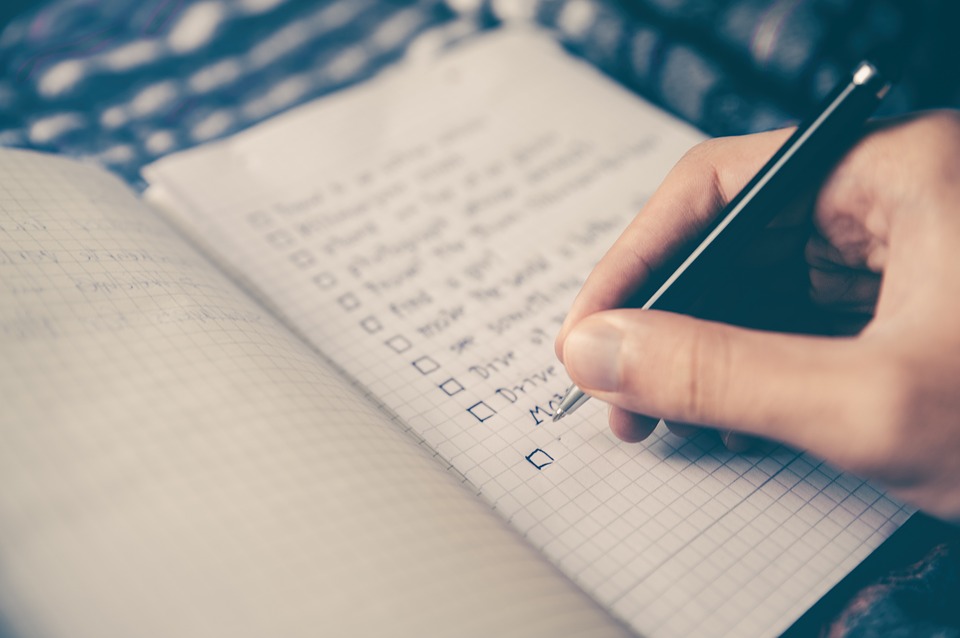
When we’ve made our list (and this takes time), we make a plan. We ask ourselves, how do we get back to wholeness? What phone calls, conversations, apologies and new commitments need to be made?

As we do this work, there are a few principles to keep in mind. First, some broken relationships might not be possible to repair. If you are in an unhealthy relationship that leaves you feeling constantly hurt or unvalued, and you believe that the other person is not open or incapable of changing, you may have to let it go for your own well being.

In the case of deeply painful (often family) ruptures that will require more than one High Holy Days season to repair, please know that it might be enough to just begin. It could take therapy, alone or together, for healing to take place.

Second, some of us feel responsible for everything, and what teshuvah might look like is turning back to a more solid sense of our own worth. Comedian Amy Schumer did a funny but true sketch on her show several years ago depicting a group of ve women, each one apologizing more than the one before. There’s even a Gmail app that a few women put together that catches all the times we pepper our emails with “I’m sorry.”

Sometimes the process of teshuvah is about acceptance of what is, which might be the hardest work of all. We can control only our own selves.

For your Elul practice this week, journal to the questions I’ve suggested above. Make a list of the apologies you need to make, and set aside time to explore how you can return to your own best self.

When you engage in teshuvah, you enter this year’s stream of souls longing to come Home and restore unity to our lives. Next week we continue the journey.

Rabbi Jill Berkson Zimmerman is a rabbi-at-large. She has created a Holy Days Spiritual & Practical Preparation Checklist, available on her website.

Elul Week Four: Taking Teshuvah’s Path Home Read More »

‘BlacKkKlansman’ and Jewish Identity

Movies are meant to be escapism, but in Spike Lee’s new film, “BlacKkKlansman,” there is no escaping. Lee is actively trying to blur the line between cinematic reality and our own.

The film tells the story of African-American police officer Ron Stallworth, who, with the help of a white colleague, infiltrates the Ku Klux Klan. This powerhouse of a film is a rendering of real-life events in the 1970s, but with Klan members talking about “America first” and “Making America great again,” the references are about as subtle as tiki torches on the streets of Charlottesville, Va. This film intentionally calls in the modern era and the state of racism and anti-Semitism in the age of President Donald Trump. And the film, based on Stallworth’s 2014 nonfiction book of the same name, also contains some fascinating insights on Jewish identity. (Warning: This column contains a few spoilers.)

While Stallworth handles the phone conversations with the Klan, he must rely on Flip Zimmerman, a white detective, to stand in for him in person at Klan meetings. In a short monologue, Zimmerman says he was born Jewish but not raised to be Jewish, that his experience contained no synagogues or bar mitzvahs or holiday observances. In fact, he never thought about being Jewish at all until his under-cover assignment. Now, he says, he “can’t stop thinking about it.”

Anti-Semitism can become a crucible that forges Jewish identity and awakens the Jew within. Zimmerman is now aware. Even though the Klan members hate Jews, he can “pass” in a way Stallworth can’t. He hadn’t seen the Klan as an immediate threat because his Jewishness was invisible, at most moments, even to himself. But now he realizes the danger is very real, not just to people of color, but to himself and others.

But Zimmerman was invented for the film. In an interview with Filmmaker magazine, one of the film’s screenwriters, David Rabinowitz, said they made the character Jewish to heighten the stakes, and, “on top of that, we’re [he and co-writer Charlie Wachtel] both Jewish.”

At one point in the film, Stallworth goes to hear civil rights activist Kwame Ture, who riles up a crowd of African-American students using the words of Hillel the Elder as a call to action: “If I am not for myself, who will be? If I am only for myself, what am I? If not now, when?”

Remembering the agenda of “BlacKkKlansman” — to share Stallworth’s story while reminding audiences of the story unfolding now outside the theater — the message is clear. The chants of “blood and soil” and “Jews will not replace us” in Charlottesville and the proliferation of online hate, including social media trolling by neo-Nazis and white supremacists, have reminded us that racism and anti-Semitism are still alive and well in America. The release of the film was intentionally scheduled for the first anniversary of the events in Charlottesville, including the death of activist Heather Heyer. Now is a time for empowerment and justice for ourselves. Empowerment and justice for others. And action immediately, in this moment.

Never has this been more true. We need to find our ways into other people’s stories. And we need to do it now. Because if we only act when we ourselves are the most active or most visible targets of hatred, we play into the hands of racists who count on complacency to help them move their agendas forward. Lee’s movie — entertaining in parts, starkly somber in others — may not be a vacation from reality, but it’s a well crafted, important statement about where we are and perhaps a warning of what we might become, if we continue on this path.


Esther D. Kustanowitz is a contributing writer to the Jewish Journal.

‘BlacKkKlansman’ and Jewish Identity Read More »

Week of August 31, 2018

Week of August 31, 2018 Read More »

A Feast of Two Worlds: Celebrating the new year by blending Ashkenazic and Sephardic traditions

I was raised Ashkenazi. I knew about apples and honey, and I knew about the Passover seder, but I’d never heard about a simanim (meaning signs or symbols) seder for Rosh Hashanah. That was all before I married my husband, Jacob. His family came from Salonika, Greece, yet here he was, my Sephardic pasha, eating gefilte fish, rugelach, lox and bagels, and loving it all. 

My grandma’s kitchen in Silver Lake was heaven for a kid like me, as I watched her roll out strudel dough, fill blintzes and roast chickens. Later, I had the privilege of watching fine Sephardic cooks like my friends Kaye, Linda, Leona and Lilly turn out boyos (Turkish pastry), kibbe (Middle Eastern dish of spiced meat and grain), sambusak (Middle Eastern stuffed pastry) and other wonders. Both streams of cuisine flowed into my imagination, through my kitchen and onto my table. Broadening, enriching and savory, Ashkephardic food isn’t just a cuisine, it’s a lifestyle, it’s an adventure. 

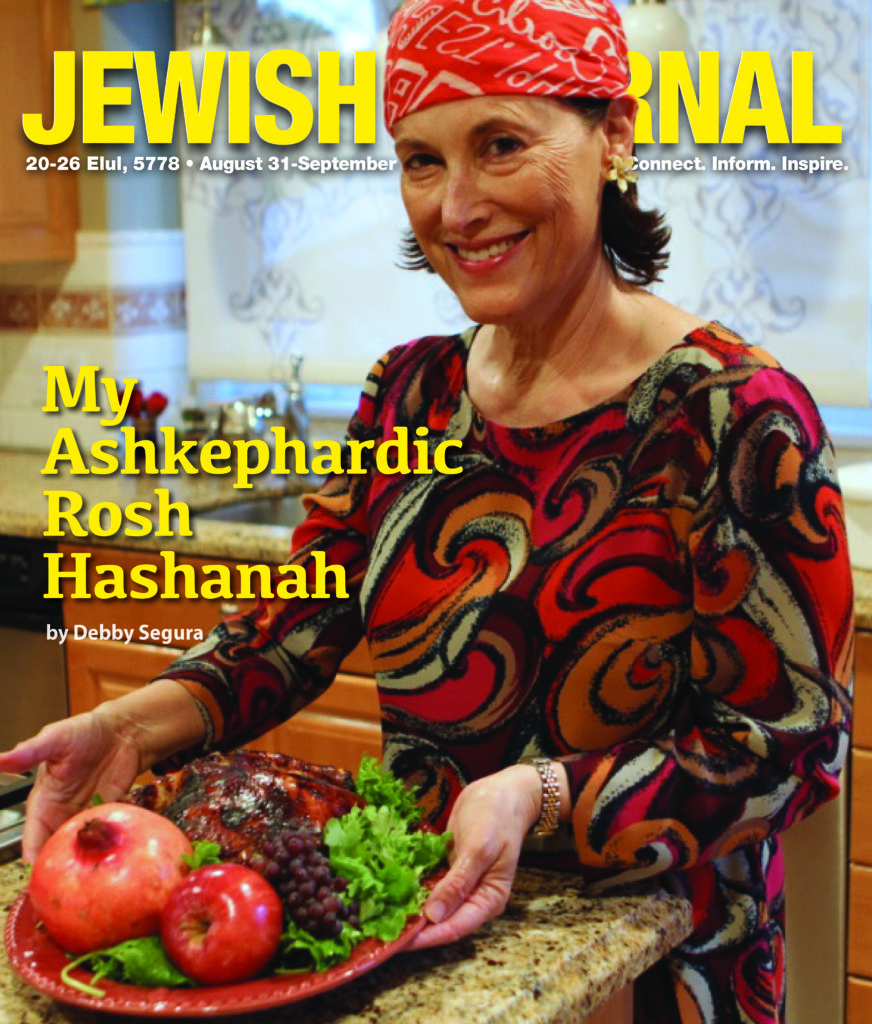
I’m a designer, so I bring my art to the table. I present my Rosh Hashanah simanim seder on an artist’s palette set before each guest. Each palette holds bite-sized tastes of the colorful and brilliant simanim. As we go around the table and read about the symbolic value of each food, we bless it and we connect it to our goals for the coming year, with vivid wishes for good deeds, protection, prosperity, potential, sweetness, life and light in the new year.


Roasted Beet Salad

For salads, let’s start with beets. I love borscht, especially its color. But here is another use for the mighty beet, which seems to be the nutritional darling of the hour. Beet greens are a siman for beating our enemies and those people (or those things!) who cause us trouble. In this recipe, I cook with the beetroot itself. I season beets with the classic Sephardic dressing of lemon and olive oil. I add a dash of pomegranate molasses for sweetness and pomegranate seeds for beauty.

4 medium-size red and/or yellow beets of similar size and shape (about 2 pounds)
2 tablespoons olive oil
1 tablespoon fresh lemon or lime juice
1 teaspoon pomegranate molasses (optional, available at kosher markets)
1 clove of garlic (optional)
Salt, cayenne pepper and cumin, to taste
Preheat oven to 350 F.

Scrub the beets clean and double wrap them in aluminum foil. (If you use both colors of beets, wrap, cook, dress and keep the two colors separate until serving or the red beets will bleed into the yellow beets.) Bake beets for about 1 1/2 hours or until they cut easily with a sharp knife.

If it’s easier, scrub the beets and place them in a Pyrex container with a small amount of water. Cover and microwave until they cut easily with a sharp knife

If you prefer a subtler garlic flavor, cook the garlic clove when you bake the beets. If not, leave the garlic raw.

Cut the cooked beets into thin slices, wedges or 3/4-inch chunks, whichevver you like. Mix the dressing ingredients according to taste, adding the minced raw or cooked garlic clove. Pour half of the dressing over the beets and toss gently to coat. Save the remaining dressing in a jar or container. Refrigerate the beets and the dressing. Fifteen minutes before serving, bring the beets and dressing to room temperature. Immediately before serving, toss beets with the remaining dressing.

Garnish with parsley, Thai or Persian basil, or tarragon. If you use the pomegranate molasses, sprinkle beets with fresh pomegranate seeds.

Serves 12.
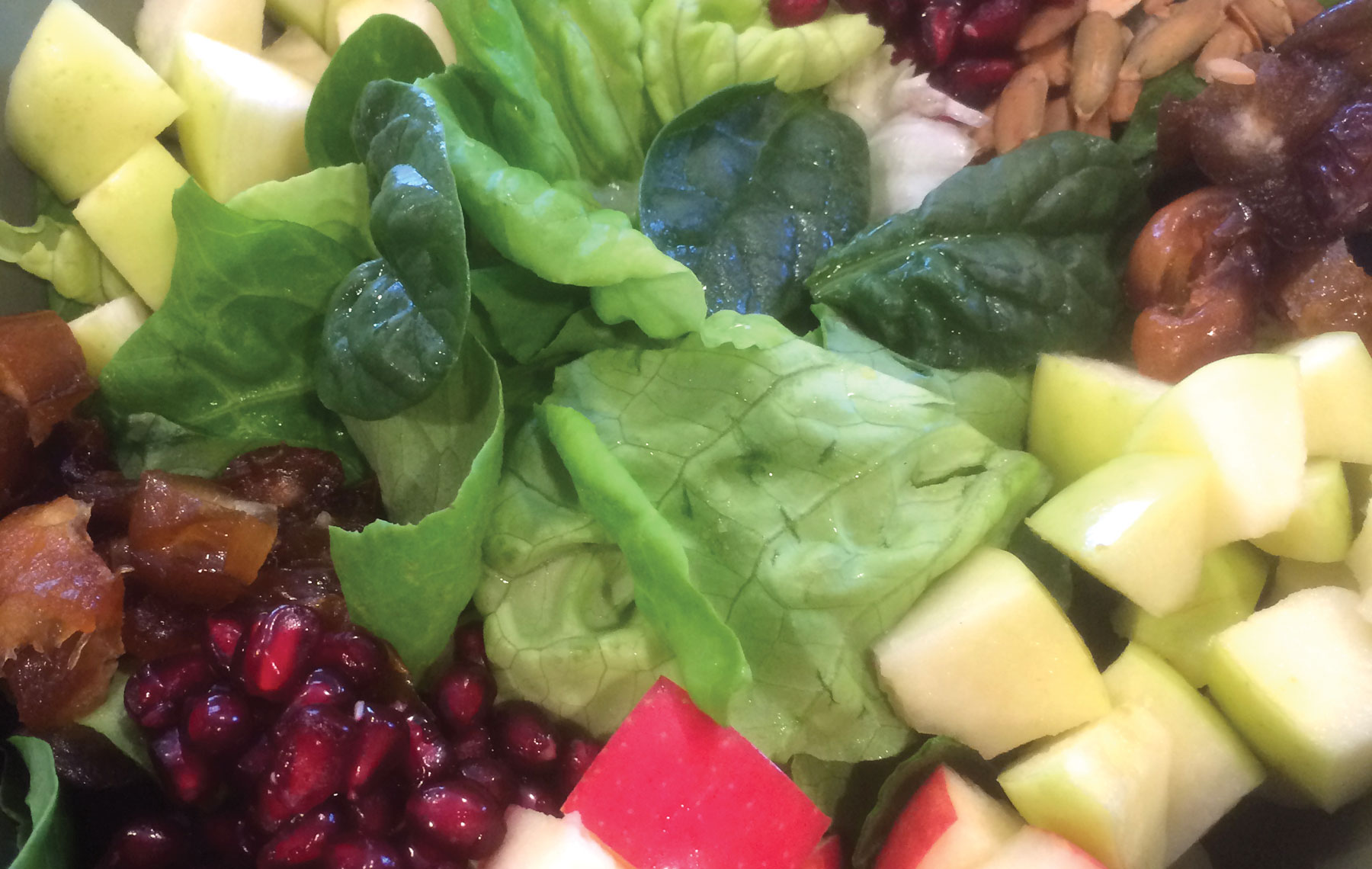

New Year Siminam Salad

My Simanim Salad is a classic among my family and friends. It’s vividly colorful and just plain yummy. This dressing is unique in that it uses leeks, a new taste for many and a siman.

The pumpkin seeds can share that 350-degree oven, too. This is also a nice salad dressing for the whole year.

1 large head butter lettuce
1 bunch tender spinach leaves
1/4 cup raw pumpkin seeds
1/2 yellow apple
1/2 red apple
8 pitted dried dates
Seeds of 1/2 a pomegranate, rind and white membrane removed

Preheat oven to 350 F.

Thoroughly clean lettuce and spinach leaves and tear into bite size pieces. (Spinach is another version of lubiya, a symbol of a purified heart.)
Toast pumpkin seeds until some begin to plump, about 10 minutes.
Core apples, leaving on the colorful skin, and cut into 1/2-inch chunks.
Cut dates into 1/4-inch rings.

Honey Leek Vinaigrette

1/4 cup canola oil
2 tablespoons fresh lemon juice or white vinegar (Dressing made with vinegar lasts longer)

1 tablespoon minced leek, white part only
2 tablespoons honey
1 teaspoon Dijon mustard
1/2 teaspoon salt
1 /4 teaspoon garlic powder
Pinch of cayenne pepper

Combine all ingredients until emulsified.

Refrigerate at least 4 hours before using.

Arrange lettuce leaves and most of the seeds, dates and apples in a large bowl.
Toss with vinaigrette just before serving.
Place remaining seeds, apples and dates on top of the salad.

Serves 12 as a first course.
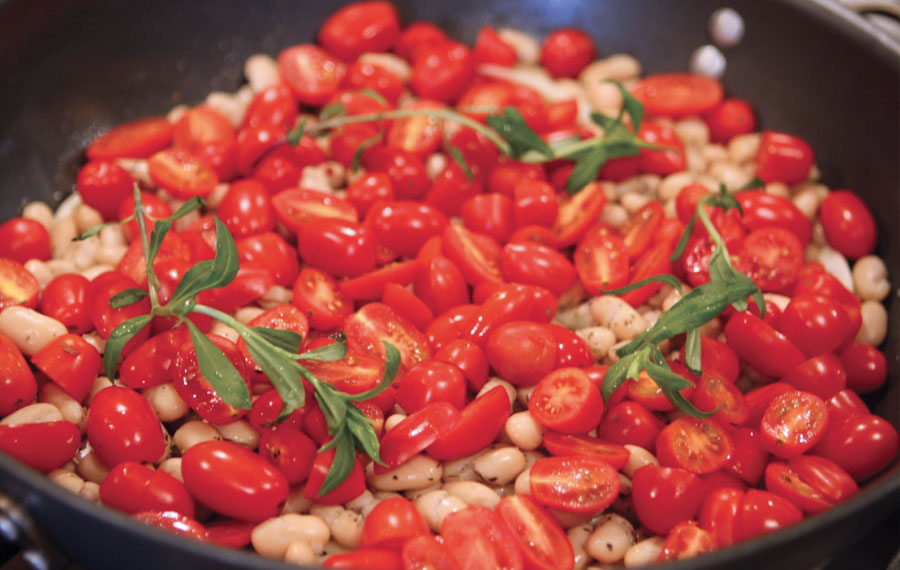

Roasted  Tomatoes with Cannellini 

Beans and peas are simans of prosperity and plenty. Although black-eyed peas are often used here, I just couldn’t pass up the beauty of cannellini beans.

2 large fennel bulbs
1/4 cup olive oil
2 teaspoons kosher salt, divided
2 pints grape tomatoes or cherry tomatoes, halved
4 large, fresh oregano, rosemary, tarragon or thyme sprigs
4 large shallots, peeled and trimmed
3 large garlic cloves, thinly sliced
1/4 teaspoon dried crushed red pepper
1 teaspoon freshly ground black or white pepper
2 15-ounce cans cannellini (white kidney beans), rinsed and drained
One sprig of tomatoes on the vine (tomatoes should be not larger than 1 inch)

Preheat oven to 425 F.

Heat a large and deep ovenproof skillet over medium-high heat until hot.
Trim fennel bulbs and cut in half vertically. Cut each bulb half into 1/2-inch-wide wedges, leaving some of the core attached to each wedge.
Add about 1/4 cup of olive oil to the pan.
Carefully place the fennel wedges on the bottom of the pan in a single layer; sprinkle with 1 teaspoon kosher salt.
Cook until fennel begins to brown and soften, turning once for a total of 10 to 12 minutes.
Add tomatoes, herb sprigs, shallots, garlic, crushed red pepper and sprinkle with remaining teaspoon of kosher salt and ground pepper.
Stir in cannellini beans.
Cover the skillet and transfer to the preheated oven. Bake 20 minutes.
Uncover the pot and, if desired, place the vine of tomatoes on top of the bean mixture.
Continue baking about 10 minutes more, or until the sprig of tomatoes just barely begins to soften and color.
Remove the herb sprigs (if desired) and serve warm or at room temperature.

Serves 6-8.
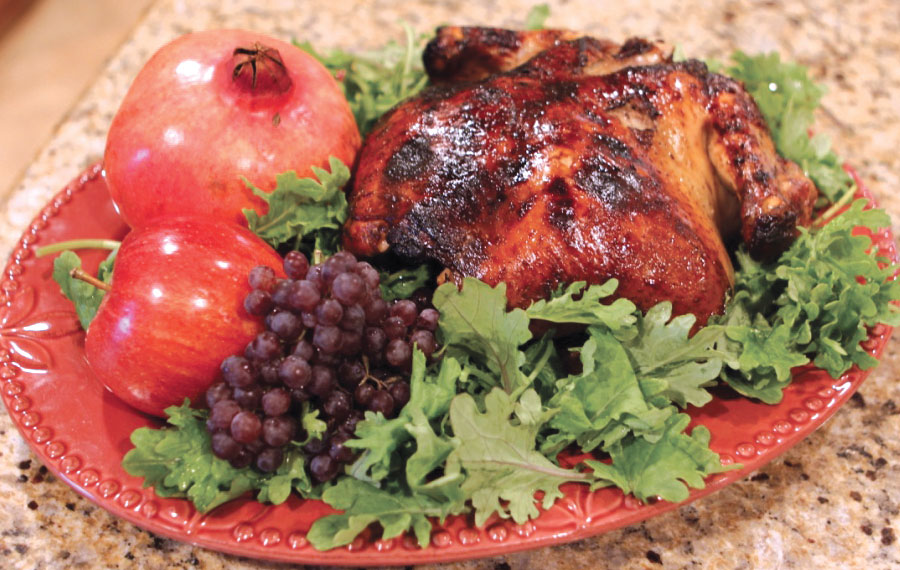

Pomegranate Chicken

For a main course, it’s hard to beat Pomegranate Chicken, also cooked at 350 degrees. Pomegranates, another siman, are full of seeds, and we pray that our year will be just as full of mitzvot!

This recipe features pomegranate molasses, a bittersweet, deep-red syrup beloved by Jews from many lands. I use Cortas Pomegranate Molasses, available at local kosher markets. A dramatic dish, with a rich, mahogany skin, the chicken presents beautifully on a bed of baby kale and pomegranates.

Marinade:

1/2 cup pomegranate molasses
2 tablespoons brown sugar or agave syrup
2 tablespoons olive or canola oil
1 teaspoon kosher salt
1/8 teaspoon white pepper

Chicken:

2 red onions, peeled and quartered
A 3 1/2-pound whole chicken

Combine marinade ingredients in a small saucepan and simmer for 5 minutes, until slightly reduced. Allow the marinade to cool. Place the marinade, chicken and onions in a large bowl or zip-close bag. Refrigerate 8-10 hours, rotating occasionally.

Preheat oven to 350 F. Place the onion wedges in a small roasting pan and place the chicken on top of the onion, breast-side down. Discard excess marinade.

Roast the chicken, covered, for an hour, and then uncovered for half an hour, or until the juices from the thigh run clear when pierced with a fork.

On a platter, arrange the chicken on a bed of fresh baby kale or rainbow Swiss chard leaves. Garnish with pomegranate seeds. Serve hot or warm.

Serves 6-8.
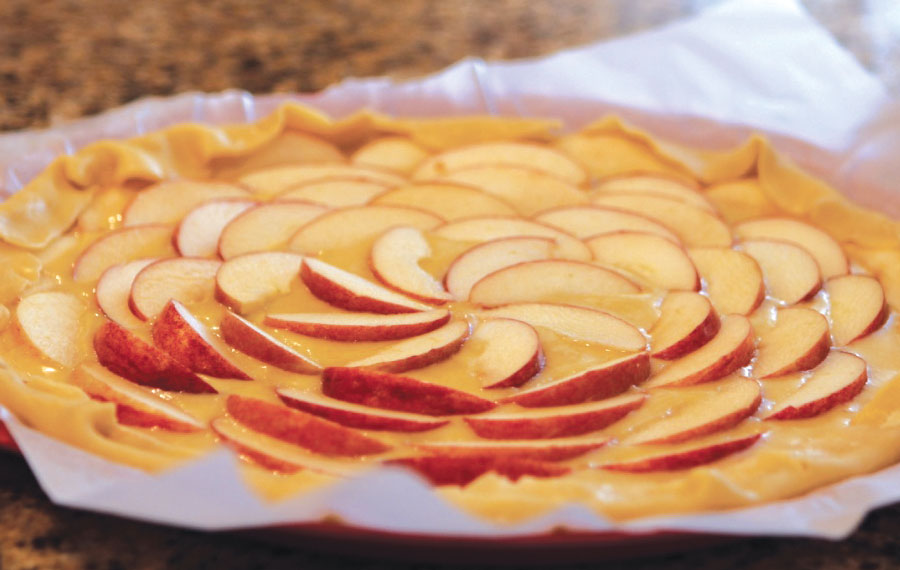

Rustic Apple Frangipane Fruit Pizza

I learned to love marzipan at beautiful and festive Moroccan mimouna, right after Passover every year.

Thin slices of cooked apples recall the classic Ashkenazi apple cake of my childhood, but the base of this frangipane has the subtle aroma of marzipan. To serve a big holiday crowd, I’ve scaled a rustic apple tart up to pizza size. This dessert can be frozen, too. Cool completely and double wrap in foil.

Crust:

1 1/4 cup unbleached, all-purpose flour
Pinch of salt
1 4-ounce stick margarine, cut into 8 pieces
3 to 4 tablespoons ice water

Filling:

1/2 cup slivered blanched almonds
1/3 cup sugar
One pinch salt
1/2 cup unsalted, room-temperature margarine, butter or canola oil
2 eggs
1 teaspoon vanilla extract
2 or 3 drops almond extract
2 tablespoons flour
1/2 teaspoon baking powder
3 medium-size Gala or Golden Delicious apples, cored and thinly sliced
Egg wash (1 egg beaten with 2 tablespoons of water)
Sugar, cinnamon sugar or turbinado sugar for dusting (optional)
1/4 cup warm apricot or peach jam, all chunks of fruit removed

Crust:

In a food processor**, place the flour salt and margarine. Pulse off and on until the mixture resembles coarse meal.

Add 3 tablespoons of ice water and pulse again, just until the mixture forms a ball. Place the ball of dough on a long piece of plastic wrap, flatten the dough into a disc, and wrap with the plastic wrap.

Refrigerate the dough for 30 minutes.

** The dough and the fruit pizza filling can be made by hand. The food processor just makes it a little easier.

Filling:

Place the almonds, sugar and salt in a food processor or blender,  and process until fine in texture. With the motor running, add the margarine, butter or oil; then the eggs, one at a time; followed by the extracts, flour and baking powder. Reserve.

Preheat the oven to 350 F.

Between two large pieces of plastic wrap, roll out the crust gently until uniformly thin, creating a circle that is 16 inches across. Line a pizza pan with baking parchment and carefully place the dough on the pan.

Gently spread the almond mixture over the dough, leaving a 1-inch border around the edge. Place the apple slices in a fan pattern on top of the almond mixture.

Fold the 1-inch edge of the dough over the last inch of the apples, and paint the edge with the egg wash. Sprinkle the egg- washed edge with sugar, cinnamon sugar or turbinado sugar if desired.

Bake the fruit pizza in the center of the preheated oven for 30 minutes or until the crust is golden brown. Remove the fruit pizza from the oven, and use the parchment to slide the fruit pizza onto a cooling rack to cool. Gently paint the jam over the baked apple slices.

Serve warm or at room temperature with a small scoop of parve ice cream (for a meat meal) or regular ice cream, if desired.

Makes one 14-inch pizza.
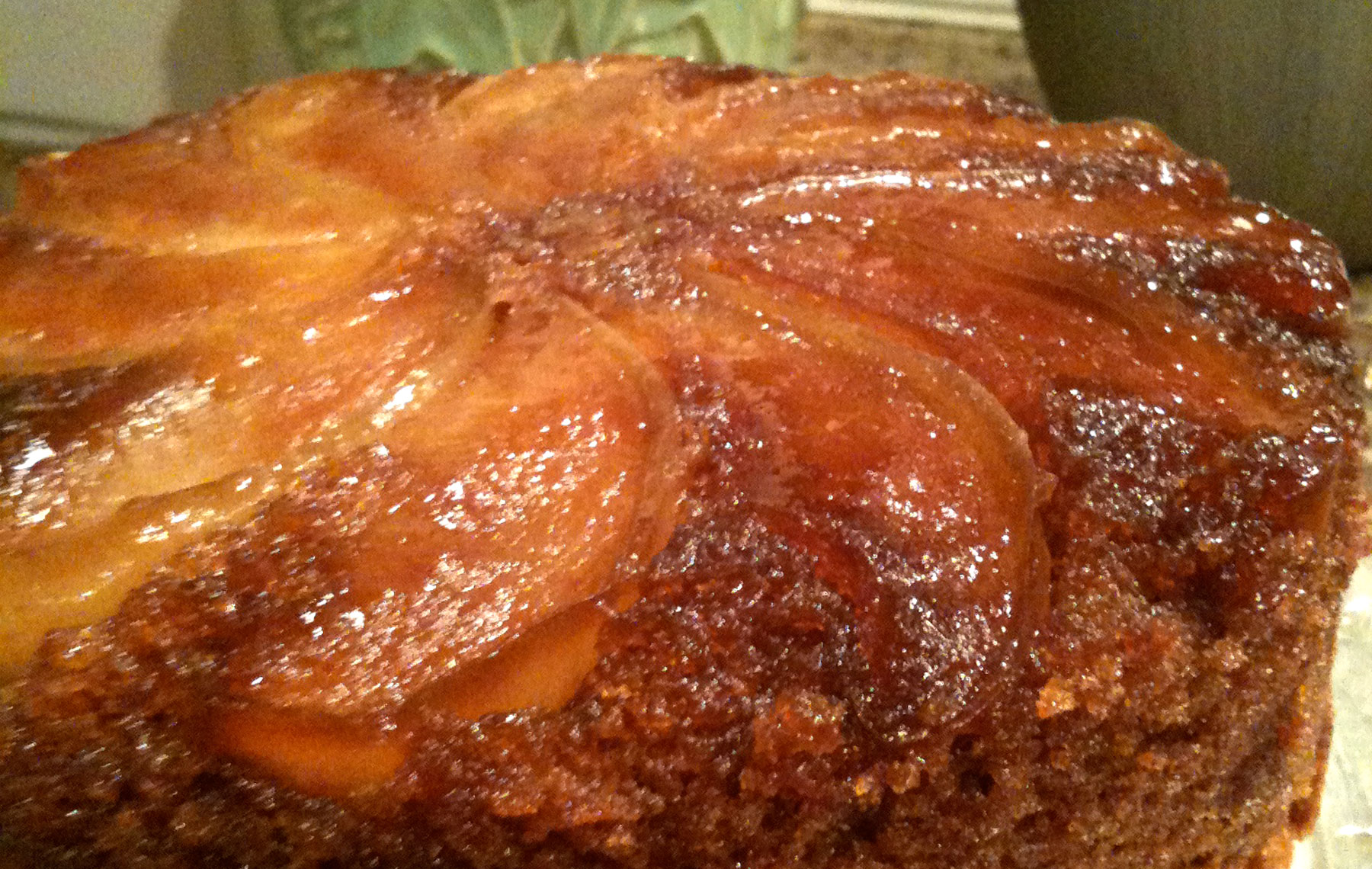

Caramel Apple Honey Upside-Down Cake

Apple-and-honey desserts are timely because fall is the beginning of the apple season. I grew up with honey cake, lekach, so I’m always nostalgic for it, but I mainly liked the gooey top of the loaf. Tarte Tatin came to me via the French patisserie influence of my Moroccan friends. I just couldn’t help putting that Ashkephardic touch of caramelized apples on top of classic honey cake.

Voila! Caramel Apple Honey Upside-down Cake!

Upside-Down Topping:

6 tablespoons canola or grape seed oil, divided (2 tablespoons in each of the 3 pans)
3 large Gala or Golden Delicious apples, cored and cut into thin wedges
1/2 cup brown sugar, divided (3 tablespoons in each of the 3 pans)

Honey Cake:

1/3 cup canola or grape seed oil
1 cup light brown sugar
4 eggs
1 cup honey
3/4 cup corn syrup or agave syrup
1 cup strong coffee
1 tablespoon vanilla extract
4 cups unbleached, all-purpose flour
1 tablespoon baking powder
1 teaspoon baking soda
1 teaspoon ground cinnamon
1/2 teaspoon each of ground allspice, ground ginger, ground nutmeg

In a sauté pan, warm the oil and gently sauté the apple slices in a single layer until they begin to soften. Reserve.

Preheat the oven to 350 F.

Line the bottom of three 9-inch round cake pans with baking parchment. In each lined pan, pour 2 tablespoons of oil and sprinkle one-third of the brown sugar; then place the pans in the oven for about 10 minutes or until the brown sugar has melted.

Arrange the apple slices on the brown sugar at the bottom of each pan like the petals of a flower.

In the bowl of an electric mixer, combine the oil and brown sugar and beat until fluffy. Add the eggs one at a time. Stir in the honey, corn or agave syrup, coffee and vanilla extract until combined. Add the flour, baking powder, baking soda, cinnamon and spices. Mix until well combined.

Gently pour the batter evenly over the apple slices. Bake for 40 minutes or until a toothpick inserted in each cake comes out clean. Cool 10 minutes.

These cooled cakes can either be served at room temperature or frozen for up to a month. To serve, invert the cake pan onto a cake stand and carefully peel away the baking parchment. To freeze, wrap in plastic wrap and then double-wrap in foil.

Makes three 9-inch round cakes.

Debby Segura designs dinnerware and textiles, teaches cooking classes, and lives in Los Angeles with her husband Jacob.

A Feast of Two Worlds: Celebrating the new year by blending Ashkenazic and Sephardic traditions Read More »

Stanley Kubrick: Subliminal Jew

“To write poetry after Auschwitz is barbaric,” stated German philosopher Theodor Adorno.

Jews did, of course, create all types of art after World War II, even works of great beauty. But what about the young Jewish artists who came of age right after the Holocaust?

Stanley Kubrick was born in the Bronx in 1928. His maternal grandmother spoke Yiddish, but his home was not religious. (He once said he was “not really a Jew, but just happened to have two Jewish parents.”) 

Yet Kubrick certainly felt the awkwardness of being an outsider, a theme that turned up frequently in his films. He confronted blatant anti-Semitism — he was barred from restaurants and hotels in the South and was denied a table in Vermont. Even Hollywood was far from receptive early on. “Get that little Jewboy from the Bronx off my crane,” famed cinematographer Russell Metty once grumbled.

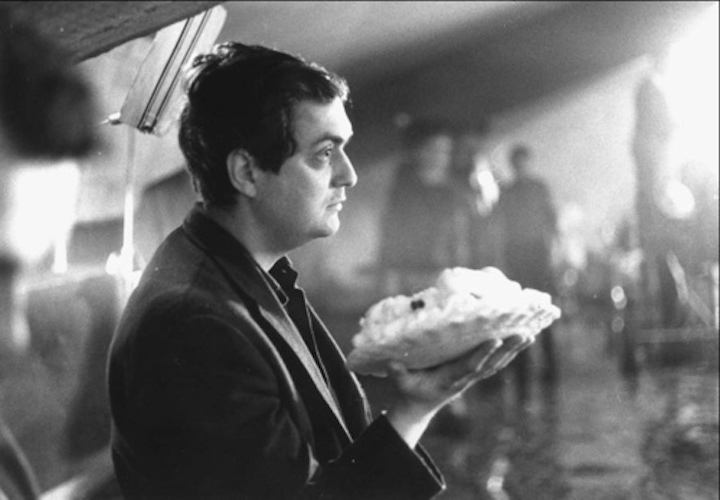
Kubrick’s observant sense of the outsider no doubt fueled the innovative brilliance of his early photographs. A new exhibition at the Museum of the City of New York, “Through a Different Lens: Stanley Kubrick Photographs,” focuses exclusively on Kubrick’s early work as a photographer for Look magazine. In 1945, at just 17, he sold his first photo to the magazine — an image of a dejected newsstand vendor the day after the death of President Franklin D. Roosevelt. 

In the exhibition’s 130 images, you can see Kubrick’s uncanny artistic sensibility, finding inspiration in New York’s characters and settings. An acute observer of human interaction, Kubrick was brilliant at capturing the grit and dark glamour of the city — nightclubs, street scenes, sporting events — and trained his eye to capture poignant moments. He spent five years at the magazine, until he began work on his first independently produced documentary, “Day of the Fight.”

The exhibition’s curators claim  Kubrick’s photography laid the technical and aesthetic foundations for his iconic films. In terms of framing, lighting and composition, that would appear to be the case. There is even a poetry to some of them, however dark.

In a new book, “Stanley Kubrick: New York Jewish Intellectual,” author Nathan Abrams asserts that if you look closely enough, the tension between being a cultural and religious Jew turns up frequently in Kubrick’s work. 

Kubrick consistently worked with Jewish writers and actors. In general, Kubrick obfuscated the Jewishness of some of his characters, but expanded the roles that were “coded” for Jews. “2001: A Space Odyssey” plays with the Bible, Jewish liturgy and kabbalah. And Abrams argues “Eyes Wide Shut” is Kubrick’s most Jewish film, adapted from a Jewish author and heavily influenced by Sigmund Freud. 

But what’s most apparent in Kubrick’s films is the extraordinary effect the Holocaust had on him. According to Abrams, Kubrick read every word he could find on the subject. He became obsessed with darkness, perversity and evil, and with what it took for a soul to go from light to dark, for humanity to die on the inside.

Nazi or Holocaust references turn up frequently in his films. Out of nowhere in “Lolita” the title character shouts “Sieg Hiel!” at her mother with a Nazi salute. “Dr. Strangelove” is about the mundane processes of mass murder. “Full Metal Jacket” sports Naziesque generals. Kubrick’s films are filled with explosives, gunfire, firing squads and bombs.

Did the Holocaust destroy Kubrick’s own soul? There is little beauty — poetry — in Kubrick’s films. He ended up fulfilling Adorno’s most famous quote.

For the last 20 years of his life (he died in 1999, at 71), Kubrick worked on “Aryan Papers,” based on Louis Begley’s “Wartime Lies,” about a Jewish boy pretending to be Catholic to survive the war. But he was never able to finish it and was known to be very depressed when working on it. 

This may have been for the best. A Kubrick Holocaust movie would probably have been unbearable to watch.

Karen Lehrman Bloch is an author and cultural critic. 

Stanley Kubrick: Subliminal Jew Read More »