fbpx

August 29, 2018

Letters to the editor: Paper in Your Hands, Protests in America

Paper in Your Hands

Thank you for your excellent piece dedicated to Franklin Foer’s book “World Without Mind” (“In the Shadow of Big Tech,” Aug. 24.)

I am one of the many (I hope) who appreciates the printed word on paper far above the electronic word on screen.

Not only do I wholeheartedly understand the value of private reading, but I also value the non-censorable quality of print. I have had posts on Facebook deleted because they (obviously) did not fit Facebook’s desired view, although they were not offensive or inflammatory in any way. I think one might have been in support of the U.S. backing of Israel, to give an example of the censorship available to editors on the internet.

I love reading the Journal to stay abreast of developments I don’t hear about anywhere else. Thank you.

M.J. Leppert, Thousand Oaks

How ironic that I read the story “In the Shadow of Big Tech” while holding the Jewish Journal in my hands. 

Warren Scheinin, Redondo Beach

Protests in America

I don’t see much if any difference between a raised fist, taking a knee during the national anthem, or blowing the shofar at a Nazi rally (“Not All Protests Created Equal,” Aug. 17).
This is America. People have a right to protest. It doesn’t matter if there is what some view as a singular impact or not.
The problem with the NFL protests isn’t with the players, but with President Donald Trump. He chooses actions and uses words to divide the nation rather than uniting it to confront the problem of police violence against Black people.
I wouldn’t expect anything less from someone who thinks there were fine people on both sides of the march in Charlottesville, Va., and who doesn’t have a single senior Black official in his (literally) White House.

Daniel Fink, Beverly Hills

Anti-Semitism and the Jewish Homeland

The article by Steven Windmueller was truly a clear and impactful analysis of the need for a Jewish homeland (“When Is a Place No Longer ‘Good for the Jews’?” Aug. 24). 

I am a nonagenarian retired aerospace engineer. Only those of my generation and part of the previous one can have the experience and the gut feeling of what the existence of a Jewish homeland means to the Jewish people around the world.

I am the first generation born in this country of parents from Poland. I recall my mother sending packages to the relatives back in the “Fiddler on the Roof” town of her origin. Then came Hitler. One cousin of my mishpachah married and emigrated to Palestine in the mid-’30s. She would be the only survivor of the Holocaust from our family. Currently, their children and succeeding generations amount to some 40 sabras. How many more millions of Jews would exist today if the Holocaust victims had a Jewish country to which to escape?

Joseph Klein, Alhambra

Thank you for your article “When Is a Place No Longer ‘Good for the Jews’?” Sadly, Britain may be facing that “moment of truth” because of Labour Party leader Jeremy Corbyn.

Corbyn rejects parts of the International Holocaust Remembrance Alliance’s definition of anti-Semitism, in part because he would run afoul of it. He has called Hamas and Hezbollah “brothers” and “friends,” and complained about media “bias” in favor of Israel’s “right to exist.” He has tried to remove the word “Holocaust” from “Holocaust Remembrance Day”; supported Holocaust deniers; defended a Der Sturmer-style anti-Semitic mural; and equated democratic, multicultural Israel with genocidal Nazi Germany. In 2013, he said that “Zionists” (meaning Jews) don’t understand history or irony and suggested they aren’t real Britons. And in 2014, he attended a wreath-laying ceremony in Tunisia honoring Palestinian terrorists who planned the 1972 Munich Olympics massacre of 11 Israeli athletes and coaches. Tellingly, former KKK leader David Duke is supporting Corbyn on social media.

The three major British-Jewish newspapers recently published a joint front-page editorial warning that Corbyn poses an “existential threat to Jewish life in this country” should he become prime minister.

Stephen A. Silver, San Francisco

No Peace With Murderers

In the search for peace, it’s important to recognize inconvenient facts. On Aug. 9, 2001, a Palestinian bomber entered a Sbarro pizzeria in Jerusalem and murdered 15 people, including children Malka Roth, 15, and her best friend Michal Raziel, 16; Yocheved Shoshan, 10; Tamara Shimashvili, 8; siblings Hemda, Avraham Yitzhak and Ra’aya Schijveschuurder, ages 2, 4 and 14, respectively; and Judy Greenbaum, who was five months pregnant.

Yasser Arafat, the Palestinian leader at the time, was complicit in massacres of Israeli children. His PLO was behind the 1974 Ma’alot massacre of 22 Israeli children at an elementary school and the 1978 coastal road massacre of 13 Israeli children near Tel Aviv. After the June 1, 2001, Dolphinarium disco suicide bombing in Tel Aviv that killed 21 Israelis — mostly teenage girls as young as 14 — he sent the bomber’s father a $2,000 reward and a personal letter praising “the heroic martyrdom operation” and calling the bomber “the son of Palestine the model of manhood and sacrifice.”

Arafat’s “moderate” successor, Mahmoud Abbas, is no different. He arranged financing for the 1972 Munich Olympics massacre of 11 Israeli athletes and coaches, incited numerous deadly terror attacks and named a public square, high schools, summer camps and sports competitions in honor of Dalal Mughrabi, who perpetrated the coastal road massacre.

Brian J. Goldenfeld, Woodland Hills

Gefilte Fish’s Bad Rap 

I’m writing in response to the story “Sparrow Mart Art Installation Has a Kosher Section,” Aug. 24. I have feeling I’m not the only reader to respond that she is wrong about gefilte fish, especially since she’s never tasted it.

Disgusting is not a nice way to describe it — OK, out of the jar, you do need horseradish. What my mother did (after the carp in the bathtub days) is boil a jar of gefilte fish together with carrots and a brown onion with the skin still on.

Voila! The fish is a nice brown color and tastes like homemade. That is how I’ve always made it since then.

Ruth Lercher Bornstein, via email

Book Review Is a Revelation

What a marvelous story reteller Jonathan Kirsch is. His review of Leslie Schwartz’s “The Lost Chapters” brought tears to my eyes while opening them up to the deplorable state of our jail system. Such a pleasure to read his reviews. Thank you.

Warren Scheinin, Redondo Beach

A Different Kindertransport

The work done in England to save children from the Nazis was a very great and valiant effort and is to be remembered, as it is in the Kindertransport story (“Kindertrasport Exhibit Displays ‘Childhood Left at the Station,’ ” Aug. 24).

But, although small, there were also Kindertransports to the United States, one of which saved my life. The story is told in “50 Children” by Steven Pressman (Harper, 2014) and relates a private effort by the Brit Shalom Lodge in Philadelphia to save 50 children from Vienna in 1939. It is quite a story.

Robert Spies, Via email


We wanna hear from you. Letters should be no more than 200 words and must include a valid name and city. The Journal reserves the right to edit all letters. You can also submit emails here

Letters to the editor: Paper in Your Hands, Protests in America Read More »

Deadly Salmonella Outbreak Traced to Kosher Chicken

The Centers for Disease Control (CDC) announced on Wednesday that 17 people have been afflicted by a recent salmonella outbreak possibly tied to Empire Kosher, resulting in one dead and eight hospitalized.

The 17 people afflicted were all on the East Coast: 11 in New York, four in Pennsylvania, one in Maryland and one in Virginia between September 25, 2017-June 4, 2018, according to the CDC’s website. Seven of the 17 infected people said that they ate Empire Kosher chicken, and the CDC found a strain of salmonella in one of Empire Kosher’s processing plants.

The strain was found in another processing plant that has not been publicly identified.

The CDC noted on its website that they are not officially advising people to stay away from kosher chicken or Empire Kosher chicken specifically. The CDC’s investigation is ongoing.

Empire Kosher has not responded to the Journal’s request for comment.

Salmonella’s symptoms include “diarrhea, fever and stomach cramps” and it normally lasts four to seven days. However, there are some instances in which the infection can be fatal if it isn’t treated.

Deadly Salmonella Outbreak Traced to Kosher Chicken Read More »

Blending of Cultures Keeps Judaism Alive

It’s hard to believe it’s been a year since I became food editor at the Jewish Journal but sure enough, the hallmarks of time passing are etched into the calendar by the Jewish holidays. I remember hugging my cousins in Israel this time last year at my aunt’s funeral and wondering how we would celebrate Rosh Hashanah without her food.

In our wonderful cover story this week about the delights of the Ashkephardic table, Debby Segura reminds us how powerful and symbolic this holiday is and how, when cultures collide, the food bar is raised to new levels of creativity while keeping traditions intact. This is certainly the case in Israel, where multi-ethnic food culture is the norm, but traditions like eating something sweet at the start of the Rosh Hashanah meal endure.

As a product of an Ashkenazi and Sephardic household, but also one in which my Israeli parents raised me in a third culture, American, I find it difficult to overstate the confusion I felt as a child during the High Holy Days. On the one hand, my Romanian mother’s Ashkenazi tastes included blander, sweeter things, but on the other hand, my father’s Sephardic roots as a Bulgarian dictated that we never mix sweet and savory in one dish, unless the natural sweetness of an ingredient such as caramelized onions happened to mingle with the savory qualities of chicken wings.

Then there was the American-Jewish Ashkenazi palate of my parents’ best friends while I was growing up, both of whom stayed true to their brisket, tzimmes and gefilte fish routine year after year. Add to that the fact that my mother’s Bulgarian sisters-in-law taught her to cook my father’s soul food, and you get a good idea of how confused I was about our food traditions.

On the one hand, I knew it was special when my mother cooked Sephardic dishes and blew the minds and taste buds off of my parents’ Ashkenazi friends. On the other hand, I was a little miffed when I went to Ashkenazi-American households and discovered blintzes and kugel. Where has this been my whole life, I would think to myself.

The only common denominator seemed to be the chicken soup. But even that was confusing. While my father would thumb his nose at my mother’s and my love for knaidlach or matzo balls, he would load his bowl of soup with lemon and black pepper. While my mother would break matzo into her soup and wait for it to get soggy before eating it, my father and I would make fun of her and put spicy Bulgarian lutenitsa hot sauce all over our matzo.

The end result of this bipolar food mixing that went on in my household was exacerbated by the fact that when we went home to Israel, there was a definite delineation of holiday food at our celebrations. My mother’s family always laid out an Ashkenazi spread: Rice, potatoes and carrots were their side dishes of choice along with jellied carp with enough sugar in the stock for my father to lament. But at my father’s family occasions, stuffed eggplant, onions and grape leaves abounded, along with fish in spicy tomato sauce, bamia (okra), preserved lemon, sour soups and oxtail.

It didn’t dawn on me until I opened my second restaurant, a Mexican-Asian fusion joint in Uganda, called Lotus Mexicana, that this Ashkephardic upbringing had not only affected my palate but my view of the world. Not only had growing up in a mixed household taught me to try things before determining I didn’t like them, traveling with this attitude had opened my taste buds to flavors and combinations of foods.

In the first draft of my extensive menu at Lotus Mexicana, I had more than 100 fusion dishes ranging from plantain fried rice with guacamole to smoked salmon ceviche with mango and pickled onions. To this day, there is no flavor combination I enjoy more than sweet with salty, followed as a close second by sour and spicy and then sweet and spicy. In my bakery, even my chocolate chip cookies are finished with a flourish of flakey sea salt and my dulce de leche caramel is always salted.

One year in Israel, I decided to invite both sides of the family, my mother’s and father’s, to a special-occasion meal. I resisted any offers to bring food, as is usually the custom when we have large family gatherings. Although I didn’t stick to a theme, I took a chance on a few dishes that mixed sweet and savory, one of which is for a lamb tanjia (recipe in next week’s issue) with dried sweet fruit and honey. I made sure not to tell my cousins on my father’s side what was in the dish so that they would not steer their parents away from it before tasting. I’m sure you’ve already guessed that everyone loved the lamb and both sides of the family asked me for the recipe, even the Sephardic palates who were the most vehement about not mixing salty with sweet.

They say too many cooks spoil the broth but, in my experience, there is no such thing as too many cooks. Perhaps my luck growing up in a mixed household, and in another land from the one of my birth, gave me part of the magic formula for life in and out of the kitchen. Being adventurous, taking chances, learning from those who came before me and not labeling anyone or anything before knowing or trying are certainly good rules to live by.

But more importantly, when I share my people’s traditions with my customers and friends and explain to them the significance of the symbolism behind why we eat these foods during a certain time of the year, I’m doubly blessed by gratitude for having tasted so many combinations of cultures. When I braid my round challah this Rosh Hashanah and I explain to my customers or my friends the symbolism behind it and that of the honey and apples we will eat, I’m part of that circle of life that’s kept all people rooted since the beginning of time.

Just as we all are — I’m part fusion and I’ve become a symbol of continuity.


Yamit Behar Wood, an Israeli-American food and travel writer, is the executive chef at the U.S. Embassy in Kampala, Uganda, and founder of the New York Kitchen Catering Co.

Blending of Cultures Keeps Judaism Alive Read More »

Columbia Professor Says It’s Anti-Semitic to Call Israel ‘the Jewish State’

Columbia Professor Joseph Massad, who has a history of criticizing Israel, wrote on an anti-Zionist website that it’s anti-Semitic to refer to Israel as “the Jewish state.”

In an August 24 Electronic Intifada piece titled “Anti-Semitism vs. anti-colonialism,” Massad argued that the ongoing anti-Semitic controversies involving Jeremy Corbyn’s Labour Party was predicated on Zionists equating criticisms of the Israeli government to anti-Semitism.

“In naming its state ‘the Jewish people,’ the Zionist movement conflated and conflates its colonial project with all Jews, even when the majority of world Jewry did not support the movement and continues to refuse to live in, and become citizens of, Israel,” Massad wrote. “Therefore, it is imperative to emphasize that it is Israel and its supporters who conflate Israel with all Jews, and then claim that condemning Israel, its laws, policies, actions and ideology amounts to condemning the Jewish people.”

Massad added that Palestinians are simply resisting Israel’s “racist and colonial nature.”

“If there should be a definition of anti-Semitism to be adopted by the Labour Party (or any other political party or institution) in Britain today, it should include the condemnation of anti-Semitic and colonial expressions such as: ‘Israel is the Jewish state,’ or ‘Israel is the state of the Jewish people’ or Israel ‘speaks for Jews,’ or colonizing the land of the Palestinians is a ‘Jewish value,’” Massad wrote.

Massad has written similar statements in the past, such as in 2003, when he wrote that Israel has turned “the Jew into the anti-Semite, and the Palestinian into the Jew.”

Simon Wiesenthal Center Associate Dean Rabbi Abraham Cooper told the Journal in a phone interview that Massad is “a denier of reality.”

“This professor at Columbia University is going to teach us who is a Jew, what is anti-Semitism, and he has to come up with a construct that makes him feel comfortable,” Cooper said, “and along the way, by constructing it his way, he gets to blame the victim.”

Cooper added that the “blame the victim” tactic has been used by anti-Semites for years, stating that it goes as far back as “the church in the Middle Ages,” when they said that bad things happened to the Jews because they wouldn’t convert to Christianity.

“Now, it’s real simple: ‘Oh, if only the Jews would walk away from the largest Jewish community in the world, there would be no more anti-Semitism,’” Cooper said. “It’s an old tactic dressed up in the most fancy, post-modern lexicon, but it still comes down to old-fashioned Jew hatred.”

According to the Canary Mission website, Massad has previously stated that “the Jewish state is a racist state that does not have the right to exist” and that Zionists were allied with the Nazis.

A student who took Massad’s class on Palestinian and Israeli Politics wrote in an August 2017 post on an anonymous student review site of Columbia professors:

He really blurs the line between facts and opinions, which gets on everyone’s nerves. 
Massad treats a lot of his course like a media appearance advocating for one side and berating the other. I can’t say he is as intense as some of his fans in the course who think everyone criticizing him is just trying to paint him as an anti-Semite, but Massad can be frustrating to work with. 

He brings a lot of analysis to the course but much of that is skewed, something that wasn’t obvious to classmates of mine who were less familiar with the course material than I was.

H/T: Columbia University Monitor

Columbia Professor Says It’s Anti-Semitic to Call Israel ‘the Jewish State’ Read More »

New ‘Anne Frank’ Production Broadens Its Holocaust Message

When director Stan Zimmerman decided to cast Latino actors in key roles in a new stage production of “The Diary of Anne Frank,” he never expected the controversy it would unleash.

Inspired by a news story about a Jewish woman in Los Angeles who created a safe house to shelter undocumented immigrants, Zimmerman intended the casting to draw a contemporary parallel to the immigration crisis in the United States. But when false reports surfaced that he also was replacing the Gestapo with Immigration and Customs Enforcement (ICE) agents, he became a target of haters on both sides of the political divide.

Although the publicity has brought attention to the production, which will open next month at the Dorie Theatre in Hollywood, “I would rather have not gone through all of that anxiety,” Zimmerman told the Journal in a break during rehearsals at his home in Los Angeles. “It’s very hurtful to get scary hate mail that’s either calling me a Nazi or a Holocaust denier. I know these are sensitive issues. As a Jew, I’m sensitive to [them], too.”

The play, based on a journal written by Frank while she and her family hid from the Gestapo in a “secret annex” in Amsterdam, has a script identical to the 1997 Broadway version that starred Natalie Portman. Zimmerman explained how the misconception likely arose.

“In our press release, we had an image of ICE. But we never said we were changing the script. People made the leap, and I think certain [outlets] had an agenda.” He cited right-leaning media including the Breitbart News Network and Fox News. “I was shocked when Deadline Hollywood just ran with that. No one called and asked.”

Genesis Ochoa, 16, and David Gurrola, 15, who play Anne Frank and Peter van Daan, have been trying to ignore the “people whose minds you can’t change. There’s no point in arguing with them,” Gurrola said of the internet trolls.

Both actors are of Mexican descent, and neither had read Anne Frank’s diary or the play before they were cast. Ochoa did not learn about the Holocaust in school, and Gurrola said there was “maybe a page” in his history book about it. But Frank’s story resonates with them, and they see parallels with the immigration crisis. “Not too far from us are safe houses, right in our backyard,” Gurrola said. “I have many relatives who are undocumented. Some were even deported.”

Playing Anne’s sister, Margot, is Teddi Schaffer, an Ashkenazi Jew whose mother grew up in Mexico. She isn’t surprised by the controversy, “but I stand behind the project,” she said. “It’s being done in a very respectful manner, all in the name of art and awareness.”

Schaffer grew up “culturally Jewish” in the predominantly Jewish community of Parkland, Fla., where Holocaust studies are part of the curriculum. She hasn’t been able to go back since the shooting at Marjory Stoneman Douglas High School in February, but she has vowed to fight for gun control legislation. “Activism has always been important to me,” she said. “All I care about is getting a platform for gun reform to help those wonderful kids.”

Zimmerman, who was raised in a Reform Jewish home in Southfield, Mich., a largely Jewish suburb of Detroit, revealed he was a victim of bullying, but not because he was Jewish. “As a gay kid, I experienced persecution. I was spit on at school,” he said, noting that the plight of mistreated minorities has always resonated with him because of it. He also has a strong connection to Judaism. “I’m so proud to be Jewish,” he said. “It’s the part of me that gives me humanity.”

Zimmerman, best known for writing for and producing “The Golden Girls,” “Roseanne” and “Gilmore Girls” on TV, has two new shows in the works: an office comedy about three sisters and their dad who run a baseball cap company, and “Silver Foxes,” which he describes as a “gay male ‘Golden Girls.’ ”

He has directed three plays in the last year, most recently the circumcision comedy “A Knife to the Heart.” With “Anne Frank,” he’s managing a much larger cast in a tighter stage space, marked by tape to delineate the doors and walls of the cramped annex. The costuming is of the period, he said, but stylized.

The play’s run is booked for only 15 performances, but Zimmerman would love to extend it or move to another theater. “I think it’s a great education tool, and I would love it to go to schools or have school groups come see it, since it’s not being taught anymore,” he said. “When I grew up, it was a required part of the curriculum.”

Zimmerman believes the play and the diary endure because of the writing. “It’s so beautiful and so moving that someone so young could be so insightful, that she could see the world like that.” he said. “You can’t help but be drawn into the story.”

Its takeaway message remains the same, Zimmerman said: “Never again.” But he also hopes his production and its casting provoke discussion about other issues of man’s inhumanity to man.

“There’s no way you can compare anything to the Holocaust,” he said. “But we can learn from it, open up and talk about issues, and ask ourselves how we can help.”


“The Diary of Anne Frank” runs Sept. 6-23 at the Dorie Theatre in Hollywood. Tickets are $25 online, $30 at the door.

New ‘Anne Frank’ Production Broadens Its Holocaust Message Read More »

L.A. Producer Puts ‘Guernsey’ Story of Community on Screen

The title may be difficult to remember or even say in the correct order, but the movie “The Guernsey Literary and Potato Peel Pie Society,” based on the book of the same cumbersome name, has become a sleeper hit.

Released on Netflix in early August, the film, set in 1946, tells the story of Juliet Ashton (actress Lily James), a London-based writer who travels to the island of Guernsey in the English Channel to meet a group of locals after learning about a book club (the aforementioned Guernsey Literary and Potato Peel Pie Society), they formed when the island was occupied by the Germans during World War II.

Published in 2008, the book was written by Mary Ann Shaffer and her niece Annie Barrows. At Shaffer’s request, Barrows took on editorial revisions requested by the publisher when Shaffer became ill. Shaffer died in early 2008. The book went on to rank No. 1 on The New York Times bestseller list.

But it was in 2007 when Santa Monica film producer Paula Mazur read a copy of the book’s galley proof and immediately knew she wanted to make it into a film.

Mazur was fresh off a major box-office success with “Nim’s Island,” starring Jodie Foster and Abigail Breslin, when she was introduced to Miami-based independent bookseller Mitch Kaplan.

“I always work from plays and books to screen primarily,” Mazur told the Journal in a telephone interview, “and [Kaplan] sent me [the Guernsey galley]. I fell in love with it. I could see the movie and knew how to get it made.”

Together, Mazur and Kaplan — who now run a production company, The Mazur/Kaplan Company — optioned the book nine months before it even hit bookshelves. However, the wheels of the moviemaking process grind slowly. While Studio Canal eventually bought the film, “we went through three or four financiers, four directors and seven leading ladies,” before James took on the role of Ashton and Mike Newell agreed to be the director, Mazur said.

Mazur said it was fortuitous that James eventually landed the role. Nobody could have known that the actress would become a major star in the last couple of years, with roles in “Downton Abbey,” “Cinderella,” “Mamma Mia,” “Baby Driver” and “The Darkest Hour.”

“I’m so thrilled it’s Lily,” Mazur said. “She just embodied Juliet in the best way. She’s an absolutely beautiful specimen of humankind, and yet she’s accessible. There’s a little bit of every woman in her. She represents us all looking for our authentic self and asking, ‘How can I live my most authentic life?’ ”

Mazur said she was drawn to “Guernsey” for several reasons. “It’s an epistolary novel — a novel of letters — and the voices of the individual characters were so incredibly specific and well drawn, that I kind of fell in love with everybody in the book,” she said. “I thought, ‘I can so see these people and would love to watch them on the screen.’ ”

Mazur was also interested in being able to tell a WWII story that hadn’t been told before. “This [story] had a lot of romance and breadth and history, and yet it was this incredibly personal story of transformation for Juliet and also about what is family and what is community, which is what the [Guernsey Literary and Potato Peel Pie] Society was.”

Mazur, a member of the IKAR congregation in Los Angeles, said she was struck by the book’s story of how people come together to get through extremely difficult, dark times. “It’s through community,” she said, “and I feel that this community that we have at IKAR is representative of that. It is a strong community, and our value system is about making the world better and about love and community. I feel like that is in the movie too — that’s what the [Guernsey] Society is.”

Mazur said she also wanted to fulfill a personal mission in making a film set around WWII. “My family was definitely touched by WWII,” she said. “My maternal side [of the family] is from Austria, and they were sent to concentration camps and killed.”

Born and raised in Brooklyn, Mazur said that after the war “New York was holding the remains of European Jewry in its hands. You could feel it everywhere. When we went to buy clothes, my mother would say, ‘Don’t look at the [tattoos] on survivors’ arms.’ ”

For Mazur, a graduate of NYU’s film school, “Guernsey” was an opportunity to answer the part of her that had always asked, ‘How do I feel about [the war]? What do I want to say and not repeat already trodden territory?’ ”

“I like to tell stories that definitely talk about the problem but also offer solutions or hope or a silver lining, and this felt like that for me,” she said. “And there were Jewish people from Guernsey sent to concentration camps. That’s not part of the movie, but it is part of Guernsey’s history.”

Mazur/Kaplan’s immediate past film was 2017’s “The Man Who Invented Christmas,” about Charles Dickens writing “A Christmas Carol.” It starred Dan Stevens and Christopher Plummer and was “made by a bunch of Jews,” Mazur quipped. Next up for her is “All the Bright Places,” starring Elle Fanning in an adaptation of Jennifer Nivens’ young-adult novel about teen depression.

For now, Mazur is enjoying the success of “Guernsey,” which grossed more than $18 million in theaters outside the United States before its Netflix debut.

“I love that it comes back to community,” she said. “It’s really about people who [dealt with] very difficult experiences through this communal experience of a book club, even if it was just for a short while every week — where they could remember their humanity.”

L.A. Producer Puts ‘Guernsey’ Story of Community on Screen Read More »

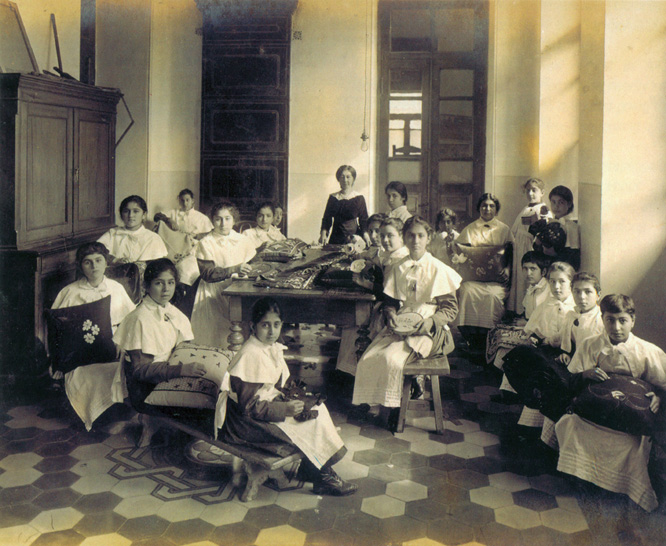
If you educate a woman, you educate a whole nation

World's first secular school for Muslim girls was opened in 1901 in Baku, Azerbaijan
World’s first secular school for Muslim girls was opened in 1901 in Baku, Azerbaijan


I just finished reading “Malala’s Magic Pencil”, an autobiographical picture book, written by Nobel Peace Prize winner Malala Yousafzai, together with my daughter, who is going to return to school next month. It is an incredible and fascinating story of a girl who is fighting for education and peace, and delivers a powerful and inspirational message not only for kids, but for everyone.

Today unfortunately in many parts of the world women’s rights are still being suppressed, and millions of women are out of school and cannot get basic education. I feel lucky and proud that my daughter grows up in a majority-Muslim country, where women get free, compulsory and quality education, and play a significant role in the political, economic and social life of the country.

Education of women in Azerbaijan has evolved significantly since the beginning of the 20th century. In 1901, the very first secular school for Muslim girls in the entire Muslim world was opened in Baku at the initiative of the great Azerbaijani philanthropist Haji Zeynalabdin Tagiyev. This pioneer project inspired Muslim communities in other parts of the Russian Empire, which Azerbaijan was part of then, to establish similar secular schools.

In 1908 Hamida Javanshir, great-great-grandniece of the Karabakh region’s last ruling Khan (Ibrahim Khalil Khan) and wife of the famous Azerbaijani writer Jalil Mammadguluzade, founded a coeducational school in her home village of Kahrizli, which became the first Azerbaijani school, where boys and girls could study in the same classroom.

By 1915, in Baku alone there were 5 schools for Muslim girls. Also around this time, a women’s newspaper called “İşıq” (Light) was published in Baku to support women’s rights and promote education among women.

Moreover, Azerbaijan was the first majority-Muslim country in the world to grant women equal voting rights – in 1919, an entire year before the United States and decades before many Western European nations. It happened after Azerbaijan gained its freedom from the Russian Empire in 1918, establishing the first ever secular democracy among Muslim nations.

In the later decades of the past century, Azerbaijani women got new opportunities to realize their potential and be successful in various fields. During these decades Azerbaijani women pioneered many “firsts” for women in the Muslim world: First female opera singer Shovkat Mammadova, first ballerina Gamar Almaszade, first female pilot Leyla Mammadbeyova, first professionally educated composer Agabaji Rzayeva, etc.

After restoring its independence from the Soviet Union in 1991, women’s rights further prospered in Azerbaijan. We have laws in place that assert the protections and respect for women across Azerbaijani society. For example, Article 25 and 34 were added in 1993 to Azerbaijan’s Constitution, ensuring full equality between men and women generally, and equality of men and women within marriage specifically. In 2006, Azerbaijan passed a Gender Equality Law which guarantees that women receive equal pay at work and prohibits discrimination in hiring and promotional practices.

The past 27 years have seen a steady and uphill growth in Azerbaijan, as both the economic, financial and social wellbeing of the country has significantly improved. The country currently boasts a 99 percent literacy level. School enrollment rates for women are at 99.8-100%. Comprising 50.1% of Azerbaijan’s entire population, women constitute about 80% of all employees in education and 65.7% in healthcare. Moreover, 56% of all PhD degree holders, 48.2% of university students, 6 university presidents, 15 college presidents and 1244 school principals in Azerbaijan are women.

The judicial branch of the government has many female judges, comprising around 15 percent of all judges in the country, including Tatiana Goldman, who is Jewish, and Justice at Azerbaijan’s Supreme Court. Goldman is one of the 7 female Supreme Court Justices of Azerbaijan.

The legislative branch is not lagging behind in this regard: there are 20 women in Azerbaijan’s Parliament (out of 125 total), including Bahar Muradova, the Deputy Speaker.

First Vice President Mehriban Aliyeva, the highest-ranking woman official in the history of Azerbaijan, is a true inspiration for Azerbaijani women. Her activities in promoting gender equality and women’s education in the country and beyond are tremendous. The First Vice President is known for her tireless humanitarian efforts in Azerbaijan and internationally as UNESCO Goodwill Ambassador, and for her advocacy for health, women and children, among so many areas she works on to make the world a better place. The Heydar Aliyev Foundation, led by Mrs. Aliyeva, has built and rebuilt hundreds of new schools in Azerbaijan in a short period of time, even in the most remote villages of the country. The Foundation has also implemented a vast number of international humanitarian projects, including the construction of a new girls’ school in Pakistan for 500 students.

Education of women is a milestone in the development of any society. It is education that can help millions of women around the globe realize their potential and empower them to change the world for the better. A country, a nation cannot progress without women’s education. As Malala Yousafzai mentioned in her famous speech at the UN Youth Assembly, “One child, one teacher, one pen and one book can change the world”.

Also there is an old African proverb that says: “If you educate a man, you educate an individual. But if you educate a woman, you educate a nation”.

If you educate a woman, you educate a whole nation Read More »

A New Jewish Leader for the Pasadena Playhouse

When the Pasadena Playhouse opened in 1917, it took over an abandoned burlesque stage, but this year, as the theater marks its centennial, it is attracting a more discriminating audience.

The Playhouse’s façade bears the proud title, “Official State Theatre of California,” an honor conferred by the state legislature in 1937, after the company performed the canon of 36 Shakespeare plays on a single stage for the first time in the United States.

Recently, however, the venerable institution had fallen on hard times. In 2010, it led for bankruptcy and though it survived, two years ago, the Los Angeles Times proclaimed that the Playhouse was “struggling for survival.”

At that point, Danny Feldman came aboard with the title of producing artistic director and the assignment to right the listing ship.

“I was the first new leader in 20 years, and I saw my job as rebuilding the Playhouse for the next 100 years,” Feldman, 38, said in a phone interview.

Asked for a diagnosis of the Playhouse’s current state of health, Feldman said, “We had a [financial] surplus the past year and we’ll have one next year.”

Feldman grew up in West Hills in the San Fernando Valley in a “culturally Jewish” family, with an Israeli-born father and American mother, and studied at the Kadimah Hebrew Academy.

When he accepted the Playhouse position, he was aware — like most Angelenos — of Pasadena’s reputation as a city settled and run by WASPs who did not particularly welcome Jewish newcomers.

Pasadena was initially settled in the 1870s by wealthy families from the East Coast and Midwest looking for warmer winter climes. The new community prided itself on its reputation as a bastion of white Protestant culture, which enacted restrictive covenants to try and stay that way.

One of its leading citizens, Robert Millikan, Nobel Laureate and president of Caltech, lauded Pasadena as “the western-most outpost of Nordic civilization.”

However, over the past 50 years, Pasadena, like most of the rest of the country, has become more diverse and so has the Playhouse’s theatrical productions. Where once plays revolved mainly around the romantic and other tribulations of the upper classes, the upcoming season reflects Feldman’s more adventurous taste.

Opening the new season on Sept. 5 is the regional premiere of “Native Gardens,” a new comedy by Karen Zacarias and directed by Jason Alexander. The play centers on two neighboring families in Washington, D.C., whose feud over their respective gardens and common fence line escalates into a “war of the hoses.”

On Oct. 17, the ghostly “Woman in Black” opens, and arrives in Pasadena directly from London’s West End. The show has been keeping audiences on the edge of their seats for 28 years.

Scheduled for next February is “Ragtime,” whose scenes of poor Jewish and other immigrants seeking a new life in America are seen by Feldman as “wildly relevant” to the present.

Feldman also is reaching out to neighboring Jewish communities, particularly the Jewish Federation of San Gabriel and Pomona Valley. For instance, for the annual Holocaust Remembrance Day, the Federation’s Jewish Community Players join the Playhouse actors for a presentation appropriate to the occasion.

Among the strongest supporters of the Playhouse is the Jewish community of Pasadena. Feldman said the reason for that affinity is that the theater is about contesting ideas and “arguing is in our DNA.”

For tickets and information, call (626) 356 – 7529.

A New Jewish Leader for the Pasadena Playhouse Read More »

Abbas Calls for Demilitarized Palestinian State

Palestinian Authority President Mahmoud Abbas stated on Tuesday his desire for a demilitarized Palestinian state as the Trump administration forges a peace plan to solve the Israel-Palestinian conflict.

According to the Times of Israel (TOI), Abbas told Israeli academics in Ramallah, “I support a state along the 1967 borders without an army. I want unarmed police forces with batons, not guns. Instead of warplanes and tanks, I prefer to build schools and hospitals and allocate funds and resources to social institutions.”

The TOI report goes onto note that Abbas has previously called a demilitarized Palestinian state in 2013 and 2014, which the report calls “a key Israeli demand in any peace deal.” Arutz Sheva cited an unconfirmed report from an Arabic newspaper stating that a demilitarized Palestinian state would be part of the Trump administration’s peace proposal.

However, Purdue University Professor Louis René Beres argued in 2016 that promises of a demilitarized would be nothing more than an “illusion.”

“Even now, the Palestinians remain as divided as ever; it remains unclear, therefore, who can speak with real authority for any still-plausible Palestinian state,” Beres wrote. “Palestinian Authority President Mahmoud Abbas is in the eleventh year of his four-year term; should he agree to anything substantive, others could later legitimately claim, long after land may have been irreversibly ‘exchanged,’ that he had no legal authority to make a decision, and they would be right.”

Beres also pointed out that Palestinian factions consider the entirety of Israel to be “occupied” rather than simply the West Bank and the Gaza Strip.

Abbas Calls for Demilitarized Palestinian State Read More »

Reality Train’s Next Stop: Right of Return

Try connecting three separate yet related events: President Donald Trump recognizes Jerusalem as the capital of Israel and moves the United States Embassy to the city.

Donald Trump cuts $200 million in U.S. aid to the Palestinians. Donald Trump freezes $300 million in annual funding for the United Nations Relief and Works Agency (UNRWA) for Palestinian refugees.

What’s similar? That’s easy. All of these moves concern the Israeli-Palestinian theater. All of them raise the fury of Palestinians. All of them are destabilizing moves. All of them signal an alteration of policy. What’s different? The first step — recognizing Jerusalem — is accepted with Israeli delight. The other two steps seem to foster mixed feelings for Israelis.

Why?

Israel does not see a way forward that can lead to a reliable peace deal with the Palestinians. Not now. Not for a long time. Not before the Palestinians have new leadership that is willing to be more realistic. While we wait for these things to happen, two contradictory interests make it difficult to navigate the conflict.

On the one hand, since this is going to take awhile, Israel hopes for stability. If it is not necessary, it will not launch an operation in Gaza. If it is politically possible, it will ease the lives of ordinary Palestinians to keep them away from being desperate.

On the other hand, since this is going to require a change of attitudes, Israel needs the boat to rock. It needs the Palestinians to realize that hoping for Israel to abandon Jerusalem is a lost cause. It needs them to relinquish the ridiculous U.N.-facilitated façade of fourth-and fifth-generation refugees.

Stability is convenient in the short term. No one wants war, violence, terrorism. Instability is less convenient but maybe necessary — if Israel desires its message to get through.

Enter Trump. Think what you think of him, stability is not the game he plays. Maybe that’s because he believes that in negotiations, one must shake the tree. Maybe that’s because he has such personality, and all other explanations are no more than rationalizations of a feverish and irrational behavior. No matter the reason, the effect is similar. As the president explained last week, “If there’s ever going to be peace … with the Palestinians, it was a good thing to have done because we took it off the table, because every time there were peace talks, they never got past Jerusalem becoming their capital. So I said let’s take it off the table.” Translation: The Palestinians were entertaining a pipe dream about Jerusalem and couldn’t get past it. So, the U.S. took Jerusalem off the table and now negotiations can resume under more realistic expectations.

The matter of the U.N. agency for Palestinian refugees is no different. The Palestinians still do not accept that a right of return for millions of grandchildren of refugees from 1948 is a killer of any hope for a settlement of peace. Trump recognizes the obstacle and signals that Jerusalem was not the last stop on reality road, that there is more to come. Next stop: UNRWA.

But on the way to this stop, the train encounters an unexpected obstacle. Well, it is not really an obstruction, more a lack of excitement. Some senior Israelis are having doubts about getting more of this sweet reality-check medicine. High-ranking defense of cials warned government agencies that a sudden cut in UNRWA’s budget could make Gazans more dependent on Hamas. Other officials expressed a fear that bold moves made by the U.S. administration would ignite violence. They see danger. The cause of keeping stability is disturbed by the cause of injecting reality.

Shmuel Rosner is senior political editor. For more analysis of Israeli and international politics, visit Rosner’s Domain.

Reality Train’s Next Stop: Right of Return Read More »