fbpx

July 12, 2018

Rosner’s Torah Talk: Matot-Masei with Rabbi Ariana Silverman

Ariana Silverman is the Rabbi of the Isaac Agree Downtown Synagogue, the last freestanding synagogue in the City of Detroit. Raised in Chicago, she received her undergraduate degree from Harvard University, her ordination from the Hebrew Union College-Jewish Institute of Religion, and is an alumna of the Wexner Graduate Fellowship Program. She lives in Detroit with her family.

This Week’s Torah portion – Parashat Matot-Masei (Numbers 30:2-36:13) – begins with Moses presenting the heads of the tribes with rules concerning the annulment of vows. War is waged against Midian and the Torah lists the different spoils Israel took hold of in their victory and describes how they are distributed. The tribes of Gad, Reuben and half of Menashe ask Moses for the territory East of the Jordan as their portion of the promised land, and Moses eventually agrees on the condition that they first help conquering the west part West of the Jordan. The boundaries of the Promised Land are stated, and cities of refuge are designated as havens for people who commit inadvertent murder. The portion ends with the story of the daughters of Tzelafchad marrying men of their own tribe (Menashe) in order to keep the estate which they inherited from their father within their own tribe. Our conversation focuses on the two and a half tribes’ request for land and on what this episode could teach us about conflict resolution.
Previous Torah Talks about Matot-Masei
Rabbi Uri Regev

Rosner’s Torah Talk: Matot-Masei with Rabbi Ariana Silverman Read More »

A Stand-Up Comedian Who Sounds ‘Like Your Dad or Uncle’

Orny Adams is a comedy veteran. He began his career in Boston and has been in the game for more than 25 years. Now based in Los Angeles, Adams, 47, recently completed a tour of the Bahamas, Australia, France, Canada and Israel, and is headlining “The Ethnic Show” during the Just for Laughs (JFL) comedy festival in Montreal this month.  

The Journal recently spoke with Adams about his upcoming shows, his role as Coach Bobby Finstock from 2011-17 in the MTV television series “Teen Wolf,” and how his Judaism informs his work.

Jewish Journal: What was it like when you started doing comedy in Boston?
Orny Adams: It’s like doing comedy for your family. Everyone has the same rhythm and mindset. Boston comics tend to be very fast. There’s sarcasm. When you see one you go, “That’s a Boston comic.” You just know it. I never did an open mic. I was fortunate that comedy was booming in the early ’90s and I could go on at the big clubs. It was really different than it is now. 

JJ: What’s comedy like now?
OA: There’s a lot more people doing it and I think it’s more restrictive. You have to think a lot more [before you talk]. Boston was the only town where I was doing comedy that was purely for the sake of comedy. There was no thought about what I would wear, or what the industry would think, or would this joke play on TV, or is this joke offensive? You got up there and you were funny. People had comedy in their bones. You weren’t doing it because you thought it might lead to something else or because it was trendy. You were just a comedian. 

JJ: What was your Jewish upbringing like?
OA: My family is very Jewish-centric. I went to temple and I identify as Jewish. I feel my comedy is very Jewish. If you look at me you’d say, “That guy is Jewish.” To me, it’s a big part of my essence. I talked about being Jewish on my last special. I changed my name when I was younger [from Adam Jason Orenstein to Orny Adams] because I didn’t like people knowing I was Jewish without getting to know me first. There was anti-Semitism. When I was 8 years old, a kid told me I was a cheap Jew. I was 8. I didn’t even have money! 

JJ: What was it like working on “Teen Wolf”?
OA: We reached 100 episodes over six seasons. I loved that I showed up and did somebody else’s lines. It was a really great experience. The fans are not comedy fans. They are younger, exuberant, not jaded. It’s the most beautiful thing. When you go to one of my stand-up shows you can see it. There are “Teen Wolf” fans and there are comedy fans. I love the duality of my career and that I had that experience. There was a coach in the movie version, but Jeff Davis, who created the show, also wrote [the coach part] for me. He was a fan of my comedy. I never auditioned, which is really the way I’d like all of life to be.

“I changed my name from Adam Jason Orenstein because I didn’t like people knowing I was Jewish without getting to know me first. There was anti-Semitism. When I was 8, a kid told me I was a cheap Jew. I was 8. I didn’t even have money!” 

JJ: How many times have you been to JFL?
OA: I couldn’t even count. I did “New Faces,” and there was a little bit of a gap, and then it was once every other year. That festival has been so good to me. That’s a family. I love those guys and going up every year and seeing the same faces in the audience and the same reviewers. When I started going up there it was a dream. I was going to be discovered and get a sitcom. Now I go up there and I couldn’t care less about the business. I just go up there and I’m social. I consider Montreal a second home. 

JJ: How are you going to represent the Jews at “The Ethnic Show”?
OA: They have a Jewish flag behind me [on the flyer]. I’m Jewish but not Israeli. The flag doesn’t represent me as a Jew. Shouldn’t it be a dreidel, or a hanukkiah? I’d like the Dead Sea Scrolls behind me. I don’t think I have to do Jewish jokes [on the show]. I could talk about my experience in Israel. If you see me and you’re Jewish, you’ll say that I sound like your dad or uncle. 

JJ: Last question. Do you have any tips on how to keep a healthy head of hair?OA: I just pray to God. I think it’s genetic. I can’t lose it now because it’s sort of become my identity. I’ve become one of those hair comics.

A Stand-Up Comedian Who Sounds ‘Like Your Dad or Uncle’ Read More »

Tel Aviv University MBA Students Pitch Ideas in Silicon Beach

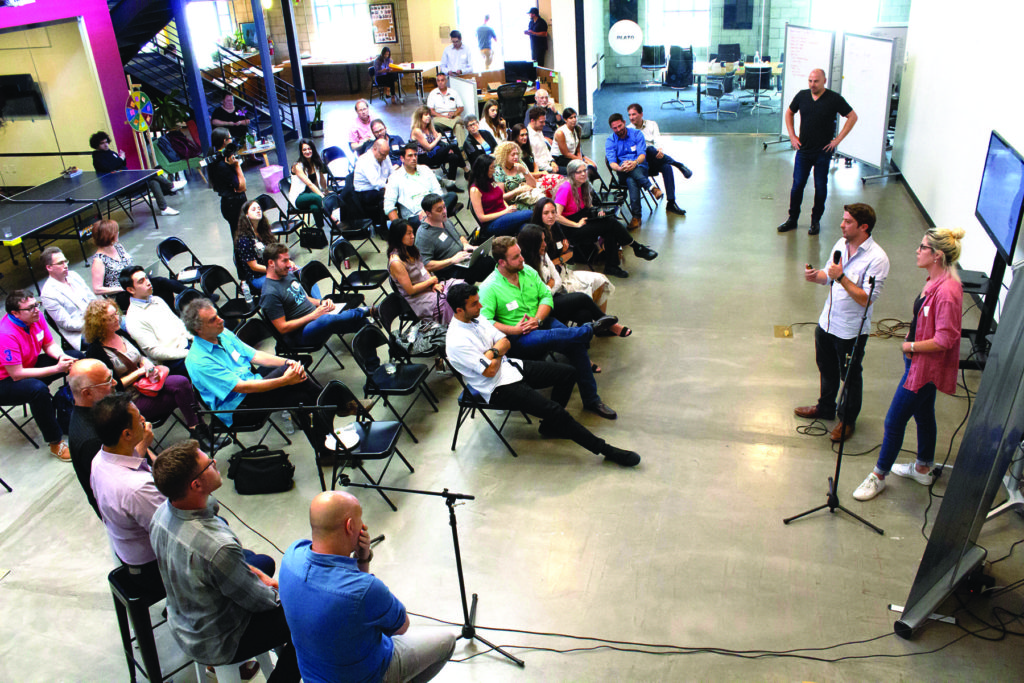
EARLIER THIS MONTH, STUDENTS from Tel Aviv University’s (TAU) International MBA Program descended on the Santa Monica offices of Philosophie, a digital innovation firm, to present their high-tech ventures to a panel of experts. 

Under the banner “Demo Day,” the event was the culmination of their three-week IDEAS (Israel, Digital, Entertainment, Arts and Sciences) Immersion program.

Over the past 10 years, TAU — the largest Jewish University in the world — has become a powerhouse when it comes to creating startups and venture capital-backed entrepreneurs. 

“Pitchbook has ranked us the last eight years in the top 10 schools globally,” IDEAS Immersion Founder David Dorfman told the Journal at Demo Day.

The group of 10 TAU students, which included participants from Israel, Turkey, Switzerland, South Africa and North America, spent four days in San Francisco and Silicon Valley and the rest of their time in Silicon Beach. 

While Silicon Valley has been incubating startups for around 40 years, “I think there’s more opportunity for a startup [in Los Angeles] in that it’s a little less expensive to run your company here than it is in San Francisco,” Dorfman said. “And because L.A. County and the Southland territories have 28 million people, there’s a big market [for testing] ideas.”

Designed to engage and encourage a new generation of innovators, Immersion  started out as a conference in Southern California in 2015. Within two years, the organization realized it could create something more substantive for participants. 

Students from TAU’s MBA program who apply for Immersion “go through interviews to make sure their ideas are doable and we can actually work with them,” said Inbal Sason, manager of  TAU’s student affairs at the international Sofaer Global MBA program. “My favorite part is getting to know the students and working with them,” she said, “because they transform so much throughout the year.”

Of the 46 students in the program, where the average age is late 20s, 10 students representing five early-stage (pre-investment and pre-revenue) projects were selected for the IDEAS program. 

“We bring them here and we do tons of workshops that deal with legal issues, marketing issues, design issues and financial issues,” Dorfman said. “[These are] all the issues that startups face and that a lot of the times can wind up setting them back months, if not years, if they don’t navigate them correctly.” 

The Immersion program, Dorfman added, is an opportunity to give back to the students, create a strong alumni network and enable them to avoid some of the pitfalls that a typical entrepreneur, especially one coming from Israel, isn’t always aware of.

“We bring the students [to California] and do workshops that deal with all the issues that startups face that can wind up setting them back months, if not years, if they don’t navigate them correctly.” — David Dorfman

At Demo Day, three of five student teams pitched the panel of founders and venture capitalists, including Eran Gilad of Scopus Ventures, Behzad Kianmahd and Daniel Nazarian of TAU Ventures, and Ben McMaster of Philosophie. 

Itay Lotan and Oren Blank presented their project called BrightPaths, designed to help prevent employee turnover through a system that helps companies collate employees’ skills, competencies and goals, then maps out development possibilities with the organization.

PlantOptics, an integrated greenhouse control system that utilizes image processing and machine learning algorithms to increase yield for greenhouse cultivators, was presented by Alex Joseph from New York and Elif Kara from Turkey.

Viibe, presented by Ron Biton and Shiran Shmerling, is a dating app that enables matched users to select from a collection of curated activities.

The two companies that did not present were GoldBuzz, created by Richard Kampel and Maya Lazarovich, and WeStream, created by Avi Forcheimer and Tamar Purdize. GoldBuzz’s mission  is to alleviate the loneliness that millennials feel in the workplace, while WeStream is a single online platform for content production.

“There’s probably a reason why the majority of entrepreneurs these days are 40  years old,” Lazarovich said. “There’s a lot of learning and experience that goes into these great ideas that turn into strong, healthy businesses.”

Lazarovich said he was grateful for the opportunity provided by Immersion. “We were given a lot of tools to figure out how to get to that [next] level,” he said, “but that also comes with the understanding that right now we might not be in that place and that’s OK.”

“Creating a business is three steps,” Kampel added. “Identifying a problem, creating a value proposition around that problem and then building a sustainable model to support it. And we’ve correctly identified a problem but not fully how to address or how to create a viable, sustainable model.”

Armed with knowledge from their Immersion experience, they will go back to Israel and continue to work on their project, which, Dorfman said, is the point of the Immersion experience. 

“Our mission is not to have the students move to the United States. It’s more to give them an idea that they can do it and keep part of it in Israel and also set it up in North America.”

Tel Aviv University MBA Students Pitch Ideas in Silicon Beach Read More »

IAC Teen Hackathon Brings Jewish Students Closer to Israel

In May, West Los Angeles resident Darya Aminia learned she had landed the CEO job she’d applied for. But Aminia isn’t a seasoned executive. She’s a 15-year-old high school sophomore. And the CEO gig was for the recent Israeli American Council’s (IAC) Eitanim summer hackathon — a five-day residential program that took place last month at American Jewish University (AJU). 

The third-annual hackathon brought together 169 Jewish- and Israeli-American middle and high school students from across the country. This year, for the first time, a handful of students also came from Israel. 

The students were divided into 17 teams and tasked with “developing a groundbreaking solution to introduce Israel and its Jewish heritage to people visiting Israel during their inflight experience.”

On June 29, the students, together with their two dozen volunteer mentors and a small group of family and friends, participated in what was billed as Demo Day at AJU’s Gindi Auditorium.  The seven final teams (semifinals were held earlier in the day), presented their products to the audience and judges: Danna Balas Caldwell, president of Menchie’s Frozen Yogurt; Yonatan Winetraub, co-founder of SpaceIL; David Gonen, co-founder of Curious Minds; and IAC CEO and Eitanim founder Shoham Nicolet. In addition to the hackathon, IAC Eitanim operates programs in over a dozen states throughout the school year.

Each of the seven groups had four minutes for its presentation, which included professional quality videos, charts, graphs and budget forecasts. Some groups created product demos, including a rough version of a virtual reality tour of the Western Wall.

The proposal for “In A Bite” began with a takedown of traditional airline food. Instead, it promised delicious dishes like couscous that reflected Israel’s diversity. Each item would come with a brief, printed description for a more immersive experience.

The students were divided into 17 teams and tasked with “developing a groundbreaking solution to introduce Israel and its Jewish heritage to people visiting Israel.”

But the winning product was “180°.” Based on the concept of tikkun olam, 180°, which was conceived as a nonprofit, aimed to connect travelers to causes and organizations in Israel that resonated with them. They could then opt to make charitable donations or volunteer.

Even though Aminia’s team’s virtual reality simulated bus tour of Israel called “Israelity” did not win the big prize, the experience “definitely motivated me to be a better leader,” she said. The biggest challenge was “keeping everyone on task, she said. “That was very difficult for my group,” she admitted, in large part because her group became so close over the course of the week. 

However, that’s one of the goals of IAC Eitanim. While connecting these Jewish tweens and teens to Israel and their Jewish identity is important, Nicolet said, “Friendship is the best gift you can get out of Eitanim.” 

Nicolet, who grew up in Israel, demonstrated that value by sharing three photographs with the attendees before the finalists’ presentations. The first was of him in a program in seventh grade, with his own small group of friends. Nicolet credited that hands-on, project-based learning program with changing his life and teaching him “to innovate and work hard to meet deadlines.” Those experiences, he said, served as the model for IAC Eitanim.

The second photo from 1999 showed a group of Israeli soldiers, including Nicolet, alongside Maj. Eitan Belachsan, who was killed while fighting Hezbollah mere days after the photo was taken, and whom the Eitanim program is named after. 

The final photograph was of 20 individuals, including Nicolet, who were pivotal in founding the IAC 11 years ago. “It is all about the team,” Nicolet said. “Great things are done in teams.”

IAC Teen Hackathon Brings Jewish Students Closer to Israel Read More »

Turning Readers Into Leaders

It’s summertime and the school bells are no longer ringing, but more than 400 students from Title I schools continue to board school buses. 

All over Los Angeles, kindergartners through eighth-graders hop out of those buses onto the grounds of several Jewish institutions, and they’re all greeted with enthusiastic cheers. They’re served breakfast, followed by a “Reading Rally” featuring cheers, chants, a read-aloud session and a visit by a community guest. 

Welcome to a typical morning in the Wise Readers to Leaders (WRTL) Summer Literacy and Enrichment Program.

From June 25 through Aug. 3, children accepted into the free WRTL summer program hone their academic skills. Founded in 2012 as a Stephen Wise Temple Outreach Program by the organization’s CEO, Andrea Sonnenberg, and Rabbi Ron Stern in collaboration with the Children’s Defense Fund (CDF), WRTL works to close the achievement gap facing lower-income kids.

American Jewish University, Stephen Wise Temple, Milken Community Schools and Wilshire Boulevard Temple serve as campuses for the program. “We figured there’s all these incredible Jewish institutions around town that are sitting empty over the summer, why not make use of them?” Sonnenberg told the Journal.

The program is designed to prevent the academic “summer slide.”

“[The kids] — who predominantly are Latino and who can’t normally afford access to these types of camps — work hard all year long on their literacy,” Sonnenberg said, “and then come summer, they lose much more than the two months. It takes them the whole year to get themselves back to the level they were at.”

When WRTL began in 2012, it was called Wise Freedom School Partners, had only eight children in attendance and used the CDF’s curriculum. Today, it’s an independent organization with a literacy curriculum designed by a team of Los Angeles Unified School District (LAUSD) teachers. 

“We wanted our curriculum to be cross-cultural,” Sonnenberg said. “One of the things that we pride ourselves on is that we’re able to [build] bonds between the Latino and the Jewish community in Los Angeles.” 

To this end, many of the books read in the program are by Latino authors and about Latino families. 

“We wanted our curriculum to be cross-cultural. One of the things that we pride ourselves on is that we’re able to [build] bonds between the Latino and the Jewish community in Los Angeles.” — Andrea Sonnenberg 

“It’s important that they see aspects of their own lives or characteristics of themselves within the story,” Middle School Site Coordinator Nicole Soriano said. However, there are also books about Jewish and other cultures. “We want the kids to be exposed to everything,” Sonnenberg said.

Each day at the summer camp, the children — called scholars —  improve their literacy skills through a variety of programs, including “Drop Everything and Read” time, which gives the scholars 15 minutes to read on their own from any book in their classroom library. Each week they are allowed to take home and keep one book. 

“It’s really important to have books in the home,” Sonnenberg explained. “There’s a strict correlation between the number of books in the home and academic success.”

The scholars are provided with lunch and time for recess, after which their afternoon is filled with various activities. Some afternoons they learn science from a special curriculum designed by DJ Kast, one of Forbes magazine’s “30 Under 30” honorees on its annual list of change-makers. They also learn things such as coding, journalism, music and sports. “It’s a broader education than just literacy,” Sonnenberg said. “We’re helping the whole child.” 

Because physical education and music classes are not provided by Title I schools, WRTL ensures that the scholars are exposed to these activities. Weekly field trips to places such as the Skirball Cultural Center and Underwood Farms are also used to broaden the scholars’ education.

To help with these daily activities, more than 150 Jewish teenagers volunteer throughout the summer as “Junior Literacy Leaders.” “[Having the teenage volunteers] spend time with and make connections with the scholars is incredibly important,” Sonnenberg said.

Junior Literacy Leader Aaron Tizabgar said he felt that connection while on a program field trip to the park. “I spent the whole three hours playing soccer and it was amazing to see how happy I made the kids,” he said. “I would look around and see a group of 30 little kids smiling and laughing and having an incredible time. It made me really proud of what I was doing.”

The concept of tikkun olam inspires the organization, and every teenage volunteer must explain what tikkun olam means to them on their application. 

“What I consider to be one of the core obligations of Jews is to make a difference,” Stern said. “We live in a world where the overwhelming tendency is toward selfishness and self-absorption, and what I try to show these kids is that Judaism doesn’t advocate that position.”

Indeed, WRTL’s motto is “Healing the world, one scholar at a time.” 

“I’m very proud of the connection that we’ve been able to make with the Latino community,” Sonnenberg said, “to bring these two communities together and sort of realize that we’re all really the same and that we can work together and heal the world.” 

Yet WRTL’s work does not end with the summer program. Thanks to partnerships with the Los Angeles, Stanley Mosk, Fulbright and Garden Grove Elementary schools, along with 17 public middle schools, WRTL hosts year-round parent workshops on topics such as child development, education, finances, drug prevention and immigration. A choir currently is being established with the scholars to perform year-round at synagogues and churches, and the Remote Reading and Leading programs enable scholars to keep in touch with volunteers throughout the year.

“My vision really is to license the curriculum in Jewish institutions all over the country,” Sonnenberg said, “where there are underserved neighboring communities, and using our curriculum to help more kids.” 


Nicole Levi is a senior at Palisades High School and a Jewish Journal summer intern. 

Turning Readers Into Leaders Read More »

The Impossible Burger Goes Kosher

Back in 2011, founder and CEO of Impossible Foods Patrick O. Brown started to  experiment with ingredients to make a meat-free burger, including potato and wheat protein, coconut oil and heme, which gives meat its taste and aroma but can also be found in plants. 

Now his tasty creation, the Impossible Burger, is being sold at more than 1,400 eateries, including Fatburger, White Castle, Umami Burger and Crossroads Kitchen. 

Backed by Bill Gates, Impossible Foods is nearing $400 million in funding, and in May the Impossible Burger received a kosher pareve certification from the Orthodox Union. The May launch at Crossroads Kitchen was significant enough for IKAR Senior Rabbi Sharon Brous to use it as a jumping off point for a sermon about growing up vegetarian and why Jews keep kosher. 

While its rollout has been slow across the kosher world — only one local kosher joint, Wunder Eats, is selling it — Los Angeles Jews have been eating it at other restaurants across town. 

“I have had many veggie burgers in my 27 years as a vegetarian and most were ‘granola’ tasting,” said Pico-Robertson resident Noah Bleich. When he discovered the $9 Impossible Burger at Fatburger, Bleich said, “It’s the closest thing to eating burgers I have had since becoming a vegetarian.”

The burger with fries is $16 at Crossroads, $13 at Wunder Eats and $16 at Umami, where it comes with two patties. In kosher restaurants, a typical meat burger ranges anywhere from $7 to $30 with add-ons like beef pastrami and a side of fries.  

Meat-eater Nicole Aimee Schreiber, who paid $16 at Umami, said it was “totally reasonable” and “incredible. It doesn’t taste like real meat but it tastes amazing.”

According to Brown, the company went kosher so that everyone could try it. “Getting kosher certification is an important milestone,” he said. “We want the Impossible Burger to be ubiquitous, and that means it must be affordable and accessible to everyone, including people who have food restrictions for religious reasons.”

To receive kosher certification, a  rabbinic field representative toured Impossible Foods’ 67,000-square-foot manufacturing facility in Oakland, which puts out 500,000 pounds of plant-based meat every month. “The rabbi confirmed that all ingredients, processes and equipment used to make the Impossible Burger are compliant with kosher law, derived from the Torah’s books of Leviticus and Deuteronomy,” Brown said.

A 3-ounce Impossible Burger has 200 calories and contains 10 grams of saturated fat, 430 milligrams of sodium and 20 grams of protein. A real meat patty that is 80 percent lean ground chuck will typically have 271 calories, 25 grams of protein and 18 grams of total fat.

“All ingredients, processes and equipment used to make the Impossible Burger are compliant with kosher law, derived from the Torah’s books of Leviticus and Deuteronomy.” — Patrick O. Brown 

There are no hormones, cholesterol or artificial flavors in the Impossible Burger, while real burgers usually have all three. The Impossible Burger has roughly 75 percent less water, generates about 87 percent fewer greenhouse gases and requires about 95 percent less land than ground beef from cows. Brown said he hopes Impossible Foods will replace meat from animals by 2035. 

“The Impossible Burger is absurdly delicious, and not just ‘for a meat replacement,’ ” L.A. vegan and storyteller Sarah Klegman said. “[It’s got] that perfectly grilled outside and soft, flavorful, delicious inside. I’ve had a real burger, and a real cheeseburger and the Impossible Burger measures up without a doubt.”

The Impossible Burger Goes Kosher Read More »

Table for Five: Matot Massei

Weekly Parsha: One verse, Five voices

When a man voweth a vow unto the Lord, or sweareth an oath to bind his soul with a bond, he shall not break his word; he shall do according to all that proceedeth out of his mouth. (Numbers 30:3)

Rabbi Susan Leider
Congregation Kol Shofar
What does it take for you to double down in life? What does it take to become more tenacious, more resolute? In this power-packed verse, there is not one, but three “doubling downs.” The verse could be translated, “When a person vows vowingly to God, or swears swearingly to bind bindingly his soul, a person shall do according to all that proceeds from the mouth.” Yes, the English is a bit awkward, but it more succinctly conveys the idea of doubling down. The ancient listener, with no written text in hand, was left with the aural impact of these words. The doubling would not escape the ear, but instead intensified the imperative behind these three key Hebrew words.

What is striking about this triple doubling down is that it is all up to the individual. A person vows or swears to bind his soul, not to break his word. Apart from the implication that someone else (other than God) should hear his word, this mitzvah seems radically independent. It does not hinge on others’ behavior or choices. It speaks to us as pure individuals. You can do this, it says.

So, how might we double down in life? What part of our life cries out to us for this focused attention? Is it about what comes out of our mouth? (Remember the focus here is on us, not on others). Or is it about our actions?

Double down: It’s up to you. 


Rabbi Lord Jonathan Sacks
British Orthodox rabbi, author and politician
Excerpted from rabbisacks.org
Freedom needs trust; trust needs people to keep their word; and keeping your word means treating words as holy, vows and oaths as sacrosanct. Only under very special and precisely formulated circumstances can you be released from your undertakings. That is why, as the Israelites approached the Holy Land where they were to create a free society, they had to be reminded of the sacred character of vows and oaths.

The temptation to break your word when it is to your advantage to do so can sometimes be overwhelming. That is why belief in God — a God who oversees all we think, say and do, and who holds us accountable to our commitments — is so fundamental. Although it sounds strange to us now, the father of toleration and liberalism, John Locke (England, 17th century), held that citizenship should not be extended to atheists because not believing in God, they could not be trusted to honor their word.

So the appearance of laws about vows and oaths at the end of the book of Bemidbar, as the Israelites are approaching the Holy Land, is no accident, and the moral is still relevant today. A free society depends on trust. Trust depends on keeping your word. That is how humans imitate God by using language to create.

Words create moral obligations, and moral obligations, undertaken responsibly and honored faithfully, create the possibility of a free society.

So, always do what you say you are going to do. If we fail to keep our word, eventually we will lose our freedom.


Rabbi Shmuly Yanklowitz
President and dean of Valley Beit Midrash
Our moment is a desperate time for truth. With each passing day, the norms of facts, accuracy and honesty are reduced for short-sighted political or material gain. Though Americans are proud of our society that normatively looks to righteousness as the foundation of our national identity, we seem to be slipping more and more into a valueless society where mendacity and capriciousness reign with overwhelming force. Information is not so much presented as it is distorted, where power über alles rules and forthrightness falters. 

Of course, none of this yeridat ha’dorot (ethical decline) happens in isolation; remaining silent equals complicity. Indeed, there has been a social crumbling of integrity and we are now experiencing the ramifications of this post-fact ethos. But it does not have to be this way. Indeed, this week’s parsha makes a powerful point that integrity and the centrality of truth-seeking are essential for the moral progress of humanity. 

While the verse refers explicitly to “vows,” we also understand this language to indicate that we are meant to value the actions of our hands as much as the words that flow from our mouths. In all we do, we are to be decent and virtuous, never to sink so low as to formulate falsehoods against anyone in our personal or professional lives. In everything we do, we must be cognizant to not let our tongues betray our deeds or our minds. 

May we seek justice through the enterprise of rebuilding truth.


Rabbi Eli Fink
Jewish Journal
The prohibition against breaking a promise fits neatly into the Torah’s overall plan for the ideal society. It is a sensible law that is ethically and sociologically sound. But why now? Why does God wait until the Israelites are about to enter the Holy Land to teach this seemingly random law? 

One way to understand the story arc of the Torah is as a justification for settling the Land of Israel. God created the world and gave it to mankind. Then God chose a special family and promised the tract of land to them under specific conditions. The terms of the deal are the laws and rituals of the Torah. 

Up until this point in the story, God’s promise is yet unfulfilled. It would have seemed hypocritical for God to mandate that we keep our word while God’s promise lingered unresolved. We would have rejected the teaching. Only now, standing at the threshold of the Promised Land, was it appropriate for God to instruct the Israelites that they too must keep their promises. God practices what God preaches.

By waiting for the right moment, God teaches us integrity in two ways. The text of the law preaches fidelity to our words and the teaching itself is an example of how God practices fidelity to God’s word.

It is tantalizing to dismiss the word of anyone who fails to keep their promises. Don’t give others that excuse to dismiss your words. Be like God and practice what you preach.


Rabbi Andrea Steinberger
University of Wisconsin Hillel
Excerpted from myjewishlearning.com
From Moses’ speech we may infer that the power of the spoken word is holy. We can stretch our understanding of the Torah portion to mean that not just promises are important to us, but words themselves. We must be careful of the words we speak, because they are powerful.

If words are so powerful, are they magic? If we pray, can we make something happen, something magical, with our words? No, we cannot. But we pray for something holy to happen. We creatures, who have the God-given ability to create, can create a holy moment with our words, facing the ordinary and creating the extraordinary. When we turn to God and to one another with our words of prayer and praise, we create a holy moment in time.

There is an appropriate custom associated for the final words of each book of Torah. At the end of each book, we recognize that the words of Torah are holy and help us to grow in strength. This Shabbat, as we finish the book of Numbers, we say, “hazak hazak, v’nithazek,” which means, “Be strong, be strong and let us strengthen one another.”

As we say these words this Shabbat, we will have said important words to one another. We will have said: “May the words of Torah strengthen us all. May we learn to speak in holy and kind ways to one another. May we learn to make the ordinary extraordinary. May we go from strength to strength.”

May it be so.

Table for Five: Matot Massei Read More »

Making Absence Visible: Remembering Claude Lanzmann

The news of the death of French-Jewish filmmaker Claude Lanzmann last week stunned me. It was a palpable disruption to my morning routine of coffee, an uncomfortable severing of my usual moments of quiet reflection. It’s not that it was surprising. He was 92 years old, after all. It was, rather, the sensation of having lost one of the most important storytellers of this generation.

It is difficult to lose our storytellers, and Lanzmann is not the first of such losses this year. But, for me, this felt different because Lanzmann was a very different kind of storyteller. He took a peculiar and profound interest in the inherent silences contained in the stories we tell, particularly the stories of traumatic experiences. The unsaid, for Lanzmann, was as important as the said.

There are gaps and silences in every story. The Jewish tradition of midrash confirms and highlights this fundamental component of hearing and telling stories. Midrashim exist to respond to the silences and incongruities of the Hebrew Bible, yet their existence serves not to fill or diminish those silences, but to highlight them — to remind us that they matter.

It’s a curious brand of storytelling, and yet it is perhaps the most organic and authentic way to tell a story.

Storytelling has always been a primary function of humanity. From the walls of ancient caves that narrate the stories of the earliest humans, to the mindless drama of reality television shows, to today’s confessional outpourings on blogs and social media, we insist on telling stories wherever and whoever we are.

Stories outlive and immortalize us. 

When it comes to the Holocaust, there are countless storytellers. There are, first, the survivors who tell us what they remember and, through silence or omission, what they don’t. “I was there,” they say relentlessly, “and words cannot describe it.” Then there are the stories of second- and third-generation survivors who grew up in the shadow of stories that were told and not told. 

There are also the countless second-hand witnesses to the trauma, those of us who have inherited the stories by absorbing the countless films or books about the Holocaust, which are utterly pervasive. Many are compelled to respond to these stories through art, literature, film and various forms of writing.

We have a lot to say about the Holocaust. And the imperative to never forget instills our words with a sense of urgency and intensity. But is there not a point at which words break down? At which language is rendered inadequate? And what about images? Is there a point at which we become desensitized to the standard Holocaust images of crematoria, barbed wire and corpses piled high? After all, these images are the creation of Nazis, the product (and evidence) of the mechanization of an evil marketed as the solution to the world’s greatest problem: the Jews.

Such questions were addressed implicitly by Lanzmann in his groundbreaking 1985 film, “Shoah.” Using no archival footage, the more than nine-hour film explores the dark world of Holocaust survivors, relying primarily on their first-hand testimonies, which are often recounted as the survivor stands in the precise place where a camp once operated. In the film’s opening, we meet Polish-Jewish survivor Simon Srebnik in the beautiful and lush green fields of Chelmno. Srebnik, who was 13 when the Chelmno camp was liquidated, survived a gunshot to the head and later moved to Israel.

In the film’s earliest images, we are struck by how peaceful, silent and serene the landscape is — by the absence of anything sinister. The camera moves down the Ner River, along which Srebnik was forced to row a boat of sacks containing human ash and crushed bones. We hear the sound of singing and realize that it is Srebnik, recalling the songs he was forced to sing to the Nazis as they rowed down the river in search of a place to dispose of their transgressions.

We’ve been moved and horrified by the important photographs taken within concentration camps, but there’s something exceptionally eerie about listening to a survivor tell his story while standing in a grassy field from which a camp once rose. While the photographs taken within the camps tell a crucial part of the story, they also distance us from it. Srebnik’s voice and the image of him standing in this place open us up to the horror that is not in the past but living within him.

What Lanzmann showed us in “Shoah” is that trauma is not contained solely in the moment that defines it, the moment in the past. It breaks its container, remaining with the survivor indefinitely.

And then there’s the Jewish barber Abraham Bomba, who remembers cutting hair in the women’s crematorium in Auschwitz. But what makes the story especially horrific is that he tells it to Lanzmann, who appears on camera as the interviewer, while he cuts hair in his Tel Aviv barbershop. The implicit juxtaposition of past and present here is a spark of Lanzmann’s brilliance, for it demonstrates the collapsing of time that characterizes every story of trauma. 

But there’s one man in particular, a survivor, who has haunted me since I first watched the film years ago. This man smiles widely as Lanzmann asks terrifying questions about his experience, and though he tries to answer, his language begins to disintegrate. Lanzmann knows this is where the story is. His camera stays locked on the man’s face, zooming in, even and especially when he fails to speak, and we bear witness to the power of what cannot be said. 

We see that the past is not past at all. While traditional cinematographic impulses would be to cut away from the survivor’s face in this moment — when narrative seems to collapse — Lanzmann’s decision not to cut away from the awkwardness and silence of the moment is also a reminder of our own responsibility to read ethically, to take account of the points at which language ceases to be the most compelling communication. 

Learning to read the silences contained in every story of trauma is critical if we are to bear witness to suffering. Lanzmann’s “Shoah” stands alone in its understanding of the phenomenon of words ceasing to act as they should, of ceasing to bear the burden of communication we have imposed on them. The traumatic silences identifiable within the testimony of a Holocaust survivor are the disruptions of narrative that contain the story that we are after. 

What Lanzmann showed us is that trauma is not contained solely in the moment that defines it, the moment in the past. It breaks its container, remaining with the survivor indefinitely, pushing holes in every moment that follows. It becomes the more within the less. 

Lanzmann’s way of storytelling was unconventional and brash, but the result is a film that is not only a work of art, but one of the most important historical records of the Holocaust. He brings us as close to the story of the Holocaust as we can possibly be without crossing the boundary between knowing and not knowing. We cannot presume to know, he subtly reminds us, but neither are we free to forget.

The story of the Holocaust is ultimately a story about absence. Lanzmann made that absence visible and rendered it almost tangible, if always just beyond our reach.


Monica Osborne is a scholar of Jewish literature and culture. She is the author of “The Midrashic Impulse and the Contemporary Literary Response to Trauma.”

Making Absence Visible: Remembering Claude Lanzmann Read More »

A Vietnamese Chef in Tel-Aviv

Escorting an amateur Vietnamese chef to a kosher Vietnamese-fusion restaurant in the heart of Tel Aviv was a curious thing. The experience spanned the gamut of reactions: incredulity (mostly at the pareve desserts — “How is this not dairy?”), nostalgia, confusion (“Wait, are the sous chefs Chinese or Vietnamese?”), a healthy dose of critique and no shortage of sheer, culinary pleasure.  

Twenty-something Vu Xuan Minh couldn’t stop snapping photos. It helps that the restaurant — Cà Phê Hanoi — boasts probably the most Instagrammable food in Tel Aviv. Embellished with edible flowers, lemongrass cylinders, coconut flakes and plump lychees, the dishes and the cocktails are as much a feast for the eyes as they are for the taste buds. 

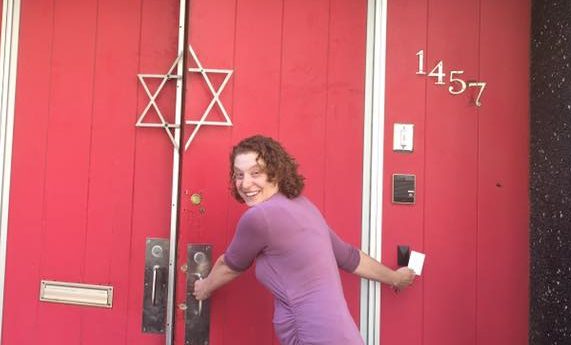
The restaurant’s giant red doors welcome visitors with paper lanterns and colorful banners. Vietnamese idioms lend the place an authentic atmosphere, although, as Minh pointed out, the best Vietnamese food he’s ever tasted won’t be found in trendy, concept restaurants. Rather, it’s sold on the street from grimy carts. 

However, almost without exception, all the dishes at Cà Phê Hanoi — and there are many — satisfied Minh’s exacting palate. We opened with — what else? — spring rolls. Minh said that in high-class restaurants back home in Ho Chi Minh City, diners roll their own spring rolls from a selection of fillings in the center of the table. “It’s a bonding experience for the whole family,” he said. 

The kab kem (meal sharing), was a veritable party in the mouth, exploding with flavor and competing textures such as salmon tartar, smoked tomatoes, mushroom leaf and chopped peanuts. Next  was banh mi, a sub with chicken, aioli sriracha and smoked goose, which the French introduced to Vietnam in the 18th century when the country was under French control.

The French also reassigned the role of the cow in Vietnamese tradition as a culinary staple. “Before then, the cow was like the pet dog,” Minh said. “The cow was a very important animal in my culture because it would plow the field. We never ate it.” 

In high-class restaurants in Ho Chi Minh City, diners roll their own spring rolls from a selection of fillings in the center of the table. “It’s a bonding experience for the whole family.”  — Vu Xuan Minh

Minh translated the Vietnamese catchphrase emblazoned on the wall: “The fatter the cow, the better the house.”

Beef dominated much of what we ordered, from the bun-bo (rice vermicelli and beef soup) to the boa beef ragout to the pho bo soup — arguably Vietnam’s pièce de résistance. The soup is slow cooked over nine hours with bone marrow, star anise, cinnamon, sirloin, rice noodles and coriander. 

Chef Raz Coszka  served us his off-menu special: mango butterfly fish — fried sea-bass splayed opened to resemble a butterfly — and topped with mango salad. Minh’s face split into a grin. “Now this reminds me of home,” he said.

Dinner ended with a round of dairy-defying desserts, courtesy of the restaurant’s kosher status. The coconut ice cream — a creation by Ofer Aharoni, one of Cà Phê Hanoi’s partners — and another unadvertised special, a white chocolate mousse sandwiched between passion fruit syrup and a chocolate chip pastry, had us both salivating and skeptical that it really was dairy-free.  

The meal was washed down with cocktails — works of art that you feel guilty for drinking — but Minh was unimpressed. He said he was desperate for traditional Vietnamese drip coffee.

A Vietnamese Chef in Tel-Aviv Read More »

Should Israel Care About Historical Truths?

There are three main players in the unfolding drama surrounding the Israel-Poland statement that ended the diplomatic crisis between the two countries: the government of Israel, the government of Poland and the historians debating, and mostly criticizing, the statement. 

There are three main layers in this unfolding drama that must be discussed separately: the interests of the two countries involved, the role of the three main players and the historical truth. 

There are three main stages in this unfolding drama: the decision by Poland to pass a law that could turn an honest discussion of the Holocaust into a crime, the negotiation and agreement that enabled the cancelation of this law, and the aftermath — that is, the drama of the last week. 

At the beginning of the year, Poland passed a bill that outlawed anything that could be interpreted as blaming the country for crimes committed during the Holocaust. The response was harsh: the law was seen — rightly so — as an attempt to silence any research that exposes the extent to which Poles participated in the persecution of Jews. A diplomatic crisis with Israel ensued. It was a crisis that the two countries, which have mutually beneficial relations, did not seek nor want. A ladder was needed for both to be able to climb down and go back to business as usual. 

Following negotiation, an agreement was reached. The law would be eliminated; Israel and Poland would issue a statement. The statement said many things — some more accurate than others. Among them, for example, “that structures of the Polish underground state supervised by the Polish government-in-exile created a mechanism of systematic help and support to Jewish people.” Historians in Yad Vashem, Israel’s Holocaust memorial museum, argue that this is “a narrative that research has long since disproved.” They harshly criticized the joint statement, because of this and other untruths, and were joined in their criticism by some of Israel’s politicians. 

Remember, we have three players. The Polish government does not much care. It handed Israel what Israel demanded (a cancellation of the law) and got what it wanted in return (a whitewashed version of historical events). The Israeli government is embarrassed. Its supposed achievement — repairing relations with an ally — became a fiasco. Historians are both outraged (because of the statement) and dismayed (because they were not consulted). 

Remember, we also have three layers. 

Layer One — The interests of the countries: Interest — remedy the relations. Done. Interest — remedy the relations amid certain political realities. This means that neither Poland nor Israel could get everything it wanted from the negotiation. So, at some point, a decision had to be made based on one question: Is the agreement good enough for Israel (and Poland) to sign. Good enough means not perfect, not what we wanted, not what we’d sign in an ideal world. Well, was it good enough? Israeli Prime Minister Benjamin Netanyahu decided that it was. He decided to make a compromise on the past to preserve the present. 

A ladder was needed for Israel and Poland to be able to climb down and go back to business as usual.

Layer Two — The role of the players: Here it is important to remember that people do have roles. Prime ministers make history. Historians make research. Prime ministers can, if they want, consult with historians. But they don’t have to. Prime ministers can, if they want, accept the advice of historians. They can also ignore their advice or accept some parts of it and ignore other parts. This is what Netanyahu did. This is what he ought to do, if the interest of the country demands it.

Layer Three — The historical truth: It is, of course, important for us to know that Poles (like citizens of many other European countries) actively participated in hunting Jews, killing Jews and robbing them of their property. Historians must defend their ability to expose these actions. Israel must also defend it, with a caveat. It must defend it among other things that it must defend. In other words, for historians, the main interest is caring for historical truth. For a country, historical truth is one interest, relations with Poland are another interest. 

Is one more important than the other? Balancing both is important. Maybe Netanyahu failed to strike the right balance; or maybe he succeeded in striking the right balance. As long as we remember what we seek is a balance; as long as we remember prime ministers are not elected to defend a truth, but rather to defend a country; the debate can go on.


Shmuel Rosner is senior political editor. For more analysis of Israeli and international politics, visit Rosner’s Domain at jewishjournal.com/rosnersdomain.

Should Israel Care About Historical Truths? Read More »