fbpx

July 12, 2018

Bringing Hope and Healing to Puerto Rico

It’s close to 11 p.m. as my flight begins its descent into the San Juan, Puerto Rico, airport. The city lights aglow in the inky night look like one of those images on a picture postcard. It’s hard to believe it was just last September when an extremely angry Hurricane Maria slammed into the island and ripped out its power grid — which in some areas took months to repair.

Suddenly, black clouds scuttle past the plane’s windows, looking for all the world like the Dementors of “Harry Potter.”

It’s a metaphor that will bear out in the coming days, because it’s easy to be drawn in by the pristine white sand beaches steps from the tourist hotels at Isla Verde, the crystal blue waters of the Atlantic Ocean and the glittering cobblestones and candy-colored buildings of Old San Juan.

But travel a little farther into the mountainous regions of Puerto Rico, as I did, and you’ll discover the lost, forgotten communities still struggling to recover from the devastation that Maria wreaked.

Some of the island’s most desperate, indigent residents — many of them elderly and frail — live in these areas where homes have yet to be rebuilt, electricity and clean water are still scarce, and finding food, clothing and other basic necessities is a daily challenge.

Were it not for Jewish groups working hand-in-hand with local municipalities and other nonprofit, humanitarian agencies, the people in these areas would be in considerably worse states than they are now. They are hardy and resilient, but their plight is now seldom in headlines and the governments of Puerto Rico and the United States have all but forgotten them.

In the immediate aftermath of Maria, Chabad of Puerto Rico, in conjunction with a local nonprofit organization called PR4PR, leaped into action to help some of the poorest communities. At the same time, half a world away, IsraAID, the Israel-based humanitarian aid organization, started sending emergency response teams to some of the island’s hardest hit areas. Today, IsraAID is still there, working on long-term recovery efforts.

Chabad to the Rescue

Shortly after the hurricane hit on Sept. 20, Chabad of Puerto Rico Rabbi Mendel Zarchi, the organization’s emissary on the island for two decades, managed to hold Rosh Hashanah services, despite parts of his shul’s roof being ripped off and its sanctuary being flooded.

Together with volunteers, Zarchi waded through flooded streets to deliver both physical and spiritual aid to stranded residents. While the Chabad headquarters is located in the very touristy Isla Verde, the organization made a point of coordinating efforts to ensure those in the poorest neighborhoods received help.

The Chabad’s two-story, white structure sits on a narrow street, a short walk from the beach. It’s marble-tiled floors and dark-wood doors project an air of serenity. A gigantic, framed portrait of the late Lubavitcher Rebbe, Menachem Mendel Schneerson, watches over those who come to pray, study or enjoy a kosher meal in the center’s tiny café.

Construction of the Chabad building was completed two years ago, but had been 19 years in the making. It took a major battering during the hurricane, and if you look closely today, you can still see some of the damage.

The storage room upstairs is crammed with nonperishable foodstuffs, leaving only narrow passageways to walk through. Those passageways were where Zarchi, his wife Rachel, and seven other people rode out the hurricane, lying on blankets on the floor. 

On the ground floor, the large social hall is lined with long tables, and when I visited two small girls were playing in the corner. But it was in this room where “we ran our relief project, right after the storm,” Zarchi said. “The entire room was covered in pallets.”
Those pallets were stacked with nonperishable items from Goya Foods, the New Jersey-based Latino food company that has a large manufacturing and distribution center in Puerto Rico. Chabad organized deliveries of the food to the most needy and continued to work with Goya on distributing the much-needed supplies. 

“Goya doesn’t normally sell to individual vendors, but we had a local contact and they made their products available to us at a very reasonable price,” Zarchi said.

In Canovanas, the thick blanket of humidity mixes with the stench of utter defeat. Here, the hurricane looked like it had left just after breakfast that morning. Sad-eyed dogs, skin hanging off their ribs, flopped in the midday sun, seeking shelter and any morsel of food.

“We also got kosher certification from Hands on Tzedakah (HOT) in Florida. They were tremendous,” he added, crediting HOT’s President Ron Gallatin and its project coordinator, Summer Faerman. “Gallatin sponsored a sizable amount of Goya products — beans and vegetables and corn and chickpeas and sauces — anything you could think of.

“We also gave out gas cards to run the generators and there was just tremendous effort from across the spectrum from Jewish communities. They sent food and clothing, gift cards and water. The generosity was just beautiful.”

Zarchi also thanked the kosher Kayco company – the largest food distributors in the U.S for sending dozens of palettes of quality food products and water, as well as the Jewish Federation, for providing subsidies for hard-hit Jewish community families and the community at large.

For all the praise Zarchi heaps on others, Jewish community members (Chabad caters to about 75 Jewish families on the island) are just as quick to praise the rabbi and his wife.

Seventy-four-year-old Rhoda Ringelheim, who lives alone, was trapped in her 10th-floor apartment for 10 days after the hurricane. She had moved there just days before the storm hit, which meant Zarchi and others at Chabad did not have her new address and didn’t know her whereabouts. Once she managed to get out of her home, her first stop was the Chabad center.

“I was bear-hugged when I got there,” Ringelheim said. “They had a generator and electricity and water. They have a shower, so if you needed to take one you could. And they fed you if you came in. Chabad is a family and they really let you know that.”

Mely Revay, 58, who moved to Puerto Rico from Venezuela with her husband two years ago to join their son and daughter-in-law, managed to walk to Rosh Hashanah services at Chabad after the hurricane.

“It was sad to see all the damage and that only a few of us were able to get to the synagogue,” she said, “but we were happy to see each other even though there were towels on the floor during services. Rabbi Mendel was amazing. They started distributing supplies right away. It was incredible.”

Selwyn Rosen, who is 79, has lived in Puerto Rico for 51 years. Because of the hurricane, he missed High Holy Days services for the first time in his life — and that upset him.

PR4PR summer camps kids sing and dance at a retirement home in Trujillo Alto.

“We had three feet of water in our home and I was unable to leave the house for 10 days,” Rosen said. “It was very painful for me. But Chabad came to us right after the storm. God bless them. It was truly unbelievable. The rabbi and his wife and his son came down my street. They had to wade through the water, but they gave us drinking water, soups, food, chocolates and candies. And they gave us food to give to our neighbors.”

Rosen said he was most grateful for the coffee. “You know, when you have a disaster, you want coffee. It was like a war zone here.”

But Rosen said that what impressed him most was that Chabad volunteers went up into the mountains to provide residents there with generators and food.

“I could not praise them enough,” Rosen said. “I’ve known Rabbi Mendel for 20 years. He and his wife are the most truly unique, fantastic, dedicated, loving, caring human beings I’ve ever met. What they did for this community is unbelievable. Forget my religious affiliation. When it comes to disaster relief, God bless us all for having [Chabad].”

Go Tell It on the Mountains

Chabad’s ability to head out to some of the most remote, mountainous regions came about, in part, thanks to a unique partnership formed with a local nonprofit called PR4PR, founded in 2004 by New Jersey-based Orthodox Jew Henry Orlinsky.

Orlinsky used to run part of his real estate business out of Puerto Rico, and in 1990 he decided a Chabad was needed there. He contacted Chabad’s world headquarters in New York, which eventually sent Zarchi to the island territory.

“Rabbi Mendel and his wife are the most truly unique, fantastic, dedicated, loving, caring human beings I’ve ever met. What they did for this community is unbelievable. Forget my religious affiliation. When it comes to disaster relief, God bless us all for having [Chabad].” – Selwyn Rosen

“Within a short period of time, Chabad of Puerto Rico became the center of Jewish life in the Caribbean,” thanks to Zarchi and his wife being “warm, unique, intelligent educated people who have been embraced by everyone they come into contact with,” Orlinsky told the Journal via telephone from New Jersey.

Orlinsky said he also wanted to do more for Puerto Rico’s non-Jewish community and came up with the idea to launch PR4PR.
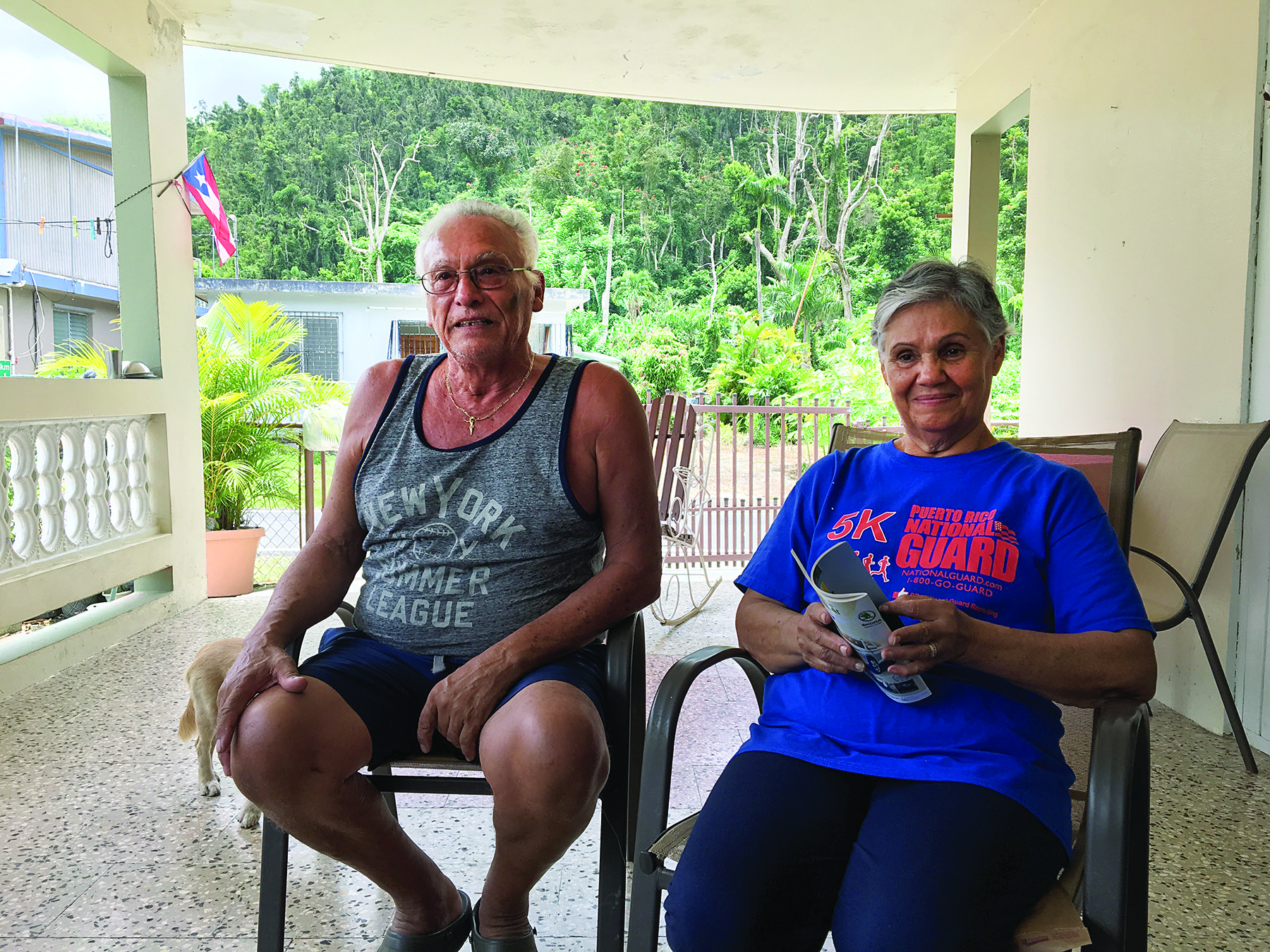
Heriberto Mauras and his wife, Mayu, at their home in Barrio Real

“The idea was to run summer camps and programming throughout the year in the blighted, dangerous neighborhoods of San Juan that have the highest crime rates,” he said. “We aim to break the cycle of crime and dependency and give these kids role models, from the police department and with volunteers.”

Today, PR4PR services some 2,000 children who might otherwise turn to drugs or criminal activity.

When Hurricane Maria hit, Orlinsky capitalized on his friendship with Zarchi and Chabad: “We saw an opportunity to work with these communities to take advantage of all these generous donations that were being sent to Chabad to help the island, and we led the way to go into remote communities to distribute food and water and essentials.”

PR4PR works in collaboration with Puerto Rico’s state police department as well as the San Juan police department’s athletic league in developing educational, cultural and recreational activities for youth. Orlinsky’s man on the ground is 60-year-old retired police officer Levid Ortiz, who has been with PR4PR since its inception and who served as my guide for a day.

The Land of Blue Tarps

Early one morning, Ortiz and fellow police officer Ricardo picked me up in their police van. The humidity was already thick as we headed away from the Metro tourist district to visit a home for the elderly in the municipality of Trujillo Alto, about 10 miles southeast of San Juan. Children from one of PR4PR’s summer camps were going to be there to sing and dance with the residents.

As we drove up to the area, Ortiz pointed out the blue tarps covering the roofs of dozens of homes.

“These are the tarps that FEMA [the Federal Emergency Management Agency] provided after the storm,” Ortiz said. “And 10 months later they’re still here. Nothing has been fixed.”

(Later, as we drove to more remote areas, the repeated sightings of blue tarps billowing in the wind signaled the continuing widespread needs of people forgotten by the Puerto Rico government and the U.S. government.)

At the home for the elderly, Zarchi and two rabbinical students here for the summer from the States, sang and danced with the kids and residents and helped distribute bags of food.

We then clambored back into the van and headed out to visit one of the summer camps. We soon arrived at an elementary school building that had seen better days, where 260 children from the ages of 5 to 16 were playing basketball, listening to music and playing video games.

Wisps of humid air rose like steam from a cauldron as the broiling sun beat down relentlessly on the asphalt, but the kids didn’t seem to care. Some held crumpled dollar bills in their sweat-soaked palms as they waited to buy candy from a makeshift kiosk. Many of the kids didn’t have money for a sweet treat, so I handed a $5 bill to the volunteers and told them to hand out candy to as many kids as they could.

“San Juan Mayor Carmen Yulin Cruz has political aspirations. She was using the hurricane and she was using the people and she was using these crocodile tears.” – Rhoda Ringelheim

Some of the kids played basketball with Rabbi Zarchi and the rabbinical students, while others lined up along a wall for their free lunch of sandwiches and fruit. They were all laughing and chatting and were thrilled to have their photo taken with the visiting journalist.

For all the blue tarps and derelict buildings in Trujillo Alto, nothing could prepare me for what we saw as we drove another 10 miles east to Canovanas, another blighted area with a population of just under 8,000.

As we head into one of the poorest villages with close to 3,000 residents, the tarps multiplied like an airborne virus. But far worse were the remnants of buildings ripped from their foundations. Staircases of blown-away homes led to nowhere. Random washing machines sat behind chain-link fences where homes once stood. The thick blanket of humidity mixed with the stench of utter defeat.

Here, the hurricane looked like it had left just after breakfast that morning. Sad-eyed dogs, skin hanging off their ribs, flopped in the midday sun, seeking shelter and morsels of food at a local store where tables and chairs and large pallets of bottled water sat.

The reason this area was such a disaster, Ortiz said, was because “FEMA won’t come here. This is a poor community. [The residents] don’t have papers — titles for their homes — so they can’t prove they own their places and can’t get funds.”

A large generator truck sat just above the local store. “The community got together and everyone put in a penny so they could get a generator up here,” he said. “They just got power a few weeks ago.”

One of those residents, Yessinia Ortiz, is 33 and has lived in the village for 19 years. Her home was destroyed in the hurricane. She now lives in the store and helps coordinate all the relief efforts that come through, including the assistance from PR4PR.

Iris Rosario also lives in the area and helps coordinate relief activities. “We need everything,” she said. “We have elderly people without food and money. Their streets are broken down, the kids have nothing and the government doesn’t help. We still have people without water in their homes.”

On that day, an organization called Praying Pelican Missions was there with a group of 14 Connecticut high school students who had come to help with painting and rebuilding projects.

IsrAid’s slow sand, gravitational water filtration system in Barrio Real

After the group left, Ortiz scoffed. “It’s nice,” he said, “but people don’t understand. They say, ‘We’re bringing 30 kids here to help rebuild houses,’ but I tell them, ‘I don’t need 30 kids; I need five guys who know what they’re doing and how to build. Because if any kid gets injured, we can get fined.”

The Mayor of San Juan: Good for Puerto Rico?

We headed back into San Juan to visit a community center for the PR4PR kids, where a basketball court could no longer be used because the corrugated metal roof  had collapsed onto the court.

“The mayor [Carmen Yulin Cruz] says she’s a good lady and she can fight for her people,” Ortiz said, “but it’s not true. Yes, she works in San Juan, but she spends more time in the States on vacation.” He shook his head. “People aren’t happy with her. Everything with her is ‘promise, promise, promise,’ but she never fixes anything.”

It was a complaint echoed by all the locals I spoke with.

Yulin Cruz is under investigation by the FBI for corruption for allegedly slowing the delivery of supplies to Puerto Rico in the aftermath of the hurricane.

“She destroyed San Juan,” Ringelheim said. “She didn’t start picking up the garbage from Hurricane Irma (two weeks before Maria hit), so that was stacked up 3 feet. And then all of a sudden, Maria came and the garbage was stacked up 8 or 9 feet.”

In the U.S., when people saw Yulin Cruz standing up to President Donald Trump and demanding help, Ringelheim said, “She has political aspirations. She was using the hurricane and she was using the people and she was using these crocodile tears.”

Rosen also didn’t mince words. “She is full of it,” he said. “She was disgusting. [The island] is in the throes of a $70 billion deficit. She expected the U.S. to give that money back. She is no damn good for this country. She is politicized and she should hide her head in disgrace.”

Et Tu, U.S. Government?

Beyond the harsh words for San Juan’s mayor, locals also damned with faint praise the efforts of the territory’s government and the U.S. government, but gave high marks to private U.S. companies and the volunteers who continued to come to the aid of the island.

“The U.S. government, as far as I’m concerned, is the biggest failure that ever existed, as far as hurricane response,” Ringelheim said. 

Rosen, who still rides his Harley-Davidson motorcycle every weekend up to the mountains with a local club, said he is also angry with the Puerto Rican government. “I see all those blue [tarps] when we go up to the country and it’s truly heartbreaking. I’m angry because the government knew [the hurricane] was coming and they didn’t do their job.”

Rosen, who lives in the San Juan suburb of Ocean Park, said,“Our area has been known to flood. We had seven huge pumps that could have been used to remove water but they didn’t work because they haven’t been fixed in years.”

As a result, he said, many homes were destroyed, people left and because of the flooding in the area, many of the abandoned homes were looted. “We only had our own roof finally put back up last week,” he said.

 Giancarlos Portalatin, my 30-something taxi driver from the airport to my hotel, said the slow recovery efforts were hampered by the Jones Act, which requires the transportation of goods between U.S. ports be carried out by ships built in the U.S. and operated primarily by Americans.

“The houses that survived the storm were mostly built out of concrete,” Portalatin said, “but other countries weren’t allowed to ship materials to us. How can we rebuild so we can [withstand] other hurricanes if other countries can’t bring us materials?”

President Trump waived the Jones Act on Sept. 28, but only for 10 days.

“We know we’re an island,” Ringelheim said, “but following laws like the Jones Act, if you can’t get supplies, how can you support the people? And Trump? He says, ‘We’re relieving you of the Jones Act, and now [we’re ending it].’ We’re in limbo. Trump forgets everybody exists because all that’s important to him is him.”

People had praise for Consolidated Edison, or Con-Edison, the New York energy company that sent its engineers to work on restoring the electrical grids.

“Those are the ones I give the most credit to,” Ringelheim said. “If it wasn’t for them, we still wouldn’t have electricity today. There are still people without electricity,” she added, noting that even she only had her power restored in December, and she lives in a major metropolitan area.

“It’s going to take 10 years to recover [from the hurricane], Ringelheim said. “They’re trying to rebuild our antiquated electric system, but what [the government] should have done was modernized it. We’re in hurricane season again and the same thing could happen tomorrow.”

The Death Toll

Although most news coverage of Puerto Rico faded a few months after the hurricane, the island territory was back in the news in early June when a Harvard University study published in the New England Journal of Medicine estimated that close to 4,600 people died as a result of the storm, far beyond the government’s official toll of 64.

“It’s because a lot of people didn’t die during the hurricane itself,” Ortiz said. “You’ve seen the areas. There were lots of elderly people who died after the storm. They were in places where there was no electricity and no oxygen machines, so they died. It’s just so sad.”

“I think the government here was trying to keep the [official] numbers down because there would be major panic,” Ringelheim said. “I lost two friends, both of them to heart problems. One of them was in the mountains in Canovanas on a ventilator and she had no electricity. I couldn’t even get a text message to the area until January. So many people are in rural areas. This is what we’re living through. They have no power, no water.”

‘Water Takes Care of You,
You Take Care of Water’

I took another drive with Haley Broder, IsraAid’s deputy head of mission for Puerto Rico, and other IsraAid workers and volunteers to the remote area of Barrio Real, on the eastern side of the island and one of the 16 wards of the municipality of Patillas.

The last 30 minutes of the drive were up a steep, switchback mountain road, overgrown with lush, green foliage. The hazardous road with a river running through it makes it easy to understand how cut off this particular part of the island is, why there is absolutely no cellphone service, and how it’s conceivable that the community of around 1,300 people and 250 homes received power only a month ago.

IsraAid landed in Puerto Rico to help with initial emergency relief efforts after the hurricane, but stayed to work with the community of Barrio Real in setting up a slow sand, gravitational water filtration system.

“IsraAID never works in isolation,” Broder said. “We’re working with the Barillo Real water board and the Interamerican University of Puerto Rico, Recinto de San Germán Campus through the C.E.C.I.A. (the center for environmental education and conservation) department.”

The U.S. Environmental Protection Agency designated Patillas an area in need of support, because it’s part of the 3 percent of communities on the island that do not receive water from the Puerto Rico Aqueduct and Sewers System.

High in the mountains, we pulled over to the side of the road to meet with IsraAID’s Israeli-born Water, Sanitation and Hygiene (WASH) engineer, Mori Neumann, who was out in the baking sun reading the neighborhood’s water meters.

The filtration system, Neumann explained, was important for a number of reasons, including the fact that the system can work without electricity. Construction began in June and is expected to be completed by September.

“Even though you can see and hear the river running behind us, obviously that water was not safe to drink after the hurricane,” Neumann said. People had been taking water from the river, he explained, because even though the community had a well, it wasn’t enough to supply all the residents.

“They were just putting that water into the well, not understanding that it wasn’t safe because the water wasn’t being filtered,” he said.

With issues of soil- and water-borne bacterial diseases, including leptospirosis, being a very real threat in the region, when IsraAID first arrived in the area they handed out water filters to the community and taught people how to use them.

On July 3, while I was still in Puerto Rico, CNN reported that it and the Center for Investigative Journalism had examined the Puerto Rico Demographic Registry’s mortality database and found that 26 people had died from leptospirosis in the wake of the hurricane. CNN reported that, based on those numbers, Puerto Rico should have declared an epidemic in the area.

Because IsraAID works with local communities to make them self-sustainable, part of Neumann’s job is to ensure that the people of Barrio Real know how to continue operating the water system.

To this end, IsraAID has established a series of workshops for the entire community throughout the month of July, under the banner, “Water Takes Care of You, You Take Care of Water.”

IsraAID has partnered with local Puerto Rican agencies on its project, and it has also brought in the three Jewish communities from the three different denominations in Puerto Rico: the Orthodox Chabad, the Conservative Jewish Community Center  and the Reform Temple Beth Shalom. Neumann has trained 14 volunteers from these communities to host the workshops throughout the month.

Husband and wifea Heriberto and Luz Maria (Mayu) Maurás are 71 and 70, have been married 51 years and were born and raised in Barrio Real.

They sat on their porch in the sweltering sun, the river rushing behind their home. Their dogs Leica and her 9-month-old puppy, Princess, lay panting in the midday heat.

Inside the devout Catholic couple’s home, crucifixes and pictures of Jesus adorned the walls, and statues of the Virgin Mary were on almost every available surface.

“The hurricane was horrible,” Mayu said. One of their windows was blown out as they huddled in the hallway during the storm. “We peeked out of our dining room at one point and saw tiny tornados twirling,” she said. “It sounded like a battlefield. And our power didn’t come back on till May 2.”

She said she had no idea what IsraAID was but was thrilled when its staff members came to their remote mountain homes to hand out the water filters and help set up the water project.

Like many residents in this area, she had no idea about water-borne bacterial diseases from the river, and she had been washing her clothes in the river after the hurricane. But she and Heriberto had been to every meeting IsraAID hosted. “We think it’s a great [water] project, but I hope our river doesn’t run out of water because there are a lot of dry areas,” she said.

Like so many other residents all over the island, Mayu praised IsraAID and the Jewish communities in the area for helping them when so many of their own had forgotten them.

“We love Mori,” she said, breaking into a huge smile when Neumann stopped by. “He came down here one day and asked to take a five-minute nap, and he slept on our sofa for two hours,” she added, laughing.

Why do you love him? I asked her.

“Because,” she said, “he’s a humble person fighting for our community.”


Puerto Rico still needs your help. To send donations, please contact Chabad of Puerto Rico at www.chabadpr.com, PR4PR.org and israaid.org/donate

Bringing Hope and Healing to Puerto Rico Read More »

Lawfare Project Threatens to File Lawsuit Against Irish BDS Bill If It Becomes Law

The Lawfare Project has threatened to file lawsuit against the Irish government if they a recently passed Senate Boycott, Divestment and Sanctions (BDS) bill becomes law.

On July 11, the Irish Senate passed a bill that would criminalize the importation and sale of goods from Israeli settlements by a margin of 25 lawmakers in favor, 20 against and 14 abstaining. Those in violation would have to pay a fine or serve up to five years in prison.

The Lawfare Project explained in a press release that such a law would have detrimental ramifications on several American businesses in Ireland – Apple being among them – and would therefore violate American boycott laws.

“We are determined to expose the illegality of the Irish boycott bill under European law, as well as the unnecessary damage that it will inflict on U.S. companies operating in Ireland,” Lawfare Project Executive Director Brooke Goldstein said. “Commercial discrimination on the basis of nationality is shameful in any form, but it is particularly frightening when it emanates from the halls of government—from the same lawmakers who were elected to protect the legal rights of their constituents. We will do everything in our power to prevent this unprecedented state-sanctioned discrimination from becoming law in Ireland.”

The Israeli Foreign Ministry has also issued a statement slamming the bill.

“The absurdity in the course of the Irish Senate is that the boycott will harm the livelihood of many Palestinians working in the Israeli industrial zones affected by the boycott, and Israel will consider its steps in accordance with the developments in this legislation,” the statement read.

Lawfare Project Threatens to File Lawsuit Against Irish BDS Bill If It Becomes Law Read More »

Jewish TV Stars and Creators Vie For Emmy Awards

Members of the Tribe are celebrating their nominations for the 70th Emmy Awards, which will take place in September. The list includes veterans, newcomers, and a shower of accolades for Amazon’s “The Marvelous Mrs. Maisel,” about a Jewish woman who becomes a standup comic 1950s New York. The series scored 14 nominations, including best comedy series and nods for creator-director Amy Sherman-Palladino and supporting actress Alex Borstein, who also received a nomination for her voice-over work in “Family Guy.”

The return of “Curb Your Enthusiasm” to HBO resulted in the series eighth nod for outstanding comedy series, and Larry David’s sixth as lead actor in a comedy series.

Henry Winkler, who was nominated twice for playing Fonzie on “Happy Days” in the 1970s and in 2000 for a guest role on “The Practice,” is up for an Emmy this year for his role as an acting coach in the HBO comedy “Barry,” one of several awards for the show.

“On the one hand I’ve been here before and I know not to get too excited,” Winkler said in a statement. “On the other hand I’m filled with HAPPY and so thrilled for Bill [Hader], Alec [Berg] and the whole company,” he said.

Nonagenarian Carl Reiner, who has nine Emmys to his credit, may get one more for narrating the aging-well documentary in which he appears, “If You’re Not in the Obit, Eat Breakfast” (HBO).

“My nephew, George Shapiro, came up with the idea and called it “Vitality at 90.”  I just said, ‘If I’m not in the obit, I eat breakfast,’ and that became the title.  94.6% of the credit goes to George, but I’m happy to have lent my agile mind and aging body to such a worthy project,” Reiner said in a statement.

Liev Schreiber was also nominated in the narration category for “24/7,” but the “Ray Donovan” star was shut out of dramatic acting category this year, after three consecutive nominations for the Showtime series.

Judith Light, who has been Emmy-nominated three times, for “Transparent” and “Ugly Betty,” earned her fourth nod for her supporting performance as widow Marilyn Miglin in FX’s “The Assassination of Gianni Versace: American Crime Story.”

“My deepest thanks to the Emmy voters and of course, the brilliant Ryan Murphy for the gift of being a part of this culture changing production,” Light said in a statement that gave props to the producers, writers, directors, and hair/makeup artists. “My gratitude to all of them and FX is beyond words or measure.”

Mandy Patinkin picked up his fifth nomination for his role as Saul Berenson in Showtime’s “Homeland” (he has one Emmy, for “Chicago Hope”), and both Evan Rachel Wood and Pamela Adlon received their second consecutive nominations for their lead actress work in HBO’S “Westworld” and FX’s “Better Things,” respectively.

“I am completely over the moon and so happy [for] this recognition from my peers for my life’s work and my show, ‘Better Things,’” Adlon said in a statement. “Filled with gratitude. Thank you.”

“Game of Thrones’” 22 nominations include a nod for writers David Benioff and D.B. Weiss, their seventh in the category for the HBO series. First time nominees include Michael Stuhlbarg for “The Looming Tower” and series “I Love You America with Sarah Silverman,” both on Hulu.

Bryan Fogel won an Oscar this year for his sports-doping documentary “Icarus,” and since Netflix acquired it, it will vie for an Emmy in the same category as two HBO docs, Susan Lacy’s biography “Spielberg” and Judd Apatow’s homage, “The Zen Diaries of Garry Shandling.”

“I’m so glad that people have had such a strong reaction to our documentary and Garry’s life.  I’m somewhat sure he would be thrilled,” Apatow, who was also nominated for directing the film, said in a statement.  Other nominees for directing include Carrie Brownstein for IFC’s “Portlandia” and Barry Levinson for HBO’s “Paterno.”

The 70th Emmy Awards will telecast live from the Microsoft Theater in Los Angeles on Sept. 17 at 5 p.m. PT on NBC.

Jewish TV Stars and Creators Vie For Emmy Awards Read More »

No Rabbi – It’s Not Jewish Love for Our ‘Historical, Religious Narrative’ That Prevents Peace

On the 10th of Tammuz (in the Hebrew calendar) the last king of Israel, King Zedekiah, was captured by the Babylonians, who had conquered Jerusalem the day before. Zedekiah was captured after he fled Jerusalem through a subterranean tunnel to Jericho. Exactly 2,606 years later, an article was published in the Forward by American Rabbi Philip Graubart titled “‘Letters To My Palestinian Neighbor’ Is Not The Book We Need Right Now.

I have to admit, when I first saw the title, I thought the article would be about how even though most “moderate” elements of Palestinian leadership: (a) engage in blatant Holocaust denial; (b) promote vicious anti-Semitic canards, such as Jews poison water wells; and (c) deny any Jewish historical connection to the land of Israel — all while promoting and rewarding the murder of Jews (such as through the Palestinian Authority’s “Pay to Slay” program), that this article would argue that we need to wait for a massive sea change in Palestinian Arab culture and leadership before Yossi Klein Halevi’s “Letters to My Palestinian Neighbor” could make a credible difference and help advance the peace process.

Instead, this article took the opposite approach and actually accused Halevi of being too jingoistic, too stuck in the Jewish “narrative.”

Imagining a “Palestinian moderate,” who has never assumed leadership among the various Arab groups representing the Palestinians, Graubart posits that after reading Halevi’s book, this imaginary Palestinian Arab moderate might say to Halevi “why waste time with you? … we already agree on the basics.

Reading such a statement raises the question, what “basics” does Rabbi Graubart think Palestinian Arab “moderates” agree on with Halevi? As should be clear from Halevi’s scholarship, he believes Jews have a deep historical, religious and national connection to the land of Israel. As should be also clear to anyone paying attention, the “moderate leaders” among the Palestinians who run the Palestinian Authority (who are also sadly the least rabidly Jew-hating and extremist among the various Palestinian Arabs factions who have any chance of ruling any Palestinian state in the near future), do not believe the Jewish people are even a people, let alone a people who have a deep 3,300 year old love affair with the land of Israel.

As recently as January 15, 2018 Mahmoud Abbas, the “President for Life” of the Palestinian Authority, gave a speech where he said: Israel is a colonial project that has nothing to do with Jews.” This same “moderate” leader not only wrote a thesis back in 1982 at the Russian Academy of Sciences, which denies and trivializes the Holocaust, and is a featured part of the current curriculum in Palestinian Authority schools; he also, on April 30, 2018, gave a speech where he once again trivialized the Holocaust and said that to the extent the Nazis murdered Jews, their murder was not caused by anti-Semitism, but by … “Jewish financial behavior.”

So again, what “basics” does Graubart think the “moderate Palestinian” and Halevi agree on?

Then apparently ignoring the last 100 years of history (at least), Graubart claims that the main problem with Halevi’s book is that it makes claims – mostly about Halevi’s “loving embrace of religious biblical narrative” – that “no Palestinian could accept” and that the “biblical impulse to build settlements in the West Bank [Judea and  Samaria] is precisely what’s sabotaged an agreement.”

So the “moderate” Palestinian Arab leadership turn down offers in 1937, 1948, 1967, 2000, 2001, and 2008 to have the first-ever independent Arab state west of the Jordan River, and it is the desire of Jews to establish and live in Jewish communities in their biblical homeland that “sabotaged” a peace agreement? It wasn’t Arafat’s rejection in 2000 of an offer to have an independent Palestinian Arab state in all of Gaza and over 90% of Judea & Samaria, and his decision to instead launch the Second Intifada, which led to the murder of more than 1,000 Jews? It wasn’t Mahmoud Abbas’s rejection – without a counteroffer – of an even better offer from Israel in 2008? It wasn’t the decision to turn land Israel fully relinquished (the Gaza strip in 2005) into a terror state run by a genocidal organization whose very Charter calls for the murder of every Jew on the planet, including Graubart?

No. According to Graubart, it isn’t Palestinian anti-Semitism, the Palestinian dismissal of any Jewish connection to the land of Israel or even the Palestinian rejection (in favor of violence) of offer after offer to have an independent Arab state in a land where there has never been one before in history that is to blame for the absence of a peace agreement. It is the Jews’ “biblical impulse” to live in Judea that is the problem.

Graubart even disparages the “impulse” of Jews to live in Hebron, one of the most holy and historically important cities for the Jewish people. Hebron, a city where Jews have lived for centuries and where our ancestors in 1929 were literally massacred, ethnically cleansed from and prevented from returning to (by the Jordanian Army after it illegally conquered and controlled all of Judea and & Samaria in 1949). Per Graubart, however, it is the “religious longing” of Jews to live in places like Hebron that is the obstacle to peace, all while 1.5 million Arabs can live among more than 6 million Jews in Haifa, Jerusalem, Tel-Aviv Yafo, etc. without their presence “sabotaging” peace.

There is so much that is problematic with this perspective it is difficult to know where to start. Perhaps the most obvious problem is that, just like most arguments of the “blame Israel” camp, Graubart’s open letter to Halevi implies the Palestinian Arabs have no agency or responsibility for their actions, and that peace (or the lack thereof) is solely a function of what we Jews choose to do (or not do). The other problem is that this article completely whitewashes nearly 100 years of Arab rejection of peace in favor of violence and more than 1,400 years of Arab persecution of Jews throughout the Middle East, as well as the widely held belief among far too many Arabs that Jews can only be second class (dhimmi) in Arab conquered land, never sovereign and independent.

What Graubart’s piece (albeit likely unwittingly) does a great job of capturing, is the growing divide between many secular Jews in the United States  and the overwhelming majority of Jews in Israel. Jews, like Yossi Klein Halevi, who are in Israel considered quite moderate or even left-leaning.

This divide is represented most strikingly in Graubart’s article where he writes the following illuminating and astonishing paragraph directed at Halevi:

“In fact, if your book taught me anything, it’s that we must begin the admittedly difficult process of privileging basic values over national, religious narratives. In discussing Arab rejectionism after the Six-Day War, you write, ‘What people, in our place, would have resisted reclaiming land it regarded as its own for thousands of years?’ But the answer to this question is obvious: a people who valued peace and democracy and human rights over historical/religious narrative. People who weren’t willing to sabotage future peace negotiations by giving in to religious longings, no matter how deeply felt. People who loved peace more than they loved the ancient stories of their people. In other words, people like you and me and many Jews, in Israel and out. But not, sadly, enough.”

Wow. I agree with Graubart on one thing for certain. This is “sad.” It is sad that it is becoming more and more evident that many Jews living in relative safety in the United States  have not internalized the lessons most Jews in Israel have learned from the history of the last 100 years. It also becoming more and more evident that many of today’s secular leaning Jews in America are not very different from the many Jews in America who before 1940 rejected the very idea of Jews seeking sovereignty and independence in our indigenous homeland.

After all, if we just “privileged basic values” (depending – of course – on whose “basic values” we are talking about) “over national, religious narratives,” then why drain swamps, irrigate deserts, establish fence and stockade kibbutzim all over the land of Israel (where you were certain to be plagued by malaria and were almost always immediately attacked by your Arab neighbors)? Why revive Hebrew from being not only our religious tongue but our national language? Why even fight for our freedom and independence against five Arab armies and nearly a half-dozen Arab militias sworn to snuff out our independence before it even happened?

After all, if we value “peace” above everything else, then we could all just give up on our indigenous faith, stop being “stiff-necked” Jews, and convert to either Christianity or Islam or perhaps to the new pseudo-religion of “secular-humanism.” If only, our forefathers had thought of this solution … Plainly, that would have made the Jew-haters much happier and much more “peaceful” toward us.

Thankfully, most of our forefathers didn’t think abdicating our religious values and our “religious longings” to live in Zion was the way to go, as not only would there be no modern state of Israel today, but Graubart would also have needed to find a very different job; as by now the world would have been Jew-free and Judaism would be like the ancient faiths of Minoanism, Mithraism, and Ashurism After all, if we valued “peace” above everything else, including the justice of Jews being able to live anywhere in the land of Israel, then is there anything worth fighting for?

Of course, by Graubart’s definition, the Maccabees would also be disparaged as people who were “willing to sabotage future peace negotiations by giving in to religious longings.” A people unwilling to “love peace more than they loved the ancient stories of their people.” After all, the Hellenists “just” wanted us to accept their “narrative” and to stop insisting on our sovereignty and freedom in our religious, historical and indigenous homeland; just like so many Hellenized or Islamized people do today.

Today, most Palestinian Arabs reject the idea that there were ever Maccabees who fought to liberate the land of Israel and Jerusalem from the yoke of the Hellenists. And this is where Graubart is the most mistaken in his rejection of Halevi’s book. Graubart assumes it is the Jewish respect and love of our “historical/religious narrative” that is somehow the obstacle to peace. The reality is that it is, and has always been, the Arab rejection of Jewish history and our deep connection to the land of Israel that is the obstacle to peace. The Arab rejection of the fact (not “narrative”) that 2,606 years before Graubart published his article that there was a Jewish king named Zedekiah fleeing the Babylonians and their destruction of the first Jewish Holy Temple in Jerusalem.

And that is the ultimate message of Halevi’s book. In order for there to be peace, the Palestinian Arabs are going to have to meet us halfway and stop asking us to accept that their relatively new Palestinian identity deserves two independent Arab states in the former British Mandate for Palestine (as Jordan is the first); all while they reject more than 3,000 years of Jewish history and Jewish sovereignty anywhere in the land of Israel.

As should be painfully apparent, there are many other things wrong with this open letter to Halevi, but the most glaring problem is the willingness to disparage the “historical, religious narrative” of our people, which is at the core for why we finally have an independent and sovereign state in our indigenous homeland after 2,000 years of recurring persecution, oppression and mass murder of Jews in the Diaspora.

Micha Danzig served in the Israeli Army and is a former police officer with the NYPD. He is currently an attorney and is very active with numerous Jewish and pro-Israel organizations, including Stand With Us, T.E.A.M. and the FIDF. He is also a frequent guest on the One America News Network, including shows like The Tipping Point and The Daily Ledger where he is called on to discuss matters related to Israel and the Middle East.

No Rabbi – It’s Not Jewish Love for Our ‘Historical, Religious Narrative’ That Prevents Peace Read More »

The Curse of Beauty: America’s First Jewish Pageant Winner

Less than a week after the end of World War II, 21-year-old Bess Myerson, the daughter of poor Jewish immigrants living in the Bronx, won the Miss America pageant in Atlantic City. She was the first Jewish contestant to win since the pageant’s inception in 1921 (and to date, the only one). 

For many Jews at the time, her victory felt hugely symbolic and personal. On the heels of the Nazis’ murderous regime — which was fueled in part by vicious anti-Semitic rhetoric — a Jewish woman had been declared the feminine ideal in the United States.

After Myerson’s victory, many of the contest’s sponsors declined to have a Jewish winner model their products. Certain hotels on the tour were restricted. Myerson quit the national tour, and at the urging of the Anti-Defamation League, began giving talks in high schools around the nation called “You Can’t Be Beautiful and Hate.” She went on to be a political and social leader in New York City and in the greater Jewish community. She married, had a daughter, divorced and married again.

In her 60s, she had a fall from grace that was nearly as visible as her rise. She fell in love with a Mafioso and was caught trying to influence the court to rule in his favor during his divorce proceedings.

Myerson died in 2014 at the age of 90, and this month, her daughter, Barra Grant, brings to the Edye Stage in Santa Monica, “Miss America’s Ugly Daughter.” Working with director Eve Brandstein and producer Suzi Dietz, Grant, 69, has written a humorous take on Myerson’s life — and on her own maturation. Monica Piper (of “Not the Jewish” fame) plays the voice of Myerson. 

The Journal spoke with Grant and Brandstein at the Edye during rehearsals.

Jewish Journal: How did a Jewish woman come to win the Miss America contest in 1945?
Barra Grant: It was a time of everyone looking like Betty Grable — short, very buxom and blond. My mother was 5 (feet) 10, skinny like a rail, with crazy raven hair. She was staggeringly beautiful, but not the stereotype. Her own mother always said, “Miss Louisiana was prettier.”

It was also a time of virulent anti-Semitism. No one wanted her to win. The judges were warned that if they voted for her, they wouldn’t be asked back, but she had a huge following among Jews and the veterans who’d been shipped to Atlantic City. Those huge hotels had been transformed into hospitals for amputees from the war, and they were all over the boardwalk. During the week or so leading up to the contest, the organizers asked if any of the girls would like to come and entertain the men. Only my mom and one other girl agreed to go. She played her flute for the boys and they loved it. During the contest, the audience was filed with vets and with Jews who had called other Jews who knew other Jews, etc. Huge applause would arise whenever my mom came out. The judges had to vote for her.

She was also the only winner at the time who won the talent contest. The other girls twirled the baton or yodeled. My mother played a piece of the Grieg piano concerto and then Gershwin’s “Summertime” on the flute.

JJ: Why did she enter the contest?
BG: She’d just graduated college and she wanted a piano. Her sister Sylvia said, “Bessie, you’ll enter this contest and you’ll win enough money to get a piano.” Her mother was very against girls in bathing suits, so they kept it a secret until she won Miss New York City.

JJ: What inspired you to write this play now?
BG: I was working as an actor and screenwriter and I’d started writing stories that I’d tell around town. I realized they were all about my mother. People would say, “You have to do something with this!” But I had to wait until she passed to tell the truth.

“If you burst out at 21 and are called ‘the most beautiful girl in the world,’ it’s part of your life forever. But it’s a curse to be that beautiful.” — Barra Grant


JJ: What part of her life, and yours, does this play cover?
BG: The concept is that she’s now 70. She’s had the scandal. No one is talking to her, so she calls me at 2 in the morning. But she’s not listening to me. She’s lined up a lot of pill bottles and threatens to take them. That’s what keeps her daughter on the phone. But it’s funny. It’s humor coming from character and emotions. I think the best humor comes from pain, and there’s a lot of pain between me and my mother.

Eve Brandstein: There are also dialogues that are conversations taking place within Barra’s mind. You hear flashbacks of childhood and adolescence and throughout her life. The play shows the triumph of a young woman coming out of this situation and crafting a life that’s magnificent, on her own.

JJ: How important was the beauty pageant to your mother?
BG: If you burst out at 21 and are called “the most beautiful girl in the world,” it’s part of your life forever. But it’s a curse to be that beautiful. “Beautiful” is about other people looking at you and you seeing the look in their eyes, as opposed to being focused on how you look at yourself and feeling some kind of pride because you understood something today that you didn’t understand yesterday. That doesn’t require a mirror or 50 people turning their heads as soon as you walk in. It’s hard to depend on that, particularly as you get older. Culturally, it’s very tough to get old and appreciate anything. It’s a real curse if you’re beautiful.

JJ: How Important is the fall from grace?
BG: The fall is a big thing because she was a tragic figure. She had it all. She made a mistake and paid for it the rest of her life.

JJ: What role did Judaism play in your mother’s life?
BG: My mom felt her Judaism very strongly and was extremely connected to Israel. I can say things about her that might not be complimentary, but that was her true nature. She wanted to save her people. That was her crusade.

JJ: Does this feel like the show you were always “meant” to do?
BG: This is the apex of my life. I have a very dark sense of humor and I love using it. This is the first time I’ve been able to imbue an hour and 20 minutes with that kind of humor.


“Miss America’s Ugly Daughter” runs July 14-Aug. 12 at the Edye Stage at the Santa Monica College Performing Arts Center, 1310 11th St., Santa Monica. 8 p.m. Fridays and Saturdays; 3 p.m. Sundays. Also, 8 p.m. Thursday, July 19. missamericasuglydaugther.com  

The Curse of Beauty: America’s First Jewish Pageant Winner Read More »

University of Oregon Hillel Sign Defaced With ‘Free Palestine You F*cks’

A “Welcome” sign from the University of Oregon Hillel was vandalized with cuss-laden graffiti on July 6.

The sign originally stated “Welcome” in both English and Hebrew; black marker was used to write “Free Palestine you f*cks.” Also written in black marker was something that resembled, “F*ck your high horse.”

In a Facebook post, the Oregon Hillel Foundation wrote that they were “shocked and saddened” by the vandalism and that they took the sign off the premises to clean off the marker.

“We greatly appreciate the immediate support of President [Michael] Schill, the Dean of Students Office and the Office of Equity and Inclusion,” Oregon Hillel wrote. “All have voiced their concern and support for our community and offered their resources.”

The post also included a statement from University of Oregon Division of Student Life Vice President Kevin Marbury condemning the vandalism.

“Anti-Semitism and other forms of hate have no place at the University of Oregon. We condemn this as an unacceptable violation our university values,” Marbury said. “The UO Police Department has taken the initial report and is working with Eugene PD to further investigate. To the extent we are able, we will share additional information as it becomes available.”

At the end of May, University of Oregon’s student government passed a resolution calling on the university to divest funding from companies that do business with Israel. Shill denounced the resolution as not being “welcoming and inclusive.”

Despite all this, the Oregon Hillel Foundation is pressing on.

“Despite hate we celebrate light by lighting the Shabbat candles with our community around the world,” they wrote.

University of Oregon Hillel Sign Defaced With ‘Free Palestine You F*cks’ Read More »

A Moment in Time: Bouncing Back

 Dear all,

I attended a 4th of July picnic with my family yesterday. It had been a particularly difficult week for me, and I was trying to gain perspective. While my nephew was in the bouncy house, Ron reminded me, “We should never miss an opportunity to bounce back when we can.”

Life can be uncertain. And we will endure difficult times. But we don’t give up – because we don’t want to miss out on even the dimmest of rays of goodness. Our liturgy teaches that light folds into darkness, and darkness folds back into light (Ma-ariv aravim prayer). And so we capture the moment in time to bounce back, reach for tomorrow, and embrace life. And boy, is it worth it!

With love and Shalom,

Rabbi Zach Shapiro
Temple Akiba of Culver City

Rabbi Zach Shapiro
Rabbi Zach Shapiro

A change in perspective can shift the focus of our day – and even our lives. We have an opportunity to harness “a moment in time,” allowing our souls to be both grounded and lifted. This blog shows how the simplest of daily experiences can become the most meaningful of life’s blessings. All it takes is a moment in time.

Rabbi Zach Shapiro is the Spiritual Leader of Temple Akiba of Culver City, a Reform Jewish Congregation in California. He earned his B.A. in Spanish from Colby College in 1992, and his M.A.H.L. from HUC-JIR in 1996. He was ordained from HUC-JIR – Cincinnati, in 1997. He was appointed to the HUC-JIR Board of Governors in 2018.

A Moment in Time: Bouncing Back Read More »

Israeli Professor Assaulted by Palestinian in Germany; German Police Respond by Beating Professor and Apologizing for It

An Israeli professor was visiting Germany, only to be assaulted by a Palestinian. The police responded to the incident by attacking… the professor.

The Times of Israel (TOI) reports that the 50-year-old University of Baltimore philosophy professor, who has not been publicly identified, was walking through a park in the city of Bonn with a friend. The 20-year-old Palestinian, who has also not been identified, took umbrage at the yarmulke the professor was wearing and knocked it off numerous times as he shouted “No Jew in Germany!”

The Palestinian also smacked the professor’s shoulder and shoved him.

The professor, who was in Germany as a guest lecturer, attempted to defend himself, as he chased after the Palestinian. The police, however, according to TOI, thought that this meant the professor was the aggressor – especially after he didn’t comply with their calls to stand down. They initially went after the professor, resulting in an altercation where “he was hit in the face and wrestled to the ground” by police, according to TOI.

Eventually, the professor’s friend explained to the police what had transpired, prompting the police to arrest the Palestinian and apologize to the professor.

“A terrible and regrettable misunderstanding in the field, for which I have expressly apologized to the professor concerned,” Bonn police chief Ursula Brohl-Sawa said in a statement. “We will examine exactly how this situation came about and do everything possible to avoid such misunderstandings in the future.”

The Palestinian was eventually released from detainment, but he faces charges of assault and incitement. The police are saying he was under the influence of drugs at the time of the assault.

Simon Wiesenthal Center Associate Dean Rabbi Abraham Cooper slammed the Bonn police’s actions in a statement.

“It is difficult to fathom how a middle-aged professor wearing a kippah would be identified as the perpetrator,” Cooper said. “Then comes word that the suspect, rather than being held in jail, received a psychiatric evaluation and then sent home? We are deeply concerned that in Germany, France, and The Netherlands, that ‘psychiatric evaluations’ are being used to whitewash anti-Semitic acts instead of confronting and dealing forthrightly with violent Jew-hatred.”

Cooper added, “During his recent visit to the Simon Wiesenthal Center, we told German President Steinmeier of our concerns that German authorities aren’t doing anything to confront the anti-Semitism that many Arabs and Muslims in Germany harbor. The incident in Bonn is yet another indication that Germany is not yet taking this source of anti-Semitism seriously enough. The Wiesenthal Center urges Chancellor Merkel’s government to expand the budget and powers of Felix Klein the Anti-Semitism Commissioner to ensure police and other state entities are properly trained to respond to such hateful attacks.”

Israeli Professor Assaulted by Palestinian in Germany; German Police Respond by Beating Professor and Apologizing for It Read More »