fbpx

January 3, 2018

James Bachner: A Getaway, Forced Labor and Then, Finally, War’s End

On Jim Bachner’s first morning in Auschwitz-Birkenau in mid-September 1943, after a sleepless night on the cold, crowded floor of an unfinished barracks, he and the other new arrivals were lined up outdoors and ordered to run about 25 yards.

An SS officer, whom Jim later learned was the infamous Nazi Dr. Josef Mengele, stood on one side, chatting with an attractive woman, his arm across her shoulder. With his other arm, he waved his hand to the left or right as prisoners rushed past him, and without even glancing up, dispatching them to a waiting truck or to work.

As Jim finished his run, a kapo shoved the bewildered 21-year-old to the right, into a barracks where a prisoner grabbed his arm and pushed up his sleeve.

“Look at your friends on the truck,” he told Jim, directing him to the window. “This will be the last time you’ll see them.”

Jim was too distraught to notice that the prisoner was tattooing the number “159942” on his arm.

“My heart was working overtime and so was my mind,” Jim recalled.

Looking back, Jim, now 95, credits what he calls his “positive mind” with enabling him to rise above the confusion and fear of those times, even at Auschwitz. “I knew at some point that I will not go through the smokestacks but that I will survive,” he said.

Jim was born in Berlin on May 24, 1922, to Abraham and Esther Bachner. His brother, Fred, arrived three years later. Abraham manufactured men’s clothing, providing his family a comfortable life.

Anti-Semitism became a problem for Jim in 1934, when his non-Jewish friends at a public high school began to shun him. The following year, he was forced to leave. Anti-Jewish measures shrank Abraham’s business and restricted the family’s lives.

Early on Oct. 28, 1938, a policeman arrived at the Bachners’ apartment with a warrant for “Abraham” and “Johannes.” Because Jim’s name was incorrect, the policeman said he would return for him with a corrected document. Meanwhile, the policeman waited for Abraham to dress, unaware that he had already escaped down the back stairwell. Jim followed suit.

The two fled to Poland, where they also held citizenship, settling in Chrzanow, in western Poland, where most of Abraham’s siblings lived and where Jim’s mother and brother joined them just before Germany attacked Poland on Sept. 1, 1939.

Under the German occupation, Jim performed menial work until early November 1940, when he was one of 800 men rounded up and sent to the Ottmuth labor camp, 75 miles northwest, to build the autobahn.

“My heart was working overtime and so was my mind.” — James Bachner

There, Jim loaded and unloaded sand by the shovelful. He also volunteered as a medic — the Nazis had quashed his dream of becoming a doctor — assisting during evenings in the infirmary.

In March 1941, the prisoners were transferred to the Gogolin labor camp, closer to the worksite, where Jim served as the resident medic.

The prisoners twice were transferred between the two camps until the fall of 1942, when they were shipped to Trzebinia, an unfinished labor camp. Food and water were scarce; prisoners slept on the floor.

One day, Jim received permission to walk 4 miles to Chrzanow, accompanied by a guard, to procure medication. While there, he managed a short visit with his parents. “It was hugs, kisses and crying,” Jim said. And it was the last time he saw his mother.

In mid-September 1943, Trzebinia was evacuated and the prisoners marched to Auschwitz-Birkenau. With sick and dying prisoners and senseless work, Jim reached a low point in December. He decided if nothing worked out in the coming days, he would throw himself against the electrified fence.

But another selection took place, and Jim found himself among 2,000 prisoners who were transported to Warsaw to tear down the facades of the burnt-out buildings in the now-deserted ghetto.

On July 29, 1944, with the Soviets approaching, the prisoners were marched to Poznan, 190 miles away, where they were loaded into cattle cars. With no food or water, the men were starving and dehydrated. Many died en route. After a two-day trip, the prisoners — about 3,500 of the original 5,500 who had departed Warsaw — arrived at Dachau on Aug. 6, 1944.

Several weeks later, they were transferred to Waldlager, a labor camp deep in the forest near Muhldorf, Germany, where the Germans were building an underground factory for the production of V1 and V2 rockets. Jim’s job was shoveling sand into trucks and carrying 100-plus- pound bags of cement.

One day, as 500 new and bedraggled prisoners limped into camp, Jim recognized his brother, Fred, among them. “The reunion was just unbelievable,” Jim said.

On April 19 or 20, 1945, prisoners were again loaded onto a train. “Things are so bad you won’t get far,” the camp commander said. “The war is coming to an end.”

Twelve miles later, at Taufkirchen, the train stopped. As Allied bombers flew overhead, the prisoners were ordered to run out and wave their uniforms. Jim, Fred and a friend, Peter, ran into an adjacent woods.

With help from a man in the French underground, they made their way to a series of safehouses, until they reached the front. There, amid the sound of bursting shells and gunfire, Jim approached a priest, who gave them a room in a silo, bringing them food and blankets.

The next morning, Jim ventured outside and saw white flags hanging from buildings. He ran back to Fred and Peter. “It’s finished. It’s gone. We’re free,” he announced. It was May 1, 1945.

Weeks later, Jim and Fred traveled to Munich, where they started a registry for displaced persons. Around August, learning that his father had survived, Jim traveled back to Berlin. When they met, the two hugged and kissed.

Jim, Fred, Abraham and Abraham’s new wife, Gusti Landerer, immigrated to the United States, arriving in New York on Jan. 16, 1947. Jim found a job as a commercial artist at an advertising agency.

While living in Queens, he met Marilyn Glassman, and they married on Sept. 3, 1955. Their son Evan was born in January 1958 and son Robert in September 1960. They now have five grandchildren.

Jim eventually became a junior partner at the agency and then, in 1976, opened his own shop, retiring in 1986 when he and Marilyn moved to Delray Beach, Fla. In June 2016, they moved to Thousand Oaks.

In 2007, Jim published a memoir, “My Darkest Years,” which is available on Amazon. In the book’s preface and in his talks to students and adults — delivered while living in Delray Beach and currently at the Los Angeles Museum of the Holocaust — he says that people must work to prevent another Holocaust.

“You must be on your toes,” he says. “Be aware of bullies because they grow into desperate dictators.”

James Bachner: A Getaway, Forced Labor and Then, Finally, War’s End Read More »

I’ll Have What He’s Having: Jake Dell at Katz’s Delicatessen

It was 25 degrees outside recently when I went to Katz’s Delicatessen on Manhattan’s Lower East Side to talk to fifth-generation owner Jake Dell. Despite the frigid temperatures and impending icy slush, throngs of customers were waiting in line to eat in New York’s only remaining heavy hitter in the delicatessen business.

Gone are the days when 2nd Avenue Deli was actually on Second Avenue, and Katz’s competed with other major players like Carnegie Deli. Yet, there isn’t a time that I’ve been to the restaurant that I haven’t seen Dell dutifully lurking around. Standing well over 6 feet tall in his blue Katz’s T-shirt, the fit and lanky Dell makes quite an impression, standing cross-armed like a bouncer outside the velvet ropes of a popular club.

Before I introduced myself, I watched as he presided over the cutters and chatted with the managers on the floor of the jam-packed restaurant. Then there was that smile. The word “disarming” was invented for that smile. It’s the unmistakable grin of a happy person who is more than thrilled to be exactly where he is. In this case, that means running an iconic New York landmark, just like his father and grandfather did, serving smoked meat the same way for almost 130 years.

Everywhere you look at Katz’s, placards and neon display the company slogan, a plea to “Send a Salami to Your Boy in the Army.” It’s a throwback to a time when three members of the Katz family were in the armed forces during World War II and they received meat from the folks back home.

Framed photographs adorn the walls, featuring everyone from Barack Obama to Frank Sinatra. There also are hats, sweatshirts, aprons, mugs and even an egg cream seltzer-scented candle with the Katz’s logo for sale.

Then there’s the old-fashioned ticket system. Upon entering the establishment, customers are handed a ticket and told by a doorman of sorts that they need to hold on to it at all costs lest they incur a $50 fine. Because some people don’t do as they are told and lose their tickets, Katz’s employees at times have to go rooting around in the garbage to help the customers find them.

Why do they still do this? “Because when you serve 4,000 people a day, you need a tried-and-true system,” Dell explained. “It’s a classic system, and you don’t see it anywhere else.”

It’s not celebrities or tourists Dell wants to please. The real pressure comes from pleasing his old-school New York customers.

The 30-year-old Dell prides himself on giving locals — and the tourists that consider Katz’s a bucket-list item — a true New York experience. At the turn of the 20th century, Katz’s was a meeting place for new immigrants who would congregate on Fridays for a franks and
beans dinner.

Jake Dell. Photo courtesy of katzsdelicatessen.com

Later, when Yiddish theaters lined Second Avenue, the restaurant was full of actors, singers and comedians. Quite a few iconic New York scenes have been filmed at Katz’s as well, the most famous of which was Meg Ryan’s hilarious “fake-gasm” scene in “When Harry Met Sally,” featuring director Rob Reiner’s real-life Jewish mother, proclaiming: “I’ll have what she’s having.”

But it’s not celebrities or tourists Dell wants to please. The real pressure comes from pleasing his old-school New York customers.

Imagine telling your Jewish family at age 21, after taking the Medical College Admission Test, that you’ve decided against medical school in favor of spending seven days a week at the deli so that you can check every tray of pastrami and corned beef that comes out of the smokers and look for just the right bounce and jiggle of the meat. That you are going to follow in the footsteps of the Katz family and the partners who came into the business later — your grandfather, uncle and father, who toiled in the same cutthroat industry and worked so hard that they probably aged well before their time.

That’s what Dell did, choosing to devote himself to the restaurant he grew up in — where he celebrated his birthday parties and bar mitzvah, worked every job from cleaner to cutter, and where some customers still remember when he was in diapers.

Somehow he understood that, although he could never re-create the “good old days” that New Yorkers are always going on and on about, he wanted to keep doing what he watched his family do his whole life — keep the traditions of our American-Jewish bubbes alive.

Dell understood that Katz’s is about a lot more than perfectly juicy, 4-inch-high pastrami sandwiches. It’s a living, breathing entity with a life all it’s own, with customers who for generations have been ordering meat platters for weddings and funerals and everything in between.

Dell told me that during the holiday season Katz’s makes 3,000 of its famous mini latkes a day and ships them all over the country — mostly to Los Angeles and Florida — through its online ordering system. It’s not an exaggeration, he added, to say the restaurant has people peeling potatoes 24/7 around Hanukkah time.

I told him that, in my experience, there is no appreciable difference between latkes made from peeled potatoes and those made from unpeeled potatoes. He looked at me and blinked, as if he hadn’t considered this before. I told him he could save a ton of time and manpower by skipping this step.

“Yeah, but the color wouldn’t be the same,” he said.

I told him the color wasn’t that different from the peel-on potatoes, and for a few seconds I thought I’d convinced him. I was already picking out the spot where I wanted my photo to go up on Katz’s wall.

Then he turned to me, with a very serious expression, and said, “They will never go for it.”

I didn’t get a chance to ask, but I assume he was talking about the family members and longtime customers to whom he feels he owes his only explanations. So, peel away forever, Katz’s — peel away forever.

I’ll Have What He’s Having: Jake Dell at Katz’s Delicatessen Read More »

Shopping for Votes: The Haredi-Ben-Gurion Alliance

On Jan. 1, Israel’s governing coalition suffered a blow: It could not find the majority needed to pass the so-called Supermarkets Bill, which is intended to give the Interior Ministry the power to decide whether a city can allow the opening of stores on Shabbat.

The Haredi Shas party has been demanding such a law, claiming that Supreme Court rulings have changed the sacred “status quo” on Shabbat observance. But some of the coalition parties do not approve of the bill. They dislike the idea of clashing with Israel’s secular voters over the sensitivities of a Haredi party.

On the morning of Jan. 1, in an attempt to convince the larger Israeli public that the law is required, Deputy Minister of Finance Yitzhak Cohen found an unlikely ally. Holding a sheet of paper, he gleefully read aloud from an old letter without revealing the identity of the writer. “Do you know who wrote this?” he then asked.

That Shas finds Ben-Gurion a useful ally is thus not as surprising as you’d think.

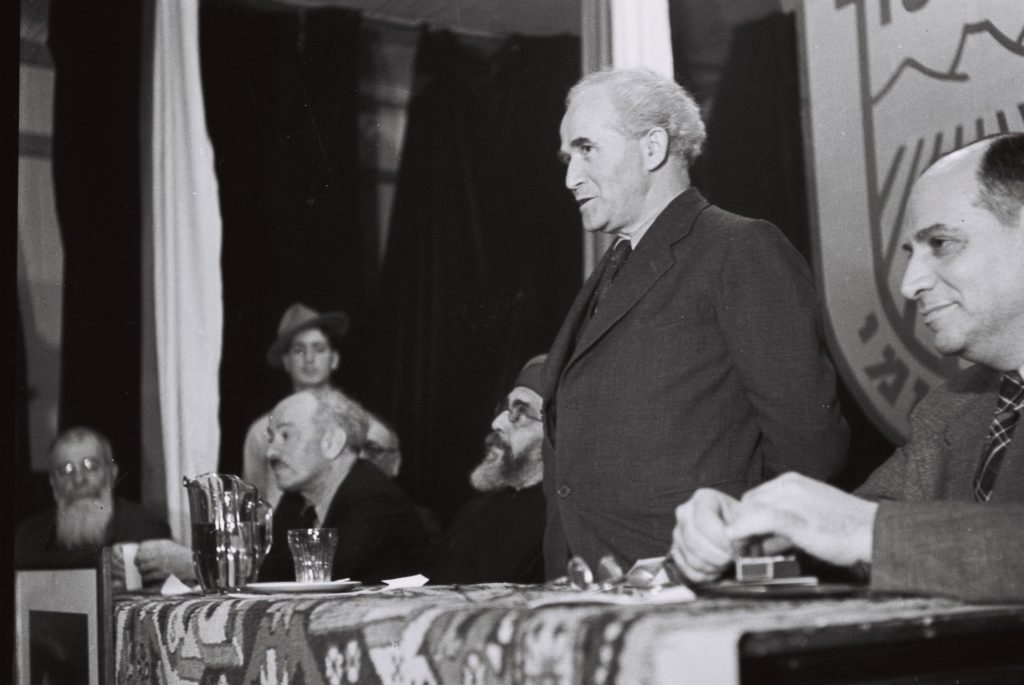
It was not a well-known rabbi, a Torah scholar or a Haredi sage. Shas was relying on an atheist to make its point: Israel’s founder, David Ben-Gurion. The letter, dated January 1936, was sent to a group of young pioneers — members of a kibbutz. They worked on Shabbat, and Ben-Gurion was pleading with them to stop.

“There is a need for a mandatory day of rest,” Ben Gurion wrote.

The leaders of Shas likewise believe that such day can be mandatory.

That an Israeli Haredi party uses Ben-Gurion to make its case is a positive sign — a sign of normalization, of the gradual Israelization of Haredi Israelis. Also, Shas leaders have a point. In many ways, their approach resembles Ben-Gurion’s — not necessarily on the specific issue of how Shabbat ought to be observed, but rather on the issue of uniformity versus diversity.

It is often an overlooked aspect of the debate on Shabbat, but the law currently on the table makes it hard not to notice: The debate about Shabbat is also a debate about other issues — such as the power of the state to control and dictate the culture of a country, and to control how localities behave.

It is these aspects of the debate over Shabbat that exhibit the intellectual incoherence of both proponents and opponents of the law.

Shas leaders — the initiators of this legislation — are happy to impose their cultural preferences on cities in which a majority of residents are secular. But they cry foul if a government attempts to impose its cultural preferences on Haredi cities. For example, if the government tries to force the city of Bnei Brak to open its roads to Shabbat drivers; or when it tries to force Haredi schools to include more “secular studies” such as math and English in their curricula.

The same is true as one examines the coherence of the law’s opponents. They want localities to have the freedom to open stores on Shabbat but insist on their right to impose a certain curriculum on Haredi schools. They want everyone to have the right to decide what to do on Shabbat but support strict regulation of culture by the state when they deem it important (one recent debate concerns the right of a right-tilting TV channel to broadcast news as it desires).

That Shas finds Ben-Gurion a useful ally is not as surprising as you might think. Ben Gurion wanted uniformity for many good reasons — to have a sense of community, to establish the power of the state, and to bring together a collection of people from different places and cultures. But he also wanted it because he was the one to decide what uniformity meant. In his time he called the shots, so uniformity, in most instances, meant that everybody did what Ben-Gurion said.

Today, as an important member of the ruling coalition, Shas has the power to call some shots. It can strive to achieve, on some issues, a Shas-type uniformity. So yes, you can call it “preserving the status quo.” But the real name of it ought to be: Where you sit is where you stand.


Shmuel Rosner is senior political editor. For more analysis of Israeli and international politics, visit Rosner’s Domain at jewishjournal.com/rosnersdomain.

Shopping for Votes: The Haredi-Ben-Gurion Alliance Read More »

Pixar and the Zohar

If you’ve seen the trailer or any advertisements for “Coco,” you already know that it’s Pixar’s most Mexican film yet. What you don’t see in the trailer is that Coco is also Pixar’s most Jewish film. You probably would not see that by watching the movie, either, but it’s all I saw.

“Coco” tells the story of Miguel Rivera, a Mexican boy who travels on Día de los Muertos (the Day of the Dead) to the Land of the Dead, where he must reconnect with his deceased ancestors to return to the Land of the Living. “Coco” fits neatly in the pantheon of familiar Pixar stories and the film is bursting with wholesome values.

The Jewish idea that aveira goreret aveira — once we step onto a dark path of sin, it can lead to an endless cycle of darkness — is prominent in “Coco.” The filmmakers sprinkle simple truths and lessons throughout: Fame is not correlated with talent or ability; our role models should be the people in our lives who are good, not those who appear to be most successful; we should follow our dreams but not hurt others in the process. Seeing Hollywood teaching good values is worth the price of admission.

On a deeper level, “Coco” is much more. It’s the stuff of primordial storytelling. Many stories dazzle us with mind-bending plot twists and vibrant original characters. “Coco” has neither. The story is not particularly remarkable and the characters are not unique.

“Coco” is a different kind of story — it is a fable. Specifically, it is the kind of fable that has been the bedrock of religious storytelling for thousands of years. “Coco” is a biblical story with new people and modern dilemmas.

Bible stories are not known for their plot twists, but they are brilliant vehicles for life lessons. The purpose of a Bible story is not to entertain — it is to enlighten. “Coco” is certainly entertaining and its agile lesson-teaching impresses. But its true brilliance is the way it enlightens the audience.

Religious stories, loaded with religious meaning and morality, serve a social function, as well. They connect people through ritual and common beliefs. They form a moral fiber that binds religious people to their communities while also answering the “big questions” of life. They connect and enlighten people. This is how religion builds society through storytelling. Without answers to “big questions” and meaning to pull everything together, people don’t build societies.

“Coco” is Hollywood’s most financially successful attempt to tell a universal story with lessons addressing one life’s “biggest” questions: What happens after we die?

“Coco” is a spectacular sermon on the afterlife. Consider this: Pixar spent $200 million to respectfully and faithfully teach the world about Día de los Muertos — authentically. There’s a lot of explaining in the movie as the theology and traditions of Día de los Muertos are doled out in bite-sized pieces.

“Coco” is a spectacular sermon on the afterlife.

The religious moviegoer expects Hollywood to get religion wrong and to subvert whatever it manages to get right. Incredibly, “Coco” does the opposite. It gets Día de los Muertos right. In a nutshell, on Día de los Muertos, the dead visit with the living. Only when we celebrate the dead will their memories live on, enabling them to visit and celebrate along with the living.

This is a powerful teaching. Another movie of biblical proportions, “Interstellar” (2014), also conveyed this idea. Coop, its protagonist, tells his daughter, “We [parents] are the memories of our children.” We find a similar idea in Jewish mysticism. The Zohar says that on days of great celebration, when the living inevitably remember the dead, the souls of the dead leave their heavenly domain and join in the celebration with the living.

This is the kind of “big idea” that traditionally was exclusively religion’s domain. “Coco” is a film doing what religion used to do. It is building culture and meaning. It is building society. Most of all, it is not replacing traditional religious stories with something new, but faithfully retelling the old in a modern way.


Eli Fink is a rabbi, writer and managing supervisor at the Jewish Journal.

Pixar and the Zohar Read More »

Trip to Israel Gives Television Star Insight Into Middle East’s Complex Politics

Actress Michaela Watkins — whose resume includes Hulu’s “Casual,” ABC’s “Trophy Wife,” Amazon’s “Transparent” and NBC’s “Saturday Night Live” — recently returned from a tour of Israel to news of a wildfire threatening her home in Ojai. After the winds shifted and her house was spared, Watkins, 46, spoke to the Journal about the fire, the trip — run by the Jewish Women’s Renaissance Project — and about how she’s hoping to make an impact in today’s world.

Jewish Journal: What’s next for Ojai after the fire?

Michaela Watkins: The town is preserved, but there’s a lot of damage. We need to figure out how to show gratitude to every single cop and firefighter. I feel more connected to Ojai than I did before. We’re there for the long haul.

JJ: Did you have any hesitations about the trip to Israel before you went?

MW: I’m not aligned with [Prime Minister Benjamin] Netanyahu, so I wondered, how do I go and support this country? My husband was brilliant: [He said,] “You need to go because a lot of people feel the same as you, and you need to go and look people in the eye.” If we’re ever going to get anywhere, we have to continue to travel and look in the eyes of other people and remember that we all want peace and to love and be loved.

“The trip was like an Israel sampler; I have to come back and order off the main menu.”

JJ: What were your impressions of Israel?

MW: There’s tension, beauty and so much history. … What they’re doing on a technology level is so innovative, and it’s so archaic and untouched and preserved. The elegance of those worlds leaning against each other, the way that they’re woven together, is splendid and not like any country I’ve ever visited.

The trip was like an Israel sampler; I have to come back and order off the main menu. I have to come back and do Yad Vashem again, to sit and commune with nightmares. I was very moved by it and fascinated by reflections of what was going on then duplicated in our current state of affairs. … I need to go back to Tel Aviv and Jerusalem more — experience more of the food situation, which is bananas good.

JJ: How has your trip enriched your understanding of Middle East politics?

MW: There’s such a complexity to Israel. You go to Yad Vashem and you think, “Give Jews whatever they need because what befell the Jews in Europe was so horrific that, of course, they should have a place for them to be in charge of themselves.” At the same time, I feel that if we learn nothing else from the Holocaust, we learn that oppression is wrong. [But] near the Lebanon border, [where] doctors feel they have one job — to save life no matter whose life it is — that raises the moral vibration and I hope everyone else gets on board. At the same time, I understand that there are people who don’t think they have a right to even exist. You have to defend your life, and it’s hard to hold all of those things.

JJ: In this news whiplash society, what issues are you most concerned about?

MW: Promoting women’s voices, especially women of color and LGBTQ. And after this last week, I think, how can we have a government that’s so dumb about climate change? This is the [biggest] fire in California history. The focus of everything should be clean air and water and food …

We need women in power positions. I think Harvey Weinstein could get by with horrible behavior because there’s not any agency in all of L.A. where half of the board members or shareholders are women. We need to change the landscape of power. If we don’t change male toxicity, take away assumed privilege and entitlement, then the environment is not going to change.

JJ: You put a note in the Western Wall, wishing for world peace. If you had two more notes, what would you wish for?

MW: That chocolate is the panacea for everlasting youth. And that my husband and I have a long, happy, healthy, romantic relationship together, forever and forever.

Trip to Israel Gives Television Star Insight Into Middle East’s Complex Politics Read More »

To the Stranger Who Asked Me About Contradictions in the Bible

May you walk through this world as though
you’ve just come upon a garden. A once hidden
garden. You walked past its walls every day
on your way to and from work, never once
did it open its ivy green doors; but, now! Now!
Rejoice! Now! As if by mistake, the Divine Fool
has left open a door, once thought to be
set in stone; He has flung it wide open and
angels’ voices seep out from behind its walls
and sing to you!  Yes, you! In your ears, in a voice
only you can hear, they sing, “enter, enter,
come hither, sweet lover of all that is Good.”
And of course you concede and you follow
the lead of some ethereal usher whose hands
are the wind. Who guides your gate and your gaze
into the garden doors.

You walk between three arches
which frame three murals hung on
the opposite walls.

The first is of an aged woman with a basket of
grains upon her head; and upon the grains
rests a town, rising like bread.

The second is of several women standing
under a crescent moon, some young and
some old; all with arms filled with water,
as though their limbs were made to rock the sea.

The third is of a circle traced in ivy.

And there’s a fountain in the garden,
which you hear before you see.
Your eyes have left the murals
and belong to a statue now.
A statue of a woman whose newborn child
sits at her feet, rooted deeper than the soil.
Her eyes are set upon heaven.
And her child smiles: he knows
his destiny is set in stone,
belonging to a timeless entering of the garden.

To the Stranger Who Asked Me About Contradictions in the Bible Read More »

Meet the Fosters

Twelve seconds. That’s how long it took for my wife, Shawni, to respond to a text asking if she wanted to put our name on the list of families willing to foster a newborn baby.

To put this into perspective: It takes Shawni three months to commit to buying a T-shirt (and another two months to return it). Our son’s bar mitzvah album arrived just in time for his 14th birthday. We’ve been shopping for bedroom furniture since we moved into our house four years ago.

But when a good friend told us that a baby needed a Jewish family to foster him so he could have a bris, Shawni immediately said yes.

To be clear, lots of people are looking to adopt babies, but we are not among them.  We’re in the “How long until the kids are in college?” stage. But we had no choice.

You see, when we bought a house we couldn’t really afford, I made an agreement with God. “If you do your part and pay the mortgage, we’ll always keep a space at our table for anyone who needs a Shabbat meal, and our guest room open for anyone who needs a place.”

Since then, we have put up guests about 40 weekends annually — including a 20-year-old woman I met in Toronto and invited to stay for six months. (That’s another story and why I’m not allowed to travel by myself anymore.)

Shawni’s first question about the baby was whether we would be his best possible option. We’re both 50-something, and it turned out this kid needed a lot of help. The family situation was complicated, with daily plot twists: surprise court appearances, paternity tests.

My wife did what she does before every life-changing decision: She davened. She spoke to God for an entire spinning class — 45 minutes, including arms!

“If this is meant to be the best thing for the baby,” she said, “please let it happen quickly and easily. If not, please let him find the proper home.” When she got off her bike, she received a text: “The other families dropped out — you got him.”

Then it sank in: We would have a new baby for the first time in 14 years! The plan: We would keep him 3 to 6 months, until the mom got her act together. We’d fill his body and soul with the sounds and smells and warmth of a Jewish home — careful to not get too attached, since we knew he was not ours.

The reality: Shawni brought him home from the hospital and said, “I love him!” We invited 40 people for his first Shabbat to offer blessings before his bris. There never has been a baby more surrounded by love. Shawni snuggled with him constantly, my kids changed and fed him, and I vowed to “get it right this time.”

Then, a week later, the unthinkable happened: We had to give him back. In a third-act twist, the biological father had learned of the son and wanted custody. It hardly seemed fair — “We’re not done with him!”— but the court thought otherwise.

So, together as a family, we waited for the “real” dad to show up. Shawni offered a blessing that the baby always would know he is loved and have a strong connection with God and a love of being Jewish.

Then it sank in: We would have a new baby for the first time in 14 years! The plan: We would keep him 3 to 6 months, until the mom got her act together.

When the dad finally showed up, the resemblance was undeniable. He had a natural bond with the baby — and a shock of thick black hair that we could never provide. I adjured my family not to cry. (“He was never ours.”) Then, when the baby left with his dad, who couldn’t have been kinder or more grateful, my eyes exploded as I sobbed, “Our baby!”

People had warned us that saying goodbye would be the hardest part. In fairness, most people, including us, thought we would have him for longer than a week. But that one week was powerful — for all of us.

Interestingly, Shawni, who has never made it through an episode of “This Is Us” without blowing through a box of Kleenex, didn’t shed a tear. As she requested in the beginning, “If this is meant to be the best thing for the baby, please let it happen quickly and easily.” And so it was.


Jeff Astrof, a television writer and producer, is the creator of “Trial & Error.”

Meet the Fosters Read More »

Settler Opens Her Home to Peace

Fourteen years ago, during the Second Intifada, Caroline Schuhl Schattner of Toulouse, France, felt the time had come to realize her Zionist dream. Frustrated with French news media coverage that made Israel out to be the aggressor during the prolonged uprising, she moved to Israel intent on becoming an actor in Israeli history, not a bystander.

Schuhl Schattner enlisted in the Israel Defense Forces and joined a combat rescue unit. Today, at the age of 34, with a master’s degree in linguistics, a husband and three children, she lives in Efrat, a largely Modern Orthodox town in the Gush Etzion settlement bloc south of Jerusalem, where she continues to work at making peace.

Every two weeks she hosts informal meetings in her home between Palestinians and Israeli settlers living in and around Gush Etzion, a flashpoint in 2015-16 for what is sometimes known as the “Knife Intifada,” a period when Palestinians regularly stabbed, shot and ran over random Israelis in the streets.

Schuhl Schattner believes that many Palestinians reject such violence, and she is determined to get Israeli Jews to know them, and for them to get to know Israeli Jews.

“I saw that Jews and Arabs live in the region and I see how they see each other — in business, at the shopping center — but they don’t know each other,” Schuhl Schattner said in phone interview from her home in Efrat. “Even though they meet via commerce, Jews have a stereotypical view of Arabs and Arabs have a stereotypical view of Jews. I thought that it’s a shame. We all live here, and we’ll all continue to live here.”

Schuhl Schattner was recently appointed project manager for olim [immigrants] at the Gush Etzion Regional Council. Her work with Palestinians is her personal initiative that she began a year ago.

Recently, she led a joint Israeli-Palestinian olive harvest in the village of Kfar Hussan.

“Most of the Palestinians, they’re people who want to live well — that’s what’s important to them,” she said. “And part of the good and simple life is to live in harmony with the Jews. Many of them don’t have extreme political views. If you succeed in having Jews and Palestinians meet each other, and the Palestinian sees the Jew is not the enemy, he’ll break out of his stereotypical view, and vice versa.”

The joint harvest produced a Facebook friendship between a young Israeli and a Palestinian, who are not allowed by Palestinian law to meet in person. Palestinians must receive permission from Israeli authorities to enter Israeli towns, but the Palestinian Authority can imprison Palestinians who interact socially with Israelis.

“Part of the good and simple life [for most of these Palestinians] is to live in harmony with the Jews.” — Caroline Schuhl Schattner

These days, about 20 to 30 people meet in Schuhl Schattner’s home for coffee, cookies, cake and conversations about topics that are generally taboo at the table: religion and politics. At the meetings, Palestinians often relay their frustrations with living under IDF controls that limit their freedom of movement, while Israelis express their fear of the terrorism and violence that make such security measures necessary. But participants from both groups generally agree that the Palestinian Authority doesn’t have the Palestinians’ best interests at heart — it seeks to thwart attempts at normalization in Israeli-Palestinian relations, and it feeds off conflict.

Schuhl Schattner said some of her friends and neighbors have been skeptical about her efforts, but she remains undeterred, encouraged by the story of one of her Palestinian friends whose brother was released from prison 10 years ago after serving a term for terrorist activity. After the friend introduced his brother to his Jewish friends, the brother’s hatred of Israel and Jews faded.

“I don’t care how much hate you instill in someone’s head,” Schuhl Schattner said. “If you have a good meeting, that’s what stays.”

Settler Opens Her Home to Peace Read More »

Can Running Be a Jewish Practice?

It happened by accident. Late one night, after scrolling through dozens of inspiring photos of friends running in the New York City Marathon, I idly typed a status update: “I’m 40 and I’ve never run more than three miles. Should I run a marathon?”

I expected to hear that I was too old, or training would destroy my knees. Instead, a series of heartfelt, secular-but-profoundly-spiritual testaments of people’s running journeys began to pour in. They told their stories and they told me to go for it.

Some of these people were Jewish; most were not. To my knowledge, only a few publicly presented themselves as people of faith. Yet, to a person, they wrote from a deeply intimate place of questing, in a personal voice we rarely hear in public discourse these days. They wrote without irony or judgment, full of kindness, encouragement and a palpable sense of joy.

Our Jewish culture, our understanding of the Divine and the human spirit — these live in us.

Social media as a tool for heartfelt, profound conversation about the spiritual journey? If this was what marathons brought out in people, I wanted in.

And so my journey began — and with it, a new spiritual practice.

Even a month in, it seems odd to me that I’d never thought of running as a spiritual practice before, since I’d been jogging casually for decades. After all, the point of noncompetitive running is to show up, to connect, to transcend the noise of everyday life. And as with so many forms of spiritual practice, although I don’t always want to do it, I always feel better afterward.

I love how the secularity of running crosses religious borders, but since much of my own spiritual life takes place in a Jewish context, I also have been considering how running lines up with Jewish practice.

For example, I think about how running in different parts of the day — a morning grounding, a midday reset, an evening cleansing — echoes the three Jewish prayer services.

Or I consider jogging as a mini-Shabbat in the middle of my day. Running clears my mind, calms my anxiety and puts the workday life in perspective — a hit of the most sacred Friday night services, available at noon on Tuesday.

Or I experience new understanding of the kabbalistic concept of balancing chesed (kindness) and gevurah (judgment) as I search for that razor-thin zone of pushing past comfort while listening to my body.

Curious about others’ experiences, I took a second poll, this one geared toward my Jewish friends who are runners. I asked, “Is your running a Jewish practice?”

Here are some of my favorite answers, all from Jewish marathoners:

A law professor: “Running does for me what prayer is supposed to do, but prayer never quite gets there in the same way. Before we had prayer, Jewish worship was physical — pilgrimage, food, sacrifice. Being in synagogue in a suit will never get me to the place that moving through creation, feeling life and strength flow through me and feeling more alive with each step does.”

A Jewish professional: “My Jewish practice has become synonymous with my work. And so, running is ‘me’ time. I use running to just be by myself. I try to push all work-related stuff out of my head. I breathe, become mindful and on those long runs I strive for ‘flow.’ ”

A teacher: “The marathon is my taste of the World to Come, a world where strangers support each other and feel a kinship despite the many differences that might usually keep them apart. It also allowed me to finally treat my guf [body] as a gift, to be cherished and seen as able rather than not the right size or unable.”

Our Jewish culture, our understanding of the Divine and the human spirit — these live in us. They are alive through us. They find us exactly where we are. And we find them, too, in the very stuff of our lives — in our grandmothers’ recipes, the prayers of our ancestors, the activism of our generation, or the simple act of putting one foot in front of the other, mile after mile, breath after sacred breath.


Alicia Jo Rabins is a writer, musician and Torah teacher who lives in Portland, Ore.

Can Running Be a Jewish Practice? Read More »

Oh, Lorde

It’s a good thing Jews don’t celebrate Christmas, because this last one would have been thoroughly spoiled.

’Twas the night before said holiday when 21-year-old New Zealand-born pop star Lorde, a Grammy-winning artist, succumbed to pressure from the Boycott, Divestment and Sanctions (BDS) movement and canceled her Tel Aviv concert planned for later this year.

“I pride myself on being an informed young citizen, and I had done a lot of reading and sought a lot of opinions before deciding to book a show in Tel Aviv, but I’m not too proud to admit I didn’t make the right call on this one,” the singer said in a statement.

Lorde’s acquiescence to the forceful politics of BDS was a blow to Jewish and Israeli morale, prompting defenders of Israel to respond with rebuke.

Instead of lobbing attacks and insults, what if defenders of Israel encouraged Lorde to perform for her fans to
promote reconciliation and peace?

Israeli Culture Minister Miri Regev offered a slyly mocking appeal to the young musician, urging her to reverse her decision. “I’m hoping you can be a ‘pure heroine,’ like the title of your first album,” Regev said in a statement. “[B]e a heroine of pure culture, free from any foreign — and ridiculous — political considerations.”

But asking an artist to be free of political considerations when it comes to the most loaded conflict in the world is naïve and shortsighted. The current generation of young people is the most interconnected in human history, and as a result, deeply socially conscious. Many of them are eager to integrate their values into the decisions they make. Besides, how can you insist a celebrity with a worldwide following divest herself of what happens in the world?

You can’t.

Regev’s statement isn’t the worst offense committed by a lover of Israel in defending the Jewish state. That accolade belongs to The World Values Network, led by Rabbi Shmuley Boteach, who on New Year’s Day took out a full-page ad in The Washington Post shaming and defaming Lorde for bowing to BDS pressure.

The ad states, “21 is young to become a bigot.” At the center of the ad is Lorde, superimposed on a split-screen background that features two contrasting images: In one, men clutch babies to their chests as they run from a scene of total destruction. In the other, beautiful buildings of Jerusalem stone stand tall and proud, topped by Israeli flags. “Lorde and New Zealand ignore Syria to attack Israel,” the ad declares.

Lorde certainly doesn’t deserve any credit for heroism. As the ad suggests, she schmeissed Israel while proceeding to perform in countries with far worse records. If her aim is to take a stand against countries with stained human rights histories, she’d best cancel other stops on her tour, starting with Russia. President Vladimir Putin’s annexation of Crimea was a strutting display of anti-democratic expansionism and his autocratic tactics at home are equally treacherous. According to Human Rights Watch, “Today, Russia is more repressive than it has ever been in the post-Soviet era.”

Because she is young and inexperienced, Lorde is not worthy of our scorn.

But if Boteach and others think politicized assaults on a global superstar are the way to “win” against BDS, they’re mistaken. The language of Boteach’s ad is mean-spirited and offensive, and will only further alienate the pop star and her millions of fans. How does that serve Israel?

Instead of lobbing attacks and insults, what if defenders of Israel encouraged Lorde to perform for her fans, and perhaps use her platform, to promote reconciliation and peace? What if Regev had offered to help facilitate an additional concert in the West Bank for Palestinian fans? What if the message was inviting and encouraging instead of angry and denigrating?

BDS has failed to intimidate musicians into not performing in Israel far more than it has succeeded. Fighting the nasty fight only makes Israel — and us — look foolish, spiteful and, worst of all, guilty.


Danielle Berrin is a senior writer and columnist at the Jewish Journal.

Oh, Lorde Read More »