fbpx

December 20, 2017

Despite a Year of Anxiety, a Note of Hope

As 2017 comes to a close, the weariness and exhaustion generated by the Donald Trump presidency seem everywhere. Dinner conversations inevitably come around to dreary discussions of Trump’s latest tweets, his disregard for democratic norms or his fantasyland distortion of demonstrable facts. Family gatherings have a pall cast over them as people contemplate three more years of disarray and mendacity.

It is easy to be depressed and assume the achievements of past decades — under both Democratic and Republican administrations — on issues of tolerance and intergroup relations are being undone by a president who has no shame in targeting minorities and the most vulnerable in overt, insensitive and mocking ways.

Despite Trump, I remain hopeful that, as the Rev. Martin Luther King Jr. observed, “The arc of the moral universe is long, but it bends toward justice.” If one steps back a bit, it seems that America has banked enough goodwill and broadly inculcated notions of tolerance that the body politic can withstand the fevered emanations from the Oval Office.

The vote in Alabama is one indication that even in the reddest of states, Trump’s act is wearing thin. His disdain for the norms of modern American modes of conduct helped sink the Roy Moore candidacy. Despite Trump’s entreaties, some 350,000 to 400,000 Alabama evangelicals did not show up at the polls this month to support Judge Moore in his bid for the Senate.

Evangelicals are the core of Trump’s support. If they are seeing through his pseudo-religious veneer, many others will, as well.

Despite his distancing of himself and his office from minority groups and his assault on them during his campaign and since his election, Americans haven’t forgotten what work remains on the intergroup front.

In summarizing a recent poll, the Pew Research Center said that “growing shares of the public say more needs to be done to address racial equality and see discrimination against Blacks as an impediment to this.”

Sixty-one percent of the public (81 percent of Democrats and 36 percent of Republicans) say the country needs to continue making changes to give Blacks equal rights with whites. Support for that proposition among Democrats is at a high mark since 2010 and within 3 points of the Republican high of support from 2015. The Trump effect hasn’t blinded Americans to the work that remains.

Even on the local level, racial groups get along, despite the Trump effect. A study earlier this year by the Center for the Study of Los Angeles found that 76 percent of Angelenos believe that “racial groups in Los Angeles are getting along well.” That compares with 37 percent in 1997 (five years after the riots), 48 percent in 2007, and 72 percent in 2012. Angelenos have equaled the most positive assessment of race relations at any point in the last 25 years.

In terms of particular groups in L.A., African-Americans think we are getting along “well or somewhat well” at 73 percent, Asians at 79 percent, whites at 81 percent and Latinos at 72 percent.

The barrage of bad news is rarely contextualized and set in its historic context.

These findings, though taken early in the Trump presidency, suggest that groups can distinguish between the rhetoric of a president who cares not a whit about whom he ostracizes, condemns or harms and the real world. They have figured out that their lives are independent of the show in Washington, D.C. Even Latinos, a particular target of Trump, have a positive assessment (at 72 percent) of how we are getting along in L.A.

On a more global scale, there is reason for optimism. In a post-Trump election interview posted on Vox, Harvard’s Steven Pinker (author of “The Better Angels of Our Nature”) warned about getting too concerned with the headlines of the day and the media’s “given wisdom.” The fact is that well-established trends and attitudes transcend the vagaries of one election.

“More generally,” Pinker said, “the worldwide, decadeslong current toward racial tolerance is too strong to be undone by one man. Public opinion polls in almost every country show steady declines in racial and religious prejudice — and more importantly for the future, that younger are less prejudiced than older ones. As my own cohort of baby boomers (who helped elect Trump) dies off and is replaced by millennials (who rejected him in droves), the world will become more tolerant.

“It’s not just that people are increasingly disagreeing with intolerant statements when asked by pollsters, which could be driven by a taboo against explicit racism. [Seth] Stephens-Davidowitz has shown that Google searches for racist jokes
and organizations are sensitive indicators of private racism. They have declined steadily over the past dozen years, and they are more popular in older than younger cohorts.”

If you want to see the dark clouds on the horizon, there are plenty. The next three years will continue to be very rocky. The nightly news will stream awful stories and troubling facts. Yet, the barrage of bad news is rarely contextualized and set in its historic context. By most measures we and the world are doing better than we ever have, if not as well as we might.


David A. Lehrer is president of Community Advocates Inc., which is chaired by former Los Angeles Mayor Richard J. Riordan.

Despite a Year of Anxiety, a Note of Hope Read More »

An Officer’s Other Cheek

An Israeli officer is tasked with patrolling a West Bank village. A young Arab woman attacks him. She pushes him around, slaps him, scratches, kicks. The soldier does nothing. He understands that this is a trap. There are cameras around waiting for him to hit back, waiting for him to provide them with the footage that will cast him as a villain — an armed soldier hitting an unarmed young Palestinian female.

This is what happened on Dec. 15, in the West Bank village of Nabi Saleh. And as the footage made its way online, it stirred a debate in Israel. A debate about the woman: Was she a criminal, or maybe behaving as you’d expect from people under occupation? A debate about the young officer — was he being professional through his use of restraint, or maybe showing confusion by refraining from doing what you’d expect from a solder slapped in the face?

As often happens, this became a debate of “right” vs. “left.” But a sober discussion of this event should have nothing to do with the politics of Judea and Samaria. This ought to be a debate about cost and benefit, about military tactics in complex situations. This ought to be a debate about short-term gains and long-term pains.

Yes, there is short-term gain: The officer evaded the public relations trap that the young Palestinians prepared for him. They wanted to show the ugly face of a brutal occupying military, and what they got instead is the real face of a military going to great lengths to show restraint.

As the footage of the Arab woman slapping the Israeli officer made its way online, it stirred a debate in Israel.

Yes, there is a long-term pain: The Israel Defense Forces (IDF) needs to be an intimidating force — a force that Israel’s enemies fear. A footage of an IDF officer slapped in the face by a teenage girl does not serve such an image.

There also is the internal gain and pain to be considered. A message to Israel’s society from the IDF: We attempt to be as humane as possible. Another message to Israel’s society from the IDF: You are sending us to accomplish mission impossible. A yet a third message to Israel’s society from the IDF: Know that this is the cost of having to keep a hostile civilian population under our control. Maybe there is no other choice, maybe there is no better solution, but be aware of the price.

What would be the benefit and the cost of a reverse response by the officer? This is not hard to imagine, as such instances have occurred in the past. The young woman hits the officer, the officer hits back, cameras role. A PR embarrassment for Israel. An embarrassment that is part of an ongoing campaign to delegitimize Israel’s presence in Judea and Samaria, and to portray the IDF as a dark, cruel force.

Many Israelis, maybe a majority, would prefer such an outcome to the outcome we saw recently. They would prefer it because the young officers are their sons or cousins or neighbors, and because they feel in the Middle East that you do not let anyone slap you in the face without responding with force.

Let the cameras roll, let the world of hypocrites jabber. When you are a proud Israeli citizen, highly appreciative of the IDF and its soldiers, and isolated from the fallout of international condemnation, you’d instinctively take such a position. You don’t care about a Swedish or a Venezuelan or an American-on-campus condemnation — you care about your soldiers. You care about them not having to suffer through humiliation, about them not seeming weak.

There is a lot of sense in both positions, whether or not you support Israel’s control of the West Bank. If you support the occupation, you have fewer moral qualms about having to use force in the territories; if you oppose the occupation, you have to support an intimidating IDF as the only shield that can guarantee a safe withdrawal from the territory.

But if you support the occupation, you also understand the need for a long, patient game; if you oppose the occupation, you will upload restraint as the moral choice.

Now consider the officer’s situation. Consider him having to make all these calculations while someone is slapping him in the face.


Shmuel Rosner is senior political editor. For more analysis of Israeli and international politics, visit Rosner’s Domain at jewishjournal.com/rosnersdomain.

An Officer’s Other Cheek Read More »

Matzo Balls: Not Just for Passover

In last week’s column, I waxed poetic about chicken stock, so it seemed appropriate that I should follow up by telling you how I make matzo balls. Then you can use up all that glorious stock and schmaltz you will have in your freezer.

Each time I serve matzo ball soup, I see looks of ecstasy on the faces of my customers, because even non-Jews seem to have a deep, nostalgic love for soup with savory, fluffy dumplings.

Matzo balls — or kneidlach, as they are called in Israel — are Jewish soup dumplings that hail from Central and Eastern Europe. Of course, being a Jewish food means that no one can agree on a recipe, and you can find as many variations for matzo balls as for bread.

Matzo ball enthusiasts are separated by the controversy over their preference for “sinkers” or “floaters.” Sinkers are matzo balls that are heavy in the middle and quite al dente, whereas floaters are lighter and fluffier and usually much larger, like the size of a tennis ball, as opposed to the size of a golf ball.

In the United States and Israel, matzo ball mixes are very popular because it’s hard to beat the convenience of a dump-and-stir box. However, in the kosher section of most U. S. grocery stores, you can find matzo at any time of the year, and to make your own mix is not complicated or fussy.

The best matzo balls are made from coarsely ground matzo as opposed to the fine matzo meal powder that is in boxed mixes. If you have some matzo, a rolling pin or heavy object to crush them, making matzo into balls is just a matter of adding a few ingredients, stirring them up and you’re done. Making your own mix also enables you to control the salt content.

Because I’m a picky bugger, I enjoy matzo balls that are fluffy and al dente in the middle. I know that sounds like a contradiction, and my Romanian mother would disagree on this in principle — she likes floaters — but I like it when the outside of the matzo ball is fluffy (like a floater) and the inside of the ball still has a bit of a bite and is sinkerish.

This hybrid recipe is my preference both in my restaurant kitchen and at home. It’s pretty much a home run in the winter to serve in a steaming bowl of chicken soup with vegetables with plenty of chopped herbs floating about. It also is able to make any illness go away, fix a broken heart, and it’s more likely to put you in touch with your ancestors than a séance ever could. It’s comfort personified, and I don’t think I’m exaggerating one bit when I say it must be one of the foods of the Gods.

I hope this will demystify the matzo ball issue because these dumplings deserve to be eaten all year round and not just on Passover.

MATZO BALL SOUP
12 cups strong, seasoned chicken broth
4 eggs, beaten
1 cup matzo meal, coarsely pounded
to 1/4 of a pea size
1 1/2 teaspoons kosher salt (or to taste)
Freshly ground black pepper to taste
1/4 cup canola oil or schmaltz
(rendered chicken fat)
1/4 cup seltzer water or club soda

Beat 4 eggs in a bowl and then add matzo meal, salt, pepper, melted schmaltz (or oil) and seltzer water, and stir with a fork. Put the mixture in the refrigerator covered in plastic wrap for at least 2 hours or until ready to use.

When you want to cook your matzo balls, take the mixture out of the fridge; it should be hardened but still moist. Put about half of the seasoned chicken stock into a large pot with a tight-fitting lid. Make sure it’s large enough because these double in size and you don’t want to crowd them, or your matzo balls won’t fluff up. The other half of the chicken stock can be reserved for your soup.

When the stock is simmering, wet your hands with water and pinch off golf ball-size balls and immediately drop them into the hot stock. Work quickly, wetting your hands again as you go. If you don’t want to get your hands dirty, and you don’t mind quenelle-shaped matzo balls, use 2 spoons and scoop a bit of the mix out with one spoon, and then push it off with the other spoon into the simmering pot of stock.  This method will result in a very light, irregularly shaped floater because you haven’t compacted the mix at all.

Once all the balls have been formed and dropped, bring your stock back to a simmer and cover the pot tightly with a lid. The pot can be quite full; the ideal is 3/4 full, but not too crowded, so the balls have room to expand.

The matzo balls will sink at first and then burst their lovely heads to the surface. From the time you have covered the pot, let them simmer approximately 50–60 minutes, or until they are soft all the way through and have a tad of give in the middle. You may have to sacrifice one to cut it open and see that it is cooked through.

Note that matzo balls simmered in stock will make your chicken soup cloudy. I don’t mind that sacrifice for the great taste the stock imparts to the matzo balls, but if you prefer clear broth, use the reserved stock to make soup to ladle on top of your matzo balls.

When the matzo balls are cooked, take them out of the stock with a slotted spoon and reserve until you want to serve them.

If you are making your matzo balls in advance of a meal and need to reheat them, transfer them back into the soup pot to cook in the simmering broth for a few minutes until heated through.

Word to the wise: Matzo balls are like sponges — don’t leave already-cooked matzo balls in soup for more than 5 minutes, because you will come back to find they have sucked up a lot of your soup and become soggy.

Serve with broth, vegetables and chopped dill and parsley in warmed bowls, and thank your nearest Jewish grandmother.

Makes about 12 matzo balls and 4 bowls of chicken soup.


Yamit Behar Wood, an Israeli-American food and travel writer, is the executive chef at the U.S. Embassy in Kampala, Uganda, and founder of the New York Kitchen Catering Co.

Matzo Balls: Not Just for Passover Read More »

Words Which Come to Mind At The Thought of Love

Olive branches somehow turned to a bronze oil,
dripped over white petals which float atop a
ship of leaves in the fountain of a secret garden
known only to a sheep dog and a woman who
loves nothing more than to paint olive trees.

Forests growing on a distant planet,
whose trees have a deep red bark
and send their vanilla scent with the breeze,
along with the smell of burning wood from
a fire set upon the ocean’s shore, which on
this planet has deep blue sand speckled with gold,
so that when you walk on it, assuming you’re
used to Earthly skies, it’s as though you’re
walking over the midnight sky as seen from
Death Valley. Your toes kissing the stars. And
the fire you lazily kindle is nothing less than the sun.

Something relevant to physics and chemistry
which explains the improbability of everything
and some other equation which explains attraction.

Barefeet and a world which is comfortably walkable by them.
Everywhere. A world furnished by flowers and fields.

Sewing seeds and sweaters, done in different
weather of course, but done with equal amounts
of love; an amount equal to water falling over
once sharp rocks, now turned to smooth stones,
which hawks like to perch atop when the snow
flow from the mountain tops is rather slow.

Tiny ballerinas dancing atop piano keys.

A fog hovering over a lake whose only ripple
traces back to a shoreline where two deer stand
lapping at their own reflections.

Tree sap boiling in a small log cabin so that the air
is thick with sugary steam; a syrup sauna.
And there’s snow outside whiter than a child’s eyes.

Lighting entire castles by fire. Chandeliers of 1,000 candles.

Rambling hills of green which match the clouds roundness —
Heaven and Earth folding into each other’s grooves.

A redwood and a willow tree’s love child.

Words Which Come to Mind At The Thought of Love Read More »

Reboh Brings His Style Back to Israel

Maybe it’s his easy smile, his quick laugh or the way he greets his clients as if he’s been waiting forever to see them, but when Marcel Reboh says, “I love beautiful women,” it’s not creepy. His job, he says, is to know how to read any woman who sits in his chair and to “change her life, to make her happy.”

Reboh isn’t a therapist, he’s a hairstylist. Known in Israel as the celebrity stylist, Reboh has been cutting and styling hair for more than three decades. He discovered his talent at the age of 13 when his older sister paid him to blow dry her hair in their home in Petac Tikva, Israel. At 18, he flew to Paris to study with the best stylists in the industry. Together with his brother Rafael, Reboh opened 10 salons in six cities in the United States and Canada.

Reboh got his big break in Montreal when Barbara Walters stopped by for a cut. Impressed with his skills — and his effusive personality — she referred Reboh to such friends as Candice Bergen, Mary Tyler Moore, Lauren Bacall and Mia Farrow. Since then, Reboh has worked with Cindy Crawford, Claudia Schiffer, Sharon Stone, Mariah Carey and Catherine Zeta-Jones.

But for all the glitz and glamour, Reboh is first and foremost a family man — a trait that brought him and his wife, Sandra, and their two sets of twins back to Israel after a 30-year absence.

Born in Casablanca, Reboh and his nine siblings moved to his mother’s hometown of Paris when he was 2 months old. In 1961, the family immigrated to Israel. Tragedy struck during the Six-Day War when Reboh’s brother, Eli, was killed. “Three of my brothers went to the war, only two came back,” he recounted with tears in his eyes.

The sorrow of this loss became too much for the family to bear, so in 1975 it moved again, to Montreal. After 20 years of “too many ice storms” in Canada, Reboh moved his family to the warmer climes of Miami, where he lived until two years ago.

It was Reboh’s twin 18-year-old daughters, Sarah and Kayla, who eventually brought him back to Israel in 2015. Even though they carry American and Canadian citizenships as well as Israeli, they were determined to serve in the Israel Defense Forces. With the pain of his brother’s death in 1967 still haunting him, Reboh was unsure how he felt about their ambition. There also were huge obstacles involved with uprooting his family: His children, having never lived in Israel, didn’t speak the language or know the culture; and his younger twins, Ilan and Shani, were just starting high school. There also was the issue of what Reboh would do with his successful salons in Miami and Los Angeles.

“It’s going to be the best hair salon in the country, in the Middle East, and even in Europe.” — Marcel Reboh

But then he got inspired, he said, not just by the love his daughters reawakened in him for the country of his youth and the Jewish homeland, but by seeing and embracing the Israel of today and tomorrow. Reboh was inspired to bring over his own brand of high fashion and gilt-edged cosmopolitanism, “something that they’ve never had in Israel,” he said with a laugh. And he’s doing just that.

His salon, Femme Coiffure, at the Dan Hotel in Tel Aviv, is changing the hair-styling industry in Israel as one of the only salons in the country using entirely organic hair products. And in January, Reboh and his brother Rafael, who moved back to Israel a year ago with his family, will open another luxury salon in the new Setai hotel in the Old City of Jaffa.

“The Setai is a major brand in the world, top 10, and now it needs a hair salon that deals with the rich and famous and in bringing them hair that they have never seen before,” he said.

In his typical hyperbolic manner, Reboh declared with a wide grin, “It’s going to be the best hair salon in the country, in the Middle East, and even in Europe.”

This article has been modified to correct Marcel Reboh’s name.

Reboh Brings His Style Back to Israel Read More »

My Reform Colleagues Were Wrong on Jerusalem

We were wrong.

As Jewish Agency Chairman Natan Sharansky pointed out, “The Reform response to the recognition of Jerusalem was terrible. When … a superpower recognizes Jerusalem, first you … welcome it, then offer disagreement. Here it was the opposite.”

Sharansky was referring to the Dec. 5 statement issued by all 16 North American Reform organizations and affiliates in response to President Donald Trump’s declaration recognizing Jerusalem as the capital of Israel. The operative clause reads: “While we share the President’s belief that the U.S. Embassy should, at the right time, be moved from Tel Aviv to Jerusalem, we cannot support his decision to begin preparing that move now, absent a comprehensive plan for a peace process.”

There have been several attempts to clarify this position, but not by all of the original signatories. It is still the official position of the entire North American apparatus of the Reform movement. If our movement’s affiliates have had a change of heart, all of them should say it through another statement: “We made a mistake.”

If not, and if we still stand by our original statement, I want the Jewish world to know that this position is not my position, nor does it reflect the views of multitudes of, perhaps most, Reform Jews.

We were wrong on the politics. With the exception of one small hard-left party, there is wall-to-wall agreement among the Zionist parties in the Knesset supporting the embassy move. We have alienated the very people who support and defend us in our campaign for religious pluralism and equitable funding. Sharansky himself is the most dogged and prominent supporter of the Western Wall compromise.

More important, we were wrong on the merits. We have yearned for Jerusalem for two millennia. It is the source of our strength, the place where our people were formed, where the Bible was written. Jews lived free and made pilgrimage to Jerusalem for a thousand years. Our national existence changed the world and led to the creation of two other great faiths.

The world’s superpower finally did the right thing, and we opposed it — not on the principle, but on the “timing.” The timing? Now is not the right time? Two thousand years later and it is still not the right time? As if there is a peace process that the Palestinians are committed to and pursuing with conviction.

There were critics who accused the civil rights movement of moving too quickly. The Rev. Martin Luther King Jr.’s response: “The time is always ripe to do what is right.”

In his Letter from Birmingham Jail, King wrote: “For years now I have
heard the word ‘wait’ … that [our] action … is untimely. This ‘wait’ has almost always meant ‘Never.’ We must come to see that justice too long delayed is justice denied.”

King often reminded us that time is neutral, that it can be used constructively or destructively. Israel’s opponents have used time more effectively than we have. They have so distorted history that so many around the world question the
very legitimacy of Jewish ties to Zion and Jerusalem. We have neglected teaching and conveying, even to our own children, our millennia-old love affair with the Land of Israel and Jerusalem as its beating heart.

Judaism without Eretz Yisrael is not Judaism. Judaism without Jerusalem is not Judaism.

This is not to deny that others consider Jerusalem holy. It is not to deny that the Palestinians seek Jerusalem as their capital. I am in favor of two states for two peoples. For that to happen, some kind of accommodation on Jerusalem will be necessary. If and when it occurs, I will support it.

But let no one be fooled. Peace will never rise on foundations of sand. Any agreement will collapse under the weight of its own inconsistencies if constructed on a scaffolding of lies.

President Trump simply acknowledged reality. It is about time. It should have been done decades ago, in 1949, when Israel declared Jerusalem its capital. Many presidents — Democrats and Republicans — promised to move the U.S. Embassy.

The embassy will be in West Jerusalem. Who contests West Jerusalem? President Trump did not pre-empt the eventual borders of Jerusalem. He did not preclude a permanent status agreement. He simply acknowledged a fact. Where do people meet Israeli prime ministers, presidents, parliamentarians and Supreme Court
justices — in Tel Aviv? Where did Anwar Sadat speak when he wanted to
convey on behalf of the Egyptian people a message of peace to Israelis: Tel Aviv?

The embassy will be in West Jerusalem. Who contests West Jerusalem? President Trump did not pre-empt the eventual borders of Jerusalem. He did not preclude a permanent status agreement. He simply acknowledged a fact.

It is for each country to declare its own capital. What other nation declares a capital unrecognized by the nations of the world? What kind of special abuse is reserved for the Jewish nation?

At the same time, it is proper and necessary for us to remind ourselves and others that we are committed to a two-state solution that will require territorial compromises from both sides, including in Jerusalem. We should continue to urge the American government to help bring about a negotiated peace.

We also should urge the international community to disabuse the Palestinian national movement of its exaggerated expectations and its insidious efforts to undermine and erase our connection to Zion. Until that happens, peace is an illusion.


Ammiel Hirsch is senior rabbi of Stephen Wise Free Synagogue in New York. 

My Reform Colleagues Were Wrong on Jerusalem Read More »

Scary, Uncertain, Happy

“It’s so great that you can be such a happy person,” she said as we watched our boys’ basketball game.

The woman had just read my latest blog post — a particularly painful one detailing how my rare, progressively debilitating neuromuscular disease was increasingly contaminating my daily life.

Her comment caught me off guard. She was well intentioned, yet I felt annoyed and defensive.

What exactly did she mean? People with disabilities or hardships can’t also be happy? Because l let myself feel pain and sadness, I can’t also feel gratitude and joy? Is it that hard to imagine one could be happy despite living inside a slowly deteriorating body?

The results revealed that more than money, fame or career success, it is close relationships that keep people happy.

I paused. I wondered if I was judging her too harshly. Did I once think like her?

When I was diagnosed with GNE myopathy (also called hereditary inclusion body myopathy) at age 29, the prospect of physically wasting away over time was terrifying. But even more so was the fear of never again feeling truly happy in an authentic, carefree, unadulterated way. Back then, I didn’t believe that slowly losing my strength and mobility over time was compatible with happiness.

The past 12 years of living with this disease have shattered my preconceived notions of what’s required to live a happy life. I used to believe that everything needed to be OK in order to feel OK. I hadn’t yet learned that life could be simultaneously uncertain, scary, frustrating, fulfilling and satisfying.

But how? Society convinces us that if we look a certain way and acquire the right job, car and house, we can achieve happiness. And yet what happens when the job is lost or the house burns down or the beautiful face is disfigured in a tragic accident? Or when an ultra-rare disease with no treatment or cure strikes in the prime of your life? What becomes the source of your happiness when things happen that are beyond your control?

Harvard researchers have spent the last 80 years conducting one of the world’s longest longitudinal studies in an effort to answer that very question. Starting in 1938, as part of the Harvard Study of Adult Development, scientists began collecting data on the physical and mental health of 268 Harvard sophomore men. Over time, the study has expanded to include their wives and offspring.

The results revealed that more than money, fame or career success, it is close relationships that keep people happy. Close ties to one’s family, friends and community “protect people from life’s discontents, help delay mental and physical decline, and are better predictors of long and happy lives than social class, IQ, or even genes.”

Relationships are potent therapeutics, but there is no shortcut to feeling closely connected to another human being. Emotional intimacy is messy. It is uncomfortable. It requires you to put your guard down and be vulnerable. It also puts you at risk for the pain of rejection.

But it is a temporary discomfort in the service of longer-term comfort. There is no substitute for feeling truly emotionally safe with someone. Secure attachments to others cushion us from the sharp, jagged edges of the inevitable pain and loss in life.

As someone who now lives with a disability, I no longer have the luxury of choosing when I want to be vulnerable out in the world. I walk slowly and awkwardly, wearing my leg braces and holding a cane. I ask people for help constantly. I am dependent on others in a way that most able-bodied adults don’t experience until well into old age.

This is not the way I ever imagined my life would go, but this is the way it’s going. I don’t know how I’ll feel in 10 years if I’m wheelchair-bound and having trouble dressing, bathing and feeding myself. What I do know is that my willingness to be vulnerable, my openness to sharing my feelings and my receptivity to the compassion of others is what has allowed me to remain my happy self.

At times it feels easy; other times, it’s excruciating. But the benefits always seem to outweigh the costs.


Dr. Jennifer Yashari is a board-certified psychiatrist in private practice in Los Angeles.

Scary, Uncertain, Happy Read More »

Why a Jewish Hospital Has a Christmas Concert

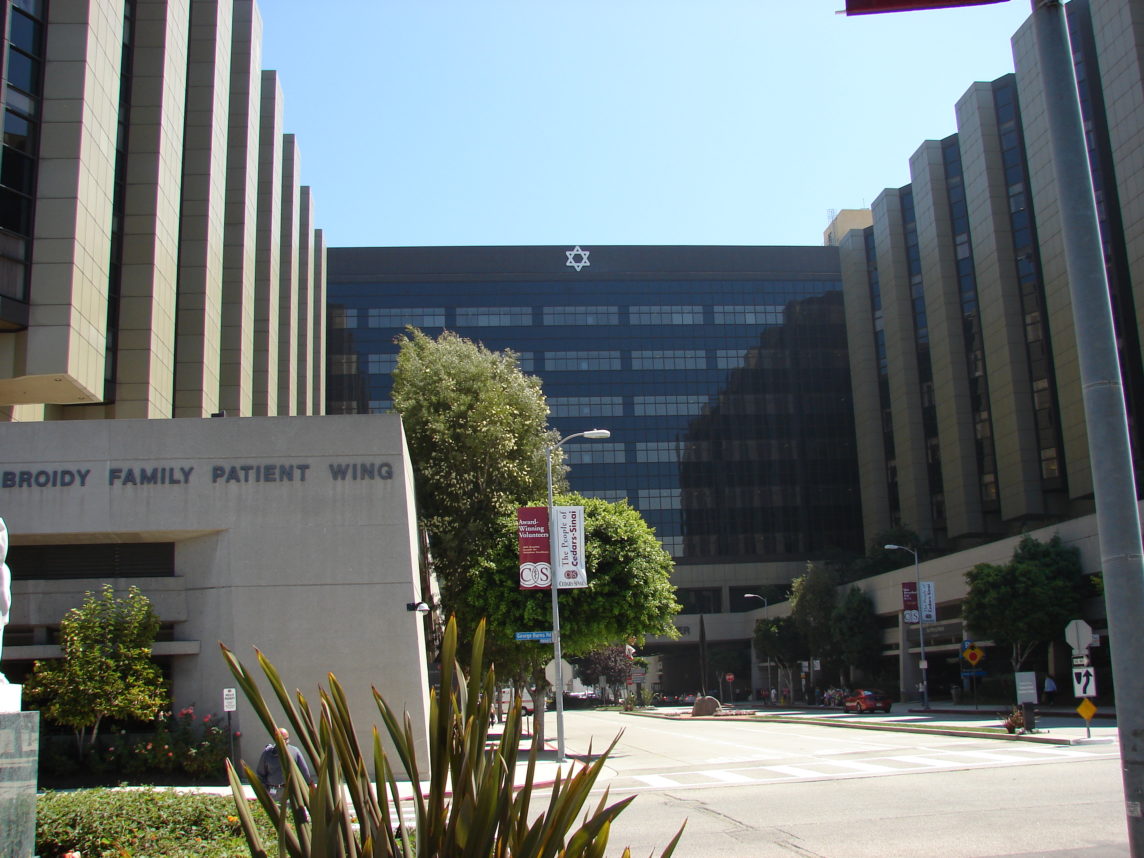
Cedars-Sinai Medical Center once dutifully held a holiday concert. The annual show, put on in a small auditorium on the periphery of the medical campus, contained discreet references to Christmas with a couple mentions of Hanukkah. But the bulk of the program centered around songs of sleigh rides, snowfalls and winter frivolity.

Then, several years ago, we decided to scrap the holiday program in favor of the annual Cedars-Sinai Christmas Concert. The idea was to bring greater meaning to an event with important religious underpinnings for so many who work and spend time at the hospital.

These concerts typically open with a Christian prayer led by one of our staff chaplains. Carolers wearing Santa hats sing Yuletide favorites like “O Come All Ye Faithful” and “O Holy Night.”

The event now is held in the medical center’s main auditorium, which also features a 12-foot-high mural honoring Jewish pioneers in medicine. It features a reading from the Gospel of Luke or another book from the New Testament about the origins of Christmas amid murals depicting Maimonides, Sigmund Freud and other great Jewish scholars.

I’m often asked: Why would a Jewish hospital stage a Christmas concert? My answer is easy: For the same reason it celebrates Diwali, the Hindu festival of lights and holds a nightly iftar break-fast during Ramadan. (We also gather during Hanukkah for a candle-lighting ceremony and mark other Jewish holidays, but this is hardly news to most.)

Honoring other faith traditions is an integral part of what it means to be a Jewish hospital. More than a century ago, Jewish hospitals were established primarily because most of their American counterparts refused to hire Jewish doctors or treat Jewish patients with dignity and respect — or at all, for that matter. These Jewish institutions were never intended to be exclusively Jewish. They were meant to be open to everyone.

As a Jewish hospital, we have a special obligation to be attuned to what it feels like to be alienated, separated or excluded.

We have a special obligation to be attuned to what it feels like to be alienated, separated or excluded.

When our original holiday concert was organized, it was done with the best of intentions. Even in name, the point was to avoid offending anyone or appearing to be exclusionary. However, it unwittingly became a mishmash, a watered-down version of its true inspiration.

We all knew it was a Christmas concert. Why not treat it like one?

Rabbi Joseph B. Soloveitchik, one of the 20th century’s most influential Orthodox figures, once wrote that there can be no identity without uniqueness. To preserve this distinctiveness, he argued, each group must be allowed to flourish on its own and in its own context.

We are charged in our daily work at Cedars-Sinai with healing the sick, comforting the dying and providing the best possible medical care for all. In this, we are unified. But in our religious and spiritual beliefs, we want people to express themselves in ways that are most meaningful and genuine to themselves.

I do play one small part in the annual Christmas concert, and it is one that I always look forward to. Toward the end of the hourlong lunchtime program, I go up to the podium — not only as a rabbi but in my role as administrator of the Spiritual Care Department. I thank our department for organizing another wonderful show and recognize the performers and support crew who set the stage, the lights and the decorations, which create such a festive mood. I thank the overflow crowd for attending.

And then I say something that may surprise people, and even sometimes draws a laugh, because it’s coming from a bearded man in a yarmulke. These parting words are meant to convey my respect for the Christian observance and honor the faithful who are celebrating.

I say simply, “Merry Christmas!”


Rabbi Jason Weiner is senior rabbi and manager of the Spiritual Care Department at Cedars-Sinai.

Why a Jewish Hospital Has a Christmas Concert Read More »

The December Dilemma Revisited

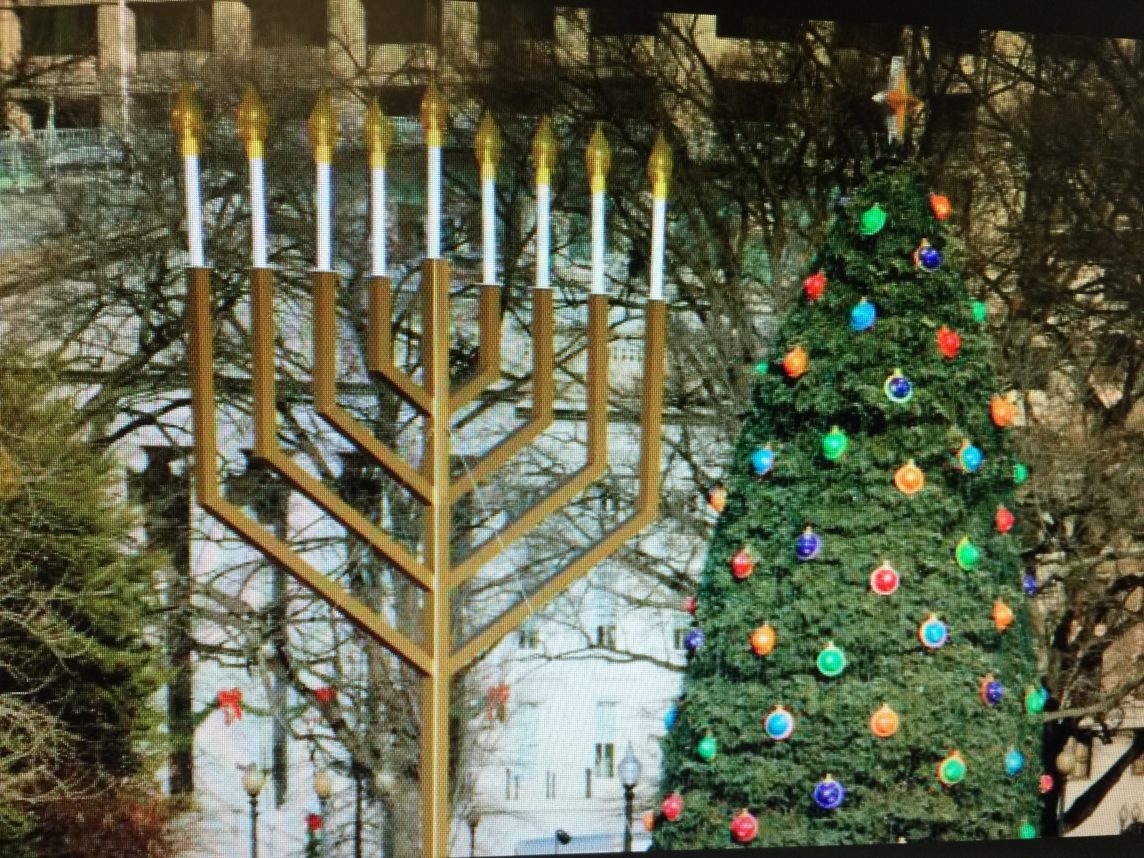
Every year I’m asked what I think about Jews bringing Christmas trees into their homes. For Jews, my answer is simple – it’s inappropriate. But, when a Jew is married or living with a Christian, it isn’t an unreasonable request, as emotionally difficult as it may be, for the Jew to accept having a Christmas tree in the home. After all, for the Christian partner, the tree is a tactile and joyous symbol of the season, the coming together of family, and for more than 50% of American Christians (according to recent polls) the Christmas tree is representative of a deeply held religious belief in Jesus as the Christ Messiah.

For so many Jews, the thought of bringing a Christmas tree into the house feels like a betrayal against the Jewish people, Jewish tradition, Jewish history, and one’s own Jewish identity. Not only this. For Jewish couples to have a Christmas tree in their homes, unwittingly perhaps, is disrespectful of the sacred symbols of Christianity.

Though many regard the Christmas season in America as a secular celebration, the Christmas tree is far more than a secular sign of the season. According to many Christian religious authorities the tree represents the cross upon which Jesus was executed. The crowning star recalls the star over Bethlehem on the eve of the Christian savior’s birth. The tinsel represents angel hair. The bulbs recall the apple on the tree of knowledge and the Christian dogma of “original sin.” The holly wreath symbolizes the crown of thorns worn by Jesus as he carried the cross, and the berries are drops of blood symbolizing the Christian Messiah’s vicarious suffering for the sins of humanity.

For Jews to appropriate cavalierly the sacred symbols of another faith tradition for our own use and purposes is a profound act of disrespect.

All this being said, I confess that there’s something magical about this time of year. I personally love Christmas carols. I enjoy the smell of pine and the beauty of the tree decorated in my Christian friends’ homes. I appreciate it all and I value the deeper religious meaning of these symbols for Christians. But as Dr. Ron Wolfson of the American Jewish University has written, it is one thing for a Jew to “appreciate” Christmas and it is quite another for a Jew to “appropriate” Christmas as it is not ours to appropriate.

A good rule of thumb for Jews when questioning whether we should use a symbol is to ask if that symbol would be appropriate to place in a synagogue lobby.

“Of course not!” most of us would say. “After all – the synagogue is a Jewish house of worship, a place of study and assembly!”

Jewish tradition teaches that not only is the synagogue a holy place, but so too is the home which is called a mik’dash m’at (a small sanctuary). Therefore, what is observed at home ought not to conflict with what is observed in the synagogue.

I once suggested to an interfaith couple that was arguing vehemently about having a Christmas tree in their living room that the Jewish partner might consider creating a “fiction” whereby he would consider the corner of the house in which the tree is placed to be temporarily not part of his home. He’d be a “visitor” there and after the holiday, when the tree is removed, he could reclaim that space as part of his home. That bout of mental gymnastics worked for him, and I’ve suggested it to others as well.

What about the children of interfaith marriages? Can they be raised in both traditions, as so many couples claim to be doing?

I believe it’s a mistake to think that children can be raised in two different religious traditions. Not only is such an effort lacking in integrity, it’s confusing to children.

Judaism and Christianity fundamentally hold different religious world-views, theologies, beliefs, customs, rites, rituals, practices, histories, and traditions. One cannot be “half-Jewish” and “half-Christian.” One is either Jewish or Christian.

For parents of children who believe that during the Christmas season it’s easier to acquiesce to their children’s desires for Christmas in their own home, I have two responses. First, Judaism provides many ongoing opportunities for celebration including Shabbat every week, the holidays, festivals, and life-cycle events. And second, parents often say “no” to their children, whether it be “no” to more toys, television and social media time, high fat foods, and staying up late. Why should it be any different when it comes to having a Christmas tree in a Jewish home?

Parents need to be able to explain that Christmas does not belong to Jews. It isn’t our holiday. It’s certainly appropriate and even enriching for children to visit the homes of their Christian friends and relatives during this season and enjoy the holiday there, but they need to understand that Christmas does not belong in a Jewish home. Giving this clear message to our children is important for as we do so we are teaching them that we Jews have self-respect and that we respect others as well.

The December Dilemma Revisited Read More »