Week of November 23, 2017
Week of November 23, 2017 Read More »

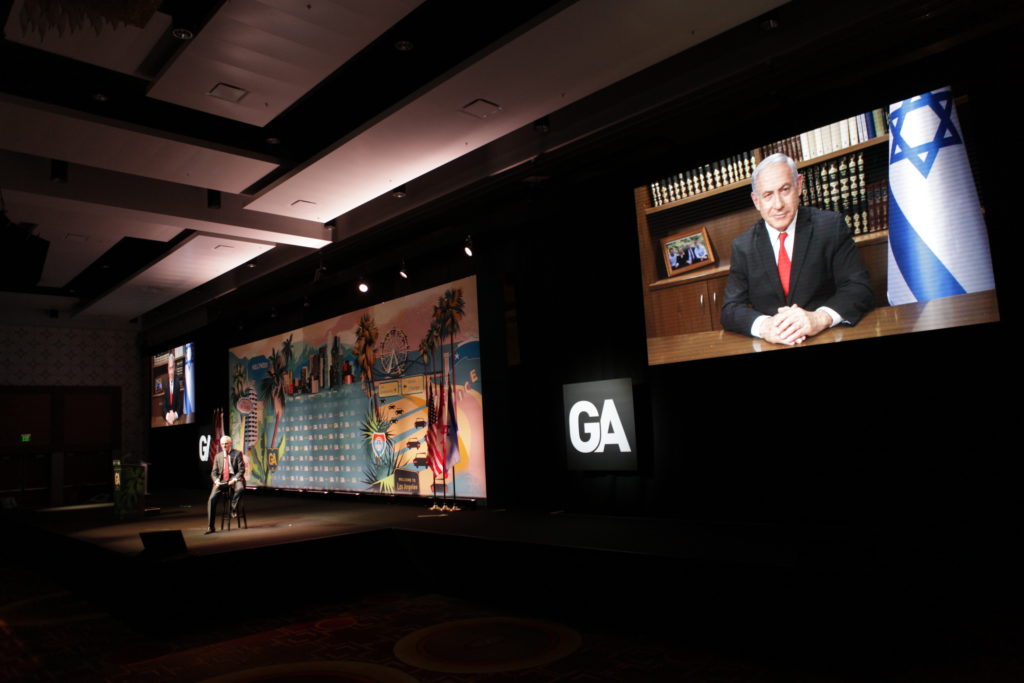
Israel Prime Minister Benjamin discussed the controversial decision of the Israeli government to freeze the implementation of the Western Wall agreement; President Donald Trump’s decision to decertify the Iranian nuclear deal, which Israel was opposed to when it was authorized during the Obama administration; Israel’s improved relationships with its Middle Eastern neighbors and more during the final day of the Jewish Federations of North America’s 2017 General Assembly.
JFNA Chair Richard Sandler conducted the interview with Netanyahu, who appeared from Israel via satellite, on Nov. 14. The GA was held at the JW Marriott hotel at L.A. Live in downtown Los Angeles.
More than 3,000 people attended.
Here is a transcript of the interview, or you can watch the interview here. The section with Netanyahu begins at the 1:17:47 mark.
Richard Sandler (RS): Mr. Prime Minister, in January of 2016 much of our audience here today celebrated the resolution the government passed regarding the pluralistic prayer space at the Kotel. And then as we know last June the government froze the implementation. Yesterday at the GA we passed a resolution requesting the Kotel resolution be implemented. So can you please share with us the present status of the resolution and what do we tell those in our community who feel that as Reform or Conservative Jews they may not be fully welcome in Israel?
Benjamin Netanyahu (BN): First of all, you are fully welcome. Israel is the home of all Jews and it must remain so. I took on the issue of prayer arrangements at the Western Wall because I strongly believe all Jews, without exception, should feel at home in Israel.
Now, Richard, you know very well I didn’t have to deal with this; I could have left it to the courts, to the Knesset, but it is vitally important to me, personally. What the government froze in June are only the most ideologically-charged elements of the Western Wall plan. They were holding up the practical elements hostage.
So as many of you know there has been a pluralistic prayer space in the Western Wall, in the Kotel, for almost 20 years. The 2016 decision wasn’t to create prayer space; it was to improve the existing space. We are moving forward with construction to do just that, and I hope, and I am working to make sure that this happens, that you will see the improved prayer space before the next GA [in Tel-Aviv in 2018]. I am working to move forward on solutions for other issues as well.
Here is the thing that guides me—this is true from the time of Ben-Gurion, who as Israel’s first prime minster was faced with this dilemma, how to deal with the conflicting views of religion and the state, and what he articulated then is something that basically all prime ministers have done and I have done as well—you remember also with the issue of conversion, this is this principal: religious status quo issues have always been resolved as the result of evolution, and not revolution.
So, despite the disagreements, despite I have to say a lot of distortions and despite the at-times disparaging remarks about me and my government, I remain committed to moving forward. I believe that the Jewish people are all one family. I believe that Israel is the home of all Jews and that all Jews should have access and prayer in the Kotel.
RS: Now that President Trump has decertified the JCPOA [Joint Comprehensive Plan of Action] what is in Israel’s best interest and what would we like to see happen next?
BN: Well, for me the bottom line hasn’t changed, Richard. We must ensure that Iran never gets a nuclear weapon. The JCPOA, the Iran nuclear deal, doesn’t achieve that. On the contrary after about a decade it will leave Iran able to produce hundreds of nuclear weapons in a very short time because the deal rescinds all limitations on Iran’s enrichment capacity. They can have hundreds of thousands of centrifuges, and they plan to.
I want to thank President Trump and his administration for the current American Iran policy. I also want to thank Ambassador Haley for the strong support given for Israel at the U.N.
What President Trump has done is create an opportunity to address the deal’s flaws and in my view I don’t particularly care about the deal. I don’t care if you keep it or you remove it. But you have to correct it either by fixing it or nixing it.
I’ve been speaking to world leaders around the world actually, and I’ve encouraged them to take advantage of this opportunity. Now the question is why is Iran so dangerous? It’s dangerous because of its fanatical ideology of global conquest, its growing power, its unflagging commitment to destroy Israel, its unvarnished aggression.
Iran has already spread bloody conflict across the Middle East – in Yemen; Iraq; in Syria; in Lebanon – and we are far from alone in recognizing the Iranian threat to the Middle East. I believe that the leading Arab countries—Saudi Arabia; the Emirates; many of our Arab neighbors—see things exactly as we do, and I think they’re right.
Now Iran is scheming to entrench itself military in Syria. They want to create a permanent air, land and sea military presence with a declared intent of using Syria as a base from which to destroy Israel. We’re not going to agree to that. I’ve said very clearly: Israel will work to stop this, and we must all work together to stop Iran’s aggression, its worldwide campaign of terror and its pursuit of nuclear weapons.
I think if we stand together we are going to achieve it, but I’ve always said if we have to we will stand alone. Iran will not get nuclear weapons. It will not turn Syria into a military base against us.
RS: I read recently in U.S. News and World Report where Israel was ranked the eighth most powerful country in the world. And thinking about the 70 years of all the pressures and all the distractions Israel has been put under, how do you do it?
BN: It begins with a simple reality that we understand. In our area, and it’s a very, very tough neighborhood, the weak don’t survive. The strong survive. We look around us and see entire nations being wiped out. People massacred tragically. So you have to be strong, and there are basically three powers that we are all the time nurturing. The first power, you would be surprised, you’d think it is military power and it is, but it is very expensive. We nurture the Israeli army, we’re very grateful for the support, the continued support of the United States, and I am very happy I signed with President Obama the MOU for 10-year support for Israel, $38 billion, it helps, but believe me 85-percent of our budget, our military budget, has to come from Israel. And where do you get that? Well you get it from a strong economy, that’s the other power we’re developing.
And, you know, there is a great genius in our people but for too long it was shackled, it was really not allowed to burst out because we had a very controlled economy. So I’ve been working very hard over the past 20 years to liberate, liberalize our economy and it has produce a tremendous economic success.
Now you take our military and intelligence prowess, which all nations need. Our intelligence, because Israel has stopped dozens and dozens of terrorist attacks, in dozens and dozens of countries. We share that intelligence with our friends and with many countries that are not our friends but we want to stop attacks like Barcelona or Paris or the other horrors that you see, and we have. So nations want to partner with us, for intelligence or for technology. They want more milk for the cows; guess which country has the most milk per cow? It’s an Israeli cow, you know that.
Or they want solar energy. Or they want clean water. Or they want cherry tomatoes — it’s ours too. Anything you can imagine. Autonomous vehicles. Israel has this dual prowess of technology and security and we combine that to get an unprecedented diplomatic flourish. We now have diplomatic power because many countries, many, many countries around the world, are coming to Israel, in fact some of them are standing in line – I was in Africa, twice in a year, I was in Latin America. It’s unbelievable. Can you imagine? I am the first Israeli Prime Minister to have visited a country south of the United States in the western hemisphere in 70 years. It is a tremendous change. And by the way, Mexico should be congratulated. Mexico has just decided to vote against 10 anti-Israel resolutions in the U.N., and I think they deserve your applause.
So these three powers – our economic power, our military power, our diplomatic power – give Israel great presence and great capacity to defend ourselves but they all rest on one other power – our spiritual power. Our strength as a fighter of democracy, as a society anchored in our heritage but always seeking the future, our strength is what creates greatest chances for peace, because you don’t make peace with the weak; you make peace with the strong and the threat of Iran has done one good thing: It’s brought us closer than ever to our neighbors, creating new opportunities for peace and I think you will be hearing more about that in the future.
RS: That’s a perfect segue to my last question. As you think about Israel today, what makes you the most proud?
BN: I’m most proud of the rebirth of the Jewish people through the rebirth of Jewish sovereignty. Remember that for thousands of years Jews wandered around the globe. We were homeless, we were voiceless, we were defenseless, and today the Jewish people have returned to our ancestral homeland, and today Israel is capable of defending itself, by itself, against any threat. Today we have a voice and we need to raise that voice,
I’m also proud Israel is an open society, a free society, an island of liberal democracy in a sea of terror. We have free speech, a free press, minority LGBT rights, everything, we have an Arab Supreme Court Justice, a Druze minister who I appointed in my government; female generals; gay members of Knesset. This is what a vibrant and diverse society looks like. I’m proud we have created an open economy that as I told you before has unleashed the ingenuity of our people, our capacity for innovation; I’m proud that Israel has helped thousands of Syrian civilians injured in the war.
Now I just saw the pictures of the destruction in Iran and Iraq following this week’s earthquake. I saw these heartbreaking images of men, women and children buried under the rubble. I’m proud to announce tonight that a few hours ago I directed that we offer the Red Cross medical assistance for the Iraqi and Iranian victims of this disaster. Now you heard me right. We have no quarrel with the people of Iran. Our quarrel is only with the tyrannical regime that holds them hostage and threatens our destruction. But our humanity is greater than their hatred. Israel continues to be a light unto the nations. This is what I am proud of, and all of you can be proud of, of Israel’s morals and Israel’s might.
Israeli Prime Minister Benjamin Netanyahu discusses Western Wall, Iran and more Read More »
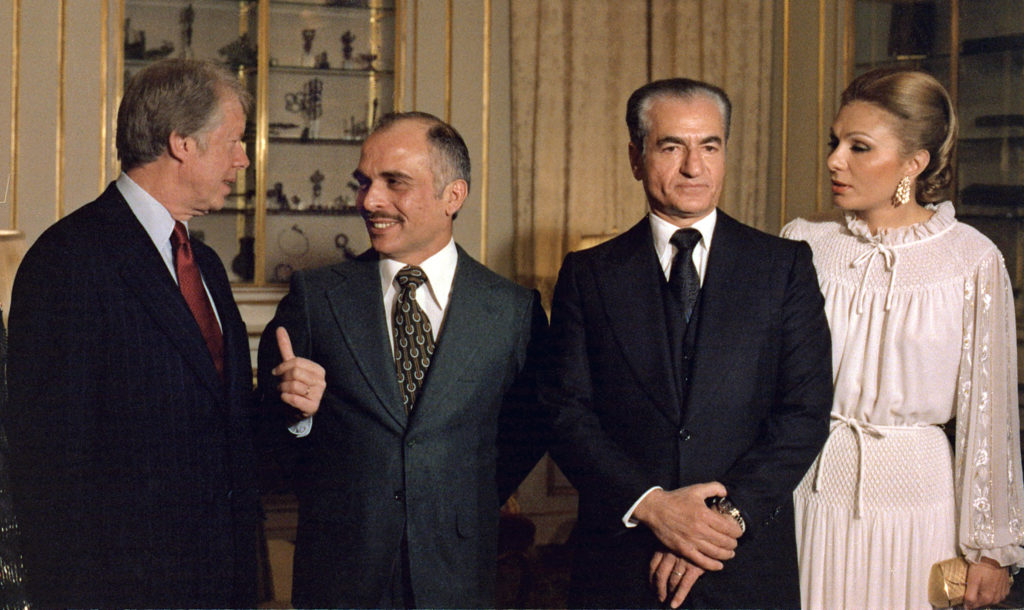
The death of the Shah of Iran, Mohammad Reza Pahlavi, in 1980 had profound consequences in shaping the Middle East today, yet there was some mystery surrounding the circumstances of his death. A new film is being released that explains how the declining health of the Shah led to his departure and death, and that it could have been avoided had the Shah received proper treatment.
The documentary “A Dying King,” which was written and directed by Bobak Kalhor, consists of interviews from the many doctors treating the Shah who explained that he had been living with cancer for six years prior to the Iranian revolution. The Shah suffered from a rare type of leukemia known as chronic lymphocytic leukemia, which was diagnosed by French doctors only after the Shah noticed a lump in his spleen while water skiing.
Due to the Shah’s paranoia of his people viewing him as weak, only a handful of people knew he was dealing with cancer; even his family didn’t know. But the Shah’s declining health from the cancer inhibited his ability to lead the country, and was a driving factor behind his decision to leave Iran when the revolution was brewing.
The Shah bounced around various countries, including Mexico, Morocco, the Bahamas the United States and Egypt. His health deteriorated to the point where his cancer had turned into a more severe form of lymphoma, and eventually his spleen had to be removed. But, according to the documentary, the surgeon who removed the Shah’s spleen accidentally snipped off part of his pancreas because the spleen was never drained, causing an infection. He eventually succumbed to his ailments in July 1980.
“A Dying King” suggests that the Shah could have prevailed from his illness had the doctors properly treated him and had his presence in different countries not become such a major issue. For instance, Iran demanded that the U.S., which was treating the Shah in New York at the time, extradite the Shah back to Iran in exchange for the hostages that had been taken in the American embassy. The Shah was sent to another country instead.
“A Dying King” adds an additional piece to the puzzle of how the Shah lost his throne in Iran, an event that reverberates to this day.
Review: ‘A Dying King’ Reveals the Medical Circumstances That Led to the Shah’s Death Read More »

Israel’s Supreme Court is the most powerful court in the free world. Its supporters say that it looks out for the little guy, but the court’s rulings belie this argument. The court has seized legislative and executive powers to advance two agendas: populism and post-Zionism.
On the populist side, the court in August abrogated a law levying a new tax on owners of more than two apartments. For taxpayers shouldering one of the highest tax burdens in the world, the popularity of the court’s move is self-evident. But popularity isn’t a legal argument, and indeed, the justices gave no legal grounds for their ruling.
The justices asserted that the law must be overturned because, in their view, lawmakers didn’t deliberate it sufficiently before it passed the first of three readings required to be made into law. Through their ruling, the justices arrogated the right to strike down any law. Who can argue with the inherently debatable allegation that a bill wasn’t deliberated sufficiently?
Supporters of the court assert that its judgments are geared toward ensuring that all citizens and noncitizen petitioners receive equal treatment. But again, court rulings contradict this notion.
For instance, in 2002, the court overturned the so-called Arutz 7 law. The law regulated the operation of private radio stations and gave a license to Arutz 7, a popular religious Zionist station that had been broadcasting illegally.
The court struck down the law, finding that it harmed the principle of equality. According to the justices, because someone else in the future might want to broadcast on Arutz 7’s frequencies, the station couldn’t use them in 2002.
Far from ensuring equality, the court’s ruling was deliberately prejudicial. It denied broadcast rights to a specific minority group that was underrepresented in the radio industry because the group — the religious Zionist sector — is despised by the justices.
In subsequent rulings, the court has cultivated inequality in the name of “equality.” It has provided extra-legal rights to Israeli Arabs and Palestinians while denying civil rights to religious Zionists, ultra-Orthodox Israelis, working-class Israeli Jews and Israeli Jewish farmers. It has struck down manifestly legal government policies in spheres as diverse as annual budgets and national security.
For instance, the court has issued a series of rulings that prevent the government from destroying buildings built illegally on state lands by Bedouins while ordering the destruction of Israeli-Jewish homes and communities in Judea and Samaria without receiving proof the land was settled illegally.
Despite the government’s legal right to order the destruction of the homes of terrorists, the court has issued injunction after injunction to stall and limit the government’s use of its power, to the point of diminishing the effectiveness of this key counterterrorism tool.
To the detriment of working-class Israelis, the court seized the power of the government and Knesset to determine immigration policies. Working-class Israelis in south Tel Aviv have seen their neighborhoods transformed into crime-plagued no-go zones by illegal immigrants from Eritrea and Sudan. Every law the Knesset has passed and policy the government has approved to lawfully remove the illegal immigrants has been abrogated by the court.
Far from ensuring equality, the court’s ruling was deliberately prejudicial.
The premise that the court’s actions protect the country from the “tyranny of the majority” is manifestly absurd. Under Israel’s multiparty system, there is no way for such a majority to ever form.
The court has exploited this state of affairs. It has seized tyrannical powers with the full knowledge that a divided government is hard-pressed to limit its actions.
It is hard to know how long this judicial tyranny will expand unchecked. Last month, the court’s recently installed Esther Hayut (sworn in Oct. 26) intimated that her goal as chief justice is formally to empower justices to issue rulings without even paying lip service to laws.
But the political will to rein in the court is building. Support for the court is now a political liability for major and minor parties alike as sector after sector in Israeli society sees its rights to security, property and equality trampled by the court.
Caroline Glick has a master’s in public policy from Harvard. Her stories have been published in The Jerusalem Post and other publications.
The Supreme Court Needs Urgent Reform Read More »

Israel’s Supreme Court is a problematic institution whose problem begins with denial: It denies the obvious fact that many of its decisions are ideologically driven. That is, the background, beliefs and emotions of the justices play a significant role in their rulings.
In late October, for example, the court ruled that the Tel Aviv municipality can keep mini markets open on Shabbat. Expectedly, the ruling was hailed by secular liberal leaders and derided by conservative religious leaders. Was it the right decision? The case is complicated. Was it ideologically driven? Consider the following fact: Five justices supported the decision — all secular; two justices were in the minority opposition to the ruling — the two religious justices on the court.
Israel’s Supreme Court is a strange breed. It functions as a professional court of appeals and as an arbiter of highly politicized motions against the government. It often is called upon to decide what the political class can and cannot do — even though Israel has no full constitution on which to rely in making such assessments.
The court displays, in some cases, interventionist tendencies. It is suspected, in some cases, of having ideological tendencies. And it is guided less by a clear law, and more by a vaguer set of values. If one wants to make a case against the court, one has a long list of dubious decisions on which to rely.
The question remains: Why make a case against the court?
It is not even clear that the government has an interest in changing the court.
Every country has many institutions, and in most countries, not one of them is free of deficiencies. Still, priorities must be applied as a country goes about improving its institutions. The urgent comes before the not urgent. The highly corrupt comes before the slightly inefficient.
The main problem with the many Israelis, most of them in conservative circles, who complain about the Supreme Court is not that they don’t have a case. They do have a case. The problem is that they make it seem as if the Supreme Court is Israel’s most pressing problem or close to being that. And it is not.
The court’s ideological bent should be gradually and methodically corrected by the appointment of a more ideologically balanced cast of justices. But such a process takes time and patience, and the court’s opponents have neither: They want change now, and refuse to acknowledge an obvious fact. When change in the court is made rapidly, and when attacks on the court become a bad habit of the government, the court loses legitimacy. And for a country to have a court without legitimacy is more dangerous than to have a court with a slight ideological bent.
In fact, it is not even clear that the government has an interest in changing the court. More often it seems to want the court to remain as it is and serve as a scapegoat on which to blame the government’s impotence. If the government truly wants all stores to be closed on Shabbat, it can put in place the legislation that will make it mandatory. However, this will be a tough political maneuver — a maneuver and result that the public doesn’t appreciate. It is much easier for the government to refrain from making tough decisions, and blame the court for the result.
This is what happened in many of the other cases that the court was forced — by an inept political machine — to decide. Last summer, the court repealed a tax on the owners of more than two apartments. The politicians who made the decision to levy this tax were furious, but the court said nothing about their right to legislate; it said only that legislation must follow a certain process, and that the Knesset did not follow the proper process — it rushed the legislation in an unlawful way.
You want proof that the court was correct in making this judgment? That’s easy: After the ruling, the government never attempted to re-pass the law. Apparently, when it must play by the rules, it doesn’t have the vote to support the legislation.
So yes, the court occasionally is problematic. But the court is hardly Israel’s most pressing problem. There is a much stronger case to be made against the ineptitude of its political class.
Shmuel Rosner is senior political editor. For more analysis of Israeli and international politics, visit Rosner’s Domain at jewishjournal.com/rosnersdomain.
The Supreme Court Is Not a Pressing Problem Read More »

I sometimes joke that if there’s anything I’ve learned in three years at UCLA, it’s how to spell “privilege” without spell-check.
In the age of identity politics, the concept of group-based privilege frames nearly every political discussion on college campuses, from debates on immigration to the Boycott, Divestment and Sanctions movement.
The idea is that nearly all of us benefit from some combination of unearned, identity-based advantages embedded in American socio-historical structures. People must “check their privilege,” or adjust their everyday behavior accordingly, by trying to dismantle the structures that give their identity groups a leg up.
This shift in political language poses crucial questions for Jewish students: Do Jews have privilege in America, despite persistent anti-Semitism? If so, what are we doing with that privilege?
Our answers could determine whether we are included within progressive campus circles, which generally regard checking one’s privilege as a signal of solidarity with other marginalized students.
The question of whether Jews have white privilege surfaced in June, when light-skinned Israeli actress Gal Gadot starred in the film “Wonder Woman,” and again in early August when white supremacists chanted anti-Semitic slurs at a far-right rally in Charlottesville, Va.
In his Jewish Journal column about Gadot’s casting, Shmuel Rosner asked, in perhaps one of the most pronounced examples of the generational gap in Jewish priorities, “Who cares if Gadot is white?”
The answer to that question is, of course, college students — including the Jewish ones who reject the very pretense of the progressive expectation that we recognize our privilege. These students claim it’s an insult to say Jews benefit from white privilege in this country when anti-Semitism has often relegated us to otherness.
In 2014, Tal Fortgang, a Jewish freshman at Princeton, appeared on Fox News regarding an article he wrote, “Checking My Privilege,” in his campus conservative magazine. Fortgang argued that accusations of white privilege erased the reality of anti-Semitic oppression his Jewish ancestors faced in Nazi Germany.
“Perhaps it was the privilege my great-grandmother and those five great-aunts and uncles I never knew had of being shot into an open grave outside their hometown,” Fortgang wrote. “Maybe that’s my privilege.”
Other Jewish students feel the burden of Jewish privilege on their shoulders — even more so when it goes unrecognized by the larger community. Prior to this year’s AIPAC Policy Conference, UCLA student leader Rafael Sands penned an op-ed to the Jewish Journal called, “Why I’m Skipping AIPAC This Year.”
Sands explained the moral conflict he felt as an American Jew: Yes, Jews face anti-Semitism, sometimes subtly and other times hideously, but Jews also have come a long way — succeeding at getting our foot in the door of American politics (AIPAC’s magnitude a case in point) and, by extension, American privilege.
We must consider the need to reckon with the Jewish place in the narrative of American white privilege.
Inviting Donald Trump and Mike Pence to speak at AIPAC represented American Jewish complicity in the administration’s ban on Muslim immigration, animosity toward undocumented people and hostility to reproductive choice, Sands wrote.
I hope my non-Jewish peers agree that it was refreshing to hear such remarks from a Jewish UCLA leader. The work of justice requires, before anything else, that we address our flaws.
This is not to say there isn’t a serious need for progressives to grant more legitimacy to claims of anti-Semitism, which sometimes seem to get thrust outside the circle of real oppressions. We should never have to choose between condemning anti-Semitism and supporting social justice movements.
In our own community, though, we must consider the need to reckon with the Jewish place in the narrative of American white privilege, the reality that some Jewish people and institutions have been reluctant to do so, and a progressive alliance that’s not going to wait for us while we figure all of this out.
If Jewish students want to be true partners to our progressive peers, it is our responsibility to check our privilege — even if, at times, we’re unsure what we will find.
Gabriella Kamran is a third-year communications and gender studies student at UCLA.
Are Jewish College Students Privileged? Read More »

Yose ben Yochanan of Jerusalem said: “Let your house be wide open to guests. Treat the poor as members of your household, and do not indulge excessively in conversation with the woman.”
This was said concerning one’s own wife: How much more so does it apply to the wife of another. Hence, the Sages have declared: “Anyone who indulges excessively in conversation with a woman causes evil to himself, neglects the study of Torah, and ultimately will inherit Hell.”
Avot 1:5
Oy.
I’ve been teaching Pirkei Avot (Ethics of the Fathers) to UCLA law students and undergraduates for several years now, and this Mishnah invariably makes my life difficult. “Don’t talk too much to a woman”!?
This is Jewish wisdom?
Well, yes, it is. But in ways that we might not initially recognize. And it tells us how great Jewish texts can challenge our assumptions about language, God and how we live our lives.
One could, of course, simply take the view that the text means what it says and says what it means. That seems to be the response of the ultra-Orthodox, who have decided that women cannot be heard from or seen, or even sat next to. They get unexpected support from many modern quarters.
The great scholar Jacob Neusner observes that traditional Judaism was sexist, and, so, from this Mishnah we should simply “sadly walk away.”
Reform Rabbi Kerry Olitzky notes that “however we understand the phrase … we modern Jews reject the premise entirely.”
William Berkson’s JPS commentary takes a similar tack, referring to the passage as “narrow-minded” and “wrong-headed.”
Such views are themselves, however, somewhat narrow-minded. In Judaism, the text virtually never means what it says and says what it means. Instead, we need to look more closely.
Here, our first model should be the great Modern Orthodox Rabbi Samson Raphael Hirsch (1808-1888), who focused on the precise Hebrew word translated as “conversation.” That word is sicha, and Hirsch noted accurately that it does not mean serious conversation (that would be diyyun) but rather “merely idle talk and gossip.” This interpretation flips the entire Mishnah on its head: Rather than saying that men should ostracize women from important matters, the passage actually suggests that men and women should not separate themselves when it comes to serious conversation. The interpretive process can generate an egalitarian result.
We need not stop there. Whenever we see an injunction such as is found in Avot 1:5, we can’t assume that it always applies. Under what circumstances and contexts? The great 13th-century Rabbi Yonah Gerondi argued that the whole passage was simply referring to a menstruant woman and thus the laws of family purity: In the same way that the Torah refers to sexual relations as “knowing” a woman, all that “talking” means here is sex during her period, which is forbidden. These laws also raise important issues concerning gender equality, which I hope to deal with in a subsequent column, but it is a far cry from banishing women from the public sphere or intellectual life. Hirsch ingeniously placed the line in the context of the mistress of the household preparing to open it for scholars and the poor, referred to in the beginning of the passage; in other words, it means don’t bother your wife with frivolities when she is trying to engage in a mitzvah. Here, too, context truly changes meaning.
This mode of interpretation is crucial to understanding sex and text: Simply because a passage appears to establish or reinforce gender hierarchy does not mean that it does. It might be limited to particular situations and contexts, and not subordinate women at all. And more importantly, our tradition encourages such a way of reading.
But why bother with all this? If we have to reject the text’s plain meaning to reach an acceptable result, isn’t it just a waste of time? Not at all. The act of interpretation is itself one of the fundamental practices of what it means to be Jewish. Wrestling with God means wrestling with text. It allows us to engage in a conversation across generations, across literally thousands of years, enabling our voices to ring through time. That’s about as far as possible from wasting time.
In Judaism, the text virtually never means what it says and says what it means.
More importantly, though, it forces us to grapple with an even more challenging meaning of Pirkei Avot’s words. The Mishnah is not establishing gender hierarchies, but rather warning us of sexual danger. “Don’t talk too much to a woman” is about passion, not inequality. Here again, a 19th-century Orthodox writer, Rabbi Marcus Lehmann, grasped a core principle of the Mishnah.
“Man’s strongest passion,” Lehmann noted, “is sexual desire. Even though this emotion is God-given for the preservation of humanity, its effect can also be destructive if it arouses man to lose his self-control and incites him to transgress Divine laws. … wild passion breaks through all barriers; the soundest principles yield to it.”
Although the recent sexual harassment scandals implicate the abuse of power far more than sexual desire, Lehmann’s admonition reminds us that sex and danger are intimately linked.
Sexual freedom has brought tremendous good to men and women, LGBTQ and straight, throughout the world, but it also brought enormous costs. For example, you don’t have to be a prude to recognize that out-of-wedlock births harm children’s chances for success in life, and such births skyrocketed after social norms concerning sexuality liberalized in the 1960s. Similarly, you don’t have to be a Buddhist to recognize that desire can cause suffering. Love is wonderful. Unrequited love is devastating. Jealousy, bitterness and resentment all come from desire, and they all corrode the human spirit. The rabbis identified the Evil Inclination with sexuality for precisely this reason.
That does not mean that we should sweep sexuality under the rug (or back into the closet), and lead repressed lives. But it forces us to scrutinize our own sexual desires unsparingly, and examine aspects of our personalities that we would prefer to ignore. Politically, it forces us to recognize the costs of sexual liberation, even as we advocate for it. These conclusions do not give us a lot of comfort. Nor should they.
If we just rejected the seemingly hierarchical implications of Avot 1:5, we would miss all of this. Wrestling with text is difficult and complicated, but it yields enormous riches. How should we, as individuals and citizens, regulate sexual desire? What will empower us to channel our passions constructively? If we find that sexual expression has harmful social effects, what should we do? Avot demands we confront these questions. For Jews, dodging them is not an option.
Jonathan Zasloff is professor of law at UCLA, where he teaches, among other things, property, international law and Pirkei Avot. He is also a rabbinical ordination candidate at the Alliance for Jewish Renewal.

Eight weeks after Hurricane Maria devastated Puerto Rico, Rabbi Mendel Zarchi, Chabad’s emissary in San Juan still faces a daily challenge: balancing his organization’s needs with those of the community it supports.
“We were fortunate that our electricity came back on just over a week ago,” he said last week in a telephone interview, “but 65 percent of the island’s residents are still without electricity.”
Zarchi, together with employees and volunteers, heads out each day to deliver food, drink and moral support to some of San Juan’s neediest citizens. “We just hope and pray they receive power quickly because it’s a very difficult reality to live” without it, he said.
Many of the areas Zarchi and his workers visit are also still without a phone signal — or even water. “As long as there’s a need out there, we hope to be able to do our part in being a resource for those who are less fortunate,” he said. “When people are in pain, you respond.”
Yet Chabad is facing its own challenges. The hurricane ripped off a large section of the synagogue’s roof, and extensive water damage has affected the sanctuary, the walls, the ceiling and the shul’s electrical outlets.
“When people are in pain, you respond.” — Rabbi Mendel Zarchi
The damage assessment, delayed for weeks, finally came in at $120,000. With a $50,000 deductible that Chabad must meet, along with a $35,000 bill for a generator that provided power over the past two months, Zarchi admitted that Chabad faces a considerable financial challenge. To date, no repairs have been undertaken, but “it’s a process,” he said. “It’s hard to find people to respond and do tasks on a good day.”
Zarchi said his challenge is to devise a budget to cover the repairs, but fundraising efforts have been stymied in the wake of the hurricane.
https://www.facebook.com/JewishJournal/videos/10155632841554713/
“We’re in a great tourist zone but practically every major hotel in the area is closed,” he said. “Weddings and bar and bat mitzvahs at Chabad have been canceled.” These events typically generate considerable income for Chabad, said Zarchi, who said others in Puerto Rico’s Jewish community also are suffering from closures caused by storm damage.
Still, Zarchi remains optimistic. “It’s about surviving the short term — the next six to eight months — until things get better and tourism returns,” he said. “It’s definitely a challenge but we have the belief and the faith we’ll persevere.”
However, he added, “that doesn’t diminish our resolve to go out and help the greater community.” Zarchi said those wishing to support Chabad’s hurricane-relief efforts can donate at chabadpr.com.
Zarchi said he drew strength from the haftarah read on Nov. 4 for parashat Vayeira. It recounts how the prophet Elisha revived the deceased child of the Shunammite woman.
“This woman had faith that she could run to the prophet in the time of her direst need — when her child had already died — and that he would be able to help her,” he said. “To me, the story is about how in dire situations, with our determination and our faith, we can transform reality, make a difference and bring healing to the pain.”
Chabad of Puerto Rico Balances Taking Care of the Needy and Itself Read More »
About three years ago, Leo Wolinsky got a call from a private investigator in Santa Monica who asked if he knew Abraham Wolinsky.
Yes, he replied, Abraham Wolinsky was his father.
“Next thing I know, I’m in touch with Hashava, which I had never heard of,” Wolisnky said in an interview.
Established in 2007 by passage of the Israeli Holocaust Victims Assets Law the previous year, Hashava’s mandate was to gather assets that belonged to European Jews who never made it to Israel’s shores — namely, their bonds, bank deposits and real estate — and distribute them to their rightful heirs. Among the 60,000 assets they collected was a piece of real estate bought by Wolinsky’s great uncle.
But Wolinsky will be among the last to receive a mysterious call from Israel about a surprise inheritance. On Dec. 31, Hashava will shut its doors.
Like many other heirs, Wolinsky was suspicious at first — as were his friends. They warned him, “Watch out, it’s a scam,” he said.
The genealogist who connected the dots to Wolinsky for Hashava, Ayana Kimron, eventually told him that his uncle, a Polish textile manufacturer who perished in the Holocaust, had purchased a property in the Israeli city of Bat Yam in the 1930s, which Wolinsky and his family members now stood to inherit.
Kimron, for her part, said she enjoyed making such calls. “Wonderful job,” she said in an interview. “I wish it continued.”
While heirs still will be able to claim assets after Hashava shuts down at the end of this year, Hashava’s team will no longer actively search them out, said Elinor Kroitoru, Hashava’s head of research. Moreover, claimants will have to produce their own documents proving their inheritance, and there is no statute of limitations, she said.
“The special thing about Hashava is that we did a lot of research for the heirs,” she said. “They didn’t have to come with any documents.”
From the time it was established, Hashava has collected about $600 million worth of assets. It has approved 2,811 applications for restitution, totaling about $205 million in disbursements. Another $285 million worth were liquidated after Hashava determined heirs could not be found, with proceeds given to needy Holocaust survivors or spent on Holocaust commemoration and education.
In September, Hashava announced it had met its targets set out by law and would shut down.
Now, Kroitoru said, “Heirs will have to do a bit more themselves,” and claims will be handled by a small staff working within the Israeli Ministry of Justice, which will hold the remaining assets. “It’s just not worth holding a whole company for the assets that are left. And so it was decided that Hashava would close.”
But for Kimron, the genealogist who was terminated in June, Hashava’s shutdown leaves a chapter of history unresolved. As long as assets remain unclaimed, she said, “for me, personally, the Second World War did not end.”
Kimron said she treasured her job tracking down the heirs of Holocaust victims, especially when she was able to inform non-Jews of their Jewish heritage, and of forging close relationships with heirs, she said.
“Sometimes, I would call a person, like Leo, and talk to them as if I was their cousin — and I knew more about their family than they did,” she said.
This summer, Kimron plans to visit Wolinsky in Los Angeles.
Often, she said, people were suspicious of her. For instance, Wolinsky’s distant cousin in Israel, with whom he and his two sisters will split their inheritance, took some time to convince.
“And not just her — there’s a woman that I chased for a whole year, to convince her to file the request,” she said.
For Wolinsky, Kimron’s call introduced him to a dark chapter in his family’s history that he had never bothered to ask his European-born parents about when he was young and the subject was still fresh in their minds.
“People are not used to having Israelis look for people to pay them.” — Elinor Kroitoru
“As a kid, I didn’t care that much, to be perfectly honest,” Wolinsky said. “Growing up in L.A. in the 1950s, it’s the last thing you care about — these men with long beards in sepia-tone photographs.”
Nonetheless, he said, he was impressed by Kimron’s skill. Through some Yiddish writing on the back of a passport-sized photo, she was able to track down his cousin in Herzliya, whom he never knew existed.
Kimron also learned that Wolinsky’s great uncle, Joseph Volisnky of Lodz, Poland, had acquired a piece of real estate in Bat Yam before perishing in Europe, most likely in Treblinka. The new information excited Wolinsky’s curiosity enough that he eventually traveled to Poland, visiting his father’s hometown of Grodek, near the Belarussian border.
The lot in Bat Yam, he learned, had remained undeveloped as sand dunes all around it were gradually replaced by high-rise buildings. Now, Wolinsky said, it is worth well over $1 million — that is, if he manages to change the title and pay 80 years’ worth of back-taxes.
“I love Israel, but what a bureaucratic country — unbelievable,” he said.
As of Jan. 1, 2018, despite Hashava’s decade-long effort to get the word out, unclaimed assets will likely be locked behind even greater bureaucratic obstacles. Moreover, calls from the forgotten past like the one Wolinsky received will cease.
“It wasn’t easy to get our message out over the years, but we did try our best,” Kroitoru said. “People are not used to having Israelis look for people to pay them. If an Israeli calls them, it’s usually for a donation, not to give money.”
Israeli Organization That Connected Heirs With Assets to Be Shut Down Read More »

With a French father and Lebanese mother, “Fauda” star Laëtitia Eïdo attributes her versatility as an actress to her mixed ethnicity, as well as family religious ties to “the three big religions”: Islam, Christianity and Judaism.
In her breakout role on the Israeli-created Netflix hit, Eïdo plays Shirin, a Palestinian doctor who works in the West Bank and becomes romantically involved with an Israeli special forces officer working undercover as an Arab. During an interview from Paris, Eïdo talked about the ways “Fauda” — which premiered its second season opener this month at the Israel Film Festival in Los Angeles — has resonated across the globe and impacted her own attitude toward the Israeli-Palestinian conflict. You can also catch her in theaters on Nov. 17 as the star of the Israeli film “Holy Air.”
Jewish Journal: I read that you’re French of Lebanese descent. What is your relationship to Israel/Palestine and how did you end up on an Israeli show?
Laëtitia Eïdo: I was born and raised in the south of France in a small area called Ardèche, a very beautiful town next to Lyon. [But] my family is very mixed. Actually, [while working in Israel] I discovered that I have some Lebanese Jewish family that came to Israel in the ’70s. Before that, my relationship to the show was just the relationship of a French actress brought to Israel by her roles. It started with “Dancing Arabs” (“A Borrowed Identity” in the U.S.) by Eran Riklis, and what happened is “Fauda’s” director watched the movie and wanted to work with me. [One day] my mother told me, “By the way, do you know that we have Jewish family?” I was even more mixed than I thought!
JJ: How does your mixed background serve you as an actress?
LE: What I try to be in my life and bring through my work is to be a link between people. My character, Shirin, in “Fauda,” is close to this, because she has a French father and spends more time in Paris than in Palestine. And the fact that she hasn’t spent much time in Palestine or Israel makes her neither on one side or the other. It positions her in this in-between space, which allows her to feel compassion, which is important as a doctor. And it allows her to refuse to be part of the conflict. She’s able to break those imaginary borders between people. This is exactly what I have inherited, being a mix of three religions and mixed cultures.
JJ: What are the biggest misconceptions you think people have about Israel and Palestine?
LE: It’s the same misconception on both sides, because I’ve been on both sides of the border. People are told that they’re different and they should fear the other side. But when it comes to a personal level — not on a political one — families are the same on both sides. They laugh and cry for the same things. And, actually, I really can’t tell where the hummus is the best!
JJ: Israel is controversial subject matter in many parts of the world. Has the reception to “Fauda” been different depending on where you are in the world?
LE: The reception to the show is intense everywhere. Apparently, the show is becoming a big hit in the Middle East — in countries like Lebanon, Qatar and Saudi Arabia. In Israel and Palestine, some people love the show, and others think the show is not balanced enough. But it’s really important to remember the show is a fiction, made of stories based on a much more complex and unreachable reality. As an artist I focus on some positive things, like the fact that since the show was first aired in Israel, some teachers had to open Arabic classes for new students wanting to understand their neighbors.
JJ: On “Fauda,” your character has an affair with an Israeli who pretends to be Arab. Do you think it’s possible an Israeli/Palestinian love affair could occur under the current circumstances?
LE: I can only tell what I see around me. It’s still too rare, but these love stories do exist. They’ve always existed in any conflict in the world, and they will [continue to] exist. More, of course, would be better, because it helps shutting down the fear, as people and families get to know and understand each other through this mixed relationship.
Q&A with Laëtitia Eïdo: Actress Wants Her Work to Be a ‘Link Between People’ Read More »