fbpx

September 28, 2017

Obituaries, Week of Sept. 29

Richard Eget died Aug. 28 at 64. Survived by daughter Sarah (Rafael) Eisenman; sons Adam, Nicola, Nathan; sister Pamela Juhos. Mount Sinai 

Claire Gelman died Sept. 15 at 93. Survived by daughters Hilarie (Gregg) Steele, Sherry (Stephen) Kennedy; son Mitchell Gelman; 6 grandchildren; 1 great-grandchild. Mount Sinai 

Richard Glasband Sr. died Aug. 25 at 75. Survived by wife Jennifer; sons Richard Jr. (Paris), Daniel (Lissette Garcia); William; sister Cheryl. Malinow and Silverman

Lora Goltseva died Aug. 31 at 64. Survived by husband Yevgeniy Bershadskiy. Mount Sinai 

Ben S. Greenberg died Sept. 4 at 92. Survived by daughter Amy Powell; son Jim (Judith Bell); 4 grandchildren. Mount Sinai 

Ann Jacobs died Sept. 13 at 87. Survived by husband Irwin; daughter Marcy (Robert) Hurlbut; son Howard; 5 grandchildren; 3 great-grandchildren. Mount Sinai 

Rhee Kaplan died Sept. 6 at 103. Survived by 6 grandchildren. Mount Sinai 

Adeline Dale Kass died Sept. 3 at 90. Survived by husband Howard; daughters Cheryl (John) Daly, Laurie Anderson; sons Phillip (Nina), Ronald (Louise); 8 grandchildren. Mount Sinai 

Pearl H. Kilbrick died Sept. 3 at 97. Survived by daughters Sherrie Adler, Bunni Evans; 3 grandchildren; 3 great-grandchildren. Mount Sinai 

Rick Leed died Aug. 31 at 62. Survived by husband Joseph Zipkin; daughter Katie Zipkin-Leed; son David Zipkin-Leed; sister
Patrice Tilson; brother Jonathan. Malinow and Silverman

Donald Lewis Levine died Sept. 1 at 80. Survived by wife Sharon; daughters Stacey (Leoward) Perlman, Peri Ellen (Fred) Berne; son Robert (Malia); 2 grandchildren. Mount Sinai 

Rochelle Carol Linder died Aug. 27 at 59. Survived by father Robert; brother Mark (Sandra); sister Sandi. Mount Sinai

Mark Litsky died Sept. 10 at 53. Survived by aunt Carol Kaufman; cousins Gabrielle Leventhal, Daniel Kaufman. Mount Sinai 

Martin Mendelsohn died Aug. 29 at 85. Survived by wife Golda; daughter Julie; sons Joel (Jodi), Stuart (Lynette Hand), Mark; 12 grandchildren; brother Jerry. Mount Sinai

Etta Mogil died Sept. 1 at 93. Survived by husband Teddy; sons Rick (Maggie), Barry (Marylee), Scott (Denise); 7 grandchildren; 5 great-grandchildren; 1 great-great-grandchild. Mount Sinai 

Judith Nance died Sept. 3 at 70. Survived by husband Ricardo. Mount Sinai 

Leon Nitz died Aug. 31 at age 88. Survived by wife Marie; sons Gary (Jeanette), Jim (Wendy); 5 grandchildren; 5 great-grandchildren. Mount Sinai 

Hilda Vogel Parker died Sept. 8 at 95. Survived by daughters Susan (Michael Wright), Janet (Edward) Warnecke; sons Steven, Douglas (Francisca Salmon); 1 grandchild. Mount Sinai 

Alan Lawrence Peterkofsky died Sept. 9 at 78. Survived by wife Roslyn; sons Eric (Debra), David (Wendy) Peterkofsky-Spander; 3 grandchildren. Mount Sinai 

Jennifer Richmond died Sept. 12 at 49. Survived by husband Andrew; daughter Bianca; mother Judith Strauss; mother-in-law Penny. Mount Sinai 

Betty Rothkopf died Sept. 5 at 91. Survived by daughters Phyllis (J. Michael) Hennigan, Susan (Jeffrey Taxier) Kop; son James Paul (Genevieve); 6 grandchildren; 8 great-grandchildren; brother Alan (Elsie) Paul. Mount Sinai 

Jerome S. Sanderson died Sept. 14 at 93. Survived by wife Jean Sanderson; daughter Sharon Rosenthal; sons Paul (Donna), Howard (Hayli); 6 grandchildren; 6 great-grandchildren. Mount Sinai 

Nancy Schwartz died Sept. 13 at 61. Survived by husband Randall; daughter Molly; sons Andrew, Samuel; mother Mildred Steinfeld; brother Bradley Steinfeld. Mount Sinai 

Sigmund “Ziggy” Silbert died Sept. 8 at 94. Survived by nephew Martin Smietanka. Mount Sinai 

Olga Simon died July 13 at 90. Survived by daughters Rina (Sherwin) Isenberg and Sharon (Kenneth) Cohen; brother Edmund (Molly) Sayers; 11 grandchildren; many great-grandchildren. Chevra Kadisha

Michael Spielman died Sept. 10 at 74. Survived by wife Loretta; daughters Claudia (Harrison) Barnes, Rebecca (Darrell) Seskind; son Daniel; 6 grandchildren. Mount Sinai 

Jeffrey Stone died Sept. 1 at 64. Survived by sister Patti; brother Scott (Gary Brown). Mount Sinai 

Nancy Tonick died Sept. 14 at 66. Survived by husband Steve; daughter Alisha (John) Elvington; son Brent; 4 grandchildren. Mount Sinai 

Robert Wenkert died Sept. 15 at 87. Survived by nephew Daniel (Nila). Mount Sinai

Leonard Yudis died Sept. 4 at 81. Survived by wife Diana; son Eric. Mount Sinai

Julia Zornizer died Sept. 6 at 93. Survived by daughter Silvana Behrens; sons Ozzie, Ernest; 6 grandchildren; 14 great-grandchildren; 2 great-great-grandchildren. Mount Sinai

Obituaries, Week of Sept. 29 Read More »

Detecting early signs of Alzheimer’s

Romantics say that you can see a person’s soul by looking into his or her eyes. Apparently, you also can see whether they eventually will develop Alzheimer’s disease.

The same biomarkers that accumulate in the brain — proteins called beta-amyloids that clump together into sticky “plaque” that are the signs of Alzheimer’s disease — appear in the retina of the eyes up to 15 years before the onset of any symptoms.

Diagnosing Alzheimer’s today is an expensive, invasive and not always readily available process, mainly utilizing PET brain imaging and lumbar puncturing.

But what if all a physician had to do was plug in a portable scanner and train it on a patient’s eyes? That would save money, minimize patient discomfort and make earlier testing much more common.

That’s what excites Eliav Shaked, the founder and CEO of RetiSpec, an Israeli startup that hopes to build and begin testing its unique Alzheimer’s ocular scanner in the next 12 months.

It is hoped that RetiSpec’s scanner can identify the spectral signature of neuropathological changes indicating Alzheimer’s disease in a matter of seconds, Shaked says.

The burden — or, for RetiSpec, the opportunity — of treating Alzheimer’s is clear: It is the most costly disease in North America, costing an estimated $247 billion in the health care system and out-of-pocket costs in 2016. Globally, it’s more than $800 billion. The number of patients worldwide is expected to double to 75 million by 2030 and nearly double again to 130 million by 2050.

There is no cure for Alzheimer’s disease. But early detection would enable people to try diet and lifestyle modifications that may slow the pace or onset of dementia. And they can get prepared financially and emotionally.

“If you knew you could spend more lucid time with your loved ones, if you could extend that even by one year, there’s no way to put a price on that,” Shaked said. “The problem is, by the time we diagnose the disease today, it’s already too late. The Alzheimer’s patient doesn’t understand why they’re in the doctor’s office or who he or she is talking with. It’s devastating.”

There’s another advantage to early testing: Alzheimer’s disease might not be incurable forever. There are dozens of new drugs in the pharmaceutical pipeline, Shaked said, and true preventative treatment could reach the market as early as 2025.

“The biggest need pharmaceutical companies have is to identify people in need of these new drugs before they start to show symptoms,” Shaked explained. “But to screen a large pre-symptomatic population is too expensive. No doctor will send a healthy 50-year-old for an invasive PET scan or stick a needle in his spine just because there’s a history of Alzheimer’s in the family. We can streamline the process and identify people truly at risk.”

RetiSpec started in Israel but temporarily relocated earlier this year to Boston to join the MassChallenge accelerator. MassChallenge has a branch in Jerusalem, but “we chose Boston to be closer to the large medical research community there,” Shaked said.

RetiSpec won first place at the 2016 Partners Connected Health and AARP startup competition in Boston.

The team now is in Toronto collaborating with the Ontario Brain Institute, which in July invested $50,000 in RetiSpec.

“There’s no retinal eye bank in Israel,” Shaked said. “Before we build the scanner, we needed to first collect the data. We feel very fortunate to be part of 2017 Ontario Brain Institute program and to tap into the incredible research community in Toronto.”

The company is raising a seed round and expects to return to Israel in the future.

Shaked, a biomedical engineer with degrees from Tel Aviv University, was inspired to start RetiSpec after he was accepted to a program funded by NASA and Google under the auspices of Singularity University. The program brings 80 entrepreneurs from around the world to Silicon Valley for a 10-week seminar “to educate, inspire  and empower leaders to apply exponential technologies to address humanity’s grand challenges.”

For Shaked, that was Alzheimer’s disease. When he was in a Jewish Agency-sponsored summer camp as a teenager, he became close to his adopted “American mother.” She now has Alzheimer’s disease.

“I asked her daughter if I could come and visit her, and she said her mother wouldn’t even recognize me,” Shaked said. “That resonated a lot and impacted me to identify a need.”

RetiSpec is not alone in looking into the eyes of patients to diagnose Alzheimer’s disease. The retina-brain connection was discovered more than a decade ago and there are other companies that track the cognitive and muscular movement of the eye or use conventional ophthalmological technology.

For example, NeuroVision Imaging in California requires patients to ingest curcumin, a component of the spice turmeric, which can penetrate the blood-brain barrier. There it bonds to beta amyloid, the biomarker for Alzheimer’s. A physician can then use a fluorescent imaging scanner to see if the turmeric has made its way to the retina.

Shaked isn’t worried.

“Competition is great,” he said. “It paves the way to the market and changes the mindset about early Alzheimer’s detection. It helps us build our value proposition and moves us forward to clinical studies.”

Shaked added that he feels “deeply driven” to help find a cure for Alzheimer’s disease and likens the process to what we know now about preventing heart disease.

“Imagine someone gets a heart attack and only then the doctor says, ‘OK, now we’re going to start lowering your cholesterol level,’ ” he said.

Just as we can proactively test for high cholesterol, Shaked hopes the same ultimately will be true for Alzheimer’s disease. “Early detection is what will drive prevention.”

Detecting early signs of Alzheimer’s Read More »

‘Settlements are part of Israel,’ US Ambassador David Friedman says

U.S. Ambassador to Israel David Friedman said a Trump administration-proposed peace plan likely will go public in months and that it was always understood that Israel would expand into the West Bank.

Israel’s Walla news website posted excerpts of an interview with Friedman on Thursday morning, and was scheduled to release the rest of the interview in the evening.

Friedman said a peace proposal was advancing in Washington.

In answer to a question about when a plan would go public, the ambassador said, “I would speculate within months, but we’re not holding ourselves to any hard deadline. We’ll try to get it done right, not done fast.”

Friedman, an Orthodox Jew who owns a home in Jerusalem, would not say whether the U.S. plan includes Israel giving up any settlements.

“I think the settlements are part of Israel,” he told Walla. “I think that was always the expectation when Resolution 242 was adopted in 1967. It remains today the only substantive resolution that was agreed to by everybody.”

Friedman was referring to the U.N. Security Council resolution passed following the Six-Day War that called for Israel to withdraw from the territories it occupied in 1967 in exchange for peace with its Arab neighbors.

“The idea was that Israel would be entitled to secure borders,” he said. “The existing borders, the 1967 borders, were viewed by everybody as not secure, so Israel would retain a meaningful portion of the West Bank, and it would return that which it didn’t need for peace and security.”

“So there was always supposed to be some notion of expansion into the West Bank, but not necessarily expansion into the entire West Bank. And I think that’s exactly what, you know, Israel has done. I mean, they’re only occupying 2 percent of the West Bank. There is important nationalistic, historical, religious significance to those settlements, and I think the settlers view themselves as Israelis and Israel views the settlers as Israelis.”

Friedman also told Walla that the concept of a two-state solution “has lost its meaning, or at least has a different meaning for different people.”

‘Settlements are part of Israel,’ US Ambassador David Friedman says Read More »

Eventful life still happily moving forward at 105

Motel Shmulevich says some days he feels lonely because so many people he has known have passed away. Still, the 105-year-old former Soviet Jew has a way to cheer himself up.

“When I feel upset, I open my passport and that makes me feel much better,” he said. “I am a very old man.”

Shmulevich was born before World War I in what is now Moldova, and the span of his life could serve as a historical novel. A Jew born in Romania, he survived both world wars, the seizure of his native land by the Soviets and the collapse of the Soviet Union. He then immigrated to the United States, where he has lived in West Hollywood since 1993.

The former educator was born in 1912 in Leova, a small Romanian town along the Prut River in Eastern Europe with a small population of Jews. A 1907 city census put the number at about 4,500, enough to support kosher markets, a Jewish cemetery and a synagogue. Now, it’s almost entirely Christian.

Shmulevich grew up in a household with four children. His father owned a restaurant while his mother took care of their family. At home, Shmulevich spoke Yiddish. At school, he studied Hebrew and Romanian. He went to a synagogue regularly with his father until he turned 13.

“I became very progressive and didn’t want to go to my synagogue anymore,” he said.

That period of his life coincided with a family upheaval when his mother left them and moved in with another man.

As with many young Jews in his town, Shmulevich welcomed the Soviet government and viewed it as a liberator when the Soviet Union began looking to take over Romania-controlled Moldova, known as Bessarabia at the time. These left-leaning views were common among young Jews, said Steven Shvarts, a nephew of Shmulevich, whose father also lived in Leova and sympathized with the Soviet ideology.

In addition to his active political life, Shmulevich was a good student. He graduated from college and was a Romanian language teacher, eventually being promoted and overseeing several schools and about 180 teachers. He speaks affectionately about this period, when he would ride a horse to inspect neighboring schools. Around the same time, he married his cousin Ada, an elementary school teacher, and moved with her to Kishinev, the capital of Bessarabia.

In the summer of 1940, Bessarabia officially became part of the Soviet Union and was known as the Moldavian Soviet Socialist Republic.

The peaceful and prosperous life Shmulevich built with Ada was cut short in 1941, however, when Nazi Germany invaded, forcing residents to evacuate to Central Asia and other places across the Soviet Union.

At that point, the Romanian government regained control, and the Jews who didn’t evacuate were herded into newly formed ghettos and concentration camps.

As a Soviet supporter, Shmulevich strived to join its army, but the military enlistment officers rejected his application because of his poor vision. While unfit for combat, he was transferred by the military to the Caucasus, an oil-rich region of the Soviet Union nestled between the Caspian and Black seas, where Shmulevich dug trenches as part of the defense against the German army.

“We heard bullets above our heads all the time,” he said. “I saw death every day, and our lives were constantly in danger. Many people in my troop were killed.”

After the war, Shmulevich returned to Kishinev, which now is the Moldovan capital of Chisinau. But the shadows of the war and despair followed him back home.

“I worried that so many people died,” he said. “But I survived, and I couldn’t stop thinking about those who were killed.”

Shmulevich eventually lost his faith in the Soviet Union. “The Soviet leadership was not anything we thought it was,” he said. “But thanks to the Soviets, we won the war.”

Shmulevich said he doesn’t remember experiencing anti-Semitism. Only once, in the 1960s, he witnessed discrimination when his son, Misha, an honor student, was rejected by a university.

“Back then, they enrolled only ethnic Russians into universities,” Shmulevich said, adding that he had to seek help from his affluent friends in the Soviet ministry of education to enroll his son. “But later, my son was accepted even though he was a Jew.”

His son finished college and soon was mobilized by the Soviet military into a border conflict with China in 1969. Two months later, Shmulevich received news that his son had been killed during the military operations.

“He went there happy and full of life,” Shmulevich said. “The next time I saw him, he was in a coffin.”

Ada,  who was unable to bear the grief, died a few years later.

The loss of his son and wife left Shmulevich forlorn, but he found support from Lyuba, the wife of a childhood friend, who had lost her husband around the same time Ada died. The pair decided to marry.

Shmulevich was almost 80 when Lyuba suggested they join her relatives in Los Angeles. A volatile political environment and the collapse of the Soviet Union in 1991 strengthened their decision to move to the U.S.

Lyuba’s family welcomed the couple with open arms when they arrived in L.A. For the first time since his childhood, Shmulevich began celebrating Jewish holidays.

“Thanks to her, I was lucky enough to move here,” he said.

Lyuba died in 2003.

“When my wife was alive, I really enjoyed celebrating Rosh Hashanah and other holidays,” he said.

These days, he tries to keep his brain active by calculating math problems, solving crossword puzzles and memorizing phone numbers of his relatives and friends. He admits longevity runs in his family: His half-brother Roman is 91 and his sister Inda is 101.

Shmulevich says the key to longevity is optimism and an active lifestyle. Despite his advanced age, he exercises 30 minutes every day. After breakfast, he takes a two-hour stroll, leaning on his walker and singing his favorite Russian song from the 1930s: “Ah, Odessa, a jewel by the sea, you witnessed so much sorrow. My beloved town, it is time for you to live and thrive.”

Eventful life still happily moving forward at 105 Read More »

To Rob, with love

When my friend Rob Eshman suggested I write a weekly neighborhood column in the Jewish Journal in August 2006, my immediate response was, “How can I do it every week? I can’t write about the same neighborhood week after week.”

His response: “So write about whatever you’re passionate about that week.”

Those words have stayed with me ever since, and whenever I wasn’t sure what to write about on any given week, I just followed Rob’s advice.

Well, now that I have to fill Rob’s pretty considerable shoes as the Journal’s publisher and editor-in-chief, I will try to do the same.

My first issue in my new role will be next week’s Sukkot issue. I approach this moment with some trepidation. Already, from my experience of just the past two weeks, I can tell you it is a huge amount of work to produce quality journalism every week.

When I started a spiritual magazine many years ago called OLAM, we had months to put it together. We could agonize for weeks over the articles, the writers, the images, the design, everything. Will I have as much time to agonize at the Jewish Journal? Not a chance. Will I try to be as meticulous? Yes. Wish me luck.

Producing a weekly community paper is, above all, an enormous responsibility. The eyes of a community are on you, on every word and on every image. The more I get into it, the more appreciation I have for what Rob did over the past 17 years as editor-in-chief, week in and week out.

First, I’m learning that everyone thinks they’re Ernest Hemingway, everyone has a piece that absolutely must be published. Rob knew how to manage sticky situations like this — where you want to be honest without hurting people’s feelings — with class and grace. Will I have the same grace? I don’t know. I’ll try.

Second, many readers get angry when they read content with which they disagree. Rob had this remarkable willingness to publish letters to the editor that completely reamed his own paper. Will I be as fearless? I don’t know. I’ll try.

Third, Rob was a journalist at heart. He loved news. He loved everything that would advance a story. He loved stories, period. Will I be as great a journalist and storyteller? I don’t know. I’ll try.

One of Rob’s great contributions to the Journal and to our community is his appreciation for diverse voices. I know from experience. Occasionally, I would send him an op-ed from another writer that I knew he would sharply disagree with, and I’d get this kind of response: “I disagree with it, but it’s well written and well argued.” And more often than not, he’d publish it.

You can never underestimate this talent. At a time when the nation has been as polarized as ever, when people are repulsed by views they disagree with, when disagreements easily turn into animosity, it takes guts to publish stuff you completely disagree with.

Will I have that same courage? I don’t know. I’ll try.

One thing I do know is this: If there is one thing that has bonded Rob and me over the years, it is our love of fresh and different voices, our love of trying new things, our love of shaking things up and keeping readers on their toes.

In fact, when he first brought up the idea that I take over his role, one thing he said was, “Hey, maybe the place can use some new blood.”

Am I that new blood? I don’t know. I certainly hope so.

What I can tell you is that Rob had a genius for constantly providing that new blood. His eyes and ears and taste buds were always open for something new to share with readers. If he tasted something he liked at my Shabbat table, he’d show up at my home the following week and film my mother making her famous galettes.

It is that openness I will miss the most. Those impromptu conversations in our offices about movies, food (always food), the Jewish community (don’t ask), a new book, Israeli politics (always polite), a new person we met, a cool event we attended or that was coming up, a story about one of our kids … there were always new stories to share.

Will I continue to follow Rob’s lead and tell all those new stories with fairness and passion? I’m not Hemingway, but I’ll try.


David Suissa is president of TRIBE Media Corp./Jewish Journal and can be reached at davids@jewishjournal.com.

To Rob, with love Read More »

Yom Kippur fasting poses dilemma for those with eating disorders

Fasting on Yom Kippur was the easy part for Temimah Zucker. The real challenge came after sundown, when her first bite of food reminded her that the fast was only temporary — she would have to eat, that night and every night thereafter.

It was Zucker’s first ritual fast since her eating disorder diagnosis two years prior. Although her rabbi and therapist deemed her fit to fast, forgoing food on Yom Kippur was a gamble that could have sent Zucker back to compulsive calorie restriction.

“It was torture,” she said. “I was reliving this major behavior that I’d been working so hard not to do.”

Fasting on Yom Kippur is a delicate matter for observant Jews recovering from eating disorders, whether or not they partake in the ritual: Many meet the halachic criteria for illness that exempts them from the fast, but eating on the holiest Jewish day feels unwarranted, even sinful, to those for whom fasting is a way of life.

Zucker, now fully recovered and a licensed eating disorder therapist in New York City, facilitates a support group for Orthodox women that addresses Jewish rituals such as fasting in the context of eating disorder recovery. Zucker said the idea for the group stemmed from her own recovery experience, during which she noticed a lack of treatment spaces that understand Jewish practice or incorporate Judaism as a source of healing.

“I like to connect the themes of Yom Kippur to my [recovery] journey,” Zucker said. “There’s a lot [in the holiday] about being on this precipice, not really knowing what’s to come, and being really stripped raw in your connection to God and mortality.”

“I like to connect the themes of Yom Kippur to my [recovery] journey. There’s a lot [in the holiday] about being on this precipice, not really knowing what’s to come, and being really stripped raw in your connection to God and mortality.”

— Temimah Zucker

Zucker said many women in the support group question why, if fasting is a way to connect with God, they are discouraged from doing it every day. Zucker addressed the question in an article for The Times of Israel, in which she argued that the underlying motivations for fasting and calorie restriction are different, and fasting beyond the circumscribed holidays would dilute the ritual’s meaning.

At the Renfrew Center, an eating disorder treatment facility in locations around the country that opened a Jewish track in 2009, patients often want to fast as an excuse to restrict calories and lose weight, said Jewish community liaison Sarah Bateman.

Bateman said the Renfrew Center approaches Yom Kippur on a case-by-case basis, weighing factors such as a patient’s mental state and how long they’ve been in recovery before approving a request to fast. Many Orthodox women who are too ill to fast require a dispensation from a rabbi, Bateman said, and the Renfrew Center makes an effort to contact rabbis who are familiar with eating disorders in the Orthodox community.

Rabbi Dovid Goldwasser of New York became an accidental eating disorder expert when an Orthodox family enlisted his help in facilitating their child’s recovery. Now a go-to figure for eating disorder guidance in the Jewish community, Goldwasser said he focuses on spirituality as an anchor for those in need of healing. For example, he adapted a prayer for those who must eat on Yom Kippur.

“Since your messengers allowed me to eat on this holy day, I ask You, please accept my eating as part of my service to You,” the prayer reads. “And, when I will eat this year, may it be considered as though I fasted the entire day.”

Goldwasser said he tells eating disordered individuals who seek his counsel that it is a mitzvah for them to eat on Yom Kippur, as Jewish law commands us to guard our health. God does not care much whether we fast on Yom Kippur, Goldwasser said, but rather whether we repent for our deeds and better our ways.

Still, in some cases, the rabbi’s advice does little to assuage the sense of failure that often preoccupies those with eating disorders.

“I told one young woman she had to eat on Yom Kippur, and she said, ‘I can’t believe it. I don’t do anything right, and now I have to mess this up, too,’ ” Goldwasser said.

Community is the best remedy for those who feel apprehensive about eating on the holiest Jewish day, said Rabbi Simkha Weintraub, rabbinic director of the Jewish Board of Family and Children’s Services in New York City. It holds group healing and meditation sessions for those with life-altering illnesses such as eating disorders and facilitates a network for people with similar conditions to share strategies and support.

“It’s so important not to suffer alone or in silence,” Weintraub said. “Helping somebody else is the best antidote.”

Weintraub, like Goldwasser, dismisses fasting as the most important aspect of Yom Kippur. The holiday’s themes of new beginnings, second chances and the imperative to reckon honestly with our behavior are all accessible to those who cannot fast, he said.

“The idea [of Yom Kippur] is not to have that relentless fantasy that we are in control of nature,” Weintraub said.

Relinquishing control is one of the High Holy Days themes that Zucker found meaningful during eating disorder recovery, and she revisits it each Yom Kippur.

“When you have an eating disorder, there are a lot of questions about what’s going to happen next — ‘Am I going to recover?’ ‘Am I going to live this year?’ ” Zucker said. “I told myself I may not be totally in control, but I can still make choices that are going to be best for me and my life.”

Yom Kippur fasting poses dilemma for those with eating disorders Read More »

‘Drowning Sea’ focuses on Jews’ safe harbor in Shanghai

He’s best known for crafting courtroom dramas. But longtime “Law & Order” showrunner and head writer René Balcer’s latest project takes on a different kind of drama: the escape of European Jews to Shanghai on the eve of World War II.

Balcer tells the real-life stories of Jewish refugees and the Chinese residents of Shanghai who helped them in “Above the Drowning Sea,” a feature-length documentary that follows the refugees’ voyage from Nazi-controlled Europe to the east coast of China. The film, narrated by actress Julianna Margulies, will screen on Oct. 5 at USC’s Annenberg Auditorium, as a joint presentation by the USC Shoah Foundation, USC Pacific Asia Museum and the US-China Institute.

Getting out of Europe required a visa from a foreign country, and that’s where Ho Feng-Shan came in. The Chinese consul-general in Vienna defied the Gestapo and his own government to issue as many as 3,000 visas to the refugees.

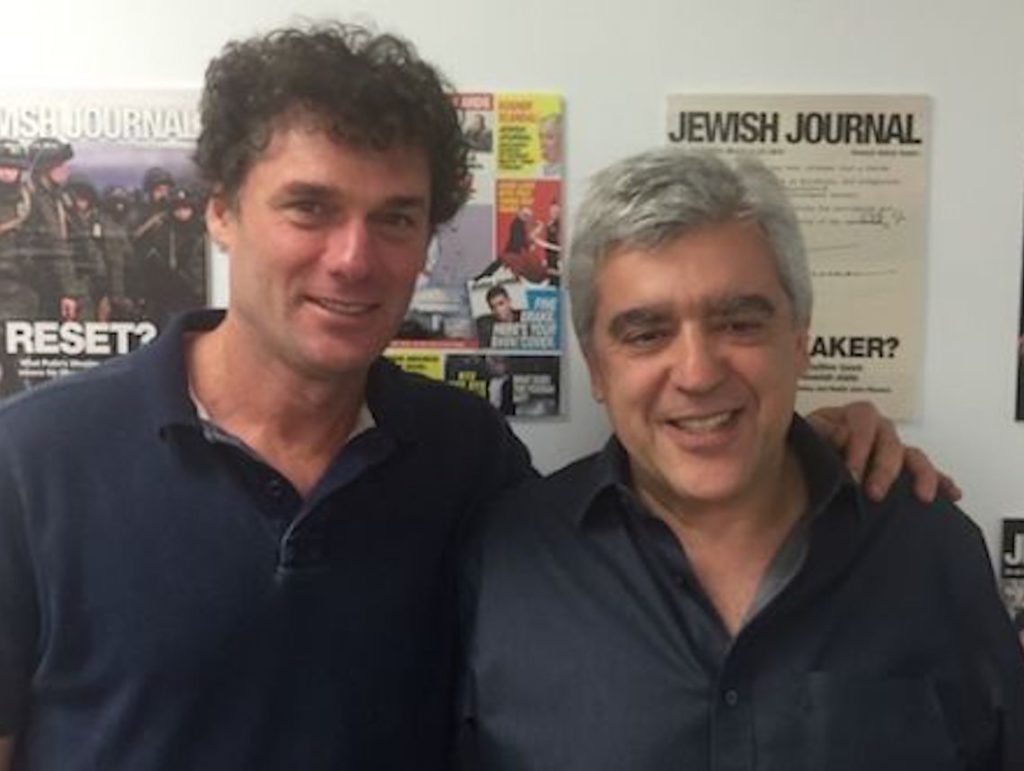
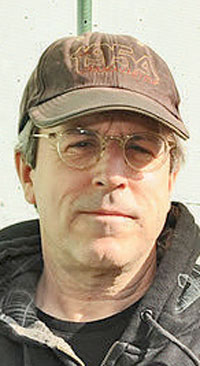
Director René Balcer

Balcer, who wrote and directed the film with longtime collaborator Nicola Zavaglia, became interested in the subject while visiting the Shanghai Jewish Refugees Museum, housed in a former synagogue. Balcer’s wife is Chinese, and her father grew up in Shanghai.

“The documentary, to me, was a way of looking at today’s refugee crisis through a historical lens and see what history could teach us,” Balcer said in an interview in his office at the couple’s Brentwood apartment.

Strewn about the office are piles of scripts and research material for television projects, including the upcoming “Law & Order True Crime: The Menendez Murders,” an eight-episode NBC series for which Balcer served as executive producer. It recounts the 1990s case of brothers Lyle and Erik Menendez, who were sentenced to life in prison without the possibility of parole for killing their parents.

Such true-crime fare seems like a far cry from “Above the Drowning Sea,” but Balcer always has sought out captivating historic figures. He chronicles the intricate history of Japanese-Jewish relations as effortlessly as he recites the history of race relations in his home country of Canada. Besides winning an Emmy Award, a Peabody Award, a Writers Guild of America Award and four Edgar Awards for his television work, Balcer has written and produced award-winning documentaries on art and China.

Balcer shot “Above the Drowning Sea” in six countries on four continents. Among the stories told in the film is that of William Eisner, who left Austria at age 6 and traveled with his family to Shanghai in 1939. He and his son Keith Eisner recount the harrowing journey and the help he got from the Chinese.

“I feel a sorrow for his lost childhood. It was all ripped away, everything was,” Keith Eisner says in the film. Balcer has a personal connection with the younger Eisner: He once hired him to help write an episode of “Law & Order.”

Jerry Moses, born in 1934, recounts a fearful childhood in Breslau, Germany. “I always thought I was going to die. I didn’t think about toys, only death,” he says. He left Shanghai in 1947 for Chile and later worked in Los Angeles in real estate and the clothing business.

Lotte Marcus remembers her family scrambling to find a consulate that would offer them visas. After hearing of her uncle’s death at Dachau, then a labor camp, their plight became extreme. In 1939, her parents sewed diamonds into their coat linings and fled Austria with Lotte, then 11 years old.

The world turned its back on Jewish refugees, and in the summer of 1938, delegates from 32 countries met at the French resort of Evian. The delegates expressed sympathy for the German-Jewish refugees, but most countries, including the United States and Great Britain, were unwilling to ease their immigration restrictions.

Ho’s decision to help Jews escape Vienna is especially remarkable considering the Chinese nationalist government’s close ties to Nazi Germany. Hitler even trained and supplied the Chinese soldiers in their fight against the Communists. But after witnessing Kristallnacht in November 1938, in which Jewish homes, shops and synagogues were destroyed, Ho decided to help the Jews get to Shanghai.

“Great humanitarian acts aren’t necessarily the product of governments. It’s usually the product of thousands of individuals performing small acts of charity and compassion. And that’s really what we found in this,” Balcer said.

When the Nazis took over the building that held the consulate, Ho opened his own office, even setting up shop at a nearby restaurant. He became known as the Chinese Oskar Schindler.

After weeks at sea, the refugees found Shanghai to be “a city in chaos,” Marcus recalled. “The streets were loaded with cars, rickshaws, pigs, farmers carrying chickens. It was a mass of people. … We saw dead babies just lying on the street.”

Years of foreign invasion, civil war, Western occupation, poverty and famine had made Shanghai an “open city” where no one checked the passports of new arrivals. In total, more than 20,000 European Jews found safe haven there before and during World War II.

Many settled in the city’s Hongkou District, where they opened watch repair shops, photography studios and other speciality stores. They did business with the Chinese and their children played together. After the Japanese invasion, the Jews were forced into an overcrowded ghetto of approximately 1 square mile.

In one moving scene in the film, two childhood friends, one Jewish and one Chinese, are reunited after decades apart. They pore over old photographs and eat challah, recalling their time spent together during the war.

Stories like theirs are in danger of being lost. It’s why Balcer wanted to make a film about Shanghai’s Jews now — and to highlight the connection to Europe’s current migrant crisis.

Making the documentary, Balcer said, “was a way of looking at today’s refugee crisis through a historical lens and seeing what history could teach us. Because history doesn’t necessarily repeat, but it rhymes.”

“Above the Drowning Sea” will screen at 6 p.m. Oct. 5 at USC’s Annenberg Auditorium, and will be followed by a panel conversation. For more information, go to abovethedrowningsea.com.

.  

‘Drowning Sea’ focuses on Jews’ safe harbor in Shanghai Read More »

‘Walking to Buchenwald’: an old play made new

While a family of four Americans journeys across Europe, the United States is on the brink of Armageddon. A dangerous, distrustful president has declared martial law and is threatening to plunge the country into war. Prophetically, the Americans receive some frightening news just as they are arriving at the ruins of the Buchenwald concentration camp.

Tom Jacobson, the creator of this scenario, might seem to be writing with present day headlines as his signpost. In fact, one of the unusual elements of Jacobson’s “new” play, “Walking to Buchenwald” — in its world premiere produced by the Open Fist Theatre Company at the Atwater Village Theatre — is that it is set in a recognizable present day but was written 14 years ago. Apart from updating some of the references to reflect changes in technology, Jacobson had to change very little of what he penned in 2003.

“This is not a play written about Trump. It was written by someone 14 years ago who barely knew Trump,” Jacobson said of the play that runs through Oct. 21. “The audience brings their current situation into the theater. That’s what has changed. The audience has 14 years of experience that they didn’t have when this play was written, so they’re bringing in very different emotions. That kind of excites me.”

Written during the administration of George W. Bush, who served two terms through early 2009, “Buchenwald” received several readings but not a fully produced staging. Jacobson said the play was not considered especially “urgent” during President Barack Obama’s years in office. Shortly before the 2016 presidential election, Open Fist held a couple of readings of “Buchenwald” as fundraisers. Even amid the assumption that Hillary Clinton would assume the Oval Office, “Walking to Buchenwald” generated plenty of discussion and, yes, a certain amount of fear among its audiences.

After Trump got into office, Jacobson’s play seemed relevant again, and Open Fist committed to a staging.

“You can assume the president is Republican, but there’s almost no discussion of his policies; they just don’t like him,” Jacobson said. “If Hillary had won the election, the play clearly would not have been about her. It would have to be about some other president.”

The play charts a family’s trip through England to France and ultimately to Germany. In a serious-comic odyssey that includes fantastic encounters, the four travelers take in the sights, mingle with locals and experience what it feels like to be viewed as stereotypically “ugly Americans.” Indeed, the more aggressive the unseen president gets, the worse the four travelers — Schiller, Arjay, Roger and Mildred — are treated.

The L.A.-based Jacobson is one of the city’s most inventive playwrights, and his plays invariably experiment with theatrical form. A previous work, “Ouroboros,” can be staged as either a comedy or a tragedy, depending on the order in which the scenes are played. “Captain of the Bible Quiz Team,” staged in various churches last year, had four actors — two male and two female of mixed ethnicities — playing the same character.

In “Buchenwald,” Schiller and partner Arjay are played by two men during some performances and by two women in others. Toward the end of the run, some mixing and matching among the cast members will make Schiller and Arjay a heterosexual couple.

“One of the characters talks about it in ‘Buchenwald,’ how theater changes from performance to performance depending on who is in the audience or if an actor does something different,” Jacobson said. “That’s something that’s unique to theater that doesn’t happen in movies or novels. I like to play around with that.”

Its political landscape notwithstanding, “Walking to Buchenwald” is loosely based on the playwright’s experiences. Jacobson traveled to Europe in 1998 and then again with his parents in 2002, shortly before they celebrated their 50th wedding anniversary. During his visit to Germany, Jacobson stumbled into Buchenwald through an indirect route and discovered some rather unsettling parallels to a place much closer to home: the Japanese internment camp at Manzanar in California.

“It looks so similar to Manzanar, which was built at the same time and for a somewhat similar purpose,” he said. “If you have been to a Nazi concentration camp and to a Japanese internment camp, it’s sort of doubly difficult because you realize what happened in your own country. My awareness is heightened and it’s very personal to me because I live here.”

Jacobson is not Jewish. Nor is Schiller, the trip-planner and tour guide of “Buchenwald,” who is essentially the playwright’s onstage persona, who says, “You can’t come all the way to Germany and not go to a concentration camp. It’s like visiting L.A. and not going to Disneyland.” Schiller’s father, Roger (played by Ben Martin), is frightened at the prospect, but agrees that the visit is a moral obligation. “Some things you just have to do,” he says in the play.

Mandy Schneider, who plays Schiller in the female (“Die Damen”) cast, can relate to the ambivalence. Schneider previously worked in Nuremberg and Hanover but did not visit any Holocaust-related museums or memorials. She has visited the Anne Frank House in Amsterdam and is planning a trip to the Museum of Tolerance as part of her character research.

“There’s always been a little bit of out of sight, out of mind,” said Schneider, who is Jewish. “Today, since we’re in such crazy times, it made me become even more aware that this does exist. It’s always existed, but seeing it on the news and whatnot, it just reminds me, ‘OK, we need to remember this.’ ”

 “Walking to Buchenwald” continues through Oct. 21 at the Atwater Village Theatre. For more information call (323) 882-6912 or go to OpenFist.org 

‘Walking to Buchenwald’: an old play made new Read More »

Paul Rudnick’s humor lightens an otherwise serious ‘Big Night’

Playwright-author Paul Rudnick chatted breezily on the Culver City set of his new comic drama, “Big Night,” engaging in the kind of banter that led The New York Times to call him “one of our pre-eminent humorists.”

Rudnick said he is now engaged to his longtime boyfriend, a physician, but they will opt for modest nuptials “because neither of us are groomzillas.” His diet, which consists exclusively of junk food, led one friend to wonder, “Why aren’t you dead?” he said. And he recalled the time his Jewish mother first visited his Gothic-style Greenwich Village apartment years ago and remarked: “Why do you have the Pope’s furniture?”

Rudnick then turned serious as he discussed the impetus for “Big Night,” now at the Kirk Douglas Theatre through Oct. 8. The inspiration, he said, came on June 12, 2016, when he learned about the mass shooting that claimed the lives of 49 people in a gay nightclub in Orlando, Fla. It was the deadliest incident against LGBTQ people in the United States and the worst U.S. terrorist incident since the 9/11 attacks.

“Something that affected me deeply was that, of course, it was an attack on gay people and especially on gay kids,” Rudnick said. “But it also, like so many terror attacks, was aimed at places where people were going to have a good time. Going after people at moments of peak happiness seems particularly obscene and vile on levels that none of us can comprehend.”

The shootings occurred just hours before the annual Tony Awards ceremony, prompting Rudnick to phone a good friend, an organizer of the event, to find out “Whether the awards would be canceled because of this ongoing horror,” he said. The awards show went on, with a number of heartfelt speeches about the tragedy and participants decked out in silver ribbons to show solidarity with the victims.

“I remember thinking that that particular combination of showbiz celebration and human tragedy was very interesting to me as a writer and seemed like a high-stakes and also comic situation,” Rudnick said.

“That’s something I’ve tried to do in a number of my plays,” he added. “I don’t think comedy and tragedy are ever kept separate in life. Jews certainly have a tradition of both, which is something that makes me very grateful for having grown up Jewish. It’s that tradition of using humor as a way to sustain yourself through great suffering.”

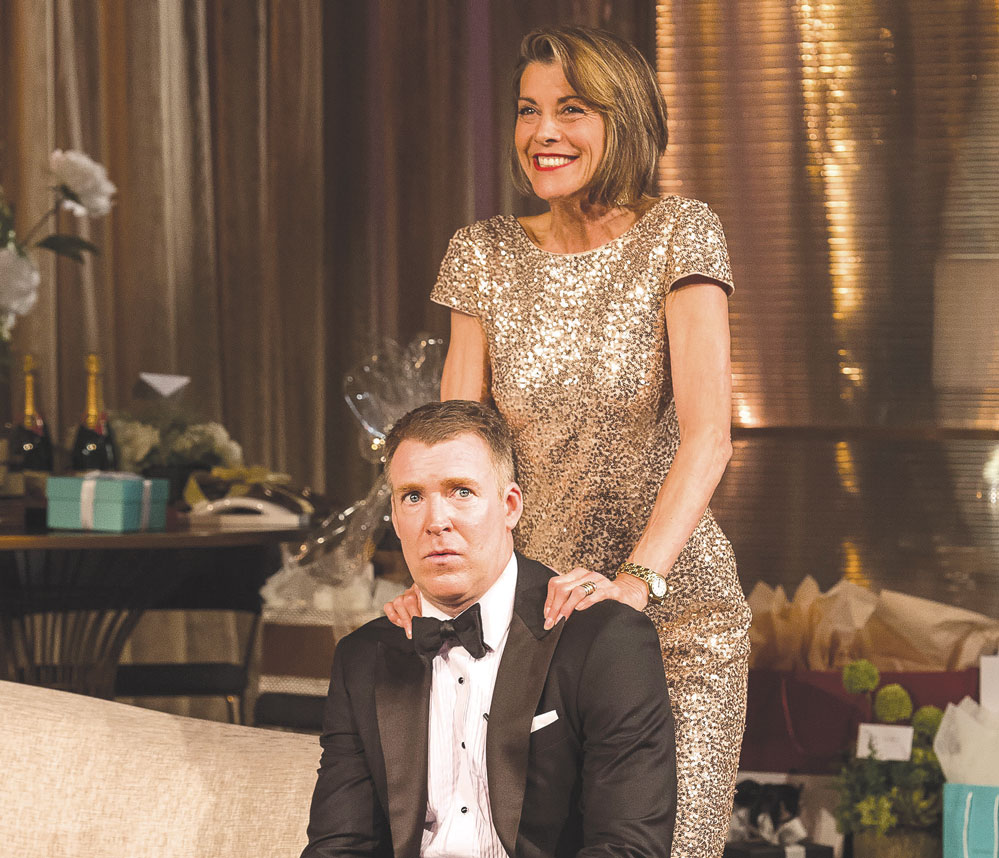
In “Big Night,” Michael, a gay actor who has paid more than his share of dues, is up for an Academy Award that could place him on the Hollywood A-list. But as he nervously awaits the ceremony with his agent, his Jewish mother and her lesbian lover, tragedy strikes the LGBTQ community. The question becomes: Should Michael risk his livelihood by publicly speaking out about the disaster, or should he keep mum to protect his burgeoning celebrity?

Along the way, there are plenty of Rudnickesque one-liners, some of them poking fun at the political correctness of the term LGBTQ, which has become like the alphabet, as one character notes. Michael’s agent in the play, Cary Blumenthal, recalls his bar mitzvah at an ostentatious hotel “with calla lilies, a vegan buffet and twin Soviet gymnasts from Cirque du Soleil.”

He chose to set the play on Oscar night because “everybody’s wearing their tuxes and their gowns and they look so great. But how do you balance that with someone who’s just a few miles away, who’s dead or injured or in the hospital?”

The author sees similarities between “Big Night” and his most famous play, “Jeffrey,” about love and sex during the HIV/AIDS crisis of the early 1990s.

“[‘Jeffrey’] is a comedy set in the age of AIDS, which most people thought was impossible,” Rudnick said. “It was turned down by every theater in New York until it was done in a very tiny playhouse. I wasn’t sure whether people would laugh or whether they would want to kill me.”

Not only did audiences laugh, the play went on to have a successful one-year run off-Broadway and to be performed around the world.

Rudnick’s 1997 film, “In & Out,” another gay romantic comedy, was inspired by Tom Hanks’ Oscar acceptance speech for his performance in the AIDS drama “Philadelphia.”

“He thanked his high school drama teacher and honored him as a great gay American,” Rudnick said. “So then I thought, what if an Oscar winner thanked his gay high school drama teacher, who was not yet out, and even more, what if he thanked him on the week he was about to be married to a woman?”

As for “Big Night,” it’s also a tribute to Rudnick’s mother, Selma, a publicist, who died of cervical cancer six years ago at 86.

“This play is one of the first times I’m sort of dealing with my mom’s death,” he said. “She was charming and funny and smart and she could also drive you crazy.”

Michael’s mom in the play, Esther, played by Wendie Malick, draws on Rudnick’s own mother. “You don’t want to stereotype, but in ways she could be traditionally ‘Jewish,’ ” he said.

Upon meeting Michael’s boyfriend in the play, Esther asks, “Is he Jewish?”

“I wrote a novel years ago called, ‘I’ll Take It,’ which was a tribute to my mom and her sisters and their great shopping tradition,” Rudnick said. “These were strong, political, liberal, hard-working women. But also each year in the fall, we would all pile into the car and I’d go with them on a road trip through New England, where they would all claim that we were visiting cultural sites and whaling museums and restored homes. But we were actually going and hitting every outlet between New Jersey and Freeport, Maine.”

For tickets and information about “Big Night,” visit centertheatregroup.org.  

Paul Rudnick’s humor lightens an otherwise serious ‘Big Night’ Read More »

In Mexico City, this Jewish NGO is the go-to agency for earthquake relief

I was on the 11th floor of an office building here when the ground started moving. There had been a mock evacuation that same day in remembrance of the 1985 earthquake that killed more than 10,000 people, but this was no drill.

According to protocol, everyone ran toward the building’s columns — structurally the safest place to be in an earthquake. I closed my eyes as the rumbling worsened, focusing on my breath and hugging the concrete structure as ceiling lamps came down, breaking the long wooden tables. Through the window, I saw clouds of dust billowing behind the skyline.

The 7.1 magnitude quake on Sept. 19 toppled 38 buildings in Mexico City and killed over 300 people nationwide. Two buildings collapsed next to my apartment in the Condesa neighborhood, and many more in Roma — both historical centers of Mexican-Jewish life. Although most Mexico City Jews moved to the city’s outskirts following the aftermath of the ’85 temblor, which destroyed both areas, the neighborhood is still home to five synagogues, a Jewish archival center, a kindergarten and a Holocaust museum.

I realized an hour later that my house was uninhabitable — windows busted, cracks across the walls, bathroom tiles scattered on the ground — and I joined an exodus of thousands of walkers (the highways needed to be cleared for emergency vehicles) as we made our way out of the disaster zone.

I stayed at my parents’ place, returning to the neighborhood two days later. The roads had been blocked by the army and marines. The parks were turned into supply centers, with thousands of volunteers making human chains and trying to help out those stuck in the rubble.

Half a block from the Alianza Nidjel Israel synagogue on Acapulco Street, whose structure was severely affected by the quake, Cadena, a Mexican-Jewish NGO specializing in humanitarian aid, set up shop. A line of about 20 people was standing waiting to be registered as volunteers, and many more were running around fetching what was needed and loading it on trucks.

During its 12 years of existence, this small organization (only 10 people work full-time) has helped over half a million people in Mexico, Haiti, Turkey, Chile, Guatemala, Ecuador, Belize and Costa Rica. Through partnerships with the American Jewish Joint Distribution Committee, IsraAID, local Jewish communities and other humanitarian organizations, Cadena has been able to operate nimbly and at incredible speed, mobilizing the human resources of the Jewish world to get to the most impenetrable disasters zones in record time.

In Condesa, Cadena repurposed the parking lot of a residential building near the synagogue as a warehouse for donated goods essential to the rescue operations in Mexico City and beyond. When I got there, the donations had been meticulously categorized into types of aid (“medicine,” “axes,” etc.) and there was a constant influx of trucks and vans — including police and army vehicles — coming to stock up on supplies. Some supplies were destined for the nearby states of Morelos and Puebla. Others, such as insulin packages, were sent via bicycle to help the victims of a building that had collapsed nearby.

By the time the latest earthquake struck, Cadena already was performing activities on the ground in the aftermath of a quake on Sept. 7 — the strongest one in a century. It had ravaged the south of Mexico, and Cadena was assisting those affected in the states of Oaxaca and Chiapas.

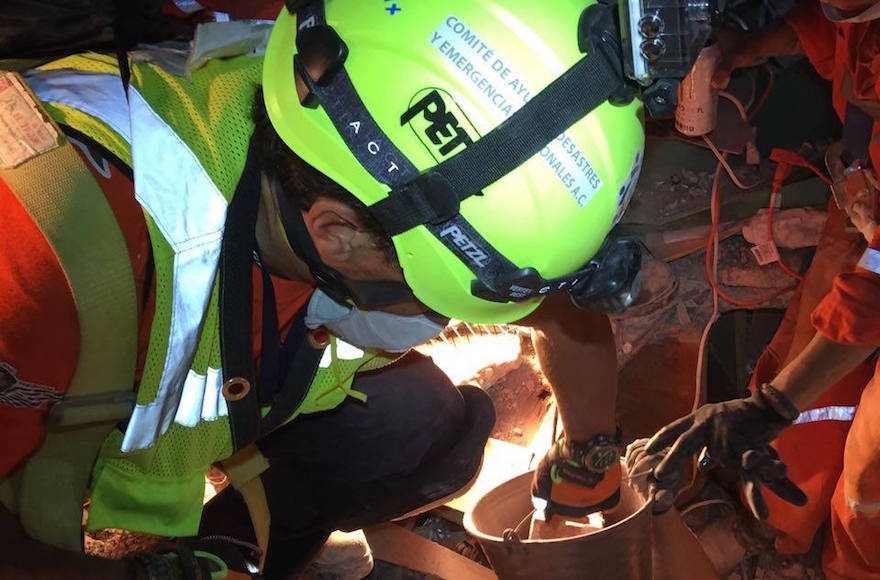
On Sept. 19, the organization deployed its Go Team, which specializes in rescuing victims from toppled structures, in the nation’s capital. In coordination with the 70 Israeli soldiers who arrived to help in the relief efforts and the Mexican army, team members visited the devastated zones.

“We are the only organization with special equipment that detects heartbeats,” Benjamin Laniado, CEO of Cadena, explained to me over the phone. “Thanks to this device we managed to rescue 25 people from underneath the rubble.”

Cadena is a Mexican-Jewish NGO specializing in humanitarian aid. (Courtesy of Cadena)

At the Condesa center, Miriam Kajomovitz, a fundraiser for the organization, had been working nonstop coordinating the delivery of the supplies even though she had been evacuated from her house after a building collapsed next to hers.

“We need hands,” she told me the day I visited as we approached the eve of Rosh Hashanah. “People are going to go home for their meals and leave us.”

The worry proved unfounded — many of the volunteers decided to forego the celebrations and continue to help out.

In a country where suspicion of government runs high, Cadena has positioned itself as an effective humanitarian alternative. Lately, the Mexican press has been running articles about the illicit use of relief funds for electioneering purposes in the state of Oaxaca. Public intellectuals like the Jewish writer Sabina Berman lambasted government-run relief efforts as inefficient and overly centralized. In the town of Juchitán de Zaragoza, Oaxaca, Cadena provided relief before any government help had arrived, according to The New York Times.

“We wanted to donate to a transparent, credible organization that was not affiliated with any political party,” said Raul Cardos, CEO of a communications firm that designed a mock Airbnb platform called Arriba Méxicoto raise funds for the victims. “When we tell people that the funds go to Cadena, they are more willing to help out.”

Clara Zabludovsky, a Mexican Jew who lives in London, found out about the destruction as her plane touched down in San Francisco. She has since raised over 17,000 British pounds ($23,000) toward a GoFundMe goal of 18,000 pounds , a lucky Jewish number — all of which will go to the NGO.

Now that a week has passed since the temblor, people who live in Condesa and Roma are coming to terms with the loss. The immediate urgency has receded, and questions about long-term damage to buildings are taking center stage. The continuing gentrification of what an American magazine recently called “Mexico City’s reigning axis of cool” is now in question.

On Sunday, Cadena shut down its emergency supply center in Condesa. In its week of operation, the center managed to send out 347 shipments to cover the needs of rescue workers in Mexico.

It’s not enough. The NGO is now organizing an international campaign to build temporary housing for those who lost their homes in Oaxaca and Chiapas. Cadena will be setting up tents with kitchen utensils, hygiene kits, water filters, beds and portable, ecological kitchens.

“There are thousands of people living in the streets, and it’s raining and cold,” Laniado, who is traveling to the state, told me. “The government reconstruction program takes too long, and in the meantime, people have nowhere to sleep.”

As for my building, it has been severely damaged. Specialists say it will take at least five months for it to be safe enough to withstand the next earthquake. I’m not taking the risk. For an unforeseeable time, I will be staying in my childhood home.

In Mexico City, this Jewish NGO is the go-to agency for earthquake relief Read More »