fbpx

September 28, 2017

New Boycott, Divestment, Sanctions effort against Israel

The UN Human Rights Commissioner has started sending letters to 150 companies in Israel and around the world, warning them that they will be put on a blacklist for doing business in Jewish communities in the West Bank, east Jerusalem or the Golan Heights.

[This article originally appeared on themedialine.org]

According to Israeli press reports, the proposed list includes large American companies such as Coca-Cola, Caterpillar, Priceline.com, and Trip Advisor. According to Israel Television’s Channel 2, Israeli companies targeted include pharmaceutical giant Teva, Bank Leumi and Bank Hapoalim as well as the national water company Mekorot.

The exact details of the letter and which other companies have been advised are murky.

When contacted by The Media Line, an Israeli government spokesman refused to comment on the issue.

Israeli analysts said the move is part of a concerted Palestinian effort to pressure Israel in diplomatic venues to end its expansion of Jewish settlements, a goal that seems unlikely. The report of the blacklist comes as Prime Minister Binyamin Netanyahu, while headlining a celebration marking 50 years of Jewish settlement construction in the West Bank, affirmed that “there will be no more uprooting of settlements in the Land of Israel.”

Some Israeli observers said the UN Human Rights Commission, headed by Jordanian Zeid Ra’ad Al Husseini, continues to pursue an anti-Israel policy.

“Nothing coming out of the Human Rights Commission is serious and Al Husseini is known to be completely and utterly hostile to Israel,” Alan Baker, an expert in international law and a former Israeli ambassador to Canada, told The Media Line. “They can send out whatever they want and they can adopt whatever resolutions they want but it doesn’t mean anything will come of it. This is part of the political action by an organization that has no credibility and no power.”

But the Israeli newspaper Ha’aretz quoted unnamed Israeli officials as saying that a number of companies that received the letter told the Human Rights Commissioner that they do not intend to renew contracts or sign new ones in Israel.

The list is part of the BDS (Boycott, Divestment and Sanctions) movement, which pursues a policy of placing economic pressure on Israel to stop expanding Jewish settlements. The letter circulated apparently includes companies active in east Jerusalem, which Israel annexed in 1967, and the Golan Heights, which Israel conquered from Syria in 1967 and later annexed as well.

“After decades of Palestinian dispossession and Israeli military occupation and apartheid, the United Nations has taken its first concrete, practical steps to secure accountability for ongoing Israeli violations of Palestinian human rights,” Omar Barghouti, the co-founder of the BDS movement said in a statement. “The Palestinians warmly welcome this step.”

Praise also came from senior Palestinian leader Hanan Ashrawi. “Israel’s illegal settlement policies and practices are a war crime under the Rome Statute of the International Criminal Court and in direct contravention of international law,” Ashrawi said in a statement. “Such a development is an indication of the United Nations attempt to curb Israeli violations and to begin a process of legal accountability for those who are complicit in illegal settlements.”

According to Israeli statistics, 380,000 Israelis live in Jewish communities located in the West Bank, and another 200,000 live in east Jerusalem. Palestinians say that all of these areas must be part of a future Palestinian state, although in the past officials have reportedly accepted the principle of land swaps in the event of any comprehensive peace deal with Israel.

It is not likely that Israeli companies on the list will make any policy changes in response to the letter, if and when it becomes public. Israeli companies for the most part do not distinguish between their operations on either side of the 1967 borders. Banks have branches both inside Israel and in the West Bank, and Israel’s national bus company runs buses there as well.

While all the details remain unknown, some Israelis believe there could be negative ramifications.

“This is a major political and economic battleground and the results are unclear,” Gerald Steinberg, the President of NGO Monitor, told The Media Line. “It is not a trivial issue, but it is also not the end of the world.”

Israeli media reported that U.S. President Donald Trump threatened to pull out of the Human Rights Commission if the list of companies is publicized.

The reports of the boycott list come the day after Interpol voted to admit the Palestinians as a member state, a move Jerusalem opposes and tried hard to prevent. It is part of an ongoing Palestinian strategy focused on achieving diplomatic gains through international forums as opposed negotiating the terms for the creation of an independent state through bilateral talks with Israel.

New Boycott, Divestment, Sanctions effort against Israel Read More »

Gay parent sues Pressman Academy for discrimination

gay man is suing Pressman Academy of Temple Beth Am, claiming the Conservative Jewish day school discriminated against his 8-year-old daughter because of his sexual orientation.

The suit refers to the man only as “John Doe,” a single, Israeli-born man whose two daughters, referred to as “Jane Doe 1” and “Jane Doe 2,” were enrolled at Pressman Academy until the end of the 2016-17 school year.

Filed Sept. 20 in Los Angeles Superior Court, it alleges that Pressman teachers and administrators “failed to address the bullying that Jane Doe 1 was subjected to because she has no mother.” It says a teacher at the school insisted on “informing everyone in the class that Jane Doe 1 was different,” even after the student asked her not to. The suit alleges civil rights violations, fraudulent business practices and infliction of emotional distress, asking for an unspecified amount in damages.

The first hearing in the case is scheduled for Dec. 20.

Adam Wasserman, the attorney for the plaintiff, declined to comment on the case.

Erica Rothblum, head of school at Pressman Academy, said in an emailed statement to the Journal, “While we cannot comment on the specifics of the lawsuit, it is important that everyone know that we are a school committed to the physical and emotional safety of our students.”

She added, “We are a community that embraces diversity, and we remain an inclusive community for LGBTQ students and families. Our commitment includes a life skills class in our middle school that explicitly teaches about sexuality and identity, as well as an active partnership with Keshet, a national organization that works for full LGBTQ equality and inclusion in Jewish life.”

The 47-page complaint alleges that Pressman Academy, a preschool through eighth-grade day school operated by Temple Beth Am on La Cienega Boulevard, engaged in false advertising by selling itself as a “warm embracing community” that “balances a rigorous academic education with social, emotional and spiritual learning.” It claims other students teased Jane Doe 1 by calling her an orphan, pushing a chair into her, circulating rumors about her and, at one point, putting thorns on her pillow.

“The inaction by the faculty and staff at Pressman sent a direct message to the students that tortured, taunted, physically, and verbally abused Jane Doe 1, ‘that this behavior is acceptable at Pressman,’ ” the suit alleges.

After a school therapist learned Jane Doe 1 and her younger sister were the daughters of a single gay man, “everything began to get progressively worse,” according to the suit. Allegedly, a teacher announced to a third-grade class that “Jane Doe 1’s family is different,” and Jane Doe 1 was discouraged from attending a Mother’s Day event.

As a result of this treatment, the suit claims, “Jane Doe 1 became severely depressed and talked to her tutor about wanting to kill herself; she isolated herself socially and would not play with other children at recess because they picked on her; she would lock herself in rooms because she felt safer alone than with other students, staff, and teachers.”

Eventually, according to the suit, a Pressman Academy counselor told John Doe it would be better if he withdrew his daughter and sent her to a local Reform day school.

At the advice of a third-party therapist, John Doe withdrew his daughters from Pressman Academy, according to the suit. Jane Doe 1 had attended the school for six years.

In her statement, Rothblum, the head of school, painted a very different picture from the one in the complaint, describing the school as a place where “everyone should feel safe and comfortable to tell a teacher, counselor or administrator” if they encounter bullying. “Those adults will then take prompt and effective action,” she wrote.

She added, “Pressman Academy is a community of support and engagement, and we are invested in the well-being of our children and our families.”

Gay parent sues Pressman Academy for discrimination Read More »

Schumer says US should back independent Kurdish state

Senate Minority Leader Charles Schumer has called on the Trump administration to recognize the Kurdish bid for independence — a position embraced among nations virtually only by Israel.

“Monday’s historic vote in Iraqi Kurdistan should be recognized and respected by the world, and the Kurdish people of northern Iraq have my utmost support,” Schumer, D-N.Y., said in a statement Wednesday, referring to the referendum in which 92 percent of 3 million voters said they favored Kurdish independence. “I believe the Kurds should have an independent state as soon as possible and that the position of the United States government should be to support a political process that addresses the aspirations of the Kurds for an independent state.”

No other power in the region except for Israel favored the referendum, with Iraq’s government threatening military action and Turkish President Recep Tayyip Erdoğan threatening to suspend normalization talks with Israel because of its backing.

Kurds for decades have functioned as a U.S. ally in the region and for even longer have had ties — at times open — with Israel, facilitated by the substantial Kurdish Jewish community in Israel. In northern Iraq, Kurds have been semi-autonomous since the late 1990s, when the United States and Britain helped push the late Iraqi dictator Saddam Hussein out of the region. His regime was responsible for the mass murder of Kurds.

The Trump administration opposed the vote, fearing it could damage the regional alliance combating the Islamic State terrorist group.

Schumer says US should back independent Kurdish state Read More »

After Trump’s third meeting with Netanyahu, experts perplexed with approach

Even back in 2004, when Donald Trump was the host of the reality television show The Apprentice, the real estate developer expressed supreme confidence in his ability to solve the decades long Israeli-Arab conflict. Trump told former Democratic Presidential candidate John Kerry that year: “It would take me two weeks to get an agreement.”

[This article originally appeared on jewishinsider.com]

Nonetheless, in the over 34 weeks since Trump has taken office and after his third round of meetings last week at the United Nations with Israeli Prime Minister Benjamin Netanyahu and Palestinian President Mahmoud Abbas, the peace process remains stagnant.  This week, with Israeli and Palestinian officials trading insults after Ramallah successfully joined Interpol on Wednesday and a Palestinian terrorist killing three Israeli security officials at a West Bank crossing this week, analysts note that the Trump administration-led process appears unable to sustain positive momentum.

Michael Koplow, Policy Director at the Israel Policy Forum, criticized Trump’s refusal to endorse the two state solution while meeting with Netanyahu and Abbas. “To continue to be coy about it and not utter the phrase two state solution and act is if there is some sort of magical answer that nobody else has ever discovered is ridiculous,” he told Jewish Insider.

“I don’t exactly know right now what the strategy is from the US,” said Grant Rumley, a researcher at the Foundation for the Defense of Democracies (FDD) and co-author of a recent biography on Abbas. Rumley added that without a framework going forward, the Palestinians are concerned that they would take unpopular domestic steps such as cutting the payments to families of terrorists and “follow the Trump team to something that ended up as a status quo quasi- agreement, leaving them in the cold.”

Into the 10th month of the Trump presidency, the administration has still declined to outline any concrete proposal towards relaunching talks. “There is a good chance that it (peace) can happen. The Israelis would like to see it. And I think the Palestinians would like to see it and I can tell you that Trump administration would like to see it,” the President declared on September 18.

For all the attention on the Trump administration, David Makovsky, a fellow at the Washington Institute expressed skepticism about the attitudes towards peace in Jerusalem and Ramallah. “I do not think both the Israelis and Palestinians have the requisite domestic political will to do anything that is politically hard for them. It is hard to imagine a breakthrough at this time.” Makovsky cited the inability for the PA to curb incitement along with the Israeli cabinet freeze of a proposal to expand housing units in the Palestinian city of Qalqilya as signs that Jerusalem and Ramallah remain unable to take the steps necessary towards peace.

In a September 19th speech to international donors, Middle East envoy Jason Greenblatt highlighted how the current US approach “departs from some of the usual orthodoxy” while emphasizing collaborative wastewater projects and economic assistance. Noting the economic challenges in Ramallah, Greenblatt added, “The PA is still dependent on international donors and is unable to afford important services which Israel is willing to provide – so I encourage all of us to work with the parties, in a coordinated manner, to reduce fiscal losses and ensure that the PA collects the taxes it is owed.”

Daniel Kurtzer, a former U.S. Ambassador to Israel and Egypt, explained that without a “top-down component” addressing core political issues including Jerusalem, borders and refugees, then the infrastructure projects “will become conflict management tactics rather than conflict resolution tactics.”

In contrast to the friction between the Obama administration and the Netanyahu government, many supporters of Israel appreciate the warmer approach taken by the Trump White House towards the Jewish state. Trump made a point during his UN meeting not to publicly criticize Netanyahu’s government and Greenblatt has repeatedly thanked the Israelis for taking steps that improve the West Bank economy.

Yet, some worry that the bear hug towards Israel could impair the U.S. ability to serve as a fair broker. In a recent interview, U.S. Ambassador to Israel David Friedman departed with longstanding State Department policy by referring to the “Alleged Occupation.” Palestinians were also disappointed when U.S. Ambassador to the United Nations Nikki Haley vowed to block any Palestinian from serving in senior UN role as a way to counter UN bias against Israel. “You also at some point cross a line from being tilted to the Israeli side and going full blown of being Israel’s advocate against the Palestinians,” Koplow said.

“We know from a very long and unfortunately sad experience that the absence of a serious process will over time result in pressures building up that contribute to the resumption of violence,” Kurtzer concluded.

After Trump’s third meeting with Netanyahu, experts perplexed with approach Read More »

7 Jewish Playboy playmates from 62 years of nudity

Playboy founder Hugh Hefner died Wednesday at 91. This article was originally published when Playboy announced in 2015 that its magazine would no longer feature completely nude models. It scrapped that policy in February.

This post is safe for work.

(JTA) — All those who claim to read Playboy “for the articles” might now actually mean it.

On Tuesday, Playboy announced that starting in March, its magazine will no longer feature nude models. It will, however, still have “sexy, seductive pictorials of the world’s most beautiful women,” according to a news release. But for the publication that changed the way sexuality was viewed in America, it certainly is the end of an era.

In reporting on the shift, The New York Times explained how the instant availability of explicit online pornography has hastened Playboy’s decline: “Pornographic magazines, even those as storied as Playboy, have lost their shock value, their commercial value and their cultural relevance.”

The magazine, founded by Hugh Hefner in 1953, has seen its circulation drop from approximately 5.6 million in 1975 to about 800,000 today.

The Playboy website eliminated nudity in August 2014 and saw a fourfold increase in traffic.

Playboy’s pages were never exactly full of members of the tribe, but below are seven Jewish women who appeared nude in the iconic magazine.

Cindy Fuller (May 1959)

Fuller is often called Playboy’s first Jewish Playmate of the Month, or the model featured in the magazine’s centerfold poster with a biography and several accompanying nude photos. But this is impossible to fully confirm since Playboy never tracked the religion of its models.

Susan Bernard (December 1966)

Bernard said she was not quite 18 years old when she posed naked in front of a Christmas tree in 1966 (something she talked about in an interview 30 years later). She went on to marry Pulitzer Prize-winning playwright Jason Miller.

Sally Sheffield (May 1969)

Sheffield spent eight months on an Israeli kibbutz, where she said she artificially inseminated hens. In her Playboy profile, Sheffield praised the integrity of Moshe Dayan, who at the time of her photo shoot was Israel’s minister of defense.

Barbi Benton (March 1970, December 1973, January 1975, December 1985)

Born Barbara Klein, Benton appeared in four Playboy issues but never as a centerfold playmate. She was best known as being Hefner’s girlfriend for most of the 1970s, but she was also a successful recording artist. Her 1975 single “Brass Knuckles” made it to No. 5 on the Billboard country music chart.

Nikki Ziering (September 1997)

Ziering, nee Schieler, converted to Judaism just before appearing in Playboy. She joined the tribe to marry “Beverly Hills, 90210” actor Ian Ziering, with whom she had a daughter before divorcing in 2002. She has since participated in several celebrity reality TV shows and acted in films such as “National Lampoon’s Gold Diggers.”

Lindsey Vuolo (November 2001)

When Vuolo told her Jewish parents that she was going to pose nude for Playboy, they told her to “just make sure you’re home for Passover.” She told Playboy that a 2-week Israel exchange program she took part in was one of the most meaningful experiences of her life. Just after posing, Vuolo famously debated Orthodox Rabbi Shumley Boteach, author of the best-selling book “Kosher Sex,” arguing against his claim that she had been exploited by Playboy for money.

Anita Marks (September 2002)

Marks posed for Playboy in the middle of her career as a professional female football player. The University of South Florida graduate is now a sports radio host for the likes of CBS and ESPN.

7 Jewish Playboy playmates from 62 years of nudity Read More »

The last column

So this is goodbye.

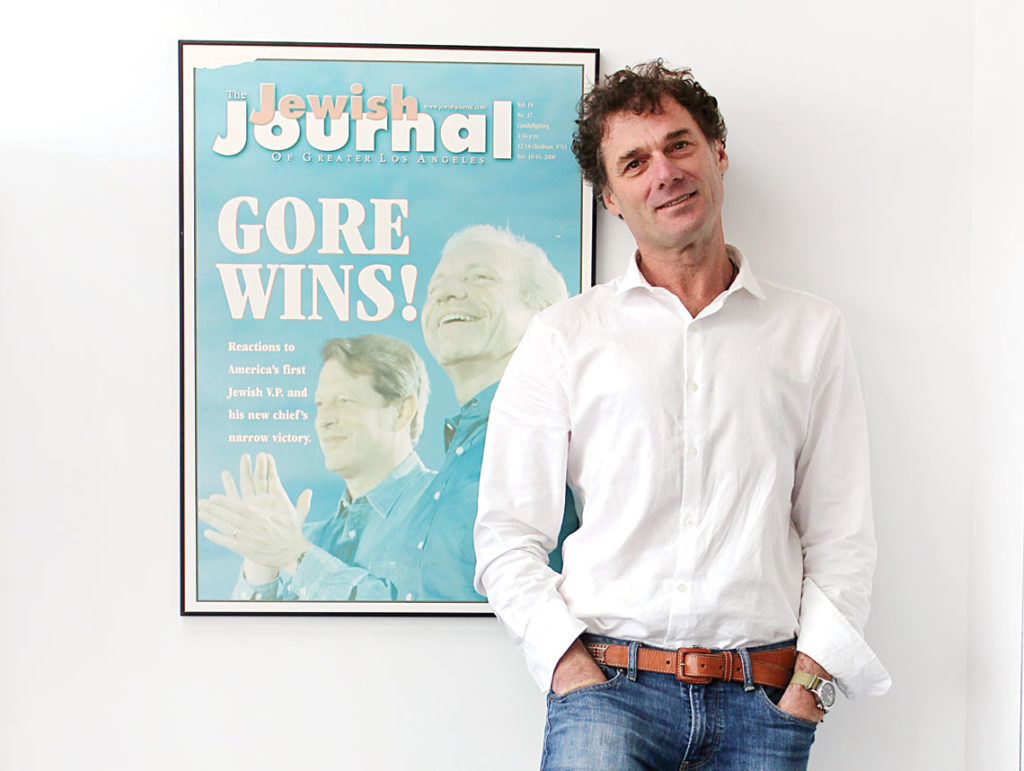
I walked into the offices of the Jewish Journal 23 years ago, and it’s time for me to walk out.

As I announced a month ago, I’ll be stepping down as editor-in-chief and publisher as of Sept. 29 and moving on to the next chapter of my life, focusing full time on writing and teaching, and being open to new possibilities as well. If the urge to return to a regular column proves irresistible, you’ll have to find me elsewhere. So this is my last column as editor. I’m truly touched by the numerous kind letters and Facebook posts from people who say they will miss me. For those of you who won’t miss me, I’m glad I could finally make you happy.

A while ago, I realized I had better move on before it was too late. The Journal has been my home since 1994, and it was time to leave home. Twenty-three years. The voice in my head kept nagging, “If not now, when?”

When I told my therapist maybe this was all just a midlife crisis, he raised an eyebrow. “Rob, you’re 57. Midlife?”

As my friends and family (and therapist) can attest, I’ve struggled with this decision. It didn’t come as an epiphany but as a gnawing sense that I had given this place my all, and it was time to stretch myself in new ways.

Each Yom Kippur, we come face to face with our mortality. The liturgy urges us to make good our vows and repair our wrongs before the closing of the gates. And each Yom Kippur for many years, I sat in services and struggled with the reality that the gates are closing, and I had to decide. I would recite the Al Chet prayer, which asks God to forgive us a litany a sins. I would get to the last one — “For the mistakes we committed before You through confusion of the heart” — and beat my breast extra hard. The rabbis understood how indecision could paralyze us, stifling our potential.

In her new book, Rabbi Naomi Levy (who also happens to be my wife) tells how the rabbis believed that an angel hovers over every living thing, every blade of grass, whispering, “Grow! Grow!” Since I first read that passage, the angel’s voice has only grown louder. By last year, that still small voice — kol d’mama daka — was screaming.

Still, I wavered. Letting go of this job turns out to be really hard. It has given me a public platform, a voice. It has taken me around the world: Poland, Azerbaijan, Turkey, Morocco, Germany, France, England, Mexico and, of course, Israel. It has brought me into the vice president’s mansion and the White House — twice — and enabled me to meet and speak with intellectuals, diplomats, artists, writers, actors, activists, rabbis, educators, politicians and world leaders. It has put me on stages from Encino to Oxford, to speak with people like Christopher Hitchens, Sam Harris, Tony Kushner, Ehud Barak, Amos Oz and the brave Muslim journalists whom the Journal has hosted as Daniel Pearl Fellows.

It has paid me to do what I would do for free: keep up with current events, learn all that I can about Judaism, Los Angeles, politics, food and Israel. It has put me into the heart of the Los Angeles Jewish community at a remarkable time, when we Jews are freer, more secure and more powerful than at any other time in our history. It also put me into journalism during a thrilling moment, when the future of media changes weekly, and when what began as a small community paper can now, with the click of a button, have an impact on people around the world.

Maybe I should stop with this litany before I change my mind, but ultimately, those are just the perks of a fascinating job. I am under no illusions about what really made my role so rewarding.

First, you.

When I say the Journal has been my home, I mean you readers have been like family. You are smart, caring, engaged and opinionated. Not for a second did I ever feel I was writing into a void — and, on occasion, I wished I were. “Eshman is a total moron when it comes to Israel,” a letter writer wrote last week. I’ve been doing this so long and have developed such a thick skin, I actually took it as a compliment. Hey, he didn’t say about everything, just Israel.

I’ve always been keenly aware the Journal serves one of the world’s largest and most diverse Jewish communities. As our online presence has grown, so has our community of readers, from L.A. to Tel Aviv to New York to Tehran. My goal has been to make the Journal the easiest and most interesting place for all these disparate voices to meet, to argue factually and honestly, to understand one another if not to agree. I’ve met or spoken with thousands of you over the years and I take comfort in knowing the Journal, 30 years after its founding, remains the one place where all of our many voices can gather and be heard, day after day, week after week. Even as online media catered more and more to ideological ghettos, the Journal remained committed to reflecting the broadest array of views.

My other deep sense of fulfillment comes from having been part of the Jewish Journal board and staff. I was fortunate to work under three chairs of TRIBE Media, the nonprofit that publishes the Journal: Stanley Hirsh, Irwin Field and Peter Lowy. All three fiercely respected the Journal’s editorial independence. Stanley tapped me to be editor and Irwin devoted himself selflessly to the Journal for years. Peter came in at a dire moment and has stuck by the Journal’s side ever since — he continues to be a selfless supporter and loyal defender. If anything, I often felt that if we weren’t raising a ruckus, we were letting Peter down. To me personally, he is a role model for fearlessness and generosity. If you have received any benefit from this enterprise, Peter Lowy deserves more credit than he will ever take.

I’ve appreciated all of our board members over the years, but I owe four of them special thanks. Uri Herscher believed in this paper when the recession had all but finished it off. His commitment to local, independent Jewish press, his moral authority and his wisdom helped bring it back to life. Uri continues to be a mentor and inspiration to me, as he is to so many. Art Bilger was part of the original rescue squad and saw us through very hard times with insight and creativity. Michael Parks, a Pulitzer Prize winner and former editor of the Los Angeles Times, has always been an unflappable editorial sounding board for me. Jonathan Kirsch has acted as the Journal’s pro bono counsel for 30 years. His expertise has been an important part of the Journal’s success, and occasionally its salvation. Tough stories often make for tough enemies. Jonathan Kirsch is our shield.

As for the staff, what can I say? There’s a word for an editor without a staff — it’s called a blogger. An enormous amount of work goes into putting out a weekly paper and a constantly updated website. That work is unceasing, always under deadline with never enough time or money. Whether it’s Tom Tugend, who fled Nazi Berlin and fought in three wars — and still reports for us — or our newest interns, the people who do this work on the advertising, production, administrative and editorial sides are the paper. They are an extraordinary group of people, from all different faiths and backgrounds. I’ll take full blame for any criticism you may have of this paper, but any compliments must be shared with them.

Six years ago, when I asked David Suissa to join the paper, I knew that there were few people in L.A. who share his passion for Jewish life combined with his commitment to fine journalism and an intense creativity. Three years ago, when I first told David I was thinking of leaving, he said, “No!” David can be very persuasive, so no it was, and I’m grateful I stayed. These past few years have been the most exciting.

I know there are Suissa people out there and Eshman people, but as David takes the reins, I want you to know that I am a Suissa person. I am sure under David this enterprise will go from strength to strength.

There is a second “staff” that also has been a blessing: my family. Raising a family in the Jewish community while reporting on the Jewish community has been tricky at times, and often personally hard for them. To protect their privacy, I chose to write about my son, Adi, and daughter, Noa, very sparingly in this space, but know that is in inverse proportion to the amount of room they take up in my heart and soul. Adi and Noa have been my constant joy and inspiration.

If there’s anything I’ve learned in those decades, it’s that nothing is as important to individual success as community. Yes, the community can offer connections and a leg up. But it also will be there when you fall.

My wife Naomi approaches Jewish learning and practice with utter commitment and total joy. She doesn’t just inspire me, she revives my faith when the politics of communal life can sometimes sour it. Being married to a brilliant rabbi and writer has also helped me fool you into thinking I know far more than I do.   

My parents, Aaron and Sari Eshman, are my role models for community and caring. My dad was born in 1927 in Los Angeles, where his father, Louis, was on the original medical staff of what was then Cedars of Lebanon Hospital. I have vivid childhood memories of Mom and Dad heading off to charity events and volunteering for Cedars, Vista Del Mar and other organizations. Like so many of their contemporaries, they have left this city and its Jewish community far better than they found it. I hope I have been a worthy link in the chain.

That chain includes my predecessors at the paper. Founding editor Gene Lichtenstein set an example of journalistic excellence I have tried to emulate. The cover of the first issue on Feb. 28, 1986,  featured a story on Jews and the school busing controversy. Clearly this was never going to be a paper content to run puff pieces.

Gene accepted men-seeking-men ads long before mainstream papers did. After he left, we were the first Jewish paper to run cover stories on gay marriage and transgender Jews. Religion that doesn’t wrestle with contemporary issues belongs in a museum, not a newspaper.

In the pantheon of columnists I most admire — William Safire, Peggy Noonan, Tom Friedman, Steve Lopez, Bret Stephens, Nick Kristof, Jeffrey Goldberg — I put the late Marlene Adler Marks on the highest pedestal. She was a dear colleague who died too young, and could never be replaced.

When I started at the Journal, almost all Jewish papers were exactly what the late Rabbi Stephen S. Wise called them: “weaklies.” They were parochial community organs. The lead  story of one such paper that arrived in our offices back then was, “Jewish Community Center Gets New Deck.” And yes, the entire cover photo was of a wooden deck. This is some business I’m in, I thought.

Today, Jewish journalism is in a golden age: The Jewish Journal, The Forward, The New York Jewish Week, Moment, Tablet, JTA, not to mention The Times of Israel and Haaretz (let’s face it, they’re pretty Jewish) are attracting great talent, breaking stories, providing deep insights and playing a leading role in shaping communal and international conversation. I am indebted to and often in awe of my colleagues in this corner of the journalism world. Of course, Jewish journalism still is, compared with the big guys, a small endeavor. But Jews also are small in number — and that hasn’t stopped us from making a difference. So can our media. Please support it.

I can’t tell you I’m not a little scared. I will miss being in regular contact with the remarkable people who make up this community, many of whom have become dear friends. I have this recurring, chilling thought that nothing will work out and I’ll be the guy at home in my pajamas writing those cranky letters to the editor, instead of the guy at the office who selects which ones to print.

But there’s some comfort, excitement and strength in being open to the uncertainty. That’s the lesson of Yom Kippur:  We know our days are numbered, that life is a passing shadow, and so we resolve to make changes today — haYom! the liturgy repeats — because the future is beyond our control. 

Last week, I was talking all this over with an older and far wiser attorney friend over lunch. I said I’d heard a life transition can be like a trapeze — sometimes you have to let go of one bar before the next appears. “Well,” he said, “as long as there’s a net.”

At first, I gulped. Oh, damn, I thought, he’s right. What was I thinking?

But then I remembered, I have a net, and so do you. It’s called community. It’s the reason this paper exists and thrives, it’s the reason I’ve been doing this job for 23 years.

If there’s anything I’ve learned in those decades, it’s that nothing is as important to individual success as community. Yes, the community can offer connections and a leg up. But it also will be there when you fall. It’s there for you when you get sick or a loved one dies, and it’s there for you to celebrate your successes and your joys. They say journalism is the first draft of history. But journalism’s true purpose isn’t to record history; it’s to strengthen community. No matter what comes next — trapeze bar or net — I am proud to have helped the Journal fulfill that role.

Over the years, many letter writers have accused me of being overly optimistic. Guilty. This was never the column to turn to if you wanted to read the same old dire warnings about how the Jews are disappearing, anti-Semites are everywhere, the younger generation is lost, Israel and the Palestinians are doomed, and every other gloomy prediction that passes as realism.

But it is impossible to do what I’ve done for the past two decades and not be optimistic. I leave this job with a deep sense of the abiding power of community and tradition and the ability of Judaism to meet the challenges of an unpredictable and often cruel world. To be a Jewish journalist is to see an ancient faith renewed in real time in the real world, in all its variety, abundance — and endurance.

Just this week, I was planning an upcoming trip to Berlin for a conference. When I told my wife I was thinking of finally visiting Auschwitz, a place neither of us has ever been, she became  upset.

“Please don’t go to Auschwitz without me,” she said.

The instant she said it, we had to laugh. Seventy-five years ago, who would have thought?

To this day, that somewhat over-the-top 2003 video of Israeli jets flying over Auschwitz still moves me. The weak can become powerful. Refugees can find a home. In a matter of years, enemies can become allies. Things change, often for the good.

But among all that change, the need for spirituality and tradition abides. Just last week, Facebook founder Mark Zuckerberg posted a photo of him and his wife celebrating Shabbat with their baby daughter, Max. They gave Max a 100-year-old Kiddush Cup that belonged to her great-great-grandfather.

No amount of money or power, no new technology and no social upheaval can erase our deeply human need for meaning, connection and purpose. Judaism has helped people meet those needs for millennia. After 5,778 years, the burden of proof is on the pessimists. Judaism will evolve, of course, but as long as it changes to meet these eternal human needs, it will endure.

So, now comes the time for my personal evolution. I do hope we can keep in touch. After all, I plan on staying in L.A. and, more than likely, remaining Jewish.  This Yom Kippur, you definitely will find me in shul, thankful for having made my decision, grateful for the past 23 years, and eager to open new gates as the old ones close.

In the meantime, I wish you a sweet and healthy New Year. Serving you has been my deepest honor. May you come to know all the blessings that being part of your life has brought me.


If you’d like to keep in touch with Rob Eshman, send an email to robeshman@gmail.com. You also can follow him on Instagram and Twitter @foodaism, and on his public Facebook page. Rob will still blog at foodaism.com — without a staff.

The last column Read More »

Episode 57 – The Israeli modern family according to MK Merav Ben Ari

Merav Ben Ari became a Kenesset member in 2015, as part of the Kulanu party. Before that she served at the Tel Aviv city council and took charge of the portfolio for promoting youth.
But the fame came long before that, when she participated in the Reality Show “In Search of a Leader” and won the first prize, 5 million NIS.

In late 2016 MK Ben Ari publicly revealed her decision to give birth to a child on her own, with the assistance of a friend, and thus exposed Israeli society to the concept of modern, single-parent parenthood. In a relatively conservative country, this was a courageous act that was followed by very emotional responses from all parts of Israeli society.

Ben Ari’s work in the Knesset is focused on the cost of living, educational issues and gay rights. She’s quoted in an article as saying: “I believe in the two states solution, but it’s not why I’m in the Knesset. I’m here for social issues.”

MK Ben Ari’s Facebook

Direct Download

Episode 57 – The Israeli modern family according to MK Merav Ben Ari Read More »

The Power of Kol Nidre

Though the chanting of the Kol Nidre text is the iconic moment of the evening service on Yom Kippur, the words of this Aramaic legal formula are less important than the dramatic occasion in which the Kol Nidre is the central element.

The congregation enters the Sanctuary on that holiest of nights and is stunned to see an empty open ark. Normally the Aron Hakodesh (The Holy ark) is filled with sifrei Torah – the Torah scrolls are what make the Ark “holy” (kadosh). Without Torah scrolls the Aron’s meaning changes. In Hebrew, “Aron” is an “ark,” a “closet,” and a “casket.” Looking into an empty Ark devoid of Torah scrolls is as if we are peering into our own coffins and confronting our limitations and mortality.

The High Holidays, however, offer a reprieve. The liturgy reminds us that prayer (i.e. praising and celebrating God and life), teshuvah (i.e. turning and returning to lives of meaning in relationship with others, with Torah, the Jewish people, nature, and God), and tzedakah (i.e. restoring justice into human affairs) are available to us at any time. Despite whatever has drawn us away from our core Jewish values during the year, we can recommit in this season to living our lives with greater dignity and meaning. We can turn our lives around. Fate need not necessarily determine our destiny. We can change, evolve, and grow. We can be elevated and worthy to stand with dignity before God on this holiest of days.

The Chassidim teach that if one wishes to walk east when one is walking west, all that’s necessary is to turn around.

G’mar chatimah tovah.


The Power of Kol Nidre Read More »

Guest Column: Does it matter how many Israelis define themselves as Reform\Conservative?

Two days ago, I posted an article based on a new survey. The survey showed that the number of Israelis defining themselves as Reform and Conservative is very small — in this survey of parents to children in non-religious schools, less than half a percent (read it here). I also made several observations based on that survey, including the one that this survey “means that progressive Judaism in Israel is not a movement in the same sense that it is a movement in other Jewish communities.”

Michal Berman, the head of Panim — one of the two the organizations that conducted the survey — asked to respond to my article and add her own interpretation of the state of progressive Judaism in Israel. I am happy to post it here.

Israeli Judaism and Reform Jewry — Does it really matter how large the Reform population in Israel is?

Michal Berman

In his column, Shmuel Rosner refers to data published by Panim, the Israeli Judaism Network, together with the Sapir Center, in which roughly half a percent of Israeli Jews identify as Reform or Conservative. This should be studied further.

The survey was conducted among parents of students in public secular schools. Excluded from the survey were parents whose children attend public or private religious schools, as well as people without children in the educational system or without children at all. The findings will be discussed during the Hakel Festival, organized by the Israeli Jewish pluralistic public, which will take place during the week of Sukkot in the Efal seminar, Ramat Gan.

Rosner notes that previous studies attempting to define religious identity in Israel concluded that between 6-12% of Israeli Jews identify with the two major liberal streams, indicating a higher estimate than the one mentioned in this survey. Surveys conducted over the years show larger numbers of diverse religious communities and individuals who affiliate with them.

I would like to bring a new perspective to these facts. The attempt to count those belonging to one or another liberal stream is largely an attempt to view Israeli society through American lenses. It’s difficult for Americans to understand this, but the Israeli Jewish reality is composed of paradoxes. In Israel, Judaism affects the public’s daily life; very much so. You can’t miss Yom Kippur or Passover, or any other Jewish holiday. Shabbat is everyone’s weekly day of rest. The Jewish calendar dictates the country’s yearly schedules. Hebrew is spoken everywhere. There’s no need to work hard to feel Jewish or be Jewish.

An American immigrant described it thus to a friend who remained in the U.S.:

‘What I like about Israel is that I don’t have to practice any Judaism. I can simply be a secular Jew.’

Americans who experience Yom Kippur in any large Israeli town are surprised to discover that Israelis are divided into two groups: the religious on the way to the synagogue, and the secular on bicycles and roller skates in the empty streets. While living side by side, they are all Jews at heart. Each observes Yom Kippur in their own way.

In the United States, the way to be Jewish is by joining an organization, a federation, a community, a synagogue or a Hebrew school. To belong, and have your children belong, you must invest time and resources and register with a Jewish organization. This makes it possible to count who belongs to what Jewish stream.

In Israel, on the other hand, there’s no need to affiliate with any stream; certainly not among the non-Orthodox. You don’t have to pay fees nor spend time in a synagogue to experience Yom Kippur or any Jewish holiday. Most Israelis are fluent in Judaism; there’s no strong need to belong. The issue of how many Israelis identify as Reform or Conservative doesn’t matter.

Israeli Judaism is a movement of organizations and communities that seek to cultivate Jewish spiritual meaning in life, in a culture that isn’t necessarily religious. They’re trying to integrate Judaism and democracy, so that neither comes at the expense of the other. The liberal communities (The Reform and the Conservative) are part of this movement. There are pluralistic study centers. There are also communities whose members don’t affiliate with a specific stream but may identify as religious, secular or traditional.

It’s not a missionary movement. The sole aim is to live a Jewish, democratic life and bring about change in how weddings, divorces and burials are managed. To allow people to conduct life rituals by their own principles. To allow a variety of prayer rituals in places of public worship, like the Kotel.

Israeli Judaism doesn’t necessarily belong to specific streams, but it does hold by Jewish values that resemble those of liberal American Judaism. Even more, it seeks to keep Israel a place for all Jewry, despite influences from extreme parties with a strong political position, who are trying to dispose of liberal values and turn Israel into a country based on Halacha.

The Reform and Conservative movements in Israel have an important job in facilitating a pluralistic voice. They offer a place for all those who hold by Jewish pluralism, equality and democracy and who don’t believe that these values conflict with each other.

I feel it’s important to point out that the great partnership between the Reform and Conservative communities in the United States and Israel represents far more than 6-12% of Israeli society. Furthermore, it even represents the majority of Israelis who desire fully equal and democratic lives, without yielding to outside influences coming from coalition agreements and a twisted status quo. Those agreements were formed under the pressure of time and the reluctance of politicians to make changes, once and for all, for the good of the entire public, not just a minority.

Moadim le-simcha, and chatima tova!

Michal Berman is the CEO of Panim – the Israeli Judaism Network – representing 60 Israeli,  Jewish-oriented and pluralistic organizations.

Guest Column: Does it matter how many Israelis define themselves as Reform\Conservative? Read More »