The problem of student debt is worse than people assume. Five years ago, total debts have exceeded $1 trillion and with tuition fees continuously rising – it’s safe to say this burning issue isn’t going away. In addition to the devastating fact that high costs are turning education into a privilege, student loans are also taking the mental and physical toll on those pursuing a degree.
But when people are forced to participate in a certain system, there’s nothing else to do than to find a way to adapt. Last year was marked by Elizabeth Greenwood faking her death to escape over $100.000 in student loans. While these extreme measures might not be the best option, there are ways you can pay off student loans fast in 2017.
Pay More Than the Minimum, Starting From Variable Private Loans
By paying more than the minimum monthly payment, you’re reducing your loan’s principle which prevents interests from accumulating. The more balance you take off, the lower your interests get. In addition, you should prioritize settling variable private loans first. Interest rates of this type of loans are expected to rise up to 6% in the next four years, putting more financial burden on students. Commit to eliminating this debt – you can do so by segmenting your payments. Divide payments and make one per every two weeks and you’ll end up paying off more per year. There are 52 weeks in a year: by making a payment every other week, you’ll pay off 26 payment, i.e. 13 full monthly payments.
Check Refinancing Options
Even though rates in the case of variable private loans are less predictable, they typically start out lower than in cases of fixed-rate loans, which is why students choose them. Lenders are not held responsible for the rates increasing. Here’s why you should think about student loan refinance options: you can switch to a fixed rate and get a lower interest, benefit from a more flexible repayment plan, and consolidate all debts into one. It could be a smart strategic move, although caution is advisable. Many make the mistake of locking themselves in a plan that implies small monthly payments, but also a large loan’s lifespan and increasing interest over an extensive period of time, for example, 25 years.
Turn to Your Employer
Employer student loan repayment is getting more popular for eliminating debt. Basically, employers who offer this type of help provide monthly financial aid that’s somewhere between $100 and $300 on average. So, how beneficial is this to you in real life? A little bit of math: an average student loan debt in 2016 was around $37.000, so if you have a ten-year plan and an interest rate of 6%, you’re expected to pay a little more than $410 per month. After a decade, you will have paid around $12.300 in interests. But with the monthly help of your employer in the amount of $200, you’ll be able to pay off your loan in just 6 years and with around $7150 interest. Negotiate these options when discussing salary.
Ask Around About Tax Deductions
Did you know you may be entitled to tax deductions regarding student loans? A person who is eligible to apply for the tax deduction can expect to save up to $2.500 on student loan interest in a year. However, your income has to be lower than $80.000 and if you earn between $65.000 and $80.000, the deduction is reduced. Needless to say, you can only deduct loans if they come from qualified sources. Loans from friends, family, or your employer don’t count. Most of the U.S. colleges are part of this system, so take advantage of what IRS has to offer if you’re eligible to apply.
In addition to these tips, always have a budget plan in mind. Remember: consistency is the key to paying off your student loans.
Like the grand finale culminating a fireworks show, something amazing occurs in the synagogue’s sanctuary at the end of Yom Kippur.
After 24 hours — a full day of fasting, praying, reciting po etry and absorbing scriptural readings — our souls have immersed in the flow of a day of spirit. Like angels, we dress in white and refrain from eating or attending to bodily needs. And like angels, we seek to soar upward, aided by our renewed sense of authenticity, purified from the distractions and dirt of daily life. The culmination of this packed day — filled with more mitzvot than any other 24-hour stretch during the year, crammed with ample time for reflection, contemplation and honest self-scrutiny — asks for something noble to drive home its message.
The uncertainty
Neilah delivers that grandeur, in music that is a hit parade of the High Holy Days Top 10, asking us to stand throughout the entire final service, ark open, all eyes forward, and with a culmination of responsive back-and-forth liturgy between cantor and congregation, culminating in the final blasts of the shofar.
Small wonder that as the noise crescendoes and then finally tapers away, we have the sense of being at a rally, at a crop harvest or in the final paces of a marathon. We’re sweaty, tired and hungry but champions of the spirit.
Again and again, our liturgy suggests the image of gates closing. We rush to squeeze through, but the gates are closing.
Which gates?
The gates to our hearts, cracked open by the time of intense prayer and introspection?
The gates of God’s compassion, eager to welcome us home?
The gates of heaven, inviting weary pilgrims to return?
Perhaps the gates of evening, as the setting sun meets a darkening firmament?
Or maybe the gates refer to a time limit. Isn’t part of what is special about Yom Kippur is that it is a time of particular promise for repentance, for changing our ways, for remapping our journey toward a more worthy destination? If so, then the closing of the gates refers to the time yet available for us to repent.
The gates: when and where
It turns out that the liturgy doesn’t help us resolve this ambiguity. Where are those gates? Inside our hearts? In God’s ample love? At heaven’s door? We never step outside the spatial metaphors to specify their location.
The choreography of keeping the ark open throughout the Neilah service offers a visual that the closing gates are literally just before our eyes: the gates of Torah.
But that “where” is never nailed down, never specified. And we don’t identify the “when” of our gates, either: The end of services? The end of Yom Kippur?
For us, the bigger paradox is that the very tradition that is rushing us to repent while there’s still time is unambiguous in holding that God always welcomes the sinner, is always eager for us to turn in repentance. There is never a time when God’s love is not greater than our shortcomings; never a time when God is too fatigued by our presence that we are not welcome to return. But if God always is eager to receive the sinner in repentance, then what’s the rush? Why do we feel pushed to hasten our process to coincide with the conclusion of Yom Kippur?
Unspecified gates in multiple time frames hardly sounds like a recipe for spiritual growth. Yet, it turns out that it is precisely in this uncertain swirl of multiple possibilities and shifting occasions where human transformation becomes possible.
Through paradox to growth
Were we to operate only with the assumption that repentance always is available, then we would never be motivated to actually change at a particular instance. Just as knowledge of our certain mortality infuses our life with a need to seize the day, so does the push of Yom Kippur as a time particularly favorable to teshuvah inspire us to more focused contemplation than a more open-ended process would.
But if all we had was a sense that we must repent today, before the end of the day, then repentance is paralyzed by the ticking of the clock, by the desperation inspired by time running out. It is precisely the paradoxical balance of an open-ended process joining hands with a particularly favorable moment that makes forward movement happen.
Similarly, were our tradition to limit the gates to one, then so many other portals would be closed to us. The gate of Torah is precious and vital, but it is not the only door we pass through. We turn, in different moments of our lives, to different openings: family, marriage, children, professional training and practice, spiritual discipline, pursuit of justice — to name a few. Each of these gates manifests the ways that the cosmos creates new possibilities for us, shows different ways that the sacred lures us toward our own optimal greatness. The gates must be specified, but not limited. There, too, it is precisely the paradox that allows us to squeeze ourselves through, self-surpassing, as is our God.
RABBI BRADLEY SHAVIT ARTSONholds the Abner and Roslyn Goldstine Dean’s Chair at Ziegler School of Rabbinic Studies and is vice president at American Jewish University.
Every year, during the month of Elul,if not before, cantors return to these ancient Aramaic words in reverential search of meaning and inspiration, for they possess a power beyond any others in our long liturgical tradition.
What is it about these seemingly simple, legalistic terms that hold such mystery and transformative power? To me, the compelling power of the Kol Nidre prayer is founded on two truths: 1) the meaning is the moment, and 2) the power of melody.
First, a brief history of this storied text. The first appearance of the opening words of Kol Nidre (literally, “all vows”) has been found on bowls used for magical incantations, curses and spells, which were discovered in ancient Persia (now Iran), dating as far back as the seventh century C.E. Consider this for a moment: The origin of Kol Nidre is a magical spell to deflect harmful curses.
We next encounter an expanded version in the ninth century siddur edited by Rav Amram Gaon. When it appears again a couple of centuries later in the Machzor Vitry, the custom of chanting Kol Nidre three times has taken hold and its meaning has been transformed from magical incantation to legal document, granting the annulment of vows.
This practice eventually led to a controversy that reached its apex in the 19th century, when German Reform rabbis were forced, in response to virulent anti-Semitic charges of dishonesty, to delete Kol Nidre from the machzor. The anti-Semitic claims used Kol Nidre as a proof text for Jewish distrust. Anti-Semites would say, “Look at the Jews! On their holiest day of the year they state openly that their vows are not valid.”
Until its reinstatement in the Reform machzor in 1961, the Jewish community took solace in its melody. The Kol Nidre melody that Ashkenazi Jews recognize as traditional originated in the 16th century and became embellished over the next several centuries. Its collection of simple, short melodic fragments are woven together to form an unforgettable musical moment in sacred time.
Consider the power of just two simple notes, those first two notes of Kol Nidre. In those two notes, an entire community is bound together. Beethoven also needed only two notes to compose what is arguably the most memorable symphony ever composed, his Fifth Symphony.
So potent were those first two notes of Kol Nidre that there was an outcry among the German Reform Jews when the text was deleted from their machzor. However, it wasn’t the text they desired, but the melody. In response, they chose a psalm sung in German to the Kol Nidre melody as a temporary replacement.
The other part of Kol Nidre’s power is the moment. The beginning of the evening of Yom Kippur is arguably the most palpable moment in the entire Jewish communal year. According to our tradition, our very lives hang in the balance. We dress in white and refrain from eating and drinking, as if preparing for our own funeral. We are facing death. Kol Nidre, with its strange and controversial history, its simple but unforgettable melody and the very sounds of its ancient Aramaic words all converge in what is a holy moment in time.
Chanting Kol Nidre for the first time remains a powerful and intimate memory. I was a high school senior in my hometown of Cleveland when our 2,000-member Conservative synagogue experienced a breakup. For reasons unimportant now, nearly 500 members decided to form their own congregation, and I was asked to serve as cantorial soloist.
I was honored to accept but also concerned at my lack of experience and the enormity of the responsibility. I spent the summer preparing with relentless diligence, rehearsing with my accompanist and eight-voice choir. In the end, I felt ready and worthy. Rosh Hashanah went well and I was emboldened with confidence in anticipation of what we then commonly referred to as “Kol Nidre Night.”
When that moment came, I found myself trembling with fear. I remember being grateful for the loose-fitting white robe that hid my shaking legs. I began the first of the traditional three offerings with timidity, which was all I had at that moment. Then the second with growing confidence, and by the third I was fully present.
I honestly don’t remember much of what followed, other than complete relief and exhaustion. Still, years later, the fear and trembling are present — not from inexperience, but rather from a deeper and more mature understanding of the moment and it’s meaning.
So what does a 21st century cantor do to prepare for such a monumental moment in the Jewish communal drama? We do what we’ve always done. We delve yet again into its history, text and melody, the countless commentaries and personal stories. Deeper and deeper we search so that in that Kol Nidre moment we can let go and become fully present, one with the entire community of Jews as time stands still.
Cantor Don Gurney is a cantor at Wilshire Boulevard Temple.
Although you are not sure why, you don’t want to be late for Kol Nidre. As the sun is going down, there you are in the car, even running a yellow light or two, hurrying toward the shul, temple, rented room or wherever it is you go to begin Yom Kippur.
It’s not as if you’re that religious, but somewhere in your head, where yontif memories are filtered into expectations, and doubt rubs up against belief, the majestic music and solemn words — of which you know only a few — are calling: Kol Nidre, ve-esarei, va-haramei, v’konamei.
As you look for parking, you wonder where these feelings are coming from. Is it that Kol Nidre is a powerful prayer or blessing? It’s neither. Kol Nidre, which means “all vows,” is a legal formula for the annulment of “vows, renunciations, bans, oaths, formulas of obligation, pledges and promises,” made not to another, but to yourself and God.
The murky origins of Kol Nidre do not provide much of an explanation for why it has had such a lasting grip on us. Although in Spain it might have relieved some Marrano Jews of guilt from the vows they took upon being forced to convert, many researchers believe the legal formula already was in existence long before that, sometime in the eighth or ninth centuries. The tradition of saying Kol Nidre also is supported by a Talmudic statement that calls for a similar practice to nullify every vow.
Whatever its origins, according to “A Guide to Jewish Religious Practice” by Isaac Klein, the purpose of Kol Nidre has been “to provide release from vows in matters relating to ritual, custom and personal conduct, from inadvertent vows; and from vows one might have made to himself and then forgotten. It does not refer to vows and promises to other people.”
Yet, throughout the formula’s history, that has not been the universal understanding. During the Middle Ages in Europe, for instance, some Christian courts and monarchs held that it meant a Jew could annul any promise. Some mid-19th century Reform rabbis, recognizing the confusion it could cause, even tried to do away with the legal formula.
Written in Aramaic, the language in which most Jews were conversant at that time, the idea was that everybody should understand it. Connecting us over the centuries to that age is the Jewish perspective that words are important, and that at times a promise made to ourselves or God was not made thoughtfully, realistically, with enough knowledge or the right intent, and we need a way to start anew. Kol Nidre presents that rare opportunity to reset, and perhaps it is this opportunity that draws us to hear it year after year.
Adding to its place in our lives, during the Ten Days of Repentance, the period of time from Rosh Hashanah to Yom Kippur, there is an opportunity to resolve issues between you and other people, but during Kol Nidre, there is an opening to resolve issues of the self and your relationship with God.
Helping to add drama to the recitation of this legal formula is the setting. Standing before the heavenly court of life and death brought to mind by the Yom Kippur liturgy, the recitation of Kol Nidre is the time to deliberate on our vows. The tradition is to repeat the formula three times, and thank heaven for that because even if we are late arriving, we still can hear the words: May they all be undone, repealed, canceled, voided, annulled.
Traditionally, the first time, one says the words softly, as one who hesitates to enter the ruler’s palace to make a request; the second, a little louder; and the third even louder, as one who is used to being in the ruler’s court.
Embellishing the courtly setting is the Torah pageantry. Before Kol Nidre is said, all of the congregation’s Torah scrolls are taken from the ark, and as an honor, presented to individuals to hold. In an unambiguous display, the staging lets us know under whose authority the court has been convened, and for good reason.
The Torah contains several verses concerning vows, and teaches that “you must fulfill what has crossed your lips and perform what you have voluntarily vowed to the Lord your God”(Deuteronomy 23:24). In so doing, it helps to explain the need and urgency for a legal formula that covers instances when we have messed up.
But for what year? Originally, the text read that the period the formula covered was from the “past Yom Kippur until this Yom Kippur.” However, according to “The Encyclopedia of Jewish Prayer,” Rabbeinu Tam (1100-1171), the grandson of the famous French Torah commentator Rashi, argued “’of what value is the cancellation of all vows to him who takes them and immediately declares them null and void?’”
He revised Kol Nidre to read “from this Yom Kippur to the next,” the text that most machzorim use today, although some Ashkenazi and Sephardic congregations use both, covering past and future. Others feel the revised text sufficient since it is ambiguous enough to cover the past and coming years.
For many Jews, the rush to hear Kol Nidre is not so much about the words as it is the music. Setting the table for a spiritual experience, and answering our emotional needs, if ever there were a song to begin a fast by, this would be it. Several variations are in use today, but most are derived from what is called a “Mi-Sinai” (from Sinai) melody — that is, according to Cantor Jonathan L. Friedmann, a tune “treated as if they came from Moses himself” — that emerged in Rhineland communities of Germany and France sometime between the 11th and 15th centuries.
Even if your singing voice is not one with the angels, or you can’t carry a tune in a bucket, you still can remember how some of Kol Nidre goes. Especially where it drops down low, then rises majestically, the music seems to imbue us with a sense of identity and a way to acknowledge our frailties.
The rush to shul has been worth it. Standing in the presence of Torah scrolls, family and friends, dressed in your best, maybe even in white, with the words and music washing over, we have arrived at that rare point in time when we can feel regret, and nullify some of our poor judgment.
Whether the formula gives us cover for the coming year or a chance to disavow past vows, we stand at a rare and powerful moment. Kol Nidre can lift us over missteps of the past year and help us to think, not twice but three times, before stepping into the new.
The 13 black-and-white pictures sat in a cardboard box in a North Hollywood residence, half a world and seven decades removed from the horrors they captured.
In August, Robert Aguilar, 78, a retired truck driver, found the photos at the back of a cupboard as he and his wife, Paula Parker, 69, prepared to sell their townhouse and move to Nevada to live out their retirement. The pictures are presumed to have been taken by Parker’s father, Ken Parker, a U.S. Army photographer in World War II.
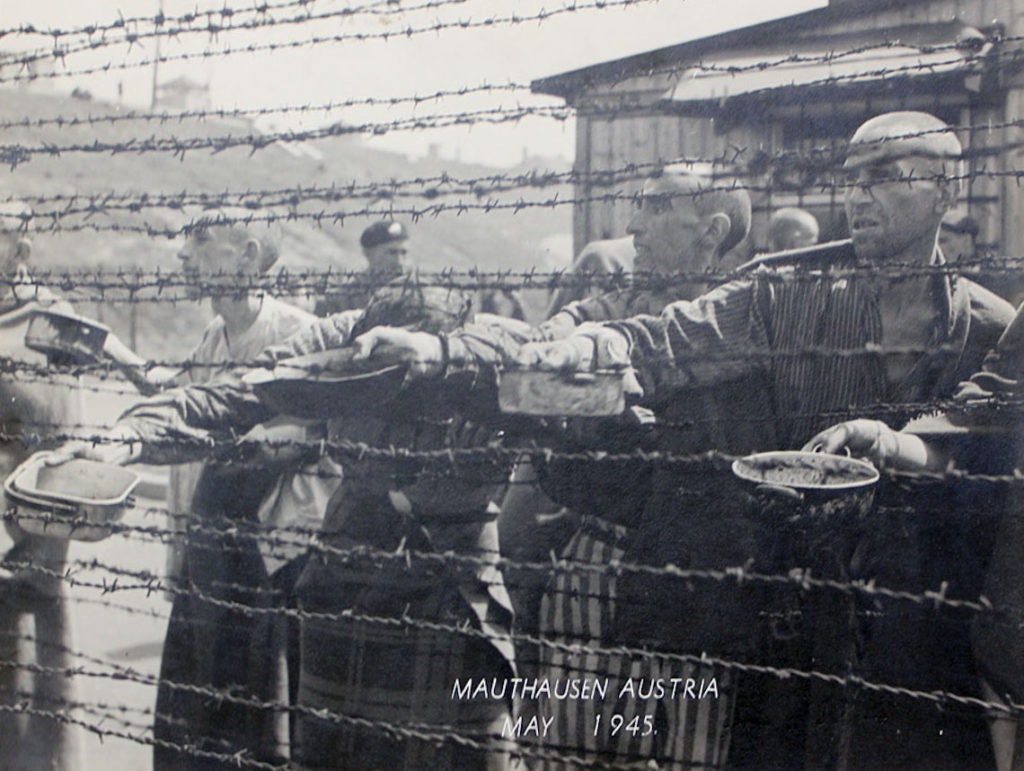
Found jumbled together with an Army uniform and a confiscated German pistol, the pictures appear to show the liberation of Mauthausen, one of the Nazis’ cruelest concentration camps. In graphic detail, they offer proof of the emaciated conditions of survivors, with their apathetic expressions and jutting ribcages, along with piles of corpses discovered by the Allies.
“I can’t believe human beings would treat others like that,” Aguilar said, his voice catching in his throat as he spoke on the phone. “Prisoners — they’re not supposed to be tortured to death.”
Aguilar, a Vietnam veteran, said the images reminded him of the American prisoners who were mistreated during the war in which he served. He called the Journal and offered to provide the photographs for safekeeping in the hope that they could be of some use.
“I didn’t want to throw them in the trash,” he said. “They’re history — World War II history, you know. I wanted somebody that could use them.”
Ken Parker was better known for the “girly pictures” of scantily clad models he took in the 1950s and ’60s — some of which still can be found on the internet — than for his war photography. But the photo prints found at the back of his daughter’s cupboard indicate that, for at least a few days in the waning moments of World War II, he became a witness to history, helping record the aftermath of some of the worst Holocaust atrocities.
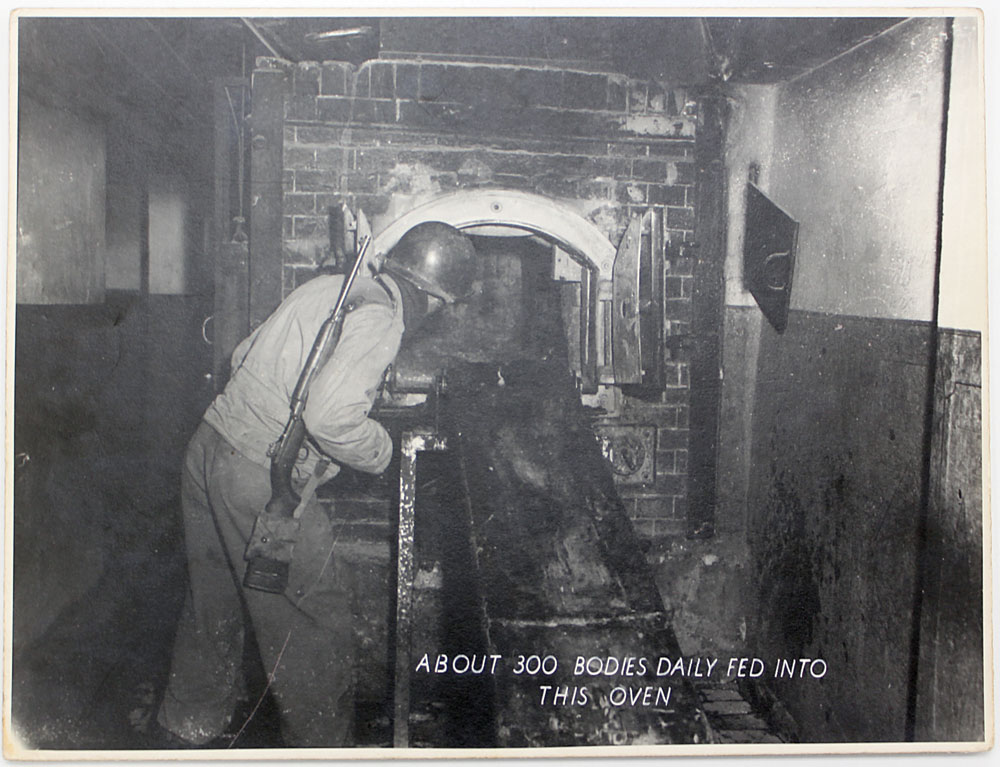
Mauthausen — the hub of a network of smaller death camps outside of Linz, Austria — was notorious for its cruelty. It had all the horrors of Nazi sadism seen at many other concentration camps: a functioning gas chamber, torture instruments and evidence of grotesque medical experimentation. Other horrors were unique to Mauthausen: Prisoners were forced to carry 50- to 60-pound rocks up 186 steep, uneven steps from a quarry. Sometimes an officer would shoot a prisoner, toppling the rest like dominoes.
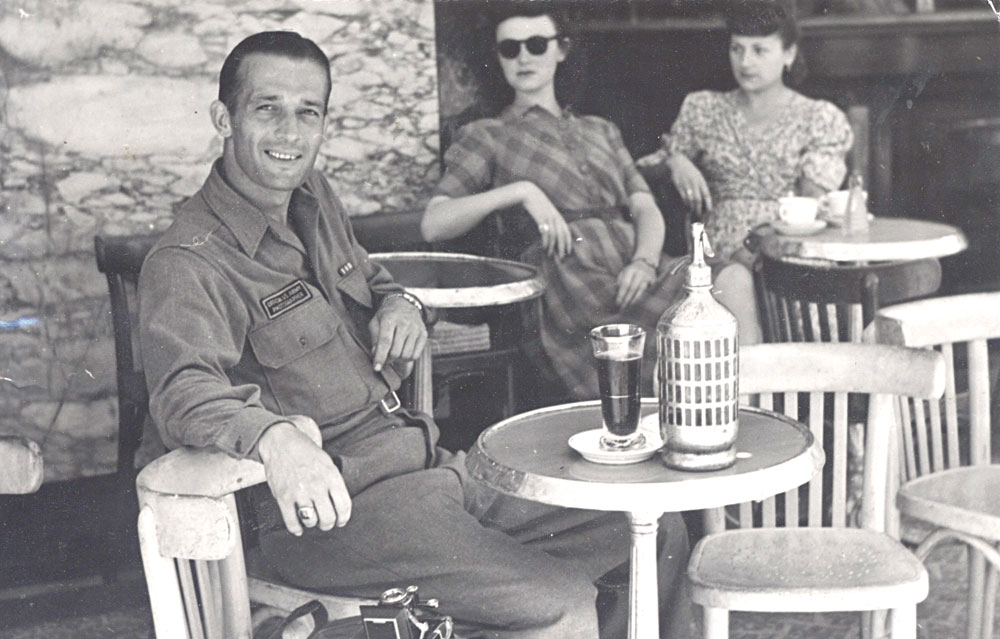
U.S. Army photographer Ken Parker in Nice, France, in 1945. Photos courtesy of Paula Parker
As the eventual outcome of the war became apparent, the camp’s leadership considered moving the remaining 18,000 prisoners into a tunnel system and sealing the exits. Instead, the SS simply abandoned the camp. The Third United States Army arrived on May 5, 1945, to find prisoners milling about in various states of starvation.
“Mauthausen, for a person going in, was absolutely bedlam,” Richard Seibel, the U.S. Army colonel who took charge of the camp after liberation, said in an interview recorded by the Dayton Holocaust Research Center in Dayton, Ohio, in 1989. “We had no water — everything had been disrupted before we got there — no water, no sewage, no food, no power, nothing. And here are 18,000 people being corralled, if you will, by combat troops who had no experience in handling a situation of this kind.”
“I’ve always heard stories about the Germans always trying to deny that they treated the people like that. Well, there’s proof in those pictures.”
Into this chaos walked Parker, who joined the war effort at 34, having already started a successful photography business in the Midwest. He easily endeared himself to colleagues, picking up nicknames like “Little Iron Man” for his compact size and tenacity, and “Tony” for his tan skin and slicked-back hair.
Before his deployment to Europe, Parker earned a reputation as a ladies’ man. He would sneak away from his Army base in Missouri and use a car he had hidden to hit the town and pick up women, according to his daughter.
As a member of the U.S. Army Signal Corps, a technology and communications division, Parker was assigned to document the U.S. combat mission, tailing Gen. George S. Patton and his troops through the Battle of the Bulge before arriving at Mauthausen.
With his camera — he favored a 35mm Nikon — Parker became involved in the documentation effort undertaken by the Allies for the twin purposes of prosecuting the Germans for war crimes and alerting the public to atrocities they had been only dimly aware of, if at all.
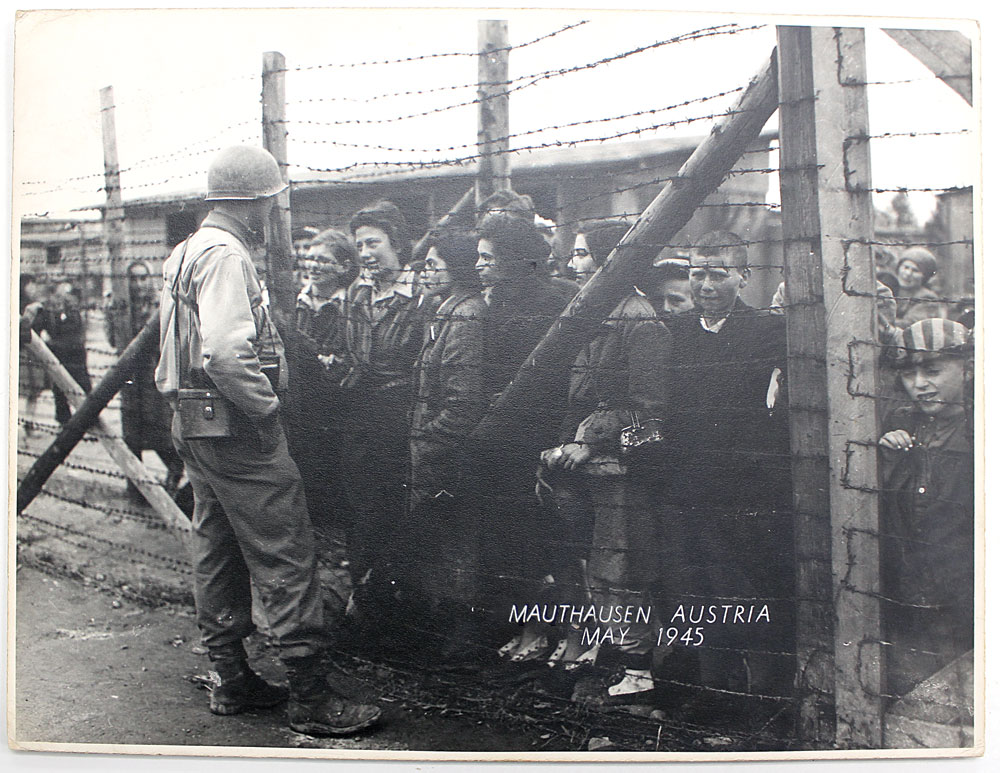
A soldier speaks with female survivors of Mauthausen shortly after the camp was liberated in May 1945.
American generals made a point of publicizing what they saw in the camps. Patton ordered the entire town of Weimar to march through Buchenwald so its residents could see the piles of emaciated corpses and a lampshade made of human skin, among other gruesome sights. Encountering the camps, Gen. Dwight D. Eisenhower, the supreme Allied commander, ordered camera crews to film them as evidence of war crimes.
“It was as if the liberators, coming originally from Eisenhower, predicted the phenomena of Holocaust denial,” said Judith Cohen, chief acquisitions curator of the United States Holocaust Memorial Museum (USHMM) in Washington, D.C. “And Eisenhower said he wanted documentation so that people wouldn’t attribute this to propaganda. That’s an amazing thing, because, of course, we see Holocaust denial left and right these days.”
In sending the photographs to the Journal, Aguilar said he had the same thought.
“I’ve always heard stories about the Germans always trying to deny that they treated the people like that,” he said. “Well, there’s proof in those pictures.”
According to Parker family lore, some of his photos ended up in the hands of prosecutors at the Nuremberg trials.
Some of Parker’s pictures also made it into the USHMM Photo Archive, courtesy of Seibel. One of them, shown here on the top right, Cohen recognized as a particularly iconic image — a picture of a soldier speaking with female survivors. In the archive, however, the photos are missing the photographer’s name. While other members of the Signal Corps went on to win widespread fame, including movie director Frank Capra and film producer Darryl F. Zanuck, Parker remained largely anonymous outside the world of Hollywood glamour photography.
Emaciated prisoners in a bunk in Mauthausen shortly after the camp was liberated.
Cohen said large amounts of historically significant material — diaries, photographs and other documents — still are stored in people’s homes, as Parker’s photos were.
“There’s an amazing amount of material still in private hands,” she said. “And we desperately would like to get it.”
“We are in a race against time,” she added.
Rabbi Michael Berenbaum, a Holocaust scholar at the American Jewish University in Bel Air, agreed.
“The reality is we’re now at one minute to midnight in the lives of the survivors, of the living witnesses,” Berenbaum said during an interview in his office. “Kids are emptying out their parents’ homes. Survivors are dying every day.”
Parker, according to his daughter, hardly ever spoke about what he saw during the war.
Moving to California in the 1940safter his Army service, Parker became a Los Angeles Police Department photographer for 11 years. He was let go for moonlighting as a photographer of pinup girls, a career that later earned him some acclaim in Hollywood.
But what he saw in Europe evidently left him with an unusually strong stomach for horrific images. Paula Parker said her father photographed the gruesome Black Dahlia murder scene for police in 1947 and kept copies, although she later threw them out, not fully aware of their value.
A soldier poses in front of an oven at Mauthausen used for the cremation of human remains.
She recounted that once, during a family vacation, her father spotted a fatal train crash along the road and pulled over.
“My mother, she couldn’t stand blood anyway,” Paula Parker said in a phone interview. “She was so upset that my father would take time out of the vacation to take pictures of people dead.”
“After the war, nothing bothered him, I think,” she said. “My dad could do things that other people couldn’t.”
While the 13 Mauthausen pictures are unsigned and no independent source could confirm Parker shot them, his daughter — who saw the photos for the first time when she was about 30 — believes they came from his camera. He often developed his own photographs and kept duplicates as keepsakes, she said.
Moreover, the Mauthausen photographs were stored among hundreds of others she inherited that he shot over his lifetime. They showed family, friends, car races, golf games, Hollywood stars like Mae West and Bing Crosby (shot for Globe Photos), and images from other countries and of natural wonders that were taken for use in advertisements promoting American Presidents Line, a shipping company.
When she spoke with the Journal, Paula Parker said clearing out her father’s photos was a necessary part ofpreparing for her Nevada retirement, after working in Jewish delis around the San Fernando Valley for 38 years, sometimes holding three jobs at once. She said she and Aguilar threw out most of her father’s photographs but kept a select few.
She was ready to pass along the pictures of starving prisoners, barbed-wire enclosures and piles of corpses.
“Oh, I’ve seen them enough,” she said, “and I’ll always remember. What am I going to do, hold on to them?”
On the evening of April 18, 1943, as Lya and Elly Meijers were being bundled up by their parents, they were told, “You’re going away for a few days.”
The day before, the girls had celebrated their shared birthday — Lya had turned 7 and Elly 4 — and now, with only a valise each and no further explanation, they were placed on the backs of bicycles belonging to non-Jewish friends, Wilhelmina and Jan van Hilten, whom the girls called Tante (Aunt) Wil and Oom (Uncle) Jan. As they rode away from their home in Utrecht, the Netherlands, Lya and Elly had no idea they soon would be separated from each other for more than two years.
They also never would see their parents again, and their only indirect communication would come 50 years later, when someone unexpectedly forwarded a postcard their father had thrown from a train on his way to a transit camp in the Netherlands, after he and their mother had been captured. It was written in pencil, dated May 1944 and addressed to a neighbor in Utrecht.
After the war, Lya and Elly were encouraged not to speak about their past. Later, as former hidden children who hadn’t experienced the horrors of roundups, ghettos or camps, they thought their stories weren’t consequential.
But faced with some personal crises in 1993, Lya began to acknowledge her long-buried anguish of having been separated from her sister and of emerging from World War II to discover that her parents and extended family — except for an uncle, aunt and cousin — had been annihilated by the Nazis. Soon after, she began sharing her story publicly. For the past five years, Elly tentatively has followed suit.
“We do have something to say. We do have a story,” Lya said. “It may not be Auschwitz,” (“Thank God,” Elly interjected) “but we have different issues.”
Lya and Elly were born in Utrecht, a city in the central Netherlands, to Lion Mauritz, known as Leo, and Renee Meijers.
Leo worked for the Hamburger Lead and Zinc manufacturing company as the equivalent of a chief financial officer. The family lived comfortably, often surrounded by friends and family. “I have memories of a happy childhood,” Lya said.
After Germany invaded and occupied the Netherlands in May 1940, anti-Jewish measures were implemented, though Lya and Elly’s parents mostly sheltered them from details of the increasingly perilous situation. By April 1943, they were living in permanent hiding places.
Lya, who kept her name, which, like her appearance, was not identifiably Jewish, was placed with the Broers family in Amersfoort, about 15 miles northeast of Utrecht. She was instructed to tell people, if asked, she was from Rotterdam, which had been heavily bombed, and didn’t know her parents’ fate.
Hugo Broers was an ophthalmologist with an office on the first floor of their spacious house. His wife, Kathy, worked with him. They had two daughters, Pauline, then 6, and Francine, 4. “I was treated as one of the girls,” Lya said.
The first night, when Hugo and Kathy entered Lya’s large bedroom to say goodnight, Lya burst into tears. “I don’t want to sleep alone,” she told them. The parents moved her into their girls’ bedroom the following night.
Sometime later, a new housekeeper cornered Lya, interrogating her. “What kind of parents do you have? They don’t write. They don’t see you,” she said. Lya remained outwardly calm. “I don’t know. I’m from Rotterdam,” she answered.
That night, Lya recounted the incident to her foster parents. “We’re really proud that you stuck to your story,” they told her, rewarding her with a scarce piece of candy and firing the housekeeper.
Elly doesn’t recall being taken to her foster families in 1943. “But I remember the families,” she said.
She first was placed on a farm in Baambrugge, about 18 miles north of Utrecht, with Wijntje and Jacobus Griffioen and their six children. But after six months, because the house was close to the road and because Elly’s darker hair and complexion made her conspicuous, she was moved to the farm of Wijntje’s sister and brother-in-law, Cornelia and Jan van der Lee.
At the time, the van der Lees had six children. They were not well-to-do, but, Elly said. “They were rich in religion and family life.” Elly attended their Dutch Reform church and was part of the family. “I was loved until [they] died,” she said. Jan van der Lee died in 1968; his wife, who was known as Cor, died in 2006.
On May 5, 1945, the area was liberated. “The [Dutch] flags went out and people were celebrating,” Lya said. Allied tanks and jeeps rolled in, and the children were allowed on the street, where soldiers distributed chocolate and white bread.
A couple of months later, Lya was visited by her Uncle Lex, their birth father’s brother, who had been in hiding himself and who had learned the girls’ locations, most likely through the van Hiltens. He reunited Lya with Elly, whom she didn’t recognize but by day’s end didn’t want to leave, in fear of being separated again. The foster parents agreed that Lya should stay with Elly while Lex and his wife, who had two daughters of their own, searched for housing.
One day, Cor van der Lee called Lya and Elly into the front room, which was used only on Sundays and holidays. “I have to tell you, Mommy and Daddy have gone to heaven,” she told the girls. Lya immediately burst into tears. “That couldn’t be,” she said. “They loved us.”
In November 1945, the girls moved to Amsterdam with their Uncle Lex and his family. They lived in a large house and attended the Rosh Pina Jewish school. “We had a good family life,” Lya said.
But when the Hungarian Revolution broke out in 1956, Lex announced, “We’re not staying here to go through this again.” They arrived in the United States as immigrants a year later.
The family first lived in Glendale, where Lya and Elly worked in banking. Eighteen months later, they moved to Los Angeles.
Lya married Henk Frank in December 1959. Their daughter, Terry, was born in August 1962. Elly and Coleman Rubin married in December 1962. Their two children are Mark, born in August 1964, and Sharon, born in April 1966. Coleman died in 2004 and Henk in 2014. Lya has two grandchildren and Elly has nine.
Over the years, Lya and Elly learned that their parents — along with two uncles, an aunt, their grandmother and a cousin — had been hidden by two brothers in Brummen, a village in central Netherlands, which was their father’s birthplace. There, one brother’s step-daughter, who was having a relationship with a German officer, divulged their hiding places and got paid for the information. “For a small amount of money, they annihilated our whole family,” Lya said.
Lya and Elly also learned that as the bus carrying the captured family members pulled away from Brummen, their mother was shouting, “I want my children. I want my children.”
The family was taken to the Westerbork transit camp and then to Auschwitz, where only a cousin survived.
The van Hiltens, Broers, Griffioens and van der Lees all have been recognized as Righteous Among the Nations by Yad Vashem. Lya and Elly have remained close to the families, visiting through the years. “I loved these families. I still do,” Elly said.
Lya and Elly said they feel fortunate to have each other, each other’s families and their hiding families.
“You know what?” Lya repeated. “We do have a story to tell.”
The roots of modern Jewish conservative politics in Los Angeles were planted in the San Fernando Valley suburbs by Arnold L. Steinberg, a perceptive campaign consultant, and the candidate he helped make a star, Bobbi Fiedler.
Steinberg tells the stories of his many campaigns in a new, insightful memoir, “Whiplash.” For those of you who are like me, obsessive followers of political news and history, “Whiplash” is an invaluable journey through conservative Republican politics, especially relevant now with Republicans in control of Congress and the presidency.
Steinberg, whom I have known for years, is more conservative than I am, by far. For example, I found it annoying when he referred to the public schools he’d attended — John Burroughs Middle School and Fairfax High — as “government schools,” making them sound like second-rate detention facilities. Come on, Steinberg! They were good enough to get you into UCLA, then on to a successful career as one of the first consultants to use advanced statistics to shape a political campaign.
To me, the most interesting and significant part of the book is the story of how Fiedler ran for the Los Angeles Unified School District (LAUSD) board in 1977.
Fiedler was a leader of a group of mothers, many of them Jewish, at Lanai Road Elementary School in Encino. A court had ruled that LAUSD was segregated. It ordered the district to be desegregated, which meant that large numbers of students of all races would be bused across town and put together in schools that had been long segregated by neighborhoods. The plan exacerbated Los Angeles’ race problems.
Fiedler organized a group known as Bustop, which fought the court order and became a powerful political force in the city. At the time, I was covering the desegregation story for the Los Angeles Times and got to know Fiedler and some of the other Lanai Road school mothers
Steinberg, then a young political consultant, didn’t see busing as his battle. He was single. “But I had cousins of modest means who wanted their children close to home,” he wrote. “This mandatory busing seemed preposterous.” Steinberg, not limited by a false sense of modesty, said, “I decided in 1977 to take over the Los Angeles school board by electing a majority opposed to forced busing.” That’s when he met Fiedler.
There were Jewish Republicans at the time but not many. A notable one was Taft Schreiber, a power in the entertainment industry who had been close to Ronald Reagan since the former governor and future president’s show business days. Most Jews were liberal and supporters of the African-American mayor, Tom Bradley, and the Westside-San Fernando Valley political operation headed by Howard Berman and Henry Waxman. But the prospect of busing angered liberals. That was clear to me when I interviewed Jewish Bustop activists, who included a substantial number of Democrats.
Steinberg saw Fiedler as a winner for a school board seat. He wrote, “Bobbi, intuitively bright and very strategic, was determined; she managed her husband’s pharmacy business. She did not have Republican roots, and was hardly a movement conservative. Like many of her Jewish contemporaries, she had backed the civil rights movement. But she opposed the forced busing of her two small children.”
With Steinberg and communications chief Paul Clarke, who later married Fiedler, calling the shots, Fiedler won, and the board’s pro-busing majority was beaten. Presiding over the board as president was Roberta Weintraub, another San Fernando Valley anti-busing leader. “We did it,” Weintraub said after the vote.
Fiedler, by then a Republican, went on to defeat a highly favored incumbent Democratic congressman and served three terms in the U.S. House.
Fiedler’s victories did not signal a Jewish conservative tidal wave. Jews continue to vote solidly Democratic in Los Angeles and elsewhere. But what Fiedler and Steinberg had tapped was an undercurrent of discontent with the Jewish establishment, a constant Steinberg theme. He wrote, “I occasionally found myself as the token conservative on an election panel that ranged from the Los Angeles Jewish Federation Council … to the American Israel Public Affairs Committee … [and] at an AJC reception a very wealthy Jewish philanthropist might agree with my sentiments but would ask if I would keep the conversation with him ‘confidential. ’ ”
Steinberg sounds as if he took it personally, as I would have. It was as if the rich man was ashamed to be caught talking to anti-busing advocate Steinberg.
Part of the grass roots’ anger could be traced to its opposition to the school board and its desegregation plan. And part was working-class and middle-class resentment of the establishment leaders who tended to support the plan.
Steinberg’s roots are in the Jewish working class. “During World War II, my father left New York for Los Angeles where he used his savings to buy a small market at the corner of 59th Street and Central Avenue,” Steinberg recalled.“He and my mother worked six full days a week.”
His extended family was similarly situated.
“Generally,” he wrote, “my relatives and their families were not into amusement parks and expensive outings — just a whole large extended family gathering nearly every Sunday in the public park. … These picnics helped me understand how people from modest circumstances can have a sense of community and have fun.”
When Bobbi Fiedler appeared on the scene, her critics, including the Jewish establishment, first tried to dismiss her as an inconsequential Valley housewife and then a bigot. Steinberg saw her as someone who could connect with people like him and his family.
The busing plan collapsed in 1981, killed by an appellate court decision, a unanimous school board vote and persistent opposition by white parents who began pulling their children from public schools.
The impact of the campaign lingers. Echoes of it could be seen in the anti-establishment aspects of President Donald Trump’s election campaign.
“Trump did not stir the expected scare among Jewish voters,” Shmuel Rosner wrote in the Jewish Journal after the election. “The share of the Democratic vote among Jews continues the slow yet steady decline from the early ’90s to today: 80 percent, 78 percent, 79 percent, 74 percent, 74 percent, 70 percent, 70 percent.”
Forty years ago, this would have been considered impossible. Then came Bustop, the empowerment of San Fernando Valley Jewish parents and the rise of conservative Jewish grass-roots political influence.
BILL BOYARSKY is a columnist for the Jewish Journal, Truthdig and L.A. Observed, and the author of “Inventing L.A.: The Chandlers and Their Times” (Angel City Press).
Ben Cardin, one of a handful of Senate Democrats who opposed the Iran nuclear deal, urged the Trump administration not to pull out of it — the latest indication of congressional resistance to killing the agreement.
“If we violate a U.N. resolution, in the eyes of the international community, do we have any credibility?” Cardin asked Wednesday at a monthly meeting he holds with foreign policy reporters, referring to the Security Council resolution that undergirds the deal. “I don’t understand the strategy to set up the potential of the United States walking away from a nuclear agreement.”
Cardin, who is Jewish and the top Democrat on the Senate’s Foreign Relations Committee, was one of four Senate Democrats who opposed the 2015 deal, which trades sanctions relief for Iran’s rollback of its nuclear program.
He warned the administration to stick to the deal as long as Iran is abiding by it. President Donald Trump has called the agreement one of the worst he ever encountered and intimated he might kill it or at least open it up to renegotiation.
Cardin said he was speaking for many opponents of the deal.
“We thought it was the wrong decision,” he said, “but we want to see it implemented.”
Trump has said his decision on what to do with the deal will be known by next month. The president can declare Iran is not complying with the agreement under a law that Cardin co-authored that requires the president to periodically certify Iran is abiding by the pact. That would give Congress 60 days to reimpose sanctions — effectively leaving it up to lawmakers whether to withdraw from the deal. The certification is due by Oct. 15.
Cardin said kicking the ball to Congress would be an abdication of executive responsibility.
“This is not a congressional agreement, this is an agreement entered into by the president,” he said.
Trump may also unilaterally stop the deal simply by refusing to waive sanctions.
Cardin echoed warnings issued earlier this week by European ambassadors that there is little appetite among U.S. allies to end the deal.
“It’s pretty universal that our friends don’t want us to walk away from the agreement,” he said.
Cardin last week joined six other Senate Democrats in top security positions in a letter to administration officials demanding evidence that Iran is not in compliance. U.N. nuclear inspectors have repeatedly certified Iranian compliance.
The resistance to ending the deal is not confined to Democrats. The top foreign policy Republican in the U.S. House of Representatives, Rep. Ed Royce of California, the chairman of the Foreign Affairs Committee, said earlier this month that he would prefer to keep the deal in place. He added that Trump should “enforce the hell out of it.”
And on Wednesday in the House, a Republican, Rep. Francis Rooney of Florida, and a Democrat, Gerald Connolly of Virginia, introduced a bill that would devolve oversight of the agreement on a bipartisan commission to include 16 lawmakers — equally split between Democrats and Republicans from the House and Senate — and four executive branch officials.
Connolly in a joint news release with Rooney indicated that the aim of the commission would be to protect the deal from the whims of the president.
“Congress has a role to play in effective oversight of this agreement, and we must assert that role regardless of whether the President certifies Iran’s compliance,” he said.
Trump derided the deal last week during the U.N. General Assembly as one of the worst he had ever encountered, and he was joined in that assessment by Israeli Prime Minister Benjamin Netanyahu. Trump is also under pressure from some conservatives to kill the deal.
This week, a letter from 45 national security experts urged Trump to quash the deal, hewing to a plan drafted by John Bolton, a former ambassador to the United Nations. Among the signers was Morton Klein, president of the Zionist Organization of America.
Like the European ambassadors who warned against pulling out of the deal, Cardin urged Trump to use the available tools to pressure Iran to modify its behavior, outside the parameter of the nuclear agreement, including a range of sanctions targeting Iran’s missile testing and its military adventurism.
“Seeking the support of our allies to isolate Iran for its non-nuclear activity,” he said. “That should be our strategy.”
Over the course of its four seasons, “Transparent” has been creating groundbreaking conversation about gender identity, telling the story of a family in which one parent is going through gender transition. It’s also become known as one of the “Jewiest” shows on TV, pushing deeper into issues of secular Jewish identity and introducing many to epigenetics, the idea that trauma — in many Jewish cases, Holocaust suffering — is hereditary, passed down from the generation that experienced it, to echo in future generations.
These conversations are complicated, and with the fourth season now available on Amazon Prime, “Transparent” adds another controversial topic: the Israel-Palestine conflict. (The following includes spoilers from Season Four.)
Throughout the series, the Pfeffermans have struggled with boundaries, definitions and fluidities; characters push against and dismantle binaries, rejecting constructs like “black/white” or “male/female” in favor of multiplicity and expanded perspectives. In Season One, Mort Pfefferman (Jeffrey Tambor) transitioned to become Maura, a decision that reshapes the family journey moving forward.In the new season, Maura is invited to speak at a conference in Israel and makes a discovery that further impacts the definition of family. The Pfefferman children — Sarah (Amy Landecker), Josh (Jay Duplass) and Ali (Gaby Hoffmann) — struggle with nonconforming identities and relationships.
The tour bus full of Pfeffermans shleps with it the traditional baggage of old and new American-Jewish perspectives on Israel: An older generation argues for Israel’s position as a safe home for Jews after pogroms and the Holocaust but is unable to see any nuance to the current conflict and is unwilling to criticize the Israeli government. The young see the black and white of suffering and inequality, whether it’s a stark imbalance of Western Wall plaza space for women or oppression of Palestinians.
When it comes to the Israeli-Palestinian storyline, the Palestinian narrative gets the most visibility. In Ramallah, the youngest Pfefferman, Ali, hears stories from her activist friends and the Palestinians who live there, of Israelis blackmailing Palestinians and exploiting their vulnerabilities, such as sexual orientation, to recruit them as informants, and that some of them can’t visit Jerusalem without permits. She asks if checkpoints are “along the border” and is quickly corrected that “there is no actual internationally recognized border, just one big, ugly wall and hundreds of checkpoints all over the place.” It’s life on the ground for the Palestinians and their activist friends, without any larger context: There’s no acknowledgment of why the wall is there, and the one person who says, “Not every Israeli is here to get rid of Palestinians” is all but drowned out as others talk over her.
Responding to her family saying that Israel was created to be a safe place for Jews post-persecution, Ali says, “We do not need to make the Palestinians unsafe just so the Jews can be safe.” But there’s no discussion of the reason for the existence of the divider and the outcome, that it is believed to have increased security for Israel by severely curtailing suicide bombings (although violence continues, as this week’s shooting in the West Bank demonstrates).
Ali always has been the millennial searcher, looking for truth, equality, love and acceptance. Her sense of right and wrong is only partly innate, and ignited and amplified by the people she meets and loves. But it would have been even more interesting if she had to navigate conflicting narratives, each of which was making compelling — and passionate — points and presented by people with whom she shares a peer-level respect and an emotional connection.
These scenes paint an unbridgeable gap: The previous generation is living in the past, unable to step away from its narrative to see any negative outcome, and the younger generation is passionate about Palestinian rights as part of an overall quest for justice but divorced from the region’s history as context. Each perspective sees no other choice; each perspective has its valid points and its blindnesses, all forged in history and emotion, with no room for nuance or compassion.
In real life in the modern American-Jewish community, when it comes to “the conflict,” there are extreme positions that mirror the extremes in the Pfefferman clan. But those of us who don’t adhere to edges or subscribe to extremes are, perhaps, more silent because we’re seeing both sides but don’t have answers, and perhaps more disturbingly, don’t have any confidence that either side is willing to listen.
Throughout, the Pfeffermans’ visit to Israel is underscored by the songs of “Jesus Christ Superstar,” a soundtrack both geographically appropriate and subversive as a score for a Jewish family’s tour of the Holy Land. For example, take “Everything’s Alright.” Its lyrics — “Try not to get worried/try not to turn on to/problems that upset you, oh/don’t you know/everything’s alright, yes, everything’s fine” — indicate a kind of wishful thinking. “Close your eyes/close your eyes/and relax/think of nothing tonight” may be a good, in-the-moment coping strategy for a fictional, rock ’n’ roll opera Jesus, but it doesn’t solve systemic problems, whether they are Pfefferman family conflicts or regional ones.
Much has been written about the unlikability and selfishness of these characters. “Transparent” is intentionally disruptive and seems built to make the characters, and viewers by extension, uncomfortable, making it a perfect tonal match for the subject of the Israeli-Palestinian conflict, in which self-interest is a necessary guiding principle and discomfort reigns as conversational default.
If there’s one thing we should be learning from the Pfeffermans, it is perhaps that pushing against social limits and rejecting binary definitions, even — or especially — in a conflict as emotional and deeply rooted as the one in the Middle East, reveals the space between extremes. It is there, not at one pole or another, that we can do our individual work in discovering identity and exercise our sense of nuance and compassion.