I like the Jewish services. I like the structure of them. I like singing along, and unintentionally embarrassing my daughters because of my loud voice. I like hearing something new each time, or at least challenging myself to, as we return and return again to the same words year after year.
This year, when it came time for silent prayer, I had to smile. Or tear up. It depended on the time. I am on doctor’s orders for voice rest. This is par for the course for performers, and though I have been through it before, it has never come during such an important season. I took it, once I stopped being mad at myself, the world and my mother, (seeing as that is the convenient route we adult children seem to take), as an opportunity to deepen the whole experience. To really listen to the music I usually sing out loud has been worth its weight in gold. To really hear the parts and the voices, and to hear my daughters’ and their beautiful maturing voices on their own not in harmony or discord with mine has been a huge gift. To get out-of-the-way.
Getting out of our own way takes a real effort. It certainly takes more listening. To the messages from your mind and the silent ones from your body. I have noticed how my whole body can tense up or release when words are used or removed. I notice too how certain things cannot get done as fast, and these are precisely the things that SHOULD not be done as fast. Like returning a phone call or text. Like listening to a person. Any person. Or like just being in silence fully with yourself.
These are things we know. We hear about them, and try them out, and we forget about them just as fast. I will certainly forget and take things like this presence for granted again once my voice returns. But for now? I continue to stand in silent prayer.
Thank you for your patient practices, and for reading.
The recent resurgence of public Nazi presence reminds me of some Nazi chocolate history. I discuss this more fully in my book.
European Jewish businesses, including a number of Jewish chocolate enterprises, were forced to shut down during World War II. Stephen Klein fled Vienna the day after the 1938 Nazi march into Austria known as the Anschluss.
In Vienna, Klein had owned one of the city’s largest commercial suppliers of chocolate. A Nazi competitor marched into Klein’s offices and seized ownership of Klein’s company the day after the Anschluss. To escape likely arrest, Klein hurriedly left his two children and pregnant wife behind, spending five months in Belgium before arriving in the United States. In New York, he started selling European chocolate from pushcarts, eventually developing what became the very popular Barton’s Bonbonniere.
Barton’s in turn assisted other World War II refugees seeking to immigrate to America. Memorabilia from the company will be displayed at the Herbert and Eileen Bernard Museum from October 20, 2017–February 25, 2018 at Temple Emanu-El, NYC the first ever exhibit about Jews and chocolate.
Nestle’s chocolate subsidiary, Maggi, employed thousands of war prisoners and Jewish slave laborers in its factory in Germany near the Swiss border. As recently as 1997, it refused to open its Nazi-era records. Nazis also used chocolate bars to lure Jews onto cattle car trains to concentration camps. They used chocolate to poison Allied officers. German saboteurs designed a chocolate-covered, sleek, steel bomb intended to explode seven seconds after breaking off a piece of the bar.
Perhaps it is not surprising then that a hideaway of former Nazis, Bariloche, Argentina, is known as the chocolate center of Argentina. One of the main streets is Mitre Avenue is known as the Avenue of Chocolate Dreams. Visitors learn more at Havanna Museo del Chocolate. Bariloche’s annual chocolate festival features an 8 meter high Easter egg. Germans settled there at the end of the 19th century. By the 1930s it already had the look of of an alpine town and came to be called “Little Switzerland.” By the 1990s attention centered on hidden Nazis, including SS Hauptsturmfürer Erich Priebke.
If these stories leave a bad taste in your mouth, as they do mine, I suggest that in addition to supporting organizations such as the Anti-Defamation League, reach for some quality chocolate.
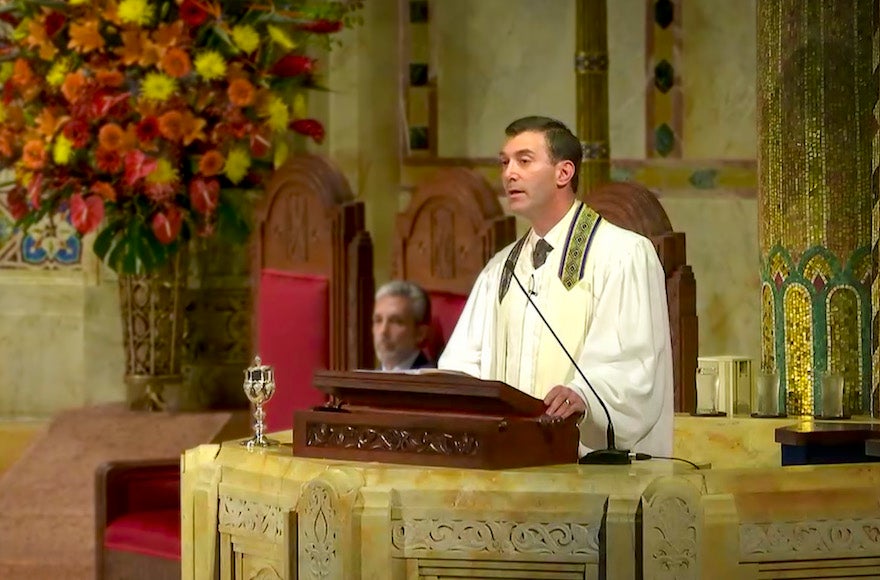
As spiritual leader of one of the most widely known Reform synagogues in America, Rabbi Joshua Davidson tries not to be divisive on the holiest days of the year.
So on the High Holy Days of years past, when he stood before thousands of congregants at Temple Emanu-El in New York City, Davidson stuck to universal and uncontroversial topics. In 2015, he spoke about the synagogue’s history and mission. A year ago, in the heat of an acrimonious election, he talked about civic duty and the value of political participation.
But this year, Davidson criticized President Donald Trump.
His Rosh Hashanah sermon last week was on “trying to lift ourselves above the dishonesty, the incivility, the indecency which so many feel has become the societal norm,” he said. One of the hallmarks of that indecency, according to Davidson, was Trump’s response to the August white supremacist rally in Charlottesville, Virginia.
“I certainly mentioned the president in certain contexts,” he told JTA. “I mentioned his response to Charlottesville and condemned it. We have to condemn any sort of equivocation when it comes to bigotry in the strongest terms. His response was an affront to decency.”
Whether or not to use the bimah as a bully pulpit has become a particularly burning issue in the first year of the Trump presidency, which even his supporters acknowledge has been unusually divisive. Non-Orthodox Jews, who make up the vast majority of American Jewry, voted against Trump in wide margins. According to a recent poll, a majority of Orthodox Jews voted for him and approve of his performance.
But rabbis disagree when it comes to talking politics from the pulpit, especially when more Jews attend their synagogues than at any other time of the year. For every rabbi who insists on taking clear stands, others worry about alienating congregants who may disagree.
Rabbi Shalom Baum advocated policies as a past president of the Orthodox Rabbinical Council of America. But he avoids discussing politics from his pulpit at Congregation Keter Torah in Teaneck, New Jersey. The High Holy Days, he said, are a time to rediscover the good in other people, not to find more reasons to disagree.
“It’s a time for spiritual growth which increases both our connection to God and our connection to people,” he told JTA. “When it comes to the way we view other people I try to focus, on the High Holy Days, on what’s right with other people, as opposed to the things that divide us.”
Rabbi Joshua Davidson delivering a High Holidays sermon at Temple Emanu-El in New York City, September 2017. (Courtesy of Temple Emanu-El)
Other politically active rabbis agree that partisan political opinions don’t belong in a sermon — and especially not on the holiest days of the year.
Rabbi Shmuel Herzfeld of Ohev Sholom-The National Synagogue in Washington, D.C., protested Trump’s 2016 speech at the AIPAC conference while wearing a prayer shawl. But he studiously avoids talking politics in synagogue.
Herzfeld’s first sermon focused on his experience volunteering to clean up Houston following Hurricane Harvey. His Yom Kippur sermon will be about the Charlottesville rally, but it won’t mention Trump. And though he has titled the sermon “Removing Our Walls,” Herzfeld insisted to JTA that he is not alluding to the border wall with Mexico that Trump has proposed.
“This group of Nazis was trying to put up walls between different communities,” he plans to say in the Yom Kippur sermon, referring to the marchers in Charlottesville. “If we are an ‘us against them’ world, an ‘us against them country’ and an ‘us against them community,’ then we are all in big trouble.”
Davidson is one of several prominent rabbis who used their pulpit on the holiest days of the year to criticize the president. Some are open about their politics and said opposition to Trump was either a matter of consensus in the congregation, or his actions have been too egregious to ignore.
“This isn’t a time for us to be silent or to be too careful not to offend anybody,” said Rabbi Sharon Brous of Ikar, an independent congregation in Los Angeles. “But instead, it’s a time for us to speak as clearly as we possibly can about the dangers we are facing as a community and a nation.”
On the first day of Rosh Hashanah, Brous in her sermon accused Trump of making America “a place in which anti-Semitism is condoned by the state.” She also criticized establishment Jewish organizations for not speaking out enough against Trump for what she said are rhetoric and actions condoning the white supremacists.
Brous has opined publicly about her politics in the past and delivered an invocation at President Barack Obama’s 2013 inauguration. Her second-day Rosh Hashanah sermon this year advocated reparations for African-Americans.
“Many of our Jewish institutions failed to find the words to condemn the spike in anti-Semitic attacks that coincided with the 2016 presidential campaign,” Brous said in the first-day sermon, adding that they “failed to speak out against white nationalist sympathizers — men who have trafficked in anti-Semitism and racism for years — becoming senior White House officials.”
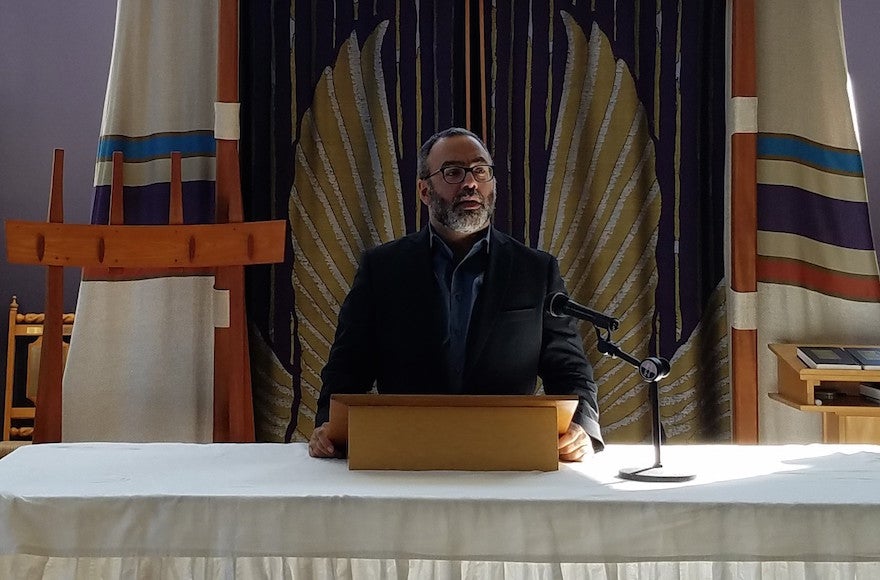
Rabbi Menachem Creditor speaking to his Congregation Netivot Shalom in Berkeley, Calif. (Courtesy of Creditor)
Rabbi Sharon Kleinbaum of Congregation Beit Simchat Torah, an LGBT synagogue in Manhattan, likewise accused Trump of cozying up to anti-Semites. Her whole congregation opposes the president, she said, so calling him out was not a risk.
“I don’t think everyone agrees with me on everything, but overall our congregation is horrified at what’s happening in our country,” Kleinbaum said. “As Jews who are all immigrants, we’re horrified. As gay people, we’re horrified at the gender violence.”
In May, Trump signed an executive order allowing clergy to endorse or oppose candidates from the pulpit. The order effectively repealed the Johnson Amendment, which threatened the tax-exempt status of religious institutions if they appeared partisan.
While a range of Jewish groups criticized the order as eroding the separation of church and state, Trump characterized it as an expansion of freedom of religion.
Another rabbi unafraid to get political, Menachem Creditor of Congregation Netivot Shalom in Berkeley, California, sermonized about not becoming ensnared in the now-endless stream of headlines and presidential tweets. While he stressed that his point was not to be consumed by any one issue, his sermon did criticize Trump’s policies on immigration and climate change.
He also spoke about the virtue of mixing religion and politics, which has been a hallmark of his career. An outspoken advocate for immigrant rights and gun control, Creditor announced recently that he would be leaving his pulpit to become a full-time activist.
“I think the posture of religion has always been within the world,” he told JTA. “Even the most devout of religious communities all band together to vote in certain patterns, act in certain patterns to influence the world. To abdicate that responsibility is to become islands and ultimately self-idolize.”
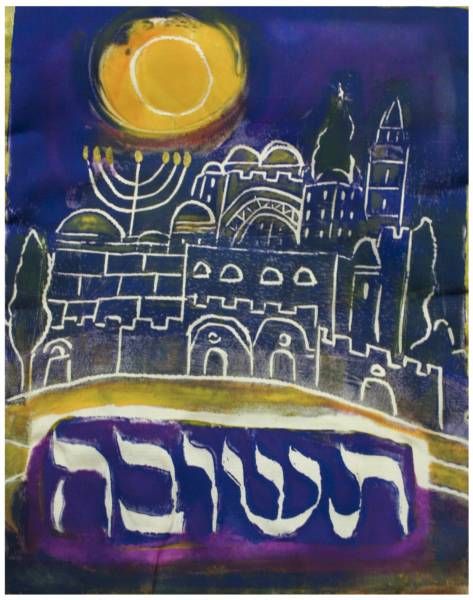
The primary responsibility of the Jew during the ten days between Rosh Hashanah and Yom Kippur is teshuvah.
I have posted here classic rabbinic text for study and contemplation during these days. I wish for everyone the strength and courage to confront that which prevents us from being close to the people we love, friends, community, the Jewish people, Torah, and God.
“Repentance must be preceded by the recognition of seven things: (1) the penitent must clearly recognize the heinousness of what s/he has done… (2) S/he must be aware that his/her specific act was legally evil and ignominious… (3) S/he must realize that retribution for his/her misdeed is inevitable… (4) S/he must realize that his/her sin is noted and recorded in the book of his iniquities… (5) S/he must be fully convinced that repentance is the remedy for his/her sickness and the road to recovery from his/her evil deed… (6) S/he must conscientiously reflect upon the bounties the Creator had already bestowed upon him/her, and how S/he had rebelled against God instead of being grateful to the Eternal… (7) S/he must strenuously persevere in keeping away from the evil to which s/he had been addicted and firmly resolve in his/her heart and mind to renounce it. – Bachya ibn Pakuda, Duties of the Heart 7:3
“What is t’shuvah? It is when a sinner abandons his/her sin and removes it from his/her thoughts, and resolves in his/her heart not to do that deed again. As it says, “Let the wicked person forsake his/her way, and the unrighteous one his/her thoughts.” (Isaiah 55:7) And so s/he repents for the past. As it says, “After I turned away, I repented.” (Jeremiah 31:18) And s/he will call the Knower of secrets to testify against him/her that s/he will never again return to this sin. As it does not say, “Nor shall we say ever again to the work of our hands, ‘You are our God’ (Hosea 14:4). And s/he must confess in words these things that s/he has resolved in his/her heart. – Maimonides, Mishnah Torah, Laws of Repentance 2:2
It is very praiseworthy for the penitent to confess publicly and announce his/her sins, and reveal to others the transgressions he committed against his/her fellow. S/he should say to them, “Truly I have sinned against so-and-so by doing such-and-such. But now I am turning and repenting.” Everyone who is arrogant and doesn’t reveal but rather conceals his/her sins – his/her t’shuvah isn’t complete. As it says, “One who conceals his transgressions does not succeed.” (Proverbs 28:13) – Maimonides, Mishnah Torah, Laws of Repentance 2:5
“What is complete t’shuvah? When one comes upon a situation in which s/he once transgressed, and it is possible to do so again, but s/he refrains and doesn’t transgress on account of his/her repentance. – Maimonides, Mishnah Torah, Laws of Repentance 2:1
“Humility is the root and beginning of repentance.” – Bachya ibn Pakuda
“Rabbi Eliezer said, “Repent one day before your death.” His disciples asked him, “Does then one know on what day s/he will die?” “All the more reason s/he should repent today, lest s/he die tomorrow.” – Babylonian Talmud, Shabbat 53a
“Great is repentance, for it brings healing to the world… When an individual repents, s/he is forgiven, and the entire world with him.” Babylonian Talmud, Yoma 86b
“How wonderful is the moral perspective that arises from this great responsibility – a responsibility for all of existence, for all worlds. We have the power to bring favor and light, life, joy, and honor in these worlds. This occurs when we follow the straight path, when we strengthen and gird ourselves with a pure fortitude and conquer paths of life that are good and admired, when we advance and go from strength to strength…. YYet it is also in our power to bring pain to every good portion, when we debase our souls and corrupt our ways, when we darken our spiritual light and suspend our moral purity.” – Rabbi Abraham Isaac Cook, Orot HaKodesh vol. III, p. 63
G’mar chatimah tovah. May you be sealed in the book of life.
[Ed. Note: I chose to publish this entry in the blog for the week leading up to Yom Kippur because the Yizkor (Memorial) service on Yom Kippur is so often a major focus in many communities. This article speaks to how memory may be fraught, and not always what we might picture. — JB]
Whether it is Yizkor or just an ordinary service, the prayers before reciting the Kaddish can make some grievers feel even more rotten instead of better. What if a mother or father was not particularly one for whom “we recall the joy of their companionship”? What if “their memory” does not exactly bring “strength and blessing?” I remember in rabbinic school wrestling with the meaning of the Fifth Commandment for those who have or did have abusive parents. How can one be good to oneself, which is a mitzvah, yet honor such a parent?
For grievers of such parents, the idea of grieving feels paradoxical. It seems straightforward enough and certainly painful enough to grieve a parent whose memories of their goodness sustains you. But a neglectful or downright hurtful mother or father elicits enough loads of guilt and anger to go round. And sadness is more about the protection or help or advice or love that parent did not provide; about the parent you never had. Thus, condolences and standard prayers before the Kaddish hardly bring comfort. Instead they are a jarring reminder of how your parent shortchanged you.
The definition a health professional gives to grieving is “reaction to the loss.” That is a broad enough definition to cover all situations. Still, how to start going about it is much more puzzling to a mourner of troubled parents. What does it mean to sit shiva for such a parent? What does it mean to recite the Kaddish for them? To me, the prepositon “for” suggests doing a ritual or prayer as an act of goodness, appreciation and love. And of course we use the expression “grieving for” so-and-so.
It seems odd to say under such circumstances, that “I am grieving for my mother.” I think part of successful grieving is portraying the process to oneself as honestly and accurately as possible. Otherwise you will hinder the purpose of grieving in the first place, which is to allow all the feelings, great and small, peaceful and turbulent, joyful and gloomy, an open path for release. Somehow saying “grieving for” sounds like the tears are ready to roll at almost any provocation and that you miss them if not for how they were at the time of their passing, then at least for how they were in better days.
I think honesty in how we use language is one step in figuring out and expressing how we really feel, which is what healthy grieving is all about. As a symbolic baby step towards this goal, I am inventing a new expression for those who did not have parents who could be caring and be there for you:
“I am grieving against my mother.”
Methinks I have found a solution for us unconventional grievers. Let me know if the sentence below helps to express to yourself how you really feel about that louse. Does saying it this way give you permission to stop censoring those less socially acceptable emotions?
“I am grieving against my father.”
Rabbi and board certified Chaplain Karen B. Kaplan is author of Encountering the Edge: What People Told Me Before They Died (Pen-L Publishing, 2014) a series of true anecdotes capped with the deeper reasons she chose her vocation. She has also recently published a collection of science fiction stories, Curiosity Seekers (Createspace Independent Publishing, 2017). She has submitted multiple entries published in Expired And Inspired.
Rabbi Karen B. Kaplan
___________
GAMLIEL INSTITUTE COURSES
LOOKING FORWARD: UPCOMING COURSE
The Gamliel Institute will be offering course 5, Chevrah Kadisha: Ritual, Liturgy, & Practice (Other than Taharah & Shmirah), online, afternoons/evenings, in the Winter semester, starting roughly in January, 2018. This is the core course focusing on ritual, liturgy, practical matters, how-to, and what it means (for everything other than Taharah and Shmirah, which are covered in course 2).
CLASS SESSIONS
The course will meet online for twelve Tuesdays (the day will be adjusted in any weeks with Jewish holidays during this course).
Information on attending the course preview, the online orientation, and the course will be announced and sent to those registered. Register or contact us for more information.
REGISTRATION
You can register for any Gamliel Institute course online at jewish-funerals.org/gamreg. A full description of all of the courses is found there.
Gamliel Students are invited to an informal online monthly session on the 3rd Wednedsays of most months. Each month, a different person will offer a short teaching or share some thoughts on a topic of interest to them, and those who are online will have a chance to respond, share their own stories and information, and build our Gamliel Institute community connections. This initiative is being headed up by Rena Boroditsky and Rick Light. You should receive email reminders monthly. The next scheduled session of the Gamliel Café is October 18th.
Graduates of the Gamliel Institute, and Gamliel students who have completed three or more Gamliel Institute courses should be on the lookout for information on a series of “Gamliel Graduate’ Courses, advanced sessions focusing in on different topics. These will be in groups of three sessions each quarter (three consecutive weeks), with different topics addressed in each series. The goal is to look at these topics in more depth than possible during the core courses. We plan to begin this Fall, in October and November. The first series will be on Psalms. Registration will be required, and there will be a tuition charge of $72 for the three sessions. Heading this intiative is the dynamic duo of Rena Boroditsky and Rick Light. Contact us – register at www.jewish-funerals.org/gamreg/, or email info@jewish-funerals.org.
_____________________
DONATIONS
Donations are always needed and most welcome to support the work of Kavod v’Nichum and the Gamliel Institute, helping us to bring you the conference, offer community trainings, provide scholarships to students, refurbish and update course materials, expand our teaching, support programs such as Taste of Gamliel, the Gamliel Café, and the Gamliel Gracuates courses, provide and add to online resources, encourage and support communities in establishing, training, and improving their Chevrah Kadisha, and assist with many other programs and activities.
You can donate online at http://jewish-funerals.org/gamliel-institute-financial-support or by snail mail to: either Kavod v’Nichum, or to The Gamliel Institute, both c/o David Zinner, Executive Director, Kavod v’Nichum, 8112 Sea Water Path, Columbia, MD 21045. Kavod v’Nichum [and the Gamliel Institute] is a recognized and registered 501(c)(3) organization, and donations may be tax-deductible to the full extent provided by law. Call 410-733-3700 if you have any questions or want to know more about supporting Kavod v’Nichum or the Gamliel Institute.
If you would like to receive the periodic Kavod v’Nichum Newsletter by email, or be added to the Kavod v’Nichum Chevrah Kadisha & Jewish Cemetery email discussion list, please be in touch and let us know at info@jewish-funerals.org.
Be sure to check out the Kavod V’Nichum website at www.jewish-funerals.org, and for information on the Gamliel Institute, courses planned, and student work in this field also visit the Gamliel.Institute website.
If you have an idea for an entry you would like to submit to this blog, please be in touch. Email J.blair@jewish-funerals.org. We are always interested in original unpublished materials that would be of interest to our readers, relating to the broad topics surrounding the continuum of Jewish preparation, planning, rituals, rites, customs, practices, activities, and celebrations approaching the end of life, at the time of death, during the funeral, in the grief and mourning process, and in comforting those dying and those mourning, as well as the actions and work of those who address those needs, including those serving in Bikkur Cholim, Caring Committees, the Chevrah Kadisha, as Shomrim, funeral providers, in funeral homes and mortuaries, and operators and maintainers of cemeteries.
Daniel Kupfert Heller is assistant professor of Jewish studies at McGill University. Dr. Heller received his PhD from Stanford University and his undergraduate degree from the University of Toronto.
We like to start these exchanges with introductory questions that allow our guests to present their theses. In this case, we might as well start with the subtitle of the book — Polish Jews and the Rise of Right-Wing Zionism.
Our first question: What would you like your book to teach your readers about the Polish origins of the Zionist right, and how does focusing on 1920s Warsaw change our understanding of Jabotinsky’s vision, the Betar movement and Israeli nationalism in general?
Yours,
Shmuel
***
Dear Shmuel,
The story of the Polish roots of right-wing Zionism took me by surprise. I had initially set out to write a book about the turbulent political life of Polish Jewish youth on the eve of the Holocaust. I knew that right-wing Zionism was popular among many Jewish youths in Poland between the two world wars, but presumed that Jabotinsky’s writings contained all I ever needed to know about their worldview.
All that changed when I began rummaging through Poland’s government archives. I kept finding police reports that described right-wing Zionist activists marching in Polish patriotic parades alongside Polish scouts and soldiers, laying wreaths at Polish war memorials, and imploring their young Jewish followers to “act Polish.” Right-wing Zionist youth could even be heard singing the Polish national anthem and chanting “Long live the Sanacja!,” the name given to Poland’s authoritarian government, which came to power in 1926.
I was baffled. Why would a Zionist movement convinced that Jews were destined for a life of misery and persecution in Europe choose the Polish national anthem as their battle cry? What inspired them to include among their chants a call to support Poland’s authoritarian government? What was it about the country’s policies and practices—many of which were already the features of right-wing regimes across Europe—that could be deemed compelling and even instructive to Zionists seeking to build a Jewish state?
These questions lie at the very heart of my book. Drawing on correspondence, autobiographies, youth movement journals and police reports from archives across Poland and Israel, I discovered that Poland was more than just a reservoir of supporters for Jabotinsky. It was also an inspiration and incubator for the development of right-wing Zionist ideology. Jabotinsky’s Polish Jewish followers in the Betar youth movement found much to emulate in the policies and practices of right-wing movements in Poland and elsewhere in Europe, even as they condemned the antisemitism advocated by many of these groups. Writing in Betar’s journals in Yiddish, Hebrew and Polish, many of the youth movement’s followers in Poland took pride in the fact that their militarist ethos, deep distrust of democracy and authoritarian leadership cult for Jabotinsky resembled the beliefs of Polish nationalists. By examining the writing of ordinary Betar members alongside Jabotinsky’s prose, I also realized that Polish Jewish youth were not merely the passive recipients of an ideology imposed “from above,” but played an active role in shaping the political beliefs and behaviors that transformed their lives. In the mid-1920s, for example, Polish Jewish youth helped to convince Jabotinsky to turn the celebration of militarism and rejection of socialism into core components of his program.
Recovering the voices of Jabotinsky’s followers during his lifetime also has profound implications for how we understand the life of the famed and controversial father of right-wing Zionism.
No Jewish leader’s legacy is more contested in Israel today than that of Jabotinsky. Some look to him as a liberal democrat and staunch defender of equality. Others among his supporters view him as a nationalist hawk who was prepared to use whatever means necessary to achieve and maintain a Jewish state with a Jewish majority. Only by recovering the voices of Jabotinsky’s early followers in Poland can we begin to understand why his politics have proven so seductive and elusive to those who claim to be his ideological descendants. My book not only reveals that Jabotinsky’s political musings on democracy, violence and Arab-Jewish relations were the subject of intense debate among his followers during his lifetime. It also demonstrates that Jabotinsky deliberately encouraged these disagreements by creating numerous possibilities for how to translate his political prose into practice.
From its founding, the Revisionist movement aimed to appeal to a broad constituency and collected a range of supporters with differing views. To maintain his leadership of this diverse political base, Jabotinsky maintained an ideological dexterity in his journalistic output and public appearances. He did not hesitate to offer ambiguous or contradictory messages to his followers. Even as he condemned radicals within his movement as reckless rebels, he offered them more ambivalent instructions to pursue. Even as he insisted that he was a fierce proponent of democracy and liberalism, he raised doubts, in full public view, about the ability of these political ideals to serve the national interests of an increasingly endangered Jewish population. He gave his followers in interwar Poland and Mandate Palestine ample room to interpret him as they saw fit, allowing them to amplify or diminish Zionism’s commitment to democratic values and the use of military force depending on the needs of the hour. By using his young followers to cultivate a Zionism that blurred the lines between democracy and authoritarianism, as well as defense and attack, Jabotinsky pioneered a political strategy that continues to this day to leave a decisive mark on Israeli politics.