fbpx

September 18, 2017

5 Ways Tech Entrepreneurs Can Finally Turn Their Business Around

If you look at Silicon Valley you’ll notice lots of Jewish entrepreneurs taking the world by storm. Thousands of people want to follow in their footsteps, but they’re not quite there at the moment. Maybe in the future, their businesses will be able to reach new heights.

There must be a reason why so many people who run a technology company can’t step up to the next level. We’re going to discuss a few ways they’ll be able to turn things around. Pay close attention if you’re in the same kind of situation right now.

Maybe You’ll Need A Quick Loan


The reason why people say you need money to make money is that it’s true. There are definitely other ways to succeed, but a lack of money in your bank account will quickly stop you from growing.

Have you ever thought about looking into a working capital loan? You need to be making money before you can apply, which means you’ll already be making sales. The extra money can speed sales up considerably.

Try To Find A Suitable Co-Founder


Look in the mirror and ask yourself if you can do everything on your own. Lots of people work with co-founders, so taking one on is nothing to be ashamed of. They’ll bring lots of new skills to the table.

It could be the boost you’ve been waiting years for. If you’re lucky they will invest lots of money into your business too. Just be careful and spend time finding the right person for the job.

Tweak A Few Things On Your Site


There are lots of elements on a website you can tweak to increase your conversation rate. It could be the words on your sales page, but it could also be as simple as changing the color of your ‘buy now’ button.

When you’re tweaking things use the split testing software. It will let you compare one thing to another. Keep changing everything around until you stop seeing results and you’ll make more every month.

Dig Into Your Savings Account


Sometimes you need to throw your own money into the equation before you’ll turn things around. You might be scared to spend it, but it’s going to make more in your business versus accumulating interest in the bank.

If you don’t have much money you could ask family and friends. This should work if they truly believe in your entrepreneurial skills, plus it’s unlikely they’ll want as much interest as the banks.

Start Raising Your Prices Now


There is a good chance you would make more money within days if you increased your prices. It’s a lot easier when you’re offering your services, but it works when you are selling physical products too.

You’ll likely have to work hard to improve your brand name. People will always pay a premium if they think something is worth more. Raise your prices soon and change them back if you don’t like the results.

You Should Take Action Straight Away


It’s a horrible feeling when you’re always a couple of moves away from true success. If you use the tips we’ve talked about today there is a good chance things will begin to change.


5 Ways Tech Entrepreneurs Can Finally Turn Their Business Around Read More »

Israel gears up to host prestigious Italian cycling race

Stressing the chance to show off Israel to the world, Israeli officials joined with their Italian counterparts in announcing Monday that three stages of the prestigious Giro d’Italia cycling race will be held in the country, starting in Jerusalem.

It will mark the first time that any leg of cycling’s Grand Tour races — the Giro, the Tour de France and the Spanish Vuelta — will take place outside of Europe, and just the 12th time the Giro had gone outside of Italy in its 101-year history.

Israeli officials said the race will be the biggest sporting event ever held in their country and touted it as an opportunity to showcase the Jewish state — and its capital — to the world.

“Hundreds of millions of viewers around the globe will watch as the world’s best cyclists ride alongside the walls of Jerusalem’s ancient Old City and our other historic sites,” Jerusalem Mayor Nir Barkat said at the hotel gathering. “Our message to the world is clear: Jerusalem is open to all.”

The race will bring more than 175 of the world’s best cyclists to Israel along with tens of thousands of tourists and cycling enthusiasts.

Culture Minister Miri Regev called on “everyone who loves the Giro to come here to Israel.”

“This bike race across the Holy Land will be a fascinating journey through time covering thousands of years,” she said. “I’m sure it will be a thrilling experience for everyone.”

Israel will host the first three stages of the Giro, or “the Big Start,” on consecutive days from May 4 to 6. Stage 1 will be a 6.3-mile individual time trial in Jerusalem, passing the Knesset and ending near the walls of the Old City. Stage 2, in the North, will start in Haifa with riders pedaling 103.8 miles down the Mediterranean coast to the Tel Aviv beach. Stage 3, in the South, will cover 140.4 miles through the arid Negev from Beersheba to Eilat on the Red Sea.

Italian officials told the Israeli newspaper Haaretz earlier this month that they were being careful to avoid crossing into politically sensitive areas, like the West Bank or eastern Jerusalem, which they feared could spark protests. An official map of the Stage 1 route shows it approaching but not entering the Old City, which is located in eastern Jerusalem — where much of the world, but not the Israeli government, envisions a future Palestinian capital.

According to the Italian daily Corriere della Sera, the route will pass the Yad Vashem Holocaust memorial as part of a tribute to Gino Bartali, an Italian cycling champion credited with saving hundreds of Jews during the Holocaust. While ostensibly training in the Italian countryside, Bartali, who won the Giro four times and the Tour de France twice, would carry forged papers in the frame and handlebars of his bicycle to Jews hiding in houses and convents. He also hid a Jewish family in his cellar.

In 2013, years after his death in 2000, he was recognized as a Righteous Among the Nations by Israel’s Holocaust authority, Yad Vashem.

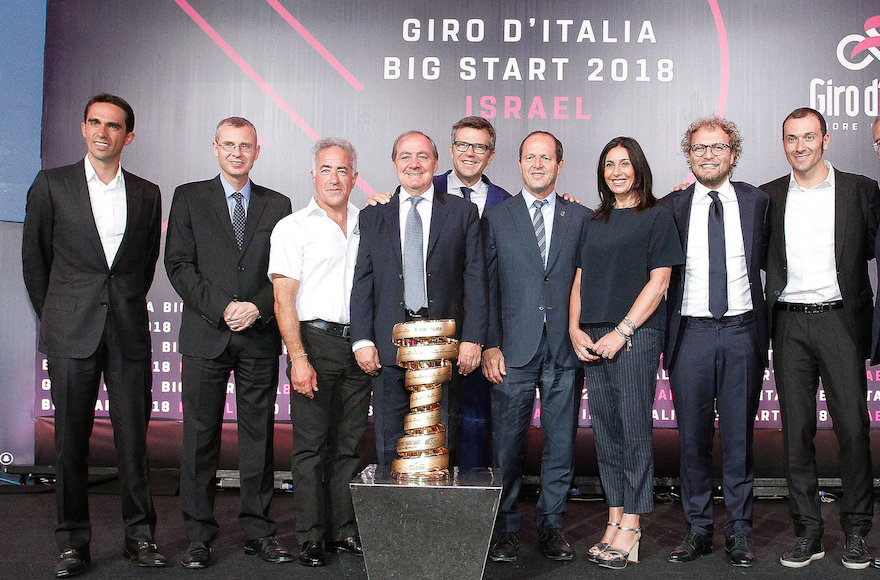
Alberto Contador, left, and Ivan Basso, right, former winners of the Giro d’Italia, with race and Israeli officials including Jerusalem Mayor Nir Barkat, fourth from right. (Courtesy of the Giro)

Italian Sports Minister Luca Lotti said Monday that the race would celebrate Bartali’s memory. In addition to being a great sports champion, he said, Bartali “was also an extraordinary champion of life, and a man of heroic virtues, and this needs to be commemorated, and shared, especially with the young generations — never to be forgotten.”

Retired Giro champions Alberto Contador of Italy and Ivan Basso of Spain, both two-time winners, also were on hand for the Jerusalem announcement.

Sylvan Adams, a Canadian real estate magnate and philanthropist who recently immigrated to Israel, helped bring the Giro to Israel and will serve as its honorary president. Adams said he was motivated by love of cycling and a desire to help his adopted country.

“I would call this the antidote to BDS,” he told JTA, referring to the global Boycott, Divestment and Sanctions campaign against Israel. “The media sometimes portrays our country in a negative way, and this is a way to bypass the media and go straight into the living rooms of 800 million people. They’ll see our country exactly as it is, and my experience is people almost universally have positive experiences when they encounter Israel.”

The Giro is just part of Adams’ larger plan to make Israel a cycling powerhouse. A co-owner of the Israel Cycling Academy, Israel’s first professional cycling team founded in 2014, he is building the first velodrome in the Middle East in Tel Aviv to be finished in time for the race.

“My plan is to bring Israeli athletes to the highest level of the sport,” he said.

Ran Margaliot, an Israeli former professional cyclist and the general manager of the Israel Cycling Academy, said the team has applied to compete in the Giro and will find out if it qualified in December. It is among 32 second division teams jockeying for a wild card spot, but he is hopeful.

“I certainly think we deserve an invitation,” Margaliot told JTA. “No one can tell me we’re not good enough, and we work as hard as the Europeans, even harder.”

Margaliot said that while he failed to achieve his ambition of becoming the first Israeli to race in a Grand Tour, the next best thing would be for an Israeli member of his international team to do it.

“You can imagine what it would mean for an Israeli rider to be racing in his own country, passing near his home and friends and family,” he said before catching himself. “But we have a lot of work to do to get ready.”


Israel gears up to host prestigious Italian cycling race Read More »

Quintessentially Jewish miracle: Torah, candles, tefillin, me

At this sacred season, Jews around the world will focus on Rosh Hashanah, the renewed year, and Yom Kippur, a day of introspection. These ancient holidays celebrate the planet and its capacity to sustain, and our interiority and its capacity to renew. These gifts are not ours as solitary individuals, but as part of an endless flow of humanity, those who have gone before us, and those who will come after us. So, let me share a few relevant memories, not because my stories are so different than yours, but because, I imagine, we all have similar stories.

The first is the story about my maternal great-grandfather, David Friedman. David came as a young man to the United States, a country full of promise and great challenges, at a time of extensive bigotry and great economic hardship. He settled in Bridgeport, Conn., where at the time there was no thriving Jewish community. His first venture was to go to Manhattan to procure a sefer Torah, a Torah scroll, for the princely sum of $100. He brought that Torah scroll home and, for some 25 years in the wilds of Connecticut, he created a minyan in his living room. In time, he gave that scroll to my great aunt Ruth, who moved to Los Angeles. Her Conservative congregation continues to use David’s Torah scroll. His decision touched the future.

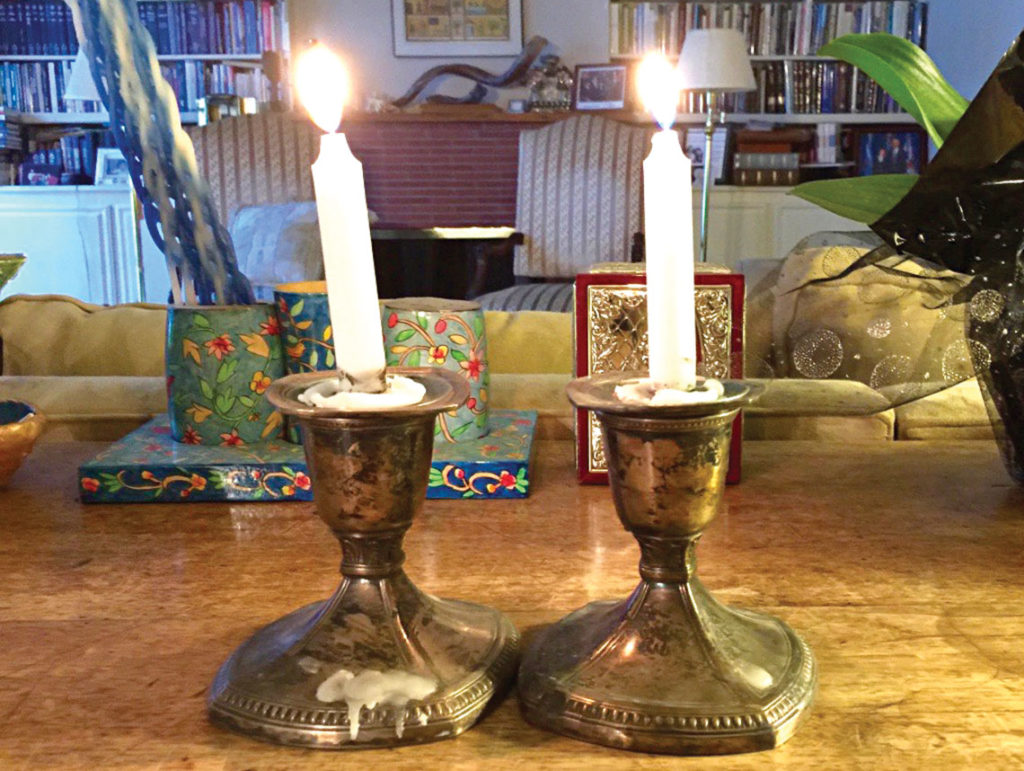
A second tale: My paternal great-grandmother, Rebecca, came to the United States from Russia. She brought with her two silver candlesticks as a connection to the world she left. Those candlesticks went into the possession of my great aunt, who was very involved in a Jewish community in Miami. On her deathbed, knowing of my love for Judaism, she bequeathed those candlesticks to me. My wife, children and I continue to bring in every Shabbat and Yom Tov with my great-grandmother’s candlesticks.

Perhaps the most inspiring of the three tales: Throughout my childhood in San Francisco, I was an atheist. I did not celebrate the Jewish holidays regularly, certainly not in any traditional way. On Yom Kippur, I went to school, ate the nonkosher food in the school cafeteria, and ended the day by “breaking the fast” at my aunt’s house.

I grew up in an elegant Reform congregation. Prayer for me was a matter of majesty and decorousness — which is to say, from my juvenile perspective, boring. (I have been back as an adult and now find those services uplifting and inspiring).

In college, for the first time, I encountered more traditional ways of being Jewish (and I was older, hence more open). A close friend’s mother died, and he needed someone to join him in reciting the Kaddish prayer for her. I had never attended a morning minyan, let alone an Orthodox one, so you can imagine my shock as a secular kid from San Francisco walking for the first time into a room in which the men and women were separated, and the men were wrapping leather boxes and straps around their arms.

The author with his great-grandfather’s tefillin.

My friend, Lee, explained that these boxes, tefillin, contained verses of Torah and that the men wrapped themselves in these boxes as a way of saying how much they loved God and Torah, physically binding these words to their bodies. I was so astonished and moved that when I returned home for winter break, I told my grandmother about these quaint leather boxes and how beautiful that tradition seemed. She left the room, went into her hallway closet and started rummaging. On the top shelf, she found a paper bag with her father’s tefillin, which hadn’t been used in the 50-some years since he had died, and gave them to me. A few years ago, a colleague took them to a scribe in Jerusalem who specializes in making old tefillin kosher for use. Now, every morning that isn’t Sabbath or festival, I bind myself to words of Torah with the exact same tefillin my great-grandfather cherished.

I tell these stories of a Torah scroll, candlesticks and tefillin because I believe I am the recipient of a recurrent and quintessentially Jewish kind of miracle: two, three and four generations ago, someone cradled something precious and then lobbed it across the generations to me, and I caught it.

Someday, I will bequeath it to my children and they to theirs. But this miraculous gift across the generations is but the physical symbol of just how much we have been given by those who have gone before us.

Think of the beauty and the wisdom in our Jewish traditions and values: a Torah that asserts the sanctity of life, the dignity of human beings and the beauty of the world; and that teaches us through stories and precepts how to elevate our lives and to re-engage the world. Think of the people who have brought us to these Holy Days of possibility, how they sacrificed so that we could receive an education. Think of what a value education has been for our people — and humanity — across the millennia, and the sacrifices our ancestors made to provide wisdom, perspective and morality. Think of the wonderful stories shared by loving parents, grandparents, aunts and uncles, and how much those stories shape our identities. Think of the places and people we’ve never met who are part of our breath.

Most precious of all, think of how most of us grew up with the sense of being loved and lovable. We had people who embraced us, who held us when we cried in the night, who fed us when we were hungry. Rabbi Abraham ibn Ezra, the great medieval Bible commentator, noted that “… a person who has a family is like a branch that is attached to its source.”

We are, all of us, mishpachah — family. No Jew is ever really alone.

Rabbi Bradley Shavit Artson holds the Abner and Roslyn Goldstine Dean’s Chair of the Ziegler School of Rabbinic Studies at American Jewish University in Los Angeles.

Quintessentially Jewish miracle: Torah, candles, tefillin, me Read More »

bagel-lox

Jewish identity beyond bagels and lox

As always, the time for panic about Jewish religious identity is now.

That’s been true for some 3,000 years. Judaism has never been great at retaining a crowd. Since the Exodus from Egypt, Jews have been fractured and fractious; censuses of the Jews in the books of Exodus and Numbers famously show identical numbers, despite the passage of years. Even when we’re not assimilating, we’re winnowing out ourselves somehow.

But a new poll from Public Religion Research Institute (PRRI) shows that American Jews younger than 30 are particularly unlikely to identify as religiously Jewish (47 percent); the rest identify as culturally Jewish. That contrasts sharply with Jewish seniors, who identify as religiously Jewish rather than culturally Jewish by a 78 percent to 22 percent margin. Furthermore, fully 37 percent of all Jews in the United States refuse to identify an affiliation with a particular religious movement; they identify as “just Jewish.”

These numbers aren’t particularly shocking — another PRRI poll from 2012 showed that only 17 percent of Jews found their Jewish identity in religious observance, and only 6 percent found that identity in cultural heritage or tradition. Most shocking, only 3 percent said they found a general set of values in Judaism. Fully 46 percent cited a belief in “social equality” separate from Judaism as somehow creating a Jewish identity.

The effort to somehow carve off Jewish religious activity from Judaism has been ongoing since the Enlightenment. But it’s a project destined to fail. That’s because the unifying factor among Jews has been religion. Trash the Torah, trash the identity. We can find values of social justice in John Rawls or Robert Nozick; we can find “culture” in Woody Allen movies. But we can’t find a common identity.

Jewish identity isn’t merely a shared reference to a set of movies or foods. It’s a set of values springing from religious identity — from God. That doesn’t mean that you have to keep kosher or turn off your phone on Sabbath to experience Jewish identity.

But it does mean that you have to respect the notion that Judaism is concerned with such matters — and more importantly, that Judaism reflects God’s immanence in the world, and that the revelation of His presence passed down from generation to generation is worth honoring.

Over the course of the holiday season, beginning with Rosh Hashanah, we work to recognize this truth. And then we celebrate this truth during Sukkot. When we sit together in the sukkah, we aren’t just eating good food and enjoying good friends. We’re not just hanging out with family. Sukkot isn’t an outdoor meal at the Olive Garden. It’s a representation of the fragility of our world — a metaphor rebuking materialism. It’s a reminder that all the things we value mean nothing without the God who infuses our lives.

And it is our task, collectively and individually, to experience the joy of knowing God. The Torah commands us no fewer than three times to rejoice on this holiday. And as Maimonides says in “Guide for the Perplexed,” we have the capacity to experience joy in what we understand of God, when we turn our intellects to Him.

Jewish identity isn’t merely a shared reference to a set of movies or foods. It’s a set of values springing from religious identity — from god.

So, how do we understand God on Sukkot?

First, we understand that there is a meaning behind the material world. Atheist materialism posits that we live in an accidental universe devoid of meaning, and wander through it alone in deterministic fashion. Sukkot and the history of the Jewish people rebuke this notion. We are participants in history, and our participation matters. We know the sukkah is temporary, but we beautify it anyway because we have been commanded to do so.

This is a uniquely Judaic notion, and one that animates even the most atheistic, secular Jews who spend inordinate amounts of time fretting over “social justice.” Why bother unless we have independence of action and a mandate to better our world?

Second, we understand that our heritage doesn’t spring from ourselves. We honor our ancestors with the ushpizin — we remember Abraham, Isaac, Jacob, Moses, Aaron, Joseph and David. We are not the source of our tradition or our values. They come from a more ancient source.

Finally, we understand that God cares about all of us. We are commanded to pick up the lulav (palm frond), along with the hadas  (myrtle) and the aravah (willow) and the etrog (citron). According to the midrash, the lulav represents those who study Torah but do not do mitzvot; the hadas represents those who do mitzvot but do not study; the aravah represents those who do not study Torah and do not do mitzvot; the etrog represents those who both study and do mitzvot. Why not pay homage to God with the etrog alone, then? Because the Jewish people are composed of all of these sorts of people — and only together, recognizing our inherent worth and value to God, can we stand before our Creator. We can’t leave one another behind.

All of which means that Sukkot is an ideal time to reach out to our fellow Jews who see themselves as cultural. God doesn’t care; they are welcome in the sukkah. It is their job to join with us, no matter our different priorities; it is our job to infuse our sukkah with light, so that they may see a world filled with the presence of God, not merely an ancient superstition with bagels and lox.


BEN SHAPIRO is editor-in-chief at The Daily Wire, host of the most listened-to conservative podcast in the nation, “The Ben Shapiro Show,” and author of The New York Times best-seller “Bullies: How the Left’s Culture of Fear Silences Americans.”

Jewish identity beyond bagels and lox Read More »

Leonard Cohen memorial concert in Montreal to feature Sting, Elvis Costello

The family of singer-songwriter Leonard Cohen has announced a benefit concert in Montreal to mark the first anniversary of his death.

The concert, called “Tower of Song: A Memorial Tribute to Leonard Cohen,” will be held Nov. 6 in Cohen’s hometown, his family said Monday. It will benefit the Canada Council, which awards grants to Canadian arts projects, and helped Cohen in the early days of his career.

Among the artists signed on to perform are Elvis Costello, Lana Del Rey, Philip Glass, Wesley Schultz and Jeremiah Fraites of The Lumineers, k.d. lang, Feist, Sting, Patrick Watson and Damien Rice, Billboard reported. Actors also will read Cohen’s poetry.

“There were so many groups of people expressing beautiful interest in commemorating and memorializing and paying tribute to my old man,” Cohen’s son, Adam, told Billboard. “Instead of having it be a whole bunch of candles burning in various places, we wanted to pull a bunch of disparate pieces together and make a big bonfire, a big sight on a hill.”

Cohen said his father wished to be buried in Montreal with a small memorial service, but gave his son permission to organize a large public event after his death with the condition that it be held in Montreal, the Montreal Gazette reported.

The event will be filmed for a TV special.

Leonard Cohen memorial concert in Montreal to feature Sting, Elvis Costello Read More »

Events in Los Angeles from September 22–27

FRI | SEPT 22

BUDD FRIEDMAN AND TRIPP WHETSELL

Budd Friedman and writer Tripp Whetsell will discuss and sign “The Improv: An Oral History of the Comedy Club That Revolutionized Stand-Up.” Friedman, in 1963, quit his job in advertising to return to his hometown, New York, to become a theatrical producer. He opened a coffee house for Broadway performers called the Improvisation, later shortened to the Improv. Friedman’s new venture was an instant hit.  It became the first venue to present live stand-up acts in a continuous format, and in the process, reinvented the art form for comedy clubs that followed. 7 p.m. Free. Book Soup, 8818 Sunset Blvd., West Hollywood. (310) 659-3110. booksoup.com.

SAT | SEPT 23

ERNEST TROOST AND JOHN ZIPPERER

During his California Gold Rush Tour, Emmy award-winning artist Ernest Troost returns to Julie’s Joint with special guest Nicole Gordon. John Zipperer & The Current Band will also perform. There will be a potluck dinner. Bring an instrument if you want to join the song circle. 5 p.m. Suggested donation $20. Address provided upon RSVP to juliesjoint@johnzipperer.com. johnzipperer.com.

SUN | SEPT 24

JEWS, SPORTS AND SOCIAL JUSTICE

The USC Casden Institute, with the support of The Jewish Community Foundation of Los Angeles and USC Athletics, proudly presents a panel discussion with athletes, writers, sports managers and sports team owners who have used athletics to illuminate social issues. Panelists include: Lenny Krayzelburg, American backstroke swimmer, former world record holder and winner of four gold medals in the 2000 and 2004 Olympic games; Noah Miller, Israel Lacrosse National Team player and head commander and chief instructor of Krav Maga in the IDF Special Forces Combat School; Alan I. Rothenberg, chairman of Premier Partnerships and former president of the United States Soccer Federation; and Erit Yellen, producer and writer for documentary films on sports and social Issues, and adjunct professor at the USC Annenberg Institute of Sports, Media & Society. The panel will be moderated by Neil Kramer, veteran educator, lacrosse coach and official who refereed the first lacrosse match played in Israel. 4:45 p.m. reception; 5:30 p.m. panel. Free. Town and Gown, University of Southern California, 665 Exposition Blvd., Los Angeles. (213) 740-1744. dornsife.usc.edu.

AUTHOR NICOLE KRAUSS

National Book Award finalist and bestselling author Nicole Krauss will discuss with Rabbi David Wolpe her fourth novel, “Forest Dark.” Krauss masterfully entwines two disparate narratives about two unrelated characters seeking answers in the Israeli desert. Books available for purchase. A book signing follows the program. Co-presented by the Skirball Cultural Center and American Jewish University’s Whizin Center for Continuing Education. 2 p.m. Free. Skirball Cultural Center, 2701 N. Sepulveda Blvd., Los Angeles. (310) 440-4500. skirball.org.

NATIONAL VILLAGE CELEBRATION: LIVE

Villages all over the country in the Village to Village Network will simultaneously gather to watch and celebrate the 15th anniversary of the Village Movement. In Los Angeles, the program will feature surgeon and writer Atul Gawande. Gawande will address the value of community and choice as people grow older. Following the program, Temple Emanuel’s Rabbi Laura Geller and Temple Isaiah’s Rabbi Zoë Klein will lead a discussion. 1:30 p.m. Free. Temple Isaiah Social Hall, 10345 W. Pico Blvd., Los Angeles. (310) 277-2772. chaivillagela.org.

WED | SEPT 27

THE YOM KIPPUR WAR: AGAINST ALL ODDS

This holiday season is the 44th anniversary of the Yom Kippur War. Rabbi Rebeccah Yussman will discuss the history of the conflict using episodes from “Against All Odds,” a documentary about the Israel Defense Forces and Israeli survival. A catered lunch is included in the program. 11 a.m. $16; $14 for members. Temple Menorah, 1101 Camino Real, Redondo Beach. (310) 316-8444. templemenorah.org.

PURSUIT OF JUSTICE: E. RANDOL SCHOENBERG

Los Angeles Theatre Works Celebrates the Pursuit of Justice, a special event honoring attorney E. Randol Schoenberg, who successfully litigated the return of five Gustav Klimt paintings from the Austrian government, as featured in the film “Woman in Gold.” The evening, hosted by Hector Elizondo, will include a performance of the L.A. Theatre Works’ acclaimed production of “Judgment at Nuremberg” by Abby Mann, and a discussion about  the challenges of the pursuit of justice with Schoenberg and Geoffrey Cowan, chair of the USC Annenberg School’s Center on Communication Leadership and Policy. The evening will begin with cocktails and hors d’oeuvres and conclude with a dessert reception. 8 p.m. Tickets start at $175. The Wallis Annenberg Center for the Performing Arts, 9390 N. Santa Monica Blvd., Beverly Hills. (310) 827-0889. latw.org.

Events in Los Angeles from September 22–27 Read More »

Watch Trump’s High Holy Days greeting

Per White House tradition, President Donald Trump released a greeting ahead of the Jewish High Holidays. The White House sent the video message on Monday, ahead of Rosh Hashanah, which starts this year on Wednesday evening.

Below is the transcript and video of Trump’s address:

“On behalf of all Americans, I want to wish Jewish families many blessings in the New Year. The High Holy Days are a time of both reflection on the past year and hope for renewal in the year to come. Jewish communities across the country, and around the world, enter into a time of prayer, repentance, and rededication to the sacred values and traditions that guide the incredible character, and spirit, of the Jewish people. We reaffirm the unbreakable bond between the United States and Israel, and we ask God to deliver justice, dignity, and peace on Earth. Melania and I wish everyone a sweet, healthy, and peaceful year, which we hope will bring many blessings to all. Thank you, God Bless you, and God Bless America.”

Watch Trump’s High Holy Days greeting Read More »

Director Jeremy Kagan takes aim at effects of gun violence in ‘Shot’

When filmmaker Jeremy Kagan first watched the gangster-film classic “Bonnie and Clyde” in 1967, he was taken not only with the brilliance of the storytelling but also by the profusion of gun wounds suffered by its characters.

“A lot of people get shot in the movie who are innocent bystanders,” Kagan, 71, said during an interview at his Venice home. “I remember walking out of the movie being impressed, but also asking myself, ‘Whatever happened to the woman who got shot at the bank? Or the cop who got shot on the chase?’ ”

Over the years, Kagan pondered what he calls “society’s thriving on the image of the gun.” He hadn’t escaped those images in his own film and television projects: In his first effort as a director in his mid-20s, on a TV series called “Nichols,” a drunken patron at a Western pool hall shoots the town’s sheriff in the opening sequence. Characters also get blown away in episodes of TV’s “Chicago Hope” and “Taken” that Kagan directed.

“Chekhov once said, if you write a gun in a scene somewhere, then you’re going to have to use it,” Kagan said.

After mass shootings such as those at Columbine High School in 1999, Kagan continued to reflect on the preponderance of firearms in the media and concluded that filmmakers seldom show the actual human consequences of gun violence. He wondered, “What is the visceral experience of what it means to get shot?”

His answer comes in the new movie, “Shot.”

The film begins as sound editor Mark Newman (Noah Wyle) is amping up gunshot sounds in a movie shootout scene. Minutes later, Mark himself becomes the gunshot victim while walking down the street. From the moment he hits the pavement, the film follows his journey in real time, from the seven minutes he lies on the street to being placed on a stretcher, carried into an ambulance and finally arriving on a hospital examination table.

Meanwhile, with the use of split screens, the drama simultaneously recounts the guilt and horror of the teenage shooter, Miguel. The second part of the film describes the lives of the perpetrator and victim five months later, as Miguel struggles with whether to make amends and Mark battles the lingering effects of his spinal injury.

Describing himself as an American-Jewish filmmaker, Kagan said “Shot” expresses the talmudic thought, “Whoever destroys a single life is considered to have destroyed the whole world, and whoever saves a single life is considered to have saved the whole world.”

As he said this, Kagan sat in his home office, looking rabbinical in a long white beard, surrounded by his own colorful artwork recounting scenes from the Torah. Silk textile art on the ceiling depicted images of the kabbalistic concept of the Tree of Life.

A poster from his 1981 movie, “The Chosen,” based on the book by Chaim Potok, graced one wall of his office, along with a lobby card from his 2007 television movie, “Golda’s Balcony,” about former Israeli Prime Minister Golda Meir.

Kagan’s films often delve into social action issues, as influenced by his father, a Reform rabbi who marched with the Rev. Martin Luther King Jr. and preached about progressive causes from the pulpit. The director’s 1987 TV movie, “Conspiracy: The Trial of the Chicago 8,” drew on Kagan’s involvement with the politics of the 1960s, and his 2004 television film, “Crown Heights,” follows the true story of racial tensions between Chasidic Jews and African-Americans in that Brooklyn community in 1991.

In his research for “Shot,” Kagan, a professor of film and TV at USC, spent time in emergency rooms, talking to physicians and gunshot victims.

“I’ve seen one person come in with three gunshots in him and he’s talking like you and me, while another person was shot in the foot and in agony,” he said. “I’ve ridden in ambulances with the EMTs and seen the ripple effect of what one bullet can do.”

He became aware of the grim statistics — 90 people a day are killed by gun violence in the United States — as well as the lingo, including the so-called “Golden Hour,” which refers to the fact that if you survive a gunshot for one hour, chances are you will live. He learned that even though a bullet wound appears tiny on the skin, it can ricochet throughout the body and damage internal organs. And he studied the five stages of grief as outlined by psychiatrist Dr. Elisabeth Kubler-Ross — denial, anger, bargaining, depression and acceptance — which he and Wyle brought to the character of Mark.

By following the protagonist both at the time of his injuries and five months later, the film “shows the level and degree to which the violence permeates,” said Wyle, best known for his long-running role of Dr. John Carter on the TV series “ER.” “The first stage is physical and traumatic and horrific, but the second, emotional stage is far more insidious.”

Wyle’s research for the medical section of the drama included the specificity of how a spinal injury advances, “where you feel sensation and where you lose sensation, what differentiates a cramping from a stinging sensation, what moment of panic would put this character over the edge, and what would he be aware of and what wouldn’t he be aware of,” the actor said. “I wanted to make sure that, moment to moment, everything rang as true as possible, so that audiences would forget that Noah Wyle is playing this character and just think in terms of, ‘Holy s—, I don’t want to get shot.’ ”

Both Kagan and Wyle said their goal is for the film to be more than entertaining; they want it to spur dialogue about anti-gun legislation.

“I hope it will have an influence on people I will never know or meet,” Wyle said. “I hope that somebody somewhere will see this and want to take corrective action of some sort.”

“Shot” opens in Los Angeles theaters Sept. 22.

Director Jeremy Kagan takes aim at effects of gun violence in ‘Shot’ Read More »

The Jewishness of RuPaul’s Drag Race

There’s a certain, Je ne sais quois, “Jewiness” about RuPaul’s Drag Race (think America’s Next Top Model, but for drag queens).

Last night at the 2017 Emmys, RuPaul’s Drag Race (which just celebrated its ninth season) may have lost Best Reality-Competition Series to The Voice, but it didn’t go home empty-handed, nabbing Best Reality Host and Outstanding Costumes – to name a couple.

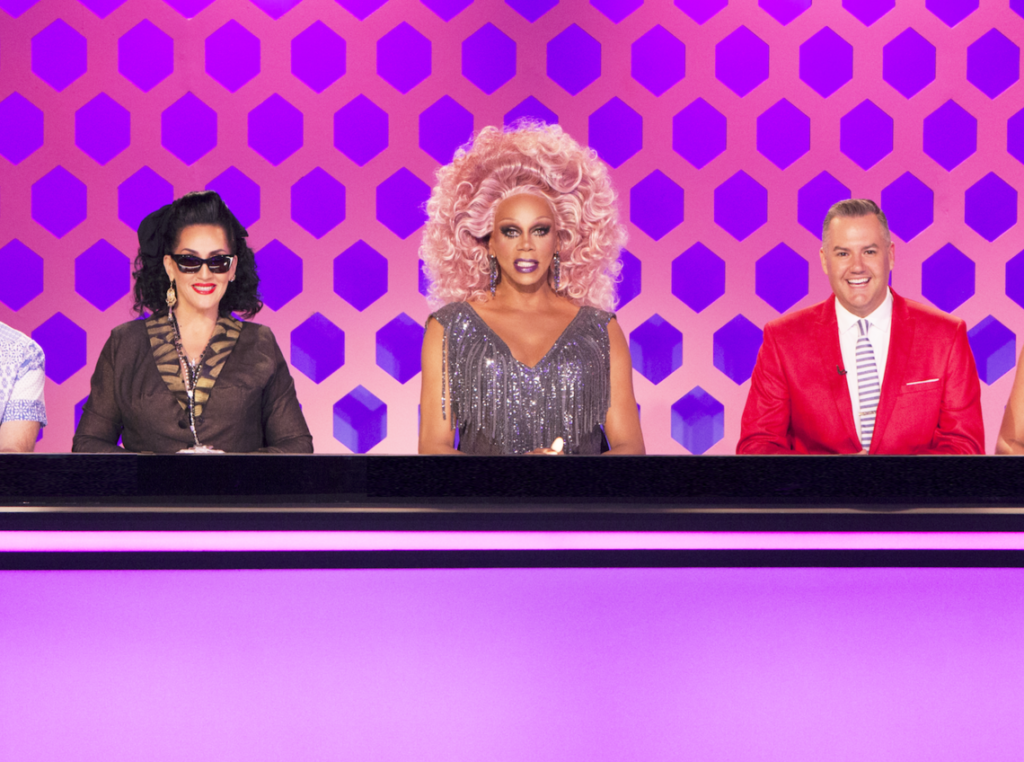
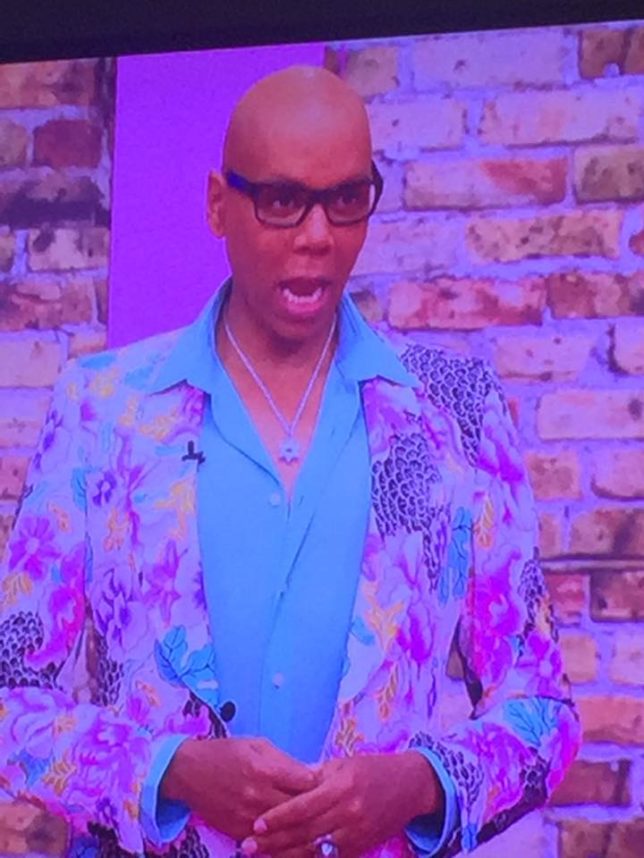
RuPaul (AKA Mama Ru) occasionally sports a Star of David necklace (as seen in this screenshot, supplied by Jewcy) on the reality competition. “RuPaul is obsessed with Jews, obsessed with Yiddish,” said Michelle Visage, a judge on Drag Race and RuPaul’s right-hand woman. Visage added that during the show’s eighth season, RuPaul kept an English-to-Yiddish dictionary underneath his chair for reference when he wanted to incorporate some Yiddishkeit into his schtick.

Visage, who was adopted at four months old and raised by Jewish parents – Arlene and Marty, met RuPaul while clubbing in New York City; they’ve been best friends ever since. With a bigger-than-life personality, Visage is famous for her ability to call out the drek and state the truth, even if it ain’t pretty. “I am that tough love auntie,” she told the Journal, attributing her “saying it like it is” attitude to her Brooklyn-born mother Arlene.

“And true story, when I met my biological mother, I was 25 years old. I told her I was raised by Jews and she said, ‘I am so happy, I was praying you’d be adopted by a Jewish family.’” 

Watch the interview below:


Last month, Visage announced that she’ll be a judge on the first season of Ireland’s Got Talent, which will air in January 2018. Of course, she’ll continue judging on Drag Race (season 10 will be her eighth season).

RuPaul’s Drag Race season nine winner Sasha Velour (Alexander Hedges Steinberg) also happens to be Jewish. “Whenever there’s a Jew, it’s an automatic identity,” said Visage. “I love it when it becomes part of their [drag] identity. It’s mishpucha.

The Jewishness of RuPaul’s Drag Race Read More »

How Houston’s synagogues are handling the High Holy Days after Harvey

A few weeks ago, Holly Davies was getting ready to homeschool her kids and preparing the family for the High Holy Days. When Hurricane Harvey hit, she helped evacuate 150 people from her neighborhood by airboat and shelter nearly 100 people in a local church.

Then came the hard part.

For the past three weeks, Davies has been leading a force of up to 300 volunteers who have mobilized to repair homes and synagogues in and around the heavily Jewish housing development of Willow Meadows. Davies has spent September  coordinating teams who are clearing Sheetrock, stripping floors, preventing mold and distributing aid.

Her volunteer operation is headquartered in Beit Rambam, a Sephardic synagogue that was spared flooding, and has helped rehabilitate the homes of about 100 families. But Davies is also helping lead the effort to make sure those families have a place to pray when Rosh Hashanah begins Wednesday.

“It’s very important for the community to have their central worship place, to not feel fragmented, not only in their homes but in their community,” she said. “A lot of people are staying with friends or other people in the community.”

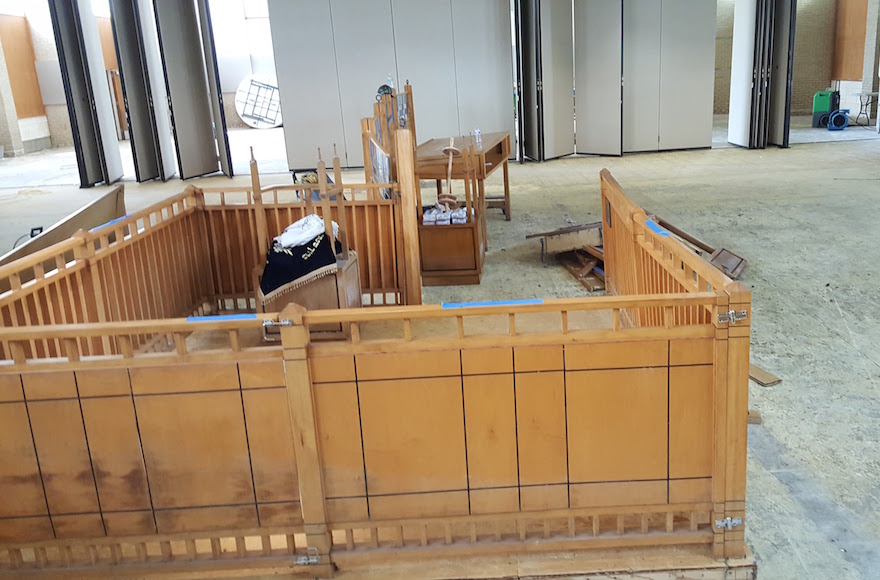
As the entire Houston area recovers from Harvey, synagogues face the added difficulty of drying out their buildings days before the holiest and busiest days of the year. Three large synagogues sustained substantial damage from the flood, forcing them to improvise, relocate or make do with whatever floors, books and ritual objects remained intact.

“There was not any part of the synagogue that was immune to the flooding,” said Rabbi Brian Strauss of Beth Yeshurun, a Conservative congregation. “There was water covering the first seven rows of the sanctuary. You couldn’t even see the seats.”

Strauss said his synagogue sustained about $3 million worth of damage. Along with cutting out floors, cabinets and Sheetrock, and disinfecting the building — the basics of flood recovery — the synagogue will have to bury nearly 1,000 holy books that were ruined in the flood. The synagogue will set up a Harvey memorial at the burial space.

United Orthodox Synagogues, another Houston congregation, had up to six feet of flooding in some places and also lost most of its prayer books. Congregation Beth Israel had damage in its sanctuary, mechanical room and offices. No Torah scrolls were damaged at any of the congregations, as they were in high places when the flooding began.

United Orthodox isn’t sure if the building can ever be completely repaired, while Strauss is shooting for his building to be back to normal for the High Holy Days — in 2018. In the meantime, the synagogues have found makeshift solutions. United Orthodox’s 300-some families have been praying, meeting and eating in a large social hall that avoided the worst of the water. The synagogue has also had hundreds of new prayer books donated from publishing companies and synagogues outside Houston, including 400 machzors, or High Holy Days prayer books.

A room in United Orthodox Synagogues of Houston, stripped of its furniture and floors. (Courtesy of United Orthodox Synagogues)

Beth Yeshurun has been holding bar and bat mitzvah services in a nearby high school auditorium, and otherwise has joined with Brith Shalom, a nearby Conservative synagogue that was not flooded. For the High Holy Days, Beth Yeshurun will be meeting at Lakewood Church, a Houston megachurch that’s donating its space and support staff. To give the building a Jewish feel, Beth Yeshurun will be projecting photos of its artwork on the church’s walls.

“Everyone is being incredibly cooperative and patient,” said Rabbi Barry Gelman of United Orthodox Synagogues. “This is an incredibly responsive community. Despite this, we’re really looking forward to a beautiful Rosh Hashanah.”

The rabbis have handled their synagogues’ recovery while also dealing with personal crises. Both Gelman and Strauss had flooding in their houses. Gelman, along with a few dozen Jewish families, has moved to an apartment complex near the synagogue that he now calls a “kibbutz.” Other religious families are hosting displaced neighbors who want to stay within walking distance of their synagogues.

“There’s a lot of expenses, there’s the physical upheaval, the emotional upheaval,” Gelman said. “There’s a lot of uncertainty, stress. The human cost of this is really unimaginable and ongoing.”

Houston’s Jewish community has also been buoyed by outside donations. Aside from approximately $9 million raised by the local federation, Israel pledged $1 million in aid, and the Orthodox Union and Chabad also sent money and volunteers.

A kosher barbecue food truck from Dallas drove down and has been making up to 1,000 meals a day, and three kosher caterers from Dallas also sent meals to Houston’s Jews. Seasons, a kosher supermarket chain, and Chasdei Lev, a charitable organization in New York, sent trucks of kosher perishable items and dry goods, including clothes. Two Israeli wineries, Golan Heights and Galil Mountain, donated 100 crates of wine to Houston Jewish institutions.

“Food is getting semi-back to normal,” said Tzivia Weiss, executive director of the Houston Kashruth Association.

Weiss said that while donations are plentiful, people are hesitant to take them because they “want to feel like people that can go to stores and buy their own clothes.”

The flood has also affected what’s usually troubling rabbis the most ahead of High Holy Days — their sermons. Strauss, who was going to talk about pressures affecting teens and young adults, will instead be discussing his family’s personal experience during Harvey and how to avoid fixating on material possessions. Gelman will talk about the connection between homelessness and repentance, as well as how to respond to the flood while thinking of the future.

“I’ll talk about long-term thinking, and not relying on short-term answers to life’s difficulties,” Gelman said, describing his Rosh Hashanah sermon on the second day. “Rosh Hashanah is the anniversary of the birthday of the world. We see this as an opportunity for our own rebirth.”

How Houston’s synagogues are handling the High Holy Days after Harvey Read More »