fbpx

September 18, 2017

Oh baby, baby: Five options for dealing with babies on the High Holy Days

New parents have a lot to figure out: how to get their baby to sleep through the night; when to introduce food; how to binge-watch Netflix while being sleep deprived. The High Holy Days present one more thing for new parents to figure out: how to atone for your sins while taking care of your baby.    

While most synagogues offer a plethora of childcare options for children who can walk and talk, most new parents are trying to decide what the best option may be for their babies. Here are just a few helpful suggestions for new parents to consider.

Find services made for young families

Many synagogues offer High Holy Days services specifically designed for young families during which crying, nursing and screaming not only are tolerated, but expected. These services are often under an hour and free. For instance, Temple Judea in Tarzana offers a “Tot High Holiday” service where clergy appear in costume and put on “a fun and wild show,” according to Ellen Franklin, Judea’s executive director. “It’s entertaining but with some traditional prayers.”

At Sinai Temple, there is a 45-minute volunteer-organized “Shofar Blast” service that is “by kids, for kids,” according to Rabbi Nicole Guzik. The service features a “highlight reel” of prayers including Avinu Malkeinu and the mourner’s Kaddish and leads into the synagogue’s “Torah-in-the-Round” family-friendly service for those who choose to stay for a fuller High Holy Day experience.

During Shofar Blast, “you’ll get a message from the rabbi and a puppet show,” said Guzik, who noted that the service is not designed for parents to chitchat but really to connect to their kids and to the spirit of the holiday.

Be there but be flexible: Go to adult services

For many parents with babies, attending regular adult services is still an option. While some synagogues explicitly discourage babies from adult-only High Holy Days programming, others are fine with infants so long as parents follow the implicit rules of High Holy Days decorum.

When Betsy Uhrman’s children were babies, she would transport them in a carrier and follow her synagogue’s  “unspoken etiquette” of sitting in the back or near an exit.  If her baby started making noise, Uhrman simply stepped out, which happened often. “I was happy to have them there but I wasn’t actively present in services,” she said.

This year IKAR, the spiritual community located in Mid-City, is setting up a “Pray-ground” with toys for children younger than 4 in the balcony overlooking the space where their main services are being held. There will be a closed-circuit feed for parents to hear the full service, including the sermon. 

“We are trying to create space that makes parents feel part of the service even if they are not in the room,” IKAR Executive Director Melissa Balaban told the Journal.

It takes a village: Attend services with family and friends

Childcare doesn’t need to be a one- or two-person task during the High Holy Days. Many new parents choose to attend services with their support networks to divide the childcare responsibilities.

Last year, Tova Leibovic Douglas, a rabbinic student at the Ziegler School of Rabbinic Studies at American Jewish University, wanted to spend some of her time in services actually praying — not just watching over her 18-month-old daughter, Eve.

For the High Holy Days, Tova and her husband, Austin, split their time between their home shul and the synagogue where Tova’s extended family was attending services.

“It made it easier for us,” she said. “Instead of Austin or me being the ones to have to watch Evie, we got to split the responsibility among ourselves, my parents and my sisters.” Austin added that in addition to being helpful, “going to services with my in-laws was a good opportunity for them to spend time with Evie,” adding that “it made services more enjoyable for everyone.”

Stephanie Steingold Bressler’s village of support wasn’t family members but other congregants at her synagogue. “When my kids were too young to go to official child care, I let rebellious teens, who were already in the lobby, take turns hanging with my kids,” she said.

Parents’ night out: Get a baby sitter

For some parents, the important work of accounting of the soul is more easily done when the kids are not around at all, so they choose to hire a baby sitter. 

Betsy Uhrman, who does attend most services with her children, always hires a baby sitter on Kol Nidre. “It is really rare that my husband and I carve out time for our own spiritual reckoning,” Uhrman told the Journal, “so on Kol Nidre, it’s important that we are both present.”

Uhrman chose Kol Nidre as the time for a baby sitter because of how “powerful” the service tends to be as well as for the importance of maintaining bedtime for her kids.

Synagogues on occasion make accommodations for baby-sitting young children. Wilshire Boulevard Temple offers baby-sitting to member families that preregister for children at least 3 months old, and at Sinai Temple families can request caregiver passes — which enables nannies to enter the building to watch over children without having to purchase tickets.

Bowing out: Staying home

For some new parents, the right answer for their High Holy Days experience is to stay home with their children and observe the holidays in other ways.

For Jenny Platt, taking her 16-month-old son, Sawyer, to services last year was going to be too big of an ordeal.

“I read Rosh Hashanah books with him and he watched a video of shofar blowing on the computer,” she said. An unconventional solution, but Platt said she was grateful that she could still celebrate the holiday with her son.

For some parents with young kids, staying home feels like the only option. “When you have an infant and a 2-year-old that wants to run around and there is no programming for them, you stay home,” according to Tamar Raucher, whose husband, Noam, is the head Rabbi at Pasadena Jewish Temple & Center. When her kids were too young for formal programming, she said, “the day became about celebrating with friends afterward at Rosh Hashanah lunch.”

Oh baby, baby: Five options for dealing with babies on the High Holy Days Read More »

Improv founder Budd Friedman looks back in laughter in new book

Budd Friedman helped launch the careers of some of comedy’s brightest stars, including Jerry Seinfeld, Lily Tomlin, Jay Leno, Andy Kaufman, Jimmy Fallon, Bill Maher, Larry David and Billy Crystal. He also invented the modern comedy club as we know it. Now, he’s released a book detailing the history of the club he founded.

Friedman’s book, “The Improv: An Oral History of the Comedy Club That Revolutionized Stand-Up,” co-authored by Tripp Whetsell, includes a foreword by Jay Leno and commentary from many of the comedians who appeared on the Improv’s stage over the years.

Friedman, 85, who lives in Los Angeles with his wife, Alix, said he decided to write the book because, “I thought everyone should see my side of things. I let the comics have their say about me and my accomplishments.”

Friedman opened the Improv on West 44th Street in Manhattan in 1963. He wanted it to be a place for Broadway performers to hang out after their shows because he had dreams of becoming a Broadway producer. Soon, people like Judy Garland, Liza Minnelli, Christopher Plummer, Bette Midler and Dustin Hoffman dropped by, and the club became a sensation among the Broadway crowd.

As Whetsell recalled, one year after the club opened, comedian David Astor asked to go onstage and do his act. Other comedians started following because they’d rather perform there than open for performers at jazz and strip clubs. They’d do their act in front of the famous brick wall, which eventually became a staple at other comedy clubs.

“It was a very eclectic bunch of comedians,” said Whetsell, who is a comedy journalist. “They were very experimental. Even though singers were the main draw for many years, eventually the comedians became the main draw.”

In 1974, Friedman left New York for Los Angeles and opened up a second Improv, on Melrose Avenue in West Hollywood. There, he discovered one of comedy’s biggest emerging acts: Robin Williams.

“From the moment he walked in, it was obvious to me and everybody else that he was going to become a big star, perhaps even one of the biggest we’d ever seen, which, of course, turned out to be true beyond anything we could have ever imagined,” he wrote in the book.

Comedians such as Williams, Kaufman and Leno were drawn to the Improv because of how Friedman treated them. “I’ve always had the attitude that the comedians are already right, even when they are wrong,” he said.

And Friedman also had standards for the comedians he booked at the club. “I looked for originality,” he said. “They had to talk in their own voice.”

Although the club was welcoming well-known comedians and taking off through the 1970s, Friedman was in a bitter rivalry with Mitzi Shore, owner of the Comedy Store on Sunset Boulevard. Before the decade was over, the Improv burned down and Friedman was finalizing his divorce with his first wife. As his 46th birthday was approaching, he almost called it quits.

Instead, he turned it all around. He struck a deal with A&E to put out a weekly syndicated comedy show called, “An Evening at the Improv,” which ran from 1982 to 1996, and he started expanding his comedy empire. The New York location eventually closed, but the Improv has 22 locations in 12 states, including the rebuilt flagship L.A. location.

Although there have been many memorable moments at the club, what sticks out the most for Friedman is the night he met Alix, in 1981. “She came into the club and sat down, and I was immediately struck by her beauty,” he said. “I was dating a girlfriend of hers, but it was then that I decided that I was going to date Alix instead.”

Today, Friedman has taken a step back from managing the club. He spends his time with Alix and reflecting on his earlier years.

“I look out of my house, which is over the Los Angeles Country Club in Westwood, and I see myself in better years,” he said. “I used to look out over the terrace and yell down to the golfers, ‘Bend your elbows!’ ”

Friedman’s daughter Zoe has carried on her father’s legacy in the entertainment business, as a senior vice president of development at Blue Ribbon Content, a digital production company, and as co-founder of Comedy Gives Back, which leverages live comedy to raise money for charity. 

Whetsell said the Improv has played an integral role in the comedy industry that will live on. “It was the first comedy club in America that pushed comedy in a full comedic format. It created the template for comedy clubs today.”

Friedman added that his club shaped two generations of comedians. And even though platforms like Comedy Central, YouTube and Snapchat have made comedy accessible to everybody, he believes the clubs will continue to flourish.

“They’re here to stay,” he said. “Especially the Improv.” n

Improv founder Budd Friedman looks back in laughter in new book Read More »

Jewish gay activists applaud the return of ‘Will & Grace’

When “Will & Grace” first aired in September 1998, the sitcom broke new ground in broadcast television by becoming a hit series with openly gay principal characters — success achieved not only from subject matter never before introduced into America’s living rooms but also through writing and acting that gave those characters magical comedic chemistry.

Because the show’s co-creators, Max Mutchnik and David Kohan, and lead actress Debra Messing all are Jewish, and Mutchnik also is gay, gay Jews in particular felt the show spoke to them more directly than any sitcom ever had.

With the series about the lives of gay lawyer Will Truman, straight interior designer Grace Adler and their friends Jack and Karen slated to return on NBC in October, Jewish LGBTQ activists are enthusiastic, meeting the reboot with expectations that reflect the impact of the groundbreaking original.

Janelle Eagle-Robles, 34, a former fundraiser for the Gay and Lesbian Alliance Against Defamation (GLAAD), remembered the show’s impact “normalizing our lives instead of being the comedic relief of it.”

“It was two characters living their best lives and having totally human moments that people were seeing on a weekly basis,” she said. “The portrayal wasn’t perfect, but it was the only thing we had, so it was held up as the Holy Grail of representation. We saw the importance of it and celebrated their achievements. They got every award from the queer community because they had done something that matters.”

Asher Gellis, 42, founder of JQ International, a West Hollywood-based Jewish LGBTQ organization, said “Will & Grace” premiered after he had been through a decade of experiencing “heartbreak and isolation” as he became aware he was gay. The show made him feel “visible” and “acknowledged” more than some gay-male-themed TV shows that would follow, like “Queer Eye for the Straight Guy.”

“I don’t fit that [‘Queer Eye’] stereotype, but it was displayed as if it was a universal,” he said. But “Will & Grace,” with its presentation of both gay and Jewish identities, made Gellis feel “a sense of pride” in both.

“The fact that neither Will nor Grace reflected the traditional archetype of their respective gay or Jewish identities was a further celebration that there isn’t just one type of gay person or one type of Jewish person,” Gellis said.

Film producer and Hebrew Helpers founder Todd Shotz, 43, who had come out only three years before “Will & Grace” first aired, said the show “felt like it charted the process of acceptance within the overall American culture [and] the process I was going through as I came out and became comfortable with being gay.”

“At the time of its premiere,” he said, “AIDS was still ever-present in the news — so much sorrow and pain had been associated with being gay. But this show gave everyone a chance to laugh and camp-up how fabulous it is to be gay.”

And although gay characters in movies often were one-dimensional, he said, a TV show like “Will & Grace” “gets time to breathe and live and evolve.”

Gellis considers shows like “Will & Grace” important because children and young adults who watch them can find stories similar to their own experiences in the small-screen narratives.

“It’s so vital for our sense of self to see ourselves reflected, especially in this current political climate,” Gellis said. Pop-culture storytelling, he added, “provides role models for our youth and is transformational for society.”

Arya Marvazy, 31, remembered watching “Will & Grace” in college with his two straight roommates. The show was “the only access to queer entertainment I had that wouldn’t be a dead giveaway about my own identity,” he said.

“Through comedy, ‘Will & Grace’ provided a safe mainstream outlet to better know and understand LGBTQ-plus identity when people were far less familiar, and other such examples simply did not exist,” said Marvazy, JQ International’s assistant director and director of its Persian programming. “Everything about it felt groundbreaking because there were so many firsts with relation to queer life on prime-time television.”

It was in 2003, during the show’s eight-season run, that Amanda Maddahi was figuring out how her sexual identity fit into her life as a Persian Jew in America. She never missed an episode, “no matter how closeted I was,” she said.

“Much of mainstream gay sentiments at the time, as far as what I knew and saw, were a cocktail of homophobia mixed with scorn and pity,” she said. But “Will & Grace” was “a turning point in American mainstream culture that proposed the gay community could be laughed with, celebrated and be given a chance at inclusion and equality.”

Maddahi, 31, a medical doctor and former director of operations at JQ International who is developing a health TV show for children, said that “without that world, I would have never had a window opened to see the beautiful and free world that I live in now.”

Shotz, who produced the LGBTQ festival hit and award-winning film “Lazy Eye,” said the revived “Will & Grace” is needed in America’s current political climate. Despite progress toward equality since the original show ended, including the U.S. Supreme Court ruling making same-sex marriage legal in 2015, more protections for the LGBTQ community are needed, he said, because “the current administration seems to want to strip away so much of the progress by the previous administration.”

“People need to understand,” Marvazy said, “that our rights as queer people are being threatened daily, and that the greater impact of inequality will be of importance to everyone. Sometimes it takes characters we love in TV and film to help us recognize that that reality is quite possible.”

Eagle-Robles said that, while she is looking forward to the new “Will & Grace,” “I hope that they don’t start from where they ended, but start from where the country has gone since the show ended. The audience of 2017 is capable of connecting with queer characters that are more layered, imperfect and therefore more human.”

Jewish gay activists applaud the return of ‘Will & Grace’ Read More »

Jenny Zigrino gets her ‘half hour’ of fame

A decade of stand-up comedy gigs and acting performances has finally paid off for Jenny Zigrino. Comedy Central has scheduled her for a half-hour episode, airing on Sept 22, that will showcase her mix of sharing personal experiences and commenting on current events.

Zigrino’s earning of an episode on “The Half Hour” series of up-and-coming comedic talent recognizes the progress she’s made from her work in clubs, on TV shows and in movies. It also puts her closer to her other dreams — creating and starring in a funny, history-themed television show; moving back to Boston, where she once lived; and buying an old Colonial home.

If you want to see the show, you may want to set your DVR. It’s scheduled to air at 12:30 a.m. Pacific time.

Zigrino, 30, lives in “sweet Echo Park” with her pug-chihuahua mix, Lupe. Comedy Central flew her to New Orleans for the show’s taping.

“It was so fun,” she said. “New Orleans is amazing. It was hard not to stuff my face full of good food and get drunk. I kept the party going pretty light until my show, and then I partied very hard.”

Zigrino started doing stand-up in Boston when she was 21 and in college. She has been busy ever since. She performed on “Conan” and “Adam Devine’s House Party,” and released a web series for IFC called, “The Filling is Mutual.”

Last year, she received a coveted spot on the “New Faces” show at the Just for Laughs comedy festival in Montreal, and she was in the movies “50 Shades of Black” and “Bad Santa 2.” Earlier this year, she released her first recording, “JZ’s New Album,” on Stand Up! Records.

To prepare for her Comedy Central show, Zigrino said she did “a lot of writing and rewriting and practicing. I did it in 10-minute increments versus doing the whole half hour. I built it from there.” Her show largely draws from material she has honed in her performances around Los Angeles, mostly at the Hollywood Improv on Melrose Avenue.

Zigrino tours frequently, doing stand-up. She recently appeared in Atlanta, Milwaukee, Cleveland, Lake Tahoe, N.Y., and Manchester, N.H. — all in a month. She also visited Minnesota and Boston, the two places where she grew up.

Zigrino said she loves learning about American history and Colonial culture. “I want to dress up in Colonial costumes and live my life that way. My dream is to have everything historically accurate in my house and just hang out there.”

She even has brought her enthusiasm for Americana into her stand-up act. She has a new bit about President Donald Trump’s transgender ban for the military and how women used to dress up like men to go to battle.

“We used to cross-dress to go fight in wars,” she said. “Almost 1,000 women fought in the Civil War and died as guys. I’m a complete coward. I hid during the mile run in high school.”


Zigrino, whose mother is Jewish and father is Italian, was raised in a Reform Jewish household and celebrated the High Holy Days with her family. She brings Jewish material into her act, as she did on “Conan” in talking about her friend with benefits, who happened to be her Chasidic landlord.

“He used to talk dirty to me in Yiddish,” she said on “Conan.” “I loved it. I feel like that girl who just found out she likes to be choked, but it’s by 5,000 years of Jewish culture.” 

Zigrino also has a bit about “trying to harvest my Jewish eggs because they are worth $30,000. But I was too fat,” she said. “You have to be within a certain [Body-Mass-Index range] and, apparently, I’m morbidly obese. Even the $30,000 didn’t convince me to lose weight. I guess I’ll have my fat babies all to myself.”

Zigrino said she is culturally Jewish but is exploring her heritage. She even signed up for JDate recently, but she “will probably delete it in a week.”

And when she turns 32, she said, she is finally going to have a bat mitzvah — 20 years after she was supposed to prepare for one.

Her guests may want to start looking around now for where they’re going to get their petticoats and breeches.

“It’s going to be a Colonial-themed bat mitzvah,” she said. “Everyone has to come dressed period-appropriate.”

Jenny Zigrino gets her ‘half hour’ of fame Read More »

Mitchell Flint, American pilot who fought for Israel’s independence, dies at 94

Mitchell Flint, a fighter pilot who flew combat missions for the United States in World War II and for Israel in its War of Independence in 1948, died of natural causes Sept. 17 at his Los Angeles home. He was 94.

Born in Kansas City, Mo., Flint enlisted in the U.S. Navy at 18, following in the footsteps of his father, who served as a combat pilot in World War I. The son trained as a fighter pilot and saw action in the Pacific in numerous dogfights and dive-bombing missions. He was awarded three Air Medals and eight Navy Unit Commendations.

Flint attended UC Berkeley, but with full-scale war between Israel and five Arab nations breaking out in 1948, he clandestinely became one of the first Americans to join Israel’s legendary 101 Squadron.

He explained his motivation in a 2012 Journal interview, saying, “I’m Jewish, Israel desperately needed trained fighter pilots, so I thought I could perhaps do something to sustain the state.”

After surviving 50 missions and two crashes, Flint flew above the 1949 Independence Day parade in one of 12 aircraft that made up Israel’s entire force of fighter planes. He was the last survivor among the dozen pilots.

Flint is believed to be the only wartime combat pilot to have flown the four greatest fighter planes of that era — Corsair, P-51 Mustang, Germanys ME 109 Messerschmitt and Britains Supermarine Spitfire. Israel used a version of the 109, bought from Czechoslovakia.

Back in the U.S., Flint earned his law degree at UCLA and established a family practice, from which he retired after 50 years.

A recent  book, “Angels in the Sky,” by Bob Gandt, details the exploits of Flint and his fellow foreign volunteers during Israel’s War of Independence.

Flint is survived by his wife of 59 years, Joyce, and sons Michael and Guy.

The family requests that any memorial donations be directed to the Friends of the Israel Defense Forces at fidf.org.

A memorial service honoring Mitchell Flint’s life will be held at 12 noon Tuesday, Sept. 19, at the Hollywood Forever Cemetery, 6000 Santa Monica Blvd. in Hollywood.

Mitchell Flint, American pilot who fought for Israel’s independence, dies at 94 Read More »

US opens first military base on Israeli soil

The United States opened its first official military base on Israeli soil.

The base started operating Monday following a ceremony at the end of last week to inaugurate the facility that included Israeli and American military personnel. It will operate independently from within an Israeli military base in southern Israel that houses an air defense school, according to the Israel Defense Forces.

Several dozen American soldiers will be stationed at the base.

“For the first time the flag of the United States, our most important ally, will be raised in an IDF base,” Brigadier Gen. Zvika Haimovich, the IDF’s head of Air Defense, said in a statement. “This expresses more than anything the long-standing partnership and the strategic commitment between the countries and the armies.”

The opening of the base comes a week after a new Iron Dome anti-missile battery became operational.

“There is no coincidence between the two events,” Haimovich said. “They add another layer to the defense of the State of Israel against the high-trajectory threats that surround us from near and far.”

Planning for the U.S. base began two years ago.

US opens first military base on Israeli soil Read More »

Hurricane Harvey fundraising for Jewish Houston just getting started

More than 1,000 Jewish families were confirmed as displaced from their homes in Houston by Hurricane Harvey, the Jewish Federation of Greater Houston estimated this month, with that number expected to more than double.

The devastating floods launched a national fundraising effort by Jewish groups to spur the recovery process. As the Jewish year drew to a close in mid-September, fundraising was well underway, but it continued to be outpaced by needs and hampered by the shrinking media attention, which shifted from Hurricane Harvey in southwest Texas to Hurricane Irma in Florida and the Caribbean. Even if fundraising goals are met, community members in Houston expect the recovery to last for months or more.

[Hurricane Harvey: How you can help]

After Harvey wrought catastrophic damage on Houston’s Jewish community, the Jewish Federations of North America put out a call asking for donations to the recovery effort that inevitably would follow.

“Especially in Los Angeles, people care about this,” said Jay Sanderson, CEO of The Jewish Federation of Greater Los Angeles, which raised $550,000 for victims of Harvey. “But the further and further away we get from the hurricane itself, the further people will feel from it. And what we do know is this is a long road that Houston has to deal with.”

Jewish communities from across the continent answered the Federations’ pleas, sending in $12 million by mid-September to a Federation fund set up for the recovery. But three weeks after the storm, the Jewish Federation of Greater Houston still aimed to raise another $18 million to meet the needs of its community.

After Irma brought flooding and power outages to Florida in early September, the Jewish Federations of North America launched a companion effort to raise funds for its victims. However, though Florida’s Jewish population is about 10 times the size of Houston’s, Jewish communities and institutions in the Sunshine State were spared the same catastrophic damage.   

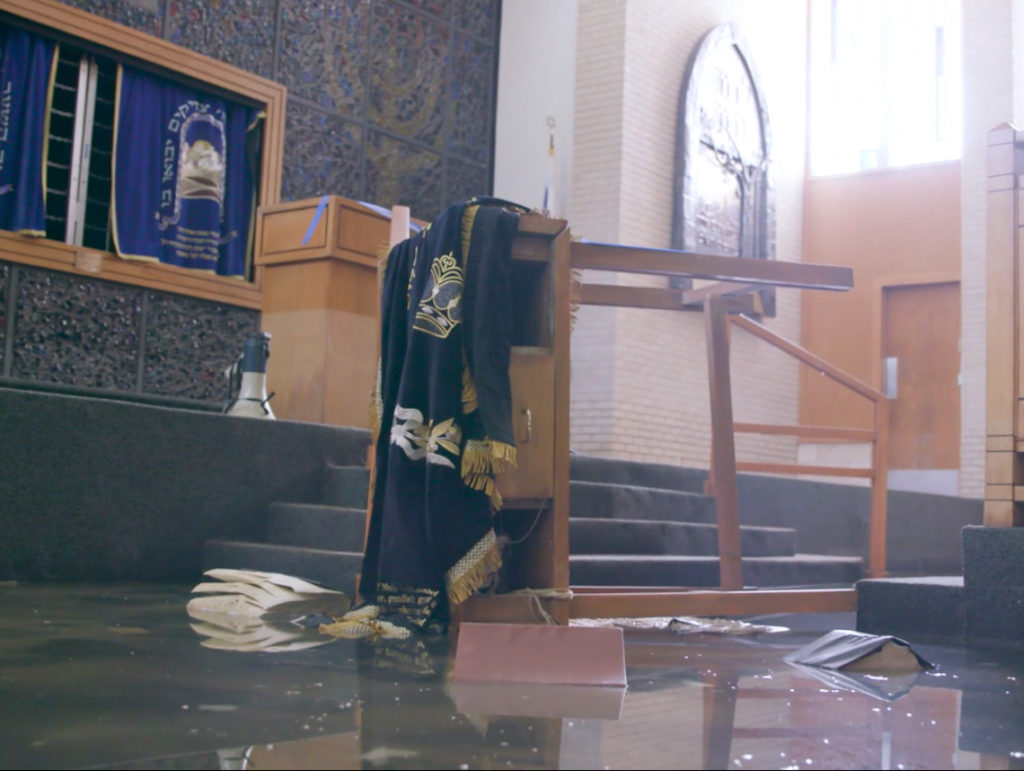
During and immediately after Hurricane Harvey, the Houston Federation worked closely with local Jewish organizations in the city, including the six major institutions that flooded: Congregation Beth Israel, a Reform temple; Congregation Beth Yeshurun, a Conservative synagogue; United Orthodox Synagogues of Houston (UOS); the Evelyn Rubenstein Jewish Community Center (JCC) of Houston; the Torah Outreach Resource Centre of Houston (TORCH); and Seven Acres Jewish Senior Care Services, a residential facility for the elderly.

Despite flooding at the homes of its top leaders, the Houston Federation partnered with Houston’s Jewish Family Service and Chabad to deploy aid.

Operating through its Texas regional headquarters in Houston, Chabad also launched a separate aid and recovery effort as record-setting rainfall lashed southwest Texas from Aug. 25-27.

Rabbi Barry Gelman of the United Orthodox Synagogues of Houston in the main sanctuary of the shul, which flooded during Hurricane Harvey.

During the first days of the disaster, Chabad arranged to ship tens of thousands of pounds of kosher meat to the Houston Jewish community, which is concentrated in the hardest-hit areas of the city and was devastated by feet of floodwater that often carried sewage and other waste.

By mid-September, the religious outreach group had collected approximately $800,000 in cash donations and donated goods worth hundreds of thousands more for relief efforts in the Houston and Corpus Christi regions, according to Rabbi Chaim Lazaroff, Chabad’s Hurricane Harvey relief coordinator. The funds are being used for storm cleanup, trucking of goods, emergency assistance, temporary housing, a food and supplies pantry, a Chabad command and call center and more, he wrote in a Sept. 17 email.

“We are focusing as well on the emotional and spiritual recovery of the community through uplifting and educational programming addressing the aftermath of Harvey” at 11 Houston-area Chabad centers and another in Corpus Christi, Lazaroff wrote in the email.

Meanwhile, Sanderson wrote in a community-wide email that the money raised by L.A.’s Federation would go to cash assistance for victims, extended day camp programs for children, congregational grants, volunteer coordination, counseling and mental health services, and mapping the community and its needs.

“We need to be invested in our brothers and sisters in Houston in the long term, not just in the immediate aftermath of the hurricane,” Sanderson told the Journal.

A set of videos produced for the Houston Federation documented the flood damage at the six Jewish institutions washed out by floods.

“It’s devastating,” Bruce Levy, president of Congregation Beth Israel, told the videographer, standing in a hallway of the flooded synagogue. “There’s so much destruction, so much loss. But we have a proud and hardworking community, and we’re going to build it back up again. That’s what I know.”

Each video ends with the same fundraising pitch, the words appearing over images of buildings destroyed and Jewish texts soaked beyond repair.

“No other Jewish community in the U.S. has witnessed such widespread devastation,” the boldfaced captions read. “Harvey’s catastrophic destruction has left Houston’s Jewish community in jeopardy. We need to rebuild. We cannot do it alone. We need your help.”

Hurricane Harvey fundraising for Jewish Houston just getting started Read More »

Worried about anti-Semitism in America? You are probably a liberal!

Last week, the American Jewish Committee published its annual survey of U.S. Jewish opinion. The survey found, among other things, that Jews “overwhelmingly disapprove” of President Donald Trump — and this was the main headline most media outlets chose as they reported on the findings.

But this survey contains much more than the quite-obvious truths about the current political tendencies of American Jews. It is one of the few surveys that ask Jews questions every year and, hence, provide us with a chance to look beyond obvious headlines. It gives us an opportunity to look at trends and to dig a little deeper.

The AJC generously provided me with some of the data that was not included in the basic presentation that appears on its website, and I will try to explain what it means. My main concern will be anti-Semitism in America.

1.

The survey found that 41 percent of U.S. Jews believe that anti-Semitism is currently a “very serious problem” in the United States, and 43 percent believe it is “somewhat of a problem.” The combined 84 percent is 11 points higher than the number last year. But more significantly, the “very serious problem” camp is now more than three times larger than what it was in 2013, when 14 percent of Jews believed anti-Semitism is a “very serious problem.” There are now twice as many as there were in 2015, when 21 percent of Jews believed anti-Semitism is a “very serious problem.”

Look at this graph based on AJC surveys and note the following things:

– 2017 is dramatically different from all previous years since 1998.

– The trend line of the last 20 years is downward – and again, it makes 2017 unique.

– Only five years ago (in both 2011, 2013) “very serious” concern about anti-Semitism was at its lowest point. So, the least concerned and the most concerned Jews both appear since the beginning of this decade.

2.

Of course, Jews are not all alike, and their assessment of anti-Semitism varies.

It varies by age, as you can see in the following graph. Note the following things:

– The youngest cohort is the one in which the least number of Jews say anti-Semitism is a very serious problem.

– The youngest cohort is also the one in which more people (albeit not many, 7%) say there is no problem of anti-Semitism.

What does it mean that younger Jews are less concerned about anti-Semitism than older Jews? Before we begin to speculate about the reasons, it is worth noting that this is not the first time younger Jews are less concerned than older Jews about anti-Semitism. For example, in 1998 the belief that anti-Semitism is a “very serious problem” in the United States was also “more prevalent among those who are older.” So maybe it is the inclination of older people — more concerned about the future, more aware of the past — to be more sensitive to anti-Semitism.

3.

The AJC survey provides proof that perception of anti-Semitism is greatly impacted by political affiliation. Broadly speaking, liberal Jews see more anti-Semitism around. Conservative Jews are much less worried. Among the “lean-conservative” group, a significant 40% think that anti-Semitism is “not much of a problem” or “not at all a problem” in the U.S. (note: to simplify the picture, the graph below only includes the liberal and conservative groups and does not include lean liberal, moderate and lean conservative. I include the full data at the end of this post).

What is the reason for such differentiation? Again, speculation is possible, but we need to note, again, that this is not the first survey in which liberals seem more concerned about anti-Semitism than conservatives. On the other hand, it is also not always the case that liberal Jews are more concerned about anti-Semitism. For example, in 2003, 35 percent of liberal Jews thought that anti-Semitism is a “very serious problem” compared with a similar 34 percent among conservatives. Or another example, in a study of Jewish students, the more hawkish “AIPAC supporters” reported a higher level of anti-Semitism compared to the more liberal “J Street” supporters.”

Why, then, are liberals the more concerned group this year? A few options:

– Liberals are more integrated into the general American society and hence have a more first-hand experience of anti-Semitic phenomena.

– Liberals are more inclined to expect that anti-Semitism will be eliminated in the U.S., and hence are more disappointed by its persistence.

– Liberals connect anti-Semitism with their general disappointment with the recent election and see a connection between the two.

4.

In several previous articles, I warned against “Politicizing the fight against anti-Semitism.” And, of course, I was hardly the only writer to do that.

Does the AJC data prove that the fight is politicized? It does not. But it does prove that the temptation to politicize it, the opportunity to politicize it and possibly the tendency to politicize it is there. It calls for caution, and sober assessment of the actual state of anti-Semitism in America.

5.

One last word on anti-Semitism: I invite you to read my recent New York Times column on Israel’s response to anti-Semitism in America. It was published late last week.

———

Full table: ideological leaning and seeing anti-Semitism in the U.S. as a problem:

Worried about anti-Semitism in America? You are probably a liberal! Read More »

A new year’s resolution: Emulating the shofar

Can the humble sound of a ram’s horn help unite our community? Can it encourage us to dialogue rather than to fight, to disagree honorably rather than to cut each other out? 

The communal rancor in the age of Donald Trump has been so ugly and intense, I’m not sure anything will help. Rabbis will surely weigh in on this subject with their holiday sermons. How could they not? I can’t recall our community being so divided. Never Trumpers versus always Trumpers versus sometimes Trumpers — the Trumpster hurricane is wreaking communal havoc.

What is behind this human rancor? In part, I call it the curse of being right. Something happens to people when they’re sure they have the whole truth on their side. They get on such a high horse they can’t see anything below. More than that, they refuse to see anything below.

I’ve seen family relationships break up over Trump. Why? Because we have become our ideology. More specifically, our political ideology. We have convinced ourselves that this is life or death, that we must all unite behind the same beliefs or a catastrophe will happen.

With that mindset, no civil dialogue is possible. If someone is not with you, they are worthy of contempt, or at least utter dismissal.

We have crossed the line from disagreement into rejection. It’s not just that I disagree with you, it’s that I am disgusted by your position. So disgusted that I am rejecting you.

When emotions are so raw, words can only go so far. To shake us up, we also need something transcendent, something nonverbal. That’s why I’m hoping that this year, the shofar will come to the rescue.

As we pray during the High Holy Days, we all will be hearing the same four sounds of the shofar: tekiah — one long blast; shevarim — three medium blasts; teruah — nine short staccato sounds; and tekiah gedolah — one extra-long blast.

I’d like to suggest that hidden in those four sounds is symbolic hope for communal healing.

Tekiah — the long blast — symbolizes the taking of a long breath before we speak. When we take that breath, we’re less likely to allow our anger to get the better of us, to say something that may irreparably damage a relationship.

Shevarim — three medium blasts — symbolizes the back and forth of a civil dialogue. Even if we are certain of our views, it behooves us to hear other views. Not because they will change our minds, but because hearing other views is an act of decency.

Teruah — nine short sounds — symbolizes sharp arguments. We can take on  each other, we can be passionate about our positions, but we don’t need to go as far as cutting people out of our lives, especially people we care about. Even, yes, if we are disgusted by their views.

On our deathbeds, will we think: I’m glad I stopped talking to this person who I care about because they said something good about Trump?

Tekiah gedolah — the extra-long blast — is, for me, the most meaningful sound. It symbolizes the long game. Why are we here? Why are we alive? What will we be thinking during the last few minutes of our lives?

Imagine, for example, that you are a liberal who is repulsed by Trump. You think he’s the worst thing that ever happened to America. You think he’s a racist and a bigot. You dream of his impeachment.

Now, you have a longtime friend or a relative who voted for Trump. Every time you see this person, it reminds you of their politics and it turns your stomach. Over time, it gets harder and harder to be in that person’s company.

Tekiah gedolah comes to remind us of the long game. We all are going to die, some of us sooner than others. On our deathbeds, will we think: I’m glad I stopped talking to this person who I care about because they said something good about Trump?

This is what turns my stomach: The notion that we can give politics the power to contaminate our relationships.

I have a friend who took me on in a nasty way recently over a political issue. Her Facebook comment shook me up because I adore this person. Not sure how to respond, I sent her this private message: “I am incapable of having any negative feelings for you. I’m trying, but I can’t.”

This is not kumbaya. This is a hard-nosed refusal to let ideology destroy a relationship.

So, here’s my suggestion: When we hear the four sounds of the shofar this year, let’s meditate on how those humble sounds can heal us. Let’s learn to express our views with passion but also with humility.

If the great Moses could do it, so could we.

Happy, sweet and peaceful new year.


David Suissa is president of TRIBE Media Corp./Jewish Journal and can be reached at davids@jewishjournal.com.

A new year’s resolution: Emulating the shofar Read More »

When a childhood home is demolished

Eighty-three years ago, in the midst of the Great Depression, my childhood home in West Los Angeles was built.

It was a charming California ranch-style home of no more than 2,100 square feet. According to neighborhood code, every home was set back 100 feet from the street.

When I was growing up, 15 mature trees populated the grounds. In the backyard, there were willow, palm, avocado, guava, kumquat, peach, plum, laurel and lemon. In the front yard grew magnolia, jacaranda, paper birch, oak, pine and maple.

Alas, all are gone now except the maple.

As a kid, I loved climbing the tall oak or magnolia whenever I needed to be alone. I also loved to climb onto our tile roof, trying to be careful not to break the tiles, which I did from time to time.

My parents bought the home in 1949, just before I was born. My brother, Michael, left for college in 1966, and after I left in 1968, my mother sold the property. The family that bought it lived there for the next 49 years until this past year.

Not long ago, it was demolished.

I loved that house. My first memories are from the age of 2. I played baseball with my dad and brother in the backyard. Michael and I dug holes lined with tin cans in the front yard so we could putt golf balls. In the back was a built-in, red-brick distressed barbecue. In the service yard behind the garage we inherited an incinerator from the 1940s and used it until the L.A. City Council banned them in 1957.

My dad played the violin and painted in the sunny lanai, a room he named for his pleasant experiences serving in the Hawaiian Islands during World War II as a physician and officer in the U.S. Navy. Our parents entertained with scotch and martinis before sit-down dinners. They drank their coffee black and hot.

My dad bought Michael and me our first bicycles. Mine was a red, 24-inch Schwinn I called “Betsy.” His was black. We rode the neighborhood with gusto. I walked to the bus stop or the mile through back streets to school from the age of 6 without my parents expressing, to my knowledge, any worry.

Our house doors were never locked. Milk was delivered in bottles and placed in a small niche near the back door. The Good Humor ice cream truck drove our streets in the afternoon. I played outside until dark and came home filthy. I knew my neighborhood like the back of my hand and knew most of the neighbors. Dogs roamed the streets unleashed.

As a little boy, I remember following my dad (whom I called “Daddy” and still do) like a puppy in the backyard, picking up the clippings he pruned. I still remember the smell of wet, cut grass and eucalyptus from the adjacent property. We fed California jays (now called scrub jays) and had names for all of them according to their markings. We collected butterflies.

In 1953, my parents bought our first television set, a 24-inch, black-and-white console. They put it in my dad’s study with his bookshelves, medical journals, desk and two red leather chairs and ottoman, on which my brother and I watched cartoons on weekend mornings, Westerns in the afternoons, “I Love Lucy” when we were sick, the Friday night fights with my dad, “The Wonderful World of Disney” and “The Ed Sullivan Show” on Sunday nights.

In 1956, I remember the interview with Adlai Stevenson when the camera caught a glimpse of a hole in the bottom of his shoe. I also recall seeing Fidel Castro on “Face the Nation” in 1959 just after the Cuban revolution; John F. Kennedy delivering his 1961 inaugural address; his Cuban missile crisis speech in 1962; the Rev. Martin Luther King Jr.’s “I Have a Dream” speech in 1963; the entire weekend after Kennedy’s assassination in November 1963, including the murder of Lee Harvey Oswald; Lyndon B. Johnson signing the 1964 Civil Rights Act and the 1965 Voting Rights Act; and footage of the fighting during the 1967 Six-Day War between Israel and Arab neighbors that promised to “push the Jews into the sea.”

I emerged into political and historical consciousness in that house.

On Aug. 10, 1959, my world changed irrevocably. Michael (a year older than me) and I saw our father for the last time that evening as he stood in the doorway of our small bedroom to say goodnight. He hadn’t been feeling well and while we slept, an ambulance came to the house and took him at 2 a.m. to the hospital where he died 23 hours later from his second heart attack. He was only 53 years old.

My brother and I call that house “321,” a reference to its address. It has been our link to our childhoods and father throughout our lives. I visited it from time to time and even knocked on the door 25 years ago and asked to walk through. The owners remembered my family and were gracious. Although it had been owned by others, Michael and I still felt that it belonged to us. I fantasized that maybe either of us would be able and want to buy it this past year when it was put up for sale.

One doesn’t say Kaddish over a house, but its demolition is a death for both of us. As the High Holy Days approach and I ponder the past year that includes the end of my childhood home, I’m left now only with, as Jim Croce poignantly said, “photographs and memories.”


RABBI JOHN ROSOVE is senior rabbi at Temple Israel of Hollywood.

When a childhood home is demolished Read More »