fbpx

September 15, 2017

The most chilling words of the High Holy Days

Rabbi David Woznica

On Rosh Hashana it is written and on Yom Kippur it is sealed: How many shall pass away, how many shall be born; who shall live and who shall die…

These words of the Unetaneh Tokef are meant to illicit shivers. If our fate for the coming year is decided during the days beginning with Rosh Hashana and concluding with Yom Kippur, these are the most unsettling words in the High Holy Day machzor (prayerbook).

It comes to teach us that the ten day period known as the Ten days of Repentance, starting with Rosh Hashanah and concluding with Yom Kippur, is an elevated block of time.

Do you believe it?  Do you believe God decides your fate for the coming year during these days?  It’s frequently suggested we not to take the words literally.  I suggest otherwise.

The reading concludes:

But repentance, prayer and charity, avert the severity of the decree.

I posit the question again.  Do you believe it?  Do you believe that with repentance, prayer and deeds of kindness during these ten days, you can affect the severity of the decree?

Not one of us can know for certain. Yet it is precisely that uncertainty that speaks to the power of the Unetaneh Tokef.  I suggest that during these ten days, we assume our fate is decided and therefore we should act as if engaging in repentance, prayer and charity during these days will determine our fate.

From our actions during those days, we can learn a great deal about our capabilities. Consider the following analogy.  Many of us have successfully dieted.  While the weight we worked so hard to shed often returns, we learned a valuable lesson.  We are capable of dieting.

Imagine during the days from Rosh Hashana to Yom Kippur we engaged in repentance, prayer and charity (and other acts of goodness) with greater frequency.  What if during these ten days we chose our words more carefully, gossiped less, prayed more frequently, were more charitable, more watchful of the kosher laws and Shabbat. In short, imagine that during the Ten Days of Repentance we elevated our ethical and ritual behavior and became better Jews.

We would discover that we are capable of living at a higher standard and we might continue to live this way throughout the year.  That is why the High Holy Days can be life changing.

If we want our High Holy Days to have deeper meaning, I suggest during the Rosh Hashana services, we set goals for the next ten days and consider that our actions during those days may shape our future.

On Rosh Hashana it is written and on Yom Kippur it is sealed. Ten Days that may have the power to influence God, but most certainly have the power to influence us.


David Woznica is rabbi at Stephen Wise Temple in Los Angeles.


The most chilling words of the High Holy Days Read More »

A Moment in Time: Are You There?

Dear all,

In preparation for the Holy Days, I’ve been doing a lot of introspection.  Life’s big questions filter my soul, and like everyone, I search for answers.

While I do lots of reading, consulting both traditional as well as contemporary sources, I decided to give Rabbi Siri (thank you Apple) a try.

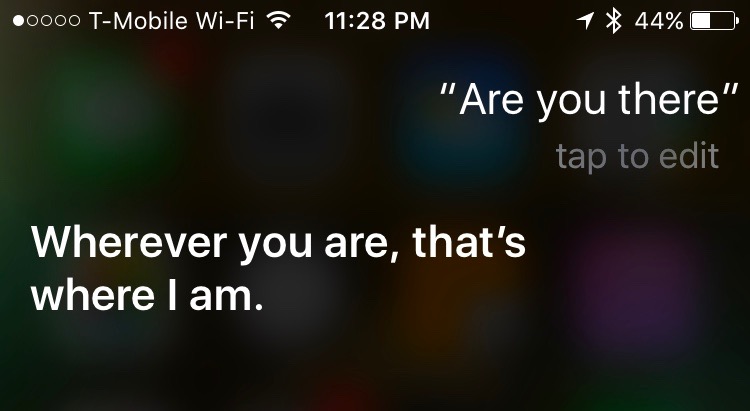
And so I asked, “Are you there?”

Siri responded, “Wherever you are, that’s where I am.

I needed to let it sink in….

Wherever you are, that’s where I am.  I thought about it for a long time.  I then realized that this is true on so many levels:

Wherever I go, my husband’s love surrounds me.
Wherever I go, the memory of my grandparents guides me.
Wherever I go, the strength of my synagogue supports me.
Wherever I go, my own soul is within me.
Wherever I go, God’s whisper inspires me.
Wherever I go, that’s where I am.

Whenever we are feeling a little out of place, just a moment in time to remember that we aren’t alone can transform darkness into light.

With love and Shalom,

Rabbi Zach Shapiro


A change in perspective can shift the focus of our day – and even our lives.  We have an opportunity to harness “a moment in time,” allowing our souls to be both grounded and lifted.  This blog shows how the simplest of daily experiences can become the most meaningful of life’s blessings.  All it takes is a moment in time.
Rabbi Zach Shapiro is the Spiritual Leader of Temple Akiba, a Reform Jewish Congregation in Culver City, CA.  He earned his B.A. in Spanish from Colby College in 1992, and his M.A.H.L. from HUC-JIR in 1996.  He was ordained from HUC-JIR – Cincinnati, in 1997.

A Moment in Time: Are You There? Read More »

If not now, when will Dreamers be seen as Americans?

I am the oldest daughter of Mexican immigrants. My dad arrived in the United States in the late 1980s and was a beneficiary of the Immigration Reform and Control Act of 1986. He became a permanent resident and gained a pathway to citizenship in 1987. My mom became a U.S. citizen a year later, after she and my dad were married. I was born a year after that.

I grew up in Encino and attended Catholic schools. I traveled to Mexico every couple of years to visit family members and heard stories of my family’s struggles with living in poverty. I also saw the poverty in which many of my family’s neighbors lived.

[Larry Greenfield: Why Trump is right on DACA]

Here in Los Angeles, I saw the fear and anxiety in which many of my relatives lived because they, unlike my parents, were undocumented. The emotional and mental strain of their instability was agonizing. I watched, feeling powerless, as my cousins hid under the couch every time they heard a siren, in fear that their parents would get deported.

I noticed, too, the disproportionate finances of our households. My parents were homeowners, able to afford the private-school tuition for my sister and me, and able to afford going on vacation. My uncles lived in apartments and did not have the luxury of taking time off work for a vacation. They kept count of the years since they had seen the home they left for a better future.

I celebrated with my family as, one by one, my relatives became permanent residents and American citizens. We kept a tally of who was undocumented in our family, and as the number shrank, we naively came to believe that our worries were over.

But after the White House announced it planned to rescind the Deferred Action for Childhood Arrivals (DACA)  program, which protects children of undocumented immigrants brought to the U.S. by their parents, many of those worries began to creep up. Not for myself, not for my family, but for Dreamers — the approximately 800,000 recipients covered by the program.

American all but in name, Dreamers entered the United States at the average age of 6, many even younger.

When DACA was established in 2012, its recipients were not offered a permanent residency or a pathway to citizenship. Instead, they received renewable two-year work permits and a Social Security number. Without fear of deportation, they entered the workforce and many enrolled in colleges and universities.

A Social Security number also offered DACA recipients the ability to obtain a driver’s license and to open bank and credit card accounts.

It is easy to take for granted obtaining a driver’s license when in California the law allows a person as young as 15 1/2 to get a driver’s permit. But having to decide whether to risk driving without a license is common for undocumented individuals. Not only must they live with the fear of getting pulled over or getting into an accident, they increase the risk for everyone else on the road because their driving skills are not fully vetted.

This is one of the ways in which the establishment of DACA benefited not only its recipients but the community at large. The access to a driver’s license has meant safer roads for all of us.

Another way in which the larger community benefits is through taxes that DACA recipients pay. A 2014 report by the American Immigration Council found that almost 60 percent of the DACA recipients surveyed had obtained a new job since qualifying for the program, and about 45 percent indicated that their earnings had increased.

While DACA recipients have benefited greatly from the program and have been shielded from deportation, recipients do not have a pathway to citizenship and therefore do not qualify for Social Security benefits. Nor can they apply for financial aid from the federal government.

As a result of President Donald Trump’s decision, DACA recipients whose permits expire after March 5, 2018, stand to lose the protection and benefits that the program provided, and now with the added fear that the government has the information on who they are and where they live.

Dreamers have grown up in this country with their right hand over their hearts, pledging their allegiance to the U.S. and believing in the promise of “liberty and justice for all.” The passing of the Dream Act by Congress is long overdue. Dreamers are American in all but name.

And if not now, then when will they be recognized as such?


Tracy Escobedo, a Los Angeles native, is the daughter of Mexican immigrants and a Jew by Choice.

If not now, when will Dreamers be seen as Americans? Read More »

Why Trump is right on DACA

President Donald Trump’s decision on “Dreamers” actually reflects a broadly held, nuanced consensus regarding the status of immigrants brought into this country as children of parents who entered illegally.

First, legal immigration is good for the United States, and the U.S. takes in more legal immigrants than any other nation. But there must be reasonable, debatable and annual limits.

[TRACY ESCOBEDO: When will Dreamers be seen as Americans?]

We are a nation of immigrants, and all Americans, born here or not, are equal citizens entitled to the full protection of the law and every opportunity to enjoy the American Dream. 

The administration has proposed prioritizing immigrants for our nation’s economic benefit and limiting the scope of family reunification to leverage the economic merit of applicants.

Silicon Valley, for instance, suggests we not deport tech graduates here on student visas once they have computer science degrees in hand. We invested in them, now they can invest in the U.S.

Next, illegal immigration is unlawful, as are sanctuary cities that violate federal law. No country allows illegal immigration, and many countries are much tougher than the U.S.

Illegal immigration results in human rights abuses by coyotes against suffering poor people and invites countries to dump their poor into the U.S. It’s corrupt and nefarious.

Businesses must not be allowed to hire illegals. This distorts the economy and drives down wages in the economy.

And Mexico, one way or another, should reimburse the United States for the decades-long purposeful strategy of exporting Mexican workers in return for importing hundreds of billions of dollars of remittances back to Mexico.

Third, our country will not round up 10 to 20 million unlawful residents and deport them. Our country will also not deport 800,000 Dreamers who work, pay taxes and go to school.

And fourth, Congress must reassert its constitutional authority and obligation to protect our borders and set immigration policy, denying federal aid to “sanctuary” states and cities.

Congress must clarify if Birthright Citizenship — which meant Black slaves and their progeny in the 19th century were full Americans — should continue to reward “birth tourism;” whether illegal immigrants may earn a path to citizenship, voting rights or the ability to run for office; and, finally, the federal penalty for employers hiring illegal workers.

States must decide on the welfare, educational and health benefits to be afforded undocumented workers and their families.

The Dreamers have already won. They have made it to America, built lives of generally good citizenship and are unlikely to be deported in big numbers due to the compassion and common sense of the American people, who respect the rule of law, with fair and reasonable policies regarding immigrants here illegally via border crossing or by over-staying visas.

But the critics of illegal immigration have also won the debate: No blanket amnesty or citizenship status for illegal entrants, except perhaps enlistees of the armed forces; and no patience for violent criminals, many of whom are repeat border violators who must be deported (along with a bill to the countries of origin for our troubles).

Advocates for resolute border security make economic, rule-of-law and national-security arguments for tougher standards and controls of both legal and illegal immigration.

Americans support both a border wall and advanced technologies to increase security in a world of jihadism and weapons of mass destruction.

President Trump, who has asserted his “love” for the Dreamers, is balancing his “America First” / “The Business of America Is Business” policies with the facts on the ground and his knowledge that legal immigration is American.

President Barack Obama repeatedly asserted he lacked unilateral authority to keep the Dreamers, but he did so anyway. President Trump has been well advised to return the policy issues to Congress.


Larry Greenfield has been a Fellow of the Claremont Institute, the Tikvah Advanced Institute, and the Wexner Heritage Foundation. He is former executive director of the California Republican Jewish Coalition, the Reagan Legacy Foundation, and the Jewish Institute for National Security Affairs.

Why Trump is right on DACA Read More »

Israeli consulate in NY evacuated after death threat against Netanyahu

The Israeli consulate in New York City was evacuated after receiving a threatening letter.

The consulate’s spokeswoman, Almog Elijis, confirmed that the building was evacuated Friday due to a threatening package and that the situation was under control, but did not provide further details. The Jerusalem Post reported, based on a source at the consulate, that the package contained an envelope with white powder and a letter threatening Israeli Prime Minister Benjamin Netanyahu’s life, written in English.

Netanyahu is set to visit New York this week, where he will speak at the United Nations General Assembly Tuesday and meet with President Donald Trump.

Israeli consulate in NY evacuated after death threat against Netanyahu Read More »

The top 10 moments that mattered to Jews in 5777

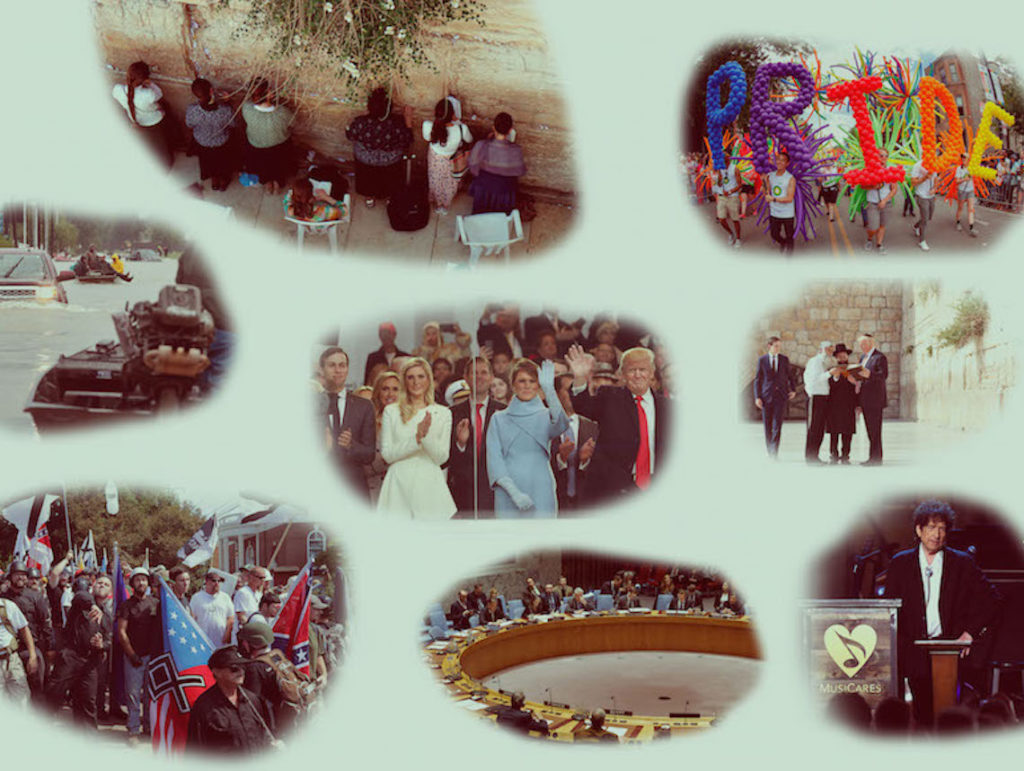
This Jewish year was not a quiet one, to say the least. From the tumultuous first eight months of Donald Trump’s presidency, to a wave of bomb threats against Jewish community centers, to a neo-Nazi protest in Charlottesville that turned violent, to the twin weather catastrophes of Hurricanes Harvey and Irma, Jews, like so many others, found it hard to take their eyes off the news.

As the year 5777 comes to a close, JTA looks back at some of the moments that had the most significance for Jews, sorted below by date.

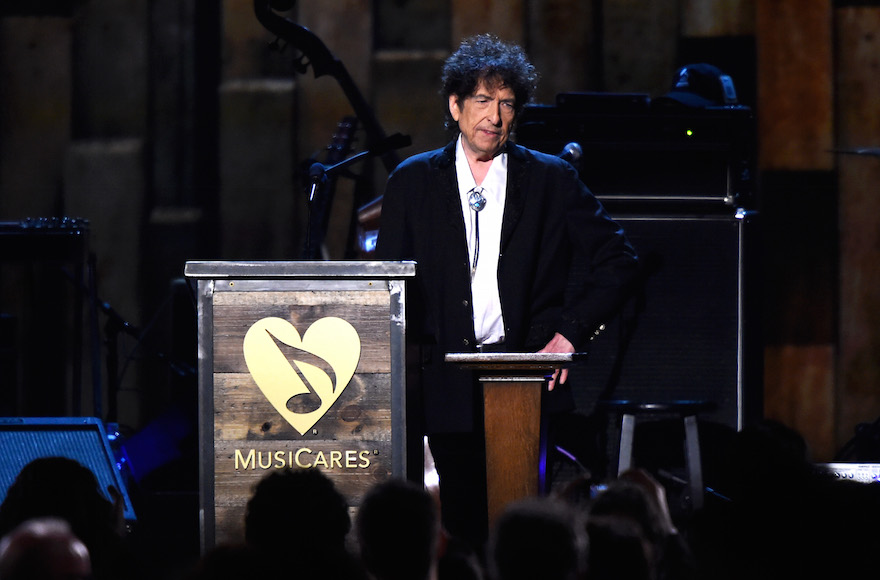
Bob Dylan is awarded the 2016 Nobel Prize in Literature.

Bob Dylan speaking at the 25th anniversary MusiCares Person of the Year Gala at the Los Angeles Convention Center, Feb. 6, 2015. (Frazer Harrison/Getty Images)

In an unexpected move, the Swedish Academy bestowed the iconic Jewish American singer — born Robert Zimmerman — with the highly coveted prize in October. Though Bob Dylan’s fame is indisputable — he wrote some of the most well-known and culturally significant songs of the 1960s — the decision raised eyebrows because the prize has traditionally been given to novelists and poets, not songwriters. Dylan did not seem as enthusiastic as some of his fans: He took two weeks to acknowledge the award and said he was unable to travel to Sweden for the official ceremony, though he traveled there at a later date to accept the award and present the required lecture.

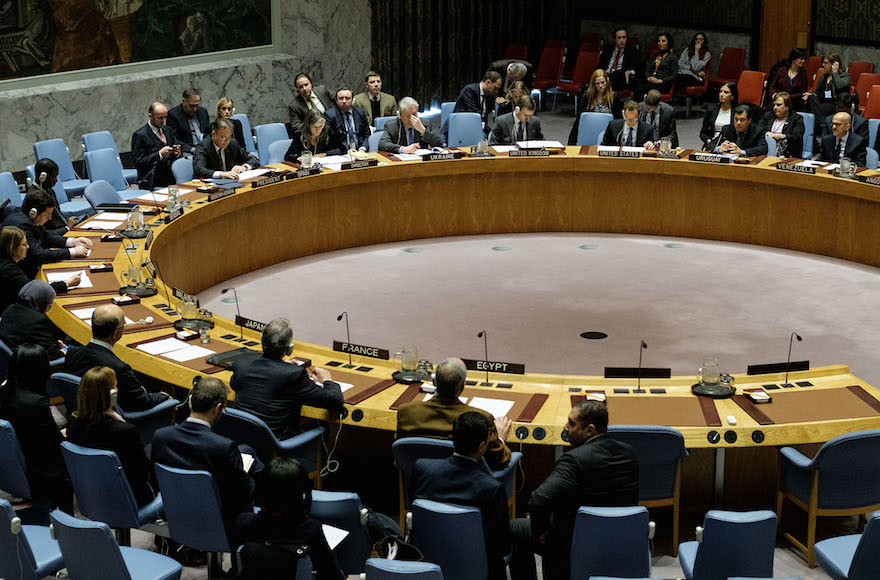
U.N. criticizes Israeli settlement, and the U.S. abstains.

UN Security Council

The Security Council meeting at U.N. headquarters in New York, Dec. 21, 2016. (Drew Angerer/Getty Images)

In December, the United Nations sharply condemned Israeli actions in a resolution calling settlements “a flagrant violation of international law” that damage the prospects of a two-state solution to the Israeli-Palestinian conflict. Traditionally, the United States has vetoed such resolutions — but in its waning days the Obama administration chose not to follow suit. The move prompted outrage from Israel, centrist and right-leaning Jewish groups and then President-elect Donald Trump, who called the resolution “extremely unfair.” Samantha Power, then the American envoy to the U.N., defended the abstention, saying the resolution was in line with longstanding U.S. opposition to Israeli settlements.

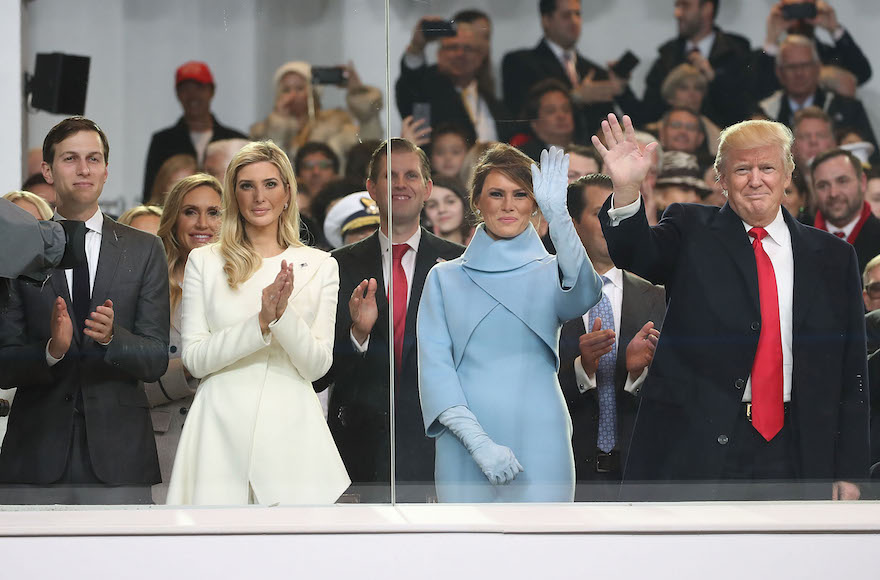
Trump takes office, bringing Ivanka and Jared with him.

President Donald Trump, standing with his wife, Melania, daughter Ivanka Trump and her husband, Jared Kushner, inside of the inaugural parade reviewing stand in front of the White House, Jan. 20, 2017. (Mark Wilson/Getty Images)

Trump took office in January after his unexpected victory over Hillary Clinton in November, pledging in his inaugural address to put “America first.” The use of the slogan — the name of an isolationist and often anti-Semitic movement leading up to World War II — alarmed some Jews, but Trump said the phrase had no connection to the earlier usage. Trump brought with him a cadre of Jewish advisers, including his daughter, Ivanka Trump, and her husband, Jared Kushner. The couple, both of whom are observant Jews, would take on critical roles in the administration as senior advisers to the president, with Kushner in charge of a thick portfolio that included brokering a peace deal between Israel and the Palestinians.

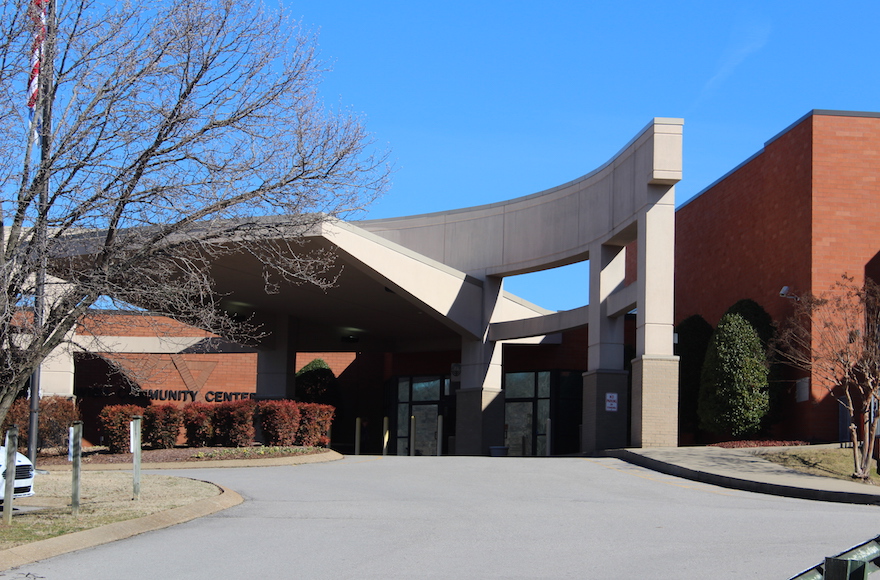
JCCs in U.S. and Canada targeted with more than 100 bomb threats.

The Gordon JCC in Nashville was targeted multiple times with bomb threats in 2017. (Courtesy of Gordon JCC)

From January to March, Jewish community centers, Jewish schools and other institutions were hit with more than 100 bomb threats. None of the threats, many of which were called in, turned out to be credible, but they forced evacuations and spread fear among local communities. Several Jewish cemeteries were also vandalized, prompting some to blame the rise of the “alt-right” — some say the movement was legitimized following Trump’s election — for the threats. However, neither of the two men arrested for making the threats turned out to be motivated by far-right beliefs. One of the accused, Juan Thompson, was arrested for making bomb threats against eight Jewish institutions in the name of an ex-girlfriend in a revenge plot. The main suspect, however, turned out to be an Israeli-American teenager, Michael Kadar of Ashkelon, who was arrested for making hundreds of threats. Kadar reportedly sold his bomb threat services online and suffers from a brain tumor, according to his lawyer.

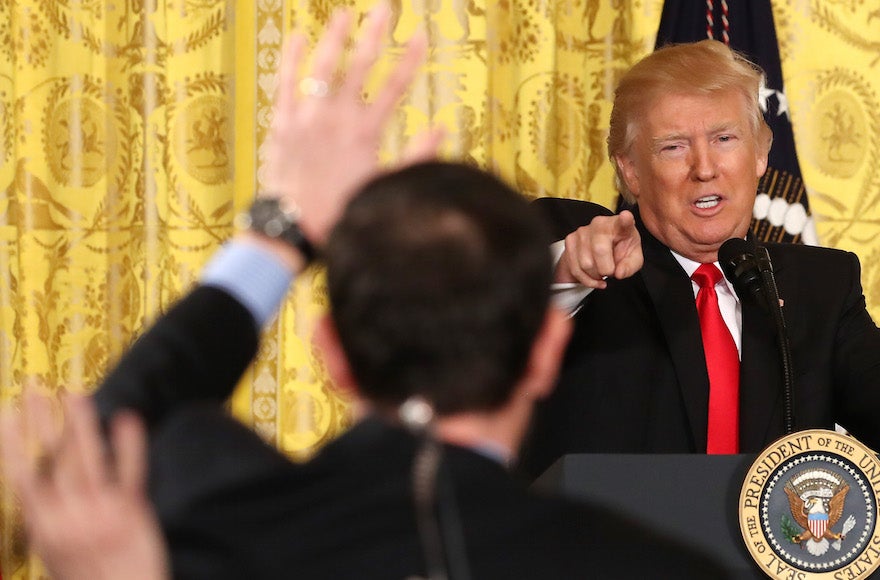
Trump shouts down reporters who ask him about a rise in anti-Semitism.

President Donald Trump speaking at a White House news conference, Feb. 16, 2017. (Mark Wilson/Getty Images)

In February, the president shouted at two journalists who asked him about an increase in anti-Jewish sentiments and incidents, and said he “hates” being called an anti-Semite, although neither reporter called him one. After asking for a “friendly” reporter, Trump interrupted a question by a haredi Orthodox journalist — he accused him of lying about his intentions — and claimed to be the “least anti-Semitic person that you have ever seen in your entire life.” Trump’s response drew criticism from Jewish groups, many of which had already criticized him a month earlier for releasing a statement on International Holocaust Remembrance Day that notably did not mention Jews. His defenders said the president’s critics were politically motivated.

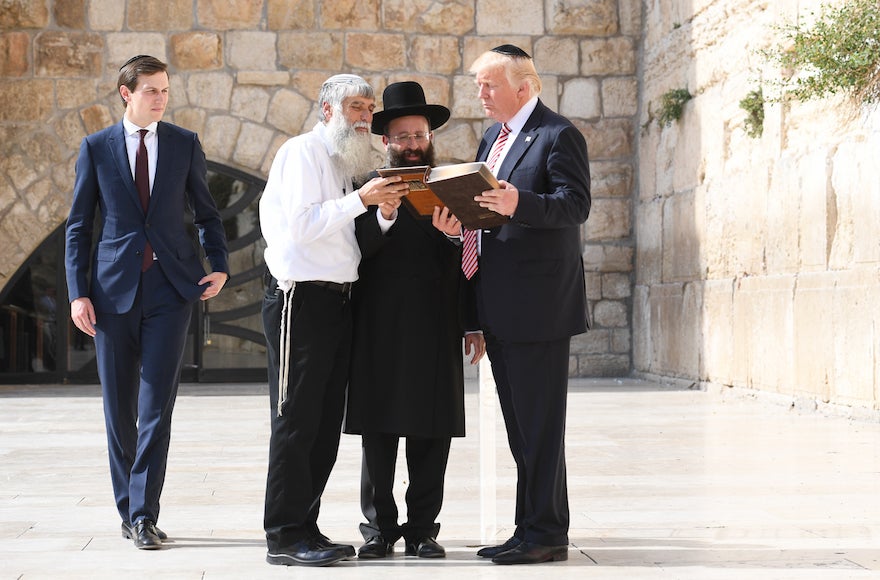
On first overseas trip, Trump visits Israel.

President Donald Trump and Jared Kushner, left, at the Western Wall in Jerusalem, May 22, 2017. (Israel Bardugo)

Trump paid a visit to the Jewish state on his first overseas trip as president in May, which also included stops in Italy and Saudi Arabia. The two-day trip included a stop at Yad Vashem and meetings with Prime Minister Benjamin Netanyahu and President Reuven Rivlin, as well as Palestinian Authority President Mahmoud Abbas. Trump, accompanied by his daughter Ivanka and her husband Jared Kushner, also stopped at the Western Wall for a private visit, making him the first sitting U.S. president to visit the holy site and earning him high praise across Israel. A few months after the visit, Trump dispatched a team of top aides, including Kushner, Jason Greenblatt and Dina Powell, to visit Israel and other Middle Eastern countries in an attempt to revive peace talks.

Israel freezes pluralistic Western Wall agreement.

Western Wall

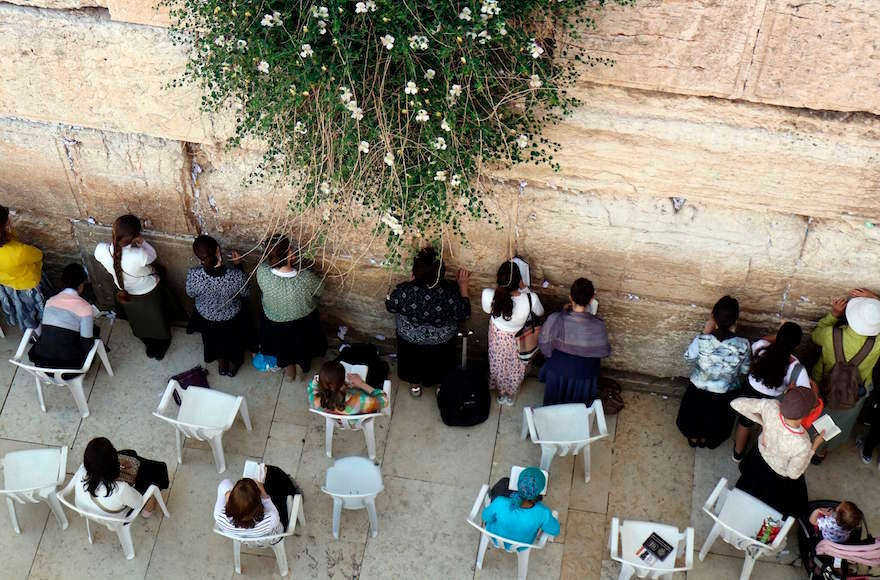
Jewish women praying at the women’s section of the Western Wall in Jerusalem, May 16, 2017. (Thomas Coex/AFP/Getty Images)

A June decision by Netanyahu’s Cabinet to put a hold on the creation of an egalitarian section of the Western Wall, a deal passed in 2016, drew the ire of American Jewish leaders. Some leaders, also angered by the advancement of a bill to give the Orthodox Chief Rabbinate complete control of conversions performed in Israel, warned of a growing schism between American Jews and Israel. Natan Sharansky, the chairman of the Jewish Agency for Israel, also joined critics of the decision, saying it “will make our work to bring Israel and the Jewish world closer together increasingly more difficult.” In August, the Israeli Supreme Court said the government must either reinstate the agreement or provide an explanation as to why it had put a hold on it.

Chicago Dyke March bans three women for carrying flags with Jewish stars.

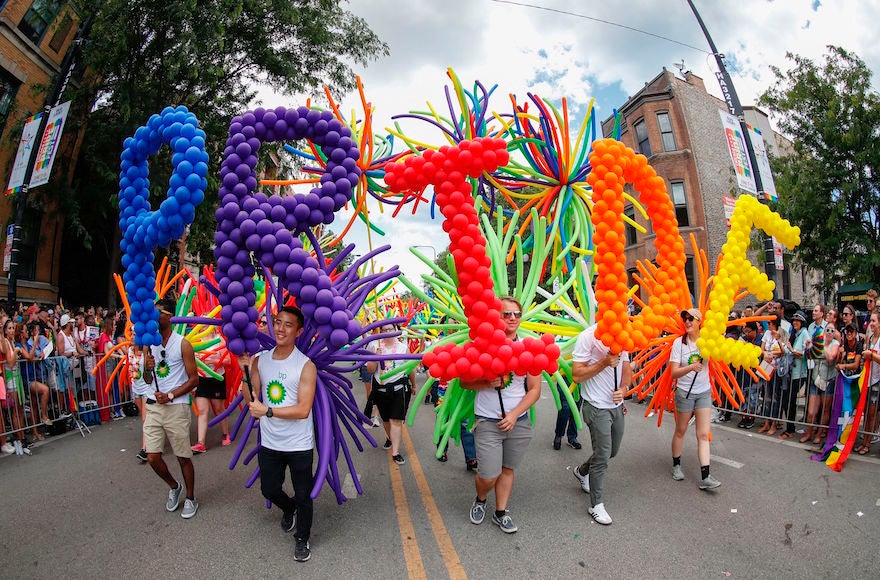
Marchers at the 48th annual Gay and Lesbian Pride Parade in Chicago, June 25, 2017. (Kamil Krzaczynski/AFP/Getty Images)

In June, a Chicago lesbian march ejected three women for carrying Gay Pride flags with Jewish stars, saying the march was “anti-Zionist” and “pro-Palestinian.” The decision drew heated debate, and the Jewish reporter who first wrote about the incident for a Chicago LGBTQ newspaper said she was removed from her reporting job as a result of the article. The Dyke March controversy — as well as similar debates about the role of Zionists in the feminist movement and whether demonstrators could bring banners with Jewish stars to a Chicago feminist march — illuminated a growing challenge for Zionist Jews who feel unwelcome in liberal spaces.

Neo-Nazis rally in Charlottesville.

Hundreds of white supremacists and far-rightists on the outskirts of Emancipation Park during the Unite the Right rally in Charlottesville, Va., Aug. 12, 2017. (Chip Somodevilla/Getty Images)

Neo-Nazis and white supremacists gathered in a Virginia park in August to protest the removal of a statue of Confederate Gen. Robert E. Lee. The far-right protesters chanted anti-Semitic and racist slogans, including “Jews will not replace us,” and brawled with counterprotesters. One counterprotester, Heather Heyer, was killed when a suspected white supremacist rammed his car into a crowd. Trump waffled on condemning the protest, calling out neo-Nazis and white supremacists in one remark, but blaming both sides for the violence at other times, and saying there were “some very fine people” in both groups. Jewish groups, lawmakers from both sides of the aisle and the president’s top economic adviser, Gary Cohn, criticized Trump for his response, saying he was not doing his part to condemn hate.

Hurricane Harvey floods Houston

Rescue workers and volunteers helping residents make their way out of a flooded neighborhood in Houston following Hurricane Harvey, Aug. 29, 2017. (Scott Olson/Getty Images)

Homes were flooded and lives were turned upside down as Hurricane Harvey hit Texas in August, forcing mass evacuations across the state. Over 70 percent of the city’s Jews live in areas that experienced high flooding, and synagogues, schools and other Jewish community buildings sustained significant damage. Recovery from the hurricane is expected to take years, but the disaster also served as a point of coming together for the community, as Jewish groups rallied to distribute donations and local Jewish camps offered housing to those with nowhere to go.

The top 10 moments that mattered to Jews in 5777 Read More »

Myers proves an ideal Jewish voice in ‘Jewish History: A Very Short Introduction’

David N. Myers, an accomplished and distinguished Jewish historian, has written a small book about a very big subject: “Jewish History: A Very Short Introduction” (Oxford).  It’s the latest title in Oxford’s “Very Short Introduction” series, which now consists of more than 500 chapbooks that span the breadth of human knowledge from “Accounting” to “Zionism.”

I am very nearly heartbroken at my obligation to acknowledge that Myers, who is a contributor to the Journal, the Sady and Ludwig Kahn Professor of Jewish History at UCLA and the recently appointed president of the Center for Jewish History in New York City, is the same embattled figure who has come under an especially ugly attack by a few right-wing character assassins.

The criticism starts with the fact that Myers is affiliated with the New Israel Fund, a progressive Zionist organization that opposes the building of new settlements on the West Bank and does not rule out a boycott of some products manufactured there — a position shared by many Jews in Israel and around the world. His critics leap to the conclusion that Myers is therefore “unfit” to head the Center for Jewish History or any other Jewish organization.  But as the Journal reported, some 500 of his fellow scholars came to his defense in a letter of support.

Happily, the scholarship that informs “Jewish History: A Very Short Introduction” is the best evidence of what his colleagues have written about. Indeed, it’s not less than breathtaking to behold how Myers has managed to capture the vast sweep of Jewish history without sacrificing its substance or its nuance, all the way from the ancient Israelites we encounter in the Bible to the modern Jewish communities in which we live now.

As one of the many examples of his intellectual deftness, Myers describes how the writings that come down to us from distant antiquity only gradually “gain[ed] coherence and the veil of sanctity that envelops the Bible as sacred scripture.” But, as a deeply well-informed Zionist, he reminds us that “[t]he bookishness of the Jews became a sore point for later Zionists,” who “aimed to replace what they saw as the excessively cerebral and passive diaspora Jews with a strong and brave ‘New Hebrew’ rooted in the soil of the homeland.” And when he writes that “the association of Jews and books has been virtually unbreakable,” the words take on a certain irony when we think of the conflicts that are raging between secular Jews and religious Jews in Israel today.

The same irony rings out from his description of medieval Spain under Muslim control. “Although Muslim rule was not uniformly favorable toward Jews, it was under the reign of Islam that Jewish culture reached some of its grandest attainments —  in philosophy, science, and poetry, as well as in the more traditional Jewish pursuit of rabbinic commentary.”

Above all, Myers affirms that Judaism is a tapestry, not a monolith, and it is a fabric to which new threads are always being added. “Jewish identity, like Jewish history itself, has never been a static proposition; from their humble desert origins, Jews have continually reimagined and renamed themselves —  and been renamed by others — in response to shifting historical circumstances.” Precisely because the Jewish people were dispersed so widely and for such a long time, Myers points out, we must speak of “an evolving series of Jewish cultures (plural) rather than a single unified culture,” which he describes as “a richly marbled admixture of local customs and shared global practices.”

Perhaps the highest compliment that can be bestowed on this little book is that it amounts to a short course on a subject so rich and strange that even a library full of books cannot exhaust its complexities. Virtually any line of text from “Jewish History” will provide enough ideas and information to sustain a passionate conversation, whether in a book club, a classroom or around a Shabbat dinner table.

Still, the sound and fury that has been recently directed toward Myers must come to the reader’s mind when we come upon certain passages that were written before he came into the crosshairs. “The task ahead is to understand the different, though connected, ways in which Jews have chosen to identify themselves,” he writes. “In so doing, we can see the continuity and change that add such animating tension to Jewish history.”

Alas, the “animating tension” has come to focus on Myers himself, if perhaps only briefly. His book is the best evidence that the abuse he has suffered from some right-wing critics is not only unmerited but downright tragic. In the pages of “Jewish History,” he shows himself to be moderate, measured, deeply knowledgeable and fairly glowing with Jewish values. All we can hope is that Myers, like the Jewish people themselves, will not only survive but, more than that, go from strength to strength.


JONATHAN KIRSCH, author and publishing attorney, is the book editor of the Jewish Journal.

Myers proves an ideal Jewish voice in ‘Jewish History: A Very Short Introduction’ Read More »

Horn Blowing

We’re Jewish, Father said,
so we don’t go to church. We
go to temple. Christians like
to ring bells. We like to blow
horns — the shofar — particularly
on the Jewish New Year. I don’t
see why musical differences
should make it hard to get along.


Hal Sirowitz is the author of five books of poetry: “Mother Said,” “My Therapist Said,” “Before,
During & After,” “Father Said” and “Stray Cat Blues.” His work has been translated into 13 languages and has been featured on NPR’s “All Things Considered” and  PBS’ “The United States of Poetry.” pGarrison Keillor has read many of Sirowitz’s poems on NPR’s “The Writer’s Almanac.”

Horn Blowing Read More »

In call with Jewish groups, Trump does not take questions

The debate has gone on for weeks among rabbis and Jewish leaders: If President Donald Trump does not formally renounce white supremacists, is it still worth engaging in a conversation with him?

This has been on much of the Jewish community’s mind since Aug. 23, when the leaders of three religious streams — Reconstructionist, Reform and Conservative — said they would not organize the annual pre-Rosh Hashanah call with the president, which the rabbinical groups had instituted at the start of President Barack Obama’s administration. That call, principally for clergy, was aimed at helping to shape the High Holy Days.

But last week, the White House said it would hold a call with Jewish leaders — one that would be in line with the calls and meetings that Jewish leaders have had with the sitting president since the Dwight Eisenhower era. It would be initiated by the White House, not the rabbis, and lay and religious leaders would be invited.

On Sept. 15, Trump delivered his holiday greetings in a conference call with Jewish leaders that lasted barely eight minutes. He condemned those who spread anti-Semitism. He expressed his love for Israel. And he hoped for progress in the peace process.

He took no questions. By contrast, calls and meetings with past presidents have included exchanges — sometimes tough — and generally lasted at least 45 minutes.

Some of the participants expressed disappointment after having done public battle with the Reform, Reconstructionist and Conservative movements over whether one should engage Trump in conversation in the wake of his equivocations over white supremacists.

“Everyone would look less stupid if he had just put it on YouTube,” one said, encapsulating the one-way direction of the conversation.

But others said it was important that they take part, out of respect for the office and as part of their duty to represent a diverse community.

Not invited to join the call were leaders of  the Reform and Reconstructionist movements. The Conservative movement did receive an invitation but Rabbi Julie Schonfeld, the CEO of its Rabbinical Assembly, declined to participate.

All the participants who spoke to JTA asked not to be identified because the call was off the record, although the White House released a transcript the same day.

Rabbi Avi Shafran, the director of public affairs for Agudath Israel, a Charedi Orthodox group, had argued in a Forward op-ed Sept. 14 that the rabbis who had opted out of the call with the president were missing an opportunity to raise the painful issue of the white supremacists and neo-Nazis who marched last month in Charlottesville, Va., which culminated in an attack by an alleged white supremacist that killed one counterprotester and injured at least 20 others.

“There is a difference between respectfully asking a president to clarify that he does not equate proponents of white supremacism with protesters against the same and, however one might feel about him, publicly and starkly insulting our nation’s duly elected national leader,” he said.

In the end, there were no surprises. Trump covered the standard range of issues in these calls and did not depart from the script.

Anti-Semitism and bias: “We forcefully condemn those who seek to incite anti-Semitism, or to spread any form of slander and hate — and I will ensure we protect Jewish communities, and all communities, that face threats to their safety,” he said.

Israel: “The United States will always support Israel not only because of the vital security partnership between our two nations, but because of the shared values between our two peoples,” he said.

Trump noted that his ambassador to the United Nations, Nikki Haley, was making a priority of keeping international bodies from singling out Israel for criticism.

“I can tell you on a personal basis, and I just left Israel recently, I love Israel,” he said.

Peace: “This next New Year also offers a new opportunity to seek peace between the Israelis and Palestinians, and I am very hopeful that we will see significant progress before the end of the year,” the president said. “Ambassador David Friedman, Jared [Kushner], Jason [Greenblatt] and the rest of my team are working very hard to achieve a peace agreement. I think it’s something that actually could happen.” Friedman is the ambassador to Israel, Kushner is Trump’s son-in-law and a top adviser, and Greenblatt is the president’s top international negotiator.

Kushner, an observant Jew, opened the call by introducing the president, saying his father-in-law “takes great pride in having a Jewish daughter and Jewish grandchildren.” Ivanka Trump, Jared’s wife, is also a top adviser to her father. Trump closed the call by saying he and his wife, Melania, are wishing all “a sweet, healthy and peaceful new year.”

The controversy surrounding the call began last month, when the Reform, Reconstructionist and Conservative movements cast their decision to cancel the call — an outcome of Trump’s equivocation after the Charlottesville violence, when he said “many sides” were to blame for the violence, and that there were “very fine people” among both the white supremacists and the counterprotesters.

“The president’s words have given succor to those who advocate anti-Semitism, racism, and xenophobia,” the joint statement said.

The day before the call, Trump again insisted that there was blame on both sides.

Those who participated in the call said that even absent a question-and-answer period, it still was better to be on the call than not.

“These are rabbis whose foremost cause should be the Jewish people and Israel,” said Morton Klein, the president of the Zionist Organization of America.

Klein, who was on the call, noted that he participated in similar calls and meetings with Obama, even though he rarely agreed with him.

“Why stupidly insult the president, who we need for those issues?” he asked.

Rabbi Jonah Dov Pesner, director of the Religious Action Center of Reform Judaism, said in an email to JTA that because he was not on the call, he had no comment on what was said.

But, he wrote, “We stand by our decision to not host a High Holy Days call with the President this year. We are disappointed that the President continues to draw a false equivalency between white supremacists and counter-demonstrators in Charlottesville.”

In call with Jewish groups, Trump does not take questions Read More »

Having the eyes of God on us is a blessing

To be watched is to feel the expectation of the watcher. The driver is more careful with a police car behind, the high school athlete more adept with the cheerleader on the sideline, every performance heightened once there is an audience.

To be seen is to behave differently. It is to excite admiration, avoid censure — to be aware of being judged.

Walking inside our homes, we sigh with relief. The prying eyes of the world no longer are on us. We can loosen a tie, take off shoes, “unwind.” We are wound for the world that is always watching.

Watching need not involve a physical observer. The musical “Hamilton” celebrates the genius of the Founding Fathers with a song that reminds us what they knew: “History has its eyes on you.” The judgment of posterity can feel as real as the judgment of one’s neighbor or friend.

As much as we prize individualism, human beings are social creatures. Even as we act alone, we wonder what this person or that would think of our actions. We can feel embarrassed by something we do even when no one is around, for the eyes of others are always present as possibilities.

For the Jewish tradition, watching does not end at death. There is a practice called shemira, literally “guarding,” in which one watches over a deceased body after death until burial. We are watched literally until the grave.

Rosh Hashanah is a time when we are reminded that our actions are observed. It is a season of intensified watching. Jewish communal closeness means that we watch one another. Jews often come to High Holy Days services dressed in nice clothes; the paradox of dressing up your body when you are expected to bare your soul is not lost on them. Even those who are draped in finery make fun of the practice. But it persists because we will be watched: our clothes, our comportment, our words. The community will be there, and every community is a collection of witnesses.

Moreover, the point of the holiday is that God watches. Everyone gives account, every deed is known.

There are many reasons why this makes moderns uncomfortable. It anthropomorphizes God, as though the Creator were peeping through a celestial telescope to check us out. More disturbingly, it makes of God an ever vigilant and presumably harsh dictator watching at every moment.

The high holiday liturgy, however, refers to God as a shepherd and Israel as God’s sheep. Watching is not malevolent or dictatorial; it is a watching of gentleness, from the One who understands, and the One who is said in our prayers to have Ahavat Olam — eternal love. If we understand being watched as an act of love, as parents watch a child, the significance shifts.

To be watched by One who understands and knows you (Psalm 139: “Dear Lord, you have searched me and know me”) is a blessing. We are no longer alone. Most of our lives, we live inside ourselves, expressing but a small fraction of the drama, the dreams and the pain that make us human.

All day long, we think and experience, imagine and wonder about life, and then when we return home we are asked, “How was your day?” and we answer, “Fine.” Our internal drama is mostly lost. But there is a God who understands. On the High Holy Days, we renew our appreciation for the promise of not walking through life misunderstood and alone.

To feel that you are before God is to be aware of the consequences of your actions, to be sure. A simple photocopy of eyes taped to a wall makes us act more honestly. But the watching of God is not only an encouragement to ethics; it is a comfort. We will act better for the recognition that we do not act in secret. But we also will live more happily for the recognition that we do not live in isolation.

As the new year dawns, and we reflect more on ourselves than our screens, Jewish tradition reassures us: We are seen, and being seen is a gift and a blessing.

Shanah tovah.

Rabbi David Wolpe is the Max Webb Senior Rabbi of Sinai Temple. His most recent book is “David: The Divided Heart” (Yale University Press).

Having the eyes of God on us is a blessing Read More »