I came of cooking age in the Israel of the 1970s. Israel in that period had a Third World economy, and food was still a very large part of each family’s budget. Basic food items — milk, flour, bread — were subsidized, and the best of Israel’s fantastic produce — the soog alef (grade A) — was exported. Domestically, we satisfied ourselves with grade B and lower.
Israeli cuisine of the ’70s retained relics from the shortages and rationing of the ’50s, when a lot of Israel’s basic food items were surpluses from abroad. Most dairy products, including milk, were made with excess powdered milk from the United States. There was an abundance of cheap imported frozen cod, but chicken cost a fortune. Eggs were, even in the ’70s, subject to constant shortages. And tree nuts, such as almonds, pecans and walnuts, while available, were still fantastically expensive.
A whole body of recipes was developed to deal with this reality. The basic type of Israeli yogurt, called eshel or leben, was made exclusively from powdered milk. Not as bad as it sounds, but definitely different. Recipes were published for “fake” chicken meatballs, made with cod instead of chicken, but tasting surprisingly chickenlike.
Cakes were made using peanuts instead of almonds or walnuts, and the luxuriousness of a cake was measured by the number of eggs in it. You never could know when stores would be short of eggs, so you had to have a few eggless cake recipes in your repertoire. If you did have eggs in a cake recipe, it was two or, at most, three. A seven-egg cake was considered the height of extravagance.
My mother had only two cake recipes, a chocolate Bundt cake that she made every Friday, and an apple tart that was reserved for special occasions. So my real introduction to baking was not at home, but rather in my seventh-grade home economics classes. Since meat was so expensive, the class focused on cakes.
Which brings me to another extravagant ingredient — honey. For Rosh Hashanah, we made a honey cake. Except that there was no honey in that honey cake. Instead, we used jelly. And it was delicious.
It was only years later that I first tasted real honey cake. And to my surprise, I didn’t like it.
I’ve since tried many more, but sad to say, I haven’t really liked any of them. So if you, too, feel that honey cake is a little overrated but still want one for your Rosh Hashanah meal, let me suggest my Israeli home economics teacher’s honeyless honey cake, or as it was called in Hebrew, Oogat Dvash Medumah (literally, Fake Honey Cake). It’s quick, it’s easy, it’s delicious, and you don’t have to tell anyone that it’s not the real thing.
FAKE HONEY CAKE
– 3 1/2 cups flour
– 1 cup sugar
– 3 teaspoons baking powder
– 1 teaspoon baking soda
– 1/2 teaspoon cinnamon
– 1/2 teaspoon allspice
– 1/2 teaspoon ground cloves
– 3 eggs
– 1/2 cup jelly (I use raspberry)
– 1/2 cup canola oil
Preheat regular oven to 375 F, or convection oven to 325 F.
In a large bowl, mix the dry ingredients: flour, sugar, baking powder, baking soda and spices.
Separate the eggs, and beat the egg whites until stiff; set aside.
Mix the egg yolks with the jelly and canola oil, then add to the dry ingredients and stir. Fold in the egg whites.
Pour batter into an oiled 8-by-8-by-3-inch cake tin (or equivalent). Bake for 35 minutes or until firm to the touch.
Makes 12 servings.
HAVA VOLTERRA is the co-founder and CEO of Parsley Software, a provider of web apps that help chefs run restaurant kitchens. She can be reached at hava@parsleycooks.com.
When chef Eric Greenspan was growing up in Fullerton and Calabasas, a fork-tender brisket always graced his family’s Rosh Hashanah dinner table. The recipe came from his grandmother, Goldie, and was prepared by his mother. His other grandmother, Dora, had a similar recipe.
“It was the onions and the sweet-and-sour, tomato-saucy situation, braised slowly in the oven,” Greenspan said during an interview at Fleishik’s Sandwiches, Nosh & Whiskey, his kosher sandwich shop in the Fairfax neighborhood, which opened in March.
“It’s funny how brisket is always the go-to for Ashkenazi Jews, so it was there for every one of our Jewish holidays.”
This Rosh Hashanah, Greenspan, 42, is paying homage to his grandmother with a new recipe that’s sweet and sour — with a twist. The meat is simmered on the stove with apple sauce instead of ketchup, and apple cider vinegar rather than white vinegar. Honey, a garlic clove, apple juice and plenty of red onions also infuse the dish, which is served with a sprinkling of fresh grated horseradish.
Greenspan never got to help cook Goldie’s brisket as a child. “It was like, ‘Get out of the kitchen,’ ” he recalled with a hearty laugh. But he’s had a soft spot for the Ashkenazi delicacy all his life. “I’m Jewish, so obviously there’s a personal connection,” he said. “Find me a Jew who doesn’t have a personal connection to brisket, and I will question their bar mitzvah.”
As for his new brisket recipe, “I like taking the high-end aesthetic I have from my training and applying it to basically peasant food and making it delicious.”
Greenspan’s culinary pedigree includes graduating from the Le Cordon Bleu Paris, training with celebrated chefs such as Alain Ducasse and opening The Foundry on Melrose to rave reviews in 2007. The restaurant earned multiple awards, including a runner-up title for Los Angeles Magazine’s “Best New Restaurant” category.
Three years later, Greenspan defeated uber-celebrity chef Bobby Flay on “Iron Chef America,” winning, in part, due to his preparation of sautéed beef heart, beets and potato gnocchi. He has since become something of a celebrity himself, having appeared on numerous food competition and reality shows, including “Chopped All-Stars.”
And, he has opened a second restaurant, The Roof on Wilshire, that serves American cuisine.
Along the way, he always has been cooking up new brisket ideas. “I did it so many different ways at The Foundry,” he said. One preparation involved cooking the meat sous vide — inside a vacuum sealed bag — for 36 hours.
Finding a rotisserie when he took over the Fleishik’s space inspired Greenspan’s latest take on how to cook brisket. He coats the beef in olive oil, salt and pepper, then roasts it on a spit for six hours. The brisket becomes the star of a Fleishik’s sandwich that’s enhanced with gribenes (chicken skin cracklings with fried onions), beet horseradish, caramelized onions, raw red onions, horseradish mayonnaise and arugula.
It’s not your grandmother’s brisket — and for that the chef has received some flack. “People say, ‘This isn’t what my bubbe made,’ ” Greenspan said.“I have to compete with every bubbe in L.A., and that’s a tall order. Like, beating Bobby Flay is easier than beating your bubbe.”
That’s why Goldie’s brisket still graces the table at Greenspan’s High Holy Day meals, which continue to take place at his mother’s and stepmother’s homes. But the chef won’t be cooking the meat this year.
“I usually just get pulled into it at the end and have to fix things,” he said.
Greenspan said brisket “used to be an affordable cut before it became so highly in demand. And frankly, throughout the Diaspora and when Jews first came to America, affordability was the name of the game.” For subsequent generations, nostalgia set in for the dish that Jews remembered and loved from their childhood celebrations.
Greenspan’s new recipe is “an illustration of what we do here at Fleishik’s,” he said. “It’s a nod to tradition and the way we were raised, without being tied down to it.”
APPLE AND HONEY-GLAZED BRISKET
– 4 pounds beef brisket
– 2 cups apple juice
– 1 cup apple sauce
– 1/2 cup cider vinegar
– 2 red onions, thinly sliced
– 1 clove garlic
– 1 cup honey
– 1 tablespoon salt
Heat brisket in a large skillet or Dutch oven over medium-high heat. Cook until browned on all sides. Stir in apple juice, apple sauce, cider vinegar, onions, garlic, honey and salt. Bring to a boil, then cover and reduce heat to medium-low. Continue simmering until tender, turning brisket occasionally, 2 1/2 hours to 3 1/2 hours.
Remove brisket and allow it to cool before slicing the meat against the grain. Place brisket slices in a 9-by-13-inch baking pan or large platter and pour gravy on top. Top with the sliced onions. Cover and refrigerate overnight. Remove any excess fat and reheat before serving. Serve with grated horseradish.
A diverse and animated crowd with hundreds of people turned out at a meeting of the Santa Monica Committee for Racial Justice on Sept. 10 to show support for the group, which has been targeted in recent months by individuals spewing hateful rhetoric.
The group’s previous two monthly meetings were interrupted by individuals who made racist and anti-Semitic remarks. At the meeting this past Sunday, however, the scene remained mostly calm, as dozens of Santa Monica police officers on foot and horseback helped maintain order. The meeting at the Virginia Avenue Park’s community center, which covered the topic “Raising Socially Conscious Children,” was filled to capacity, with additional supporters gathered outside behind barricades.
Police estimated the crowd at the park grew to about 300 people, and said no arrests were made.
Trudy Goodwin, one of the co-founders of the Committee for Racial Justice, said she and other committee members viewed the broad show of support as a triumph.
“It was inspiring,” Goodwin said. “It pretty much lets us know that we’re on the right road here, in our attempts to bring people together and foster more understanding between ethnic groups and cultures. I couldn’t believe the number of people from the Santa Monica community that showed up to show their support for racial justice.”
The committee was created six years ago by members of the Church in Ocean Park, an interfaith congregation, and has since expanded to include community members from outside the church. Today, the committee holds monthly workshops that focus on educating the community about racism and devising ways to address it.
Previous meetings this summer were disrupted by people associated with groups called the Red Elephants and the Beach Goys. In July, five agitators attended the committee’s meeting, and in August their number increased to about 50, some of whom hurled racist and anti-Jewish slurs. Those incidents were captured on video and viewed widely on the internet.
At last Sunday’s meeting, the lively, diverse crowd apparently staved off any hate-fueled attack. Among the supporters, people sported “Black Lives Matter” shirts, waved Mexican flags and wore hijabs. A traditional Aztec dance troupe from South Central Los Angeles also performed at a nearby playground in colorful garb and feathery headdresses.
About a dozen people clad in all black with baseball caps and berets and wearing bandanas covering their faces, identified themselves as members of the so-called anti-fascist group antifa. Several of them who talked with the Journal said they came to “keep the peace” but they declined to give their names.
Yosi Sergant, 41, of Culver City, a community organizer who attends the IKAR community, said he came to stand in solidarity with the committee. He said that although he was deeply troubled by the anti-Semitic outbursts at the committee’s last two meetings, he had other reasons that compelled him to come to the park.
“It certainly makes me uncomfortable and directly targets me and my heritage, but it’s simply the tip of the spear of the same forces that are incarcerating millions and millions of people of color here in the United States and forcing Dreamers out of the country,” he said. “While I show up because I am directly challenged and directly targeted, I also show up because we are all targeted.”
Goodwin said the meeting was “one of the best meetings we’ve had,” with speakers able to disseminate information without interruption.
The lone moment of tension arose when R.C. Maxwell, an outspoken, African-American supporter of President Donald Trump, showed up with a small camera crew to film interactions with members of the crowd. An internet personality who regularly contributes to conservative media, Maxwell frequents protests by progressive groups. In August, he was attacked by a counterprotester during an “America First!” rally in Laguna Beach.
At the Santa Monica park, many of the people dismissed Maxwell as an “internet troll,” including Sergant, who briefly engaged Maxwell before stepping away and then reappearing with a tray of food.
“A little pasta salad for de-escalation,” Sergant cried out before setting the tray down on a table near Maxwell, for anyone to enjoy.
After engaging in a brief shouting match with the crowd across a police barrier, Maxwell and his group were escorted out of the park by helmeted police officers.
Sarah Spitz, 65, who has lived in Santa Monica for 35 years, praised the Committee for Racial Justice and police for taking steps to ensure there wasn’t a repeat of last month’s chaos.
“I think everyone prepared very well for calming things down and keeping things from blowing things out of proportion,” she said. “The event was basically a non-event.”
When Spitz left, she thanked police officers for being there.
The next meeting of the Committee for Racial Justice is scheduled for Oct. 1.
Yiddish actor Mike Burstyn’s directorial debut, “Azimuth,” which tells the story of two soldiers during the last day of the Six-Day War in June 1967, premiered at an Aug. 24 Israel Film Festival event at the Ahrya Fine Arts Theatre in Beverly Hills.
Burstyn, 71, who also wrote the script, is the Bronx-born son of Yiddish actors. The Los Angeles resident first read the story about the two soldiers years ago and decided to develop it into a full-length film, which stars Israeli actor Yiftach Klein and Egyptian actor Sammy Sheik.
Sheik, who lives in Los Angeles, told Burstyn he loved the script.
“He called me back and said that, even though it’s an Israeli film, he wanted to do it because of the message it sends,” Burstyn said during a Q-and-A after the screening, conducted by Jewish Journal President David Suissa.
“Azimuth” follows the conflict between two soldiers deadlocked in an abandoned United Nations outpost during the ceasefire that ended the Six-Day War. Burstyn said the movie doesn’t take sides but, instead, portrays a battle of survival between two relatable individuals.
“The metaphor is … we cooperate or we are going to die in the desert,” the filmmaker said.
Sheik, who attended the premiere, said he traveled to Israel and met many Israelis whom he found to be the “sweetest people I ever met. I found that most people really want peace.”
Both Sheik’s and Klein’s fathers participated in the Six-Day War, on opposite sides.
The film will screen during the 31st Israel Film Festival, which opens in Los Angeles on Nov. 5.
— Ayala Or-El, Contributing Writer
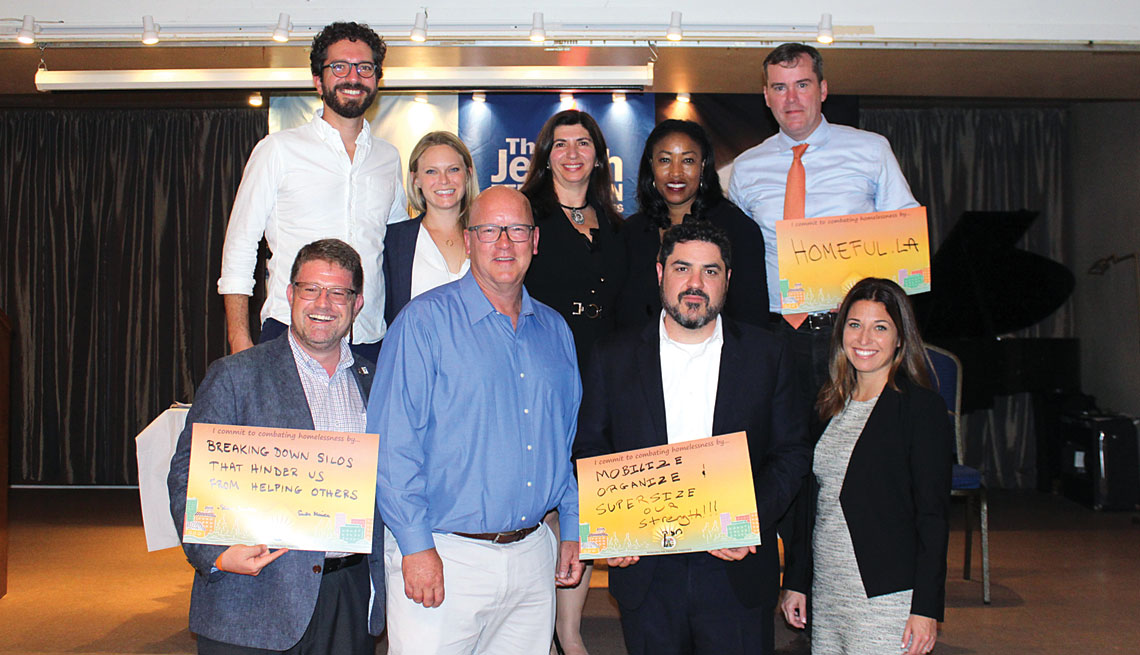
Bottom row, from left: Shawn Landres; Santa Monica Mayor Ted Winterer; Valley Beth Shalom Rabbi Noah Farkas and Julie Munjack and (top row, from left) Mishkon Tephilo Rabbi Gabriel Botnick; Dara Papel, Caroline Kelly, Va Lecia Adams Kellum and Adam Murray attend a Jewish Federation of Greater Los Angeles homelessness event. Photo courtesy of Jewish Federation of Greater Los Angeles
Religious and community leaders gathered at Mishkon Tephilo Synagogue in Venice on Aug. 24 to discuss strategies to prevent and end homelessness.
The panelists addressed the lack of sufficient resources and affordable housing in Los Angeles County at the event organized by The Jewish Federation of Greater Los Angeles’ Community Engagement Strategic Initiative.
“Every person who became homeless went through some kind of trauma,” Rabbi Noah Farkas of Valley Beth Shalom and chair of the Los Angeles Homeless Services Authority, told the audience at the synagogue located in the beach community where hundreds of women and men sleep on the street.
“We don’t have a lot of shelters, food banks and affordable housing,” Farkas said. “We have to establish neighborhoods, so people who fall into homelessness can stay in the communities and neighborhoods where they used to live.”
The event drew about 140 guests and community and civic leaders, including Ted Winterer, mayor of Santa Monica; Va Lecia Adams Kellum, president and CEO of the St. Joseph Center; and Shawn Landres, chair of the City of Santa Monica Social Services Commission and chair of the Los Angeles County Quality and Productivity Commission.
Before the panel, guests were invited to take a tour of the St. Joseph Center, which provides services to homeless people in the area.
Adam Murray, executive director of the Inner City Law Center, said the lack of affordable housing units in Los Angeles is pushing people to live on the streets. He encouraged guests to educate themselves on the issue, volunteer and join organizations that assist homeless people.
“Roll up your sleeps and get involved,” he said. “Every community needs to have affordable housing.”
With homelessness at crisis levels, some panelists encouraged everyone in the audience to be patient.
Caroline Kelly, chair of the Los Angeles County Mental Health Commission, said that because of mental illness issues, people who are homeless often “need much more time to have housing and stay in the housing.”
Other panelists talked about the importance of erasing the stigma of mental illness and homelessness.
“[Homeless people] are someone’s mother, father, brother, sister or daughter,” Murray said. “We need to bring a sense of urgency to homelessness and see them as ourselves.”
At the end of the event, the organizers announced the recipients of the Federation’s 2017 ChangeMaker Challenge, a program that rewards organizations that make an impact on the city. This year’s winners were the Latino Resource Organization, the New Beginning Outreach Foundation, Safe Place for Youth, Shomrei Torah Synagogue and University Synagogue.
— Olga Grigoryants, Contributing Writer
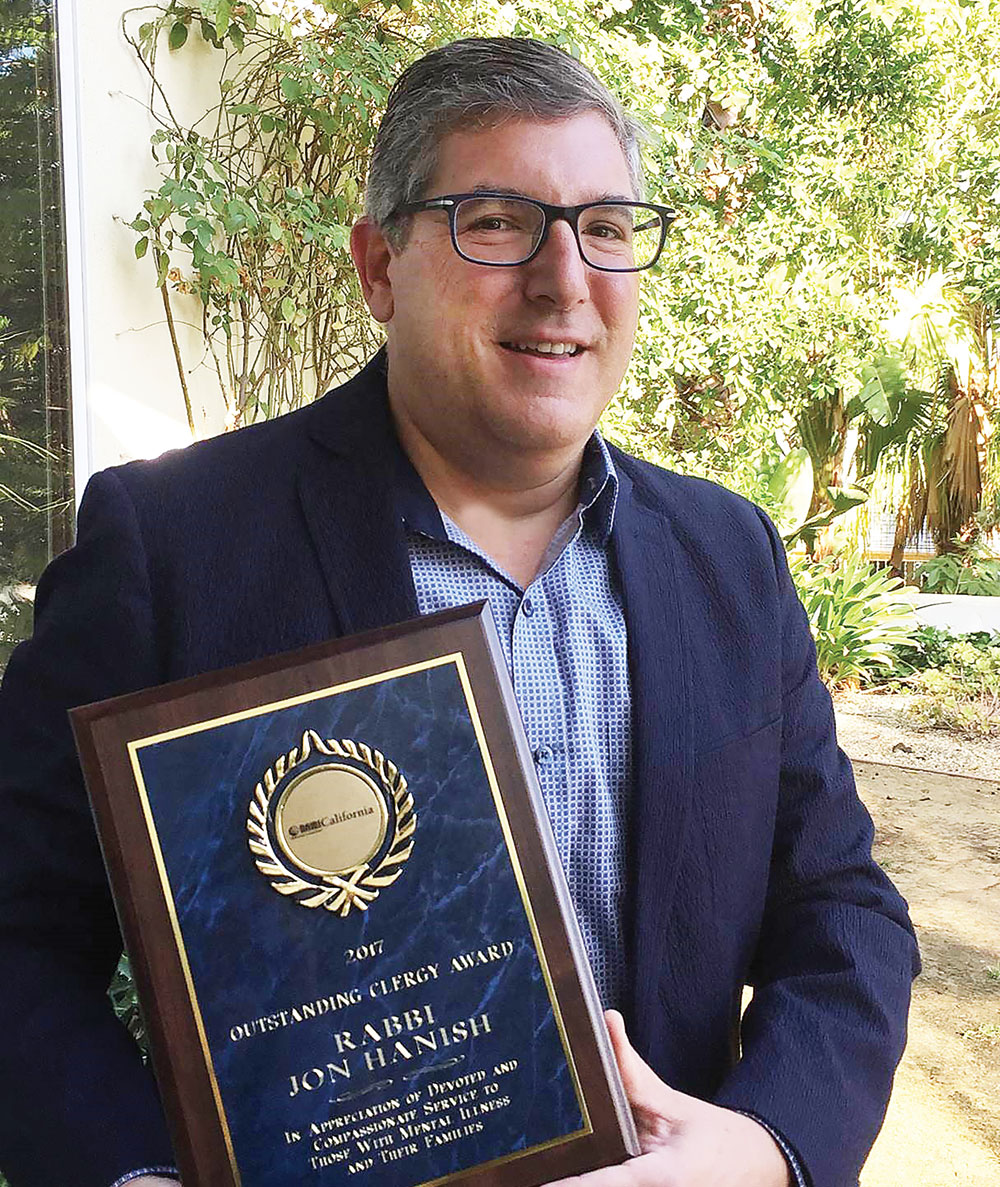
Rabbi Jon Hanish, senior rabbi at Temple Kol Tikvah of Woodland Hills and a recipient of the National Alliance on Mental Illness 2017 California Outstanding Clergy Award. Photo courtesy of Temple Kol Tikvah
Rabbi Jon Hanish, senior rabbi at Temple Kol Tikvah of Woodland Hills, has received the 2017 California Outstanding Clergy Award from the National Alliance on Mental Illness (NAMI). The honor, announced on Aug. 25 at the annual NAMI California Conference in Newport Beach, recognizes faith leaders who show exemplary commitment to supporting people with mental illness and their families.
“I know many religious leaders who do more than me when it comes to mental health issues,” Hanish said in a statement. “I feel dwarfed by their efforts. All I can do is say thank you to NAMI for this unexpected award.”
Hanish became involved with NAMI, a volunteer-based organization that provides resources and support groups for people affected by mental illness, when he participated in a clergy panel in 2013. Hanish has since become a regular speaker about Judaism and mental health at NAMI events, and every year has invited a NAMI speaker to address his congregation between morning and afternoon Yom Kippur services.
Hanish recently gathered 12 congregants and community professionals for “Care and Share Training,” a two-night NAMI program that prepares religious institutions to launch mental health support groups. Hanish’s session was the first of its kind in California.
Before leading the misheberach, the prayer for the sick, during Kol Tikvah services, Hanish often emphasizes the equal importance of mental and physical healing.
“Acts of God are the actions taken by us and our communities to embrace everyone,” Hanish said. “No illness, no affliction, no challenge should be suffered alone. Community is needed.”
— Gabriella Kamran, Contributing Writer
Saba Soomekh, assistant director of interreligious and intercommunity affairs at American Jewish Committee Los Angeles. Photo courtesy of American Jewish Committee
American Jewish Committee (AJC) Los Angeles announced on Aug. 28 the addition of Saba Soomekh as its assistant director of interreligious and intercommunity affairs and Roslyn Warren as associate director for international relations.
Soomekh was the associate director of research at UCLA’s Leve Center for Jewish Studies from 2015 to 2017 and has written about world religions, women’s studies and the geopolitics and history of the Middle East. Her book, “From the Shahs to Los Angeles: Three Generations of Iranian Jewish Women Between Religion and Culture,” was published in 2012 and was awarded the gold medal at the 2013 Independent Publisher Book Awards in the religion category.
“It is an honor to be a part of the AJC family,” Soomekh said. “For the past 13 years, I have been involved with AJC as a lay person. As a religious studies scholar, my new position as the assistant director of interreligious and intercommunity affairs enables me to engage directly with various faith groups and communities in order to ensure that we work together to promote democratic values and the protection of human rights.”
Warren previously worked at the Georgetown Institute for Women, Peace and Security alongside Melanne Verveer, the first U.S. ambassador for global women’s issues and a former chief of staff to Secretary of State Hillary Clinton.
Warren has traveled to more than 50 countries throughout her career, and has written about international affairs ranging from local partner protection in Iraq and Afghanistan to women’s participation in global peace processes.
“After spending several years dedicating myself to human rights issues across the world,” Warren said, “I am honored to have the opportunity to return to my hometown of Los Angeles and serve a community and a global mission that I hold dear.”
— Virginia Isaad, Contributing Writer
Moving & Shaking highlights events, honors and simchas. Got a tip? Email ryant@jewishjournal.com.
An animal rights group filed a lawsuit against two Southern California police departments for not enforcing animal cruelty laws by halting a pre-Yom Kippur ritual.
The lawsuit filed this week naming both the Irvine and Los Angeles police departments is aimed at stopping Chabad of Irvine’s kapparot ceremony in which a chicken is swung by its legs and then slaughtered. It is the second attempt in recent years by the San Diego-based Animal Protection and Rescue League to halt the ceremony.
The lawsuit filed in the U.S. District Court in Santa Ana says both police departments protect the “illegal killing of animals” by not cracking down on the kapparot ceremonies, the Orange County Register reported.
A lawsuit filed by the group against Chabad in 2015 on the basis of animal cruelty said the chickens are crammed tightly into cages and mishandled, and are disposed of and not used for food.
A federal judge in May dismissed a lawsuit filed on behalf of the Virginia-based United Poultry Concerns claiming that the practice violates the state’s unfair competition law.
Kapparot is an ancient practice performed annually by some Jews between Rosh Hashanah and Yom Kippur. By performing kapparot, one’s sins are said to be symbolically transferred to the chicken as part of the process of atonement ahead of Yom Kippur, the Day of Atonement. The meat of the chicken is then donated to charity.
Some Jews perform the ritual using money in place of a chicken.
It’s affixed upon the doorpost. It’s wooden, thin and rectangular, but with rounded corners. It’s meant to fulfill a biblical commandment.
And it bears a verse from the Gospel of John about the resurrection of Jesus Christ.
That’s right: It’s a Christian mezuzah.
Karen Goode calls her creation the Doorpost Blessing, and it looks nearly identical to the small, oblong case that has adorned the doorways of Jewish homes for millennia. Both Goode’s creations and traditional Jewish mezuzahs are based on the same scriptural passage in Deuteronomy that commands Jews to inscribe the words of the Torah “on the doorposts of your house.” Observant Jews recite the passage twice a day with the Shema.
Except, instead of placing parchment bearing two paragraphs of Torah verses inside the mezuzah, as Jews do, Goode engraves a verse on the outside of the Doorpost Blessing, either from the Old or New Testament. She also offers Doorpost Blessings bearing lines from Christian hymns. Altogether, Goode sells 25 varieties, in English and Spanish.
“I’m following what the Bible says,” Goode told JTA. “I’m taking it to modern-day standards. I’m reminding us of our blessings. We all need something to hold onto. God is much bigger than any of us.”
Goode, who lives in the New York City borough of Staten Island and works at a hospital, launched Doorpost Blessings as part of her interest in carpentry. She came upon the concept in 2014, and began making and selling Doorpost Blessings in their current form this year. She would not disclose sales figures, but said the most popular ones bear Old Testament verses both from the books of Jeremiah and Joshua.
“The inspiration was from God, but I was looking for something that would speak of my faith and also carpentry,” she said. Goode is Christian but did not elaborate on which denomination.
Goode isn’t the first person to market mezuzahs to Christians. In 2014, a financial adviser in New York, Henry Zabarsky, created the Christoozah, a hollow red cross containing scripture on a parchment meant to be affixed to a doorpost. But Zabarsky, who is Jewish, told JTA that he is no longer involved with the Christoozah company, and though there remains a working website, it appears not to have been updated in nearly three years. A contact number with a Colorado area code was unresponsive.
Nor is Goode the only Christian to take on a Jewish practice in the name of fulfilling Old Testament dictates. Some evangelical Christians wear ritual fringes or kippahs, and some hold Passover seders — something Goode says she has done in the past. Several fringe evangelical denominations, including the Living Church of God, eschew mainstream Christian holidays like Christmas and Easter in favor of observing Old Testament festivals on the Jewish calendar.
But unlike Christoozah and the Living Church of God, Goode does not credit Jews — and specifically the practice of hanging mezuzahs — with inspiring the product she sells. There is no mention of Judaism or mezuzahs on the Doorpost Blessing website, though Goode told JTA she finds the Jewish mezuzah “a beautiful item.”
“I’m not referring to a mezuzah,” she said of her creations. “I’m doing what the commandment says. I’m doing it from a Christian perspective, not a Jewish perspective. I would see similarity in that there’s a blessing hung around the door frame, but other than that I credit the Bible.”
Mendel Kugel, a Manhattan rabbi who runs MezuzahMe, a service for selling and examining mezuzahs, says Goode’s project is a testament to the mezuzah’s resonance as a ritual item. But he worries that the presence of Christian mezuzahs will make it easier to mistakenly purchase a non-kosher mezuzah.
“It just shows that it’s such an important thing that Christians also want it,” Kugel said.
“Jews don’t try to convince non-Jews by copying their religious customs, to try to bring them into our religion. We have so much belief in our own religion, we have no reason to copy others.”
Goode, however, doesn’t see her Doorpost Blessings as copies. She prefers to see the commonalities between Christians and Jews — after all, both faiths revere the same holy book.
“We Christians celebrate quite a few holidays that the Jewish people celebrate,” she said. “We do have similar history in that we both acknowledge the Old Testament.”
For a few days, exotic animal-skin kippahs were something of a sensation in Israel.
Curious locals and journalists rushed to a Judaica store in the Old City here to marvel at the new luxury-marketed crocodile, python and cowhide Jewish head coverings. An ostrich edition was said to be coming soon.
But as the hype grew, so did the public backlash.
Last week, the government confiscated the kippahs as illegally imported wild animal products.
“The inspector came after we got this very, very negative reaction,” said store manager Shaun Nathan. “I understand the argument, I really do, but we were hearing from this ridiculous lunatic fringe. People were phoning us and threatening to burn down the store.”
It all started with some local yeshiva boys who stopped by the store on Sept. 4. Impressed by the newly arrived yarmulkes, one of them posted photos on Facebook. By the next day, newspaper reporters and TV crews were on the scene.
The Fifth Quarter Judaica store’s owner, Eli Mordechai, gamely showed off the kippahs, which are sold in fabric-lined oak boxes for as much as $1,400 each. They even come with built-in hair clips. Mordechai touted them as must-have headwear for observant Jews seeking that Russian oligarch look.
“These kippot were born out of the desire to provide people who live in a world of luxury and brands a kippah befitting their lifestyle,” he told Israel’s popular Yediot Acharonot newspaper. “A person wearing a $10,000 Gucci suit won’t be caught dead wearing a $50 off-brand kippah.”
David Roytman’s python-skin kippah, center, is flanked by crocodile-skin kippahs on display at the Fifth Quarter store in Jerusalem, Aug. 21, 2017. (Facebook)
Typical kippahs are made from cloth, cotton yarn, velvet or leather.
Yediot noted that the exotic kippahs are made from unkosher animals. But Mordechai assured the newspaper that unlike tefillin, mezuzahs or Torah scrolls, kippahs can be made from any material according to Jewish law.
As it turned out, the outrage came not from stringent Jews but from supporters of animal rights. Israel is a hotbed of activism on behalf of animals, and as much as 13 percent of its population is said to be vegetarian or vegan.
While no major organizations seemed to take up the cause, thousands of online commenters railed against Fifth Quarter for selling the kippahs. Some blamed Judaism, while others said it was a violation of the religion.
“Shameful and disgraceful religious hypocrisy. Even religious objects have a limit,” one woman wrote on Facebook. “God never said in the Bible that abuse of animals is OK and this is undoubtedly abuse.”
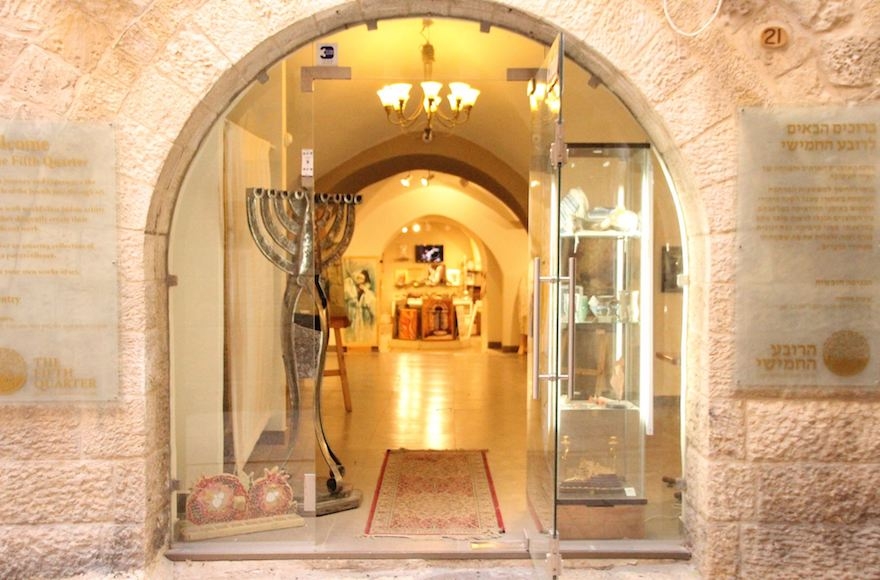
The exterior of the Fifth Quarter store in Jerusalem. (Courtesy of Fifth Quarter)
Angry phone calls started coming into the store, too. Nathan said the first person to call after the news broke, an elderly vegan woman, politely suggested that any profit from the kippahs was not worth the moral cost. But the callers became hostile, he said, with some threatening violence.
A few critics even linked the kippahs to the Israeli-Palestinian conflict, Nathan said, declaring things like, “These people are ethnically cleansing children anyway, so who cares about a python?”
Apparently alerted by the media coverage, an inspector from Israel’s Nature and Parks Authority came to the store Sept. 7 and confiscated the kippahs along with some crocodile skin mezuzahs from the same producer. He said they had been imported without the testing and approval required of products derived from wild animals.
Despite all the fuss, Fifth Quarter had only stocked one of each style of kippah and two of the mezuzahs, and had sold none, Nathan said. He said he has been awaiting a larger shipment of more products, including ostrich skin tefillin bags.
In the meantime, the kippahs had been placed on a glass display case in a room filled with Jewish tourist attractions. The store holds free educational lectures and workshops about some of its products, like an aquarium filled with blue snails that some believe are the source of the turquoise dye used in sacred Jewish garments in ancient times.
“Basically, we try to highlight Judaism and Jewish life through art and Judaic design,” Nathan said. “One of our shticks is we have special items to try to bring in tourists.”
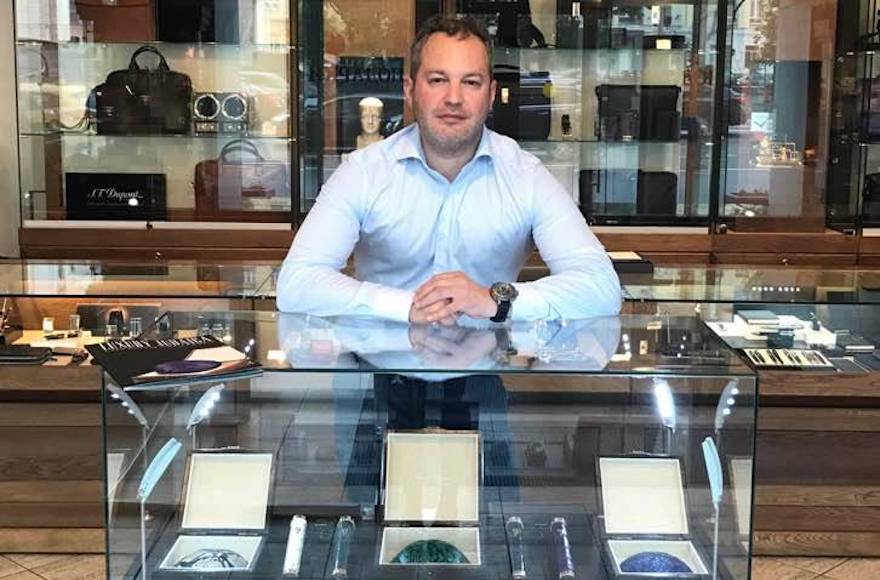
David Roytman posing with exotic animal skin kippahs at his store in Moscow, July 13, 2017. (Facebook)
The designer of the kippahs is David Roytman, a Ukraine-born Israeli specializing in “luxury Judaica.” He said he created the first kippah “prototype” in 2015, and noted that he has a stingray skin design as well.
“People spend thousands of dollars on a luxury watch and shoes, and they wear something on their head that looks like a disaster,” he said. “My idea was to make a respectable kippah.”
Although Mordechai told Yediot his was the first store in Israel to carry the kippahs, Roytman said his products have been “displayed exclusively” at the Hazorfim Judaica store in Tel Aviv, as well as in New York, Toronto, London, and Russian, European and Central Asian cities. They are also for sale on the website.
Roytman said he could do nothing to help Fifth Quarter with its permit issue, but expected their business partnership to resume when it was resolved.
As to the animal rights outcry, he said it was “ridiculous” for people to get so upset over kippahs given the other problems the region faces, “but this is Israel.”
Nathan said he sees things differently.
While the final decision is Mordechai’s, Nathan said he believes the store would be wise to get out of a business that kills animals to make kippahs for oligarchs — especially given the public relations headache.
“If I look back at it now, it’s not a cool product. It really isn’t,” he said. “It brought us a lot of attention, and people will definitely buy it. But we really don’t want any part it.”
President Donald Trump will hold a pre-High Holy Days, conference call on Friday with Synagogue Rabbis despite a boycott from rabbis who belong to the Reform, Conservative, and Reconstructionist movements.
“In commemoration of the Jewish High Holy Days, President Donald J. Trump would like to invite you to a conference call where he will send well wishes for the upcoming holidays and discuss his administration’s progress on issues of interest to the Jewish community,” the email invitation, obtained by Jewish Insider, reads. “We hope that you will accept our invitation to join this exciting call as the Jewish people welcome 5778 and reflect on the past year.”
The tradition started during the 2008 presidential campaign. It became an annual practice, with the participation of several hundred rabbis and Jewish leaders, during Barack Obama’s presidency. While the call was billed as a non-partisan briefing, President Obama often used the call to pitch and seek support for his administration’s domestic and foreign policy decisions, such as Obamacare, Middle East peace, and the Iran nuclear deal. In George W. Bush’s administration, similar conference calls took place but usually with a broad range of Jewish leaders and senior administration officials, according to an official who helped organize the briefings.
Rabbi Marvin Hier, Trump’s inauguration rabbi who criticized the President over his response to the Charlottesville protests, confirmed to Jewish Insider that he was invited to participate on the call. Rabbi Haskel Lookstein, Rabbi Emeritus of Congregation Kehilath Jeshurun in Manhattan who oversaw Ivanka Trump’s conversion to Judaism, did not receive an invite. “But if I were, I would dial in, out of respect for the President of the US,” Lookstein told Jewish Insider in an email.
Graham Roth, Communications Director for the Religious Action Center of Reform Judaism, said the initial boycott decided upon following Trump’s remarks on the Charlottesville protest still stands. “Our position has not changed. Reform rabbis, along with Reconstructionist and Conservative rabbis, decided to forgo hosting the annualHigh Holy Day call with the President this year,” he said. “This was not a decision made lightly, but the President’s lack of moral leadership in the wake of Charlottesville made it necessary.”
At this season we Jews ask ourselves the most basic of questions:
Where am I? What’s the state of my inner life, my relationships with the people I love, with Judaism and tradition, and with God? How through habit and a lack of will have I strayed from a healthy, integrated, loving, and generous life?
The Torah this week (Parashat Nitzavim) reminds us that “This mitzvah that I command you this day is not too hard for you, nor too remote…” (Deuteronomy 30:11)
A wonderful Midrash from Yemen shines a light on what is common to everyone:
“They say to a person: ‘Go to a certain town and learn Torah there.’ But the person answers: ‘I am afraid of the lions that I will encounter on the way.’
So they say: ‘You can go and learn in another town that is closer.’ But the person replies: ‘I am afraid of the thieves.’
So they suggest: ‘There is a sage in your own city. God and learn from him.’
But the person replies: ‘What if I find the door locked, and I have to return to where I am?’
So they say: ‘There is a teacher sitting and teaching right here in the chair next to you.’ But the person replies: ‘You know what? What I really want to do is go back to sleep!’ That is what Scripture refers to when it says in Proverbs 26:14: ‘The door is turning upon its hinges, and the lazy is still upon his bed.’” -Yalkut Midreshei Teiman
Do we recognize ourselves in this Midrash? Though the mitzvah refers to learning Torah its application is far broader. The protagonist lists one hundred and one ways why he can’t learn or find a teacher, mentor or guide to help him grow and change.
Are we not like the Jew in the story?
Like him, so often we just don’t want to get out of bed nor confront our shortcomings, inadequacies, and failures of will.
Like the Jew in the story, so often we’re accustomed to doing things the way we always have done them, even if they’re dysfunctional and self-destructive, and even if they’re the source and cause of our alienation from others and unhappy relationships.
Like the Jew in the story, so often we find reasons to avoid change.
Like the Jew in the story, so often we’re stubborn. Though there’s comfort in routine, a routine may keep us stuck in the past when we should be living our lives forward.
As Chassidic wisdom teaches, if you want to go east but are going west, all you have to do is turn around and take that first step.
This is the season of turning, and though changing direction may require an extreme act of will before taking that first step, once we do it, the second step is easier to take and the third easier still.
Three rulings in one week on matters concerning religion and state relations: that’s the crop of Israel’s Supreme Court.
Ruling number one: the court refuses to compel the state to operate transportation on Shabbat.
Ruling number two: the court strikes down the legislation that exempts Charedi Israelis from military service.
Ruling number three: the court carves a way for businesses to present themselves as Kosher even without having a Kosher certificate from the official rabbinate.
Each of these decisions is interesting and complicated. Taken together, they tell a confusing story.
They tell a story of a court acting with caution. Its ruling on the draft, for example, gives the government a full year to initiate new legislation. But they also tell a story of a court impatient with the state’s lack of ability to make decisions and pass acceptable legislation. They tell a story of an Israel that repeatedly surrenders to the power of the ultra-Orthodox, but also of an Israel that is gradually eroding the power of Charedi-controlled institutions. They tell a story of an Israel still seeking pragmatic solutions — the ruling on public transportation is case in point; go talk to the government first, the court told the plaintiffs. They also tell a story of an Israel unable to bridge the differences in pragmatic ways.
Thus, on Sept. 11, the day after the first ruling, Charedi politicians praised the court for not ruling on transportation, and two days later, the day after the second ruling, when I visited the Knesset, they were holding a show of condemnation of the court’s overstepping its authority for striking down the exemption law. Thus, on Sept. 10 the court seemed conservative and restrained, and on Sept. 12 it seemed revolutionary and activist.
What can be said briefly about each of these decisions?
On transportation: This ruling is just the beginning of a long road. If the government, or the Knesset, cannot reach a reasonable compromise (this is not that difficult on principle, but it is politically tricky), the court will have to re-address the question. A restrained court will say that transportation policy is for the government to decide. A more activist court would find reasons such as freedom of movement, or such vague concepts, to force a new arrangement.
On Kosher certificates: Here we see another proof supporting my very old argument that the rabbinate is not gaining power, it is losing power, and all those who say otherwise are guilty of either ignorance or self-serving interests, as in they want your money to fight a battle that is already won. What the court did in this ruling is clever. It let the rabbinate keep what the politicians can give, as it remains the only body that can use the word “Kosher.”
But the court also made the obvious ruling that a restaurant cannot be prevented from sharing information with its costumers concerning the food it supplies. So, the restaurant can say that it only buys Kosher cheese. And it can say that it does not have meat on the menu and does not let meat into the kitchen. And it can say all sorts of other things that will serve as code signifying, “We are Kosher,” but “we” can’t say the actual word “Kosher” because Kosher is a rabbinate trademark in Israel — it does sound absurd, doesn’t it?
On IDF exemption: The court’s ruling means nothing but headache. Charedi men will not join the military because of a court ruling. That is to say, on the draft issue, the court is barely more than a pundit. It can say what it wants, but cannot force a draft. The year for government deliberation it granted is an indirect acknowledgment of this fact (I will expand on this issue a few paragraphs down).
These three rulings are all a prelude to more negotiation and maneuvering. The Charedi parties might be tempted to join with other members of the coalition in support of legislation that limits the power of the court to strike down laws. On Sept. 13, some of them, still angry because of the draft ruling, suggested as much. Such court-limiting legislation is a dream of many Knesset members, but never enough to let it pass. And Charedi legislators, when they are less angry, know that such a move could be problematic for them down the road. After all, they are the ones representing a not-well-liked minority and thus should be worried about strengthening the unchecked power of a majority.
What else is going to happen as a result of the rulings? Public transportation will remain an unresolved issue with the possibility that the big eruption will come when the Tel Aviv light rail begins operation who-knows-when. Kosher food will be served, with or without rabbinate certificate. In fact, the recent ruling will make it impossible for the rabbinate not to improve its services, as chief rabbi David Lau intends to do anyhow.
The draft is a 100-pound Gorilla at the center of the Israeli room. The draft debate reflects a true and meaningful difference of opinions concerning the value and raison d’etre of Israel as a Jewish State.
For the Israeli Charedi community, the study of Torah, enabled by the exemption from military service and by the parallel prohibition of work (those who do not serve have to stay and study for many years), has become one of the building blocks of Charedi society as a group separated from Israel’s secular society. “Torah study,” as a Jewish People Policy Institute (JPPI) report once explained, is “at the ideological heart of Charedi identity.”
More than 10,000 young Charedis are exempted from army service every year. Advancing the vision of a more equal sharing of the military service burden is not impossible. But it will require determination, planning and long-term implementation of new rules. The court can strike down laws, but it cannot plan and implement, and hence its ability to change the situation is limited.
Thus, its rulings serve as a reminder that the current situation is unsustainable. There must be a tipping point somewhere down the road when the number of Charedis, a growing sector, will be such that the IDF cannot function without them, or when other Israelis will no longer agree to serve when so many others don’t. Its rulings serve as a reminder that the current situation is unjust in the view of most Israelis (Charedi Israelis disagree and see their role as no less important than the role of soldiers). Its rulings serve as a catalyst of political turmoil, following which some change must occur, and hence, theoretically, a chance for positive change.
Change can come in many formats: It can come through the cancelling the people’s military and turning the IDF into a professional military; it can come through a policy that makes it impossible for Charedis to keep resisting the draft; it can come through a realization of Charedi leaders that their role can no longer be limited to taking care of their own communities — that, having such political power, they must think more broadly about Israel’s needs.
Whatever the case, whatever the change, it will not be the prompt result of a court ruling, but rather the result of a long, frustrating, enraging, political process. The court has the ability to carve short cuts when the ruling is simple as in “you can now tell your customers that you only buy Kosher food.”
But the court does not have the ability to carve short cuts when the ruling calls for a complicated, multi-layered alteration of priorities, policies, budgeting decrees and law enforcement directives.