fbpx

September 14, 2017

Daytona

Revenge in ‘Daytona,’ life in Brooklyn

Comedy, violence and sex collide in the play “Daytona” by British actor and playwright Oliver Cotton. The work, originally produced in England, is now being presented by Rogue Machine at The MET Theatre in Hollywood.

The comedy comes early as Joe (George Wyner) and Elli (Sharron Shayne), a couple in their 70s, bicker while practicing in their Brooklyn apartment for a senior dance competition. After Elli leaves to pick up her dress for the contest, Joe’s long-lost brother, Billy (Richard Fancy), turns up at their doorstep after a 30-year disappearance.

It seems Billy needs to hide out because he’s committed a violent act of revenge while on vacation in Daytona against an old man who apparently was living under a new identity but whom he recognized as being responsible for innumerable deaths when they were in a World War II concentration camp.

“The brothers were in the same camp, where they saw their father killed, and she [Elli] was in the women’s camp — Bromberg,” director Elina de Santos explained in a recent interview.  “They knew each other before.”

The brothers and Elli survived, found each other, then went to America and made a life. For 10 years the three of them were together.

The director, who is not Jewish, speculated that being together during those years would bring up everything about their horrific past, a past she believes they’re running from in different ways. Joe tells Billy that people killed in the camps are dead and nothing will bring them back.

And what Billy does, de Santos explained, is force them to recall their days in the camp “because, in a way, you never really can get away from that. There’s no way. It was, and it is always, with you.”

Billy also reveals that, in the 30 years since he left them and the business he had with his brother, taking his share of the money with him, he removed the tattooed number from his arm; assumed the identity of a dead, non-Jewish man; got false papers; moved to Ohio; married a gentile woman; raised a family and regularly attended church — all while starting a successful real estate business.

De Santos said a variety of themes emerge from the piece.

There is the issue of identity. “I don’t think there’s any way to escape your identity, who you really are. That’s certainly what Billy learns — as much as he tried,” she said. “I think he ran away because he wanted to get away from that experience that they all had together.”

She added, “He thinks he’s just getting away from Elli and his brother, but I think he’s really getting away from being Jewish, of what it did to them; how, for him, it ruined his life. He wants to start a new life and, for him, starting a new life is not being who you were. He could pass. He didn’t have the accent his brother had. He didn’t carry that. He learned English really well and was able to sound like an American.”

During the 2014 run of the play in London, Cotton, the playwright, said in an interview that one theme he explores in the play is about displaced persons starting over, which they do in America. “There’s a lot in the play to indicate that that was the case,” de Santos said. “And then Billy leaves, and they have to start over again. They’re displaced again.”

And there is the theme of family. Joe insists that Billy turn himself in for his act of violence, and, at first, is going to let Billy go alone. But, near the play’s end in the second act, he stands by him.

“He doesn’t stand by him, saying, ‘You were right to do it.’ He stands by him [saying], ‘I’m your brother.’ And Joe walks him down to the precinct and doesn’t go in with him. He walks with him to let him know that, ‘You’re still my brother. You’re still my brother.’ And that’s what wins out. What wins out here is family. He accepts his brother,” the director said.

Also in the second act, a sexual secret is revealed that adds to Billy’s motivation for running away.

To de Santos, every level of the play has a certain richness, and she finds the exploration of a sibling relationship extraordinary.

“My brother doesn‘t talk to me,” she said. “So, that it could be 30 years that these brothers haven’t talked to each other is not out of my experience. I think it’s because they shared … they have this past that is much harder to take into their lives when you have such a horrific thing happen.”

She concluded, “We should never forget. We should never forget what it has done to people — how trauma of that sort, how the Holocaust, affected people.”

“Daytona” is being presented by Rogue Machine at The MET Theatre in Hollywood. For show times and tickets, visit roguemachinetheatre.net/daytona.

Revenge in ‘Daytona,’ life in Brooklyn Read More »

Wandering Jew leads Glen Berger on path to ‘Underneath the Lintel’

Glen Berger’s 1999 play, “Underneath the Lintel: An Impressive Presentation of Lovely Evidences,” began when “I was getting over a breakup, living with my parents again and was fairly miserable,” Berger said from his home near Hudson, N.Y.

The playwright, 49, didn’t find solace in the Judaism he had studied at a Reform synagogue during his childhood in McLean, Va., which he had abandoned after his bar mitzvah. “I didn’t know if the religion spoke to me enough at that point to say, ‘This is something I’d like to continue,’ ” he said.

But during that troubled time, Berger “had an epiphany,” he said. “I got it into my head that there was a type of music that I really wanted to get my hands on. I kept going to the stores and would spend way too much money buying Balkan accordion music or Gypsy this and Armenian that. I kept orbiting around a kind of music I kept hearing in my head but couldn’t quite find.”

Berger had almost given up when, on a whim, he purchased a recording of klezmer songs from the 1920s. “As soon as I played it in my car on the way home, I knew this was it,” he said. “On a deep DNA level, it just spoke to me. There was a minor-key melancholy that at the same time was defiantly jaunty. It was shocking to me because I realized, ‘Oh, this is Jewish.’ ”

Berger also realized that much of his previous work had been inspired by his heritage, but in disguise. His 1991 play, “The Wooden Breeks,” spotlighted a lighthouse keeper who spends his days and nights studying tomes on natural history.

“I came to see that he was actually like a talmudic scholar,” Berger said. “And I’d written one-acts where I was describing these towns with crooked streets, which I thought were like 16th-century British villages. But the more I saw photographs of Jewish ghettos, the more I realized those places in my head more resembled shtetls. I concluded that if I couldn’t quite get into Judaism through the front door, the pure religiosity of it, maybe I could get in through the side door.”

And so Berger sought to write a play that evoked the spirit of klezmer music he perceived as “dancing despite it all.” His mind turned to the 13th-century legend of the Wandering Jew, a cobbler who supposedly refused to let Jesus rest in his lintel (doorway) on the way to his execution and was cursed by the condemned man to wander the earth until the end of days.

While the legend is anti-Semitic, Berger sought to reclaim the character as a more sympathetic figure who is harshly punished for trying to save his own life from threatening Roman soldiers.

“Underneath the Lintel,” which runs at the Geffen Playhouse in Westwood from Oct. 10 to Nov. 19, became a metaphysical thriller, a one-man show narrated by an unnamed Dutch librarian who believes he is on the trail of the Wandering Jew. It all begins when he comes across a Baedeker’s travel guide that had been returned through the library’s book slot, 113 years overdue. Determined to track down the person who had returned the book and collect the fines, the librarian zeroes in on a dry-cleaning receipt from London that had been stashed in the book’s pages. When the address listed on the receipt turns out to be in China, the previously sedate librarian sets out on a worldwide quest to find the book’s borrower, whom he comes to believe is immortal.

Along the way, a series of clues helps him piece together the puzzle: among them, a love letter written in Yiddish by a woman in an Eastern European shtetl in 1906, and photographs the librarian finds in the archives at the YIVO Institute for Jewish Research in New York.

“He is an ordinary man proceeding on an extraordinary journey, just like the Wandering Jew himself,” Berger said.

“Underneath the Lintel” premiered at the Actors’ Gang in Los Angeles in 2001, went on to have a successful off-Broadway run and to be showcased in hundreds of productions worldwide. It will feature Arye Gross when  it opens Oct. 10 at the Geffen Playhouse.

The playwright acknowledged that the Wandering Jew is a metaphor for the Jews as being eternally cursed for rejecting Jesus and supposedly abetting his execution. Some viewers have regarded the play as anti-Semitic; others have seen it as anti-Christian for portraying Jesus as being petty on his way to the cross.

“But a myth can be repurposed to suit our own needs,” Berger said. He cited a 1932 Yiddish-language film that features a compassionate depiction of the Wandering Jew, which was meant to serve as a warning against growing Nazism in Germany.

As for allegations that the play is anti-Christian, Berger argued that he depicted Jesus as a human being who becomes understandably cross with the cobbler who refuses to let him rest in his doorway.

“But the play actually has very little to do with Jews and Christians, and more to do with the active search for meaning and purpose in one’s life,” Berger said.

Gross, who also is Jewish, agreed.

“What interests me about the play is its focus on the moment in one’s life where you have to follow something that wasn’t in your plans,” the actor said. “It happened to Abraham, when suddenly there was a voice telling him to destroy idols and later demands him to sacrifice his son, Isaac. His hand was stayed, but still it’s an example of how something can show up in your life and you now have to follow a different road.”

The lintel of the title becomes a metaphor for standing at this kind of crossroads. And should one choose the wrong path, Berger said, the play explores “how you literally and figuratively keep moving forward.”

“Underneath the Lintel” will run Oct. 10 through Nov. 19 at the Geffen Playhouse in Westwood. Tickets available at http://www.geffenplayhouse.org/lintel.

Wandering Jew leads Glen Berger on path to ‘Underneath the Lintel’ Read More »

This savory life: Parashat Nitzavim-Vayelech (Deuteronomy 29:9-31:30)

Rabbi Avivah W. Erlick

My name is Avivah and I am addicted to sugar.

When I am free to eat sweets, I do so with abandon. I may eat entire packages of cookies, one slice of every cake being served, whole pints of ice cream.

I don’t actually like these things. The sugar craving says sweets will make me happy, but eating them never does. Once I start, there’s no stopping me until I feel glutted and sick.

I didn’t realize this was an addiction until I attended a training program for rabbis at Beit T’Shuvah, the Jewish residential treatment center. My sugar craving seemed silly compared with alcoholism, drugs, gambling and such. But it was no less real. I was following a voice that was not acting in my best interest. I was not being my best self.

I am able to speak of my sugar problem now because I made a break and stopped eating sweetened foods this summer. The only sweetness I eat now is fresh fruit. It’s incredibly difficult. I had to go through everything in my house, throw away sweetened foods, and buy new ones without sugar. “Unsweetened” isn’t a category that restaurants are set up to offer, unlike gluten-free or vegetarian, so I have to call ahead and walk through the ingredient list with the staff, or see if it’s posted online.

Otherwise, I have to eat at home, pack my own meals or just go hungry. Being without the convenience of America’s sticky-sweet food industry, I’m on my own.

I share this with you because in this week’s parsha, Nitzavim-Vayelech, we are reminded by Moses of the covenant that God struck with the Jewish people for all time, and how covenants give us fortitude.

Atem nitzavim hayom kulchem lifnei Hashem Eloheichem — All of you stand today before God … to enter into the covenant … that He may establish you this day as His people, and be your God (Deuteronomy 29:9-12).

Rabbi Shneur Zalman of Liadi, the founder of Chabad Chassidism and author of “The Tanya,” taught that the covenant struck by the Jewish people with God was made in a time of great joy, when the miracles that brought freedom from slavery were still fresh in their minds. Like lovers who commit to marriage, we made this covenant with God when the passion for it was strong, and the reasons self-evident.

But that’s not when a covenant is needed. Lovers need their wedding contract later, when the love they felt becomes strained by the vicissitudes of daily life. Then, the mutual commitment they had made could give them strength in a way the memory of new love might not. It’s the same for us and God.

This is the mighty power that religion can have in life: to turn self-improvement efforts into something bigger than ourselves, a commitment not just to betterment, but to Hashem.

Deciding to make a major life change for the good is the easy part, but it’s only Step One. After that comes Step Two. For me, that meant rethinking everything I ate and everything I thought about eating, and sustaining it for 10 weeks, the length of time needed to establish a new pattern.

Now, my initial commitment has passed, I’ve lost some weight, I’m thinking more clearly, my palate has adjusted to find the subtle richness in savory foods, and I don’t want sweets. That leaves me with one thing to be done, and it’s the hardest part of all — Step Three: vigilance. I need to be proactive so I’m never in a position where I feel desperate — out on the road, extremely hungry, and without a plan for what or where to eat. I need to think ahead about my meals, or just plan to end up back home.

I’m reminded of the thinking behind tzit-zit, the fringes on our prayer shawls. As part of the Shema prayers, we take the tzitzit in hand, kiss them, and say that they are a helpful reminder not to allow our hearts to stray off the path that God sets for us.

This is the mighty power that religion can have in life: to turn self-improvement efforts into something bigger than ourselves, a commitment not just to betterment, but to Hashem.

So I may feel “on my own” on the American food landscape, but I’m not without support. I have my friends and family with me, encouraging me to be strong. My bulwark against that insidious, lying voice of sugar consumption is love. I love my life and my health, and I love the Holy One, blessed be God, who has brought me to this season.

L’Shanah tovah!


RABBI AVIVAH W. ERLICK is a board-certified health-care chaplain in private practice. She owns a referral agency for Jewish clergy (CommunityRabbis.com) and a private chevrah kaddishah (Sacred-Waters.com), is a spiritual counselor for hospice and serves as a chaplain in the Los Angeles County jails.

This savory life: Parashat Nitzavim-Vayelech (Deuteronomy 29:9-31:30) Read More »

Trump waives Iran sanctions, but warns of changes to deal next month

President Donald Trump waived nuclear sanctions on Iran in compliance with the 2015 nuclear deal he reviles, but warned that he could take dramatic action on the deal as early as next month.

Thursday was the deadline for Trump to waive sanctions targeting Iran’s nuclear sector, according to the deal, which includes a rollback of Iran’s nuclear program.

Returning from Florida, where he had visited sites hit by Hurricane Irma, Trump told reporters on Air Force One that the deal was “one of the worst” and he planned on addressing it soon.

“You’ll see what I’m going to be doing very shortly in October,” he said. “But I will say this: The Iran deal is one of the worst deals I’ve ever seen. Certainly, at a minimum, the spirit of the deal is just atrociously kept, but the Iran deal is not a fair deal to this country. It’s a deal that should have never, ever been made. And you’ll see what we’re doing in a couple of weeks. It’s going to be in October.”

According to U.S. law, Oct. 15 is the next deadline for Trump to certify that Iran is abiding by the deal. Inspectors from the International Atomic Energy Agency have certified that Iran is in compliance, but Trump says Iran is violating the “spirit” of the deal through its missile testing and military adventurism in the region.

Obama administration officials who negotiated the deal say it was never meant to address anything but the nuclear component. Removing Iran’s potential nuclear threat, they argue, freed the United States to pressure Iran in other areas.

“You’ll see. You’re going to see,” Trump said on the plane. “But we are not going to stand for what they’re doing to this country. They have violated so many different elements, but they’ve also violated the spirit of that deal. And you will see what we’ll be doing in October. It will be very evident.”

It’s not clear what Trump is contemplating, but a number of scenarios have circulated. One is that he will not certify Iranian compliance, which would put the burden on Congress to reimpose sanctions on Iran. Another is that he works with Europe to increase pressure on Iran in other areas. Some Trump advisers have cautioned that the United States should not be seen as sabotaging the deal lest it alienate its partners in the deal — including Russia, China and Western Europe.

Israeli Prime Minister Benjamin Netanyahu, who will meet Trump next week at the United Nations General Assembly in New York, says he wants the deal amended to remove “sunset clauses” that allow Iran to remove some restrictions on its nuclear activities within the next decade or so.

“In eight to 10 years, according to the agreement, Iran will be able to enrich uranium on an industrial scale,” Netanyahu told CNN en Español during his South America tour this week. “That means that they can make not one bomb, but an arsenal of bombs. This agreement should be changed. It should be changed so that the removal of restrictions on Iran’s nuclear program should be not a matter of the change of the calendar, but a change in Iran’s aggressive behavior.”

Separately on Thursday, the Trump administration imposed new sanctions on nine individuals and eight entities it said were violating terrorism and cybersecurity-related sanctions against Iran. Also, the U.S. House of Representatives passed a bill that would ban the sale of replacement airplane parts to Iran. The Obama administration had removed such bans as part of the overall deal package.

Trump waives Iran sanctions, but warns of changes to deal next month Read More »

Trump again blames both sides for deadly Charlottesville violence

President Donald Trump once again said both sides — white supremacists and those who opposed them — were responsible for the deadly violence in Charlottesville, Virginia last month, an equivalence that has outraged Jewish groups, Jews in his Cabinet and lawmakers from both parties.

Trump, speaking Thursday on Air Force One as he returned from Florida, where he was meeting with victims of Hurricane Irma, described his meeting a day earlier with Sen. Tim Scott, R-S.C., an African American Republican who has been critical of Trump on race-related matters.

“I think especially in light of the advent of Antifa, if you look at what’s going on there, you know, you have some pretty bad dudes on the other side also,” he said when asked what he told Scott regarding the deadly Aug. 12 violence in Charlottesville. Antifa is a loose coalition of leftists ostensibly organized to protect protesters but which has lashed out violently at times at its perceived enemies.

“And essentially that’s what I said,” Trump said. “Now because of what’s happened since then, with Antifa, you look at, you know, really what’s happened since Charlottesville.” he said, apparently referring to clashes between Antifa and right-wing protesters in Berkeley, California on Aug. 27. “A lot of people are saying — in fact a lot of people have actually written, ‘gee Trump might have a point.’ I said, you got some very bad people on the other side also, which is true.”

Antifa represented a small minority of the mostly peaceful counterprotesters in Charlottesville. There were limited skirmishes between its members and white supremacists who were protesting the planned removal of a statue honoring Confederate Gen. Robert E. Lee. Among the 500 or so white supremacists, neo-Nazis and members of the Ku Klux Klan, many were armed and some sought out counterprotesters to attack. Some carried Nazi flags and shouted racist and anti-Semitic slogans. An alleged white supremacist rammed his car into a crowd of counterprotesters, killing Heather Heyer and injuring at least 20 people.

Trump at the time blamed “many sides” for the violence and said there were “very fine people” on both sides. That caused consternation among his Jewish advisers, including reportedly his daughter Ivanka Trump, his top economic adviser Gary Cohn, Treasury Secretary Steven Mnuchin and David Shulkin, the secretary of veteran affairs. It also earned widespread condemnation from Republicans and Democrats in Congress, and from Jewish groups.

Trump later seemed to withdraw from that posture and his spokeswoman said this week he looked forward to signing a congressional resolution squarely blaming the white supremacists for the Charlottesville violence.

Trump again blames both sides for deadly Charlottesville violence Read More »

Figs add richness to holiday sweets

Traditionally during Rosh Hashanah, foods sweetened with honey are eaten to symbolize the wish for a sweet and happy year ahead. But at my family’s holiday dinner, we like to supplement them with something equally nectarous: fresh figs.

One of the seven species of fruits and grains named in the Bible, figs offer distinctive sweetness to many recipes and fit perfectly into the New Year’s menu. California dried figs are plentiful all year round, but fresh figs also are available at this time of the year. (I like to get mine from a tree in my son Zeke’s backyard.) They add a rich source of fiber, vitamins and minerals, and are versatile enough to try in salads, main courses and desserts. 

These four recipes are easy to make, and each is a little different from the way you may have enjoyed figs previously. Delicious, fresh fig bread can be whipped up in a few minutes, and it has a nice chewy texture. Served in thin slices, it is especially good with fruit or cheese. Serve for breakfast topped with orange marmalade.

Israeli-style stuffed figs with a chocolate-nut filling are a gourmet delight and they can take the place of a tray of pastries. Make a few extra to give to dinner guests to take home, or wrap them in a box or basket to bring when you are invited to dinner on Rosh Hashanah.

The Italian Fig Cake is inspired by the famous panforte, a delicious confection that originated in Siena, Italy. Rich, dense and chewy, the ingredients include dried figs, nuts, honey, spices and an assortment of other dried fruits. It keeps well in tins and is another good choice to bring as a gift from your kitchen.

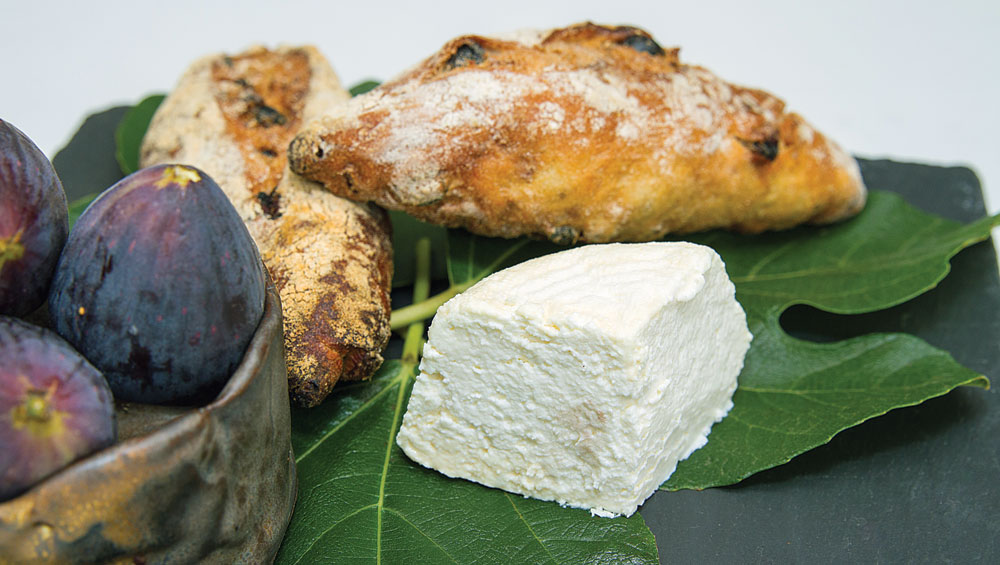
As a bonus, serve fresh figs with homemade ricotta cheese and honey. The recipe for fresh ricotta takes just a short time to make — as long as it takes to boil milk — and much longer to enjoy!

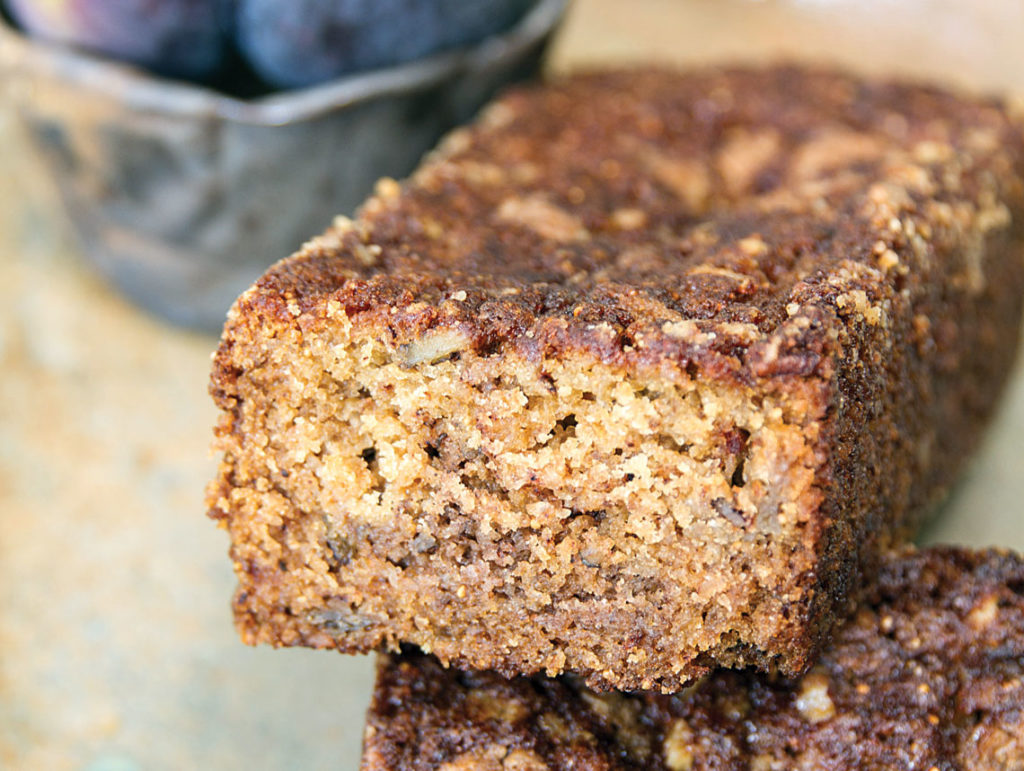
FRESH FIG-NUT LOAF WITH STREUSEL TOPPING

– Streusel Topping (recipe follows)
– 1/2 cup melted, unsalted butter
– 3/4 cup finely ground walnuts or pecans
– 2 cups sugar
– 2 1/2 cups flour
– 2 teaspoons baking soda
– 1 teaspoon salt
– 1 cup unsalted butter, cut in pieces
– 2 cups toasted, chopped walnuts or pecans
– 2 cups (about 8 large figs) peeled and mashed fresh figs
– 4 eggs
– 1/2 cup milk

Preheat oven to 350 F.

Prepare Streusel Topping; set aside.

Brush 4 3-by-7-by-2-inch loaf pans generously with melted butter; sprinkle them with ground nuts and set aside.

In the large bowl of an electric mixer, blend the sugar, flour, baking soda and salt. Add the butter and blend until crumbly. Add the chopped walnuts and mix well. 

In a medium bowl, beat the figs, eggs and milk together. Pour the fig mixture into the flour mixture all at once. Stir gently just until all the dry ingredients are moistened; do not over-stir.

Spoon the batter into the prepared loaf pans. Sprinkle each loaf with 2 to 3 tablespoons of the Streusel Topping. Bake for 40 minutes or until a toothpick inserted into the center comes out clean and the loaves begin to come away from the sides of the pans.

Makes 4 loaves.

STREUSEL TOPPING

– 1/2 cup brown sugar
– 1/4 cup flour
– 1/2 teaspoon cinnamon
– 1/4 cup unsalted butter
– 1/2 cup chopped walnuts or pecans

In a food processor or large bowl of an electric mixer, blend together the brown sugar, flour, cinnamon and butter just until crumbly; do not over-mix. Stir in the chopped walnuts. Cover and set aside.

Makes about 1 cup. 

ITALIAN FIG CAKE (PANFORTE)

– 8 ounces dried figs
– 1 cup golden raisins
– 1 cup dried apples
– Grated peel of 1 orange and 1 lemon
– 1/2 cup flour
– 1/4 cup cocoa
– 2 teaspoons cinnamon
– 1/8 teaspoon mace
– 1/8 teaspoon white pepper
– 3/4 cup honey
– 1/2 cup sugar
– Juice of 1 orange
– 1 1/2 cups whole toasted almonds
– 1 1/2 cups whole toasted filberts
– 1/2 cup powdered sugar

 Preheat oven to 300 F.

Place figs, raisins, dried apples, orange and lemon peel in a food processor and blend until finely chopped, or place in chopping bowl and chop until fine. Transfer fruit mixture to a large mixing bowl.

Sift together flour, cocoa, cinnamon, mace and pepper. Add to dried fruit mixture and mix well.

In a heavy saucepan, heat the honey, sugar and orange juice until sugar dissolves. Carefully pour hot liquid into dried fruit mixture. Add nuts and stir well.

Line  an 8- or 9-inch round baking pan with parchment or wax paper and spoon in mixture. Bake in preheated oven for 50 minutes to 1 hour or until cake browns around the edges and paper comes away from the pan. (Cake will be sticky on top.)

Cool in pan for 10 minutes.

Dust a 12-inch square of foil with 1/4 cup powdered sugar. Turn cake upside down onto prepared foil. Peel off paper used to line pan and invert onto cake plate. Before serving, sprinkle with additional powdered sugar.

Makes about 10 servings.

ISRAELI STUFFED FIGS

– 2 ounces semisweet chocolate, grated
– 1 cup ground almonds
– 24 large dried California figs
– 24 toasted whole almonds

Preheat oven to 350 F.

In a bowl, combine chocolate and ground almonds; set aside.

Using scissors or a knife, remove the stems from the figs. Make a deep depression  in each fig with your finger or a small spoon. Stuff each fig with the chocolate mixture. Pinch each opening together firmly.

Place the stuffed figs, stem side up, on a foil-lined baking sheet. Bake in preheated oven for 5 minutes. Turn figs over and bake another 5 minutes or until the bottoms begin to brown. Press a whole almond into each fig and reseal.

Makes 24 stuffed figs.

HOMEMADE RICOTTA CHEESE

Homemade ricotta cheese


– 1/2 gallon whole milk
– 1 cup cream
– 2 teaspoons salt
– 6 tablespoons lemon juice
– Honey, for garnish

Heat the milk, cream and salt over medium heat until it is about to boil. Add the lemon juice, stir a few times and when mixture begins to curdle, remove from the heat. Let curds rest for a minute or two. Using a slotted spoon, skim the ricotta curds from the whey and place them in a colander or wire sieve lined with cheesecloth. Drain for 15 minutes. Serve warm or at room temperature, with a drizzle of honey. 

Makes about 1/2 pound.


JUDY ZEIDLER is a food consultant, cooking teacher and author of 10 cookbooks, including “Italy Cooks” (Mostarda Press, 2011). Her website is judyzeidler.com.

Figs add richness to holiday sweets Read More »

Symbolic wines for the new year

In traditional circles, Rosh Hashanah meals are laden with delicious foods that carry symbolic meanings, designed to bode well for the upcoming year.

While most of us are familiar with eating apples and honey in anticipation of a sweet year, other more diverse foods can be incorporated into this ritual as well, such as squash, beans, fish and, in our family, beef tongue.

Utilizing puns and poetic license, the Hebrew names of these foods generally will reference our desire for success, progeny and dignity. While we all are looking for a happy and healthy new year, perhaps some wine descriptors might carry over their meaning and similarly bid us pleasantries for the future, in their own way.

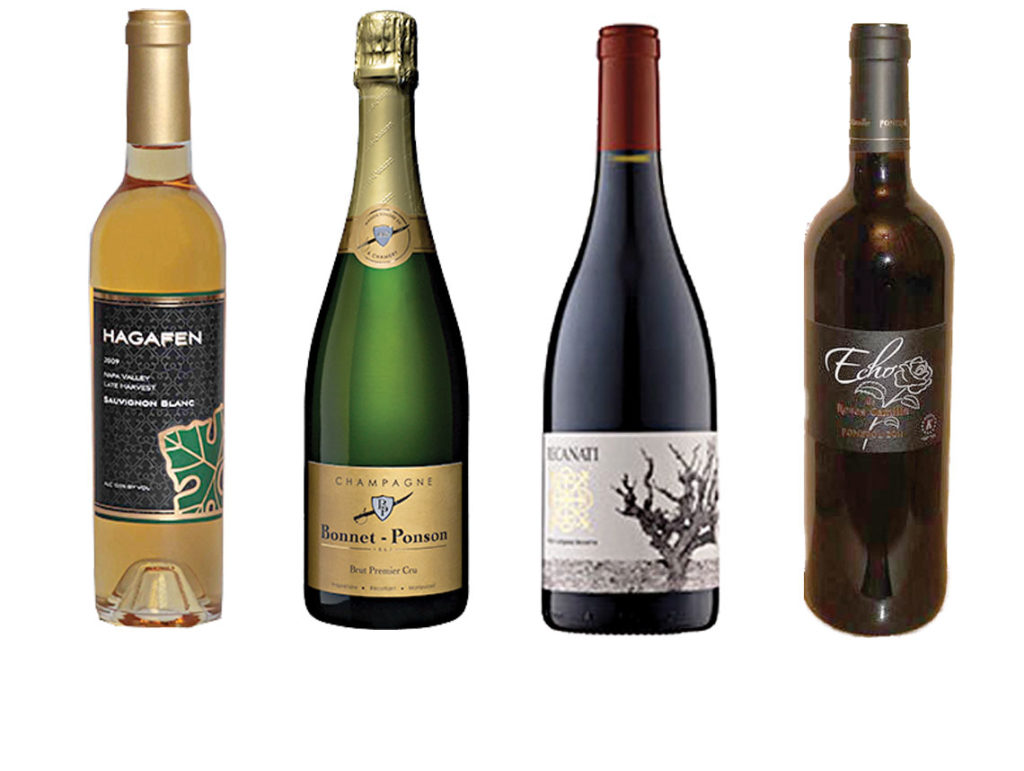
As an homage to Rosh Hashanah symbolism and a fun way to incorporate excellent wines into a traditional New Year’s celebration, I’ve chosen four wines that have their own exciting attributes, all of which carry kosher certification.

Zest

2016 Hagafen Cellars Sauvignon Blanc, Napa Valley: Alacrity for our daily tasks and an energetic approach for life truly are attributes for which to strive. Represent that drive with this lively wine from Napa stalwart Hagafen Cellars. Notes of lemon, tropical fruit, grapefruit zest and freshly cut grass are exhilarating in the glass and on the palate. Serve on its own or with a mixed-greens salad with roasted local squash. $22

Flexibility

Bonnet-Ponson Champagne, Brut Premier Cru, France: Sometimes we are faced with unexpected situations or opportunities outside of familiar areas, where our ability to adapt and adjust is tested. While most people associate Champagne only with celebratory moments, this wine is by far the most versatile on the planet. It has an elegant mousse with flavors of lemon curd and apple tart. Save the orange juice and enjoy this delectable wine with diverse cuisine from sushi to fried chicken, or even with breakfast. $59

Heritage

2014 Recanati Wild Carignan, Israel: Commitment to honoring the past is a value with which many can identify. This wine hails from a little-known vineyard in Israel, where the farmer refused to uproot ancient vines to replace them with more contemporary grape varieties. Turns out this commitment to the past was spot on: The grapes from this vineyard would go on to comprise critically acclaimed wines. They aresome of the most enjoyable and unique wines from Israel I’ve had in quite some time. $49

Strength

2012 Echo Roses Camille, Bordeaux, France: Having the strength to follow your passions, dreams and convictions requires incredible fortitude. Tap into the full-bodied structure of this small-production, single-vineyard wine from the heart of Pomerol, the Rodeo Drive of Bordeaux. Made by a fifth-generation Bordeaux winemaker, this layered, luscious wine has signature regional aromas of violets, cocoa and raspberry. Drink now after a couple hours of breathing, or cellar for New Year’s festivities to come. $79


Andrew Breskin is a sommelier and founder of Liquid Kosher, a boutique online wine shop.

Symbolic wines for the new year Read More »

To Persian Jews, roasted tongue speaks for itself

Framed by pomegranate seeds and bowls of honey, the roast on the Rosh Hashanah table might appear to be an all-too-familiar brisket.

Look closer. See those little bumps on its surface? It’s a cow tongue, the culinary centerpiece of the Persian Rosh Hashanah meal.

Where Ashkenazis place a fish head, some Sephardic Jews place a roasted cow tongue on the dinner plate to symbolize the hope that God will make us “the head, not the tail” in the coming year. This delicacy is perhaps the most polarizing food in the Rosh Hashanah spread — many young Persians find the dish repulsive, but a devout few (and their parents) savor the holiday specialty.

“Persian [adults] love tongue, but you could never get an American millennial to pick up a tongue sandwich,” said Penny Davidi, a Persian-Jewish chef and once a contestant on “Food Network Star.” “My own kids have acquired the taste buds for it through tradition. They love it with mustard on a baguette.”

Davidi compared the flavor of cow tongue with that of a short rib: fatty, rich and full of umami, a savory category known as “the fifth taste.” She prepares the meat, one of her favorite dishes to make, in a roasting pan with garlic, onion and a bay leaf. She then keeps it in the oven until the meat is tender enough to fall apart on a fork.

Davidi said her Sephardic dinner guests devour cow tongue like a feast before the main course, dressing it with pickles or pepperoncini and eating it like a French dip sandwich. Her Ashkenazi guests, on the other hand, don’t touch it.

“They look at us from across the table like we’re crazy,” she said.

Taste buds and capillaries make cow tongue an unattractive cut of meat, said Reyna Simnegar, author of the cookbook “Persian Food From the Non-Persian Bride.” She said she’s seen Persians serve their Rosh Hashanah tongue whole and unadorned, sometimes with the “kasher” symbol still branded on the meat’s surface. When she prepares tongue for Rosh Hashanah, she makes sure to dress it and sauce it to conceal its natural texture.

Aaron Hendizadeh, a 20-year-old Persian American, said he can’t get past the feeling of a cow’s taste buds brushing against his own.

“If we grew up in Iran, I think we’d be more willing to accept [cow tongue] as a normal thing to eat,” he said. “But it’s considered weird in America.”

Cow tongue is a fairly commonplace food in Iran, along with cow-foot stews and lamb testicles. During the High Holy Days, however, tongue acquires an elevated culinary importance to Persian Jews.

F & Y Kosher Meats Co. on Pico Boulevard sells cow tongue year-round, but Iranian-American owner Farajollah Yadkarim estimated that tongue sales are about six times higher during the run-up to Rosh Hashanah.

Suzee Markowitz, co-owner of Factor’s Famous Deli, also said patrons order more tongue sandwiches in the fall than they do during the spring or summer. The dish is a delicacy, she said, and those who love it might come to the deli just to enjoy some cow tongue. Often, these tongue enthusiasts are older Jews.

Simnegar said she knows many Orthodox Ashkenazis who grew up eating cow tongue in Eastern Europe, at a time when poverty or limited access to meat necessitated using every part of the animal. She said many Ashkenazi kosher markets on the East Coast still sell tongue year-round, and many of her Ashkenazi friends prepare the meat in a sweet sauce and enjoy it just as much as any Sephardi. It’s the modern Jews, she said, who think cow tongue is gross.

Any cut of meat from an animal’s head — say, a whole sheep’s head or even an eyeball — could satisfy the meal’s requirement for a symbol of progress and leadership, said Rabbi David Shofet of Nessah Synagogue, an Iranian Orthodox congregation in Beverly Hills. Tongue just happens to be one of the more available and edible options.

Shofet said he generally avoids red meat, but makes an exception for cow tongue to fulfill the Rosh Hashanah blessings.

Hendizadeh, too, said he forces himself to eat a tiny portion of tongue during the meal for the sake of ritual.

“It’s tradition,” Shofet said. “You have to have the tongue.”

ROSH HASHANAH TONGUE WITH TOMATO AND MUSHROOMS (ZABAN)

Recipe from “Persian Food From the Non-Persian Bride” by Reyna Simnegar.

– 1 beef tongue
– Water as needed
– 1 onion, diced
– 4 garlic cloves
– 3 tablespoons olive oil
– 1 onion, thinly sliced
– Dash of turmeric
– 1 (13-ounce) can mushrooms sliced or stems and pieces, drained
– 1 cup tongue broth
– 3 tablespoons tomato paste
– 1/2 teaspoon salt
– 1/4 teaspoon pepper
– Fresh flat-leaf parsley, chopped, for garnish

Place the tongue into a 6-quart saucepan and cover with water until it reaches about 3 inches above the meat. Add the diced onion and garlic cloves and bring to a boil. Reduce heat and simmer, covered, for 3 1/2 to 4 hours, checking periodically and using a small strainer or slotted spoon to remove the scum that accumulates on the surface of the water.

Remove tongue from broth and set aside to cool. Reserve one cup of broth.

To make the sauce, pour olive oil in a skillet and sauté sliced onion and turmeric until onion is translucent. Add mushrooms and toss together for one minute. Add tongue broth, tomato paste, salt and pepper. Cook for about 3 minutes.

While the tongue is still warm, peel off the surface skin and discard. Cut tongue into 1/4-inch-thick slices and arrange on a serving platter. Pour the tomato and mushroom sauce on top and sprinkle with chopped parsley.

Makes 6 to 8 servings.

To Persian Jews, roasted tongue speaks for itself Read More »

Alberto Nisman was murdered, Argentine investigators set to claim in new report

A team of forensic analysts has determined Alberto Nisman was murdered and did not commit suicide, Argentinean media is reporting.

A new toxicology report on the body of the late Argentinean prosecutor found traces of the drug ketamine, an anesthetic used on animals, and posits that at least one other person forcefully held Nisman down around the time of his death, the Infobae digital news outlet and the TN cable news network reported Thursday.

The team of investigators plans to present the report to Eduardo Taiano, the lead prosecutor looking into the circumstances of Nisman’s death, next week. Taiano will then decide how to present it to Argentina’s justice department.

Alberto Nisman was an Argentine-Jewish prosecutor who was found dead from a gunshot wound in his apartment in January 2015, on the morning before he was supposed to present a report on the 1992 AMIA Jewish center bombing to Argentinean lawmakers. The AMIA suicide bombing killed 29 and injured hundreds.

Iran has been accused of coordinating the attack, and Nisman claimed that former Argentinean President Cristina Fernandez de Kirchner covered up Iran’s role as part of a trade deal between the two countries. Since Nisman’s death, which was originally thought to have been a suicide, Kirchner has vehemently denied being involved in a cover-up.

Previous scientific tests showed that Nisman likely did not shoot himself, but the case languished until last year, when it was moved to a federal court that handles political murder cases.

Alberto Nisman was murdered, Argentine investigators set to claim in new report Read More »

The return of the sable to the table

While I was growing up, one of my favorite smoked fish was barbecued cod. It was atomic red and dripping with its own oil.

There was always a fight in my family to get some before it was all gone; my cousin Jeff had a particular affinity for loading up his bagels.

A number of years ago, that sort of cod seemed to vanish from delis and gourmet stores. You could still find it on the East Coast under its other name, smoked sable, but it just wasn’t quite the same.

When we opened Wexler’s nearly four years ago, it was one of those things that was on my mind that I really wanted to bring back. Little did I know how difficult it would be to source the fish and rediscover the lost techniques on how to cure and smoke it.

It turns out the fish is wild and abundant and has high sustainability ratings. We created a spice rub that gives it the characteristic red color without using any artificial coloring or dyes. I think we went through about 25 iterations of the recipe over the years until we got it right — frustrating, but well worth it. Now we sell it by the pound at Wexler’s in Santa Monica or through our catering.

I like it best on a great bagel with some cream cheese and red onion. But to dress it up for a Rosh Hashanah or break-the-fast meal, I serve it with colorful garnishes on a freshly made potato galette.

SLICED POTATO “LATKE” WITH BBQ COD

This dish can easily be made with the traditional latke recipe of your choosing. You can vary the garnish, too.

– 1 sprig fresh thyme
– 2 fresh garlic cloves
– Kosher salt to taste
– 2 Yukon gold potatoes
– 3 tablespoons vegetable oil
– 1/2 pound deli barbecued cod
– 2 ribs celery, shaved
– 1 watermelon radish, shaved
– 1 sprig dill
– 1 ounce crème fraîche (optional)
– 2 tablespoons diced Persian cucumber

Bring a medium pot of water to a boil with thyme, garlic and kosher salt to taste.

Peel potatoes and shave thin on a mandoline. Place in the boiling water for 3 minutes. Strain onto a baking sheet lined with a towel and cool in the refrigerator.

In a 10-inch nonstick or cast-iron pan, heat vegetable oil over medium-low heat. Place the potato slices in the oil, carefully shingling one on top of the other in a repeating pattern until the entire surface of the pan is covered. Cook for about 15 to 20 minutes, invert the galette onto a plate and slide back into a pan on the uncooked side and cook for another 15 to 20 until the galette is golden brown and crispy.

Place the latke on the plate and garnish with remaining ingredients.

Makes 2 to 4 servings.

The return of the sable to the table Read More »