fbpx

August 23, 2017

Canter’s Deli drops to a ‘C’ rating after health inspection; reopened August 10

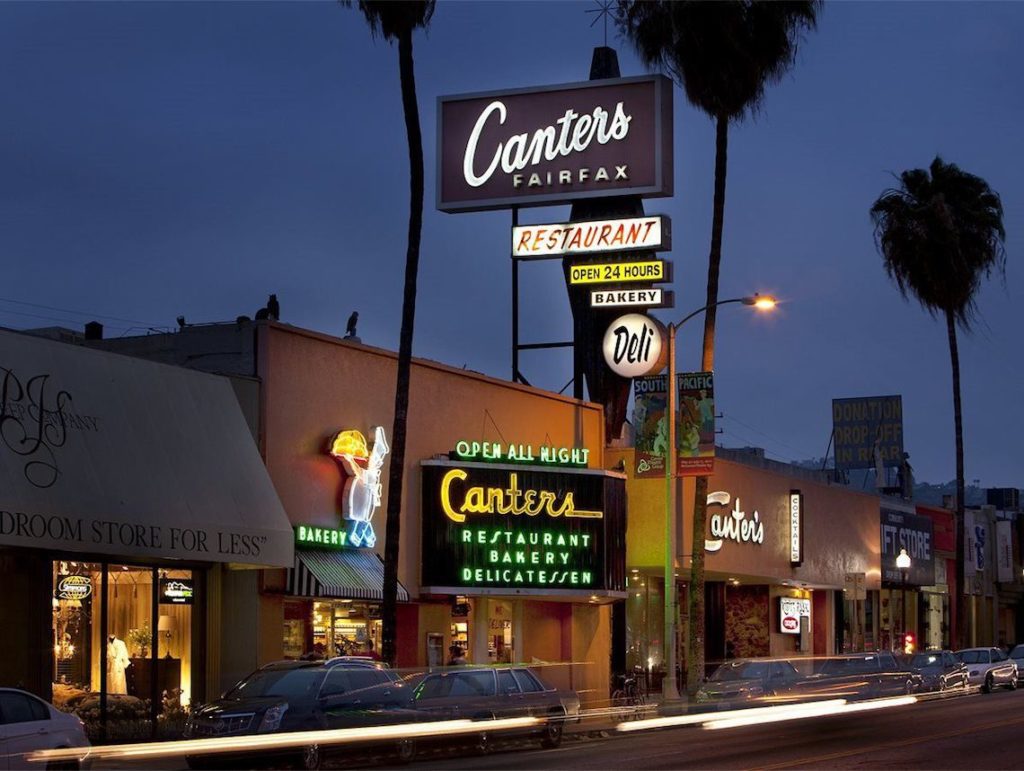
This might alter your plans for a nosh: Canter’s Deli, a Los Angeles landmark for generations on Fairfax Avenue, dropped from an A rating to a C after a recent food safety inspection.

Health inspectors observed cockroaches and rodent droppings in the restaurant’s storage and flies in the food preparation area during their visit on Aug. 7, according to a county report.

Canter’s Deli’s owners could not be reached for comment.

In total, the Aug. 7 inspection cited 11 violations that could lead to food-borne illness, according to an email from James Dragan, the county’s chief environmental health specialist.

Those violations resulted in the closure of the restaurant on Aug. 7. The deli remained shut for three days. During that time, county officials reinspected the deli twice before its reopening on Aug. 10, according to Dragan’s email.

Other violations included allowing “food to contact unclean equipment and using dirty utensil for scooping soup,” the report said.

During the inspection, county officials said in their report that they noticed “accumulated grease or food debris on the nonfood-contact surfaces of equipment, shelving, cabinets, and fryers.” One employee was found drinking from an open cup in the food preparation area.

The 24-hour deli has been known for offering a wide selection of sandwiches and welcoming famous customers such as Mel Brooks, Elvis Presley and Barack Obama.

Canter’s Deli drops to a ‘C’ rating after health inspection; reopened August 10 Read More »

Trump’s target: Immigrants like us

While reporting on the current generation of immigrants, I’ve been struck by how they resemble Jews who, like them, left the old country for a risky journey to the United States.

We forget family roots as the years pass. Only determined genealogists have the curiosity to trace families back to the towns of the Ashkenaz and Sefarad. 

But there is no better time than now to think about roots.

Who would think that the top news of the day would be American Nazis running wild, rampaging with their swastikas and anti-Semitic chants? They are evocative of the vicious young men who stormed through Russian cities and villages during pogroms, in Jewish quarters in the Middle East, in European cities when Hitler reigned.

Then, to make matters worse, President Donald Trump sank to the level of Hitler apologists when he said of the clashes in Charlottesville, Va., “You … had some very fine people on both sides.” 

The United States has been a welcoming land for Jews. But the Nazi sympathizers and Trump’s comments ought to remind us of a certain precariousness in our lives. Paranoid perhaps, but that gloomy thought is with me as I cover the immigration issue for the website Truthdig.

When Trump took office with his pledge to sharply limit immigration and to deport those here without documentation — numbering about 11 million — Truthdig Editor-in-Chief Robert Scheer, son of an immigrant mother, said he thought immigration was one of the most important stories of our time and that we were in the middle of it in Southern California.  I thought so, too.

Take Boyle Heights, for example.

I began exploring Boyle Heights, Los Angeles’ traditional immigrant center, for the Los Angeles Times in 1970.

Much has changed since then. Brooklyn Avenue, the Boyle Heights’ main street of some of our readers’ youth, is now Cesar Chavez Avenue, and the Jews who made it their community long ago migrated westward. But some of the heritage of the old Boyle Heights — then a multiethnic, working-class neighborhood with a tradition of activist politics — remains.

That activism was apparent to me during a recent community workshop organized by Truthdig Managing Editor Eric Ortiz. The event was designed to show young people how to get news out in this era of internet journalism.

The concerns of these young journalists , who contribute to Boyle Heights Beat, a bilingual community newspaper and website, ranged from fighting the gentrification of Boyle Heights to reporting on the wave of fear in the Latino community over the rapidly increasing arrests of undocumented immigrants.

One story in a recent edition was about Los Angeles’ first all-solar-powered arts and music festival in Mariachi Plaza. Another was a moving account by a Boyle Heights Beat reporter about what happened when her father, here on a green card, was deported. What distinguishes the stories is that they give full pictures of life in Boyle Heights, rather than limiting themselves to the usual media accounts of undocumented immigrants being hauled away by authorities. 

My former Los Angeles Times colleague Hector Tobar wrote of these usual accounts in a New York Times op-ed, calling such stories “kind of immigration porn,” designed to titillate readers and viewers. “You are many times more likely to see a deportee on the TV news than a Latino doctor or teacher,” he wrote. “My objection is not to the coverage of deportations. … But the humiliated and hunted people you see in coverage of the deported are not the whole person. Tenacity and stubbornness are the defining qualities of undocumented America.”

These were the qualities of our Jewish immigrant forebears. They had the tenacity, stubbornness and courage to leave the old country for a faraway land whose language they frequently could not read or speak. They were impoverished before they left and often more so when they arrived. Grit and, often, family members pulled them up — sometimes way up.

These qualities are not recognized in the cruelly restrictive immigration measure proposed by Trump that would cut the number of immigrants to this country by half and, among other provisions, require English language skills. It would also eliminate some family sponsorship of immigrants, the route most immigrants follow to get into the United States. The provision would devastate Latino and Muslim families.

One of the provision’s authors was Trump aide Stephen Miller. As Jewish Journal Publisher and Editor-in-Chief Rob Eshman wrote, Miller is the descendent of immigrants who benefited from American openness and generosity.

If you can, visit immigrant communities, go to meetings, explore the schools and watch people fight deportation in immigration court. Look carefully. You’ll see in their faces the faces of your parents, grandparents or great-grandparents.

Today, Latinos and Muslims are under threat from the Trump administration. As inconceivable as it sounds, one day it could be us.


BILL BOYARSKY is a columnist for the Jewish Journal, Truthdig and L.A. Observed, and the author of “Inventing L.A.: The Chandlers and Their Times” (Angel City Press).

Trump’s target: Immigrants like us Read More »

Holocaust-survivor

Survivors speak at The Last Bookstore, despite online harassment

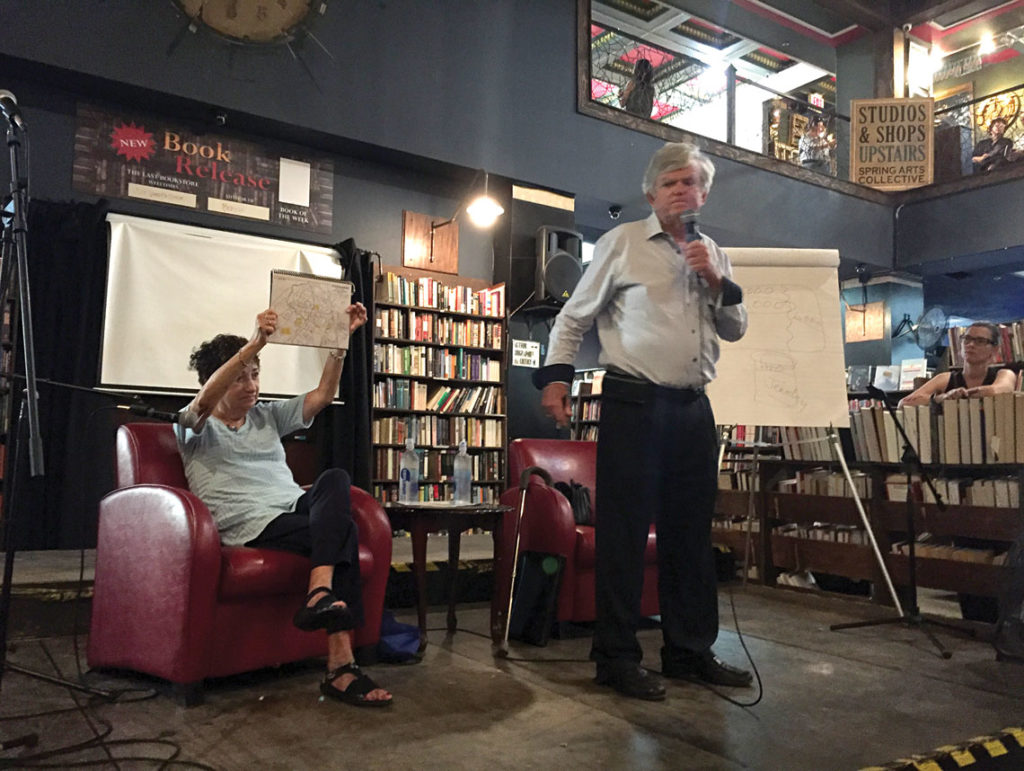
Despite online harassment by an alt-right provocateur, two Holocaust survivors told their stories of triumph over evil, as planned, to a standing-room-only crowd at The Last Bookstore in downtown Los Angeles on Aug. 19.

The appearance by Robert Geminder and Gabriella Karin came 11 days after a person who writes under the name “Johnny Benitez” posted a Facebook link for the event with the tagline: “Who wants to bet money this is another white guilt push. Lesson 1: white people are bad and it’s good they’re an ever increasing minority.”

After the event’s organizer, Jennifer Brack, told Benitez he was not welcome, Benitez — whose real name is Juan Cadavid, according to a report by the OC Weekly — posted a video encouraging his followers to attend the event.

At the advice of the Anti-Defamation League, Brack hired a pair of armed guards and proceeded with the event, the third in a series called “Lessons of the Past,” survivor speaker engagements organized by Brack with the help of the American Society for Yad Vashem.

The audience of about 300 people, who sat on folding chairs and the floor, was attentive, respectful and engaged. And after Geminder and Karin spoke, a long line formed with well-wishers who praised their eloquence and courage.

“People more than ever these days want to hear survivors,” Karin told the Journal before she spoke. “They want reassurance that people will go out and speak in spite of the threats.”

Karin, 86, and Geminder, 82, are a couple. They began dating in 2015 after both had lost their spouses to illness years before. They briefly wondered how they should proceed with the speaking event after they learned about the harassment, but they never gave a second thought to pulling out.

“I’m not afraid,” Karin said. “Maybe because of what we went through, nothing makes me afraid.”

Even so, she and Geminder were perturbed with the harassment, which came a week after white supremacists and neo-Nazis marched in Charlottesville, Va. — one of the largest such demonstrations in a decade, according to the ADL.

“When we see a Nazi flag like we saw over the weekend in Charlottesville, it just tears us apart,” Geminder said.

Both survivors tell their stories around the world, and neither has experienced any kind of harassment, online or otherwise, before the posts from Benitez.

At the event, as they have done hundreds of times before, the two carefully told the stories of their experiences and shared the lessons they have drawn from them.

Geminder was born in Wroclaw, Poland, in 1935. He saw as many as 14,000 Jews massacred at the cemetery in Stanislawow but managed to survive, he said, by pure luck. He and his brother, mother and stepfather were in Warsaw when the Warsaw Uprising was quelled. The Nazis put them in a cattle car on a train headed to the Auschwitz concentration camp, but the family was able to escape through an opening in the roof of the car within a hundred yards of the camp.

Karin was born in Bratislava, Czechoslovakia, in 1930, and spent the Holocaust in hiding, successfully sheltered by her mother’s underground contacts and the help of a righteous gentile named Karol Blanar.

Neither survivor mentioned Benitez’s harassment at the bookstore event.

“I don’t want to make anyone else aware of the negatives,” Geminder said. “I want to focus on the positives.”

Meanwhile, as Geminder and Karin were speaking, Benitez was at a Laguna Beach event he organized called “America First! Electric Vigil for the Victims of Illegals and Refugees,” according to his posts on Facebook.

Benitez, whose recent web exploits included posting a manipulated photo that made it appear the Jewish mayor of Laguna Beach was wearing a Nazi uniform, has long been on the radar of Joanna Mendelson, senior investigative researcher at the ADL’s Center on Extremism.

Benitez does not have a history of violence, but some groups who show up to his rallies, including skinheads and antigovernment extremists, do, she said.

In the video Benitez posted about the survivors’ event, a framed photograph of various guns is visible in the background as he talks about how the L.A.-based Simon Wiesenthal Center is involved in a Jewish conspiracy to use the Holocaust to antagonize white people.

“Why is it so concurrent that the anti-white narrative and the anti-Trump narrative is so closely tied to these events that push the Holocaust and white privilege and white guilt?” he says in the video, which he streamed live simultaneously on Facebook and the social media site Periscope.

Mendelson, who has followed Benitez’s rising profile within the alt-right, said he has a “fixation with Jews” that borders on Holocaust denial. After he posted the video, in which he holds up an iPad with Brack’s Facebook profile on it, the ADL encouraged her to take basic precautions such as contacting law enforcement.

“Although no direct threats of violence were made against the organizer, we still wanted to make sure that law enforcement were in the loop and to help safeguard this gathering,” Mendelson said. “It is a sad state of affairs when individuals who have been traumatized by the Holocaust are in some ways revictimized by anti-Semitic and hateful racist thought leaders.”

Contacted via Facebook Messenger, Benitez told the Journal he wanted his followers to “observe and report the narrative” from the bookstore event. He said he first learned about the event through a Facebook ad.

Asked if he denied the Holocaust or questioned its magnitude, Benitez was evasive.

“I don’t address the holocaust. I view any attempt to lure people into discussions about it to be Red Herrings,” he wrote, not acknowledging the fact that he brought the Holocaust history event to the attention of his nearly 2,000 Facebook friends and followers.

At The Last Bookstore, during the question-and-answer period, audience members wanted to know how Geminder and Karin felt about the recent events in Charlottesville, where swastikas were abundant and men yelling “Sieg Heil” marched in front of a synagogue.

“It was a nightmare for us,” Geminder said. “I can imagine how every one of you must have felt. Imagine a hundredfold how survivors felt during this. When we came to America, we never expected to see that again. Never, never, never.”

Even with the recent news events, both Geminder, a retired electrical engineer and part-time math teacher, and Karin, an artist and former fashion designer, said they are avowed optimists.

Karin recounted for the audience the moment after World War II when she decided she would move on from the trauma of the Holocaust to have a full and active life. She was standing on the platform of a train station in her native Bratislava, now the capital of Slovakia, as emaciated Jewish refugees streamed into the city.

“I decided to myself, ‘Hitler did not get my body; he will not get my soul. I will smile. I will be happy,’ ” she told the audience. “And I am.”

Survivors speak at The Last Bookstore, despite online harassment Read More »

Daniel-Steres

Galaxy’s Jewish Heritage Night will feature Los Angeles native Daniel Steres

As a soccer-cleated kid growing up in the San Fernando Valley, Daniel Steres idolized Cobi Jones, the Los Angeles Galaxy’s dreadlocked captain who played for the club from 1996 to 2007.

Steres had visions of one day following in his hero’s footsteps and slipping on the home whites of his local team — a uniform that’s been worn by the likes of Major League Soccer (MLS) stars David Beckham, Landon Donovan and Giovani dos Santos.

On March 6, 2016, after several years in the United Soccer League, a second-tier professional league, there was no more dreaming. It was real.

Steres made his debut as a central defender in the Galaxy’s season opener against D.C. United at the StubHub Center in Carson. Under those bright lights, the dream quickly descended into a nightmare.

“I started off letting in a goal in the first 10 minutes, which is never good,” Steres said. “That first game was a big welcome-to-the-league moment, you might say.”

The former Calabasas High School and San Diego State University standout quickly recovered, netting the Galaxy’s first goal of the night en route to a 3-1 victory. That performance helped solidify the 6-foot, 175-pound Steres’ place on the Galaxy backline, where he started 29 times in 31 appearances for the team.

The 27-year-old, one of a handful of Jewish players on MLS rosters, has played in 17 games this season as of Aug. 22 and is expected to be on the field for the Galaxy’s first Jewish Heritage Night on Aug. 27, when the team clashes with the visiting San Jose Earthquakes at 4 p.m

“We have a large Jewish community here in Los Angeles and I’m proud to be able to be at the forefront of that, representing that,” said Steres, who became a bar mitzvah at Wilshire Boulevard Temple.

Steres took to soccer early, or as his grandmother Jo Seligman remembers, “He was good at anything involving a ball.”

He was a standout in the Jewish Community Center (JCC) Maccabi circuit, competing at tournaments around the country under coach Kobi Goren, who worked with Steres during his teen years. Goren has been coaching local JCC Maccabi teams for 25 years, and despite seeing hundreds of youth players come and go, Steres has a special place in his memory. 

“He’s one of the top players who ever played for me, on and off the field. I want to stress that,” Goren said in a syrupy-thick Israeli accent. “He’s a brain, not just a soccer player. Making good decisions under pressure for him is easy, so his success doesn’t surprise me at all. He’s humble and has beautiful character. He’s very special for me.”

Chris Glidden, communications mana-ger for the Galaxy, said Steres has been a model professional, representing his community admirably.

“The Galaxy are very proud to have a diverse group of players from various backgrounds, ethnicities and religions,” Glidden said. “Daniel has been an excellent member of our team who has represented this club, himself, his family and his faith incredibly well during his time here.”

Even when it’s not Jewish Heritage Night, Steres always has an armada of friends and family cheering him on at home games. His parents, Mark and Suzie, his younger brother, Andrew, aunts and uncles, a pair of Jewish grandmothers, and childhood friends and former teammates make it a point to caravan to Carson from many parts of the San Fernando Valley, where most of the family still lives.

“It’s really special that I still have such a big family here and that I get to keep playing soccer as a career in their backyard,” Steres said. “This is definitely a dream I had growing up. I didn’t know if it would happen, but it’s pretty cool that it did.”

Mark Steres said sometimes it’s still hard to believe that he has a professional athlete for a son — particularly one who plays so close to home.


“For most parents, their kids’ sports careers end at high school, so we’re just having a lot of fun with this,” he said. “College was a bonus and him going pro is just over the top. The amazing thing is he could’ve ended up playing anywhere and he’s right here in his hometown.”

“It’s surreal seeing him out there and, sure, he’s a good player,” Seligman said. “But he’s not your typical flashy athlete who shows off and mouths off and all that. He’s a gentleman and, from my perspective as a Jewish grandmother, a role model for the Jewish community.”

Steres, who now lives in Long Beach, said he occasionally pops in for services at Temple Valley Beth Shalom in Encino, where Seligman and much of his family are members. When he goes, he jokes that he “stays in the back,” just like he does on the field.

It will be hard to avoid attention during the game against San Jose, however, where he will be a major attraction and remain on the field after the game to interact with Jewish fans.

“I know the Galaxy are welcoming as many fans for it as they can,” he said. “I think it’s something really cool that they’re putting on and I’m proud to be a part of it.”

Galaxy’s Jewish Heritage Night will feature Los Angeles native Daniel Steres Read More »

ADL reports 1000% surge in online donations after Charlottesville rally

The Anti-Defamation League received 10 times as much money as usual from online donations in response to the white supremacist rally in Charlottesville, Virginia.

The group, which combats anti-Semitism and bigotry, reported a 1000 percent increase in online donations during the week beginning Aug. 13, one day after the Charlottesville rally. The ADL said it received six times as many individual donations as during an average week this year, mostly from first-time donors, though it did not provide a total amount of money raised.

In the aftermath of the rally, the ADL has seen its profile skyrocket. It received $1 million donations from Apple and 21st Century Fox CEO James Murdoch, and announced a partnership with Bumble, a dating app, to block bigoted profiles. JP Morgan Chase also announced this week that it would donate $500,000 to the group. JP Morgan and Apple also pledged to match donations to the ADL and other nonprofits from employees.

On Friday, the ADL announced a partnership with the U.S. Conference of Mayors to combat hate and bigotry.

ADL reports 1000% surge in online donations after Charlottesville rally Read More »

Three Jewish movements opt out of High Holy Days call with Trump, citing ‘xenophobia’

Three streams of American Judaism will not participate in the traditional annual pre-High Holy Days call with the president, saying Donald Trump has “given succor to those who advocate anti-Semitism, racism, and xenophobia.”

“We have concluded that President Trump’s statements during and after the tragic events in Charlottesville are so lacking in moral leadership and empathy for the victims of racial and religious hatred that we cannot organize such a call this year,” said a statement Wednesday by leaders of the Reconstructionist, Reform and Conservative movements, which went on to the “succor” comment.

The reference was to Trump’s equivocation following the clash between white supremacists and counterprotesters on Aug. 12 in Charlottesville, Virginia. An alleged white supremacist later rammed his car into a crowd of counterprotesters, killing a 32-year-old woman, Heather Heyer.

Trump at first said there was violence on “both sides” and for two days did not single out the white supremacists for censure. A day after he did so, the president said there were “very fine people” among the far-right protesters and the counterprotesters.

“Responsibility for the violence that occurred in Charlottesville, including the death of Heather Heyer, does not lie with many sides but with one side: the Nazis, alt-right and white supremacists who brought their hate to a peaceful community,” the statement said. “Our tradition teaches us that humanity is fallible yet also capable of change. We pray that President Trump will recognize and remedy the grave error he has made in abetting the voices of hatred.”

It’s not clear whether there would be a separate call for Orthodox rabbis, who have participated in the annual calls, which were routine with President Barack Obama. Officials at Orthodox rabbinical groups said no separate call was in the works.

“We respect the office of the presidency and believe it is more effective to address questions and concerns directly with the White House,” said Rabbi Mark Dratch, the executive vice president of the Orthodox movement’s Rabbinical Council of America.

Similar briefings occurred with Presidents George W. Bush and Bill Clinton, but not necessarily formalized as a pre-High Holy Days call. With Bush, for instance, there often was an in-person meeting on the day of the White House Hanukkah party, a tradition launched by Bush.

Three Jewish movements opt out of High Holy Days call with Trump, citing ‘xenophobia’ Read More »

Trump and Charlottsville—Why the Meltdown?


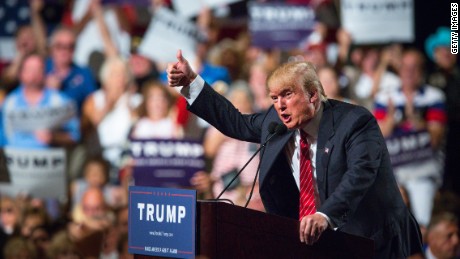
In the aftermath of Trump’s press conference at Trump Tower last week, there have been countless analyses of why he chose to undo his conciliatory condemnation of haters on Monday that sought to ameliorate his bungled statement of Saturday. He misrepresented his comments at his Phoenix campaign rally last night, raising more questions about his motivations and attitudes.

Did he calculate that his hard core base wanted him to come out swinging, to endorse Confederate monuments and thumb his nose at mainstream voters and the “mainstream media”? Was he just seeking to offer an unorthodox, revelatory and counter-intuitive take on events that was “ignored” by the media for their malevolent reasons? Or was he channeling the Fox News feed of that morning which had made virtually all of his talking points?

There was endless speculation as to what animated Trump to have a national, live TV meltdown.

The reality that he revealed in his off-script remarks is far more troubling than most of the conjecture-his Tuesday presser confirmed what should have been apparent from the outset of his candidacy-he is incapable of discerning what makes extremists and bigots different from mainstream politicians and most of civil society.

He won’t relegate extremists to the periphery of American politics-as all his predecessors of the past century have done-because he reasons and thinks as extremists do. Their tools are his tools, their warped reasoning is his warped reasoning, their obliviousness to facts, data and truth is mirrored in our commander-in-chief.

As one who has monitored, listened to, had surreptitious contacts with extremists for over four decades, it is clear that Trump’s thought processes are an awful lot like theirs. He may not be animated at base by hate and venom, but how he reasons is chillingly similar to the policy arguments of bigots.

They believe in conspiracies, they are convinced a hidden hand works against them, they ignore and have a contempt for data, truth and civil dialogue and they always blame someone or some group for what ails them or society.

For most of the last half century plus, American presidents, electeds at all levels, opinion molders, and good citizens have intuitively realized that political extremists were different than mainstream politicians on both the left and the right. Civil rights organizations and good people have endeavored to ostracize and relegate to the fringes of society extremists who violate a set of unwritten rules on public conduct and decency.

From the John Birchers and their flirting with anti-Semitism in the 60s to George Wallace in the 70s to Louis Farrakhan more recently (see my op/ed of  9/17/1985 in the Times) to David Duke and Louisiana politic–policies or comments that flirted with bigotry and stereotypes, even if made in passing, were enough to derail careers, elicit presidential condemnations and generate near universal abhorrence. It was clear to most leaders that overt expressions of bigotry and stereotypes were not acceptable vocabulary of late 20th century America.

Political correctness, with all its frailties, prevailed and there was a perceptible decline in hate crimes, the diversification of corporate boards and of elected officials, the election of an African American by significant electoral majorities and the virtual elimination in public discourse of racial, religious and homophobic epithets and expressions.

This is not to suggest that dog whistle politics with covert appeals to bias and intolerance didn’t happen-indeed they did (e.g. Willie Horton ads); but they were different than vulgar, overt expressions of hostility.

They can be offensive, but they indirectly acknowledge what the ground rules of civility are-no blatant bigotry. There have been occasional accusations made against fervent advocates on the left and the right of being extremists where the label was sloppily and unfairly applied-passion is not same as unreason. Mercifully, those instances have been few and far between.

Into that environment, comes a candidate who has flaunted all the norms of political discourse and debate and who utilizes the very cognitive tools of extremists (Klansmen, neo-Nazis and far left extremists share the methodologies): he traffics in bizarre conspiracy theories, he blithely ignores data, he bullies, attacks and demeans, he threatens, he blatantly lies with demonstrably false assertions on numerous issues, he claims to be the victim of a perpetual witch-hunt with a designated culprit[s] (other than himself) who is/are always to blame.

Why would he find extremists deserving of condemnation or isolation? He managed to become president despite all those traits- it has all worked for him.

For traditional politicians, individuals or groups that exhibit these characteristics represent flashing red lights-“stay away, extremists, bigots, crazies at work.” For Trump, they are a mirror of his modus operandi-just bit more extreme in policy.

He simply doesn’t see them as qualitatively different than himself-if he’s mainstream then they likely are too. It is not a basic instinct of his to ostracize and reject them. In fact, if they like him (and David Duke and Robert Spencer do) he may just like them back, or at a minimum, he won’t call them out.

The decades-long work of civil rights advocates and good people in society to relegate bigots and extremists to the fringes of our political system is being undone before our eyes. Trump is normalizing and mainstreaming bigots as we have never seen before-he is, once again, unprecedented in his actions.

As Edmund Burke noted, “All that is needed for evil to triumph, is for good men to remain silent” – if we care at all, that’s simply not an option.

Trump and Charlottsville—Why the Meltdown? Read More »

32 Life Lessons for the Month of Elul

Soren Kierkegaard said: “It is perfectly true, as philosophers say, that life must be understood backwards. But they forget the other proposition, that it must be lived forwards.”

Though we’re always living forward, the life lessons we learn help to shape our future. Since this is now the season of self-examination (hence, the photo of “The Thinker” by Auguste Rodin, Paris) in Elul which begins this year on Wednesday evening, leading to Rosh Hashanah, I offer you a list of 32 life lessons I’ve learned in my nearly 68 years – there are others, but the number 32 is a significant one in Jewish mystical tradition. It equals the 22 letters of the Hebrew aleph bet plus the 10 “words” of the covenant, and it’s the number equivalent for the Hebrew word lev (lamed – beit), heart, which the mystics teach are the number of pathways to God.

I offer the following, some of which I’ve borrowed gratefully from Regina Brett who first published her list of 50 life lessons (worth reading) and published in the Plain Dealer from Cleveland, Ohio (those that I borrowed from her are in italics). blog.cleveland.com/pdextra/2007/09/regina_bretts_45_life_lessons.htmlSep 20, 2007

They’re not necessarily a way to God, but a means to a healthier, wiser and more sacred way of living, at least as I’ve come to believe in them. I encourage you to draw up your own list.

  • God gave us life and our natural abilities only – everything else is either up to us or a result of dumb luck.
  • Life isn’t always fair, but it’s still good.
  • Life is short, so cut your losses early.
  • Begin planning for retirement as a teen by developing your passions and interests, for they’ll sustain you when you get old.
  • Make peace with your past so it won’t screw up your present.
  • You don’t have to win every argument, so at a certain point stop arguing.
  • Love your spouse above all other people and things. If you aren’t married, then nurture the special friendships in your life.
  • Don’t compare your life to anyone else’s as you have no idea what their journey has been all about.
  • If you can’t publish what you want to say or do on the front page of The NY Times, don’t say or do it.
  • Try not to speak ill of anyone, but if you must, do so only with trusted friends and then only so as to understand better how to cope better with people like that.
  • Don’t procrastinate seeing doctors. It may save your life.
  • Carpe diem. Take pleasure in this day and do what inspires you for we don’t know what tomorrow will bring.
  • When it comes to chocolate, resistance is futile.
  • Breathe deeply as it calms the body, mind, heart, and soul.
  • Take your shoes off whenever possible as studies indicate that doing so will prolong your life.
  • Too much alcohol and drugs dull the mind and loosen the lips compelling us to say things we may mean but don’t want said and to say things we may not mean at all.
  • Get a dog or a cat for the love for and from such a creature is unlike anything else we’ll ever know.
  • Over prepare, and then go with the flow.
  • It’s not what you say; it’s how you say it.
  • Speak the truth but only when you know you can be effective and only if it doesn’t cause another person unnecessary harm or hurt. Otherwise, be quiet.
  • Stand up to bullies wherever they are and whenever you encounter them.
  • Time does heal almost everything.
  • Don’t fear or resist change for it’s natural, necessary and an opportunity for growth.
  • Love isn’t just a matter of the heart – it comes from God.
  • Learn Torah as often as you can – it will enrich, change and enhance your life and inspire you to do what you might never choose to do otherwise.
  • Being outdoors is almost always better than being indoors.
  • Don’t envy other people’s talent, circumstances or life – you already have everything you require.
  • Be modest.
  • Be forgiving.
  • Be kind.
  • Be generous.
  • Be grateful.

Now, let’s live our lives forward.


32 Life Lessons for the Month of Elul Read More »

The Inconsistency in the Torah exchange, part 1: How do we make sense of the Torah’s many contradictions?

Joshua A. Berman is a Senior Lecturer in the Department of Hebrew Bible at Bar-Ilan University in Israel. He is the author of Created Equal: How the Bible Broke with Ancient Political Thought.

The following exchange will focus on Professor Berman’s new book Inconsistency in the Torah: Ancient Literary Convention and the Limits of Source Criticism (Oxford University Press).

***

Dear Dr. Berman,

Your new book challenges a basic assumption that Bible scholars have accepted since the beginning of the field as an academic discipline. Rather than treat inconsistencies in the Torah’s narrative and laws as a sign that we are dealing with compiled texts written by multiple authors and editors, you try to show that they are in line with ancient writing practices of their times and place.

My introductory question: what was the motivation behind this project, and how does it change our attitude to the book of books?

Yours,

Shmuel

***

Dear Shmuel,

For all of its centrality in our tradition, the Torah is a very puzzling book: it retells stories in ways that contradict earlier tellings, and it issues the same laws often several times over, here, too, sometimes with conflicting details. How can we make sense of this?

For more than two centuries, modern scholars have held to a single explanation: the inconsistencies reflect the conflicting views of multiple authors. But when you scratch beneath the surface, you see that that approach has problems of its own. Consider the laws in the Torah that seem to contradict each other. Scholars generally claim that this is because the Torah contains several mutually exclusive law codes, written at different times by different communities, and that these communities were actually in competition with one another about the correct way to observe God’s law.

But then how did all of these conflicting laws arrive in a single text? The standard explanation is that the editor did so out of duress. With the pressures of the destruction and exile, there was a need for Israel’s disparate sub-communities and traditions to unite together around a compromise document, and that document is the Torah.

But this thesis is unsatisfying for several reasons. First, and foremost, it is difficult to see how the Torah in its present form could satisfactorily be termed a “compromise document.” A document reflecting compromise between competing agendas is one where each side gives ground on its original positions and a middle ground is found. Alternatively, one side will get its way on a given issue and the other side its way on another. Where draftsmen truly find no common ground, they may employ creative ambiguity, or skirt the issue altogether. The sine qua non of a compromise document, however, is that it will iron out conflict and contradiction so that the community can proceed following one, authoritative voice. If there really are conflicting traditions here, the Torah is not a document of compromise, but of anarchy.

Moreover, were these so-called legal schools truly inimical to each other, we would expect the warfare over the law to spread to many other books of the Bible. Indeed, scholarship routinely maintains that the various schools which composed these supposedly competing legal texts were largely responsible for the editing of many of the books of the Hebrew Bible. The other books of Scripture touch upon literally dozens of areas of law. Yet, nowhere in the Hebrew Bible do we find a prophet, priest, king, or narrator who argues in explicit fashion for the legitimacy of one version of a law over another. Nowhere in the Tanakh do we find a book or a prophet that can be classified as purely following the laws of Deuteronomy, or the laws found in Exodus. In fact, quite the opposite is true. Nearly all the books of the Hebrew Bible resonate with passages from all so-called sources of law. Often, biblical writers will weave together purportedly “competing” law sources. Put succinctly, while scholars have classically seen the different law collections as mutually exclusive, all sections of the Hebrew Bible, from the Torah and on into the other books, seems to put them together. In the Torah we find these laws all united under one cover as the Torah, and in the other books we see references to these law codes woven and cited with no sense that affinity to one comes at the expense of the standing of the other.

This puzzle is what drove me to write my new book. All of this leads me to conclude that we’re missing some big piece of the puzzle; that scholars—and we as well—are stuck in the fishbowl of our own cultural assumptions about how law works, about how legal texts should be written and read.  But, it turns out, the ancients thought about law very differently, and they composed their legal texts very differently than we compose ours today. And so, my book is an attempt to jump out of the fishbowl of our own assumptions and recapture how the ancients thought and wrote in a way that makes better sense of the material than is found in modern scholarship today. And I try to do the same thing with regard to conflicting versions of the same story that we find in the Torah.  I seek—and find—examples of this kind of writing in the ancient Near East, and determine why an author would write in this fashion.


The Inconsistency in the Torah exchange, part 1: How do we make sense of the Torah’s many contradictions? Read More »

Are Jews allowed to make stock market investments?

It has been a common conception that playing the stock market is a form of gambling. Gambling is usually considered unethical by some religions. While economists may argue that there is no connection between gambling and investing in the stock market since it is a constructive way to invest savings, the view is not unanimous. Renowned English economist John Maynard Keynes compared the stock exchange to a casino. However, this assumption may not entirely hold true when closely scrutinized.

The main objective of the Torah is to promote individual spiritual development and not the efficiency of the capital markets. According to the Talmud, there are two ethical problems posed by gambling. The Mishnah disqualifies a habitual gambler from giving testimony. The Talmud then goes to ask what wrong a gambler has done. In giving the answer, the wrong that a gambler does is that the winner takes advantage of the loser, who may not be fully aware of the adverse odds he faces. Thus, gamblers will have contempt for productive work because of the easy ways they get money. Therefore, the gambler is considered not to respect ethical and legal sanctions because to him, life is a game and a gamble. This is especially true in casinos where the environment can be considered as that of immorality and immodesty. However, can the same be said of the stock market?

It is true that there are some excesses in the stock market as evidenced when media exposes some under deals in securities trade. However, this problem should not be perceived as endemic since most business establishment also suffers their own problems. It is also true that some unscrupulous brokers will take undue advantage from unsuspecting investors. However, these cases are rare and most of the brokers will be well informed about the investments they make for their clients. It is also evident that those investing in stock markets are committed to social stability and are no different from other workers in other professions. About every profession faces ethical challenges, and workers, especially in the financial markets, need to exercise special care to escape the strong lure of greed.


What about the speculative activity?


The aim of speculators is to buy assets at low prices, hoping to profit by selling them when prices increase. While economists are of the opinion that speculators are vital to the economy, they are viewed with suspicion by popular opinion. However, while Jewish religion does not inherently condemn speculation as unethical, it does have genuine considerations for popular sentiment. Nonetheless, speculation is economically productive because it encourages efficient allocation of resources. For example, speculators may hoard commodities anticipating for a future shortage. When this happens, there will be adequate stockpiles when the shortage occurs. In addition, speculation contributes to the effective exploitation of scarce resources in modern competitive markets.

Nonetheless, when left unchecked, speculation may be harmful to the economy. There have been cases where speculators collude with the market to create an artificial shortage with the aim of inflating prices. This may be harmful since instead of alleviating hunger, it creates it. This is why speculation, when viewed from the perspective of human consequences, raises ethical issues. Talmud censures hoarding not because of the economic consequences, but the likelihood of humans suffering tragic consequence which may lead to the destruction of solidarity in the society. When speculators take this route, they are only concerned about enriching themselves. The end result is the exploitation of common hard working people who may not afford to meet their needs because of high prices, and thus end up facing abuse and enslavement.

It is therefore our duty to unify our economic and human interests so that we are not enticed to quench our greed and betray our ideals. For example, we may consider a player in a football team about to play a game. If his team wins, he earns a huge sum of money, but if they lose, his earning will decrease. According to economic theory, it would be more advisable to bet against his own team. This may be considered a betrayal of loyalty since it is like betting on a disaster. While Jewish law does not regulate most kind of speculations, it is the duty of an individual speculator to ensure they are “not betting against the home team.”


Are Jews allowed to make stock market investments? Read More »