fbpx

August 23, 2017

Lawsuit just the start of crackdown on white supremacists, Feuer vows

Days after his office filed an Aug. 14 lawsuit against three people allegedly connected to a Canoga Park home serving as a gathering place for white supremacist gang activity, Los Angeles City Attorney Mike Feuer said the suit is just the beginning of a concerted effort by his team to track down and prosecute those who engage in hate crimes and other criminal behavior locally.

“In addition to lawsuits already brought regarding alleged white supremacist gangs in the Valley, there is more work under investigation on that very issue right now. I can’t discuss the state of the investigation publicly,” he said, addressing reporters at L.A. City Hall on Aug. 18. “So we are going to do that; we’re going to be vigilant in prosecuting hate crimes and continue outreach — I and others have engaged in outreach in communities — to encourage people to come forward.”

The three defendants named in the L.A. Superior Court lawsuit are Lisa Bellinaso; her mother, Isabella; and Bellinaso’s boyfriend, Ryan Matthew Andrews. The suit asks that the home, located at the 8400 block of Remmet Avenue, where Bellinaso and Andrews have been living, be declared a public nuisance and that a judge enjoin further drug dealings there.

The legal action followed a recent uptick in anti-Semitic activity in Santa Monica, where members of the conservative group the Red Elephants and the alt-right group the Beach Goys reportedly have appeared at meetings of the Santa Monica-based Committee for Racial Justice. The Santa Monica Mirror reported on Aug. 15 that during an August meeting of the Committee for Racial Justice, the tensions boiled over when one participant stood up to the far-right attendees of the meeting to express solidarity with Jews.

“I have 15 years of Catholic school and tonight I am a Jew!” the woman said.

Additionally, Feuer’s press conference, among other things, addressed the Aug. 12 violence in Charlottesville, Va., where a neo-Nazi demonstration clashed with a counterprotest, resulting in the death of one woman. At such a divisive time in this country, Feuer said it is incumbent on him as a Jewish city leader to stand up for marginalized communities, including Muslims.

“I’ve been making a systematic effort to go to mosques, Islamic centers and elsewhere because I think it is really important, not only because I’m a leader in this city but because I’m a Jewish leader in this city, to demonstrate the importance of us being together, of standing together,” he said. “That kind of outreach, conspicuous outreach, by leadership now, is, I think, pivotal.

Feuer told the room of about 30 reporters his Jewishness compels him to think about what he can do for those who cannot do for themselves.

“It happens that the theme of the [forthcoming] High Holy Days at my synagogue is taken from a teaching called the Pirkei Avot, a compilation of stories and of wisdom. And the theme is, ‘In a place where no one is acting like a human being, one needs to strive to be human,’ ” he said. “On a personal level, each of us can use this moment to think very deeply about who we are, what matters to us, and our relationships to each other and to the nation itself.” n

Lawsuit just the start of crackdown on white supremacists, Feuer vows Read More »

Torah Portion: Parashat Shoftim (Deuteronomy 16:18-21:9)

“Relevance, relevance you shall pursue.”

This is the torah, or teaching, of the commentator, charged by his or her editor to make sense of our ancient tradition and — crucially — to bring it home.

Sometimes, however, Torah does the work for us, and brings its message right to our doorstep, as it does in this week’s parsha, Shoftim.

“You shall establish judges and executive authority throughout the cities that God gives to your tribes, so that they might adjudicate among the people with a standard of justice. … Justice, and justice again, shall you pursue, in order to live and inherit the land that God gives you” (Deuteronomy 16:18-20).

To all appearances, these verses destabilize a commonplace of the Jewish tradition, and they awaken our conscience in the process. Specifically, we axiomatically and routinely claim our land on the simple grounds that God gave it to us, the implication being that we have an inalienable right to inhabit and inherit it.

Parashat Shoftim, however, disabuses us of that misconception. In fact, the Covenant is a precondition for our inheritance, but it is not sufficient to realize it. Just because God gave us the land doesn’t mean that we get to take it. We must earn our inheritance by establishing a system of justice and, no less so, by dedicating ourselves to an ethic, a culture, of pursuing it at all costs. If we pervert justice, we violate the Covenant, and we negate our own claim.

But justice and its pursuit defy easy categorization and implicate people in various positions. Three of our most revered commentators, Rashi (1040-1105), Ibn Ezra (1089-1167) and Nachmanides (1194-1270), all read these verses similarly, and help us understand what is expected of whom.

The first criterion for the fulfillment of our obligation lies with the government or leadership. God commands Moses to “establish judges and executive authority,” meaning it is Moses and his delegates who must found a government, corresponding to our notions of the executive and the judiciary. (God alone legislates.)

The second criterion, “Justice, and justice again, shall you pursue,” depends on us. “We, the People” need to pursue justice doggedly, and we must accept judicial decisions even when they don’t favor us. In this way, Parashat Shoftim describes a partnership between the government and the citizenry, for the sake of a just society that merits its place.

So much for the roles we play, but what does justice actually look like? There are, to be sure, too many possible cases to name, but our parsha lays out one very telling, if extreme, example. If someone slays another person “unintentionally and without prior, known malice” (Deuteronomy 19:4), the killer can escape to a city of refuge, where fellow citizens cannot claim his life in retribution. As long as the killer acted “without prior, known malice,” he will find sanctuary.

By contrast, “if there is one filled with malice against another, who ambushes his fellow and sets out and fatally strikes him,” then the elders of the city must allow retribution by turning the criminal over to those who seek it (Deuteronomy 19:11-12). There is no refuge for the sinister and hate-filled.

The concept of the city of refuge allows the executive authority (the town elders) and the citizenry (those seeking retribution) to negotiate justice. Accidental death means that the elders cannot “extradite” the accidental killer to those who would have his head. Instead, the government must enforce a kind of grudging reconciliation for the sake of peace. However, if the killer acted maliciously, the elders must deny him refuge and turn him over to those who would kill him on account of the murder he committed.

Justice here hinges on the state of mind of the killer. Sin’ah, meaning hatred or malice, defines the crime and its consequences, which in turn represents the principle of a just society altogether, upon which fulfillment of the Covenant depends.

Today, no one condones blood feuds, despite the fact that Torah at least partially legitimates them. We can, however, derive an enduring principle from this otherwise outdated example: Hatred matters, and killing under its sway irretrievably violates justice. Anyone who acts accordingly necessarily relinquishes his own claims.

As neo-Nazis and their sympathizers marched through Charlottesville, Va., recently, they chanted the Nazi phrase “Blood and Soil,” presumably expressing a tribal claim to this land. History and common sense reduce their chant to sheer absurdity and nothing more.

But it is worth pointing out, additionally, that many of them make claims based on their sense of religion, and they fancy themselves heirs to a biblical tradition of sorts. It’s not just whiteness that they’re championing, but also a version of Christianity that purports to draw from Scripture. If so, the Bible spurns them and their pernicious claims, for they have spilled blood in hatred and blasphemed in so doing.

JOSHUA HOLO is dean of the Hebrew Union College-Jewish Institute of Religion, Jack H. Skirball Campus in Los Angeles.

Torah Portion: Parashat Shoftim (Deuteronomy 16:18-21:9) Read More »

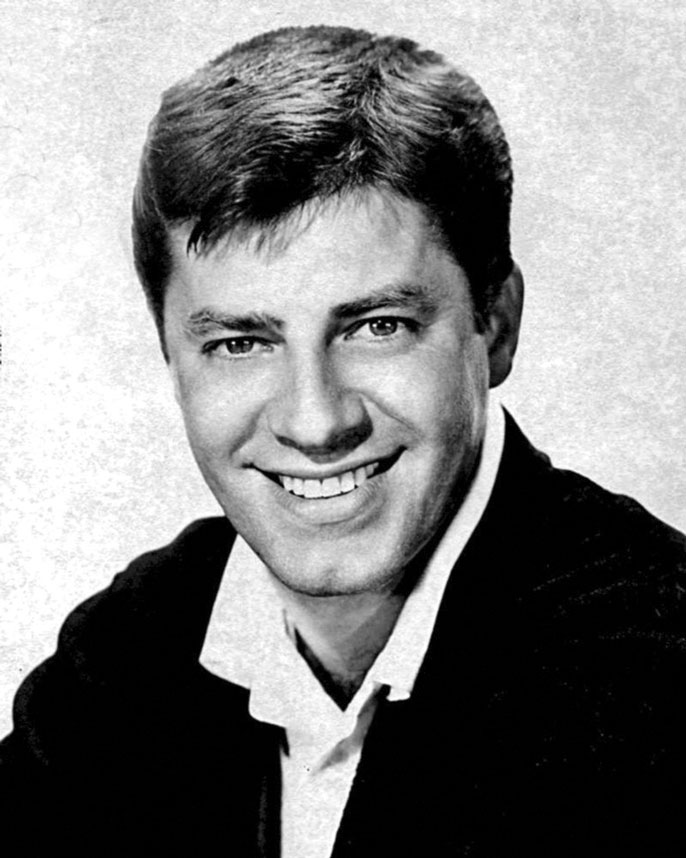
Obituary: Jerry Lewis, comedian and filmmaker, dies at 91

Jerry Lewis, the Jewish slapstick comedian, singer, actor, film producer, director, screenwriter and humanitarian, died Aug. 20 at his home in Las Vegas. He was 91 and had been in poor health for some years.

Lewis was born March 16, 1926, in Newark, N.J., into a show business family, the son of Daniel Levitch, an all-around entertainer, and mother Rachel (“Rae”), a pianist and her husband’s musical director.

As with many other aspects of their son’s life, even his first name is a matter of controversy. According to his birth certificate, he was born Jerome Levitch, but in his autobiography, he gave his fist name as Joseph.

During a professional career spanning some seven decades, Lewis appeared in and directed at least 46 films, and made innumerable radio, television and stage appearances. He made his debut as a 5-year-old, singing “Brother, Can You Spare a Dime?” in a Borscht Belt resort in New York state’s Catskill Mountains.

In 1946, he teamed up with crooner Dean Martin in what often is lauded as the most successful comedy duo in history. Within a few months, the pair’s earnings went from $250 a week to $5,000. Lewis described the partnership between the handsome, singing Martin and himself as a “sex and slapstick” collaboration.

Together, Lewis and Martin made 16 films together, including “My Friend Irma Goes West,” “The Stooge” and “Hollywood or Bust.”

The duo separated, with considerable acrimony, after 10 years, and although embittered, Lewis went on to a hugely successful and lucrative solo career. In the mid-1950s, his solo album, “Jerry Lewis Just Sings,” sold 1.5 million copies.

His movie career also hit new highs, and in 1959, Lewis signed a pathbreaking contract with Paramount, which paid him $10 million up front and 60 percent of box-office profits. Among his most successful movies during the 1960s were “The Nutty Professor” and “Three on a Couch.”

Unlike many Jewish comedians and celebrities, Lewis rarely talked, or made jokes, about his Jewish heritage. The closest he came was in his unreleased 1972 film, “The Day the Clown Cried.” The film was about a non-Jewish German circus clown, played by Lewis, who is imprisoned for mocking Hitler. In the prison camp, he insists on performing for Jewish children, and the SS guards eventually use the clown to lead the children to the Auschwitz gas chambers. He insists on joining them as they are killed.

First passionate about the project, Lewis eventually hid all the footage, saying he was too embarrassed to show it. “I was ashamed of the work,” he said. “It was all bad.”

Lewis began hosting the annual Labor Day weekend Muscular Dystrophy Association telethon in 1966, remaining as host of the telethon and his beloved “Jerry’s Kids” until 2010, raising more than $2 billion during those years.

He received the Academy of Motion Pictures Arts and Sciences’ Jean Hersholt Humanitarian Award for his charitable activity in 2009. He has two stars on the Hollywood Walk of Fame — one for his movie work, the other for television. And Lewis, whose comedy style remained popular in France, was inducted by the French government into the Légion d’Honneur.

In 2015, the Library of Congress announced it had acquired Lewis’ personal archives. In a statement, he said, “Knowing that the Library of Congress was interested in acquiring my life’s work was one of the biggest thrills of my life,” according to The New York Times.

Lewis had two heart attacks, prostate cancer and pulmonary fibrosis. He also had suffered from a painkiller dependency in the 1980s.

He had six sons with his first wife Patti Palmer — Gary, Ronnie, Scott, Anthony, Christopher and Joseph, who died in 2009. He is survived by his second wife, SanDee Pitnick, and their daughter, Danielle Sara.

— JTA contributed to this report 

Obituary: Jerry Lewis, comedian and filmmaker, dies at 91 Read More »

WWII veterans’ group battles time and others’ apathy

Many members of the Los Angeles Association of Veterans of World War II fought in some of the fiercest battles of that conflict, but now they are facing new foes: old age and a lack of interest among young people in preserving their legacy.

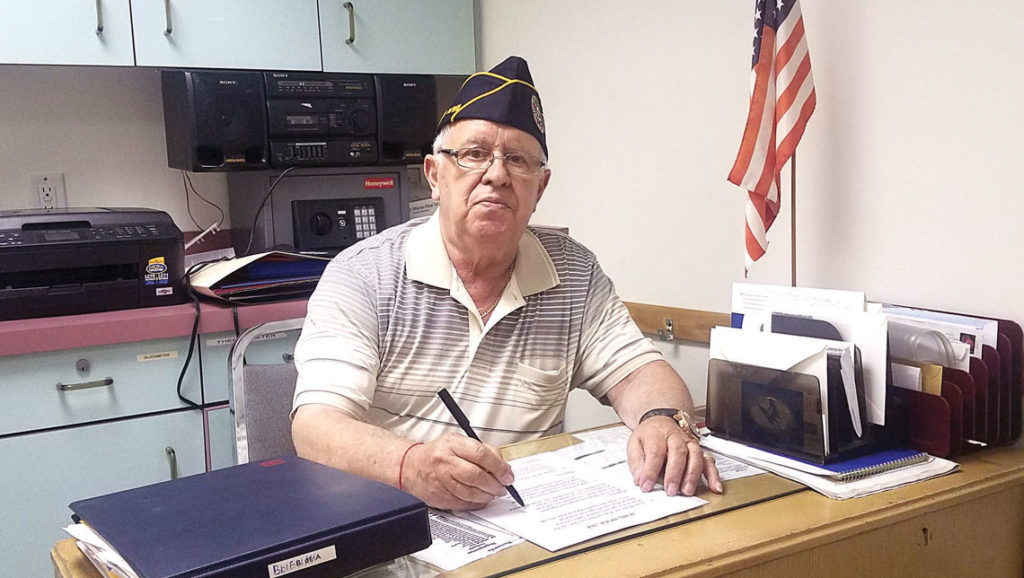
“People are getting sick and leaving us,” said Boris Melamed, 80, the association’s president. “But our children and grandchildren don’t have time to think about the second world war.”

Many of the group’s veterans are bedridden or moving to nursing homes. Some members worry the association soon will disappear as it struggles to recruit younger volunteers.

The group, made up mostly of Russian Jews, was founded in 1977 in a World War II veteran’s West Hollywood apartment as a way to socialize and preserve the legacy of veterans. Over time, its ranks became filled with those who served in the Soviet army after a wave of Russian-Jewish immigrants settled in West Hollywood.

Membership grew to 1,200 people in the 2000s after the group opened its doors to widows and children of veterans. It didn’t take long, though, for those numbers to shrink, as many veterans reached their 80s and 90s. Today, the association has 108 members. Their average age is 94, and the oldest member is 103.

“The situation is getting worse and worse, and many veterans are passing away,” Melamed, whose father served in the Soviet military, said as he sat in his office on a recent afternoon. A faded poster hung on the wall with a sign that read “Jewish heroes of WWII.”

“We say goodbye to someone almost every two weeks,” he said.

What used to be biweekly meetings turned into occasional gatherings to handle emergencies. During the Victory Day parade on May 9 — which celebrates the Soviet victory over Nazi Germany — many veterans were unable to walk. Instead, they rode a bus along Santa Monica Boulevard to Plummer Park’s monument to Soviet veterans of World War II, known in Russia as the Great Patriotic War.

Today, the association rents two rooms from the city of West Hollywood in a building across the street from Plummer Park for $1 a year. Once a month, it collects a $2 fee to buy gift certificates for birthdays and flowers for deceased members.

Melamed moved from Ukraine in 1982. His father was an engineer and served in the Soviet military squad that in 1945 removed explosives from the Reichstag building, home of the German parliament, in Berlin, after the surrender of the German army.

In 2002, Melamed joined the association as a volunteer to help with communications and event planning, and in March of this year he became the association’s president after Yefim Stolyarsky resigned due to health issues, following 26 years of service.

Melamed said the reason the association struggles to attract younger Russian volunteers is because they are busy chasing their American dream and are not interested in learning about Soviet history.

“Many children and grandchildren of veterans came to this country when they were 12 and 13 years old,” Melamed said. “They went to universities, took big posts and forgot the Russian language. They don’t have time to learn about World War II.”

Another member, Yevsey Epstein, was a teen-ager when the war started. He was a commander of an antitank battalion in the Soviet army. Now 94 and a West Hollywood resident, he said he’s not optimistic about the future of the veterans’ organization.

“The association will be over soon because there are few of us left,” Epstein said in Russian. “I have four grandchildren, and they don’t care about the Second World War. All they care about is taking care of their families and children.”

Stolyarsky, who became the honorary president of the association after his resignation, said the group has been struggling for a long time to attract younger volunteers.

“Young people are not interested in volunteering for us, and that’s really sad,” he said. “If they won’t help our association, it will disappear soon.”

Born in Ukraine, Stolyarsky enlisted in the Soviet army at age 19. Shortly after his division commander was killed in battle, Stolyarsky was promoted to the position, heading a battalion of 360 soldiers. More than once, the distance between his battalion and the German army was less than 1,000 feet, he said. He was injured several times, and a bullet fragment remains lodged in his ribs.

Just like others in the group, Stolyarsky has many war stories to tell, and he said it is important that someone preserve those memories for future generations.

A few weeks ago, Melamed found a volunteer who will help the association launch a new website and Facebook page. But for now, the group doesn’t have any far-reaching plans.

“We don’t know what’s going to happen next,” Melamed said. “We’ll wait until the end of the year and then will see whether we will keep the association open.”

WWII veterans’ group battles time and others’ apathy Read More »

Survivor: Peter Epstein: ‘There was misery all around you’

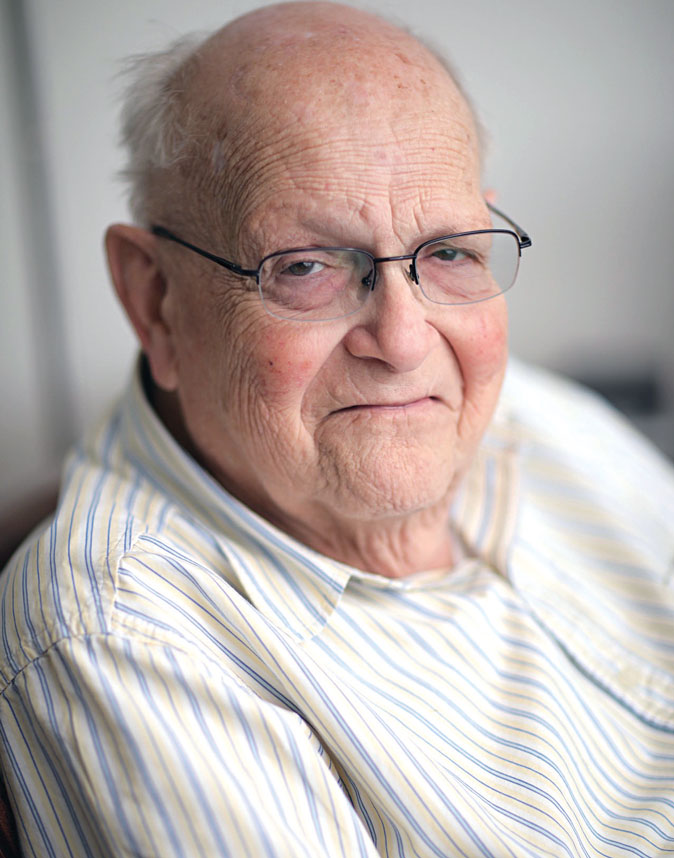
In September 1943, Peter Epstein, along with his mother, brother and grandfather, was awakened in the middle of the night by German soldiers and their Dutch collaborators and transported by rail from Amsterdam to Westerbork, a transit camp in the northeastern Netherlands. There, Peter, then 11, mostly walked around, while his mother cared for his 16-month-old brother, Frank.

A week later, unlike tens of thousands of Amsterdam Jews who had been shipped to Westerbork and then crammed into cattle cars to Auschwitz and Sobibor, Peter, Frank and their mother — though not his grandfather — were sent home.

Peter’s father, Paul, who worked for the Amsterdam Jewish Council and had been working the night they were arrested, had arranged for their release.

Over the years, Peter has felt compelled to defend his father against allegations of collaboration, even though Paul’s job was not organizing deportations but calling the moving company, Abraham Puls & Sons, and giving them addresses of the houses forcefully vacated by Jewish families. The Jewish Council co-leaders, Abraham Asscher and David Cohen, were found guilty of collaboration by a Jewish Council of Honor after the war but were exonerated by the Dutch government in 1950.

“My argument always has been, if you can save your life and that of your family, you do anything,” Peter said in his 1995 interview with what is now the USC Shoah Foundation. “It’s a situation that’s hard to imagine.”

Still, he admitted, “[The Jewish Council] is a questionable organization.”

Peter was born on July 30, 1932, in Breslau, Germany, the son of Paul and Margit Epstein. In October 1933, with Paul struggling as an attorney as Hitler assumed power, they moved to Amsterdam.

Paul sold stationery and trinkets door-to-door for several years before establishing his own business, Epstein Stalenboek Centrale, which sold sample books to textile companies, along with pinking shears he imported from Germany.

The family lived comfortably in a two-bedroom apartment in a predominately Jewish area where, Peter said, he experienced no anti-Semitism before the war.

But life as “a regular child” ended on May 10, 1940, when Germany invaded Holland. As air raid sirens sounded at night, the family huddled in their windowless bathroom, with Peter ensconced in the tub. Five days later Holland surrendered.

By fall 1940, anti-Jewish measures began being imposed. A year later, Peter could attend only a Jewish school. And in July 1942, two months after Frank was born, deportations to Westerbork commenced.

A few weeks after being released from Westerbork, in September 1943, Peter and his family were shipped back to the transit camp. This time Paul accompanied them, which comforted Peter.

Still, Peter said, “There was misery all around you,” especially on Tuesdays when the cattle-car trains were loaded. “I just knew that people were being deported and weren’t returning.”

In January 1944, Peter and his family were jubilant to be listed for the first transport to Bergen-Belsen. They had heard it was a transit camp, where they would be exchanged with prisoners of war and sent to Palestine. But Peter contracted chickenpox, moving their departure to the second transport on Feb. 1.

The prisoners’ high spirits faded, however, when their railcars arrived in Celle, a town in north-central Germany, where they were greeted by German soldiers with rifles and bloodhounds. “At that point we knew the story was fabricated,” Peter said.

They were marched 15 miles to Bergen-Belsen’s “Star Camp,” which primarily housed Jews from Holland, who were required to wear a yellow star.

Peter spent most of his days being counted. “It was an ordeal,” sometimes lasting six hours or more, he said. He also learned the pain of hunger, which prompted him and others to steal.

Peter’s father worked in a factory outside the camp, dismantling army boots, sometimes returning home bloodied and beaten when he couldn’t meet that day’s quota. “This was basically the beginning of his end,” Peter said.

Peter, too, was fighting to stay alive. Each night, lying in his bunk, he fantasized about what he would tell his friends at home about that day. He believed nobody knew what was happening.

On April 9, 1945, with the Allies closing in, the camp was evacuated and the prisoners were loaded into cattle cars on three trains.

The train carrying Peter and his family, later known as the “lost train,” was supposed to be destined for Theresienstadt. Instead, as Allied armies approached from two sides, it zigzagged, stopping every day or two to unload dead bodies.

On the morning of April 23, after traveling two weeks, the prisoners in Peter’s car awoke to see a Soviet soldier standing outside their opened door. They had been liberated. Unable to communicate with the soldier, they watched as he picked up Frank, who was screaming, and began gently singing, quieting him.

They later learned they were in the German farming village of Troebitz, about 60 miles from Leipzig.

Peter’s family, along with three childless couples, found a farmhouse inhabited by several women who raised chickens and pigs and had cupboards filled with food. They remained there for two months.

The Americans then drove the survivors to Leipzig, where they boarded trains to Maastricht, Holland. There, doctors discovered that Peter had tuberculosis and handed him over to a Christian monastery to recuperate.

Finally, in June 1945, the family reached Amsterdam. Peter, still suffering from tuberculosis, was admitted to the Central Israel Ziekenhuis hospital.

Sometime in 1946, Peter was taken to a sanitarium in Davos, Switzerland, where doctors prescribed sleeping outside in the cold air and eating eight meals a day. His parents visited often, but in April 1947 Paul died from surgical complications. Soon after, Peter came home.

Peter returned to school in 1948, leaving in 1952 when he, Frank and their mother immigrated to Los Angeles, sponsored by a paternal cousin in Marshfield, Wis.

Peter and his mother worked assembling televisions at a factory in Van Nuys for 60 cents an hour. “It was a difficult beginning in a strange country,” he said. After a year, Peter began studying accounting at Los Angeles City College and apprenticing for a certified public accountant.

In fall 1954, Peter began working as an accountant. He opened his own practice in the San Fernando Valley in the late 1980s. He retired last year.

Peter has a son, Steven, born in 1963, from his first marriage, which ended in divorce in 1969. He also has a stepdaughter, Natalie, born in 1970, and a daughter, Shira, born in 1975, with his second wife, who died in 1990. He married Polly Davis in November 1997. He now has three grandchildren and two step-grandchildren.

Peter said he first gave testimony in 1992 to a Holocaust oral history project. For several years, he spoke at the elementary school where his daughter, Shira, teaches. This past January he began speaking at the Los Angeles Museum of the Holocaust.

Now 85, Peter wants to share his Holocaust experiences as often as possible. “This is a story that should stay alive,” he said. “It’s not made better or worse.” He encourages people to ask questions.

“I have nothing to hide,” he said. “There’s nothing dishonorable to tell.”

Survivor: Peter Epstein: ‘There was misery all around you’ Read More »

Film tells story of daring creators of ‘Curious George’

In June 1940, children’s book authors Hans and Margret Rey were alarmed by Nazi troops approaching Paris, blasting canon fire in the distance. Both German-born Jews, they knew they had to flee, but it was impossible to obtain a train ticket, and they did not own a car.

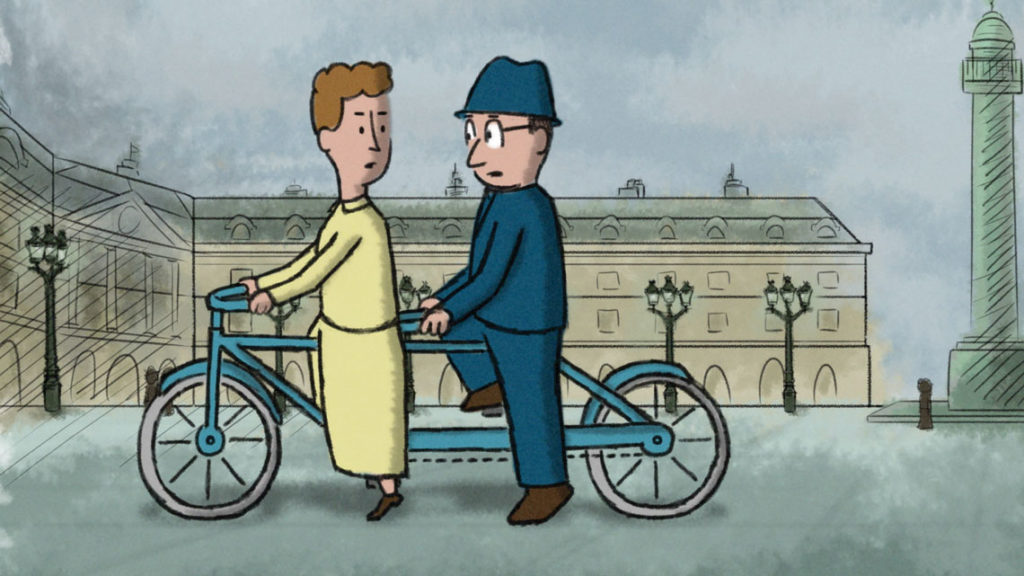
Instead, they bought a tandem bicycle, but Margret found the contraption tricky to ride. And so Hans obtained some spare parts and, in one night, patched together two separate bicycles.

At 5 a.m. the next day, they pedaled out of Paris, just 48 hours before the Nazis marched into the city. They carried little with them, save for unpublished manuscripts, including one that would eventually become their beloved 1941 book, “Curious George.” Along the way, they slept in stables and on the floors of restaurants. And when a checkpoint officer became suspicious of their German accents, their manuscript depicting a charming monkey convinced him to let them pass through.

The details of their escape and immigration to the United States in October 1940 is recounted in Ema Ryan Yamazaki’s new documentary, “Monkey Business: The Story of Curious George’s Creators,” now available online at platforms such as Amazon and iTunes.

In a telephone interview, Yamazaki, 28, pointed out that while the mischievous monkey has become an America icon, most people don’t realize that the character was created by Jewish refugees from the Nazis.

While the Reys weren’t fond of self-analysis, the documentary posits that they brought elements of their fraught past to George’s adventures. Margret once described the character as a monkey who finds himself in trouble — and gets out of it through his own ingenuity.

Filmmaker Ema Ryan Yamazaki. Courtesy of Mammoth Advertising

“She could have been describing the Reys themselves,” Yamazaki said.

The documentary also describes how Margret and Hans met in Germany when he was dating her older sister. Years later, Margret took action when she learned that her old friend Hans, a talented artist, had taken a bookkeeping job with his brother-in-law’s firm in Brazil.

A person interviewed in the film recalls how Margret declared at the time that Hans was a “damned fool” and that she was “going to Brazil to marry him.”

In 1935, she sent Hans a telegram, asking him to meet her ship at the docks in Rio de Janeiro. Upon her arrival, she promptly told him that he was leaving his job and that they would collaborate together on their own artistic projects. The couple soon married and, after moving to Paris, worked on a manuscript that ultimately would lead to “Curious George.” Margret wrote the text, and Hans, who went by the professional name of H.A. Rey, drew the illustrations.

Houghton Mifflin published the first “Curious George” book in 1941, about a year after the Reys arrived in New York City. They began living their American dream as the book and its six sequels went on to sell more than 75 million copies worldwide.

Yamazaki, the daughter of a Japanese mother and a British father, first read “Curious George” in Japanese as a girl in Japan. “I thought he was a Japanese monkey,” she said with a laugh. When Yamazaki moved to the United States to study filmmaking at New York University at 19, she happened to move into a Greenwich Village apartment a block away from where the Reys first settled in the United States.

But she knew nothing about their story until she chanced to meet Lay Lee Ong, a Malaysian-born immigrant who had become Margret’s dear friend after Hans died in 1977. By then Ong had become the literary executor of the couple’s estate. Margret died in 1996.

Just two years out of film school, Yamazaki was looking for a story for her first feature-length documentary. She was so fascinated by Ong’s tales that she immersed herself in research on the Reys.

Yamazaki was charmed by a 1966 radio interview featuring the couple, in which Hans declared, “We are in the monkey business, you might say.” The Reys’ immigrant saga also appealed to Yamazaki, who grew up mostly between Osaka and Manchester, England, before moving to New York to follow her own American dream.

For the documentary, which is narrated by actor Sam Waterston (“Law & Order”), Yamazaki tracked down and interviewed the Reys’ friends, cousins and neighbors in New York and in Waterville Valley, N.H., where the authors acquired a summer cottage in the 1950s. She also spoke with Louise Borden, author of “The Journey That Saved Curious George: The True Wartime Escape of Margret and H.A. Rey” (2005).  And she pored over the Reys’ letters and journals at their archive at the University of Southern Mississippi.

Her documentary incorporates photographs and footage of the Reys as well as animation to describe their journey.

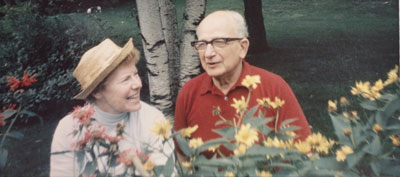
Margret and Hans Rey in 1968. Courtesy Mammoth Advertising

One surprising element revealed in the film is that Margret didn’t particularly like children. The couple never had children of their own, regarding “Curious George” as their child. In one television interview shown in the documentary, Margret tells a reporter that she never spoke to the neighborhood kids in Waterville Valley because they had nothing of value to say.

In the film, friends and neighbors describe Margret as blunt and sometimes rude.

Even back in 1940, when the Reys visited the consul who granted their visa to the United States, Margret refused to hold her tongue. She shouted that the man had taken too long to issue the documents — all the while ignoring Hans, who was stepping on her toes in a fruitless effort to silence her.

Waterston, in an email to the Journal, said he was drawn to the documentary, in part, because of how Yamazaki brought to life the authors’ “resilience, adventurousness and curiosity, in the face of WWII and their own peril … against the hard images of destruction as the Nazis invaded France.“

Yamazaki said the Reys’ immigrant story resonates today.

“There’s been so much discussion recently about refugees and immigrant bans,” she said. “But this beloved book was created by refugees who became immigrants turned Americans. I think their story is a good reminder about the people who want to come here and pursue their own American dreams.”

Film tells story of daring creators of ‘Curious George’ Read More »

Words Matter…Dammit!

The violence in Charlottesville was scary, upsetting, vile and – unfortunately not surprising. 

The United States has become a country deeply divided by wealth, education, color, religion, opportunity and politics. It should not be surprising that people feel threatened by the stranger they do not know. The more separate we are from each other, the more fearful and suspicious we have become of the other.

It doesn’t help when our President spends so much time defining what is real and what is fake news, rather than condemning obvious hatred. He is better than this and this is a distraction we can ill afford. The stakes are too high for us to make a mockery of justice and the freedoms that our constitution guarantees us.

The book of Genesis teaches us to be like Abraham and embrace the stranger – whatever the price.

Our Jewish legacy is that we are a people of the book, a book that reminds us that words matter. The beginning of the book (i.e. Genesis) teaches us to be like Abraham and embrace the stranger – whatever the price. Today is the day to break down the boundaries between us and them.

When we started the Pico Union Project four years ago, I sensed it was time to bring multiple faiths and cultures together under one roof. I had no idea how critical it would be to create a space for people to get to know each other, without judgement or fear. This is what I’ve learned:

  • We can do better
  • Anything is possible.
  • We can say yay when everyone else is saying nay
  • It’s better to focus on service than ‘serve us’
  • Upward mobility is not just a dream, it’s achievable.
  • We are honored when we honor all of creation.

The American way – the Pico Union Project way, begins with YOU and includes all of US.  If you have yet to check us out, The PUP doors are always open -and our eternal light is always on!


Craig Taubman
The Pico Union Project is a multi-faith, multi-cultural center committed to living the principle to “love your neighbor as you want to be loved.” We recognize that in order to love, you must first get to know your neighbor.  We use spirituality, arts, and a deep commitment to community activism as tools to draw individuals together, deepen a sense of self-awareness, and open eyes, minds, and souls to the value and potential of our community.


Words Matter…Dammit! Read More »

As ‘Hamilton’ debuts in L.A., historian asks: Was he Jewish?

Founding Father Alexander Hamilton was many things: statesman, lawyer, banker and Secretary of the Treasury, to name a few. With the Tony Award-winning success of the hip-hop musical “Hamilton” — now playing at the Pantages Theatre in Los Angeles — he’s also a modern pop culture icon.

But according to historian Andrew Porwancher, associate professor of constitutional history at the University of Oklahoma, Hamilton may have been something else: Jewish.

Porwancher, who holds degrees from Northwestern, Brown and Cambridge universities, has uncovered multiple sources of evidence that the man on the $10 bill was a member of the tribe. He’s compiling the information for a book titled “The Jewish Founding Father: Alexander Hamilton’s Hidden Life,” scheduled to be published by Harvard University Press in 2019.

While examining Hamilton’s Caribbean-island childhood as he prepared for his lectures, Porwancher learned that Hamilton attended a Jewish school on Nevis, a British colony. Further research suggested that Hamilton’s mother, Rachel, may have converted to Judaism when she married Danish merchant Johann Michael Lavien. She was still married to Lavien when she and James Hamilton conceived their son and gave birth to him in the mid-1750s (the exact year is disputed).

Andrew Porwancher. Photo courtesy of Andrew Porwancher

“No Hamilton biographer before me has taken seriously the idea that Alexander Hamilton might be Jewish according to Jewish law,” said Porwancher, an Ashkenazi Jew who grew up Conservative in a kosher home and is affiliated with the University of Oklahoma’s Judaic Studies Department.

“I’ve dedicated years of my life to studying Jewish history and I’m definitely very connected to Judaism,” he said.

Porwancher’s first step in researching Hamilton’s connections to Judaism was to determine the likelihood that Johann Michael Lavien was indeed Jewish.

“For generations, scholars have erroneously assumed that because [Lavien] was not identified in Danish land or census records as a Jew, he must not be Jewish,” Porwancher said via phone from London, where he was continuing his research.

Records in the National Archives of Denmark, which had colonized the Caribbean island of St. Croix, indicated that other known Jews living on the island also were not identified as Jewish. “So the assumption Lavien was not Jewish based on the records is erroneous,” he said.

Porwancher said the name Lavien is a specifically Jewish name, and Danish Christian surnames at the time, by contrast, were patronymic (derived from the name of a father or ancestor) and typically ended in “sen.” Other clues included that Lavien was a merchant, a popular trade for Jews, and that Alexander Hamilton’s grandson referred to Lavien as “a rich Danish Jew.”

Other evidence indicates Lavien wasn’t Christian, Porwancher said. Before Hamilton was born, Lavien and Rachel had a son, Peter, who was not baptized, even though baptism was standard practice for Christians on St. Croix.

“That’s evidence that not only was Lavien Jewish, but Rachel converted to Judaism to marry him,” Porwancher said. “I studied 18th-century Danish marriage law and discovered that Jews and Christians were not legally permitted to marry absent of conversion. So if Lavien was Jewish, the law would have required Rachel to convert to Judaism, explaining why their child wasn’t baptized.”

No baptismal records exist for Alexander Hamilton or his brother, James Hamilton Jr., either, but Porwancher believes it had nothing to do with their illegitimacy.

“We can find records around the Caribbean of children born out of wedlock who were baptized and could have attended a church school,” Porwancher said. “The fact that Alexander Hamilton went to a Jewish school rather than a Christian one is compelling evidence that he was seen as a Jew by the Jewish community in Nevis,” where he lived until the age 10.

“It strains credibility that this Jewish school would have taken in a child that they believed to be Christian,” Porwancher said. “His teacher would stand him on a table to recite the Ten Commandments in the original Hebrew. Bear in mind that there’s a talmudic prohibition against Jews teaching non-Jews the Torah.”

Porwancher further noted that the listing of Rachel Lavien’s 1768 death in a church register doesn’t mean she was Christian or had returned to Christianity.

“Churches would record the births and deaths of nonmembers, even Jews, particularly in a place without a synagogue like St. Croix,” he said. “Rachel isn’t buried in a church cemetery, but on the estate where her sister lived.”

Another phase of Porwancher’s research has focused on Alexander Hamilton’s relationships with Jews in his adult life. Although the adult Hamilton has never been found to explicitly identify as Jewish, he was remarkably outspoken in his defense of Jews, he said.

“Among the Founding Fathers, Hamilton was singular in his advocacy for American Jewry,” Porwancher said. “He represented a variety of Jewish legal clients. He teamed with Jewish merchants to help create the American financial system. He fought anti-Semitism in court. And thanks to Hamilton, his alma mater, Columbia University, had Jewish representation on its board for the first time: Gershom Seixas, the head of Shearith Israel, the oldest continuous Jewish community in the United States.”

Porwancher first thought about writing a book about Hamilton in 2013, but other commitments prevented him from delving further into the topic until January 2015. A month later, “Hamilton” opened at the Public Theater in New York City, and by the time it moved to Broadway that summer he was shopping around a book proposal and a sample chapter.

Porwancher saw a preview of “Hamilton” on Broadway and said the musical “does a better job than most historical scholars of understanding the centrality of Hamilton’s Caribbean origins to who he was in his adult life.”

While the show doesn’t make any reference to the potential Jewish aspects of Hamilton’s life, “I can’t hold that against Lin-Manuel Miranda,” who wrote the musical, Porwancher said. “But I do think the story of Hamilton’s Jewish origins dovetails with the spirit of the musical. They’re both attuned to the ways his Caribbean origins informed his adulthood.”

Porwancher continued: “A lot of the academic scholarship on Hamilton sees him as this wannabe aristocrat. But the musical, with this multiethnic cast, portrays his history as much more democratic. He believed in an aristocracy of merit, and that in this new American republic, a Jew and a gentile should stand equal before the law; and no matter one’s faith, one should have the opportunity to fulfill the full measure of one’s potential.”

Currently in London to research source material from Nevis at the British National Archives, Porwancher said he has a lot more investigating to do to complete his book.

“Writing the history of someone’s childhood in the Caribbean in the 18th century is a difficult enterprise because you’re required to use primary sources in multiple languages that are scattered across islands and European capitals of the countries that colonized those islands,” he said. “So it’s not a surprise that key elements of Hamilton’s childhood remain obscure today. The task of re-creating his earliest days is in many ways more difficult than understanding the origins of any other Founding Father.”

Porwancher will be on sabbatical this year to continue his research while doing a fellowship at Yeshiva University this fall and another at Princeton University in the spring.

He hopes people will approach his book with an open mind, and will “be amenable to the idea that there could be something significant about a well-known historical figure that we don’t yet know.”

Noting that scholars didn’t believe that Thomas Jefferson had fathered children with the slave Sally Hemings until DNA tests and historical evidence proved it to be true, Porwancher thinks that Hamilton’s history can be rewritten too.

He also hopes that people “see in the story of Hamilton not only the history of the Jewish experience in America, but the history of the immigrant experience writ large — the story of wanderers who come to a new homeland in search of a better life.

“It’s not just the heart of Hamilton’s story that Lin-Manuel Miranda captured so well, or the Jewish American story,” he said. “It’s the American story, period.” 

As ‘Hamilton’ debuts in L.A., historian asks: Was he Jewish? Read More »

Rabbi Noah Farkas leads faith-based approach with agency helping homeless

Rabbi Noah Farkas of Valley Beth Shalom has taken charge of Los Angeles’ homelessness agency as two new tax measures are beginning to provide the agency with millions of additional dollars to address the city’s growing homelessness problem.

At an Aug. 10 meeting, the 10-member governing board of the Los Angeles Homeless Services Authority (LAHSA) appointed the 38-year-old rabbi as its chairman.

Farkas’ leadership comes at a watershed moment for the authority. In the last year, L.A. voters have passed two tax measures to equip LAHSA with new funds intended to house the homeless: Proposition HHH, a county measure approved in November to build new housing units; and Measure H, a citywide sales tax passed in March to pay for services such as counseling and addiction treatment. Proposition HHH is slated to bring in $1.2 billion, while Measure H is projected to raise more than $3.5 billion over 10 years.

Meanwhile, the county’s homeless population is on the rise, jumping 23 percent from January 2016 to January 2017, to nearly 58,000, according to the Greater Los Angeles Homeless Count.

A 2008 graduate of the Jewish Theological Seminary in New York, Farkas has made homelessness a centerpiece of his rabbinate at the Conservative synagogue in Encino, frequently sermonizing on the topic and entering into interfaith partnerships to address it. In 2015, County Supervisor Sheila Kuehl appointed him to a seat on the commission that oversees LAHSA, a 24-year-old partnership between Los Angeles city and county.

He spoke with the Journal on Aug. 10, shortly after being sworn in as the commission’s chair, about his hopes and aims for his one-year term. The following interview has been edited for clarity and length.

Jewish Journal: As a rabbi and as a Jew, what do you feel you bring to the LAHSA chairmanship?

Noah Farkas: My role on the commission, given my background as a faith leader, is to bring a moral voice when I think morality needs to be injected into the system, to bring a calming voice when voices of disagreement arise on a certain level. I might not understand every budget line; I might not understand every rubric for funding or every reason why every political decision is made, but what I understand more fundamentally than anything else is that it’s because of the work of the commission and the agency it oversees that people get off the street and have a chance at life again.

JJ: City officials suggest from time to time that L.A.’s homelessness crisis be declared an emergency, either on the state or national level. What would that mean? Do you think homelessness is an emergency in Los Angeles?

NF: On a moral level, I don’t see a difference between an emergency that happened in one night and an emergency that happened over 15 years. It’s a slow-moving catastrophe that has built to this point, where we have nearly 60,000 people in the county who have been displaced because of mental illness, because of poverty, because of high rents and housing crises.

If there were 60,000 people displaced because of a mudslide or a fire or an earthquake, we would declare it as a state of emergency. The solutions around Measure H and Prop. HHH are excellent funding vehicles, but that money’s not coming from the state, that money’s not coming from the national government, that money’s only coming from ourselves. By declaring a state of emergency, we can open additional streams of funding and fast track our way into the solutions to this problem.

JJ: The homeless population jumped by nearly a quarter in 2016. How do you explain that increase?

NF: We voted in November and then again in the spring for these new funding strategies, but they didn’t come through until July 1. So all the money that we raised through bonds and taxes to pay for all of the funding strategies didn’t fund till last month. The homeless count takes place in January, so the uptick was expected in some ways because we hadn’t funded anything yet; we had just approved it. My guess is in the coming year, the numbers won’t change all that significantly, but in the following year, that is when we expect to make major gains because the funding would have hit the streets.

JJ: That explains why homelessness has gone up in general. But what explains such a huge increase between last year in particular?

NF: The counting has gotten a lot more comprehensive. So what happens is, when you have a bigger flashlight, you can see more things. That’s definitely part of it. But the housing vacancy rate is now the lowest in the country for the first time. It’s less than 2 percent. Of all the apartments, all the rooms, all the houses in the entire continuum, only 2 percent on any given day are unoccupied. That means, though, that if you’re looking for a place to live, you’re competing with all these other people. So that’s a big driver. You have a tighter housing market. The third piece is we haven’t really successfully dealt with mental illness and trauma in the way that we have to. I guess I would add one more piece. In trying to correct mass incarceration in California, a lot of people who are exiting the criminal justice system are exiting into homelessness, because we don’t have the proper infrastructure in place. So that adds another upward pressure on the number.

JJ: It takes a while to build housing for the homeless. What is LAHSA doing in the meanwhile to help people who are on the streets today?

NF: The long-term solution is to build infrastructure with wraparound services because we know in models across the country that people who are experiencing homelessness, if you give them a place to live and give them opportunity to deal with their traumas and addictions, that they will no longer be homeless. But it can take 18 months to two years to build a single building to be a hub for these programs. So we’re not there yet.

In the meantime, there are other opportunities that LAHSA has already engaged in. The first is the rapid expansion of what are called ERT teams, emergency response teams. They’re essentially pairs of people who are trained in counseling and social work and mental health services that actually go out to the ravines and they go out to Skid Row and all over the city to engage with people who are homeless and get them entered into the system so we can track them and help them. There are 50 teams and at any given time, two-thirds of them are out. In the past, there were only about half of that, if not less.

JJ: What was broken in the social fabric of Los Angeles that made it necessary to pass new tax measures? And how is that going to change under your leadership?

NF: The homelessness count is like taking a temperature of whether or not the city has a fever. Having a high temperature, that’s not the thing that’s making you sick. There are other things that are making you sick. It’s the same way with homelessness. People who are experiencing homelessness are an indicator of whether the city is doing right
by its own residents, morally and in a humanitarian way. And the city got really sick. It still is.

Luckily, we’ve decided to address it. We have to really service the root causes, which are poverty, mental illness and, ultimately, the housing crisis. Homelessness is also key to understanding inequality. I’m a social justice rabbi; I’m not just a homelessness rabbi. But this is a road in, this is a way of working on social justice from the bottom up. I can’t abide as a rabbi and a Jew seeing people suffer, and I see people suffering.

Rabbi Noah Farkas leads faith-based approach with agency helping homeless Read More »