fbpx

April 19, 2017

Director’s ‘Wedding Plan’ depicts hope and romance — ultra-Orthodox style

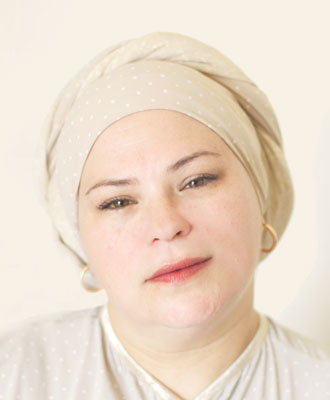
Rama Burshtein. Photo by Lea Golda Holterman

Reflecting on the years before she became religious, American-born Israeli filmmaker Rama Burshtein said, “I was very wild and very curious. I was wild then, and I am wild today.  But today I have rules that make me very healthy.”

It is Burshtein’s knowledge of both the secular and observant worlds that has propelled her to become perhaps the first female ultra-Orthodox writer-director to cross over successfully into the cinematic mainstream.

Her acclaimed 2012 drama, “Fill the Void,” spotlighting a teenager struggling with whether to marry her sister’s widower, won seven Ophir Awards, Israel’s equivalent of the Oscars, including best film and best director. The movie premiered at the Venice International Film Festival, where its star, Hadas Yaron, won for best actress.

Burshtein’s highly anticipated new film, “The Wedding Plan,” originally titled “Through the Wall,” is a comedy-drama about a religious woman who is desperate to get married. It screened at the Venice and Telluride Film Festivals last year, and  its female star, Noa Koler, won a best actress Ophir.

On April 27, the Hebrew-language movie with English subtitles will have its Los Angeles premiere at Laemmle’s Music Hall in Beverly Hills as one of 27 features, documentaries and shorts at the 12th annual Los Angeles Jewish Film Festival, which will run April 26 through May 3. The event, sponsored by the Consulate General of Israel in Los Angeles, will include a Q-and-A with Burshtein.

The film festival is a program of TRIBE Media, the parent company of the Jewish Journal.

Other festival highlights will include the world premiere of Henry Jaglom’s “Train to Zakopane,” based on his play about his Jewish father’s involvement in the 1920s with a Polish nurse who turns out to be anti-Semitic; a restored print of Charlie Chaplin’s classic “The Great Dictator”; the Yiddish-language drama “Menashe,” about a Brooklyn widower fighting for the right to raise his young son; and “Restoring Tomorrow,” a documentary spotlighting the $150 million renovation of Wilshire Boulevard Temple.

“The Wedding Plan” revolves around Michal (Koler), who had longed to get married since becoming observant in her 20s. Now in her early 30s, she finally has found a fiancé. But her hopes are dashed, just a month before their wedding, when he reveals that he does not love her. Even so, Michal refuses to cancel the date at her rented wedding hall, praying that God will provide her with an alternative groom in time.

“What we really lack in life and need to have more of is hope,” Burshtein, 50, said of her impetus for the film by telephone from Tel Aviv. “I wanted to widen the ability to feel that everything is possible, because it’s so necessary in this world.  People are depressed, in despair, and they cannot even envision a good outcome anymore.”

The observant male and female characters in the film never touch, per Jewish law, but that does not mean they do not experience love and sexual longings, Burshtein said.

The Orthodox community “is very sexual, and desire is so big in our lives,” she said. “But [Judaism knows] how to work with them within the restrictions.” In fact, Jewish laws separating men and women increase an individual’s private desire, she said.

Burshtein acknowledged that some viewers might criticize her films because they reflect a view that a woman remains incomplete without a husband. “I’m not even hiding that,” she said. “In the secular world, women are not complete without love. … But this is only my point of view.”

It wasn’t always. Born in New York City, Burshtein grew up in a secular Jewish home in Kfar Saba, the daughter of an Israeli father and an American-born mother.  Her father, a chief engineer in the shipping industry, often took his family with him on sea excursions.

Burshtein always had been a spiritual seeker, dabbling in Buddhism and other Eastern traditions. But Judaism meant little to her until, after graduating from the Sam Spiegel Film & Television School in Jerusalem, she visited a film festival in Munich.

“The minute I got there, it was like a nightmare,” she recalled.  “I felt a bit paranoid and it was a weird experience of thinking that the fact I was Jewish might be a problem, as if I were in danger,” she said. “It wasn’t that the Germans gave me this feeling, but … I couldn’t wait to get back home. And from that point, something happened in my heart.”

Burshtein went on to join the Breslov sect of Chasidism, and some months later noticed the handsome man who would ultimately become her husband.

“He was the most beautiful thing I had ever seen,” she said, and was eager when a matchmaker eventually got them together. “The butterflies [in my stomach] were the thing that made me decide to marry him. I think God works with everyone separately and personally, and I wouldn’t have been able to go under the chuppah without falling in love.”

They wed a month and a half later — 23 years ago — and Burshtein put aside filmmaking as she established a household and raised their four children, currently ages 15 to 20. She unabashedly refers to her husband, Aharon Burshtein, a therapist and mohel, as “my king.”

“I feel that if my partner is not a king, then I cannot be in love,” she said. “He’s got to be strong, he’s got to be successful, to have authority. To be in love, I have to look up. [In the secular world], it’s very mixed and very confusing, because the genders don’t have the distinctions of who they are and the true power of who they are. And to me, it’s very important that they do.”

Then, more than a decade ago, “I saw a film that portrayed the Orthodox world in a very … untrue and awful way, and that really hurt me,” Burshtein said, declining to name the movie.  “This kind of voice can exist, but if it’s the only voice, then it’s problematic. So I just knew it was time for me to go and make a film. I knew it was going to be about a man and a woman, which is what interested me when I was secular, as well as when I became religious.  This is what makes my heart beat — the enigma between a man and a woman.”

“Fill the Void” began when Burshtein chanced to meet a young woman who was about to marry her sister’s widower. “What fascinated me was: How do you make that kind of transition within a family,” she said.  “It’s easy to fall in love with your big sister’s husband, because he’s the first man inside your family who is from the outside. But how do you work that out with [memories of] your dead sister — that was something I couldn’t really understand.”

Burshtein interviewed 11 such women in order to comprehend the nuances of their decision. Yet she had trepidations about opening up, on film, “this thing between a man and a woman that is very private in Judaism.” And so she sought the guidance and the supervision of her rabbi, as well as her husband, while writing “Fill the Void.”

But dealing with both Orthodox and secular actors, as well as interacting with her male performers and crewmembers “was very hard,” she said of both her films.

“I have a problem with myself, which is that I’m very open … and then I sometimes lose my boundaries. I kind of mix myself too strongly and too personally with everyone. … The tension is crazy for me. I have a problem, not them. Of course, I never touch anyone. But when you’re open, you can feel the potential for trouble.”

Her solution was to keep a female assistant with her at all times “who could tell me if I crossed a line.” Burstein’s husband also was on set and has closely collaborated with her during every step of making both her movies.

Most people in her community have not seen her films — even her own two oldest sons declined. But then again, Burshtein said, she “only makes films for a secular audience.” She hopes to show those viewers a realistic view of the religious community from the inside out. And she is beyond pleased that her husband approves of the final products.

“He’s got to love them, to agree with them, because there’s no separation between him and me.”

“The Wedding Plan” will screen at 7:30 p.m. April 27 as part of the Los Angeles Jewish Film Festival at Laemmle’s Music Hall in Beverly Hills, and will have its theatrical release in Los Angeles starting May 12. For tickets and information about the Los Angeles Jewish Film Festival, visit lajfilmfest.org or call (800) 838-3006, or (213) 368-1661 for group sales.

Director’s ‘Wedding Plan’ depicts hope and romance — ultra-Orthodox style Read More »

Daily Kickoff: Trump admin says Iran complying with deal | Israeli Houzz eyeing $5B+ valuation | Netflix says it’s found next ‘Homeland’

Have our people email your people. Share this sign up link with your friends

WHILE WE WERE ON PASSOVER BREAK — Betsy Rothstein of The Daily Caller wrote… “If any outlet is going to know how Ivanka Trump and her husband, Jared Kushner, are spending Passover, it’s a safe bet that Jewish Insider has located the White House afikomen.” [TheDC]

CNN’s Betsy Klein: “As President Donald Trump grappled with the realities of governing, leaks about infighting within his administration, and multiple international conflicts, two of his top aides, Ivanka Trump and Jared Kushner, were far from the White House. The couple celebrated Passover at the Four Seasons Whistler in Canada, according to an article and exclusive photo in Jewish Insider.” [CNN]

“White House aides grapple with newfound celebrity” by Annie Karni and Tara Palmeri: “The Daily Mail pays photographers a daily rate to sit outside the Kalorama home of Trump’s older daughter, Ivanka Trump, and her husband, Jared Kushner, tracking them as they come and go, sometimes in their gym clothes, two industry sources said. The fashionable First Daughter, who now is an official White House staffer, is part of the gray area of formerly famous people who are now aides, as opposed to aides who are newly famous.” [Politico]

DRIVING THE CONVERSATION: “Trump administration says Iran complying with nuclear deal” by Matthew Lee: “The Trump administration has notified Congress that Iran is complying with the terms of the 2015 nuclear deal negotiated by former President Barack Obama, and says the U.S. has extended the sanctions relief… The certification of Iran’s compliance, which must be sent to Congress every 90 days, is the first issued by the Trump administration. The deadline for this certification was midnight.” [AP

But… “Trump orders review of lifting sanctions against Iran: Tillerson” by Lesley Wroughton: “President Donald J. Trump has directed a National Security Council-led interagency review of the Joint Comprehensive Plan of Action that will evaluate whether suspension of sanctions related to Iran pursuant to the JCPOA is vital to the national security interests of the United States,” Tillerson said in the statement. “It remains a leading state sponsor of terror, through many platforms and methods.” [Reuters]

FDD’s Mark Dubowitz tells us: “It underscores the commitment of the Trump administration to ramp up pressure on Iran, including through the use of increased sanctions tied to terrorism and other malign activities.”

Israeli Consul General in NY Dani Dayan: “As PM Netanyahu said in Congress: ‘[the sunset clause] creates an even greater danger that Iran could get to the bomb by KEEPING the deal’” [Twitter

Ben Rhodes‏: “Every day, the situation in North Korea makes clear just how preferable it is to have the Iran Deal in place.” [Twitter

“Mattis in Riyadh to boost US-Saudi alliance” by AFP: “Mattis arrived in Riyadh Tuesday afternoon, wishing to “reinvigorate” ties by listening to Saudi leaders and learning “what are their priorities”, the official said.” [DailyMail]

“US Defense Secretary to Arrive in Israel Thursday” by Tzippe Barrow: “Mattis begins his meetings in Israel with Defense Minister Avigdor Lieberman, who traveled to Washington in early March to reaffirm the strong military ties between the two allies. Mattis will also meet with President Reuven Rivlin and visit Jerusalem’s Yad VaShem Holocaust Memorial. On Friday, Prime Minister Benjamin Netanyahu will meet with Mattis.” [CBNNews]

ON THE HILL — JI INTERVIEW: Congressman Anthony Brown (D-MD) discusses his political career, including the lessons he’s learn from his unsuccessful campaign for Maryland Governor, and from his military service in an interview with JI’s Aaron Magid. “My takeaway is never stop introducing yourself to the voters, but the other lesson was the same lesson my father taught me as a kid growing up is sometimes in life you are going to get knocked down and you won’t be successful in what you sought out to do,” said Brown. “But, if you believe in what you are doing: that is true whether you are running for office to serve, whether you are a doctor, lawyer, teacher or anything else. You have got to pick yourself up, brush yourself off and stay in the game. Teams that lost the Super Bowl don’t drop out of the NFL. They come back: season after season because that is the nature of life.”

Brown on the Israeli-Palestinian peace process: “My basic framework is that you can’t impose a solution. I do think that there has to be a bilateral agreement reached by the Israelis and Palestinians. Our role should be to encourage, cajole, prompt and incentivize that commitment. But, this is an agreement that has to be struck between the two parties. It cannot be imposed because then it won’t be lasting.” Read the full interview here [JewishInsider]

DRIVING THE DAY: “Republicans avoid big loss by forcing runoff in Ga. House race” by Robert Costa: “[Jon] Ossoff could find it difficult to sustain the momentum he witnessed this past week in a traditionally Republican district that has been in GOP hands since 1979….[Republican Karen] Handel’s showing was due to more than name recognition from her long tenure in state politics. She also benefited from $1.3 million in support from Ending Spending, a conservative advocacy group aligned with the billionaire Ricketts family.” [WashPost

“Ossoff Just Misses Flipping the 6th” by David R. Cohen, Michael Jacobs, Patrice Worthy and Sarah Moosazadeh: “The outcome keeps alive the possibility of Georgia’s first Jewish congressman since Democrat Elliott Levitas lost a bid for a sixth term in 1984… Although little was made of it, the election took place on a Jewish holiday, the eighth day of Passover, forcing observant Jews to vote early or not at all. Secretary of State Brian Kemp reported that 55,000 ballots were cast early in the congressional election; about 5,000 of those were mailed-in absentee votes.” [ATLJewishTimes]

2ND BAR MITZVAH? Alexis Levinson: “They’ve apparently hired a bar mitzvah DJ to emcee the Jon Ossoff election night party, where they are now playing ‘Celebration’ … Ossoff’s election night party is legit a bar mitzvah with a cash bar. Ppl are dancing, smiling, hugging. #GA06.” [Twitter

Ben Jacobs: “Pretty sure Jon Ossoff is using the playlist from his bar mitzvah for his election night party.” [Twitter]

“Billionaires, companies power Trump’s record inaugural haul“ by Nancy Benac and Julie Bykowicz: “After giving $5 million, Las Vegas gaming billionaire Sheldon Adelson and his wife had prime seats for Trump’s swearing-in ceremony on Jan. 20 and gained access to a private lunch with the new president and lawmakers at the Capitol… Steve Wynn, now chief fundraiser for the Republican Party, gave $729,000 through his Wynn Resorts… Billionaire investor Paul Singer, for example, gave $1 million after long expressing skepticism about Trump. He’s since visited the president at the White House.” [AP]

Jake Sherman: “THE KRAFT GROUP — Robert Kraft’s company — gave $1 million to Trump’s inauguration. he’s at the WH today with his Super Bowl champ patriots.” [Twitter

“Trump’s reliance on billionaire adviser blurs ethics lines” by Isaac Arnsdorf and Josh Dawsey: “Billionaire investor Steve Schwarzman’s newfound status as a trusted outside adviser for President Donald Trump has created blurred lines in which the Blackstone CEO is offering guidance on policies that could boost the fortunes of his company and his personal wealth. The starkest example was Trump’s reversal last week on labeling China a currency manipulator… While many factors likely played into Trump’s decision, including the president’s desire to encourage China to get tough on North Korea, it also followed extensive advice Schwarzman had given the president on the topic, warning Trump against such a move. Even if Schwarzman was acting in the capacity of an economic expert, those policy changes directly help Schwarzman’s bottom line as CEO of Blackstone, the private equity giant. And Blackstone has gone so far as to warn its investors about the stakes of Trump’s China policy.” [Politico

“Ivanka’s brand prospers as politics mixes with business” by Erika Kinetz and Anne D’Innocenzio: “Ivanka has so many China ties and conflicts, yet she and Jared appear deeply involved in China contacts and policy. I would never have allowed it,” said Norman Eisen, who served as chief White House ethics lawyer under President Barack Obama. “For their own sake, and the country’s, Ivanka and Jared should consider stepping away from China matters.” [AP

PROFILE: “Meet The New York City Democrat Flacking For Ivanka Trump” by Steven Perlberg: “New York City political observers say that one of [Risa] Heller’s most striking traits is her fierce loyalty, clearly evidenced by her steadfast aid to Anthony Weiner… “If I had taken her advice at critical junctures even 5% of the time, I would have been infinitely better off. It doesn’t surprise me that people like the Kushners would gravitate toward her,” Weiner told BuzzFeed News… Heller became a rising star in New York political circles in the mid 2000s, when she arrived in Schumer’s office after communications guru Stu Loeser left for Michael Bloomberg’s mayoral reelection campaign. She stood out both for her aggressiveness even by Schumer’s intense standards; as a rare woman in a long line of aggressive young men who came up under the senator; and a fashionable figure in a schlumpy world.” [BuzzFeed

“With the ‘Democratic Invasion of the White House,’ Cuban Starting to Warm Up to Trump Presidency” by Brian Schwartz and Charlie Gasparino: “[Mark] Cuban gives Trump high marks for bringing into his inner circle what he considers moderate Democrats like [Gary] Cohn, Kushner and his daughter Ivanka Trump. “By my guess, 50 percent or more of non-military leadership in the White House are, or were recently, Democrats,” Cuban told Fox Business. “It’s a good balance.”” [FoxBusiness

NEXT MODERATE MOVE? “Top Trump confidant: Trump should make a deal with Ruth Bader Ginsburg” by Allan Smith: “Chris Ruddy, a confidant of President Donald Trump, told Business Insider in a Monday interview that Trump should cut a deal with Supreme Court Justice Ruth Bader Ginsburg. His proposition: Replace her on the bench with Judge Merrick Garland, President Barack Obama’s choice to fill Justice Antonin Scalia’s vacated seat in 2016… “They would remove a very liberal Democrat with a moderate, consensus Democrat, who I think Garland is,” Ruddy added. “And I think it would be a huge move and a sign for Trump that he’s willing to break through the political ice.”” [BusinessInsider

OVER THE WEEKEND — “Rex Tillerson and family tour the Holocaust Museum” by Emily Heil: “The nation’s top diplomat, dressed in the weekend business uniform of khakis and a navy blazer, spent a couple of hours touring the permanent exhibit, a spy tells us, accompanied by his wife… Tillerson’s visit came during the holy week of Passover — and just days after White House press secretary Sean Spicer apologized for remarks in which he seemed to forget about the Holocaust.” [WashPost

TRUMP TEAM: “Tillerson’s stock rises in the White House” by Annie Karni: “[Elliott] Abrams argued that while Trump’s veto of his job at State was “taken to be a slap at Tillerson – I think that was a mistake. I don’t think my situation had anything to do with the president’s view of Tillerson. They spend an awful lot of time together.”” [Politico

“Trump learning to love Bush aides” by Tara Palmeri: “Eliot A. Cohen… predicted that more Bush alumni will feel comfortable coming into the administration if it continues to shift to the conservative mainstream… “As the administration is looking a bit more normalish, there will be more people who will be willing to go in,” he said. “What would be transformative would be if Bannon quits or is fired. I think that would be an indication that it will be somewhere closer to a Republican establishment administration. That will change a lot of people’s attitudes,” Cohen added.” [Politico

COMING SOON: “Abbas ready for visit to Washington” by Daoud Kuttab: “Palestinian Foreign Minister Riyad al-Malki said April 14 that a Palestinian delegation will visit Washington in the second half of April to plan for the visit, which he said will take place early in May. The London-based al-Hayat said April 14 that the delegation preparing for Abbas’ visit will include senior Palestinian negotiator Saeb Erekat and intelligence chief Majed Faraj. The lack of a firm date has led some Palestinian media to report that the visit has been postponed, but a US White House source quickly shot down this rumor, insisting that the visit is still on.” [Al-Monitor]

— “Al-Quds said Trump’s team has prepared a draft plan demanding that the Palestinians return to negotiations with Israel without setting any conditions and halt transfer of funds to the besieged Gaza Strip.” [Wafa

KAFE KNESSET — by Tal Shalev and JPost’s Lahav Harkov: The hottest show in town today was Prime Minister Benjamin Netanyahu responding to the State Comptroller’s Report on Protective Edge in the Knesset. Several bereaved parents questioned Netanyahu and said they didn’t get the satisfaction of at least knowing that the mistakes leading to their sons’ deaths won’t be repeated. One bereaved father, Ilan Sagie, said Netanyahu “stabbed me in the heart and twisted the knife,” and pleaded “Why won’t you say you will fix the failures of Protective Edge?” Leah Goldin, mother of Hadar Goldin, a soldier presumed to be dead whose body is held by Hamas, broke down in tears while speaking to Netanyahu. The premier came off as patient, but at some times stern, explaining to Goldin, for example, that he is willing to make sacrifices to bring back her son’s body – but there is a limit. Bibi clearly knew there was no way for him to come out of such an emotional situation unscathed, and looked like he was having a difficult time.

Anyone reading haredi magazine Mishpacha over the last day of Passover in Israel, got to read about how much Netanyahu enjoyed seeing Hamilton on his last trip to NYC. Not only that, but Netanyahu said he made a suggestion to Lin-Manuel Miranda on how to improve the play. As Spamalot taught us, you won’t succeed on Broadway if you don’t have any Jews, so Netanyahu touted Hamilton’s Jewish connection. Bibi says he read that when Alexander Hamilton was a child in the Caribbean, his tutor was a Jewish woman, who taught him to recite the Ten Commandments in Hebrew. Later in life, Hamilton expressed admiration for the Jewish people, saying they have a “unique destiny” that is “part of God’s greater plan.” That, Netanyahu said, should go into the play. Read today’s entire Kafe Knesset here [JewishInsider]

** Good Wednesday Morning! Enjoying the Daily Kickoff? Please share us with your friends & tell them to sign up at [JI]. Have a tip, scoop, or op-ed? We’d love to hear from you. Anything from hard news and punditry to the lighter stuff, including event coverage, job transitions, or even special birthdays, is much appreciated. Email Editor@JewishInsider.com **

BUSINESS BRIEFS: Billionaire vs. billionaire: Israel’s Steinmetz sues Soros [ToI; Reuters] • Michael Bloomberg to fill event void left by Clinton Global Initiative [Axios] • Jared Kushner in Talks to Sell Stake in Real Estate Technology Company [WSJ] • The PPA Group teams with Israeli investor on Houston apartment complex [Chron• SeatGeek Raises $57M to Buy Israeli Firm TopTix [Billboard] • Bustle acquires Elite Daily from Daily Mail, rebrands as Bustle Digital Group [BI]

SPOTLIGHT: “Houzz Raising Funding at Valuation Above $5 Billion” by Erin Griffith, Leena Rao: “Houzz, an online platform for home remodeling and design services, is in the market raising a large new round of venture funding that could value the company at more than $5 billion, according to several sources familiar with the situation. The talks are early, but sources say the company could raise as much as $500 million. Asked to comment, a Houzz representative wrote, “It’s not true.” Founded in 2009 by Adi Tatarko and Alon Cohen, Houzz has raised $213 million in funding to date. The Palo Alto-based company’s latest round, a $165 million Series D in late 2014 led by Sequoia Capital, valued it at $2.3 billion.” [Fortune]

“Sheryl Sandberg: Option B and Life After Grief” by Belinda Luscombe: “The woman who urged the world to lean in is now under­taking a campaign to help people push on, to bounce back from horrible misfortune. Her newest book, Option B: Facing Adversity, Building Resilience, and Finding Joy, is a primer for those who are bereaved, to help them recover and find happiness. But it’s also a guide for the unscathed on how to help people “lean in to the suck,” as Sandberg’s rabbi puts it.” [TimeMag]

“Inside Mark Zuckerberg’s controversial decision to turn down Yahoo’s $1 billion early offer to buy Facebook” by Mike Hoefflinger: “Curious, [Andy] Grove followed up: “Where does that willpower come from?” Zuckerberg considered the question—possibly for the first time—and concluded simply, “Jewish mother.”” [BI

“Selling Mark Zuckerberg” by Nitasha Tiku: “The Facebook CEO’s likability blitz isn’t a presidential campaign, it’s a focus group for his 1.8 billion constituents — and part of a high stakes campaign to win your likes” [BuzzFeed]

“Here’s Why A Nonprofit Named For Anne Frank Keeps Attacking Trump” by Jessica Schulberg: “Keeping a low profile is not [Steve] Goldstein’s style. When he was 6 years old, he skipped school to stuff envelopes at the local Democratic headquarters for then-presidential nominee Hubert Humphrey, according to a bio he provided. He has worked on Capitol Hill for Democratic lawmakers Frank Lautenberg and Chuck Schumer… Despite his past work on Capitol Hill, Goldstein says “nothing could be farther from the truth” in response to accusations that he’s taken the Anne Frank Center in a partisan direction. The center goes out of its way to point out that it was Democratic President Franklin Roosevelt who denied Anne Frank entry to the U.S., and has defended members of the Trump family when they were unfairly attacked, Goldstein noted.” [HuffPost]

Michael Steinhardt, Birthright Founder and ‘Wall Street’s Greatest Trader’, to Light Torch on Israel’s Independence Day: “Michael Steinhardt, one of the founders of Taglit-Birthright and a man once dubbed “Wall Street’s greatest trader”, has been selected to light an official torch on Israel’s Independence Day, Israel announced on Wednesday. He will join Rabbi Marvin Hier, who took part in U.S. President Donald Trump’s inauguration, in lighting the torch for the Jewish diaspora.” [Haaretz

Netflix says it’s found the next ‘Homeland’ — “Netflix thinks its new series, Fauda, could rival the success of Homeland across the globe. Lior Raz — lead actor and series co-creator — speaks with CNN’s Samuel Burke in Israel about his own time in the security forces, a tragic terrorist attack that killed his girlfriend, and how Netflix has garnered a once small Israeli series global praise.” [CNN]

TALK OF THE TOWN: “Lawsuit targets neo-Nazi ‘troll storm’ against Jewish family” by Phil Drake and Seaborn Larson: “The lawsuit claims Andrew Anglin, publisher of the Daily Stormer neo-Nazi website with hundreds of thousands of visitors a month, provoked legions of his followers to send a “tsunami of threats” to Tanya Gersh and her relatives. Gersh is a Montana real-estate agent who fell out of favor with the mother of Richard B. Spencer, considered by many to be the founder of the alt-right movement… A monetary figure has not been attached to the suit although Gersh hopes to win at least $225,000 for three of the four counts asserted in the complaint.” [USAToday

MEDIA WATCH — “Bari Weiss Joins ‘New York Times’ Opinion Section” by Tablet Magazine: “Bari, who edited [Tablet] news and politics section from 2011 to 2013, moves to the Times from the Wall Street Journal, where she worked as associate book review editor and also wrote frequently about topics like political correctness and campus culture.” [Tablet• Hiring Anti-Trump Conservative Is Part Of New York Times’ Effort To Expand Opinion [HuffPost

“An Op-Ed Author Omits His Crimes, and The Times Does Too” by Liz Spayd: “Marwan Barghouti… was given five consecutive life terms after being convicted in an Israeli criminal court of premeditated murder for his role in terrorist attacks that killed five people… On Sunday, he wrote a piece for the Op-Ed pages of The New York Times to draw attention to a mass hunger strike for what he calls Israel’s arbitrary arrests and poor treatment of Palestinian prisoners…  A biographical sentence at the end of the Op-Ed simply says, “Marwan Barghouti is a Palestinian leader and parliamentarian.” I asked Jim Dao, editor of the Op-Ed pages, about the decision not to include Barghouti’s crimes…  I see no reason to skimp on this, while failing to do so risks the credibility of the author and the Op-Ed pages. In this case, I’m pleased to see the editors responding to the complaints, and moving to correct the issue rather than resist it.” [NYTimes• Netanyahu slams New York Times over Barghouti op-ed byline [i24News]

SPOTLIGHT: “CNN’s Jake Tapper Is the Realest Man in “Fake News”” by Taffy Brodesser-Akner: “Tapper is on a diet… His diet consists, as basically all diets do, of pretty much just protein: protein shakes, protein snacks, protein protein. His friend Paul Rudd, who, Tapper says, got “really shredded” for Ant-Man, gave him the diet. Tapper follows it mostly, also doing cardio at the gym five times a week. “The modified Ant-Man” is what he calls it. I wonder what it says about us when Ant-Man is our superhero aspiration, but Tapper is realistic: “Paul’s a fellow 48-year-old Jew. This is achievable.” Fair.” [GQ]

BOOK REVIEW: “The Inside Story of the Clinton Campaign Disaster” by Bess Levin: “As Hillary thumbed through the pages, the [concession] speech struck her as tone-deaf. It’s too charged, she thought, too political… Jake Sullivan, her chief strategist took the lead in defending the tone. ‘Everything you said, we’re going to do in this speech. . . . But you have been saying for many months that he is temperamentally unfit and that he would be dangerous, and, if you meant it, you should say it. And you made a case that all these people’s rights and safety are in danger—if you meant that, you should say it.’ ‘It’s not my job anymore to do this,’ she said, her voice growing more forceful.” [VanityFair; Axios]  

TRANSITIONS — Fred Brown, Communications Director for the Republican Jewish Coalition, was hired by Dezenhall Resources, a crisis management and communications firm, to serve as a senior counselor. h/t Playbook

Sinclair Announces the Addition of Boris Epshteyn: Boris Epshteyn, a former White House aide and Trump campaign chief surrogate, has joined Sinclair Broadcast Group as chief political analyst and will provide analysis and insight on major political stories. [SBGI• Flashback: Kushner: We struck deal with Sinclair for straighter coverage [Politico

BIRTHDAYS: US diplomat from 1962 forward, then President of the Council on Foreign Relations (1986-1993) ultimately becoming the Under Secretary of State for Political Affairs (1993-1997), Peter Tarnoff turns 80… Literary theorist, legal scholar, author and public intellectual, has taught at Cardozo School of Law, Florida International University and University of Illinois at Chicago, Stanley Fish turns 79… Prominent Israeli criminal defense attorney who also served as the Attorney General of Israel (2010-2016), Yehuda Weinstein turns 73… Comedienne, actress and mental health campaigner in the UK, Ruby Wax (born Ruby Wachs in Chicago)… Overland Park, Kansas resident, Gloria Elyachar turns 57… Angel investment fund manager, who during his 12-year NFL career (1987-1998) won three Super Bowls, Harris Barton turns 53… Jerusalem-born historian, author, screenwriter, political commentator and senior lecturer at the Hebrew University, Gadi Taub turns 52… Israeli entrepreneur best known as the founder and former CEO of Better Place, an electric car company that raised $850 million yet was liquidated in a 2013 bankruptcy, Shai Agassi turns 49… French stand-up comedian and actor, Gad Elmaleh turns 46… Award-winning, film, televison and theatre actor, his official bar mitzvah was in 2015 at age 37, James Franco turns 39… Tel Aviv-born, now living in Toronto, entrepreneur, philanthropist, CEO and co-founder of Klick Health (a digital marketing firm in the medical field), Leerom Segal turns 38… Assistant Director of Campus Affairs at AJC: Global Jewish Advocacy, Seffi Kogen… Arthur Cohn… Jake Gerber

BIRTHWEEK: Editor of Commentary magazine, columnist for the New York Post, John Mordechai Podhoretz turns 56… NYTimes White House reporter Julie Hirschfeld Davis… Chabad Rabbi, founder and executive director of the Aspen Chabad Jewish Community Center, Mendel Mintz turns 42… Political director for AIPAC’s Florida region, Evan Philipson turns 28… RNC’s Jonathan R. Brodo… VP and Deputy General Counsel at Scholastic Inc, Mark Seidenfeld

Gratuity not included. We love receiving news tips but we also gladly accept tax deductible tips. 100% of your donation will go directly towards improving Jewish Insider. Thanks! [PayPal]

Daily Kickoff: Trump admin says Iran complying with deal | Israeli Houzz eyeing $5B+ valuation | Netflix says it’s found next ‘Homeland’ Read More »

Synagogue members take action after board stymies refugee banner

Driving around Pasadena, you might spot one of as many as 250 lawn signs that read, in all capital letters, “Immigrants & Refugees Welcome” along with a quote from Leviticus: “We Must Not Stand Idly By.”

But the signs are as much about one local synagogue’s struggle over Jewish leadership as they are about welcoming the stranger.

The signs, advertising a group called Greater Pasadena Jews for Justice, represent a breakaway movement from the Pasadena Jewish Temple & Center (PJTC) after the synagogue’s board failed to approve a banner with similar language.

The push to hang a banner on a large masonry wall outside the temple came as liberal Jewish groups across the country mobilized in opposition to President Donald Trump’s Jan. 27 executive order restricting refugee admissions.

As protesters descended on the nation’s airports, about 30 synagogue members gathered on a Sunday morning, Jan. 29, to puzzle out how to respond, according to Peter Dreier, who drafted a mission statement for the group. The idea, he said, was to “give a Jewish voice in Pasadena to the outrage against what’s going on in the country.”

They held a series of Sunday meetings throughout February and formed a list of suggestions, outlined in a petition signed by nearly 150 temple members. The petition asked the synagogue’s board to revive a social justice committee that had been defunct for about a decade, and to approve an education series about “immigration law and the impact of current federal policies toward immigrants and refugees.”

It also asked for a banner, funded by congregants, facing Altadena Drive, that would have read, “We were all once immigrants or refugees. ‘Do not stand idly by’ — Leviticus 19:16.”

The board gave a green light to the group’s suggestions — except for the banner. The board declined to endorse the signage at a Feb. 27 meeting on a tie vote of its 13 members, with one abstaining, according to people who were present at the meeting.

“We were shocked,” said Dreier, 68, a public policy professor at Occidental College. “They seemed to be running the temple like it was a corporation, not a democracy — like they knew what was best.”

Since the board meeting, the social justice committee has been operating at full steam, for instance sending members to the April 16 “Tax March” and securing an April 20 appearance by Pasadena Congresswoman Judy Chu. But some congregants felt that by nixing the banner, the board had stymied an expression of Jewish values.

“It’s important that we make statements as a Jewish community,” synagogue member Ed Honowitz said. “And so, yeah, I felt that it was a lost opportunity to have an impact and take a stand as our local Jewish organization.”

Board members who voted against the banner declined to comment.

“It’s not appropriate to air congregational issues with the Jewish Journal,” said board member and past president Faith Segal.

Jeff Landau, the board’s current president, also declined to comment, citing synagogue policy.

But others who were present say the board members who opposed the banner were concerned about jeopardizing the synagogue’s security, and about making a statement that didn’t necessarily reflect all of its members.

Advocates of the signage say chasing unanimity is a recipe for paralysis.

“If we have to wait until there’s unambiguous unanimity on every issue, nobody’s ever going to make a statement, no organization is ever going to take a stand,” said Rabbi Marvin Gross, who heads the synagogue’s new social justice committee.

Ruth Several, a longtime PJTC board member who introduced the motion to hang the banner, said that while she disagrees with her fellow board members who blocked her motion, the temple is putting the disagreement behind it.

“I’m quite uncomfortable with the fact that we didn’t put it up,” she said. “But I’m dealing with it. I’m not going anywhere. I’m still supportive of the board and our temple.”

After the board rejected the banner, though, some synagogue members took initiative on their own. Social justice committee members ordered lawn signs with similar language and began to distribute them just in time for Passover.

Dreier said since the lawn signs are distributed over a wide area around Pasadena, they might actually be more visible than a banner.

He still believes the board members were wrong to reject the signage.

“Some board members claimed that the ideas on the banner were too political,” he said. “But we believe that the words on the banner were simply statements of Jewish values.”

Synagogue members take action after board stymies refugee banner Read More »

Fleishik’s is ‘Beastie Boys of sandwich shops’

“It’s Chasids and hipsters,” chef and restaurateur Eric Greenspan says about his newest restaurant, Fleishik’s. “This is a meeting place in the best way.”

Greenspan’s latest all-kosher venture is a return to his own heritage — albeit in a more strictly observant dietary form than his own family’s practices — as well as a professional evolution.

The extroverted UC Berkeley graduate grew up in New Jersey and Southern California before cutting his teeth in restaurants such as the highly regarded original Patina on Melrose. He has turned his talents to an eatery where the clientele on a typical day wouldn’t necessarily overlap with the diners he has fed in the past at local restaurants such as Meson G, the Foundry on Melrose and Greenspan’s Grilled Cheese.

Here on Beverly Boulevard, he can serve food that’s kashrut compliant and takes advantage of the classic training he acquired at Le Cordon Bleu Paris. That said, Fleishik’s is not fine dining.

Late-lunch noshers still roll in at 3 p.m., and while Greenspan posits that the majority of Fleishik’s customers keep kosher, anyone can enjoy the irreverently named sandwiches such as the Teddy Hertz, an homage to Theodor Herzl, featuring chicken schnitzel with pickled red cabbage, red onion, green apple and hot mustard; and the Hillcrest Club, grilled chicken, beef fry, tomato, lettuce and harissa aioli in honor of the West L.A. country club. Nor is this project Greenspan’s first experiment with foods of the Diaspora; his erstwhile El Ñosh truck used to peddle Jewish and Latin fusion dishes.

It’s great if customers get the cultural allusions on the menu. And it’s OK if they don’t. Just, please, don’t call Fleishik’s a “deli.” If you want pastrami on rye and matzo ball soup, go elsewhere.

“I like to call it the Beastie Boys of sandwich shops,” Greenspan said, referencing the iconic Jewish hip-hop trio. “It’s a place to educate people on what Jewish tradition is. It’s a place to take some people’s favorites and present them in a way they haven’t had them before.”

So, “modern chicken soup” isn’t broth with noodles and a matzo ball, plus carrots tossed in. Instead, Fleishik’s version presents like a butternut squash puree but is actually Greenspan’s complex solution to a chicken soup conundrum that has dogged him for years.

“I always hate those bits that float in the broth because you never get the flavor of it,” he explains. His version incorporates pureed chicken and the water in which he has boiled skin to make gribenes (chicken skin cracklings).

The result is a velvety concoction that’s pure, satisfying comfort. As garnish, the fried wonton skins, aka “crispy kreplach,” speak to one of Greenspan’s iconoclastic opinions.

“As far as I’m concerned, matzo balls should only be around for eight days. Other than that, chicken soup should have kreplach in it, because they’re better,” he said.

Maybe someday Fleishik’s will serve kreplach, but at the moment, the kitchen is busy enough cranking out sandwiches, kugel bites, rotisserie lamb, fried pickles, kasha salad and other instant hits on the opening menu.

Customers order at the counter, where they can also get hard liquor and eat in a casual room where the hip decor includes geometric-patterned concrete tiles and dark woods.

Fleishik’s comes at a pivotal time in Greenspan’s career. Locals Avi Heyman and Daniel Uretsky initially approached and cultivated Greenspan and his business partners at Midcourse Hospitality Group out of a desire to improve and modernize kosher options in their neighborhood. At the same time, Greenspan and team were grappling with some other significant changes.

The closing of Greenspan’s Grilled Cheese and Maré Santa Monica overlapped with the period in which the team was preparing to open Fleishik’s. Meanwhile, the first iteration of Maré, a quasi-hidden outdoor seafood-centric restaurant tucked behind the former Foundry on Melrose, moved to a new 90-seat space on Hyperion in Silver Lake. Midcourse also owns Erven, chef Nick Erven’s celebrated vegan restaurant in Santa Monica, and Greenspan operates the Roof on Wilshire at the Hotel Wilshire.

“Last year was a significant year of growth,” Greenspan says of the ebbs and flows of his industry. “We have enough restaurants in our portfolio that we are going to focus on the ones that work.”

Nor is he considering expanding Fleishik’s just yet.

“I’m thinking about getting this thing down. Let’s just do this, and do this right,” he said. Adding catering is an immediate goal. He also needs to make sure to spend time with his family, as he is the father of two boys — a 3-year-old and an infant.

While Greenspan has adjusted to the demands of maintaining a kosher kitchen, another aspect of running Fleishik’s has proven tough: “If I hear Matisyahu one more time, I’m going to [expletive] lose it,” he said, a reference to songs by the eclectic, formerly Chasidic musician on the restaurant soundtrack.

So, that’s one more thing on his to-do list: find different tunes for Fleishik’s play list.

Fleishik’s is located at 7563 Beverly Blvd., Los Angeles. For more information, call (323) 746-5750 or go to fleishiks.com 

Fleishik’s is ‘Beastie Boys of sandwich shops’ Read More »

More left-wing abuse of the Holocaust

Last week, President Donald Trump’s press secretary, Sean Spicer, was widely accused by Jews and non-Jews on the left of engaging in Holocaust denial and anti-Semitism when he drew a comparison between Syrian dictator Bashar Assad and Adolf Hitler. The comparison involved Assad’s use of chemical weapons to kill and terrorize his own citizens. As there is no lie more heinous than Holocaust denial, this is quite a charge. If true, it would signal an unprecedented moral collapse at the highest levels of American government.

But Sean Spicer never denied the Holocaust.

As professor Alan Dershowitz, a lifelong Democrat, Hillary Clinton supporter and liberal (though not leftist) activist wrote: “It never occurred to me that Spicer’s misstatements were motivated by anti-Semitism, Holocaust denial or an intent to ‘slur’ the Jewish people. Nor do I believe that those who have accused him of such evil motivations actually believe it. They deliberately attributed an evil motive to him in order to pander to Jewish listeners. That offends me more than anything Spicer did.”

Dershowitz is right: the only thing worse than Holocaust denial is falsely accusing someone of engaging in it.

Yet, that is what many on the Jewish and non-Jewish left (but when it comes to the Holocaust, it’s the Jews who matter the most) are guilty of. Accusing a non-Jew of engaging in Holocaust denial is the moral equivalent of the medieval Blood Libel against Jews (the accusation that a Jew killed a Christian child to use the child’s blood to bake matzo for Passover).

Most public figures know that it usually is a bad idea to invoke Nazism or Hitler to make a political point. But Spicer did invoke Hitler, and though he immediately explained himself, the left-wing media, also known as the mainstream media, unleashed a frenzy of irresponsible charges.

Most people knew what Spicer meant — that Assad had done something that even Hitler didn’t do: specifically, use warplanes to drop chemical weapons on his own people. However, given Hitler’s use of gas to murder German Jews, mentally handicapped Germans and others he considered less than human, the statement was factually incorrect. Spicer should not have made the point. Assad’s evil is clear enough without invoking Hitler; and the point he made could be taken by some to lessen Hitler’s evil.

Spicer realized this immediately and made a full apology shortly afterward.

Again, Dershowitz: “There was no hint of anti-Semitism in his [Spicer’s] historical mistake and his apology should have ended the matter.”

Nevertheless, the Democratic National Committee issued a statement under the headline “We will not stand for anti-Semitism,” that included the following: “Denying the atrocities committed by Adolf Hitler and the Nazi regime is a tried and true tactic used by Neo-Nazis and white supremacist groups that have become emboldened since Donald Trump first announced his campaign for president.”

And Nancy Pelosi, the House minority leader, falsely accused Spicer of “downplaying the horror of the Holocaust.”

To which Dershowitz responded: “By leveling that false accusation, Pelosi herself is exploiting the tragedy,” he wrote.

Most people knew what Spicer meant — that Assad had done something that even Hitler didn’t do: specifically, use warplanes to drop chemical weapons on his own people.

Dershowitz also attacked two Jewish frauds, Steven Goldstein and the so-called Anne Frank Center for Mutual Respect. As I wrote in my last Jewish Journal column, Goldstein engages in chillul Anne Frank, a desecration of the name of Anne Frank.

“Steven Goldstein,” Dershowitz wrote, “a hard-left radical who heads a phony organization that calls itself ‘The Anne Frank Center for Mutual Respect,’ accused Spicer of ‘engage[ing] in Holocaust denial. … ’

“Goldstein,” Dershowitz continued, “repeatedly exploits the Holocaust in order to gain publicity for him and his tiny group of followers. Shame on them!”

But many left-wing Jews repeatedly quoted Goldstein and his radical Anne Frank Center. Adam Peck, an editor at ThinkProgress; Antonia Blumberg, a reporter at Huffington Post; Noah Berlatsky, writing in the Los Angeles Times; Kenneth Stern, executive director of the Justus & Karin Rosenberg Foundation, which also purportedly exists to fight anti-Semitism; and other left-wing Jews cited Goldstein and his organization charging Spicer with Holocaust denial.

Another one of them, Ruth Ben-Ghiat, a contributor to CNN Opinion and professor of history and Italian studies at New York University, also continued the lie of tying Trump to anti-Semites and to anti-Semitism, even after it became clear that threats to Jewish community centers had been made by either a Black radical or young American Jew in Israel.

Meanwhile, for the record, in 2013, Chris Matthews, host of MSNBC’s “Hardball,” said that unlike Assad, Hitler never used chemical weapons. It is true that he was not the president’s press secretary. But no one — on the left or the right — said anything, let alone accused Matthews of Holocaust denial. But if a Fox News host had said it, left-wing Jews and non-Jews surely would have accused him or her of Holocaust denial.

No one, left or right, should invoke Hitler for political gain. But among Jews, the left has a near monopoly on misusing the Holocaust and anti-Semitism to attack its political foes. It only serves to lessen the unique evil that constitutes the Holocaust.

More left-wing abuse of the Holocaust Read More »

I thought I knew my family’s Holocaust story — until I met this man

I was in the middle of an email exchange with my Israeli cousin, Miriam, when she unwittingly dropped the bombshell.

I had written to her early last year to tell her that I would be making my first visit to Poland. I knew she had traveled to the small town that was the childhood home to our fathers’ brothers who are now deceased. So I asked her for details.

Writing in Hebrew, Miriam shared the address and a photo of the building where our fathers lived. Then, several emails later, she added a detail. “There’s a man in Warsaw whose parents saved my parents’ lives during the Holocaust,” she wrote, “in case you’re interested.”

Had I understood correctly?

I grew up in the shadow of the Holocaust. My father, Samuel Halbert (Halberstadt), narrowly escaped the Nazis, thanks to a counterfeit passport, but his parents, a sister, and her husband and son were murdered in Treblinka. In my childhood, my father suffered nightmares about the war. He so hated Poland that he wouldn’t even admit he was born there. His mantra was that the Poles were hateful, evil and eager to kill Jews.

Certainly, I had heard about righteous gentiles, selfless people who found ways to save Jewish lives. But my own relatives’ lives? How had I never known?

My plan was to join a Builders of Jewish Education (BJE) Los Angeles adult delegation to March of the Living, the program that takes thousands of Jewish teenagers to Poland each spring to bear witness and remember. I already had scheduled an extra day to visit Siedlce (pronounced SHED-litz), my father’s birthplace. Now I made an additional plan: to meet the man my cousin told me about, Janusz Kowalski.

I was so excited to hear his story that the meeting became a focal point of my journey. Painful as it was to stand at Treblinka and Majdanek, at Belzec and Auschwitz-Birkenau, knowing that I would encounter this righteous man somehow made it all the more bearable.

I felt that most acutely on the day the 12,000 march participants gathered at Auschwitz. During a memorial ceremony, a video of Benjamin Netanyahu, the Israeli prime minister, was projected on giant monitors. His voice booming through the loudspeakers, he acknowledged Auschwitz as the place where “millions perished, and no one lifted a finger.”

No one lifted a finger. In my head I was screaming, “That’s simply not true!” His words irked me, in part because I was so focused on what I would be doing soon — meeting a Polish man who actually had done something.

A few days later at my Warsaw hotel, I met my guide, Dominika, a Polish-Jewish woman who was around 30 years old. She and her husband drove me the 43 miles to Siedlce. When my father was growing up there, it was a lively center of Jewish life, with some 15,000 Jews, two Yiddish newspapers, several synagogues, even a Jewish hospital. The Nazis murdered nearly all of Siedlce’s Jews in Treblinka. And now, set within the drab, Soviet-era cinderblock buildings, Dominika pointed out the scattered black stone monuments honoring Polish resistance fighters, some of them Jewish.

We also found the apartment house, pictured in my cousin’s photograph, where my grandparents, Herc Halberstadt and Jenta-Gitla Liberant Halberstadt, lived. I tried to imagine my grandparents living here, my father walking these streets as a boy. We visited sites where two synagogues had stood before they were destroyed by fire during World War II. She pointed out where Talmud Torah, the religious school, had stood. We walked through the lone remaining Jewish cemetery, among four that once existed, in search of my great-grandmother’s grave.

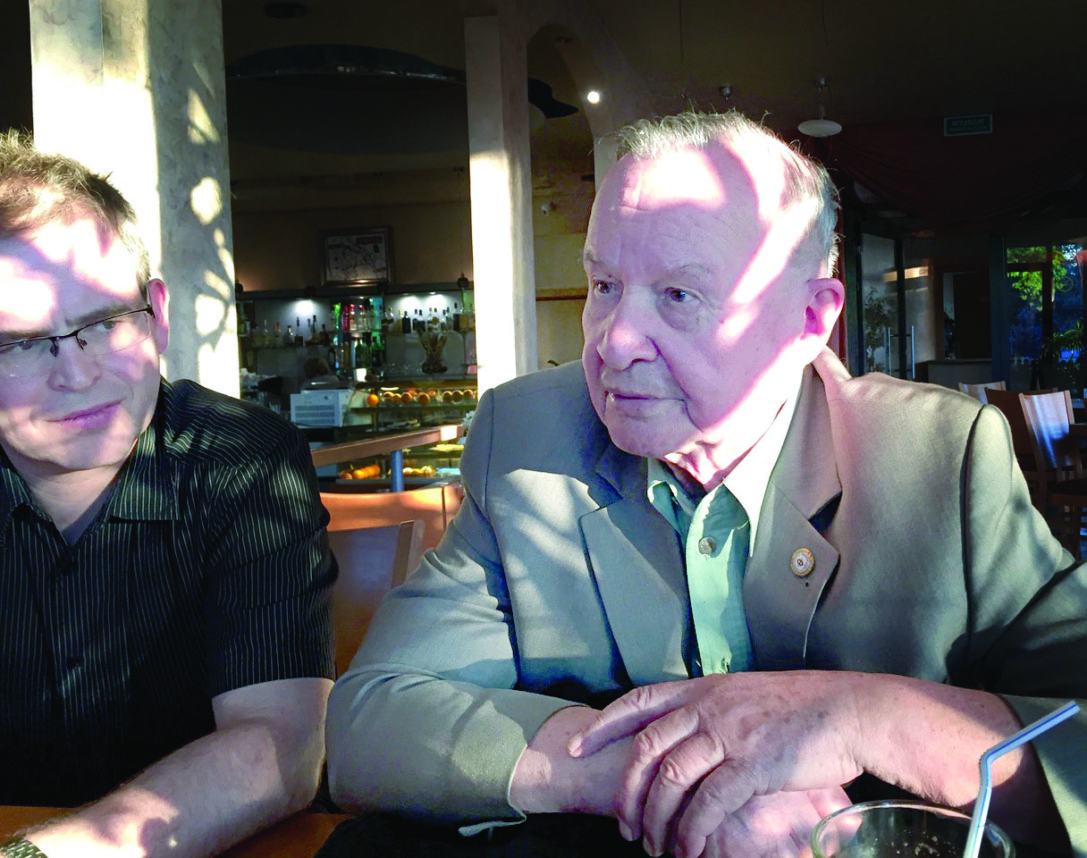
Then we drove back to Warsaw, where we had arranged to meet Janusz Kowalski at a cafe. Janusz is 85 years old. Dressed in a dark suit, he immediately struck me as spry and sharp. I instantly felt that I was in the presence of a righteous man, a godly person. Almost without hesitation, speaking through a translator, he launched into his story — as if he had been waiting years for someone to ask.

Janusz grew up in Warsaw. His father, Witold, was a postmaster. Janusz was 9 years old in the summer of 1939 when, anticipating the German invasion, his father sent his mother, Maria, along with Janusz and an older brother, to a vacation house near Bialystok for their safety. The father stayed behind in Warsaw.

When the Germans invaded, the mother and children fled for their lives. They hoped to return to Warsaw but, in the chaos on the streets, couldn’t penetrate the crowds fleeing the city. They were on the outskirts of Siedlce when they encountered a column of German tanks. Suddenly caught in the crossfire, Janusz watched helplessly as German gunfire killed two nearby Polish soldiers and then his brother, who died on the spot as Janusz watched in horror. Another bullet struck Janusz’s mother in the arm.

After a German medic helped bandage Maria’s arm, the pair — unable to retrieve Janusz’s brother’s body amid the gunfire — took refuge in a nearby town. The next day, German soldiers threatened to kill his mother, but she begged them to spare her for Janusz’s sake. A Polish noble family took in Janusz and transported Maria to a hospital in Siedlce.

There, her condition worsened, her arm becoming so infected that doctors considered amputation. Despite frantic efforts, she couldn’t reach her husband, Witold, who was in Warsaw, unaware of what had befallen his wife and children. Maria finally prevailed upon a patient who was being discharged to make contact in Warsaw with her husband, who rushed to Siedlce to reconnect with her.

First retrieving Janusz from the home where he had been sheltered, Witold made his way to Lochow, the place where the tank battle had occurred. There, he learned that a Jewish man had buried his son and the two Polish soldiers, on orders from the Germans. Witold found the man, who escorted him to the grave. The grieving father expressed gratitude for the man’s kindness. It was Witold’s first close encounter with a Jewish person, and it left a positive impression.

Soon after, he had another. Witold was at a barbershop in Siedlce when he struck up a conversation with a Jewish doctor, the head of Siedlce’s Jewish hospital. Hearing Witold’s story, the doctor offered financial and medical help.

Witold, grateful, was quick to reciprocate, volunteering to transport letters and money to Jews suffering under Nazi occupation in Warsaw.

I instantly felt that I was in the presence of a righteous man, a godly person. Almost without hesitation, speaking through a translator, he launched into his story — as if he had been waiting years for someone to ask.

As the war raged around them and Maria recovered from her injuries, the Kowalski family relocated repeatedly, ultimately to a bare-bones one-room apartment in Siedlce. Because the building lacked running water or toilets, the Germans were unlikely to seize it for themselves.

That was where the Kowalskis’ fate intersected with my family’s.

As it happened, my aunt and uncle, Israel and Rachela Halberstadt, lived across the street. At some point, they met the Kowalskis. Rachela was working as a nurse at the Jewish hospital when German soldiers opened fire there, killing nearly everyone: doctors, nurses and patients. Rachela managed to flee and hid in the bushes until the Germans moved on.

Traumatized, she showed up at the Kowalskis’ door. Fully aware that hiding a Jewish person under Nazi occupation meant risking their own lives, they agreed to take her in.

Not that there was anywhere to hide Rachela in the small flat. With Janusz sleeping in the kitchen, his parents sleeping in one bed, and Rachela in another, hiding under the blankets when she had to was all she could do to conceal herself.

Janusz was 11 years old when his parents took in my Aunt Rachela. They sheltered her for two years. To hide her Jewish identity, she assumed a Polish name, Jadzia.

There were close calls. Once, after Rachela inadvertently opened a window and a neighbor spotted her, a German soldier knocked at the door to inquire. Janusz, the only one home at the time besides Rachela, pretended he was alone, even sitting on the bed to conceal her, trying to hide his fear.

Maria and Rachela were the same age. They grew close, sometimes crying together over events raging outside, such as the time German soldiers abruptly shot an elderly Jewish man drawing water from a nearby well.

To pass time, Rachela, a talented knitter, spent long hours in the apartment making sweaters. Maria sold them, passing off the work as her own, to bring in extra income.

Since the apartment had no running water and no toilet, it fell to Janusz to dispose of the waste. Rachela, who couldn’t risk stepping outside, regularly expressed gratitude to the boy for taking on that task.

Meanwhile, Rachela’s husband, my Uncle Israel, was facing his own difficulties. Taking refuge in a series of Warsaw hideouts, he repeatedly found himself back on the street, alone, bereft and afraid. When Maria learned of his predicament, she contacted a brother-in-law and persuaded him to create a hiding place in his Warsaw flat. While Rachela hid with the Kowalskis, Israel spent 18 months concealed at the relatives’ place, along with eight other Jews.

In 1944, with Russian forces closing in on Siedlce, the Kowalskis and Rachela fled to the countryside. When they encountered a troop of German soldiers, they feared Rachela’s Jewish appearance might raise suspicions. Those anxieties were heightened when the commander asked Maria in German to cook dinner for his men. Only Rachela understood both Polish and German, so she stepped in as translator. Fortunately, the soldiers were too focused on filling their bellies to ask whether she was Jewish. The soldiers moved on the next day.

Within days, Russian troops arrived and liberated the area. My Aunt Rachela parted with the Kowalskis and made her way back to Siedlce, where she reunited with my Uncle Israel and others who had been in hiding with him in Warsaw.

The Kowalski family relocated to a different part of Poland. It wasn’t until four years later, in 1948, that Witold and Maria met again with Rachela and Israel. (Janusz was away, serving in the military.) The Halberstadts came to visit with their new baby — my cousin Miriam — just before they emigrated to Israel. Grateful for everything the Kowalski family had done, the Halberstadts made a generous proposition. They offered the Kowalskis their Siedlce home.

The Kowalskis refused to accept the gift.

Sitting in the café in Warsaw, I was stunned. Stunned by the selfless acts of this man and his parents. Stunned that they had refused compensation for their heroism. Stunned that seven decades later, I was sitting across from Janusz, hearing this story for the first time.

Then Janusz pulled out an olive wood box and opened it, displaying its contents: a medal, with words in Hebrew: “A sign of gratitude from the Jewish people.” And beneath that, their names: “Kowalski Witold, Maria & Janusz.”

It had been presented to Janusz’s parents in the 1950s by Yad Vashem, the Holocaust memorial in Jerusalem, where the Kowalskis are among more than 26,000 individuals honored as chasidei haumot haolam, righteous among the nations, for risking their lives, liberty or positions to save Jews during the Holocaust.

Now, sitting in that Warsaw café, I was stunned by something else: No one had ever told me this story.

While my father had spent years disparaging Polish people, my aunt and uncle knew better. Perhaps they thought my father had told me. For years, they had kept in touch with Janusz’s parents, routinely sending financial support from Israel, even when they themselves were strapped. My cousin Miriam and her children visited Janusz in 1994, and in recent years she has provided occasional financial support. Janusz told me that the money helped him to pay for repairs at the grave of his brother, the one killed by German gunfire.

Kowalski in 2014.
Kowalski in 2016. Photo courtesy of Janet Halbert.

In the café, he pulled out something else: a folder filled with photos Miriam had sent him over the years, including pictures of my Israeli cousins at Miriam’s wedding, her children and her grandchildren. As he spoke of them, it was as if he were speaking of his own family. In a way, he was.

After the war, Janusz went on to pilot planes in the Polish military. Later, he spent a decade as a provincial governor of the district that includes Siedlce. In that capacity, he oversaw the maintenance of the area of the Treblinka death camp, a responsibility whose significance he clearly took seriously. He also worked to support the repair of neglected Jewish cemeteries.

He now lives with his wife, who is seven years younger. Although I asked him to bring her along, he declined, explaining that she doesn’t share his interest in the past. I asked Janusz if, as a child, he had fully understood the danger of the situation. He told me he was sure his parents had lived with great fear, but they understood the importance of what they were doing.

“We were characters in a play,” he said, smiling, “and each of us understood our role.” He said he had experienced more fear later in life, flying poorly equipped airplanes.

As we stood to leave, Janusz gave me a warm hug. An hour earlier, we had been strangers. Now, we both understood the close bond that linked us. He told me to be in touch on my next trip to Poland, but I knew I was unlikely to return.   

People often ask: Where was God during the Holocaust? Where is God whenever people face calamities? The answer I prefer is the one I once heard from the late Rabbi Harold Schulweis of Valley Beth Shalom in Encino: God is the response.

On my trip to Poland, I learned about the Kowalski family’s response. They didn’t need to help my aunt and uncle, who were strangers. But because they acted, they gave life to my cousin Miriam, and her three children, and their nine children. Indeed, if not for the Kowalskis, none of those people, would be alive.

"If not for the Kowalskis, none of those people would be alive.” Photo by Miriam Halberstadt Segev
“If not for the Kowalskis, none of those people would be alive.” Photo by Miriam Halberstadt Segev

I have thought of Janusz many times, especially in recent months amid the news of travel bans and deportations. At my synagogue, IKAR, one recent Shabbat, Rabbi Sharon Brous made the connection even more explicit in a sermon. She reminded us of the thousands of righteous gentiles who risked life and liberty to save Jewish lives during the Holocaust. “We work very hard to honor them, and we should,” she said. But in this moment, she said, the best way for us to pay respects to their memory is for us to stand up for those who are vulnerable,  “to strive to become righteous Jews.”

My father died in 1982. I’m not sure if he knew of the righteous acts of the Kowalski family. If he did, he never told me. I wish he had. There were so many painful events he simply wouldn’t talk about. In any case, I’m so thankful I had the opportunity to meet Janusz.  It changed my life and reminds me every day about the steps we all can take toward making a difference in another person’s life.


Janet Halbert, a Los Angeles CPA, is a longtime social justice activist. She was founding treasurer of Bend the Arc (formerly Progressive Jewish Alliance) and serves on J Street’s national finance committee.

I thought I knew my family’s Holocaust story — until I met this man Read More »

Enslaved by politics

One thing you learn by engaging in “dialogue” with Jews is what the essayist Joseph Epstein put this way: “Jews don’t listen. They wait.”

I discovered this truth — yet again — when I served as a guest speaker at an international Passover gathering at a beach resort south of Cancun, Mexico. On the second day of Pesach, I stood in front of a mostly Modern Orthodox crowd from 11 countries and delivered a warning: My lecture, “Seeking Truth: Journalism in the Age of Trump,” was going to be critical of the president.

Before I finished my second sentence, six people walked out.

My premise wasn’t exactly provocative. Anyone who has read a newspaper in the last six months knows that America’s press has taken a beating from Trump — both during his campaign and the first few months of his administration. What I had hoped to do, rather than provoke, was use my Passover pulpit to defend the institution of a free press as an essential feature of democracy — and establish some common ground. I didn’t think it was controversial to draw upon philosophical reinforcement from John Adams, the First Amendment and the U.N.’s Universal Declaration of Human Rights.

To do this, I based my presentation strictly on facts: that is, things that have actually happened. That was my first mistake. We are now living in an “alternative fact” universe where a “fact” is a dirty, politicized word that doesn’t settle a dispute so much as provoke one. A fact used to be a thing that was “indisputably the case,” as defined in the dictionary — a common, shared language, like, “Sugar is sweet.” But now, a fact is considered subjective, open to debate.

I had hoped to have a civil discussion about how we, as a community, could respond to Trump’s effort to repress our press. Instead, what emerged during the Q-and-A after my lecture and in the days afterward was a combination of acrimony, distrust and disrespect that reveals the extent to which deep and ugly political divisions in the Jewish community are tearing us apart.

Here is some of what I heard: My talk was “offensive”; I have “garbage” in my head; I “don’t know facts or history”; political correctness is “fake news”; the media “lost credibility a long time ago,” “doesn’t report accurately,” is “biased against Israel,” “never questioned” Barack Obama; and – my personal favorite – “I wanted to walk out, but I actually came back in because I believe in discourse.”

No kidding!

The broad, sweeping generalizations were astounding. The New York Times might as well be Al Jazeera. There was no acknowledgment that American newspapers employ thousands of reporters worldwide, many of whom risk their lives to bring us information. What does it matter, if it’s information you don’t like?

During a panel I moderated on campus anti-Semitism and Boycott, Divestment and Sanctions (BDS), I referred to the West Bank and Gaza as occupied territory — another “fact” that can’t be called a fact because it’s open for debate. A woman approached me at lunch all hot and bothered because how dare I say what I said. “The Arabs want to kill us!” “The Palestinians don’t want a state!” “They weren’t there first anyway!” And she could “prove scientifically” that God exists and the Exodus happened.

I declined the lesson in metaphysics, but when I asked her to address the disenfranchised Palestinian population in “Judea and Samaria,” she said she had no solution. She’s hoping the Messiah will come.

Me, too.

Some of these arguments seem ludicrous, but these are the kinds of statements that earn applause in certain Jewish circles.

During an evening lecture by former Ambassador Dennis Ross, who has spent the last 30 years working on the Middle East conflict under four administrations, Democrat and Republican, a woman took issue with Palestinian self-determination. After going on and on, he finally stopped her. “You’re not going to convince me,” Ross said. “I’ve been working on this issue for 30 years.”

“Unsuccessfully,” she sniped.

The room was silent. But Ross, the consummate diplomat, kept his cool, letting slide a public insult that labeled his career a failure.

Some of us are so far down the rabbit hole of self-righteousness and self-rightness, we have forgotten how to be kind.

The Torah tells us that Moses, the most vaunted leader in Jewish history, was a man of deep humility, a quality our current political discourse sorely lacks. Communal certainty has replaced critical thinking. The State of Israel has become more sacred than the People of Israel.

What is under attack in our community isn’t politics, but pluralism itself. For the right, criticizing or challenging Israel is an unforgivable heresy. For the left, moral superiority has become unassailable orthodoxy. For both, the other perspective is viewed as “destroying the Jewish people.”

And guess what. It is.

Our community will be profoundly compromised if we choose ideology over one another. Communities that prize ideology over humanity are doomed to fail. We know this. We criticize Islam endlessly for the very same reason.


Danielle Berrin is a senior writer and columnist at the Jewish Journal.

Enslaved by politics Read More »

Israeli man injured, Palestinian assailant shot to death in car-ramming attack

JERUSALEM — An Israeli man, 60, was injured in a car-ramming attack in the West Bank that ended with the Palestinian driver being shot to death by soldiers.

The driver in the Wednesday afternoon attack rammed his car into a bus stop near the Gush Etzion junction in the Etzion Bloc, located south of Jerusalem, according to the Israel Defense Forces. He was stopped when soldiers at the scene opened fire on the vehicle.

The victim suffered a head injury and was taken to a Jerusalem hospital in light-to-moderate condition, according to Israeli reports citing emergency services. Israeli army medics treated the driver at the scene, according to reports, but he later died of his wounds at the hospital.

Several car-ramming attacks have occurred at that junction in the past year and a half.

Israeli man injured, Palestinian assailant shot to death in car-ramming attack Read More »

Trump wants ‘conflict-ending settlement’ between Israelis and Palestinians

WASHINGTON — President Donald Trump is seeking “a conflict-ending settlement” for Israelis and Palestinians, his spokesman said ahead of Trump’s meeting with Palestinian Authority President Mahmoud Abbas.

The statement Wednesday by Sean Spicer, who was confirming the May 3 visit, is an indication that Trump is determined to extract a deal from the sides.

“They will use the visit to reaffirm the commitment of both the United States and the Palestinian leadership to pursuing and ultimately concluding a conflict-ending settlement between the Palestinians and Israel,” Spicer said in his opening remarks at the daily news briefing.

Israeli Prime Minister Benjamin Netanyahu has said he wants a peace deal, but Cabinet officials to Netanyahu’s right favor unilateral actions, including annexing portions of the West Bank, that would stop well short of a final status deal.

Trump, who hosted Netanyahu in February at the White House, retreated from an explicit U.S. endorsement of the two-state solution — U.S. policy for 15 years — but also surprised Netanyahu by asking him publicly to slow settlement expansion for a period.

One of Trump’s top foreign policy advisers, Jason Greenblatt, has spent time in the region in an intensive canvassing of the principals ahead of reviving peace talks.

Trump wants ‘conflict-ending settlement’ between Israelis and Palestinians Read More »

Sheldon-Adelson

Sheldon Adelson gave record $5 million to Trump inauguration celebrations

Sheldon Adelson, a casino magnate and major donor to Republican and Jewish causes, gave a reported record of $5 million for President Donald Trump’s inauguration celebrations.

The gift was the largest single contribution ever given to an inauguration, The New York Times reported Wednesday, adding that Adelson’s donation was “far from the only seven-figure check deposited by the committee responsible for carrying out much of the pomp leading up to Mr. Trump’s swearing in.”

Adelson and his wife, Miriam, were on the dais for Trump’s inaugural oath-taking, a rare honor for campaign funders.

Adelson did not commit to a candidate until last May, when he endorsed Trump at a time when it was clear the reality TV star and real estate magnate would be the Republican nominee. He subsequently donated tens of millions of dollars to the Trump election campaign.

Other large donors to support Trump’s inauguration festivities included New England Patriots owner Robert Kraft, a donor to many Jewish and Israeli causes who gave $1 million, Haaretz reported, citing new documents released Wednesday by the U.S. Federal Election Commission.

The Trump Inauguration Committee raised a record-breaking $107 million from both large public donors and dozens of corporations, including Google and Pepsi.

Sheldon Adelson gave record $5 million to Trump inauguration celebrations Read More »