fbpx

April 19, 2017

I Made A Mistake

Recently, I signed a letter, circulated by a rabbi I revere, who will, I think, be remembered as one of the important rabbis of our generation. I was in august company; the letter having also been signed by deeply respected teachers and colleagues.  Immediately, equally respected colleagues and friends sent emails asking (in more polite terms): WTF? Having mostly been off social media for the Pesach season, I’ve had a quiet time out to think about what I’ve done. And I’m sorry.

Just before Pesach, nauseated at the massacre of civilians perpetrated by Syrian dictator Bashar al-Assad, I signed a letter which called on Donald Trump to “Order targeted airstrikes on Assad regime air facilities, jetways, and fix-wing and rotary aircraft so as to prevent the regime from carrying out further chemical attacks with nerve agents.”

And then, son-of-a-gun, he did it.  And, I’ve been marooned on the Island of Dread and Regret ever since. While I don’t think that our letter had anything to do with the decision (or, probably, ever came to his attention), I’ve been increasingly regretful that I put my name to something that offered the tiniest bit of cover or support for 45.

So what’s my problem? Am I just upset because a president I don’t support actually did something admirable and I don’t want to admit it? No. But, in an oblique way, that’s getting warm.

See, here’s the thing: I thought we were pushing against a closed door and that we would be lucky to get any presidential acknowledgment of wrongdoing by the Assad regime. That’s because I made the mistake of taking Trump at his word. Just a week previous, his administration had signaled acceptance of Assad’s continuing rule in Syria. The administration is still being investigated for illicit ties to the regime of Vladimir Putin, Assad’s sponsor. I figured we were shaming him for his consistent support for brutal dictators, like Egypt’s Abdel Fattah el-Sisi, like Vladimir Putin and like Assad himself.

Then he did a 180 away from his own policies.

After years of urging President Obama not to take military action in Syria, immediately after assuring Assad that he was welcome, as far as the US is concerned, to do whatever he wanted, Trump bombed Iraq….er Syria. While enjoying a mind-blowingly good piece of chocolate cake. Because of an action on Assad’s part that was completely in character and entirely predictable?

Three possibilities suggest themselves, and I don’t know which is scarier: 1. Our current president really is naïve and uninformed enough to be shocked at learning that the Assad regime would murder “beautiful babies.” 2. This is a bit of political theatre cooked up between the administration and the Putin regime (who were warned in advance) and the Assad regime (also warned) or (most likely)  3. This guy is completely erratic, has no policy, and has no frikkin idea about what he will do next. And he wields the mightiest arsenal this planet has ever seen. Dread. And regret.

Things I still believe:

  • There are some war crimes, such as deliberate massacres of civilians, that demand a response from the world.
  • “The world” is a mashup of power relations both economic and political, ideologies, alliances and interests. No one is disinterested. Still, when it comes to genocides, massacres, torture, created famines and similar atrocities “we” have to draw lines somewhere. That is what the UN, an institution for which, until recently, Trump has expressed nothing but contempt is supposed to be for. (Really, the United States and Russia can each end any initiative before it begins.)
  • Resistance is resistance and it’s not compatible with respectful petition. (This is the most embarrassing part of all—I should not have forgotten that.) The action for which we were calling would have been appropriate coming from a president of intelligence and discernment, one who had done everything possible to see that it didn’t come to this (Oh, Barack Obama, where are you now?) We behaved as though such a person sat in the Oval Office because, well, because that’s what was needed, you see, and I thought it was a neat rhetorical jab to address its current occupant as though he were such a person. I was being too clever by half.)
  • Now that we have officially owned our share of the wreckage, it’s time to give the Syrian safe passage to our country. No more excuses.


Unlike some of my friends on the Left, I no longer assume reflexively that no exercise of American military power can ever be justified. Not after the former Yugoslavia where, if anything, we were a little late in bestirring ourselves. Of course, as various correspondents have pointed out, that was not only a UN affair, it was also a project of NATO (another institution for which Trump has discovered belated respect), one that was supported tepidly by Congress.

Generally, though, there is much to be said on the side of those who resist any mobilization of the American imperium for any purpose. Look at Iraq: Saddam Hussein was as brutal and evil as is Assad, but removing him did not heal or stabilize Iraq; all we did was redistribute the pain. We should always ask who stands to gain (multi-national oil interests and the military industrial complex come to mind).

Something was done and nothing is better. Assad’s regime remains in power, and even the airfield is still viable. Meanwhile, our attention has been diverted from the issue of the Trump administration’s collusion with Russian intelligence operatives and from their steady removal of federal protections from racist and violent police departments, union-busting, pollution and discrimination based on gender and sexual orientation.

Again, I made a mistake, and I’m sorry. I’m learning how it’s possible to be filled with weariness and dread at the same time. It’s going to be a long four years.

I Made A Mistake Read More »

Moving and Shaking: Autism performing arts, Aish gala, and Mensch Foundation honoring Bush family

Holocaust aid organization Mensch International Foundation, a nonprofit dedicated to assisting Hungarian Holocaust survivors, honored former President George H.W. Bush and former first lady Barbara Bush with the Mensch Award at Congregation Beth Israel in Houston, the oldest Jewish congregation in Texas, on March 8.

“In a time today when we question our politicians’ ethics, when we question our politicians’ behavior and decency, this man, George Bush, and his wife were impeccable. They had no scandals, whether monetary or family-related. They are decent people and that’s what menschlikayt stands for,” Steve Geiger, founder of the Mensch International Foundation, said in an interview. Geiger, a former Los Angeles resident who currently lives in Palm Springs, said the former president played an important role in getting Ethiopian Jews to Israel.

“Without his help, it might not have happened,” Geiger said.

The organization promotes tolerance and offers Holocaust education programs in Hungary, which has the largest Jewish population in central Europe, he said.

Previous Mensch International Foundation honorees include Branko Lustig, a Holocaust survivor who was a producer on the movies “Schindler’s List” and “Gladiator.”

“We figure if we give the award to prominent people that the message will get across more,” Geiger said. “We also give it to very simple people.”


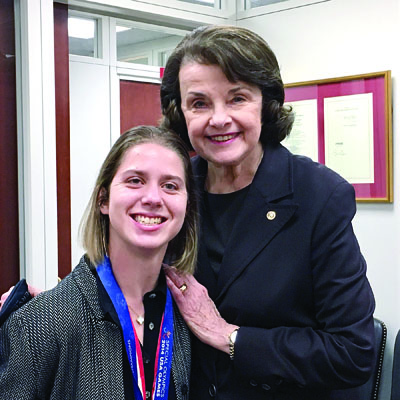
Special needs advocate Lucy Meyer, 17 — a Bel Air resident who has cerebral palsy and a Special Olympics athlete whose family belongs to Leo Baeck Temple — visited with U.S. Sen. Dianne Feinstein on April 3 at the senator’s Washington, D.C., office.

“Lucy loves Senator Feinstein,” said Jamie Meyer, Lucy’s mother.

Lucy, who is in 10th grade, was in the nation’s capital to speak at the UNICEF USA 2017 Annual Meeting, a four-day event that brought together UNICEF supporters, partners, constituents and students.

Special Olympics athlete and Leo Baeck Temple congregant Lucy Meyer meets with Sen. Dianne Feinstein at the  California senator’s  office in Washington. Photo courtesy of Lucy Meyer
Special Olympics athlete and Leo Baeck Temple congregant Lucy Meyer meets with Sen. Dianne Feinstein at the
California senator’s
office in Washington. Photo courtesy of Lucy Meyer

During the trip, Lucy also met with U.S. Sens. Maggie Hassan (D-N.H.), Chris Coons (D-Del.) and Dick Durbin (D-Ill.) to discuss “kids with disabilities and Lucy’s work to support the partnership between UNICEF USA and Special Olympics,” as well as ways to broaden the partnership between Special Olympics Southern California and the Los Angeles Unified School District, Jamie said. Lucy has met with more than half of the U.S. Senate, both Republicans and Democrats, to discuss the needs of athletes with disabilities, her mother said.


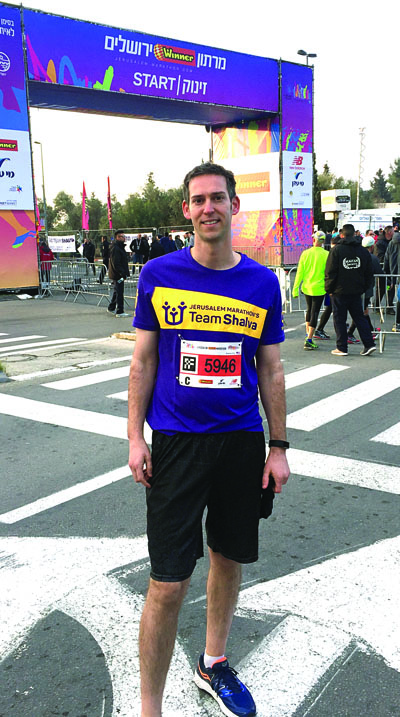
Sinai Temple Rabbi Erez Sherman participated in the Jerusalem Winner Marathon on March 17. Photo courtesy of Rabbi Erez Sherman

Sinai Temple delegation of 10 people, led by the congregation’s Rabbi Erez Sherman, traveled to Israel to participate in the seventh annual Jerusalem Winner Marathon on March 17.

The group ran as part of Team Shalva and raised nearly $31,000 for Shalva, an Israeli organization serving people with mental and physical disabilities. Jerusalem Mayor Nir Barkat said the event is the “most socially engaged marathon in Israel, with more than 6,000 runners participating to promote social causes.”

Sherman and his younger sister, Nitza, a nurse at Cedars-Sinai Medical Center, participated in honor of their brother, Eyal, a quadriplegic.

Rich Garcia, head of Sinai Temple security, a U.S. military veteran and a Jew by Choice, also participated. Garcia ran in honor of a friend who died in a suicide bombing in Iraq.

Wendy Merchan, who is Catholic and a preschool teacher at Sinai Akiba Academy, also ran with the group, along with her two sisters.

“So, in short, not your normal group going to Israel,” Sherman told the Journal.

And for Garcia, the March 12-20 trip to Israel was about more than running in the marathon. He had his bar mitzvah during Shabbat at the Western Wall.


Students with autism and students from Sinai Akiba Academy came together Feb. 27 at Sinai Temple for a production of “The Intimidation Game.”

Scheduled in honor of February being Jewish Disability Awareness and Inclusion Month, “The Intimidation Game” is an original musical about overcoming bullying and finding one’s true community. It is a production of The Miracle Project, a community theater group founded in 2004 by Elaine Hall that features cast members on and off the autism spectrum. The Emmy-winning documentary “Autism: The Musical” spotlighted the Miracle Project’s acclaimed arts program.

About 300 Sinai Akiba Academy students were in the audience for the performance of “The Intimidation Game,” which debuted last year at the Wallis Annenberg Center for the Performing Arts in Beverly Hills.

Dahlia Trilling, a cast member and Sinai Akiba Academy student, raised funds and awareness for The Miracle Project as part of her bat mitzvah community service project. Her older sister, Lyla, also has volunteered for and performed with The Miracle Project. The sisters, who are not on the  autisum spectrum, are mentors at The Miracle Project. The program’s next musical, “Work in Progress,” will debut April 30.


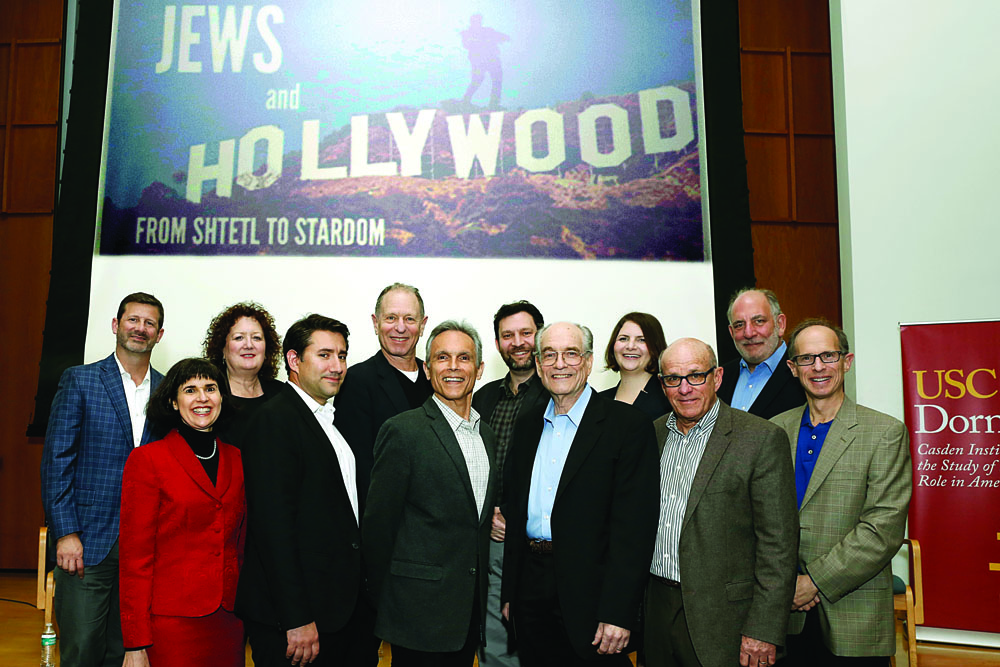
From left, back row: Steve Gamer, Rabbi Susan Nanus, Steve Ross, Josh Moss, Shaina Hammerman and Dan Rothblatt, and from left, front row: Susan Mattisinko, Ross Melnick, Michael Renov, Vince Brook, David Isaacs and Lew Groner attend “From Shtetl to Stardom: Jews and Hollywood,” a discussion at Wilshire Boulevard Temple. Photo by Steve Cohn/USC

More than 250 people attended “From Shtetl to Stardom: Jews and Hollywood,” a March 5 discussion at Wilshire Boulevard Temple’s Irmas Campus in West Los Angeles.

The panelists in the discussion were Vince Brook, a lecturer at the UCLA School of Theater, Film and Television; Shaina Hammerman, a Bay Area lecturer on Jewish film, literature, religion and cultural history; David Isaacs, a television writer who won an Emmy for his work on “Cheers”; Ross Melnick, a UC Santa Barbara (UCSB) associate professor of film and media studies; and Josh Moss, a UCSB visiting professor of film and media studies. Michael Renov, a USC cinema studies professor, moderated.

“The panel of prominent television and film academics and entertainment professionals offered a uniquely multifaceted and up-to-the-minute account of the remarkable role Jews have played in the entertainment industry and in American popular culture,” a press release said.

The panelists discussed Jewish comedians Amy Schumer and Sarah Silverman; Jill Soloway’s television series “Transparent”; the Jewishness of Matthew Weiner’s “Mad Men” and more.

The USC Casden Institute organized the event, which was supported by the Jewish Community Foundation of Los Angeles.


Jewish outreach organization Aish Los Angeles’ April 2 gala at the California Science Center celebrated the 50th anniversary of the 1967 unification of Jerusalem; paid tribute to late philanthropist Charles Howard Boxenbaum, who died in 2016; and honored several of its supporters.

The gala’s opening reception and dinner were held in the museum’s entrance hall, and the honors and awards were presented in the Space Shuttle Endeavour exhibit, beneath the shuttle. The Leadership Award was given to Stacey and Julian Maimin, Lauren and Zigi Dromy, and Kellie and Jeff Singer for their underwriting of buses for Israel trips taken by Aish’s Jewish Women’s Initiative (JWI) and Jewish Men’s Initiative.

“I wanted to make a difference in the lives of Jewish families in Los Angeles,” Lauren Dromy said in a prerecorded video. “It was very important for us to underwrite a second bus for JWI. When I went back [to Israel] a second time, I went as a community leader. I became a teacher and a role model.”

The event also honored Aish L.A. rabbinic staff member Rabbi Yitz Jacobs in recognition of his educational excellence.

“I feel like I was created to invest in people and bring out their souls,” Jacobs said. “What keeps me inspired is the beauty of witnessing the spiritual journey of my students.”

Patrick Amar, who operates a tour company in Israel, emceed the event.

More than 800 people attended, including philanthropist Marvin Markowitz; Jewish Journal President David Suissa; StandWithUs co-founders Roz and Jerry Rothstein; Beverly Hills pawn broker Yossi Dina; philanthropist Barak Raviv; Israeli American Council National Chairman Adam Milstein and his wife Gila; and American Friends of Magen David Adom Regional President Dina Leeds and her husband Fred.

Rabbi Steven Burg, director general of Aish HaTorah Jerusalem, concluded the program with remarks.

“For Aish HaTorah … our job is to teach people that they have potential, to teach Jews that they have a job to do, that we have to be there for each other, be there for Israel, be there for Jerusalem, the eternal capital of our people,” Burg said.

— Mati Geula Cohen, Contributing Writer


Moving & Shaking highlights events, honors and simchas. Got a tip? Email ryant@jewishjournal.com. 

Moving and Shaking: Autism performing arts, Aish gala, and Mensch Foundation honoring Bush family Read More »

Love at first bite at Langer’s

Last year, my husband asked me where I wanted to go for my birthday. Since he keeps current by reading restaurant reviews, I deferred to him.

“Yesterday, you mentioned a new wine bar that just opened in Silver Lake. Let’s go there,” I said.

This wine bar was quite the scene. Very hip. Very trendy. Lots of glass and concrete. The waiters were all skinny, dressed in black, aggressively gender-neutral. I ordered a glass of wine — a delicious Syrah. But it wasn’t truly a glass of wine; it was more like a splash. After three sips, the wine was gone. It cost $15. I felt cheated — and on my birthday, no less.

This year, as my big day approached, I didn’t mess around. I said to my husband, “We’ve lived in Los Angeles for 35 years. It’s about time we went to Langer’s Deli!”

“Langer’s Deli?” My husband was in shock. “They haven’t been reviewed in years.”

An iconic landmark by MacArthur Park, Langer’s has been a fixture in Los Angeles for decades. In fact, this year marks Langer’s 70th anniversary. According to many foodies, Langer’s serves the greatest sandwiches in America. Its pastrami is world famous, but after all these years, I still hadn’t experienced it for myself.

That’s even more surprising, given that my love for pastrami on rye goes back to when I was a child. At that time — during the ’60s — there was an advertising campaign for Levy’s rye bread with the slogan: “You don’t have to be Jewish to love Levy’s.” It served as the caption to a series of photos that included the likes of a Native American and an Asian boy, each with a sandwich close at hand. This ad campaign was groundbreaking. It said so much about Jewish pride: We Jews love our food, and if gentiles also love it, then surely the Messiah will be here any minute.

So when this year’s birthday rolled around, my husband and I walk into Langer’s, and immediately, it feels like reuniting with an old flame. The décor is vintage 1962, back when Formica reigned supreme. The joint is hopping with people representing all corners of the globe. I see dashikis, saris, turbans. There are Asians and Latinos, and even a couple of Nordic blondes in a corner booth. The multilingual hum is just like the Levy’s ad promised: proof that everyone is loving their food.

A waiter comes to our table. I order a cream soda and pastrami on rye with all the trimmings.

The waiter turns to my husband and asks for his order. This could go in so many directions, because my husband is a food extremist. At home, he’s a disciplined dieter and will avoid salt, sugar, fat, butter, citrus, starchy vegetables, red meat, smoked red meat, smoked fish, nuts, chocolate and booze. But in a restaurant, he sometimes throws caution to the wind. I’ve seen him order wine, margaritas, lamb roast, garlic potatoes, tiramisu, chocolate mousse, gelato.

When he’s finally ready to order, I take a deep breath. He wants cream cheese and coleslaw on a Kaiser roll.

He eats his stupid sandwich and pretends to like it. Meanwhile, I’ve fallen in love with my pastrami masterpiece. It turns out that my soul mate is a pastrami on rye!

While clearing the table, the waiter asks, “Are you folks here for a special occasion?”

This question delights me and I answer, “Yes! As a matter of fact, it is my birthday.”

“If it’s your birthday, you get dessert!”

“Oh, no! I couldn’t. After that sandwich, I’m stuffed.”

“Oh, c’mon! It’s on the house. Our gift to you!”

“A gift? To me?”

“Yes. What’s your name?”

“Ellen.”

“Ellen, try some dessert — you’ll love it!”

The waiter — and this guy is a pro, not some 20-something aspiring actor-director-writer biding his time — is a waiter’s waiter. He returns to our table with a delicious sweet, singing: “Happy birthday, dear Ellen!”

I look out over the restaurant and all these faces from around the world are singing happy birthday to me. It looks like a greeting card from the United Nations. I throw kisses to one and all.

The dessert is delicious. My husband takes a bite and deems it worthy. We leave Langer’s. I’m floating on air. It takes so little to make me happy. And my husband’s happy that I’m happy. And I’m happy that he’s happy. So we’re happy, happy, happy, happy.

As we walk to our car, it gets me thinking: I just saw people of every race and creed coming together in peace and harmony over a deli sandwich. The golden age is within our grasp! All we need are heaping portions of pastrami on rye, plenty of dessert and gallons of cream soda.

And don’t forget the pickles.


Ellen Switkes writes for the page and the stage. She’s with Ladies Who Lunch, a storytelling duo.

Do you have a story about dating, marriage, singlehood or any important relationship in your life? Email us at meant2be@jewishjournal.com.

Love at first bite at Langer’s Read More »

Morgenthau’s Children

If you go see the movie “The Promise” this weekend — and you should — you’ll notice a brief scene about two-thirds of the way through, one that ought to resonate even more deeply with American Jews.

“The Promise” is the first large-scale Hollywood film about the Armenian genocide of the early 20th century. It uses big stars, gripping action and a wrenching love story to tell about what the United Nations recognizes as the first modern, organized mass murder of a single people. 

In the scene I’m referring to, Henry Morgenthau, the United States ambassador to the Ottoman Empire, played by actor James Cromwell, confronts Mehmet Talaat, the empire’s interior minister. Morgenthau demands the Turks put an end to the killing and forced deportation of innocent Armenians. When the official repeats the party line (which Turkish officials parrot to this day) that any deaths are the unfortunate consequence of the chaos of war, Morgenthau presents evidence compiled by American consuls and journalists of an organized and concerted effort to wipe out the Armenian minority. Talaat fixes Morgenthau with an icy stare.

“You are a Jew, Ambassador Morgenthau,” he says. “Why should you care about these people?”

Morgenthau answers that as a Jew and an American, he knows what it is to be persecuted, and a refugee.

That shuts upTalaat — but the killing continues.

I don’t know whether the incident happened exactly as it played on screen. But I do know that in reality, Morgenthau cabled Washington, D.C., to report, “a campaign of race extermination is in progress.” He exhausted himself trying to stop it and, despondent that he failed, spent much of the rest of his life raising the equivalent of $1 billion in today’s dollars for Armenian relief.

I used to think the Holocaust was special. I now know that it is, and it isn’t. It was preceded by genocides, it has been followed by genocides, and it will likely, tragically, be echoed by current and future genocides.

The current list includes those in Syria and Iraq, where, along with 500,000 casualties of the civil war, ISIS has singled out the Yazidi people for extermination. In the Central African Republic, continuing violence between Christian majority and Muslim minority militias have seen thousands murdered and hundreds of thousands driven from their homes.

In South Sudan, genocide already has taken 450,000 lives since 2003 and threatens to take many more. This year, the group Genocide Watch listed the failed state of Somalia at Stage 9 on the 10 Stages of Genocide and issued a Genocide and Mass Atrocities Alert. In Myanmar, the 1 million members of the Muslim minority Rohingya face persecution, deportation and starvation.

We know these things are happening. The lack of information is only a convenient excuse in hindsight. Even in Morgenthau’s time, there was contemporary reporting and eyewitnesses.

This week, we learned from newly released archives from the Wiener Library for the Study of the Holocaust & Genocide that as early as 1944, the West knew what was really happening in Auschwitz and Treblinka. Documents smuggled out to the Polish government in exile provided all the evidence leaders needed to act. Today, we have even fewer excuses.

The American-Jewish community focuses a lot of attention on what will happen when there are no more Holocaust survivors to bear witness to what happened. I can understand why. Each year I go to Holocaust commemorative events, where the survivors in the audience are asked to stand up. What used to be dozens of resolute individuals has now dwindled to a handful — and most of these men and women were young children during the war years.

Fortunately, we have created a firewall of memory that includes liturgy, museums, art, film and TV, books, academic research and documentary testimony that will speak to future generations. It is easy to groan at yet another Holocaust memorial or movie, but each is a testament to the disappearing survivors, that their suffering will not be forgotten, that the living have done their duty to the past.

The question we need to ask ourselves is this: Have we done our duty to the living? Are we listening to the eyewitnesses to the contemporary genocides who are trying to speak to us? Are we reading the unpleasant journalism from the Democratic Republic of Congo, South Sudan and Myanmar? As we turn our attention, activism and philanthropy, for good reason, to the shambles that is our domestic politics, are we ignoring the urgent pleas from this generation’s victims?

The answer is yes, we are guilty of all those things. The internet has made it easier than ever to find out what fresh hell is happening — just click on the website for Genocide Watch or add The Mantle (mantlethought.org) to your favorites bar. But the internet also has given us the attention spans of 2-year-olds. 

Too sad?  Too hard? Too much?  Remember: We are the children of Morgenthau. If we, of all people, do not take up the cause of the victims of genocide, in every country, in every generation, who will? 


Rob Eshman is publisher and editor-in-chief of TRIBE Media Corp./Jewish Journal. Email
him at robe@jewishjournal.com. You can follow him on Instagram and Twitter @foodaism
and @RobEshman.

Morgenthau’s Children Read More »

Accept the loving care of others

PARASHAT SHEMINI (LEVITICUS 9:1-11:47)

My mom died three years ago. To say her death has had a profound effect on my life would be an unspeakable understatement.

In a stunning moment four months ago, marking the passage of time and possibility, I gave birth to twin boys. Since their arrival, a curious thing has happened to me. I feel my mother’s gentle actions in my life. All the time. Acutely.

Mostly, I feel her acting through the caring, nurturing, loving presence of others. My sense is that she has sent these human angels to care for me, to care for our family. For the first time since her death, I have found myself feeling safe in a way that is hard to articulate.

For me, the curious part about feeling my mom this strongly is that I have never believed that the dead act in our lives in these ways. And so, while I might not believe it is happening, I feel it is.

A teacher of mine recently told me to stop overthinking this gift from the Universe. “Just receive it with gratitude,” he told me, gently. And so I am.

In this week’s Torah portion, Parashat Shemini, Moses’ brother, the High Priest Aaron, witnesses an unfathomable tragedy — the death of his sons. After his boys, Nadav and Avihu, clutching their incense pans, bring alien fire to the altar, a divine fire consumes them as their father and uncle look on.

I lack the words to describe the stunned silence I always have felt reading the Torah’s matter-of-fact account of this sudden, violent and seemingly nonsensical death. I long to scoop up Aaron in my arms, to hold him, to be present with him. I can’t imagine reacting in any other way.

Oddly, Aaron’s brother Moses responds coldly, with words I always have read as either a theological chastisement or platitude (depending on how generous I’m feeling): “This is what the Eternal meant when saying: Through those near to Me I show Myself holy, And gain glory before all the people” (Leviticus 10:3). Aaron hears these words and is silent.

When I reread the parsha this week, what I expected was to feel frustration with Moses’ lack of empathy. And yet, distance and time are funny things. Two hands’ worth of 5777 Omer days counted, and Moses’ words seem less horrible and more poignant: “Through those near to Me I show Myself holy, And gain glory before all the people.”

In this statement, I always have assumed Moses was trying to tell Aaron that God was somehow illustrating the sacred in his boys’ death. But maybe Moses wasn’t talking about God’s act of divine fire in his words, after all. Maybe Moses actually was foreshadowing the seconds and minutes and years to come for Aaron. Maybe Moses knew that I would not be alone in my impulse to rush to Aaron’s side. Maybe Moses knew the community would gather around this grieving family.

“Through those near to Me I show Myself holy.”

Maybe Moses knew, despite some strange commandments about not grieving publicly, that Aaron would be comforted in whispers and actions and the loving presence of others. Maybe, much as I have begun to feel my mother’s hand in my own life through the actions of others, Moses suspected that Aaron would feel generations acting upon him, as well. “Through those near to Me I show Myself holy.”

Maybe Moses was saying to Aaron: You will feel the love of your community envelope you. You will feel holiness, if not wholeness, again. You will feel a sacred presence in your life through the kind actions of others.

During a recent conversation I had with a confirmation student at my synagogue, as he described what it means to him to be an atheist, I couldn’t help but lean forward intently. “But what about the Mystery?” I asked him. “What about the Why of the universe? The Interconnectivity?”

“I don’t feel it,” he told me.

If I am being honest, there have been times in my life when I have not have felt the Mystery, either. There have been times when I have read words of truth as words of admonishment. There have been times when a divine gift has felt hard to receive.

This week, I’m not going to overthink it, though. This week, I will endeavor to hold onto the Aarons around me, trust the truth of Moses’ explanation, and express gratitude for what I have. This week, I will try just to accept. 


Rabbi Jocee Hudson is an associate rabbi at Temple Israel of Hollywood.

Accept the loving care of others Read More »

Episode 34 – AIPAC, weed, and the two-state solution with MK Tamar Zandberg

Meretz, one of Israel’s left-wing, social-democratic parties, was formed in 1992, winning 12 parliamentary seats in that year’s election. Over the years the party has sat on both sides of the aisle, even joining the ultra-orthodox Shas party in Yitzhak Rabin’s 1992 Labor-led coalition. Today, Meretz is part of the opposition and holds 5 seats, one of which is held by Tamar Zandberg.

MK Zandberg was elected to the Tel Aviv city council in 2008 as a member of Meretz. She was a key figure in the 2011 social protests, during which she led, along with other council members, Meretz’s withdrawal from the city council coalition. Zandberg was elected to the Knesset in 2013, and today she is one of the most well-spoken and thought-provoking Kenneset Members. She joins 2NJB to talk about the future of Israel’s left.

iTunes

Direct Download

Episode 34 – AIPAC, weed, and the two-state solution with MK Tamar Zandberg Read More »

Designer lights up electronic music festivals, clubs

The electronic dance music industry (EDM) has taken over pop music, and festival attendance has seen exponential growth. The fans come for the top-notch DJs, but lighting has become a huge part of the experience. And one of the top lighting designers for EDM nightclubs and festivals is Steve Lieberman, a 44-year-old Jewish resident of Agoura Hills.

Lieberman designed the lights for the Yuma Tent at the Coachella Valley Music and Arts Festival, which ends April 23. The tent is an air-conditioned cavern of underground dance music with wood floors and finished walls. The DJs perform as Lieberman controls the complex lighting board.

“Audience members don’t necessarily look up and notice the lighting guy when everything’s going perfectly, but they certainly notice and look up when you’ve missed blatantly,” he said.

Lieberman has been designing lighting systems for the biggest EDM festivals for the past 25 years. His interest in electronic music goes back to when he was in high school on Long Island, N.Y., in the late ’80s. He and his friends would sneak into nightclubs in Manhattan.

“Things were a little more lax back in those years,” he said.

During the summers, he worked in a nightclub in Southampton, “which was a very Brooklyn, Bronx-centric kind of environment: a lot of guys in tank tops and a lot of chains and a lot of Camaros in front.”

In his senior year of high school, a friend took him to his first rave. In a nearby record store, they bought tickets that came with a crudely drawn map that directed them to the parking lot of a supermarket in Sheepshead Bay. Beside it was a field filled with thousands of other teenagers.

“We hung out and danced till 6 in the morning to thumping, thundering techno music, hard core. After that, I just looked at my buddy and I was like, ‘Oh my god, this is it. This is intense. When’s the next one?’ ”

Before long, Lieberman was carting around lights in the back of his Chevy Blazer and setting up before shows. He studied history at the University of Arizona but continued producing raves there and back home during summers.

“So that was kind of the first real entré into it,” he said. “I didn’t really know what was going on. I didn’t know which end of the cable went where. I didn’t know how to turn the controllers on, and I didn’t know what the lights were called, but I knew it was an awesome environment.”

After graduating, Lieberman taught himself AutoCAD, a computer-aided design and drafting software program. Before long, he was using the program to design lighting set-ups. Over the next two decades, his hobby turned into a full-fledged career. Lieberman has designed the lights for massive festivals like Ultra Music Festival in Miami, Electric Daisy Carnival in Las Vegas and Nocturnal Wonderland in San Bernardino, and for more than 200 nightclubs across the country.

When Lieberman started out in the music scene, the special effects at techno shows consisted of “six lights set up on stage, and maybe a smoke machine and two strobe lights and a DJ playing on a banquet table,” he said.

As technology progressed and the industry moved from underground to mainstream, the lighting systems have become more complex and costly.

“It‘s not like 25 years ago when I started going to nightclubs, Lieberman said. “It’s an educated audience. They’re expecting LED walls. They’re expecting a thousand moving lights. They’re expecting scenery and dancers and fireworks.”

The EDM industry now accounts for more than $7 billion a year, and about a quarter of all live music concerts in the U.S. are now electronic. Last year, nearly 400,000 people attended Electric Daisy Carnival, a three-day festival that went until sunrise every morning.

“It’s a fantasy world,” he said. “You walk into Beyond Wonderland, you’re in the middle of Alice in Wonderland. You just went down the rabbit hole. You’re going to walk into one stage and the light show’s going to run you over like a truck. And then you’re going to walk into another stage and there’s going to be a giant caterpillar puffing on a hookah, sending smoke rings into the air. And then you’re going to walk into another stage and there’s going to be carpet on the ground and a beautiful chandelier overhead, in a completely 360-degree environment.”

As the EDM industry expands, audiences’ expectations rise as well. Now, the light show is immersive, covering nearly every square inch of space. It’s up to Lieberman to keep pushing the envelope, something he says he enjoys.

“I’m an obsessive-compulsive, neurotic, Jewish kid from Long Island. So there’s something in my DNA that makes me a little bit crazy,” he said. “So that actually lends itself very well to design, because I have expectations of myself and what I’m going to produce and what my office is going to produce.”

Lieberman is not the hard-partying college kid he once was. He’s married with two children, and last year, he took his son, 10, and daughter, 13, to Coachella and Lollapalooza.

“So that was their first entré into daddy’s world, and they both took an interest in standing in front of the console, which is really cool,” he said.

At the Sound Nightclub in Hollywood, which has become a must-visit destination for underground techno fans since opening five years ago, Lieberman described the lighting system he designed. It features a long mixing board, with buttons and handles that control various elements, such as the colors, patterns and movement of the lights. He programmed the controls on the board, as well as a computer monitor that shows which lights are in use.

One button on the board shines a spotlight on a glittering 8-foot fiberglass shark covered in mirror panels and Swarovski crystals. When it’s not hanging in the Yuma tent at Coachella, it’s here at Sound. Other buttons trigger the lights to flash all at once, and a blackout button can plunge the club into darkness. The lighting accentuates the music, especially during a drop — a moment when the music builds to a climax, suddenly drops out for a second and then comes back.

The booth at Sound sits across the dance floor from the DJ booth, enabling the DJ and lighting operator to communicate directly. It’s a far cry from past times, when the person in charge of lights was delegated to a closet with a TV monitor.

“There has to be some sort of symbiotic relationship between the artist performing the music and the artist running the lights and the visuals,” he said. “There’s that human touch that a computer can’t ever replace.” he said.

The set-up looks similar to what an electronic music DJ would use, except instead of beats and samples, Lieberman is triggering light displays. The way he flicks the handles, turns the knobs and hits the buttons is like a choreographed dance. As he runs the board, he nods his head and sways his hips, listening to the imaginary music in his head.

Designer lights up electronic music festivals, clubs Read More »

Film focuses on how war warps human behavior

“I go on the assumption that everyone is guilty.”

This sentiment of a guilt that is assumed automatically through membership in the human race is expressed by Jewish master violinist Yehudi Menuhin at the beginning of “The Memory of Justice,” and it’s an assessment that is largely borne out over the course of the 4 1/2-hour HBO documentary that airs April 24.

Although publicists for the film make a point that the screening date was set intentionally for Holocaust Remembrance Day, the production deals with three examples of man’s inhumanity during the 20th century.

The first and longest segment does focus on the Holocaust, but the second part covers France’s attempted suppression of the Algerian bid for independence, and the third on America’s role in the Vietnam War.

“The Memory of Justice” is a massive — and masterful — restoration of a film of the same title released in 1976 that was produced, written and directed by Marcel Ophuls. He and his father, Max Ophuls (nee Oppenheimer), were German-born Jews, who resumed their brilliant film careers after fleeing to France and then the United States.

The main part of the film’s Holocaust-themed segment deals with the postwar Nuremberg war crimes trials that began in 1945 and in which an international tribunal tried 22 top political and military leaders of the Nazi regime. (Hitler had cheated the gallows by shooting himself as Soviet forces closed in on his Berlin bunker.)

Interviews with 40 people, perpetrators and victims, form the backbone of this segment. The two main figures are Telford Taylor, chief American prosecutor at the Nuremberg trials, and Albert Speer, an architect who served as Hitler’s minister of armaments.

Taylor went on to cover the Vietnam War (1955-75) and his views on war crimes, as well as similarities between Nazi and American conduct during the war in Southeast Asia, were expressed clearly in the title of his 1970 book, “Nuremberg and Vietnam: An American Tragedy.” A considerable part of the film is based on Taylor’s book.

After a 20-minute intermission, both in the press screening and the TV presentation, Ophul’s documentary moves on to the Algerian war (1954-62), in which France tried to squelch its colony’s independence movement, and in which both sides systematically tortured their enemies. In French history, the conflict is known as “the dirty war.”

The final segment focuses on the Vietnam War. The centerpiece is the 1968 My Lai Massacre, in which U.S. soldiers killed, mutilated and raped up to 500 unresisting men, women and children.

“The Memory of Justice” has been widely acclaimed as a masterpiece of documentary filmmaking, which it is, but the mass of material can at times overload the attentive viewer, who also may have difficulties in quickly adjusting to the film’s shifts in tone from gruesome depictions of death camp atrocities to merry songs of the era.

Ophuls, now 89, did not take an active part in the film’s restoration. Instead, the living link between the 1976 original and the current version is Hamilton Fish, a personality worth his own biographical film.

He is the descendant of an old American family of Anglo-Saxon and Scottish extraction. Formally named Hamilton Fish V, during a phone interview he invited a reporter to address him as “Ham.”

The Fish dynasty produced a series of rock-ribbed Republican politicians, including a former governor of New York. Another member of the clan, Hamilton Fish III, was a congressman from New York’s Hudson Valley for 25 years and the nemesis of President Franklin D. Roosevelt.

“Ham,” 64, however, has flipped in the opposite direction, and as publisher of The Nation, is credited with preserving and upgrading America’s premier liberal magazine.

In 1975, he partnered with Ophuls to produce the original version of “Memory of Justice” and, in 2011, embarked on the “excruciatingly difficult” six-year project to restore and revive the documentary.

Some of the challenges called for scanning 50 reels of the 16 mm original negatives, frame by frame, eliminating dirt and scratches, restoring the soundtrack and adding new subtitles in English, French and German.

“What I take away from the film are the continuing questions of justice and accountability, of a system of international law to counter rogue behavior by government leaders,” Fish said.

However, looking at the present state of the world in general, and in Washington, D.C., in particular, Fish sounded a pessimistic note: “We see a renewed emphasis on military power at the expense of meeting human needs at home.”

“The Memory of Justice” will air at 5 p.m. April 24 on HBO2, HBO Now, HBO Go and HBO on Demand.

Film focuses on how war warps human behavior Read More »

In ‘The Promise,’ Hollywood (finally) tells the Armenian genocide story

Speaking about the Holocaust, Elie Wiesel once asked, “Does there exist another way, another language, to say what is unsayable?” Perhaps there isn’t, but cinema comes pretty close. Movies tell stories about atrocities that are beyond the human psyche to grasp, forcing us as individuals and as a society to confront history that we would otherwise rather forget. Movies can be a witness to unspeakable events.

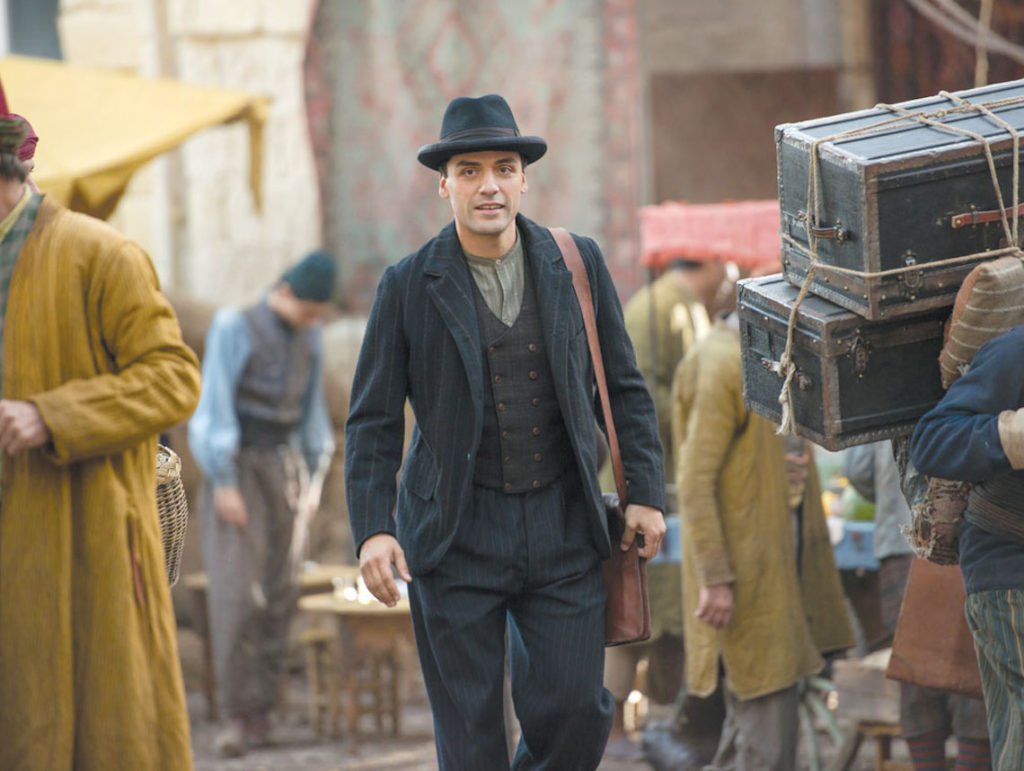
On April 21, one such movie finally makes it to the big screen. “The Promise,” a long-awaited, first-ever mass-market movie about the Armenian genocide, will be released in theaters across the nation. Starring Oscar Isaac, Christian Bale and Charlotte Le Bon, the film is a love story set in Ottoman Turkey in 1915 as the empire was coming to a rapid collapse.

Although there are numerous films that compel us to remember the horrors of the Holocaust, no such movie exists for the Armenian genocide. The annihilation of 1.5 million Armenians at the hands of the Ottoman Turks constitutes the first genocide of the 20th century. In fact, Raphael Lemkin, the Jewish lawyer and scholar of Polish-Jewish descent, coined the term “genocide” based on the Armenian massacres of 1915.

The Armenian genocide met every statute of the United Nation’s Convention on the Prevention and Punishment of the Crime of Genocide, adopted in 1948, and was recognized and defended by the International Association of Genocide Scholars — the main organization that studies genocides. Nevertheless, the Turkish government systematically denies the recognition. While many countries acknowledge the Armenian genocide, Turkey’s heavy-handed denials have prevented the United States, as well as Israel, from recognizing it as genocide. Their denial has nothing to do with fact or history, rather political expedience.

President Barack Obama made this very clear when he backtracked on his campaign promise to recognize the Armenian genocide.

“I have consistently stated my own view of what occurred in 1915, and my view has not changed,” he said. His views were that the Armenian genocide is not an allegation, a personal opinion or a point of view, but rather a widely documented, undeniable fact supported by an overwhelming body of historical evidence. Forty-five U.S. states recognize the Armenian genocide along with most foreign governments.

Nevertheless, after eight years in office, Obama refused to describe the killings of the Armenians as genocide.

The Armenian community has for a long time demanded a political recognition of the genocide by the U.S. While such a political resolution may be appropriate, it might not embed the tragedy into our popular consciousness as a film might, bringing to the screen the cold, hard facts of history.

“The Promise” is not the first film about the Armenian genocide, but it is the first large-scale film of the events. Films such as Fatih Akin’s “The Cut” (2014), Atom Egoyan’s “Ararat” (2002) and Henri Verneuil’s “Mayrig” (1991), featuring Omar Sharif, are beautifully and masterly told stories of the personal and generational effects of the horrors of history, but they are auteur films with limited reach.

Perhaps only a movie of sweep and stature like “The Promise”  can break a brutal and vicious silence of the double-edged pain of the Armenian nation, both the experience of the crime and the denial of the crime.

In “The Promise,” Isaac portrays Michael, a medical student who leaves his village of Sirun in Anatolia for Constantinople (modern-day Istanbul) at the brink of World War I. Although he is promised to a woman in his village whose dowry pays for his studies, he falls in love with Ana (Le Bon), an Armenian woman from Paris. But Ana is involved with Chris (Bale), an American journalist with The Associated Press, who is dedicated to exposing the Turkish government’s horrors and galvanizing his government to take action.

The love triangle plays out against the broad sweep of history, as the Ottoman Empire comes to a rapid collapse and genocide ensues.

To viewers of Holocaust movies, many of the scenes will seem disturbingly familiar. Michael tries to free deportees from cattle cars, spends time as a forced laborer among sadistic guards and comes across killing fields of slaughtered innocents. Although the movie doesn’t make the connection, Hitler himself did: If people didn’t care while the Armenians were being slaughtered, he once wrote, they surely wouldn’t care about the Jews.

Actor James Cromwell plays United States Ambassador to the Ottomon Empire Henry Morgenthau, one of the rare people who did care. Morgenthau documented the genocide and implored the Woodrow Wilson government to take action. In one of the film’s most resonant scenes, a Turkish official asks Morgenthau why he, a Jew, should care about the Armenians. Morgenthau shoots back that his people know what it is like to be refugees.

It was the desire to bring the Armenian genocide to mass consciousness that brought “The Promise” to the big screen. Before he died, Kirk Kerkorian, former owner of MGM and an Armenian American, entrusted Eric Esrailian, a Los Angeles physician and close friend, with making the movie. Kirkorian requested that it would be an old-fashioned epic; have a love story; and include the rescue of the Armenians of the village of Musa Dagh by the French navy.

Esrailian sought the help of veteran producer Mike Medavoy (“Black Swan”) and tapped Terry George  (“Hotel Rwanda”) as writer-director, with Robin Swicord (“The Curious Case of Benjamin Button”) as co-writer.

According to Esrailian, this was a passion project for many involved in the film. George had a keen knowledge of the Armenian genocide, having studied it while writing “Hotel Rwanda.” Medavoy, who is Jewish, was drawn to the project by the shared history of genocide.

The filmmakers remained true to Kerkorian’s vision: “The Promise” is a love story at heart, but the plot stays true to historical detail, including Turks who risked their lives to save their fellow Armenian countrymen, the New York Life Insurance Co. policy that an Ottoman ruler demanded from Morgenthau, and German culpability.

Movies not only compel compassion, they propel action. Just as “Schindler’s List” advanced our understanding of the Holocaust, etching its atrocities in our collective conscience, “The Promise” should do the same for the Armenian genocide. Holocaust movies are made so we won’t risk the loss of memory. “The Promise” was made to reassert that which has been systematically erased from our memory.

The Armenian genocide has long been omitted from Turkish academic books. One would be hard pressed to find a reputable scholar inside or outside of Turkey today who doesn’t acknowledge the events of 1915 as genocide. Yet students in Turkey continue to learn an altered version of history that’s contradictory to facts.

After the failed coup in Turkey last summer, president Recep Tayyip Erdogan purged the education ministry, expelling 15,000 students and 1,577 university deans. To control education is to control the mass mind, which is why movies like “The Promise” are essential. “The Promise” is a consequential film, first and foremost, for Turks.

To underscore their movie’s mission, the producers have created an interactive website (thepromise.movie) that provides more information about the atrocities of 1915. The website has a historical overview of the Armenian genocide as well as a timeline of all modern-day genocides. And since history is the documentation of experience, survivors or families of survivors from Yazidis in Syria to Jews worldwide can upload their personal stories on the website for documentation.

Ultimately, “The Promise” is about breaking the silence and dismantling the systematic machinery that would like us to stay ignorant or to forget. Where governments fail us, art can deliver, attaining something much greater than a political recognition and reaching into the hearts and minds of the masses.

In ‘The Promise,’ Hollywood (finally) tells the Armenian genocide story Read More »

There’s no backing down for Ed Asner, film festival honoree

Ed Asner has enough friends.

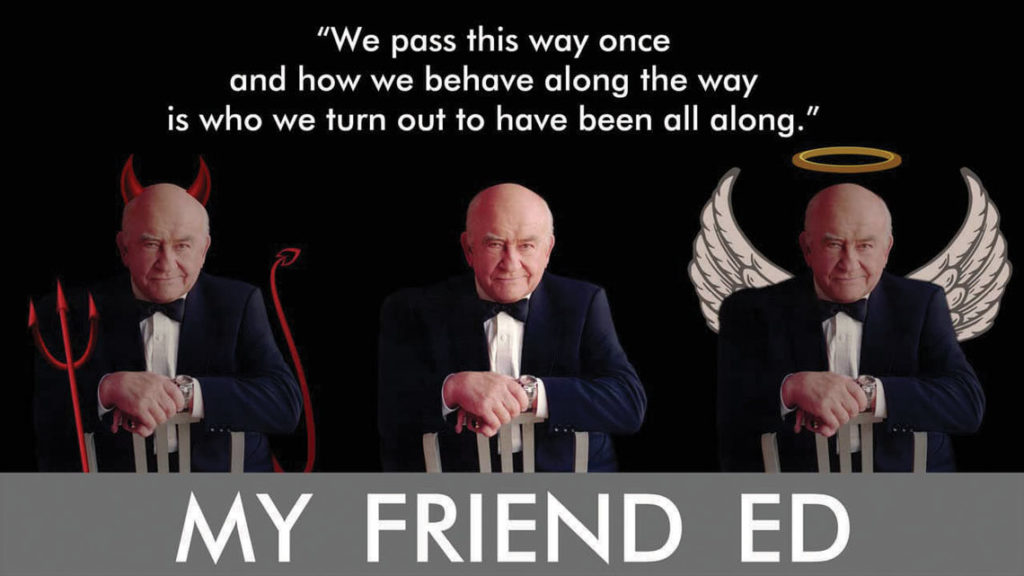
At least that’s what the veteran actor says in the new documentary “My Friend Ed,” when an interviewer tells him his political activism isn’t winning him many pals.

Asner is beloved for playing curmudgeonly characters in film and TV, from news editor Lou Grant on “The Mary Tyler Moore Show” and its spinoff series “Lou Grant,” to Santa Claus in “Elf,” to the voice of widower Carl Fredricksen in the animated film “Up.”

But the winner of seven Emmy Awards also is known for championing a wide variety of liberal causes — some that have landed him in hot water. He’s been a labor leader and autism activist who has taken stands on everything from U.S. foreign policy to Israeli settlements.

Asner will be celebrated at the opening night of the Los Angeles Jewish Film Festival (LAJFF) on April 26 with a screening of “My Friend Ed,” which includes interviews with the likes of Elliott Gould, Paul Rudd, Valerie Harper and Betty White. It will be followed by a Q-and-A with Asner and director Sharon Baker, moderated by Rob Eshman, Jewish Journal publisher and editor-in-chief.

The film festival is a program of TRIBE Media, the parent company of the Journal.

The actor — who recently presented Survivor Mitzvah Project founder Zane Buzby with an award from the Anti-Defamation League — is being honored for his accomplishments onscreen and for his humanitarian efforts, according to LAJFF founder Hilary Helstein. She had no comment about his political views and activism.

In a phone interview with the Journal, the sharp-witted actor was true to form. When this reporter said he didn’t want to take too much of Asner’s time, Asner retorted, “Then why’d you call?”

Asner said he’s happy to be recognized for his Jewish roots at the LAJFF’s opening night.

“I certainly have had times in my life when I was younger, where I tried to keep a low profile,” he said. “I regret the times I wasn’t proud to be a Jew, but those days are way past.”

Asner was born and raised in Kansas City, Kan. His father, a Lithuanian immigrant, started a junkyard and helped found an Orthodox synagogue in Kansas City. His mother was a housekeeper. Neither of his parents, he said, were social activists.

“In those days, you worried about the Jews. You worried about making your money, feeding your kids, housing your kids, educating them if possible,” Asner says in the film.

Asner’s two brothers also were focused on business, but his two sisters were social workers.

“I saw their treatment of peddlers and of those who were less fortunate,” he said, and that influenced his desire to speak out on social justice issues.

Long before he achieved fame and success, Asner was a blue-collar worker, as a crane hooker’s assistant in a steel mill in Gary, Ind., and as an assembly line worker for General Motors and Ford. He drove a cab in Chicago, sold TV advertising over the phone and sold shoes. He even trained to be an encyclopedia salesman but said he “quit that because I was nauseated with the techniques.” His empathy for the struggles of everyday Americans stuck with him.

Asner moved to New York to pursue an acting career, where, he said, “I was fortunate to get jobs fairly quickly, so I didn’t have to scour the want ads that much.” He became a rising star on stage and screen. After six years, he moved to Los Angeles, where “The Mary Tyler Moore Show” rocketed him to stardom in the early 1970s.

Activism always was an important part of his life. “My Friend Ed” includes photographs of Asner speaking at AIDS charities, Latin-American solidarity fundraisers and union rallies, appearing alongside the likes of Fidel Castro, Jimmy Carter, Jesse Jackson and Cesar Chavez.

His labor activism earned him two terms as president of the Screen Actors Guild (SAG) from 1981 to 1985, where he lobbied for higher compensation for the bulk of actors who struggled to make a living wage. He also engaged in a public feud with former SAG president Charlton Heston, who criticized Asner’s efforts to merge SAG with the Screen Extras Guild.

Asner’s Emmy-winning show “Lou Grant” was taken off the air in 1982, despite high ratings. Asner argues that his opposition to U.S. policy in Central America, and his work with the nonprofit group Medical Aid for El Salvador, led to the show’s cancellation. Sponsors of the show, including Kimberly-Clark, Vidal Sassoon and Cadbury, withdrew their support, and Asner received death threats.

“It was truly a challenge to the freedom of the artist to express his opinion. I was being humanistic, so to speak, and people weren’t interested in hearing about humanism,” Asner told the Journal.

Asner identifies himself as a socialist and has spoken out on controversial issues. He has called for a new investigation into the 9/11 attacks, suggesting the World Trade Center may have toppled with the help of explosives placed inside the building. And he was among more than 150 theater and film professionals who signed a petition, organized by the national left-wing group Jewish Voice for Peace, backing Israeli artists refusing to perform in the settlements.

While Asner still considers himself part of the 9/11 Truth movement, he no longer has a position on the Boycott, Divestment and Sanctions campaign against Israel.

“I’m not sure where I stand now on that,” he told the Journal, “although I’m certainly not a flag waver for [Israeli Prime Minister] Bibi Netanyahu.”

Asner, who does not discuss the Jewish state in the film, criticized Netanyahu for his hostile relationship with former U.S. President Barack Obama and his campaigning against the Iran nuclear deal in his interview with the Journal.

“I think that Israel is tremendously in debt to the United States. It’s almost been a protectorate all these years,” he said. “And I think that to constantly try to sway American opinion to their way of thinking denies us an independent thought of our own, such as the Iranian solution, and I have big problems with that. Especially the manner, the insulting manner.”

Asner has visited Israel once, as a guest of the Middle East Children’s Alliance.

“The Israeli government had nothing to do with it at the time. Once I got there and they saw me going around visiting Arabs as well as Jews, they got involved and wanted me to see their version of Israel, and not some suspect version, and I did that, as well,” he said.

The Israeli government added him to a military-led trip through Nablus, he said. “I expressed no opinion. I was merely keeping an open mind.”

While in Israel, he also watched an Arab theater company’s dramatic production about Arab history.

“I met some of the actors afterward and found out that they all learned several different roles. I asked, ‘Why are you multitasking?’ They said, ‘Because we get picked up from time to time by the police and we’re held over, so we never know when that’s going to happen. And when it does happen, then somebody has to take over.’ And that’s why they learn multiple roles,” he said. “And I thought, well, that’s not that kosher, either.”

Less provocative among Asner’s causes is raising awareness of autism. He has an autistic son, Charlie, and three autistic grandsons, and he hosts a charity poker tournament to support the group Autism Speaks. His son Matt Asner is vice president of development at the Autism Society of America and started the AutFest film festival.

Before “My Friend Ed,” LAJFF — which will run April 26 through May 3 — will screen the eight-minute short film “Super Sex.” Directed by actor Matthew Modine, it’s based on a classic joke in which a pair of siblings (Kevin Nealon and Elizabeth Perkins) get their elderly father (Asner) a surprise birthday gift: a prostitute (Ruby Modine). She knocks on his door and says, “I’m here to give you super sex!” Asner responds, “I’ll take the soup.”

So at the ripe young age of 87, what does Asner still hope to achieve?

“To make more money. I hate to be so mercenary, so mundane. But I still have debts,” he said. “I want to leave my four kids an estate worth keeping. And I want to keep acting until I’m lowered in the box.”

Ed Asner will be celebrated at the opening night of the Los Angeles Jewish Film Festival on April 26 with a screening of “My Friend Ed” at the Ahrya Fine Arts Theater in Beverly Hills. Tickets are $36. More information is at lajfilmfest.org.

There’s no backing down for Ed Asner, film festival honoree Read More »