fbpx

April 6, 2017

Israeli anti-missile system becomes operational

Israel’s medium-to-long-range anti-missile system became operational on April 2 as tensions on the country’s northern and southern borders have heated up. The defense system is meant to intercept rockets fired from a range of 20 to 200 miles, including those fired from the Gaza Strip toward Tel Aviv.

“I will reiterate, that whoever wants to strike us will be beaten, and those who threaten our existence are putting their own lives at risk,” Israeli Prime Minister Benjamin Netanyahu said at the official launching ceremony for the system, adding that defending the home front is of the “utmost importance.”

The system, called David’s Sling (which used to be called Magic Wand) joins the Iron Dome, which is designed to shoot down short-range rockets, such as those fired from the Gaza Strip at Jewish communities near the Gaza border, and the Arrow system, which intercepts long-range missiles of more than 300 miles. David’s Sling is designed to intercept tactical ballistic missiles, medium- to long-range rockets and cruise missiles.

“It’s always good when you have several layers of defense, as there is always some leakage [of missiles that get through],” said Shlomo Brom, a former head of the strategic planning division of the Israeli army. “This is an optimal system for dealing with medium-range missiles.”

Hezbollah has threatened to target a large ammonia storage tank in the northern Israeli city of Haifa. The Haifa District court has ordered the 12,000-ton tank shut, fearing it could cost thousands of lives if it were hit. Despite an April 1 deadline for closure, the site remains open. David’s Sling could hit a Hezbollah missile fired from Lebanon.

David’s Sling is a joint project with Israel’s Rafael Advance Defense Systems collaborating with Raytheon, which also produces the Patriot missile system. Some of the components were built by Elta, a subdivision of Israel Aerospace Industries that developed the system’s radar, and Elbit Systems, which developed the command and control mechanisms.

Vice Admiral James Syring, director of the U.S. Missile Defense Agency, attended the launching ceremony and Netanyahu addressed part of his speech to him.

“Admiral, today marks an important milestone in our joint development of cutting-edge missile defense technologies. We face, both of us, increasingly sophisticated threats, but we have repeatedly demonstrated that together we can meet these challenges a lot better than any one of us could do so alone,” he said.

“We’re white and blue, [but] red, white and blue, in this context, works even better.

“At a time when budgets are tight, please know that the government of Israel and the people of Israel are deeply grateful for the ongoing support by the United States of this crucial effort and the ongoing support of the United States for the general defense of Israel,” Netanyahu said.

The new system comes as President Donald Trump has said he wants to cut budgets for foreign aid.

“When it concerns declarations, President Trump is very supportive of Israel, but a basic element of the policy that he talked about during the campaign is that he wants to cut U.S. foreign aid expenses because America is first now,” Brom said. “If this project is continuing, it shows the U.S. wants to make an exception when it comes to Israel.”

Israeli anti-missile system becomes operational Read More »

After new building restrictions, Israeli settlers lower expectations for Trump era

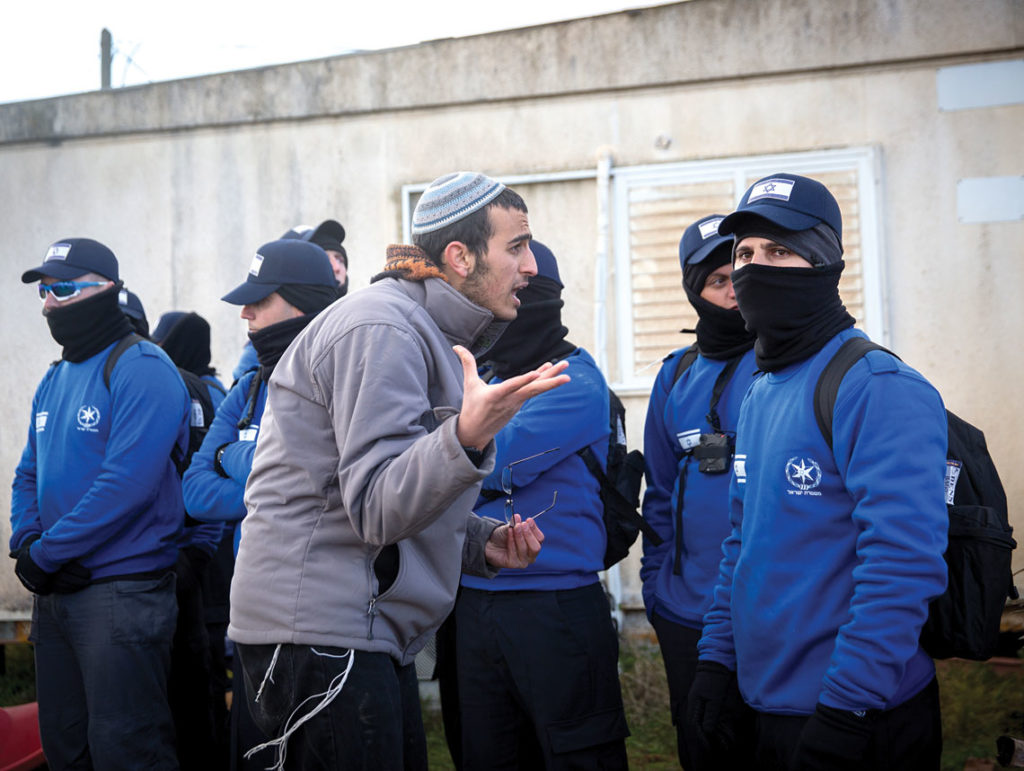
In response to new curbs on West Bank construction, Israeli settlement supporters hoped for the best and expected the worst, tempering their initial euphoria at Donald Trump’s election as U.S. president.

Pro-settlement leaders who advocate Jewish control of the entire West Bank went as far as to welcome the March 30 announcement that the government, in a nod to Trump, would restrict construction to developed areas of existing West Bank Jewish communities. Others hoped the restrictions did not amount to a freeze on settlement building.

No one was talking about bringing down the government, which has been shaky in recent weeks over the obscure issue of public broadcasting.

“You need to understand that people built up an expectation that there would be a new president, the old era would end and we’d be able to do whatever we want,” Yesha Council foreign envoy Oded Revivi said on April 2. “All of a sudden, reality doesn’t look like our expectations.”

Much of the Israeli right anticipated Trump would give Israel a freer hand in the West Bank than had his predecessor, Barack Obama. But since being elected in January, Trump has backed off his pledge to move the U.S. Embassy to disputed Jerusalem from Tel Aviv and made moves toward the final-status agreement he has said he wants to broker between Israel and the Palestinians.

Some observers have speculated that Prime Minister Benjamin Netanyahu wants Trump to push back on settlements for fear of his own right-wing coalition.

Having welcomed Trump’s election by announcing “the era of a Palestinian state is over,” Education Minister Naftali Bennett at first expressed cautious optimism on April 2 at the weekly Cabinet meeting in Jerusalem.

“The arrangement is a fitting one, but the proof will be in the pudding,” Bennett reportedly said.

Later in the day, he tweeted halfhearted criticism after the Israeli daily Haaretz reported leaks from the meeting that the prime minister not only proposed limiting settlement construction, but also a raft of measures to benefit the Palestinians.

“We are back to the same old two-state solution that will lead nowhere but to frustration,” Bennett said. “I can’t complain because this has always been Netanyahu’s declared policy.”

Netanyahu announced the new settlement policy on March 30 in a meeting of the security cabinet. He told his top ministers that the policy was a goodwill gesture to Trump, who last month said settlement expansion “may not be helpful” in achieving peace and asked Netanyahu to “hold back on settlements a little bit.”

According to the Prime Minister’s Office, Netanyahu said settlement construction would be limited to previously developed areas of the West Bank. But where security or topography prevented this, new homes would be built as close as possible to the developed areas. Israel would not allow the creation of any new illegal outposts, he said.

Citing five participants in the meeting, Haaretz reported that Netanyahu also would allow the Palestinians to build in Area C of the West Bank, where Israel has full civil and military control, and said “we have to act wisely” in eastern Jerusalem.

“This is a very friendly administration and we need to be considerate of the president’s requests,” Netanyahu said, according to Haaretz.

Hours earlier, the security cabinet approved the establishment of the first entirely new settlement in two decades for families evicted last month from Amona, an illegal West Bank outpost. That settlement would not be affected by the policy, which the White House welcomed.

Most of the world considers as illegal all Israeli construction in the territories it captured in the 1967 Six-Day War. But Israel disputes this view and allows government-authorized settlements on land not demonstrably owned by Palestinians. While Israel stopped building new settlements in the early 1990s, it has retroactively approved outposts and let existing settlements expand.

On March 31, Revivi put a positive spin on Netanyahu’s policy change, saying the Yesha Council, the main umbrella group for the settlements, would keep an eye on the West Bank — which he referred to by its biblical name, Judea and Samaria.

“The Yesha Council welcomes the cabinet decision to support new building projects across Judea and Samaria, in addition to the establishment of a new town for the former residents of Amona,” he said. “We will be monitoring the government very closely to see that these plans come to fruition, enabling a new era of building throughout our ancestral homeland.”

Shlomo Brom, the head researcher on Israeli-Palestinian relations at the Institute for National Security Studies, said that if the policy were strictly enforced, it would dramatically reduce West Bank construction. But Brom said many settlers seem to be betting the policy would be “flexibly” interpreted, which could allow the settlements to gradually expand indefinitely.

Noting that his think tank in January urged Israel to limit settlement construction to the major settlement blocs, Brom said this policy “is not close” to that.

Meanwhile, several right-wing lawmakers worried that the restrictions amounted to a suspension of settlement building. Yehudah Glick, a Knesset member in the ruling Likud party who lives in a settlement, held out hope in a tweet that this was not the case.

“I hope, in contrast to the commentators, that the government did not decide on a freeze on settlement construction,” he said. “We cannot accept this. Construction in Judea and Samaria is important for those who want peace.”

Bezalel Smotrich, an often-inflammatory Jewish Home party lawmaker who also lives in a settlement, suggested that Israel’s political right had lowered its expectations too far.

“This morning, on my [news feed] and according to the commentators — the right wing claims that the cabinet decided yesterday on construction [in the West Bank], the left claims that there is a freeze,” Smotrich tweeted on March 31. “Unfortunately, this time the commentators on the left are correct. The right is willfully blinded.”

Revivi, who is also the mayor of the Efrat settlement, said settlers have been most disappointed by Netanyahu. He said the prime minister blamed Obama for the lack of construction in the West Bank for years, but that is harder to do with Trump, who is seen as more sympathetic to Israel.

Especially after the evacuation of Amona, Revivi said, “people feel that promises are made but not really fulfilled.”

Judy Simon, the former tourism coordinator for the Beit El settlement and a teacher there, said she has lost faith in the government’s commitment to the settlement enterprise since Trump took office.

“Here we have the most pro-Israel government we’ve had [in Washington] in a decade, some say decades, and yet building is still being limited. What that says to me is the king has no clothes,” she said. “But God promised this is our land forever, and God never reneges on his promises, unlike some politicians.” n

After new building restrictions, Israeli settlers lower expectations for Trump era Read More »

How to stand together

When I woke up one morning a few weeks ago and saw the photos of more than 100 desecrated graves at Mount Carmel Cemetery in Philadelphia, I felt bereft.

In the 18 months since my husband died, I have been a frequent visitor to his grave, finding solace in the sanctity and peace of the cemetery. On the morning after the incident in Philadelphia, I rushed through my morning tea and returned after several months away. Walking through the grounds, I felt them all present, demanding an answer: Will you be silent or will you speak up?

That evening, I read about the Muslim veterans across the country who had tweeted their offer to stand guard at Jewish cemeteries, and about the incredible fundraising campaign in the Muslim community, raising $135,000 to repair the broken gravestones. 

Those who wreak havoc in the name of hate are a very few, outnumbered by those of us who want to live together in love and in peace.

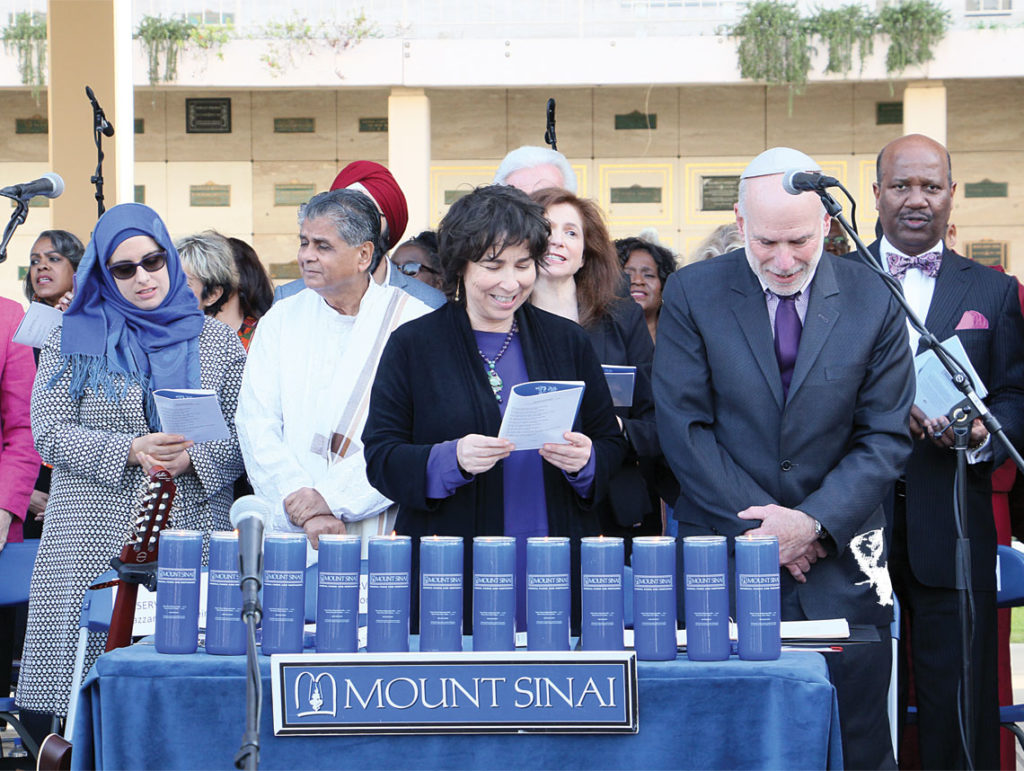
Rabbi Neil-Comess Daniels, of Beth Shir Shalom in Santa Monica, and Hazzan Mike Stein, of Temple Aliyah in Woodland Hills, share this vision, and we decided to create an interfaith gathering for unity, love and mutual respect. We wanted to create something that did not stand against anything — we’ve all had quite a lot of that lately. What we wanted was to joyfully affirm that we are indeed who we know ourselves to be: loving, peace-seeking, fair-minded people who respect one another and hold one another in the highest regard.

It was surprising, maybe even disappointing, that there were some people — rabbis, community leaders, heads of boards — who were hesitant about this event. They thought it was a mistake and that it would be better to “lay low,” not make a splash, avoid becoming a target. While respecting the impulse to be protective, this was so foreign to our own inner directive of “Silent never again!”

Len Lawrence, general manager of the Mount Sinai Memorial Parks and Mortuaries, immediately rose to the call, and with true conviction and generosity, turned to staging an event he hoped would resonate throughout the country.

“We put in a new, large sign at the entrance to the memorial park recently,” he explained, “and some people told me that in times like these, I was crazy to do so. I told them that it is exactly in times like these that I am going to stand even taller. I am proud of what we do and proud of who we are and will never be scared to say so.”

We realized we wanted a way to ground our intention to stand in unity, and to defend one another and our holy sites. So we wrote a unity pledge that was read aloud by everyone present, and our elected officials and clergy signed it. Making a pledge in the presence of our ancestors, resting in peace below our feet in the beautiful hills of Mount Sinai, felt both solemn and joyous. A month after that day in the cemetery, I was able to answer the question posed to me by the spirits I had met.

The religious leaders (more than 30 of them) strode up the walkway to the grand setting with an air of sacred joy, of reunion with one’s family. Our Tibetan Buddhist monks — whose chant during the blessing ceremony gave many of us goosebumps — later said they had felt as if a cloud of blessing had descended upon the entire city. Elected officials — Los Angeles Mayor Eric Garcetti, state senators and assembly members, four other mayors, City Council members and two police chiefs — had that same sense of presence and emotion. It was clear that they were there because of a personal need to stand shoulder to shoulder with their community, and assert their commitment to love their brothers and sisters as themselves.

City Controller Ron Galperin led the Kaddish. City Attorney Mike Feuer, as one of the participants in our responsive prayer, read this verse from Leviticus: “And if a man from another country is living in your land with you, do not make life hard for him; Let him be to you as one of your countrymen and have love for him as for yourself; for you were living in a strange land, in the land of Egypt: I am the Lord your God.” City Council President Herb Wesson had tears in his eyes when he read this from Holocaust survivor and Nobel Laureate Elie Wiesel: “I swore never to be silent whenever and wherever human beings endure suffering and humiliation. We must take sides. Neutrality helps the oppressor, never the victim. Silence encourages the tormentor, never the tormented.”  

My late husband, actor-musician-activist Theo Bikel, always warned against silence and implored us to speak out. He used to say: “We are like a field of flowers, each distinct and with roots of our own. But together we are a gorgeous field. I take care of my own flower not because it is better or more special but because it is my duty, and otherwise it will wither and die — and the beauty of the field will be forever diminished. It is the beauty of this field that I ultimately hold most cherished.” It was his legacy we celebrated while raising our voices together, flowers in a field, united in love.


Aimee Ginsburg Bikel is a journalist who was a correspondent for Yedioth Ahronoth for 16 years. She is the founding director of the Theodore Bikel Legacy Project. She was married to actor, musician and activist Theodore Bikel from 2013 until his death in 2015.

How to stand together Read More »

We refuse to fall into the abyss

On Jan. 18, 2016, a Palestinian youth entered my hometown and stabbed my beloved wife, Michal, who was five months pregnant at the time. One young terrorist brought us face to face with the pain, danger and hatred that has accompanied our return to Zion. A few days of mortal danger for a beloved woman and an unborn child clarified the moral obligation we have to defend ourselves without compromise.

Last Oct. 16, I published my first post calling on the people of Israel to take action against the horror taking place just beyond our border in Syria. Thousands of Israelis responded, creating the largest crowdfunding campaign in Israel, raising millions of shekels for humanitarian aid — aid that was transferred by the Israeli Flying Aid organization to the real victims of that war: the suffering children in Syria.

These donors were thousands of Israelis who did what people in no other nation have done, not even Muslim countries. Thousands of Israelis who, with donations large and small, chose to be on the right side of history. This was done despite the bloody history between the Syrians and Israelis, despite the current situation between the two countries, which is full of hate, despite the uncertain future between us. Or, in the words of one of our donors: “My husband and my brother were killed in Israel’s wars with Syria, and my donation is the way I choose to honor them.”

This is not my personal story; it is the story of Israeli society, a small example of the strange existence that is our reality. Rabbi Nachman of Breslov said the whole world is a very narrow bridge, and the important thing is not to be afraid. To live the true reality of our lives, we must achieve a delicate balance in crossing this bridge, without falling into either side of the abyss.

On the one side is an abyss of surrender to those who want to destroy us; an abyss they have tried to throw us into in the past; an abyss they hope will swallow us in the present. On the other side is the abyss of focusing only on our own existence, of drowning out everything and everyone else.

But despite our enemies’ hopes that we will either fall into one abyss and disappear or descend willingly into the other, and despite their accusations, we, the Jewish people and Israeli society, are carefully traveling across this bridge. We refuse to fall into the abyss. We refuse to lose ourselves and our identity as Jews in the Land of Israel. We also refuse to lose the image of God within us and our responsibility to others, even when they are our enemies.

There is so much pain in this world, and so many people who are purposely inflicting that pain. And it saddens me that the United Nations has chosen again and again to focus on Israel, a nation that is walking a very narrow bridge. We’ll continue on the path we have chosen because that is who we are. We will continue to exist as we are, because that is what is right and what is true. We will continue to exist as we are, because it is the righteous way to defeat the likes of those in the Boycott, Divestment and Sanctions movement who are against us.

My father passed away four years ago. Menachem Froman z”l was a rabbi, a resident of Judea and Samaria, and a peace activist. My father taught me that we were born with two hands. One hand with which to defend ourselves, and a second hand to extend in peace, compassion and caring for others. He taught me that our lives should be the clapping that happens when these two hands come together. Our lives should be an ongoing encounter between these conflicting motivations.

So let us raise both hands. Let us honor those two tasks — for the people of Israel, for the State of Israel, for our right to exist in our homeland, for our constant desire for peace, for the Israel Defense Forces and those who stand up for Israel, for Israelis who are engaged in acts of humane compassion, wherever they may be, for all those sharing our prophets’ vision of making the world a better place.

This is our story.

This article is adapted from a speech delivered on March 29 at the United Nations and reprinted at timesofisrael.com.


SHIVI FROMAN is an Israeli human rights activist and co-founder of Just Beyond Our Borders, a crowdfunding initiative that provides humanitarian aid for children in Syria.

We refuse to fall into the abyss Read More »

A Passover without sustenance in South Sudan

Each year, we gather with family and friends for our Passover seder. We lift the matzo and remember how we were once slaves in the land of Egypt. We talk about the blood, locusts, boils, hail and so on, then we dig in to our “festive meal.” We remember, and then we eat. How lucky are we?

This year at Jewish World Watch (jww.org) — the anti-genocide organization where I serve — we are going beyond remembering the traditional Exodus story of the Hebrew slaves. Our Passover conversation also remembers the fleeing, homeless refugees and displaced people worldwide whose number, according to the United Nations High Commissioner for Refugees (UNHCR), has officially topped 65 million. They, too, are innocent people who’ve lost their homes and their livelihoods through violence perpetrated, in many cases, by outright hostility from their own governments.

Bombs, not hail, have fallen from the skies over Syria and in the Nuba Mountains of Sudan. Deliberate acts of arson, not frogs, have destroyed the farms of peace-loving South Sudanese. And rampant sexual violence against women and children — there are too many places to name where that behavior is just a fact of life.

What do these stories have to do with Passover? For those who survive the modern-day plagues to flee, these are their Passover stories. We need alter our haggadah only slightly to see the parallels: We must remember that we were once refugees from the land of Egypt. We fled from the torment of a greedy and vicious head of state — Pharaoh —  who profited from our labor and tortured us because we were ethnically different, and because we sought freedom from his tyranny.

But in our flight, we had an extraordinary asset: Moses, a stalwart, though initially unlikely, leader who stood up for our rights and dignity. An inspirational, albeit flawed, figure who tried to advocate peacefully before leading us out of bondage.

And we had matzo. As flat and tasteless as it still may seem, we brought it with us as sustenance as we headed to the desert where, unbelievably, we were gifted with the manna that kept us alive.

We must ask ourselves: Who is Moses for today’s refugees?

We must ask ourselves: Who is Moses for today’s refugees? And where is the matzo — and the manna — for the famine-afflicted people attempting to find food for their children and themselves in civil war-infested South Sudan? I call out South Sudan, in particular, because it is one of the countries in which Jewish World Watch has long invested. So, at our Passover meal, we will remember that, despite the efforts of Jewish World Watch and many other international nongovernmental organizations, innocent people in South Sudan, the world’s youngest country, are dying of starvation because of a senseless civil war. 

The United Nations reports that more than half the population is in need of humanitarian assistance and protection, with 1 million people at risk of famine. And just two years after the country became an independent nation, 1.9 million people in South Sudan have become internally displaced. Another 1.6 million people have exited its borders as refugees. Many of those refugees are children orphaned by the civil war.

Who will be Moses for the people of South Sudan? Who will save lives by offering support and sustenance? It’s up to you and me to help fill in the gap. Jewish World Watch is embarking on an emergency campaign to help respond to this crisis. 

Most of all, we must recognize that the humanitarian crisis will end only when South Sudan’s leaders are forced to end the civil war and address the corruption, poor governance and fractures within the ruling Sudan People’s Liberation Movement. A united effort to put pressure on the key actors and their warring factions in the conflict must come from all of us, and from the United Nations, the African Union and the United States.

We cannot stand idly by.


SUSAN FREUDENHEIM is executive director of Jewish World Watch.

A Passover without sustenance in South Sudan Read More »

Not Iranian

You would think I’d be used to it by now.

In the 1980s, at a dinner party at the home of a Muslim Iranian friend, an older woman sitting next to me panics when she realizes I’m Jewish. Quickly, she gathers her coat around her and hugs herself tight to create as much space between us as she can. Later, the host explains that the old woman still believes what she was taught as a child in Iran — that Jews are najis (ritually impure) and will contaminate anything they touch.

In the 1990s, at a book talk in Portland, I’m confronted by an angry group of nearly 100 Muslim Iranian men and women who demand to know why I feel the need to write about the persecution of Jews in Iran under Shia Islam. The evening  ends  when one woman — a dentist — asserts without irony that it is indeed true that Jews are najis. It also is true, she goes on to say, that Jews have little tails hidden by their clothes. Everyone hears her, but not a single person in the room steps in to correct her.

These are not everyday occurrences. For every bigoted Muslim Iranian I know, I’ve also known a dozen civil, enlightened and cultured ones. Many of them, in fact, are more accepting of Jews than Jews are of them.

They’re not everyday occurrences, and yet, when they happen, they all but take my breath away.

In the 2000s, I’m in the studios of a Persian-language radio station in Los Angeles. As I wait for one program to end and my interview to begin, I hear an angry caller yell at the host that he should not refer to Iranian Jews as “Iranian.” “Those people are not and have never been Iranians. They were subversives we let live in our country.” The caller is somewhere in the United States. After he signs off, a second caller, then a third echo his sentiments.

Last week, I happened upon a Facebook conversation among a few Iranian Muslims about Iranian Jews. The subject is “Iranians who attended the AIPAC conference,” and how “these are the same people who voted for Donald Trump.” This, we all know and understand, means something like, “Iranian Jews all support Israel and would like to bomb and obliterate Iran, and that’s why they voted for Trump.”

In response to the post, people have made comments such as, “Those people are not Iranians; they’re Israelis disguised as Iranian” or “Those are Israelis who speak Farsi.”

The most vocal of the anti-Zionists in this conversation has been firing off pictures that depict Jews as little devils sitting on piles of money, and worse, for years.

Iranian Jews have been in Iran, and before it in Persia, since before Persia itself. They were brought in as slaves by Nebuchadnezzar, from Palestine, after he destroyed the First Temple in 586 B.C.E. They were there for 12 centuries before the Arabs conquered the country and forcefully converted most of the population to Islam. And they’ve been there since. And still, we were — are — told we’re not “real” Iranians.

I write that this is anti-Semitic talk wrapped in anti-Israel lingo. I say that support for Israel as a nation, or for Zionism as an idea, does not make a person subversive. This, in turn, unleashes a torrent of comments about the evils of Zionism, Israel’s treatment of Palestinians, and how it is I, and other Zionists, who should apologize to the world, and not the other way around. In short order, I’m told by my fellow Iranian Americans that “most Jews are self-hating”; that Jews “should go back to Germany, yallah”; that “Jews should go to Africa, where their ancestry started”; that “hell hath no fury like that of Iranians who are blinded by the Zionist dream”; and that “Israel should be established in the United States” so that the “Middle East will again be peaceful.”

Anti-Zionism by Iranian Muslims, in short, is not the same as anti-Semitism.

Well, maybe.

Except, you see, Israel as a country is 69 years old; Jews have been persecuted in Iran, called “not Iranian,” accused of sedition, declared untouchable, since Iran became Shia 700 years ago.

And there’s also this: The most vocal of the anti-Zionists in this conversation has been firing off pictures that depict Jews as little devils sitting on piles of money, and worse, for years. From what I can tell, she still has hundreds of Iranian Facebook friends. In fact, when I raise this person’s past online activities, only 1 out of nearly 50 Iranians engaged in the conversation steps up to say, “This is wrong.”

Now, I don’t believe that being opposed to Israel’s settlement policy or Prime Minister Benjamin Netanyahu’s government, or being sympathetic to the plight of the Palestinian people, is tantamount to anti-Semitism. By that measure, I imagine half of the Jews in the world — I among them — would be anti-Semitic. But I do wonder, when it comes to Muslims in Iran and abroad, how they distinguish between the suffering of the Palestinian people and that of, say, the half-million Muslim civilians in Syria since 2011, or 1 million in Iraq since 2003, another 1 million in the Iran-Iraq war of the 1980s — where is their outrage at these and countless other Muslim-on-Muslim, Shia-on-Sunni, Arab-on-Arab or Arab-on-Iranian atrocities? Why do they call for boycotting Israel but oppose sanctions on Iran?

Most of the Muslims I know are too civil, enlightened and cultured to be consciously anti-Semitic. I’m not being coy when I say that I truly do not understand the double standard these tolerant Muslims apply to the Arab-Israeli issue as opposed to all other Muslim-related tragedies. But I will say this, because I think it bears thinking about: None of us, Jews, Muslims or others, is free of prejudice.

Often, the racism is so old and deeply engrained that we truly don’t recognize it for what it is. I wish these enlightened Muslims would consider this possibility. Because, let me tell you, it doesn’t get any easier, doesn’t hurt any less to be told, by your own people, that you’re not one of them.


GINA NAHAI’s most recent novel is “The Luminous Heart of Jonah S.”

Not Iranian Read More »

We need to ‘seize opportunity’ with Trump, Palestinian official says

Conditions are ripe for a regional peace initiative given President Donald Trump’s interest in achieving a peace settlement between Israel and the Palestinians with the backing of Arab countries, says IDF Brigadier General (Res.) Michael Herzog, who was involved in every round of negotiations since the Oslo Accords, including in the years 2013-2014 on behalf of Prime Minister Benjamin Netanyahu.

[This story originally appeared on jewishinsider.com]

During a panel on the Israeli-Palestinian peace process with Jibril Rajoub, Secretary of the Fatah Central Committee, hosted by the Israel Policy Forum in New York on Wednesday, Herzog said that one of the reasons the most recent regional peace initiative (in 2016) fell apart was because the Obama administration didn’t want to be part of it. “I think they did not believe that this would yield results. To my knowledge, both sides – the Israelis and Palestinians – did not trust the [Obama] Administration to be the leading part of that initiative and the administration didn’t want to be part of it,” he explained.

The principles of the initiative were agreed upon during a secret peace summit between Israeli Prime Minister Benjamin Netanyahu and Jordan’s King Abdullah II and Egyptian President Abdel Fattah al-Sissi in Aqaba, according to a report by Haaretz. The proposal later served as a basis for talks between Netanyahu and Opposition Leader Isaac Herzog on joining a national unity government. As reported by Haaretz, the plan was laid to rest after the coalition talks fell through in late 2016.

During Netanyahu’s meeting with President Trump in February, the two leaders agreed on reviving that plan with the backing of Saudi Arabia and other countries in the Gulf region.

“This administration is willing to involve the region in the peace process,” said Herzog. “I still don’t know how they are going to design the process. I don’t know if they have a strategy yet. We just have to wait and see. But it’s clearly a priority for this administration.”

Following a meeting with King Abdullah of Jordan on Wednesday, Trump said, “I’m working very, very hard on trying to finally create peace between the Palestinians and Israel, and I think we’ll be successful,” The President called Abdullah a “tireless advocate” for a peace settlement “and he’s going to help me with that and help me at the highest level. And we will be consulting with him closely in the days ahead.”

Rajoub, after expressing regret at some of his past statements and promising to be more cautious in the future, agreed that the Palestinians need to “seize this opportunity” with the Trump Administration to renew peace talks. Asked if the Palestinians would agree to enter into negotiations without a full settlement freeze, Rajoub told Jewish Insider, “The settlements, believe me, brother, its existence is a threat to the state of Israel. We are talking about two states – with two territories. Why expand it? Listen, I think it’s the time to freeze all settlement activities. Believe me, it’s a benefit to the Israelis like it’s a benefit to the Palestinians.”

According to Herzog, Trump has leverage on the Palestinian Authority to bring them to the negotiation table if Israel follows through with the new policy restraint in settlement activity. “I think the Palestinians will demand a freeze,” Herzog told Jewish Insider after the event. “However,  I believe that if the Trump Administration pushes them to enter negotiations even with Israel just restraining settlement activity, I don’t think they have an alternative. I do think Trump has leverage over them. You don’t want to mess with him. And since he prioritizes the peace process and wants a deal, he has leverage on them. They will have to do with some kind of restraint, and if he pressed them they will follow.”

We need to ‘seize opportunity’ with Trump, Palestinian official says Read More »

A dysfunctional family’s long journey to seder in a dystopian America

All the stars are in alignment for a remarkable new book by novelist and short-story writer David Samuel Levinson, “Tell Me How This Ends Well” (Crown Publishing/Hogarth). Set in a dangerously dystopian Los Angeles a scant five years in future, the story focuses on the Passover gathering of the Jacobson family in Calabasas, and the author’s timely commitment to truth-telling in the guise of a comic novel is evident from the outset.

A Passover seder at the Jacobson house, we are told, is “like a terrifying golem made from the clay of behavioral tics and personality disorders — a litany of ills and a penchant for hypochondriasis and full-blown neurosis, with bouts of accompanying sanctimony, blinding narcissism, and a plain, old-fashioned, wrath-of-God-style guilt.”

The prime mover of the Jacobson family’s dysfunction is Julian, the paterfamilias, who possesses an “obscenely pronounced underbite, which went hand in hand with the rest of his handsome albeit cavemanlike face, thick, bushy eyebrows, broody, overhanging brow.”  Julian is the problem to be solved by his three long-suffering adult children, Jacob, Moses (known as Mo) and Edith.

Jacob is a gay man with a problematic German lover, and his siblings call him “Gay-Jay.” Mo is a “registered dietician and semifamous actor.” Edith adopted the nickname Thistle in early adolescence, and Jacob describes her as “our Thistle of the Congregation of Least Resistance.” We see the story through the eyes of each sibling in turn, but it is Gay-Jay who first imagines taking the final Oedipal step to protect their ailing mother from what they fear are the evil intentions of their father, a notion that may or may not be a joke.

“[Jacob] had a sneaking, awful suspicion, though, that because he was the youngest and thus usually dared and bullied into mischief by his older brother and sister, it would fall on him to interview the hit men, whomever Mo had found to do it, probably former, disbanded Mossad operatives — the USA was rife with them,” Levinson writes. Mo has a different idea: “If we were keeping with the Passover theme, then we’d drop him off in the middle of the desert without food or water,” Mo cracks. “He wouldn’t last forty hours, much less forty days in that heat.”

But the author’s anxieties transcend those of the Jacobson family, which is why “Tell Me How This Ends Well” has been compared to Philip Roth’s memorable novel about an anti-Semitic version of the history of the United States, “The Plot Against America.” Levinson imagines that an isolationist American president has refused to come to the aid of Israel in a war with Syria, Iran and Lebanon, a catastrophe that has resulted in the destruction of the Jewish homeland, a massive influx of Israeli refugees, and an upwelling of violence against Jews: “[A]nother torched synagogue, another murdered youth, another suicide bomber on the 405 or the 101, the anti-Semitism that swept across L.A. with the tenacity of a wildfire.”

So Levinson dares to play out a worst-case scenario that overshadows the woes of all unhappy families: “They’d given Israel back, yet the world still came for them,” muses Edith, who happens to be a professor of ethics. “How could anyone have guessed that a mere eighty years after the end of World War Two the Jews would be made to roam the world yet again?”

Levinson has been compared by the early blurbers of his book to authors ranging from Roth to Nathanael West to Flannery O’Connor. (I would add Joseph Heller to the list.) But Levinson also deserves to be praised for qualities of his own — a mastery of verbal invention and rhetorical pyrotechnics, an imagination that shocks us by showing us an alternate future that is all too plausible nowadays, and a gift for humor so dark that we find ourselves dancing on the edge of the grave.

By the time we reach the Passover seder itself, the opening words of the Four Questions (“Why is this night different from all other nights?”) suggest a new, different and especially terrifying answer.


Jonathan Kirsch, author and publishing attorney, is the book editor of the Jewish Journal.

A dysfunctional family’s long journey to seder in a dystopian America Read More »

Stephen Bannon reportedly calls Jared Kushner a ‘cuck’ and a ‘globalist’

A report on emerging tensions between Jared Kushner, President Donald Trump’s son-in-law and adviser, and Stephen Bannon, his top strategist, said Bannon called Kushner a “cuck” and “globalist,” terms familiar to “alt-right” conspiracy theorists.

A Daily Beast report on Thursday detailed Bannon’s alleged use of the pejoratives. “Cuck,” a play on “cuckold,” is the alt-right term for conservatives who allowed themselves to be played by liberals and the establishment.

“Globalist” refers to theories of a conspiracy of elites to maintain control of the global economy. Its use has overlapped with anti-Semitic theories of Jewish financial control, but it is not a term used exclusively by anti-Semites. Kushner is Jewish.

Before joining the Trump campaign last summer, Bannon helmed Breitbart News, a site that he said was a platform for the alt-right, a loose assemblage of anti-establishment conservatives that includes anti-Semites, as well as some Jews and some fierce defenders of Israel.

News of the tensions between Bannon and Kushner, who reportedly were close during the campaign, follow Trump’s order this week removing Bannon from the National Security Council.

Kushner, according to the reports, believes Bannon went too far in pushing for travelers’ bans and in playing hardball with Congress in an attempt to replace the Affordable Care Act. Both initiatives failed.

Bannon, according to the reports, in turn resents Kushner for bringing into the White House figures associated with Democrats, including Gary Cohn, the former Goldman Sachs banker who is Trump’s chief economic adviser, and Zeke Emanuel, a physician who consulted with the Obama administration on the Affordable Care Act and is the brother of Rahm Emanuel, President Barack Obama’s first chief of staff. Kushner reportedly has hosted three meetings with Zeke Emanuel. Cohn and Emanuel are Jewish.

Stephen Bannon reportedly calls Jared Kushner a ‘cuck’ and a ‘globalist’ Read More »