Journalists cover stories—we don’t make them. Once in a while, though, stories find us, and they move our hearts so much that we can’t help adding to the original story.
This is what happened to my friend Sharon Waxman, founder, CEO and editor-in-chief of the popular entertainment and culture news site, The Wrap.
I’ve known Sharon for years. Before starting The Wrap, she covered Hollywood for The New York Times. One of the things I’ve always admired about her work is a no-nonsense quality to covering glamorous subjects. She’s not starstruck, she’s storystruck. Earlier in her career, she covered foreign affairs in Europe. Now she covers cultural affairs in Hollywood. She’s still the same journalist looking for real stories.
On her way to a Brentwood restaurant on a recent Friday night, she stumbled onto one of those real stories. She noticed a 40ish woman sleeping beneath an outdoor heater at The Coffee Bean and Tea Leaf. Next to the woman were her two teenage daughters, slumped against one another.
They were in the same position when Sharon came out of the restaurant. She couldn’t resist. She doubled back and asked the woman, Katherine, if she needed help. They were homeless, Katherine explained. She and her 19-year-old twins had nowhere to go.
One thing that caught Sharon’s eye was that Katherine was well-dressed and articulate, while her twins were beautiful girls with wide eyes that said “they expected nothing from anyone.” As they laid there with no place to go, they even charged their cell phones.
Sharon decided this was a story. So she stayed and asked questions. Here’s what she wrote later on her Waxword blog:
“In a resigned monotone, Katherine said that all the shelters were full. That since her daughters weren’t pregnant and none of them were drug addicts, they could not get into city programs. A Veteran Administration facility was less than a mile away on a huge federal plot of land, but they weren’t veterans.
“Family would not help them, she said. She had a car up until a few weeks ago but it was repossessed when she learned the payments she’d been making on a friend’s car were going elsewhere.
“I asked when was the last time they’d slept in a bed.
“Three weeks, they said.”
But here’s where the story takes off. After Sharon published the story, a group of people started reaching out to help. Within a week, the “Wrap community” was able to raise $2,000 via a Gofundme campaign to put Katherine and her girls in temporary housing. Of course, Sharon knew this wasn’t a longterm solution. So she set her investigative eye on city services. Here’s what she wrote on April 3:
“Social services that claim to exist to help families like this—I keep hearing about this terrific, phantom thing called ‘Rapid Rehousing’—have been missing in action.
“The two local organizations, OPCC or The People’s Concern, and St. Joseph—where everyone tells me the people are hard-working and professional—need to do their part. So far a case worker from St. Joseph has failed to show up to two appointments. I’d love to know why. Where’s the OPCC?
“Katherine and her daughters are burning through the money we’ve raised at a local motel. Scott and Lori Sale are willing to provide support for longer term housing, but not without the support of a case worker, which is critical. What’s the deal, social services?”
Yes, what’s the deal?
Sharon is not letting go. She’s tweeting about the case and moving the story forward. When I emailed her saying how much I loved the initiative, she used the term “nightmare” to describe the case. Her focus now is to help publicize the plight of Katherine and her two daughters and get them longer term help.
Knowing Sharon, I’m sure she would have preferred if my lead to this story was an appeal for help. I do hope the help will come through and that this story has a happy ending. But I can’t help seeing another story here that I stumbled upon—that of a journalist who walked out of a restaurant on a Friday night and decided not to ignore human pain.
U.S. warships launched 50-60 missiles at an airbase in northern Syria in retaliation for a chemical weapons attack on civilians in President Donald Trump’s first major intervention in the Middle East.
The Tomahawk missiles hit Shayrat airfield on Thursday, north of Damascus, CNN reported, citing Pentagon sources. The Bashar Assad regime is believed to have launched the chemical attacks on Iblid province in northern Syria earlier this week which killed at least 82 civilians, including many children.
Trump ordered the attack from his Mar-A-Lago estate in Florida, where he is spending the weekend.
“It is in the vital national security interests of the United States to prevent the spread and use of deadly chemical weapons,” Trump said in a short statement to the media at Mar-A-Lago.
As a result of Assad’s repression and use of chemical weapons among other means, Trump said, “the refugee crisis continues to deepen and the region continues to destabilize threatening the United States and allies.” Trump has said he sees the exodus of refugees from Syria as a threat to the West because of terrorists who may be among them. He has twice sought to bar their entry into the United States; both bids were stayed by the courts.
Trump had indicated earlier that he was considering action.
“Yesterday, a chemical attack — a chemical attack that was so horrific, in Syria, against innocent people, including women, small children, and even beautiful little babies,” Trump said Wednesday during a press opportunity with Jordan’s King Abdullah, a U.S. ally whose nation borders Syria. “Their deaths was an affront to humanity. These heinous actions by the Assad regime cannot be tolerated.”
The Assad regime has denied responsibility and its ally, Russia, has resisted U.N. Security Council action, saying that it is premature to blame Assad for the attack. Trump, in his short statement to the press on Thursday, said there was “no dispute” Assad was behind the attack.
The missile launch represents a sharp departure from the policies of his predecessor, President Barack Obama, who resisted targeting the Assad regime while maintaining some U.S. involvement in the efforts to push back the Islamic State, the terrorist group that is among Assad’s enemies.
It is also a dramatic departure from how Trump campaigned for president, when he lacerated Obama’s predecessor, President George W. Bush, for deepening U.S. involvement in the Middle East, and called for a pullback of U.S. involvement in foreign conflicts.
Just last week, Trump officials suggested that the United States was withdrawing from what was for years a U.S. policy of seeking Assad’s removal.
At his Wednesday press conference, Trump said he was flexible in how he approached policy. “I have that flexibility, and it’s very, very possible — and I will tell you, it’s already happened that my attitude toward Syria and Assad has changed very much,” he said.
CNN reported that Trump informed other countries prior to the attack, although it did not specify whether Israel was among those countries. Israel is concerned about any escalation north of the Golan Heights, which Israel controls; that area, in southwest Syria, is not near the targeted base.
The attack could for the first time in Trump’s presidency rattle what had been warming ties with Russia.
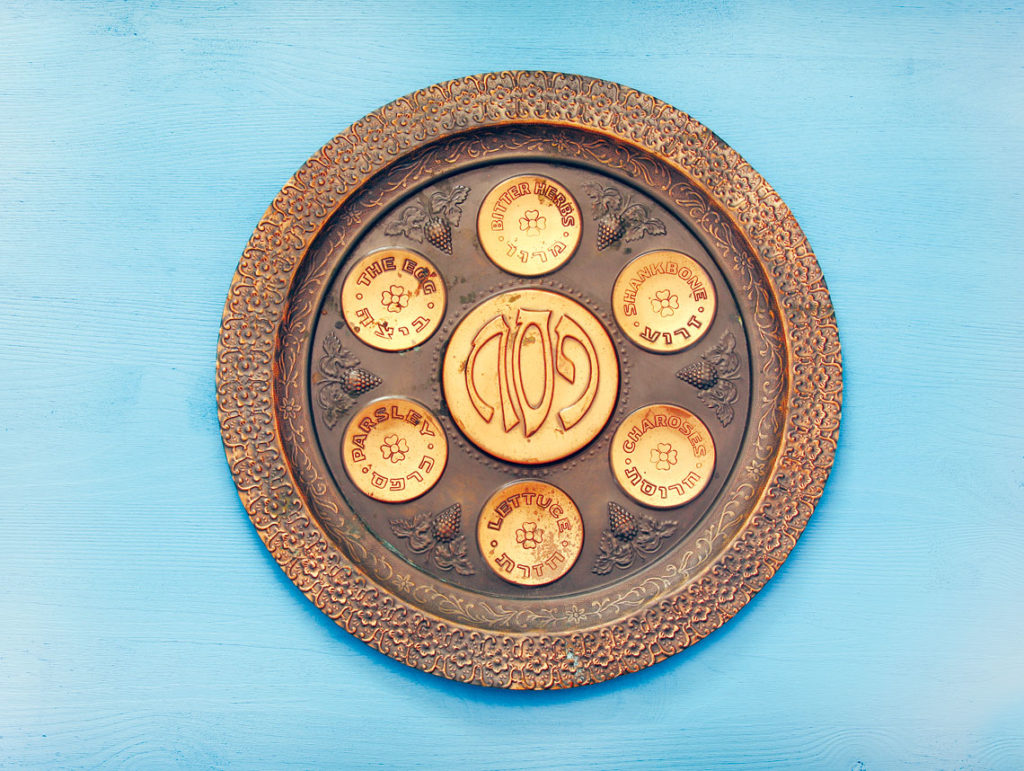
For most Jews gathering next week for Passover, the items on the seder table are as familiar as the story of the Exodus. Which is too bad, given the richness of their history and the multitude of meanings they can embody as times change. To get beyond the traditional explanations for matzo, charoset and the rest of the Passover seder’s usual suspects, area rabbis have offered new interpretations and revelations about some of Judaism’s most beloved symbols.
BEITZAH
While so very fragile, lengthwise the eggshell becomes strong and can withstand surprising pressure. This is because it is a natural arch. Leonardo da Vinci described an arch as “two weaknesses [that] are converted into a single strength.” By supporting each other, the weak segments redistribute the crushing forces upon them and become the strongest structure in engineering.
The purpose of an arch is to act as a passageway, whether for light through a window or people over a threshold. The Passover egg commemorates the passageway from sure death into new life. Its shape symbolizes the great power created when vulnerable individuals are united into a single strength, embodying the talmudic axiom, “Kol Yisrael arevim zeh bazeh”/“All Israel is responsible for each other” (Shavuot 39a). Its perfect arch reminds us that God designed us with the ability to bear heavy burdens while remaining full of light. The arch of the Passover egg is the ancient strength of aqueducts and bridges. It is the means to take us from here to there, to enable us to cross over. Is it any wonder why, to mark the covenant between God and humankind, God chose the rainbow arch? The egg is the very architecture of community.
— Rabbi Zoë Klein, Temple Isaiah
CHAROSET
There is no explanation of charoset in the haggadah, but in the Mishnah, one suggestion is that it represents the mortar the Israelites used during their forced labor. Still, it seems odd that the food’s complex deliciousness would be a symbol of oppression, and other, more positive explanations abound.
Since talmudic times, charoset has been associated with the women of the Exodus who, one midrash says, took fish and wine to their husbands in the fields to seduce them into bearing more children even while they were enslaved, a time of danger and despair.
Rabbi Arthur Waskow points out that all of the ingredients in charoset appear in the Song of Songs, which we read on the Shabbat of Passover — sacred poetry about love and taking pleasure in the beloved.
Or charoset may simply exist to offset the burn of maror — it sits on the seder plate throughout the narrative of our suffering and oppression as witness to the sweetness that people create even in the worst of times.
The ingredients for charoset are as different as the Jewish cultures that prepare it. No matter our differences, we all need the sweetness of hope and love to balance doubt and pain.
— Rabbi Amy Bernstein, Kehillat Israel
KARPAS
Confronted with our contemporary political and religious climate, the karpas at the seder contains a crucial lesson for us. The word “karpas” means fine quality wool, as the verse in Megillat Esther indicates when it describes the woolen tapestries of King Ahasuerus as “chur karpas u’techelet.”
With this definition, Rabbeinu Manoah of Narbonne offers a stunning suggestion that karpas at the seder symbolizes the wool coat of Joseph gifted to him by his father Jacob (see Rashi Genesis 37:3). We dip the vegetable (usually parsley, celery or potato) into saltwater to re-enact the brothers’ act of dipping Joseph’s wool coat into blood to deceive their father after they had sold Joseph down to Egypt.
Before we celebrate how the Jews proudly left Egypt, we take the karpas to reflect upon how the Jews sadly got there in the first place. Jealousy, polarization and divisiveness led to our troubles. One central goal of the seder is to address the divisiveness that plagued us then and now — symbolized by karpas — and repeal and replace it with respect, tolerance, inclusiveness and friendship — symbolized by the enterprise of sitting around the table together.
— Rabbi Kalman Topp, Beth Jacob Congregation
MAROR/CHAZERET
The Almighty called to the children of Jacob
“I have taken notice of you
And seen your suffering
And sent to you my prophet
To relieve you of your maror-bitterness.
I carried you on eagles’ wings
And shielded you from the pursuers’ arrows
So that whenever you taste the maror
You will remember
Who I am
And who you are
And why you are free.
As I took notice of your ancestors
I call upon you today
The descendants of slaves
Who know the heart of strangers
And their fear and desperation
And do for them as I have done for you
And liberate them
The oppressed and the tempest-tossed
The poor and the discarded
The old and the lonely
The abused and the addict
The victim of violence and injustice
And everyone who tastes daily the maror-bitterness
That you know so very well.
As you sit around your seder tables
I call upon you to act
With open, pure and loving hearts
On My behalf
And be My witnesses
And bring healing and peace.”
— Rabbi John L. Rosove, Temple Israel of Hollywood
ZEROA
One anomalous item on the seder plate is the zeroa, according to the Jerusalem Talmud a shank bone, which is roasted and represents the special Passover sacrifice that was at the center of the festival’s observance in Temple times. Because sacrifices may be offered only from the Holy Temple in Jerusalem, and because that Temple no longer exists, we create a replica of the sacrifice, but we do not eat it, only pointing at it. We physically aspire to something that remains beyond our reach.
How paradoxical that what is beyond reach is the zeroa (literally “the arm”), recalling God’s “strong hand and outstretched arm” that liberates us from slavery. At the seder table, where it is our hands and arms that do the pointing, we embody God’s liberatory lure. God persistently frees the oppressed and lifts the fallen, but only through us, with us. It turns out that the real image of God’s commitment to human dignity and freedom is not on the plate at all. The outstretched arm and hands are our own. So, this Passover, arm yourself and give God a hand.
— Rabbi Bradley Shavit Artson, dean of the Ziegler School of Rabbinic Studies at American Jewish University
SALT WATER
Each year at our sedarim, we dip a bit of karpas into salt water — and in some ethnic traditions, into vinegar or lemon water. The bitter liquid reminds us of the deep pain, sweat and tears that accompany hardships such as slavery and oppression. As we dip, we reflect on our ancestors’ pain, modern examples of oppression and times in the past year when our tears flowed freely. Many of us will dip a second time into the salt water at our seder with a hardboiled egg, which serves as a sign of spring and birth. Just as our Israelite ancestors left Egypt by crossing through the saltwater sea to enter the vastness of freedom, the salt water and egg dipping can be for us symbolic of a mikveh, a spiritual cleansing, an acknowledgement of the sweetness that lay ahead.
Salt enhances sweetness. Think salted caramel or salted chocolate. Dipping in salt water acknowledges suffering and bitterness, but also that there, too, will be a time of healing and celebration of freedom. Think, too, of the Dead Sea. It is so bitter nothing can live within it, but within it lies powers of healing. As we dip into salt water this year, may we recall our pain and suffering and exit into renewal, healing, feeling refreshed and free.
— Rabbi Sarah Hronsky, Temple Beth Hillel
MATZO
Passover is such a grand holiday — why should its central symbol be a cracker?
The rabbis identify the matzo with humility. Unlike bread, which is puffed up, the matzo lays flat, shorn of ego. But Passover is not a holiday of humility, but of slavery and freedom. So, why matzo?
Ralph Waldo Emerson once recorded in his journal something his aunt, Mary Moody Emerson, said to him: “ ‘Hurry’ is for slaves.”
To be a slave is to have no control over your own time. The Israelites baked matzo because they had a brief moment, a slice of time, the beginning of true freedom, but they were not yet there. Matzo is the sign of a people soon to be free: the bread of affliction but also the bread of transition — from being a slave to liberation into the service of God.
— Rabbi David Wolpe, Sinai Temple
ELIJAH’S CUP
When are the Jewish people going to be able to drink with joy from the fifth cup, Eliyahu’s Cup, during the seder? When we have prepared the world for redemption. Preparing the world for redemption, however, requires tremendous effort and faithfulness to our people’s mission. Where do we start? The haggadah gives us a brilliant place to begin. Immediately after we pour the Fifth Cup for Eliyahu, we open our front door. What a strange custom, right? But it sends a message to our generation: We can help prepare the world for redemption by opening our hearts to one another. Why is the door normally closed? Because we’re in pain. So we close the door on each other — parents and children, husbands and wives, brothers and sisters. Right after opening the door during the seder, we read a passage from Psalms, a dire warning to those who forget that we are all children of the Creator and must act righteously with one another. My blessing for all of us is that we avoid the consequences of failing to act righteously toward one another and instead pave the road to the redemption of the world. It’s all there in the Cup of Elijah.
— Rabbi Yonah Bookstein, Pico Shul
ORANGE
Since the 1980s, many Jews include Susannah Heschel’s tradition of adding an orange to the seder plate as a symbol of people marginalized in the Jewish community. Heschel chose an orange because, as she said, “in a whole orange, each segment sticks together.”
Over the years, I’ve added to that tradition, and you can, too, with just a few words and actions:
“Tonight, let’s squeeze some orange juice upon the charoset, that already sweet promise of freedom, that symbol of the mortar our ancestors used when they were slaves. In so doing, we offer a reminder that those who some call ‘outsiders’ among the Jewish people — including LGBTQ Jews, Jews by choice, Jews of color, Jews from other traditions, Jews who are adopted, non-Jewish family members — have actually become part of the mortar that holds our people and our traditions together.”
[One person at each table squeezes some orange juice on charoset as we say:]
Evan ma-ah-su ha-bonim ha-y’tah l’rosh pinah.
“The stone the builders rejected has become the chief cornerstone” (Psalm 118:22).
[Each person takes a slice of orange to eat, as we recite:]
Baruch atah Adonai eloheinu melech ha-olam borei pri ha-eitz.
“Blessed are You, God, creator of all, who created the fruit of the tree.”
Through the camera of my iPhone I see people’s feet. They jump over five wooden crates filled with burning twigs. The crates are spaced a few yards apart, sitting on the concrete patio in the backyard. I lift the phone to get a wider shot.
I see a mom holding one daughter’s hand on her right side and holding her little one in her left arm, eagerly jumping over the first box and running toward the next. As she gets closer to the second box, the next family, swiftly and skillfully, moves into action from the orderly line behind her.
Sinuous Persian music is playing in the background as the rhythm of jumping and passing over fire after fire happens naturally and without supervision. I am excited to text this footage to my son, who is away in college. He has never been to a Shabeh Chahar Shanbeh Suri, an ancient Persian ritual that takes place on the last Tuesday of the year. I have not been to one, either, since that fateful time, three decades ago, when our retelling of the biblical Exodus merged horribly, unbelievably, with our own.
As I look at these flames, I remember the first time I jumped over fire. I was 9 years old. It was just outside of our home in Tehran, the last Tuesday of the year. All the neighborhood kids were out and had lined up dry bushes, and set them aflame on the street. Each fire had its own height, proportionate to how much material was burning. I was standing to one side, mesmerized by how nimbly Azadeh, a neighbor girl my age, navigated through the fire, as her hazel eyes emanated an amber spark and her golden pony tail flew in the air.
Azadeh, came over and asked, “Hi. Why don’t you jump?”
“I’m going to get burned!” I said.
“Don’t be silly! Nobody burns! This is so much fun! Here, why don’t you hold my hand and we’ll jump together! Just do it really fast!”
Her grandma was watching us. She said, “Girls, don’t forget to say, ‘My yellow is yours, your red is mine’ as you jump over! This way, the fire will take your sickness and problems and give you warmth and vitality, instead!”
In one evening, I had mastered the art of jumping over medium-height fires. Better yet, I had found my best friend.
Charshanbesuri, as the kids call it, is the ancient Persian ritual of lighting fire to say farewell to the darkness of winter and to welcome the brightness of spring in Iran. The busiest week of the year followed with spring cleaning at home and shopping for new shoes and clothes to welcome Nowruz, the Persian New Year. Nowruzcomprises 12 days of open house, where everyone is obligated to visit one another’s homes. On the 13th day, families go outdoors and spend the day in the fields.
Jewish families hold their open houses during the eight days of Passover, instead of Nowruz. On the first day, you visit mourners. On the second day, the oldest of the family, and on the following days, the younger family members, and so forth. They spend the day after the end of Passover outdoors.
That year, the Passover sederfell on the seventh day of Nowruz. This meant that when Azadeh and her parents were hosting their open house, Mom and Grandma were still busy preparing for Passover, cleaning and cooking.
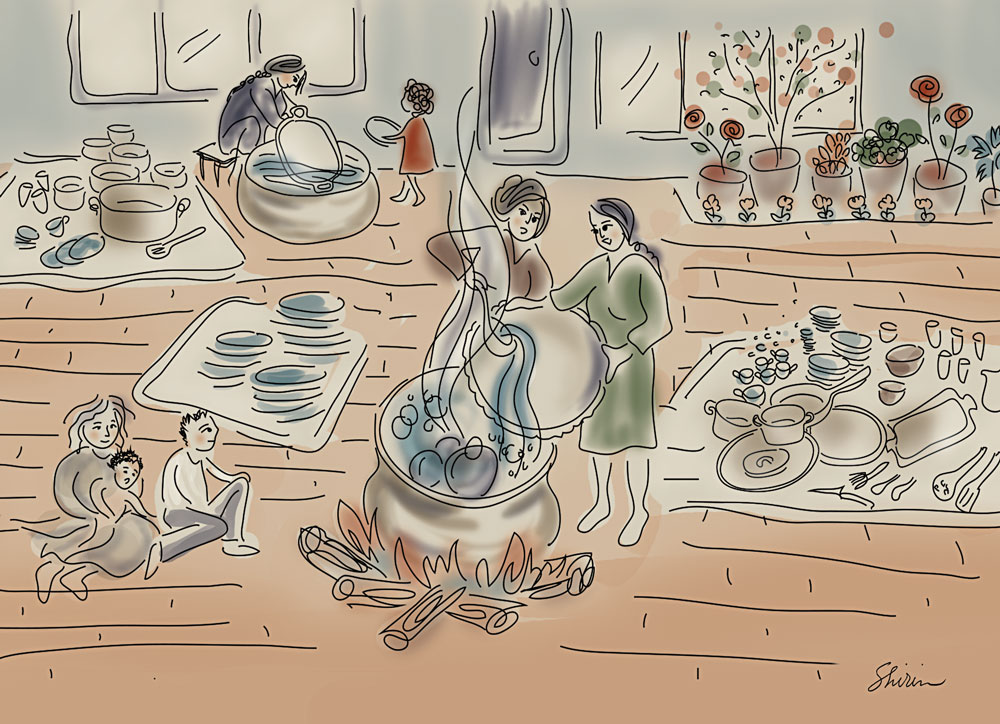
Our entire household was in preparation mode. All the closets would be cleaned out and reorganized. All the dishes and pots would be washed in hot and cold water for Haghalah, or purification. The kids were as involved in this ritual as the adults. There were always tasks for us to do, and the main attraction was Grandma’s stories about the lives of our ancestors and the stories from Torah. She would tell us about how they had to take the pots and pans to coppersmiths to remove the rust and to add a layer of zinc. They had to buy sesame seeds to take to a processing plant and have the oil extracted for Passover cooking. They had to have someone come into their home and open the mattresses and re-fluff and clean the cotton and re-sew the mattresses and quilts, wash the cover, open the pillows and wash the feathers …
Grandma was making hallegh (charoset) in the kitchen. It was made from nuts, grapes, pomegranate seeds, wine and cardamom. Mom was making special almond-and-walnut cookies with eggs and no flour, because we were forbidden to eat anything with leavening during the eight days of Passover.
“Mom, when are we going to visit Azadeh’s family?”
“We have to wait for Dad. He has gone to the Jewish cemetery where they are baking the matzo. And you know how crazy that gets when everyone is there.”
Grandma said, “You don’t need to tell your friend about all this, dear.”
“Why?” I asked.
“It’s complicated!” she said.
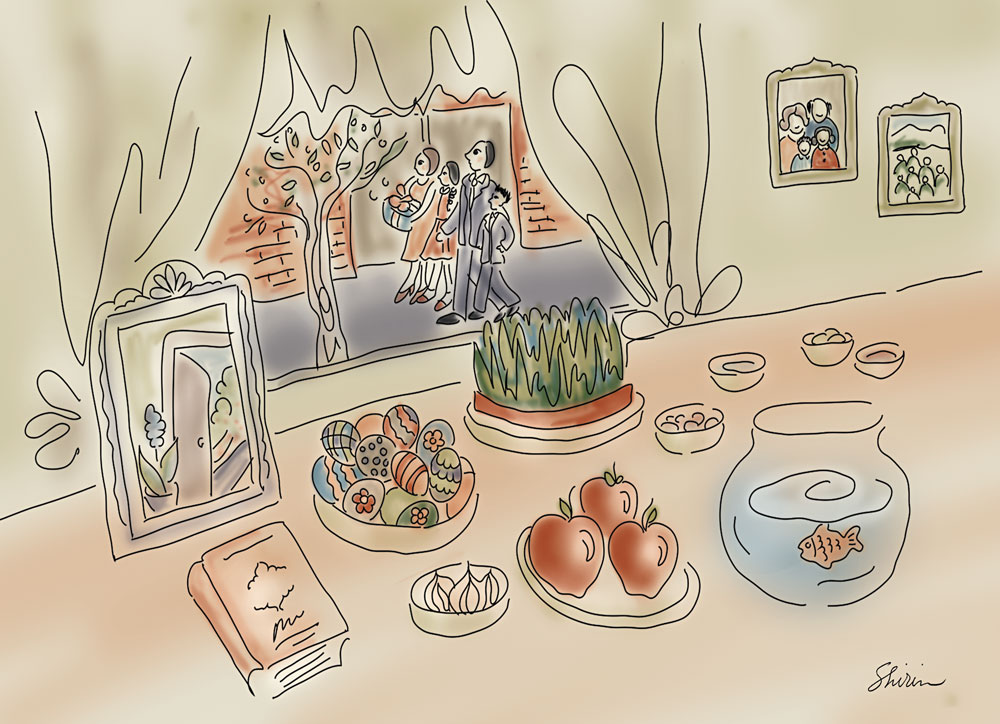
Haft-Seen is an arrangement of seven symbolic items whose names start with S.
Before we entered Azadeh’s home, Mom said, “Make sure you do not touch any food before you are offered! You have to sit politely and quietly. You are a big girl now, and you should know that kids are not to speak unless asked. And do not eat too many pistachios as you will get a stomachache.”
The Nowruz Haft-Seen set up at Azadeh’s home was similar to the one at our home, except that, instead of an edition of the Torah on our table, they had a Quran. Two fish were dancing in a bowl of water set next to a pot of tulips. A bowl of hand-painted eggs, and an elaborate mirror were set next to the seven plates holding items that start with the letter S: sabzeh (a green plate of grown wheat), seeb (red apples), samanoo (a wheat-based dish), senjed (a fruit of the lotus tree), seer (garlic), serkeh (vinegar) and sekkeh (coins laid in water). The two burning candles on the Haftseen table reminded me of my grandma’s Shabbat candles.
After returning home, I asked Grandma, “Why is our sabzeh different?”
“We don’t grow wheat when it is close to Passover. Instead we grow lentils.”
“Why?”
“It’s complicated!”
Finally Passover began. Every year, we went to my oldest uncle’s home for the seder. In the dining room, there was an extra-long mahogany table with just about enough chairs pulled from around the house to fit four families. I still remember the smell of the carrots, beans and cinnamon rice that my aunt cooked for dinner. The chicken with the tomato sauce was divine.
The ceremony was even longer than the table. Uncle would sit at the head of the table, monotonously reading in Hebrew the entire story of the Exodus of Jews from Egypt. Men and children sat in the middle trying to follow the story in Farsi. Women sat at the far endof the table gossiping. Every once in a while, Uncle would stop reading and yell, “Quiet!”
There were only three or four haggadot passed on to people who recited a section in Farsi. We were never able to finish reading. Nor did we understand most of what was written. The text was esoteric and disconnected.
Children loved the “Kaddesh Urechatz” mantra. For this, each person got the chance to hold the afikomen (unleavened bread) that was wrapped in a special fabric, and recite the names for the sections of the haggadah. Later, the afikomen would be hidden and kids would be sent to find it.
Adults even allowed us to drink wine four times. And we asked the Four Questions, which I never completely understood as a child. What I did notice was that similar to Haftseen, we also had a bunch of greens, eggs and vinegar on our table. We dipped celery in the vinegar and ate it to remember the tears of our forefathers in Egypt.
Before the recitation of the Ten Plagues, women covered the long table with a couple of white sheets. This had two functions. First, it protected our food from the terrible words that were about to be uttered. More importantly, it gave kids an opportunity to start to steal scallions from underneath the white sheets and store them for the “Dayenu” ritual.
As soon as the section on Ten Plagues ended, children would jump off their chairs and attack! There was no song. “Dayenu” was a cross-generational free-for-all, and this sweet moment was worth waiting for, the entire year. At any other time of year, it was unimaginable for children to look adults in the eye, let alone hit them. Now, there was no time to spare! We had only 5 or 10 minutes to run around the table and the room and hit everyone with the scallions.
Grandma said that everything at the seder was to remind us of what our ancestors went through. “Dayenu” reminded us of slaves who were whipped and that we were now free. Charoset was the mud our ancestors used to build the Pyramids. The piece of meat on the seder plate was for remembering that Jews made a burnt offering right before they set out to leave Egypt, in order to divert the attention of Egyptians.
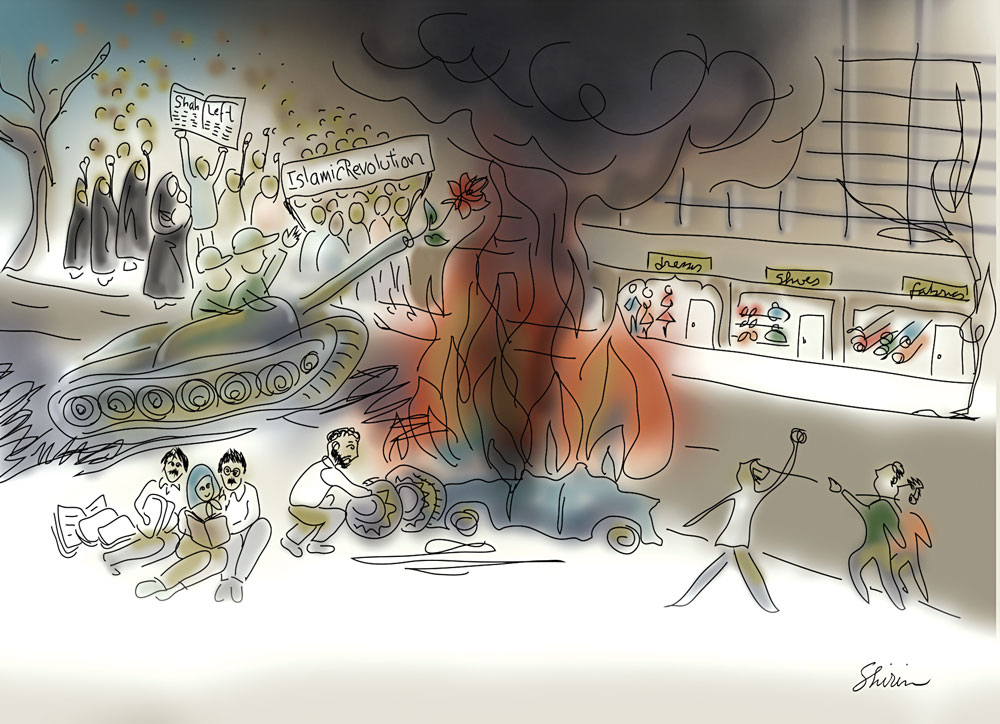
That was spring 1978. The following winter, people took to the streets demanding, “Independence, Freedom, Islamic Republic!” The smell and sight of the smoke from burning tires and storefronts marked the beginning of the exodus of many families, including Jews, from Iran. Schools were closed, on and off. Grandma declared that our family had to leave for Israel. We had family there and would be staying with them for a while until things normalized. Dad agreed to let us go. He did not wish to leave his job.
People set fire to stores and cars during the 1979 Islamic Revolution.
During the one month we were in Israel, I went to public school. Unlike my school in Tehran, the school in Tel Aviv had many creative activities during the week, such as wood shop. I was starting to write in Hebrew and learn the language, when Mom decided to take my brother and me back to Iran to be with Dad. Grandma did not come back with us. I started to write her long-winded letters on a regular basis.
Dad said Azadeh had come to our home and asked for me. He had told her that we’d gone to France because my mother needed surgery. The first day I was to return to school, Mom said, “Do not, under any circumstances, tell anyone that we went to Israel! Tell everyone we were in France for my surgery!”
The first thing I noticed in school was that Azadeh was wearing a scarf that tightly covered her entire hair and forehead as well as any trace of her playful nature and free spirit. I remembered the Charshanbesuri when Azadeh and I had taken a spoon and bowl to go Ghashogh-Zani (Knocking on Neighbors’ Doors). We had disguised ourselves in sheets, laughing our way through the street as we knocked on doors to collect nuts and sweets.
There was a knock on the classroom door. The school custodian came in and asked for a student to go to the office. My teacher asked him, “Did they kill his father?”
After he left, she asked me in front of the whole class, “Were you in Israel?” “No, ma’am!” I declared. Before I knew it, I added, “We had gone to France for my mother to have surgery!”
That summer, Mom found me a painting class that I could ride the bus to. It was a very pleasant way for me to divert my attention from the turmoil and tension in the air. One day, as I was walking on the busy street toward the bus stop, a motorcyclist sped toward me, yelled and zoomed away. I was mortified, because I had heard rumors about motorcyclists who would throw acid onto the faces of girls wearing short sleeves! Summer got unbearably warmer as I started to wear long sleeve clothes.
The following fall, the Iran-Iraq war began and the airports closed. Nobody was to leave the country. One step at a time, personal and community freedoms were curtailed. Women had to cover their heads and wear baggy, long-sleeve dresses called uniforms with long pants and socks — preferably all black. People’s homes were broken into to collect evidence of “un-revolutionary” belongings or activities. A not-so-distant relative was labeled as “Zionist, Imperialist, Enemy of God and the Prophet of God.” He was executed without a trial.
Charshanbesuri— the fire-jumping ceremony of Nowruz — was outlawed. People did it anyway. Revolutionary guards doused the fires with water, which made them look dark and smell wrong.
For the first time, Mom and Dad were experiencing anti-Semitism at work.
They found solace in trying to prevent the government from closing the Jewish school. Therefore, they put me in that school. It didn’t take long for the government to forbid schools belonging to religious minorities to enroll Muslim students.Here, I met my new Jewish friend Parastoo. The spark in her eyes reminded me of the Azadeh I used to know. She was fun and unafraid, a free-spirit in spite of the tensions around us. Parastoo lived far from our home, but when she would visit, we hung out with Azadeh.
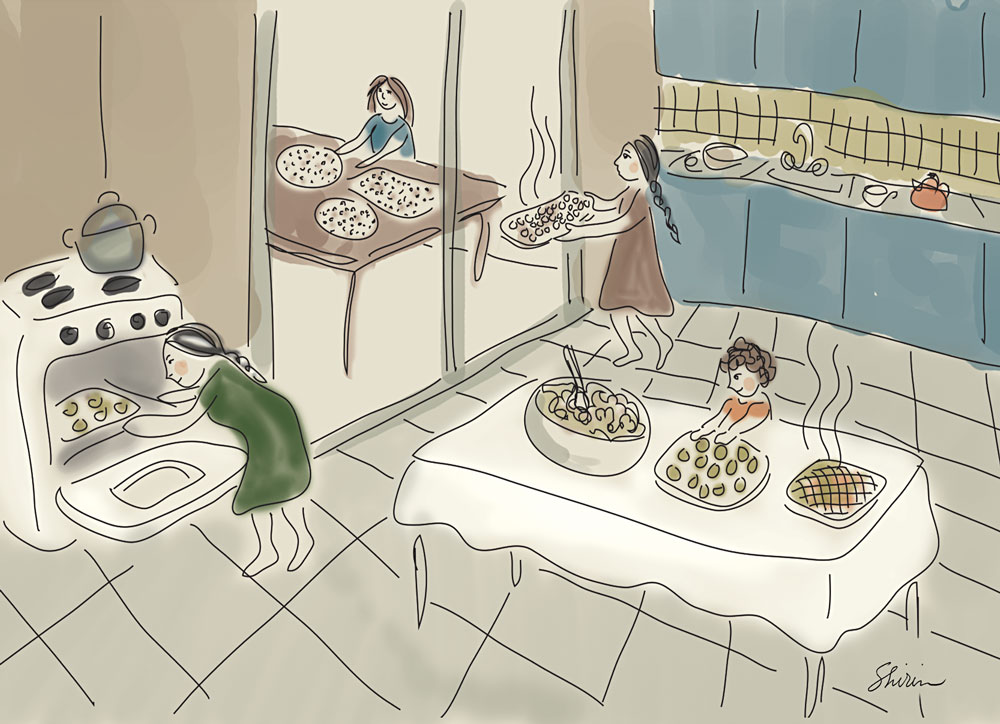
A mother and her daughters prepare kosher baked goods and dried fruits for Passover.
One day when I came home from school, I heard a wailing that I had never heard before. It was so strange. I didn’t know what to make of it. I went into the kitchen and saw Mom sobbing quietly as she was staring at the wall. “What is that noise, Mom?” I asked. “It’s Azadeh’s Mom!” Azadeh’s brother, an Iranian soldier, had been killed in the civil war with the Iranian Kurds.
This was the last straw for Mom. Her goal in life became for the family to leave Iran. And it had to be before my brother turned 13 years old, the age the Islamic government considered boys as soldiers. The punishment for a runaway soldier would be no less than death.
By now the airports were open, but not to Jews. The passport application process included declaring one’s religion and the names of one’s entire extended family. Jews would have to go to the prime minister’s office to obtain their passports instead of the passport office. Mom and Dad managed to purchase an exorbitantly expensive fake passport for my brother from the governor of an obscure state. My brother needed to leave the country before he would be found out. My parents and I had to take the illegal route. As Grandma would say, “It was complicated.”
Mom stressed to me, “Nobody can know about this! I mean nobody! Remember those people who told their friends and then they were found and taken to prison?”
“Parastoo, I have to tell you a secret!” I whispered in her ear.
“What is it?” she said jokingly in her playful manner.
“Never mind.” I turned my head away. She suddenly changed. She looked at me seriously and said, “I’m sorry. Tell me. I am listening.”
“You must not share this with anyone! I mean nobody!OK?”
“Are you leaving?”
I closed my eyes and nodded my head in agreement.
“OK, then. You cannot tell anyone that we are leaving too. Who is taking you?”
As I watch the Charshanbesuri fire through my iPhone, I remember my exodus from Iran through the deserts of Pakistan. My family and other Jewish families were following our Baluchi guides through the desert. There were many dry bushes along the way. I thought of the Jewish people following Moses in the desert, longing for freedom. I wondered what Moses thought when he saw the burning bush.
Hagalah is the process of washing plates, pots and utensils for Passover.
Parastoo and her siblings went to Israel. After my family arrived in Los Angeles, I wrote to Azadeh and told her about our journey. We continued correspondence for a few years. Later, we became part of an online group for our elementary school friends. She stayed in Iran and married. When it was time for her son to be drafted, they moved to Irvine.
My thoughts are interrupted as Azadeh comes toward me to greet me. Her long, golden hair is now flowing gloriously in the open air. The spark in her eyes is back.
“Thanks so much for coming all the way to Irvine from L.A.! It’s so good to see you after all these years!” We hug and shed tears.
Then she straightens herself up and smiles. “Put that phone away! Hold my hand and we’ll jump together! Just do it really fast!”
“Wow, Azadeh!” I exclaim. “I never realized that all those years I was celebrating my Persian identity by passing over a burning bush!”
“Tell me!” she demands, “what happened to Parastoo?”
“Oh, yes, she is now living in Israel and covers her head. Last time I saw her, she had six children. She has been a grandmother for a while! When I went to Grandma’s funeral in Israel, Parastoo came and brought some scented herbs to say blessings for her. We lit candles together.”
As I take another glance into the burning bush, I think to myself, “It’s complicated!”
Shirin Raban is an award-winning designer, cine-ethnographer and educator. She created the film “The Fifth Question: Why Is This Passover Different?” and lectures at UCLA Extension and Cal State Northridge.
Many women are adopting the same outlook in forging their careers as they are in finding their bashert: Never settle. Los Angeles resident Talia Goldstein is one of them, as that mindset led her to both her husband and her entrepreneurial path as founder of the dating company Three Day Rule (TDR).
Armed with a degree from Tulane University, Goldstein landed coveted associate and segment producer positions at VH1 and E! Entertainment. However, her observations about singles and desire to be of service to others paved the way to TDR in 2010.
In the beginning, her company focused on producing singles events. She got the inspiration for the name from the ’90s movie “Swingers” and its characters’ discussion of the “Three Day Rule.” “Guys thought you had to wait three days after getting a girl’s number before you called her. We definitely don’t believe in that rule anymore, but we still love the name,” Goldstein said.
In 2013, she reinvented TDR as a full-service dating company (threedayrule.com) which covers nine U.S. cities. TDR now has 39 employees, including 32 matchmakers nationwide, to help “hundreds of clients” a year, Goldstein said. Currently, 70,000 people are in TDR’s database.
Goldstein’s parents’ happy 40-year marriage influenced her business model. Her American-born father was doing his medical residency in Israel when he met her mother, who is a social worker. “They instilled in me the understanding that being judgmental may prevent one person from making a meaningful connection with another,” said Goldstein, who is 37 and grew up in Orange County.
Anybody can enroll in Three Day Rule’s database free of charge. In 2017, TDR expanded to include yearlong VIP nationwide matchmaking packages with two hands-on matchmakers and personalized concierge services ($35,000) in addition to its basic packages, starting at $4,000 for three months of matching in one’s city of residence.
TDR was one of just a few dating companies to secure “Series A” funding in 2016, bringing in $1.2 million when venture capital investment for dating companies fell overall. To get there, however, Goldstein faced judgmental thinking from investors.
“I was pregnant both times I set out to raise capital,” she said. “The first time, I hid my pregnancy under trench coats and ponchos. Business advisers warned me that (financiers) saw pregnancy as a red flag. Later, I decided not to hide my second pregnancy, as I felt my company had such excellent metrics and traction that it would not make a difference.”
But it did. Male investors told her that they preferred to wait to commit until she had her second baby. Days after leaving the hospital, she finally closed the deal with nine investors.
“I hope this mentality will change, as women should not have to decide between starting a family and becoming an entrepreneur,” she stated.
TDR matchmakers develop a customized plan for clients who have been dating for years, had bad experiences with dating sites, or are newly divorced or widowed. While she believes online dating can be effective, she found daters spend an average of 13 hours a week online.
“If you have a full-time job and a full life, finding the time to do it effectively is hard,” she conceded. “When you factor in that other people are busy, it makes sense that one may not get the replies online he or she may be hoping for. This can make the process demoralizing.”
Phil Wallace, 35, of West Los Angeles, a longtime online site user, said he was pleased that TDR communicated with women on his behalf. He said his dating life has blossomed since his enrollment, with four excellent prospects.
“I didn’t have to worry about them not looking like their pictures. [Goldstein] had met with all of them in advance. Deal-breakers were addressed ahead of time, so there were no sudden, shocking revelations that made me question my date’s character,” he said.
Adelle Gomelsky Kelleher, 37, who was matched with now-husband David Kelleher, felt relief that “someone who had more networking and resources than I did was out there looking.” She used a popular Jewish dating site, but was frustrated with constantly seeing the same men whom she had met at Jewish singles events. At the same time, she found her perceptions of what made a man an ideal candidate shifted.
Gomelsky Kelleher said the process enabled her to relax and enjoy her dates more while also getting her to look beyond first impressions of a possible match to “how I treated all people overall.”
Goldstein pointed out the “mental checklist of wants” is a common mistake among daters: “She may indicate she wants a man with dark hair who is 6 feet tall. But by putting up these filters, she may miss out on somebody who happens to be 5-10 and blond, who could have been her soul mate.”
Goldstein’s business model contrasts with others that match only paid members. People with limited budgets still have a shot at being paired with a paying member if common interests, values and preferences line up.
The old adage goes that you can’t win if you don’t play. Even rookies may get lucky during their first times at bat. Allie Jablon, 41, who avoided online dating because of its “impersonal” nature, was introduced to her husband within a week of signing with TDR.
“Having [a matchmaker] who gets to know you before you are introduced to men is much more productive and fulfilling in my opinion,” said the Hollywood resident. “Where online dating can feel like a job to some, dating should be a joy, not a job.”
Picture this: An Arab Jew, a Palestinian Muslim and a Canadian Jew telling jokes.
Mind you, the Palestinian Muslim and the Canadian Jew are married to each other.
Mind you again, they’re women.
The venue? The oldest synagogue building in Los Angeles, adorned with stained-glass windows and home to rows of pews. The jokes aren’t as “PG” as one might expect in such a venue, but explicit enough for the comics to ask the audience, more than once, “Is this OK?”
Political correctness was put aside on March 26 at the Pico Union Project, which, depending on the day, serves as a shul, mosque or church — but on this particular night, an underground comedy club, thanks to The Markaz, a Middle East arts center that serves to unite various Middle Eastern heritages.
“You guys are fun,” comedian Jess Salomon (the Canadian Jew) told a raucous crowd during her set. “You never know with these interfaith shuls.”
Earlier that night, Eman El-Husseini, the Muslim, introduced Salomon to the stage after her comedy routine that left no taboo subjects untouched, ranging from women in Islam, to her parents’ wedding anniversary (which happens to be on Sept. 11), to her own marriage.
“I did end up marrying a Jewish woman,” El-Husseini told the audience, which sat in silence — waiting for a punch line.
“Thank you, that’s how our parents responded,” she said.
For El-Husseini and Salomon, their same-sex interfaith marriage strayed from their traditional upbringings. None of their parents attended their wedding two years ago, although both women said they continue to have a relationship with their parents. “They want us to be in their lives, but they don’t want us to talk about our lives,” El-Husseini told the Journal.
But they do.
“I’m really excited about bringing on your next act, you guys,” El-Husseini said in introducing her wife. “She makes me go through checkpoints in my own apartment. Give it up for my wife, Jess El-Husseini!”
Applause ensued as Salomon joined her wife to partake in some onstage banter with each other.
“Thank you. I was pretty sure we were going with Salomon as a last name, Eman,” Salomon jabbed. “I thought that was going to give our children hope or something.”
They met while doing the comedy rounds in Montreal, engaging each other in conversation about politics after their sets. “I loved the way she expressed herself and the way she thought about things. And that’s what attracted us, outside of just finding each other funny or physically attractive,” Salomon said.
Those after-show discussions eventually evolved into a modern-day love story. One year ago, they packed their bags and moved to New York to pursue comedy careers.
El-Husseini and Salomon are perfectly aware of their dichotomy. As newbies to the United States, they felt impelled to attend the Women’s March in Washington, D.C., where Salomon carried a sign that read, “My Muslim wife is registered at Bed Bath & Beyond,” and on the back read, “Jihad me at Hello.”
El-Husseini was born in Kuwait to Palestinian refugee parents and raised in Canada. When she finally decided to enter the comedy world, she said, “It was the saddest news ever to my parents.” But El-Husseini said she completely understands their reaction. “If we ever decided to have children and they wanted to do stand-up, I’d be heartbroken. It’s a hard career.”
“I always joke about being so happily married that it’s affecting my comedy. I’m too happy to be a comic,” El-Husseini said. “Nobody wants to see a happy comedian.”
The red-headed Salomon, whose mother hails from Peru and who has a grandfather from Egypt, poked fun at herself onstage when she said, “I just choose to keep all that Arab-Latina-Jewish-bisexual spice under this St. Patrick’s Day Parade.”
A former human rights lawyer working for the United Nations war crimes tribunal in The Hague,Netherlands— a distinctly unfunny job — Salomon took a sabbatical to try comedy. She’s been doing it ever since.
The opening actfor the evening, Noel Elgrably, the Arab Jew, said the show was, in essence, a chance to celebrate the black sheep of the comedy world. The brother of Jordan Elgrably, founding director of The Markaz, Noel is of Moroccan descent. He told the Journal that as a Sephardic Jew, he tends to be the odd man out during comedy lineups. “I don’t know if there are a lot of Sephardic comics,” he said before pointing out that a majority of Jewish comics are Ashkenazi, of European descent. “For a long time, I was the only Sephardic comic in L.A. I would look for them.”
For this night, anyway, distinctions didn’t matter.And in this makeshift synagogue-turned-comedy-club, there were no black sheep, no outcasts. Heritages were melded, jokes were blurted, conventions defied and lines blurred.n
In early March, the United Nations announced that the world is facing — and this is not hyperbole — “the greatest humanitarian crisis since 1945.”
If you’re thinking Syria or European migrants, you’re wrong. Neither of those issues was mentioned once.
Right now, the great humanitarian crisis of our world is food insecurity — a condition afflicting tens of millions of people who have limited or uncertain access to nutritional and safe food.
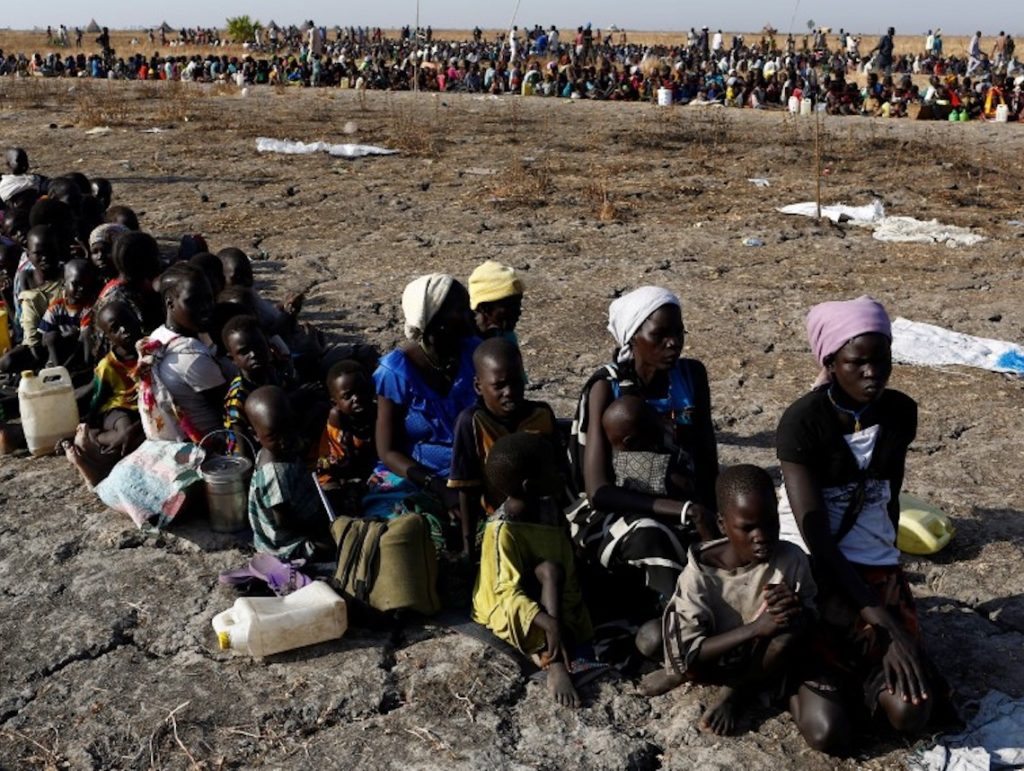
According to the U.N., an estimated 20 million people will face the threat of starvation and famine this year in Yemen, Somalia, South Sudan and Nigeria. The New York Times devoted a special section on April 2 to the stories of 130,000 people forced from their homes by the Islamist militant group Boko Haram, who have camped next to a highway in the Niger desert in search of food and water.
UNICEF is warning that “1.4 million children could starve to death this year.” And I hesitate to describe the accompanying pictures of children already in peril — their faces sunken, desperate, nearly deformed from malnourishment.
Now comes Pesach, a harvest festival. It arrives every spring when the earth is bursting with blooms, when crops are growing and nature renews itself, offering its bounty.
And yet, it forces us to confront hunger.
The relationship between hunger and the Passover seder is so central to the holiday that reiterating the connection is stating the obvious. Early on, before we do almost anything else, we hold up the matzo, and we sing “Ha Lachma Anya” — behold, the bread of affliction. The central symbol of Pesach literallyisthe poor man’s bread: It is the bread of the persecuted, degraded and displaced who could not afford to waste a single second letting dough rise when the moment for liberation came.
On Pesach, our task is to relive the experience of slavery and its infinite deprivations so deeply, so viscerally, it should be as if each one of us had personally gone out of Egypt.
And yet, when I think of the modern Jewish seder table, I think of abundance. Most of us probably enjoy multiple courses of food, flowing wine, crystal glasses, fine china, luxurious table linens. Others partake of popular Pesach “vacations” with kosher buffets so ample they could feed a king, a queen and their court. And I wonder if all of this abundance on the holiday when we are meant to recall deprivation is missing the point. Slavery is having to do without; but our seder tables sometimes are paradigms of excess.
The year 2016 was the second year in a row in which the Department of Housing and Urban Development named Los Angeles as the city with the most chronically homeless people in the country. An estimated 44,000 people sleep on the streets of our city each night. On Pesach, we’ll sing, “All who hunger, you are welcome here,” but how many of us will invite a hungry person to eat at our table? How many of us will welcome the stranger, the orphan, the refugee?
Our tradition is clear about our obligation, as Jews, to make the world better. We all understand this. That’s why we give to charities, and pay taxes, and support food kitchens, and engage in the fight for political equality and justice. The Shulchan Aruch demands that every Jewish community establish a kupa, a welfare fund to be distributed to those in need. It also prescribes a tamchui, a communal kitchen that provides food for the poor.
But it doesn’t end there.
Our tradition also recognizes that something different happens when you invite a hungry person into your home. That it is spiritually elevating to break “bread” with someone who is not like you — who does not share your background, your skin color, your socioeconomic status. The holiday table can become an extraordinary equalizer in allowing us to realize our shared humanity. What makes us human is not what we have; it is what we have to give.
A couple of years ago, I had the opportunity to invite one of my mother’s former students to spend Shabbat with my family and me. He is a refugee from the Democratic Republic of Congo who lost nine family members in a horrendous slaughter. He and his brother, a former child soldier, and a young woman who also survived the conflict sat in my grandmother’s living room as we lit yahrzeit candles together and remembered all of the people we had lost. That night, we counted more dead among us than living. It was one of the most profound moments of human connection in my life. A Shabbat meal bound me to refugees as we ate, sang, shared and danced to real African drums.
What would it look like if more families modeled this kind of exchange the way my mother did for me? What is the point of digging into our formative pain as a people if it does not awaken us to the pain of others? It’s not enough just to tell the story.
Our communal destiny is to write a new one.
Chag sameach.
Danielle Berrin is a senior writer and columnist at the Jewish Journal.
My editorial column this week is a reflection on Passover. I know the rabbis teach that we do without leavening during Passover to remind us of the time we were slaves, but in this column I ask, Is there a deeper reason behind the reason? I write:
I started making sourdough bread in college — my first job as a junior was turning out 10 loaves each day for a local bakery. It has a pure taste, simple ingredients, and the probiotic fermentation makes the bread more digestible and better for you. Most other bread tastes cottony and dry to me.
But our ancestors ate sourdough bread because they didn’t have a choice. If you want to know why the Israelites couldn’t wait for their bread to rise, it’s because natural leavening takes a long time to do its magic. Until two Hungarian Jewish immigrant brothers named Charles and Maximilian Fleischmann came up with commercially produced yeast in 1868, all bread was based on starter cultures like mine.
To keep a starter culture alive and healthy, you must feed it daily, keep it at a comfortable temperature, protect it from contamination, and occasionally nurse it back to bubbly life. What I am telling you is that, yes, I have an I-Thou relationship with my blob of sourdough starter. I am sensitive to its needs. I feed it; it nourishes us.
And now comes Passover, when we are commanded to forgo any leavened thing. In our kosher home, that means all yeast products, all flour, anything with leavening, must go. I would ask my wife, the rabbi, if that means the starter too. Except I already know the answer.
After nurturing my baby for nine months, I figure I have to use it all at once or toss it. As we say in Venice, this bums me out. I ask that age-old question of an inscrutable God: Why?
Until you actually make bread like your Israelite ancestors did, it’s hard to understand what lesson there is in prohibiting leavening.
Israelite slaves escaping Pharaoh’s army didn’t have time for their bread to rise, the Passover liturgy tells us. Remember you were once slaves. So don’t eat bread, or anything remotely like it.
That’s the reason the rabbis always give us — it’s right there in the story — but I assume there must be some reason for the reason. Why of all the things the Jews must give up for eight days, God picks yeast? After all, did the Israelites have time to bring their oxen or wine barrels? Why not meat or sugar or alcohol — things that other religions commonly proscribe? We would nod our heads — oh, that makes sense. But yeast?
I have never come across religion that places prohibitions on leavening. If I was going to have to say goodbye to my beautiful 9-month-old bouncing baby starter, I needed to see the deeper meaning behind it.
Two weeks ago, when the rains finally stopped and the sun appeared in a brilliant blue sky, I took my sourdough starter outside for some fresh air. I sat on a bench in the garden and read a book. My starter sat beside me.
After a while, my wife came out.
“What are you doing?”
“Reading.”
“No, I mean, what’s that?”
“My sourdough starter.”
She was kind enough not to say, “You’re so weird.” But I’m pretty certain she was thinking it.
Each week when I make bread, I use the starter. I created it nine months ago, mixing a few tablespoons of freshly grown local wheat and water in a large mason jar, and setting it aside, uncovered, on my kitchen counter. The next day I added a little more flour and water.
After about a week of these incremental additions, the slurry bubbled and frothed. Wild yeasts, ever present in our air, had landed in the starter and multiplied. Tiny bubbles appeared where the gasses formed by the yeasts tried to escape. When I lowered my nose to the jar, it smelled like the tank room of a winery. A really good winery.
From that day on, to make bread, I only had to combine a portion of the starter with some flour, water and salt, stir it into a lump, let it sit overnight, and the next day, bake it into a beautiful loaf. I do about 10 minutes of work, total. Those wild yeasts do all the rest.
To replenish my starter, I add more fresh flour and water, then let it sit out again, until the yeasts gather and activate. Sandor Katz, the modern-day guru of fermentation, once wrote that he likes to take his sourdough starter outdoors so it can collect the various local yeasts that may not make it as far as his kitchen counter. Los Angeles forager Pascal Baudar said that he often takes his sourdough along with him when he goes for a walk in the woods. I figured I would do no less for mine.
I started making sourdough bread in college — my first job as a junior was turning out 10 loaves each day for a local bakery. It has a pure taste, simple ingredients, and the probiotic fermentation makes the bread more digestible and better for you. Most other bread tastes cottony and dry to me.
But our ancestors ate sourdough bread because they didn’t have a choice. If you want to know why the Israelites couldn’t wait for their bread to rise, it’s because natural leavening takes a long time to do its magic. Until two Hungarian Jewish immigrant brothers named Charles and Maximilian Fleischmann came up with commercially produced yeast in 1868, all bread was based on starter cultures like mine.
To keep a starter culture alive and healthy, you must feed it daily, keep it at a comfortable temperature, protect it from contamination, and occasionally nurse it back to bubbly life. What I am telling you is that, yes, I have an I-Thou relationship with my blob of sourdough starter. I am sensitive to its needs. I feed it; it nourishes us.
And now comes Passover, when we are commanded to forgo any leavened thing. In our kosher home, that means all yeast products, all flour, anything with leavening, must go. I would ask my wife, the rabbi, if that means the starter too. Except I already know the answer.
After nurturing my baby for nine months, I figure I have to use it all at once or toss it. As we say in Venice, this bums me out. I ask that age-old question of an inscrutable God: Why?
Until you actually make bread like your Israelite ancestors did, it’s hard to understand what lesson there is in prohibiting leavening.
Israelite slaves escaping Pharaoh’s army didn’t have time for their bread to rise, the Passover liturgy tells us. Remember you were once slaves. So don’t eat bread, or anything remotely like it.
That’s the reason the rabbis always give us — it’s right there in the story. I turned for answers to my sourdough guru, or rabbi, Sandor Katz.
“I’ve vaguely understood it to be a metaphor for remembering a time in exile and in transit, without even a place/time to let dough rise, which of course would also imply no place/time to let grape juice ferment (or to grow grapes for that matter),” he e-mailed back.
But I wanted more. I assume there must be some reason for the reason. Why of all the things the Jews must give up for eight days, God picks yeast? After all, did the Israelites have time to bring their oxen or wine barrels? Why not meat or sugar or alcohol — things that other religions commonly proscribe? We would nod our heads — oh, that makes sense. But yeast?
I have never come across religion that places prohibitions on leavening. If I was going to have to say goodbye to my beautiful 9-month-old bouncing baby starter, I needed to see the deeper meaning behind it.
And precisely because of that starter, I do.
Until you actually make bread like your Israelite ancestors did, it’s hard to understand what lesson there is in prohibiting leavening. But staring at my starter, I’ve come up with three.
First, sourdough culture is a very human enterprise. Humans manipulate nature to make bread. It takes culture to culture. But for the eight days of Passover, we step away from what we humans create, and sit down to what God created. Eggs. Meat. The first greens. We eat what’s fresh and new and pure (even more reason those processed Passover foods are heretical to the holiday). The earth that was dead in winter has come alive in spring — and we had nothing to do with that. Enjoy it, marvel in it, understand it.
Second, baking takes time. Sure, the Israelites could have scooped their starters into their goatskin purses as they fled. But no matter where they went, they would have had to camp for at least a day to let their bread rise. Passover teaches us to live lightly, be ready to move on quickly, live for today in the presence of all you have — leave tomorrow behind.
Finally, in order to thrive, a sourdough culture needs continuity with the past. Yesterday’s starter becomes tomorrow’s, which becomes next month’s. Passover breaks that chain. You toss it all out, you start fresh.
These are lessons no less profound than remembering our redemption, but harder for our modern minds to understand — at least without a sourdough starter around.
As for mine, I figured a solution. Our neighbors will baby-sit the batter during the holiday. I’ll leave them instructions. Feed and water daily. Keep warm. Walks optional.
Happy Passover.
ROB ESHMAN is publisher and editor-in-chief of TRIBE Media Corp./Jewish Journal. Email
him at robe@jewishjournal.com. You can follow him on Instagram and Twitter @foodaism
and @RobEshman.
I’ve had a lifelong fascination with people who can’t keep their mouths shut. I don’t mean that in a negative way. I mean it in the sense of the person who could always fill awkward silences in social situations. These rollicking social animals don’t fill awkward silences by waiting for them and then pouncing. Their style is to make sure the awkward silences never happen in the first place.
I never met Don Rickles, who passed away today at the age of 90, but if I had to guess, I would think he’d fall in that category of people who don’t mix well with awkward silences. He might even be an extreme case. His frantic style during his comedy acts and interviews on late night television suffocated any possibility of silence. If there was any awkwardness, it would be from the digs he would take at everyone and anyone around him.
This clownish quality is rarely given its due. I have a close friend who I love having over for Shabbat. He’s French. His name is Bob. He’s super high energy. His spirit never flags. He will sing, do a little magic, weigh in on someone he recently met, comment on the food, recite a few lines of poetry, engage with others, never bring up Trump, and, basically, elevate the whole spirit of the table. He’s Rickles without the digs.
He told me once that he feels a sense of responsibility in social situations. He has a gift. He can make people happy. He can entertain them. Why not use it? Whether he’s in a good mood or not is not the point. The point is to put others in a good mood.
I’ve never had Don Rickles over for Shabbat. I may be totally wrong about him. Maybe he clammed up in social situations and saved himself for the stage, as many comedians do. Maybe he made no jokes at Passover seders. Maybe he wasn’t the life of the party during meals at the Polo Lounge or in Vegas clubs.
I doubt it, though. If his public act is any guide, I’d be surprised if he didn’t enjoy being the life of the party.
But even if I’m exaggerating here based on ignorance and partial information, it’s worth raising a glass to all those people who take it upon themselves to elevate the mood and spirit of social situations. We need them. We have more than enough grouchy and moody people, or even just people who prefer to say nothing if they have nothing to say.
Because here’s the thing about rollicking social animals: Even when they have nothing to say, they come up with something. Their material may fall flat once in a while, but they prefer that to the coldness of silence.
Of course, there’s nothing wrong with silence, especially if you’re at a yoga or meditation retreat. But when people gather to enjoy life, silence can wait. I say, bring on the clowns.
Don Rickles was one of the greatest clowns we had, and there was nothing awkward about that.
David Suissa is president of TRIBE Media Corp./Jewish Journal and can be reached at davids@jewishjournal.com.