“Vayakel Moshe— and Moses gathered the whole community of Israelites and said unto them, these are the things that the Lord has commanded you to do.”
— Exodus 35:1
For centuries, Jews have gathered to hear and embellish the stories of Torah in accordance with the perspectives of the time. I would like to add a “Malibu midrash” to our portion, Vayakhel-Pekudei, a true story titled “The Ark That Wasn’t There.”
In this week’s parsha, Moses again recounts the directions for building the Mishkan, the Tabernacle. “Let them make Me a sanctuary so that I may dwell among them,” God instructs Moses (Exodus 25:8). The directions for the menorah, the ark, the furnishings and even the priestly garb are described to Moses in minute detail. All of the senses are combined to echo the beauty of God’s creation as heaven is to be grounded on earth in this mikdash, holy space.
Before the sanctuary in space is to be completed, however, God reminds the Israelites to remember to observe Shabbat, our sanctuary in time that always is accessible, every seventh day. No assembly required. We have always had a “date night” with God, if only we will observe the Sabbath.
The instructions for intimacy with God in time and space are interrupted by the story of the golden calf. It appears that the Israelites are not yet ready to engrave God upon their hearts in faithfulness and love. The gold of the ark is traded for the gold of an idol.
In our subsequent portions of Vayakhel-Pekudei, it becomes evident that the repentant Israelites clearly need a building project. Again, they are reminded to first observe Shabbat: “On six days work may be done, but on the seventh day you shall have a Sabbath of complete rest” (Exodus 35:2).
Bezalel, a man endowed by the Creator with “a divine spirit of skill, ability and knowledge in every kind of craft,” is chosen as master craftsman (Exodus 35:31). At the center of the Holy of Holies was an ark of acacia wood, with a cover of pure gold. Two cherubs were of one piece with the cover, their wings spread out above and their facesturned toward each other, and it is there that God “will meet with you … from between the two cherubim on the top of the Ark of the Pact” (Exodus 25:22).
Here, in the space enclosed by the wings of the cherubs, heaven and earth are to intersect. In this void, this emptiness, the voice of God, the bat kol, will be heard.
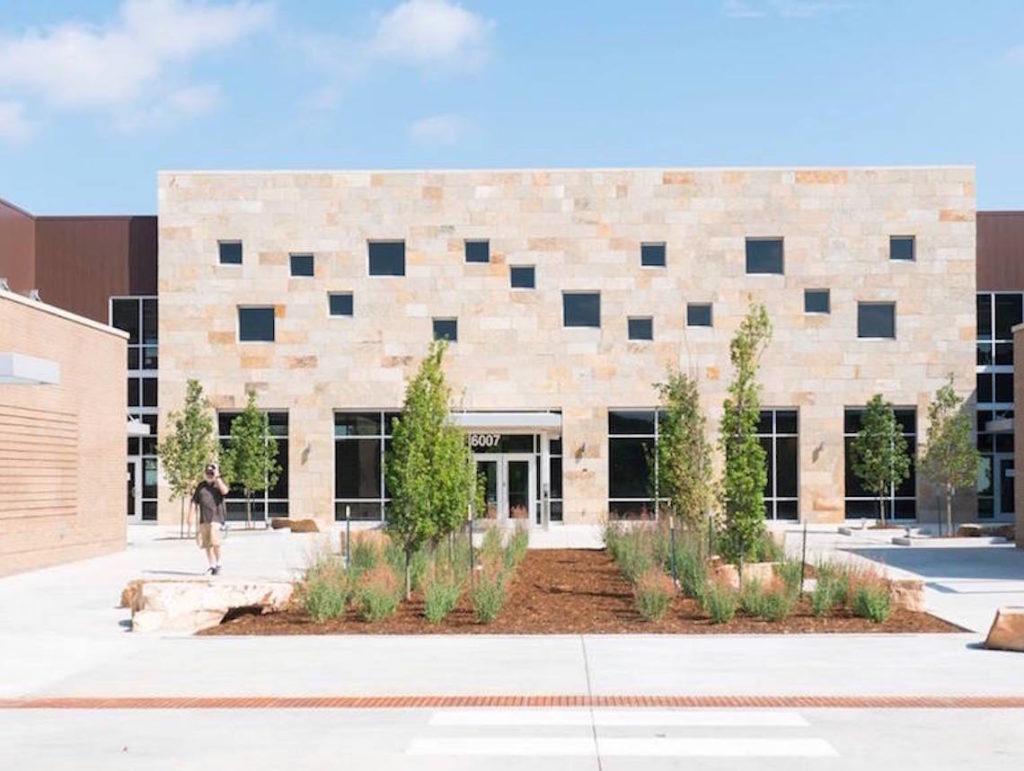
It was no small matter, then, to finally dedicate the ark that was to crown our new sanctuary here in Malibu 11 years ago. Our Bezalel, chosen after an arduous committee process, was an artist who, in fact, was a graduate of the Bezalel Academy of Arts and Design in Jerusalem. He was a superb craftsman, with an exacting eye for detail.
A year after the building was completed, we finally scheduled an inauguration of our precious ark with a gathering of the entire community on Shabbat. As the day grew near, I visited the artist’s studio and saw the ark doors, lying on the table. “Just a balancing problem,” I was told. “Don’t worry, it’s a few small details.” The next morning, an hour before the ceremony was to begin, I received an ominous phone call. There still were details to be worked out. The ark was not going to appear.
I ran into the sanctuary and set up a small screen, draped with cloth.
“Where’s the ark?” Cantor Marcelo Gindlin whispered as we took our places on the bimah.
“Don’t worry,” I said, pointing to the panels behind me. “Let’s get started.”
Vayakhel. A large crowd gathered, with all of our board of directors and major donors sitting in the front rows. We made our way through the service, and at last it was time to “install” our ark.
“Please rise if you were among the donors to this project,” I said. “You are the doors to our ark, providing both opening and protection.” About 50 people stood.
I then asked all those who had read Torah that year to rise. “You really hold the Torah within you. Please remain standing.”
I then asked our board to rise, our Eternal Light, as our choir sang words of Torah.
Soon everyone was on their feet, singing and clapping. I then asked people to give one another a blessing. The room grew quiet and a holy silence descended. Here and there, a heavenly voice could be heard.
“But what about the ark?” someone shouted.
“Oh, that ark,” I responded. “Ah, it’s not quite ready yet. But each one of you is really a holy ark, making a space for God to dwell. The real ark is in the human heart.”
No assembly required.
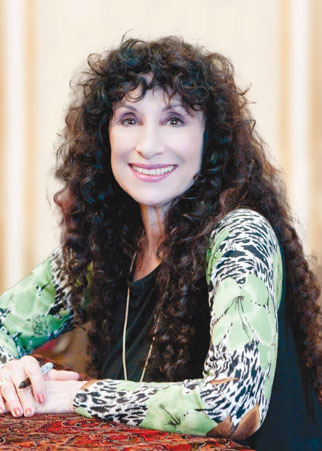
Rabbi Judith HaLevy is the rabbi of the Malibu Jewish Center & Synagogue and a past president of the Board of Rabbis of Southern California. For more of her Torah commentaries, visit mjcs.org.
Homesickness and nostalgia are similar, but there’s a subtle difference. Homesickness is when you miss a place you can go back to, and when you do go back, what you’re homesick for will likely still be there. Nostalgia, on the other hand, is a place you cannot go back to because it’s rooted in the past, and you know, deep inside, that the past cannot be lived again.
Nostalgia is a running thread in “Exile: Kisses on Both Cheeks,” a Jewish Women’s Theatre (JWT) show that opened March 18 and runs through April 3 in various venues, including synagogues and private homes. Directed by Susan Morgenstern, “Exile,” like other JWT shows, is a staged reading — performed by professional actors — of more than a dozen thematically connected personal stories and songs that evoke laughs, smiles of recognition and more than a few tears.
The subject matter of “Exile” — the journey of Sephardic Jews — is at times tragic or hilarious and always touching. Sephardim were forced to leave Spain and Portugal more than 500 years ago, after which they settled in far-flung places, from Central America to South Asia, but mostly in North Africa, Turkey, Greece and the Middle East. Over the years, often after being forced into exile again, most Sephardim have found safety in Western Europe, the Americas or Israel, but their history has taught them that safety may not be permanent: However secure a haven may seem, it could eventually turn out to be temporary.
“The motif that I saw repeated is being in a place for a generation or two, North Africa or Turkey, then having to move someplace else for a generation or two, and then having to go someplace else,” said Ronda Spinak, the JWT co-founder and artistic director who adapted and produced this show. “A sense of nomad, that there really is no home. … What you see in a couple of the pieces [in “Exile”] is the sense of, ‘OK, we’re here now, but how long will it be before we have to move someplace else again?’ ”
In a piece called “Becoming American,” Gladys Moreau expresses the uncertainty that many Sephardim carry in their DNA. Born in Egypt, Moreau moved to Italy with her parents, lived there for years, and as a schoolgirl, immigrated to the U.S. In a touching piece in which Moreau talks about Ashkenazi friends who had never met a Sephardic Jew, she writes that she has always felt secure here, but “I don’t know what’s going to happen tomorrow, and this feeling of, yeah, I’m in America, but still … I don’t know.”
The Sephardic writers of the pieces seem to be “groping,”not only to find a place where they can feel secure and at home, but also toward an identity.
In “Living Between the Question Marks,” Ruth Knafo Setton writes: “I dream in French, write in English, mysteriously know Spanish, curse in Arabic, cry in Hebrew,” an apt summary of Sephardic history’s interwoven strands. “I exist between languages, roam between countries, write between genres. … In a sense, I’m always writing in translation.”
That feeling of an uncertain future is captured in “The Last Seder” by Andre Aciman, whose Sephardic ancestors left Iberia, lived in Turkey for generations, then settled in Egypt. The story takes place during Passover in Alexandria in the 1960s after then-President Gamal Abdel Nasser has ordered Aciman’s family and other Jews to leave the country. The piece poignantly expresses a 10-year-old boy’s pain at being uprooted from a place he loves and will never forget.
In “Both Jewish and Arabic,” a young father whose Sephardic family lived in Syria and is now in the U.S., tries to teach his daughter Arabic, which he himself barely knows, and is gratified when she responds. Even though he knows they’ll never go back to Syria, her counting to 10 in Arabic is a symbolic return to a land where his family once felt at home.
An issue that Sephardic Jews have had to confront, after leaving Morocco or Turkey and coming to North America, is the interaction with Ashkenazi Jews.
“I wasn’t aware that many Sephardim have a sense that Ashkenazis consider them second-class,” Spinak said, “that [Sephardim] are not the real Jews. … So part of this show is trying to get at how much we are alike. … To acknowledge from the part of Ashkenazis, that, yes, we’ve done that to you. And for the Ashkenazis who are being shown this for the first time, that there is a whole different type of Jewish culture that is equally valid and equally Jewish.”
“Differences,” performed by the ensemble, was, according to program notes, “assembled from the internet” and pokes fun of cultural divides between Sephardim and Ashkenazis, while “A Sephardi Air,” by Ruth Behar, zeroes in on the customs relating to the sensitive issue of child-naming — Sephardim name a child after a living relative, while Ashkenazis do not — to highlight divergences and similarities between these two Jewish groups.
Spinak said that she and some others at JWT had wanted to do a Sephardic-themed show for some time. She met with UCLA Sephardic Studies professor Sarah Stein, who “was helpful in giving me a list of books to read about Sephardim: their history, their journey, as well as books of poetry and literature. She suggested different writers, so then I … did a lot of reading.”
While watching “Exile,” it’s no great leap to hear references to current events. “The play’s themes of loss and uncertainty about being forced to leave one’s home resonate deeply … at this day and age,” she said. “The Sephardic story is one that every Jew needs to hear.”
“Exile: Kisses on Both Cheeks” is adapted and produced by Ronda Spinak, and directed by Susan Morgenstern. Funding for the project was provided by the Maurice Amado Foundation. There is also an art show on Sephardic themes at the Braid, JWT’s home base, at 2912 Colorado St., No. 102, Santa Monica, with works created by artists Rene Amitai, Jaco Halfon, and Sarah True. For dates and venues, please go to jewishwomenstheatre.org or call (310) 315-1400.
One of the curiosities in “The Story of Hebrew” by Lewis Glinert (Princeton University Press) is that the author manages to write a history of the Hebrew language without using a single Hebrew letter in the text, although Hebrew appears in the illustrations, including a page from Franz Kafka’s Hebrew notebook. Indeed, Glinert announces at the outset of his richly detailed and wholly fascinating book that it is “not much a book about what Hebrew words mean as about what the Hebrew language has meant to the people who have possessed it.”
Another curiosity is to be found in the fact that Hebrew started out as one of the languages of ordinary life in the ancient Middle East, was preserved in the holy texts of the Jewish people, and was reinvented to serve as the lingua franca of the modern Jewish homeland. To be sure, the most observant Jews still regard Hebrew as leshon ha-kodesh, a language so holy that they insist on using Yiddish for everyday transactions. And yet, as Glinert points out, Hebrew is also “the language of secular Jewish culture,” and the revival of Hebrew was one of the great successes of the Zionist project: “Whether religious or national in spirit, or both, creativity has driven the Hebrew language and its literature to ever-new vistas and forms.”
Glinert, a renowned linguist and professor of Hebrew Studies at Dartmouth College, is willing to entertain a pious question: “What language, then, did God speak?” He points out that Jewish mystics proposed that “God was creating or deploying Hebrew itself, rather than waiting for a human being to do so,” and that Maimonides regarded all speech attributed to God in the Bible as purely metaphorical. History and science, however, offer a different explanation: “Scholars have long insisted that Hebrew was simply one of many Canaanite dialects, albeit one that happened to survive into the Common Era.”
The watershed moment, Glinert explains, was the Babylonian Exile in the sixth century B.C.E. Hebrew disappeared in various places around the Diaspora, and many Jewish communities required Aramaic and Greek translations in order to understand what is written in the Torah. But the leadership of the exiles who later returned to Judea, “in a remarkable textual act of spiritual resistance,” embraced Hebrew as the language in which the Midrash, the Mishnah and the liturgy were to be expressed: “Out of this grew a great corpus of Hebrew literature, embodying the religion and culture of the Jews down to modern times.”
“The Story of Hebrew” is deeply rooted in scholarship, but Glinert is an engaging storyteller, always lucid, wry and accessible. Thus, for example, he explains the intricacies and inner workings of Hebrew liturgy as it developed in antiquity, showing how “the poets were tempted to produce extravagant flights of fancy, building new words from old in ways even native speakers would have been unlikely to attempt.” And then he sums up: “Could the average worshipper fathom it all? Probably not. (Most modern Israelis can’t, either.)”
Throughout the book, the author reminds us that the survival of Hebrew over several millennia of history is remarkable in itself, although we can thank the generations of translators known as Masoretes for what might seem wholly miraculous. “They preserved both the living sound and shape of biblical Hebrew and the biblical text itself as canonized by the Rabbis two thousand years ago,” he writes. “Thus they ensured that Jews across the Diaspora would study from (more or less) identical copies.”
Yet Hebrew itself changed over time. In that sense, “The Story of Hebrew” is actually a story of the Jewish people, both in the Holy Land and throughout the Diaspora. For a thousand years or so, between the completion of the Talmud and the Jewish Enlightenment of the 19th century, “Hebrew was primarily a religious language.” Once the Jews began to leave the ghettos and enter the secular world, Hebrew was reinvented as a modern national language. “It was not only necessary to invent words denoting [the] locomotive, telegraph, or parliament; the language would also need to express such conceptual distinctions as people, nation, and state.”
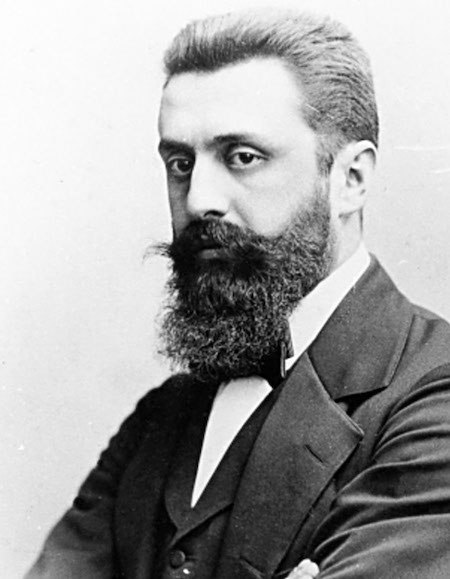
Hebraists turned to “the lucid, no-nonsense rabbinic style of Rashi and Maimonides” to coin the new words they needed. While Theodor Herzl assumed that German would be the national language of the Jewish homeland, lexicographer Eliezer Ben-Yehuda, poet Hayim Nahman Bialik and their like-minded colleagues devoted themselves to nothing less than the remaking of the Hebrew language.
Significantly, Glinert always finds a way to make these facts of history come fully alive for his readers, which is why “The Story of Hebrew” is both an eye-opening study of the Hebrew language and an extraordinarily pleasurable reading experience. For example, the author describes how Ben-Yehuda and his first wife, Dvora, resolved to speak only Hebrew when they arrived in Palestine — “an agreement that initially bound her to silence since she knew none.”
The rule was still in place when their first child was born. “Dire warnings by fellow Zionists that the child might grow up retarded seemed confirmed when he turned 3 without yet uttering a word — until one day Ben-Yehuda caught his wife singing a Russian lullaby and flew into a rage, when suddenly the frightened child blurted out Abba, Abba! (Daddy, Daddy!).”
The internet treated us to quite a debate last week. The issue: Are Zionism and feminism, two of the most successful social revolutions of the 20th century, compatible?
In a New York Times op-ed, Jewish American Emily Shire wondered if her identity as a Zionist would alienate her from a resurgent feminist movement aligned with the Palestinian cause. “I am troubled by the portion of the International Women’s Strike platform that calls for a ‘decolonization of Palestine’ as part of ‘the beating heart of this new feminist movement,’ ” she wrote. “Why should criticism of Israel be key to feminism in 2017?”
She was answered by Linda Sarsour, a Muslim-American activist and one of the organizers behind the Women’s March on Washington. In an interview with The Nation, Sarsour responded bluntly: “It just doesn’t make any sense for someone to say, ‘Is there room for people who support the state of Israel and do not criticize it in the movement?’ There can’t be in feminism. You either stand up for the rights of all women, including Palestinians, or none. There’s just no way around it.”
On one point, Sarsour is right: To believe in the rights of women is to believe in the rights of all women — including those in Sudan, Afghanistan and Saudi Arabia. A feminism that lacks inclusion is a flawed feminism. There’s just no way around it.
But many in our community only heard Sarsour say: “criticize Israel.” And so the debate descended into something vicious and misguided, helped in large part by The Nation’s deeply irresponsible headline — “Can You Be a Zionist Feminist? Linda Sarsour Says No” — and a reporter who was even more irresponsible. She offered Sarsour an unrestricted soapbox on which to air her views, without ever thinking to ask if she supports the same Jewish right to self-determination that Sarsour is seeking for the Palestinians.
I spent a few days thinking about why this little tempest matters, and you know what I concluded? It doesn’t.
“Basically, this is a conversation about theory,” Anat Hoffman, perhaps Israel’s most famous feminist, said when I reached her by phone. “The practical, immediate repercussions of this are zero.”
Talking is not especially useful to Hoffman, who is one of Israel’s leading activists. She is a founding member of the Women of the Wall movement, which seeks prayer equality for women at the Western Wall in Jerusalem, and the executive director of the Israel Religious Action Center, a legal advocacy arm pursuing gender equality, social justice and religious pluralism. Hoffman spends most of her time bringing lawsuits against the State of Israel, demonstrating that arguments about the definition of political movements are far less consequential than policy change.
If people like Sarsour count no Jewish Zionists among their friends or colleagues, it is virtually guaranteed they will never modify their views.
For women who work in the trenches of Israel’s justice movement, the tension between Zionism and feminism is nothing new. The Orthodox establishment within Israel’s government has precluded women from realizing their full rights since the country’s founding.
“What about the 50,000 women who cannot get divorced because there is no civil marriage or civil divorce in Israel? What about the gaps in salaries? What about domestic violence?” Hoffman said. “To the Jewish woman who says that for the first time she feels a tug between her Zionism and her feminism, I say: ‘Good morning, sister!’ ”
How one Muslim-American woman defines feminism, or Zionism, is irrelevant. Any thoughtful person can define his or her personal politics and has the right to set their own political priorities. What matters is that we stop instantly vilifying anyone and everyone with whom we don’t agree — whether within our own communities or outside of them.
“Zionism needs a good kick in the ass,” Hoffman said, “as long as there’s one condition: that you love Israel, that you are committed to the existence of Israel, and to the right of the Jewish people to have a sovereign state and self-determination. Then you can criticize Israel as much as you want.”
But what about people like Sarsour, who might not love Israel? Should we, as a community, even bother talking to her? Where do we draw the line?
“If you believe terrorizing innocent civilians is the way to achieve liberation, then that crosses my line,” Hoffman said. “Someone who believes the only way to go is to explode buses in Israel — he is my enemy.”
A shared premise of nonviolence is a reasonable rule of engagement. Better to engage — even our foes — than walk away from the table altogether, right? At least if we’re talking, there is hope our views will prevail over time, or that we’ll reach a compromise. After all, if people like Sarsour count no Jewish Zionists among their friends or colleagues, it is virtually guaranteed they will never modify their views.
Sarsour says she is committed to non-violence, but other aspects of her record are troubling. She fights on behalf of the oppressed but seems to have little regard for Jewish history. Nowhere is there a record of her support for the existence of Israel as a Jewish state, and she has tweeted that Zionism is “creepy” and akin to racism. Is it worth talking to her if she doesn’t support Israel’s right to exist? If she’s really an anti-Zionist activist disguised in social justice clothing?
“I believe in Sarsour’s right to self-determination and an independent state of her own,” Hoffman said. “And I would like you to find out if she believes in my right to [the same]. Because I have no other choice: Hebrew is my language and Jerusalem is my home. I have nowhere else to go.”
My mother passed away, and my dad was all alone in his apartment. He decided to move in with me but he was still alone, as I worked during the day and would sometimes go out at night.
Dad was 90 at the time, and I thought of a retirement home for him but did not know how to approach him about it. I started to investigate different facilities and found one near the Fairfax area called the Shalom Retirement Home. It was new and looked like a lot of seniors were living there.
I visited during a lunch break on a Friday and went directly to the administrator’s desk. The woman working there said her name was Miriam. I said, “I’m looking for a place for my dad to live.” Miriam replied, “Why doesn’t your wife take care of him?” This was her sneaky way to find out what I said next, which was, “I’m not married.” Well, that evening Miriam told her mother that she met the man she was going to marry. Her mother responded, “I’m going to commit you to a mental facility.”
The next day I brought my dad to the Shalom Retirement Home to see the place. We had lunch there and then Dad moved in — that same afternoon — but not before Miriam called the owners to ask if she could rent the room to him at a slightly cheaper rate.
My dad loved the place, and within an hour, he told Miriam, “You’re just the right girl for my son Fred.” Well, Miriam told him that she had a young son from a previous marriage, to which he replied, “Even better!”
It took me three weeks to ask Miriam out on a date, and when I did, she said, “It’s about time! We’re not getting any younger!”
On the nights I took out Miriam, which were frequent, my dad would happily baby-sit her son, Marc. Well, that’s when the great conspiracy began. Marc and my father became fast friends. They loved keeping each other company. They played all kinds of board games while they discussed when they thought I was going to pop the question to Miriam. Soon after, Marc said, “Mommy, Fred is the right guy to marry.”
Miriam lived in an apartment. When I would pick her up for a date, I’d come a few hours early to take Marc to Jack in the Box for a hamburger (his favorite) while Miriam got ready. Then we’d bring Marc to my father. I wasn’t sure if my dad was baby-sitting Marc or if it was the other way around. One thing was undeniable: They adored each other.
I was employed only a few blocks away from Miriam’s apartment. Every day, she would wait for me to visit after work. Each time, she’d serve cottage cheese and fruit. Needless to say,
I never want to see cottage cheese again. As for the fruit, I’m still on the fence.
Three or four months into our relationship, we started to take small trips, sometimes bringing along young Marc. He was a very smart boy for his age. He won any game I played with him. We had a special relationship, and he already thought of me as his new father. Seeing that I had never married or had children, this was a catalyst that took me through the ups and downs of fatherhood.
Seven months after Miriam and I met, I popped the question. Two months later, we had a lovely, quaint wedding.
I sold my house in the city, and Miriam gave up her apartment. We purchased a home in Sherman Oaks.
I’m now 83; Miriam is 80. We were married on July 28, 1972, and our next wedding anniversary will be our 45th. We have loved each other more and more, every day.
Yes, we were indeed meant for each other.
FRED GERSON is a former controller for a real estate developer.
With characteristic poise, Rabbi David Wolpe turned to the three panelists onstage at Sinai Temple on a recent Wednesday evening, in front of a sellout crowd of some 250 people.
“I’m going to start with a quick yes-or-no question,” he began. “Do you believe that people under 35 are less attached to the State of Israel than they were 30 years ago?”
On either side of me were Rabbi Sarah Bassin, 34, of Temple Emanuel of Beverly Hills, and Sam Yebri, 35, a lawyer, accomplished leaders in their respective Jewish communities, progressive and Persian. Each answered immediately in the affirmative. And then there was me — the only millennial on the panel, feeling intellectually outmatched, my headset pressing uncomfortably into the back of my skull.
“Yes,” I answered quickly.
And yet, in my mind, I was already hedging, picking at the very premise of the question. I scribbled the phrase “less attached” on the legal pad perched on my knee and frowned at it. Of course my generation is less attached to Israel. Is a parent less attached to an 18-year-old child than to a defenseless toddler taking its first steps into the world?
That’s the difference the past 30 years have wrought for Israel: from a state struggling out of its uncertain beginnings to a proud and mighty nation. Over the generations, the meaning of the word “Israel” has changed, and consequently, inevitably, so has the meaning of the word “Zionism.”
“No one in the Jewish community supported a Palestinian state — I mean, no one, post-1967,” Wolpe said at the March 15 panel about young Zionists, sponsored by Hadassah and the Jewish Journal. “Then, a Palestinian state became orthodoxy. Everybody in the Jewish community supported a Palestinian state. Now, it’s becoming unorthodox again.”
The pendulum has swung wildly and often. What began in Europe as a movement of socialists and atheists to re-establish a Jewish homeland these days often feels monopolized by the religious right.
“Instead of creating bridges, we are contributing to the conflict between East and West by our stupid desire to have more.” —A.B. Yehoshua, Israeli author
Each generation defines and redefines Zionism to suit its needs and circumstances. It’s a task that becomes more and more difficult, as each passing year is another separating today’s youth from the movement’s inception.
By the time I enrolled at UCLA, Zionism was read in many circles as a type of extremism. “Really?” an editor at the UCLA Daily Bruin once said to me after I professed to being a Zionist. “I didn’t expect that.” I read his meaning well enough: How could a person who seems to be reasonable also be a Zionist?
It used to be that the definition was a simpler and easier one, dictated by ironclad concerns of Jewish continuance and survival. Such was the case, for instance, in the Galician shtetl where my paternal grandfather was born, where Zionism meant young people training together in preparation to cultivate the land that would shortly become their only refuge.
In 1939,my great uncle, Mordechai Arom, was one such youth, preparing to join his brother, my grandfather Shmuel, in Mandatory Palestine, when their mother took ill. Mordechai was ready to stay in Poland to care for his dying mother, but she called him to her bedside and commanded him to go. With her dying act, she became the matriarch of a Zionist tradition that still holds. The first day Mordechai arrived in Palestine, he received a telegram that she’d died. His first week in the Holy Land was spent sitting shivah for his mother.
For my grandfather Shmuel, in the years after the war, Zionism meant building an observant congregation in Rishon LeZion even while questioning the God that sent his relatives to be slaughtered en masse. He died in 1964, struck by a car while collecting alms for the temple, later named Neve Shmuel in his honor.
Zionism intruded on my mother at Leuzinger High School in Lawndale, on June 10, 1967, when news came over the radio in Mr. Cameron’s 12th-grade history class that Israeli troops had taken the Western Wall plaza. My mother was visibly emotional, so the teacher dismissed her to the library, where she wept.
After college, she got on an airplane — for the first time ever — and flew to Jerusalem, not knowing a soul in Israel, not a cousin, not a second cousin, nobody. She stayed for two years. “As soon as I knew there was a State of Israel, I knew I had to go,” she said.
Those years marked an inflection point for Zionism. It had started almost a century earlier as a whisper, an outlandish notion popularized by Theodor Herzl, a peripatetic journalist and self-identified atheist. It began, if you will, as a bad word, denounced by much of the Jewish establishment as a Messianic affectation. In 1880, Rabbi Isaac Mayer Wise, the founder of Hebrew Union College, wrote, “We want no Jewish princes, and no Jewish country or government.”
“Zionism demands a publicly recognized and legally secured homeland in Palestine for the Jewish people. This platform is unchangeable.” —Theodor Herzl, father of modern Zionism
Of course, the attainment of such a country in 1948 changed everything. My mother was born three years later, and the first 16 years of her life were marked by an aspirational Zionism, with Israel as the David to an Arab Goliath.
That Zionism reached its high point in 1967, with Israel’s astonishing victory in the Six-Day War. Then, Israel enjoyed the world’s admiration. Today, pro-Palestinian activists, including thousands of Jews, see 1967 as the beginning of the occupation — the moment the Jewish people went from oppressed to oppressor.
That unlikely triumph has come back to haunt the conscience of American Jewish youth, who have never known any Zionism other than one of victory and strength.
Meanwhile, the 80-year history of flight, toil and fear of death that my parents and grandparents experienced as Zionism is regularly obliterated by the reductionist slogans of pro-Palestinian groups and their allies, for whom a Zionist is an occupier, Jews are the White Man and oppression in Palestine is no different from oppression in Ferguson, Mo.
Nearly half a century after my mother graduated from UCLA, African-American activist Amy Hunter was invited by Students for Justice in Palestine to speak at UCLA’s campus as part of Palestine Awareness Week.
“We will not be free here in the United States if they are not free in Palestine,” she told a small but diverse audience, their fingers snapping in agreement. “I’m clear about that.”
It’s not as if the “Zionism-is-racism” equivalence is news. My mom remembers campus leftists asserting as much in the early 1970s. In response, she and her Hillel buddies walked around with pins that read, “I am a Zionist.”
Those pins still might be a good idea today. In 2017, campus Zionists face a movement that bills itself as a global liberation struggle. In the parlance of that struggle, “Zionist” is a slur, and the connections and political opinions it suggests have become so toxic as to discourage its use, even among many who ostensibly support Jewish statehood. Imagine if people who don’t eat meat balked at calling themselves vegetarians.
Among the reasons for my invitation to speak at Sinai Temple are the many conversations I have in the course of my reporting with members of the Jewish far left, including the group IfNotNow, a diffuse network of young Jews openly challenging the Jewish establishment for its support of the status quo in Israel and the Palestinian territories.
It’s neither the largest nor the most influential pro-Palestinian Jewish group, but it’s the newest and, because of its confrontational approach, perhaps the most worrisome for mainstream Jewish organizations. Lately, I’ve taken to asking members of IfNotNow if they consider themselves to be Zionists.
Unanimously, they decline to be quoted by name and then give variations of the same answer: I’ve moved past the term. It doesn’t apply. It’s beside the point. I don’t identify either way.
These young people are neither Zionist nor anti-Zionist — they’re post-Zionist.
In fact, IfNotNow and its constituency seem to be in the minority of young people in that they care about Israel at all. A Pew Research Cemter poll in 2013 found that among Jews 18 to 29 years old, 32 percent said caring about Israel is essential to being Jewish, compared with 53 percent of Jews age 65 and older.
Within that slice of young Jews, there is, of course, a considerable range of opinion. Among such groups as IfNotNow and J Street and Jewish Voice for Peace, caring means advocating a Palestinian state for the sake of maintaining a Jewish one.
But on the other hand, when the American Israel Public Affairs Committee convenes its annual policy conference later this month in Washington, D.C., you can bet there will be plenty of Jewish youth in attendance for whom caring about Israel means something very different.Just ask Ron Krudo, executive director of campus affairs for the pro-Israel organization StandWithUs, which is active on high school and college campuses across the country. Notwithstanding anti-Israel sentiment, students “are excited to share their stories of being a proud Zionist, and what Zionism means to them.”
“Even on some of these tougher campuses, you can always find a student who’s inspired to take action and be a voice,” said Krudo, 26.
Yet the fact remains that most young Jews can’t be bothered to care, or at least don’t feel their Judaism compels them to. For many, the question of Zionism is so fraught with contradiction that it’s much easier just to swear it off entirely.
I’m not immune to my generation’s ambivalence on the matter of Jewish nationalism. In the vocabulary of my education on a liberal campus, the word “nationalist” is likely to follow the word “white” or “militant” or “ultra.” In other words, mine is a Zionism that’s not without reservations.
“Let no American imagine that Zionism is inconsistent with patriotism. Multiple loyalties are objectionable only if they are inconsistent.” — Supreme Court Justice Louis D. Brandeis
But to say that I’m post-Zionist would be tantamount to saying that I’m post-Jewish — which is simple and easy but altogether untrue. The struggle for Jewish nationhood was written into my biography long before I was born.
After all, if it weren’t for the itinerant Zionism that motivated my grandfather Shmuel to drag his wife, the daughter of a cultured and well-to-do German-Jewish family, to hardscrabble Palestine, where they slept in tents and toiled without end, it might very well have been somebody else’s byline on this story; I may well have never been born. Israel is the center of gravity for world Jewry. You may object to its pull, but you simply can’t free yourself from its orbit.
To be sure, mine is not the blustering, self-assured Zionism of my parents. Even having this conversation with my mother sets her singing an interminable series of Israeli folk songs. Recently, standing in her kitchen, I pressed her on whether she truly believes that God gave us all the land from the Jordan River to the Mediterranean Sea. “Listen,” she replied, “I don’t know who gave it to us, but it’s ours.”
I’m not so sure about that. But that doesn’t mean we’re not part of the same movement, she and I, the same multigenerational struggle for identity and soil. The panel at Sinai Temple landed repeatedly on the idea of “big-tent Zionism.” The tent has to be big enough for my parents and me.
Sometimes, that prospect feels doubtful. But nothing could be more necessary for the continuance of the movement. If Zionism is little more than a narrow political creed, it can be shouted down or reasoned away. What ultimately will win over the next generation of Zionists is what Yebri called “the beautiful aspect and miraculous magical aspect of Zionism.”
The miracle, in short, is that in 80 years, we have moved from total disempowerment to a position of such security and strength that we can argue bitterly among ourselves about what to do with it. It’s a compelling narrative, if we can capitalize on it.
“One of the strongest indicators of having a strong Jewish identity, beyond campus and education and peer trips to Israel, is a Jewish grandparent that identifies strongly with his or her Judaism, and I would submit that follows for Zionism,” Yebri told the crowd at Sinai Temple. “So if you’re a parent or a grandparent in this room who feels strongly about Israel … don’t delegate it to school or a book or Birthright, because by that point it’s too late.”
I suspect that many of the Jewish youth who have distanced themselves from Zionism aren’t as familiar with the Zionist narrative of their forebears as they are with today’s more politically charged definitions. If they were, they might be more likely to adopt it, baggage and all. It is, after all, an enthralling story, with no small share of heroes and martyrs.
A decade after sitting shivah for his mother, Mordechai, my great uncle, closed out his own life by sacrificing it to the Zionist cause — cut down while defending his village in Gush Etzion during the War of Independence. This, before Green Lines and settlement blocs and two-state solutions.
If the next Jewish generation wants to be part of a global struggle for liberation, then it may as well be our own.
Editor’s note: This opinion tackling the United Nations Human Rights Council is the “pro” argument published in conjunction with the “con” argument written by Roz Rothstein and Max Samarov, “When will the UN Human Rights Council follow its own mission?”
Nearly three years ago, the United Nations Human Rights Council appointed me as its monitor — “special rapporteur” — on freedom of expression. I report to the council about the worst abuses of expression worldwide, such as attacks on journalists and independent media, members of vulnerable minorities, and the ability of anyone to seek, receive and impart information online. In this position, I know the council, its strengths and its weaknesses.
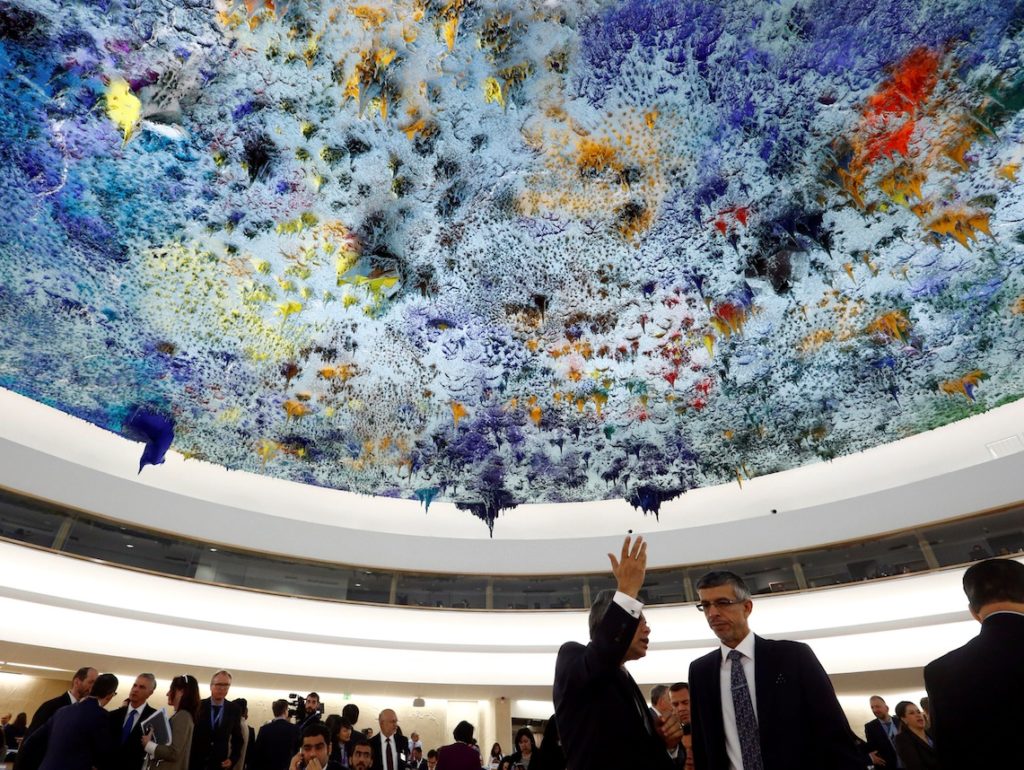
Composed of government representatives, the council gathers for several weeks every March, June and September in an ornate conference room at the Palais des Nations, the European headquarters of the United Nations in Geneva, to proclaim a commitment to such fundamental human rights as the prohibition of torture, extrajudicial killing and arbitrary detention, as well as the rights to freedom of expression, religious belief and peaceful protest.
From my experience, I can say one thing with certainty: Activists around the world, in every country, value the council as a central global platform for their voices to be heard. In my missions to Turkey, Tajikistan and Japan last year, journalists, lawyers, judges, teachers, humanitarian workers and activists all sought the help of the U.N. — at the very least, its moral support. While a U.N. visit or statement may get lost in the Western media, in many countries around the world, a word from a U.N. official or the Council can instigate controversy for days, sometimes even leading to solutions.
To be sure, the council is not a human rights nirvana. Its flaws are well-known. Forty-seven governments — including the United States — are elected to sit on the council and all other governments have a seat in the room at the Palais. Many violate human rights norms regularly, some in repressive and violent ways. These flaws, according to our new Secretary of State, Rex Tillerson, seem to be moving the Trump administration to consider whether the United States should abandon the council seat it won last year.
I believe the case for leaving the council is extraordinarily weak. If the administration, like Barack Obama’s administration before it, strongly objects to the council’s “biased agenda item against Israel,” as Tillerson put it, then the place to fight that bias is from within. Few listen to those outside, and few outside have the tools or the leverage to make reform.
Others have made the case for why the council serves American interests. As Suzanne Nossel, a former State Department official and current head of PEN America, has summarized it in a must-read contribution to the debate, U.S. departure from the council would help cede control of the human rights agenda to authoritarians — exactly those that the council is supposed to resist and restrain. She notes that a council with the United States has historically been better for human rights globally, not to mention better for Israel.
These realpolitik arguments work. Leaving the council makes no sense if we are talking about U.S. national interests.
For me, as someone who heard of tikkun olam before human rights, the council has merit on its own. We constantly sought venues for our own demands for the rights of Soviet Jews during the years of the Cold War or for the rights of African-Americans during the civil rights era. In recognizing that kind of searching today, the council amplifies the messages of those deprived of a voice or denounced as enemies of their people in their home countries.
Consider the kind of discussion that can take place during council meetings. In an era when governments kill their opponents, jail their chroniclers and repress their critics, human rights talk may seem wildly out of sync with the times. Yet there at the Palais, one by one, individual human rights advocates rise from their seats in the back of the room and make their way to microphones so that every person there — every government representative, every U.N. official — can hear. They have come from all corners of the world, and they say what the governments need to hear, calling them out for their abuses in front of a global audience.
You might hear, as I have, Bahraini advocates identify friends and family members held in prison merely for criticizing the government, some for doing so on Facebook or Twitter. You might hear criticism of Saudi Arabia for its jailing and flogging of bloggers, or condemnation of Turkey’s massive attack on the media, the bureaucracy and opposition politicians. You might learn of the ways in which Iran silences and represses its Baha’i minority, in areas such as education, music and religious tradition.
You might hear from a refugee who has fled totalitarian North Korea or war-ravaged South Sudan, a member of the Muslim Rohingya community subject to attack and statelessness in Myanmar, or from a Tibetan activist recounting the repression of Chinese authorities. You could be brought to outrage from stories of hunger in Venezuela, driven by authoritarian governance, or of fear from stories of LGBT communities in Cuba, Russia, Kyrgyzstan, Uganda and elsewhere.
This is more than idle talk; these individual interventions can have impact. The voices of victims and advocates have helped lead to important outcomes: special commissions to tell the truth about human rights abuses in North Korea or the brutality of ISIS and the Bashar Assad regime in Syria or special monitors to report on the human rights crises in Iran, Cambodia, Myanmar, South Sudan and many other places — including, yes, the West Bank and Gaza. In some cases, stories told in Geneva have helped lead to sanctions adopted by the U.N. Security Council in New York.
In response to advocacy by nongovernmental organizations, the council also has created special mandates and appointed individual experts to monitor human rights issues worldwide, including freedom of religious belief, peaceful protest, violence against women, racism and housing (and the one I hold on freedom of expression). It has condemned all manner of human rights abuses, from anti-Semitism to discrimination against women, from racist crimes to attacks on workers’ rights. Through its Universal Periodic Review, the council reports on every country’s human rights behavior, allowing local and international activists a role in that process.
Leaving the council makes little sense if we still are to maintain that human rights play some significant role in America’s engagement in the world, even if not a leading or pivotal one. The U.N. isn’t perfect, and neither is the United States. But walking away from human rights is not who we are, and it’s not where we should go.
Reform the council, yes. Criticize its biases, sure. But recommit to it. Fix it. And make it work for those who need it worldwide.
David Kaye is a law professor at UC Irvine School of Law and the U.N. special rapporteur on freedom of opinion and expression. He can be found at @davidakaye and freedex.org.
About 40 Valley Beth Shalom (VBS) Day School fifth-graders were among the 18,000 elementary school students who participated in the 47th annual Blue Ribbon Children’s Festival, a free arts education initiative held Feb. 28 at The Music Center in downtown Los Angeles.
Nancy Herbst,director of general studies at the day school, was among the adults accompanying the VBS students, who attended a performance by the Ailey II dance company in the Dorothy Chandler Pavilion before they performed a synchronized dance inspired by Ailey II in The Music Center plaza.
Blue Ribbon is the self-described “premier women’s support organization of The Music Center.”
The Anti-Defamation League’s (ADL) Helene & Joseph Sherwood Prize for Combating Hate luncheon and awards ceremony was held March 14 at the Skirball Cultural Center.
The event honored law enforcement officials who have played a role in fighting hate in Southern California.
Among the honorees were Riverside County Sheriff’s Department Deputy Yadira Perez, who helped apprehend an arsonist responsible for setting a mosque ablaze in Coachella in December 2015, and Cindy Cipriani, senior management counsel and director of community outreach in the U.S. Attorney’s Office for the Southern District of California, who “has dedicated her life’s work to advancing the values of unity and understanding with humility and compassion,” the ADL statement said.
Perez recalled her decision to pursue the arsonist after spotting him while off-duty: “At that point,” she said, “I felt the risk to public safety outweighed the risk of me catching him.”
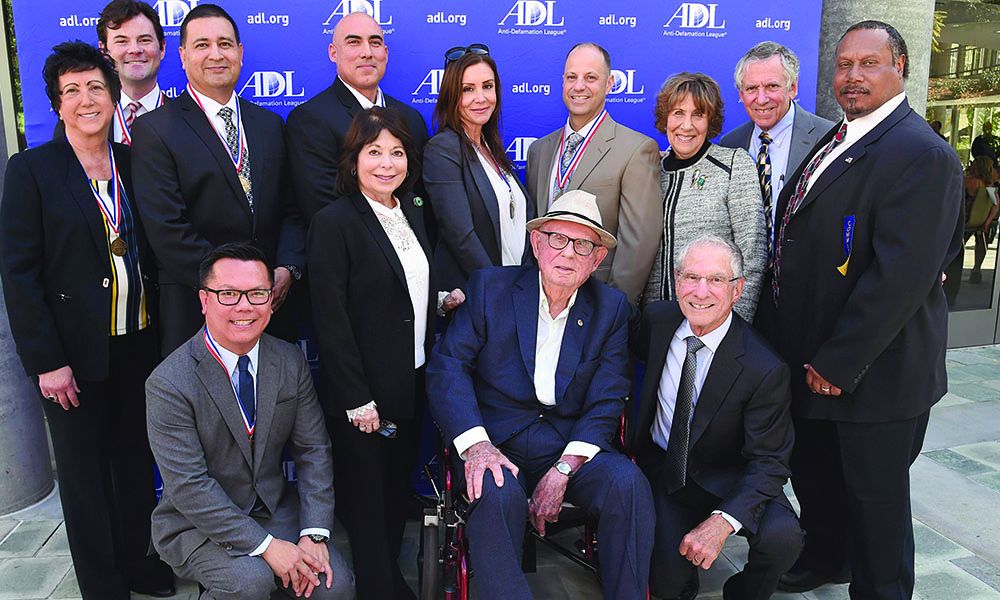
LAPD and Bureau of Alcohol, Tobacco, Firearms and Explosives investigators and L.A. city attorneys, who were honored for their takedown of a white supremacist gang in the San Fernando Valley, come together with Joseph Sherwood (seated, front row) and his son, Howard (crouching, far right) at the Anti-Defamation League’s Helene & Joseph Sherwood Prize for Combating Hate luncheon and awards event.
The fire at the mosque was seen as a vengeful reaction to the killing of 14 people and wounding of 22 earlier that month at the Inland Regional Center in San Bernardino by perpetrators who claimed terrorist allegiances.
In addition, the FBI’s Los Angeles Field Division, its Orange County Resident Agency, the Orange County Intelligence Assessment Center and the U.S. Attorney’s Office for the Central District of California were honored as a group for thwarting “two Anaheim individuals planning to travel to Syria and fight for ISIS,” the ADL said. One of the individuals had planned to fly from Los Angeles to Tel Aviv to join terrorist fighters in the Middle East.
The event’s additional group honoree was the Bureau of Alcohol, Tobacco, Firearms and Explosives’ L.A. field division, the L.A. City Attorney’s Office and the Los Angeles Police Department’s Major Crimes Division, which were honored for removing a “stronghold of San Fernando Valley Peckerwoods, a white supremacist gang,” the ADL said.
The more than 250 attendees included Ayelet Feiman, an L.A. city attorney prosecutor who was honored with the Sherwood Prize in 2013 for her efforts on a case involving swastikas drawn in maple syrup outside the home of a Jewish family in Northridge; Joseph Sherwood and his son, Howard; ADL Regional Director Amanda Susskind; L.A. County Sheriff Jim McDonnell and others.
The event also celebrated Joseph Sherwood’s 100th birthday, on March 12.
The Sherwood family launched the prize in 1996 as a way to bring attention to the positive contributions of law enforcement.
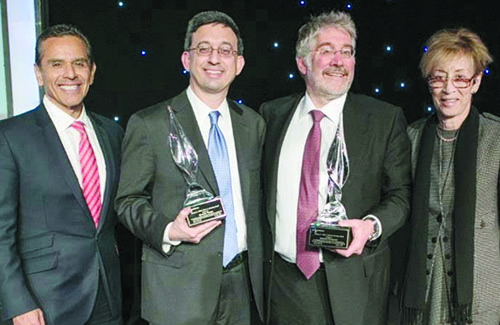
From left: Former L.A. Mayor Antonio Villaraigosa, Michael Tuchin, Richard Pachulski and Patricia Glaser attend the American Friends of Hebrew University Torch of Learning Award Dinner, which honored Tuchin and Pachulski. Photo courtesy of AFHU.
The March 1 American Friends of Hebrew University (AFHU) Harvey L. Silbert Torch of Learning Award Dinner at the Beverly Hilton honored Richard Pachulski, a corporate restructuring attorney, and Michael L. Tuchin, a founding member and co-manager of Klee, Tuchin, Bogdanoff & Stern.
Wall Street Journal columnist Bret Stephens, who often writes about events pertaining to Israel and has spoken out against President Donald Trump despite being a conservative, was the guest speaker. He discussed what makes America great, noting the disproportionate number of Nobel Prize winners who are Americans, many of whom are immigrants. Additionally, he said HU, with its diverse student population of Arab, secular and religious students, embodies what is best about Israel.
Former Los Angeles Mayor Antonio Villaraigosa, who is described by an AFHU press release as “the honorees’ longtime friend,” presented Pachulski and Tuchin with their awards.
The event raised $1.2 million for the Hebrew University of Jerusalem Faculty of Law.
Attendees included Patricia Glaser, event chair and the AFHU western region vice chair; Michael Karayanni, dean of the Hebrew University Faculty of Law; Richard Ziman,vice chairman of the AFHU board of directors; and Brindell Gottlieb,president of AFHU’s western region.
AFHU raises awareness of and support for Hebrew University of Jerusalem.
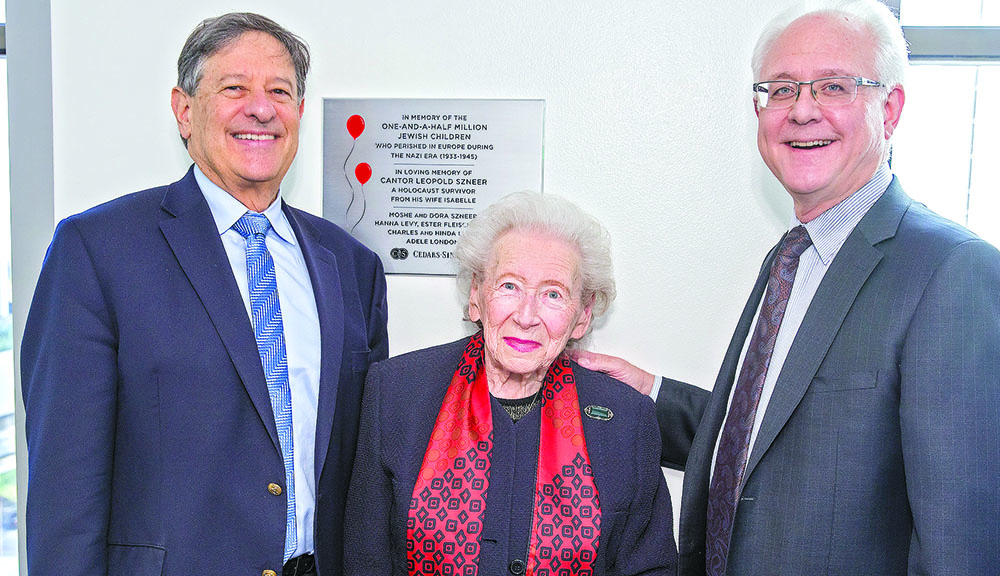
From left: Cedars-Sinai Dr. Shlomo Melmed, Isabelle Szneer and Cedars-Sinai Dr. Charles Simmons commemorate Szneer’s donation to Cedars-Sinai Medical Center. Photo courtesy of Cedars-Sinai Medical Center.
The family of the late Leopold Szneer, a German-Jewish Holocaust survivor and former Congregation Mogen David cantor, has provided a $250,000 gift to the Cedars-Sinai Pediatric Inflammatory Bowel Disease program.
A dedication and luncheon to celebrate the donation, given in Szneer’s memory and in the memory of the 1.5 million children who perished during the Holocaust, was held Jan. 17 at Cedars-Sinai Medical Center.
Szneer, who died in 2016, was imprisoned in Dachau during the Shoah, fled on the Kindertransport to Belgium in 1938 and experienced numerous challenges before immigrating to Los Angeles in the 1950s.
He went on to serve as a cantor, his longtime dream, at Congregation Mogen David in Pico-Robertson, for more than 20 years.
Isabelle Szneer, his wife since 1947 and also a Holocaust survivor, provided the gift in her husband’s memory. “He was a much loved man in the city,” she said.
Attendees at the event included Congregation Mogen David Rabbi Gabriel Elias; Dr. Shlomo Melmed, executive vice president of academic affairs at Cedars-Sinai; and Dr. Charles Simmons, chair of the Department of Pediatrics at Cedars-Sinai.
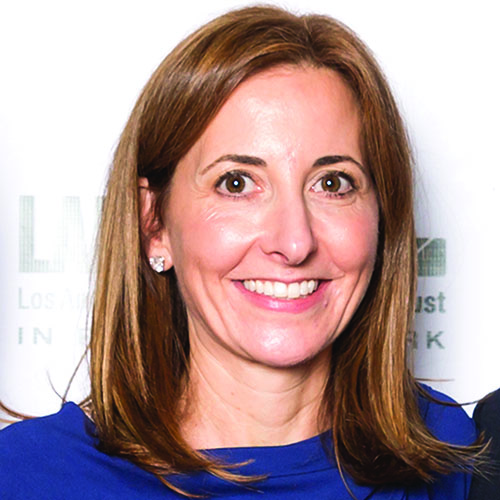
Beth Kean
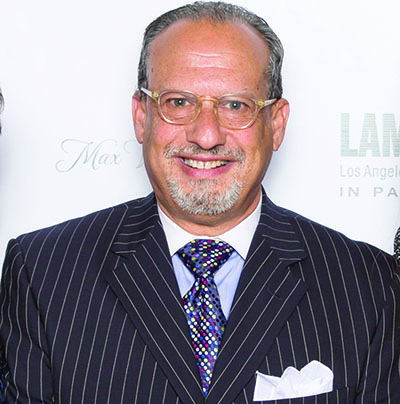
The Los Angeles Museum of the Holocaust (LAMOTH), which describes itself as the oldest survivor-founded Holocaust museum in the country, has named Beth Kean its executive director and Paul Nussbaum its president, according to a March 14 announcement.
Kean, who became the museum’s president in January 2016, had also been serving as interim executive director since November, following the departure of the museum’s previous executive director, Samara Hutman. Nussbaum previously served as the museum’s treasurer. Jamie Rosenblood, a current board member at LAMOTH and museum docent who has a background in finance, is succeeding Nussbaum in that role.
Paul Nussbaum
The leadership transition is part of “an unprecedented five-year plan to expand [the museum’s] mission of teaching the dangers of genocide and promoting empathy, tolerance and understanding through history, shared knowledge, and personal experience,” the announcement says.
Kean, the granddaughter of Holocaust survivors, has been involved in various leadership roles on the museum’s board for more than a decade. Her husband, Jon, is a filmmaker whose work includes the documentary films “Swimming in Auschwitz” and “After Auschwitz.”
“The relevance and urgency of our mission has never been more critical than it is in today’s environment,” Kean said in the announcement. “We are creating a strategic plan that will ensure that we continue to provide free educational programming, opportunities for dialogue with Holocaust survivors, and substantially grow our audience while teaching them the relevance of becoming stewards of this important history.”
The museum expects to draw more than 60,000 visitors in 2017, an increase from the 48,000 visitors it had in 2016, according to the announcement.
In the announcement, Nussbaum, the son of Holocaust survivors, expressed optimism about the museum’s continued success.
“We’re aware that we’ve become one of the most cherished cultural assets not only in Los Angeles but in the country,” Nussbaum said. “Our intent now is to establish a roadmap to guide LAMOTH on its journey toward continued growth and awareness.”
From left: Rabbis Elie Spitz, Naomi Levy, Stewart Vogel and Reuven Taff — all of California — received honorary doctorates from Jewish Theological Seminary. Photo by Jewish Journal Staff.
During a March 2 ceremony at Sutton Place Synagogue in Manhattan, New York’s Jewish Theological Seminary (JTS) awarded honorary doctorates of divinity degrees to 55 rabbis, including five California rabbis, all of whom are members of the Rabbinic Assembly, the international association of Conservative rabbis.
The honorees have served the Jewish community for 25 years or more, on the pulpit, in the classroom and elsewhere.
The local rabbis were Elie Spitz of Congregation B’nai Israel in Tustin, who was ordained at JTS in 1988; Naomi Levy of Nashuva in Los Angeles, who was a member of the first class of women to attend JTS’s rabbinical school, in 1984; Stewart Vogel of Temple Aliyah in Woodland Hills, who was ordained in 1988; Neal Scheindlin of Milken Community Schools in Los Angeles, who was ordained in 1986; and Reuven Taff of Mosaic Law Congregation in Sacramento, who studied at JTS and was ordained in 1988 at a seminary in Israel.
Levy gave remarks on behalf of those being honored.
— Jewish Journal Staff
CORRECTION – 3/28/17: The original version of this story misidentified Orly Star Setareh.
Question: In life, which is more overrated — looks or brains?
I would argue that it’s a tie.
But there is a difference. For better or for worse, valuing beauty is built-in to human nature. Notions of beauty may differ from culture to culture, but every culture values beauty. Tests done with infants show that even they are drawn to faces most adults deem beautiful.
But the valuing of intellect is much more of a cultural matter. And no culture values brain power more than Ashkenazi Jewish culture.
There certainly is anecdotal evidence to support this.
Take, for example, the famous Jewish joke about a birth notice: “Jacob and Sarah Birnbaum are proud to announce the birth of their son, Dr. David Birnbaum.”
Today, of course, the announcement would apply equally to a daughter.
Another example: I only exaggerate a bit when I tell audiences: “When you ask a Jew, ‘How are you?’ you will often receive this answer: ‘Great. My daughter is at Dartmouth.’ ”
Likewise, I tell audiences, “When a stranger recognizes me and approaches me — a somewhat frequent occurrence — unless the person is wearing a kippah, I have no way of knowing if the person is a Jew or a non-Jew. But there is often a giveaway: If the person tells me what college their son or daughter goes to, I know it’s a Jew.”
To demonstrate how cultural the Jewish preoccupation with the intellect is, the different reactions these lines receive from Jewish and non-Jewish audiences are telling. There is loud laughter in Jewish audiences but only a few chuckles from non-Jews.
Jews completely relate to what I said; to non-Jews it is just odd. Non-Jews rarely tell anyone, let alone a stranger, what college their kid goes to, no matter how prestigious. But for many American Jews, their meaning in life and social status are predicated on getting their child into a prestigious college.
Now, to be sure, this preoccupation with prestigious colleges is not only related to Jews’ valuing the intellect. It is at least as related to a preoccupation with professional success and the future earning power of their child. And, yes, ego. In Jewish life, what college one’s child attends is often seen as the single greatest proof of achievement as a parent.
This preoccupation begins at the birth of one’s children and grandchildren. Is there any Jew whose 2-year-old child or grandchild isn’t “brilliant”?
What’s wrong with all this preoccupation with brains?
First, it often overshadows the far more important trait of goodness. I am certain that for many Jewish (and, increasingly, non-Jewish) parents, their child’s brilliance is more important than his or her goodness. This is easily ascertainable: Compare how much time and effort parents spend working on their child’s moral character as opposed to their child’s intellect.
Here’s a test. Ask your child, no matter how young or how old, this question: What do you think I most want (or wanted) you to be — happy, smart, successful or good?
Here’s another test. Would you tell your high school-age son or daughter, “You need to know that I’d much rather have you attend a local state college than cheat on even one test and get into Stanford”?
And how many parents speak to others about their children’s intellectual achievements as compared with their goodness? Jewish parents who speak about how fine a person their child is usually are assumed to have a loser for a child.
The fact is, there is no correlation between intellect and goodness. In fact, a disproportionate number of intellectuals, in the 20th century and today, have been, to put it bluntly, moral idiots — and therefore disproportionately supported the greatest evils of their time. Almost all the support in the West for Soviet Communism came from intellectuals, not hard hats. Within Germany, the university was one of the most passionate pro-Nazi institutions. In America today, a Christian plumber is far more likely to support Israel than a Ph.D. in sociology, or in any other subject (including Judaic studies). And the number of bright, even “brilliant,” college students whose moral compass is broken is enormous.
Finally, intelligence not only is not as important as goodness, it is not nearly as important as common sense. A person of average intelligence with common sense will navigate life far better, by making far more intelligent decisions, than a brilliant person who lacks common sense. According to Satoshi Kanazawa, an evolutionary psychologist at the London School of Economics, in at least one important area — binge drinking and getting drunk — more intelligent people actually have less common sense. They do both more.
Parents who overemphasize brains to the detriment of other positive values, such as character, common sense and the ability to deal with life’s vicissitudes (think of all the bright college students who need “safe spaces” because they can’t deal with speakers with whom they disagree) are doing long-term damage to their child. And, to return to my opening question about looks and brains, they are not doing their daughter any favor if they neglect looks. In real life, they matter, too. But you need common sense to acknowledge that.
Actress Jessica Chastain may be best known for her Oscar-nominated turns in the racial drama “The Help” and the action-spy thriller “Zero Dark Thirty,” but her roles that have touched upon the Holocaust are among those that have moved her the most.
In 2010, Chastain starred as a Mossad agent and Auschwitz survivor in “The Debt,” a character “who absolutely broke my heart,” she said during a recent telephone interview from New York. And in her new film, “The Zookeeper’s Wife,” she portrays a Holocaust rescuer who hid some 300 Jews at the Warsaw Zoo during World War II. The 40-year-old actress is also an executive producer of the movie.
Chastain said she first became aware of Nazi atrocities while presenting a book report, at the age of 12, on Anne Frank’s “The Diary of a Young Girl.” She appeared before her class wearing a costume that included a Star of David she had sewn. “I hadn’t previously understood that a person could be discriminated against based on their religion,” she said. “And to hear it from the perspective of a girl my age was very powerful.”
Chastain drew on some of those emotions to portray the fictional Rachel Singer in “The Debt,” based on the 2007 Israeli film “Ha’Hov,” in which her character endeavors to kidnap and bring to justice a former Nazi physician known as “The Butcher of Birkenau.”
Chastain’s research for the film proved devastating, she said: “I hadn’t known about the medical experiments in the camps,” she told the Journal in 2010. “I read an awful story about a woman who had given birth to her baby, and they wanted to see how long the child would survive without being touched or fed. So, this woman had to be there, listening to her child cry and starve to death. It was an element of cruelty unlike anything I had ever known.
“Another thing that really shocked me was that I just felt this rage: When they started to separate the Jews from everybody else, why didn’t people stand up and say, ‘This isn’t right?’ I would get into these debates with my friends, and they’d say, ‘A lot of people had kids, and they knew that if they spoke out they would be killed along with their entire families.’ … I was going through a lot of emotional turmoil and then questioning myself: If something like that happened right now, would I be brave enough to step forward?”
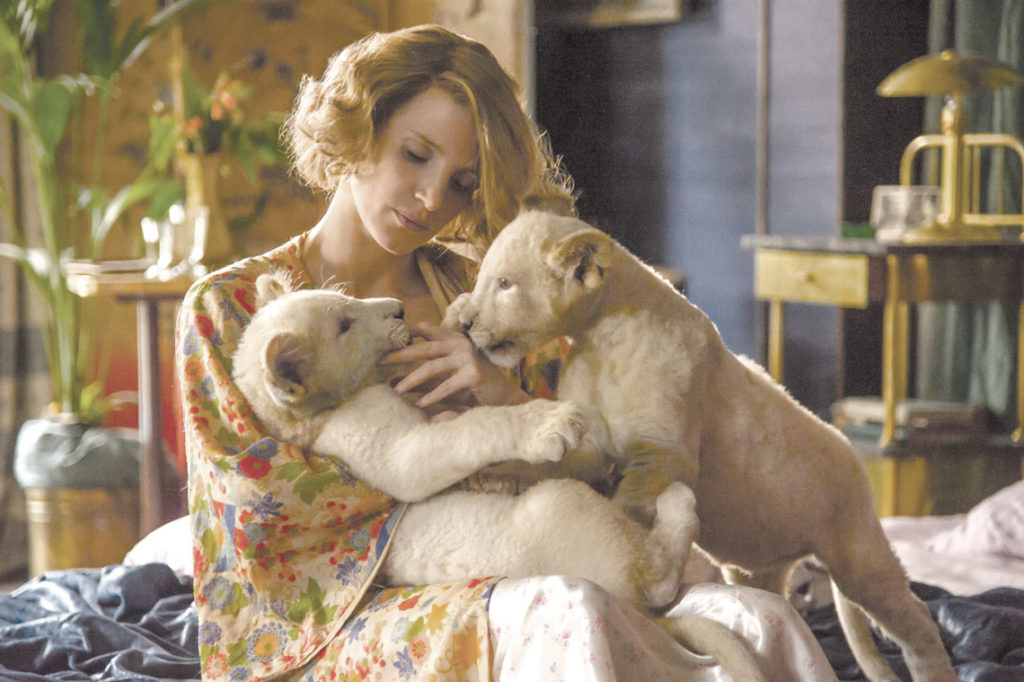
Chastain plays a character who does just that in “The Zookeeper’s Wife,” based on Diane Ackerman’s 2007 nonfiction book of the same name. The film’s heroine, Antonina Zabinska, along with her husband, Jan Zabinski, hide as many as 300 Jews in between the halls of their zoo and villa, as well as in animal cages and underground tunnels in the facility. (In Polish, “ska” is the feminine form of the surname ending of “ski.”)
The couple risk their lives — and that of their young son — even as leading Nazi zoologist Lutz Heck conducts animal experiments at the zoo to resurrect an ancient German breed of bull. All the while, Antonina empathetically cares for their Jewish “guests” as Jan clandestinely works for the Polish underground, spiriting away Jews from the Warsaw ghetto.
“Many times we celebrate heroes who use violence and aggression,” Chastain said in the recent interview. “I was drawn to Antonina because her weapon, or tool of choice, was compassion and love.”
In the film, animals are often treated like humans — at least by the Zabinskis — and humans like animals, Chastain noted. In one scene, a man and woman stand just outside the Warsaw ghetto and snap a photo of the Jews inside, “as if they are at the zoo,” she said.
Ackerman, an acclaimed author and naturalist who sold the film rights to “The Zookeeper’s Wife” eight years ago, knew Chastain was right for the part when she heard the actress had visited Auschwitz as part of her research for the movie.
“She went because she wanted to know what was at stake for Antonina,” Ackerman recalled in an interview from her home in Ithaca, N.Y. “She brought that complete immersion in the story to her role.”
Ackerman, 68, has harbored a love for animals and nature since she was a young girl in Waukegan, Ill. She discovered Antonina’s story while researching an endangered ancient breed of Polish horses for a prospective article in National Geographic around 2000.
“I felt like I needed to see the horses, and also to find out more about my Jewish heritage in Poland,” said Ackerman, whose grandfather fled that country before the Holocaust.
While trying to arrange a trip, Ackerman learned that her Polish neighbor had an uncle who had been a veterinarian at the Warsaw Zoo during the war. He told her that the zookeeper’s wife had kept journals of her experiences. Upon Ackerman’s request, he was able to procure those writings from stacks of old books at the zoo. Ackerman asked the man’s niece to translate the journals and was riveted by Antonina’s story, which she likened to that of Holocaust rescuer Oskar Schindler, who was feted in Steven Spielberg’s Academy Award-winning film, “Schindler’s List.”
“But Antonina’s story had fallen through the cracks of history,” Ackerman said, “which is why I wanted to tell it.”
Ackerman also was drawn by the fact that Antonina “had not only taken in orphaned animals, but orphaned people as well.”
The author theorized that the Russian-born Antonina may have become more attuned to human behavior because her parents were murdered during the Russian Revolution of 1917.
“Children who lose their parents can become hyper-sensitized, because they need to know whether they will be protected if they are in danger,” Ackerman said. “So they learn how to read people very well.”
“Antonina could calm animals, and she also knew she could apply that to human animals,” Ackerman said of her heroine’s approach to Nazi predators.
Would Chastain have been willing to risk her life to save others, like her character?
“To quickly say, ‘Oh yes, I could do that,’ undermines and devalues the actual sacrifices that Antonina made,” she said. “I absolutely hope and dream that we’re never in a situation where that’s going to be tested. But if ever we are, and I can stand up for people the way that she did, that would be wonderful.”
“The Zookeeper’s Wife” will open in theaters on March 31.

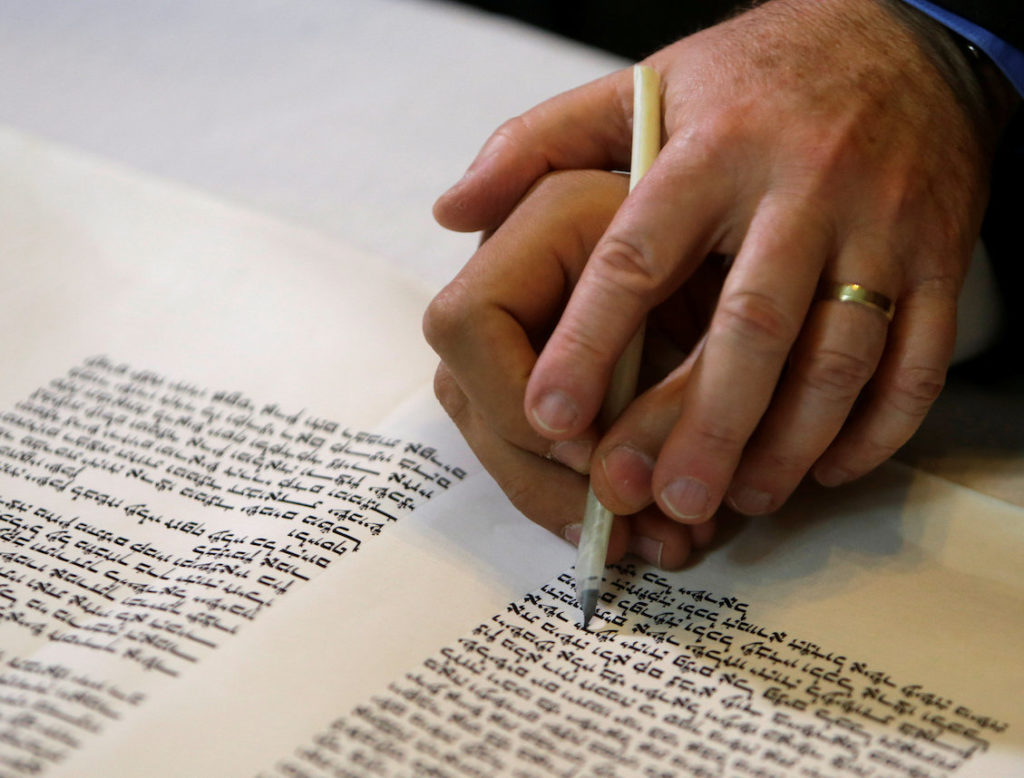

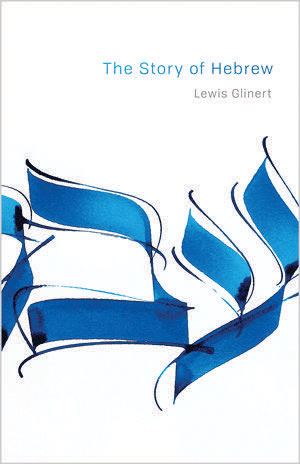 One of the curiosities in “The Story of Hebrew” by Lewis Glinert (Princeton University Press) is that the author manages to write a history of the Hebrew language without using a single Hebrew letter in the text, although Hebrew appears in the illustrations, including a page from Franz Kafka’s Hebrew notebook. Indeed, Glinert announces at the outset of his richly detailed and wholly fascinating book that it is “not much a book about what Hebrew words mean as about what the Hebrew language has meant to the people who have possessed it.”