fbpx

March 22, 2017

Seven arrested as IfNotNow protests target AIPAC

Leading up to the American Israel Public Affairs Committee’s (AIPAC) annual policy conference later this month in Washington, D.C., the progressive protest group IfNotNow set its sights on the Israel lobby with a pair of protests against AIPAC’s conservative, pro-Israel politics that led to seven arrests.

The arrests came on March 17, when seven Jewish protesters were cited for trespassing after blocking off the entrance to the lobby of 1801 Century Park East, the Century City office tower that houses AIPAC’s Los Angeles office.

Two days later, a crowd of about 150 marched through Beverly Hills and Century City, chanting and waving signs, before arriving in front of the AIPAC office, where they danced, prayed and sang in protest.

IfNotNow is a progressive network of millennial Jews that challenges Jewish establishment support for the status quo in Israel and the Palestinian territories. Over the past two weeks, the group has held community meetings across the country, including in Pittsburgh; Tucson, Ariz.; Burlington, Vt.; and Washington, D.C., to prepare for protests that will coincide with the AIPAC conference on March 26- 28.

The morning of March 17 was the first time the group’s members were arrested in
Los Angeles.

“We are here to say that we’ll occupy this building until AIPAC is ready to stop supporting the endless occupation in Israel-Palestine,” IfNotNow organizer Michal David, 26, said as Los Angeles Police Department (LAPD) officers prepared to arrest protesters. According to David, about a dozen protesters arrived at 9 a.m. at the building and blocked off entrances for about 40 minutes, encouraging AIPAC employees to go home “for a day of reflection.” By 10 a.m., those not prepared to be arrested had moved to the sidewalk.

“Shabbat shalom! AIPAC go home!” the seven protesters remaining inside chanted, seated against a marble wall facing the entrance.

The seven, who cooperated with police as they were led away in handcuffs, were Shay Roman, Sam Gast, Alex Leichenger, Alysha Schwartz Ben Koatz, Oak Loeb and Ethan Buckner, according to IfNotNow. More than a dozen uniformed LAPD officers and six police cruisers were on hand for the arrests.

The protesters were taken into police custody after the building’s management called in a private person’s arrest, also known as a citizen’s arrest, by which a private citizen technically is responsible for an arrest when a suspected crime occurs in his or her presence, according to West L.A. area commanding officer Capt. Tina Nieto.

AIPAC officials declined to comment for this story.

By March 19, all seven had been released and several were present for the second protest.

“They have a choice,” Roman, 27, said of AIPAC as she marched down Century Park East. “They can learn and respect and begin to understand. … They could have come down and talked to us, and they didn’t.”

The march began at nearby Roxbury Park in Beverly Hills, with protesters sporting masks, crowns and makeup in the spirit of Purim, which took place the week before. Others wore Jewish ritual objects, like prayer shawls and tefillin.

Protesters march through Beverly Hills March 19 to protest AIPAC. Photo by Eitan Arom.

The protesters marched 1 1/2 miles to the Century City office tower, blocking streets as they went. Many held signs aloft, while several carried a giant mock Torah scroll with the words “We will rise up” on one side and “We will not bow down” on the other.

LAPD officers blocked the short staircase to the office tower with their bicycles as protesters arrived. Standing in front of the officers, protesters gave speeches, led chants and read prayers, including a recitation of the mourner’s Kaddish to commemorate victims of conflict between Israelis and Palestinians.

Not all of the protesters were Jewish. Jean Beek, 91, said she came with her husband, Allan, after he heard about the protest on the internet. She said her son drove the couple from Newport Beach to attend.

Of AIPAC and the Israeli government it supports, she said, “We want to let them know that people don’t like what they’re doing to the Palestinians.”

Seven arrested as IfNotNow protests target AIPAC Read More »

Five alternatives to designating separate states

This opinion tackling the two-state solution is the “con” argument published in conjunction with Alan Elsner’s “pro” argument, “The Two-State Solution Won’t Die.

Israel never seems to have a good answer to accusations of occupation and illegitimacy of the settlement enterprise. Whenever the claim that Israel stole Palestinian lands is heard, Israel inevitably answers, “We invented the cellphone” and “We have gay rights.” Obvious obfuscation. And when pushed to explain why the much-promised two-state solution is perennially stuck, always the answer is to blame Arab obstructionism.

This inability to give a straight answer is a result of 30 years of bad policy that has pressed Israel to create a Palestinian state on the historic Jewish heartland of Judea and Samaria, which the world calls the West Bank. This policy has managed to legitimize the proposition that the West Bank is Arab land and that Israel is an intractable occupier there.

But for us settlers, the truth is different: The two-state solution was misconceived and will never come to pass, because Judea and Samaria belong to Israel. We have a 3,700-year presence in this land, our foundational history is here, and we have reacquired control here in defensive wars. The world recognized our indigeneity in the Balfour Declaration of 1917 and the San Remo accords of 1920.

Additionally, as a result of Israel’s 2005 withdrawal from Gaza, when Hamas seized control and turned the strip into a forward base for jihad, starting three wars in seven years, most Israelis, however pragmatic, no longer believe in a policy of forfeiting land in the hopes of getting peace in return. No Israeli wants an Islamic State of Palestine looking down at them from the hilltops.

But as Israel is beginning to walk back the two-state solution, it is not easy to admit we were wrong, and many people’s careers are on the line. This is why Israel still mouths the two-state party line yet takes no steps toward making a Palestinian state a reality.

Now, the time has come for a discussion of new options in which Israel would hold on to the West Bank and eventually assert sovereignty there. Yes, Israel will have to grapple with questions of the Arab population’s rights, and the issues of the country’s security and Jewish character, but we believe those questions can be worked out through the democratic process.

At least five credible plans are on the table.

The first option, proposed by former Knesset members Aryeh Eldad and Benny Alon, is called “Jordan is Palestine,” a fair name given that Jordan’s population is estimated to be about 80 percent Palestinian. Under their plan, Israel would assert Israeli law in Judea and Samaria while Arabs living there would have Israeli residency and Jordanian citizenship.

A second alternative, suggested by Naftali Bennett, Israel’s education minister, proposes annexation of only Area C — the territory in the West Bank as defined by the Oslo Accords where a majority of 400,000 settlers live — while offering Israeli citizenship to the relatively few Arabs there. But Arabs living in Areas A and B, the main Palestinian population centers, would have self-rule.

A third option, which dovetails with Bennett’s, is promoted by Israeli scholar Mordechai Kedar. His premise is that the most stable Arab entity in the Middle East is the Gulf emirates, which are based on a consolidated traditional group or tribe. The Palestinian Arabs are not a cohesive nation, he argues, but are composed of separate city-based clans. So, he proposes Palestinian autonomy for seven noncontiguous emirates in major Arab cities, as well as Gaza (which he considers an emirate already). Israel would annex the rest of the West Bank and offer Israeli citizenship to Arab villagers outside of those cities.

The fourth proposal is by journalist Caroline Glick, author of the 2014 book “The Israeli Solution.” She claims that contrary to prevalent opinion, Jews are not in danger of losing a demographic majority in an Israel with Judea and Samaria. Alternative demographic research shows that due to falling Palestinian birth rates and emigration, combined with the opposite trend among Jews, a stable Jewish majority of above 60 percent exists between the Jordan River and the Mediterranean Sea (excluding Gaza), and is projected to grow to 70 percent by 2059. On this basis, Glick concludes that the Jewish state is secure and that Israel should assert Israeli law in the West Bank and offer Israeli citizenship to its entire Arab population without fear of being outvoted.

Deputy Foreign Minister Tzipi Hotovely similarly would annex and give the Palestinians residency rights — with a pathway to citizenship for those who pledge allegiance to the Jewish state. Others prefer an arrangement more like that of Puerto Rico, a United States territory whose 3.5 million residents cannot vote in federal elections. Some Palestinians, like the Jabari clan in Hebron, want Israeli residency and are actively vying to undermine the Palestinian Authority, which they view as illegitimate and corrupt.

None of these options is a panacea and every formula has some potentially repugnant element or tricky trade-off. But given that the two-state solution is an empirical failure and Israelis are voting away from it … there is a historic opportunity to have an open discussion of real alternatives.

Finally, there is a fifth alternative by former Knesset member and head of the new Zehut party, Moshe Feiglin, and Martin Sherman of the Israel Institute for Strategic Studies. They do not see a resolution of conflicting national aspirations in one land and instead propose an exchange of populations with Arab countries, which expelled about 800,000 Jews around the time of Israeli independence. In contrast, Palestinians in Judea and Samaria would be offered generous compensation to emigrate voluntarily.

None of these options is a panacea and every formula has some potentially repugnant element or tricky trade-off. But given that the two-state solution is an empirical failure and Israelis are voting away from it, and given that the new Donald Trump administration in the U.S. is not locked into the land-for-peace paradigm, there is a historic opportunity to have an open discussion of real alternatives, unhampered by the bankrupt notions of the past.

YISHAI FLEISHER is the international spokesman for the Jewish community of Hebron, home of Machpelah, the biblical tombs of Judaism’s founding fathers and mothers.

Five alternatives to designating separate states Read More »

Valley Outreach Synagogue home at last

Much like the ancient Israelites, the Jews of Valley Outreach Synagogue (VOS) have spent decades wandering the Los Angeles desert in search of a home. Now, they’ve finally reached the Promised Land. 

On March 19, in a ceremony 32 years in the making, 400 VOS members attended the grand opening of the Valley Outreach Synagogue and Center for Jewish Life in Calabasas. Formerly a warehouse, the 15,000-square-foot facility, located at 26670 Agoura Road, has a library, a coffee bar, offices and a Meeting and Learning Center. Its high-ceilinged sanctuary seats 500 and features three flat-screens on the walls as well as a Jerusalem limestone-lined ark housing four newly donated Torah scrolls.

Funds for the $2 million facility were raised through private member donations, according to VOS Rabbi Ron Li-Paz. The nondenominational synagogue serves more than 2,000 Jews from some 600 families in the San Fernando Valley, Conejo Valley and Malibu-area communities.

In the past, VOS has held services in parks, backyards, schools, community centers, hotel ballrooms and churches. It has set up office space at five sites. And the adult choir has resorted to rehearsing in a bowling alley.

“I sometimes think of our community as spokes on a wheel,” Li-Paz, who has been at VOS for 21 years, told the Journal. “Everyone has been on the ends of the spokes. This allows us to bring them into a hub.”

The grand opening kicked off at noon with a lively procession from the parking lot to the glass doors of the new synagogue. Members took turns carrying the Torah scrolls through the asphalt lot in the shadow of the Santa Monica Mountains. Klezmer musicians played tunes while iPhone cameras documented the ceremony.

Once inside the new main lobby, Li-Paz led prayers to bless the newly placed mezuzot on the doorposts of its two main entrances. Then the former opera singer, who was cantor at VOS before becoming its rabbi, sang Shehecheyanu — a prayer that marks happy occasions.

The occasion tugged on heartstrings for many longstanding members. A teary-eyed Jack Bielan, who has been the musical director at the synagogue since its inception, was overcome with emotion when he addressed families in their gleaming new sanctuary.

“We are now in our house,” he said, pounding the podium for emphasis. “Valley Outreach Synagogue is an iconic, historic, world-class Jewish congregation. We’ve gotten this far together without a building for 32 years. We’re already seeing the infinite possibilities ahead of us.”

A musician who has worked with the likes of Seal and James Taylor, Bielan introduced a song he wrote called “We Have a Home.” He played piano and Bronwen Li-Paz, the rabbi’s wife, sang.

Rabbi Li-Paz said the synagogue has faced many “stops and starts” along the way to finding a home. In the past, chief among those has been the concern that getting a building would necessitate higher membership fees and restrict access to some potential members. Li-Paz said the new facility comes with no fee hikes for members.

“We’re committed to keeping the lowest dues structure that I know of for any synagogue,” he said. “It’s right there in our name. Outreach, to me, means that I want to break down barriers to Jewish life and not build them up. I think that’s why donors were inspired to give.”

Beyond functioning as a synagogue, the Valley Outreach Synagogue and Center for Jewish Life fills a void for his members, Li-Paz said. It will be a community center offering diverse programming beyond just prayer services.

“Religious real estate is the most underused real estate that I know of. Most hours of most days, spaces like churches and synagogues are dark and empty,” he said. “I wanted to build one that uses the space constantly for services, classes, art, plays and concerts.”

VOS already operates a home-based enrichment initiative called JEWELS (Jewish, Education, Wisdom, Ethics, Literacy and Service). Members currently host more than 20 programs, such as Jewish holiday cooking and art activities, in homes. These will continue at people’s homes and not the new center.

Anticipating the possibilities a new building would present, VOS recently contracted with Momentum Academies, a recreation company that specializes in after-school enrichment programming, to plan and execute a variety of programming for members of all ages inside the walls of the new facility.

Jennifer Maddux, Momentum’s director of operations, said programming like youth theater, homework club, adult exercise classes, bingo nights, health and wellness seminars, and current events discussion groups will be offered by Momentum’s staff of educators starting in April.

To Michele Berger, 72, a VOS member for more than 20 years, the opening of the building’s doors signaled something more than a new place for services or bingo nights.

“I think it’s wonderful,” she said, eyes darting around to other smiling guests. “Everyone has worked so hard for it, doing what they’re doing with the JEWELS program and now with the new building, helping grow Judaism in the community, encouraging families to lead Jewish lives. It’s helping to keep Judaism alive. We don’t want Judaism to die.” 

Valley Outreach Synagogue home at last Read More »

Kadima Day School shifts tuition model

In an effort to increase enrollment and woo new families, Kadima Day School in West Hills is implementing a tuition model that will eliminate financial aid for families in need and replace it with lower costs that will make the school more affordable for most Kadima families.

Beginning in the 2017-18 academic year, the annual tuition for children in early education (ages 2 to 5) will drop 11 percent, to $11,600; the cost for children in kindergarten through fifth grade will drop by 43 percent, to $13,900; and it will drop the same percentage for grades six through eight, to $14,900, according to a Kadima Day School press release.

The initiative is being financially supported by the Evenhaim family, the school said.

Shawn Evenhaim, a member of the board of trustees at Kadima, a Conservative school, said his family’s support — now in the millions of dollars, cumulatively — represents an investment in the future of Jewish day schools at a time when they are facing enrollment decline because of rising tuition costs and non-Orthodox families having fewer children.

“It’s a huge investment on our end. We decided to do it, and there were many reasons we decided to do it,” Evenhaim said. Not least, he added, is the experience of his own children at Kadima.

“We saw the impact on our three boys,” he said.

Nonetheless, because so many families at Kadima are on tuition assistance, the new model will result in some families paying more than they have been with financial aid, said Kadima Head of School Greg Kovacs.

“We’ve done a lot of number crunching,” he said. “We’re looking at about just under 20 percent who will see an increase in their tuition, while the rest of population will see around the same or a slight decrease.”

Kovacs told the Journal the school will continue to make quality education its top priority even as the cost of tuition decreases. There are plans to cut costs through instructional changes, such as one teacher handling different student ability levels within the same classroom, as opposed to multiple teachers leading multiple classes for each level.

The school also will integrate learning, such as a general studies teacher incorporating Judaic studies into the curriculum.

“Some say lower tuition means less quality of education. It’s not the case here. We’re putting as much energy and time into securing the best quality of teachers,” Kovacs said. “That’s the motivation, the balance of quality education with accessible tuition.”

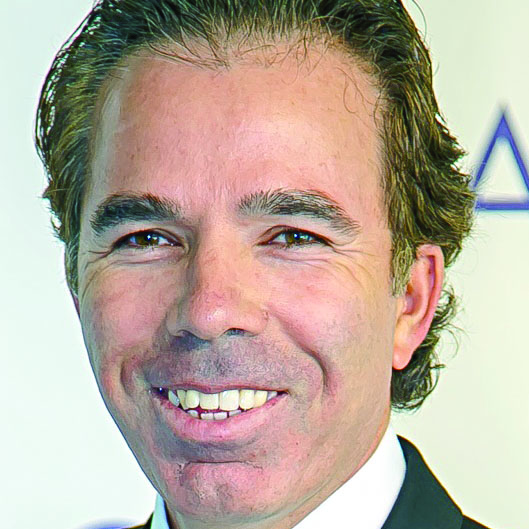
Shawn Evenhaim. Photo courtesy Miller Ink.

Evenhaim is founder and chief executive officer of Los Angeles-based California Home Builders and chairman emeritus of the Israeli American Council. In 2014, Evenhaim and his wife, Dorit, donated $1.2 million to the school — its full name is Kadima Day School Evenhaim Family Campus — for grants to help middle-income families that did not have children enrolled in Jewish day schools at the time.

Even high-earning families like the Evenhaims find day school tuition so high as to be unattractive, especially if the family has more than one prospective Jewish school student.

Indeed, families with annual incomes of even $200,000 can be eligible for financial aid at Jewish day schools. The problem is high-earning families do not want to apply for financial aid because they do not see themselves as candidates for it, Evenhaim said.

“We attracted a lot of kids through that [2014] grant and I’m very happy it was successful, but then I realized a lot of people are not even applying for these grants. They think, ‘Look, I make a good income,’ ” Evenhaim said.

Fran Amkraut, a Kadima board member and parent of four children who attend the school, said her children have received financial aid, and they are not alone — approximately 75 percent of the 250 students there currently receive some sort of tuition assistance, according to Kovacs.

Amkraut said she understands why some would not want to apply for aid.

“I find financial aid to be intimidating, tedious, laborious. I think for some families, I can’t speak for [all of] them, I find it believable it would be a reason some would not apply. It’s a headache,” she said. “People are not comfortable with numbers and paperwork. People who are new to the country, community or economy might not know where to start.”

A large portion of the student population at Kadima is Israeli. Evenhaim is Israeli and grew up with Judaism all around him. For Jewish children growing up in the multicultural United States, Jewish day school plays an important role in shaping young people as they grow older, he said.

He said he hopes other Jewish day schools follow suit and make tuition more affordable.

“This is a big-picture issue. It is not just about Kadima,” he said.

Kadima’s new tuition plan compares favorably with other Jewish schools. Annual tuition at Valley Beth Shalom Harold M. Schulweis Day School, which is Conservative and offers kindergarten through sixth grade, is $24,950. Kindergarten-through-sixth-grade tuition at Wise School, which is Reform and located at Stephen Wise Temple, is $28,885.

In non-Orthodox communities, it’s definitely on the low end,” Miriam Prum Hess, director of donor and community relations at Builders of Jewish Education (BJE), said of the new tuition costs at Kadima, one of 37 Los Angeles-area schools accredited by BJE. “I don’t think we have other schools that are anywhere near that.”

Prum Hess said that enrollment in Jewish day schools has dropped about 5 percent, to 9,500 from a peak of 10,000 in 2008.

Emblematic of the enrollment decline was the closure last May of Temple Emanuel Academy Day School.

Evenhaim said he hopes the lower tuition will entice new families, who in turn become eventual supporters of the school.

“My goal is to create a model where the school sustains itself and we’re not relying on a few donors but are creating families who are not just sending kids to Jewish education,” he said, “but are becoming supporters of Jewish education.”

Kadima Day School shifts tuition model Read More »

Jessica Biel discovers that she’s a little bit Jewish

The celebrities who appear on genealogy shows are almost invariably in for a surprise, like a criminal in their family tree or a British royal in their web of relatives. Some, like Dustin Hoffman — who broke down in tears on “Finding Your Roots” last year — delve into their Jewish ancestry deeper than they ever have before.

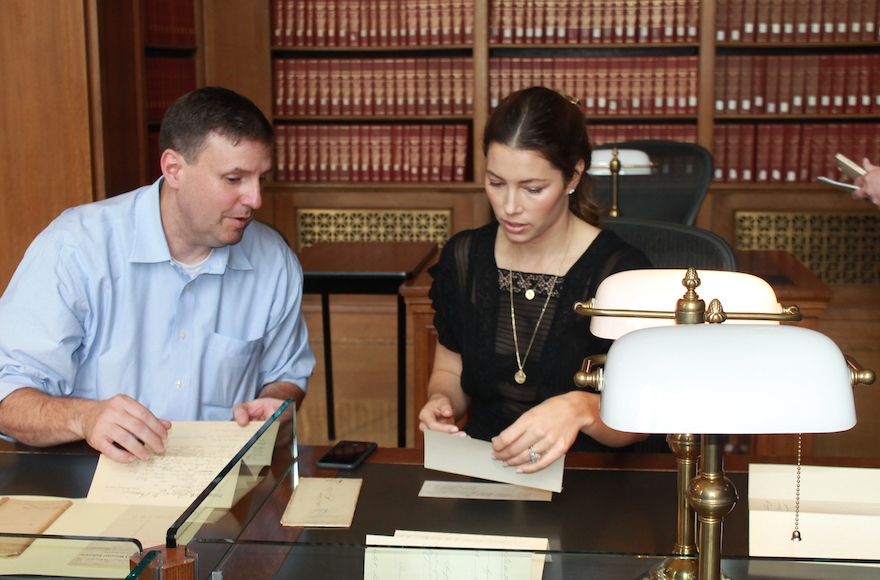
Others, like actress Jessica Biel, who appears on this Sunday’s episode of TLC’s “Who Do You Think You Are,” discover Jewish roots they didn’t know they had.

Biel — who is also Mrs. Justin Timberlake — achieved fame at age 14 when she was cast in the long-running TV series “7th Heaven.” She has appeared in a number of films since, receiving acclaim for roles in “Ulee’s Gold” and “The Illusionist,” among others.

She and Timberlake had a child in 2015, and she says her status as a new mom intensified her interest in her own family — which she didn’t know much about. Family lore on her mother’s side was that Jessica was part Native American, either Chippewa or Cherokee. There was also a legend about a Civil War soldier shot in the back by his commanding officer while wading across a river.

Jessica was also under the impression that the Biels came from a German town named Biel. After investigating with TLC’s genealogists and historians, she discovered she was the great, great granddaughter of Morris and Ottilia Biel, who emigrated from Hungary (then the Austro-Hungarian Empire) to Chicago in 1888.

The Biels were Jewish, and Morris at first found work as a cloak cutter in the garment business.

Jessica Biel

Jessica Biel found some surprises in her family tree on the show “Who Do You Think You Are.” (Courtesy of TLC)

To say that Jessica was surprised is putting it mildly. She also seemed moved.

“I felt my whole life I’ve really not had any religious community at all,” she says.  “I want something. Interestingly, we’re talking about a people with a really, really rich cultural community.”

Biel has plenty to discover about Jewish culture. Later in the episode, she notes: “My friends are really into this. They say they’re going to throw me a bar mitzvah.” (A bat mitzvah is the correct term for a girl’s coming of age ritual.)

There was another surprise awaiting her. Morris eventually went to work for a bank and became prominent enough in his community that the Chicago Tribune ran a photo of him and Ottilia on the occasion of their 50th wedding anniversary.

To follow up on all of this, Jessica had a DNA test, which proved she was eight percent Jewish.

“I’m really interested into diving into this Jewish culture a little more,” she says at the end of the episode.

Jessica Biel discovers that she’s a little bit Jewish Read More »

Why I’m skipping AIPAC this year

This weekend is the annual American Israel Public Affairs Committee (AIPAC) policy conference in Washington. Many of you will be there, and for a long time, I thought about going myself. DC, lobbying, Israel, and good friends: it sounds like a weekend I couldn’t pass up.

But this year, the thought of attending AIPAC just didn’t sit well with me. I tried to get to the bottom of why, and I realized it wasn’t because of Israel or any of my disagreements with its internal politics or policies. I knew it was deeper than that, but like any good Jew, the more I tried to dig at my internal frustration, the further I got from any concrete answer.

Then I went home to Oakland last weekend. I walked into a lecture at my temple titled “Power, Privilege, & BDS,” not expecting to enter a talk that would culminate in a discussion about UCLA student government.

“Today, American Jews face an internal conflict,” Professor Mark Dollinger of SFSU said. “On one side, we enjoy power and privilege. On the other, we maintain a Holocaust-driven fear of being marginalized and oppressed.”

I resonated with this. Since beginning at UCLA, I’ve felt incredibly lucky: I was one of just four students in my high school graduating class of 500 to become a Bruin, and I knew that it wasn’t just my intelligence that got me here but the strong support network I had growing up. At the same time, in college I’ve felt the heat of anti-Semitism beyond what I could have ever imagined: I was once told by another student that eating Ben and Jerry’s ice cream was akin to supporting an institution as oppressive as the American slave trade — because Ben and Jerry are Jewish.

Then came the talk about student government. I listened eagerly to what he would say, not telling anyone I myself sit on the student government of UCLA.

“When Rachel Beyda was questioned for being Jewish, we all jumped so quickly to do whatever it is we could to defend her,” Professor Dollinger said. “We sent UCLA pages and pages full of suggested protective measures for Jewish students and threatened to pull our donations if they didn’t change.”

The response he described to the Rachel Beyda incident was not surprising. For a Jew to do anything he possibly could to defend his Jewish community is an imperative ingrained in the Jewish DNA: after what our parents and grandparents went through a generation ago, who can say this is a wrong thing?

But, as the lecturer suggested, today is not 1930. Jews have made it in this country. In America, we are not alone. We have politicians, law enforcement officers, and university administrators to stand up for us. Anti-Semitism has not gone away, but we’ve got new ways to fight it. That’s a big deal.

I’ve come to understand that that is what Jewish privilege looks like today. It’s a good thing we have it: after thousands of years of persecution, it’s the least we could ask for. But I think that with that privilege comes a sense of responsibility and engagement, an imperative to help those who don’t have it.

As a leader on campus through my position on student government over the past year, I’ve been asked by a number of Jewish students why I’m not more involved with pro-Israel groups, why I don’t speak passionately about the cause, and why, in the midst of a national wave of anti-Semitism, I’m not doing more to stand up for my community.

It’s taken me a long time to write this because at UCLA, I’ve felt uneasy talking about my Jewish identity – and not only because I’ve faced hostility as a Jew, but because of the the power and privilege I’ve been blessed to have all my life. Today I’m ready to share.

I believe that until the Jewish community recognizes that we must use our privilege to help others, we will not be able both to defend our Jewish identities and have meaningful and necessary relationships with those with whom may disagree.

I know by now some of you may be rolling your eyes. I get it. Privilege, oppression, power, and inequity. These are words thrown around college campuses all the time nowadays, and it can be hard to find real meaning in them anymore. Let me try and ground this a bit.

I mean to say that we should be using our close relationships with administrators and lawmakers to help those who don’t have the privilege and access that we do, not just to protect ourselves when we feel hurt. Our privilege must be used for more than just ourselves.

I challenge myself and other Jews in the community to question the institutions of power we rely on. Are these institutions fulfilling this broader vision of Jewish privilege not just by protecting Jews from oppression, but by standing up to support those who don’t have the same power?

This is where AIPAC comes in.

This weekend, thousands of Jews will gather in a huge hall to hear Mike Pence, our Vice President, speak at AIPAC. They will cheer and clap, and when asked why they are cheering for Mike Pence, they will respond, “I support him because he fights for Israel.”

And Jewish institutions across America, while perhaps not outwardly promoting President Trump or his administration, will in fact do so by failing to oppose it. They will mute their opposition to his Muslim ban, or his border wall proposals, or his efforts to defund Planned Parenthood. They will do this because they don’t want to risk losing his support for Israel.

I won’t be there. I won’t be there because it hurts me inside to see an institution justifiably founded to support the continued existence of the Jewish people abusing our privilege – my privilege – to support an administration that violates norms of decency and fairness to so many in this country.

I refuse to support an organization that adopts an “Israel-at-all-costs” attitude, an organization that has become a fellow traveler of the alt-right, an organization that today is the epitome of Jewish power and privilege without responsibility and morality.

I think It’s time for AIPAC to do a little soul searching and re-think its approach. We’ve got to remember why Israel was founded, and we’ve got to think deeply about how best to fight for its future.

And to all of you reading this, to my friends who have taught me what Jewish community means and who have filled my days at UCLA with Jewish learning and exploration, I ask you to join me on a mission.

Let us begin to ask: what are our values as Jews? How can we use our privilege to protect our own rights while also standing up to support those who need protection?

And to those who tell us we cannot support Israel while also supporting marginalized communities at home, I say that’s a load of crap. No one can say that I cannot support Israel while also standing up against police brutality in America. That’s not how justice works.

Let’s stop compromising our values. Let’s begin to use our privilege, as our rabbis and teachers have always instructed us to: let us love our neighbors as ourselves and do for them what we hope they would do for us.

I hope you will join me on this mission. It won’t be easy at the start, but I believe that once we stand up for what we believe is right, other people and other institutions will follow.

Until then, I don’t need your support, Mr. Pence.


Rafi Sands studies Business Economics & Political Science at UCLA and is External Vice President of the Undergraduate Students Association

Why I’m skipping AIPAC this year Read More »

Jewish groups, politicians deem Trump budget bad for Israel, other U.S. interests

Citing the importance to Israel of a robust U.S. posture abroad, Jewish groups decried drastic proposed cuts in foreign assistance funding in President Donald Trump’s budget, despite assurances that aid to Israel would be unaffected.

Israel’s guaranteed $3.1 billion defense assistance next year is a “cutout” and not subject to proposed drastic cuts to foreign funding, the Trump administration said.

“Our assistance to Israel is, if I could say, a cutout on the budget, and that’s guaranteed, and that reflects, obviously, our strong commitment to one of our strongest partners and allies,” State Department spokesman Marc Toner said March 16 in a call with reporters.

The reassurance came as an array of Jewish groups and Democratic Jewish lawmakers expressed alarm at proposed 31 percent cuts to foreign spending, saying it would undercut U.S. influence abroad and noting that it currently constitutes just 1 percent of the budget.

“Our consistent position has been that, along with security assistance to Israel, we have always supported a robust overall foreign aid budget in order to ensure America’s strong leadership position in the world,” an official of the American Israel Public Affairs Committee stated in an email.

Rep. Lois Frenkel (D-Fla.) argued that foreign aid helps stem the unrest that threatens security interests.

“I wish the president would spend more time talking to the generals because they would tell you that pencils can be as persuasive as cannons and food can be as powerful as a tank,” she said at a news conference Thursday.

The American Jewish Committee (AJC) said national security interests are at stake.

“The proposed draconian cuts in areas vital to executing U.S. foreign policy could adversely affect our national security interests by potentially creating more pressure on the American military while essential diplomacy is being undermined,” David Harris, the AJC CEO, said in a statement. “Deep cuts to the State Department, including in key educational and cultural exchange programs, will severely harm America’s ability to assert our interests and values abroad.”

J Street, the liberal Jewish Middle East policy group, decried what it said was the budget’s isolationism.

“Over the years, many pro-Israel organizations — including J Street — have argued that Israel cannot be treated as a special case, exempted from cuts to foreign aid while programs affecting the rest of the world are slashed wholesale,” the group said in a statement. “Ultimately, weakening US foreign aid, which is already far below the contributions of other advanced economies in percentage GDP terms, undermines Israeli security as well.”

Next year is the launch of a 10-year agreement that would see Israel receiving an average of $3.8 billion a year in defense assistance.

Centrist and left-wing pro-Israel groups have long argued that overall robust foreign assistance is healthy for the United States and Israel because it sustains U.S. influence.

Toner, the State Department spokesman, fielded a question from a reporter about whether the cuts would affect funding for U.S. defense assistance to Egypt and Jordan — policies that were written into Israeli peace deals with those countries and seen for years as critical to sustaining the peace. Toner deflected the question.

“With respect to other assistance levels, foreign military assistance levels, those are still being evaluated and decisions are going to be made going forward,” he said. “So we’re still at the very beginning of the budget process, and in the coming months, these are all going to be figures that we evaluate and look at hard, obviously bearing in mind some of our — or not some of our — our treaty obligations going forward. But we’ll have more details, obviously, when the final budget rolls out in May, I believe.”

Trump administration officials have said programs targeted by the cuts have not proven their efficiency or efficacy, a claim sharply disputed by Democratic Jewish lawmakers and some Jewish groups.

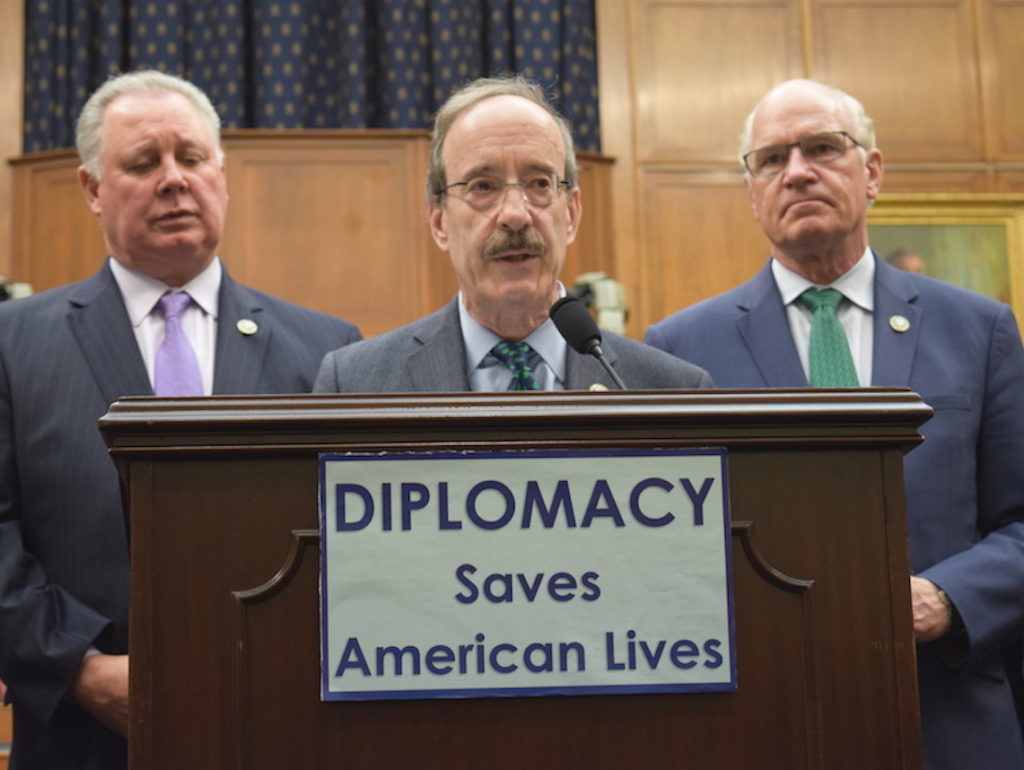
Democrats on the House Foreign Affairs Committee, led by Rep. Eliot Engel (D-N.Y.), wrote a letter to House Speaker Rep. Paul Ryan (R-Wis.), urging him to reject the cuts.

“We cede the role as the world’s champion of democracy, freedom and justice. And what happens then?” Engel said at a news conference March 16 unveiling the letter. “Who steps into the void? Probably a country that doesn’t share our values or priorities. Think Russia or some other country like that.”

Other Jewish Democrats lambasting the cuts included Reps. Brad Sherman (D-Calif.) and Ted Deutch (D-Fla.).

B’nai B’rith International, which advocates for international assistance and also focuses on assistance to the elderly in the United States, decried the budgets cuts in both areas. The organization noted a proposed 13.2 percent cut to the Housing Department, which would adversely affect the 38 buildings with 8,000 residents in the B’nai B’rith network.

“Lack of access to safe and affordable housing for all older Americans has deep ramifications for the health and welfare of so many,” it said in a statement.

Jewish groups, politicians deem Trump budget bad for Israel, other U.S. interests Read More »

AIPAC seeking bipartisan spirit in a polarized capital

Maintaining Iran sanctions, crushing BDS and ensuring aid to Israel are high on the agenda, of course.

But the overarching message at this year’s conference of the American Israel Public Affairs Committee is, if you want a break from polarization, come join us.

“This is an unprecedented time of political polarization, and we will have a rare bipartisan gathering in Washington,” an official of the lobby told JTA about the March 26-28 confab. “One of the impressive aspects of our speaker program is that we will have the entire bipartisan leadership of Congress.”

That might seem a stretch following two tense years in which AIPAC faced off against the Obama administration – and by extension much of the Democratic congressional delegation – over the Iran nuclear deal.

But check out the roster of conference speakers and you can see the lobby is trying hard.

Among Congress members, for instance, there are the usual suspects, including stalwarts of the U.S.-Israel relationship like Rep. Steny Hoyer, D-Md., the minority whip in the U.S. House of Representatives, and Rep. Ed Royce, D-Calif., the chairman of the House Foreign Affairs Committee. Vice President Mike Pence is speaking, and so are the leaders of each party in both chambers.

But also featured is Rep. Jamie Raskin, D-Md., a freshman who had the backing of Bernie Sanders, the Democratic presidential candidate who had his request for a satellite feed at last year’s conference turned down. Also present this year and absent last year, for the most part: Democrats who backed the Iran deal.

Among the other speakers are Obama administration architects and defenders of the nuclear deal, which traded sanctions relief for a rollback of Iran’s nuclear program.

One striking example is Rob Malley, a National Security Council official who didn’t join President Barack Obama’s team until his second term in part because pro-Israel objections kept him out in the first four years. (Malley, a peace negotiator under President Bill Clinton, had committed the heresy of insisting that both Israelis and Palestinians were to blame for the collapse of talks in 2000.)

If there’s a let-bygones-be-bygones flavor to all this, it results in part from anxieties pervading the Jewish organizational world about polarization in the era of Trump. Jewish groups get their most consequential policy work done lining up backers from both parties.

“We continue to very much believe in the bipartisan model because it is the only way to get things done,” said the official, who like AIPAC officials are wont to do, requested anonymity. “This is the one gathering where D’s and R’s come together for high purpose.”

J Street, the liberal Middle East policy group, demonstrated at its own policy conference last month that it was only too happy to lead the resistance to President Donald Trump, who has appalled the liberal Jewish majority with his broadsides against minorities and his isolationism. J Street’s president, Jeremy Ben-Ami, explicitly said he was ready to step in now where AIPAC would not.

AIPAC is also under fire from the right. Republican Jews who consider the lobby’s bipartisanship a bane rather than a boon were behind the party platform’s retreat last year from explicit endorsement of the two-state solution. More recently, Trump has also marked such a retreat, at least rhetorically.

The Israeli American Council, principally backed by Sheldon Adelson, the casino billionaire who in 2007 fell out with AIPAC in part over its embrace of the two-state outcome, has attempted to position itself as the more conservative-friendly Israel lobby. The right-leaning Christians United for Israel is similarly assuming a higher profile on the Hill.

And so, in forging its legislative agenda, AIPAC is doing its best to find items both parties can get behind. There are three areas:

* Iran: Democrats are still resisting legislation that would undo the nuclear deal, but are ready to countenance more narrowly targeted sanctions. AIPAC is helping to craft bills that would target Iran’s missile testing and its transfer of arms to other hostile actors in the region.

* Boycott, Divestment and Sanctions: AIPAC will back a bill modeled on one introduced in the last congressional session by Sens. Rob Portman, R-Ohio, and Ben Cardin, D-Md., that would extend to the BDS movement 1970s laws that made it illegal to participate in the Arab League boycott of Israel.

* Foreign assistance: AIPAC activists will lobby the Hill on the final day of the conference with a request to back assistance to Israel (currently at $3.1 billion a year, set to rise next year to $3.8 billion). Support for such aid is a given, despite deep cuts to diplomatic and foreign aid programs in  Trump’s budget proposal.

Also a given will be the activists’ insistence that aid to Israel should not exist in a vacuum and should be accompanied by a robust continuation of U.S. aid to other countries. With a Trump administration pledged to slashing foreign assistance by a third and wiping out whole programs, AIPAC is returning to a posture unfamiliar since the early 1990s, when it stood up to a central plank of a Republican president.

Notably absent from the agenda is any item that robustly declares support for a two-state outcome. AIPAC officials say the longtime U.S. policy remains very much on their agenda, but the lobby’s apparent soft pedaling of the issue is notable at a time when other mainstream groups, including the American Jewish Committee and the Anti-Defamation League, have been assertive in urging the U.S. and Israeli governments to preserve it.

AIPAC seeking bipartisan spirit in a polarized capital Read More »

The ‘Why?’ exchange, part 1: On trying to explain the Holocaust

Peter Hayes is professor of history and German and Theodore Zev Weiss Holocaust Educational Foundation Professor of Holocaust Studies Emeritus at Northwestern University and chair of the Academic Committee of the United States Holocaust Memorial Museum. Professor Hayes received his PhD from Yale University and taught at Northwestern for thirty-six years from 1980 to 2016. He is the author or editor of twelve books, including the prize-winning Industry and Ideology: IG Farben in the Nazi Era (1987, 2001) and Lessons and Legacies: The Meaning of the Holocaust in a Changing World (1991).  

The following exchange will focus on Professor Hayes’ new book Why?: Explaining the Holocaust (W. W. Norton & Company, 2017)

***

Dear Professor Hayes,

Your new book provides discussions of 8 giant “why?” questions concerning the Holocaust, each one of which could be studied and debated for a lifetime. Our introductory question: what kind of reader did you have in mind in the writing process, and what kind of explanations can he or she expect to find in it?

Yours,

Shmuel

***

Dear Shmuel,

For many years, I taught a course on the History of the Holocaust that I learned to structure around the questions that students most often brought with them into the class and that lay audiences most frequently posed when I lectured elsewhere. This seemed the most efficient way to deal with such a large, multi-dimensional subject within the nine teaching weeks that my university’s academic calendar allowed me. So, the lectures that are the bedrock of the book were aimed at bright undergraduates, young people aged 18-22 whose knowledge of the subject ranged from none to some.

As I approached retirement, I began thinking of turning these lectures into a book, largely because it seemed to me that the good published histories of the Holocaust had a Goldilocks problem: they were either too big or too small—too long for most people to tackle or stick with or too short to convey much depth—and none was just right.  We have massive syntheses, such as Raul Hilberg’s three volumes, Saul Friedländer’s two, the thousand-page studies by Martin Gilbert, and, most recently, David Cesarani, and short summaries by Doris Bergen and David Engel, but not a really up-to-date midsize treatment. Moreover, most of these accounts are chronological narratives, not focused analyses of key explanatory issues.

In putting a different sort of book together, I was still thinking of a student audience, but also of others: interested general readers whose knowledge of the subject ranged from none to a lot, and academic colleagues. My challenge was to speak simultaneously to these disparate groups; in other words, to offer something accessible and arresting to newcomers of different ages, as well as insights or even new information to old hands. And I wanted to do this on a scale that busy people can manage, that is concisely.

Concision is difficult for historians because we love to display the wonderful nuggets of information we have turned up (and to show off how widely we have read). But just as good writing relies heavily on finding the mot juste, the apt word that spares an author many others, memorable historical presentation requires homing in on the example just, the ideal illustration of a point that makes further demonstration superfluous. As a lecturer and a writer, I always try to be considerate of my readers’ time and mental energy. That means making my points clearly and directly, backing them with compelling evidence, but only as much as necessary, and then moving on.

So, I hope that’s the kind of explanations readers find in Why?—ones that are lucid, straightforward, and well grounded; ones that are comprehensive but no more complex than the matter at hand requires; and ones that tell readers not only what research shows, but how.

Of course, my professional training and intellectual bent mean that readers will find factual historical answers to the questions I examine, not philosophical or religious speculation about the natures of God and humans that make a catastrophe like the Holocaust possible. My quest is to explain convincingly how this cataclysm came to pass at a particular time and in a particular place and way. Meditating on the problem of evil is a task for other minds and other books.

The ‘Why?’ exchange, part 1: On trying to explain the Holocaust Read More »