fbpx

February 3, 2017

Blood on the Door

7 Haiku for Parsha Bo – Sure, let’s put blood on the door.

I
No, Mister Pharaoh
You can not keep the children
as security.

II
First the locusts, then
a darkness, so pitch dark, it
embarrassed the night.

III
Maybe the cattle
in exchange for freedom? No
conditions at all.

IV
It will happen at
midnight, Pharaoh is warned. God
invents Rosh Chodesh.

V
I’d paint anything
on my door if it meant I
could live through the night.

VI
Midnight came and the
firstborn went. There’ll be no time
to let the bread rise.

VII
Remember this day
with nothing leavened and put signs
on your hands and eyes.


Los Angeles poet Rick Lupert created a the Poetry Super Highway (an online publication and resource for poets), and hosted the Cobalt Cafe weekly poetry reading for almost 21 years. He’s authored 20 collections of poetry, including “I’m a Jew, Are You” (Jewish themed poems) and “Feeding Holy Cats” (Poetry written while a staff member on the first Birthright Israel trip), and most recently “Donut Famine” (Rothco Press, December 2016) and edited the anthologies “Ekphrastia Gone Wild”, “A Poet’s Haggadah”, and “The Night Goes on All Night.” He writes the daily web comic “Cat and Banana” with fellow Los Angeles poet Brendan Constantine. He’s widely published and reads his poetry wherever they let him.

7 Haiku for Parsha Bo – Sure, let’s put blood on the door. Read More »

“‘Remember the 11 million’? Why an inflated victims tally irks Holocaust historians” Times of Israel

Until today (February 3, 2017), I believed that the number commonly cited of murdered victims by the Nazis was 11 million (6 million Jews and 5 million others – Catholics, Romas, homosexuals, communists, trade unionists, etc.). It turns out that Simon Wiesenthal, the famed “Nazi hunter,” made up the 5 –million number of non-Jewish victims in order to catch the attention of the non-Jewish world in the 1970s that were ignoring the crime of genocide by the Nazis against Judaism and the Jewish people.

The real figure, according to Holocaust historians Yehuda Bauer and Deborah Lipstadt, is more on the order of 500,000 non-Jews murdered, certainly not a small number by any measurement, but not 5 million. The total number of people who died as a consequence of the Nazi aggression is about 35 million.

Read this article in “The Times of Israel” by Ron Kampeas (February 1) for details and the unintended impact of Wiesenthal’s made-up fiction on politics today.

An oft-cited statistic of 4 million non-Jewish Holocaust deaths has no basis in fact, experts say and may be contributing to [Holocaust] denial efforts…All of the world had to be annihilated,” [Holocaust historian Yehuda] Bauer said. “That was the intent. There was never an idea in Nazi minds to murder all the Russians…

The number 5 million also adheres to no known understanding of the number of non-Jews killed by the Nazis: While as many as 35 million people were killed overall because of Nazi aggression, the number of non-Jews who died in the concentration camps is no more than half a million, Bauer said.”

http://www.timesofisrael.com/remember-the-11-million-why-an-inflated-victims-tally-irks-holocaust-historians/


“‘Remember the 11 million’? Why an inflated victims tally irks Holocaust historians” Times of Israel Read More »

Rosner’s Torah Talk: Parashat Bo with Rabbi Adam Zeff

Our guest this week is Rabbi Adam Zeff, leader of the Germantown Jewish Center in Philadelphia. Rabbi Zeff has served the Germantown Jewish Centre community since 2002, as Student Rabbi, Assistant Rabbi, and now as Rabbi. He received his rabbinic ordination from the Reconstructionist Rabbinical College in 2007.  In addition to his other responsibilities, Rabbi Zeff enjoys bringing music and storytelling into his rabbinic work at GJC, where he also serves as the hazzan and choir director. He has trained as a singer and musician for many years, studying western classical music, South Indian classical music, and diverse Jewish musical traditions. Rabbi Zeff holds a B.A. in Anthropology from Yale University and a Ph.D. in Anthropology from the University of Pennsylvania.

This week’s Torah portion – Parashat Bo (Exodus 10:1-13:16) – features the final three plagues of Egypt, the People of Israel’s departure from Egypt, and the first Passover celebration. Our discussion focuses on the idea of maintaining positivity and recognizing the point of view of the other in our struggle for Justice.

https://youtu.be/8SySjsNyoUk

Rosner’s Torah Talk: Parashat Bo with Rabbi Adam Zeff Read More »

Episode 23 – MK Sharren Haskel: A new generation in the Likud Party

tnjb-logo-2-0MK Sharren Haskel joined the parliament not too long ago, in late 2015. Nevertheless, she’s managed to do quite a bit in the last year and a half. Haskel, the youngest MK of the Likud party, is the flag-bearer for the cannabis bill which was long opposed, and recently endorsed by Public Security Minister Gilad Erdan.

In addition to being an active member on several Knesset committees, Haskel works diligently on issues such as public diplomacy, the environment, health care, and animal rights. Returning from the inauguration of U.S. President Donald Trump, Haskel sat with Two Nice Jewish Boys to talk about her life and service as a Knesset Member.

Episode 23 – MK Sharren Haskel: A new generation in the Likud Party Read More »

When an executive order prompts civil disorder

Shortly before Shabbat fell on Jan. 27, President Donald Trump signed an executive order that effectively slammed the door on refugees seeking entry to the United States — at least for now.

Shock and dismay had been building in the Jewish community since a draft of the order was leaked days beforehand, and on Jan. 28, those sentiments exploded onto Rabbi Susan Goldberg’s cellphone in the form of concerned messages from her congregants at Wilshire Boulevard Temple.

“When Shabbat ended last night, my phone was blowing up — emails, photos,” she said Jan. 29 as a crowd milled past her at the arrivals gate at Los Angeles International Airport (LAX). “For Jews, there’s a clear line that’s been crossed.”

The airport protest came as a grass-roots reflection of simmering anger in the organized Jewish community. The days before the executive order saw statements from Jewish organizations ranging from the Orthodox Union to the Anti-Defamation League expressing their ire, and in some cases promising to fight the administration.

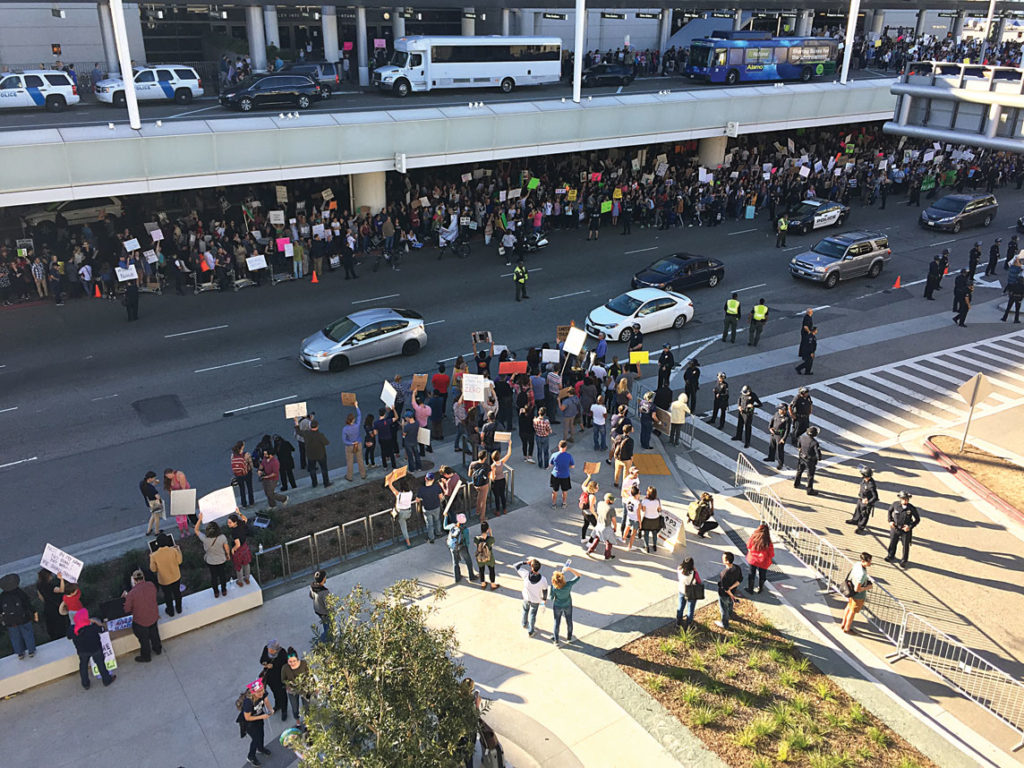
At LAX, where a number of travelers had been detained because of the order, thousands poured through terminals and onto the curbs the afternoon of Jan. 29. Police cut off traffic through much of the airport and largely gave protesters the run of Tom Bradley International Terminal.

Many protesters were Jews from congregations across the city, and even on signs held aloft by non-Jews, a certain Jewish influence could be detected in references to 1930s Germany and proclamations of “Never again.”

“Our country once made the mistake of shutting its doors to nearly 1,000 refugees on the S.S. St. Louis — people died as a result,” said Rabbi Morley Feinstein of University Synagogue, reached by phone shortly after the order was signed. “We don’t want to see that happen again.”

To be sure, there are plenty of Jews who support the ban or parts of it and others who dispute analogies to the Holocaust. “Analogy to 1930s Jews is recklessly false,” a statement from Morton A. Klein, president of the Zionist Organization of America (ZOA), declared the day before the order was signed.

But some community members who voiced their support for Trump’s order did so at their own peril, including Simon Etehad, a personal injury lawyer in Beverly Hills, who was born in Iran and fled the Islamic Revolution in 1979.
img_4102“You have no idea how many friends I lost on Facebook because of my opinion … but I believe that he’s doing a wonderful job,” he said.

“Even if I would have been personally affected by this ban, I would still support it,” he wrote in a follow-up email. “Because I am not willing to endanger the life of a single U.S. citizen so that my family members might have an easier travel experience in the next 90 days!”

The people who showed up Jan. 29 at LAX didn’t quite see it that way.

“There are a lot of Jews here — a lot,” Goldberg said from the airport, joined by her three children and her husband, who translated as she spoke in sign language, since she’d lost her voice.

‘Let them in!’

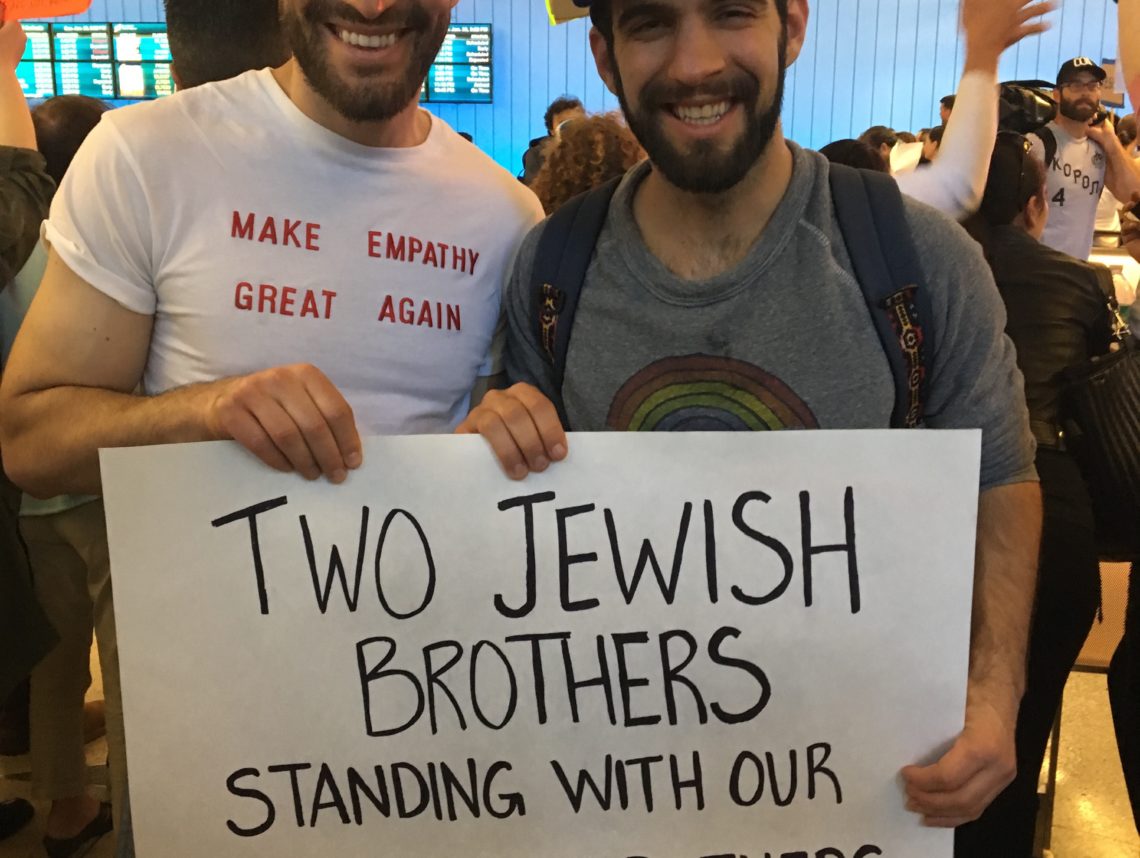
As weary travelers emerged to boisterously chanting crowds, Adam and Noah Reich held a sign reading, “Two Jewish brothers standing with our Muslim brothers.” While they spoke with a reporter, a short woman with olive skin, a total stranger, walked up and hugged both of them. That type of thing had been going on all afternoon.

“Maybe like, a dozen so far,” Noah said. “We’ve been here for a couple hours and people just come up to us.”

“The collective power of everyone here is saying, ‘You’re not alone; we’re all here for you,’ ” Adam said. “And I think that’s a powerful thing.”

Emerging from the crowd, Jesse Gabriel, an attorney and executive board member at The Jewish Federation of Greater Los Angeles, put his hand on Noah’s shoulder.

Kol ha-kavod,” he told the pair, using a Hebrew expression for “Well done!”

Gabriel was one of dozens of attorneys swarming the terminal, many with signs reading “lawyer” and announcing their foreign language proficiencies, hoping to be of help to stranded travelers or those recently released by Immigration and Customs officers.

“When you have individuals whose rights need to be protected, that’s when lawyers need to step in,” Gabriel said.

In fact, there was little work for the attorneys at the terminal, since those detained were stranded elsewhere, in the bowels of LAX, incommunicado. The crowds were chanting, “Let them in!” but lawyers were struggling even to make contact with those stranded.

“Our understanding is that there are a number of people with legal travel documents who are being detained in customs and border patrol, in custody,” said immigration attorney Michael Hagerty.

Hagerty was serving as ad hoc media liaison to a group of attorneys at the airport (as announced by a cardboard sign reading “media liaison”). Among his charges were representatives from legal aid clinic Public Counsel and the local American Civil Liberties Union. But information about those in limbo -— even a basic head count — proved difficult to come by.

“We don’t know who they are, we don’t know exactly what their legal status is on an individual basis, but in all likelihood, they are legal permanent residents, they are refugees with legal refugee travel documents, people with student visas,” Hagerty said.

As he spoke, wayfarers cut through surging crowds, pushing carts and lugging suitcases. For those just arriving, it must have presented an overwhelming scene: shouts of “USA!” from flamboyantly dressed protesters, their signs decorated with images ranging from the Statue of Liberty to Trump with a Hitler mustache, and outside, drums banging out an incessant beat.

Marchers mobbed the sidewalk on both the upper and lower levels, along with the international terminal itself. The crowd lined the curb, waving signs at passing cars, and some took to the upper levels of parking garages across the street to look down over the scene.

Some travelers decided to join the protest, including Zoe Lister-Jones, a filmmaker who had just stepped off the plane after screening her new comedy, “Band Aid,” at the Sundance Film Festival in Utah.

“I’ve been witnessing the injustices occurring from Park City and I came straight from the arrivals terminal to protest,” she said. “As a Jew, I think it’s part of our bloodline to stand up to injustice and resist fascism.”
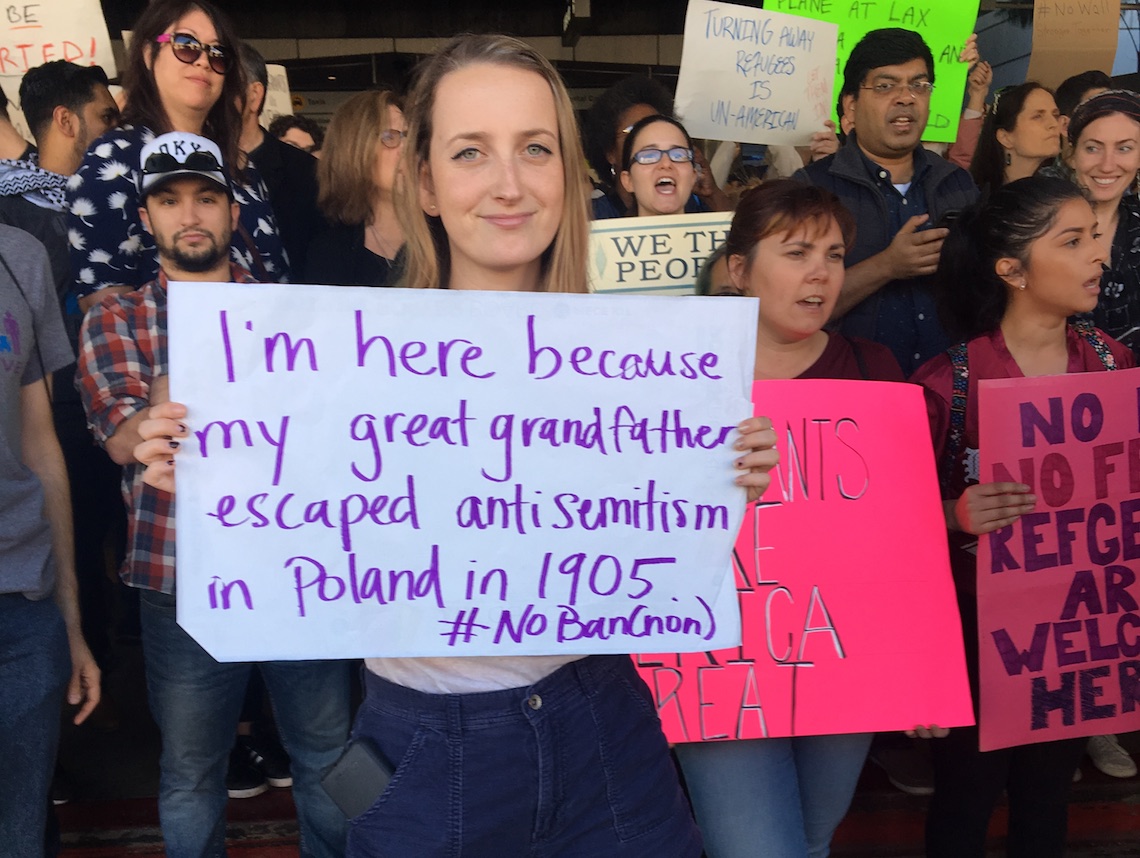
Mollie Goldberg from Los Angeles

Across Airport Way from the mass of protesters stood Michael Chusid, a kind of greeter. The tall, bearded, middle-aged Encino man held a sign that read “Welcome” in English, Arabic and Hebrew.

“My grandparents came from Lithuania and Ukraine,” Chusid said. “My grandfather was the only one to survive from his whole family. The only thing that is left in Lithuania is tombstones.

“That’s why I’m here,” he said as he teared up.

Clergy respond

News of the order quickly raised a chorus of rabbis in opposition.

The Central Conference of American Rabbis, for instance, a consortium of Reform clergy, has been abuzz with outrage at the new policy, Feinstein said.

“We know full well when people come after minorities, they don’t stop with one,” he told the Journal. “History shows this to be the canary in the mine.”

At the airport, the crowd included enough rabbis to start a seminary.

“This country is an expression of the best of what the world has to offer,” Rabbi Ron Stern of Stephen Wise Temple said at LAX. “And to be that, it has to be open to immigrants. It has to reflect the values that we hold dear as Jews.”

Rabbi Neil Comess-Daniels of Beth Shir Shalom in Santa Monica stood alone on the sidewalk outside the terminal wearing a yarmulke and prayer shawl, having been unable to locate his congregants in the chaos.

“I wanted people to know that the Jewish people feel a chill up our spine because this is happening,” he said.

Leading up to the refugee order, HIAS, a refugee resettlement agency formerly known as the Hebrew Immigrant Aid Society, recruited more than 1,700 rabbis across the denominational spectrum to sign a statement welcoming refugees to the United States. They included Rabbis Sharon Brous of IKAR, Adam Kligfeld of Temple Beth Am, Stan Levy of B’nai Horin, and Yoshi Zweiback of Stephen Wise Temple, as well as Feinstein and Stern.

Reached by phone Jan. 27, shortly after Trump signed the order, Kligfeld noted that the Exodus story obliges Jews “to advocate for our country to continue to have its arms and heart open to the bedraggled and impoverished and persecuted.” But he sounded a note of sympathy with community members who want to protect the nation’s ports of entry.

“I find myself in a centrist place on this issue,” he continued. “I’m proud of our country’s history regarding Jewish and non-Jewish refugees. I think we also live in a scary world.”

Representing the nation’s Orthodox rabbinate, the Orthodox Union and the Rabbinical Council of America reaffirmed a joint statement issued in December 2015 blasting the idea of a Muslim ban. Taken together with reproving statements from the Reconstructionist, Reform and Conservative movements, the Orthodox groups’ opposition brings every major strain of American Judaism into alignment against the immigration measures.

Struggling over security, Holocaust memory

The Orthodox rabbi’s statement fell far short of other proclamations by large Jewish organizations, some of which promised an outright battle with the administration.

The Anti-Defamation League (ADL), a nonpartisan group that was critical of candidate Trump, found fighting words: “ADL relentlessly will fight this policy in the weeks and months to come,” CEO Jonathan Greenblatt said in a statement, responding ahead of time to a leaked draft. “Our history and heritage compel us to take a stand.”

American Jewish Committee CEO David Harris also reached for Jewish heritage to motivate his opposition.

“We are all related to those fortunate enough to have been admitted to this country — in my case, my mother, father, wife, and daughters-in-law,” he said in a statement. “And we believe that other deserving individuals merit the same opportunities to be considered for permanent entry.”

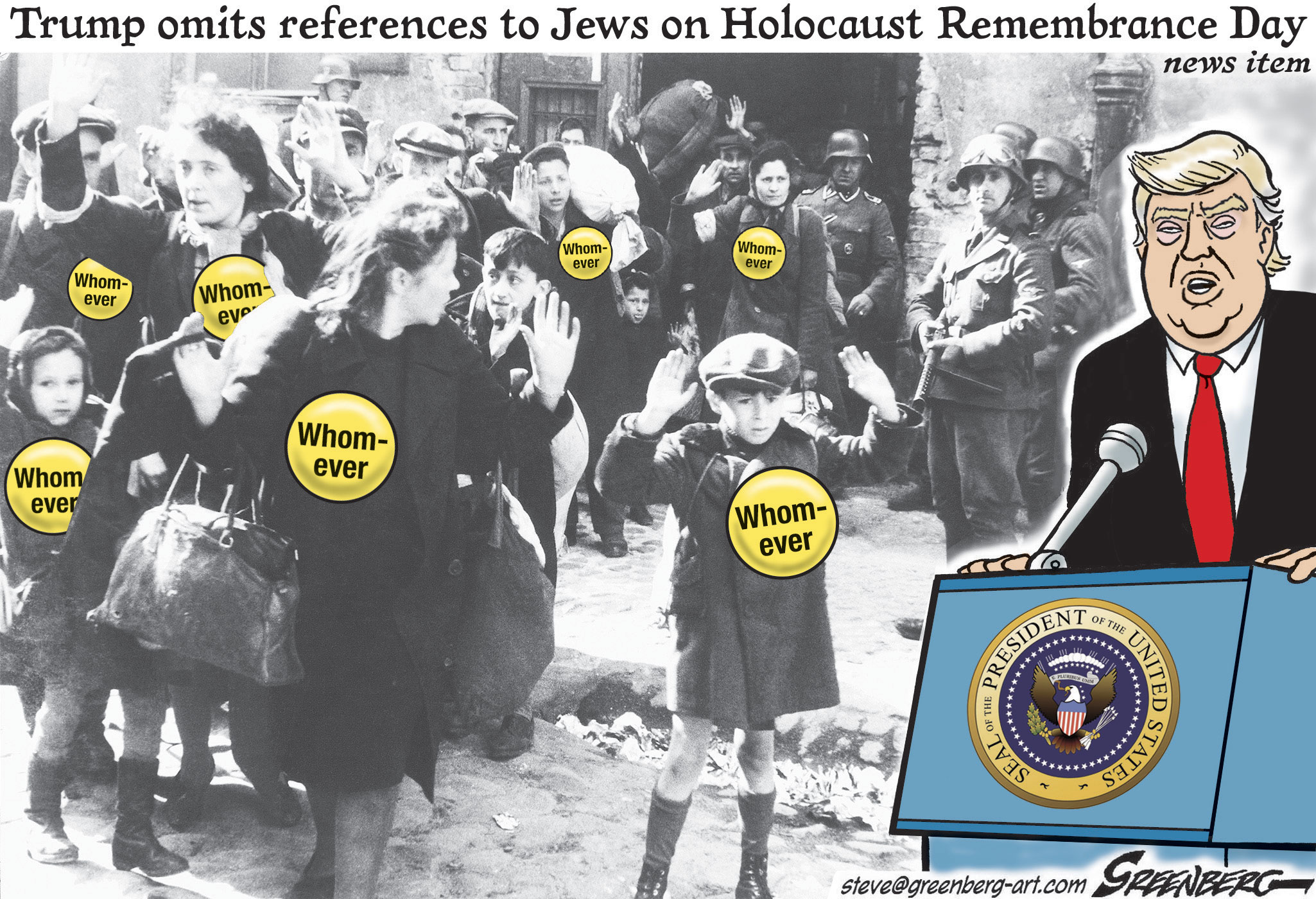
The Simon Wiesenthal Center protested the idea of a nationality-based ban in a statement the day of the order while steering clear of Holocaust imagery. But the same day, International Holocaust Remembrance Day, it criticized Trump for not mentioning Jews in a statement about the Holocaust — a week after the Wiesenthal Center’s founder, Rabbi Marvin Hier, offered a prayer at Trump’s inauguration.

Among the leaders of large Jewish institutions, ZOA’s Klein offered a rare note of support for Trump’s measures, saying in the statement his group “is appalled that left-wing Jewish groups such as the Anti-Defamation League (ADL) and the Reform Movement are ‘strongly condemning’ this draft Executive Order.”

He took umbrage with comparisons to Jewish refugees.

“No Jewish immigrants flew airplanes into buildings, or massacred scores of innocent people at a holiday party or nightclub or marathon or drive trucks into innocent citizens,” Klein said in the statement.

Though unusual within the Jewish establishment, Klein’s thesis found support in some pockets of the community, including some who are recent immigrants themselves.

“It is simply disgraceful to compare Trump to Hitler or his actions to those of the Nazi era,” Etehad wrote in the email.

Eugene Levin, president of Panorama Media Group, which operates a radio
station and two Russian-language  weekly newspapers in Los Angeles, said he supports Trump’s ban on immigrants from several predominantly Muslim countries because there is no way of doing a thorough background check and knowing if someone is not a disguised terrorist.

“Many individuals with questionable backgrounds from the Soviet Union moved here as refugees. Think about [the] Tsarnaev brothers, who were able to immigrate here as refugees,” he said, referring to the perpetrators of the Boston Marathon bombing in 2013.

“I believe what Trump did was a necessary step,” he added.

Muslims “are against the Jewish people,” said Roman Finarovsky, who grew up in Ukraine at a time when going to a synagogue could result in losing one’s job if caught by the KGB.
img_4085But some saw in the struggle of Soviet Jews cause to oppose the ban. Former Los Angeles County Supervisor Zev Yaroslavsky was an activist in the free Soviet Jewry movement as a student at UCLA. While several members of the Russian Jewish community expressed support for the ban, Yaroslavsky strongly denounced it.

“I find it to be abhorrent and contrary to every fiber of my being as a human rights activist, as an activist for Soviet Jewry in earlier years, as a civil libertarian, which I am,” Yaroslavsky said of the executive order in a phone interview. “This is un-American, literally un-American.”

Galvanizing young Jews

Shay Roman, 27, stood with two friends at LAX, all three wearing T-shirts from the group IfNotNow, a network of Millennial Jews that protests the status quo in the West Bank and Gaza.

“I’m here especially as a Jew,” Roman said. “I feel it’s so important to show support for other communities, especially the refugee community.”

“Our generation is absolutely not apathetic,” one of his companions, Jonah Breslau, 25, added. “We’re a group of young Jews and our core values are about freedom and dignity for all people — Israeli and Palestinians, Jews and Muslims.”

Danit Osborn, 22, cited her background as both Jewish and Cambodian as part of her reason for being there. She said she wasn’t sure the protest would accomplish any specific policy reform.

“I’m not sure we’re gonna change Donald Trump,” she said. “But I have to be here for my mother and I have to be here for my father.”

Olga Grigoryants, Ryan Torok, Danielle Berrin and Rob Eshman contributed to this report.

When an executive order prompts civil disorder Read More »

Rabbi Yosef Kanefsky: B’nai David will not accept new OU policy barring female clergy

This Shabbat morning, with God’s help, Rabbanit Alissa Thomas-Newborn will be offering the drasha at B’nai David – Judea, the Orthodox shul of which I am the senior rabbi. As I am presently on a study trip in Israel, this is not really news. Rabbanit Alissa is the only other member of our clergy. The news is that this is the first time that her words of Torah will be not only inspiring, but they will also be of historic importance. Though not intended or designed as such, they will constitute an act of sacred civil disobedience.

The Orthodox Union issued a policy statement today, forbidding its member shuls from employing women like Rabbanit Alissa as members of the clergy. They based this policy statement upon the findings of a panel of very distinguished rabbis, which determined that women in the clergy was contrary to the “Halakhic Ethos”, in that tradition provides no precedent for ordained women clergy, and in that – in their opinion – women serving in clergy is inconsistent with traditional Jewish gender roles.

The panel also cited an opinion within Halakhic literature that forbids the ordination of women, and interpreted Maimonides’ restriction on women being appointed to positions of “serarah” (authority) in the broadest possible sense, such that it includes even positions that do not have coercive authority, and even positions in which a person serves completely at the will of the employers who hired her.

In coming to the conclusion that it did, the rabbinic panel chose to not give weight to the ruling of Rama (Rabbi Moshe Isserlis) in the Code of Jewish law that distinguishes between the ancient ordination of the days of the Sanhedrin, and present-day ordination. Rama rules that the latter is simply a designation that a person is learned and qualified to answer halachic questions, a designation that does not distinguish based upon gender. And the panel also chose to dismiss the ruling of Rabbi

Moshe Feinstein and numerous others, who limited the definition of “serarah” to positions of coercive power which are imposed upon a community without its consent. And it also chose to not solicit the mounds of empirical evidence that all of us who have women on our clergy staff could have provided, concerning the ways that these women have vastly increased the amount of Torah study, Mitzvah observance and spiritual sensitivity within their respective Orthodox congregations. Would this evidence notpowerfully change the calculus for determining the “Halakhic Ethos” in this case? One cannot escape the feeling that from the outset the rabbinic panel deeply believed that women in the clergy was one concession to modernity too many for our deeply traditional system. And that the rest was simply justifying a pre-ordained conclusion.

Please do not misunderstand me. I would be the first to say that a female clergy member would not be the right fit in many, many Orthodox shuls. My contention is not at all that the OU should have endorsed the idea as recommended for everyone. My contention is simply that imposing one perspective on all of its member synagogues, when a Halakhicly valid alternative exists, is divisive, counter-productive, and just plain contrary to the OU’s own values of supporting Torah and Mitzvot. It constitutes a leadership error of historic proportions.

Our Orthodox synagogue, along with the several others who proudly have women on their clergy staff, will obviously not be accepting the new OU policy. I do not know what action the Orthodox Union will take against us. But I do know that we will be strong, and that we will be resolute, because that’s what you do when you are right.

That’s what you do when your driving value is the service of God and of the Jewish people.

Rabbi Yosef Kanefsky: B’nai David will not accept new OU policy barring female clergy Read More »

Trump says settlement expansion ‘may not help’ peace

Settlement expansion “may not be helpful” in achieving peace, the Trump administration said, its first pronouncement on an issue that has for decades confounded U.S.-Israel relations.

The White House announcement Thursday evening comes a week after Israeli Prime Minister Benjamin Netanyahu announced major settlement building initiatives in the West Bank and eastern Jerusalem.

“While we don’t believe the existence of settlements is an impediment to peace, the construction of new settlements or the expansion of existing settlements beyond their current borders may not be helpful in achieving that goal,” the statement said.

Most of the announcements Netanyahu’s government authorized are in existing settlements, but there are patches that would expand settlements, and Cabinet ministers to Netanyahu’s right want to seize on the new friendliness of the Trump administration to expand settlements further and to annex territory.

The Trump White House statement avoids some of the thickets of disagreement that frustrated relations between Netanyahu and President Barack Obama, Trump’s predecessor.

It does not call for a stop on building in existing settlements, an activity that troubled Obama, and it does not call settlements an impediment to peace. That suggests a return to the approach of President George W. Bush who for a period said he could tolerate “natural growth” within existing settlement boundaries.

However, the statement does suggest that a president who has turned over tables in so many other spheres that once bound Democrats and Republicans – friendly outreach to a Russian government both parties have reviled in recent years is probably the best known example – is nonetheless seeking consistency on the Israeli-Palestinian issue.

President Donald Trump, who prides himself as a deal-maker, said throughout his campaign that he wants to bring about a breakthrough in Israeli-Palestinian peace, and that hope is pronounced in the statement.

“The American desire for peace between the Israelis and the Palestinians has remained unchanged for 50 years,” the statement said. “As the President has expressed many times, he hopes to achieve peace throughout the Middle East region.”

Trump and Netanyahu are due to meet in two weeks, and the statement said an overarching policy on settlements would not be in place until then.

“The Trump administration has not taken an official position on settlement activity and looks forward to continuing discussions, including with Prime Minister Netanyahu when he visits with President Trump later this month,” it said.

Trump says settlement expansion ‘may not help’ peace Read More »

Trump’s anti-American immigration ban

The most astonishing moment for me at last Sunday’s protest against President Donald Trump’s executive order on immigration and refugees came when I was standing by the arrivals area at Tom Bradley International Terminal at LAX.

Suddenly a cheer cut through the din of chants.  A mob of photographers pushed past me to take pictures of someone walking up the exit ramp. This being LA, I was sure George Clooney had just arrived.

I elbowed my way through the crowd, and saw the source of all the excitement.  It was a stout old Muslim woman. Her head and much of her face was wrapped in a thick black hijab.  She was schlepping up the ramp, alone.

A swarm of cameras flashed in her eyes.  The crowd chanted, “Salaam aleikum!  Saleaam aleikum!”   There was applause and whistling and clapping.

The excitement bewildered her.  The photos I snapped show something close to panic in her eyes. A middle-aged Jewish woman I recognized burst through the mob and practically jumped on the older lady, stroked at her arms and said, “Salaam Aleikum ShukranSalaam Aleikum Shukran!

I couldn’t imagine what she made of the mob, the noise, the strange woman who blurted “Hello thank you! Hello thank you!”

Her family rushed to greet her. The old woman gave a get me the hell out of here look, and they spirited her away.

That’s Donald Trump for you, I thought.   The Executive Order Trump signed was so ill-conceived, slapdash, illegal, pandering, and un-American, only he could turn an innocent Muslim bubbie into an unwitting Rosa Parks.

There is something funny about the unsuspecting grandmother turned hero, or it would be funny if the actual consequences of the Muslim ban weren’t so devastating to people, to our democracy and to the actual fight against Islamic extremism that it was purportedly designed to help.

By now we have all read the stories of citizens and green card holders deprived of their rights, of chaos and confusion, of ISIS’s using the ban for recruitment, of cooperative Muslim countries being insulted, of the hypocrisy of leaving out countries that breed actual radical Muslim terrorists, like, say, America, and of the fact that countries  in which Trump does business are excluded from the ban.

In this week’s Jewish Journal, you can read even more stories of Jewish refugees whose American success stories grew from their ability to enter the United States when their lives depended on it.  They fled Nazi Germany (like the grandparents of Jared Kushner). Or they fled  Eastern Europe (like the ancestors of young Stephen Miller, who helped write the ban), or they escaped Iran.  Because politicians and people spoke up loudly to shout down the voices of xenophobia and ignorance, America opened her doors to them.

But this time, the xenophobes are in charge.

Their apologists point out that the executive orders call for only a  temporary ban at best, though a full ban on people fleeing Syria.  The masses that gathered at LA and airports around the country know better.  They get that the Syrian refugees are the German Jews of 1930, or the Persian Jews of 1979, or the Eastern European Jews fleeing the Czar or the USSR.  The hijab is the streimmel. The beard is the payes. What was foreign and threatening to Americans then is just as scary to them now.

That’s why, in frightening times, our safest bet is to rely on our deepest values.  The crowd at LAX understood that, even if their president does not.

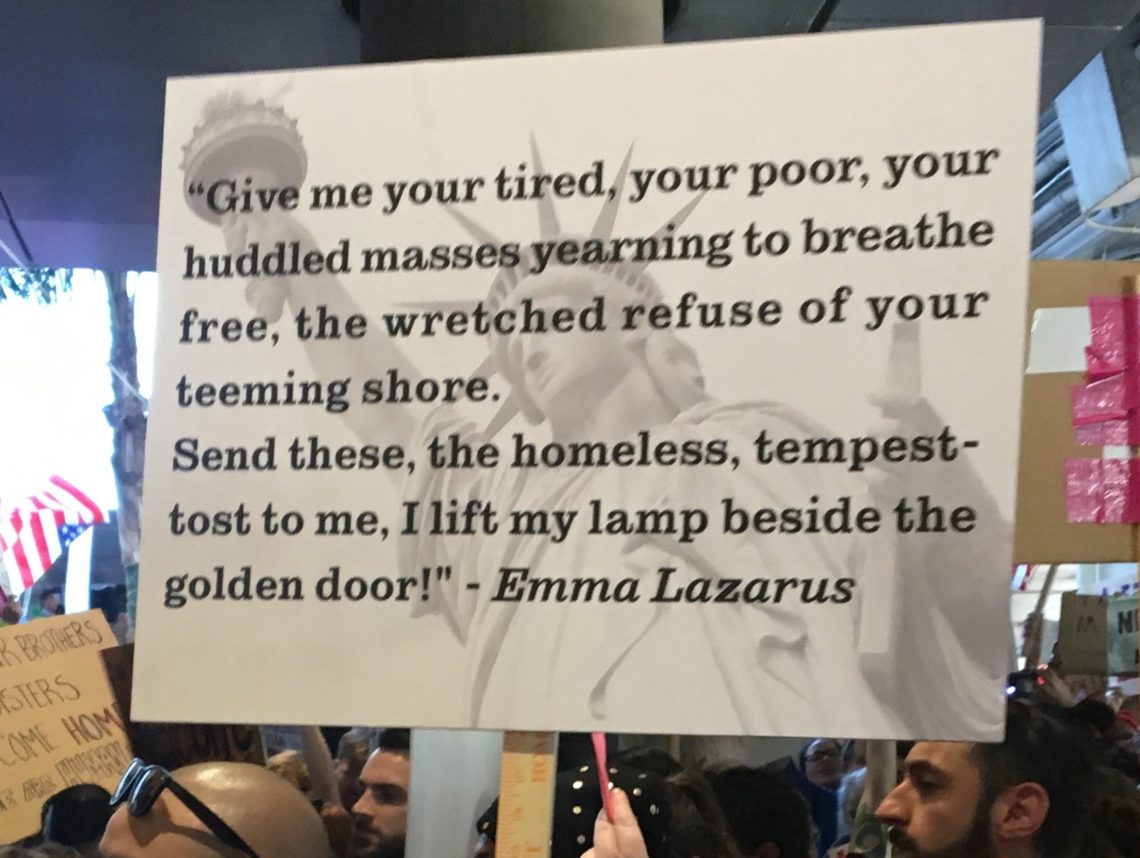
That’s why the most common message people held up on their protest protest posters were the words written in 1883 by a 34 year-old Jewish woman in New York, Emma Lazarus:

“Give me your tired, your poor,
Your huddled masses yearning to breathe free,
The wretched refuse of your teeming shore.
Send these, the homeless, tempest-tost to me,
I lift my lamp beside the golden door!”

Those posters were heartwarming, but they were my second- favorite posters I saw at the rally.

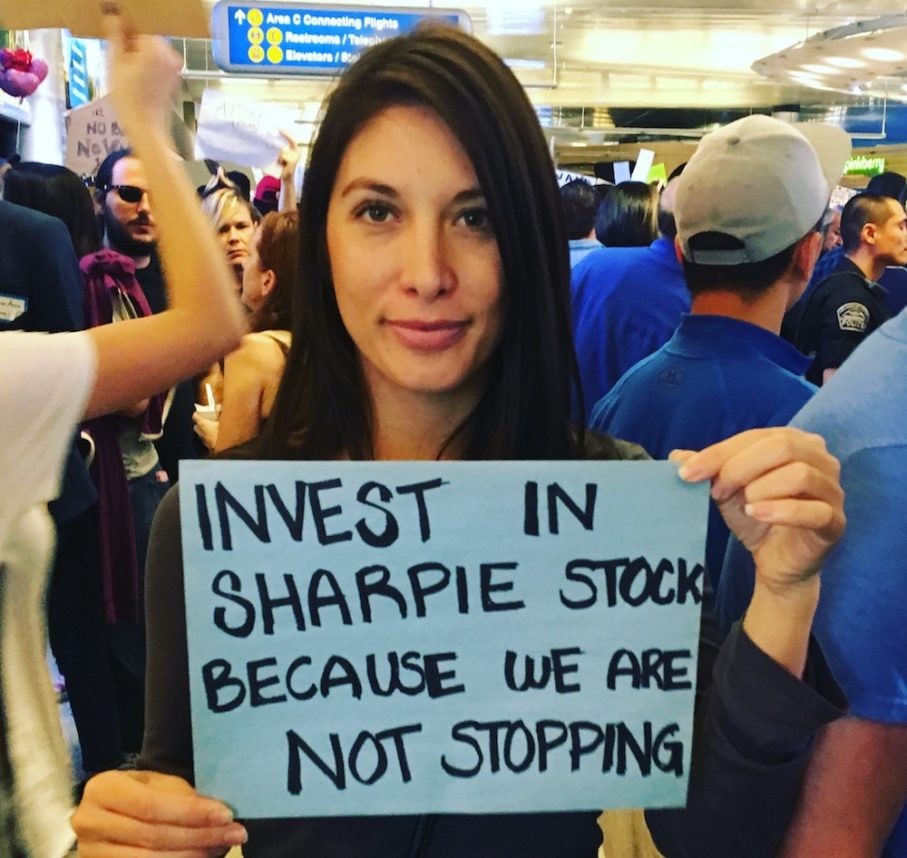
My favorite?   It was held up by a quiet young woman inside the terminal.  It read: “INVEST IN SHARPIE STOCK BECAUSE WE’RE NOT STOPPING.”

img_4107

Trump’s anti-American immigration ban Read More »

OU bars women from serving as clergy in its synagogues

The Orthodox Union released a new policy barring women from serving as clergy at its 400 member congregations across the United States.

Adopted at a board meeting Feb. 1 and reported Thursday in the Forward, the ruling cites Jewish law, or halacha, in declaring that “a woman should not be appointed to serve in a clergy position.”

The ruling bars women from holding a title such as “rabbi,” or even from serving without title in a role in which she would be performing “common” clergy functions. It lists those functions as ruling on halachic matters, officiating at lifecycle events, “delivering sermons from the pulpit during services, presiding over or ‘leading services’ at a minyan and formally serving as the synagogue’s primary religious mentor, teacher, and spiritual guide.”

Seven leading modern Orthodox rabbis contributed to the ruling — a response to a small number of synagogues that have hired female clergy ordained by institutions representing a left-wing, or “open” faction, within modern Orthodoxy. Yeshivat Maharat, a New York-based yeshiva, has already graduated 14 female Jewish clergy.

At least four synagogues that are members of the Orthodox Union currently employ women in clergy roles, according to the Forward.

Representatives and champions of such groups expressed disappointment at the new policy.

“There are various ways of practicing Judaism, halachic Orthodox Judaism,” Sharon Weiss-Greenberg, executive director of the Jewish Orthodox Feminist Alliance, told the Forward. “We are disappointed, however, that the OU is attempting to squash that healthy debate and impose their [religious ruling] on hundreds of synagogues, thus centralizing power … and not giving autonomy to communities’ lay and professional leaders.”

In a statement accompanying the ruling, the Orthodox Union asserted that the “synagogue experience would be enhanced by … an even greater presence of women functioning as educated, knowledgeable and halachically committed role models, teachers, and pastoral counselors,” and that it would encourage dialogue in order for women within Orthodoxy to “assume greater lay and professional roles” and to remove “barriers that impede women from further contributing to our community, in halachically appropriate ways.”

OU bars women from serving as clergy in its synagogues Read More »