fbpx

December 11, 2015

Sausage hash brown latkes

Sausage Hash Brown Latkes

My favorite breakfast is a combination of eggs served with sausage and hash browns. When combined together and fried to crispy perfection it makes the perfect breakfast latke!

Ingredients:

  • 4 sausages, diced
  • 1 onion, diced
  • 20 oz. shredded hash browns (3 1/2 cups)
  • 2 eggs
  • 2 T flour
  • 2 scallions chopped up
  • Salt
  • Pepper


Saute onions until tender. Add diced sausage and cook until lightly browned. Combine with hash bronws, eggs, flour, scallions and season with salt and pepper. Fry up in batches and serve with spicy mayo. (mayo with sriracha combined)

This recipe originally appeared on Kosher in the Kitch!

Sausage hash brown latkes Read More »

Rosner’s Torah-Talk: Parashat Miketz with Rabbi Corey Helfand

Our guest this week is Rabbi Corey Helfand, leader of the Peninsula Sinai congregation in Foster City, CA. Rabbi Helfand received his rabbinic ordination in May 2011 from The Jewish Theological Seminary of America along with a Masters in Talmud and Jewish Law and a certificate in pastoral care. As a Gladstein Fellow in Entrepreneurial Rabbinics, Rabbi Helfand served as the rabbinic intern at the Conservative Synagogue Adath Israel in Riverdale under the mentorship of Rabbi Barry Dov Katz and as the rabbi of Beth Shalom of Lake Norman in Davidson, North Carolina. Rabbi Helfand graduated from Washington University in St. Louis with a BA in Jewish and Islamic Studies and in Political Science. He completed two 400-hour units of Clinical Pastoral Education, one at the Zicklin Hospice Center through the Center for Pastoral Education at JTS and one unit at Bellevue Hospital. He also served as the rabbinic intern for the Masorti Community in Kiryat Bialik outside Haifa under the mentorship of Rabbi Mauricio Balter.

This week's Torah portion – Parashat Miketz (Genesis 41:1-44:17) – features the second part of the story of Joseph and his brothers. The parasha begins with Joseph interpreting the Pharaoh's dream and continues to tell us about Joseph's rise to power, about the seven years of famine, and about Joseph's first re-encounter with his brothers who come to Egypt to purchase grain. Our discussion focuses on the unclear and nuanced emotions at play when Joseph meets his family again and on what the whole episode says about Joseph and his leadership style.

Our Past discussions of Parashat Miketz:

Rabbi Aaron Bergman on the transformation of the family of Israel into the people of Israel

Rabbi Yehudah Mirsky on the Jew, the outsider, as the interpreter of dreams


Rosner’s Torah-Talk: Parashat Miketz with Rabbi Corey Helfand Read More »

Netanyahu family dog put in quarantine after biting guests

Israeli Prime Minister Benjamin Netanyahu said on Friday his family had put its dog in quarantine after she made headlines by biting two guests at a Jewish religious event they had hosted. 

“We were compelled, with sorrow, to put Kaiya into quarantine, as required by law,” Netanyahu said on Facebook. He added that he had found unspecified flaws in the conditions for canine custody in Israel that he wanted legislation to fix. 

The post did not say what fate might await the 10-year-old mixed breed, which was taken in by one of Netanyahu's sons from a rescue home earlier this year. 

Kaiya bit the husband of Israel's deputy foreign minister and a lawmaker, both from Netanyahu's Likud party, at a Hannuka candle-lighting on Wednesday. The latter victim dismissed the incident as “trivial”. 

Israel's Channel 10 TV said Netanyahu was himself also bitten by the dog that evening – an account his spokesmen could not be reached to confirm.

Netanyahu family dog put in quarantine after biting guests Read More »

Nacho latkes with creamy cheddar sauce

Spice up the original potato latke this holiday! Skewer bite sized potato latkes together with a layer of creamy nacho sauce served on top.

Potato Latkes:

  • 20 oz. shredded hash browns about 3 1/2 cups (frozen works great!)
  • 2 eggs
  • 2 T flour (add more if batter doesn’t hold together)
  • 2 scallions chopped up
  • Salt
  • Pepper


Combine, form into small patties and fry until golden.

Nacho Sauce:

  • 2 T butter
  • 2 T flour
  • 1 cup milk
  • 1 cup shredded cheddar cheese


Melt butter then add flour and whisk together until well combines and a paste forms. Add milk and over a medium flame whisk until sauce thickens then add shredded cheese and continue whisking until cheese melts and sauce is smooth.

Salsa:

  • 4 tomatoes
  • 1 bunch of cilantro
  • 1 red onion
  • Juice of 1 lime


Pulse together in a processor until smooth. Optional, add 2 jalapeno peppers without seeds for spice! Plate latke skewers over sliced avocado and salsa with nacho sauce on top.

This recipe originally appeared on Kosher in the Kitch!

Nacho latkes with creamy cheddar sauce Read More »

Maccabean dream or Hasmonean nightmare? (Chanukah 5776)

In 1972, during Richard Nixon’s visit to China, Premier Zhou Enlai was asked what he thought about the French Revolution. He responded, “Too early to tell”. His answer is celebrated to this day as an illustration of the supposed Chinese ability—and the Western need—to take the long view of history.

In fact, Enlai wasn’t really being so philosophical; he had simply misunderstood the question. He thought he was being asked about the French student revolts of 1968, the effects of which were still reverberating in capitals across Europe.

But don’t worry; Jews never needed Zhou Enlai to take the long view of history. For our people, ancient history is still playing out; it molds our values, and it affects our understanding of the modern world. History and present are two inseparable parts of one long adventure whose denouement we are still expecting.

This seamless flow of Jewish history was much in my mind this week, because Enlai’s unintentional warning against haste in judgment is particularly relevant when it comes to Chanukkah. Beyond the candles, the dreidels, and the artery-clogging foods, Chanukkah brings us a complicated and contradictory story that defies easy evaluation.

I grew up believing that Chanukah told an epic story of freedom. I believed, together with Howard Fast, that it was “the first modern fight for freedom”. For me, the Maccabees were romantic and idealistic warriors, wise democratic leaders willing to give their lives for tolerance and for the right of all people to worship and live as they chose. I imagined the Maccabees as an improbable combination of Che Guevara, John F. Kennedy, and Abraham Joshua Heschel. 

And Chanukah was indeed all that. The Maccabees were the original “band of brothers” who defied insurmountable odds and challenged a mighty empire to reclaim their right to be different, to live independently as masters of their own destinies. They sought Jewish rule for nobody but the Jews; they didn’t want to impose their ways on anybody else. They only wanted peace and respect for all. It’s an inspiring, ever-relevant tale, and it fills me with pride that it was my people who first fought for these values.

But, as I later learned, this is only one face of the Chanukah story. Viewed from another angle, Chanukah is an ugly story of zealotry, civil war, abuse of power, and eventual ruin.

The Maccabees weren’t only fighting the Seleucid army—they were fighting other Jews, namely the mityavnim, those Jews who had adopted the Greek language and Hellenistic customs. In other words, the Maccabees declared war on the “assimilated.” Jews who didn’t conform to their interpretation of Judaism were put to the sword or had to seek refuge in the Diaspora. In an all too common reversal, those who fought intolerance became intolerant themselves.

It gets worse. Simon Maccabee, the last surviving brother of the original band and the first ruler of independent Judea, tried to stay true to the original Maccabean values. He didn’t proclaim himself king, but high priest and nasi (a Hebrew term meaning ”ethnarch” or “leader,” the same word used in Modern Hebrew for “president”), and he was elected in a democratic fashion. But things went downward from there. Simon was murdered by fellow Jews, and his descendants showed fewer scruples. Violating the “Davidic principle” (that only descendants of King David can be kings of Israel), they took the crown for themselves. Assuming full kingship while retaining the high priesthood, the power-hungry Hasmoneans  violated a paramount idea of Judaism: the separation between royal and religious power. All the while, recurrent civil wars cost tens of thousands of Jewish lives.

John Hyrcanus, Simon’s son, did something else that is anathema to Judaism: after his battles with the Idumeans, he forced the conversion of the entire population. Not exactly a way to honor the ideals of tolerance and freedom of his father… But then, that was hardly the only departure the Hasomneans made from the ways of their ancestors. Indeed, while one of the first purposes of the Maccabees had been to fight the “Hellenized” Jews, the Hasmonean kings had no qualms about adopting the nice accoutrements of Hellenistic life for themselves. Even their regal title changed to basileus, the Greek designation. (This hypocrisy reminds me of some of today’s Jewish American leaders who claim that criticizing Israel is beyond the pale, but who vociferously and publicly attacked Yitzhak Rabin during the Oslo Peace process).

The Hasmonean misadventure ended, as it only could, in farce and tragedy. John Hyrcanus’s grandchildren, Aristobolous II and Hyrcanus II, engaged in yet another vicious civil war and both had the brilliant idea of inviting Rome to intercede in their favor. You can imagine what came next: the beginning of the end of Jewish independence for two thousand years.

Looking at the state of the Jewish People today, there is in us much of the light of the Maccabees and, sadly, much of the darkness of the Hasmoneans. If you ask me which I think will prevail—which will be the ultimate heritage we derive from the Chanukah story—I have to agree with Zhou Enlai: two thousand years later is too early to tell.

During the last few months we have heard dangerous echoes of the Hasmoneans: zealotry and internecine hatred running wild, poisonous cocktails of religion and power politics, and, as in John Hyrcanus’s time, abandonment of our most basic values. We must ask: are we living the Maccabean dream, or the Hasmonean nightmare? How can we celebrate Chanukah once we know how the story really ends?

And yet, the story hasn’t ended even now. Now more than ever, in these times of violence and hatred, of intolerance and radicalism, we need to rescue the original light of the Maccabees that illuminated a vision of peace and respect; the light that expelled darkness and tyranny, and made freedom and tolerance a sacred imperative. Peoples, like stars, are entitled to a momentary eclipse in which light fades away. That is tolerable if we bring the light back, if we don’t let the eclipse lengthen into endless night.

As funders we have a major role to play, for every grant, every project, every act of kindness can be an opportunity for healing a broken word and reconciling a split community. We can—we must—be the light that shines through the cracks of our imperfect reality.

This year, as we celebrate the courage and the miracles of yesteryear, let us commit to building a world in which light outweighs darkness and hope vanquishes despair. Let us face violence with the conviction that—as the Maccabees taught us—right can triumph over might, and even when we walk through the dark valley of intolerance, let us celebrate every ray of the light we give to others.

Yes, it’s too early to tell. It always will be, because the battle between light and darkness is not an event but an ever-unfolding process.

The Chanukah story is still being written today, and what makes it frightening—and beautiful—is that the ending depends on us.

Chag sameach!


Andres Spokoiny is President and CEO of Jewish Funders Network

Maccabean dream or Hasmonean nightmare? (Chanukah 5776) Read More »

Madoff trustee sues leading Israeli universities, hospitals for $95 million

Irving Picard, the trustee appointed to liquidate the assets of convicted Ponzi schemer Bernard Madoff and return money to his victims, has filed a $95 million lawsuit against some of Israel’s largest educational and medical institutions.

Among the defendants in the suit filed Wednesday in Tel Aviv District Court are Hebrew University of Jerusalem, the Weizmann Institute, the Technion-Israel Institute of Technology and Sheba Medical Center, the Israeli business daily Globes reported.

Picard’s suit, which was filed through an Israeli law firm, alleges that while the institutions unknowingly benefited from stolen money gained through their investments in an Israeli foundation, the Yeshaya Horowitz Association, they have subsequently refused to return it to the victims.

In a 2010 New York suit that is still in litigation, Picard alleged that the Yeshaya Horowitz Association and others knew at the time that Madoff’s New York investment firm was perpetrating a fraud, according to Globes.

Picard’s Tel Aviv suit says the funds received by the Israeli institutions through Yeshaya Horowitz were wrongly classified as donations and grants and were in fact tainted money that was being laundered.

Globes quoted Picard’s lawsuit as saying: “This account, which was part of the Ponzi scheme operated by [Madoff], performed no securities transactions and never generated profits for the approximately $3 million initially deposited upon opening the account. Nevertheless, Yeshaya withdrew approximately $126.5 million to its bank account, distributing it to various institutes in Israel, including the Defendants. The approximately $123 million withdrawn from [Madoff’s company], used to finance Yeshaya activities and donations, were thus stolen from defrauded [Madoff] customers and unlawfully transferred to Yeshaya.”

The lawsuit adds, “While many lost everything and were left penniless in their old age, others, including respected and leading research and study institutions in Israel, illegally received substantial funds.”

Picard’s suit, according to Globes, “relies on unjust enrichment law, which states that a person or company who has received a stolen item in good faith must restore it to its legal owner when the source of the stolen item is revealed.”

Jonathan Agmon, one of Picard’s attorneys, said, “Three years ago, the Hadassah Women’s Zionist Organization (through its organization in the U.S.) returned millions of dollars received from [Madoff], a portion of which came through Yeshaya, upon discovering that the money was stolen from defrauded [Madoff] customers. The defendants must follow suit and return the stolen money that they received. By refusing to take the moral and respectable path, the respondents associate themselves with the thief – Madoff – and not the victims. Returning the stolen money is the right thing to do.”

In a statement on behalf of the defendants, the Association of University Heads of Israel said: “The money involved was legally donated to universities, and has already been used for research and academic needs. The universities do not have, and did not have, any information about how the Horowitz Association made its investments, and any demand for the restoration of the money donated to them is groundless.”

Madoff, 77, is serving a 150-year prison sentence in a federal prison in North Carolina.

Madoff trustee sues leading Israeli universities, hospitals for $95 million Read More »

Arab-Israeli lawmaker in US refuses to enter offices shared with Jewish Agency

Arab-Israeli lawmaker and political leader Ayman Odeh refused to meet with the umbrella foreign policy body for American Jews because it shares office space with the Jewish Agency, an abrupt and dissonant end to a trip that was aimed at promoting greater Arab-Jewish cooperation.

“I came here to represent the Arab public in Israel to American audiences,” Odeh said in a statement Thursday after the Conference of Presidents of Major Jewish Organizations released a statement saying it was “disturbed and shocked” at Odeh’s refusal.

“As their representative, I cannot in good conscience participate in meetings in the offices of organizations whose work displaces Arab citizens, just as in the Knesset, we do not participate in the Ministry of Defense, the Foreign Ministry, and the Ministry of Aliyah and Immigrant Absorption,” Odeh said in his statement.

The controversy dealt a blow to Odeh’s message of outreach to U.S. Jews to join his effort to advance civil rights for Arabs and others in Israel.

“Representatives of a broad spectrum of organizations came to hear him and were rightly upset by his decision not to appear, although he was in the building lobby,” the Presidents Conference statement said.

A spokeswoman for Odeh said that the displacement of Arab citizens cited by Odeh referred to the Jewish Agency’s affiliation with a separate entity, the Jewish National Fund, which has long been challenged by Arab-Israeli groups for policies that have in the past favored Jews over Arabs in leasing land. Arab-Israeli groups allege that the policy blocks the growth of Arab towns.

The spokeswoman also said that Odeh sees aliyah, the immigration of Jews to Israel, as expanding the Jewish majority in Israel at the expense of its Arab population. The Jewish Agency is responsible, with the Ministry of Absorption, for settling newcomers in Israel. Another issue for Odeh is the funneling of money to West Bank settlements from another Jewish Agency affiliate, the World Zionist Organization, the spokeswoman said.

The Presidents Conference statement said Odeh’s decision, made in the lobby of the Manhattan building, deprived him of the chance to interact with U.S. Jewish groups.

“We received several suggestions that MK Ayman Odeh be invited and, in keeping with the Conference’s decades long tradition of providing a forum for a wide variety of points of view on issues affecting the American Jewish community’s agenda, we extended the invitation,” the umbrella group said.

“We have had leaders of virtually every faction and party in the United States, Israel, from friendly and unfriendly countries, and none ever refused to appear. For a member of the Knesset to assert that he will not enter a premises because it has an association with Zionist entities, like the Jewish Agency, is disturbing and dismaying.”

Odeh in his statement said he offered to meet elsewhere.

“The Conference will continue to provide an open forum but will not compromise our principles and yield to such an outrageous demand,” its statement said. “We hope MK Odeh will reconsider his stance if he, indeed, wants to advance coexistence in Israel and promote understanding abroad.”

On Tuesday, rabbis and lay leaders of the Reform movement in New York met with Odeh.

The meeting was hosted by Rabbi Rick Jacobs, the president of the Union for Reform Judaism, or URJ, and Rabbi Joshua Davidson, senior rabbi of Temple Emanu-El in New York City, the URJ said in a statement.

Odeh, 40, is the head of the Arab Joint List party, which won 13 seats in Israel’s national elections in March, making it the third largest faction in the Knesset. He successfully united four Arab parties to achieve that success.

In discussing his first year in the Knesset and his political goals for the future, Odeh told the Reform leaders that “more democracy and social justice in Israel is in our shared interest.”

The Reform leaders welcomed Odeh’s message.

“MK Odeh has an inspiring vision for a brighter future for Israelis and Palestinians,” Jacobs said. “We were delighted to host MK Odeh in one of our leading houses of worship, to share with him the beauty, history, and activism of our Reform Movement and to discuss together our shared commitment to a vision of Israel that draws from the prophets of justice and righteousness for all.”

The Reform leaders linked their meeting with Odeh to presidential candidate Donald Trump’s recent call for a ban on entry of Muslims to the United States.

“This is most appropriate at Hanukkah time, when we reflect on our commitment to tolerance in our increasingly intolerant world,” Jacobs said. “When we extended this invitation to Odeh, we would never have thought that his very presence in the United States would be controversial. However, we met the day after Donald Trump disgraced himself by calling for a ban on all Muslims entering the United States.”

During his weeklong visit to the United States, Odeh met with congressmen and senior Obama administration officials at the White House and State Department. He also met in Washington and in New York with Arab-American groups and leaders of progressive think tanks.

Arab-Israeli lawmaker in US refuses to enter offices shared with Jewish Agency Read More »

We must rededicate ourselves to tolerance

Thank you Mr. President.

I know that I speak on behalf of everyone present tonight in expressing our gratitude for the way that you and the First Lady have, once again, opened up your home to the Jewish community for an annual White House celebration of Chanukah.

Chanukah is a festival of liberty, teaching us that freedom is not free. When there is evil and tyranny in the world, we must summon the courage to fight it. Sadly, we are reminded of this by the daily headlines. Not too long ago, Jews were the ones on boats seeking refuge from the horrors of Nazi Europe.

The special affinity and love that Jews have for the State of Israel is because, after 2000 years of wandering, Jews were able to be, in the words of the Hatikvah, “free people in our ancestral homeland”.

But for most of us here tonight, America is our home, the most hospitable country for Jews in the entire history of our people. I know this first hand. Both of my parents were survivors of the Shoah. My father was born in Berlin. He left two weeks before Kristallnacht in 1938 at age 16. He came to America on the last successful voyage of the St. Louis. The next voyage of that ship came to be called the Voyage of the Damned because its 937 Jewish refugees were sent back to Europe, having come within sight of Miami Beach. Five years later my father would proudly put on an American uniform and return to Europe to fight with the U.S. Army to defeat the Nazis.   

The word Chanukah means dedication. At a time when we hear the most shameful expressions of bigotry in our public discourse from prominent personalities, we must re-dedicate ourselves to the principles of tolerance and justice for all, something that you, Mr. President, have modeled throughout your presidency.   

So it is in that spirit that I invite you to join me in the blessings for lighting the candles with the addition of the shehechiyanu prayer, offering gratitude for this moment celebrating Chanukah in the White House. 

Rabbi Sid Schwarz, Senior Fellow, Clal: The National Jewish Center for Learning and Leadership and Founding Rabbi of Adat Shalom Reconstructionist Congregation, Bethesda, MD delivered these remarks at the White House Chanuka Lighting on December 9, 2016

We must rededicate ourselves to tolerance Read More »

Netanyahu family dog in quarantine after biting Likud lawmaker

Veterinary authorities quarantined the family dog of Israeli Prime Minister Benjamin Netanyahu after she bit a lawmaker at a Chanukah reception.

The dog, Kaia, was placed in quarantine Thursday as per health ministry regulations after she bit Sharren Haskel, a Likud member of the Knesset, and another person the previous day at the Prime Minister’s Residence in Jerusalem, the news site Ynet reported.

“We had to give away Kaia to be quarantined as legally required,” Netanyahu wrote on his Facebook page. “Following this incident, I became aware of the issue of quarantine regulations for dogs and I found in it problems that conform neither with logic nor compassion.”

He added he would ask officials from the health and agriculture ministries, as well as animal rights groups, to “formulate suggestions to change and improve the existing laws.” Netanyahu ended his post with a greeting and happy Chanukah “to us all, two and four-legged alike.”

Dogs, cats and other mammalian pets who bit a person are required to be quarantined for 10 days of observation to determine they do not have rabies. In some cases, animals may be quarantined in their owner’s home, but the vast majority of cases  — some 3,500 annually — are held in municipal facilities.

According to Ynet, Kaia bit the prime minister in July, shortly after she was adopted, and was not quarantined, though Netanyahu was given anti-rabies shots as a precaution.

Described by the Netanyahus as a “kind and friendly dog,” Kaia, who is 10 years old, suffers from bad hearing which makes her startle and sometimes bite when approached from behind, Ynet reported.

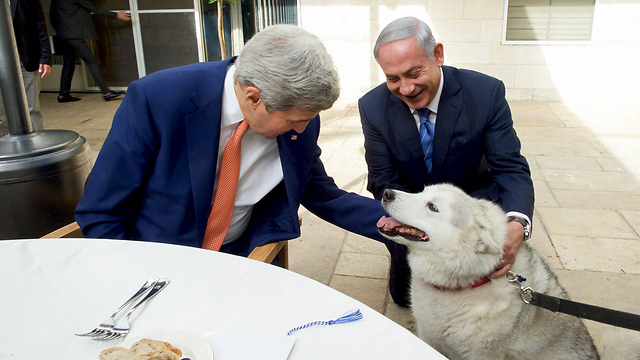
The news site published a picture of U.S. Secretary of State John Kerry petting Kaia with Netanyahu during his last visit to Israel. Kerry is seen facing her.

Netanyahu family dog in quarantine after biting Likud lawmaker Read More »

A Brokered GOP Convention: Yes But

The new scuttlebutt is that the GOP Establishment will coalesce to prevent a Trump nomination at next summer's GOP Convention.

Once upon a time, the Democrats required a two thirds convention vote to get nominated, which is why Woodrow in 1912 and FDR in 1932 required multiple ballots. An exhausted Democratic Party, divided over the KKK, required over 100 ballots before nominating a nonentity, John W. Davis, in 1924.

Technically, Eisenhower’s victory over Taft in 1952 and Gerald Ford’s over Reagan in 1976 were not determined until the GOP convention, though the outcome in each case was a foregone conclusion. Perhaps the closest thing to a real surprise was the GOP nomination of Democratic turned Republican businessman Wendell Willkie in 1940, who lost to FDR’s third term bid.

I have a gut suspicion that this year is going to produce a new variation.

Trump will see the near-impossibility of being nominated and elected. Instead, he will unite with his sometime buddy, Ted Cruz, before the convention, taking on the mantle of “kingmaker.” If Cruz wins, Trump will claim the credit. If Cruz loses to Hillary Clinton—more likely—Trump will escape the brunt of blame for the defeat. English history’s great “Kingmaker” was Richard Neville, Earl of Warwick, who made and unmade kings during the fifteenth-century War of the Roses.

A bit like Donald Trump’s abortive political tour of Israel, he spent part of his career in France trying to drum up support for England’s “mad king” Henry VI. Eventually, Warwick lost his head on the battlefield to the (temporarily) victorious House of York which he once supported and then deserted.

Trump has no intention of following in Warwick’s headless footsteps. American politicians—not yet at least—are not willing to risk paying the ultimate price for power.

A Brokered GOP Convention: Yes But Read More »