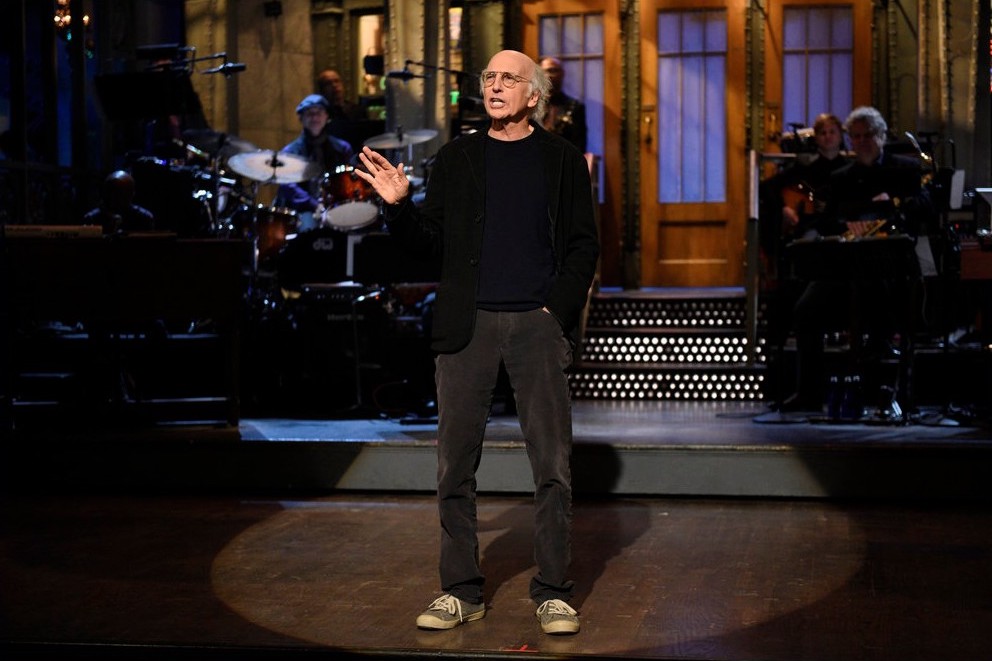
In a controversial opening monologue, Saturday Night Live host Larry David ignited a firestorm with controversial jokes connected to the Holocaust and accused sexual harasser Harvey Weinstein.
David, of “Seinfeld” and “Curb Your Enthusiasm” fame, noted the discomfiting pattern that many of the alleged sexual harassers who have been in the news are Jewish. “I don’t like it when Jews are in the headlines for notorious reasons,” he said in the monologue. “I want ‘Einstein Discovers Theory of Relativity,’ “Salk Cures Polio.’ What I don’t want? ‘Weinstein Took it Out.'”
This sent him on a tangential riff, musing about his “obsession with women,” wondering what it might have been like had he been in the concentration camps during the Holocaust. Would he still be checking out women in the camp? He comes up with some conversation starters a person in a camp might use, to highlight the absurdity of trying to think of pickup lines in a concentration camp.
The reaction was immediate.
Many deride the joke as disrespectful, while others strongly hold that we should be focusing our anger on the people who oppress others, not those who joke about that oppression.
See the video here:
https://www.hulu.com/watch/1168345
Despicable. Humor targets the powerful. He mocks the weak. Concentration camps??? https://t.co/XtzTCYcceQ via @YouTube
— David Wolpe (@RabbiWolpe) November 5, 2017
Anti-Defamation League Rips Larry David’s ‘SNL’ Monologue For Being “Insensitive” https://t.co/FkuCtLlvhv pic.twitter.com/2GvlppdCIb
— MSN (@MSN) November 5, 2017
Missed SNL last night. Reading about it now. Thinking that not watching Larry David do holocaust jokes will be my Sunday gift from me to me.
— Mark Harris (@MarkHarrisNYC) November 5, 2017
I don't like holocaust jokes. But I loved #LarryDavid on@nbcsnl. Pls save your offense for hate that causes genocides. Not jokes about them.
— Elon Gold (@ElonGold) November 5, 2017
If you want to talk actual white supremacy, it's WASPs dictating to non-WASPs about "appropriate" music, jokes, food, hair, etc#LarryDavid
— Michael Malice (@michaelmalice) November 5, 2017
https://twitter.com/DavidKlion/status/927228062323892225
Larry David, like all us Jews are allowed to make whatever Jew jokes we want. It comes with the package of being persecuted for a millennia.
— Rachel Fisher (@TheRachelFisher) November 5, 2017
https://twitter.com/kathbarbadoro/status/927238130213715968
larry david getting backlash for telling holocaust jokes on SNL just sounds like a curb your enthusiasm episode
— Smallan (╯°□°)╯︵ ┻━┻ (@s_mallan) November 5, 2017